
Judge, 1920-06-19 · page 13 of 36
Judge — June 19, 1920 — page 13: what you’re looking at
What you’re looking at
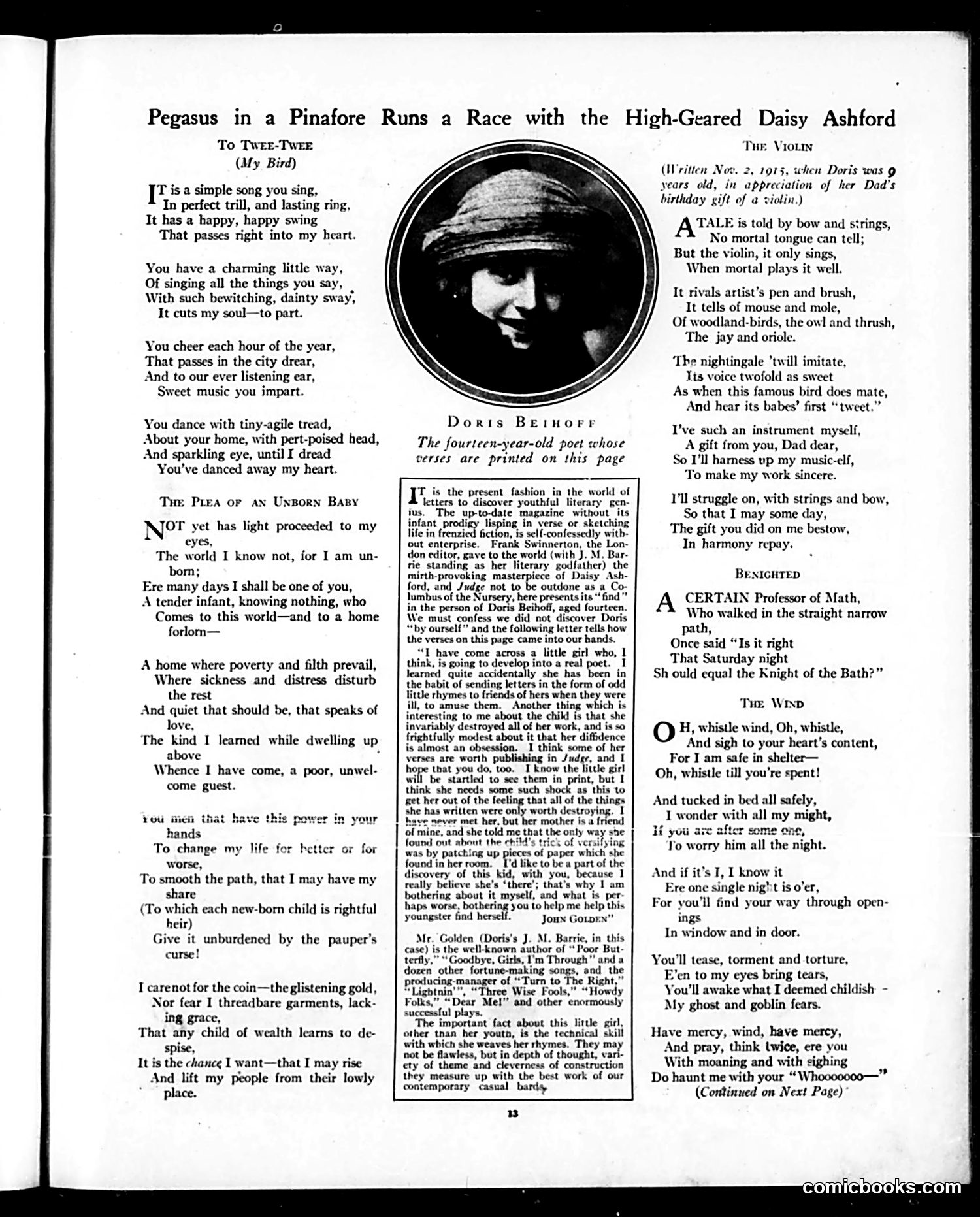
This page celebrates **Doris Belhoff, a fourteen-year-old poet**, presented as Judge magazine's discovery of literary talent. The accompanying letter explains she's been secretly writing verses to ill friends, then destroying her work out of modesty—until a friend (John Golden, a famous songwriter/producer) encouraged publication. The satire is **gentle mockery of the era's trend** of magazines showcasing child prodigies. Judge compares itself to Frank Swinton and J.M. Barrie discovering child author Daisy Ashford, positioning itself as similarly sophisticated in recognizing talent. The poems themselves—"To Twee-Twee," "The Plea of an Unborn Baby," "The Violin," and "Benighted"—are earnest but somewhat saccharine, typical of sentimental Victorian/Edwardian verse. The magazine's tone suggests affectionate amusement at both the girl's earnestness and the literary world's hunger for youthful prodigies, a fashionable trend they're playfully both mocking and participating in.
📄 Transcribed text from this page (OCR, searchable)
Machine-transcribed from the original scan — historical spelling and the odd misread are preserved.
Pegasus in a Pinafore Runs a Race with To Twee-Twee (My Bird) r- is a simple song you sing, In perfect trill, and lasting ring, It has a happy, happy swing That passes right into my heart. You have a charming little way, Of singing all the things you say, With such bewitching, dainty sway, It cuts my soul—to part. You cheer each hour of the year, That passes in the city drear, And to our ever listening ear, Sweet music you impart. You dance with tiny-agile tread, About your home, with pert-poised head, And sparkling eye, until I dread You’ve danced away my heart. Tue PLea or AN UnBorN Baby NOT yet has light proceeded to my eyes, The world I know not, for I am un- born; Ere many days I shall be one of you, A tender infant, knowing nothing, who Comes to this world—and to a home forlom— A home where poverty and filth prevail, Where sickness and distress disturb the rest And quiet that should be, that speaks of love, The kind I learned while dwelling up above Whence I have come, a poor, unwel- come guest. To change my life for better or for worse, To smooth the path, that I may have my share (To which each new-born child is rightful heir) Give it unburdened by the pauper’s curse! I carenot for the coin—the glistening gold, Nor fear I threadbare garments, lack- ing grace, That any child of wealth learns to de- spise, It is the chance I want—that I may rise And lift my people from their lowly place. Doris Betnorr The fourteen-year-old poet whose verses are printed on this page LT. is the present fashion in the world of letters to discover youthful literary gen- jus. The up-to-date magazine without its infant prodigy lisping in verse or sketching life in ffensied Gctlon. is sel{-confessedly with- out enterprise. Frank Swinnerton, the Lon- don editor, gave to the world (with J. M. Bar- rie standing as her literary godfather) the mirth-provoking masterpiece of Daisy Ash- ford, and Judge not to be outdone as a Co- lumbus ofthe Nursery, here presents its find” in the person of Doris Beihoff, aged fourteen. We must confess we did not discover Doris “by ourself” and the following letter tells how the verses on this page came into our hands. “TI have come across a little girl who, I think, is going to develop into a real poet. I learned quite accidentally she has been in the babit of sending letters in the form of odd little rhymes to friends of hers when they were ill, to amuse them. Another thing which is interesting to me about the child is that she invariably destroyed all of her work, and is so frightfully modest about it that her diffdence is almost an obsession. I think some of her verses are worth publishing in Judge, and I ion that you do, too. I know the little girl ill be startled to see them in print, but I think she needs some such shock as this to get her out of the feeling that all of the things she has written were only worth destroying. 1 never met her. but her mother is a friend Fi mine, and she told me that the only way she found out about the ¢ rick of versifying was by patching ing up pieces of paper which she found in her Ta like to be a part of the dlacovery' of this: kid’ with 1 really believe she’s ‘there’ bothering about it myself, and what is per- haps worse, bothering you to help me help this youngster find herself. Joux Gor Mr. Golden (Doris's J. M. Barrie, in this case) is the well-known author of “Poor But- terfly,”’ “* Goodbye, Girls, I'm Through” and a dozen other fortune-making songs, ie the producing. manager of “Turn to Th Lightnin’”, “Three Wise Fools,” Heady Folks,” “Dear Me!” and other enormously successful plays. important fact about this litte girl, other than her youth, is the technical skill with which she weaves her rhymes, They may not be flawless, but in depth of thought, vari- ety of theme and cleverness of construction they measure up with the best work of our contemporary casual bards the High-Geared Daisy Ashford Tue Violin (Written Nov. 2, 1915, when Doris was 9 years old, in appreciation of her Dad's birthday gift of a violin.) ATALE is told by bow and strings, No mortal tongue can tell; But the violin, it only sings, When mortal plays it well. It rivals artist’s pen and brush, It tells of mouse and mole, Of woodland-birds, the owl and thrush, The jay and oriole. ‘The nightingale twill imitate, Tis voice twofold as sweet As when this famous bird does mate, And hear its babes’ first “tweet.” I’ve such an instrument myself, A gift from you, Dad dear, So I'll harness up my music-elf, To make my work sincere. I'll struggle on, with strings and bow, So that I may some day, The gift you did on me bestow, In harmony repay. BENIGHTED CERTAIN Professor of Math, Who walked in the straight narrow path, Once said “Is it right That Saturday night Sh ould equal the Knight of the Bath?” THe Wisp H, whistle wind, Oh, whistle, And sigh to your heart’s content, For I am safe in shelter— Oh, whistle till you're spent! And tucked in bed all safely, 1 wonder with all my might, Hf yuu ave after some one, Yo worry him all the night. And if it’s T, I know it Ere one single night is o'er, For you'll find your way through open- ings In window and in door. You'll tease, torment and torture, E’en to my eyes bring tears, You'll awake what I deemed childish: - My ghost and goblin fears. Have mercy, wind, have mercy, And pray, think twice, ere you With moaning and with sighing Do haunt me with your “Whoooocco—”? (Continued on Next Page)”