
Judge, 1920-06-19 · page 5 of 36
Judge — June 19, 1920 — page 5: what you’re looking at
What you’re looking at
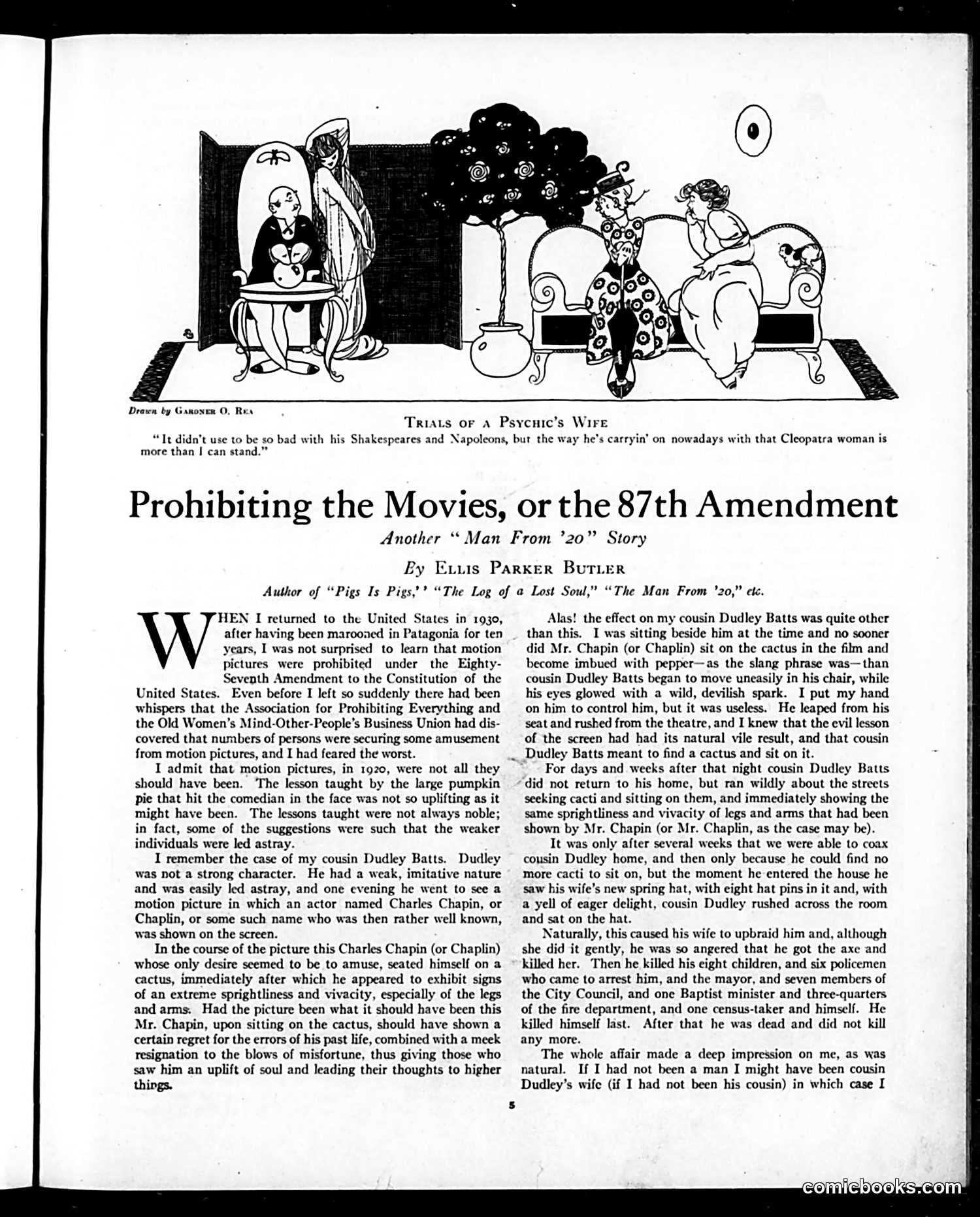
The cartoon titled "Trials of a Psychic's Wife" satirizes a husband obsessed with movies—specifically Charlie Chaplin films. The wife complains he's become insufferable, constantly mimicking Chaplin's mannerisms and sitting on cacti (referencing Chaplin's physical comedy). The accompanying story, "Prohibiting the Movies, or the 87th Amendment," mocks both movie censorship movements and Chaplin's influence on American culture. The author describes how his cousin became so enamored watching Chaplin that he imitated the actor's behaviors at home, ultimately leading to domestic chaos and his wife's violent response. The satire targets 1920s moral panic about cinema's corrupting influence on audiences while also poking fun at Chaplin's then-enormous cultural impact.
📄 Transcribed text from this page (OCR, searchable)
Machine-transcribed from the original scan — historical spelling and the odd misread are preserved.
Drawn by Ganoxen O, Res Triats or a Psycnic’s WIFE “It didn’t use to be so bad with his Shakespeares and Napoleons, but the way he’s carryin’ on nowadays with that Cleopatra woman is more than I can stand.” Prohibiting the Movies, or the 87th Amendment Another “ Man From ’20” Story By Eviis Parker BuTLer Author of “Pigs Is Pigs,’ “The Log of a Lost Soul,” “The Man From 20,” ek. HEN I returned to the United States in 1930, after having been marooned in Patagonia for ten years, I was not surprised to learn that motion pictures were prohibited under the Eighty- Seventh Amendment to the Constitution of the United States. Even before I left so suddenly there had been whispers that the Association for Prohibiting Everything and the Old Women’s Mind-Other-People’s Business Union had dis- covered that numbers of persons were securing some amusement from motion pictures, and I had feared the worst. I admit that motion pictures, in 1920, were not all they should have been. The lesson taught by the large pumpkin Pie that hit the comedian in the face was not so uplifting as it might have been. The lessons taught were not always noble; in fact, some of the suggestions were such that the weaker individuals were led astray. I remember the case of my cousin Dudley Batts. Dudley was not a strong character. He had a weak, imitative nature and was easily led astray, and one evening he went to see a motion picture in which an actor named Charles Chapin, or Chaplin, or some such name who was then rather well known, was shown on the screen. In the course of the picture this Charles Chapin (or Chaplin) whose only desire seemed to be to amuse, seated himself on a cactus, immediately after which he appeared to exhibit signs of an extreme sprightliness and vivacity, especially of the legs and arms. Had the picture been what it should have been this Mr. Chapin, upon sitting on the cactus, should have shown a certain regret for the errors of his past life, combined with a meek resignation to the blows of misfortune, thus giving those who saw him an uplift of soul and leading their thoughts to higher things. Alas! the effect on my cousin Dudley Batts was quite other than this. I was sitting beside him at the time and no sooner did Mr. Chapin (or Chaplin) sit on the cactus in the film and become imbued with pepper—as the slang phrase was—than cousin Dudley Batts began to move uneasily in his chair, while his eyes glowed with a wild, devilish spark. I put my hand on him to control him, but it was useless. He leaped from his seat and rushed from the theatre, and I knew that the evil lesson of the screen had had its natural vile result, and that cousin Dudley Batts meant to find a cactus and sit on it. For days and weeks after that night cousin Dudley Batts did not return to his home, but ran wildly about the streets seeking cacti and sitting on them, and immediately showing the same sprightliness and vivacity of legs and arms that had been shown by Mr. Chapin (or Mr. Chaplin, as the case may be). It was only after several weeks that we were able to coax cousin Dudley home, and then only because he could find no more cacti to sit on, but the moment he entered the house he saw his wife’s new spring hat, with eight hat pins in it and, with a yell of eager delight, cousin Dudley rushed across the room and sat on the hat. Naturally, this caused his wife to upbraid him and, although she did it gently, he was so angered that he got the axe and killed her. Then he killed his eight children, and six policemen who came to arrest him, and the mayor, and seven members of the City Council, and one Baptist minister and three-quarters of the fire department, and one census-taker and himself. He killed himself last. After that he was dead and did not kill any more. The whole affair made a deep impression on me, as was natural. If I had not been a man I might have been cousin Dudley’s wife (if I had not been his cousin) in which case I