
A complete issue · 36 pages · 1920
Judge — May 8, 1920
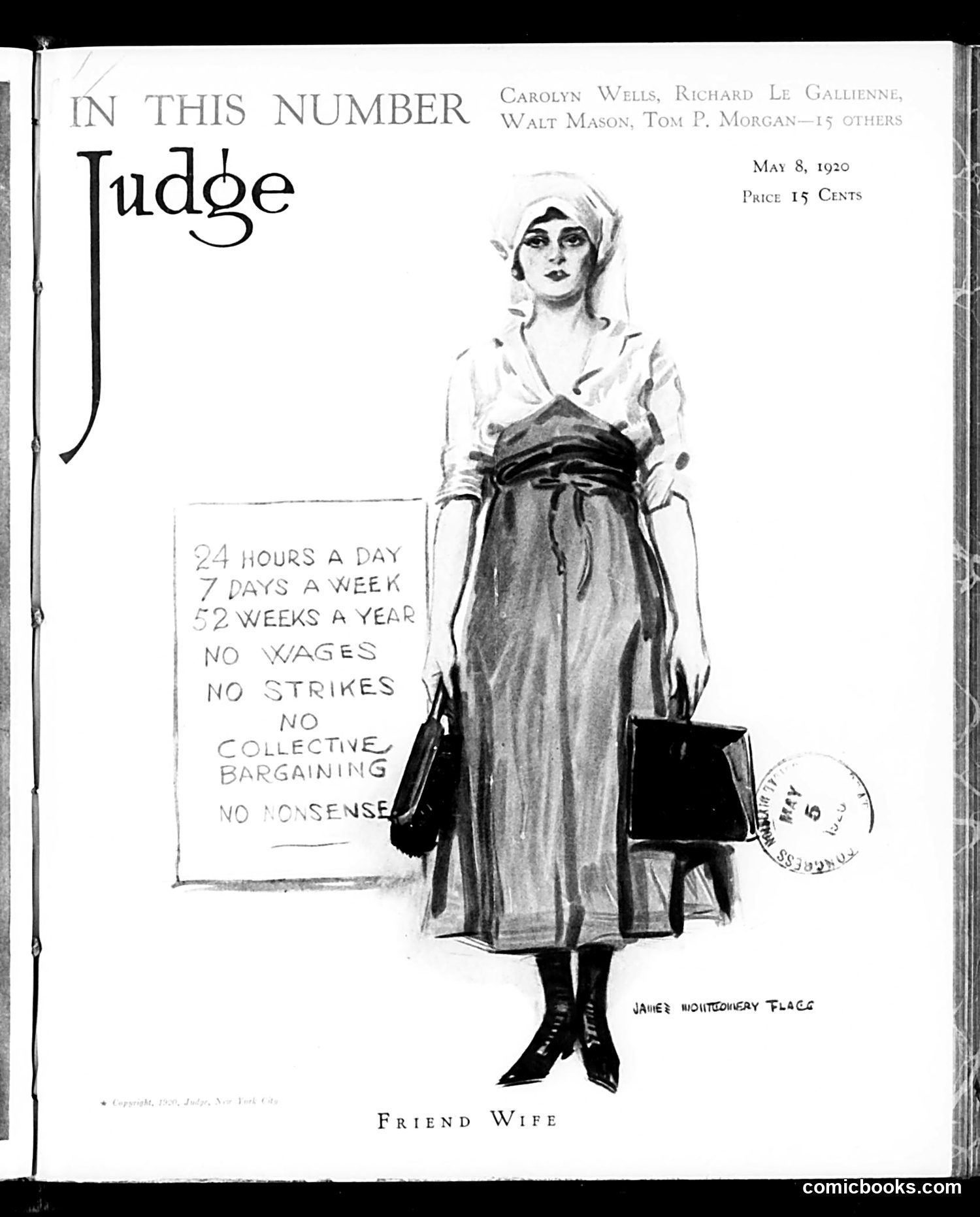
This satirical cover criticizes the unpaid domestic labor of housewives. The illustration shows a woman holding a sign listing her working conditions: "24 hours a day / 7 days a week / 52 weeks a year / No wages / No strikes / No collective bargaining / No nonsense." The satire is bitter: housewives work constantly without compensation, legal protections, or recourse—conditions no other worker would accept. The title "Friend Wife" implies irony; she's presented as a domestic laborer rather than a partner. This reflects 1920 debates about women's roles during the post-WWI period, when women had recently gained voting rights. The cartoon advocates for recognizing housework as legitimate labor deserving compensation and dignity.

This is not satire—it's a straightforward cigarette advertisement for Camel brand, published by R.J. Reynolds Tobacco Co. of Winston-Salem, North Carolina. The ad features a camel logo and promises that Camels are made "to meet your taste," emphasizing their "mild-mellow-body" and "refreshing flavor." It highlights the blend of Turkish and domestic tobaccos and claims Camels won't tire smokers' tastes or leave unpleasant aftertaste. The "Yes sir-ee!" headline mimics military deference, possibly targeting soldiers during wartime production. By modern standards, this advertisement is notable for making health claims about a product now recognized as highly addictive and carcinogenic—marketing that would be illegal today under FDA regulations.
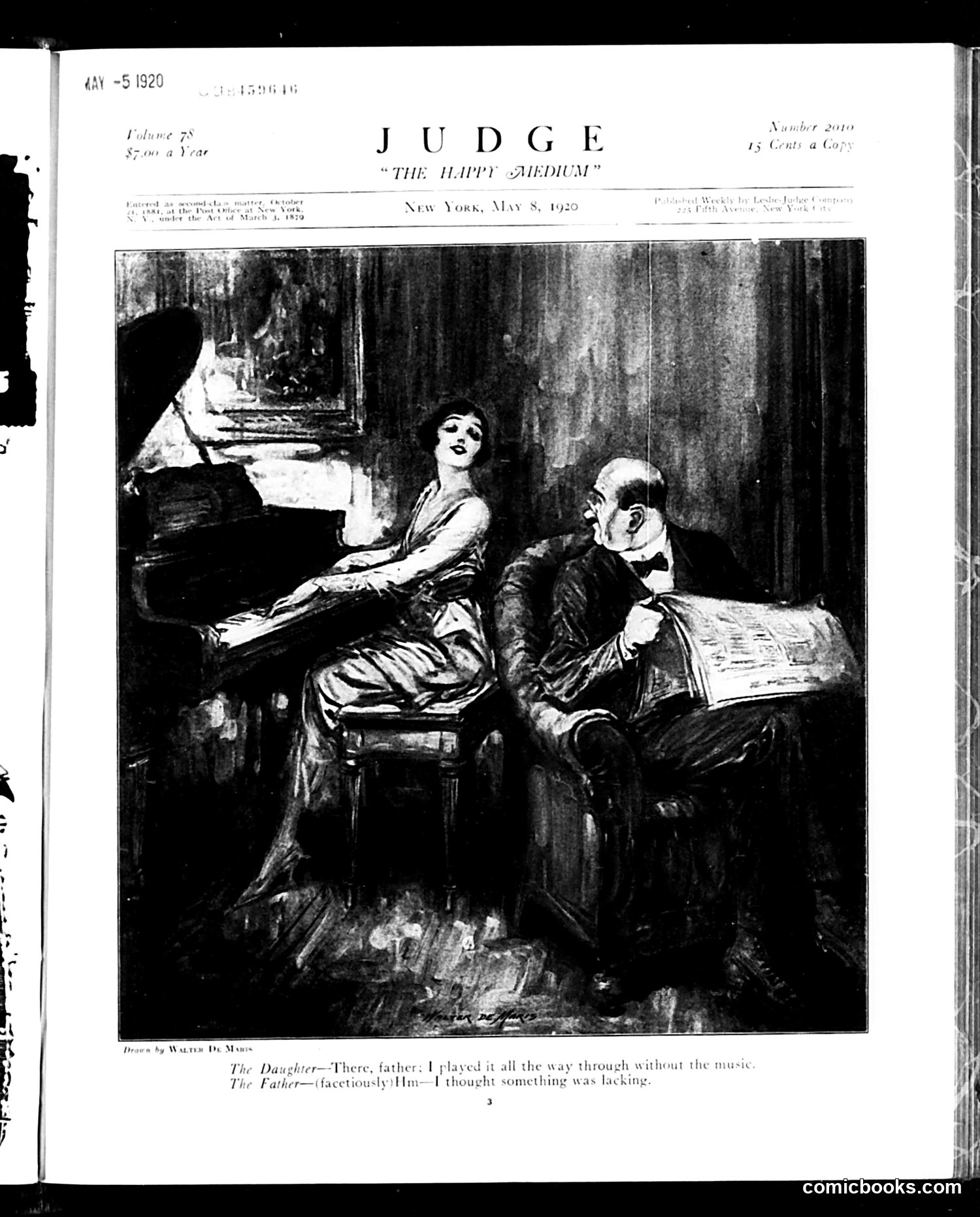
This is the cover of Judge magazine from May 5, 1920. The illustration by Walter De Maris depicts a domestic scene: a woman at a piano and a man reading a newspaper, with accompanying dialogue. The daughter complains she "played it all the way through without the music," while the father responds "facetiously: 'Hm—I thought something was lacking.'" This is a gentle domestic humor piece satirizing amateur piano playing—a common leisure activity for middle-class families of the era. The joke mocks both the daughter's poor performance and the father's sardonic reaction. It reflects the period's cultural assumption that piano playing was expected of young women, while humorously acknowledging that execution often fell short of standards. The satire targets domestic pretension rather than political issues.
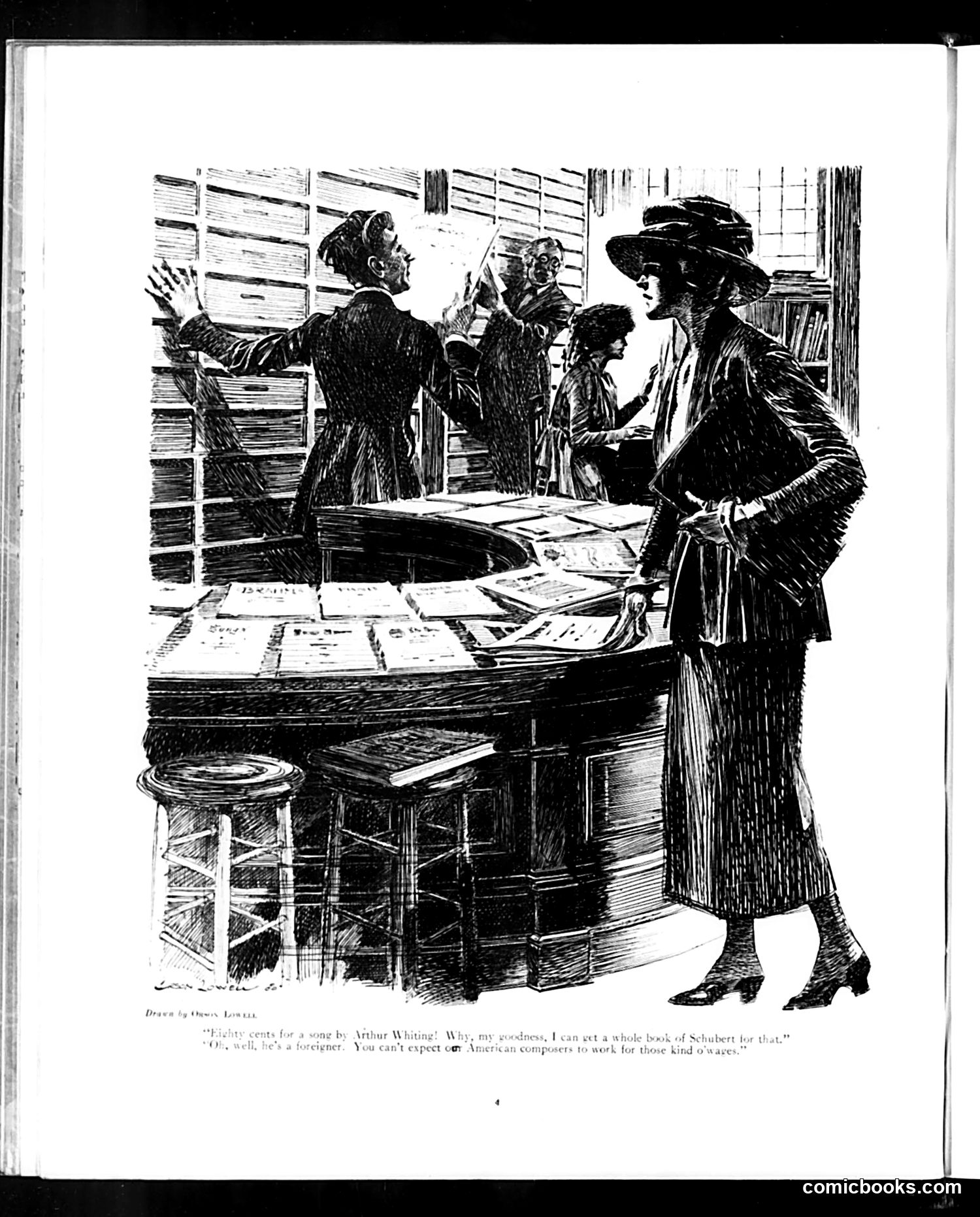
This is a satirical cartoon from *Judge* magazine depicting a scene at what appears to be a music publisher's or composer's office. A woman in an elegant hat and coat stands at a desk examining sheet music, while staff members work in the background among filing cabinets. The caption references "a song by Arthur Whiting" and jokes about obtaining "a whole book of Schubert" in exchange for American composer works. The satire critiques the perceived superiority of European (specifically German) classical composers over American ones—suggesting that even a substantial collection of the master Schubert's work wouldn't be worth trading for American compositions. The humor targets American cultural inferiority complex regarding European art.
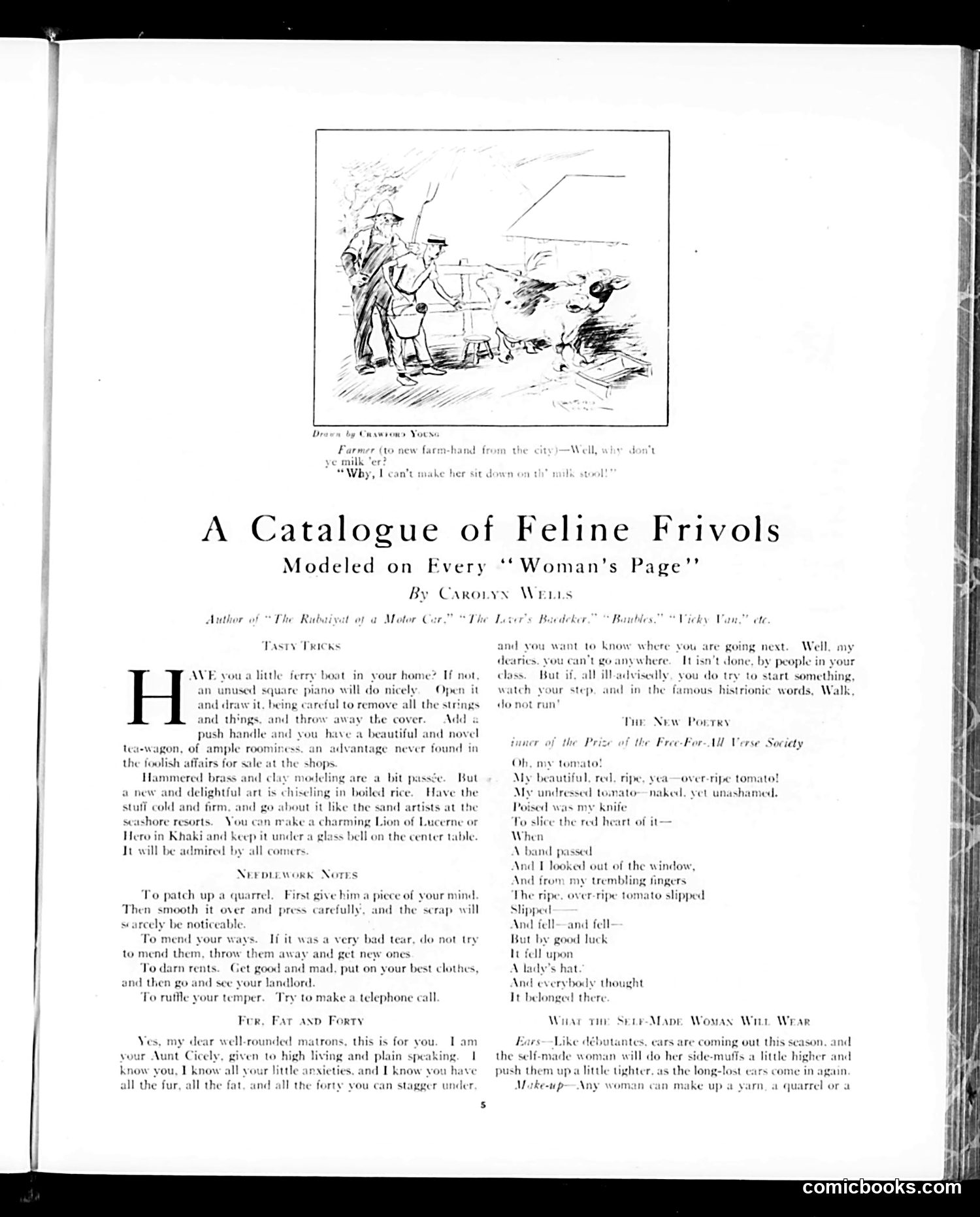
The cartoon depicts a farmer confronting what appears to be a city person (likely a farm hand or worker) about a cow. The farmer says, "Well, she don't ye milk yet?" and the worker responds, "Why, I can't make her sit down on th' milk stool!" **The satire**: This is a humorous commentary on the incompetence of city dwellers attempting rural farm work. The joke relies on the absurdity of the worker's excuse—implying the cow won't cooperate or that the worker lacks basic farming knowledge. It's mocking the disconnect between urban and rural life, a common theme in early 20th-century American humor. The broader page content—"A Catalogue of Feline Frivols" by Carolyn Wells—suggests this issue focused on lighthearted domestic humor and domestic situations rather than hard political satire.
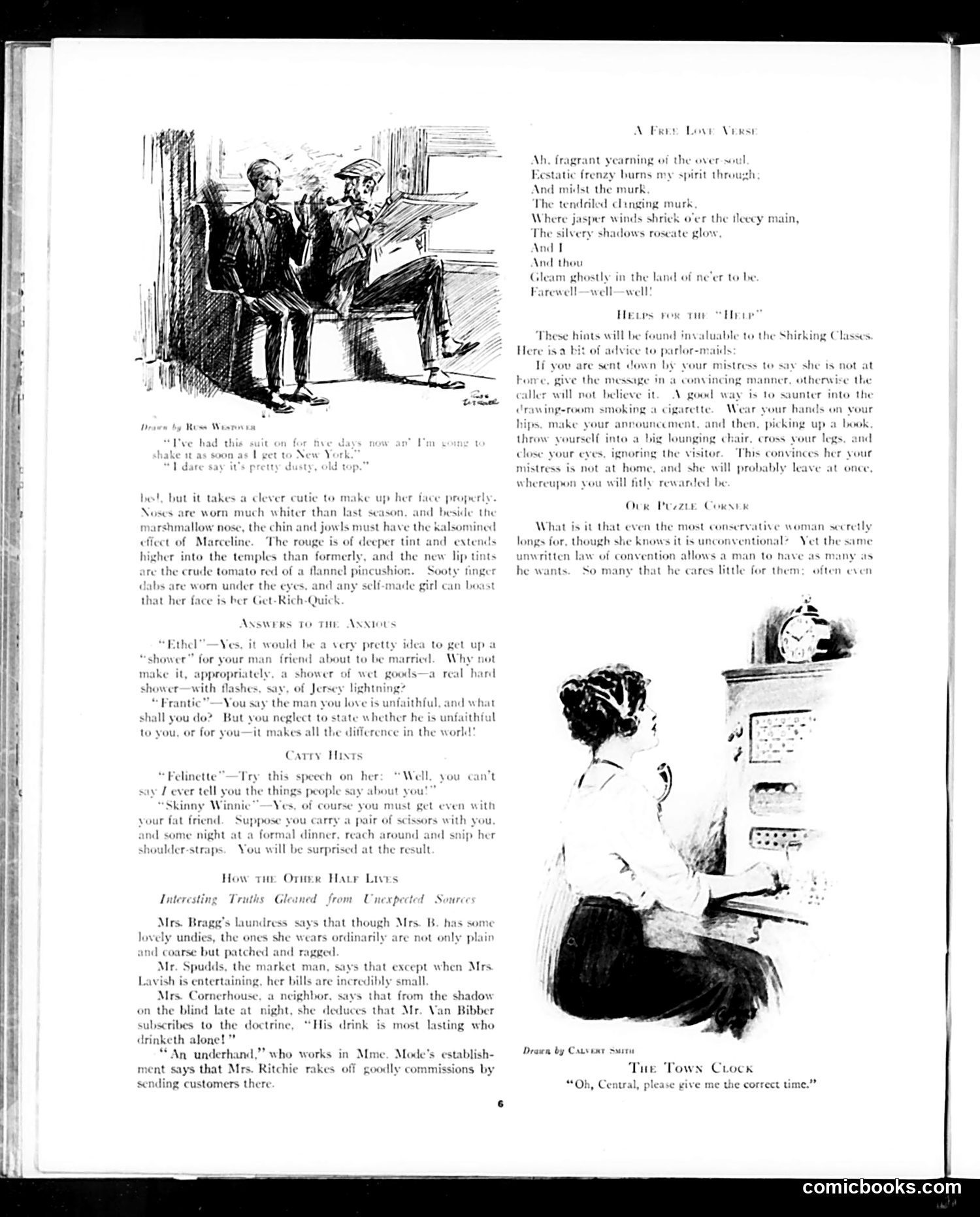
This page mixes humor columns with an illustration titled "The Town's Clock" by Calvert Smith. The main content includes: **"A Fair Love Verse"** and **"Helps for the 'Help'"** — advice columns addressing domestic servants ("Shirking Classes"), offering practical tips for communicating with employers about absences and household tasks. **"Answers to the Anxious"** and **"Carty Hints"** — relationship advice for women, including managing unfaithful partners and social situations. **"How the Other Half Lives"** — gossipy observations about society women's appearances and habits, presented as insider knowledge from servants and tradespeople. The illustration depicts a woman asking Central (the telephone operator) for the correct time—a gentle joke about modern conveniences and urban life. The page targets middle-class readers interested in etiquette, servant management, and social gossip.
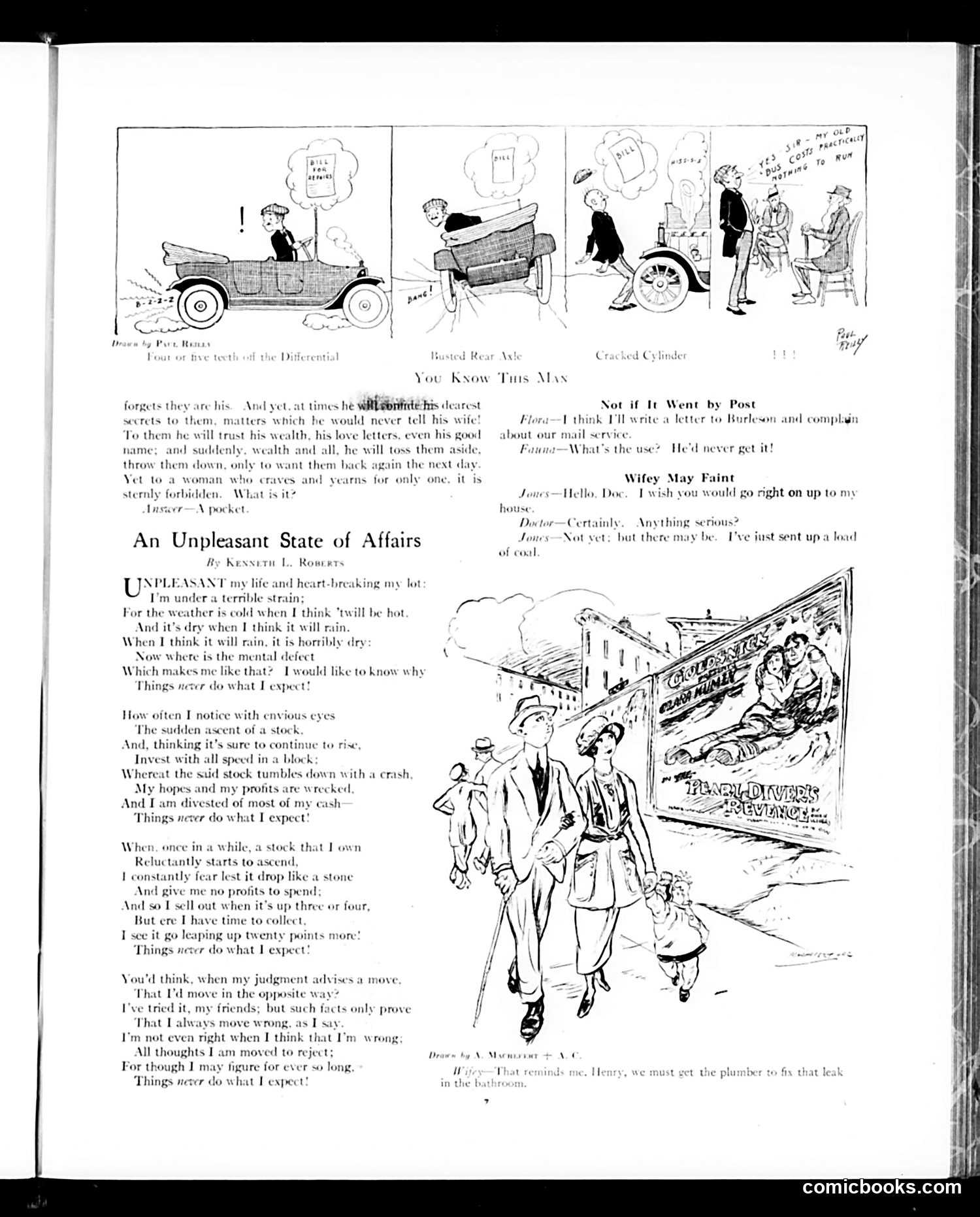
This page contains three separate humorous pieces typical of early 20th-century Judge magazine satire: **"You Know This Man"** (top): A four-panel cartoon about a man who keeps secrets from his wife but shares them with friends—illustrating the social hypocrisy of married men maintaining separate spheres of trust. **"Not if It Went by Post"** (dialogue): References Albert Burleson, Postmaster General under Wilson, mocking the slowness of U.S. mail delivery during this era. It's a dig at government inefficiency. **"An Unpleasant State of Affairs"** (poem + illustration): The verse satirizes anxiety-driven poor decision-making—investing unwisely, selling stocks too early, second-guessing oneself. The illustration shows men outside a cinema, depicting urban leisure culture. The satire targets how human pessimism and indecision undermine financial success. Overall, these pieces mock middle-class anxieties: marital duplicity, government bureaucracy, and financial self-sabotage through irrational behavior—common Judge themes reflecting Progressive-era concerns about modern life.
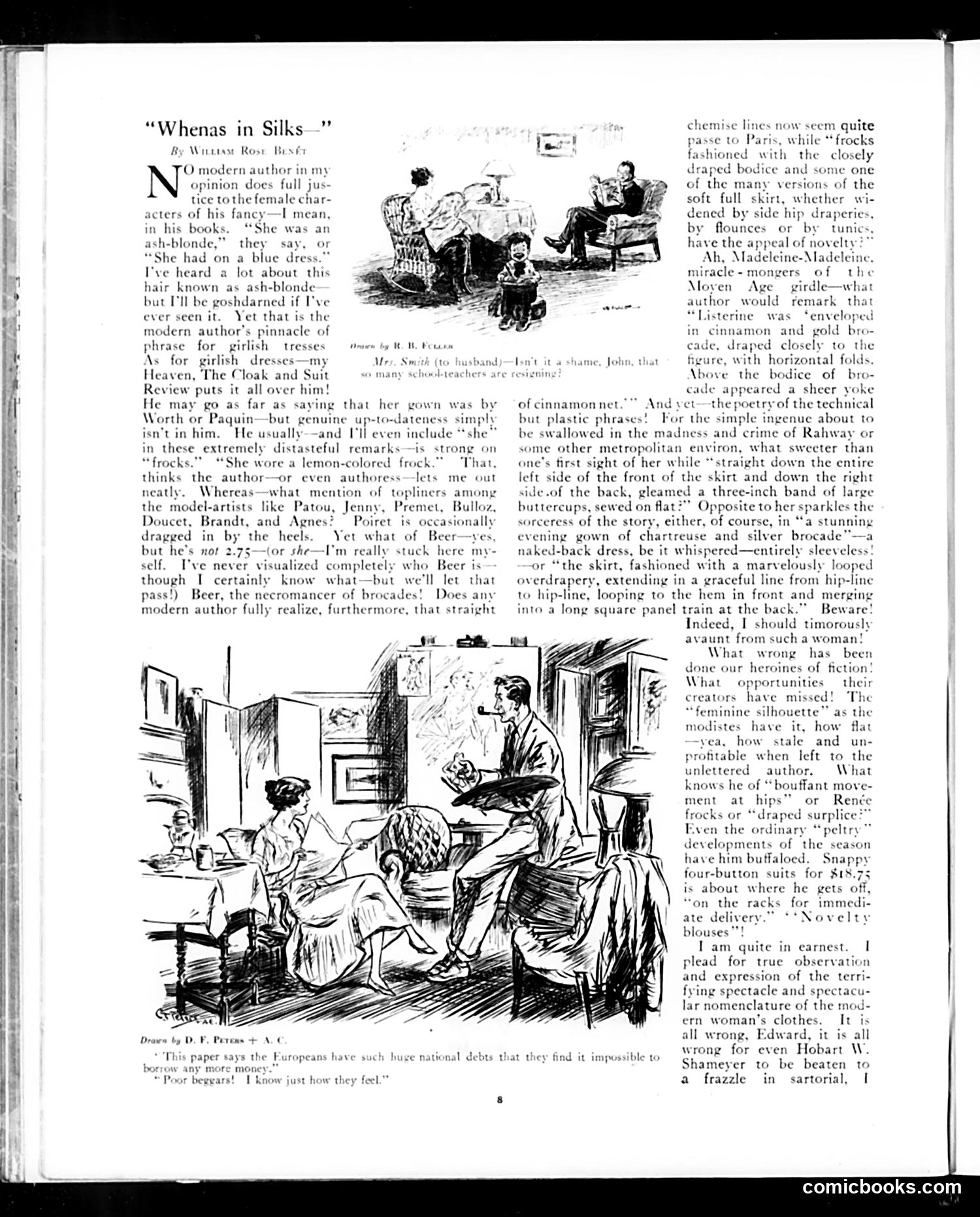
This article by William Rose Benét mocks modern authors for their lazy, clichéd descriptions of women's clothing. The piece argues that novelists rely on vague phrases like "ash-blonde hair" and generic "frocks" while ignoring the actual sophistication of contemporary fashion design. Benét contrasts this with real fashion terminology from haute couture designers (Worth, Paquin, Patou, Poiret)—names that signal genuine expertise. He sarcastically suggests authors should describe specific details like "buttercups sewn on flat" or "looped overdrapery" rather than leaving fashion description to superficial cliché. The accompanying illustrations show a fashion design studio, emphasizing the specialized artistry authors ignore. The joke targets the gap between literary pretension and actual observational skill: even respected writers like Edward Sandford (likely "Hobart W. Shameyer" is satirical) fail at basic fashion realism. Benét demands authors pay proper attention to the "terrible and spectacular nomenclature of the modern woman's clothes."
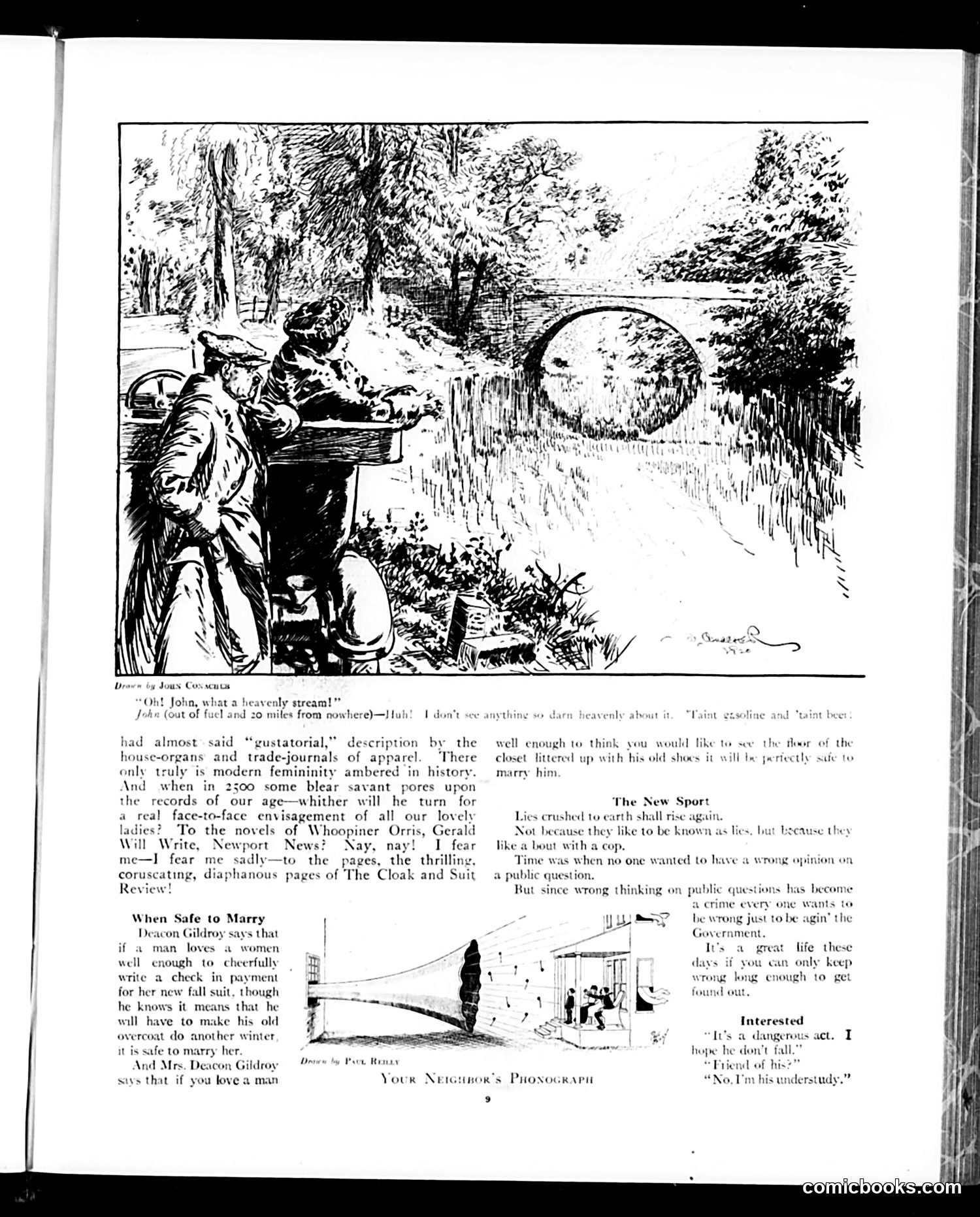
This page contains three satirical pieces: **Top cartoon**: A couple admires a stream while picnicking. The woman calls it "heavenly," but the man dismisses her enthusiasm, saying he sees nothing special about it—just "taint gasoline and 'taint beer." The satire mocks how industrial pollution has degraded natural beauty to the point where pristine water seems remarkable. **"When Safe to Marry"**: Deacon Gildroy offers cynical advice: a man should marry a woman if he'll sacrifice his own needs (buying her new clothes while wearing an old overcoat) for hers—and vice versa. This satirizes how marriage requires financial self-sacrifice and practical compromise. **"The New Sport"**: This criticizes the modern tendency to argue positions simply to be contrarian ("agin' the Government"). The piece suggests that holding wrong opinions has become entertainment—people maintain incorrect views just to provoke debate. It's satire on argumentativeness as a fashionable activity. The page reflects early 20th-century anxieties about consumer culture, marital economics, and public discourse.
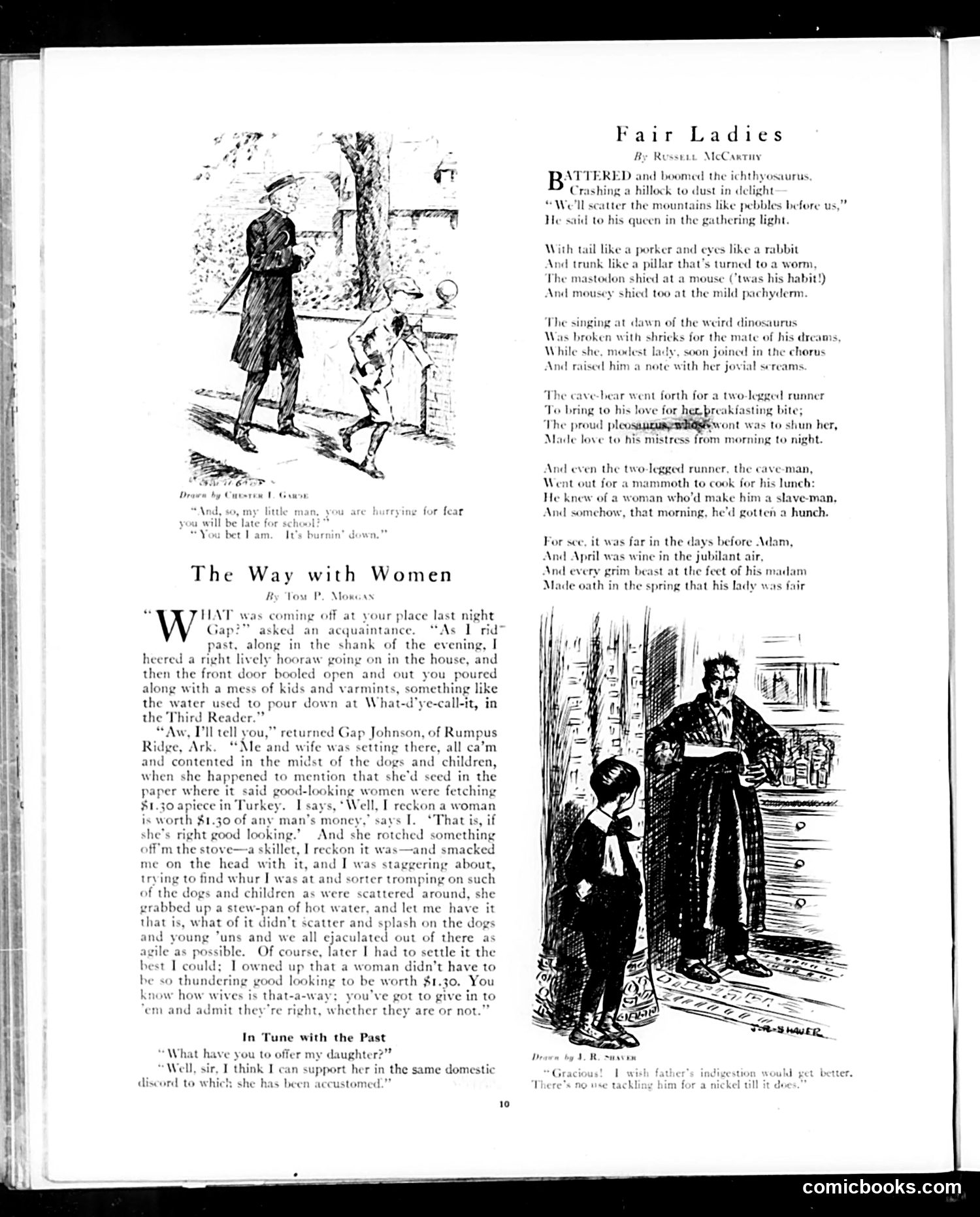
This page contains two humorous pieces satirizing gender relations in early 20th-century America. **"The Way with Women"** (left) presents a tall tale by "Gap Johnson" from Arkansas. When he casually mentions reading that attractive women in Turkey fetch $1.30, his wife interprets this as an insult to her looks. She responds by hurling a skillet at his head, then a pan of hot water, forcing the entire household to flee. The joke: women are volatile and irrational when their appearance is questioned. Johnson ultimately "settles it" by submitting—admitting women don't need good looks to be worth $1.30. The satire mocks both male insensitivity and female domestic violence as inevitable marital reality. **"Fair Ladies"** (right) is a mock-heroic poem comparing prehistoric creatures' devotion to their mates with human courtship. Dinosaurs, cave bears, and early humans all scramble to serve or impress their females. The joke: male subservience to females is ancient and universal, appearing comical when extended to primitive beasts. Both pieces use exaggeration to mock contemporary gender dynamics and male complaint about female power in domestic settings.
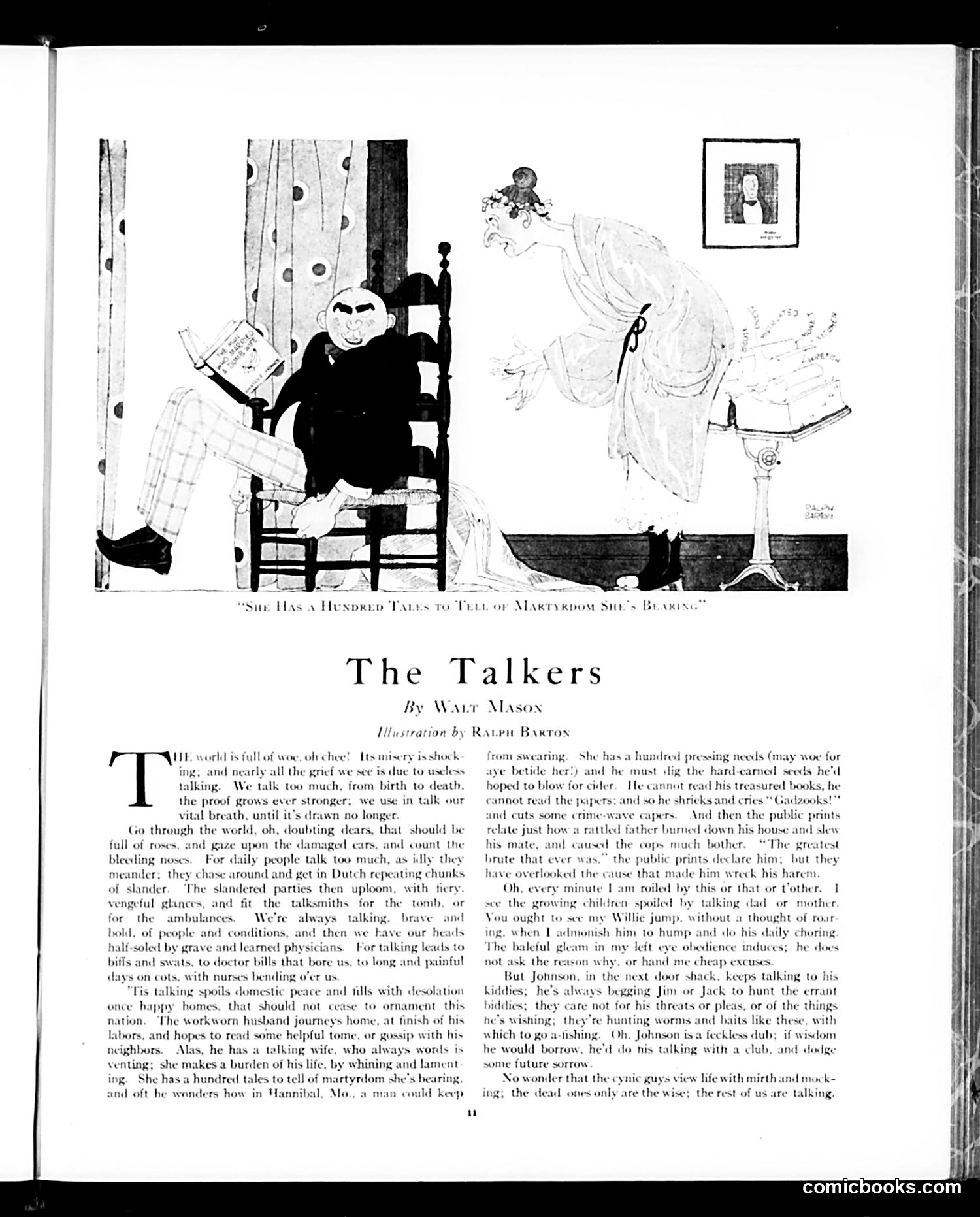
This is an illustrated essay by Walt Mason (with Ralph Barton's cartoons) satirizing American over-talkativeness as a social plague. The piece argues that constant, pointless talking destroys domestic peace and leads to violence. The cartoon depicts a domestic dispute: a nagging wife (shown gesturing dramatically) talks incessantly while her husband sits in a chair, clearly exasperated. The caption references "a hundred tales" of her "martyrdom." **The satire's point:** Mason blames wives' constant complaining and husbands' excessive talking to children for social ills—domestic discord, crime, and violence. The essay suggests that if people simply talked less, many social problems would vanish. This reflects early 20th-century gender stereotypes portraying women as inherent nags and men as their frustrated victims. The piece represents a common period attitude: that women's speech was both excessive and destructive to family stability.
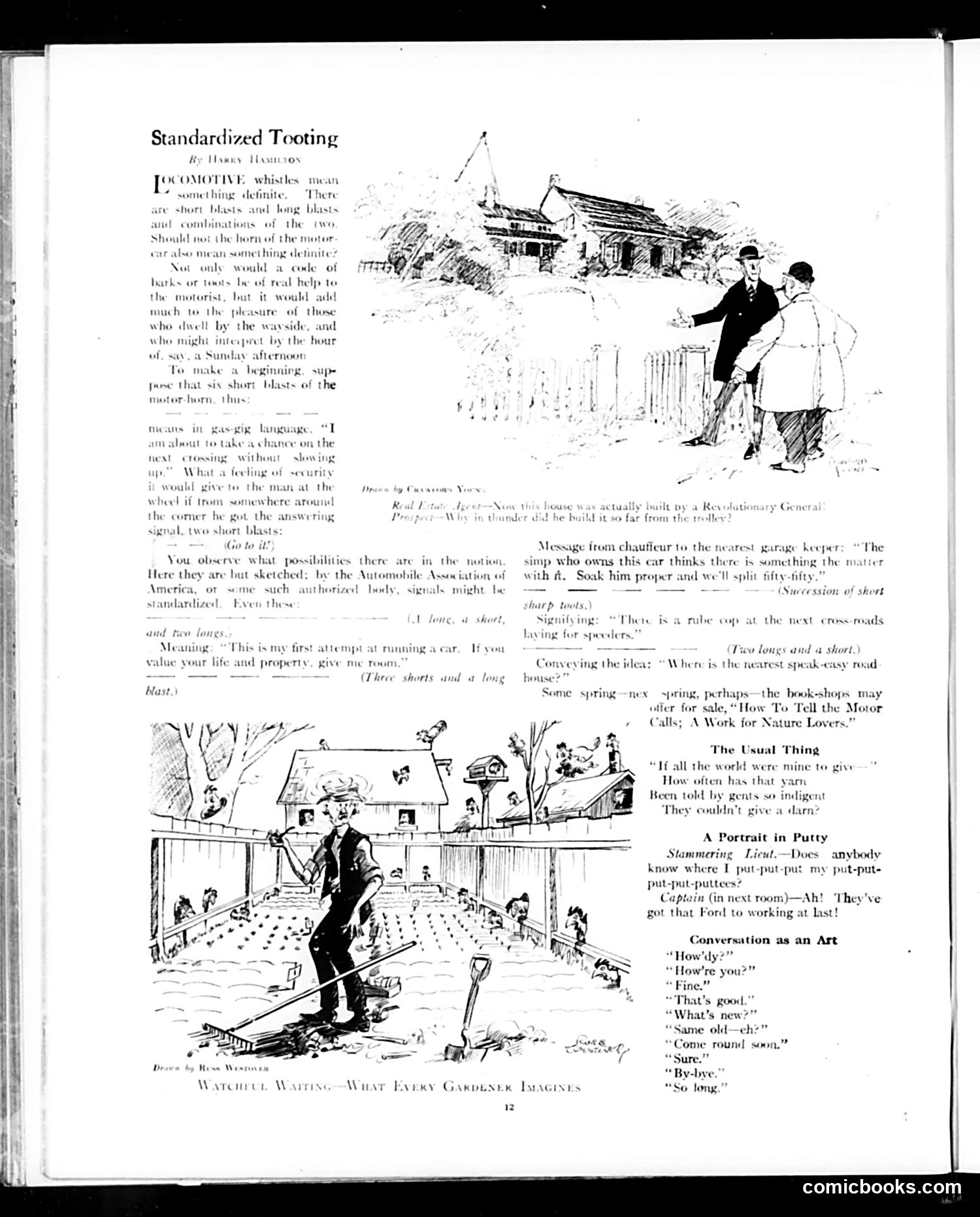
This satirical article proposes standardizing automobile horn signals—assigning specific meanings to different horn blast patterns (short blasts, long blasts, combinations). The humor lies in the earnest premise contrasted with cynical, self-interested interpretations. The cartoons illustrate both the earnest idea (top: a motorist using standardized signals near a Revolutionary-era house) and the reality of how drivers would *actually* use such a system. The lower cartoon shows a chauffeur receiving a message interpreting a horn blast not as helpful navigation, but as: "The car's owner thinks something's wrong—overcharge him and we'll split the profits." The joke reflects 1920s-era anxieties about automobiles as still-new technology, the dishonesty of service workers, and the gap between idealistic standardization schemes and human greed. The "speak-easy" reference dates this to Prohibition era, adding period-specific humor about illegal alcohol.
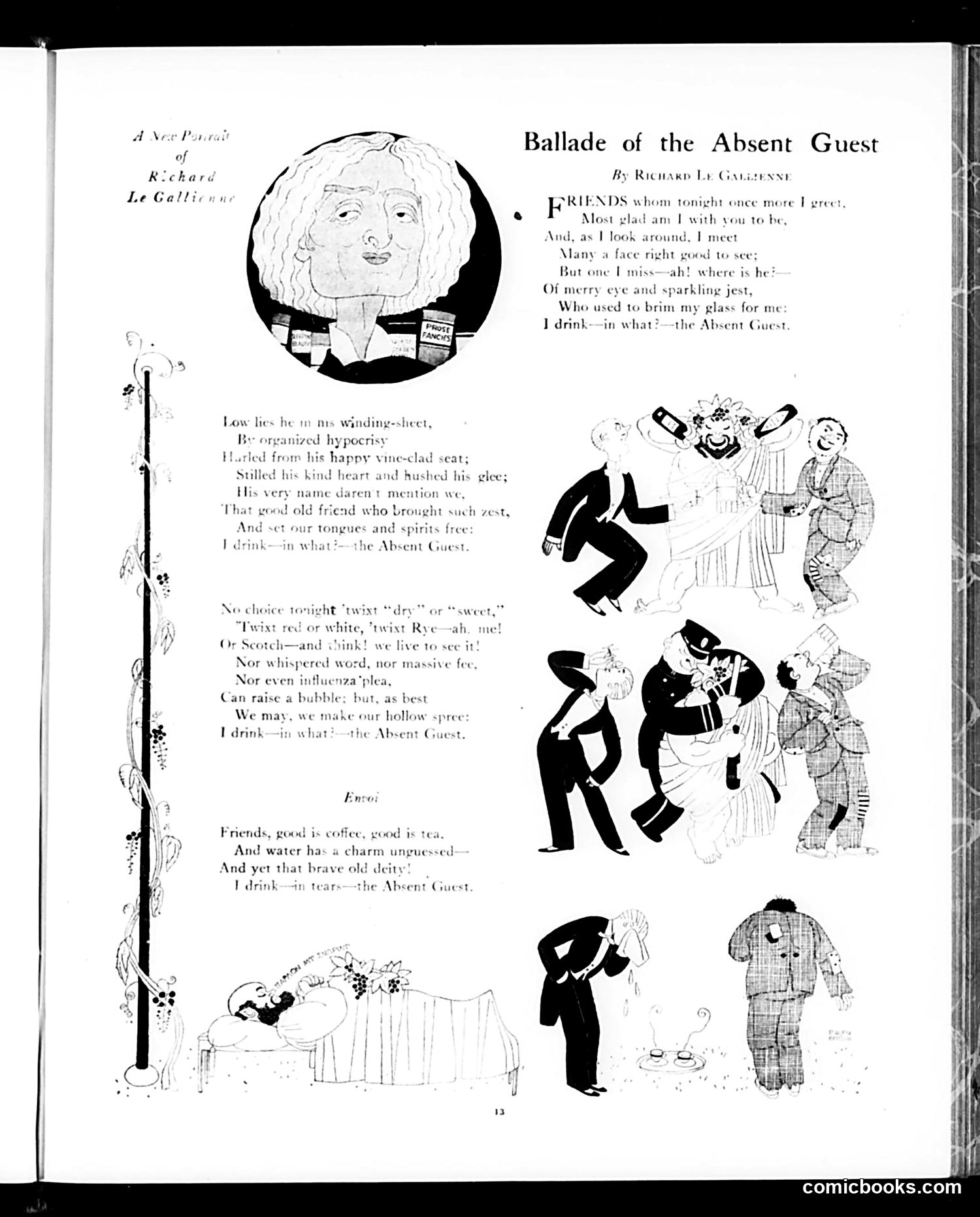
This is a poem by Richard Le Gallienne lamenting Prohibition. The "Absent Guest" is alcohol—specifically the spirits and drinks that were once central to social gatherings but are now absent due to legal ban. The poem uses the format of a formal ballade to express nostalgia for pre-Prohibition drinking culture. References to "Rye," "Scotch," and various cocktails highlight what partygoers can no longer openly enjoy. Lines like "No choice tonight 'twixt 'dry' or 'sweet'" mock the inability to order drinks freely. The illustrations show a party where guests appear dejected or awkward—the social lubricant of alcohol is missing, leaving only "hollow spree" and "tears." The final irony: the speaker drinks "in tears—the Absent Guest," suggesting that without alcohol, gatherings are reduced to mourning what's been lost. This reflects the cultural resistance to Prohibition among educated, social classes who viewed the law as culturally destructive.
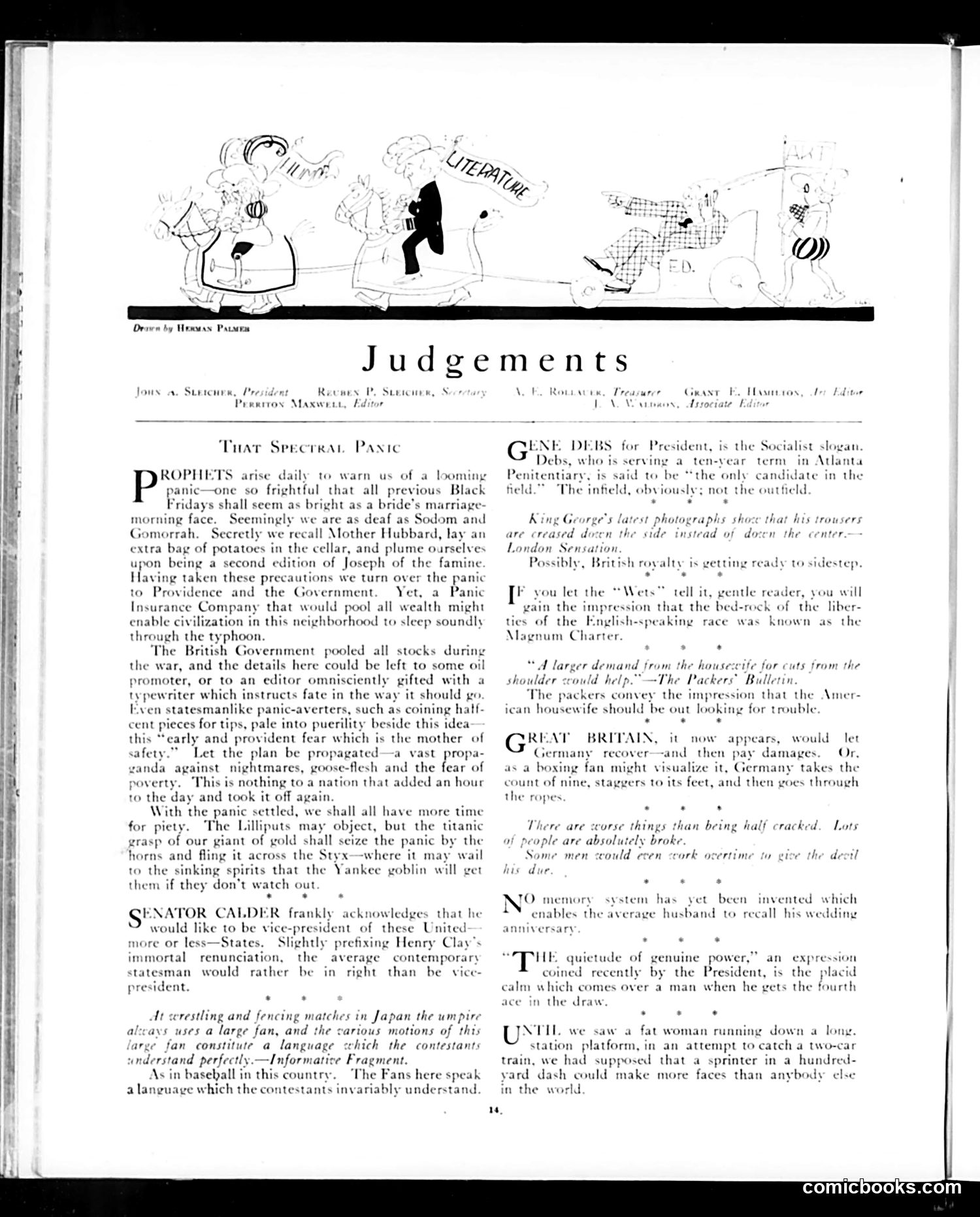
This satirical commentary page addresses early 20th-century American anxieties and politics: **"That Spectral Panic"** mocks recurring warnings of financial collapse. The piece argues panic-mongering is overblown—Americans stockpile supplies (like Mother Hubbard's cupboard) yet ignore the warnings anyway, leaving crises to "Providence and the Government." **Senator Calder** reference ridicules political ambition: the Senator wants the vice-presidency but won't admit it, unlike Henry Clay's famous renunciation. **Eugene Debs for President** is ironic commentary on the Socialist leader imprisoned in Atlanta Penitentiary, sarcastically called "the only candidate in the field." **British royalty/Germany section** appears to reference post-WWI reparations—Britain letting Germany recover before demanding damages. **The "Wets" and Magnum Charter** reference Prohibition-era debate, conflating wet/dry politics with English liberties. **The Fans/baseball umpire analogy** compares Japanese fan-signals to American baseball crowds—both groups speak a language participants "invariably understand." The overall tone is wry, dismissive of contemporary anxieties as cyclical and overblown.
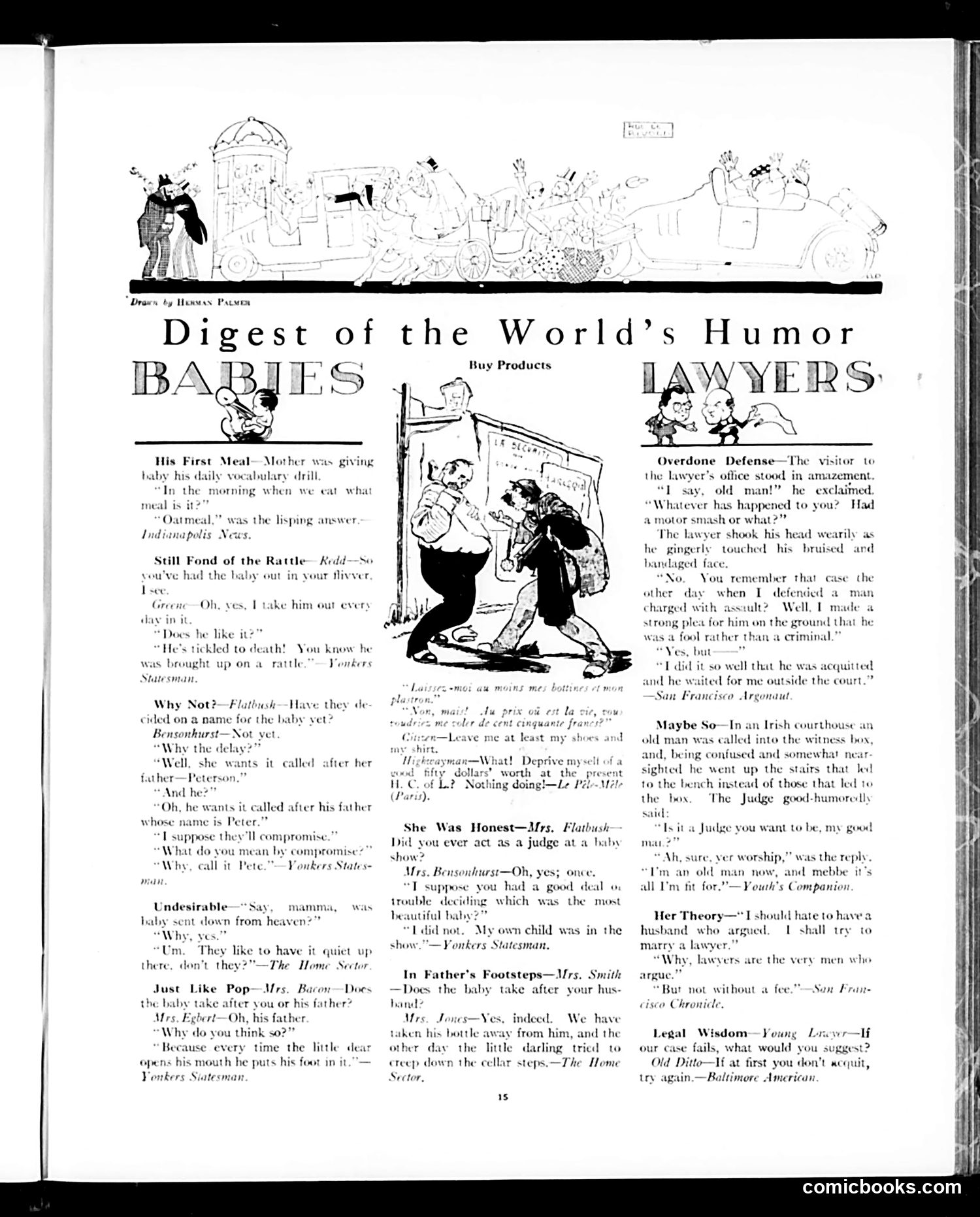
This is a humor compilation page featuring short jokes organized by topic: babies, lawyers, and legal proceedings. The cartoons and quips satirize early 20th-century American life. **Key targets:** - **Babies/parenting**: Mock new parents' obsession with automobiles ("flivvers") and changing naming customs - **Lawyers**: Ridicule their defensive tactics, fee-gouging, and self-interest. One joke depicts a lawyer so badly beaten defending an "assault" client that he admits the man *was* actually guilty—undermining his own legal argument - **The legal system**: Portray judges and courtrooms as absurd (an elderly witness climbing judge's stairs instead of witness box stairs) and encourage retrying cases until acquittal succeeds The humor relies on wordplay, irony, and cultural stereotypes. Lawyers emerge as the primary targets—portrayed as morally flexible professionals more interested in fees than justice, willing to distort facts to win cases.
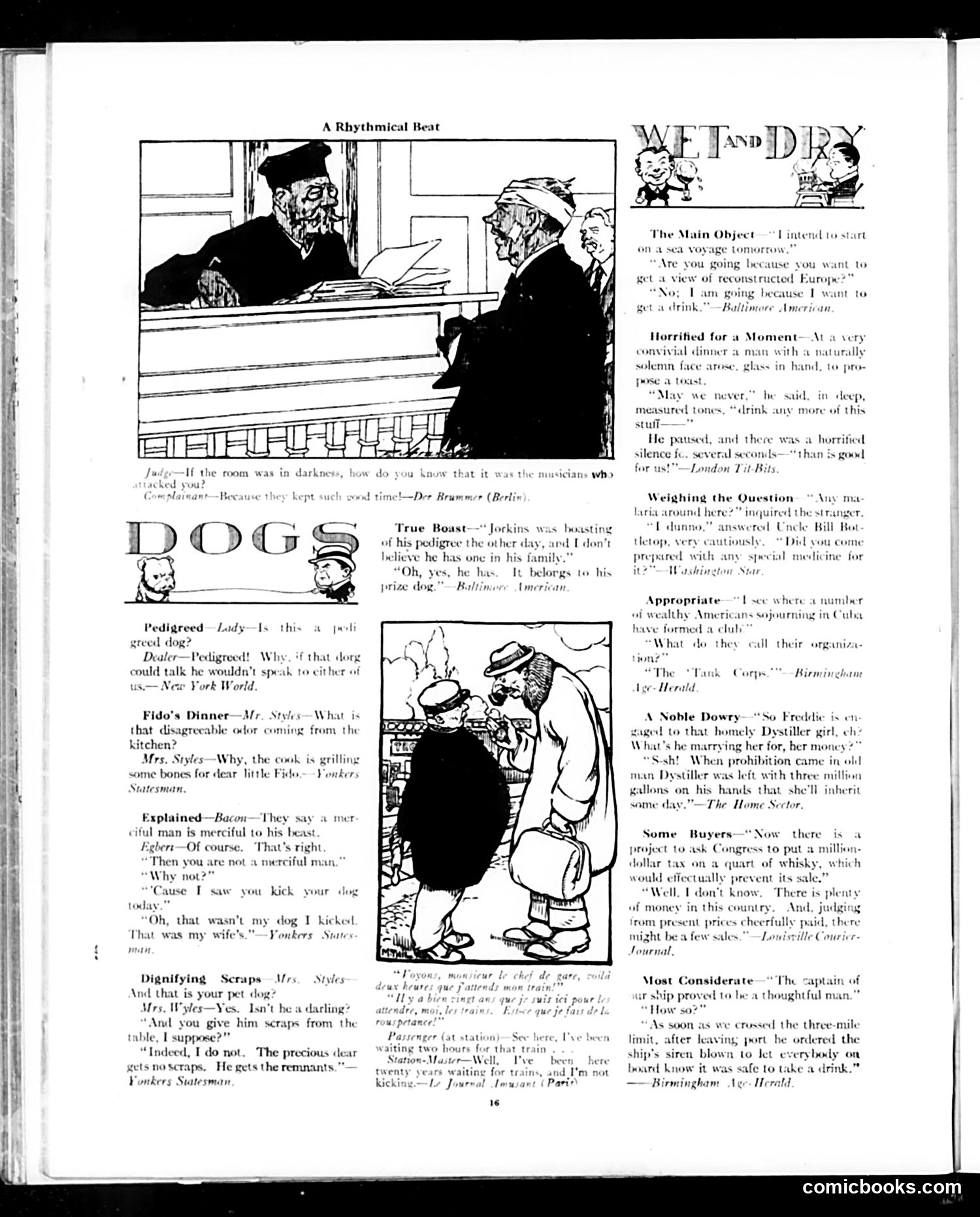
This page satirizes Prohibition-era America through interconnected jokes and cartoons. The central theme mocks both alcohol prohibition and those who circumvent it. **Key content:** The "Dogs" section contains unrelated puns about pedigree and pet care. However, the right column—titled "Wet and Dry"—directly addresses Prohibition debates through short anecdotes. **Main satirical points:** 1. **"The Main Object"**: A man claims he's taking a sea voyage to see "reconstructed Europe" but actually wants a drink—mocking those who travel to escape Prohibition. 2. **"Some Buyers"**: Congress considers a tax on whisky to prevent sales, but wealthy Americans will pay anything—suggesting Prohibition fails among the rich. 3. **"Most Considerate"**: A ship captain sounds the siren after crossing the three-mile limit (international waters) to signal passengers they can legally drink—exposing the absurdity of Prohibition's jurisdictional loopholes. The satire targets Prohibition's ineffectiveness, particularly among the wealthy who easily circumvent restrictions.
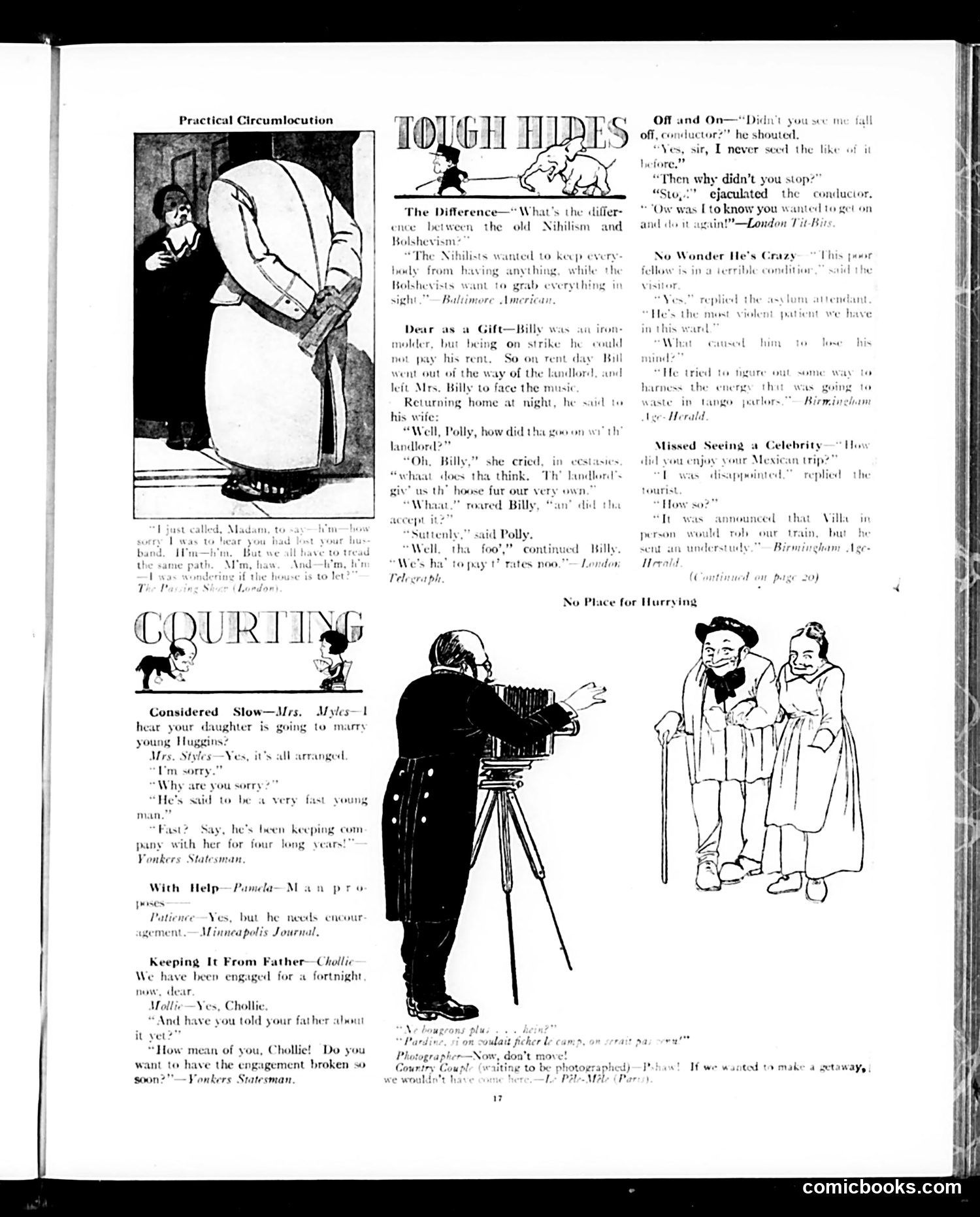
This page contains several short humorous anecdotes typical of early 20th-century Judge magazine, presented as brief comic exchanges rather than visual cartoons. The jokes satirize common social situations: a man's four-year courtship suddenly becoming a "fast" engagement (mocking the speed); an engaged couple hiding their engagement from the father; a working-class couple's landlord giving them free housing, only to realize they'll owe taxes; a conductor claiming ignorance about a passenger's stop request. One section references contemporary politics—a discussion of "Nihilism vs. Bolshevism," likely commentary on Russian revolutionary movements. Another depicts the practical circumlocution of an ironworker on strike unable to pay rent, forcing his wife to face the landlord. The humor relies on class commentary, domestic situations, and wordplay typical of the era's satire. The "Missed Seeing a Celebrity" section appears to reference Pancho Villa's involvement in Mexican border raids, a topical 1910s-1920s reference.
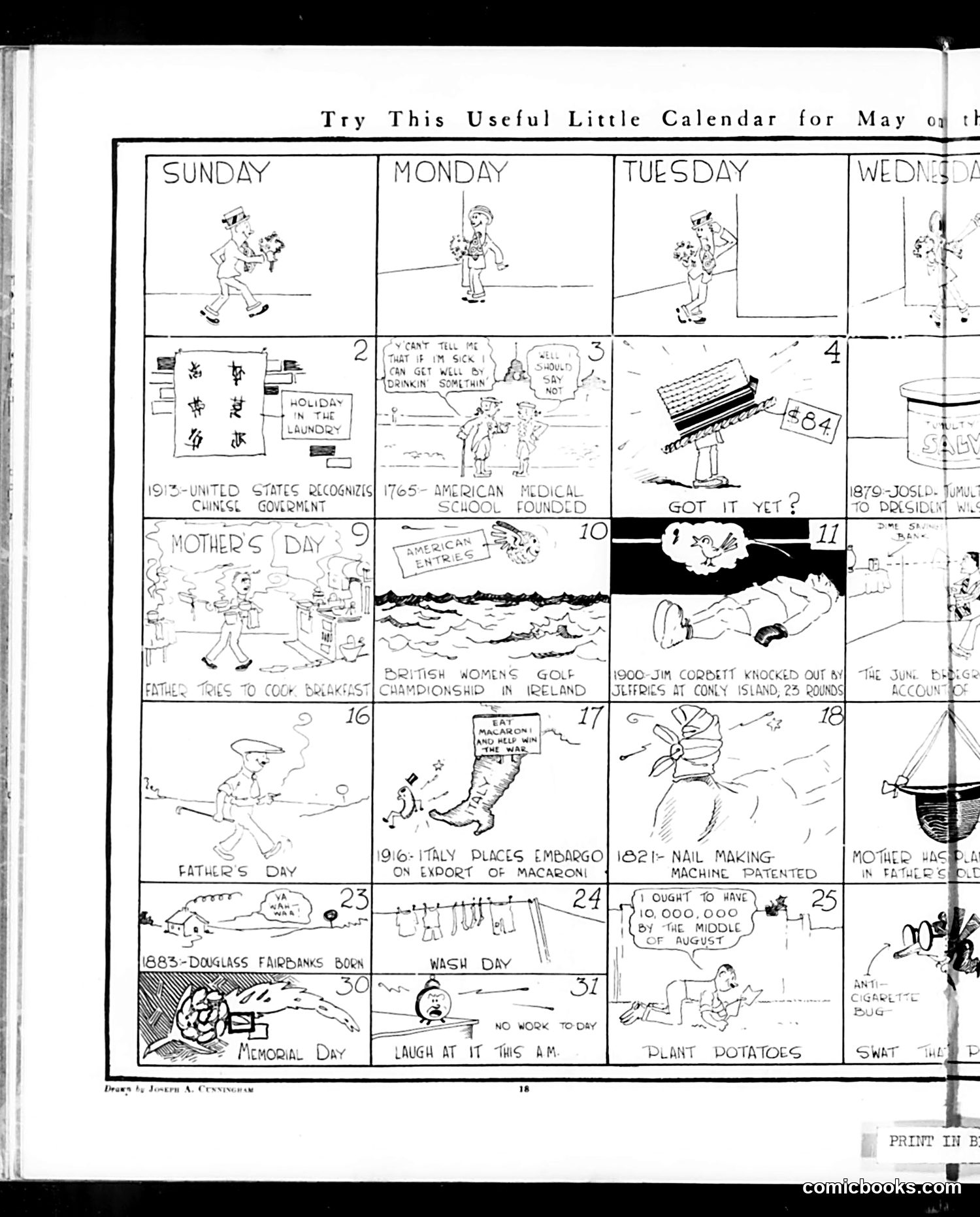
This is a humorous calendar page combining daily cartoon vignettes with historical "this day in history" entries. The satire works through contrasts: **Daily life scenes** show ordinary activities: Father cooking breakfast, wash day, planting potatoes—domestic routines presented with gentle humor. **Historical entries** juxtapose trivial modern concerns against significant past events: the 1913 Chinese government recognition appears alongside holiday laundry; an 1879 presidential inauguration next to a child's calculation problem; the 1916 Italian macaroni embargo beside a "Wash Day" comic. **The joke**: The calendar presents everyday American life as deserving the same historical documentation as major events—mocking both the pretentiousness of "useful calendars" and Americans' self-importance. It's gentle satire on domesticity and national self-regard, typical of Judge's sophisticated humor mixing domestic comedy with topical reference. No specific political figures appear to be caricatured here.
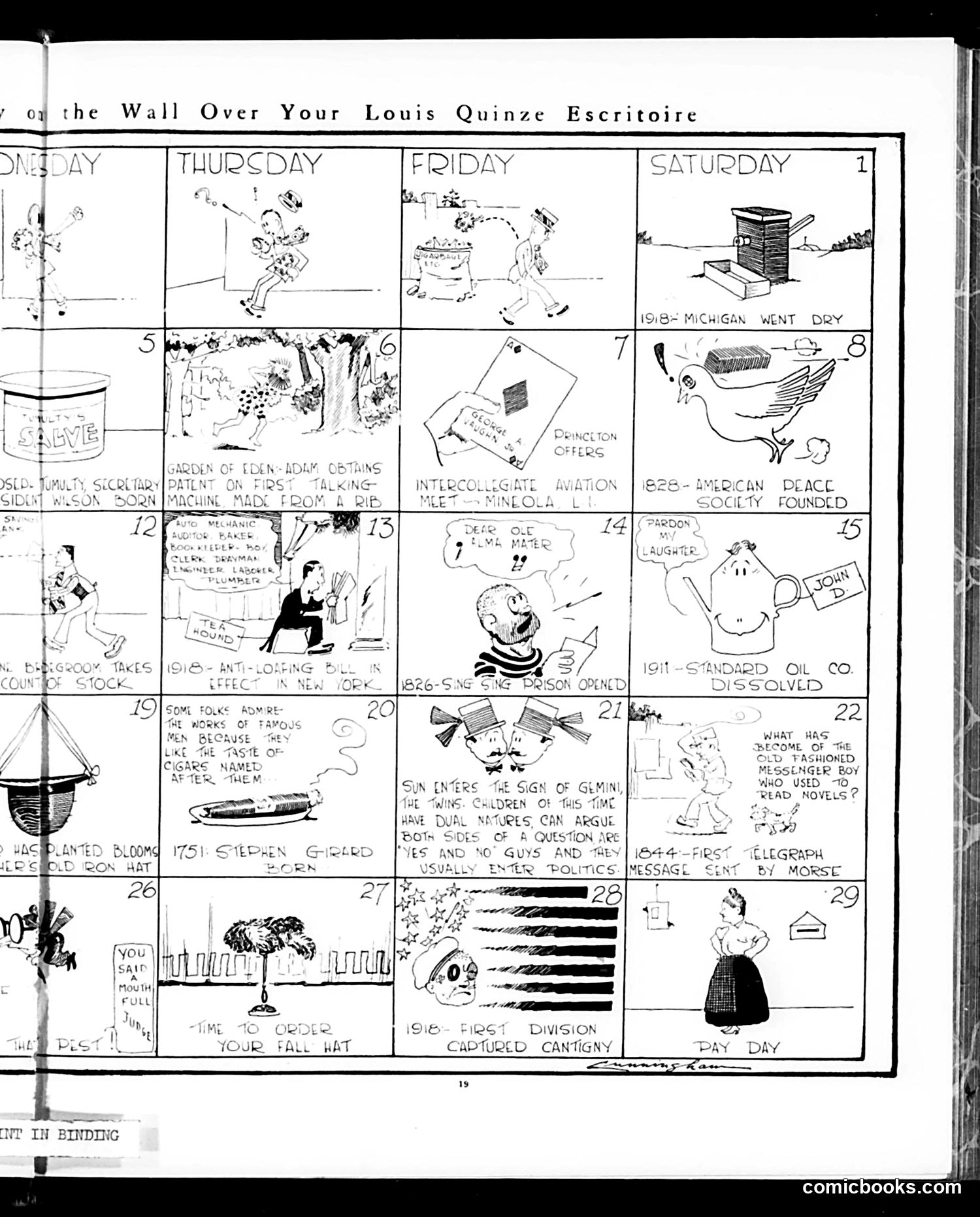
This is a 1918 calendar page from *Judge* magazine mixing historical events with humor. Key references: **Panel 1**: "1918—Michigan went dry" (Prohibition era). **Panel 8**: "1828—American Peace Society founded" (pacifism). **Panel 13**: "1918—Color Effect in New York" (unclear specific reference). **Panel 15**: "1911—Standard Oil dissolved" (the famous monopoly breakup). **Panel 21**: "1918—First Division captured Cantigny" (WWI battle; American Expeditionary Forces' first major offensive). **Panel 28**: "1918—First Division captured Cantigny" (repeated, emphasizing recent military success). **Panel 22**: "1844—First Telegraph Message Sent by Morse" (Samuel Morse's invention). The page interweaves American historical milestones with contemporary 1918 events, particularly celebrating U.S. military achievements in World War I alongside earlier national developments. The humor appears to derive from juxtaposing serious historical moments.
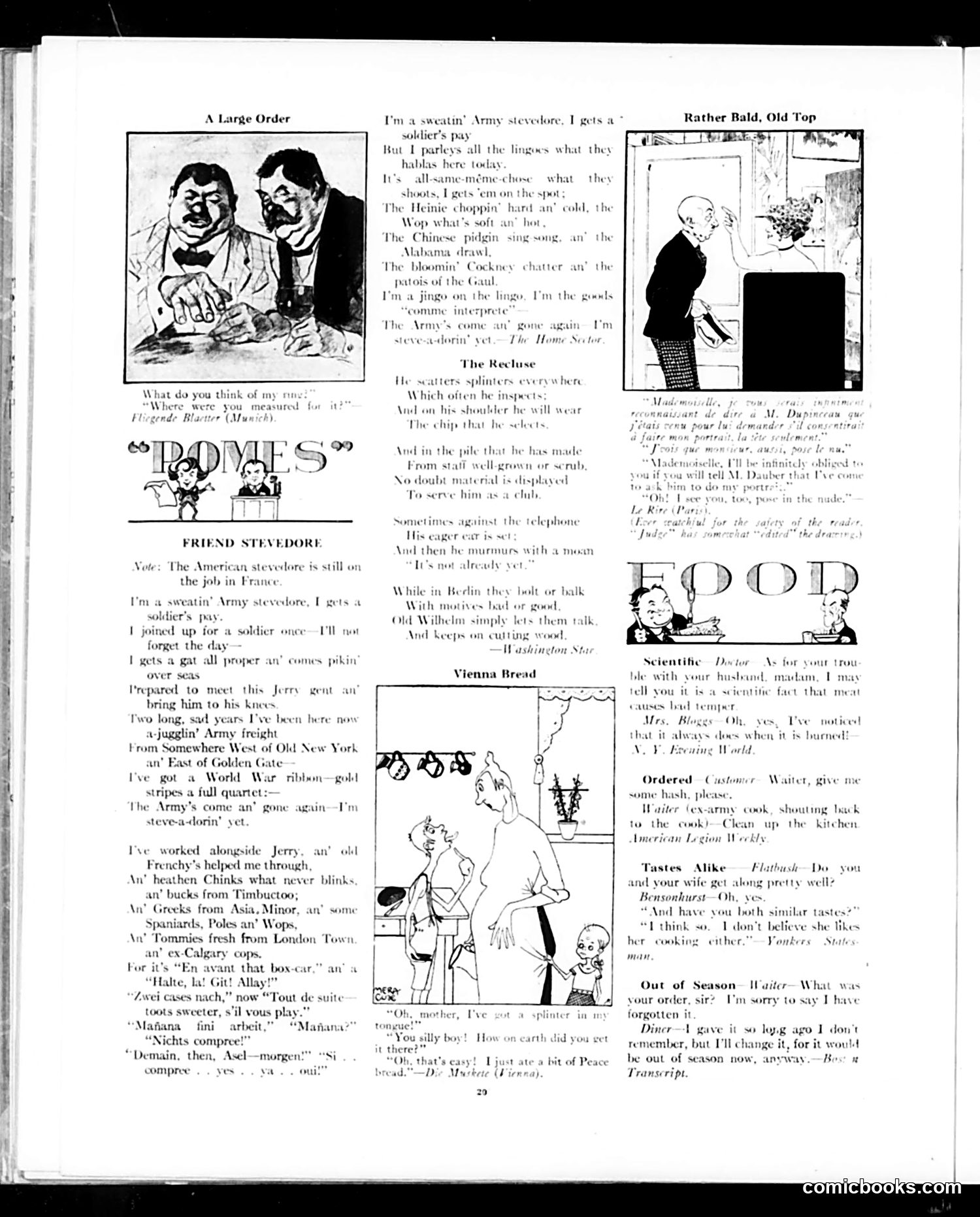
This page from *Judge* magazine contains several satirical pieces from the World War I era: **"Friend Stevedore"** celebrates American dock workers serving in France. The humor lies in the stevedore's multilingual pidgin—he's absorbed phrases from French, German, Italian, Spanish, Chinese, and other languages while loading military cargo. The satire mocks both the linguistic chaos of the international war effort and celebrates working-class American versatility. **"The Recluse"** depicts an old man obsessively selecting wood chips from piles, examining each one. The joke is his meticulous, pointless labor—satirizing either miserly frugality or simple-minded obsession. **"Vienna Bread"** appears to reference wartime bread shortages or rationing, likely German-related given the Vienna reference. The remaining items are brief humor pieces about marital discord, customer service, and seasonal restaurant offerings—standard comedic fare unrelated to the war. The page reflects 1918-era American attitudes toward immigrants, laborers, and Allied cooperation.
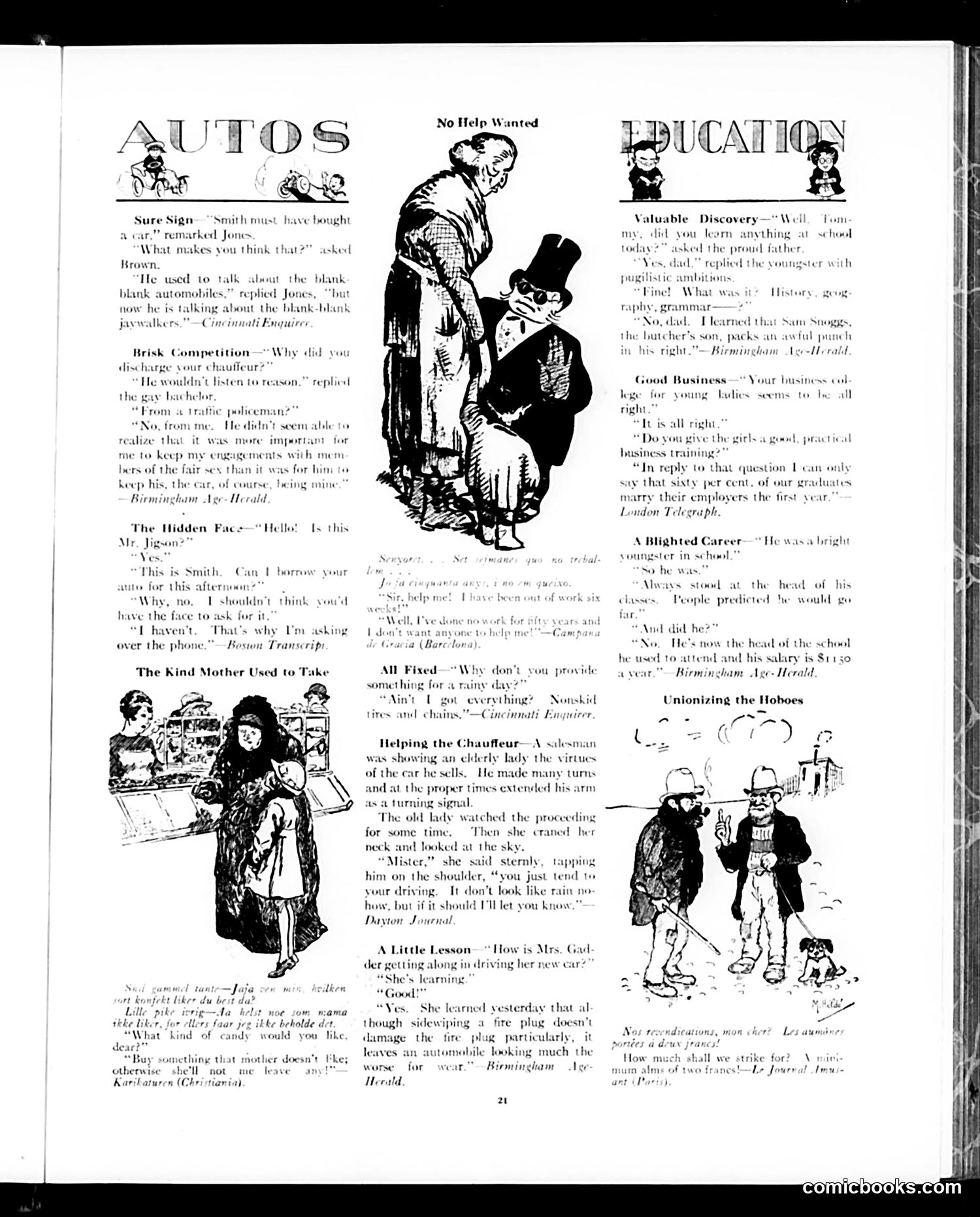
This page collects brief humorous anecdotes and cartoons satirizing early 20th-century American life, particularly automobiles and social mobility. **Key themes:** - **Auto culture's social disruption**: Multiple jokes mock how car ownership changes behavior ("blank-blank" cursing, jaywalking, chauffeur disputes). Cars are new enough that etiquette around them is confused. - **Class anxieties**: A wealthy bachelor prioritizes social engagements over keeping his chauffeur; an elderly woman mistakes a turning signal for weather prediction, suggesting generational disconnect with new technology. - **Ambition vs. reality**: "A Blighted Career" satirizes how a bright student becomes a schoolmaster earning only $1,150/year—a commentary on limited opportunity despite promise. - **Women and employment**: "Good Business" jokes about training young women for jobs while hinting they marry their bosses instead—reflecting era's assumptions about female employment. The cartoons use working-class and immigrant perspectives (note "Unionizing the Hoboes" headline) to poke fun at modern society's complications.
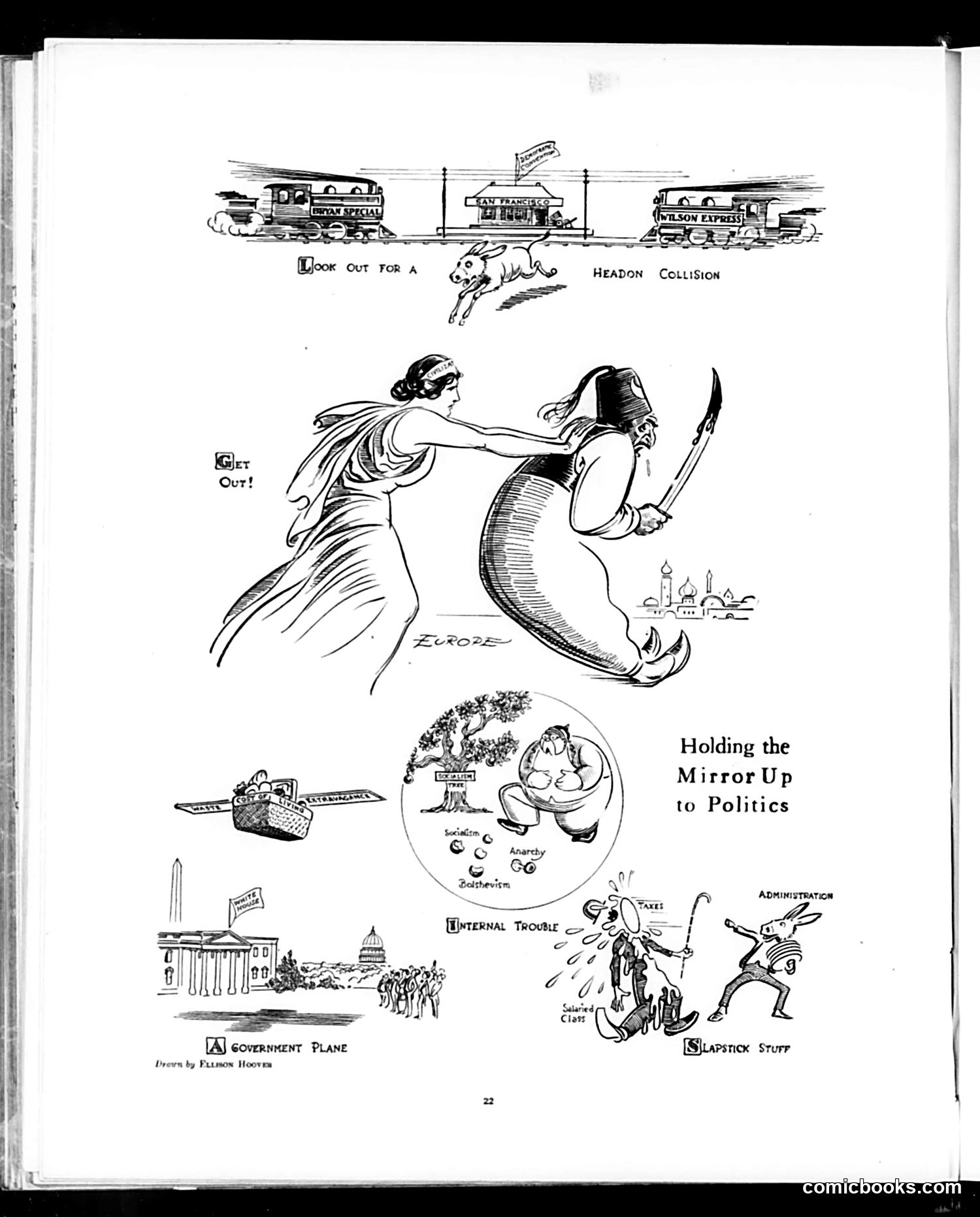
This page presents several editorial cartoons satirizing American politics and international affairs. The top panel shows trains labeled with company names about to collide—a "headon collision" metaphor for business or political conflict. The central image depicts a woman (likely representing America or Lady Liberty) pushing back against a threatening figure labeled "Europe," who wields a sword and appears menacing, suggesting anxieties about European aggression or instability. Lower panels mock various political problems: "Internal Trouble" shows chaos among different social classes; "A Government Plane" and "Slapstick Stuff" appear to satirize administrative incompetence or foolish policy decisions. The overall theme—"Holding the Mirror Up to Politics"—announces the page's purpose: reflecting contemporary political failures and absurdities back at viewers. The cartoons likely address early 20th-century American isolationism concerns, domestic discord, and government effectiveness.
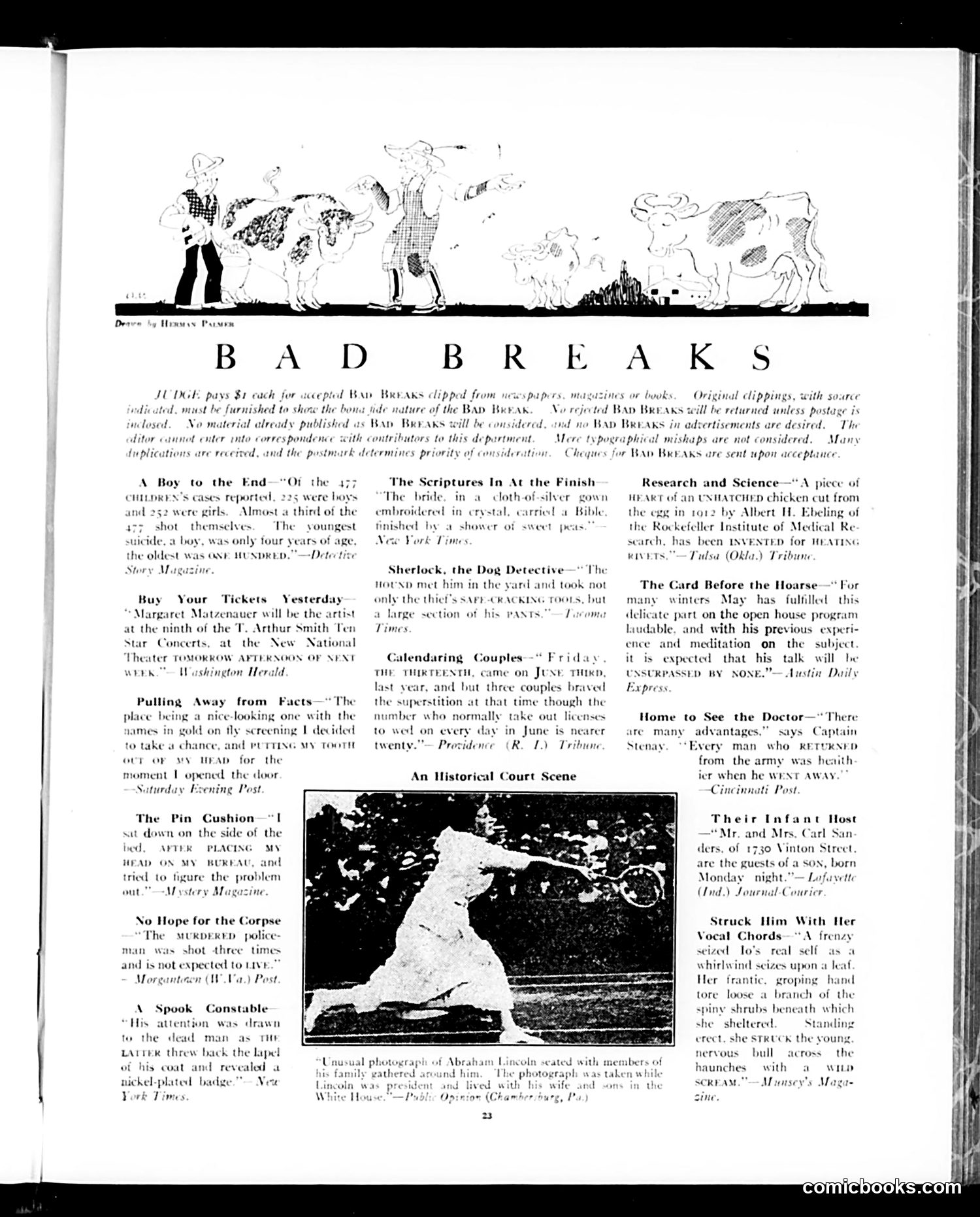
This is a **humor page dedicated to publishing amusing typographical errors and awkward phrasings** from newspapers and magazines—called "Bad Breaks" or "Boners." Judge paid $1 per accepted submission. The humor works through **unintentional double meanings created by poor word placement or editing**. For example: - "A boy, was **only four years of age**...the **oldest was one hundred**" (suggesting impossible family age gaps) - "**Struck him with her vocal chords**" (misplaced phrase makes it sound physically violent rather than melodious) - "The **murdered policeman...is not expected to live**" (darkly comic understatement) - A dog detective who steals a thief's pants (likely meant something else) **The satire targets**: careless newspaper journalism and editing. By collecting these public gaffes, Judge mocked the press's sloppy work while providing readers entertainment. The historical court scene photograph below appears unrelated filler content. This reflects early 20th-century print media's vulnerability to human error before digital spell-checking.
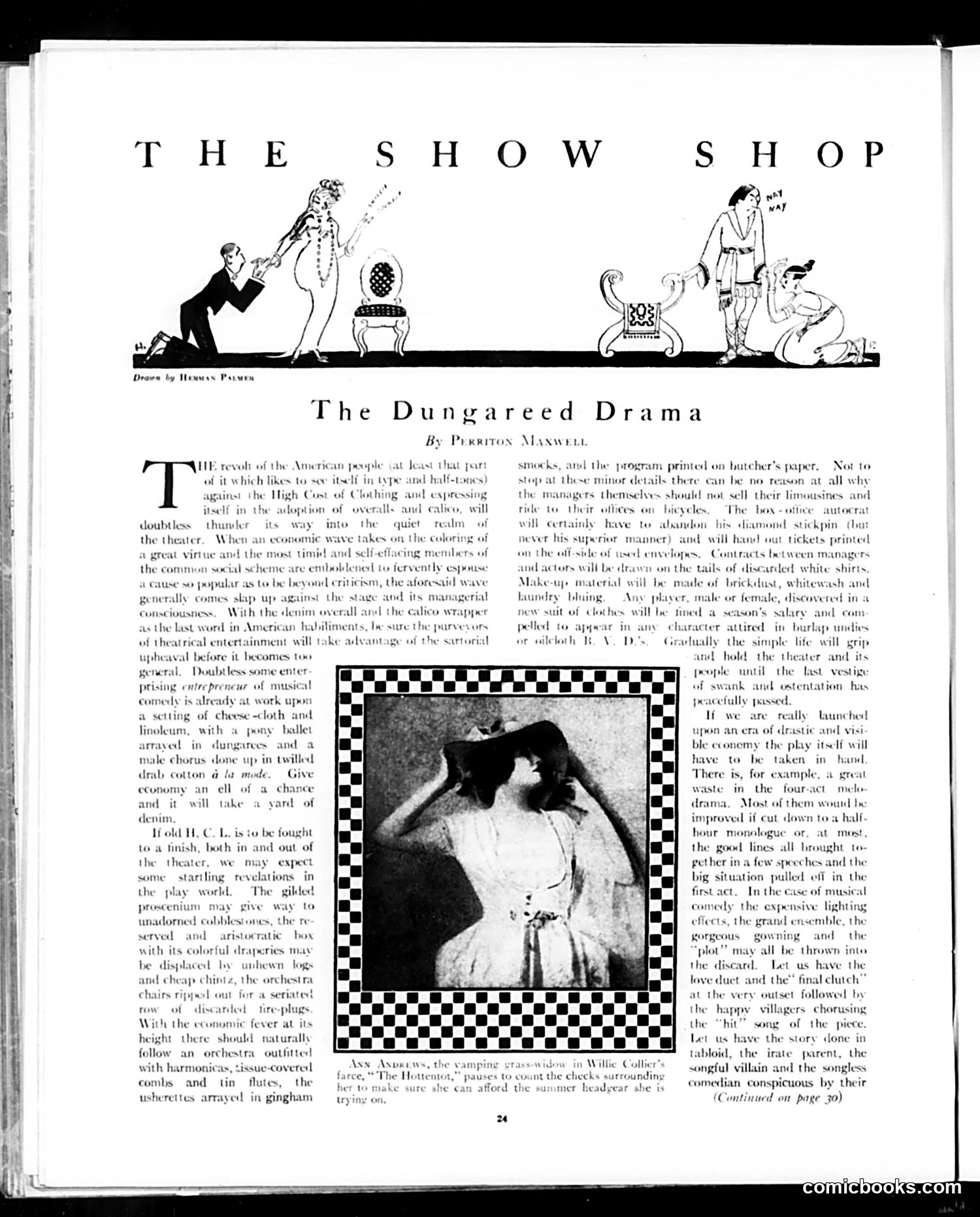
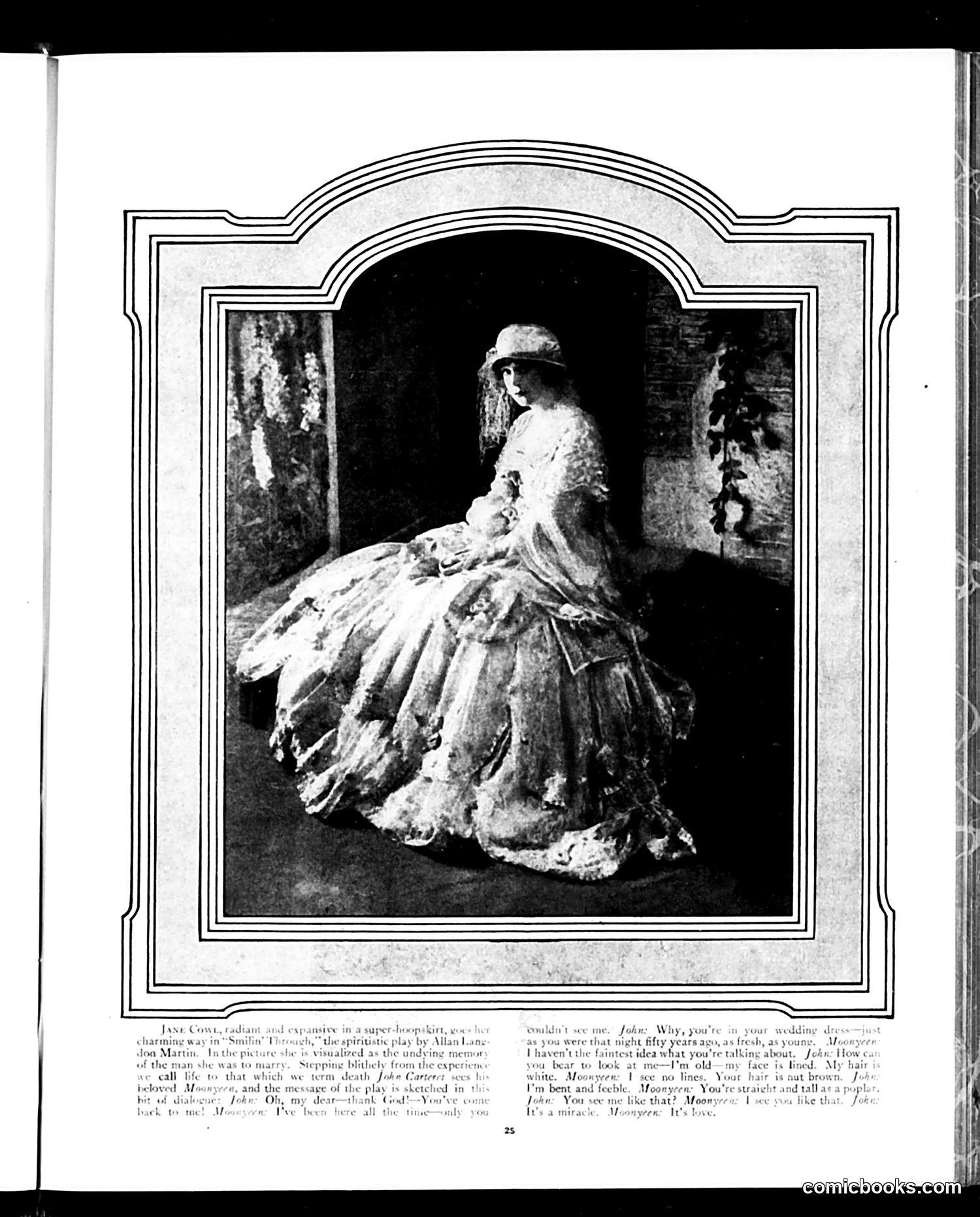
This page from *Judge* magazine features a theatrical scene photograph with dialogue beneath it. The image shows a woman in an elaborate, voluminous dress from what appears to be a period costume drama, likely from Allan Lane's play "Smilin' Through." The caption reveals a satirical dialogue between characters "John" and "Moonyean" (likely "Moonbeam" or similar). The joke appears to center on the contrast between the character's youthful appearance in the stage costume versus her actual age—someone notes she looks exactly as she did "fifty years ago," leading John to quip about the impossibility and call it "a miracle." This is likely mocking either the actress's age or the theatrical artifice of stage makeup and costuming. The satire targets vanity and the theatrical illusion of timelessness in performance.
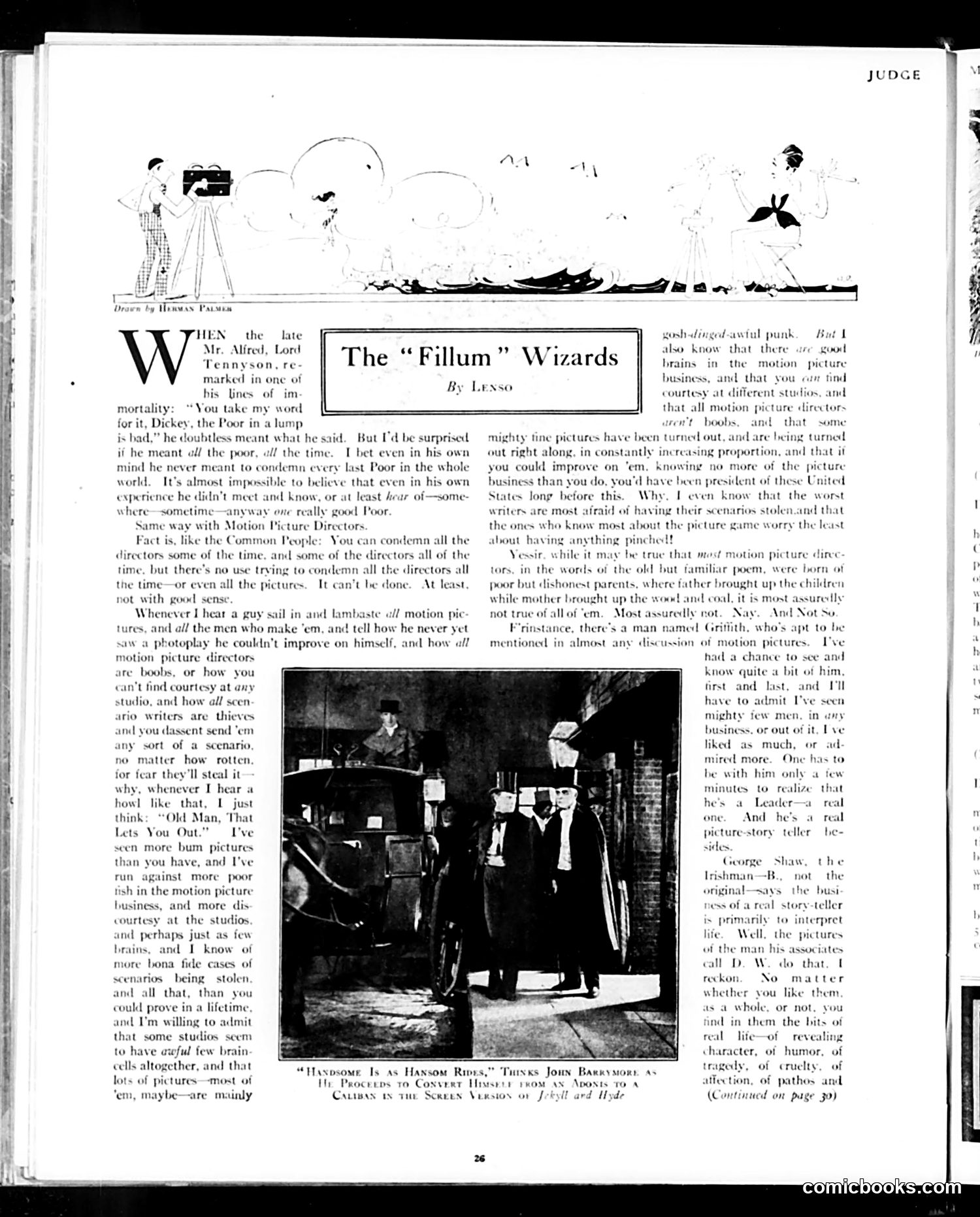
This article satirizes film critics who blanket-condemn all motion picture directors and scenarios as incompetent or stolen. The author—using the analogy of Tennyson's line about "the Poor"—argues it's logically absurd to condemn *all* directors *all* the time, since he himself has seen both terrible pictures and genuinely good ones. The piece defends the film industry against sweeping criticism, arguing that courtesy and talent do exist in studios. It specifically praises **D.W. Griffith** (called "Griffith" here, though the photo caption identifies "D.W.") as a respected "picture-story teller" who reveals real life and character on screen. The author also mentions **George Shaw** ("the Irishman—B."). The satirical point: pretentious critics who claim they've never seen a good film, yet couldn't do better themselves, are hypocrites deserving ridicule. The cartoon above depicts early filmmaking with cameras, actors, and technical crew.
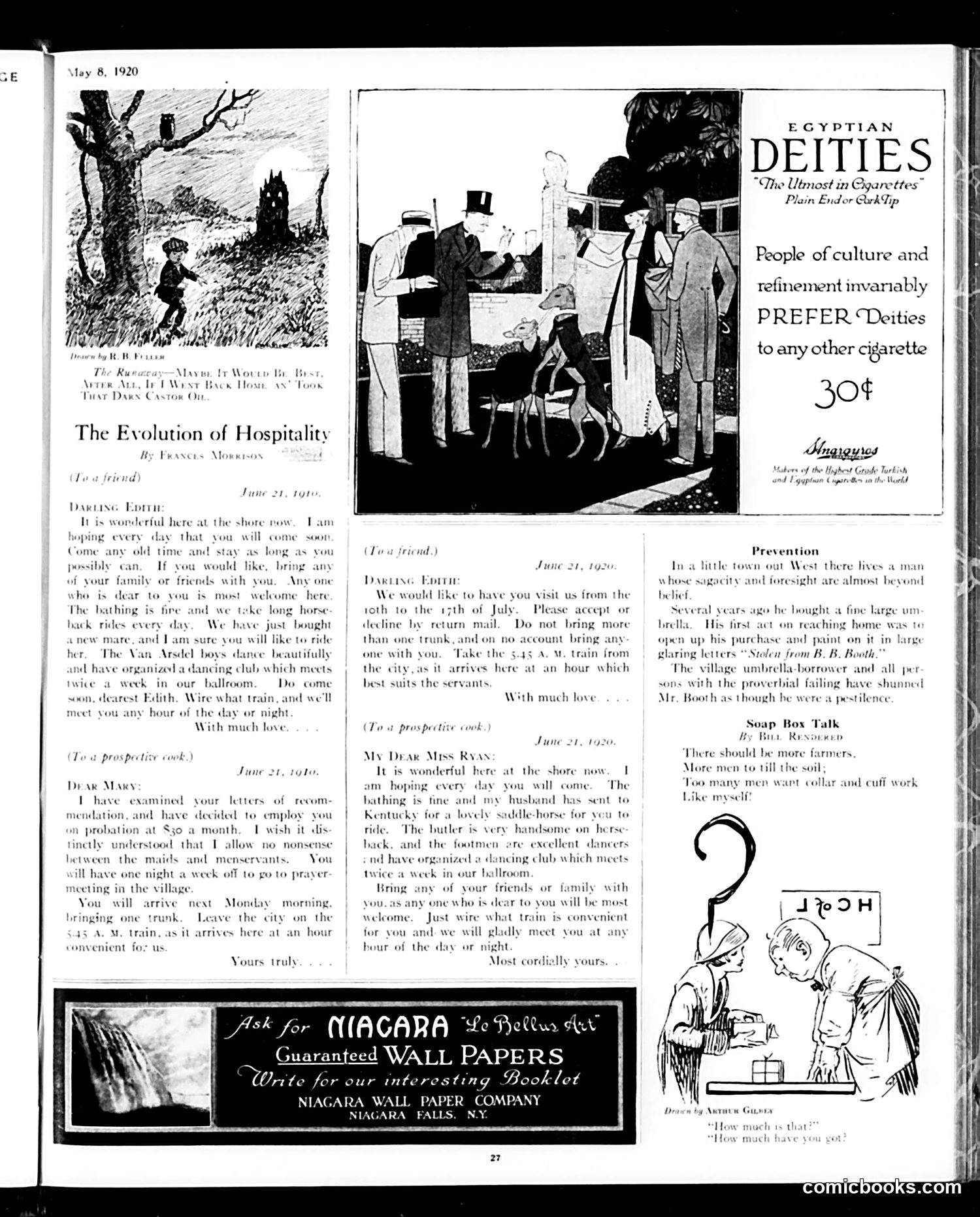
This page satirizes the **hypocrisy of wealthy hospitality**. "The Evolution of Hospitality" consists of three nearly identical invitation letters—from a society hostess, her husband, and the hired cook—each warmly welcoming guests to their shore estate, each claiming the sender "hopes every day you will come," each using identical phrasing about trains and arrangements. The joke: all three writers are actually **servants or employees**, not the family. The progression reveals that even the lowly cook extends the same elaborate, effusive welcomes as the supposed hosts, exposing how mechanical and insincere wealthy social conventions have become. The "evolution" shows hospitality reduced to formulaic performance—genuine warmth replaced by scripted courtesy. The accompanying cartoon "Prevention" depicts a man who painted "Stolen from B.B. Booth" on his umbrella to discourage borrowing—a practical joke about social parasitism. The page also contains a cigarette advertisement and a recruitment cartoon about farm labor shortages.
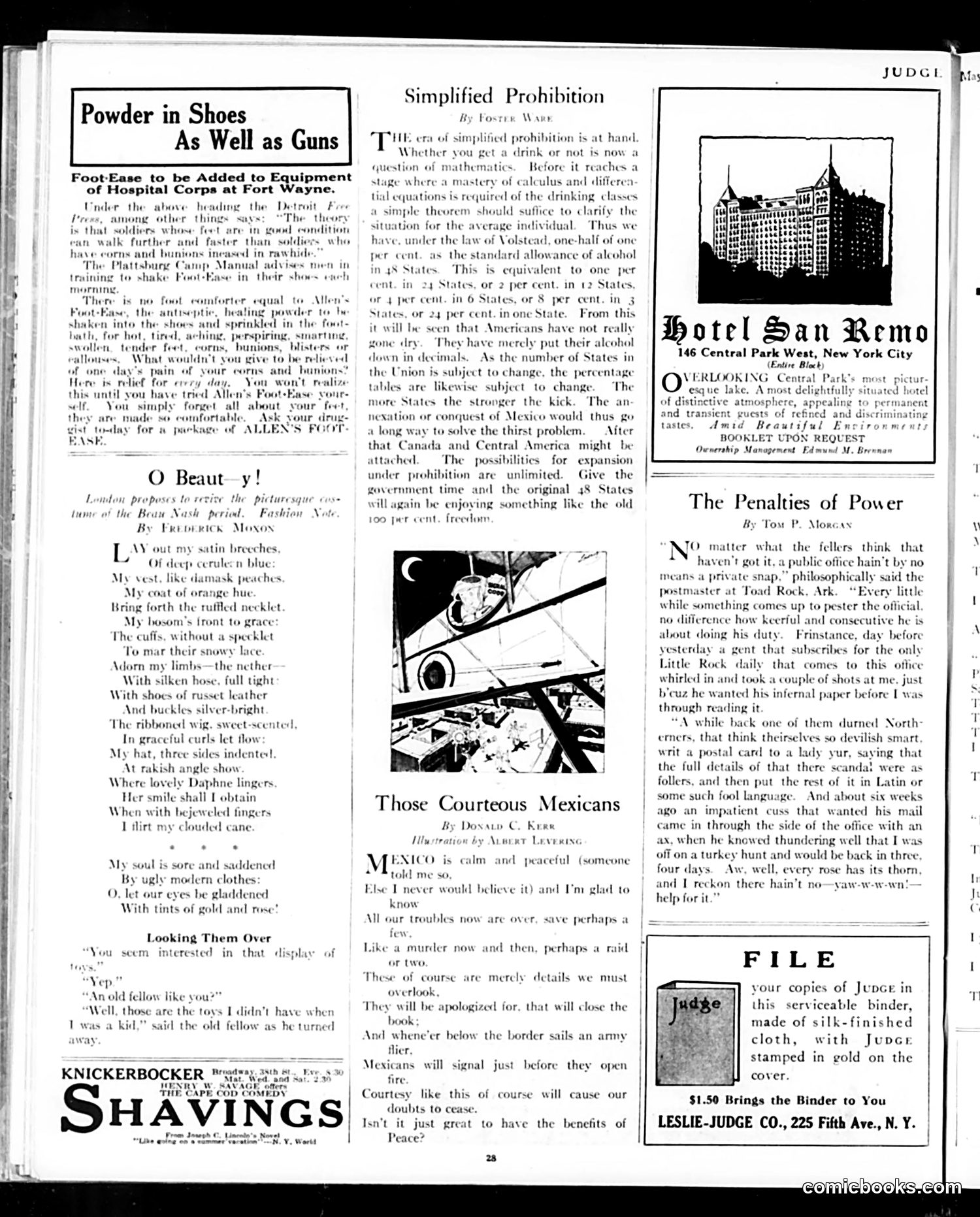
This page contains three main pieces of satirical content: **"Simplified Prohibition"** mocks the Volstead Act (Prohibition enforcement) by proposing absurd mathematical solutions to alcohol regulation. The satire suggests that if different states have different alcohol allowances (one state allowing 24% while others allow fractions), Americans could simply relocate or aggregate their legal allowances. The joke escalates ridiculously—suggesting conquering Mexico and Canada to expand prohibition's "possibilities." It critiques prohibition as mathematically unworkable and fundamentally pointless. **"Those Courteous Mexicans"** sarcastically praises Mexican courtesy regarding cross-border military conflicts. It mocks American-Mexican relations by noting Mexicans "signal just before they open fire"—portraying attacks as politely announced. This reflects contemporary tensions over U.S. military interventions in Mexico during the Mexican Revolution era. **"O Beauty!"** is a poem lamenting modern fashion, advocating for restoration of 18th-century Beau Nash–era clothing with elaborate wigs, breeches, and rufflies—pure nostalgic humor with no political content. The page is primarily satirical commentary on Prohibition policy and U.S.-Mexico relations.
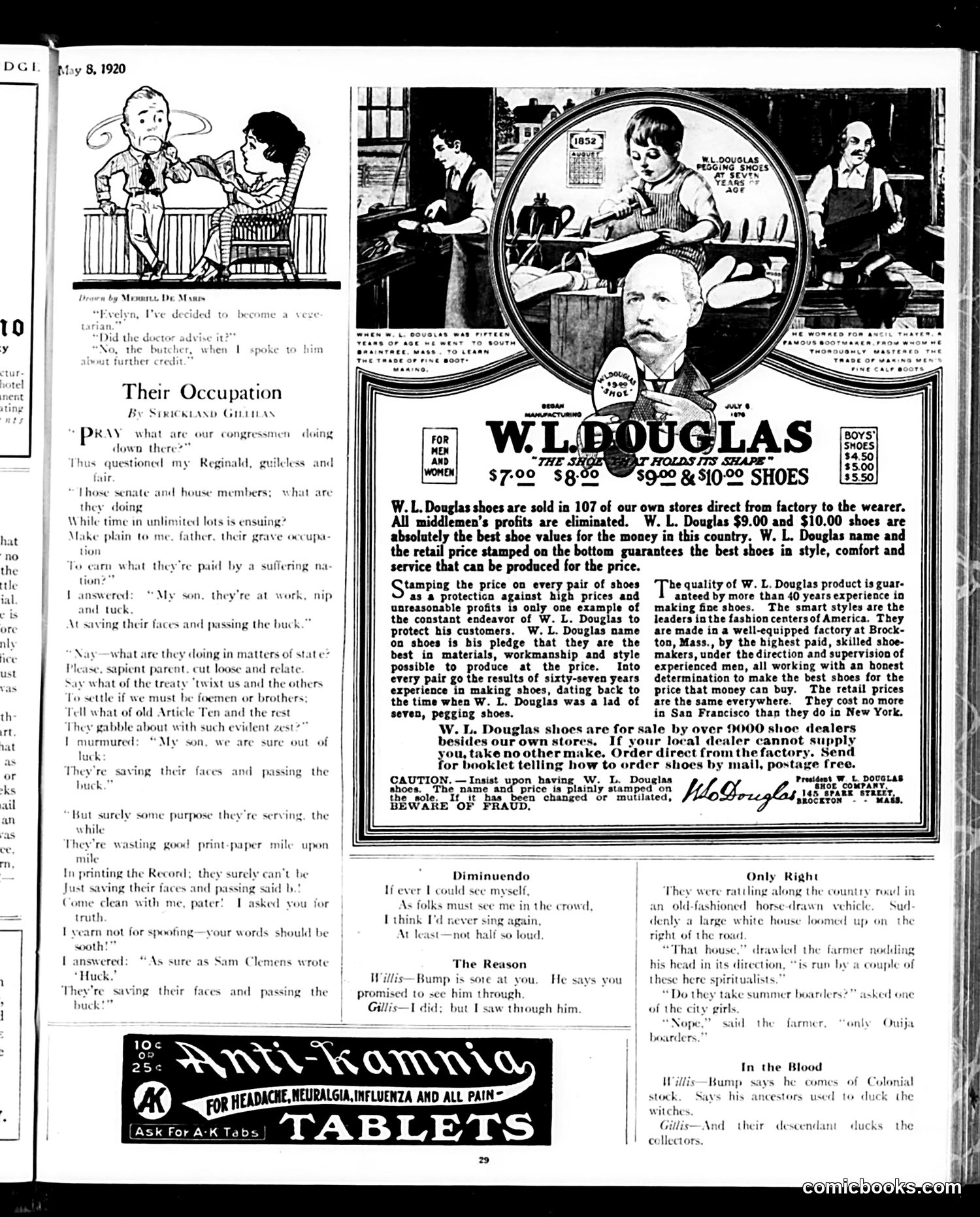
This cartoon satirizes the U.S. Congress's perceived inaction during a critical political moment. The repeated refrain—"saving their faces and passing the buck"—mocks congressmen for avoiding responsibility rather than conducting actual legislative work. The specific context appears to be the **1920 Treaty of Versailles debate**. The child asks his father about the "Article Ten" treaty dispute between nations, referencing the League of Nations controversy that divided Congress. Republicans opposed President Wilson's League proposal, creating legislative gridlock. The satire's point: rather than seriously debate this momentous foreign policy question or take clear positions, Congress members were engaged in political theater—protecting their political standing while dodging accountability. "Passing the buck" means deflecting responsibility to others. This reflects widespread public frustration with Congress's perceived timidity and partisan maneuvering on post-WWI policy matters in 1920.
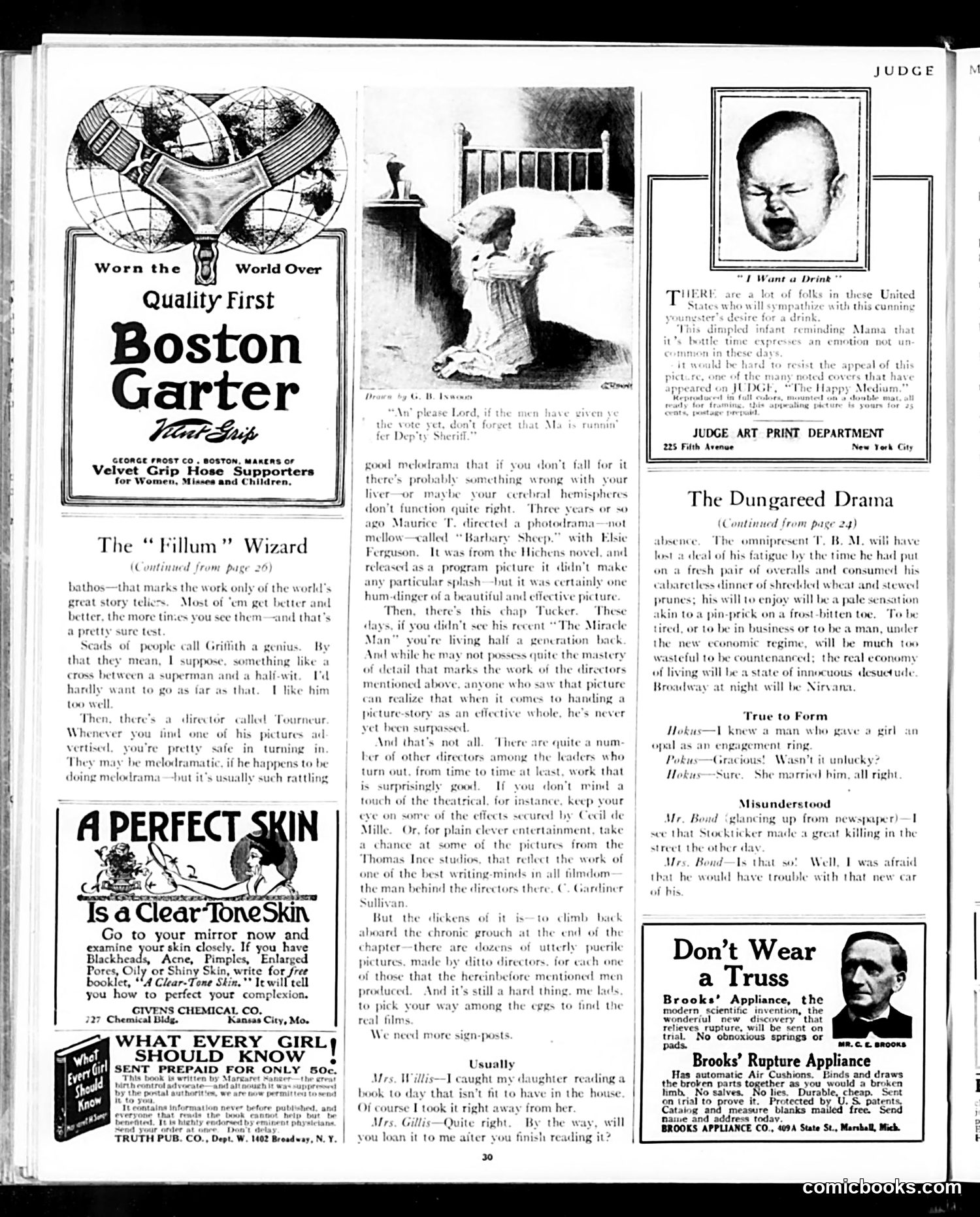
This page mixes film criticism with period advertisements and humor. The main article discusses film directors (Maurice Tourneur, D.W. Griffith, Tucker, Cecil B. DeMille, C. Gardner Sullivan), praising some as artistic while critiquing others for melodrama. The writer argues quality filmmaking requires discernment to distinguish genuine artistry from formulaic work. The cartoons and ads reflect 1910s-20s concerns: a "Boston Garter" ad promotes hosiery supports; a skin-care ad promises complexion perfection; a "Don't Wear a Truss" ad hawks an alternative appliance; and a brief joke about a woman lending her daughter's "unfit" book to a friend satirizes hypocrisy about censorship. The page reflects early cinema's cultural legitimacy struggle—debating whether film was serious art or mere entertainment—alongside typical magazine advertising targeting women's appearance and health anxieties.
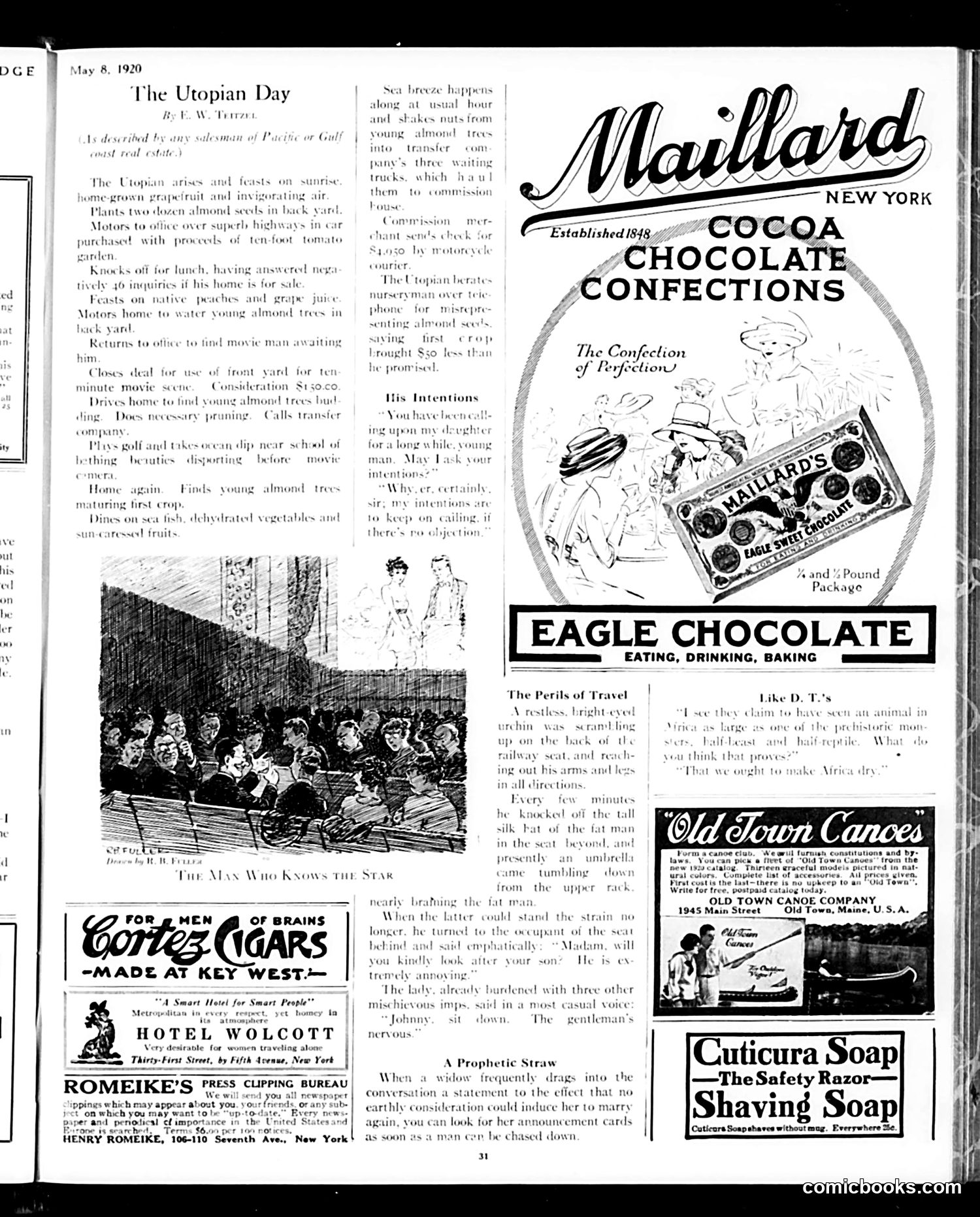
This page features a satirical article by F.W. Terrant describing an idealized American day of leisure and prosperity. The cartoon (credited to H.H. Forsythe) illustrates "The Man Who Knows the Star" — likely a film industry figure — shown surrounded by a crowd, suggesting the celebrity culture and movie industry boom of 1920s America. The "Utopian Day" text satirizes post-WWI optimism: a man grows his own food, conducts profitable business from his home garden, enjoys leisure activities (golf, ocean bathing), and profits from Hollywood filming on his property. The satire gently mocks the era's unrealistic promises of easy wealth and abundance through real estate, agriculture, and entertainment ventures. The surrounding advertisements (chocolates, cigars, canoes, razors) reflect typical 1920s consumer goods marketing to this idealized, prosperous middle-class audience.
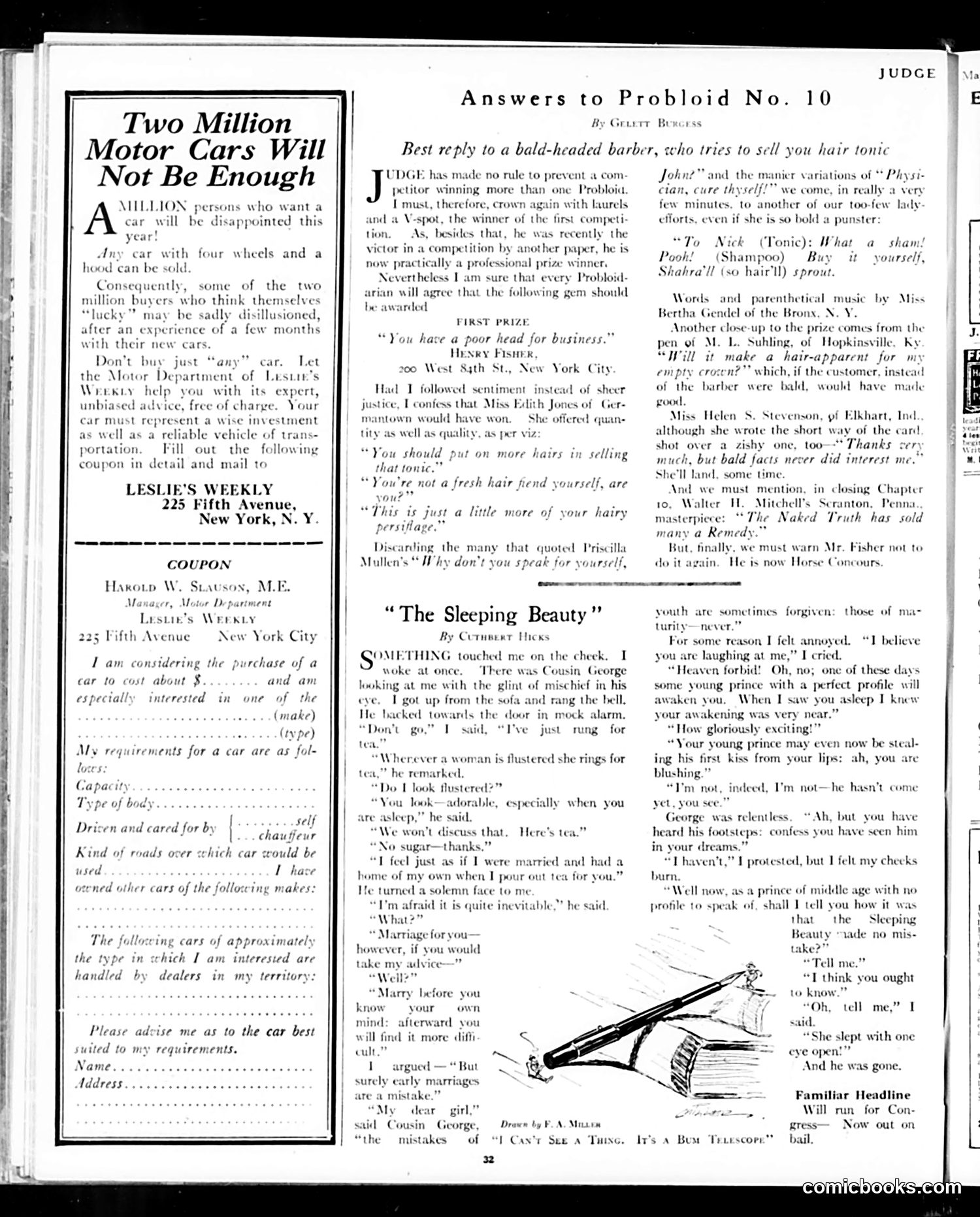
This Judge magazine page contains two main sections: **Left side:** An advertisement for Leslie's Weekly's motor car advisory service. The headline jokes that despite two million cars being sold annually, buyers are often disappointed. The coupon invites readers to submit their car requirements for expert, unbiased advice—essentially an early consumer guidance service disguised as advertising. **Right side:** A humor competition results page ("Probloid No. 10"). Judge invited readers to submit witty comebacks to a bald barber trying to sell hair tonic. The winning response is straightforward insult humor: "You have a poor head for business"—a pun suggesting the barber lacks business acumen while literally referencing his bald head. Other entries play on similar wordplay (Nick/Tonic, hair-apparent). Below that, "The Sleeping Beauty" appears to be a serialized short story about a woman flirting with her cousin George while she's drowsy. The overall page reflects early-20th-century Judge content: consumer satire, participatory humor competitions, and romantic fiction for middle-class readers.
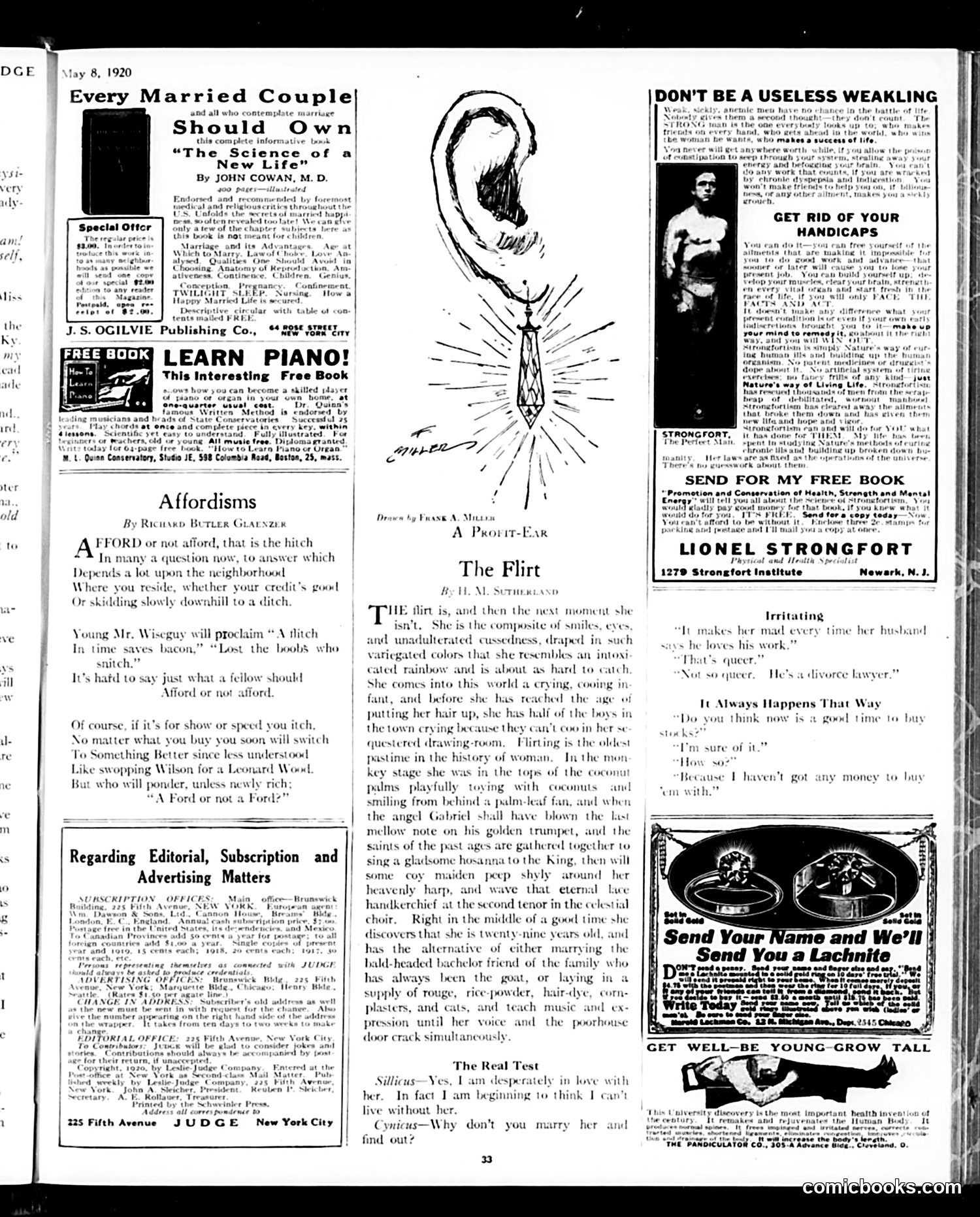
This is primarily a **literary and advertising page** rather than political satire. The main content includes: **Literary pieces:** - "Affordisms" by Richard Butler Grayson: humorous verse about whether people can afford luxuries, culminating in a pun ("A Ford or not a Ford?")—a reference to Henry Ford's affordable Model T automobile - "The Flirt" by H.M. Sutherland: a satirical character sketch of the archetypal flirt as simultaneously childish and manipulative, destined to age into spinsterhood or desperate matrimony **Central cartoon**: A crude anatomical drawing labeled "A Profit-Ear," appearing to mock or illustrate some economic or bodily concept (unclear without additional context). **Advertising**: Dominates the right side—promoting correspondence courses (piano, health/strength training by "Lionel Strongfort"), marriage advice books, and lachnite products. **Social humor**: The dialogue snippets mock marriage dynamics and romantic delusions typical of 1920s domestic comedy. The page reflects **post-WWI consumer culture** and conventional gender stereotypes rather than explicit political commentary.
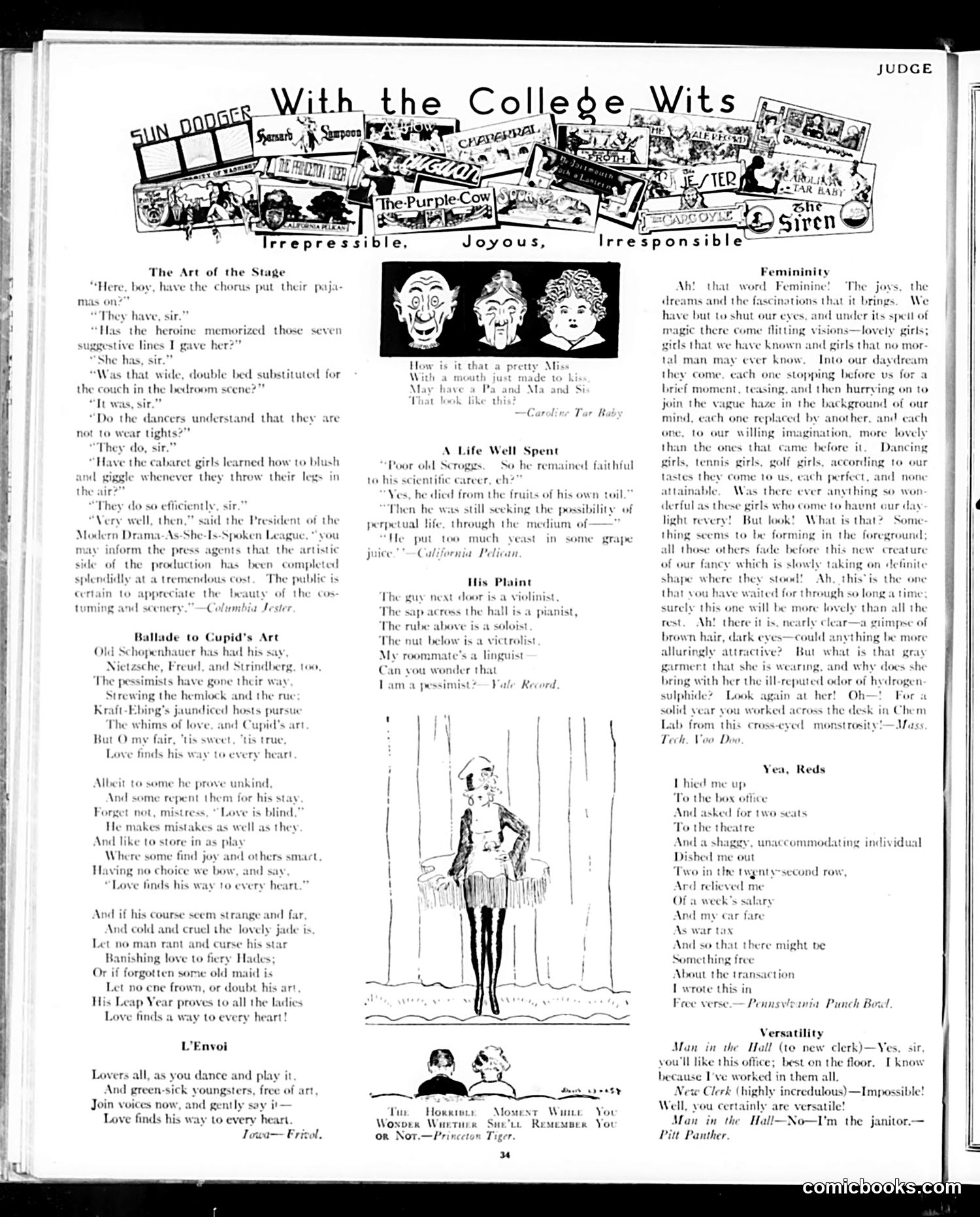
This page collects humorous college and theatrical commentary from Judge magazine's satirical section. **"The Art of the Stage"** mocks theatrical productions with absurdist dialogue—a director questioning whether his chorus has "put their pajamas on" and whether dancers understand they must wear tights. The satire targets the ridiculousness of low-brow theatrical productions and incompetent stage management. **"Femininity"** is a lengthy, flowery meditation on idealized femininity that parodies sentimental romanticism. It describes women as interchangeable fantasy objects that appear and disappear in male daydreams, ultimately deflating when reality intrudes (a "gray garment" and the "ill-reputed odor of hydrogen sulphide" reveal the woman works in a chemistry lab). **Other poems** ("Ballade to Cupid's Art," "L'Envoi," "Yea, Reds") continue satirizing romantic pretension and theatrical/college life absurdities. The humor targets collegiate sophistication, theatrical mediocrity, and romantic idealization—typical Judge fare mocking educated urban audiences.
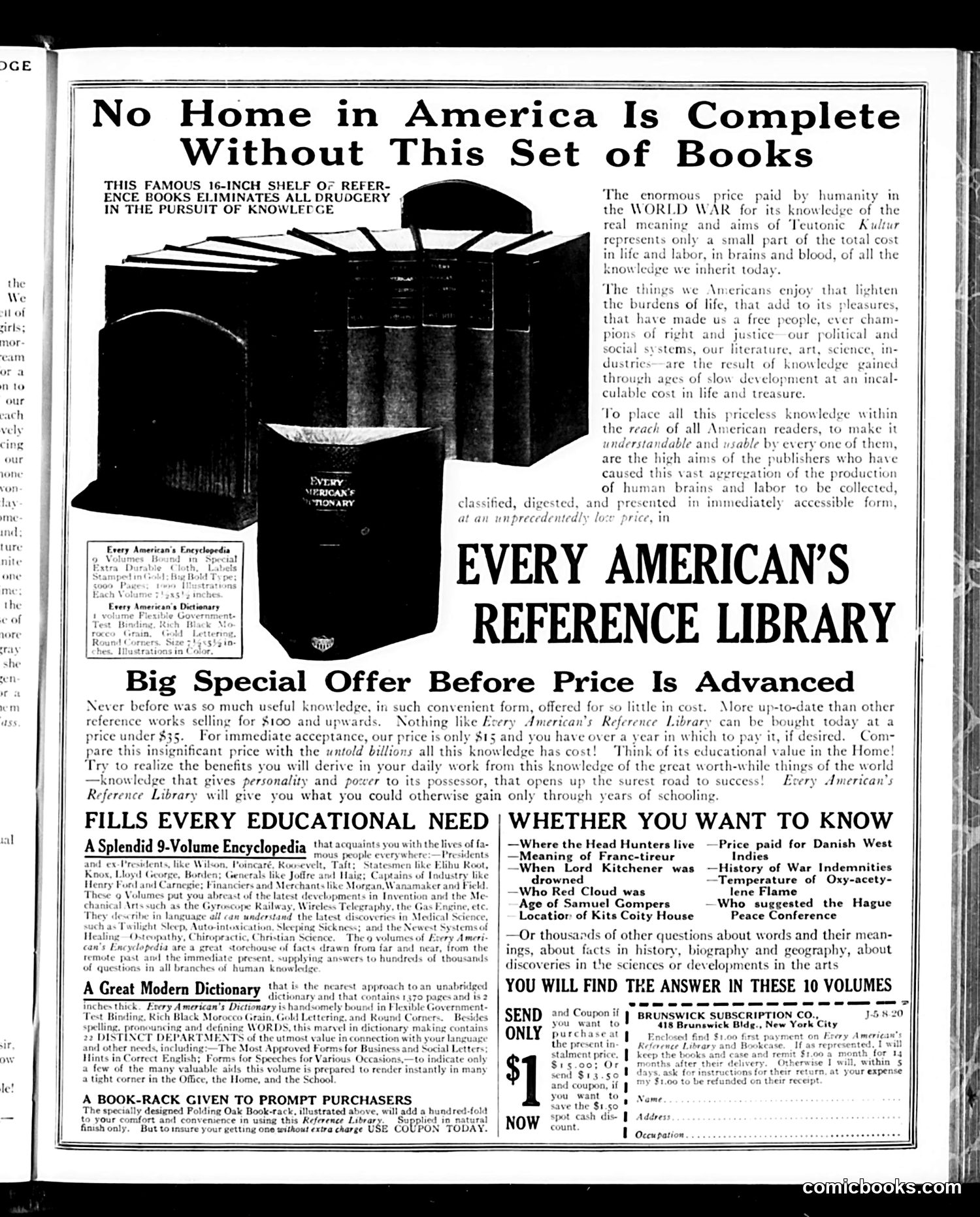
This is a full-page advertisement, not satirical content. It promotes "Every American's Reference Library"—a 10-volume encyclopedia set marketed as essential for American homes. The pitch leverages post-WWI anxieties: the ad emphasizes that knowledge cost humanity dearly during "the World War" and claims this affordable reference set ($15, payable over time) democratizes access to information previously available only to the wealthy. It promises to answer questions about history, geography, biography, and science—positioning knowledge as the foundation of American freedom and success. The "no home complete without" framing is typical early-20th-century advertising rhetoric. While not overtly satirical, Judge may have included this as humorous commentary on American consumer culture and the era's faith in self-improvement through purchasing books—though the satire, if intended, is subtle.
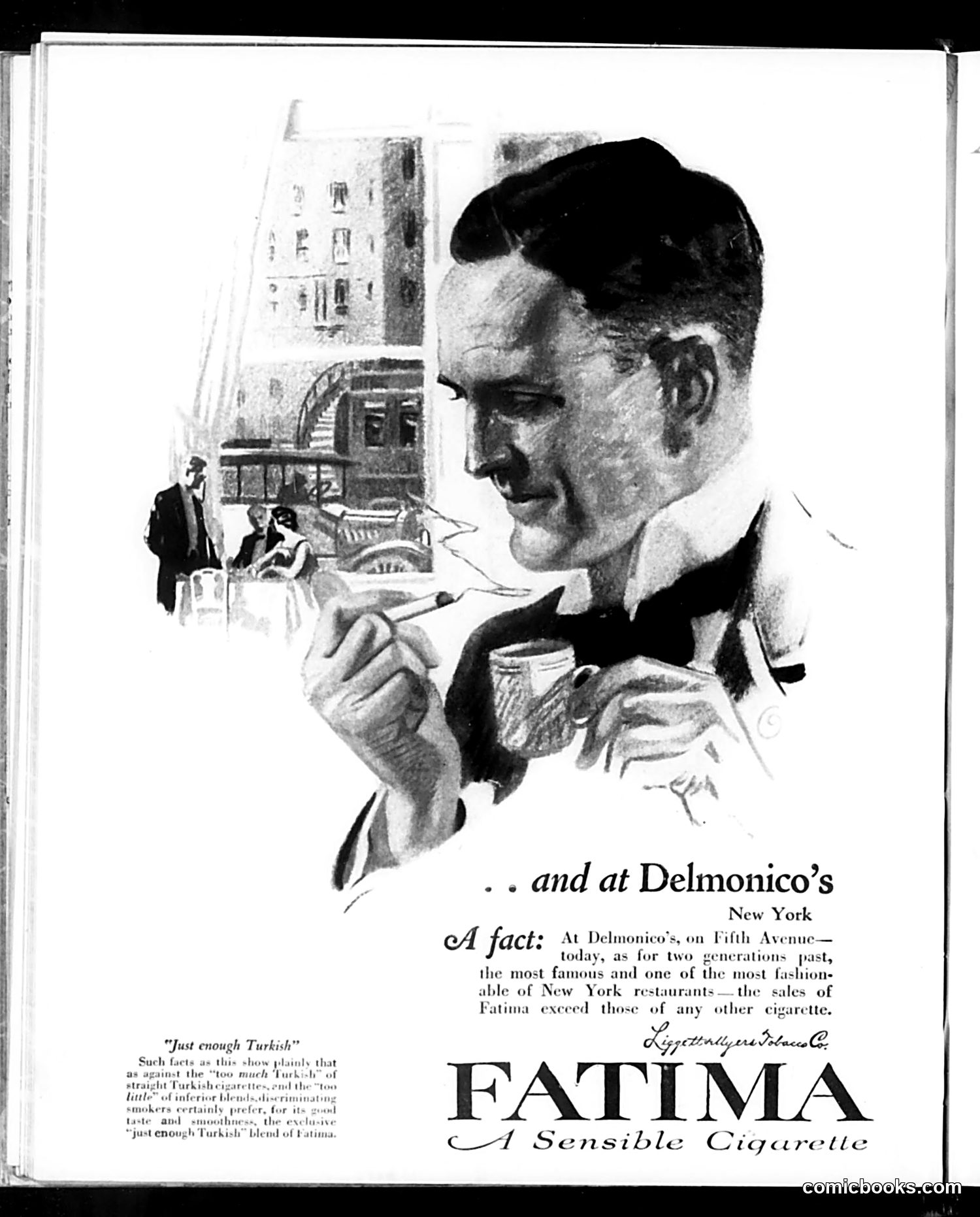
This is primarily **advertising, not satire or political content**. The page promotes Fatima cigarettes using a glamorous illustration of a well-dressed man at Delmonico's, the famous New York restaurant on Fifth Avenue. The "Just enough Turkish" tagline refers to Fatima's blend—positioning it as a cigarette with Turkish tobacco that isn't overpowering ("sensible"). The phrase "A fact" attempts to lend authority by claiming Fatima outsells competing cigarettes at this prestigious establishment, implying that sophisticated diners prefer this brand. The illustration style is typical of early 20th-century advertising: the refined gentleman, elegant setting, and aspirational messaging aimed at upper-class consumers. There is no political cartoon or satire visible—this is straightforward product marketing leveraging the prestige of a high-end venue and clientele.