
Judge, 1920-05-08 · page 12 of 36
Judge — May 8, 1920 — page 12: what you’re looking at
What you’re looking at
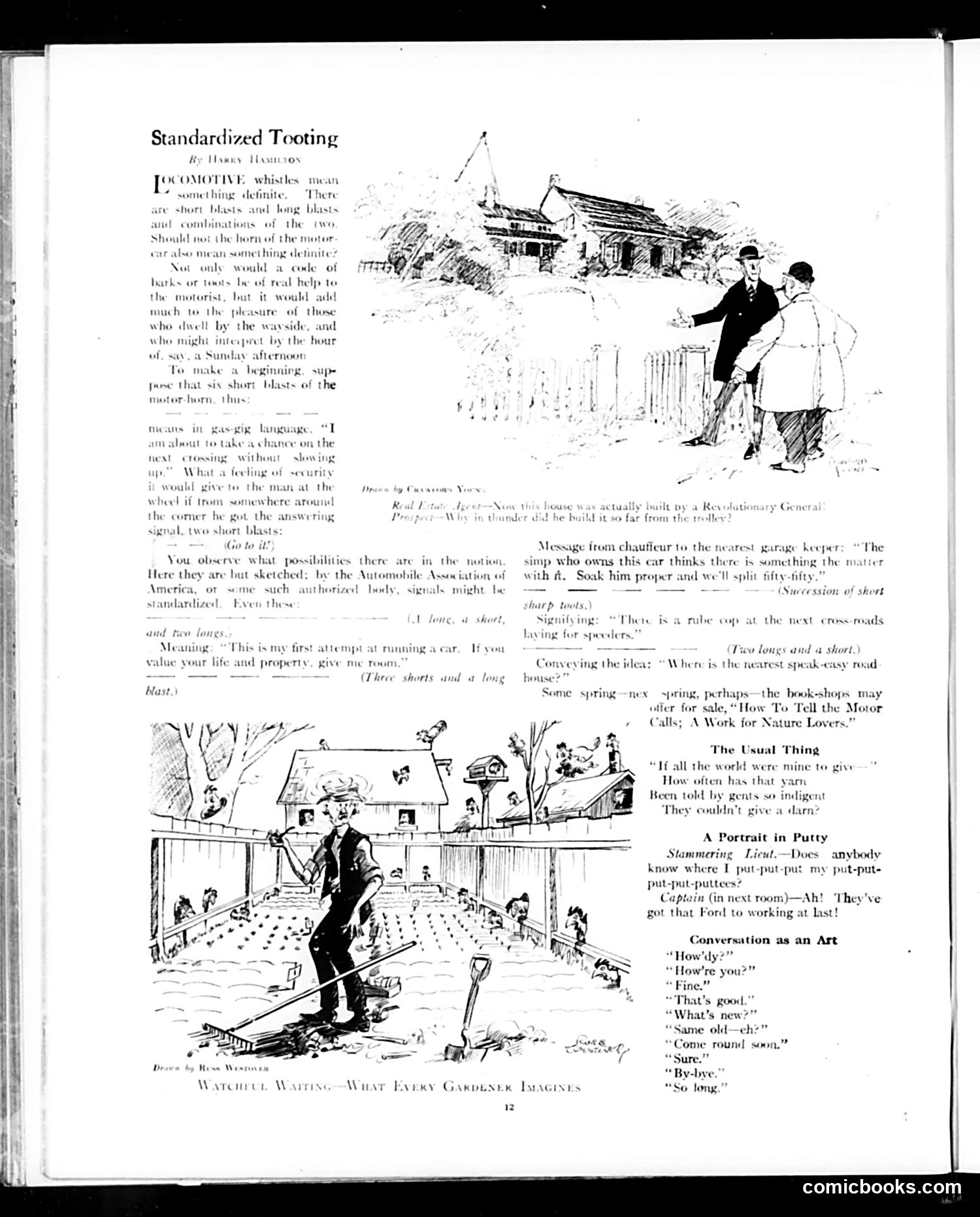
This satirical article proposes standardizing automobile horn signals—assigning specific meanings to different horn blast patterns (short blasts, long blasts, combinations). The humor lies in the earnest premise contrasted with cynical, self-interested interpretations. The cartoons illustrate both the earnest idea (top: a motorist using standardized signals near a Revolutionary-era house) and the reality of how drivers would *actually* use such a system. The lower cartoon shows a chauffeur receiving a message interpreting a horn blast not as helpful navigation, but as: "The car's owner thinks something's wrong—overcharge him and we'll split the profits." The joke reflects 1920s-era anxieties about automobiles as still-new technology, the dishonesty of service workers, and the gap between idealistic standardization schemes and human greed. The "speak-easy" reference dates this to Prohibition era, adding period-specific humor about illegal alcohol.
📄 Transcribed text from this page (OCR, searchable)
Machine-transcribed from the original scan — historical spelling and the odd misread are preserved.
Standardized Tooting 4 By Haany Easinos / I OMOTIVE whistles mean thing definite. ‘There f j t blasts and long bI tions of the Should net che horn of the me earabo mean something detinite? Now ily would a code of wots be of real help te the motorist, but it would add f those much to the pl who dwell by the wayside, and whe might interpret by the hour of, says a Sunday afternoor To make a beginning, sup- pose that six short blasts of the metor-horn. thus wig language, “1 take a chance on the ing with toa feeling urmy > he man at the wheel if trom: somewhere aro the comer he got the answering signal. Message from chauffeur to the nearest garage keeper: “The You observe what possibilities there are in the notien. — simp who owns this car thinks there is something the matter Here they are but sketched; by the Automobile Association of — with ft. Soak him proper and we'll split fifty-fifty.” America, or seme such authorized body, signals might: be —_ —_— —_— —_ -- (Succession of short standardized. Even these harp toots. t low hort Signifying: “There is a mibe cop at the next cross-reads { two lone laving for speeders.” Meaning: “This is my first attempt at running a car, Hf yeu - —— Two longs and a short value your life and property, give me Toon Conveying the idea: “Where is the nearest speak-casy road — —— = (Three shorts and a long how Some spring—nex spring, pethaps—the book-shops may "o Tell the Motor ure Lovers.” offer for sale, “How ” Calls; A Work for The Usual Thing “If all the world were mine to give How often has that yarn Been told by gents so indigent They « Vito give a darn? A Portrait in Putty Stammering Lieut.—Does anybody know where I put-put-put my put-put- put-put-puttees? Captain (in next room)—Ah! They've got that Ford to working at last! --—-- -—- Ape ee erm Sy is Conversation as an Art “How'dy?” “How're you?” “Fine.” “What's ne “Same old—ech?" “Come round seon.” “Sure.” “ By-bye.” Warciren Warrisc -Wiar Every Garpexex IMacixes “So long.” fosrwiat o (te RE sy wee comicbooks.com