
A complete issue · 36 pages · 1920
Judge — March 27, 1920
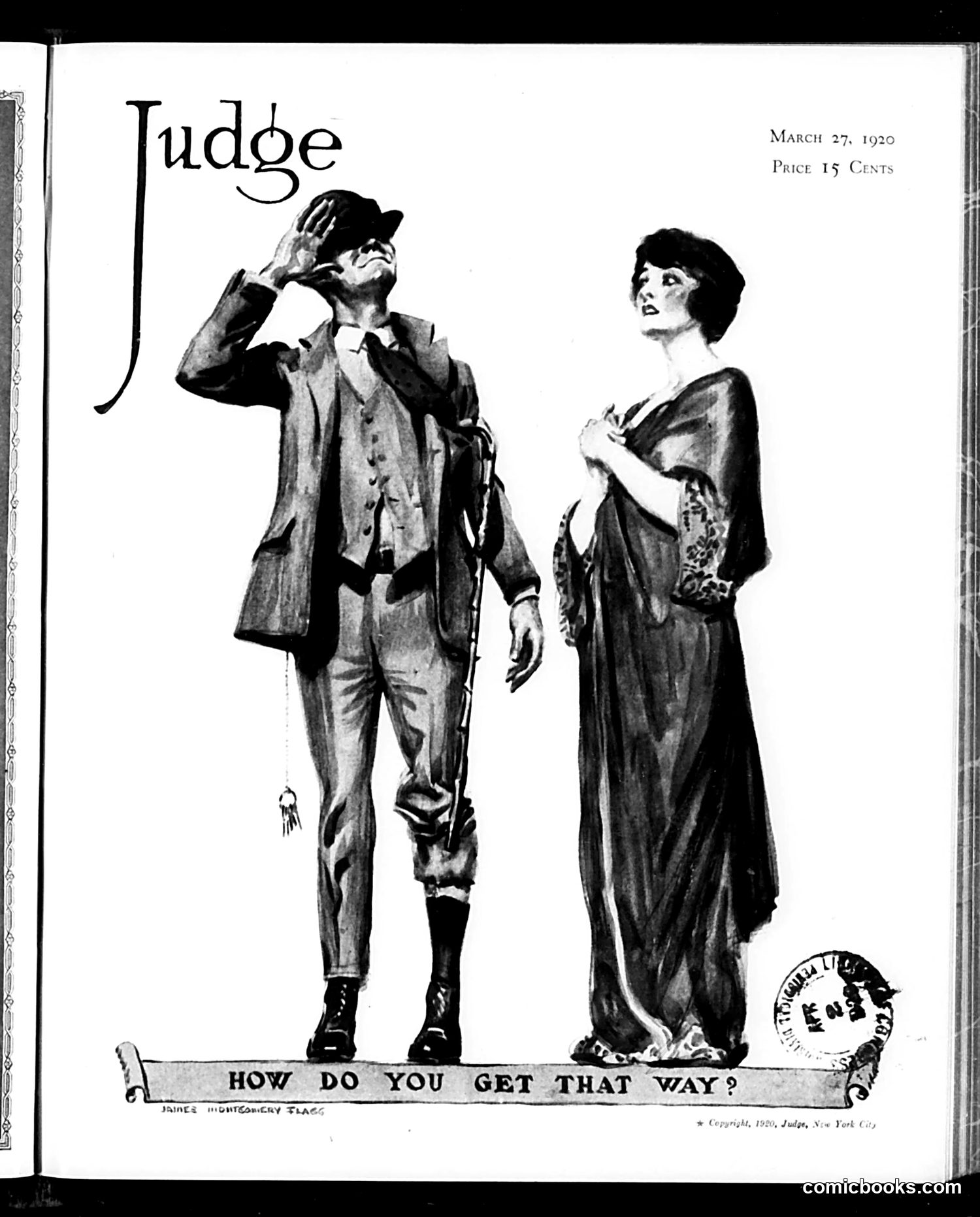
This Judge magazine cover from March 27, 1920, titled "How Do You Get That Way?" depicts a soldier in military uniform (appears to be World War I-era, given the 1920 date and style) gesturing upward in frustration or confusion, while a woman in an elegant robe stands beside him looking away. The cartoon likely satirizes the readjustment struggles of returning WWI veterans. The soldier's exasperated gesture and the title suggest commentary on either romantic complications post-war or the difficulty veterans faced reintegrating into civilian society and expectations. The woman's aloof demeanor may represent either romantic rejection or civilian indifference to soldiers' wartime experiences. This reflects 1920s anxieties about returning servicemen and social change.
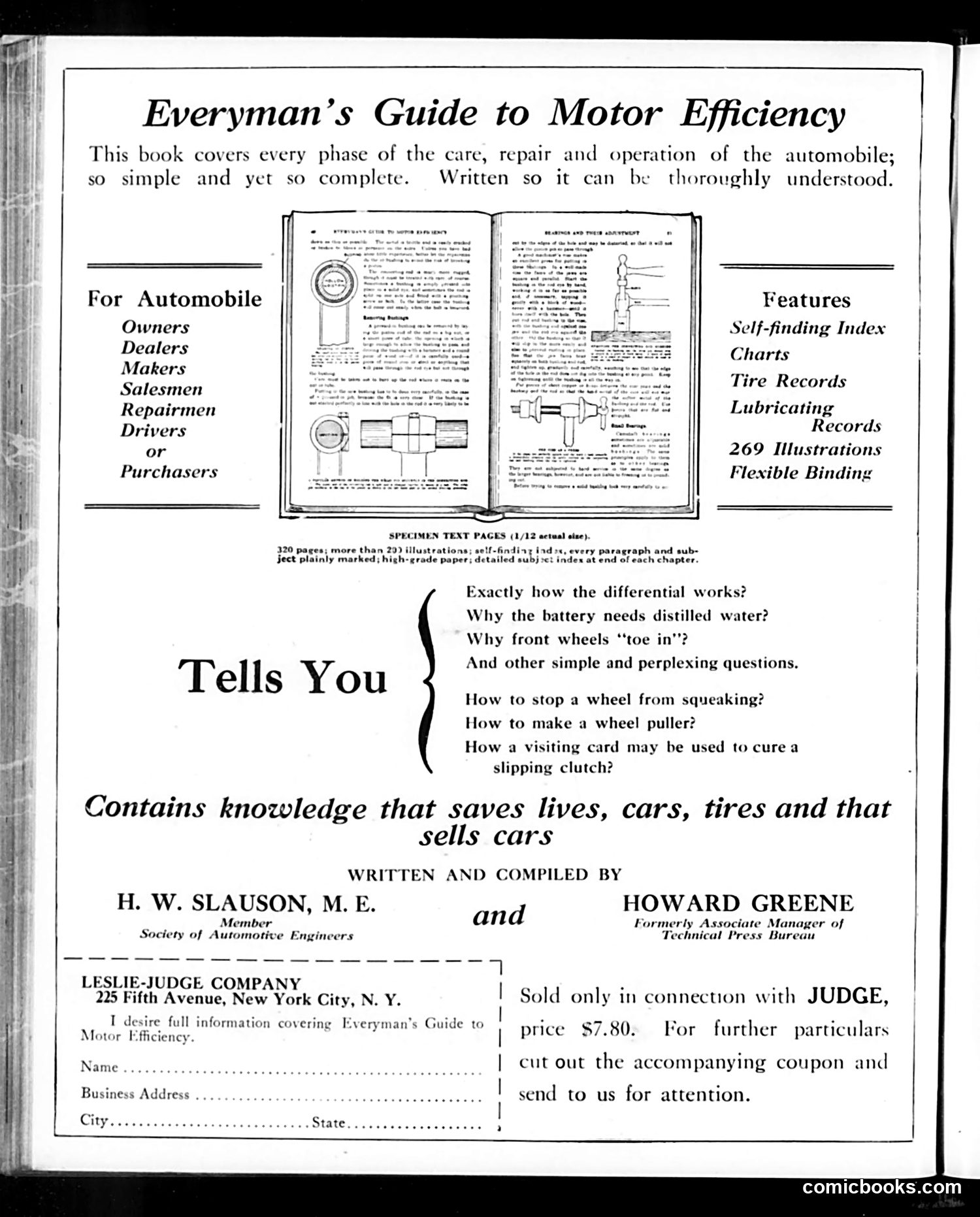
This page is primarily **advertising, not satire or political content**. It's a full-page advertisement for "Everyman's Guide to Motor Efficiency," a technical manual about automobile care and repair published by Leslie-Judge Company in New York. The ad targets various audiences (owners, dealers, salesmen, drivers) and highlights the book's practical features: 320 pages, 269 illustrations, self-finding index, and tire/lubrication records. It promises to answer common automotive questions like "Why does the battery need distilled water?" and "How to stop a wheel from squeaking?" The price was $7.80, sold exclusively through Judge magazine. This reflects Judge's era—likely early-to-mid 20th century—when automotive ownership was becoming widespread and technical guidance was commercially valuable.
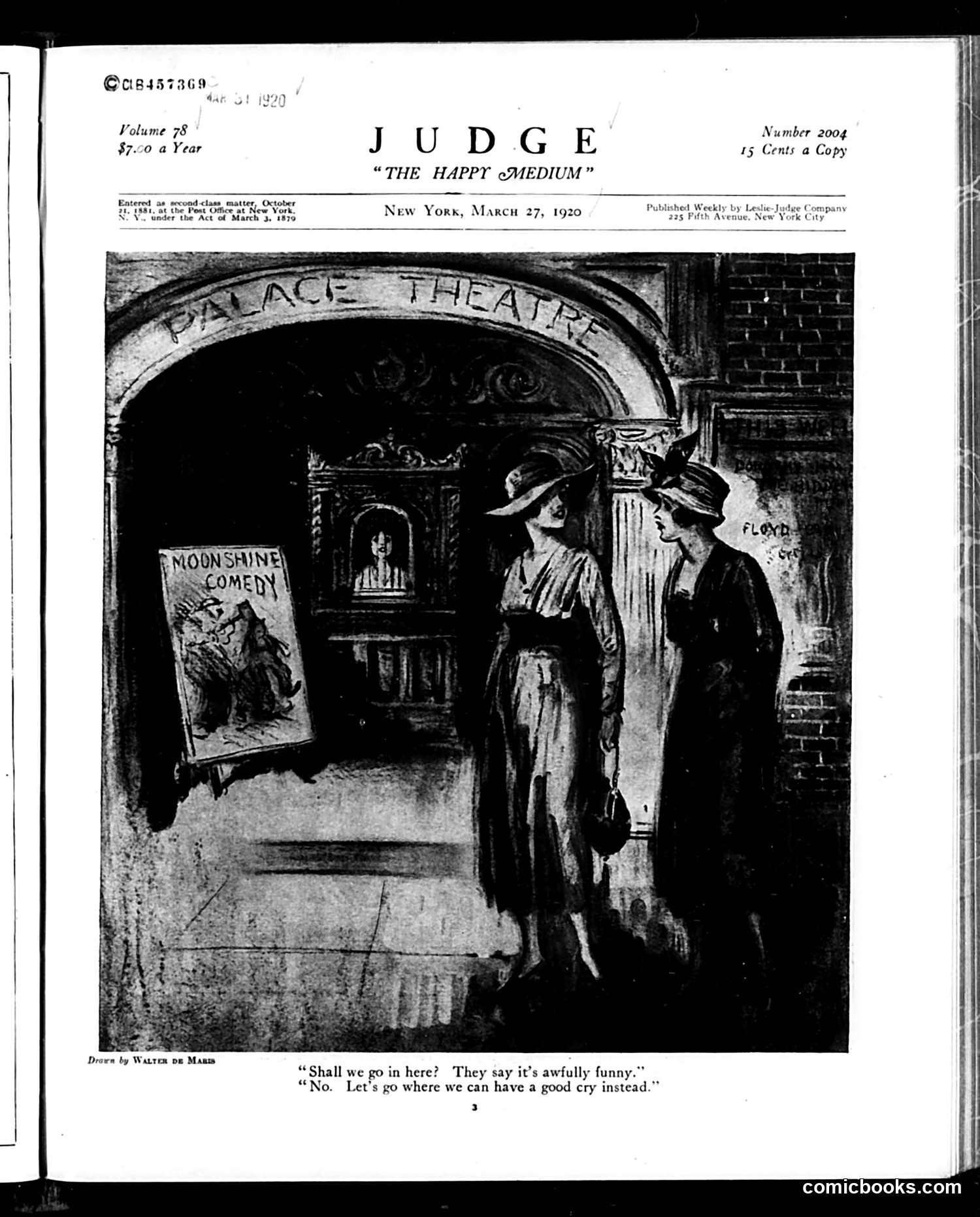
This is a satirical cartoon by Walter de Maris depicting two well-dressed people standing outside the Palace Theatre, considering whether to see "Moonshine Comedy." One person suggests they go elsewhere to "have a good cry instead," implying the film is so unfunny it's depressing. The joke likely references Prohibition (enacted January 1920), with "moonshine" being slang for illegally-distilled liquor. The cartoon satirizes either: (1) bad comedies made during Prohibition's early days, or (2) the absurdity of Prohibition itself as a source of dark humor rather than entertainment. The casual rejection of the theater suggests contemporary audiences found certain entertainment offerings disappointing during this period of social upheaval.
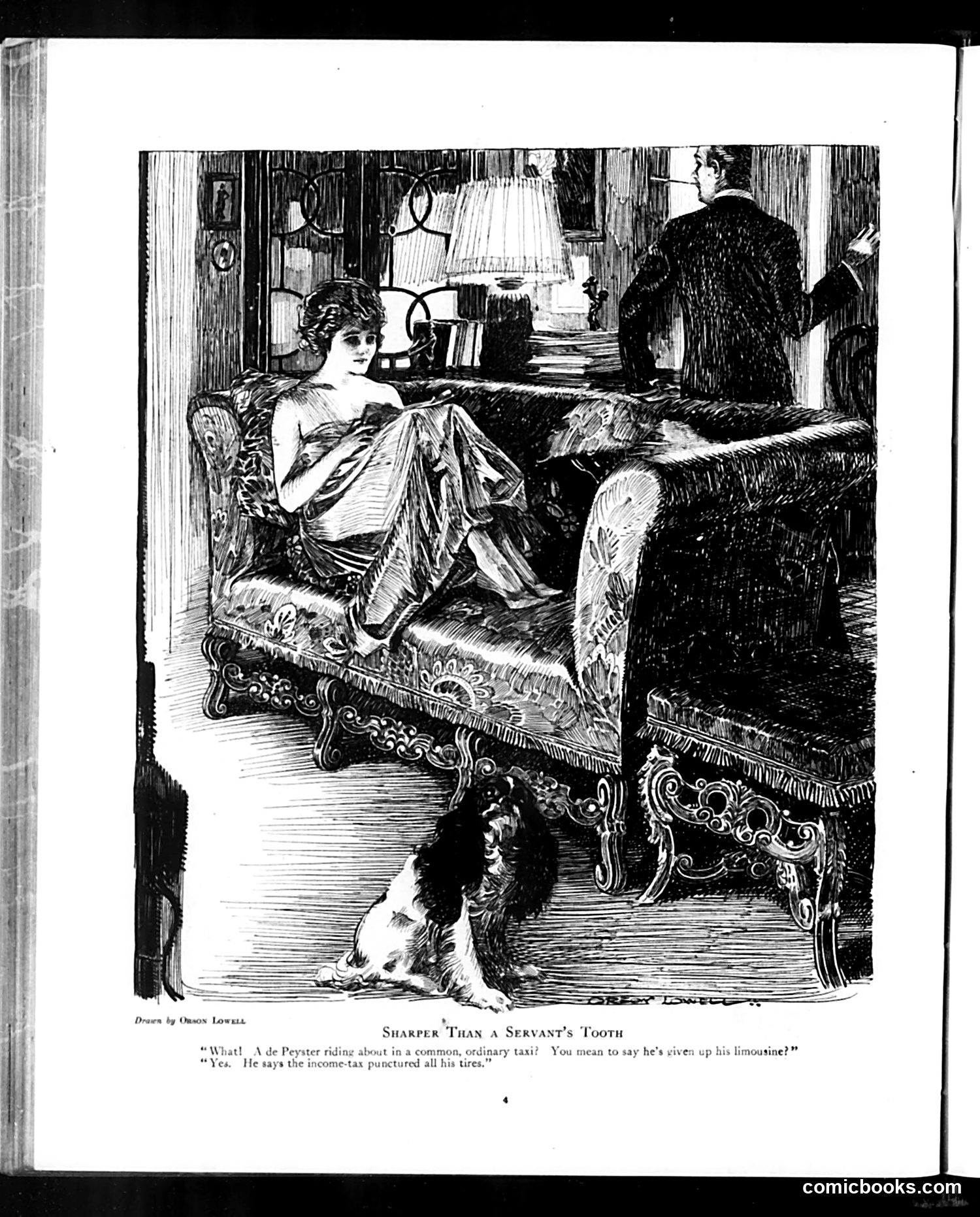
This cartoon satirizes wealthy leisure-class attitudes toward taxation and servants. The scene shows an elegantly dressed woman reclining on a sofa while a man stands in the background, apparently departing. The caption references "de Peyster riding about in a common, ordinary taxi" and jokes that he's "given up his limousine" because "the income-tax punctured all his tires." The humor targets the wealthy's complaints about income tax, personified as literal punctures destroying their luxurious automobiles—a metaphor for how taxation erodes their lifestyle. The small dog observing the scene adds domestic irony. The illustration mocks upper-class anxiety over newfound tax burdens, presenting their distress as trivial compared to servants' hardships (the proverb reference in the title).
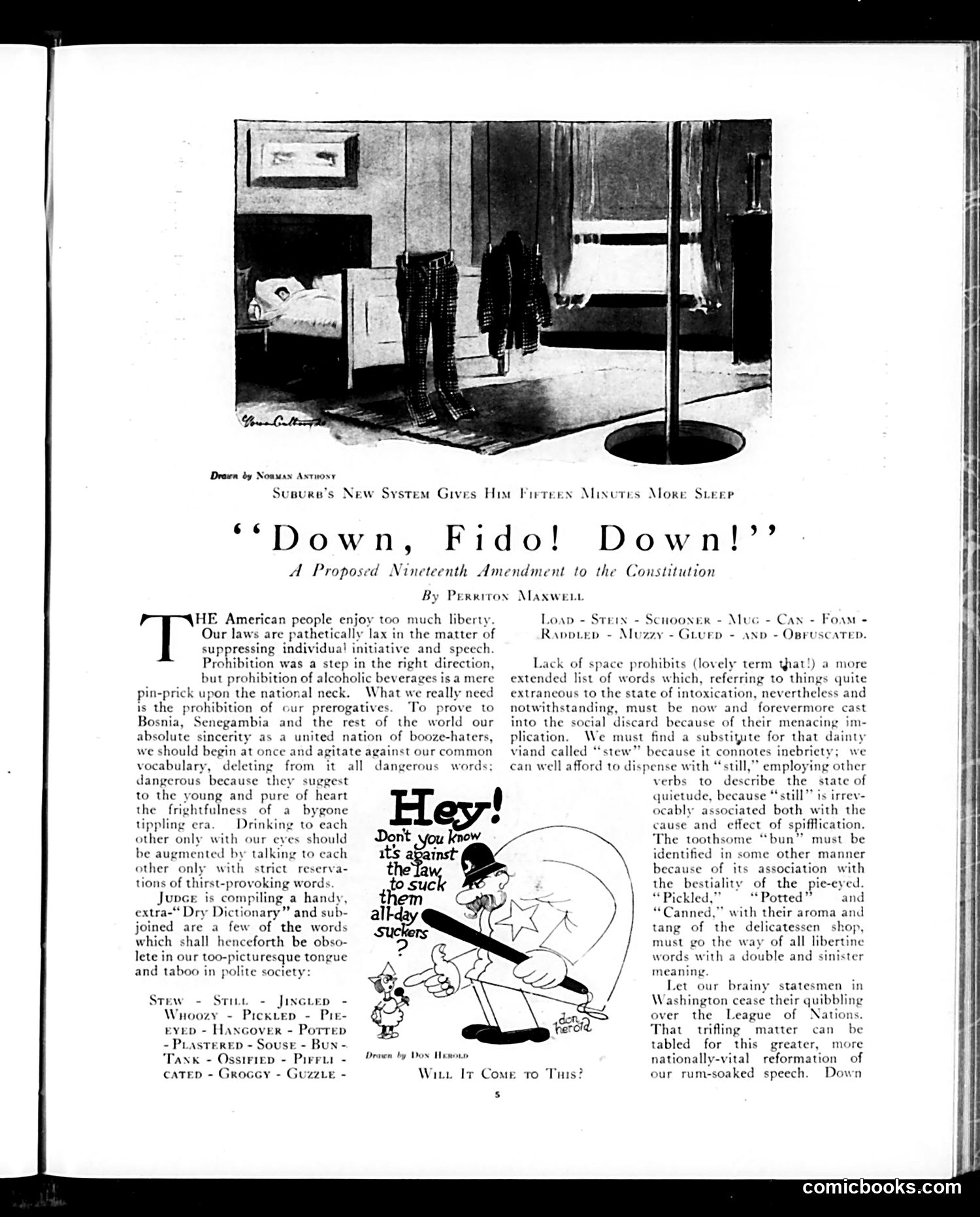
This satirical piece by Perriton Maxwell proposes a "Nineteenth Amendment to the Constitution" titled "Down, Fido! Down!" It mocks what the author sees as excessive American freedom of speech and press. The cartoon depicts a man commanding a dog labeled with various vulgar slang terms (depicted as a list in the text). The satire argues that Americans have too much liberty—particularly regarding "booze-haters" and their prohibition activism. Maxwell suggests that certain offensive words should be eliminated from common vocabulary to maintain national decorum. The piece is fundamentally conservative satire opposing Prohibition's advocates and criticizing censorship of language. The dog imagery positions uncontrolled speech and vulgarity as something that needs disciplining, reflecting anxieties about social propriety during the Prohibition era.
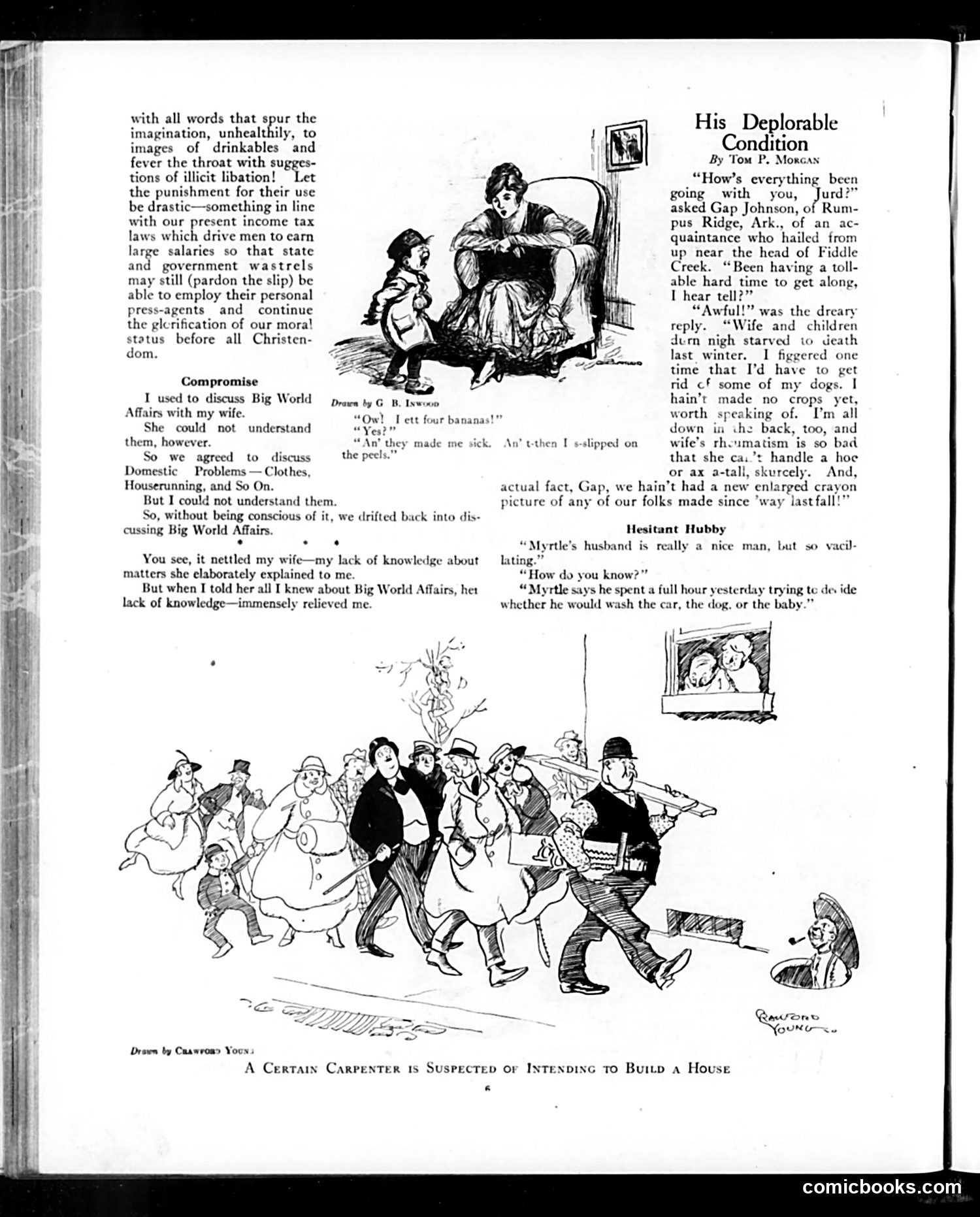
This page contains three distinct pieces of satirical content: **"His Deplorable Condition"** (right column): A dialogue between Gap Johnson and Jurd about rural hardship—starvation, crop failures, and inability to feed livestock. The satire targets rural poverty during what appears to be an agricultural crisis period. **"Compromise"** (left column): Commentary on marital compromise, where the author discusses "Big World Affairs" with his wife by reducing complex topics to domestic simplicity. The satire mocks both intellectual laziness and how serious matters get trivialized in casual conversation. **Lower cartoon**: "A Certain Carpenter Is Suspected of Intending to Build a House"—depicting what appears to be public suspicion or concern about construction plans, though the specific reference remains unclear without additional context. All three pieces employ Judge's characteristic satirical humor targeting contemporary social and economic conditions.
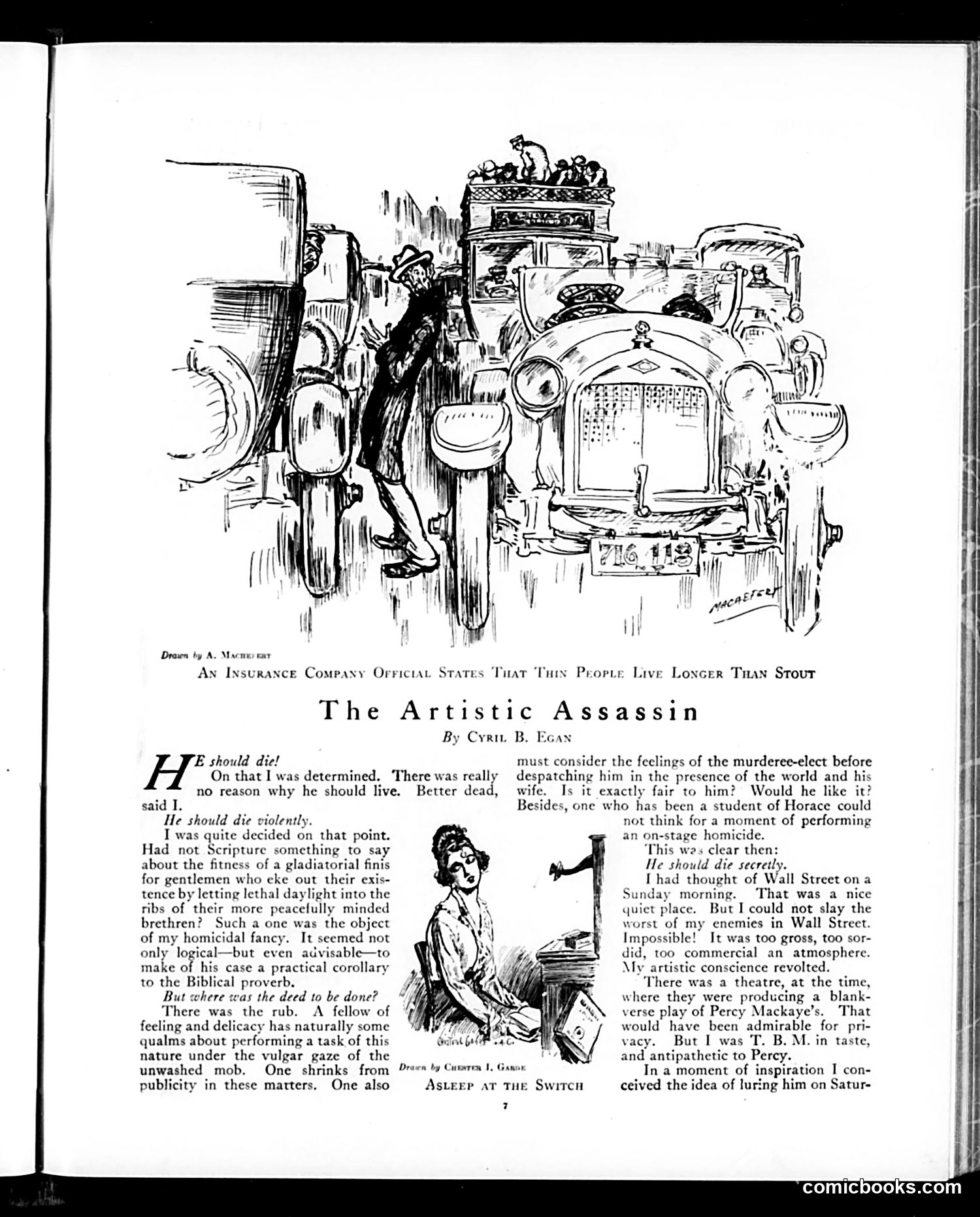
This is a satirical story by Cyril B. Egan about a narrator obsessed with murdering someone—likely a theatrical or literary rival—but paralyzed by aesthetic concerns rather than moral ones. The joke centers on the narrator's twisted priorities: he's determined to kill, but agonizes over *where* and *how* to do it artistically. He rejects Wall Street as "too commercial" and initially considers a Percy Mackaye play for privacy, before reconsidering due to taste. He references being "T. B. M. in taste" (unclear who this abbreviates), suggesting snobbish artistic pretension. The top cartoon shows crowded cars—likely mocking an insurance company's claim that certain people "live longer than Stout," implying the joke involves mortality or traffic accidents. The satire appears to mock the pretentious artistic world's self-absorbed concerns, where even murderous impulses must be filtered through refined sensibilities. It's dark comedy about bohemian affectation.
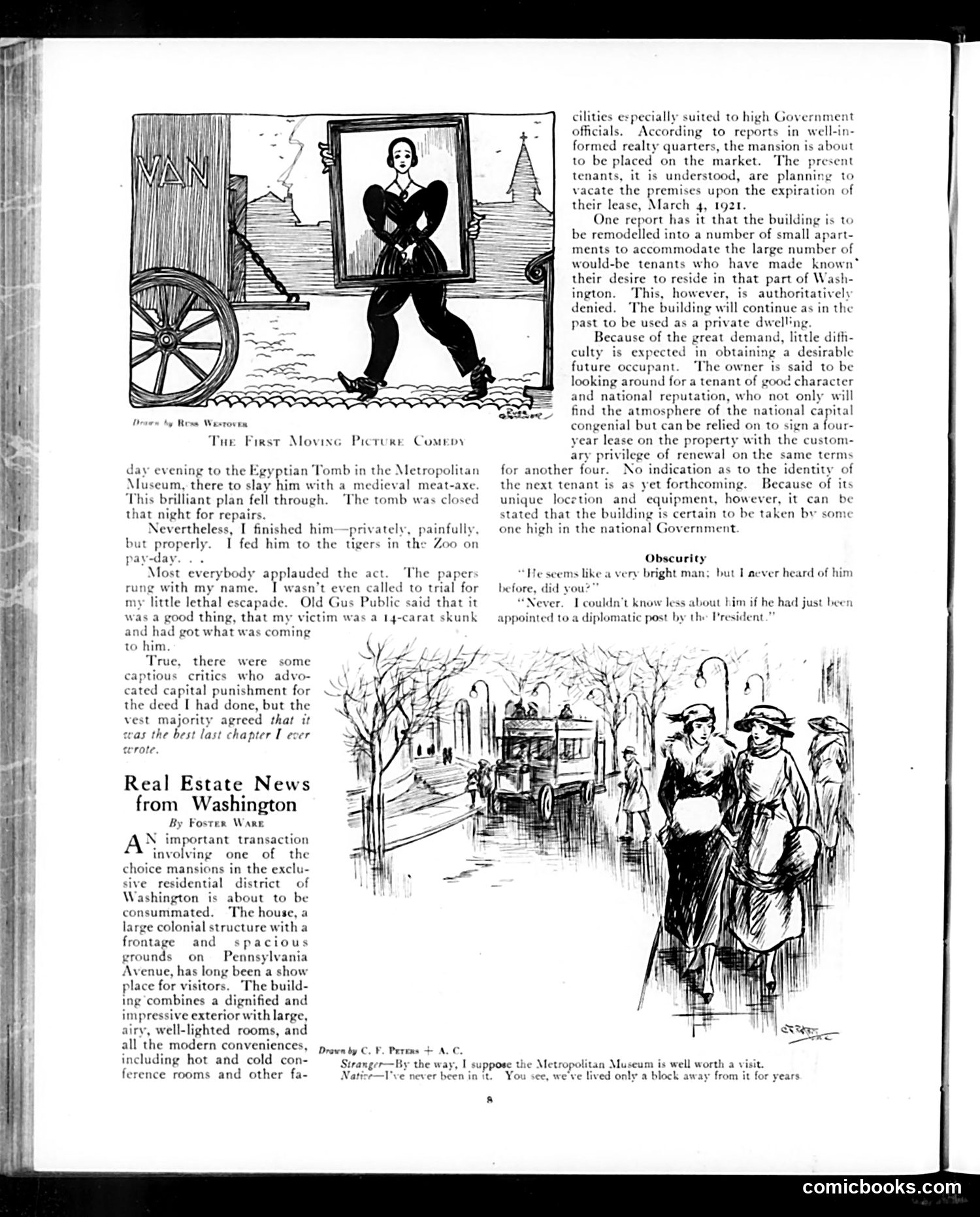
**Top Cartoon ("The First Moving Picture Comedy"):** A man carries a portrait of another man away in a wheelbarrow. The accompanying text describes the narrator murdering someone (feeding him to tigers at the zoo) and receiving public approval—a dark satire on vigilante justice and mob sentiment. The joke mocks how the public celebrated extrajudicial killing without trial. **Bottom Section - Real Estate News:** This is thinly-veiled political satire. The "important transaction" describes a "choice mansion" on Pennsylvania Avenue being vacated on March 4, 1921—the White House. The text jokes about the sitting president's lease expiring and the property being offered to a new tenant "high in the national Government." This references President Woodrow Wilson's final day in office (March 4, 1921), when Warren G. Harding would assume the presidency. The estate-speak disguises commentary on executive transitions. The lower cartoon about obscurity is unrelated social humor.
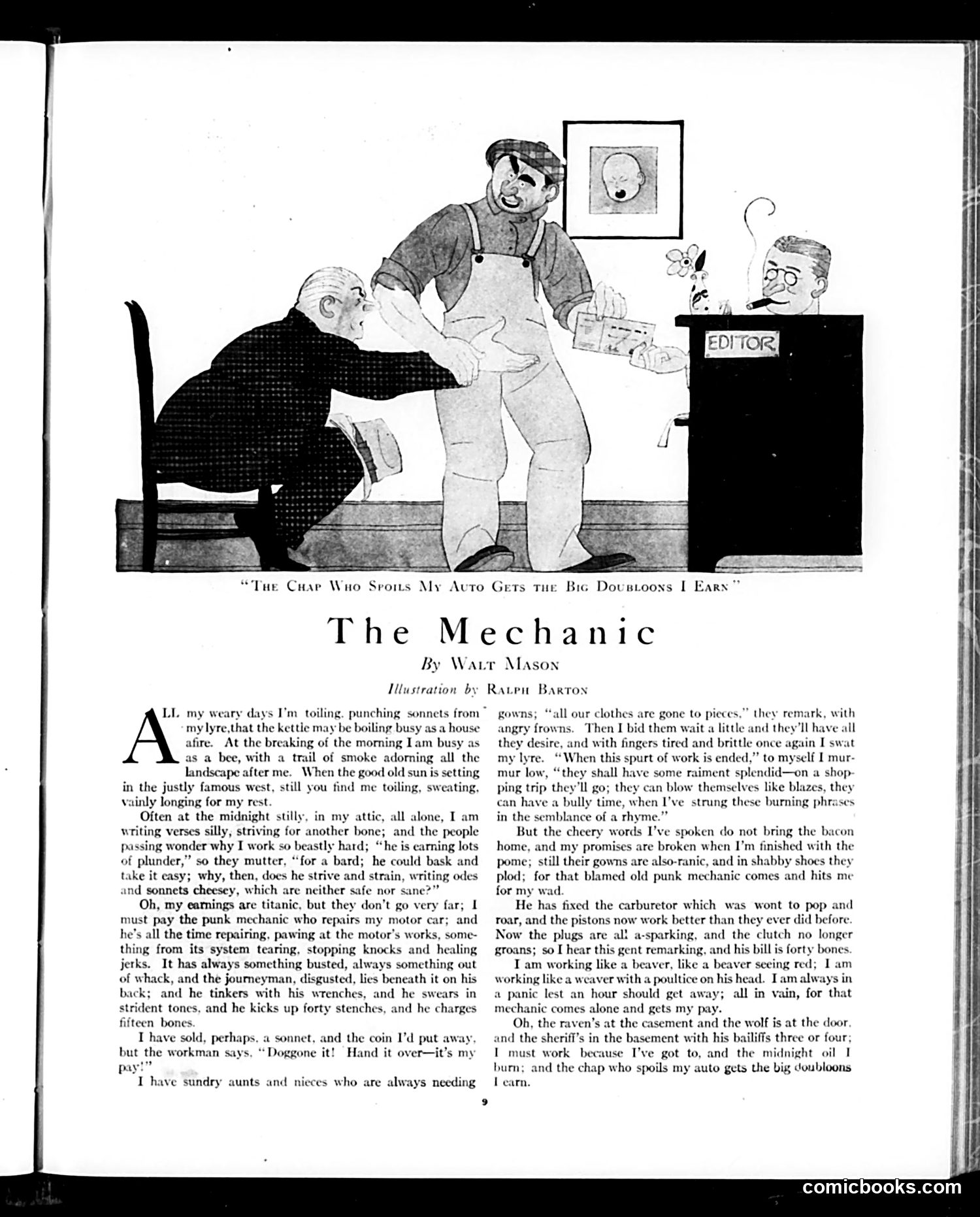
This is a humorous poem with accompanying cartoon, not political satire. The cartoon illustrates the written complaint: a weary poet/writer sits at his desk while a smiling mechanic stands nearby holding a bill, with an editor visible in the background. **The joke:** The narrator is a struggling writer who earns decent money from his work, but all his income gets consumed by an incompetent—or at least constantly-working—auto mechanic. His car perpetually breaks down, requiring expensive repairs. Meanwhile, his aunts and nieces need new clothes, creditors are at the door, and the sheriff awaits payment, yet the mechanic keeps extracting fees ("doubloons"). **The satire:** This reflects early-1900s frustration with the unreliability and high costs of automobile ownership—then a relatively new phenomenon. The mechanic becomes a comic villain, the modern equivalent of a parasitic drain on income, while the writer remains trapped toiling endlessly to support both his car and dependents.
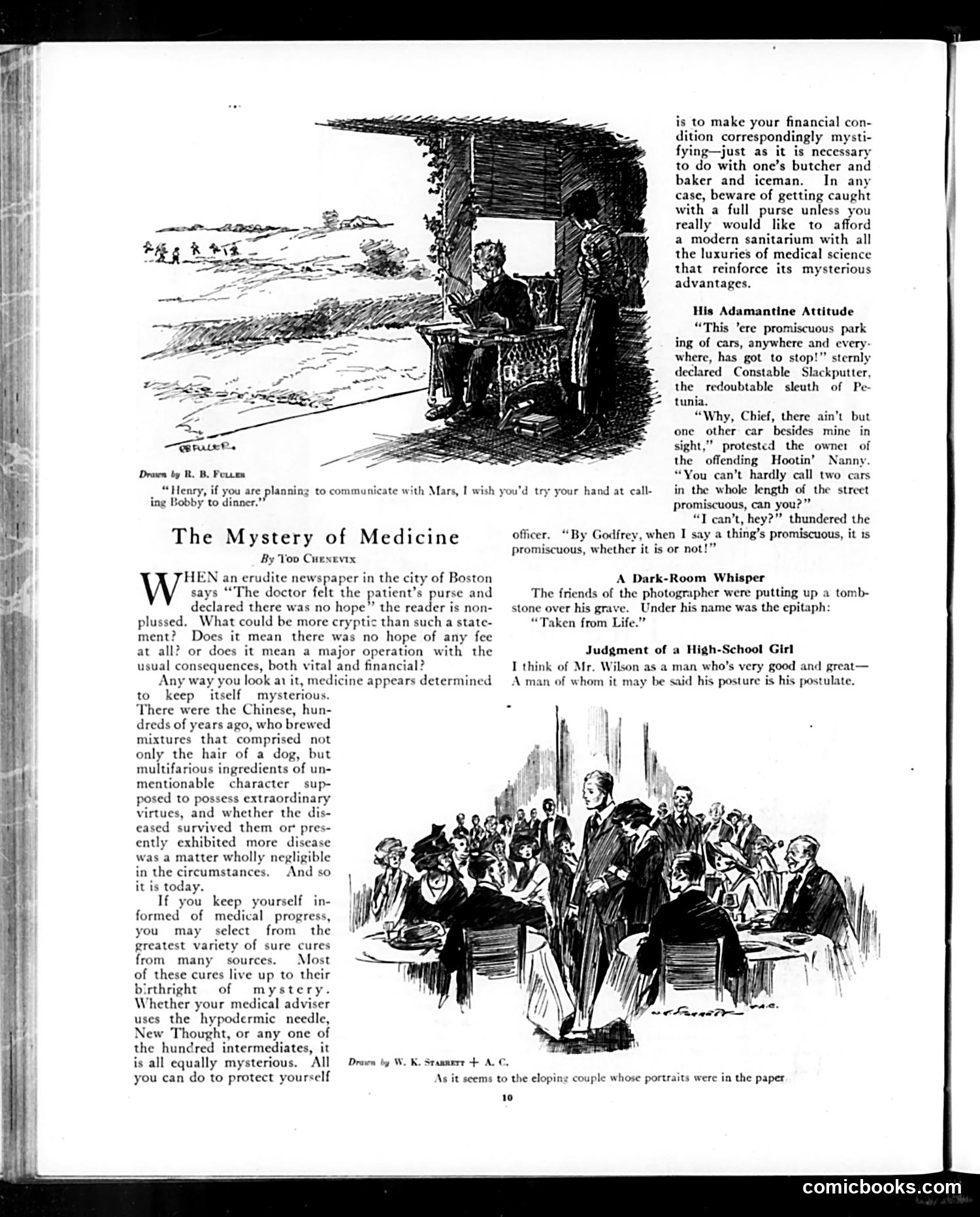
This page from *Judge* contains three satirical pieces: **"The Mystery of Medicine"** mocks doctors for deliberately obscuring their practices and finances. The Boston newspaper anecdote—"The doctor felt the patient's purse"—jokes that physicians diagnose based on ability to pay rather than actual illness. The essay satirizes medicine as inherently mysterious, comparing modern doctors to ancient Chinese practitioners who used dubious ingredients, arguing patients can't understand treatments anyway, so they should keep their finances equally opaque to protect themselves. **"His Adamantine Attitude"** ridicules an overzealous small-town constable (Slackputter in "Petunia") who declares two cars parked in a street "promiscuous" and refuses to listen to reason—illustrating foolish, inflexible authority. **"Judgment of a High-School Girl"** appears to reference President Wilson, praising his physical posture as representing his philosophical position—likely contemporary political commentary, though the specific context remains unclear. The page emphasizes satirizing institutional opacity and pompous authority figures.
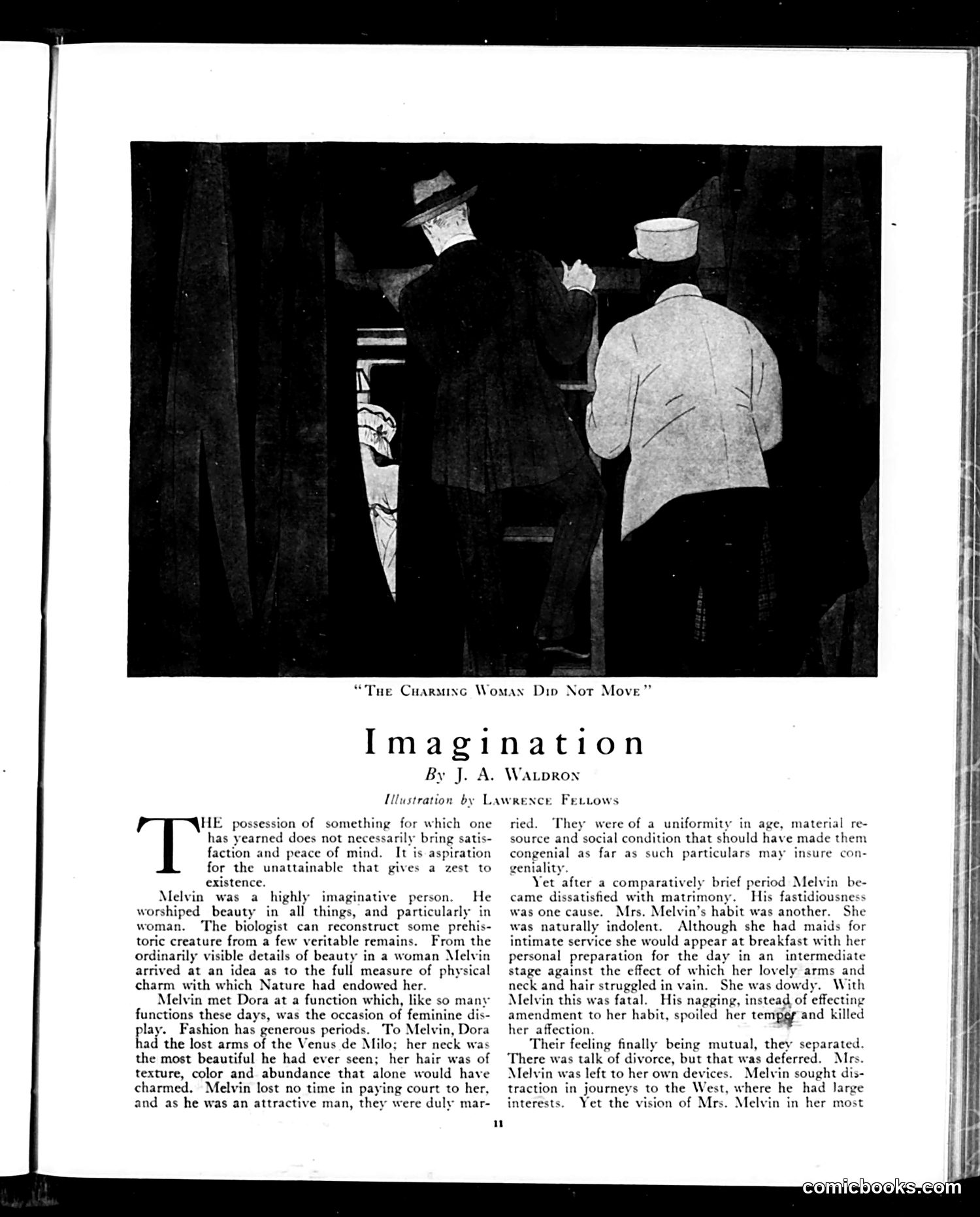
This satirical story critiques romantic idealization and marital disillusionment. Melvin obsesses over a woman (Dora) as an idealized fantasy—he reconstructs her beauty imaginatively, like a biologist reconstructing prehistoric creatures from fragments. Upon marrying her, reality disappoints: she's naturally lazy and appears at breakfast unkempt, lacking the "personal preparation" he demands. His constant criticism about her dowdiness damages their affection rather than improving her habits. They separate, though divorce is deferred. The caption "The Charming Woman Did Not Move" suggests she refuses to change to meet his impossible standards. The satire targets masculine fantasy-projection in courtship—men creating imaginary perfection rather than accepting actual women—and the inevitable collision between imagination and reality in marriage. It's a critique of both male fastidiousness and the gap between romantic aspiration and domestic life.
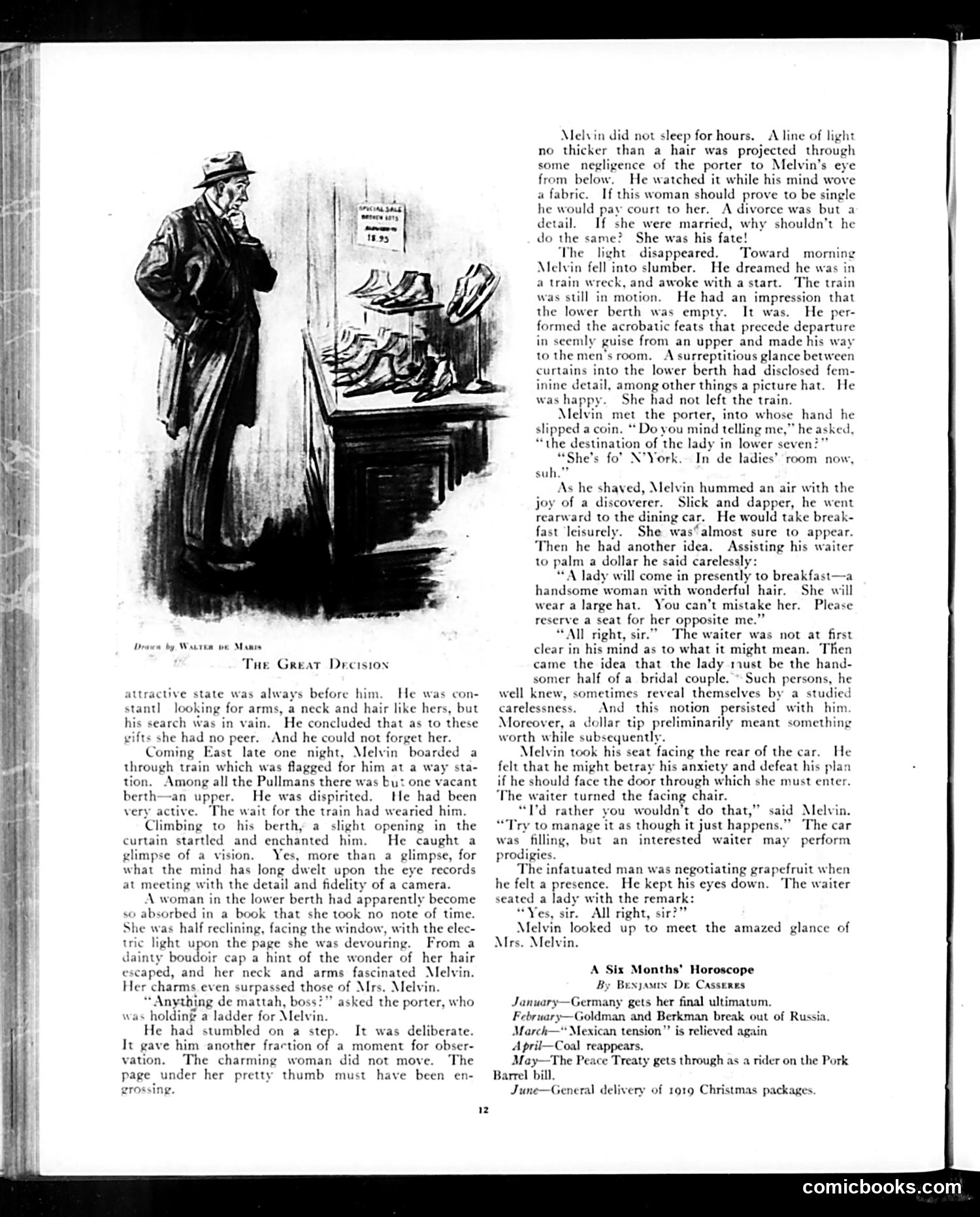
This illustrated story, drawn by Warren de Maris, depicts a married man named Melvin who becomes infatuated with an unknown woman on a train. Glimpsing her through her lower berth curtain—noticing her hair, neck, and arms—he fantasizes about pursuing her, rationalizing that if she's single, he'd court her; if married, he'd pursue her anyway since "she was his fate." The satire targets masculine entitlement and rationalization of infidelity. Melvin's casual willingness to abandon his marriage ("A divorce was but a detail") and his scheme to engineer a breakfast encounter with a stranger reveal the era's critique of male hypocrisy. The porter and waiter's misinterpretations—assuming the woman must be a bride—add ironic commentary on how society romanticizes such meetings while ignoring moral implications. The "great decision" is Melvin's internal justification for potential infidelity.
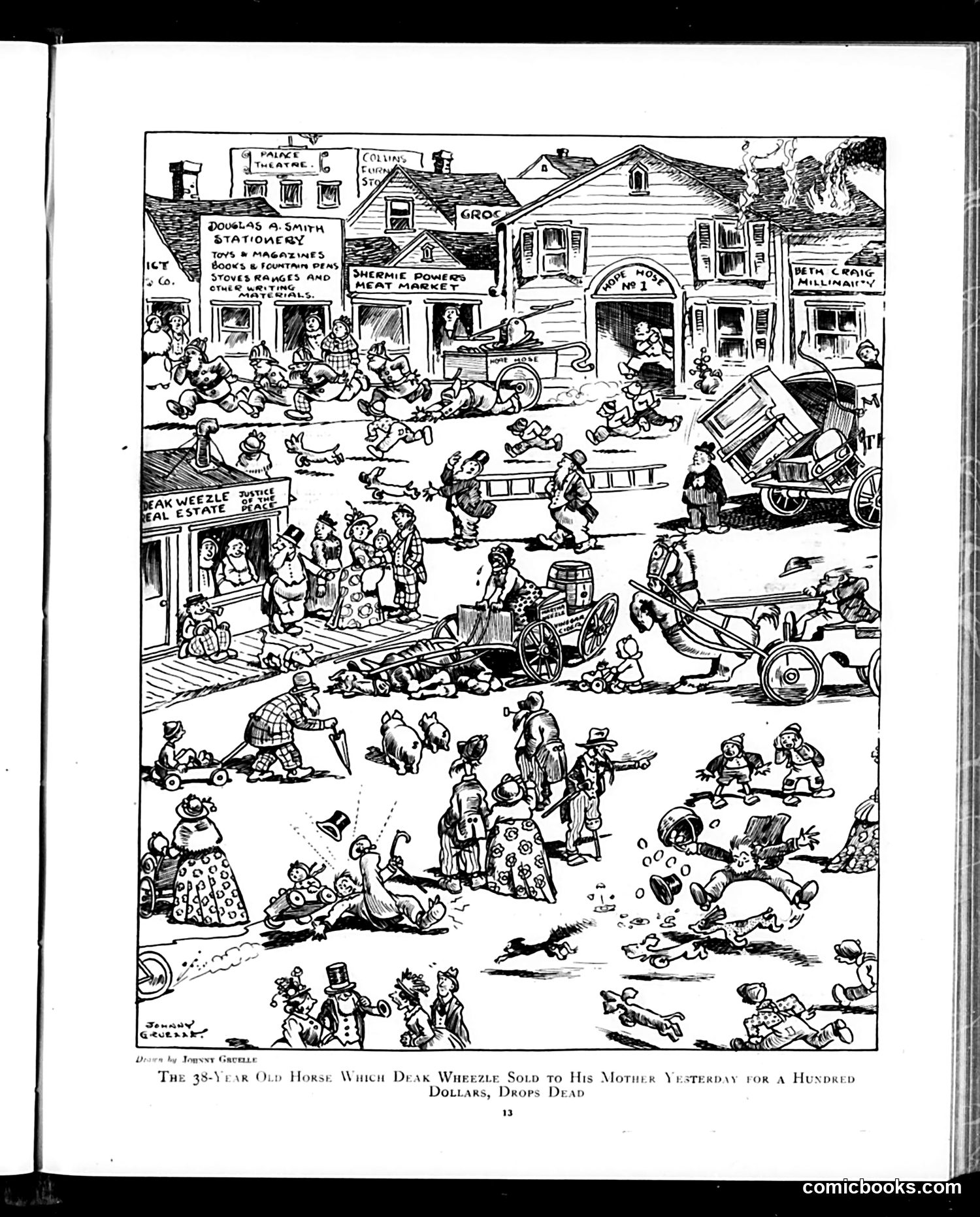
This is a crowded street scene satirizing urban life, likely from the early 20th century. The cartoon depicts a chaotic neighborhood with various businesses (butcher shop, stationery store, grocer) and abundant children and activity in the streets. The central joke, revealed in the caption, involves "Deak Wheezle," who sold his 38-year-old horse to his mother for a hundred dollars—and the horse promptly dropped dead. The satire mocks both the absurdity of the transaction and the gullible mother who purchased such a decrepit animal. This reflects period humor about urban poverty, shabby commerce, and family dynamics in working-class neighborhoods where people might genuinely try to profit from worthless goods. The detailed street scene establishes the setting as a tenement district where such shady dealings were apparently common enough to warrant satirical comment.
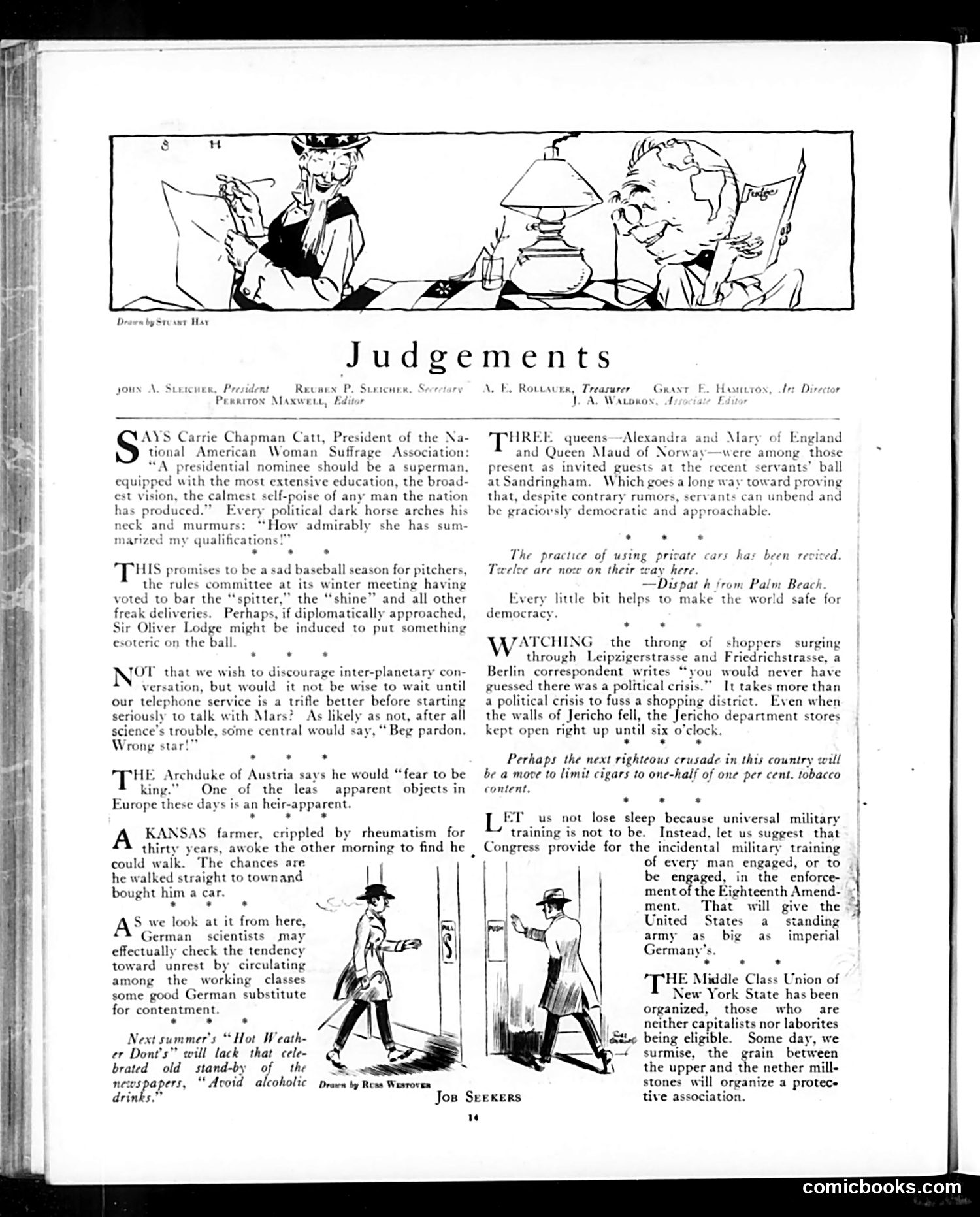
This page collects satirical editorial quips on contemporary political and social topics, typical of Judge's commentary format. **Key references:** - **Carrie Chapman Catt quote** on presidential qualifications: Satirizes the women's suffrage movement leader's standards as hilariously applicable to any mediocre candidate. - **Baseball "spitter" ban**: Mocks prohibition of trick pitches by suggesting even spiritualist Sir Oliver Lodge couldn't help. - **Archduke of Austria**: References the precarious European monarchy situation post-WWI instability. - **German scientists/contentment**: Jibes at German attempts to suppress working-class unrest through distraction. - **Royal servants' ball**: Notes three queens attending, suggesting even aristocracy embraces democracy. - **Berlin shopping during crisis**: Observes Germans prioritize commerce over politics. - **Prohibition reference** ("one-half of one per cent. tobacco"): Mocks the recent Eighteenth Amendment. - **Eighteenth Amendment enforcement**: Suggests military training enforcement officers would constitute a large standing army. The page satirizes both foreign and domestic politics through brief, punchy observations rather than developed cartoons.
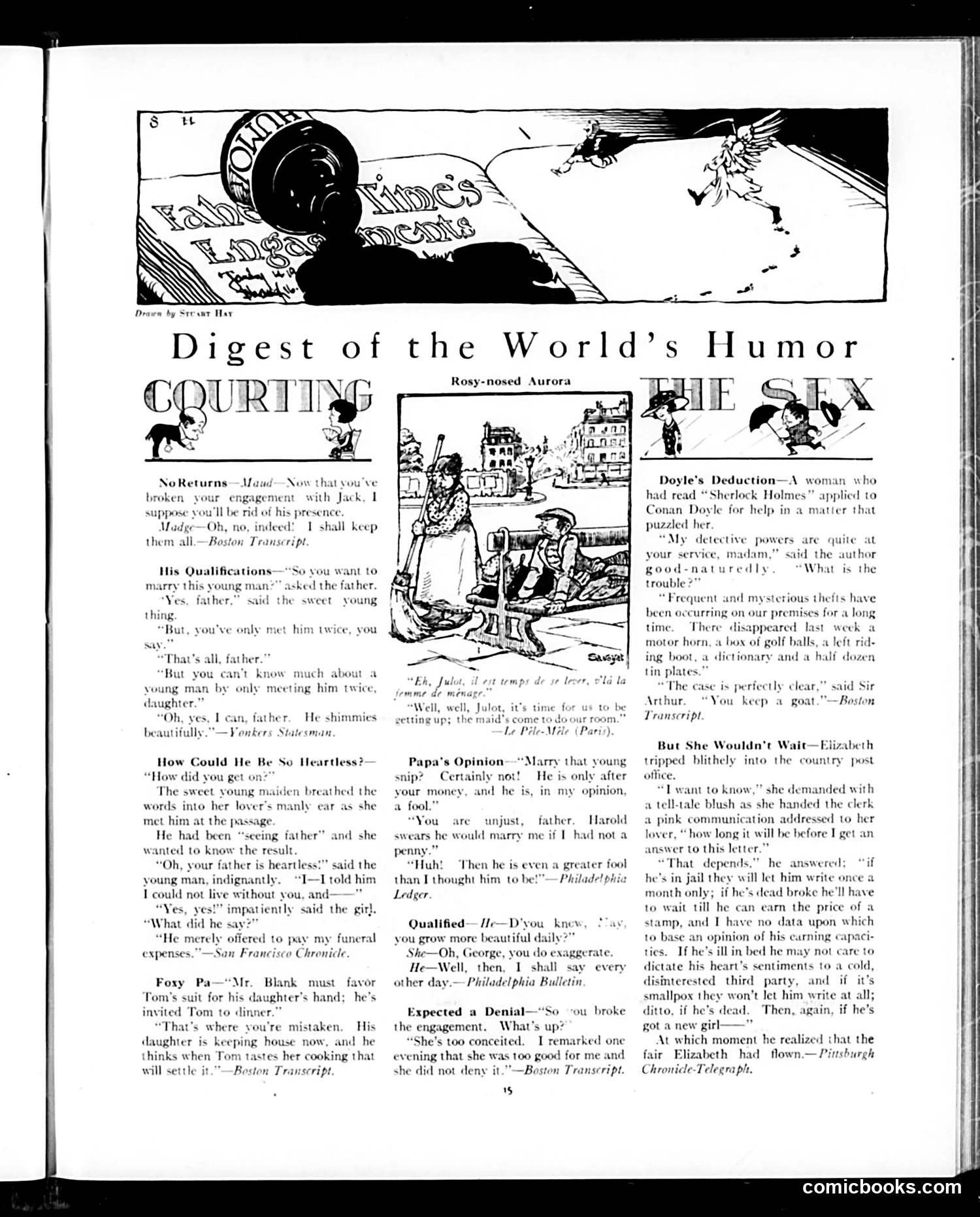
This page collects brief comedic anecdotes satirizing early 20th-century courtship, marriage, and gender relations. The jokes mock both romantic conventions and practical realities: **Key themes:** - **Mercenary motivations**: "Papa's Opinion" and "Expected a Denial" satirize men pursuing women for money and women's vanity - **Class anxiety**: "His Qualifications" mocks suitors judged solely on ability to "shimmy" (dance) - **Domestic practicality**: "Foxy Pa" suggests a woman's cooking ability matters more than romance - **Gender role absurdities**: "But She Wouldn't Wait" lampoons a woman's eagerness for a suitor's response, with the postmaster offering darkly comic scenarios (jail, poverty, illness, infidelity) - **Literary reference humor**: "Doyle's Deduction" jokes that Conan Doyle (creator of Sherlock Holmes) can deduce a goat from stolen items The cartoons rely on period-specific courtship rituals and assume male breadwinner/female homemaker dynamics. The humor targets romantic pretension and exposes the transactional nature underlying ostensibly romantic relationships.
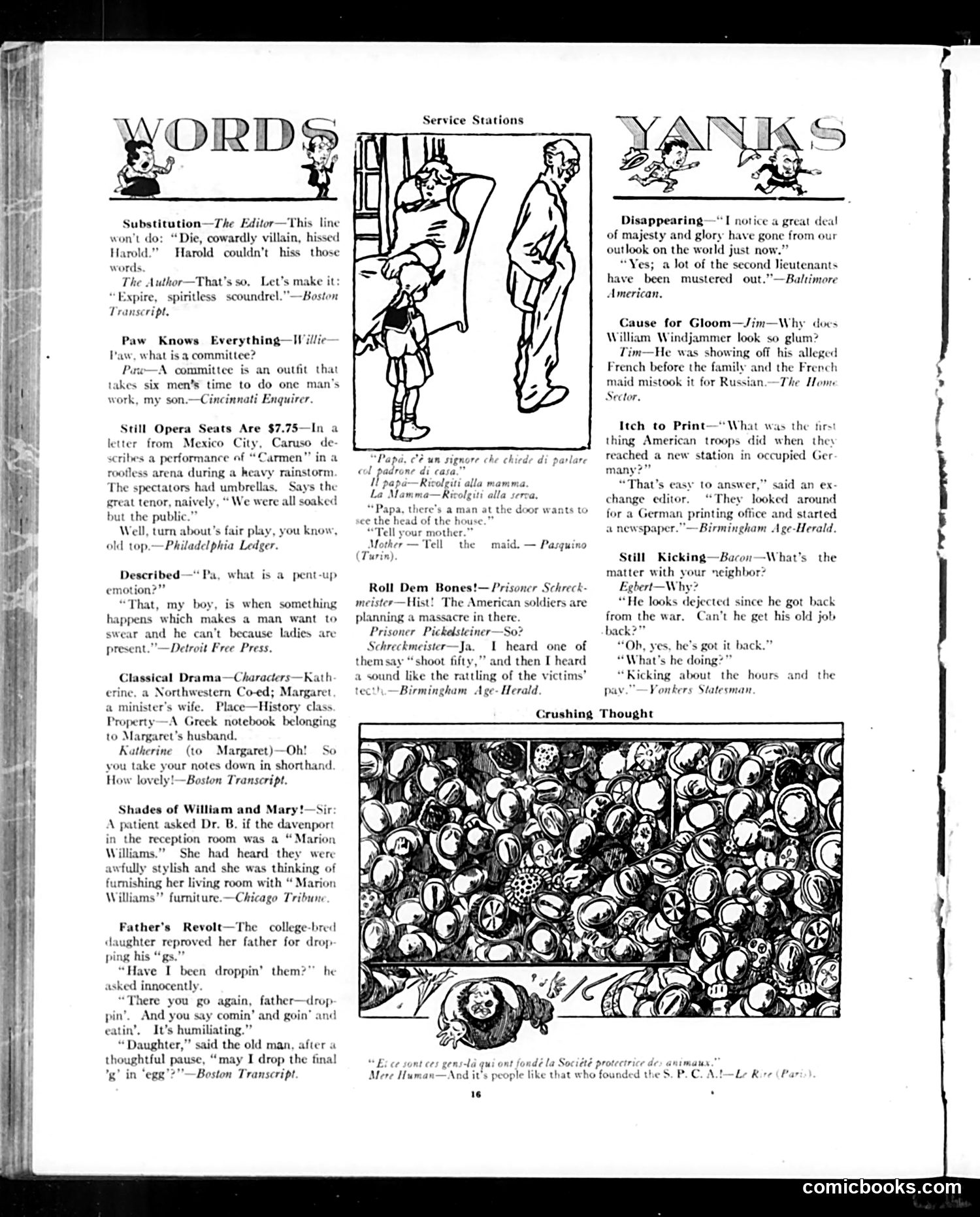
This page contains multiple short humor pieces typical of Judge's satirical format, likely from the WWI era based on references to American soldiers in occupied Germany. **Key Content:** The "Service Stations" section at top depicts interactions between military personnel and civilians—appearing to show soldiers receiving instructions or information. **Notable Pieces:** - "Roll Dem Bones" references American soldiers planning violence, with a German prisoner misinterpreting "shoot fifty" (likely dice game terminology) as a military threat—satire on language misunderstandings during occupation. - "Itch to Print" jokes that occupying American troops immediately sought German printing presses to start newspapers—mocking American soldiers' eagerness for familiar institutions. - "Disappearing" sarcastically notes that "majesty and glory" vanished when second lieutenants were discharged—cynical commentary on wartime military hierarchies. - Several domestic humor pieces ("Classical Drama," "Father's Revolt") target educated women and linguistic pretension among the middle class. The page is primarily **humorous editorial content** mocking military culture, German-American encounters, and American social manners—standard Judge fare blending gentle satire with wartime commentary.
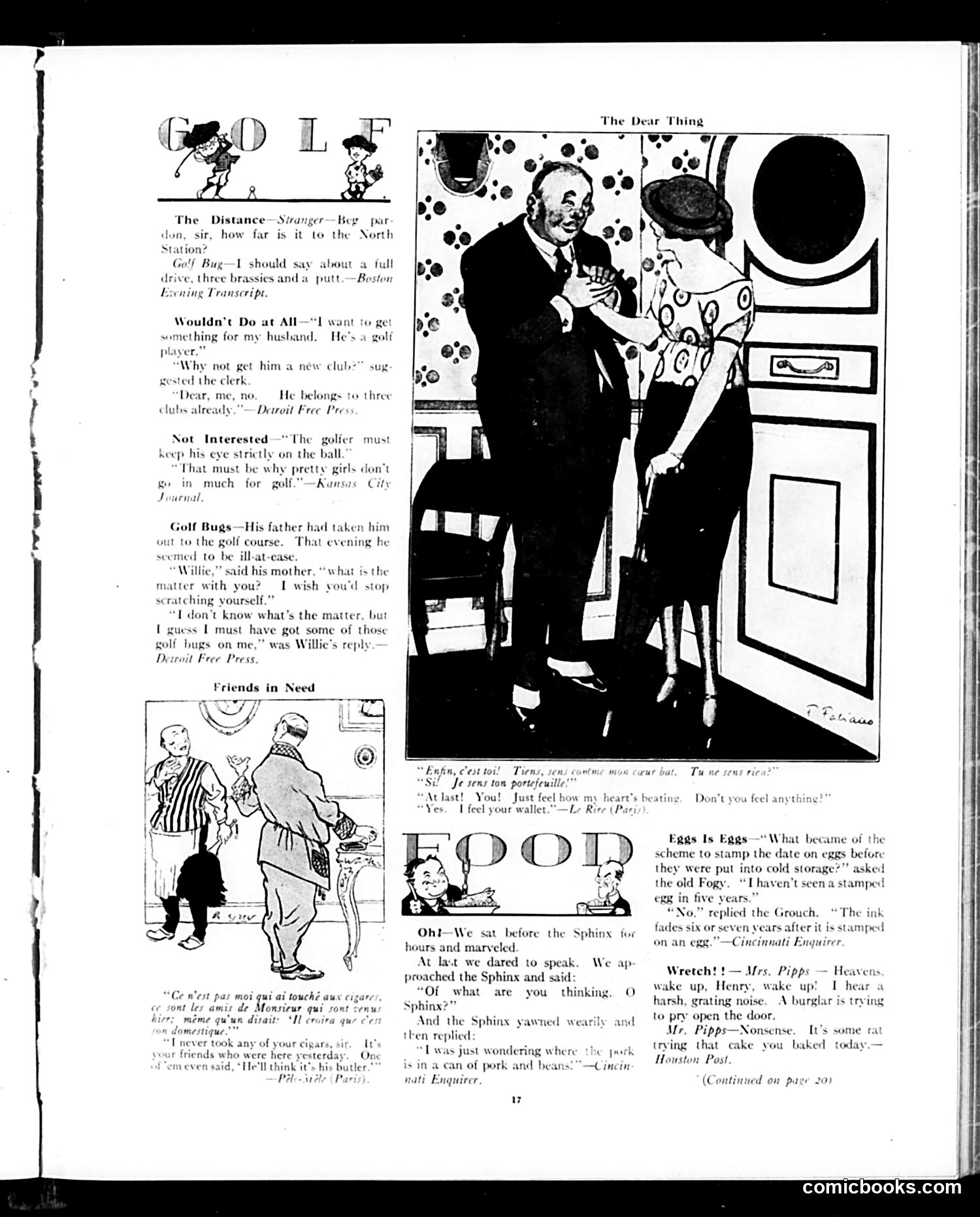
This page contains several short humorous anecdotes satirizing early 20th-century American society, centered on golf culture and domestic life. **"The Distance"** mocks the golf obsession of the era: a man answers directions using golf terminology (drives, brassies, putts) instead of actual measurements. **"Wouldn't Do at All"** satirizes both golf fanaticism and club exclusivity—a husband belongs to three clubs already, making a new golf club an inappropriate gift. **"Golf Bugs"** jokes about golf's parasitic hold on men, causing them to neglect family and scratch themselves like they have actual bugs. **"The Dear Thing"** (main cartoon) depicts a woman discovering her husband's infidelity through his wallet, while he deflects with romantic pretense—social commentary on male deception and materialism. **"Eggs Is Eggs"** and other brief items mock bureaucratic consumer protection schemes and marital misunderstandings about household matters. The overall satire targets golf's grip on male leisure time, consumer culture, and the gap between marital expectations and reality in the period.
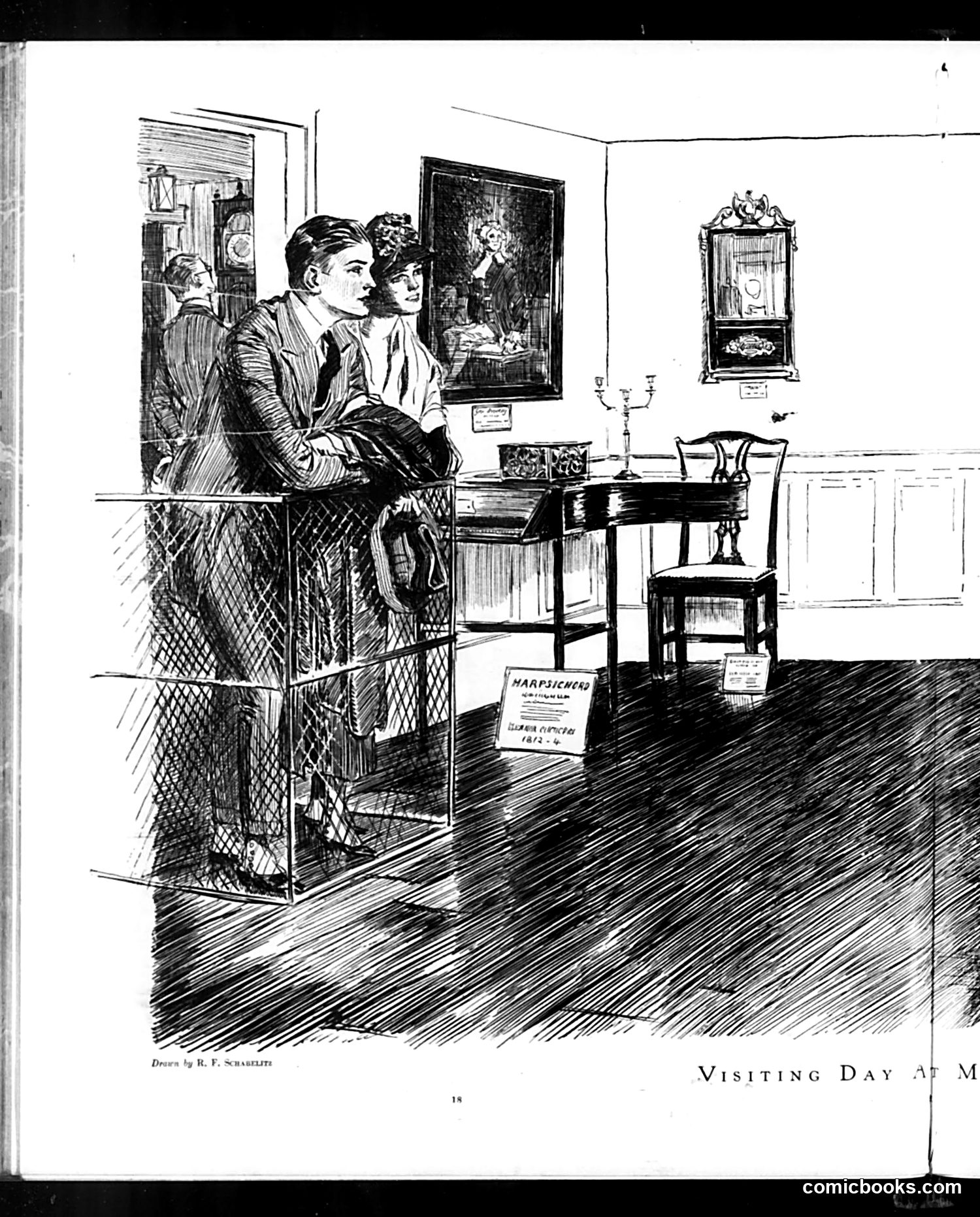
This is a pen-and-ink illustration by R. F. Schuetze depicting visitors in what appears to be a museum gallery. The scene shows well-dressed figures examining displayed artworks and decorative objects on pedestals and walls. The drawing style emphasizes the formal, cultured atmosphere of the institution through careful architectural detail and period clothing. The page title reads "VISITING DAY AT M[USEUM]" (text is cut off). Without additional context or visible satirical captions, the cartoon appears to be a straightforward social scene rather than political satire—depicting the genteel practice of museum-going as a respectable leisure activity, likely commenting on contemporary cultural life or social customs of Judge magazine's readership.
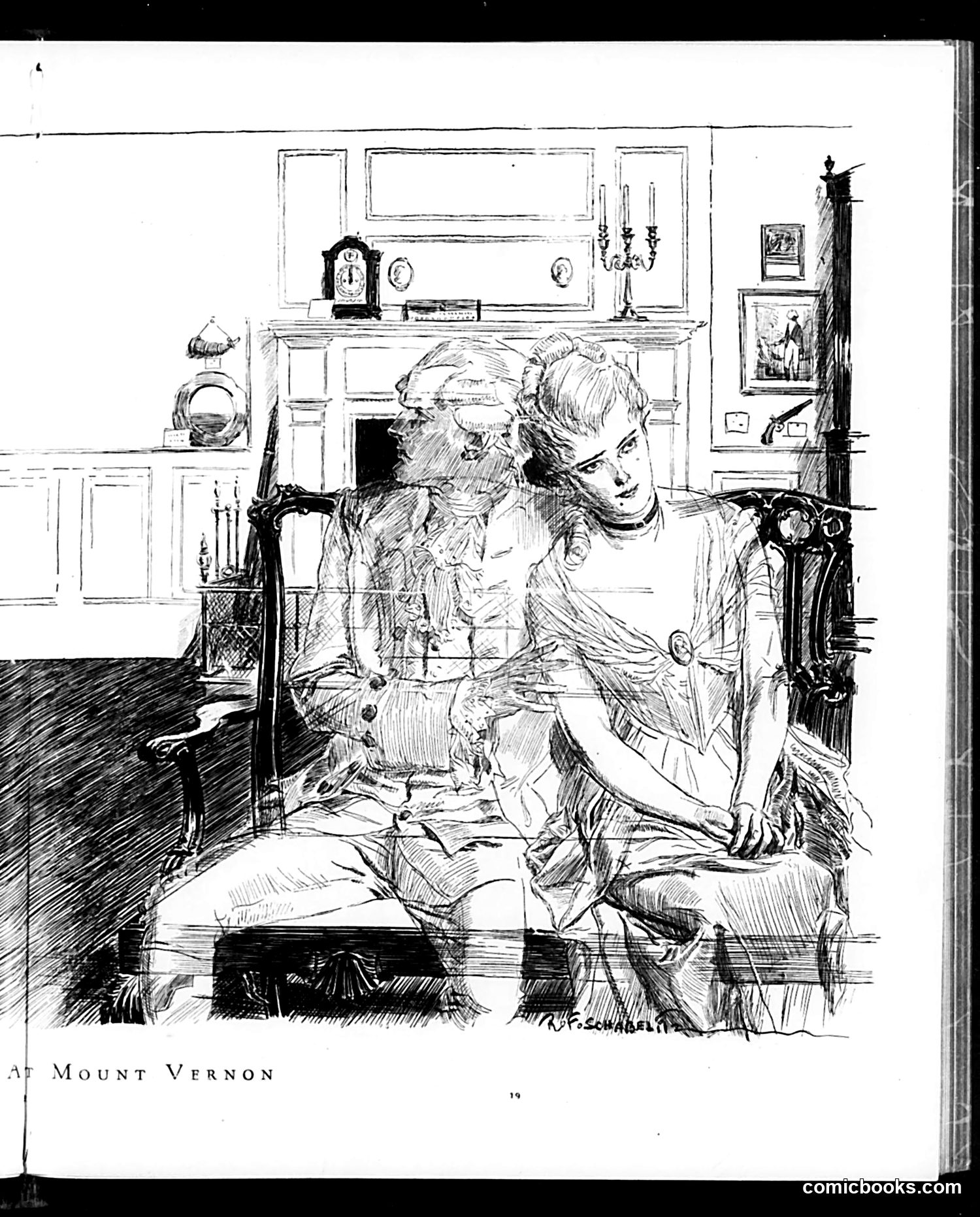
This pen-and-ink illustration depicts two figures in what appears to be a parlor at Mount Vernon (George Washington's estate). The drawing shows detailed period furnishings including a fireplace with mantelpiece, clock, candelabra, framed artwork, and period chairs. The specific political or social satire is unclear from the image alone without additional context or caption text. The sketch's style and inclusion in Judge magazine suggests it may comment on American history, tourism, or contemporary attitudes toward the nation's founding sites. However, without visible captions identifying the figures or explaining the joke, I cannot definitively state what point the cartoonist intended to make. The page number "19" suggests this is from a larger article or series about Mount Vernon.
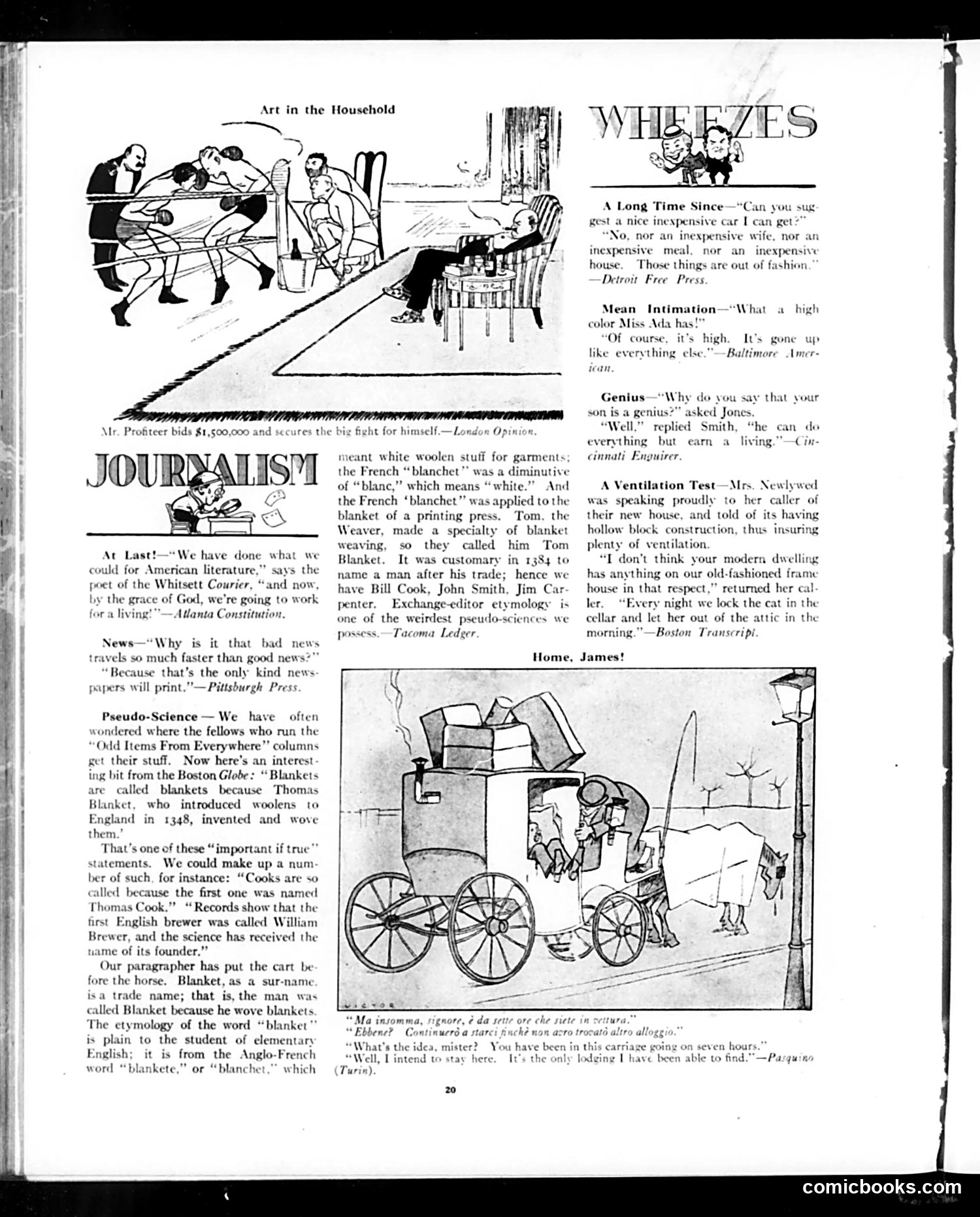
This is a humor/satirical page from *Judge* magazine containing several brief jokes and one cartoon about domestic life. The **top cartoon** ("Art in the Household") shows a boxing match occurring inside a home while someone relaxes in a chair—satirizing marital discord or domestic violence as entertainment, likely mocking the idea that rowdy behavior is acceptable "art" in one's household. The **text section** "Journalism" is a meta-joke mocking newspapers' "Odd Items From Everywhere" columns for printing false etymologies. The example claims blankets are named after a man called Thomas Blanket who invented them in 1348—deliberately backwards logic. The actual etymology is reversed: the fabric was called "blanchet" (French for white cloth), and the *man* was nicknamed after *the blanket weaving he did*, not vice versa. This satirizes how newspapers spread misinformation. The remaining brief **jokes** mock inflation, social pretension, and modern conveniences—typical early-20th-century domestic humor targeting middle-class anxieties about expense, status, and changing family dynamics.
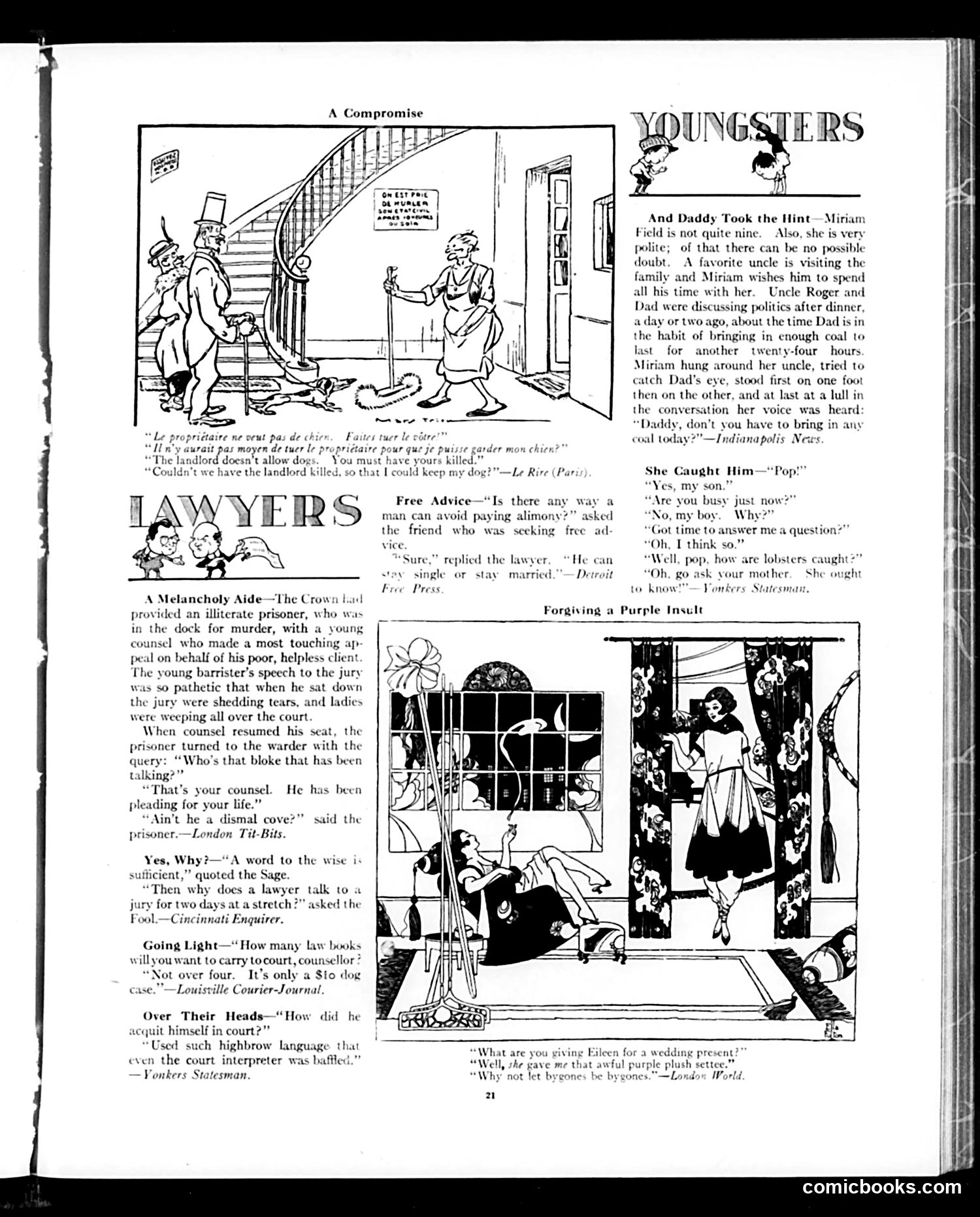
This page contains satirical humor pieces typical of early 20th-century American magazines, targeting legal and domestic life. **"A Compromise"** mocks French bureaucracy and absurd logic: a man wants to kill his landlord to keep his dog, since the landlord forbids pets—presenting an intentionally ridiculous "solution" to a minor problem. **"Lawyers" section** comprises several brief jokes satirizing the legal profession: lawyers' verbosity, high fees, incomprehensible jargon, and their tendency to charge for obvious advice (a man can avoid alimony by staying single or married—both impossible). **"Youngsters"** contains family humor: a child named Miriam tactfully hints her father should do chores (fetch coal) to leave her alone with her uncle; a father deflects his son's question about catching lobsters to the mother, implying she has "experience." The overall tone is light mockery of professional pretension and domestic dynamics, with no apparent political content or specific historical references beyond general critiques of lawyers' reputation.
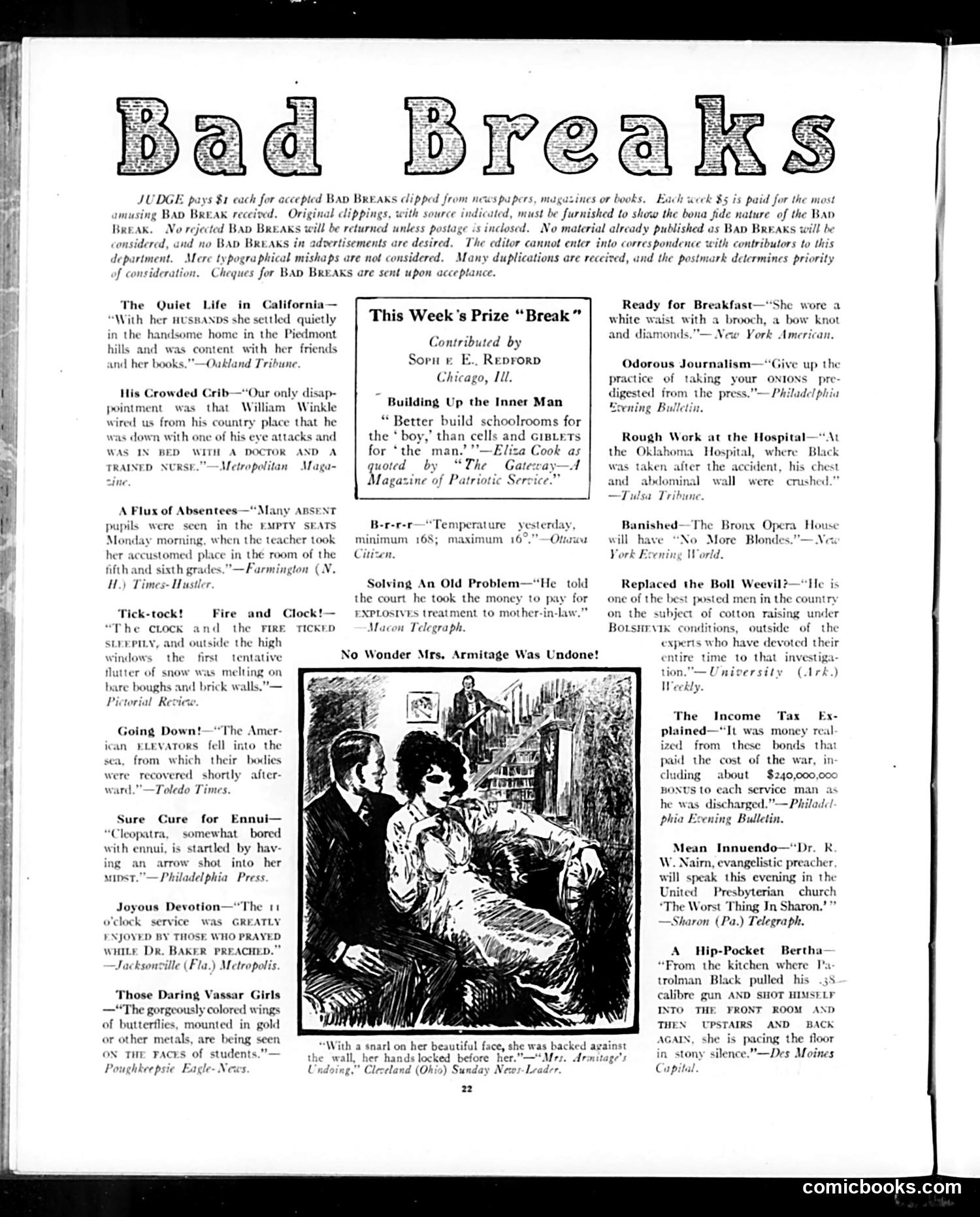
This page reprints "Bad Breaks"—unintentional newspaper typography errors from various publications. These are jokes about proofreading failures, not political cartoons. The central illustration shows a man and woman against a wall with a cityscape, captioned from an Ohio newspaper report about a woman "backed against the wall, her hands locked before her." The humor comes from how the source newspaper phrased its crime reporting awkwardly. The bulk of the page collects examples like temperature reading as "minimum 168" instead of 68, or "American ELEVATORS fell into the sea" when meant as a ship's name. Each "break" relies on readers catching how embarrassing typos or careless editing created unintended meanings in serious news and commentary. This was a popular Judge magazine feature—readers submitted clipping for payment, making it participatory humor mocking journalistic incompetence rather than offering political or social satire.
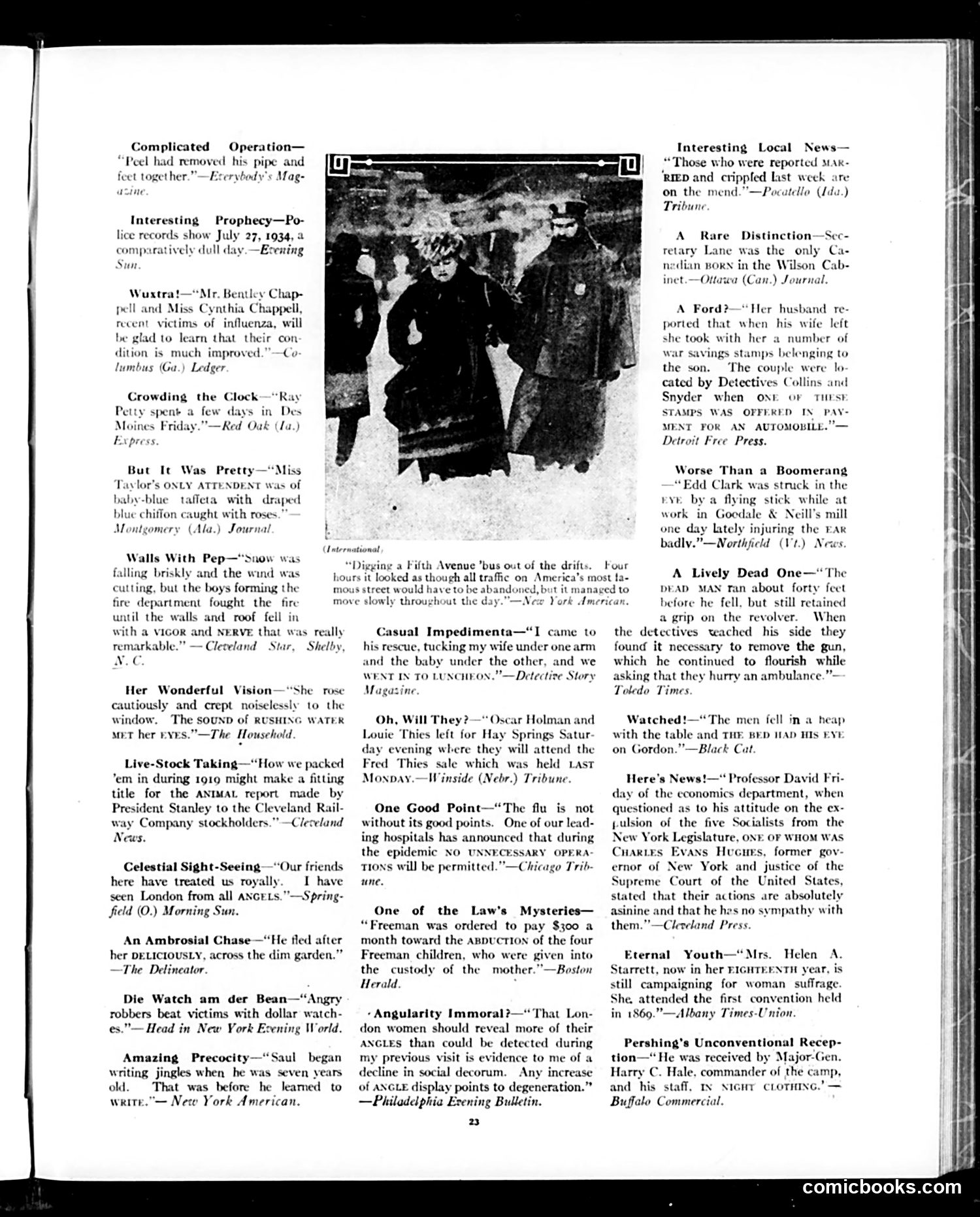
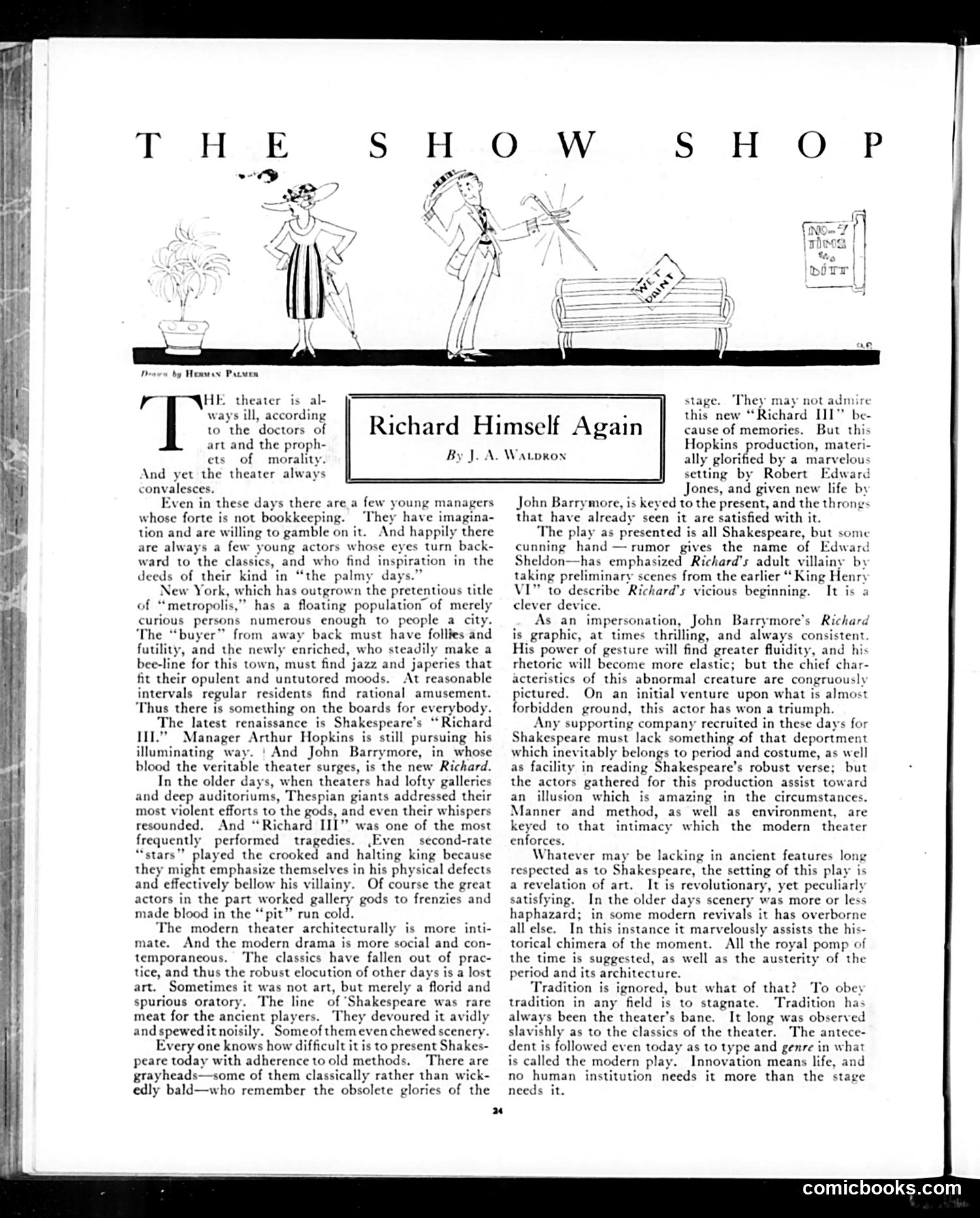
This page contains an illustrated header and a theater review essay by J.A. Waldron about John Barrymore's 1920 production of Shakespeare's *Richard III*, directed by Arthur Hopkins with set design by Robert Edward Jones. The cartoon header depicts a stylized "Show Shop" with fashionable figures, a potted plant, and a bench—representing the modern theatrical world. The review discusses how Shakespeare productions have evolved from the old era of grand theatrical performance (when actors bellowed to gallery audiences) to the contemporary "intimate" modern theater. Waldron praises Barrymore's portrayal of Richard as "graphic" and "consistent," noting that a clever dramaturgical device—incorporating scenes from *Henry VI* (rumored by playwright Edward Sheldon)—emphasizes Richard's villainy from the start. The essay celebrates this production as successfully bridging classical Shakespeare with modern sensibilities, even while acknowledging contemporary actors lack the vocal training and period expertise of their predecessors.
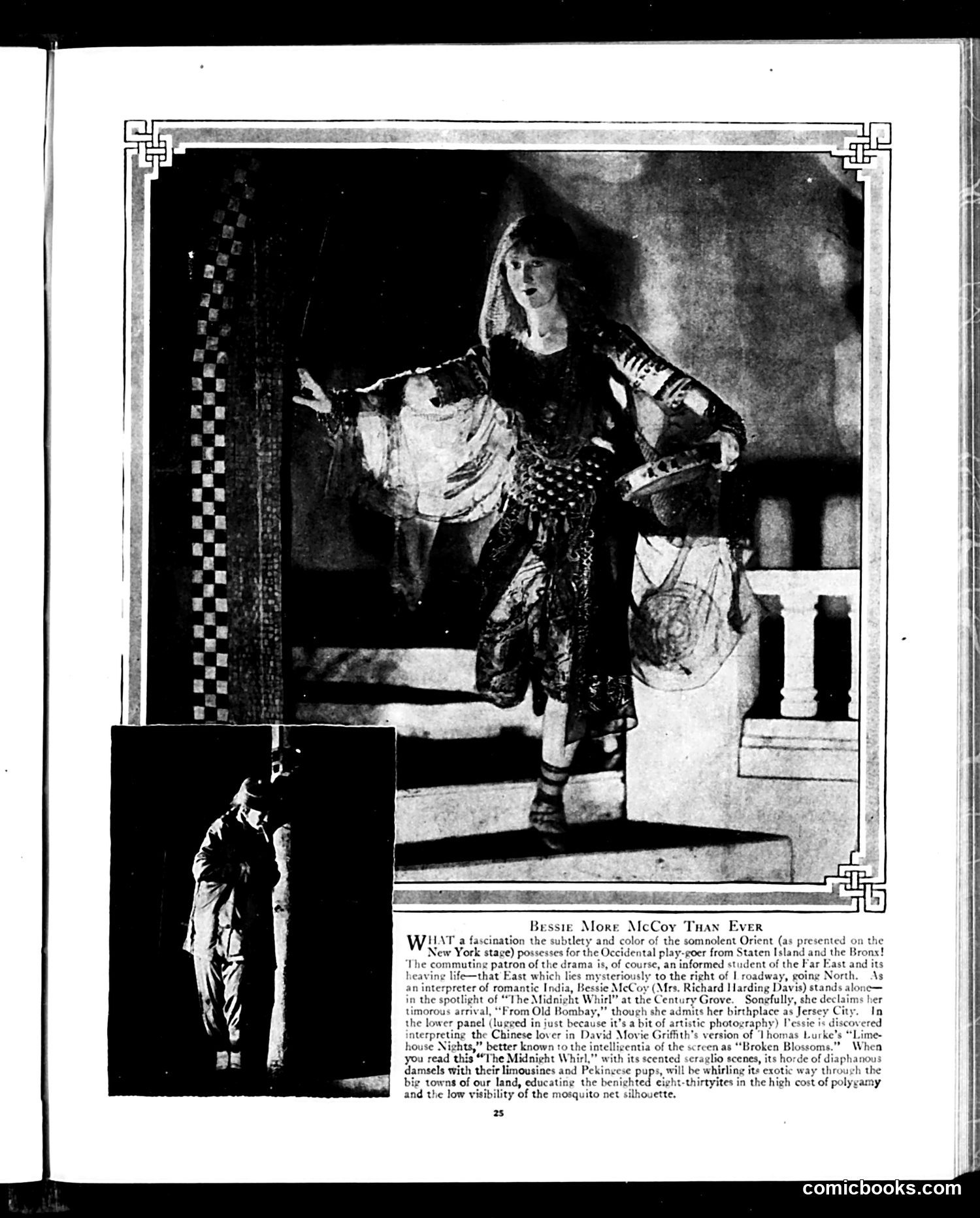
This is a theatrical review of actress Bessie McCoy (Mrs. Richard Harding Davis) in the Broadway play "The Midnight Whirl" at the Century Grove. The piece satirizes early 20th-century American fascination with "Oriental" exoticism—how New York audiences from outer boroughs like Staten Island and the Bronx eagerly consume romanticized depictions of the Far East on stage. The satire mocks both the play's appeal and McCoy's performance: her "exotic" portrayal of India despite claiming Jersey City origins, and the absurdity of how these theatrical productions present the East as mysteriously sensual spectacle. The reference to "Broken Blossoms" (a contemporary film) and jokes about "polygamy," "scented seragios," and "Peking pups" highlight how American entertainment packaged the Orient as decadent luxury for mass consumption. The tone is dismissive of both the artificial exoticism and audience gullibility.
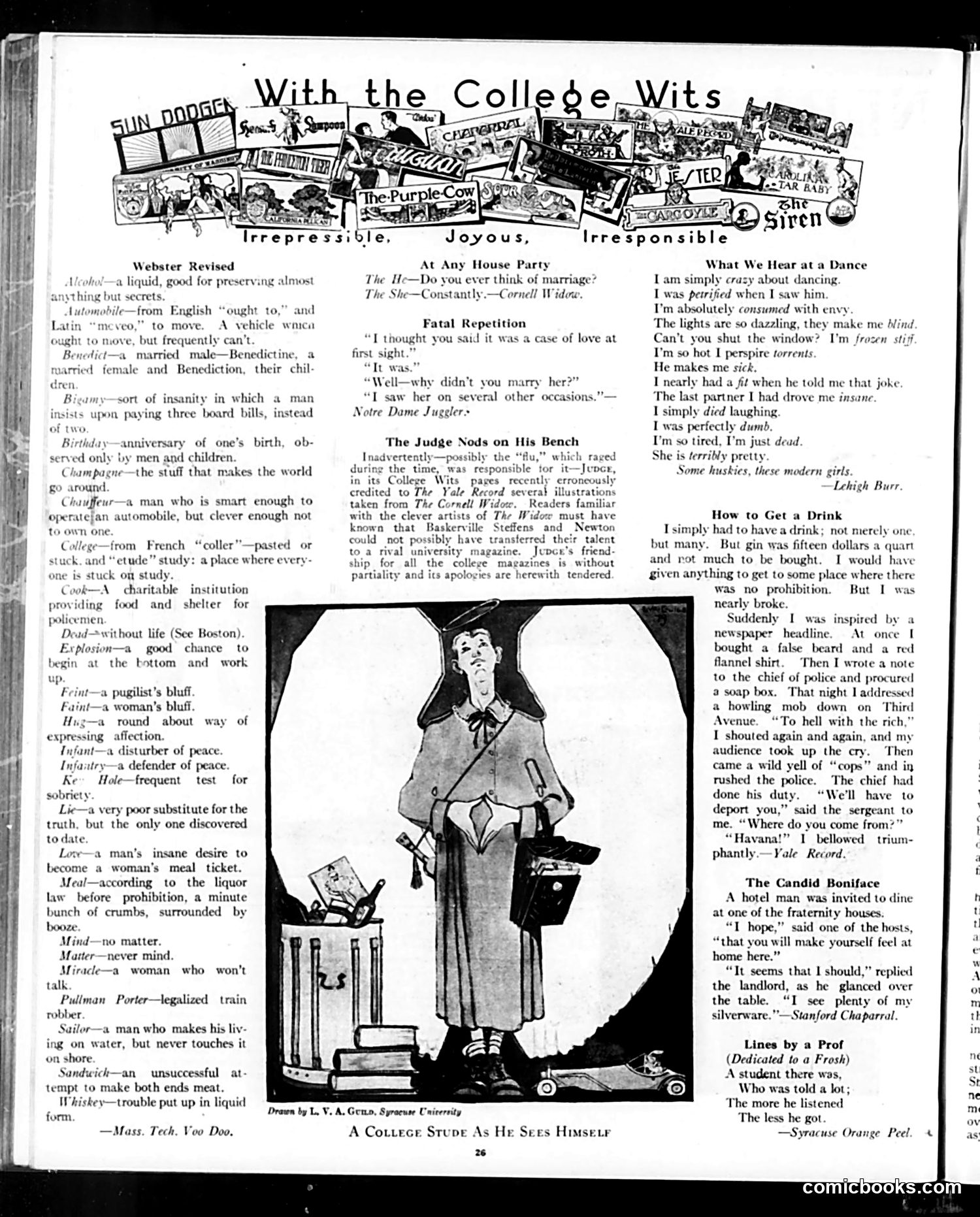
This page from Judge magazine features satirical humor targeting college students and 1920s social customs during Prohibition. The main cartoon shows a college student laden with textbooks, cigarettes, and alcohol—satirizing young people's contradictory priorities and reckless behavior. The text sections mock college life through humorous definitions ("Champaigne—the stuff that makes the world go around") and fictional anecdotes: - **"At Any House Party"**: jokes about marriage obsession - **"The Judge Nods on His Bench"**: criticizes Judge magazine's rival college humor publications (Yale Record, Cornell Widow) for allegedly plagiarizing artwork - **"What We Hear at a Dance"**: women's exaggerated, contradictory statements (loving dancing while terrified, frozen yet perspiring) - **"How to Get a Drink"**: absurdist Prohibition-era humor about acquiring alcohol, ending with a man pretending to be a radical agitator to get deported to Havana—where drink is legal The satire targets youth frivolousness, female affectation, and Prohibition's comic absurdities.
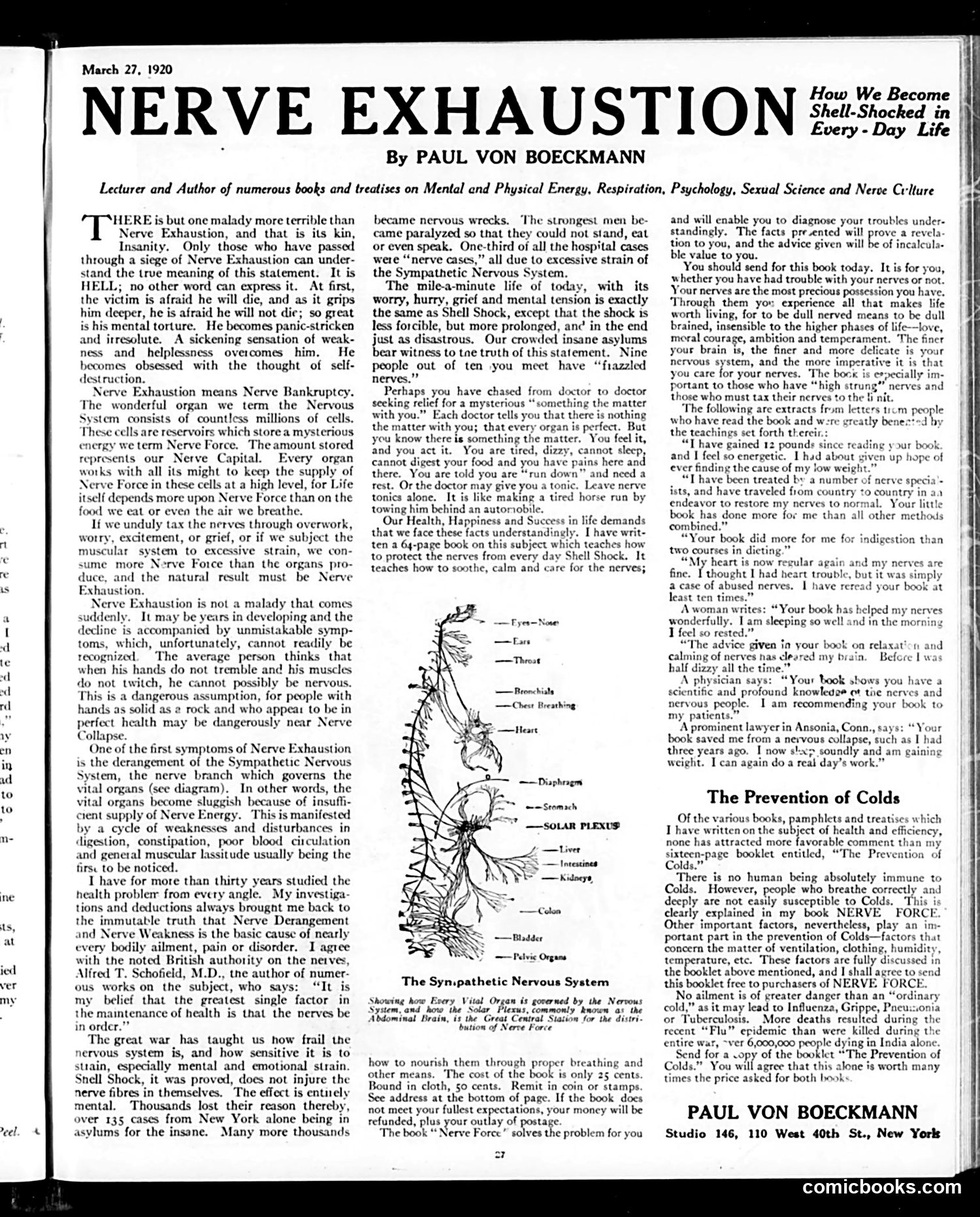
This page is primarily an extended advertisement disguised as an article, promoting Paul von Boeckmann's book "Nerve Force" and his self-help theories about nerve exhaustion. The accompanying anatomical diagram illustrates the sympathetic nervous system and vital organs, supporting Boeckmann's pseudo-scientific claims that modern life—especially the mental strain of World War I and its aftermath—depletes "Nerve Force," causing widespread illness. The page references "Shell Shock" (PTSD from WWI), using it to argue that mental strain damages nerves. This was actually progressive for 1920, acknowledging psychological injury, though Boeckmann's "nerve bankruptcy" theory was quackery even then. The testimonial quotes at right (appearing from satisfied customers) were common advertising techniques. This represents early 20th-century medical pseudoscience exploiting post-war anxiety about mental health and modern life's pace.
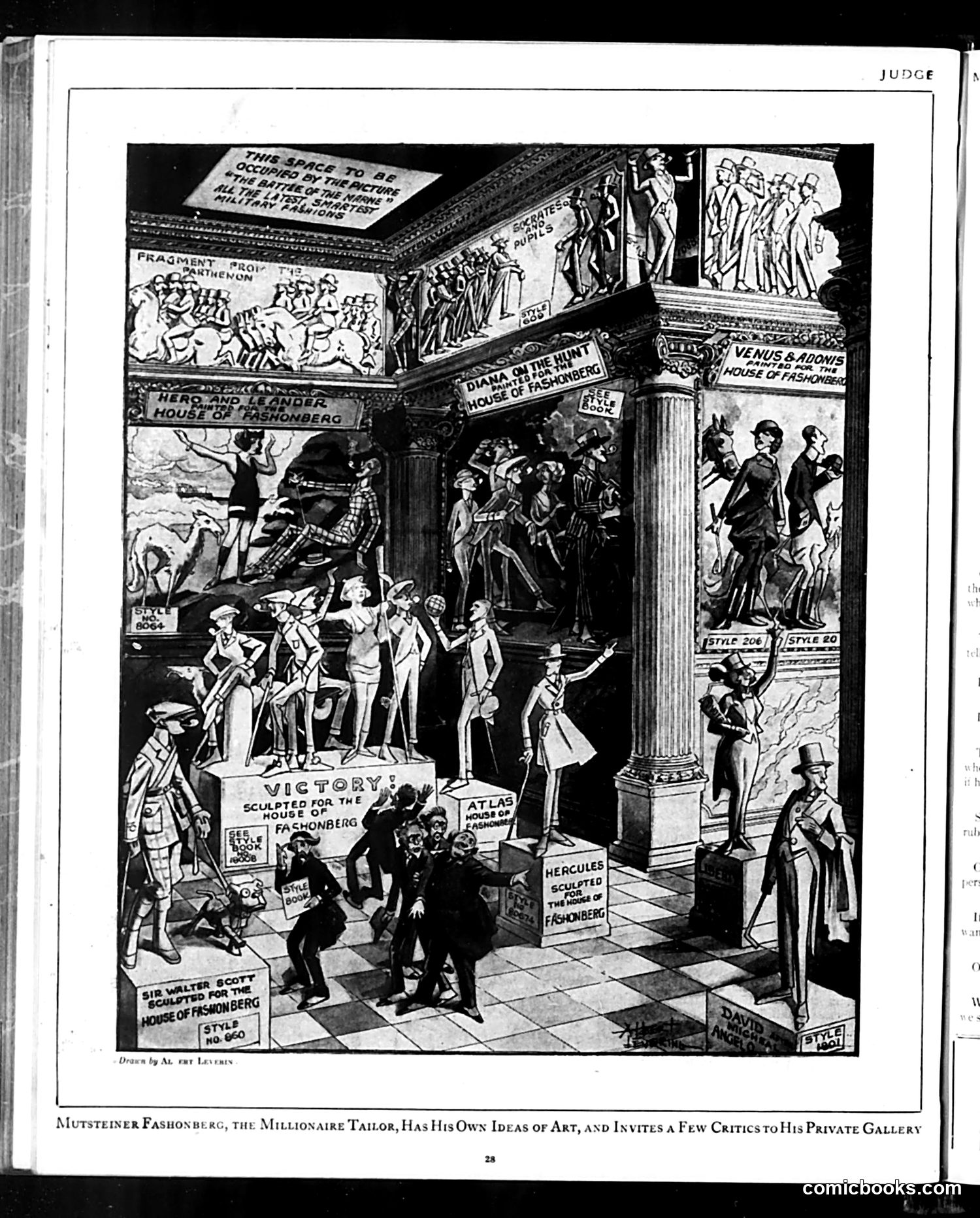
This is a single satirical illustration about "Mutsteiner Fashionsberg, the Millionaire Tailor" who has commissioned artworks for his private gallery. The cartoon depicts his palatial gallery filled with classical sculptures and paintings, where various society figures admire his collection. The satire targets wealthy industrialists' nouveau-riche pretensions to cultural sophistication. Labels identify artworks as "commissioned for the House of Fashionsberg"—suggesting the tailor has purchased or commissioned replicas of famous classical works (Victory, Atlas, Hercules, Diana, Venus & Adonis, Hero and Leander) to display his wealth and taste. The joke appears to be mocking how newly-rich businessmen attempted to gain social legitimacy through art collecting and patronage, rather than possessing genuine cultural understanding.
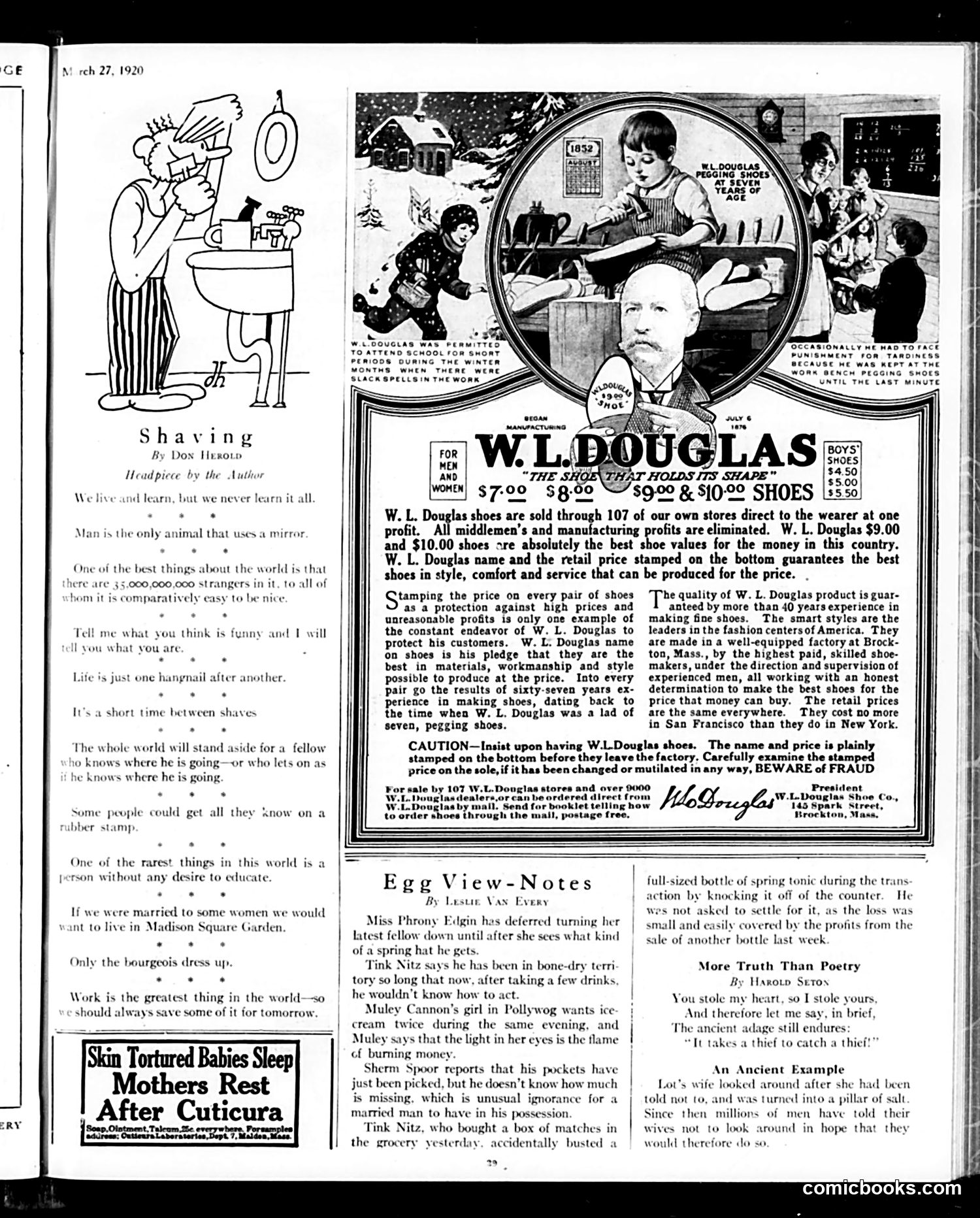
This page is primarily **advertising and humor columns**, not political cartoons. The main feature is a large **W.L. Douglas shoe advertisement**, which dominates the right side. The ad emphasizes direct factory-to-consumer sales at $9.00 and $10.00, eliminating middlemen profits—a anti-inflation, consumer-protection message relevant to 1920's post-war economic concerns. The left side contains a "Shaving" humor column by Don Herold with brief aphorisms ("Man is the only animal that uses a mirror"; "Life is just one hangnail after another"). These are gentle observations rather than satire. Below that is an ad for Cuticura products (baby care). The bottom right features "Egg View-Notes," a gossip/humor column with small-town anecdotes about characters like "Miss Phrony Edgin" and "Muley Cannon." **Notable context**: The Douglas ad references "bone-dry territory," alluding to Prohibition (enacted January 1920), making the column's joke about someone not knowing "how to act" after drinking a contemporary reference.
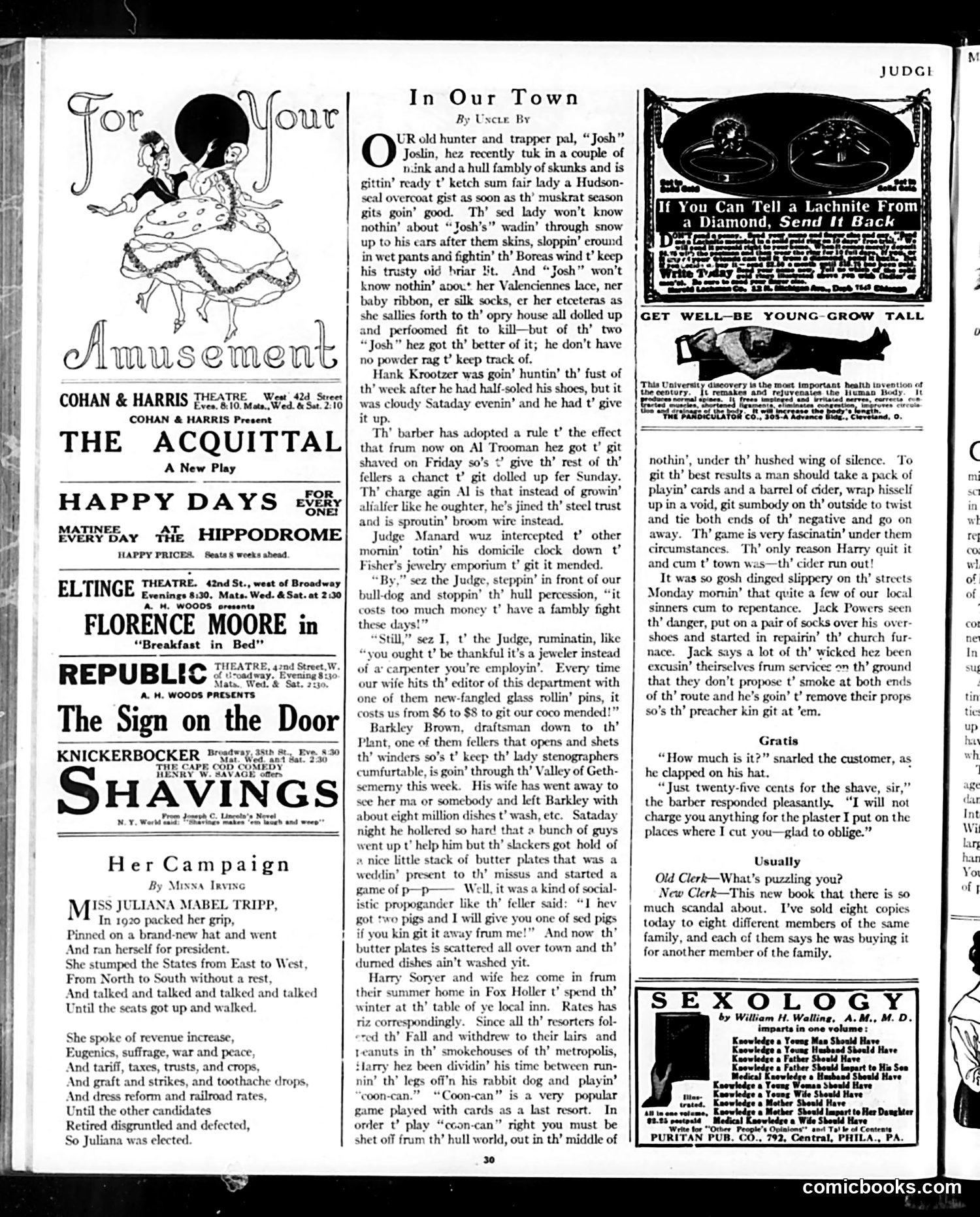
This page primarily showcases **theatrical advertisements** and light humor columns rather than political satire. The notable content is "Her Campaign," a humorous poem about **Juliana Mabel Tripp**, a fictional female presidential candidate from 1920. The satire is gentle: she wins by talking so much that other candidates abandon the race and "the seats got up and walked"—mocking both verbose political campaigning and, implicitly, the novelty of women entering electoral politics (women gained voting rights via the 19th Amendment in 1920). "In Our Town" is a folksy rural humor column depicting small-town life with exaggerated dialect—featuring characters like Josh the trapper and their romantic/domestic mishaps. It's gentle Americana satire about rural courtship and household economics. The bulk of the page consists of Broadway theater advertisements (Cohan & Harris productions, Florence Moore, etc.), reflecting Judge's audience of urban, entertainment-minded readers. No major political figures or events appear to be specifically targeted here.
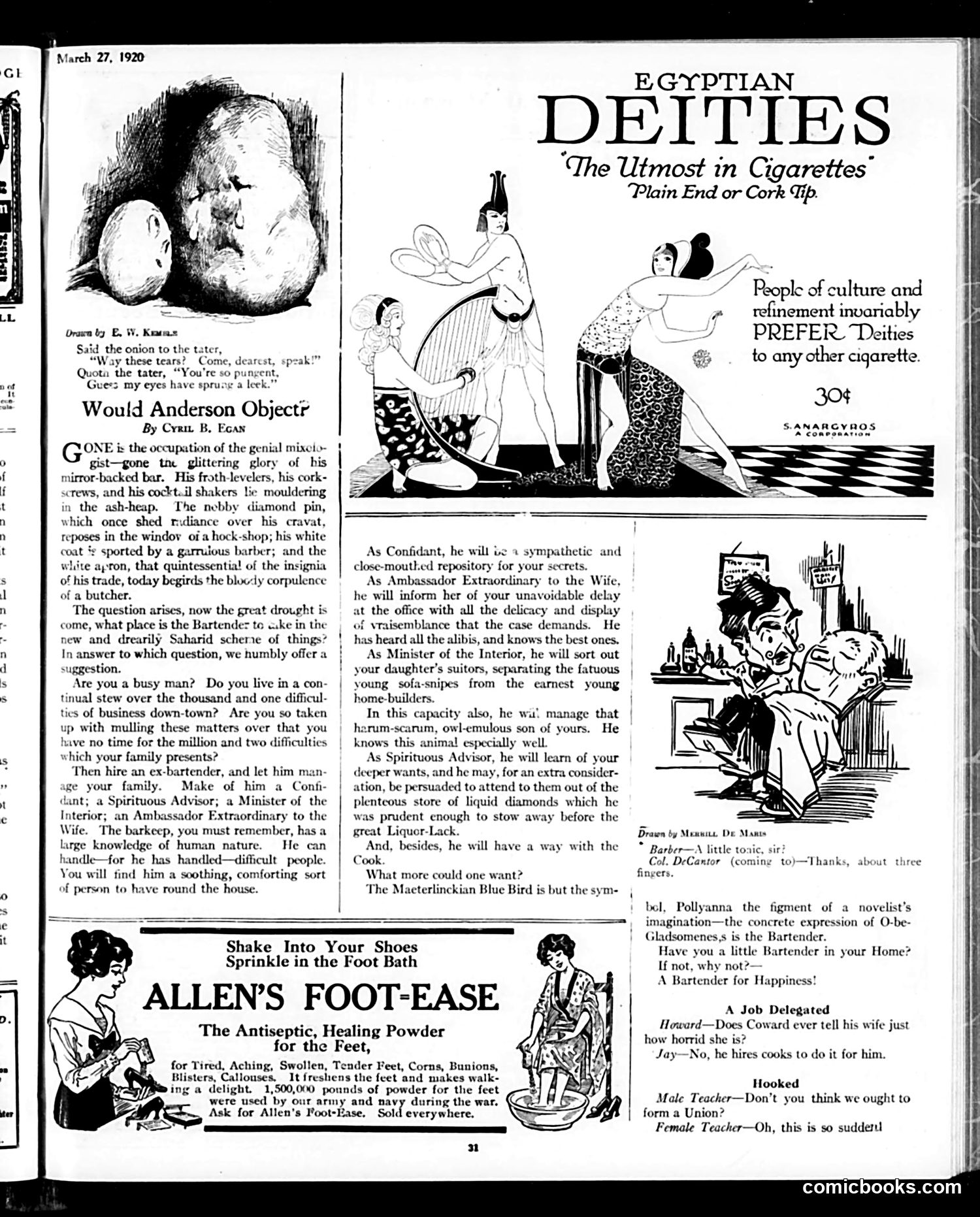
This 1920 piece satirizes the plight of American bartenders following Prohibition's implementation (January 1920). The main cartoon proposes a darkly comic solution: hire an unemployed bartender as a household "Confidant," "Spirituous Advisor," and "Minister of the Interior" to manage family troubles. The joke exploits bartenders' reputation for discretion, knowledge of human nature, and skill with excuses—skills now useless in their former profession. The text suggests they could handle difficult family members (wayward daughters, troublesome sons, neglectful cooks) with the same practiced ease they once handled drunk patrons. The piece is both sympathetic to displaced workers and cynical about Prohibition's economic impact. The cartoon sarcastically positions the bartender as society's secret solution to domestic chaos—a desperate profession reimagined for a "dry" America that no longer needs them behind a bar.
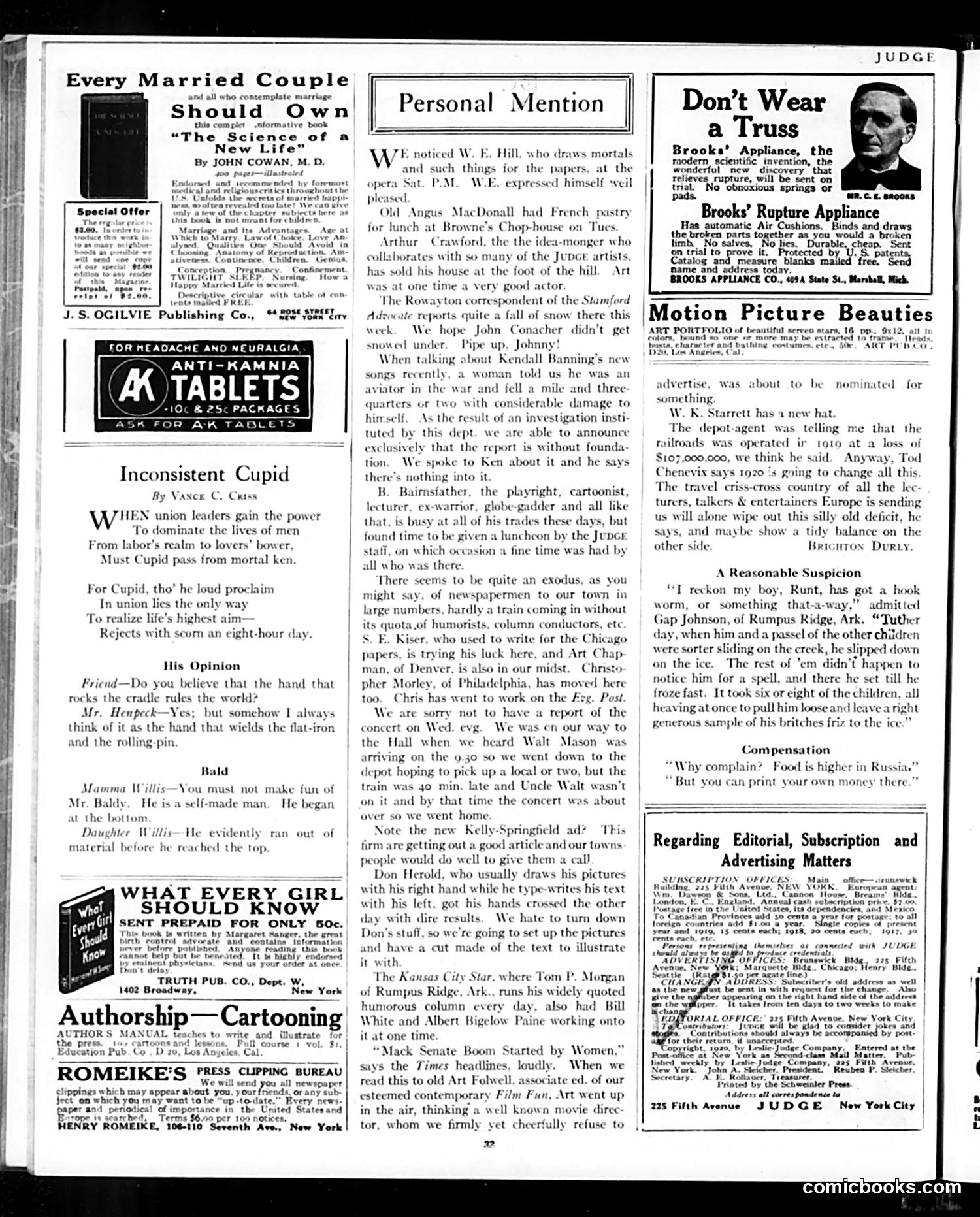
This page is primarily **advertising and filler content** rather than political satire. The layout includes multiple ads (for marriage advice books, headache tablets, clipping services) alongside brief editorial items. The one notable cartoon is **"Inconsistent Cupid"** by Vance C. Criss, which critiques **labor unions**. The joke: union leaders demand an eight-hour workday for laborers, yet Cupid (representing romantic love/personal freedom) rejects such restrictions on his own domain. It's a libertarian critique suggesting unions impose rigid controls on workers' lives while hypocritically exempting themselves—a common anti-labor argument of the era. The "Personal Mention" section offers gossipy notes about cartoonists and humorists (W.E. Hill, Arthur Crawford, Kendall Banning, Bruce Bairnsfather, S.E. Kiser). These appear designed to boost Judge's credibility by name-dropping creative figures associated with the publication. The page reflects **early 20th-century editorial practices**: mixing advertisements, society gossip, and light satire.
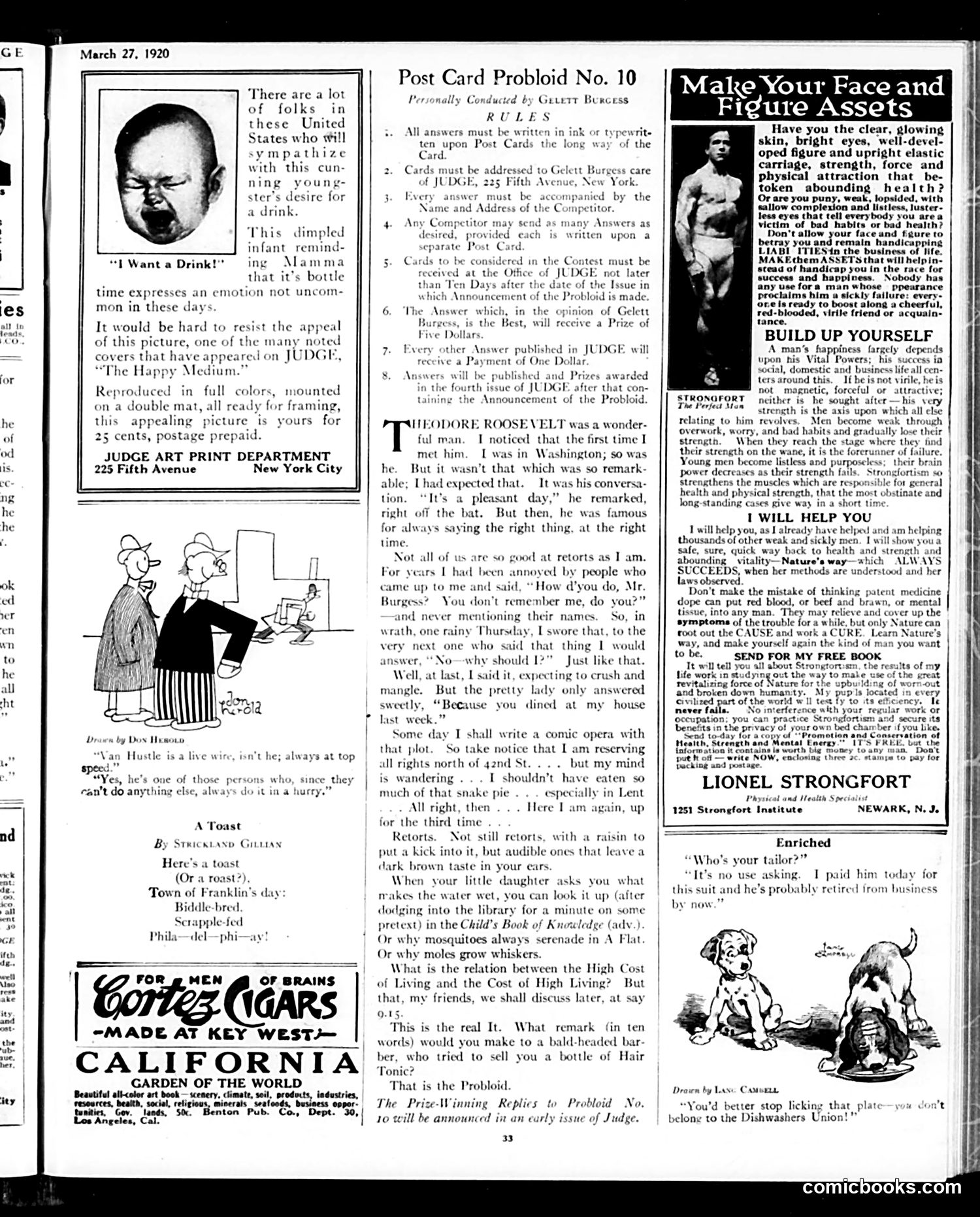
This March 27, 1920 *Judge* page contains Prohibition-era satire. The main cartoon features a baby demanding "I Want a Drink!"—a pointed joke about Prohibition, which began January 1920. The infant's plea humorously expresses widespread adult frustration at the alcohol ban, as the text explicitly states: many Americans sympathized with wanting a drink during "these days." The page also includes a Gelett Burgess humor column about Theodore Roosevelt's conversational skills and a separate joke about quick-witted comebacks. A small cartoon depicts two dogs discussing labor unions. The remaining content consists largely of advertisements (California tourism, cigars) and contest rules for the "Post Card Probloid" puzzle feature. The overall theme reflects early-1920s American anxieties about Prohibition's enforcement and cultural impact.
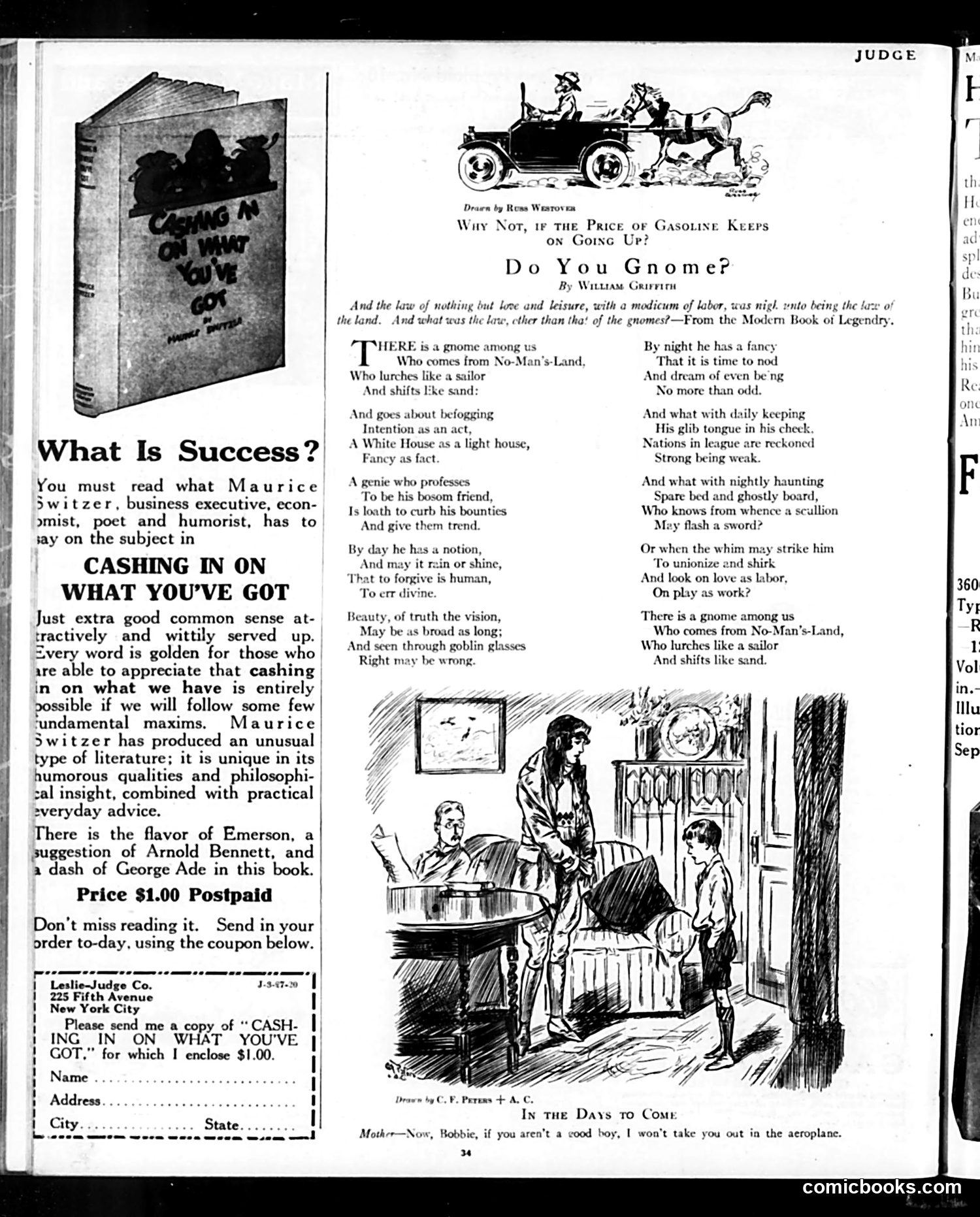
This page mixes advertising with satirical poetry. The main content is "Do You Gnome?" by William Griffith—a poem about a mysterious gnome figure who embodies labor unrest and social disruption. **The Gnome symbolizes** a troublemaker from "No-Man's-Land" who: - Confuses intentions and facts (spreads propaganda) - Refuses to work hard ("keep his glib tongue in his cheek") - Threatens to "unionize and shirk" labor - Blurs the line between work and leisure **The satire targets** early-20th-century labor activism and radical ideology. The gnome represents anxieties about unionization, workers' resistance, and those who challenge capitalist values like productivity and duty. The accompanying cartoon ("In the Days to Come") shows a mother threatening her son with withholding an aeroplane ride—suggesting anxieties about modern technology and changing parental authority. The left sidebar advertises Maurice Switzer's self-help book "Cashing In on What You've Got," promoting practical success through common sense—the ideological opposite of the gnome's destabilizing influence.
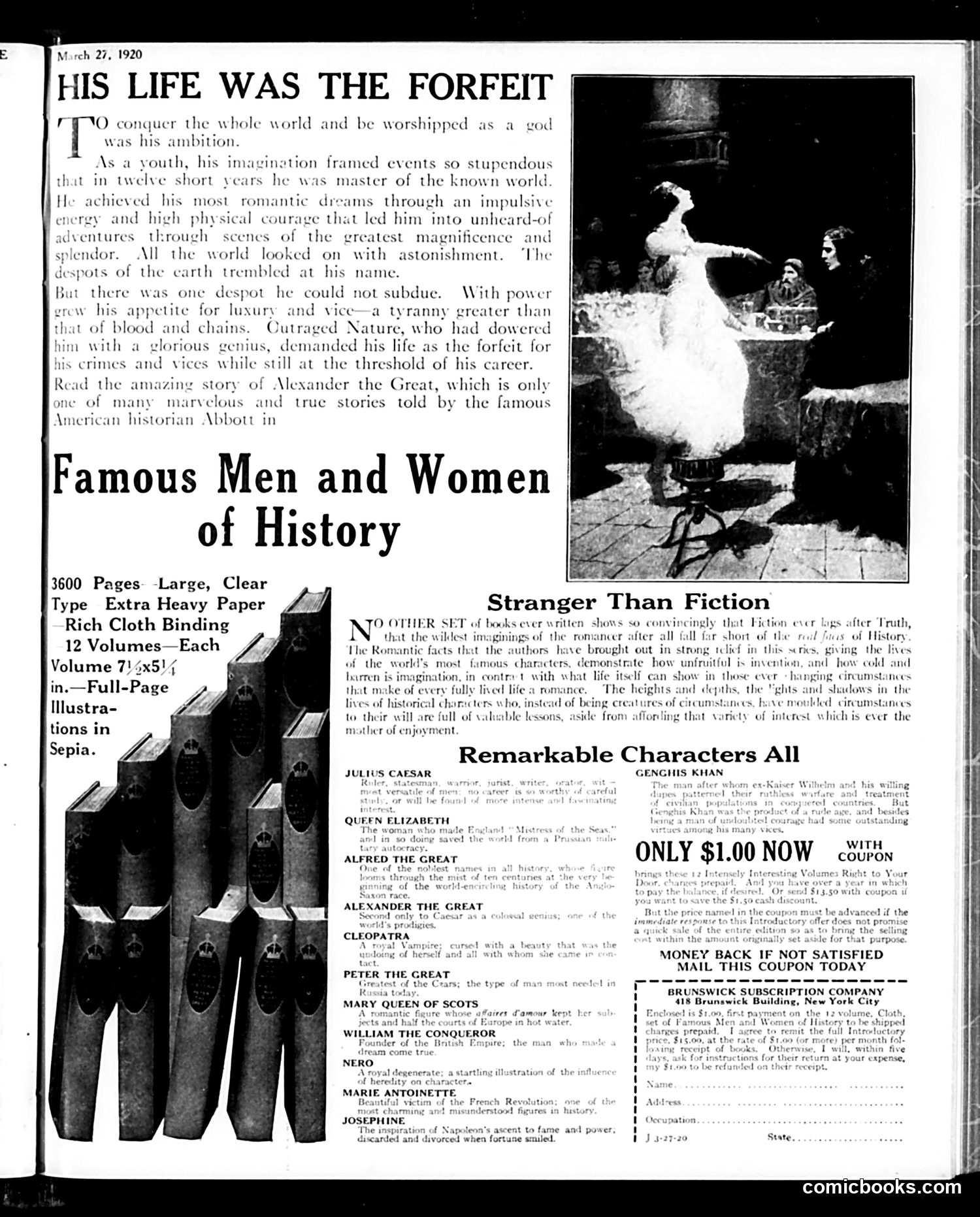
This page is primarily **advertising, not political satire**. The dominant content is a book advertisement for "Famous Men and Women of History," a 12-volume set published by Brunswick Subscription Company. The header story about Alexander the Great—whose ambition to "conquer the whole world" led to his downfall through vice and luxury—serves as **marketing copy**, not satire. It frames the book set's appeal: readers can learn dramatic true stories of historical figures whose lives contain moral lessons and romantic grandeur that "fiction ever lags after." The accompanying photograph (top right) appears to show a theatrical scene, likely from a period drama, reinforcing the "stranger than fiction" marketing angle. The listed "Remarkable Characters" (Julius Caesar, Queen Elizabeth, Alfred the Great, Cleopatra, etc.) are **selling points**, not subjects of satire. **No political commentary or cartoon satire is present on this page.** It's a straightforward early 20th-century mail-order book advertisement targeting readers interested in history and biography.

This is a **Camel cigarette advertisement**, not satire or political commentary. The page features the iconic Camel brand mascot—a stylized camel head in a circular emblem—alongside product packaging imagery. The ad targets consumers by claiming superiority: Camels' Turkish-domestic tobacco blend supposedly surpasses smoking either tobacco "straight," never tires the palate, leaves no unpleasant aftertaste or odor, and invites direct comparison with competitors. The headline's folksy "as sure as you are a foot high" uses colloquial language for broad appeal. The peculiar phrase "a foot high" remains unclear in meaning—possibly a height reference used colloquially in the era, or advertising wordplay now obscure. This reflects early-20th-century cigarette marketing before health warnings existed. R.J. Reynolds (Winston-Salem, North Carolina) was a major tobacco manufacturer. The advertisement is straightforward product promotion, not editorial content or satire.