
Judge, 1920-03-27 · page 24 of 36
Judge — March 27, 1920 — page 24: what you’re looking at
What you’re looking at
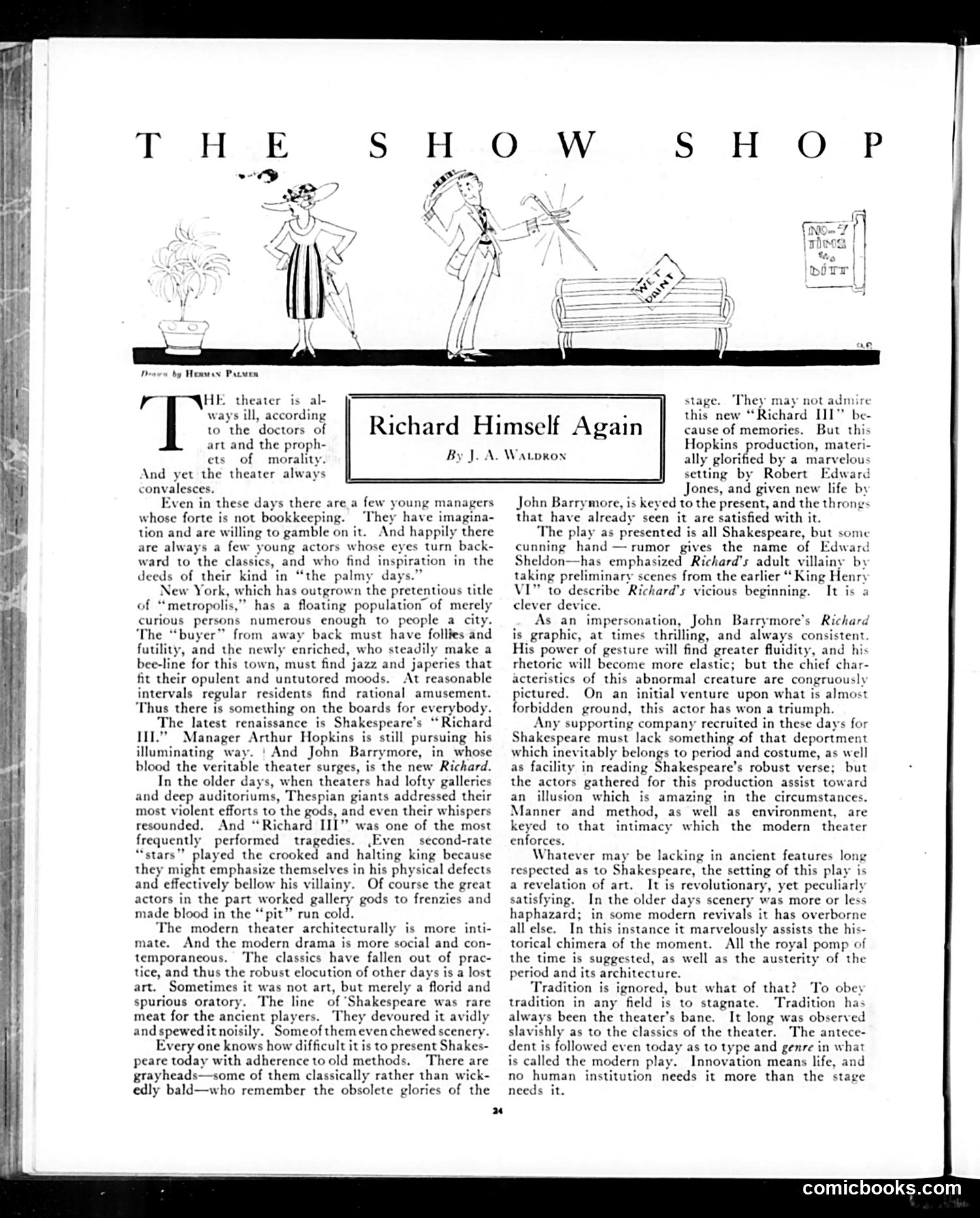
This page contains an illustrated header and a theater review essay by J.A. Waldron about John Barrymore's 1920 production of Shakespeare's *Richard III*, directed by Arthur Hopkins with set design by Robert Edward Jones. The cartoon header depicts a stylized "Show Shop" with fashionable figures, a potted plant, and a bench—representing the modern theatrical world. The review discusses how Shakespeare productions have evolved from the old era of grand theatrical performance (when actors bellowed to gallery audiences) to the contemporary "intimate" modern theater. Waldron praises Barrymore's portrayal of Richard as "graphic" and "consistent," noting that a clever dramaturgical device—incorporating scenes from *Henry VI* (rumored by playwright Edward Sheldon)—emphasizes Richard's villainy from the start. The essay celebrates this production as successfully bridging classical Shakespeare with modern sensibilities, even while acknowledging contemporary actors lack the vocal training and period expertise of their predecessors.
📄 Transcribed text from this page (OCR, searchable)
Machine-transcribed from the original scan — historical spelling and the odd misread are preserved.
ererens SET y Hears Pacer rr HE theater is al- ways ill, according to the doctors of art and the proph- ets of morality. And yet the theater always convalesces. en in these days there are a few young managers whose forte is not bookkeeping. hey have imagina- tion and are willing to gamble on it. And happily there are always a few young actors whose eyes turn back- ward to the classics, and who find inspiration in the deeds of their kind in “the palmy day New York, which has outgrown the pretentious title of “metropolis,” has a floating population of merely curious persons numerous enough to people a city. he “buyer” from away back must have follies and futility, and the newly enriched, who steadily make a bee-line for this town, must find jazz and japeries that fit their opulent and untutored moods. At reasonable intervals regular residents find rational amusement. ‘Thus there is something on the boards for everybody. The latest renaissance is Shakespeare’s “Richard III.” Manager Arthur Hopkins is still pursuing his illuminating way. | And John Barrymore, in whose blood the veritable theater surges, is the new Richard. In the older days, when theaters had lofty galleries and deep auditoriums, Thespian giants addressed their most violent efforts to the gods, and even their whispers resounded, And “Richard III” was one of the most frequently performed tragedies. ,Even second-rate “stars” played the crooked and halting king because they might emphasize themselves in his physical defects and effectively bellow his villainy. Of course the great actors in the part worked gallery gods to frenzies and made blood in the “pit” run cold. The modern theater architecturally is more inti- mate. And the modern drama is more social and con- temporaneous. The classics have fallen out of prac- tice, and thus the robust elocution of other days is a lost art. Sometimes it was not art, but merely a florid and spurious oratory. The line of ‘Shakespeare was rare meat for the ancient players. They devoured it avidly and spewedit noisily. Someofthemevenchewed scenery. Every one knows how difficult it is to present Shakes- peare today with adherence to old methods. There are gtayheads—some of them classically rather than wick- edly bald—who remember the obsolete glories of the Richard Himself Again By J. A. Watprox stage. They may not admire this new “Richard II” be- cause of memories. But this Hopkins production, materi- ally glorified by a marvelous setting by Robert Edward Jones, and given new life by John Barrymore, is keyed to the present, and the throngs that have already seen it are satisfied with it. ‘The play as presented is all Shakespeare, but some cunning hand — rumor gives the name of Edward Sheldon—has emphasized Richard’s adult villainy by taking preliminary scenes from the earlier “King Henry VI” to describe Richard’s vicious beginning. It is a clever device. As an impersonation, John Barrymore's Richard is graphic, at times thrilling, and always consistent. His power of gesture will find greater fluidity, and his rhetoric will become more elastic; but the chief char- acteristics of this abnormal creature are congruously pictured. On an initial venture upon what is almost forbidden ground, this actor has won a triumph. Any supporting company recruited in these days for Shakespeare must lack something of that deportment which inevitably belongs to period and costume, as well as facility in reading Shakespeare’s robust verse; but the actors gathered for this production assist toward an illusion which is amazing in the circumstances. Manner and method, as well as environment, are keyed to that intimacy which the modern theater enforces. Whatever may be lacking in ancient features long respected as to Shakespeare, the setting of this play is a revelation of art. It is revolutionary, yet peculiarly satisfying. In the older days scenery was more or less haphazard; in some modern revivals it has overborne all else. In this instance it marvelously assists the his- torical chimera of the moment. All the royal pomp of the time is suggested, as well as the austerity of the period and its architecture. Tradition is ignored, but what of that? To obey tradition in any field is to stagnate. Tradition h always been the theater’s bane. It long was observed slavishly as to the classics of the theater. The antece- dent is followed even today as to type and genre in wh is called the modern play. Innovation means life, and no human institution needs it more than the stage needs it. comicbooks.com