
Judge, 1920-03-27 · page 11 of 36
Judge — March 27, 1920 — page 11: what you’re looking at
What you’re looking at
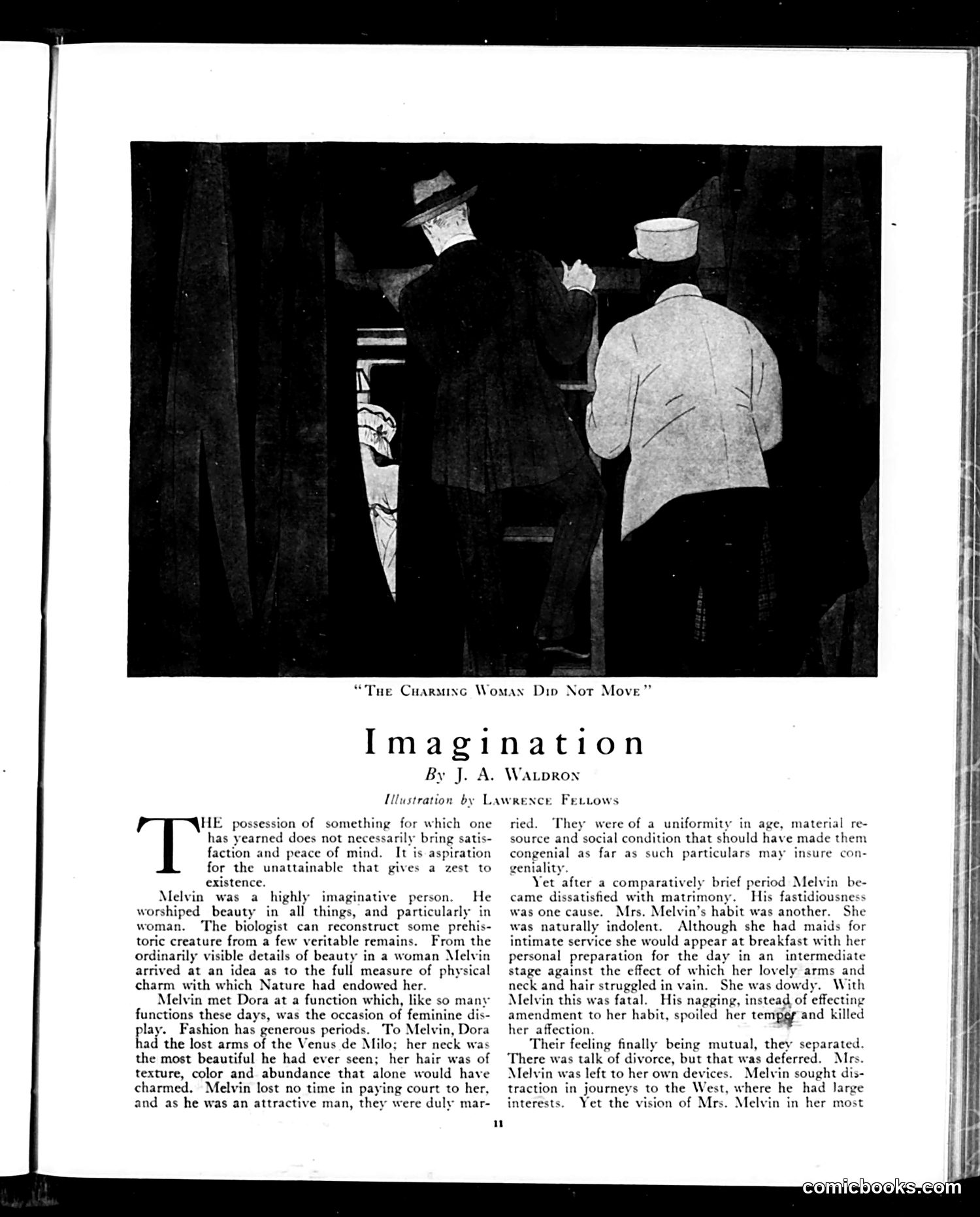
This satirical story critiques romantic idealization and marital disillusionment. Melvin obsesses over a woman (Dora) as an idealized fantasy—he reconstructs her beauty imaginatively, like a biologist reconstructing prehistoric creatures from fragments. Upon marrying her, reality disappoints: she's naturally lazy and appears at breakfast unkempt, lacking the "personal preparation" he demands. His constant criticism about her dowdiness damages their affection rather than improving her habits. They separate, though divorce is deferred. The caption "The Charming Woman Did Not Move" suggests she refuses to change to meet his impossible standards. The satire targets masculine fantasy-projection in courtship—men creating imaginary perfection rather than accepting actual women—and the inevitable collision between imagination and reality in marriage. It's a critique of both male fastidiousness and the gap between romantic aspiration and domestic life.
📄 Transcribed text from this page (OCR, searchable)
Machine-transcribed from the original scan — historical spelling and the odd misread are preserved.
qe “Tue Cuarmixnc Womax Dip Not Move” Imagination By J Ulustration by HE possession of something for which one has yearned does not necessarily bring satis- faction and peace of mind. It is aspiration for the unattainable that gives a zest to existence. Melvin was a_ highly worshiped beauty in all thing: woman. The biologist can reconstruct some prehis- toric creature from a few veritable remains. From the ordinarily visible details of beauty in a woman Melvin arrived at an idea as to the full measure of physical charm with which Nature had endowed her. Melvin met Dora at a function which, like so many functions these days, was the occasion of feminine dis- play. Fashion has generous periods. To Melvin, Dora had the lost arms of the Venus de Milo; her neck was the most beautiful he had ever seen; her hair was of texture, color and abundance that alone would have charmed. Melvin lost no time in paying court to her, and as he was an attractive man, they were duly mar- imaginative person. He and particularly in Lawrence A. Wa.tpron Fettows ried. They were of a uniformity in age, material re- source and social condition that should have made them congenial as far as such particulars may insure con- geniality. Yet after a comparatively brief period Melvin be- came dissatisfied with matrimony. His fastidiousness was one cause. Mrs. Melvin’s habit was another. She was naturally indolent. Although she had maids for intimate service she would appear at breakfast with her personal preparation for the day in an intermediate stage against the effect of which her lovely arms and neck and hair struggled in vain. She was dowdy. With Melvin this was fatal. His nagging, instead of ‘effecting amendment to her habit, spoiled her temper and killed her affection. Their feeling finally being mutual, they separated. There was talk of divorce, but that was deferred. Mrs. Melvin was left to her own devic Melvin sought dis- traction in journeys to the West, where he had large interests. Yet the vision of Mrs. Melvin in her most