
A complete issue · 36 pages · 1920
Judge — March 13, 1920
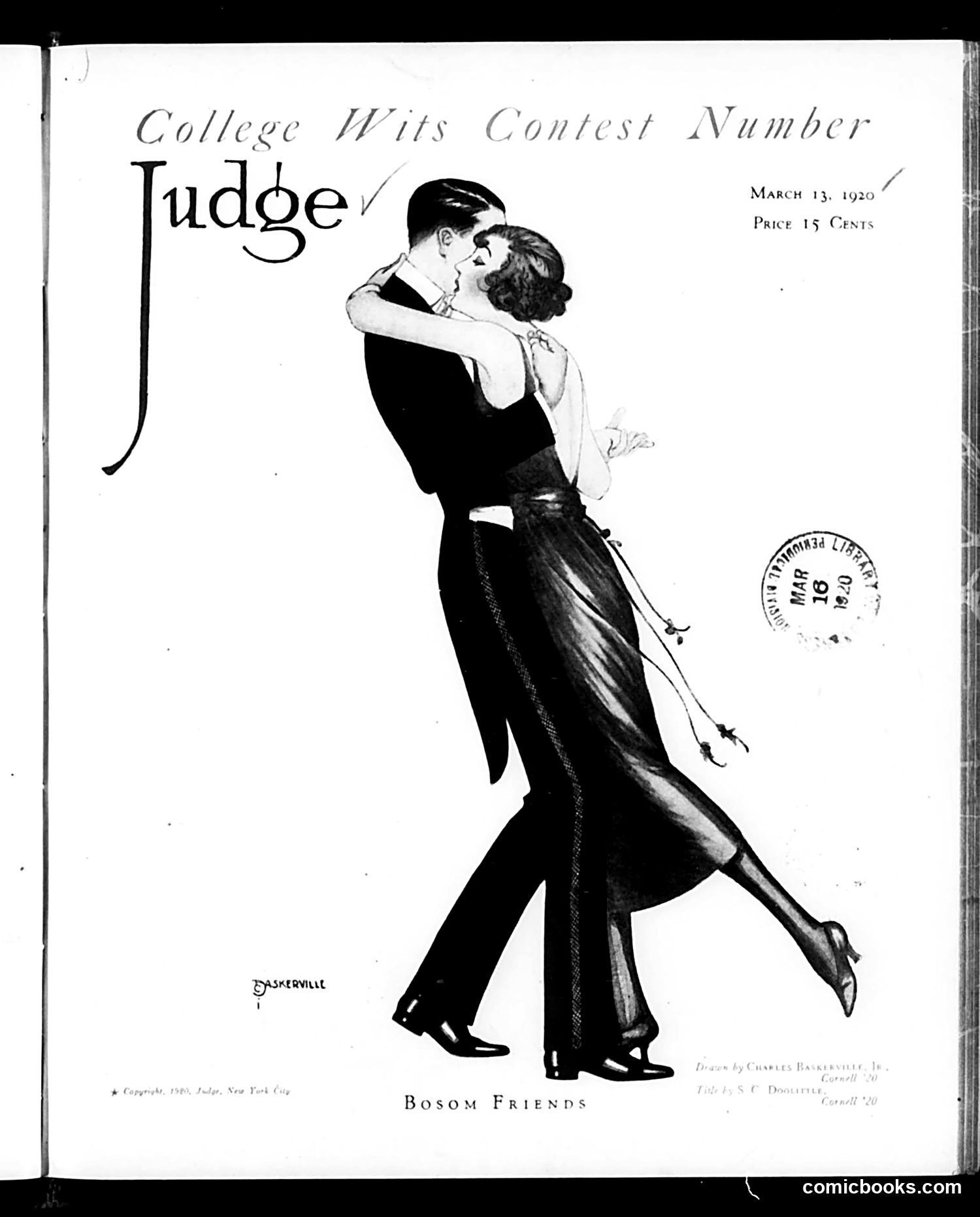
This is the cover of Judge magazine from March 13, 1920, priced at 15 cents. The illustration, credited to Charles Barberville Jr., depicts a couple dancing together, labeled "Bosom Friends" at the bottom. The cartoon appears to be social commentary on 1920s courtship and intimacy during the Jazz Age. "Bosom Friends" is a playful double entendre—the phrase traditionally meant close companions, but here the proximity of the dancing couple (with the man embracing the woman closely) makes the joke literal. The cartoon likely satirizes the increasingly casual physical intimacy and modern dating practices of young people in the 1920s, which many considered scandalous compared to Victorian propriety. The elegant styling reflects the fashionable "flapper" era.
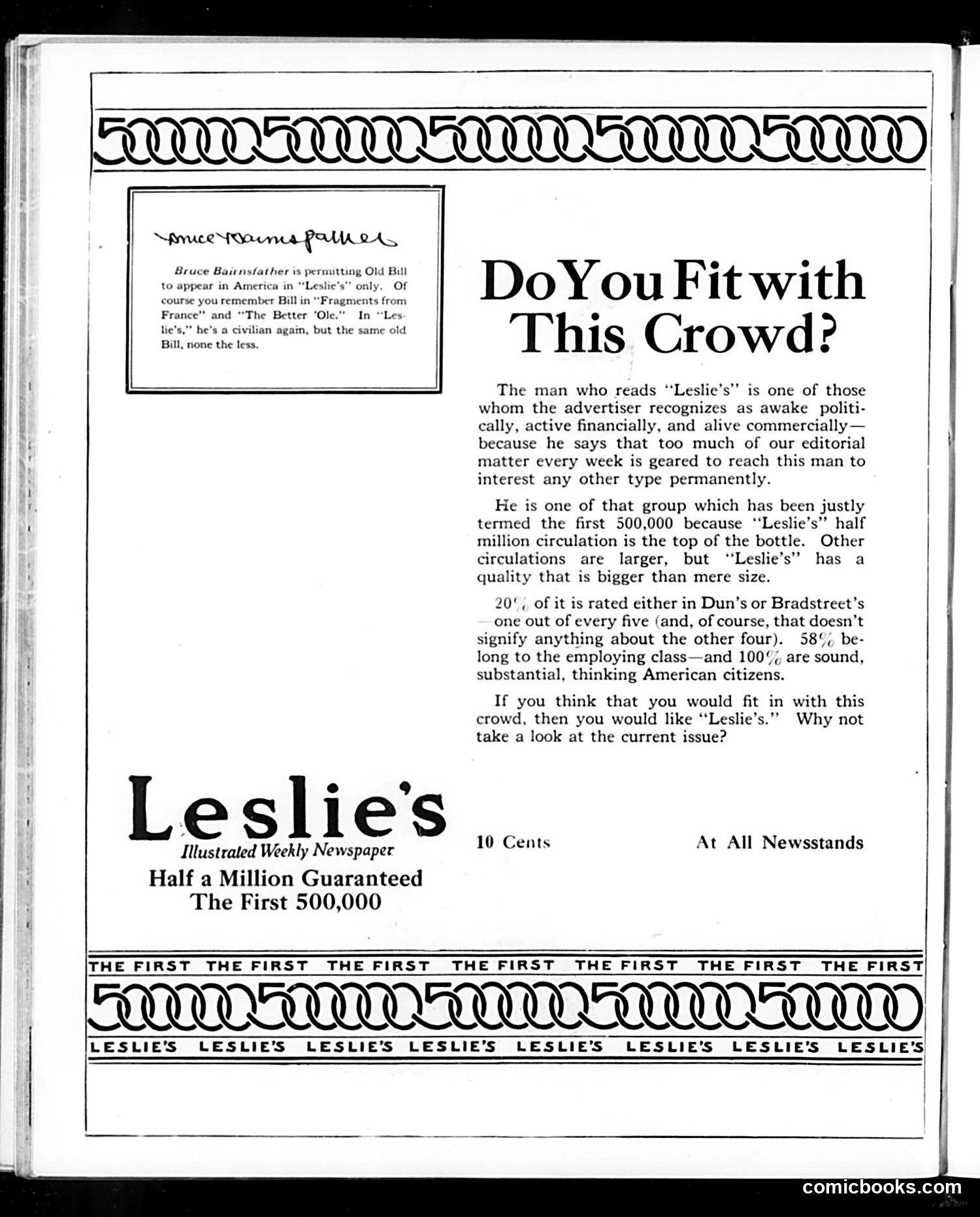
This page is primarily an **advertisement for Leslie's Illustrated Weekly Newspaper**, not a political cartoon. The ad promotes the publication's circulation and target readership. The text describes Leslie's as reaching "the first 500,000"—affluent, politically engaged readers. It claims 20% are rated highly by business directories, 58% belong to the employing class, and 100% are "sound, substantial, thinking American citizens." The small boxed note mentions **Bruce Baumgartner** (or similar—handwriting is unclear), an actor permitted to appear in Leslie's only, referencing his roles in French films and Bill-related productions. The advertisement's tone is promotional rather than satirical—it's selling the magazine's respectability and the quality of its readership to potential advertisers, emphasizing that readers are financially solvent, politically aware consumers worth reaching.
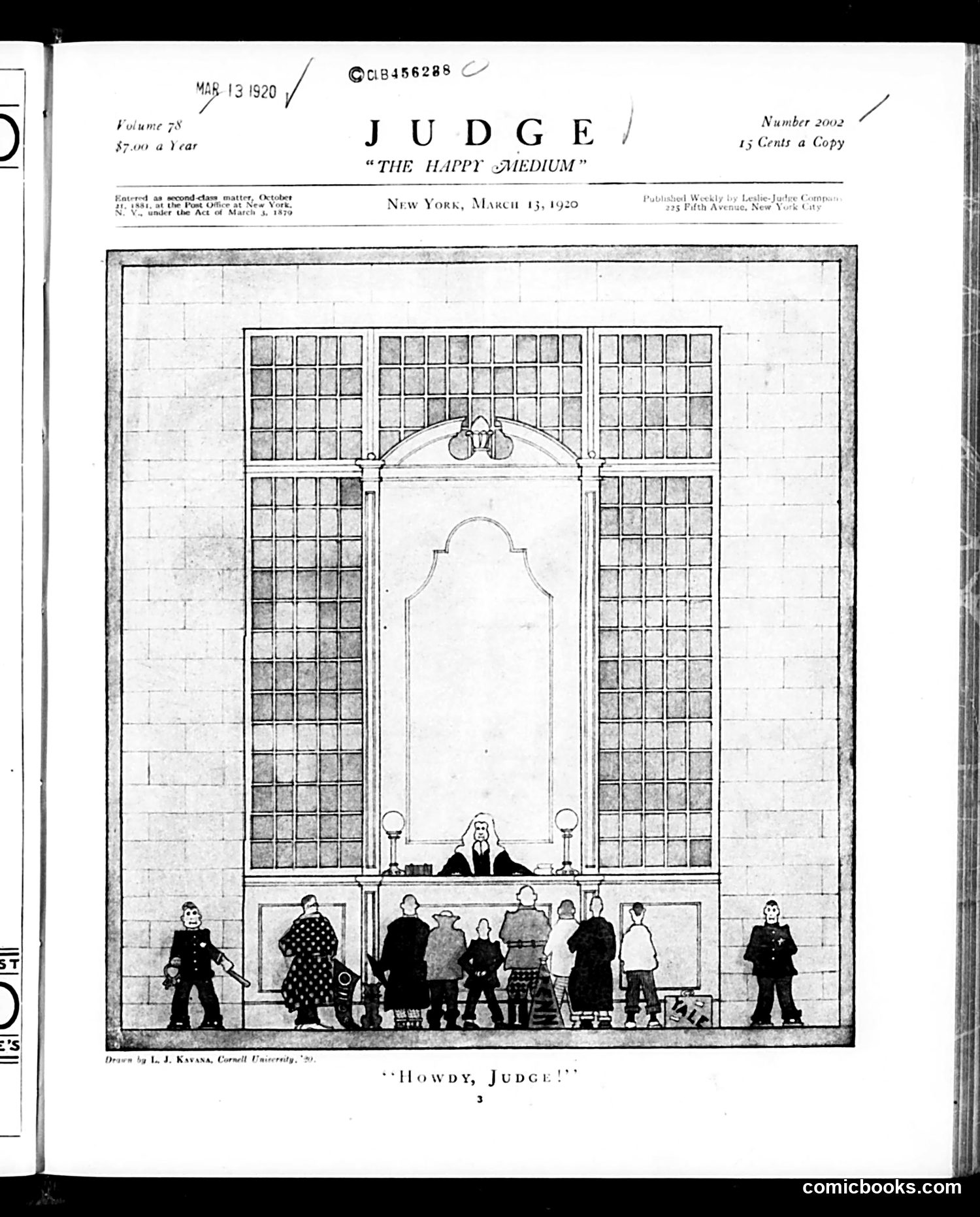
This cartoon depicts a courtroom scene where a judge sits elevated on the bench, greeting visitors below with "Howdy, Judge!" The informal salutation appears to be satirizing the casualness and lack of decorum in American courtrooms of the era. Various figures—appearing to include lawyers, defendants, and court attendees in period dress—stand before the bench in a somewhat chaotic arrangement. The satire likely critiques the informality creeping into formal legal proceedings, or possibly mocks judicial corruption or political favoritism in courts. The title's folksy greeting contrasts sharply with the formal, dignified setting traditionally expected in courtrooms, suggesting the cartoon comments on declining standards of legal propriety during the post-World War I period.
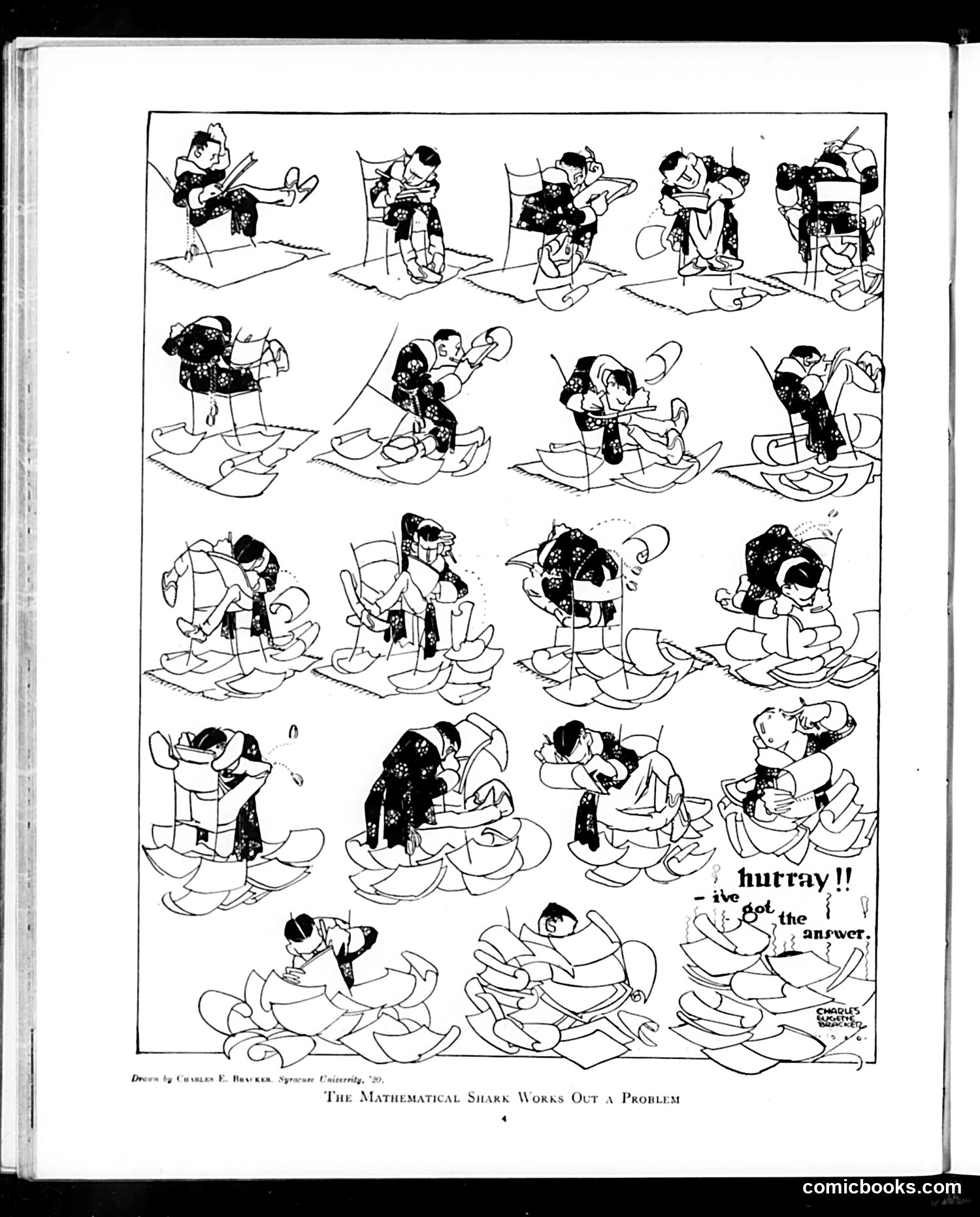
This comic strip, drawn by Charles E. Hallan for Syracuse University, depicts a shark methodically working through a mathematical problem using the sequential panels typical of early comics. The shark appears to represent either a person or institution engaged in complex calculation or problem-solving—the "mathematical" element suggests intellectual work or strategy. The final panels show the shark triumphantly declaring "hurray!!" and "i've got the answer," suggesting the strip humorously chronicles the process of struggling with a difficult problem before reaching resolution. Without clearer historical context about Syracuse University's situation in the Judge publication period, the specific satirical target remains unclear, though it likely comments on academic or institutional challenge-solving.
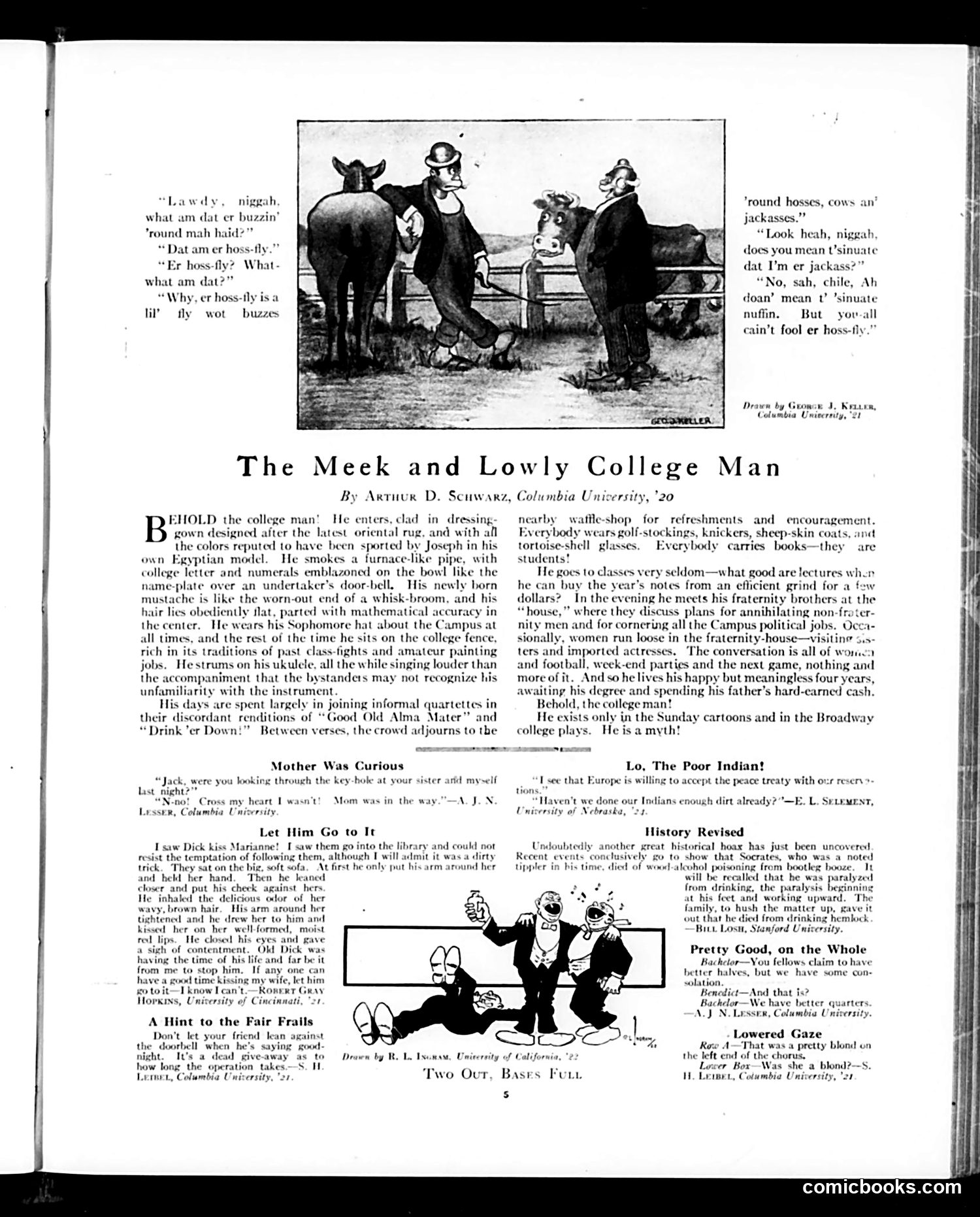
This page contains several humorous pieces satirizing college life circa 1920. The main article, "The Meek and Lowly College Man" by Arthur D. Schwarz, mocks the pretentious affectations of college students who adopt exaggerated fashion and mannerisms—wearing "golf-stockings, knickers, sheep-skin coats"—while remaining intellectually disconnected from actual learning. The satire suggests college men are more concerned with social status, fraternities, and appearing sophisticated than genuine scholarship. The accompanying cartoons ridicule courtship rituals and student behavior. The top illustration depicts rural/pastoral confusion, while "Two Out, Bases Full" appears to reference baseball as metaphor for romantic or social fumbling. The overall message: 1920s college culture was superficial theater, with students performing identity rather than pursuing education.
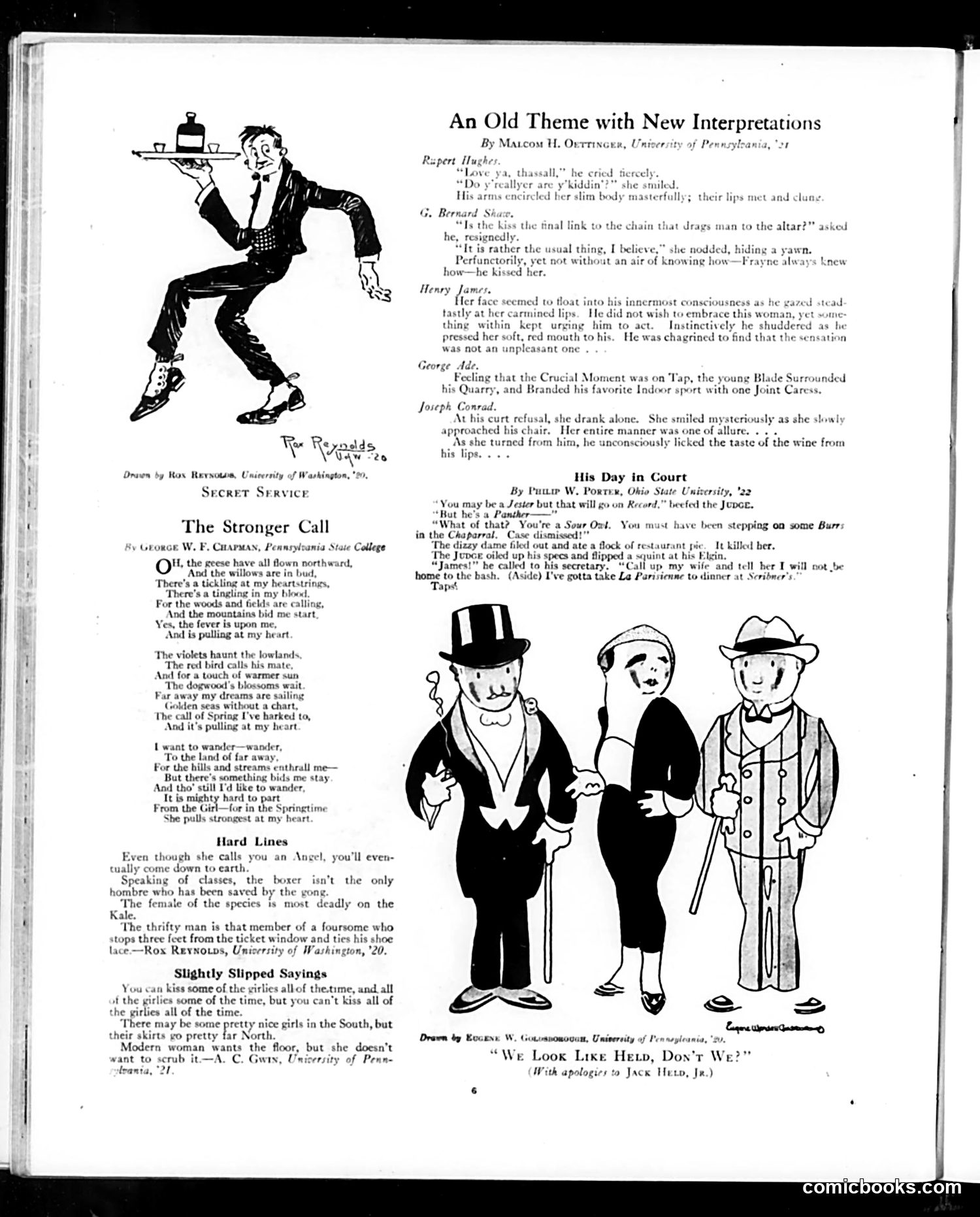
This page contains humorous literary and social commentary rather than political cartoons. The top section, "An Old Theme with New Interpretations," presents romantic scenarios from classic literature reinterpreted by various college writers—treating familiar literary moments with modern cynicism and wit. "The Stronger Call" is a poem about spring's pull on the heart. "Hard Lines" offers sardonic observations about class distinctions and gender, noting the boxer and female of the species as "most deadly." The bottom cartoon, "We Look Like Held, Don't We?" (with apologies to Jack Held Jr.) depicts three working-class men in period dress, appearing to be a humorous commentary on appearance or social status, though the specific reference remains unclear without additional context. The page targets educated, literary readers familiar with classical works.
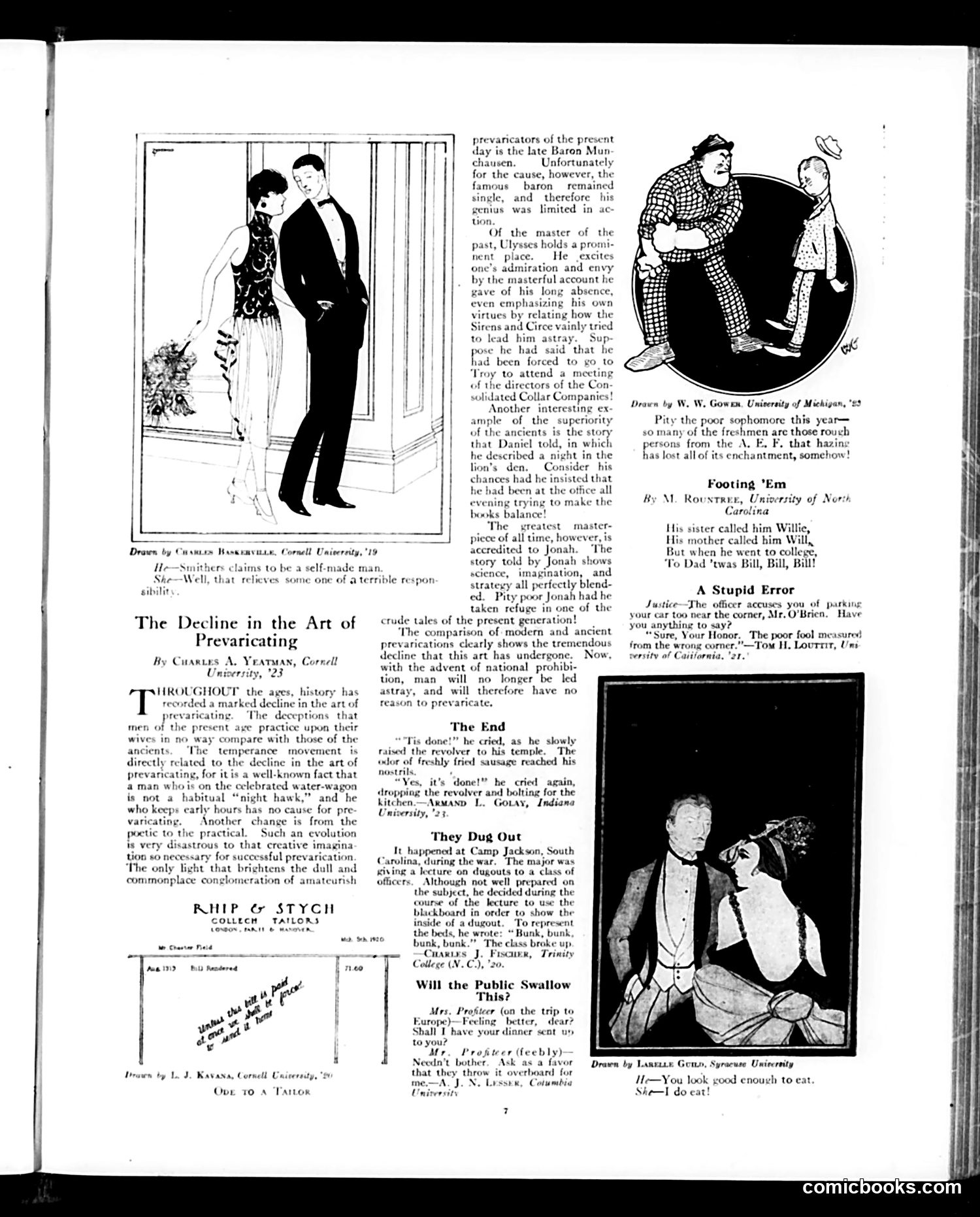
This *Judge* page satirizes the decline of lying as a cultural art form. The main article argues that modern society—particularly the temperance movement and shift toward practical rather than poetic thinking—has weakened humanity's capacity for creative prevarication. The author contrasts ancient master liars (Ulysses, Jonah, Baron Munchausen) with contemporary "amateurish" deceivers, lamenting that modern prevaricators lack imagination and sophistication. The piece is humorous social commentary on how urbanization and reform movements have supposedly diminished traditional skills. The page also contains several unrelated college humor comics and advertisements typical of *Judge*'s format, including jokes about military life, freshman hazing, parking violations, and social embarrassments. These represent standard collegiate humor of the era. The overall tone suggests nostalgic mockery of both past and present, written primarily for educated, college-age readers.
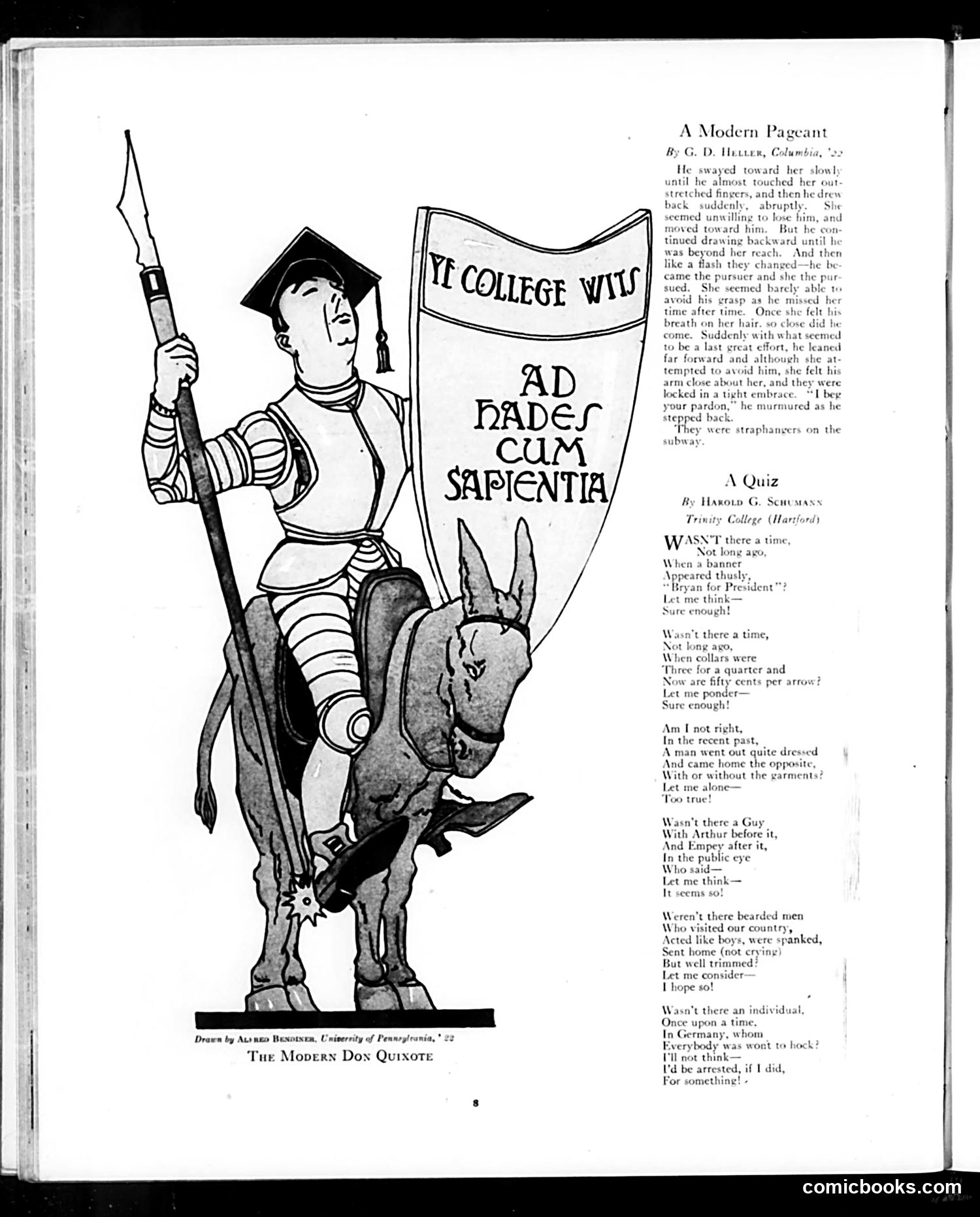
**The Left Illustration:** A figure in medieval armor rides a skeletal horse while holding a lance and banner reading "YE COLLEGE WITS / AD HADES CUM SAPIENTIA" (College Wit to Hell with Wisdom). This is a modern reimagining of Don Quixote, Cervantes's delusional knight, suggesting college-educated people are tilting at windmills—pursuing impractical ideals disconnected from reality. **The Right Content:** "A Quiz" by Harold G. Schumann contains rhetorical questions about recent American history and politics: changing presidential candidates, changing fashion standards, a mysterious public figure (possibly referencing a political or military personality), bearded visitors (likely German officials or dignitaries), and a German individual everyone wanted to "hock" (mock/criticize). **The Satire:** Both pieces mock educated elites and topical political figures through humorous questions, suggesting contemporary college intellectuals are out-of-touch idealists, while satirizing specific recent political/diplomatic events the audience would recognize.
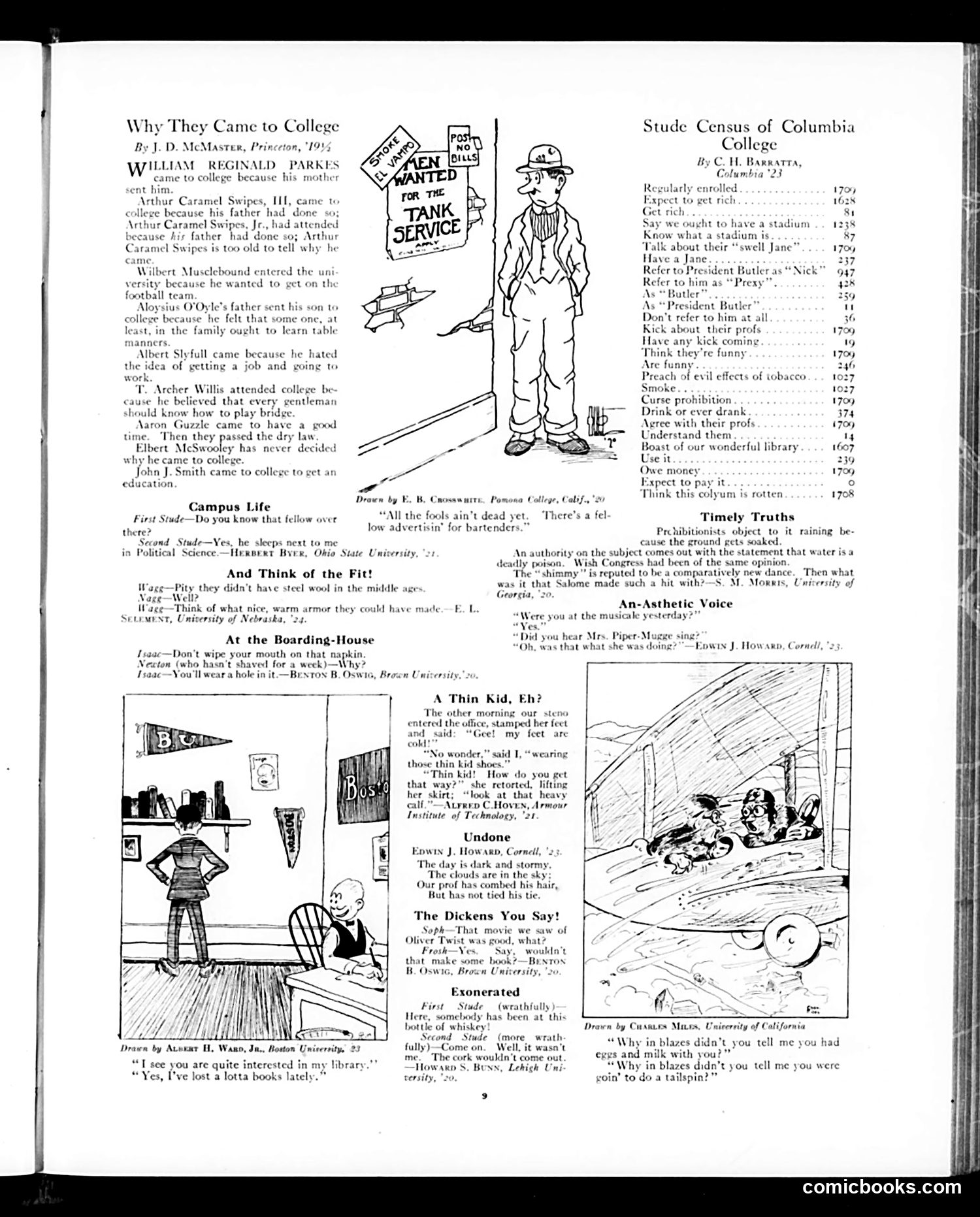
This page from Judge magazine (circa 1923, based on attribution dates) contains several brief humorous pieces satirizing college life: **"Why They Came to College"** mocks various student motivations—some seeking education (rare), others avoiding work, pursuing athletics, or learning social skills like card games. The satire suggests frivolous reasons dominate college attendance. **"Stude Census of Columbia College"** uses numerical data humorously, listing contradictory student behaviors (e.g., "1709" both drink AND oppose prohibition; many "owe money" yet "expect to pay it"). **Other vignettes** mock dormitory etiquette, student romance ("swell Jane"), and prohibition-era drinking culture (the "whiskey bottle" joke). The **cartoon drawings** illustrate typical college "types"—the earnest student, the casual dorm-dweller. Overall, the satire targets college students as hypocritical, idle, and motivated by social status rather than genuine learning—a common 1920s critique of higher education's accessibility to the wealthy and socially ambitious.
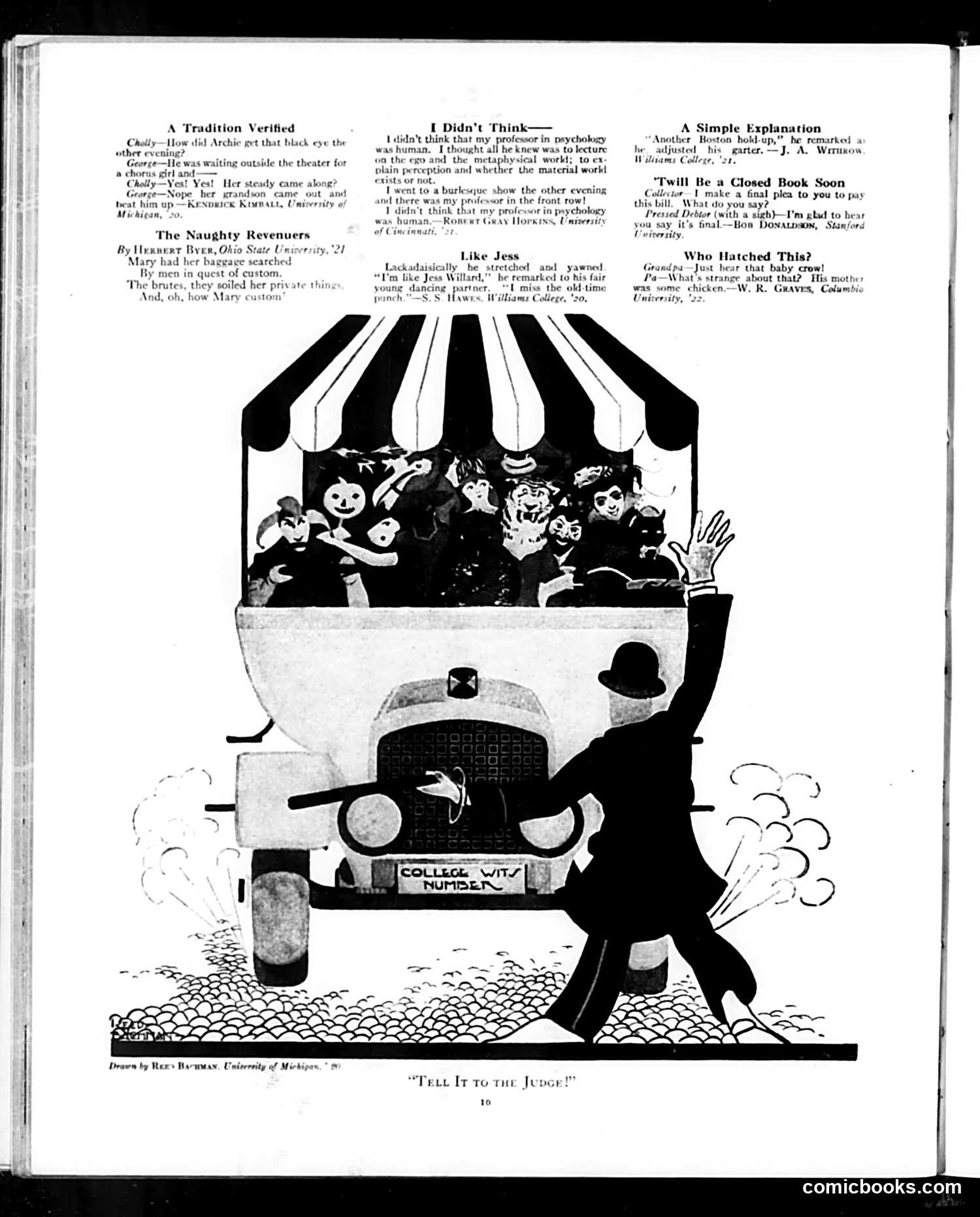
This page features a large cartoon depicting a man operating an oversized vehicle styled like a baby carriage or delivery cart, labeled "College Wit/Number." The vehicle is overflowing with characters representing college students engaged in various antics and pranks. The man driving appears to be transporting "college wit" — jokes and humorous anecdotes — suggesting colleges as sources of humor. The surrounding text consists of brief jokes submitted by college students, each credited to different universities. These short quips touch on romantic mishaps, misunderstandings with professors, and financial troubles. The cartoon's title, "Tell It to the Judge," frames this collection of college humor as frivolous matters unworthy of serious consideration. The satire targets college students' self-perceived cleverness and their tendency to recycle tired jokes and pranks as original wit. The overflowing cart suggests an endless supply of derivative, trivial humor being produced by American colleges.
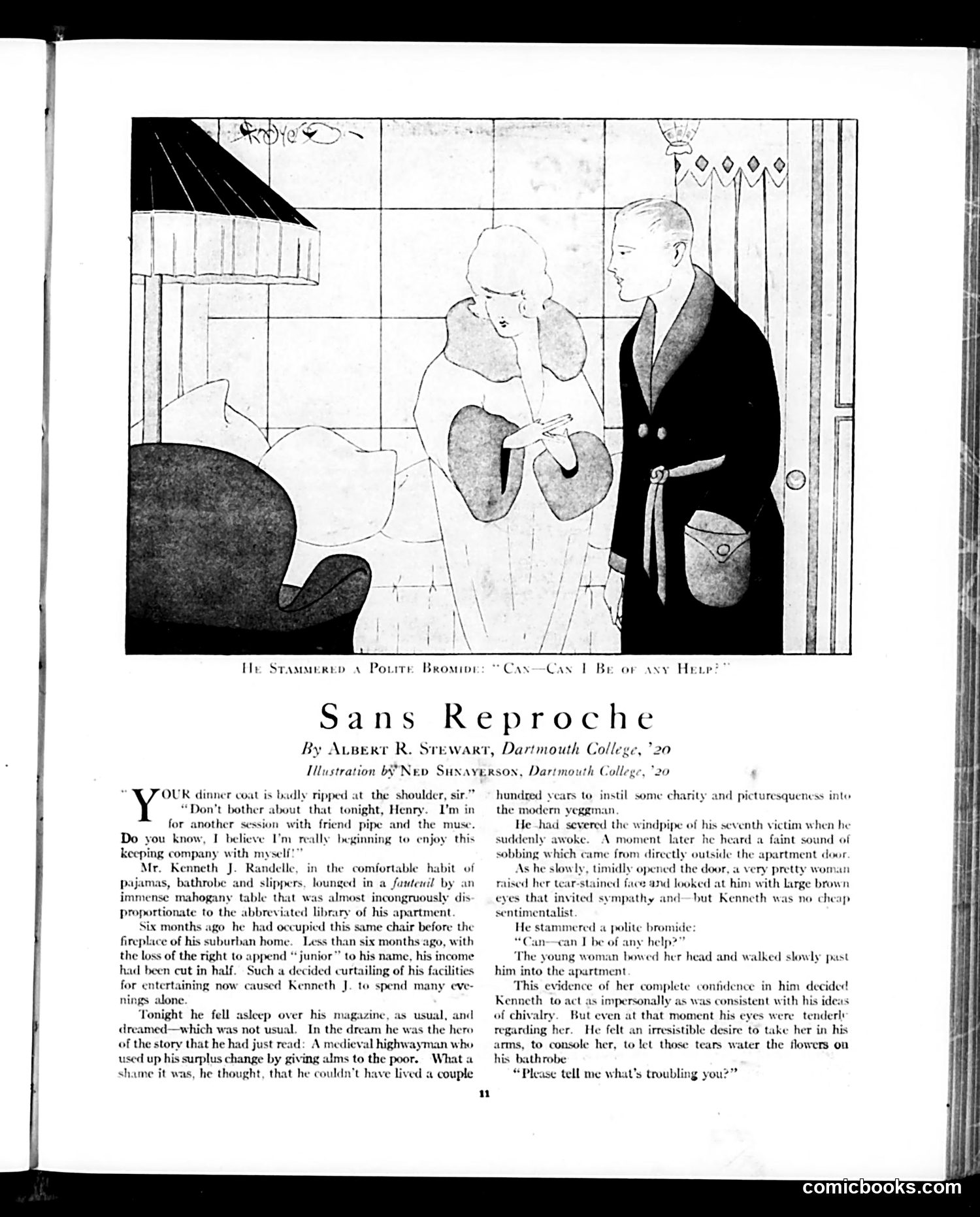
This is a short story illustration, not political satire. The narrative follows Kenneth J. Randelle, a gentleman recently reduced in circumstances—he's lost the "junior" suffix from his name and his income has been "cut in half," forcing him to live a solitary life in a modest apartment rather than his suburban home. The story's irony centers on Kenneth's character: he's a sentimental dreamer (fantasizing about being a Robin Hood-like medieval outlaw) who nonetheless prides himself on emotional restraint and propriety. When a distressed young woman appears at his door seeking help, he maintains formal politeness despite his obvious attraction to her—a "polite bromide" response masking deeper feeling. The title "Sans Reproche" (without reproach/blame) suggests the story examines whether Kenneth can maintain his honor and chivalrous ideals despite his reduced circumstances and emotional vulnerability. The humor lies in the gap between his self-image as a dispassionate gentleman and his actual emotional nature.
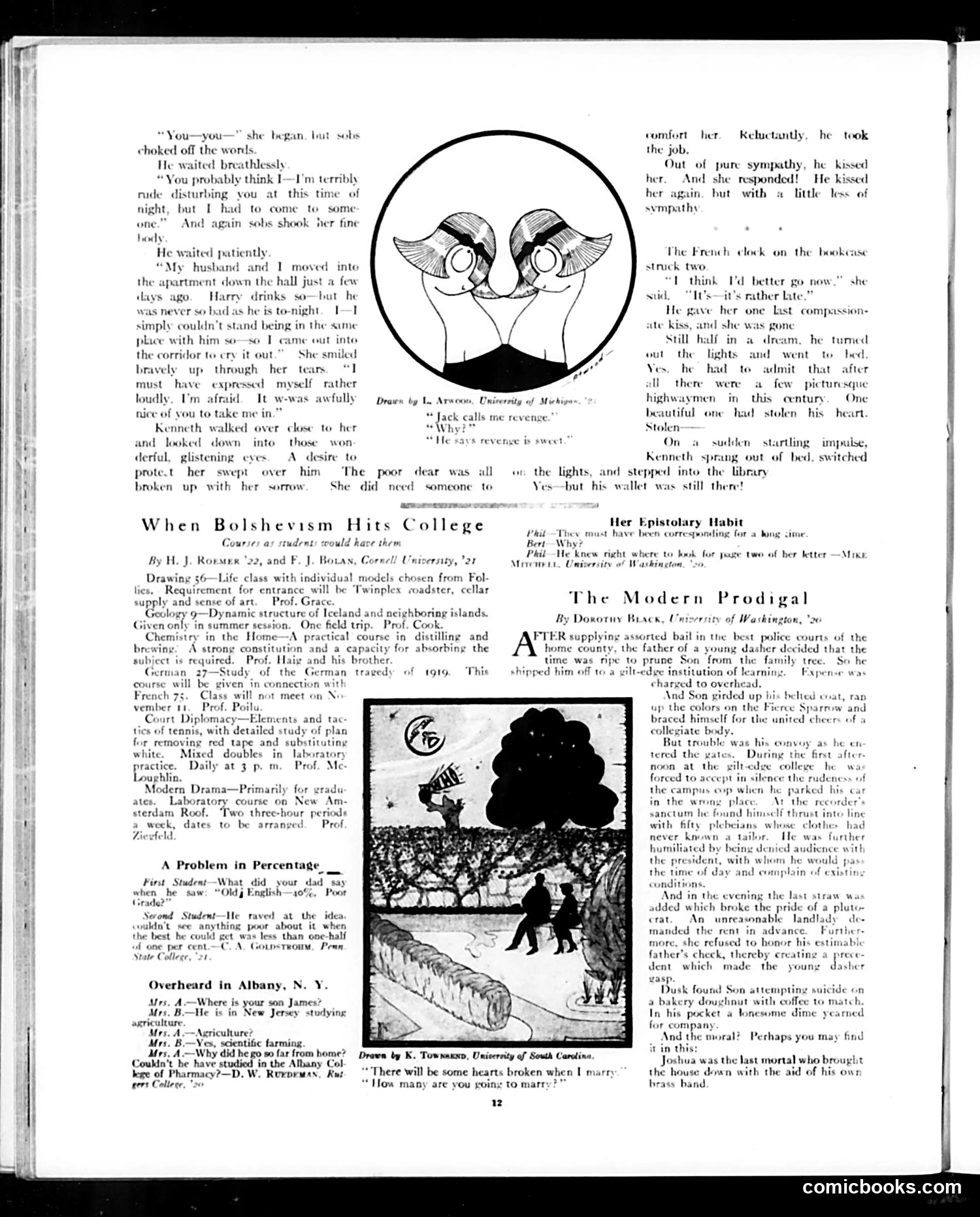
This page contains multiple short stories and humorous anecdotes typical of Judge magazine's satirical content. The main illustrated narrative (top) depicts a domestic drama: a woman visits a man's apartment late at night, claiming her husband drinks excessively and she couldn't bear being near him. The man comforts her with kisses, but she leaves when the clock strikes two. The joke's ironic twist: he discovers his wallet is still there—implying her visit was genuinely about distress, not theft, subverting expectations of seduction or robbery. The other content includes college curriculum satire ("When Bolshevism Hits College"), academic overheard conversations, and brief anecdotes mocking student life and family dynamics. The cartoons by credited university artists suggest Judge frequently published student-contributed humor. The overall tone reflects 1920s attitudes toward marriage, propriety, and urban domestic life, using romantic misunderstanding and small moral reversals for comedic effect.
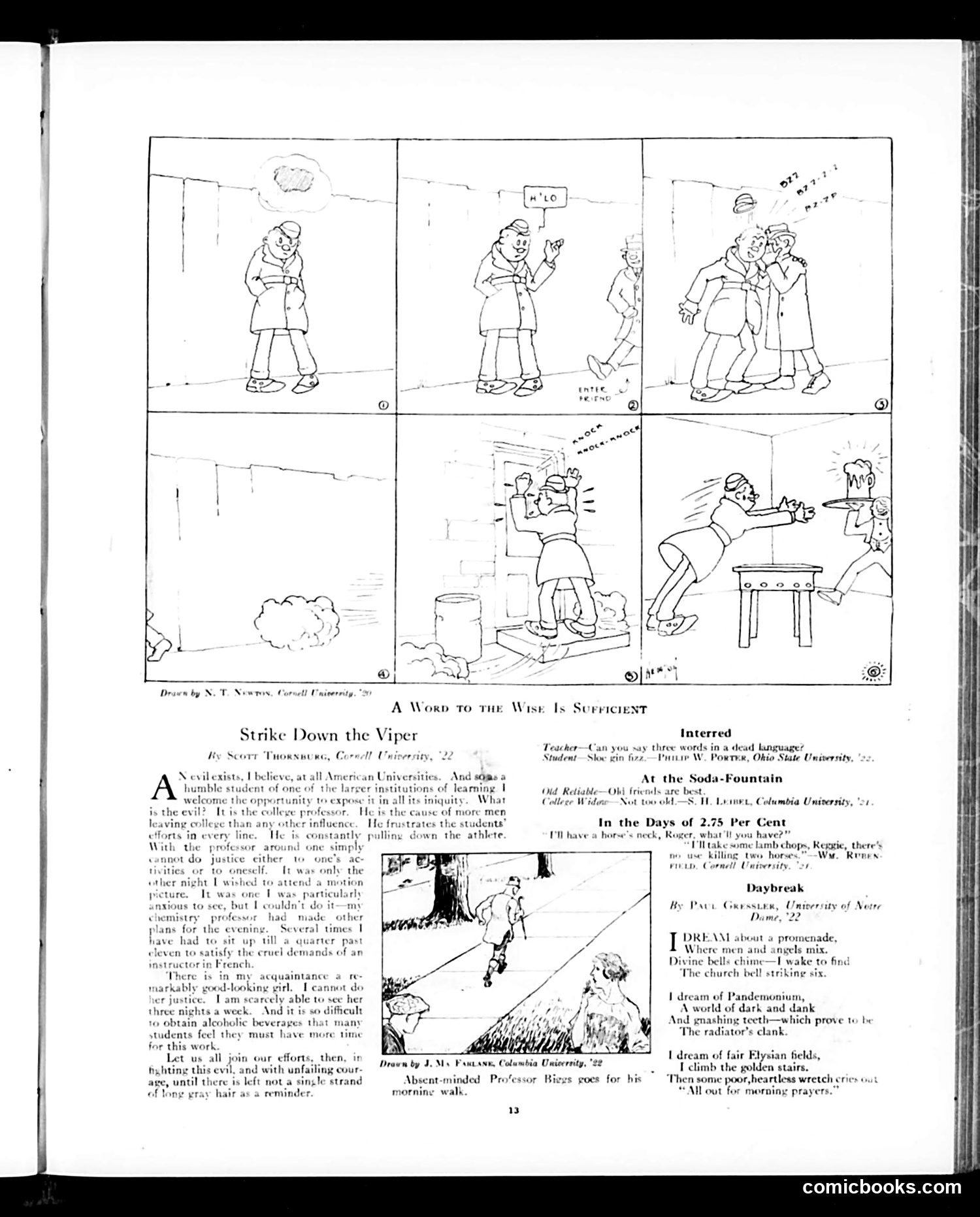
This Judge magazine page (circa 1922) contains student-authored humor pieces reflecting college life anxieties of the era. **"Strike Down the Viper"** (top comic strip) depicts a student struggling with alcohol temptation. The "viper" refers to illicit liquor—Prohibition was in effect (1920-1933), making alcohol illegal. The accompanying essay by Scott Thorndike advocates eliminating student drinking, framing it as an "evil" that distracts from studies and corrupts character. **The remaining pieces** are brief humorous anecdotes about college life: jokes about speaking Latin, soda fountain slang ("horse's neck" = a drink), Depression-era economics ("2.75 per cent"), and dormitory complaints about mandatory morning prayers interrupting dreams. The overall theme: earnest moralistic concern about student behavior—particularly alcohol consumption—mixed with irreverent student humor mocking authority figures and institutional rules. The satire targets both student vices and rigid college discipline.
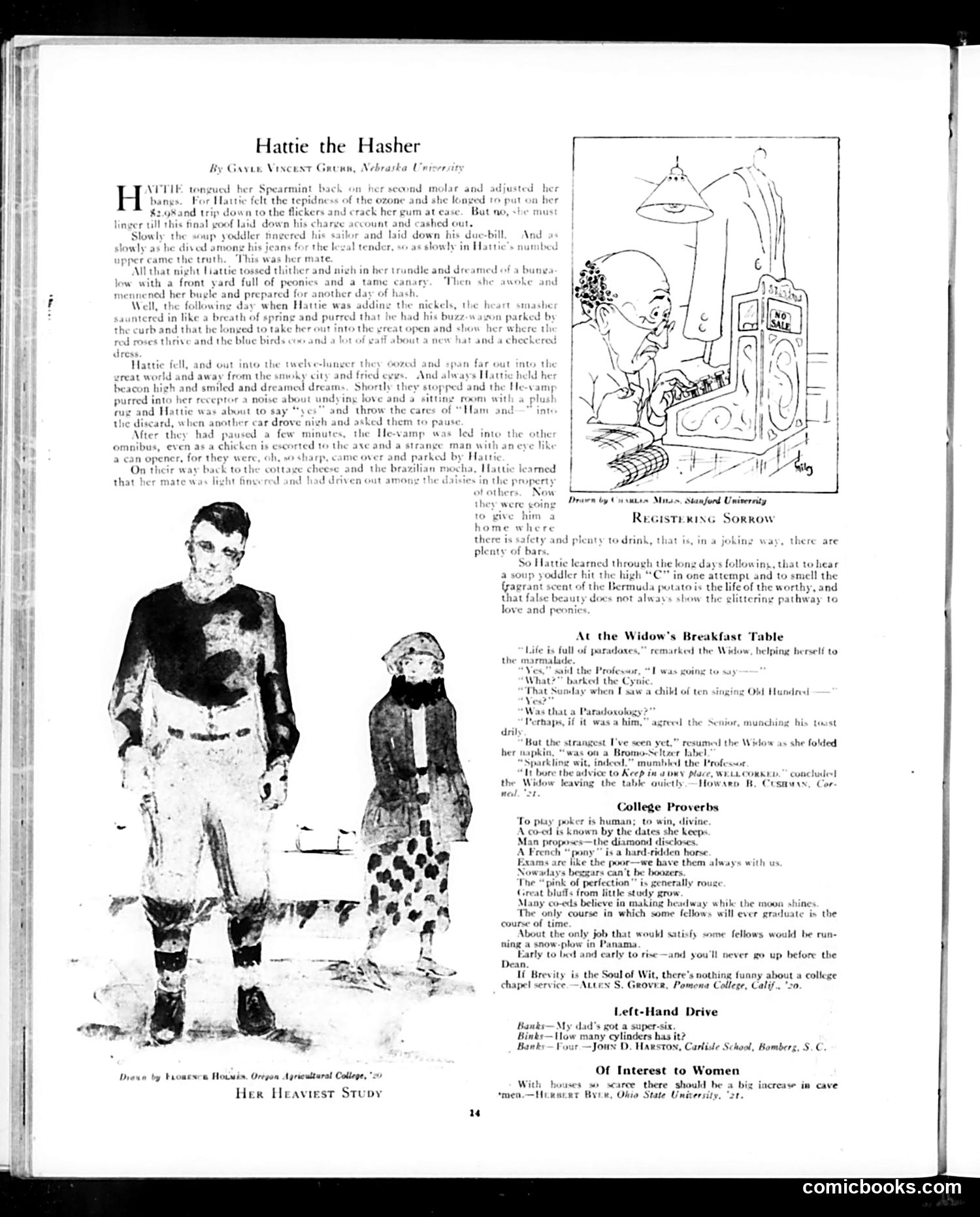
This page contains a short story with illustrations satirizing working-class life in the 1920s. "Hattie the Hasher" tells of a diner waitress who dreams of escaping her mundane job. The narrative mocks her unrealistic aspirations—she fantasizes about luxury (a bungalow, ponies, canary) while working a low-wage restaurant job. The humor derives from the contrast between her actual circumstances and her romantic daydreams. The accompanying sections—"At the Widow's Breakfast Table," "College Proverbs," and miscellaneous jokes—offer typical Judge magazine humor: observations on paradoxes, college dating culture, and absurdist one-liners. The tone is gently mocking of aspiring youth and working people. The illustrations show Hattie as a somewhat plain, working-class figure, emphasizing the gap between her reality and fantasy. This represents typical early-20th-century American satirical humor targeting lower economic classes.
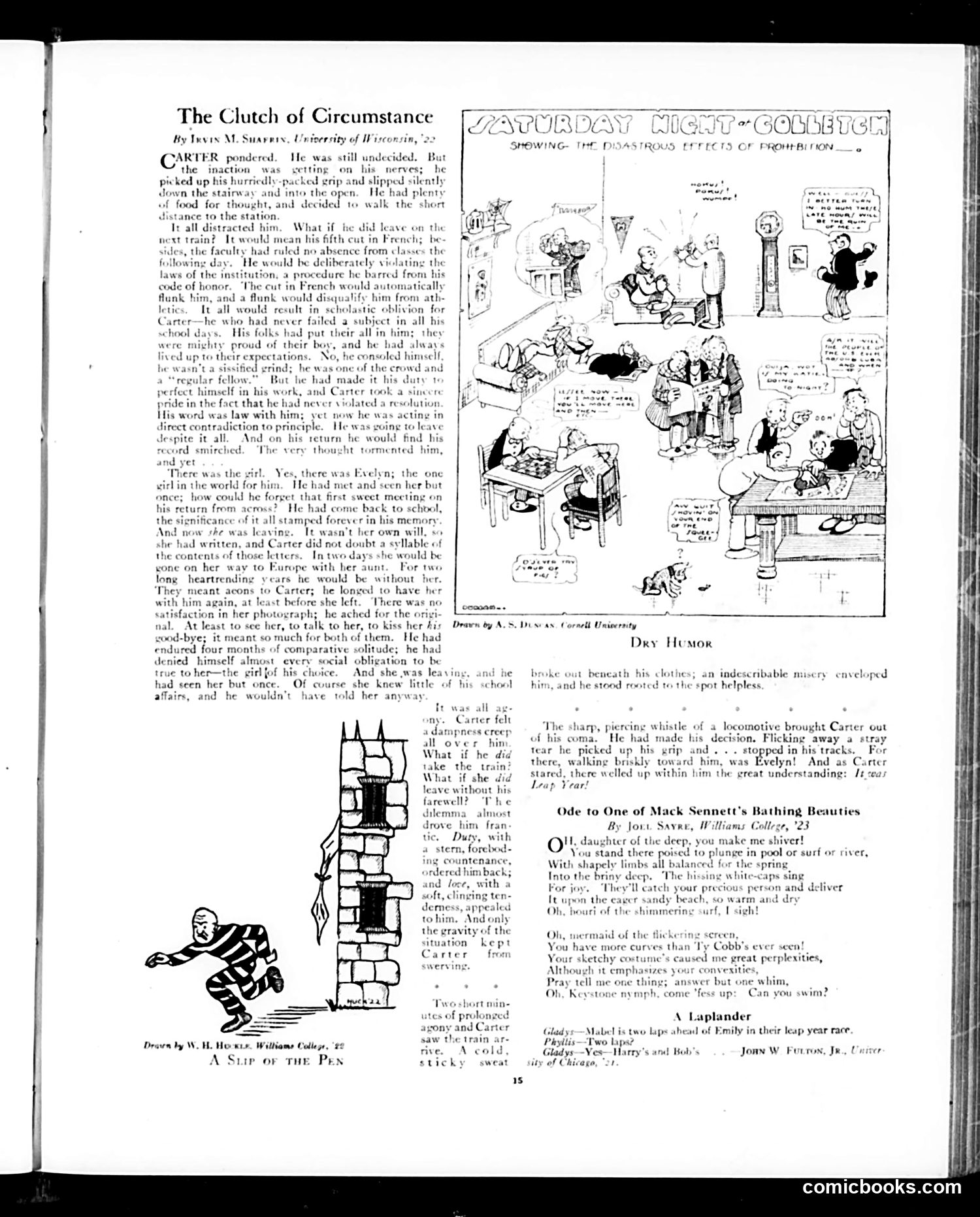
This page contains three separate pieces of college humor from the early 1920s: **"The Clutch of Circumstance"** is a romantic drama about a student named Carter torn between attending to his girlfriend Evelyn (who's leaving for Europe) and avoiding a French class absence that would violate honor code and end his academic standing. The tension resolves when he sees a train whistle—presumably he'll make a fateful choice. **"Saturday Night at Colledge"** is a comic illustration satirizing Prohibition's effects on college life, showing students engaged in various illicit drinking activities and rowdy behavior during the alcohol ban era (1920-1933). **"Dry Humor"** presents a brief anecdote about a student's misery over forbidden romance. **"Ode to One of Mack Sennett's Bathing Beauties"** parodies silent film starlets, referencing the famous slapstick filmmaker's comedy shorts featuring scantily-clad women. The page reflects 1920s college culture: Prohibition enforcement, romantic melodrama, and fascination with emerging cinema. These pieces appeared in *Judge*, a satirical magazine targeting educated, urbane readers familiar with contemporary scandals and entertainment.
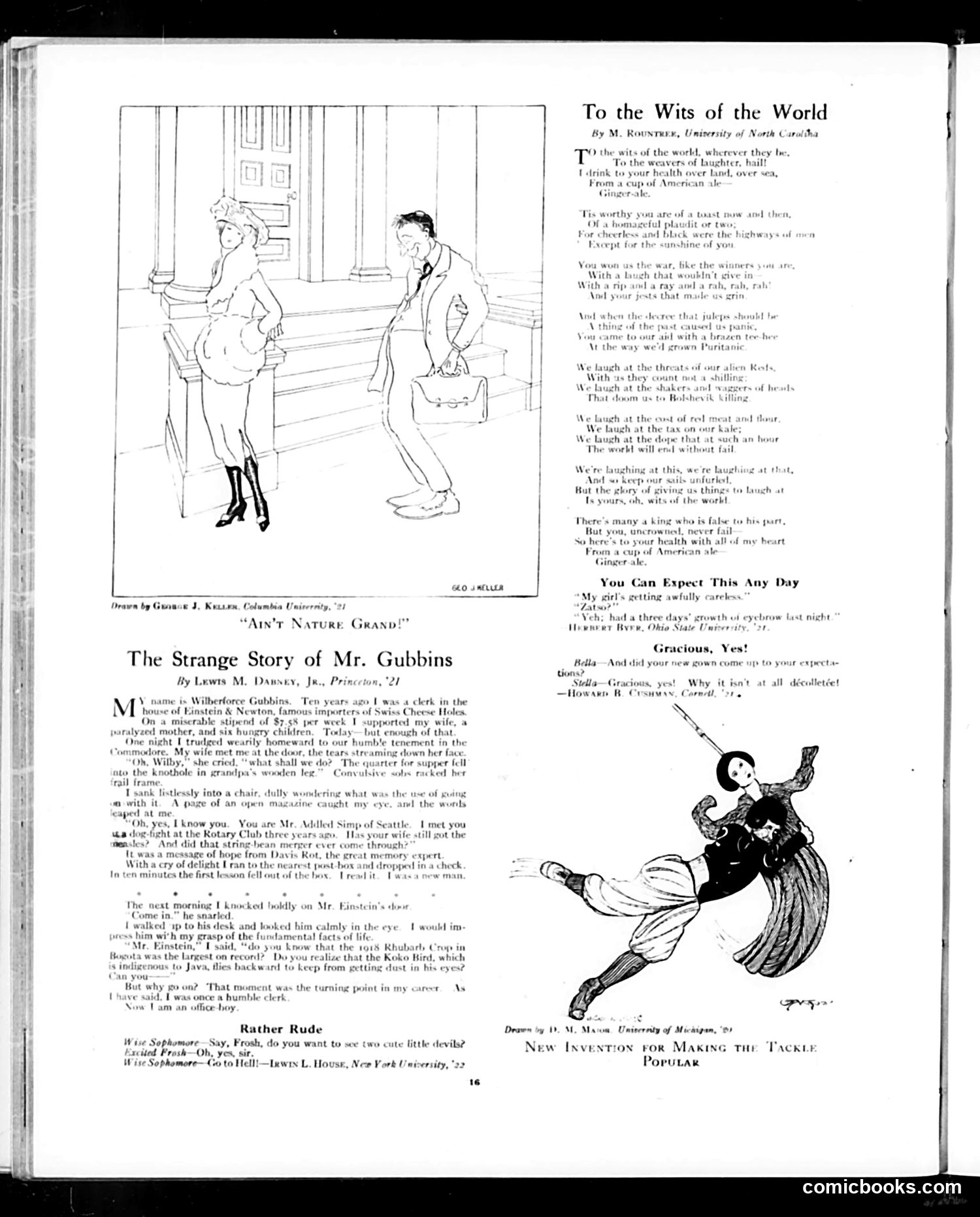
This page contains several humorous pieces typical of 1920s college humor magazines: **"Ain't Nature Grand"** (top cartoon): Shows two men, apparently soldiers or officers, in a domestic interior. The joke appears to reference WWI veterans and post-war adjustment, though the specific reference is unclear from the image alone. **"The Strange Story of Mr. Gubbins"**: A satirical story about a poor clerk whose life transforms after a chance encounter. It mocks self-help narratives and the "bootstraps" mythology of success, suggesting absurd coincidences (the "1918 Rhubarb Crop") drive fortune rather than merit. **"You Can Expect This Any Day"** and **"Gracious, Yes!"**: Brief joke exchanges about domestic life and personal grooming—typical lightweight humor about courtship and marriage. **"Rather Rude"**: A campus joke playing on the phrase "go to Hell" as both a dismissal and literal direction. **"New Invention for Making the Tackle Popular"**: The caption suggests a sports-related joke, though details are unclear. Overall, this represents typical 1920s college magazine satire: gentle social commentary mixed with campus humor and domestic wit, aimed at educated young readers.
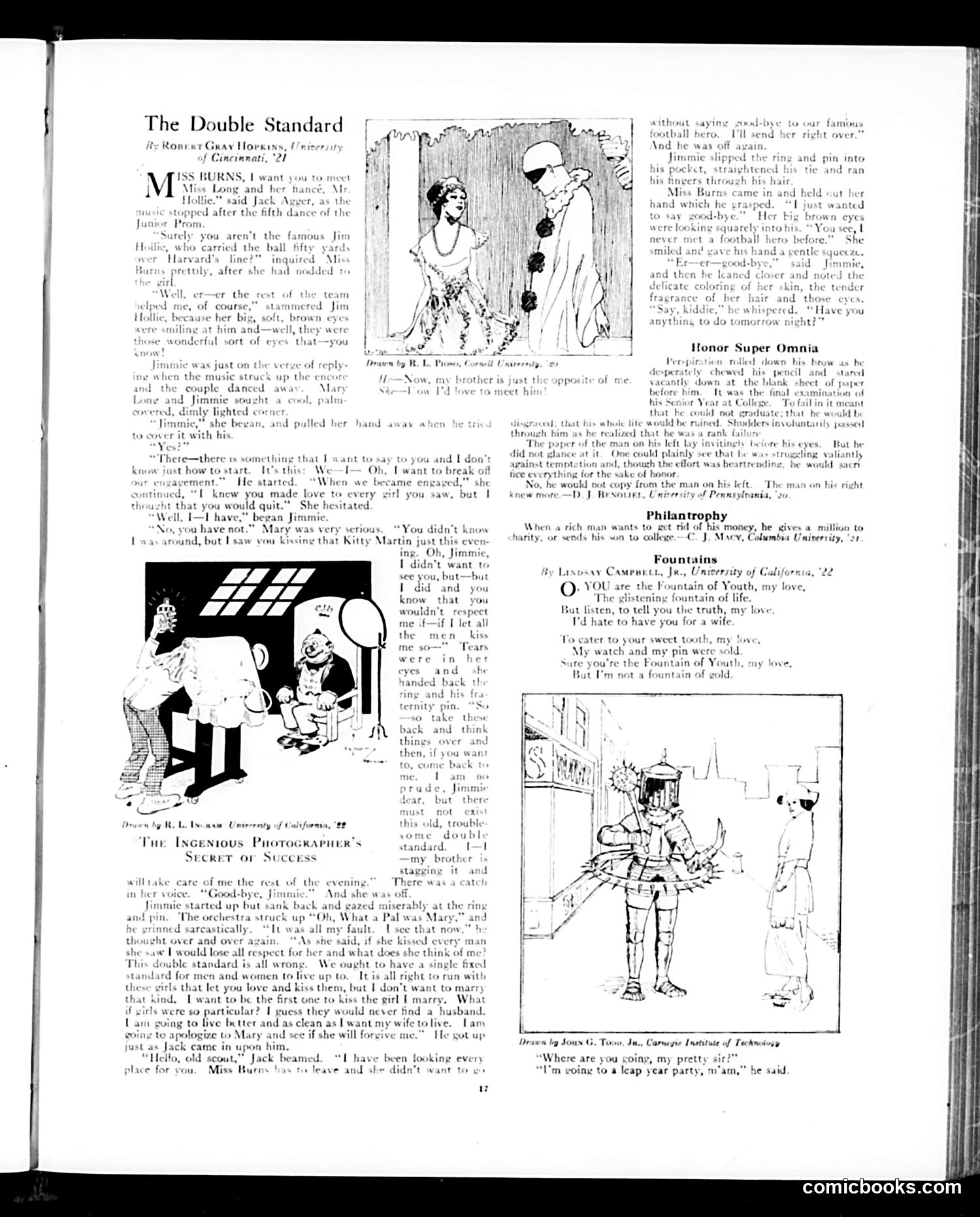
This story critiques the era's sexual double standard. A man (Jimmie) dances with Miss Burns, then later with Mary, treating them differently based on their reputations. When Miss Burns pulls away after he tries to kiss her, she confronts him: men can pursue multiple women without consequence, but women face social ruin for the same behavior. Jimmie recognizes the injustice—he wants a "clean" wife but hasn't lived cleanly himself. He decides to apologize to Mary and reform, acknowledging the hypocrisy is "all wrong." The accompanying cartoons mock related absurdities: a wealthy man's "philanthropy" of sending his son to college (implying the son is a burden), and a woman in "leap year party" attire (when tradition allowed women to propose), joking about matrimonial desperation. The satire targets masculine privilege and the Victorian sexual morality that punished women far more severely than men.
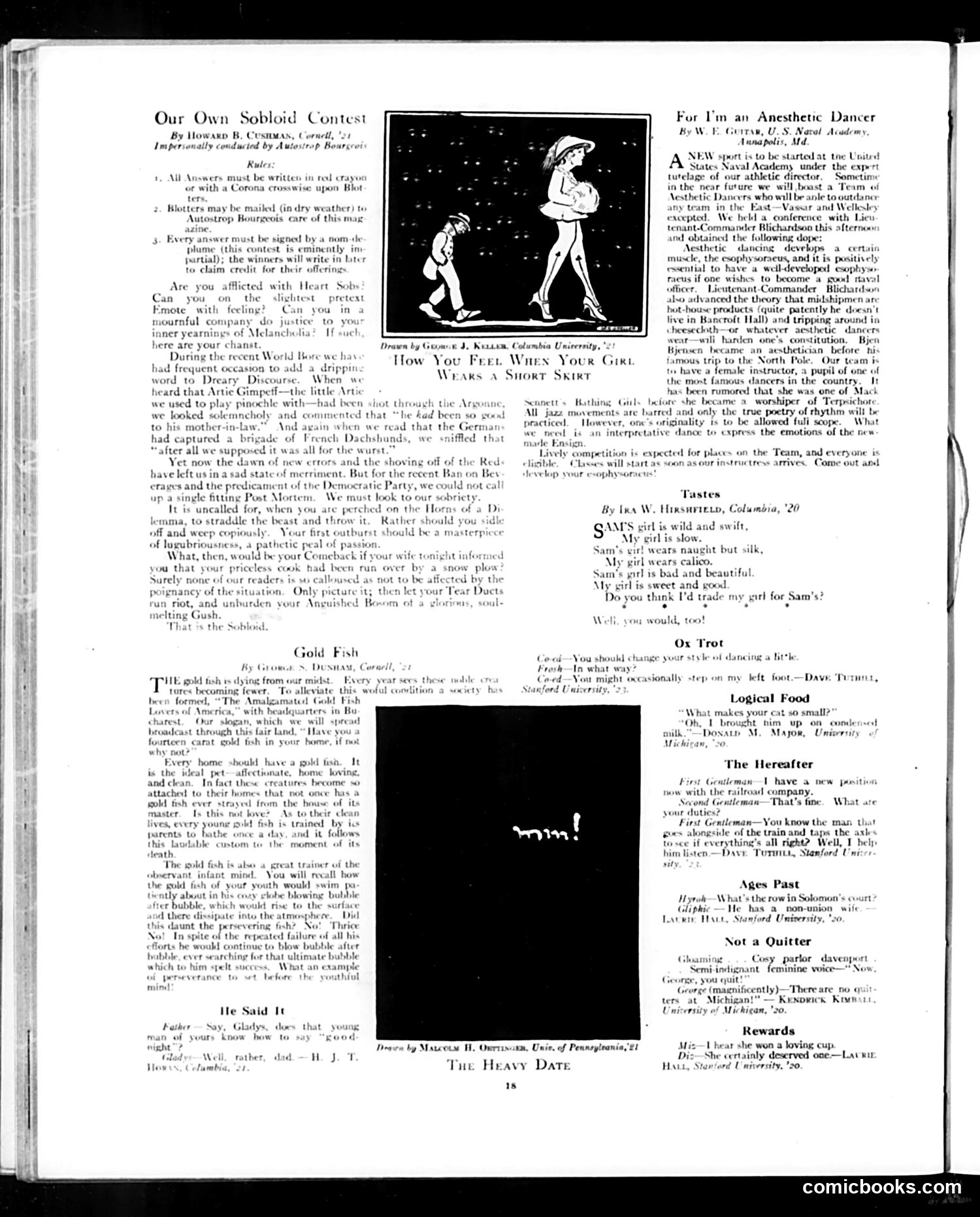
This page from *Judge* contains humor columns and brief satirical pieces typical of the 1920s college magazine style. The main illustrated cartoon shows a couple dancing, accompanying text about "How You Feel When Your Girl Wears a Short Skirt"—likely commenting on the contemporary shock of women's fashion becoming shorter and more revealing. The text includes various humorous columns: "Gold Fish" discusses the fad of keeping goldfish as pets; "He Said It" presents a dating scenario; and "Aesthetic Dancer" satirizes the Naval Academy introducing modern dance as a sport, poking fun at athletic pretension and the absurdity of training "aestheticians." Other pieces ("Logical Food," "The Hereafter," "Not a Quitter") are brief joke exchanges between characters, typical of collegiate humor. The overall tone is lighthearted mockery of 1920s social trends—flapper fashion, pet-keeping fads, and institutional pomposity. The content reflects concerns and anxieties of the era presented through witty, somewhat juvenile humor.
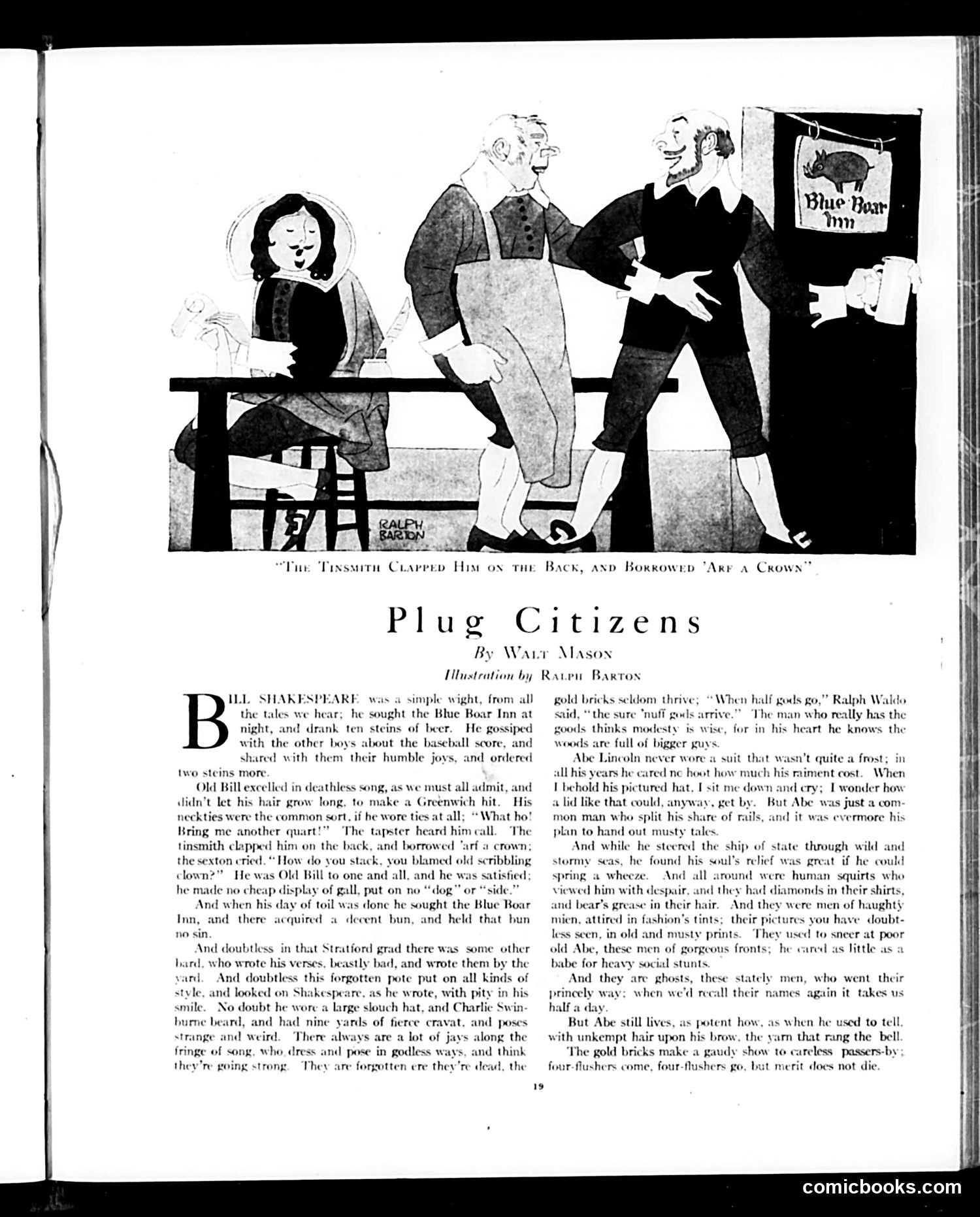
This page presents Walt Mason's poem (illustrated by Ralph Barton) contrasting genuine, unpretentious figures—Shakespeare and Abraham Lincoln—with self-aggrandizing poseurs and social climbers. The cartoon caption depicts the "tinsmith" and "sexton" borrowing from Shakespeare and mocking his lack of affectation ("you blamed old scribbling clown"), establishing the theme: truly great men don't perform or adopt artificial airs. Mason argues that Shakespeare and Lincoln succeeded through modesty and authenticity rather than fashionable pretense. They wore common clothes, told simple jokes, and cared nothing for social status—yet remain immortal. Meanwhile, their contemporaries who wore elaborate costumes, affected poses, and cultivated impressive appearances are now forgotten ("ghosts"). The poem satirizes turn-of-the-century "four-flushers" (frauds) who adopted exaggerated artistic or social personas to seem important. Mason's message: genuine merit and character endure; fashionable posturing vanishes with its practitioners.
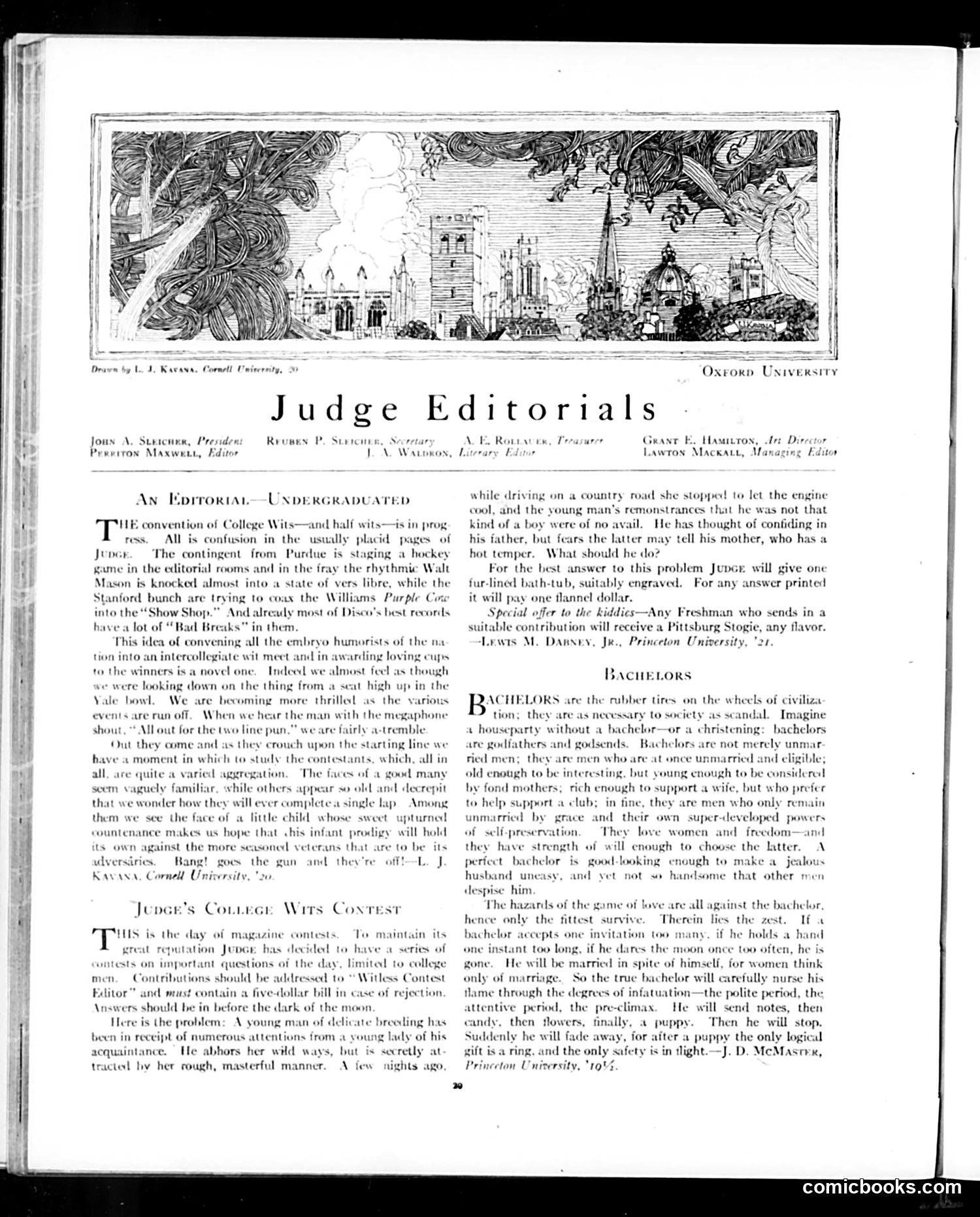
This page showcases **Judge magazine's editorial section** from what appears to be the 1920s. The top features a decorative engraving of Oxford University's skyline. The main content includes three pieces: 1. **"An Editorial—Undergraduated"**: A satirical commentary on a national college wit competition where undergraduate humorists compete. The author humorously describes the chaos of hosting visiting college teams (Purdue, Stanford, Williams) in Judge's offices, mixing gentle mockery with affectionate observation about the contestants' varying ages and talent levels. 2. **"Judge's College Wits Contest"**: An announcement for Judge's own humor competition open to college men, offering prizes including a "fur-lined bath-tub, suitably engraved" for the best answer to a humorous dilemma about a young man's romantic predicament. 3. **"Bachelors"**: A satirical essay defining bachelors as society's essential "rubber tires"—necessary fixtures who fund clubs and serve as godfathers, deliberately choosing bachelorhood over marriage. The page is primarily **editorial content**, not political commentary, reflecting Judge's focus on college humor and social satire of the era.
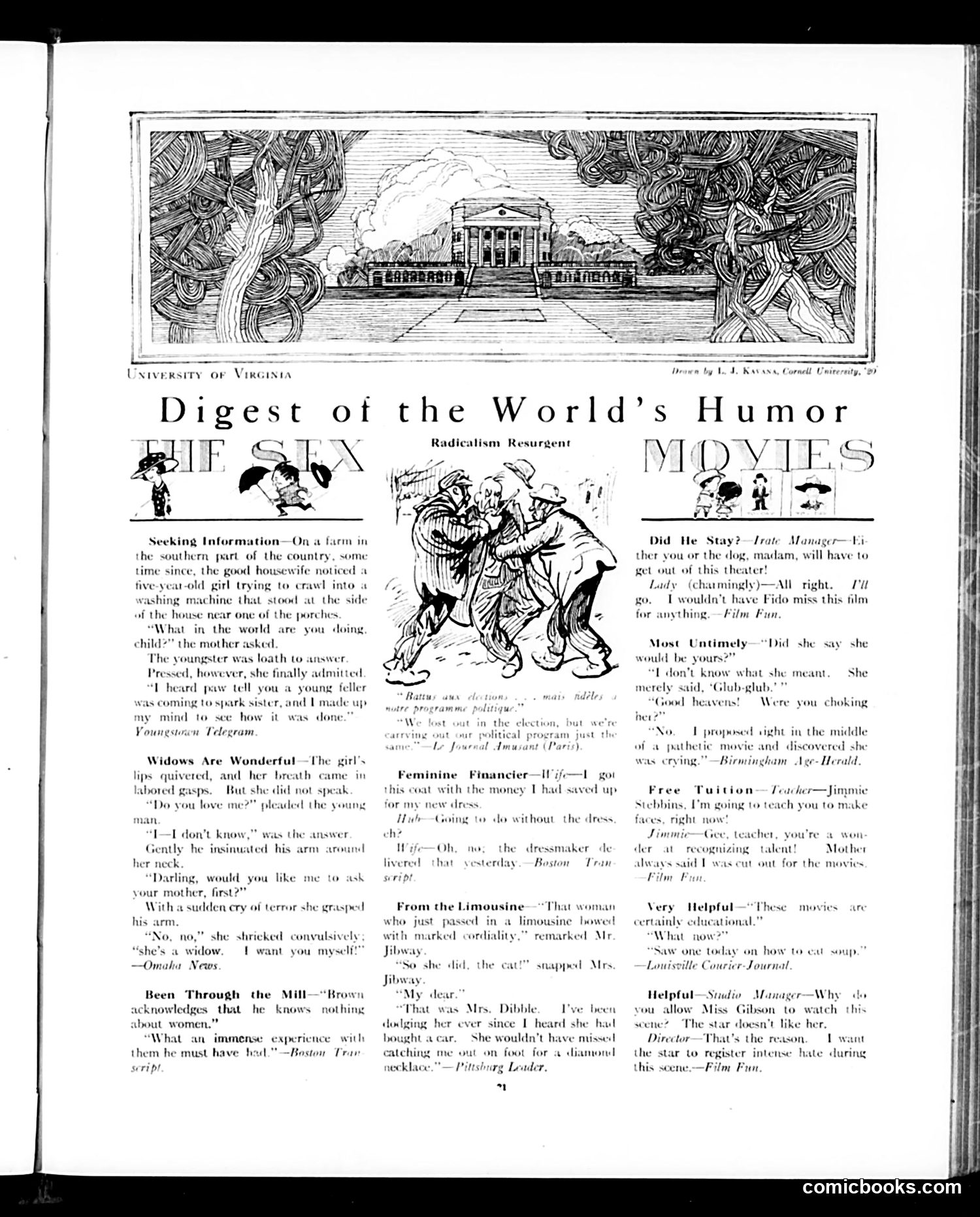
This page collects brief humorous anecdotes and jokes organized around domestic and social themes popular in early 20th-century American life. ## Key Content: **The cartoons/jokes satirize:** - **Gender dynamics**: Multiple pieces mock courtship rituals ("Widows Are Wonderful," "Seeking Information") where women are portrayed as naive or mercenary, and men as bumbling suitors. - **Class anxiety**: "From the Limousine" ridicules wealthy pretense—a woman snubs a man until she learns he's bought a car, revealing her materialism. - **Marriage complaints**: "Feminine Financier" presents the tired trope of wives controlling household money and husbands lacking agency. - **Movie culture**: Several jokes reference cinema as both educational and a venue for social mishaps, reflecting the novelty of film as entertainment. **The overall tone** reflects pre-WWI American humor: mildly sexist, focused on domestic friction, and assuming middle-class anxieties about courtship, money, and new technologies. The satire is gentle rather than biting—these are recognizable social situations treated as amusing rather than critiqued seriously.
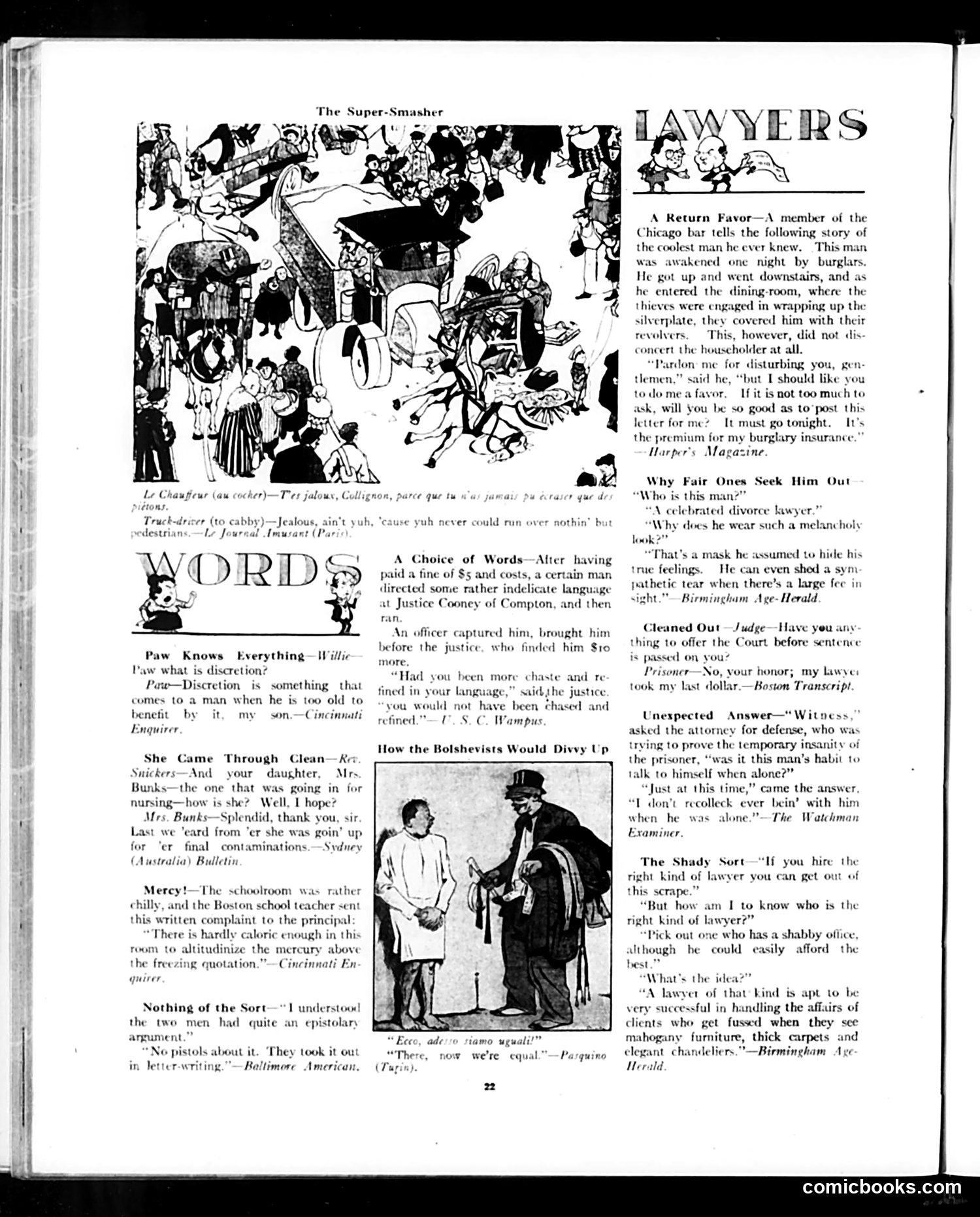
This page from the satirical magazine **Judge** contains multiple short humor pieces mocking lawyers, class pretension, and social absurdity—typical of early 20th-century American comedy. Key items include: **"The Shady Sort"** mocks lawyer selection: hiring a shabby-office lawyer works best for clients intimidated by fancy furnishings, implying successful lawyers exploit their clients' insecurity. **"A Return Favor"** features a burglarized homeowner so composed he asks the thieves to mail his burglary insurance premium—satire on absurd politeness and insurance absurdity. **"Why Fair Ones Seek Him Out"** portrays a divorce lawyer wearing a melancholic mask, shedding "sympathetic tears" for high fees—cynical commentary on lawyers' performative emotion. **"Cleaned Out"** shows a prisoner whose lawyer took his last dollar before sentencing—satirizing lawyers' greed. The cartoons and brief jokes collectively ridicule lawyer dishonesty, class anxiety, and bureaucratic pretension through exaggeration and ironic understatement typical of Judge's style.
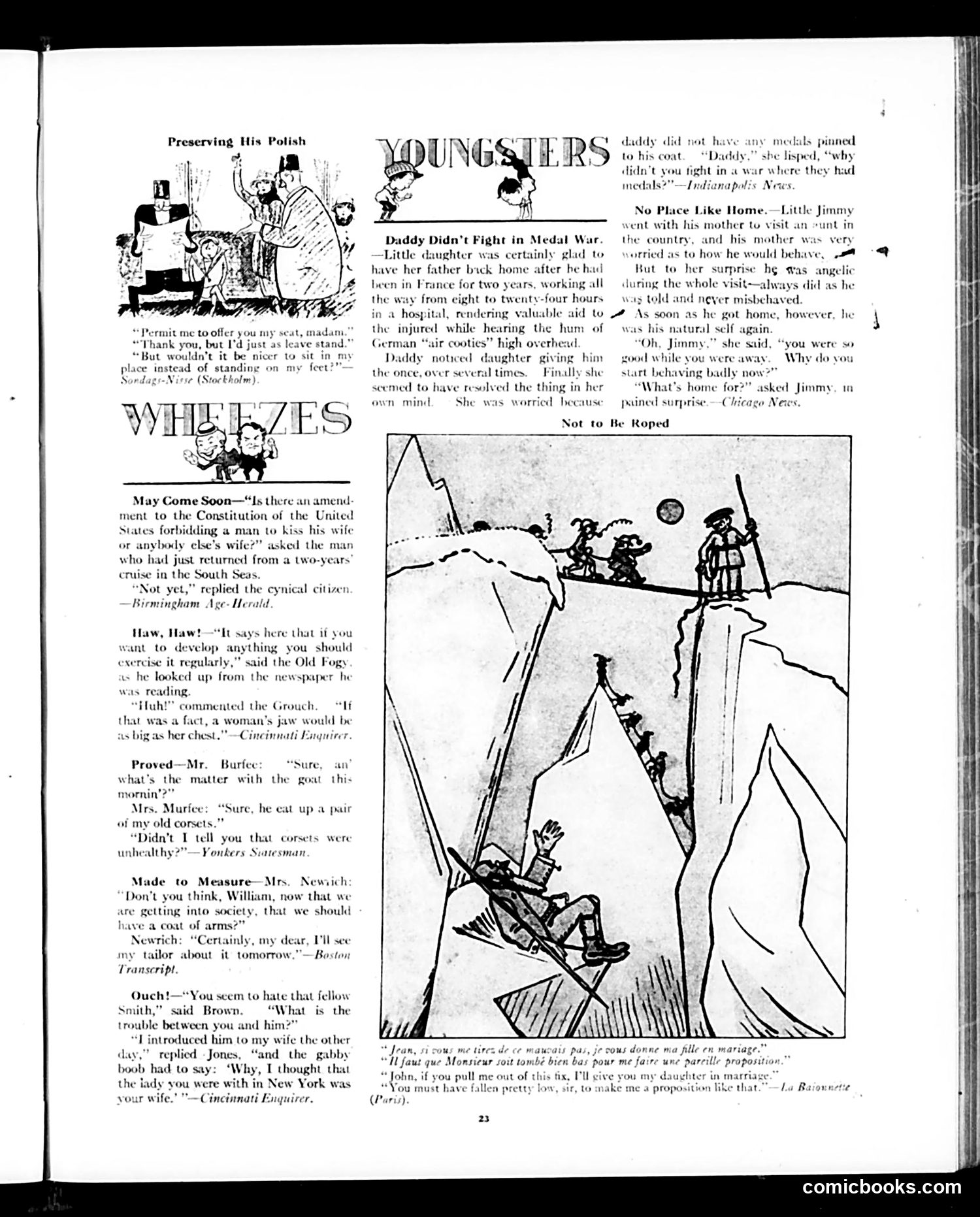
This page contains several brief comic anecdotes typical of Judge's satirical humor, plus one illustrated cartoon titled "Not to Be Roped." **The illustrated cartoon** depicts mountaineers on a cliff; the French caption references a marriage proposal involving a dowry—the satire appears to mock both romantic entanglement and financial negotiation in relationships. **The text jokes** target: - Post-WWI expectations: A daughter worries her hospital-worker father has no medals, satirizing how society valued combat glory over non-combat service - Class anxiety: A wealthy couple ("Newrich") wanting a "coat of arms" for social status - Gender stereotypes: A grouch claiming women's jaws are overdeveloped from constant talking - Marital embarrassment: A man resenting his friend revealing he'd seen him with another woman **Key context for modern readers**: These reflect 1920s-era concerns about social climbing, changing gender roles post-WWI, and the expectation that masculine worth derived from military service rather than civilian contribution.
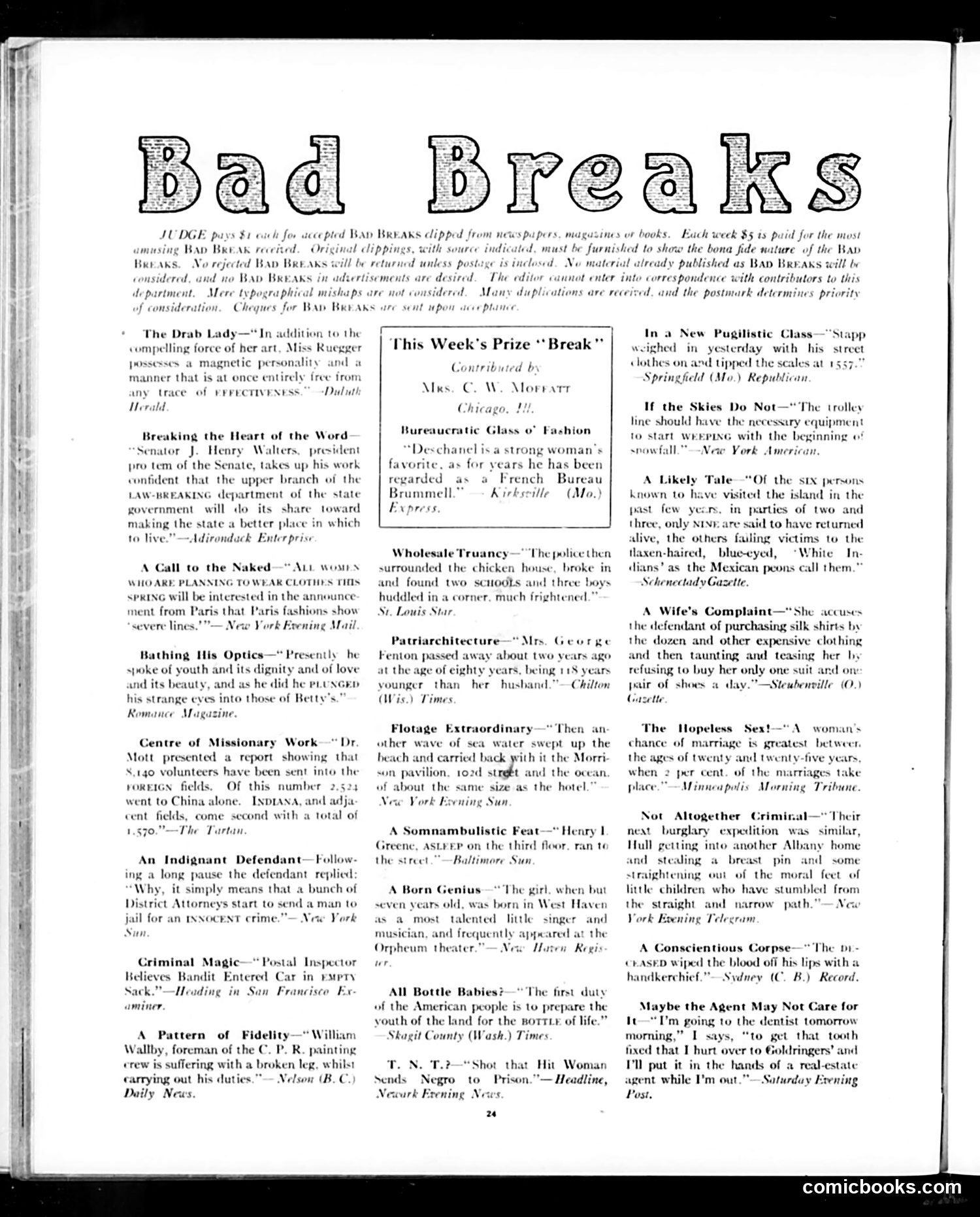
This is the "Bad Breaks" column—a recurring feature in Judge magazine that collected amusing typographical errors and unintentionally absurd newspaper excerpts. The humor relies on reading the literal text rather than the intended meaning. The examples showcase newspaper and magazine clipping mishaps with darkly comic results: a senator leading a "law-breaking department," a woman 118 years younger than her 80-year-old husband, and an item about "the Orpheum theater" describing a seven-year-old's birth. For a modern reader, this documents early-20th-century *publication limitations*—errors that would now be caught by digital spell-check or editorial review. The humor is gentle mockery of careless editors and typists. The page itself appears to be mostly text and advertisements rather than containing illustrated cartoons. This column offered readers affordable participation: Judge paid $1 for acceptable "bad breaks" sent from published sources, making it crowdsourced humor predating internet-era error collection.
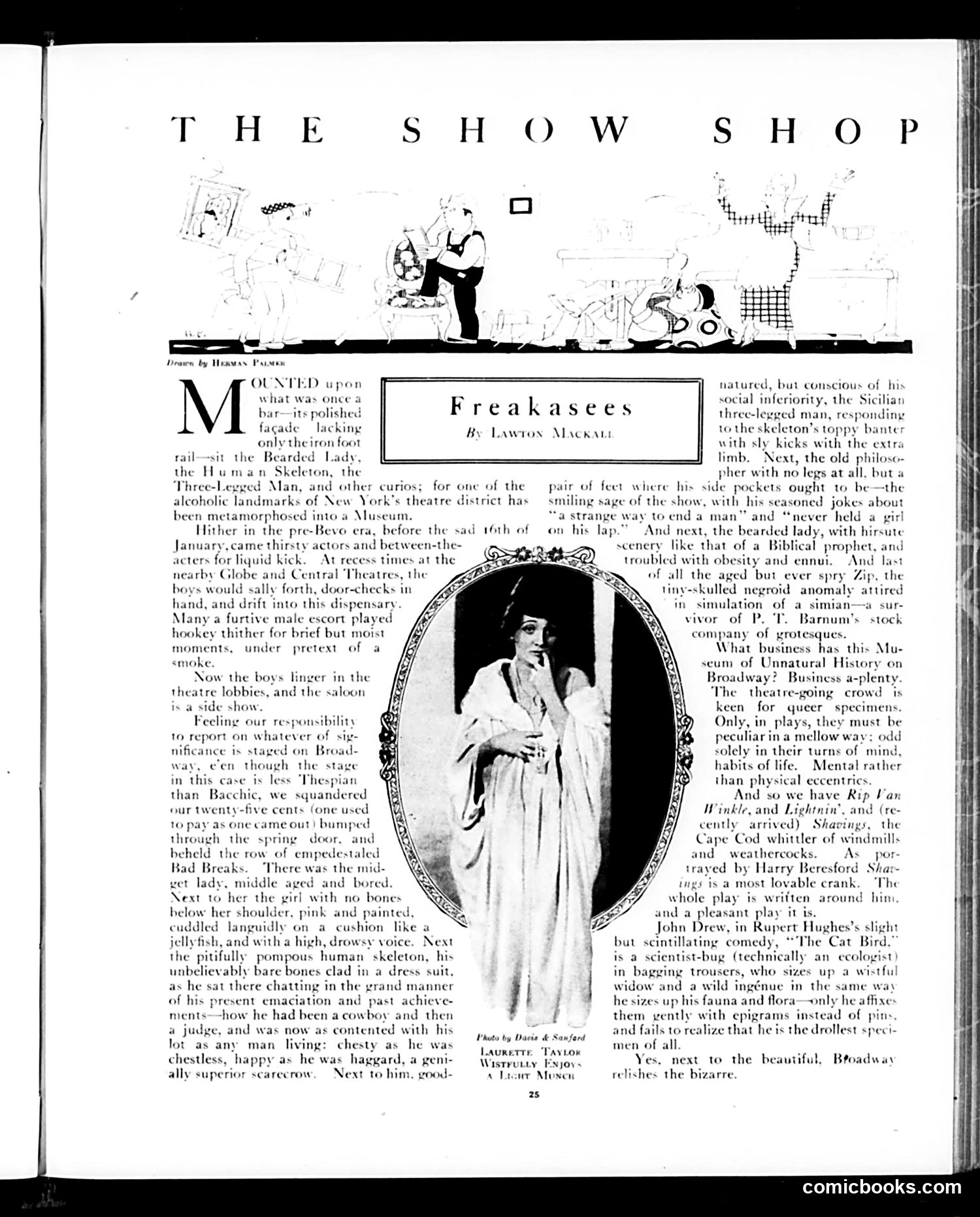
This article by Lawton Mackall satirizes Broadway theaters that have converted old saloons into museums of human curiosities—a reference to the real "dime museum" phenomenon. The piece mocks how theater audiences now flock to see "freaks" (people with physical abnormalities) rather than serious drama. The cartoon illustrates the museum's attractions: a bearded lady, human skeleton, three-legged man, and other "oddities." Mackall criticizes this trend as intellectually beneath theater, noting that pre-Prohibition, these bars served thirsty actors between performances. Now transformed into sideshow attractions, they appeal to audiences seeking mental rather than physical eccentricity in entertainment. The satire targets both the theater industry's commercialization and audience taste—suggesting Broadway has abandoned art for profitable sensationalism. References to plays like *Rip Van Winkle* and *Lightnin'* contrast "proper" eccentric characters with literal human exhibitions, lamenting Broadway's descent into spectacle.
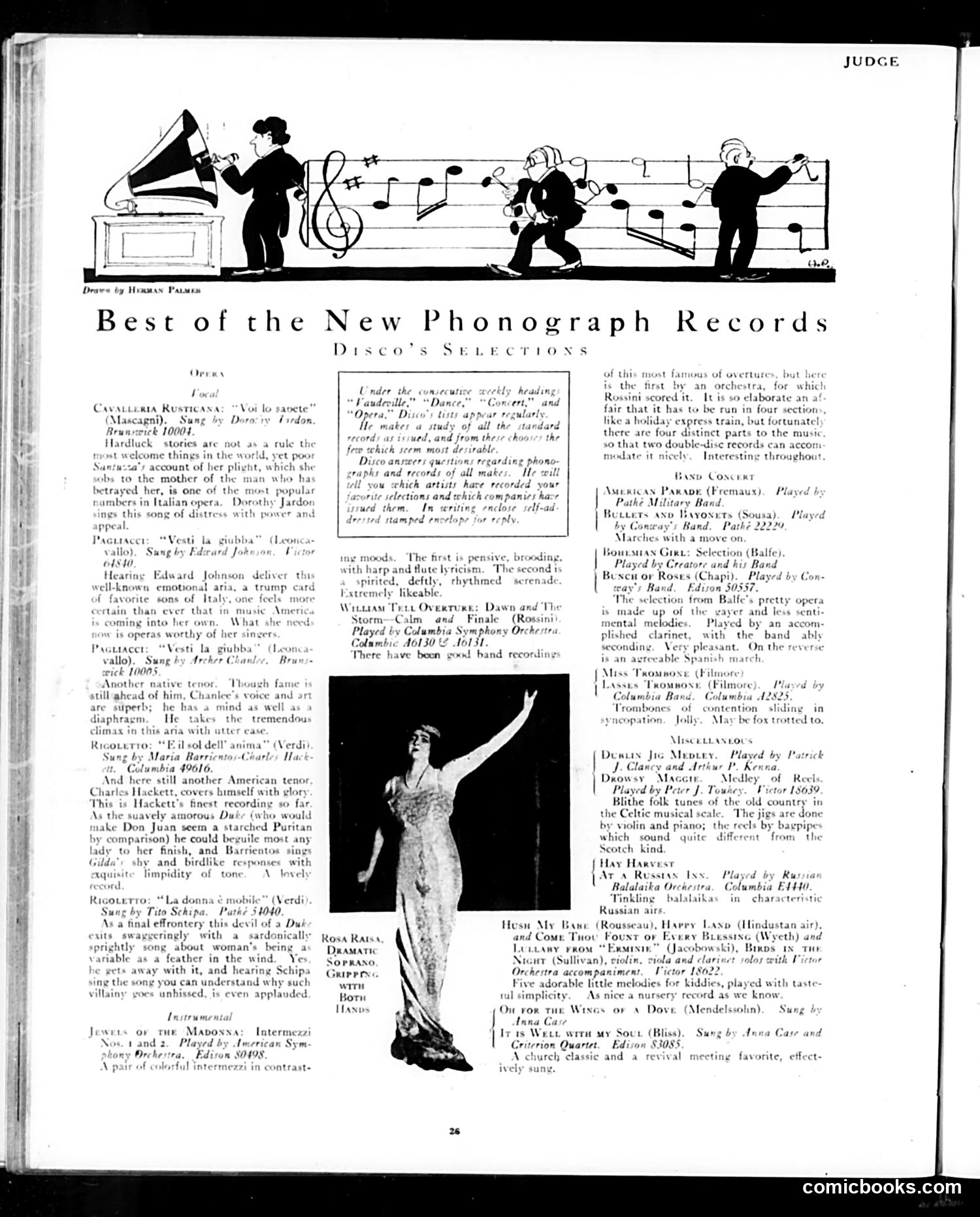
This page is **not primarily a political cartoon** but rather a **music review and advertisement** for phonograph records. The illustration at the top depicts four men in silhouette conducting or performing with a gramophone and sheet music—a decorative header for the "Disco's Selections" section reviewing opera and concert recordings. The bulk of the content comprises critical reviews of popular classical and operatic recordings, naming singers like Dorothy Jardon, Edward Johnson, and Rosa Raisa. The reviews assess vocal technique and musical quality of specific recordings available for purchase. The large photograph shows a female performer in costume, likely accompanying one of the reviewed recordings. This appears to be a standard entertainment/consumer guide page rather than satirical political content. Judge magazine, while known for satire, also published conventional lifestyle and cultural commentary for its readers interested in the arts.
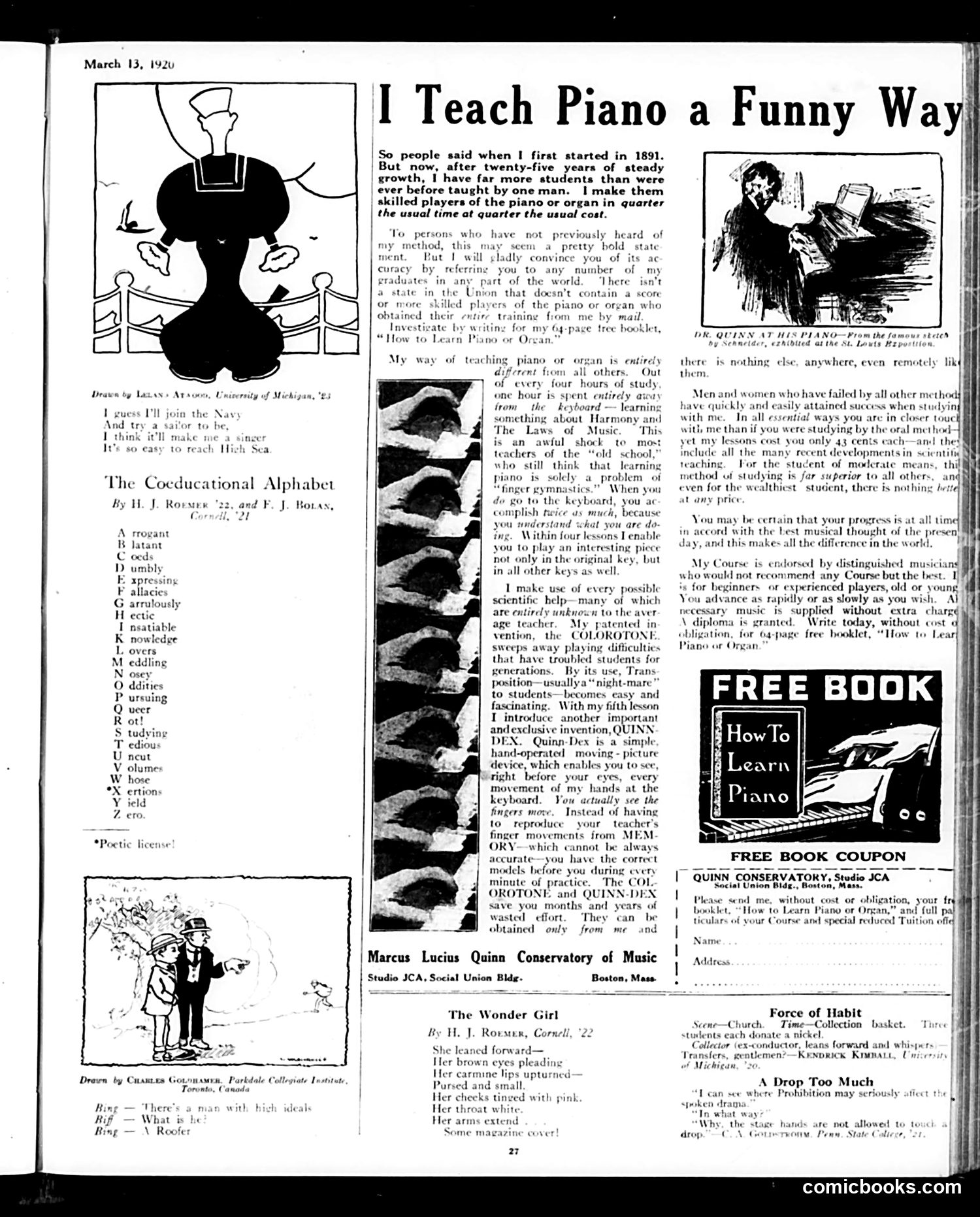
This page contains two distinct items: ## "I Teach Piano a Funny Way" (Main Advertisement) This is a full-page advertisement from the Marcus Lucius Quinn Conservatory of Music in Boston (dated March 13, 1920). Quinn claims revolutionary piano-teaching methods using patented devices called the "COLOROTONE" and "QUINN-DEX"—mechanical aids that supposedly allow students to learn in one-quarter the usual time and cost. The satire appears subtle to modern eyes, but the "funny way" likely refers to Quinn's boastful claims and his reliance on gadgets rather than traditional instruction. The accompanying illustrations show hands at a keyboard in sequence, presumably demonstrating his mechanical system. ## "The Coeducational Alphabet" (Left Column) A humorous acrostic poem by H.J. Roeser and F.J. Bolas using educational vocabulary (Arrogant, Latent, Cods, etc.). The drawings by Leroy Arrison and Charles Goulander illustrate college life scenarios. Both items are period advertising and light humor typical of *Judge* magazine's satirical approach to contemporary American society and education trends.
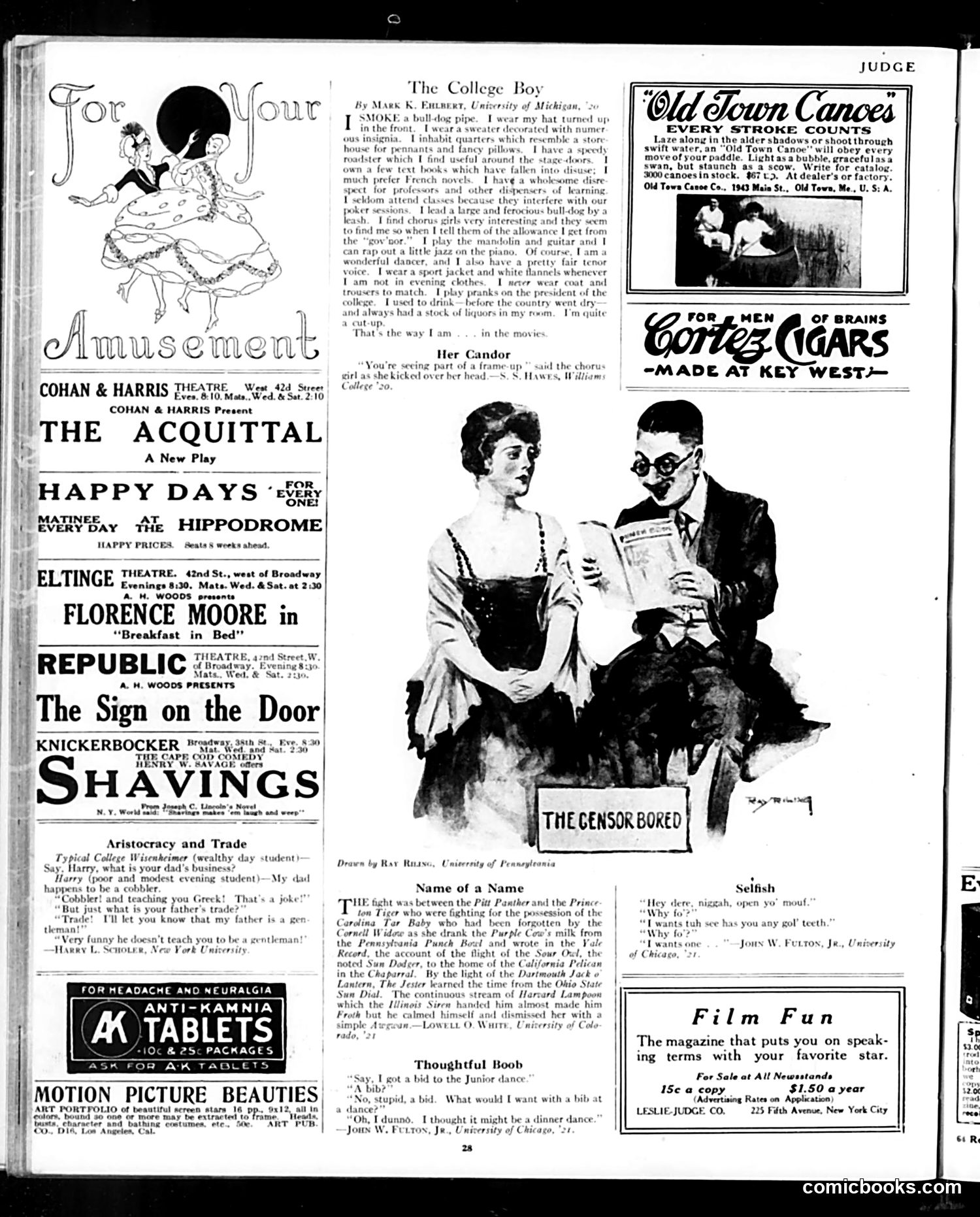
This page is primarily **advertising and theater listings** from an early 20th-century satirical magazine, with light humor pieces interspersed. The main content includes: **"The College Boy"** — A first-person essay where a wealthy university student boasts about his lifestyle: smoking, fancy clothes, musical talents, and access to alcohol. The humor lies in self-aware bragging about privileged excess. **"Her Candor"** and **"Name of a Name"** — Brief joke pieces playing on wordplay and campus life, featuring literary allusions typical of college humor magazines. **"Aristocracy and Trade"** — A short joke contrasting a wealthy student whose father is a "cobbler" (shoe-maker), mocking class pretension and the irony that manual labor fathers produce gentlemen sons. The **"Selfish"** section appears to be ethnic dialect humor (using offensive language), common to the era but reflecting period racism. Most of the page advertises Broadway theaters (Cohan & Harris, Knickerbocker) and products like Anti-Kamnia tablets and Old Town Canoes. This was Judge's primary revenue source.
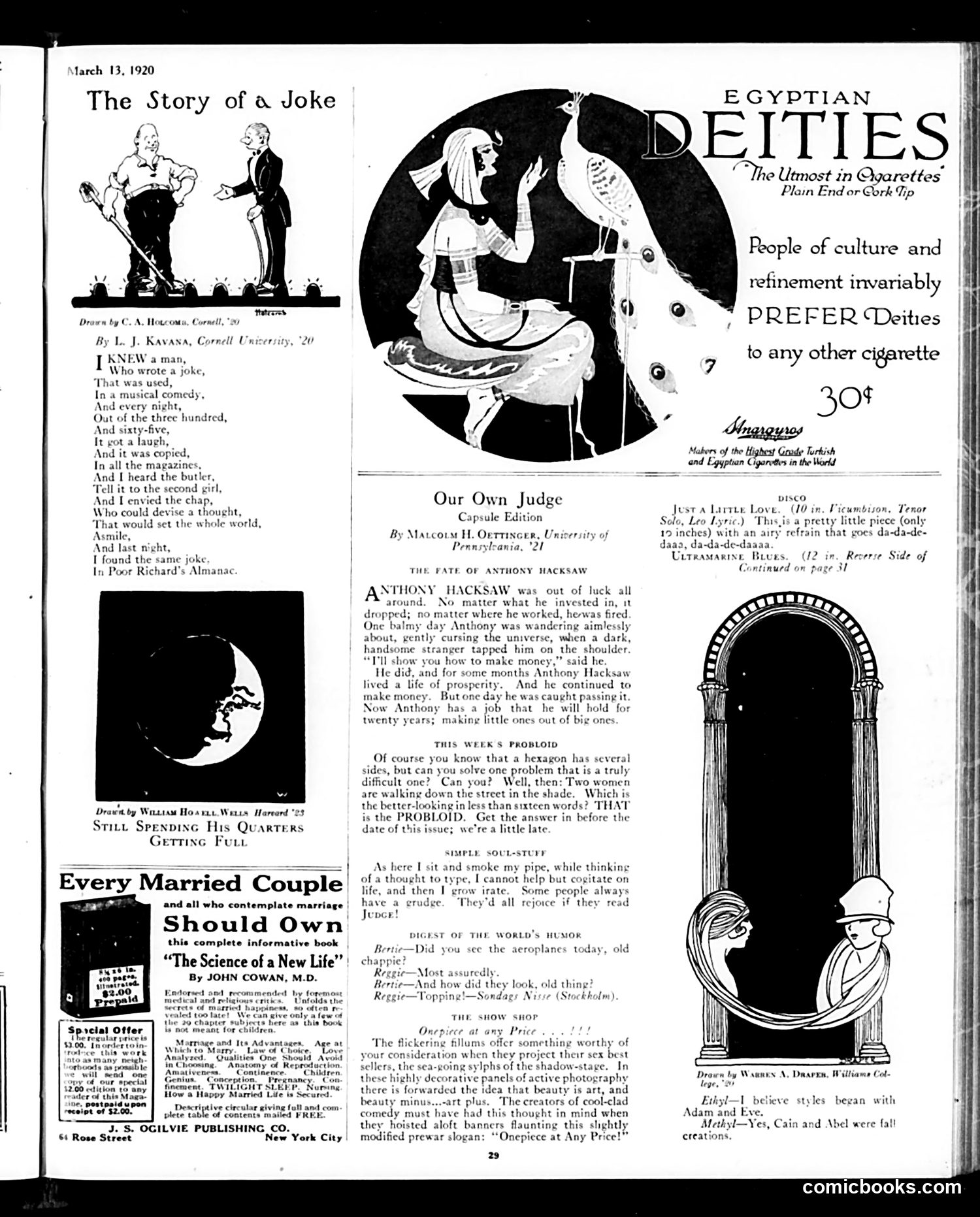
This page mixes satirical content with advertising typical of 1920s magazines. **"The Story of a Joke"** (top left): A poem about a man who writes a successful joke used in musical comedy. The satire targets how jokes circulate through society—copied in magazines, repeated by servants to their peers—suggesting both the democratization of humor and anxiety about intellectual property in mass media. **"The Fate of Anthony Hacksaw"**: A morality tale about a perpetually unlucky man who finally succeeds after meeting a stranger offering mysterious advice. The story appears incomplete but seems to mock get-rich-quick schemes popular in that era. **"This Week's Probloid"**: A playful geometry puzzle asking readers to solve a riddle while walking—typical of period puzzle-page humor. The page is dominated by **advertising**: Egyptian Deities cigarettes and "The Science of a New Life" marriage advice book occupy substantial space, reflecting how magazines subsidized content through ads. The cartoons and illustrations use period art-deco styling. Overall, the page reflects post-WWI American popular culture's mix of sophisticated wit and commercial messaging.
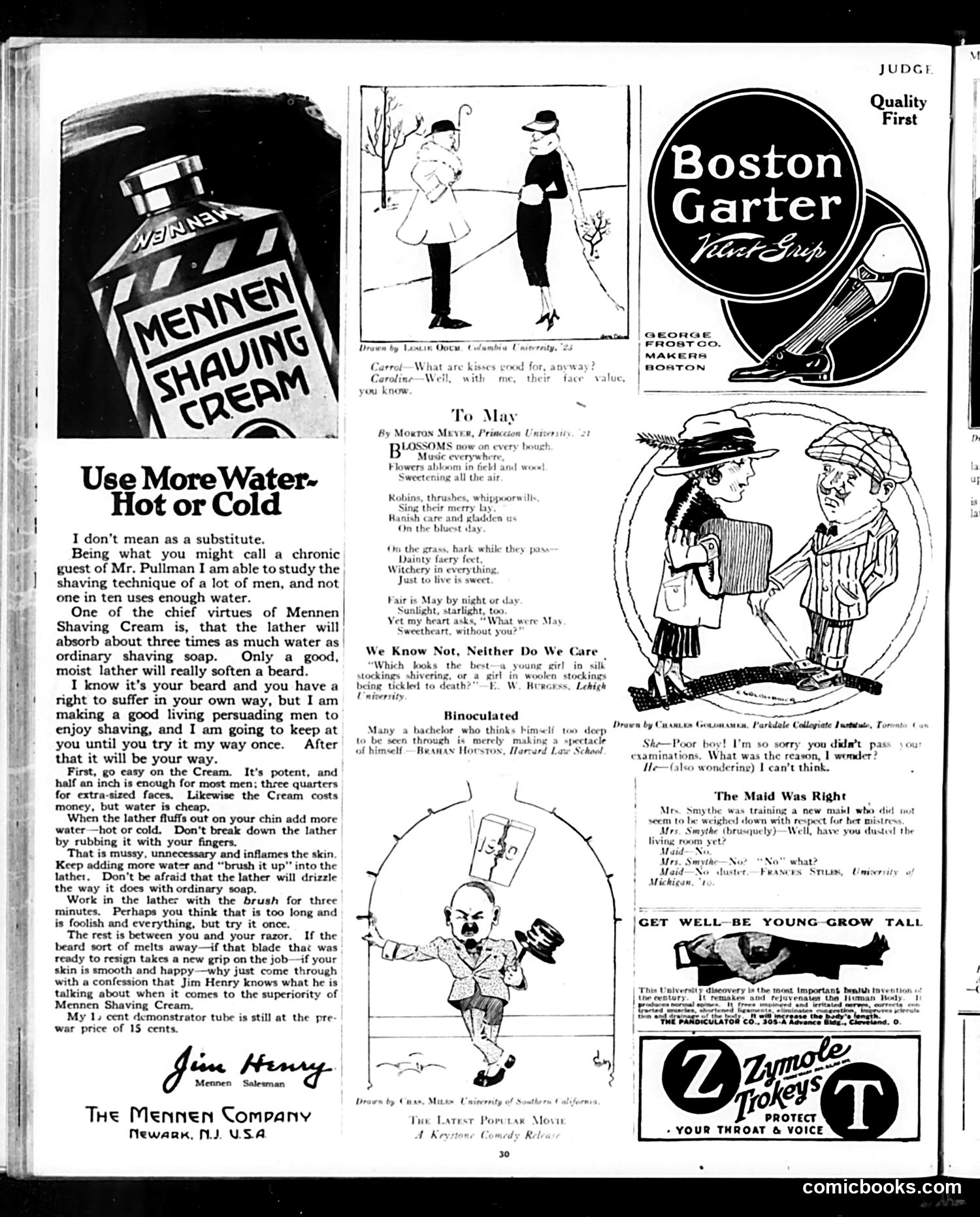
This is primarily a **Mennen Shaving Cream advertisement** disguised as editorial content. Jim Henry, identified as a Mennen salesman, lectures readers on proper shaving technique, emphasizing water usage to create better lather. The pitch appeals to male vanity and comfort while justifying the product's cost. The page also contains several **humor cartoons**: - "To May" is sentimental poetry about spring - "Binoculated" offers cynical observations on human nature - Small comics depict flirtation ("kisses...their face value") and domestic servant mishaps The ads for **Boston Garter** (hosiery) and **Zymole Trokeys** (throat lozenges) reflect early 20th-century consumer culture targeting both men and women. Overall, this represents Judge's blend of satirical commentary with commercial advertising—typical of 1910s-1920s magazine publishing, where advertiser-sponsored content blurred editorial boundaries.
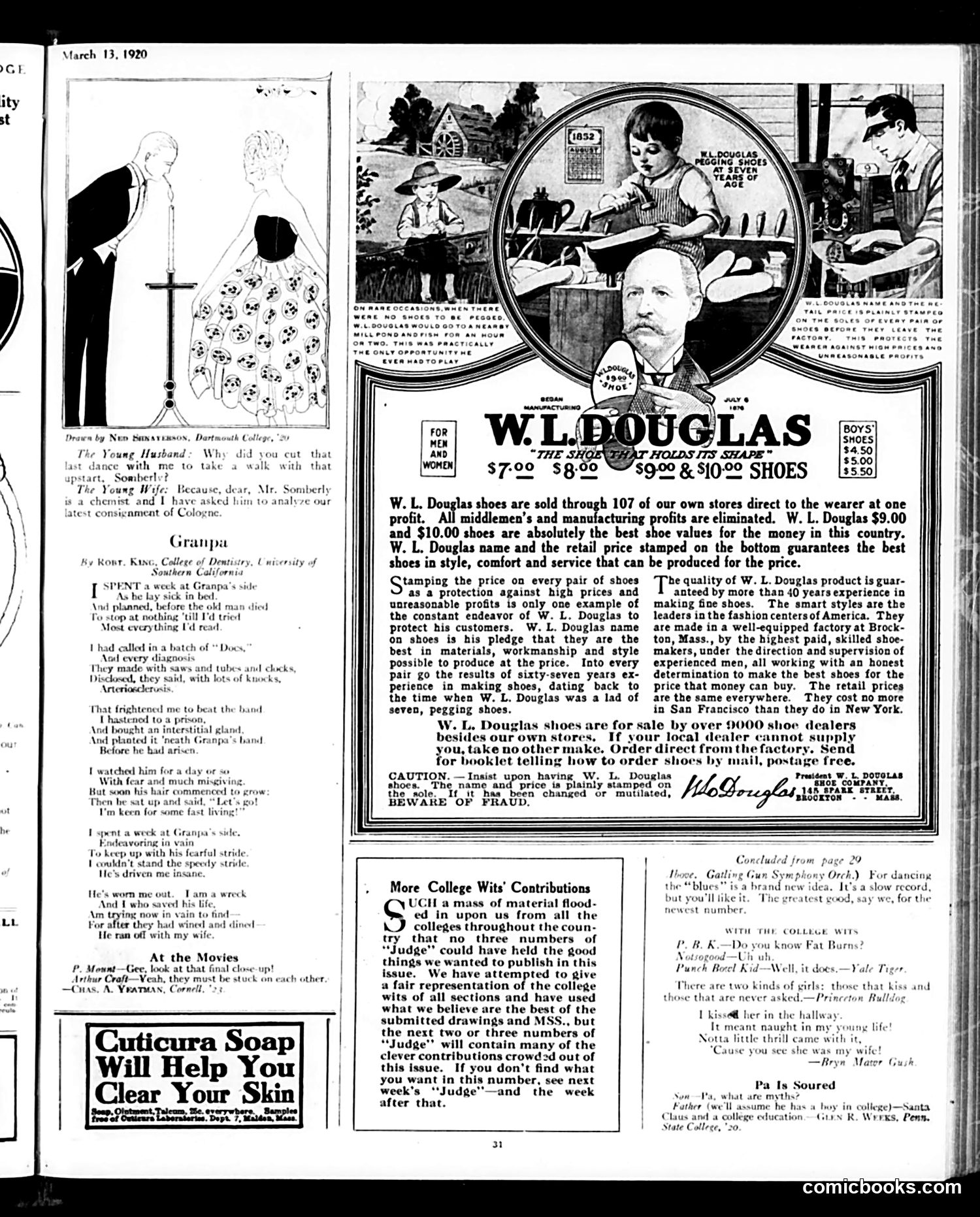
This page contains satirical poetry and advertisements rather than political cartoons. The main content includes "Grandpa," a humorous poem by Robert King about a man who implants an organ transplant into his elderly grandfather, resulting in the old man becoming wildly energetic and running off with the narrator's wife—a joke about rejuvenation and the unintended consequences of medical intervention. A separate comic anecdote titled "At the Movies" presents a brief joke about couples at cinema. The page is dominated by a large W.L. Douglas shoe advertisement emphasizing direct factory sales, fair pricing, and quality manufacturing. This represents early 20th-century consumer protection messaging—the company stamps prices on shoes to prevent price gouging and middleman markups, positioning itself as the ethical alternative to competitors. The Cuticura Soap ad below uses similar consumer-protection rhetoric.
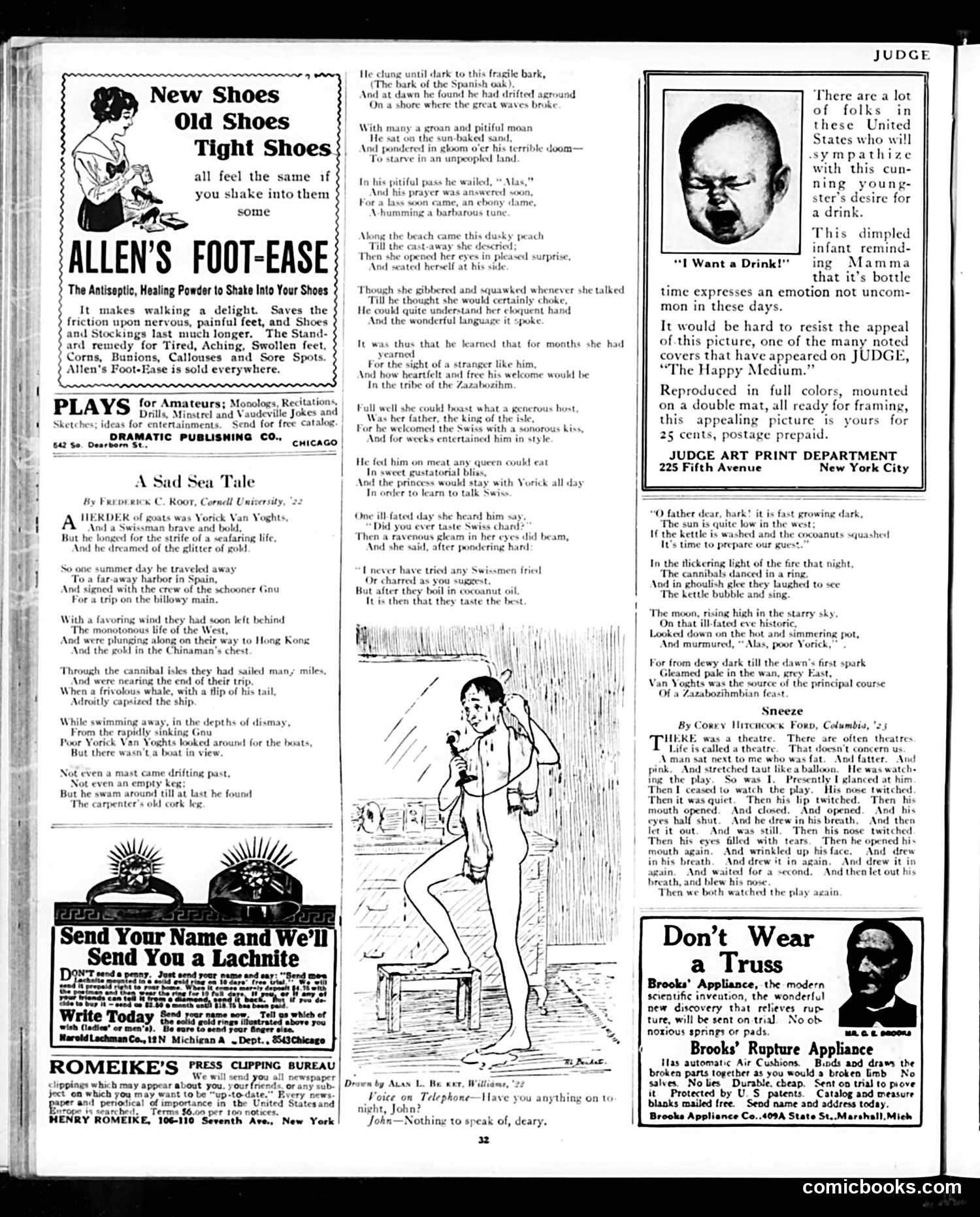
This page is primarily **advertisements and literary content** rather than political satire. The main elements are: **"A Sad Sea Tale"** — a humorous narrative poem about a Swiss goatherd named Vorick who joins a ship's crew, survives a shipwreck, and is rescued by a cannibal princess who falls for him. The joke culminates darkly: after months together, she learns he's Swiss and asks about "Swiss chard," which he misinterprets as her cannibalistic desire returning—a play on the earlier "boiling in coconut oil" threat. **Advertisement section**: Multiple product ads (Allen's Foot-Ease powder, theatrical plays for amateurs, a "Lachnite" novelty item, press clipping service, and medical appliances). **Sidebar commentary** on a Judge magazine cover depicting a child asking for a drink—described as resonating with modern readers sympathetic to the child's desire for alcohol, reflecting Prohibition-era tensions. The page contains **no significant political satire**—it's entertainment and commerce typical of early 20th-century magazine publishing.
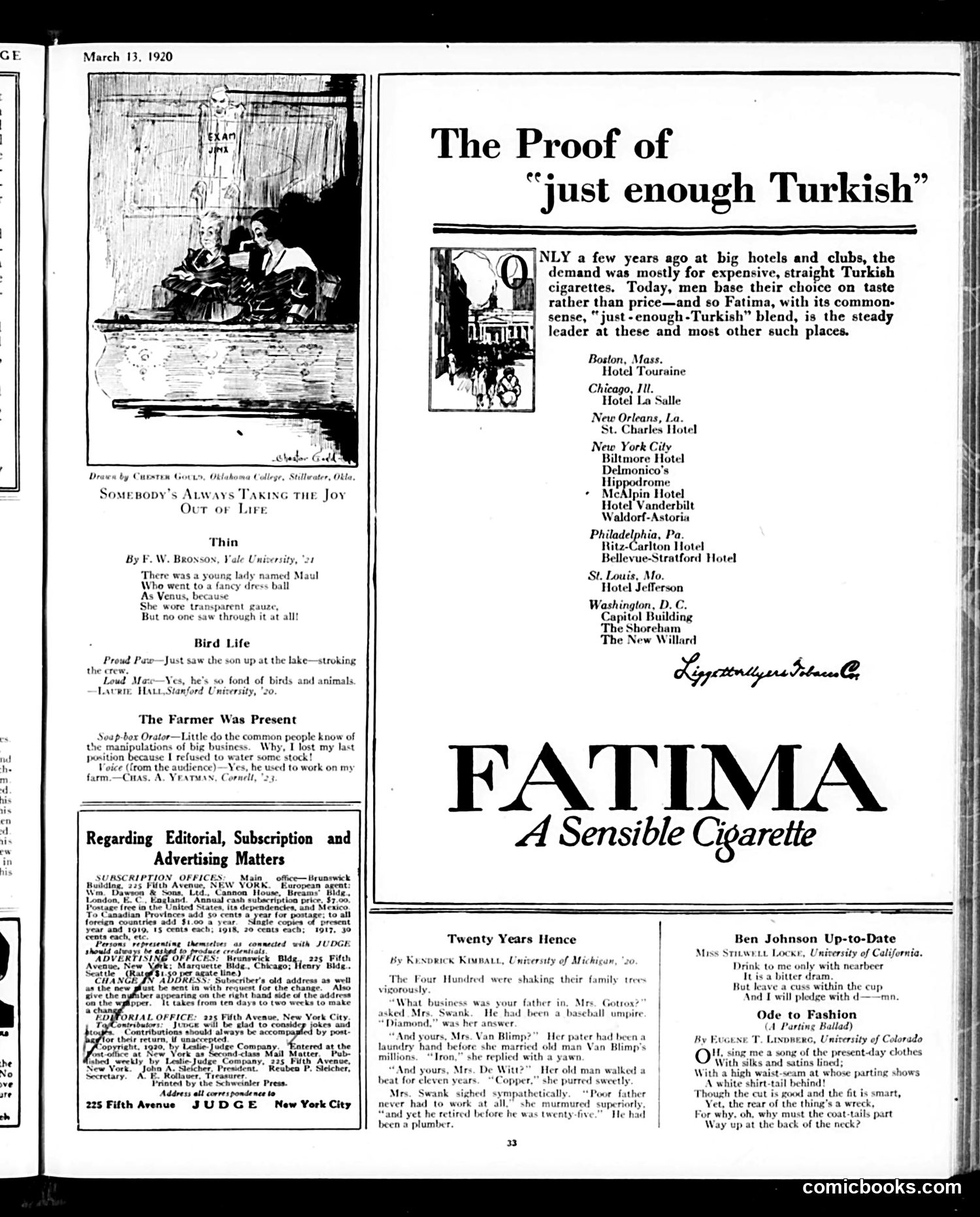
This page is primarily **advertising** for Fatima cigarettes, disguised as editorial content. The large advertisement claims Fatima's "just-enough-Turkish" blend has become the preferred cigarette at prestigious hotels and clubs, shifting consumer preference from expensive straight Turkish cigarettes to this more affordable blended option. The appeal targets affluent men at upscale establishments. The page includes several student humor pieces (jokes submitted by university students), which were typical Judge filler content. These include mild wordplay about a transparent dress, birds, and a farm worker posing as a socialist. The notable cartoon at top-left depicts someone "always taking the joy out of life"—likely satirizing excessive seriousness or pessimism, though the specific reference is unclear without additional context. The page reflects 1920 consumer culture and advertising's shift toward emphasizing "value" and "good taste" over pure luxury status.
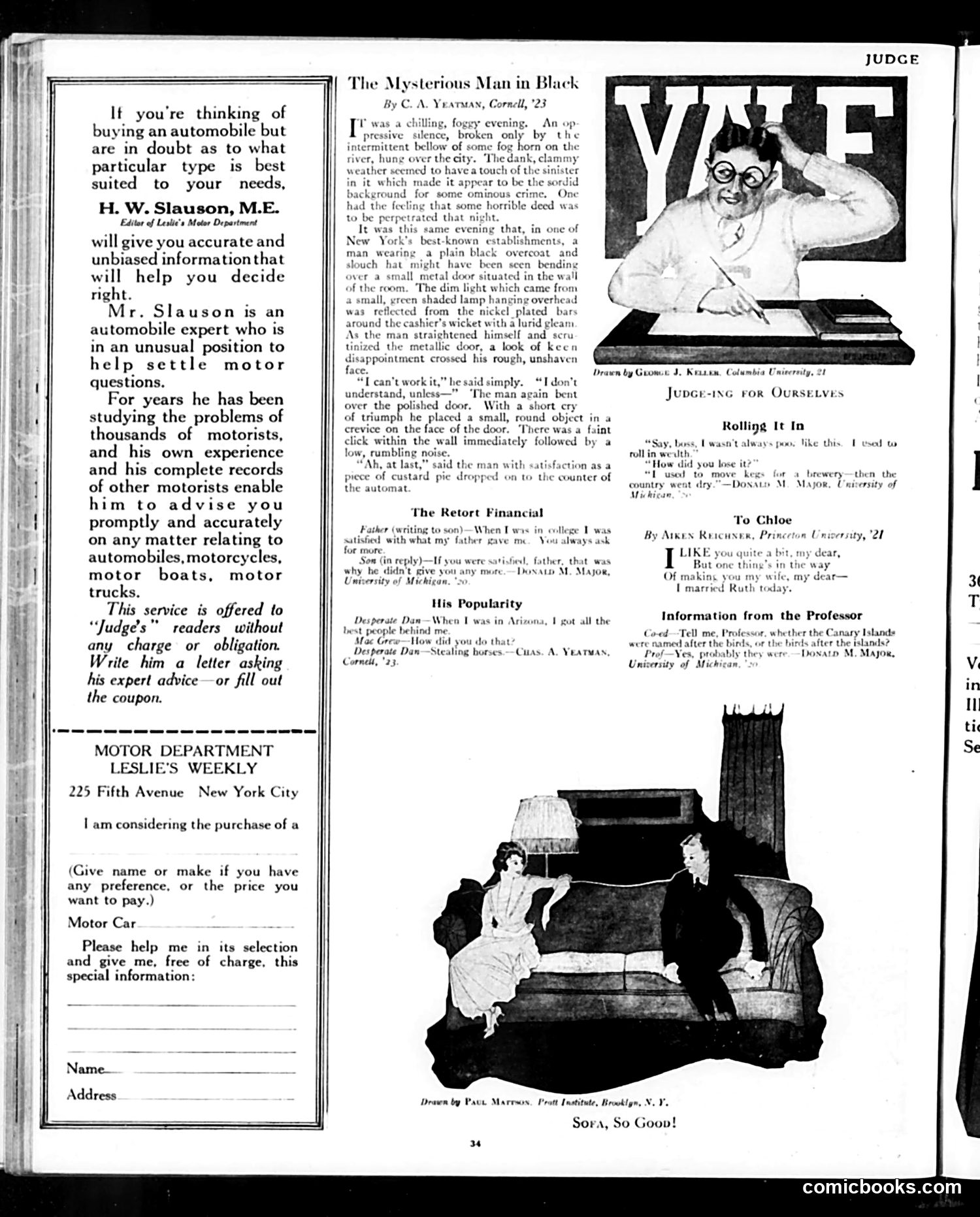
This page combines **advertising** (left sidebar for Leslie's Weekly motor department) with **humorous content** typical of Judge magazine's satirical approach. The main cartoons include: 1. **"The Mysterious Man in Black"** — A mystery story parody about a man attempting to use an automat (an early vending machine dispensing food). The joke relies on depicting him as a bumbling criminal trying to crack it open, playing on popular mystery fiction conventions of the era. 2. **"The Retort Financial"** and **"His Popularity"** — Brief joke panels using the magazine's typical format: setup and punchline about courtship, family finances, and social situations. 3. **"Sofa, So Good!"** — An illustration showing a couple on a sofa, likely a visual pun on furniture. The page reflects **1920s humor**: slapstick situations, wordplay, mild romance/courtship jokes, and gentle mockery of modern conveniences like automats. The cartoons target educated readers familiar with popular tropes while maintaining family-friendly content appropriate for the magazine's audience.
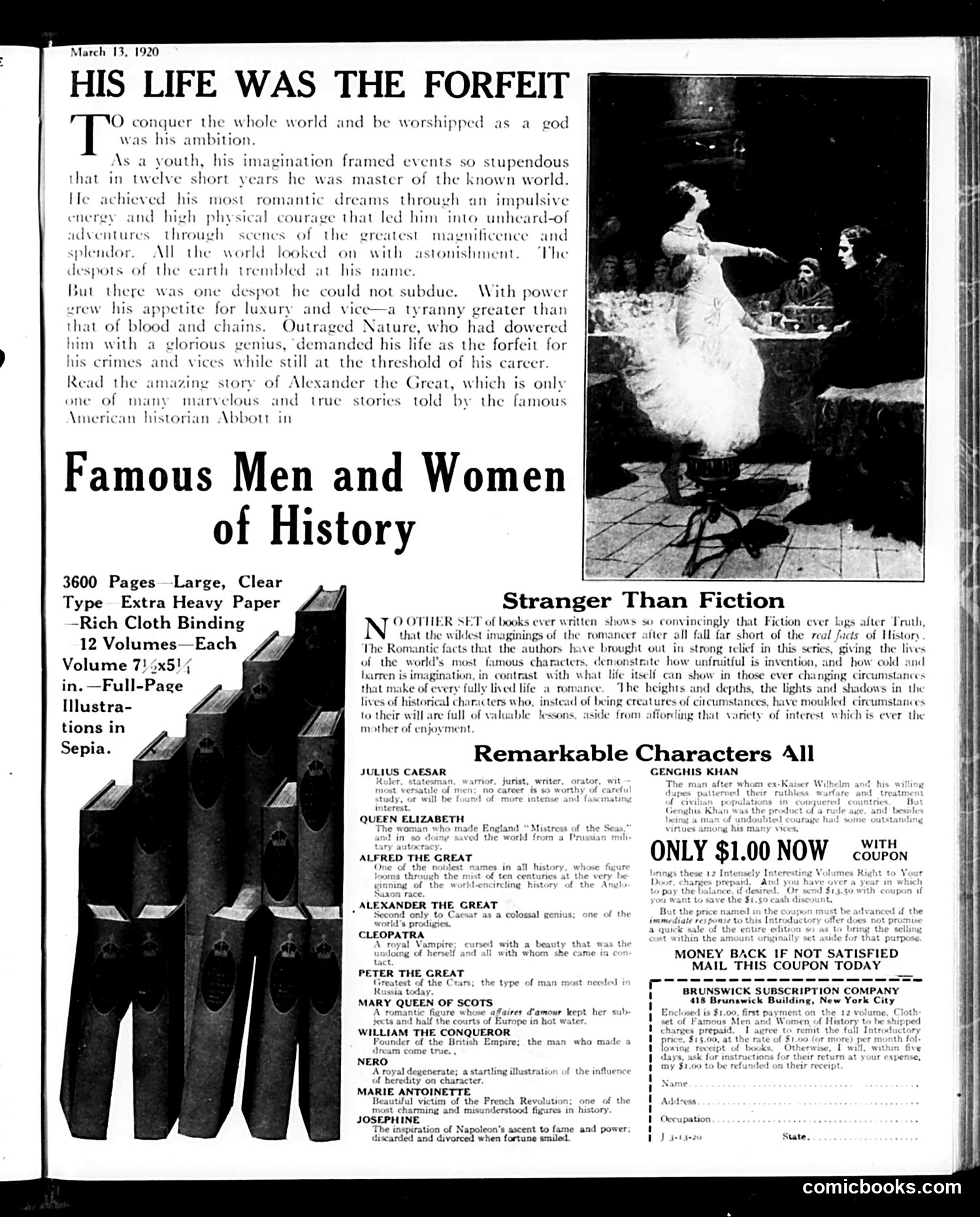
This page is primarily an advertisement for a 12-volume encyclopedia titled "Famous Men and Women of History" by historian Abbott. The headline and opening text dramatize Alexander the Great's rise and fall—conquering the world in twelve years through ambition and courage, but ultimately destroyed by his own vices and luxury. The text presents this as a moral lesson: even genius cannot overcome "Outraged Nature's" punishment for "crimes and vices." The advertisement lists historical figures covered in the set, including Julius Caesar, Cleopatra, Alfred the Great, Alexander the Great, Peter the Great, Genghis Khan, Mary Queen of Scots, William the Conqueror, Josephine, Marie Antoinette, and Nero—all presented as cautionary tales of ambition and downfall. The accompanying photograph shows a woman in classical dress, likely representing a dramatic historical scene. The "Stranger Than Fiction" subheading emphasizes that real history surpasses invented narrative. This is straightforward promotional content, not satire.
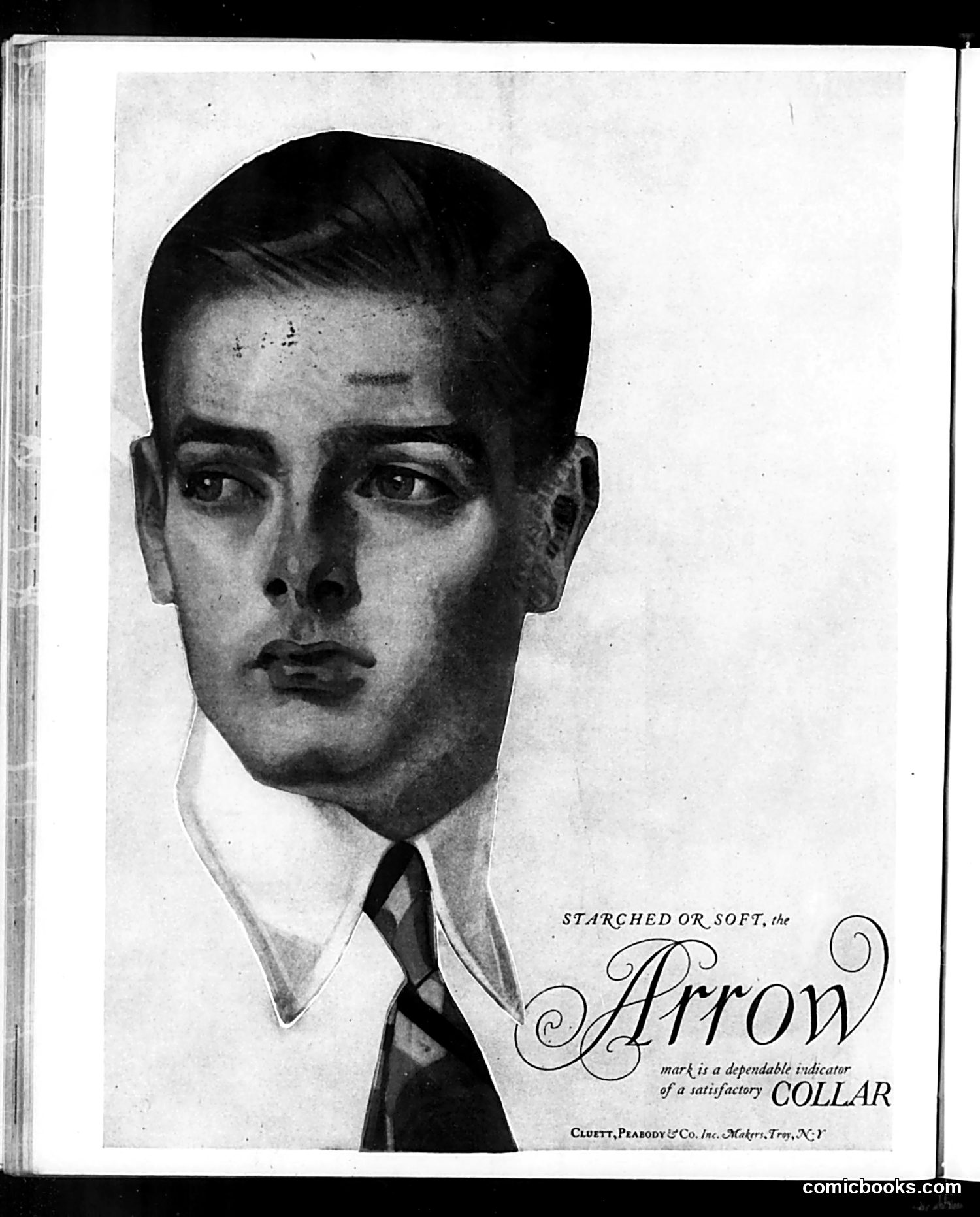
This is a **clothing advertisement**, not political satire or a cartoon. It features a formal portrait of a man in business attire—white shirt with prominent collar and striped tie—showcasing the "Arrow" brand collar by Cluett, Peabody & Co., a Troy, New York manufacturer. The ad's text emphasizes that whether starched stiffly or kept soft, an Arrow collar reliably indicates a "satisfactory" garment. This appeals to early 20th-century male consumers concerned with professional appearance and collar quality—an important detail when collars were detachable, replaceable accessories rather than integrated shirt parts. The advertisement uses the formal portrait style typical of men's fashion marketing from this era.