
Judge, 1920-03-13 · page 11 of 36
Judge — March 13, 1920 — page 11: what you’re looking at
What you’re looking at
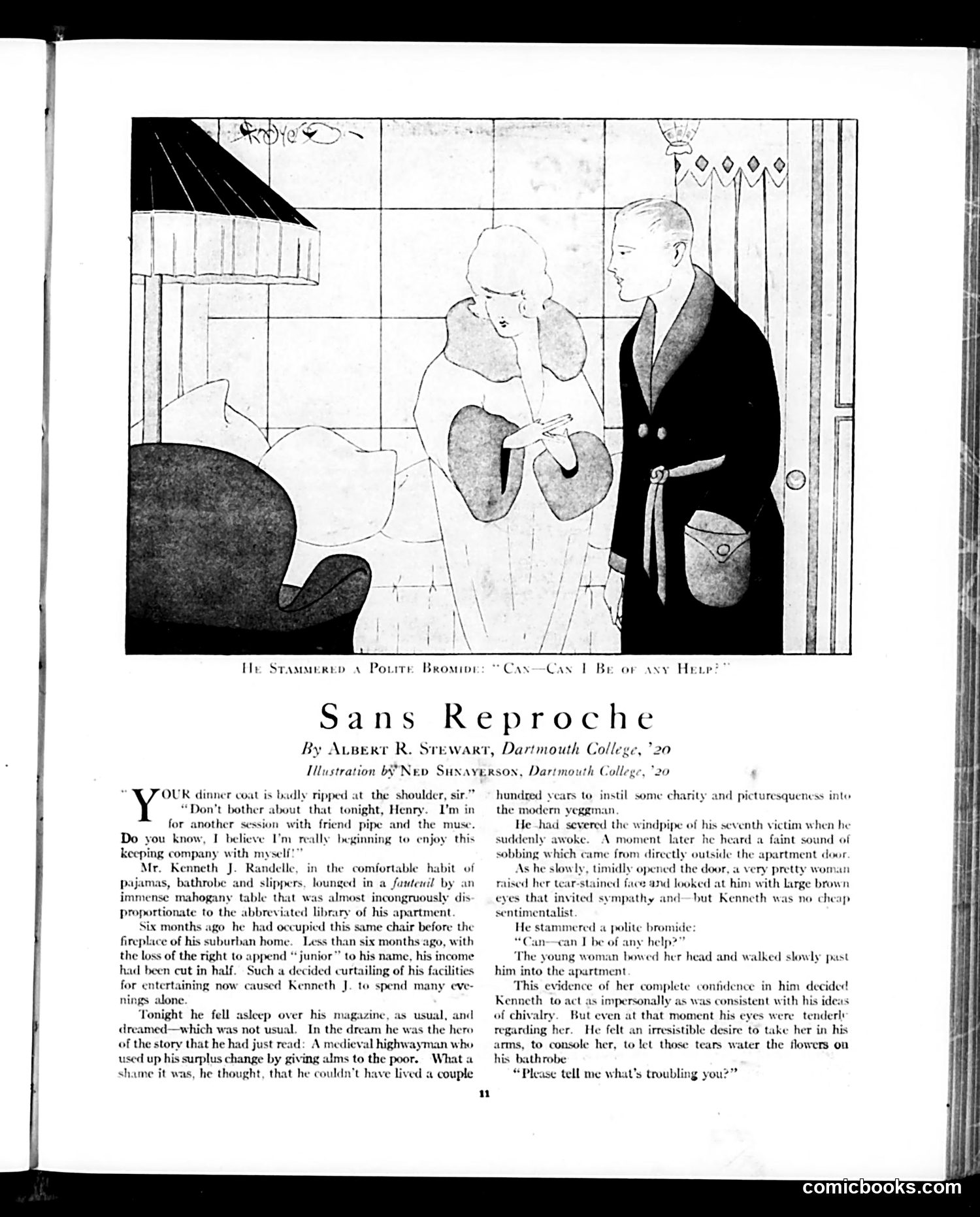
This is a short story illustration, not political satire. The narrative follows Kenneth J. Randelle, a gentleman recently reduced in circumstances—he's lost the "junior" suffix from his name and his income has been "cut in half," forcing him to live a solitary life in a modest apartment rather than his suburban home. The story's irony centers on Kenneth's character: he's a sentimental dreamer (fantasizing about being a Robin Hood-like medieval outlaw) who nonetheless prides himself on emotional restraint and propriety. When a distressed young woman appears at his door seeking help, he maintains formal politeness despite his obvious attraction to her—a "polite bromide" response masking deeper feeling. The title "Sans Reproche" (without reproach/blame) suggests the story examines whether Kenneth can maintain his honor and chivalrous ideals despite his reduced circumstances and emotional vulnerability. The humor lies in the gap between his self-image as a dispassionate gentleman and his actual emotional nature.
📄 Transcribed text from this page (OCR, searchable)
Machine-transcribed from the original scan — historical spelling and the odd misread are preserved.
He Stammerep a Pourre Bromipt “Cax—Cas 1 Be or axy Hexp?* Sans Reproche By Avsert R. S Mlustration OUR dinner coat is badly ripped at the shoulder, sir.” “Don’t bother about that tonight, Henry. I'm in for another session with friend pipe and the muse. Do you know, I believe I’m really beginning te joy this keeping company with myself!” Mr. Kenneth J. Randelle, in the comfortable habit of pajamas, bathrobe and slippers, lounged in a fautenil by an immense mahogany table that was almost incongruously dis proportionate to the abbreviated library of his apartment Six months ago he had occupied this same chair before the fireplace of his suburban home. Less than six months ago, with the loss of the right to append “junior” to his name, his income had been cut in half. Such « decided curtailing of his facilities for entertaining now caused Kenneth J. to spend many eve- nings alone ‘Tonight he fell asleep over his magazine, as usual, and dreamed—which was not usual. In the dream he was the hero of the story that he had just read: A medieval highwayman who used up his surplus change by giving alms to the poor. What a shame it was, he thought, that he couldn't have lived « couple ‘ep Suxaverson, Dartmouth College wart, Dartmouth College, °20 ‘20 hundred years to instil some charity and picturesqueness into the modern yeggman He -had severed the windpipe of his seventh victim when he suddenly awoke. A moment later he heard a faint sound of sobbing which came from directly outside the apartment door As he slowly, timidly opened the door, a very pretty woman raised her tcar-stained face and looked at him with Large brown eyes that invited sympathy and—but Kenneth was no cheap sentimentalist He stammered a polite bromide: “Can—can I be of any help?” ‘The young woman bowed her head and walked slowly past him into the apartment This evidence of her complete confidence in him decid Kenneth to act as impersonally as was consistent with his ideas of chivalry. But even at that moment his eyes were tenderl regarding her. He felt an irresistible desire to take her in his arms, to console her, to let those tears water the flowers on his bathrobe “Please tell me what's troubling you?” comicbooks.com