
Judge, 1920-03-13 · page 19 of 36
Judge — March 13, 1920 — page 19: what you’re looking at
What you’re looking at
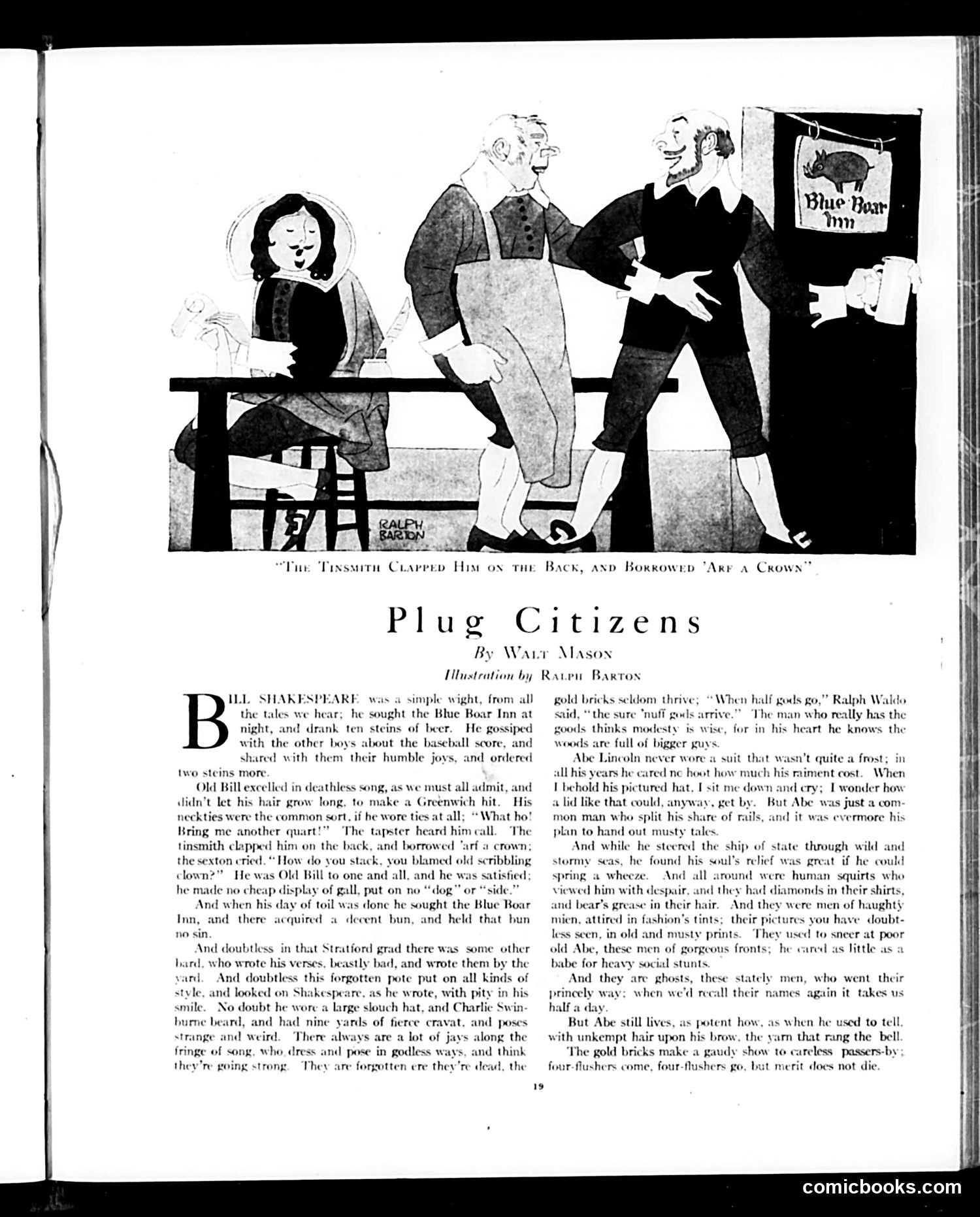
This page presents Walt Mason's poem (illustrated by Ralph Barton) contrasting genuine, unpretentious figures—Shakespeare and Abraham Lincoln—with self-aggrandizing poseurs and social climbers. The cartoon caption depicts the "tinsmith" and "sexton" borrowing from Shakespeare and mocking his lack of affectation ("you blamed old scribbling clown"), establishing the theme: truly great men don't perform or adopt artificial airs. Mason argues that Shakespeare and Lincoln succeeded through modesty and authenticity rather than fashionable pretense. They wore common clothes, told simple jokes, and cared nothing for social status—yet remain immortal. Meanwhile, their contemporaries who wore elaborate costumes, affected poses, and cultivated impressive appearances are now forgotten ("ghosts"). The poem satirizes turn-of-the-century "four-flushers" (frauds) who adopted exaggerated artistic or social personas to seem important. Mason's message: genuine merit and character endure; fashionable posturing vanishes with its practitioners.
📄 Transcribed text from this page (OCR, searchable)
Machine-transcribed from the original scan — historical spelling and the odd misread are preserved.
“Tie Tinsmirn Crarvep Him on tHe Back, anp Borxkowrp ‘Arr a Crown” Plug Citizens By War Mason Mlustration by Raveuw Barros ILL SHAKESPEARE was a simple wight, from all the tales we hear; he sought the Blue Boar Inn at night, and drank ten steins of beer. He gossiped with the other boys about the baseball score, and shared with them their humble joys, and ordered two steins more Old Bill excelled in deathless song, as we must all admit, and didn’t let his hair grow long, to make a Greenwich hit. His neckties were the common sort, if he wore ties at all; “What ho! Kring me another quart!” ‘The tapster heard him call. The tinsmith clapped him on the back, and borrowed ‘arf « crown: the sexton eried. “ How do you stack, you blamed old scribbling clown?” He was Old Bill to one and all, and he was satisfied; he made no cheap display of gall, put on no “dog” or “side.” And when his day of toil was done he sought the Blue Boar Inn, and there acquired « decent bun, and held that bun no sin And doubtless in that Stratford grad there was some other hard, who wrote his verses, beastly bad, and wrote them by the And doubtless this forgotten pote put on all kinds of style, and looked on Shakespeare, as he wrote, with pity in his smile. No doubt he wore a large slouch hat, and Charlie Swin- burne beard, and had nine yards of fierce cravat. and poses strange and weird. ‘There always are a lot of jays along the fringe of song, who dress and pose in godless ways, and think they’re going strong. They are forgotten ere they're dead, the gold bricks seldom thrive; “When half gods ge said, “the sure ‘nuff gods arrive.” The man who rea goods thinks modesty is wise, for in his heart he knows the woods are full of bigger guys. Abe Lincoln never wore a suit that wasn’t quite a frost; in all his years he cared ne hoot how much his raiment cost. When I behold his pictured hat, I sit me down and ery; [wonder how a lid like that could, anyway, get by. But Abe was just a com mon man who split his share of rails, and it was evermore his plain to hand out musty tales. And while he steered the ship of state through wild and stormy seas, he found his soul’s relief was great if he could spring a wheeze. And all around were human squirts who viewed him with despair, and they had diamonds in their shirts, and bear’s grease in their hair. And they were men of haught) mien, attired in fashion’s tints: their pictures you doubt- less seen, in old and musty prints. They used to sneer at poor old Abe, these men of gorgeous fronts; he cared as little as a babe for heavy social stunts. And they are ghosts, these stately men, who went their princely way; when we'd recall their names again it. takes us half a day But Abe still lives, as potent how, as when he used to tell with unkempt hair upon his brow. the yarn that rang the bell ‘The gold bricks make a gaudy show to careless passers-by four-flushers come, four-flushers go, but merit does not die. comicbooks.com