
A complete issue · 36 pages · 1919
Judge — November 15, 1919
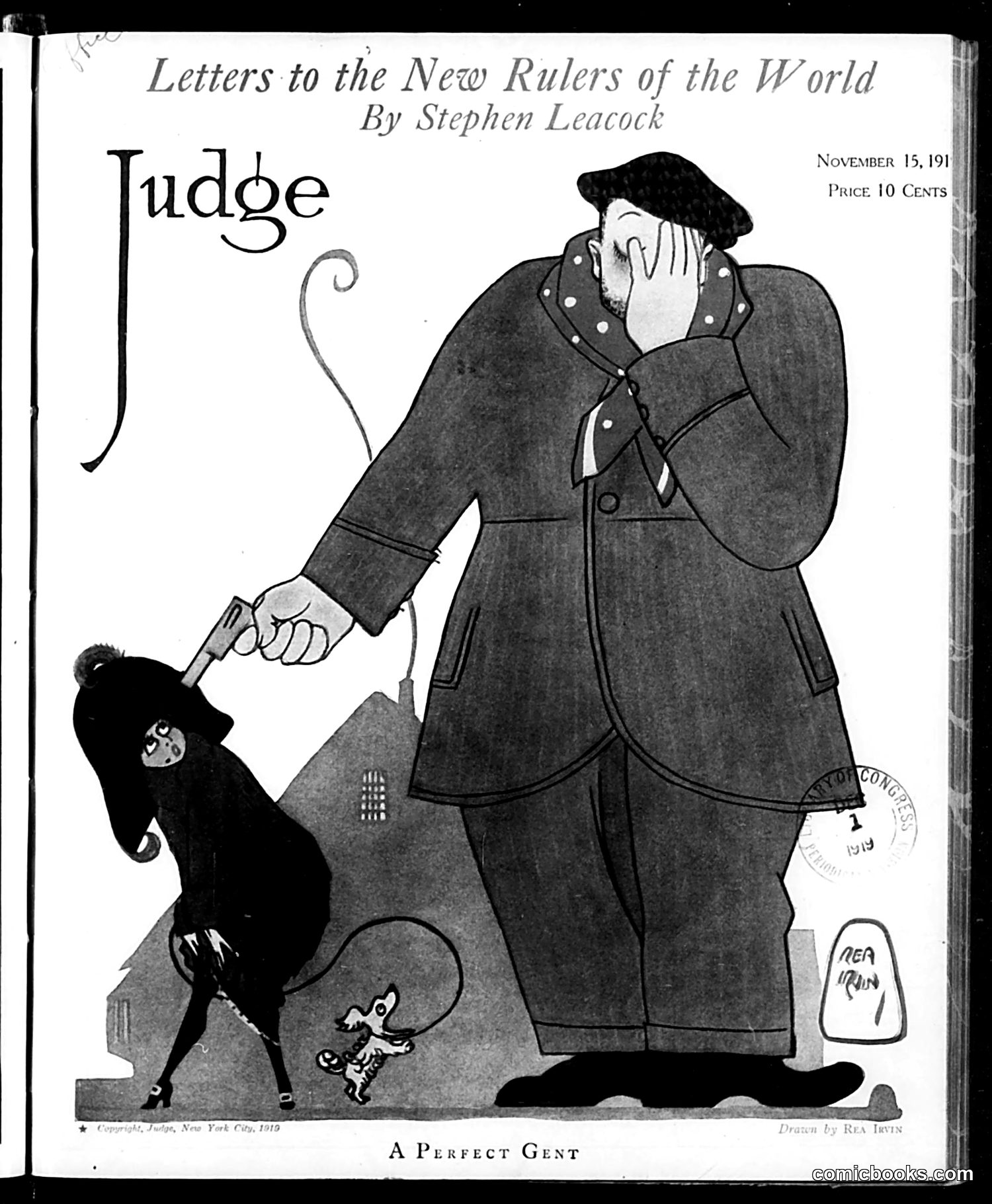
This *Judge* cover from November 15, 1911 is titled "A Perfect Gent" and appears to satirize judicial authority and power dynamics. A large, well-dressed man labeled "Judge" holds a whip while controlling smaller figures—an elephant, a donkey, and what appears to be a mouse—like circus animals. The imagery suggests the judge wields disproportionate power over various parties or constituencies (the animals likely representing different political interests or social groups). The "perfect gentleman" title is ironic: the cartoon critiques how judges, despite their refined appearance and formal attire, exercise brutal control through legal authority rather than serving justice equitably. The work's author, Rea Irvin, uses the animal metaphor to mock judicial overreach during the Progressive Era.
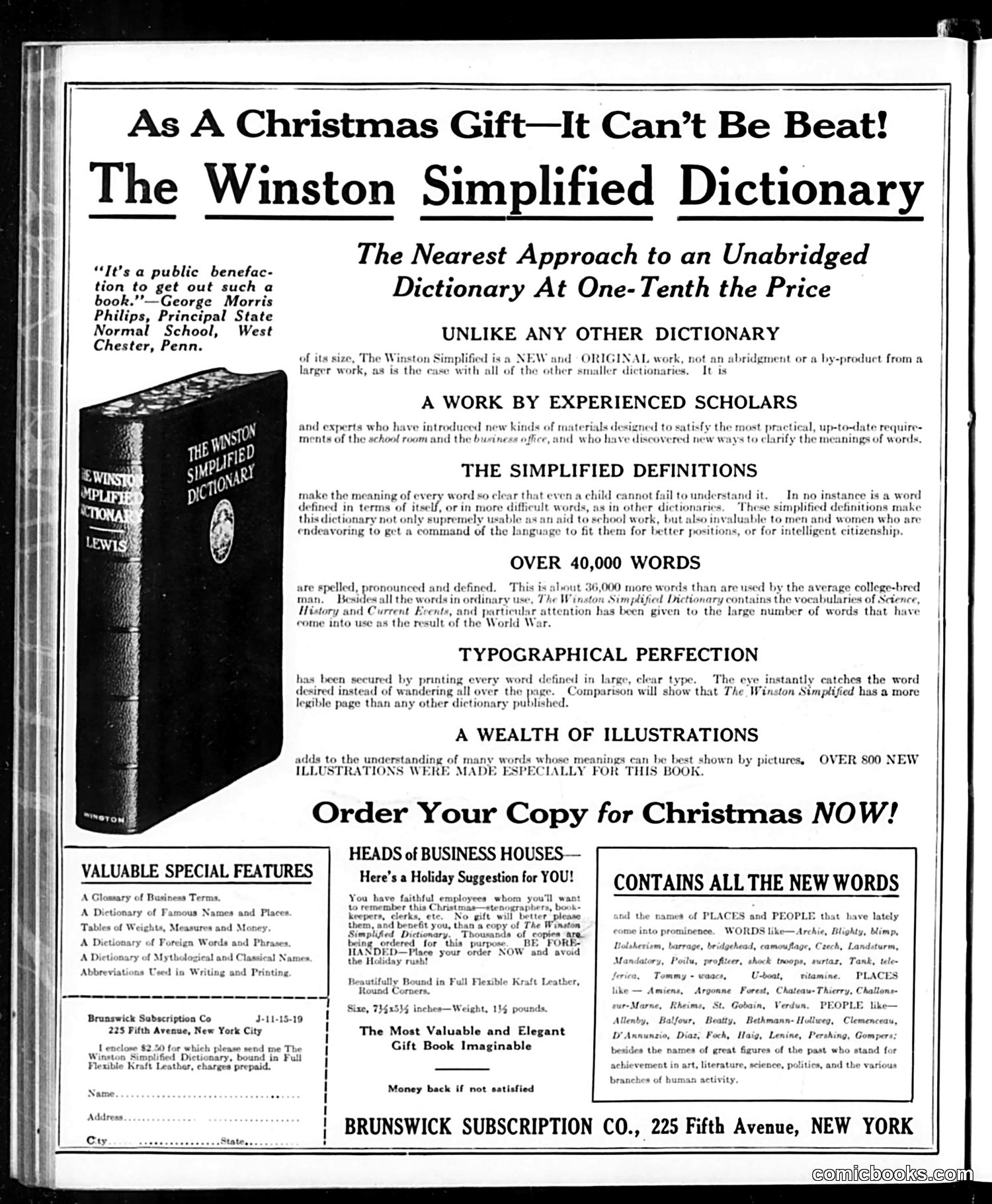
This page is **primarily an advertisement**, not satirical content. It promotes "The Winston Simplified Dictionary" as a Christmas gift, published by Brunswick Subscription Co. The ad emphasizes practical features: over 40,000 words, simplified definitions accessible to children, 800+ new illustrations, and typography designed for easy reading. It targets both individual consumers and "heads of business houses" seeking employee gifts. Notable claims include that it's "a new and original work" (not an abridgment) and contains recently-emerged words and place names, suggesting post-WWI publication. The price point—one-tenth that of unabridged dictionaries—positions it as an affordable alternative. There is **no political satire or cartoon** visible on this page. It's a straightforward commercial advertisement typical of Judge magazine's revenue model.
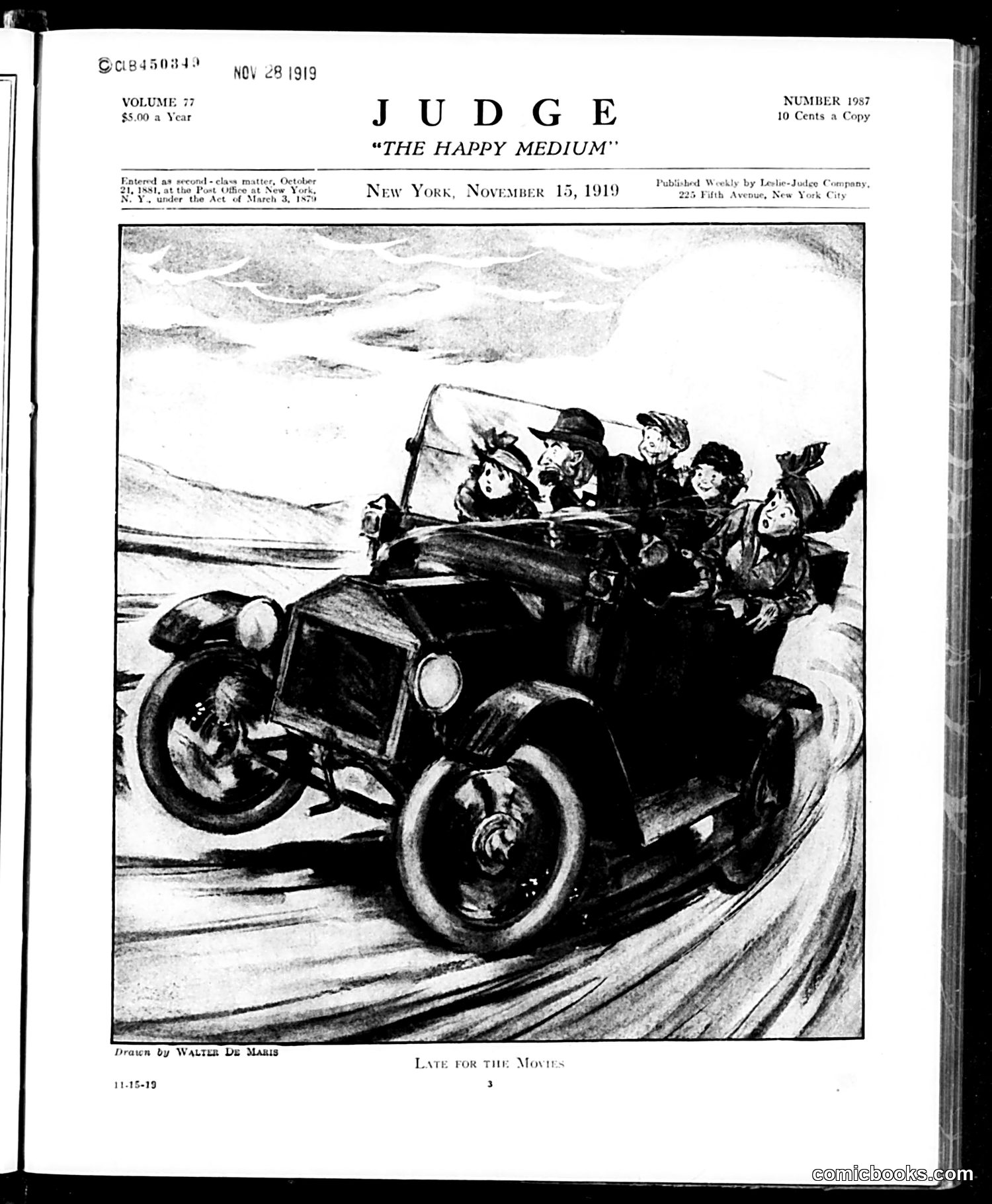
**Title:** "Late for the Movies" **Image:** A cartoon by Walter De Maris depicting a crowded automobile speeding along a curved road, packed with six or seven people in fashionable 1919 attire, all appearing excited or alarmed. **Meaning:** This is a humorous domestic scene rather than political satire. The joke plays on the popular leisure activity of attending movies—a relatively new entertainment form in 1919. The caption and scene mock the frenzy and recklessness people displayed rushing to see films, cramming multiple passengers into a vehicle and driving dangerously fast. It satirizes the emerging "movie culture" and automobile enthusiasm of the era, poking fun at Americans' enthusiasm for these modern conveniences.
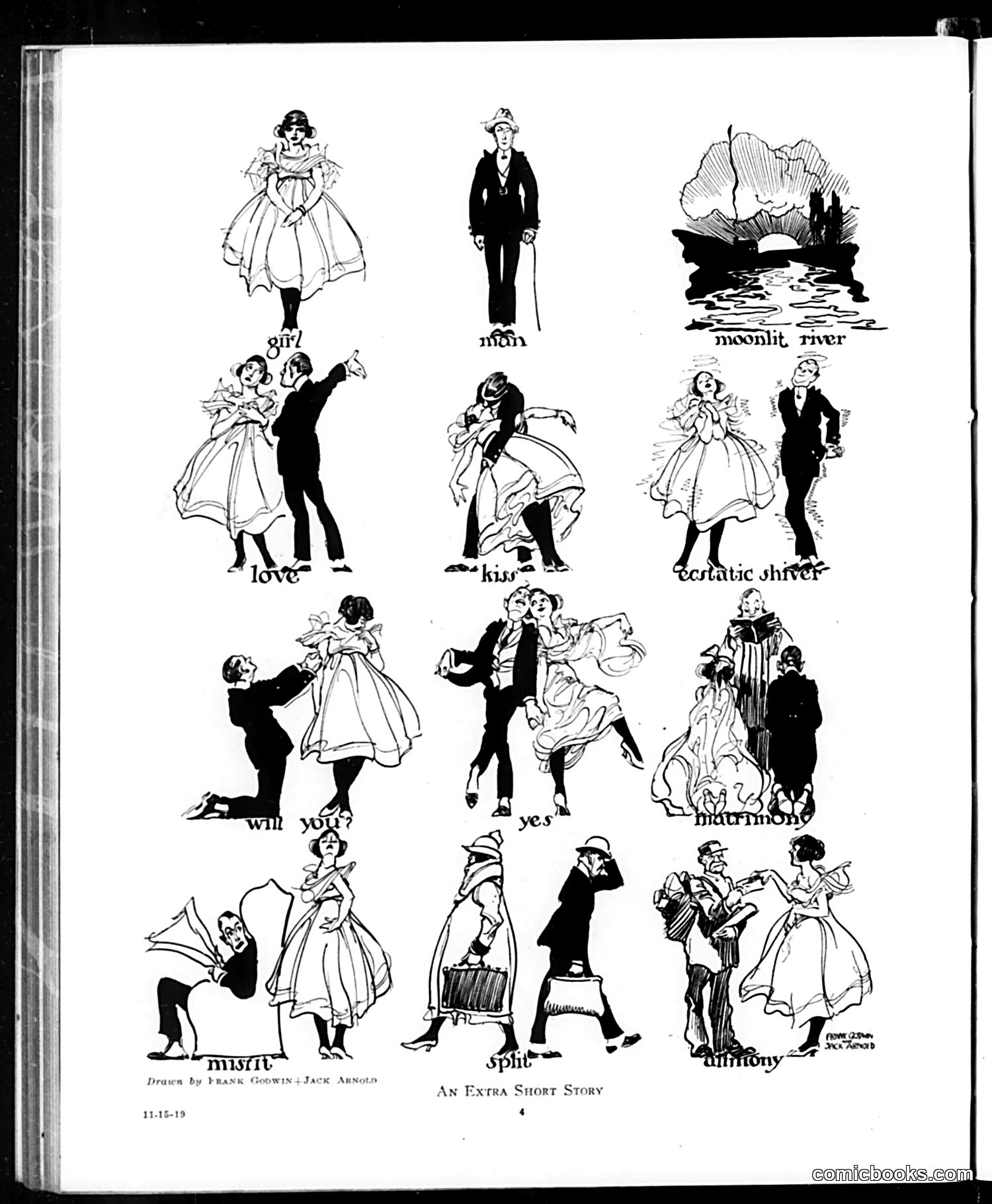
This page from *Judge* magazine presents "An Extra Short Story" through sequential illustrations depicting a romantic narrative. The labeled vignettes trace a courtship progression: "girl," "man," "love," "kiss," "ecstatic shiver," "will you?," "yes," "matrimony," "music," "split," and "alimony." The satire targets marriage itself, suggesting a predictable arc from romantic courtship through marriage to inevitable divorce and financial consequences. The final panels—where a joyful couple transitions to "split" and concludes with "alimony"—represent cynicism about marriage's durability and the financial burden of separation on men. This reflects early 20th-century anxieties about divorce, which had become increasingly common and socially visible, challenging traditional romantic idealization of marriage.
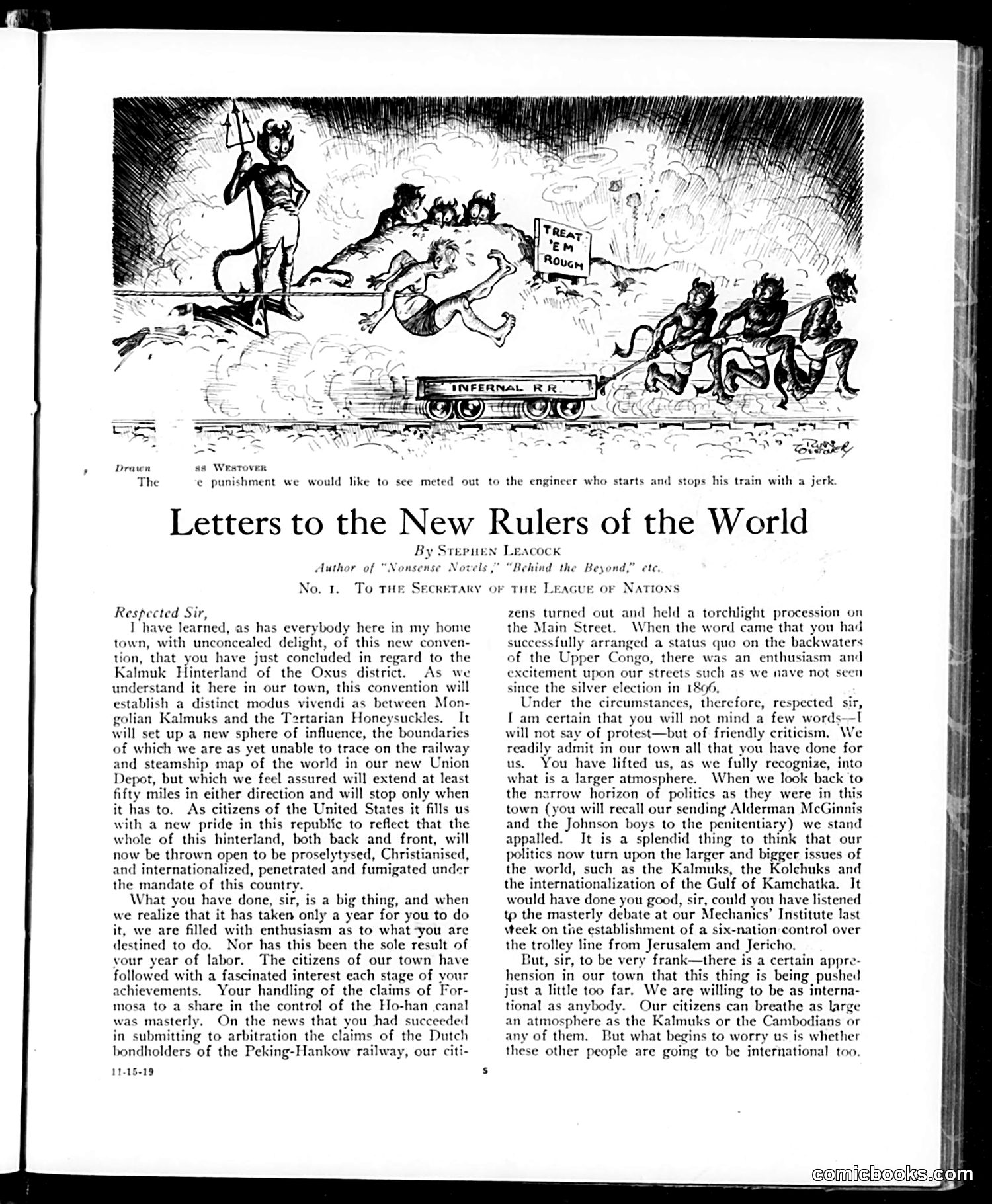
This page features a satirical letter to the League of Nations Secretary by Stephen Leacock. The accompanying cartoon depicts devils operating an "Infernal R.R." (railroad) train, with a sign reading "TREAT 'EM ROUGH." One devil conducts with a trident while others ride behind. The satire mocks the League's early failures in maintaining international order. Leacock references specific disputes—the Kalmuk Hinterland, Upper Congo, Formosa claims, and the Peking-Hankow railway—presenting them as examples of the League's inability to control global conflicts. The "Infernal Railroad" cartoon suggests international governance is chaotic and devil-driven, while the letter sarcastically congratulates the League while actually criticizing its ineffectiveness at preventing nations from pursuing self-interest over international cooperation.
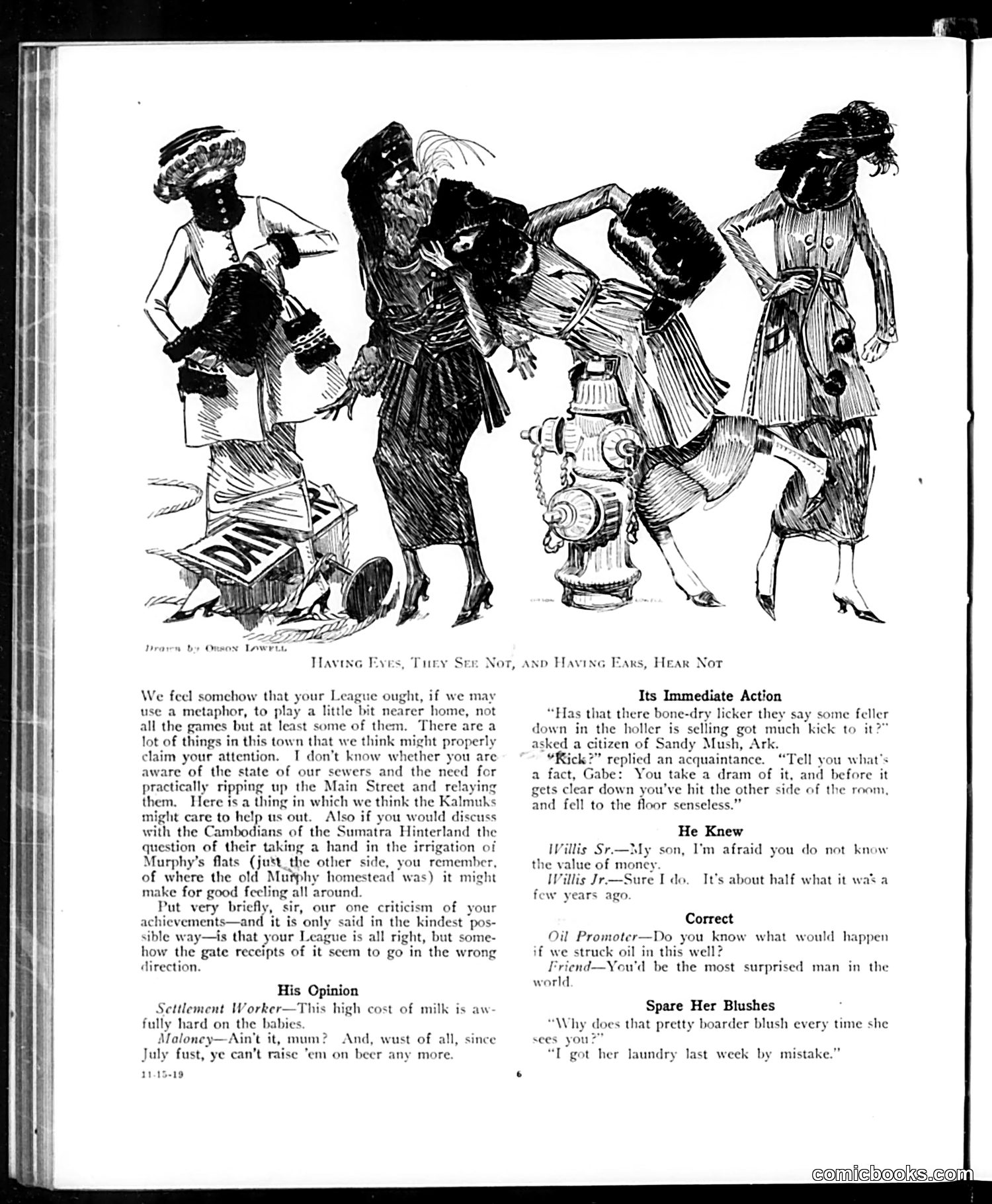
**Main Cartoon:** "Having Eyes, They See Not, and Having Ears, Hear Not" depicts five fashionably dressed women ignoring social problems. The drawing by Cesare Lovelli critiques upper-class women's alleged indifference to civic issues. **Letter Content:** The page contains reader correspondence addressing a League (likely a women's civic organization). The first letter criticizes the League for not addressing local problems—specifically Main Street deterioration, Cambodian irrigation issues, and Murphy's homestead. It suggests their charitable efforts misdirect resources. **Subsequent Jokes:** Brief humor pieces about high milk costs, property values, and a laundry mishap provide lighter content. **Overall Theme:** The page satirizes privileged women's selective social awareness and the disconnect between fashionable charity work and pressing local concerns.
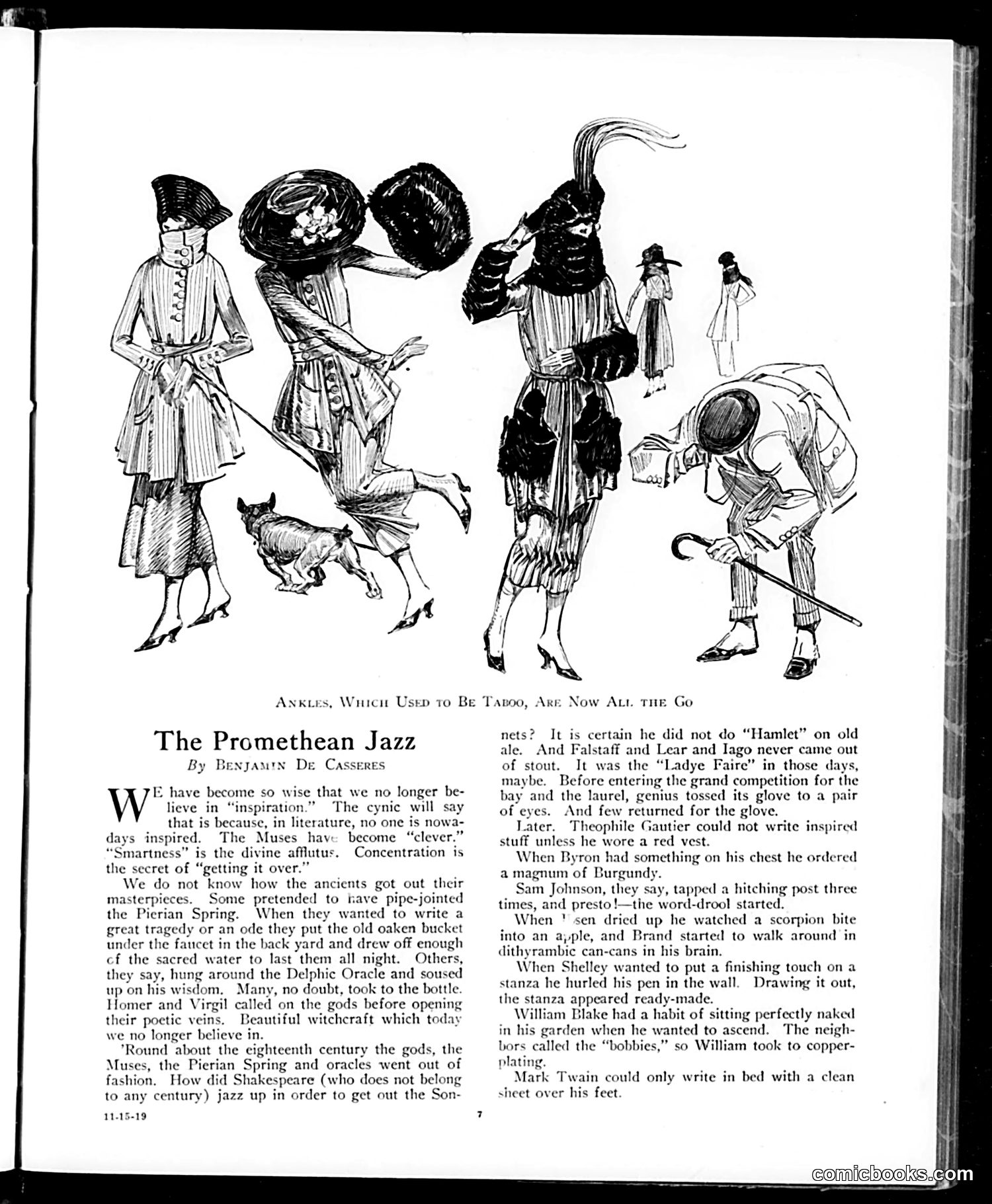
This is a satirical essay by Benjamin De Casseres mocking modern literary pretension and the decline of artistic inspiration. **The central argument:** Classical and Romantic-era writers attributed their genius to divine inspiration—the Muses, oracles, or eccentric rituals (Homer consulting gods, Byron drinking Burgundy, Blake sitting naked in his garden). Modern writers, by contrast, have abandoned belief in "inspiration" and replaced it with "cleverness" and "smartness"—mere technique. **The satire targets:** Contemporary literary culture's self-conscious artificiality. Writers now fake profundity through affected methods and concentration rather than genuine creative spirit. The essay catalogs famous authors' quirky habits to highlight how even great writers relied on ritual or altered states, not just raw skill. **The illustration** shows fashionable women displaying exaggerated ankles—referenced in the caption as formerly taboo but now "all the go"—suggesting how modern society has abandoned old conventions wholesale, paralleling literature's rejection of inspirational traditions. The piece laments the loss of authentic creative mystery in favor of manufactured "smartness."
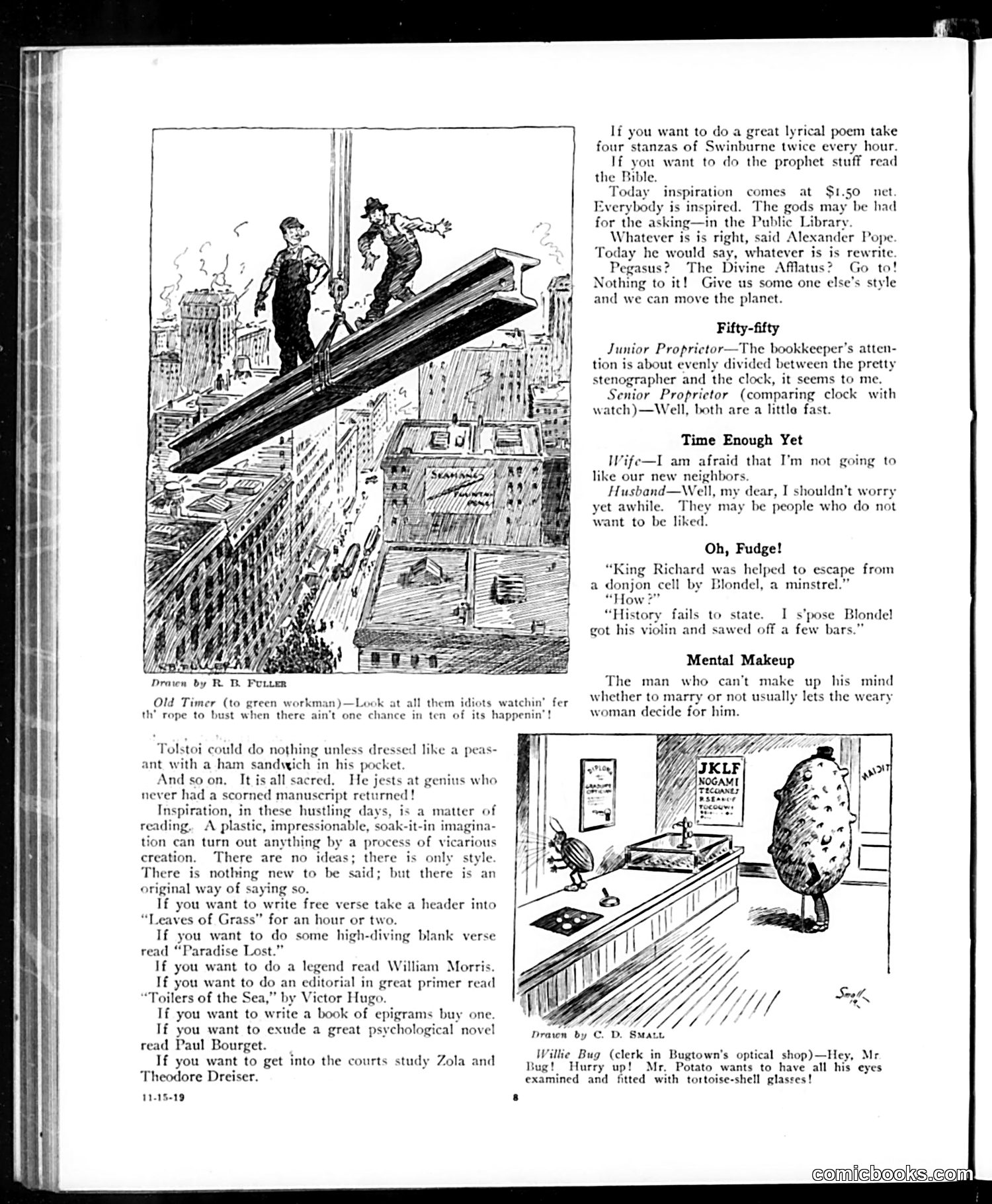
This page contains satirical commentary on literary inspiration and several comic vignettes. The top illustration by R.B. Fuller depicts construction workers and references the cliché that artists need specific conditions—the text mocks Tolstoy's supposed need to dress as a peasant with a ham sandwich to write. The lengthy prose section ridicules the notion that modern "inspiration" is merely imitation. It sardonically suggests readers wanting to write poetry should simply copy Swinburne, or study established masters (Milton, Hugo, Zola, Dreiser) rather than develop original ideas. The joke: there's "nothing new to be said"—only new ways of saying old things. At $1.50, inspiration is now a commercial commodity available at public libraries. The lower section contains three brief humor pieces: "Fifty-fifty" jokes about divided attention; "Time Enough Yet" plays on lowered expectations of neighbors; and "Oh, Fudge!" makes a pun about Blondel "sawing" violin strings. The final cartoon by C.D. Small shows an absurdist joke: Mr. Potato (anthropomorphized vegetable) wants optical fitting—a nonsense gag typical of Judge's whimsical humor.
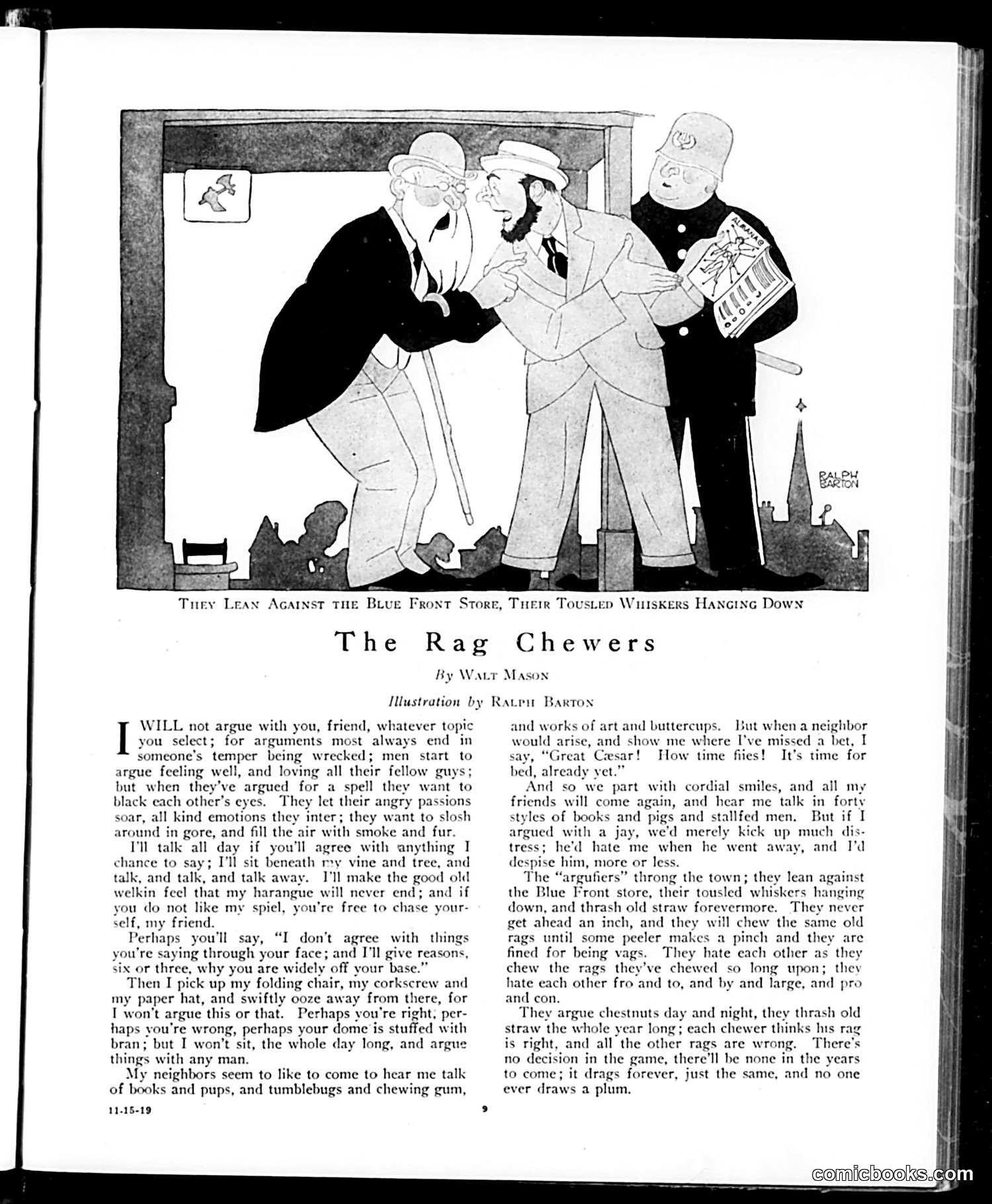
This satirical piece by Walt Mason mocks chronic arguers—the kind of people who endlessly debate trivial matters without resolution. The illustration shows shabby men loitering outside the "Blue Front Store," their whiskers unkempt, engaging in pointless disputes. Mason's humor rests on a contrast: he claims to *avoid* argument because arguing ruins friendships and tempers, yet he admits he loves talking *at* people who agree with him. The "argufiers" depicted are social misfits—vagrants or loafers ("vags") who literally "chew the rag" (discuss endlessly) about the same old topics forever, getting nowhere and earning nothing. The satire targets a recognizable urban type: unemployed men gathering on street corners, trapped in circular debates about trivial matters ("chestnuts"), never advancing in life, hating each other while unable to stop arguing. It's both humorous character sketch and mild social commentary on idleness and futility.
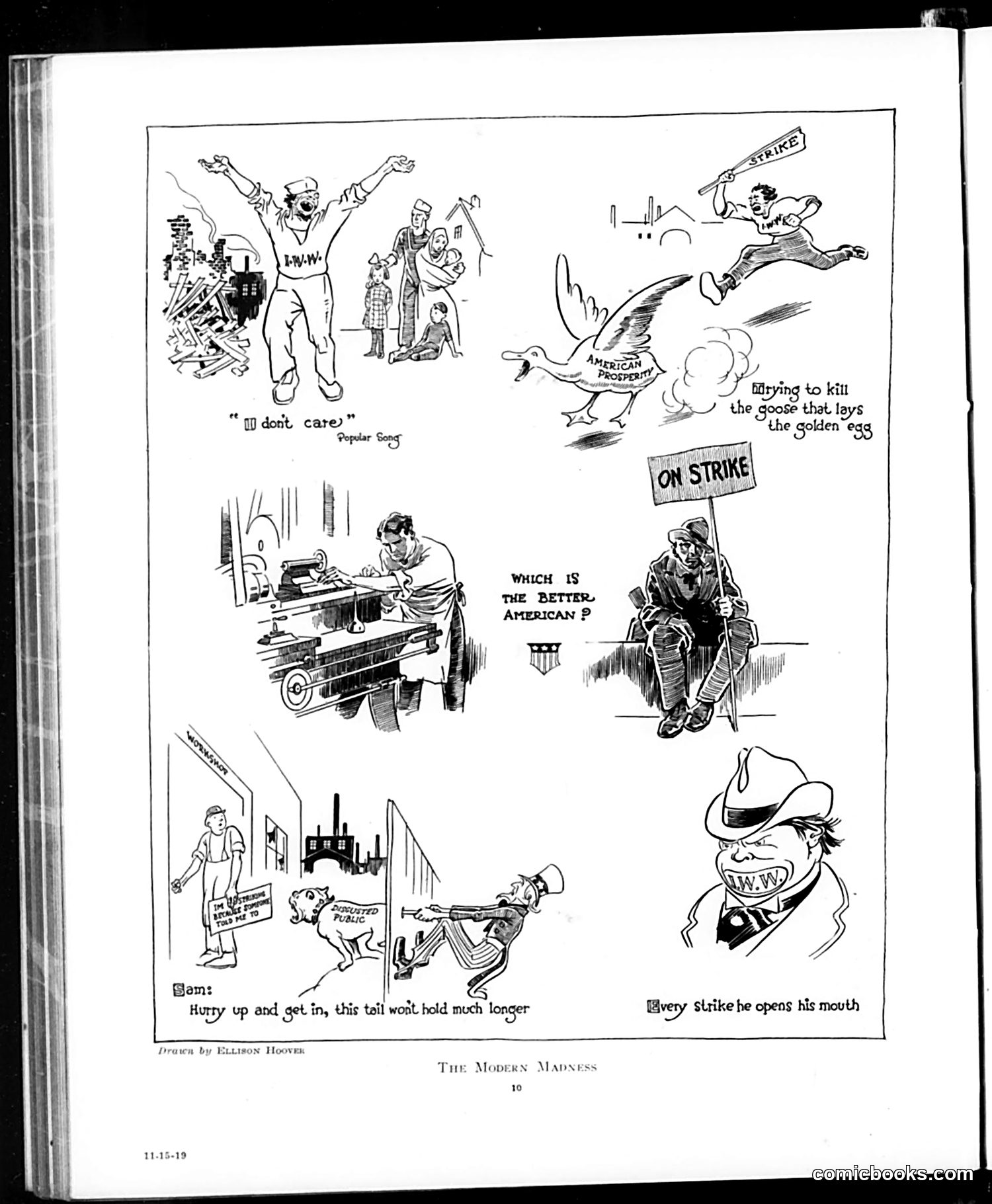
This satirical page critiques labor strikes and their consequences circa 1919. The top panel mocks strikers with "I don't care!" attitude amid destruction. The central imagery depicts "American Prosperity" as a goose being killed—the "goose that lays the golden egg"—by a striker wielding a "Strike" sign, illustrating the belief that strikes harm the economy that sustains workers. Other panels show industrial disruption and hardship. The final panels contrast two "Americans": one asks "which is the better American?"—implying strikers are unpatriotic—while the last shows a labor agitator or union organizer ("every strike he opens his mouth") as a menacing figure. The cartoons reflect anti-labor sentiment common during the 1919 strike wave, positioning strikes as economically destructive and socially dangerous.
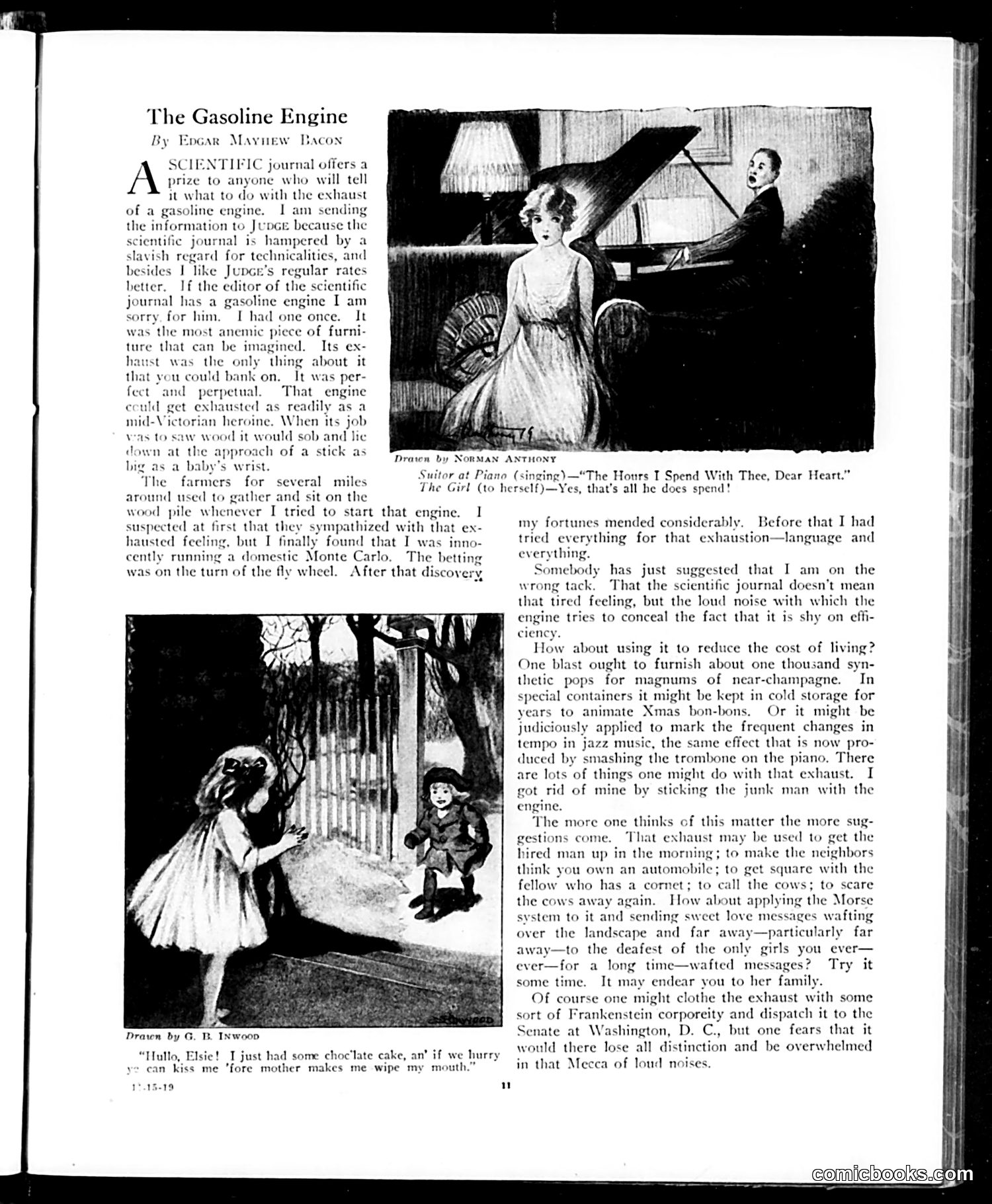
This is a humorous essay satirizing the unreliable gasoline engines of the early automobile era. Bacon describes owning a pathetically weak engine whose only reliable feature was its exhaust—which he compares to a "mid-Victorian heroine" prone to fainting fits. The satire mocks both the engine's incompetence and the era's fascination with this new technology. Bacon suggests absurd uses for the exhaust: creating fake champagne "pops," timing jazz music, waking farmhands, impressing neighbors, or even sending Morse code love messages to distant girls. The final joke—sending the exhaust to the Senate—suggests Congress is already so loud and chaotic that one more noise wouldn't matter. The accompanying illustrations (by G.B. Inwood and Norman Anthony) show domestic scenes unrelated to engines, typical of *Judge*'s light satirical style. The automobile exhaust represents early 20th-century technological frustration before engines became reliable.
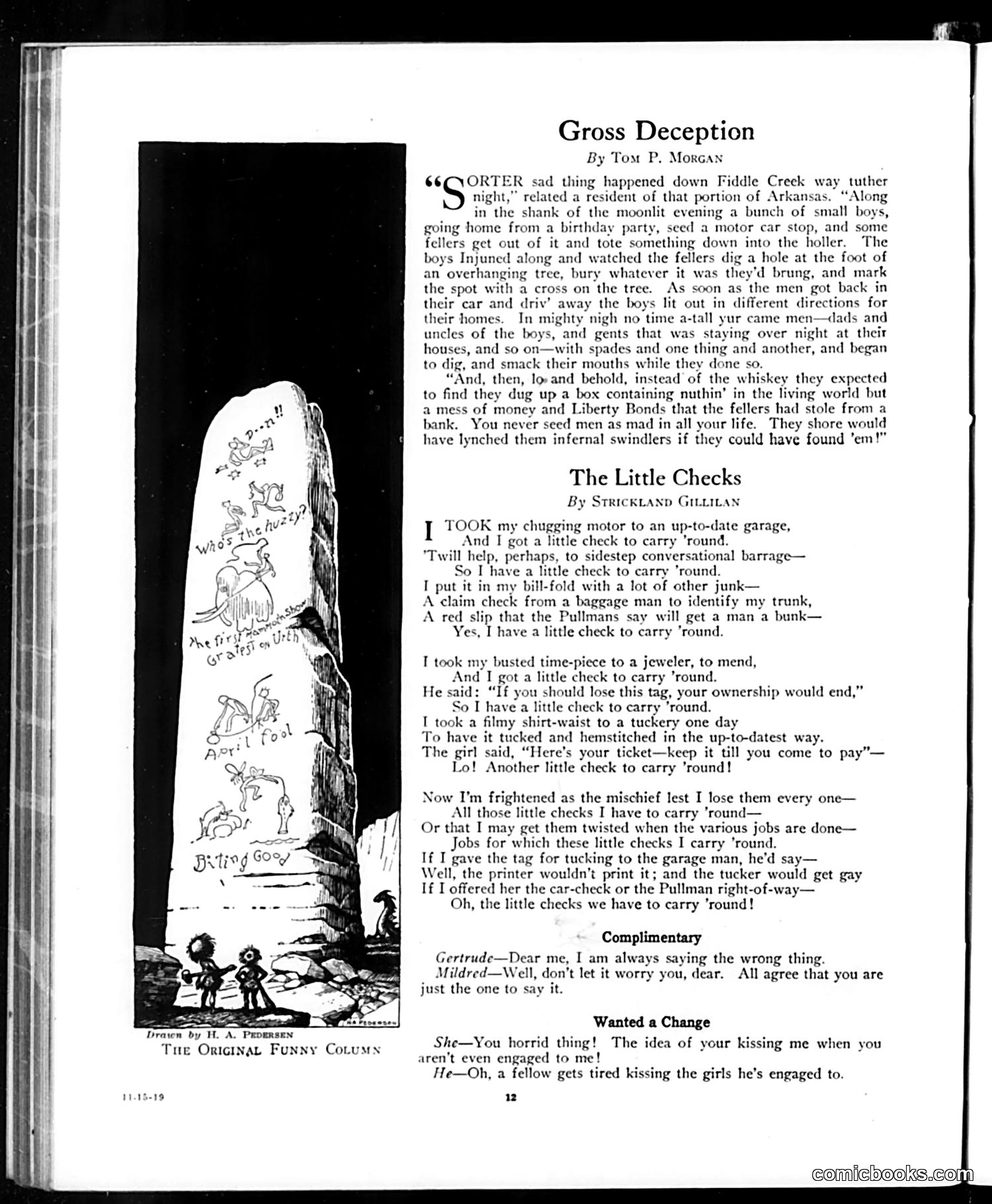
**"Gross Deception"** is a tall tale about Arkansas boys who witness men burying something suspicious. When the boys' fathers dig it up expecting stolen whiskey, they discover money and Liberty Bonds instead—the real theft. The joke: the men are outwitted by a "gross deception," expecting contraband but finding legitimate valuables, which angers them more than discovering their stolen goods. **"The Little Checks"** satirizes modern urban inconvenience. The speaker accumulates paper claim tickets from garages, laundries, jewelers, and baggage services—each representing a new service dependency. The anxiety is losing or confusing these tags, making modern life absurdly bureaucratic. It's social commentary on how emerging service industries fragment daily tasks, burdening people with administrative paper rather than simplifying life. Both pieces reflect early 20th-century anxieties: rural versus urban culture and the complications of modernization.
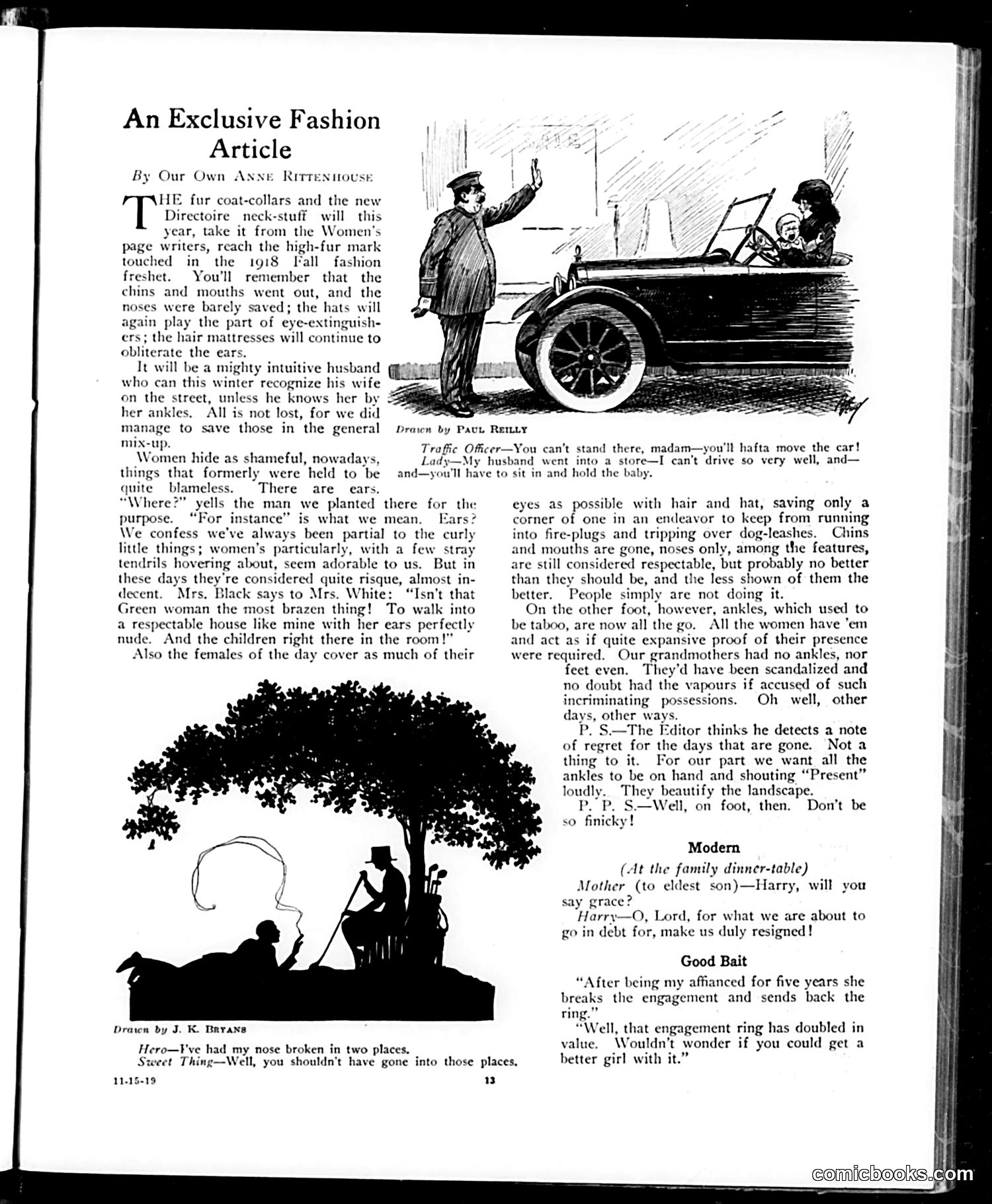
This fashion article satirizes rapid changes in women's fashion and social conventions post-WWI. Author Anne Rittenhouse observes that 1918-1919 styles hide nearly everything—ears, mouths, chins, noses—except ankles, which were formerly considered scandalous but are now fashionably displayed. The joke targets the absurdity of shifting modesty standards: what was shameful becomes acceptable and vice versa. The accompanying cartoons reinforce this theme. One shows a traffic officer stopping a woman driver; another depicts a man with a broken nose, making light of physical mishaps. The "Modern" section mocks economic anxiety (praying about going into debt) while "Good Bait" jokes about an engagement ring's resale value—cynical humor about marriage and materialism. Overall, the page satirizes post-war social upheaval, women's changing visibility in public spaces, and the superficiality of fashion-driven morality.
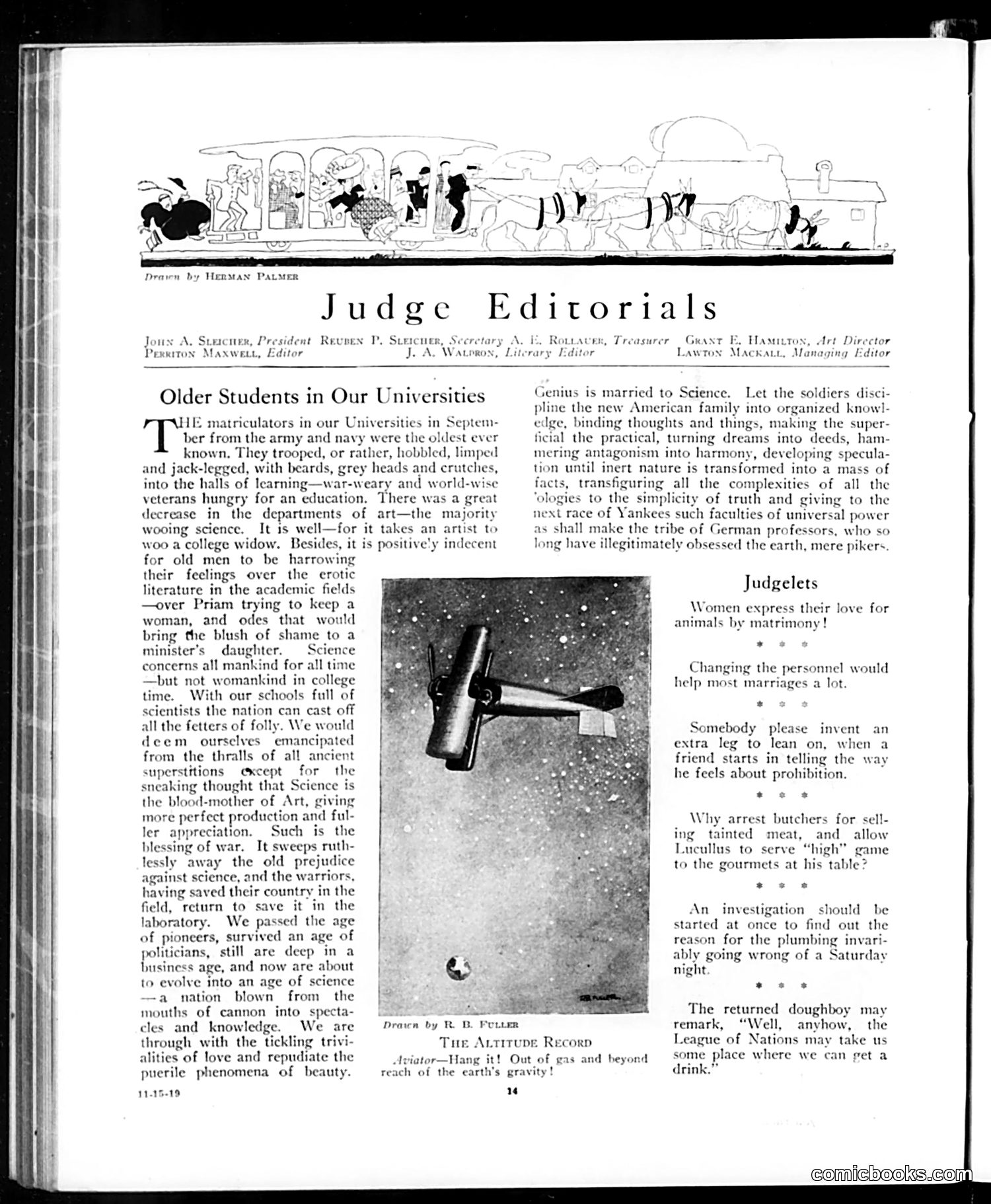
This page contains a serious editorial and light satirical commentary from post-WWI America (dated 11-15-19). **Main Editorial: "Older Students in Our Universities"** The piece celebrates older, war-weary veterans enrolling in universities after WWI, praising their enrollment in science over humanities. The editorial argues this represents national progress—that hardened soldiers will bring practical discipline to education, replacing "puerile" artistic pursuits and outdated superstitions with scientific rationalism. There's backhanded dismissal of classical literature and the humanities as unsuitable for older men. **The Cartoons:** - "The Altitude Record" (drawn by R.B. Fuller): An aviator runs out of fuel, a commentary on aviation's experimental, dangerous nature. **"Judgelets" (short jokes):** Brief satirical quips on contemporary issues: marital discord, prohibition debates, butchers selling tainted meat, and plumbing failures—typical domestic complaints of the era. The final joke mocks the League of Nations as a drinking opportunity. The overall tone reflects post-war confidence in science and skepticism toward older cultural values, mixed with everyday social complaints.
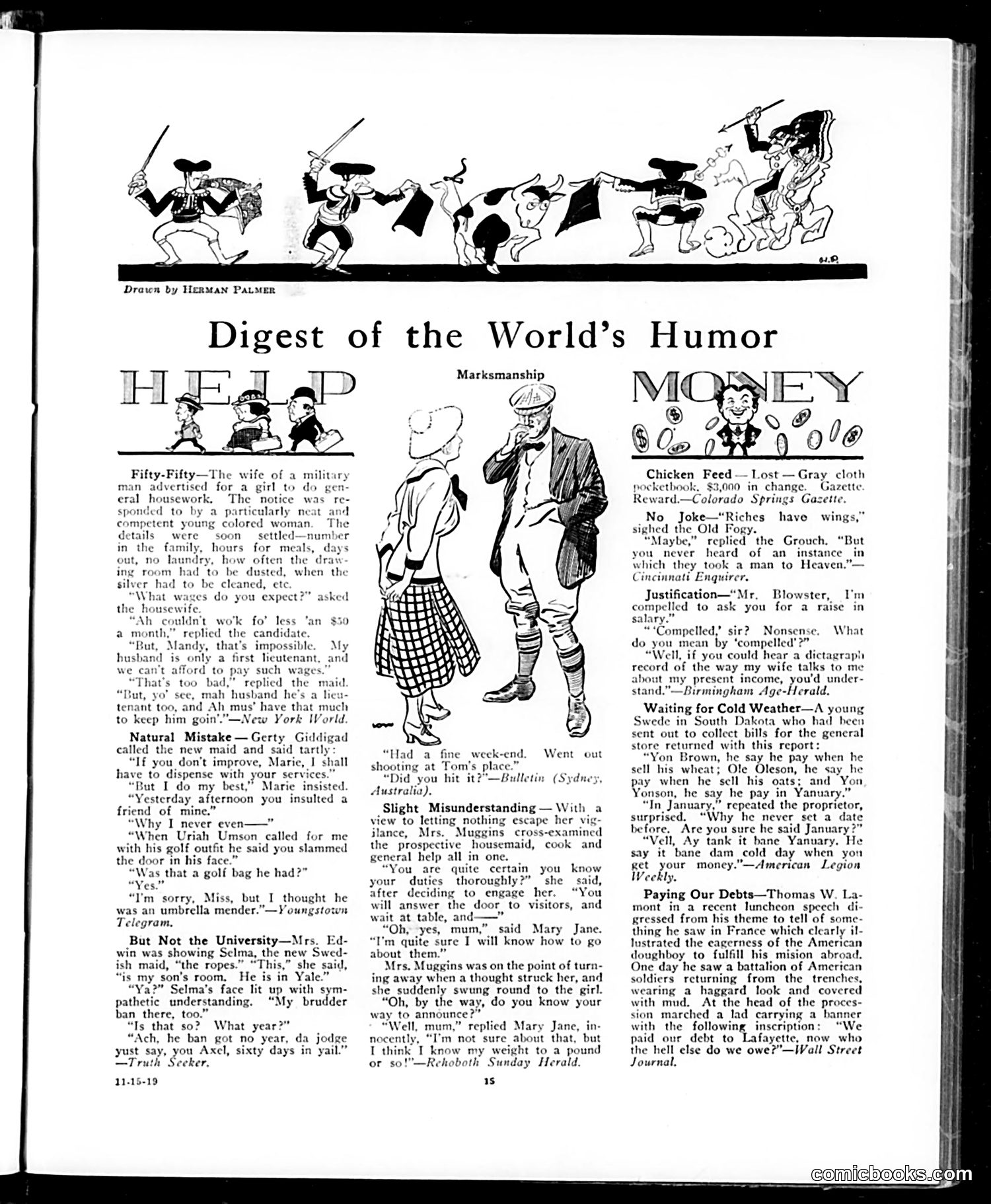
This is a humor compilation page featuring short jokes and anecdotes on various topics. The content reflects early 20th-century American attitudes, including significant racial and ethnic stereotyping now considered offensive. **Key items:** - **"Fifty-Fifty"**: A joke about a Black housemaid's wage demands, using dialect humor and stereotypical portrayal - **Domestic service anecdotes**: Several jokes about misunderstandings between employers and (often immigrant) household staff - **Swedish immigrant humor**: Multiple jokes featuring a "Swede" character and dialect, playing on immigration and cultural differences - **General humor**: Jokes about golf, marriage, wealth, and social class The satire targets social anxieties around labor negotiations, immigration, and gender roles. The consistent mockery of domestic workers and non-English speakers reflects how Judge magazine's humor functioned partly through caricature of marginalized groups. This was standard entertainment for the magazine's educated, middle-class readership.
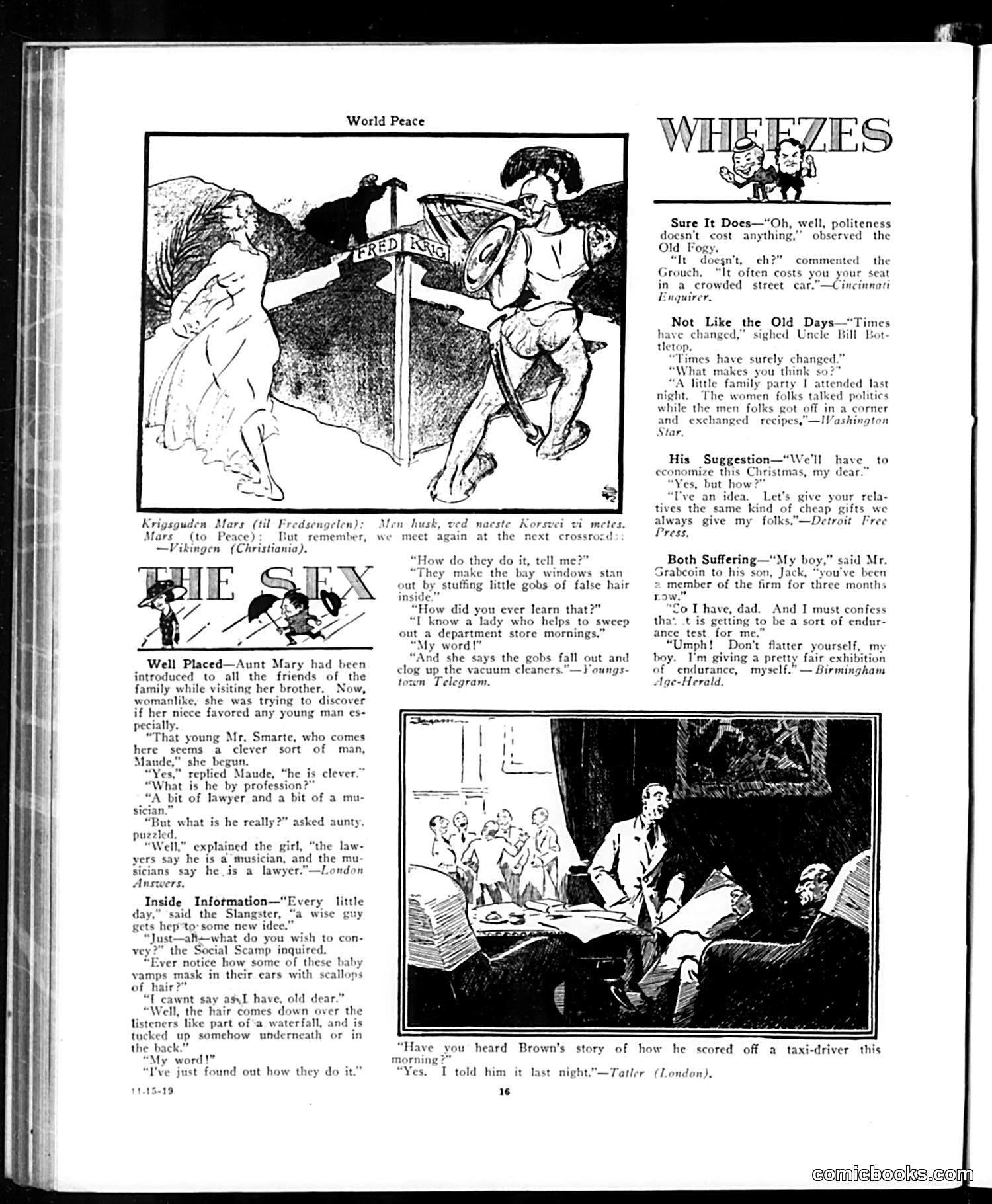
**Top Cartoon "World Peace":** This depicts Mars (god of war) meeting Peace at a crossroads. The caption, in what appears to be Swedish or Danish, suggests they're negotiating. The satire comments on post-WWI peace efforts—the implication being that peace and war are merely exchanging positions, questioning whether genuine lasting peace is achievable. **"The Sex" Section:** A collection of brief humorous anecdotes about gender relations and social behavior. Topics include: - Women's fashion (false hair in bay windows) - Changing domestic roles (women discussing politics, men exchanging recipes—reversing traditional gender expectations) - Christmas gift-giving and economizing - Workplace suffering and family business dynamics **Bottom Cartoon:** Shows a man at a desk with others in background, joking about scoring off a taxi-driver—a contemporary reference to urban life and social one-upmanship. The overall page reflects 1920s concerns: post-war disillusionment, evolving gender roles (women gaining more public voice), and modern urban social dynamics. The humor relies on observational comedy about shifting social conventions.
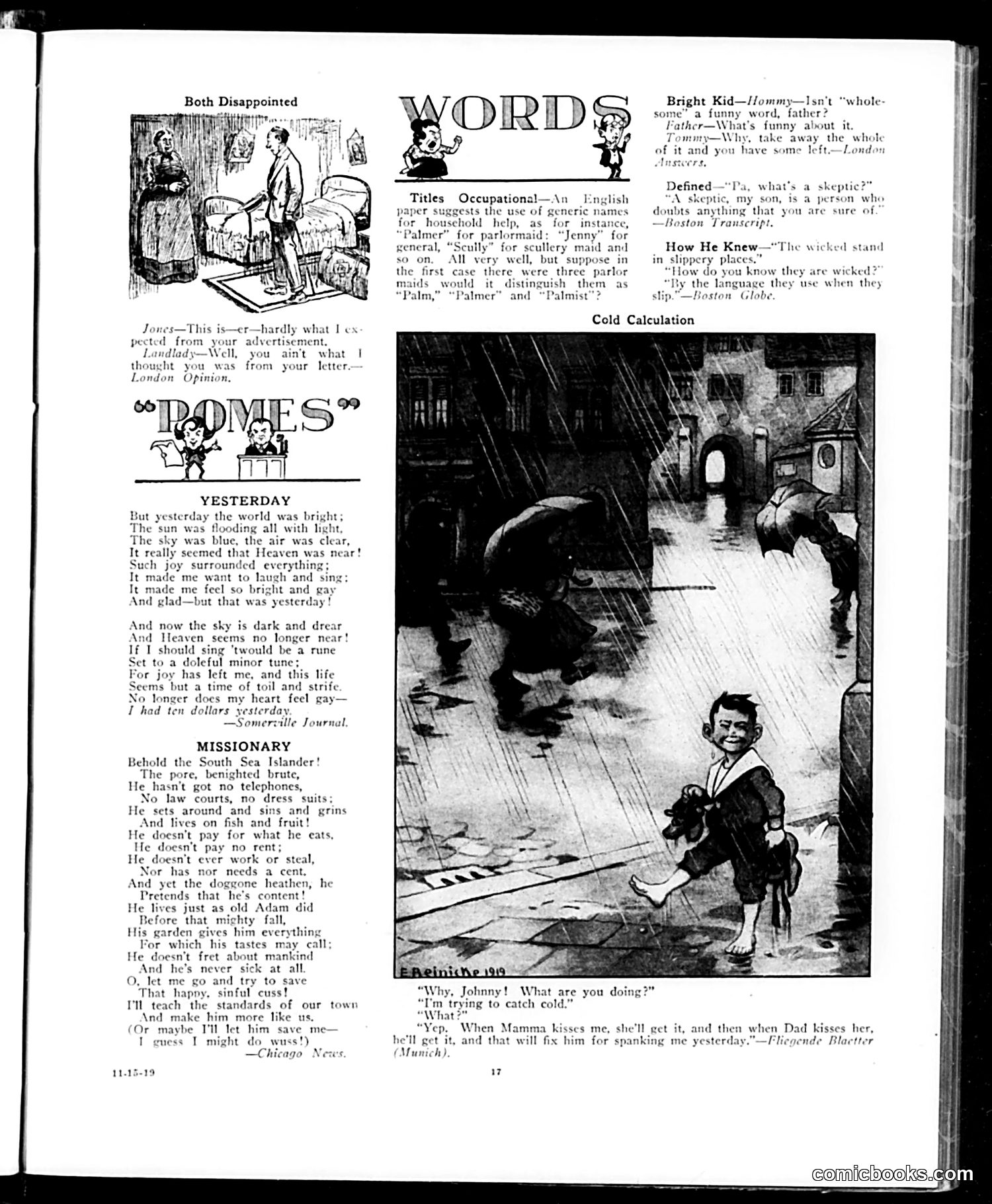
This page contains several distinct pieces of early 20th-century humor: **"Both Disappointed"** (top left cartoon): A domestic humor sketch about a maid and employer who've disappointed each other—likely regarding wages or job expectations based on their correspondence. **"Yesterday" and "Missionary" poems**: Social satire contrasting mood swings with romantic notions of "saving" indigenous peoples. The missionary poem mocks Western condescension, depicting the South Sea Islander as content without modern conveniences, then satirizing the missionary's desire to impose "our town's standards" on him. **"Words" section**: Discusses occupational titles (Palmer, Palmist for parlormaid positions)—commentary on class-based naming conventions. **"Cold Calculation"** (right cartoon): A child's scheme to deliberately catch cold and transmit it to his father as revenge for spanking—dark humor about childhood mischief typical of the era. The page reflects early 1900s attitudes: domestic servant class dynamics, imperialist attitudes toward colonized peoples, and traditional parent-child discipline humor.
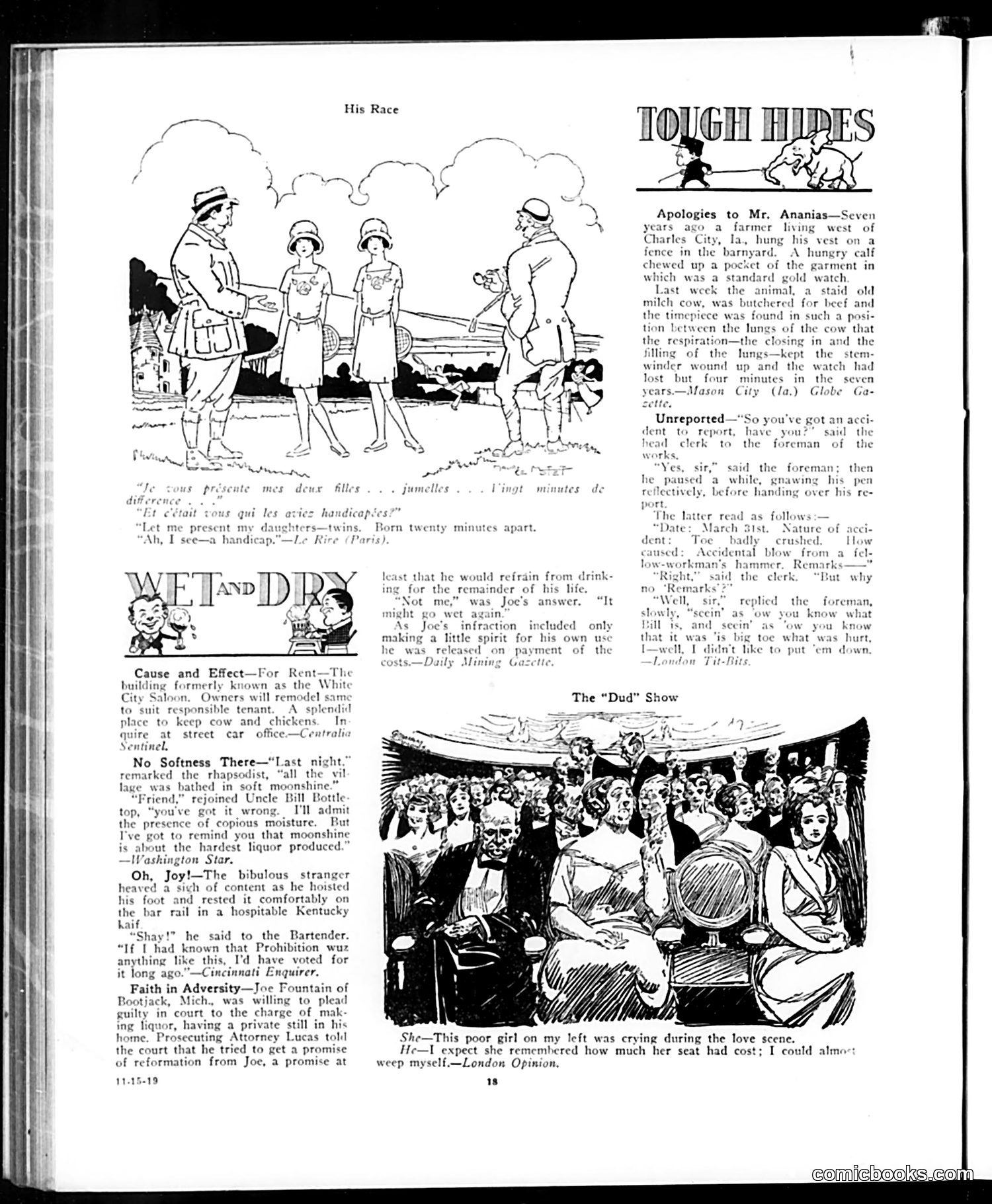
**"His Race"** (top): This cartoon depicts a wealthy family examining a horse or similar animal. The French caption jokes about aristocratic lineage ("your noble daughters... twenty minutes apart"). The satire mocks upper-class obsession with pedigree and breeding—treating humans like prized livestock. The humor suggests that obsessing over family "race" is absurd. **Other items on page**: Various short humorous anecdotes about Prohibition-era bootlegging, workplace accidents, and relationships. Notable: "Oh, Joy!" depicts someone praising Prohibition ironically while drinking illegally—commentary on how the alcohol ban actually increased drinking culture. "The 'Dud' Show" cartoon shows theater-goers, likely criticizing expensive entertainment. The page reflects 1919 American anxieties: class pretension, Prohibition's ineffectiveness, labor conditions, and consumerism. The humor is gentle satire aimed at middle-class readers.
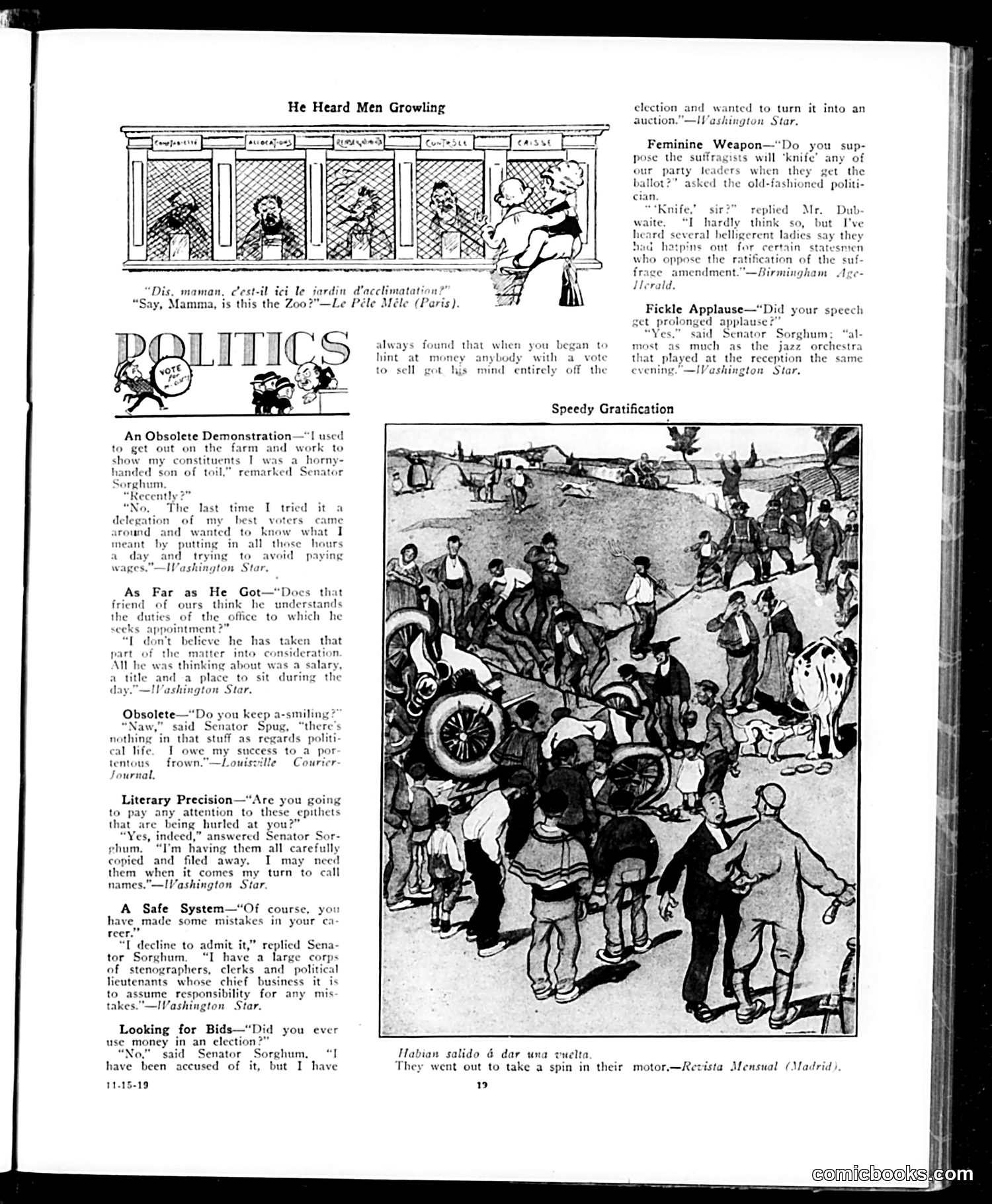
This page satirizes American politics circa 1919, featuring several short cynical jokes about politicians' hypocrisy and corruption: **"An Obsolete Demonstration"**: A senator admits that performing manual labor to appear relatable to voters backfired—constituents questioned why he was avoiding wage-paying work. **"As Far as He Got"**: A politician seeking office only cares about the salary and a desk, not understanding actual responsibilities. **"Literary Precision"**: Senator Sorghum (a recurring satirical character) files away insults to use against opponents later—suggesting political revenge rather than principle. **"A Safe System"**: The politician admits mistakes but claims his staff of stenographers and political operatives protect him from accountability. **"Looking for Bids"**: Denying electoral bribery while implying he converted an election into an auction—a direct accusation of vote-selling. The cartoon "Speedy Gratification" shows wealthy people enjoying a motor-car ride, likely contrasting leisure with the political corruption detailed above. The satire targets voter manipulation, self-serving ambition, and systemic corruption in early 20th-century American politics.
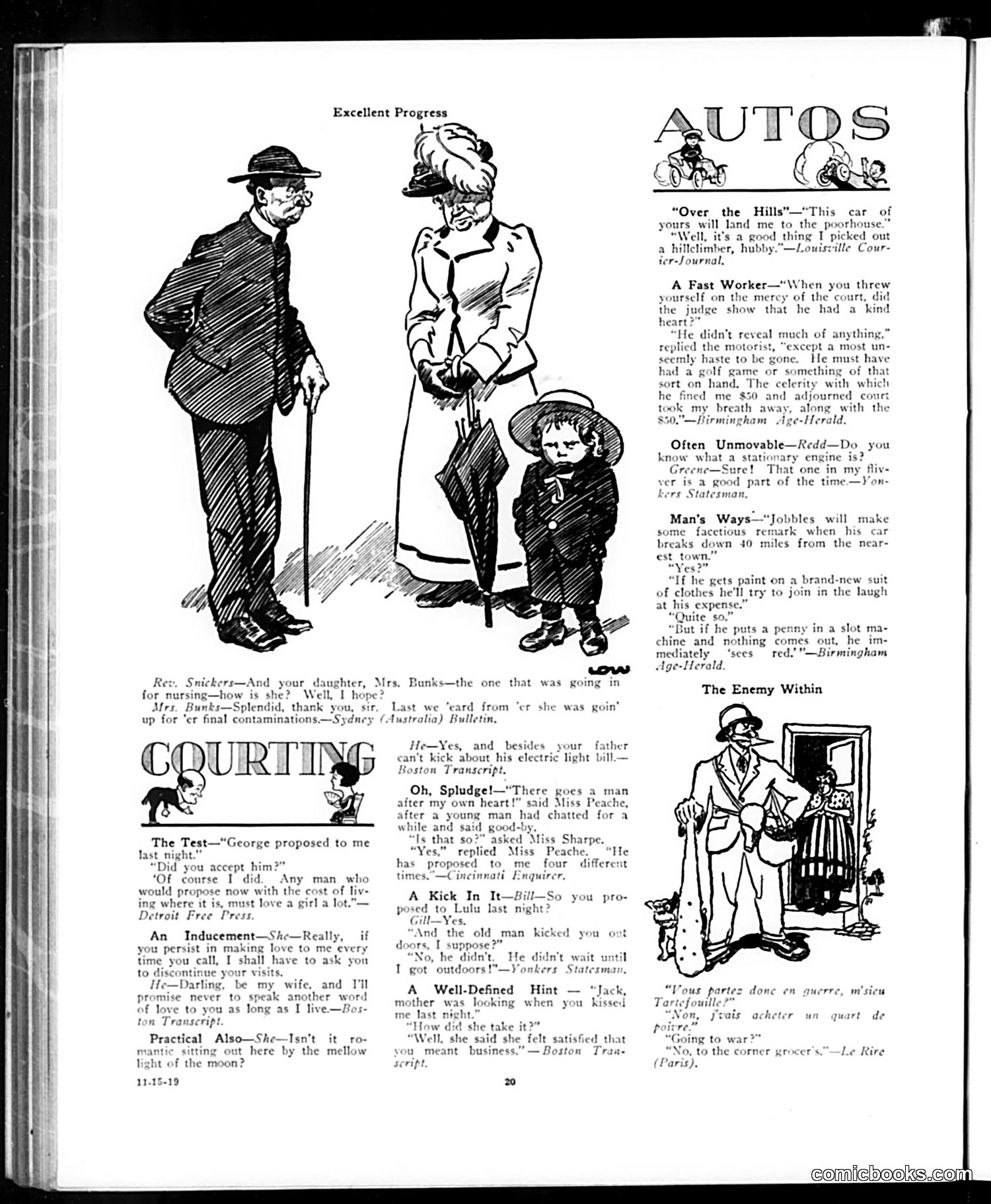
This page contains humorous anecdotes and jokes organized around two main sections: "COURTING" and "AUTOS," reflecting early 20th-century American social concerns. The **courting jokes** satirize romantic conventions: men's desperation (proposing despite high cost-of-living), women's manipulation of suitors, and courtship as a transactional arrangement. References to judges and fines suggest motorists facing consequences for traffic violations. The **automobile section** mocks early car ownership troubles: breakdowns, accidents leading to court appearances with hefty fines ($50), and the social embarrassment of automotive mishaps. The joke about paint on new clothes and slot machines reflects anxieties about cars as both status symbols and sources of humiliation. The illustration shows a well-dressed couple with a child, likely representing the aspirational automobile owner. The cartoons assume readers understand cars as novel, unreliable contraptions causing legal and financial trouble—positioning automobiles as agents of chaos in modern life rather than symbols of progress, despite the header "Excellent Progress."
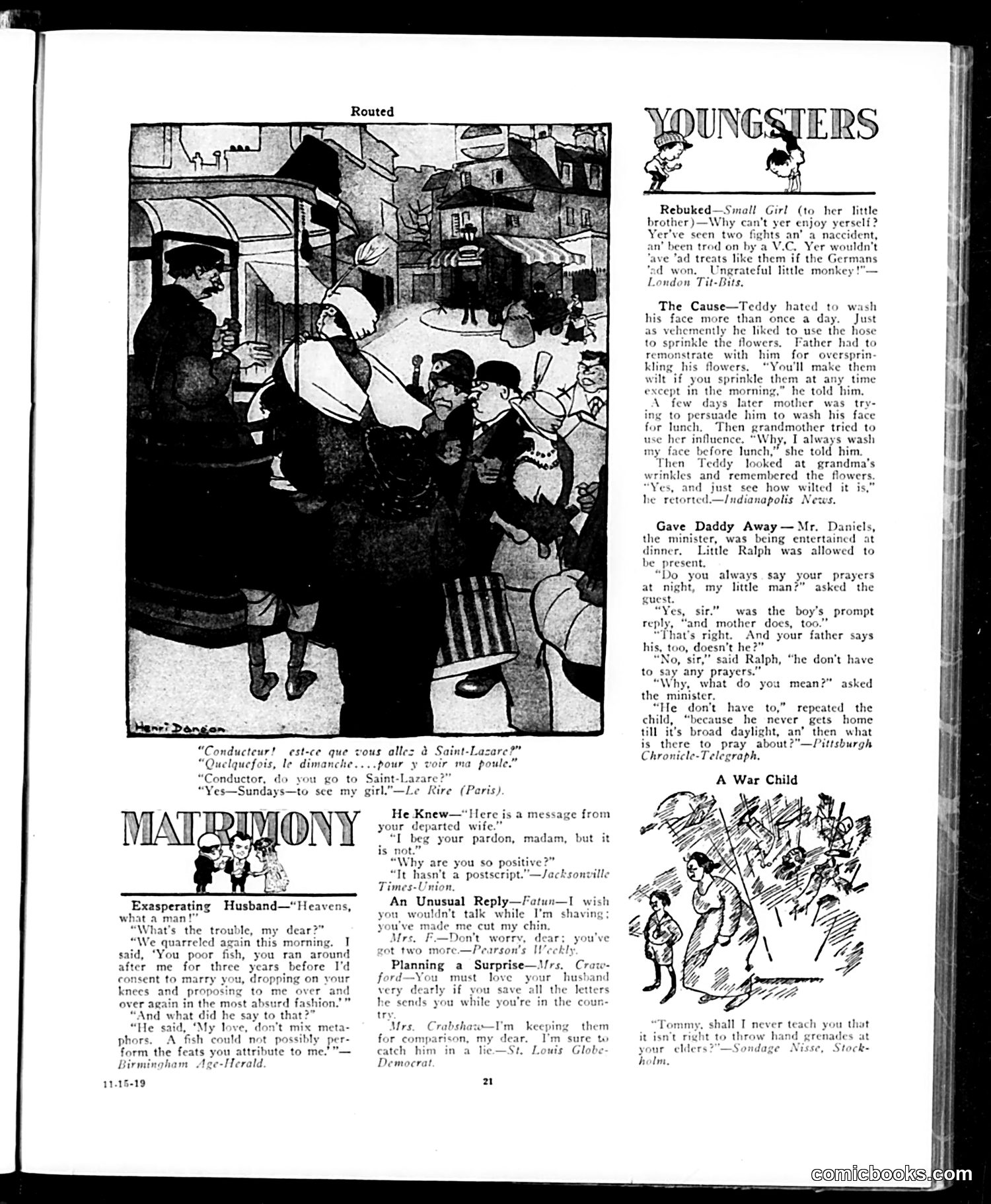
This page contains multiple short humorous anecdotes, typical of Judge's satirical format. The content reflects early 20th-century social attitudes: **"Rebuked"** references World War I—a British child scolds her brother for complaining about minor hardships, telling him he should be grateful compared to what German occupation would mean. **"The Cause"** jokes about a boy conflating flower care with personal hygiene: his father warned against overwatering flowers in sunlight, so when told to wash his face before lunch, the boy resists, noting his grandmother's "wilted" appearance from frequent face-washing. **"Gave Daddy Away"** satirizes a minister's dinner conversation. Young Ralph innocently reveals his father doesn't pray because he's never home during daylight—a dig at working men's long hours. The remaining items ("Matrimony," "A War Child," etc.) are brief comedic vignettes about marital discord, parenting, and domestic life. The overall tone is lighthearted domestic satire with occasional contemporary war references, typical of Judge's humor targeting middle-class American readers.
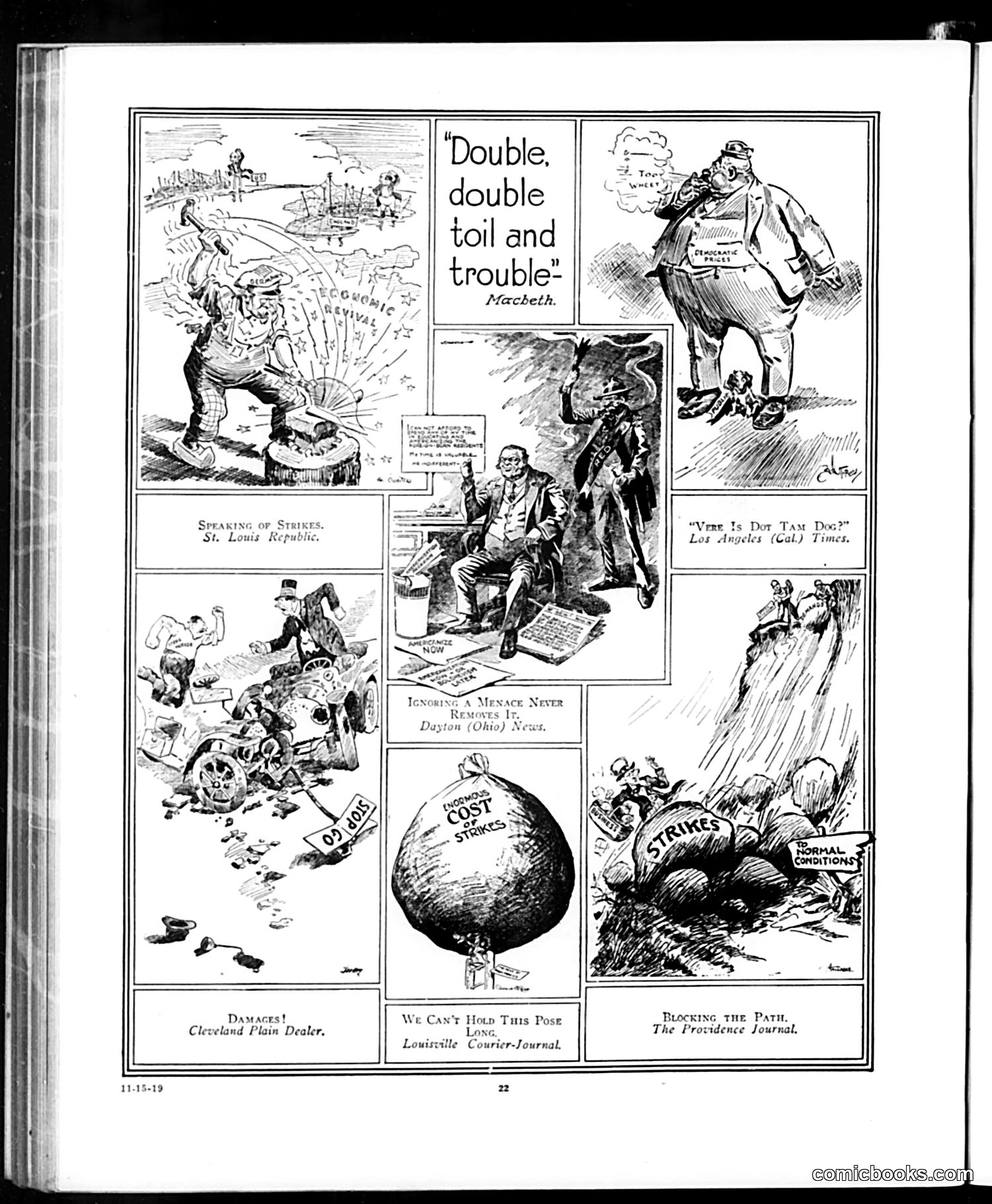
This Judge magazine page satirizes labor strikes, circa 1919. The cartoons depict strikes as chaotic destruction—a cauldron of "toil and trouble" (Shakespeare's *Macbeth* reference), wrecked machinery, and damaged property. The "Damages!" cartoon shows industrial devastation; "We Can't Hold This Pose Long" shows strikers as burdensome weight; "Blocking the Path" depicts strikes as obstacles to normalcy. The newspaper attributions (St. Louis Republic, Los Angeles Times, Cleveland Plain Dealer, etc.) suggest these were reprinted editorial cartoons reflecting widespread anti-strike sentiment. The cartoons present strikes as inherently destructive and unreasonable rather than addressing workers' legitimate grievances—a common elite perspective during the post-WWI strike wave.
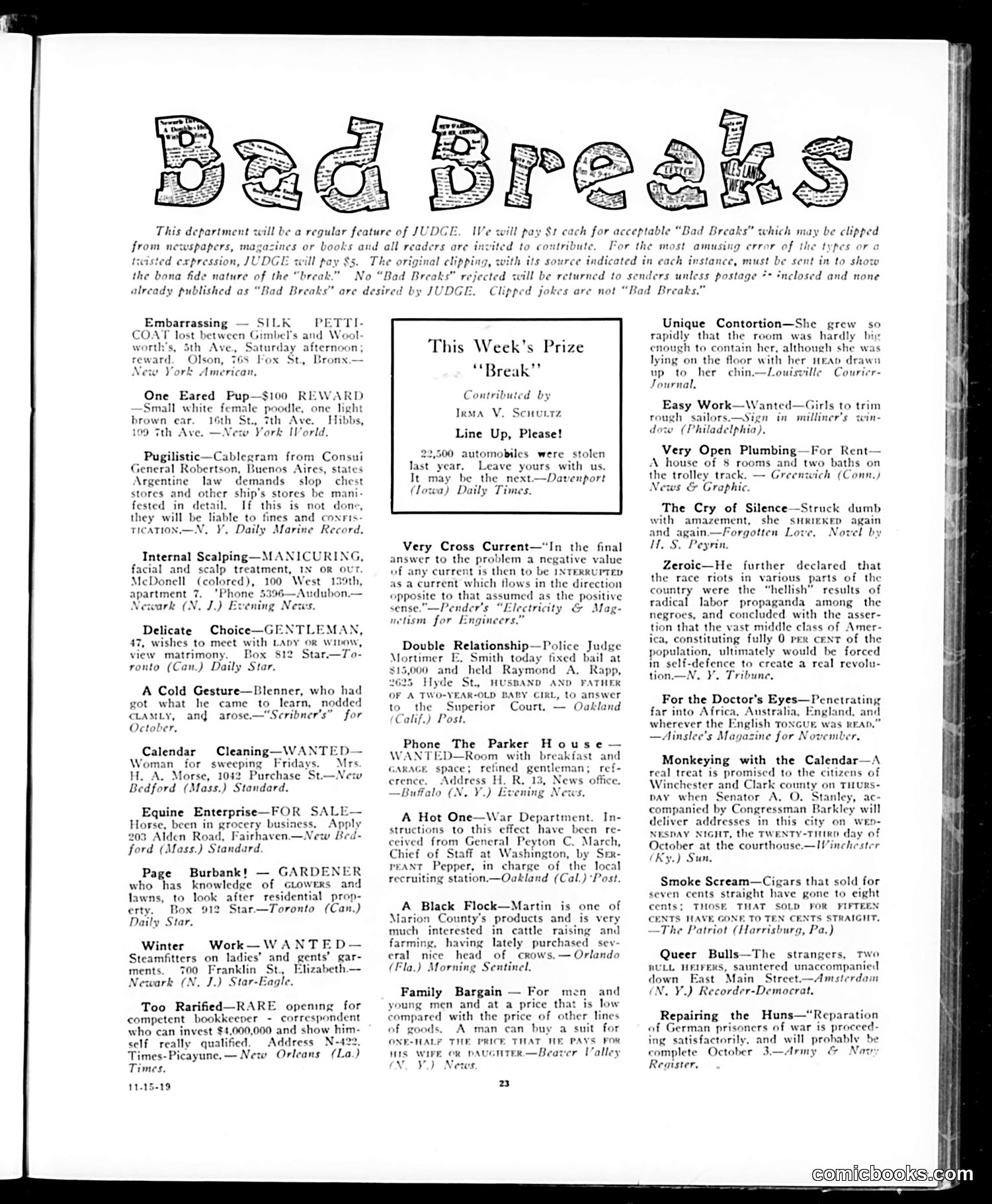
This is a typical "Bad Breaks" department page from *Judge*, a satirical magazine that published humorous classified ads and newspaper excerpts containing unintentional double meanings or absurd phrasing. Rather than political cartoons, the page collects amusing typographical errors and unfortunate word choices from real newspapers. Examples include: an auto theft ad promising stolen cars may be "the next," creating dark humor; a cattle farmer who "purchased several nice head of **crows**" instead of cattle; and a billboard offering suits at "ONE-HALF THE PRICE THAT HE PAYS FOR HIS WIFE OR DAUGHTER." The satire targets careless newspaper writing and editing. Readers were invited to submit clips for $1 per accepted submission. The humor relies on readers recognizing how innocent phrasing becomes ridiculous or inappropriate through poor word choice—mocking both the publications' sloppiness and the absurdity of classified-ad language generally.
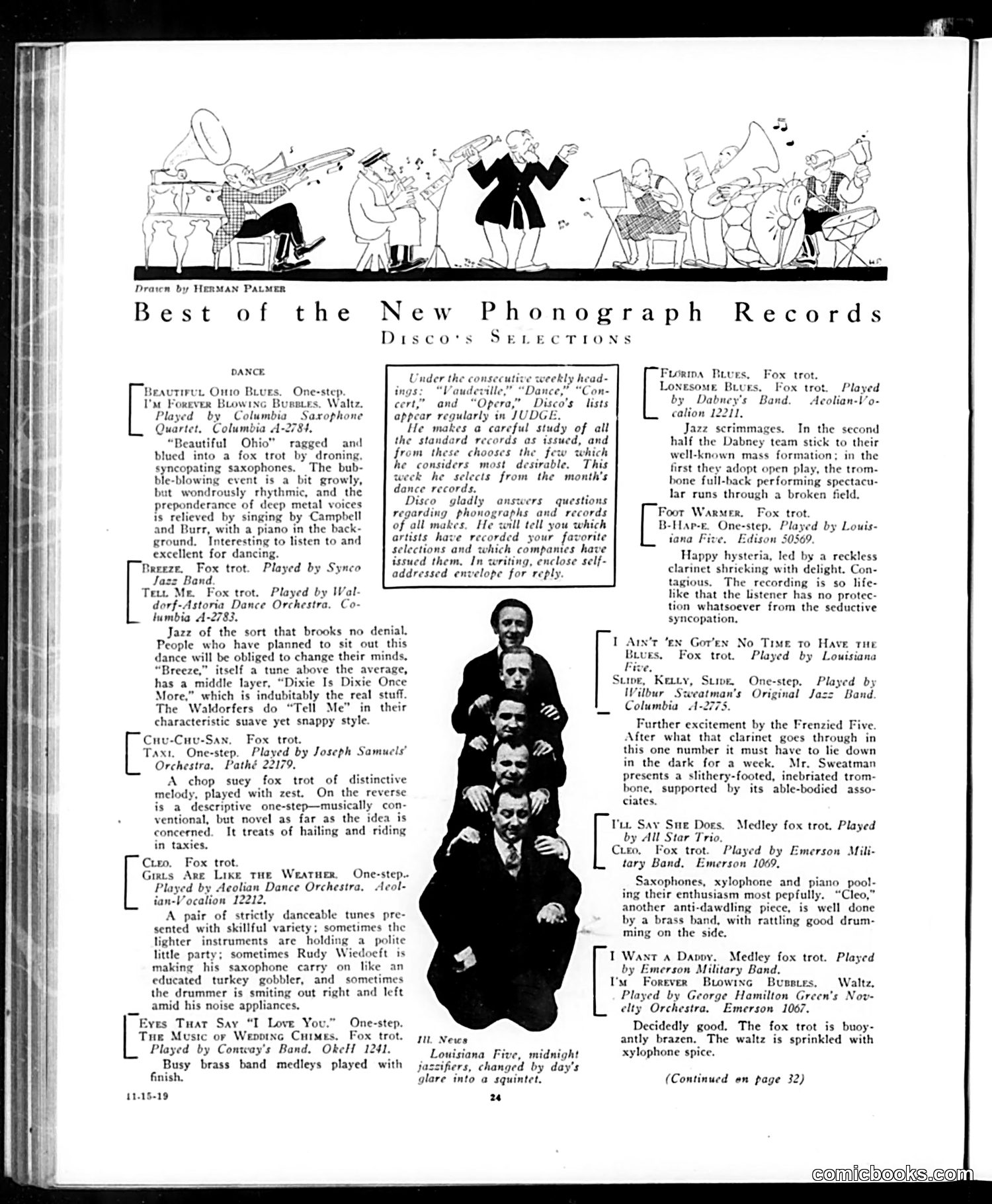
This is a record review column, not a political cartoon. The illustration at the top—drawn by Herman Palmer—shows musicians performing various styles of dance music (a conductor, saxophonist, violinist, pianist, etc.), representing the diversity of jazz and dance music being recorded. The page reviews recent phonograph releases, mostly fox trots and one-steps popular in the early 1920s. Reviews note performers like Dabney's Band and the Louisiana Five, praising energetic clarinet work and "syncopation"—then a relatively new, exciting musical style associated with jazz. The text includes a note that "Disco" (likely short for the record reviewer's name or publication section) answers reader questions about which artists recorded favorite songs and which record labels issued them. This represents early 1920s commercial music consumption and the growing popularity of jazz-influenced dance music.
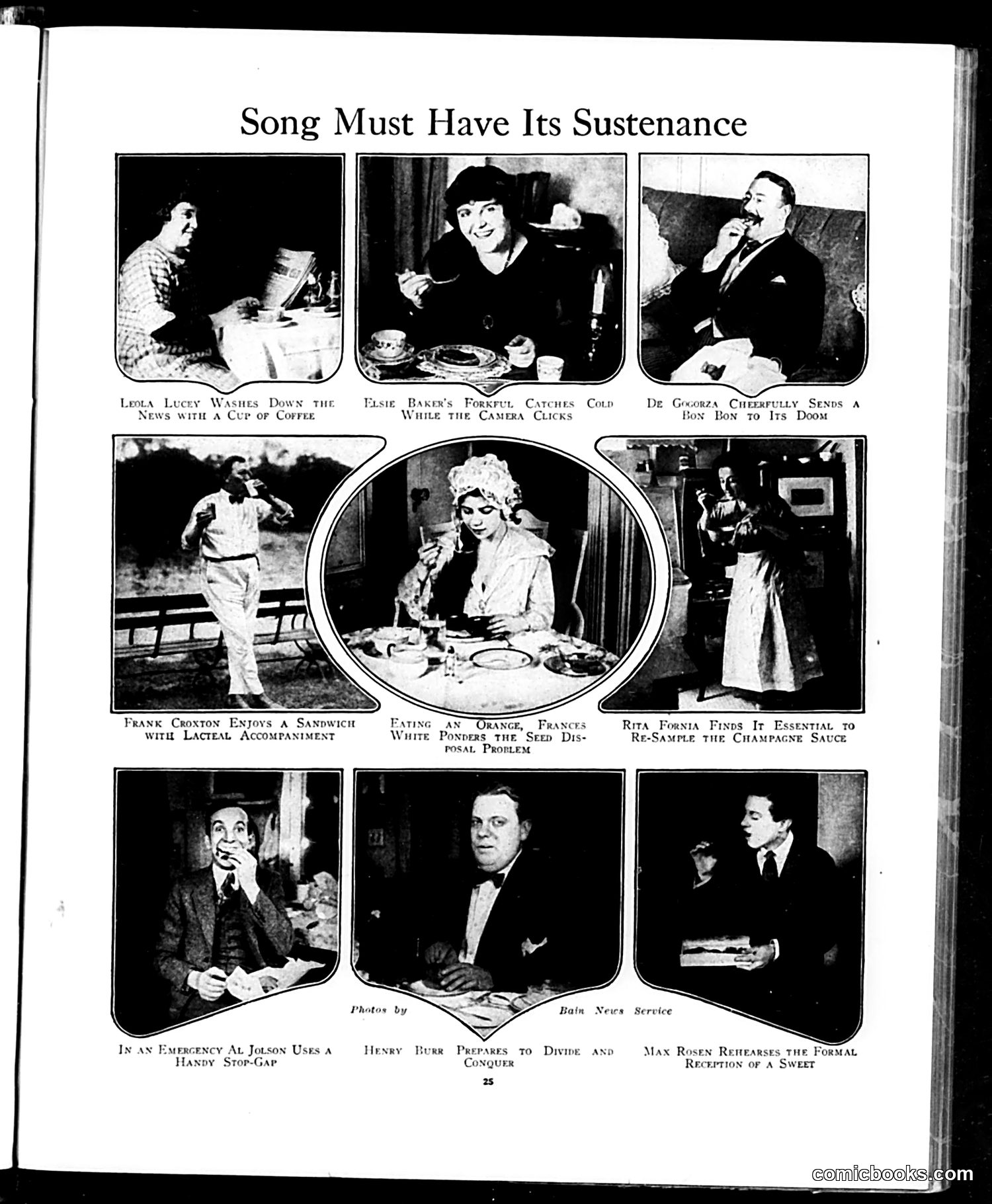
This Judge magazine page satirizes early 1920s silent film stars by showing them eating between takes or scenes. The title's pun suggests performers need literal sustenance (food) to maintain their artistic "song" (performance). The page features nine photographs of named actors—including Laela Lucey, Elsie Baker, Frank Croxton, and others—caught in candid eating moments: drinking coffee, eating sandwiches, consuming fruit, using emergency snacks. The satire targets the contrast between performers' glamorous public images and their unglamorous private necessity to eat. It's gentle mockery of cinema's illusion, exposing that even celebrated entertainers must pause their artistry for mundane biological needs. The recurring food imagery creates humor through repetition, reducing these celebrated figures to hungry humans.
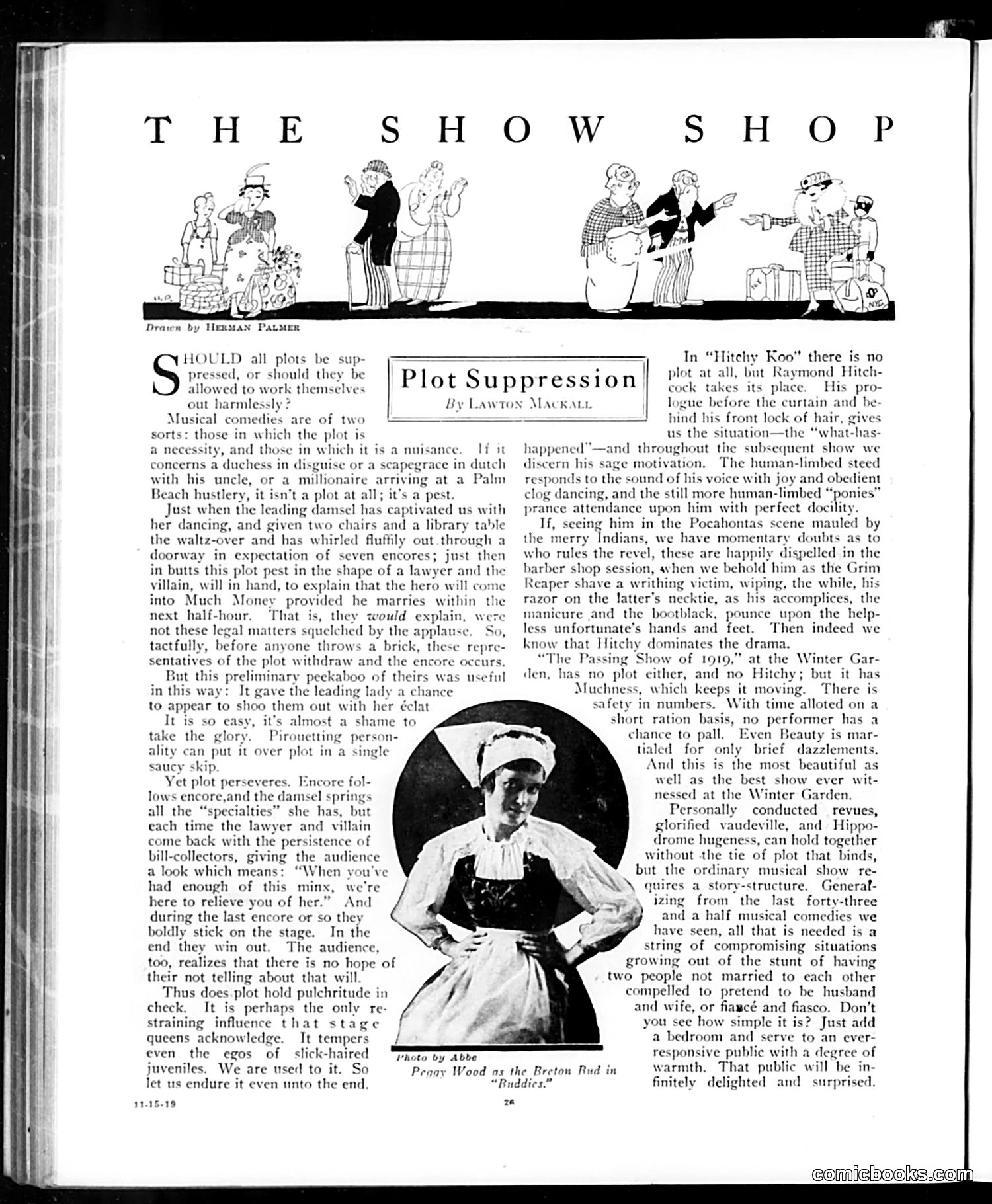
This article by Lawton Mackall examines whether musical comedies need plots. The author argues they're often unnecessary obstacles to entertainment. The piece uses **Raymond Hitchcock** (a popular stage performer of the era) as the prime example—his personality and physical comedy in "Hitchy Koo" supersede any narrative structure. Mackall contends that beautiful leading ladies and comedians can captivate audiences through dance and "specialties" (musical numbers), while plots function merely as interruptions. The accompanying photograph shows **Peggy Wood** in "Buddies," illustrating the era's star-driven musical theater. Mackall's satire targets the conventions of early 20th-century Broadway: producers felt obligated to include thin plots (divorces, inheritances, disguises) that audiences tolerated but didn't want. He notes that plot-less revues like "The Passing Show of 1919" succeed through spectacle and "muchness"—sheer entertainment volume—rather than narrative coherence. The cartoon header depicts typical musical comedy scenarios these plots generated.
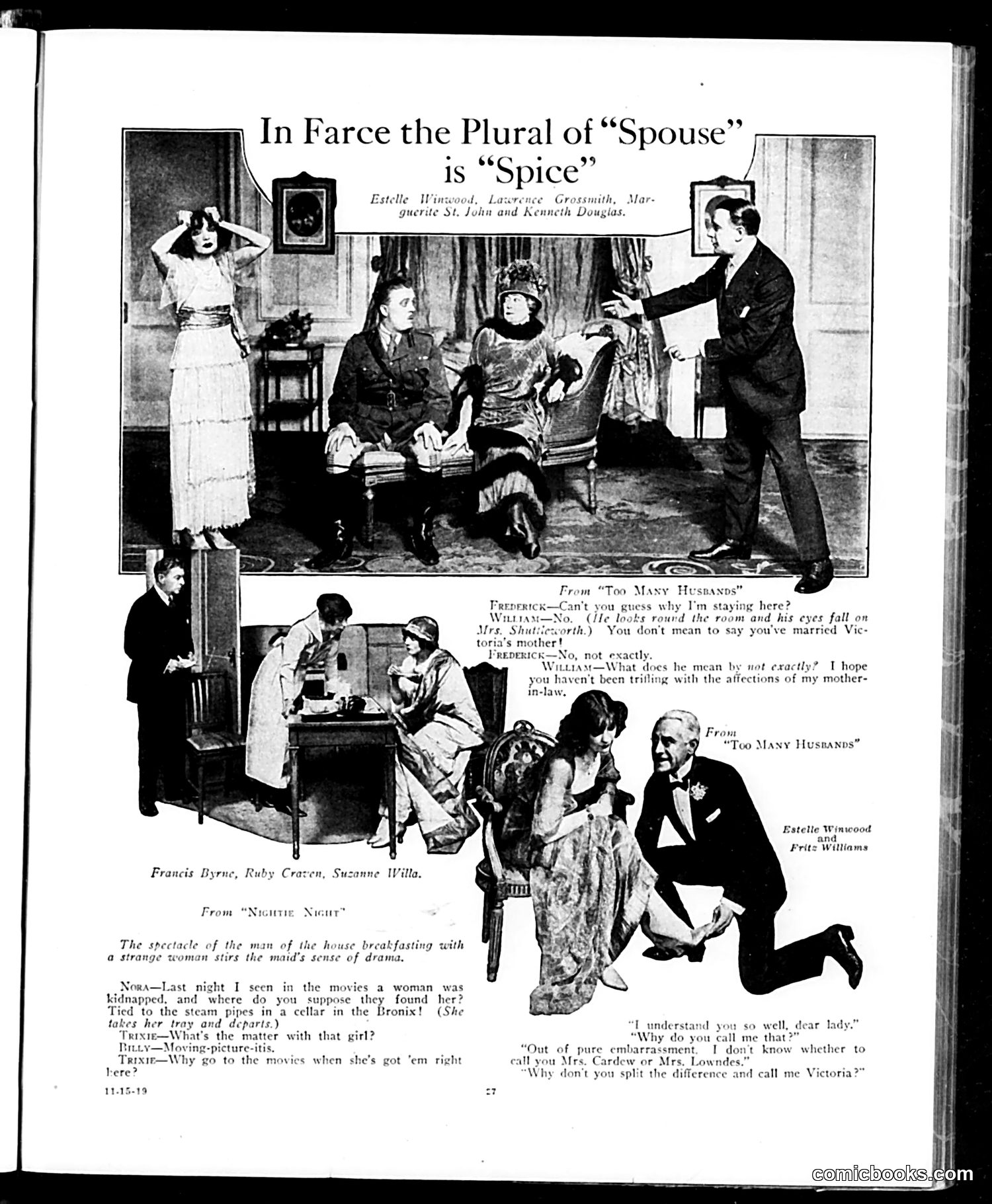
This page satirizes early 20th-century farce theater, specifically plays about infidelity and marital complications. The headline's pun—"the plural of 'Spouse' is 'Spice'"—suggests that multiple spouses or romantic entanglements make life more "spicy" (exciting/scandalous). The page features excerpts from two theatrical productions: "Nice Night" and "Too Many Husbands." The scenes depict typical farce scenarios: a man breakfasting with a mysterious woman (causing servant drama), confusion over a man's marital status, and the social awkwardness of a man uncertain whether to address a woman as "Mrs. Cardew" or "Mrs. Lowndes" (implying she has multiple names/identities from different marriages). The joke mocks how servants and working-class characters find melodramatic excitement in their employers' romantic scandals—preferring real domestic chaos to movie entertainment. The satire targets both the absurdity of theatrical farce plots and period anxieties about marriage and propriety.
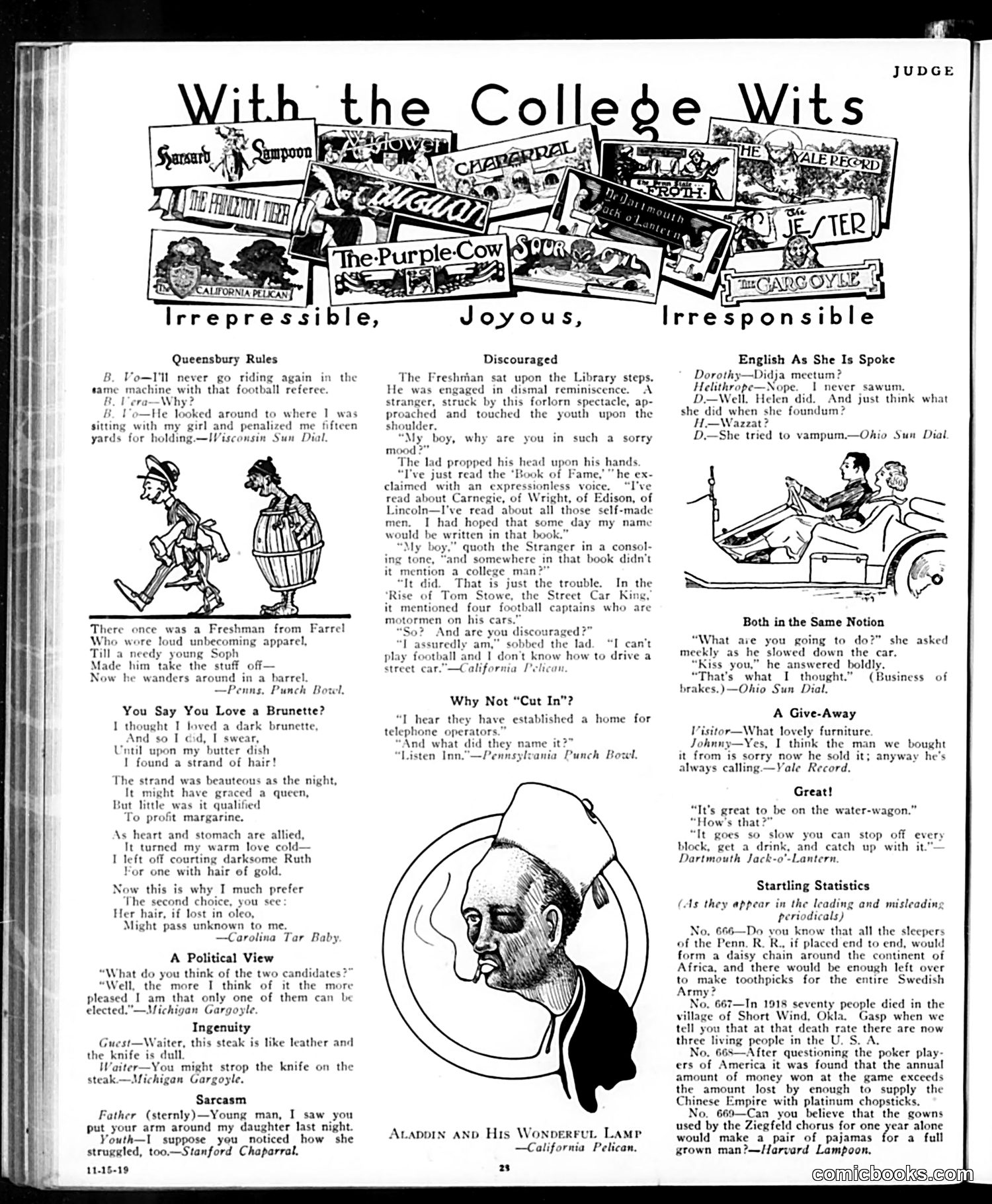
This is a **humor and jokes page** from Judge magazine (dated 11-15-19, so November 1919). It collects college humor submissions from university publications—not political cartoons, but comedic quips and observations about college life. The content reflects early 20th-century college culture: - **"Queensbury Rules"**: A football referee joke about "holding" (a penalty) applied to dating - **Brunette joke**: Plays on margarine advertising ("oleo") and hair loss concerns - **Self-made men**: A freshman reads biographies of famous industrialists (Carnegie, Wright, Lincoln) but discovers his college's "Book of Fame" only mentions football captains—satirizing the perceived worthlessness of college education versus practical success - **Vamping reference**: Flirting/seduction slang - **"Water-wagon"**: Staying sober (Prohibition era context) The **Aladdin illustration** appears to be a decorative element unrelated to the text. These are lighthearted, topical jokes targeting college students' anxieties about romance, success, and identity during the 1919 era.
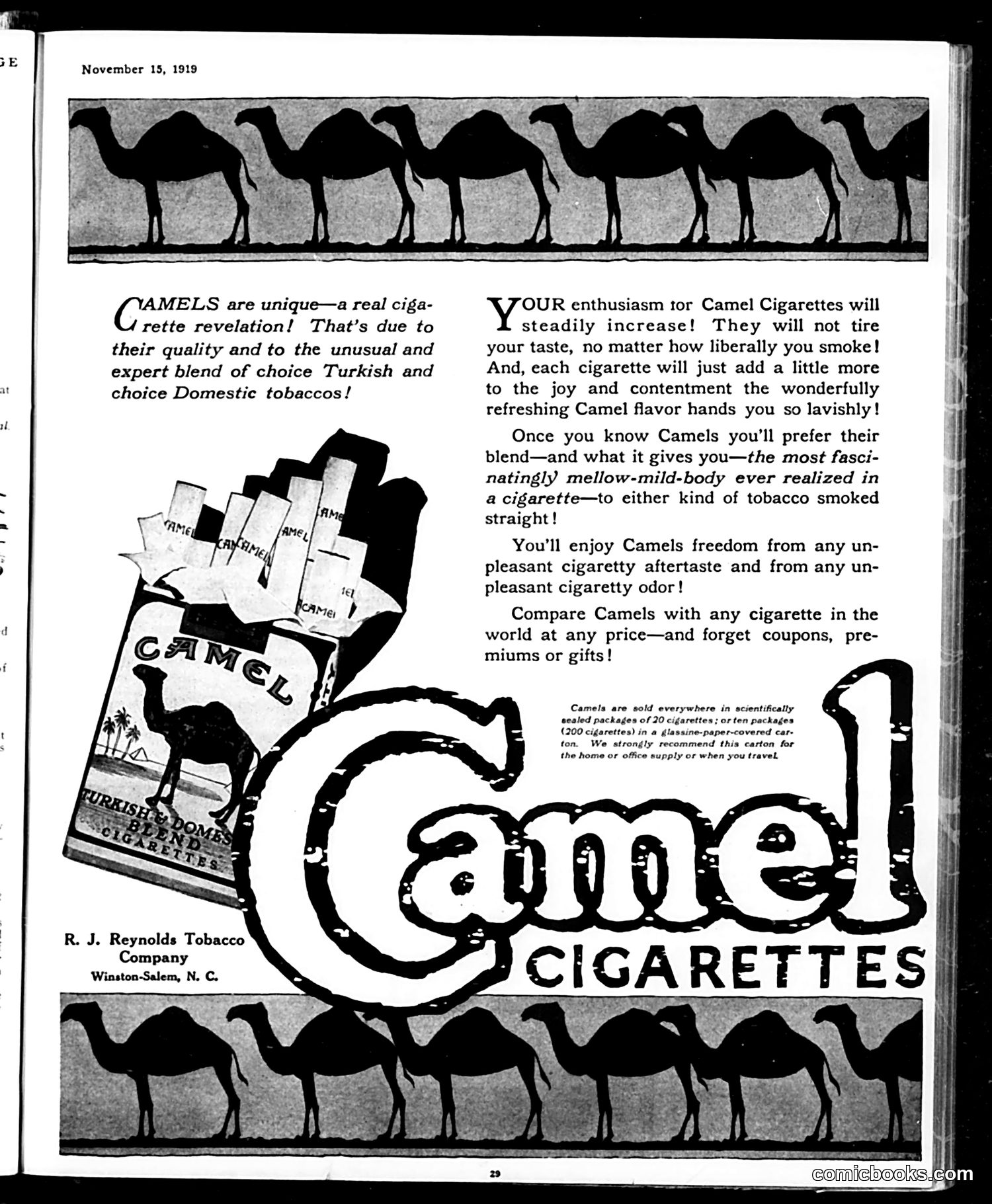
This is **advertising, not satire or commentary**—a full-page Camel cigarette advertisement from November 13, 1919, placed in *Judge* magazine by R.J. Reynolds Tobacco Company. The camel imagery (silhouettes framing the page) references Camels' brand identity and exotic appeal. The ad makes health-adjacent claims now recognized as false: that Camels won't "tire your taste," have no "unpleasant aftertaste or odor," and are superior to competitors. The emphasis on "Turkish and Domestic" tobacco blend was a major marketing point of the era. The text urges readers to compare Camels against competitors while "forgetting coupons and premiums"—suggesting competitors relied on giveaways rather than product quality. By modern standards, this advertisement is remarkable for its unregulated health claims and casual promotion of cigarettes without any health warnings—practices that became illegal decades later.
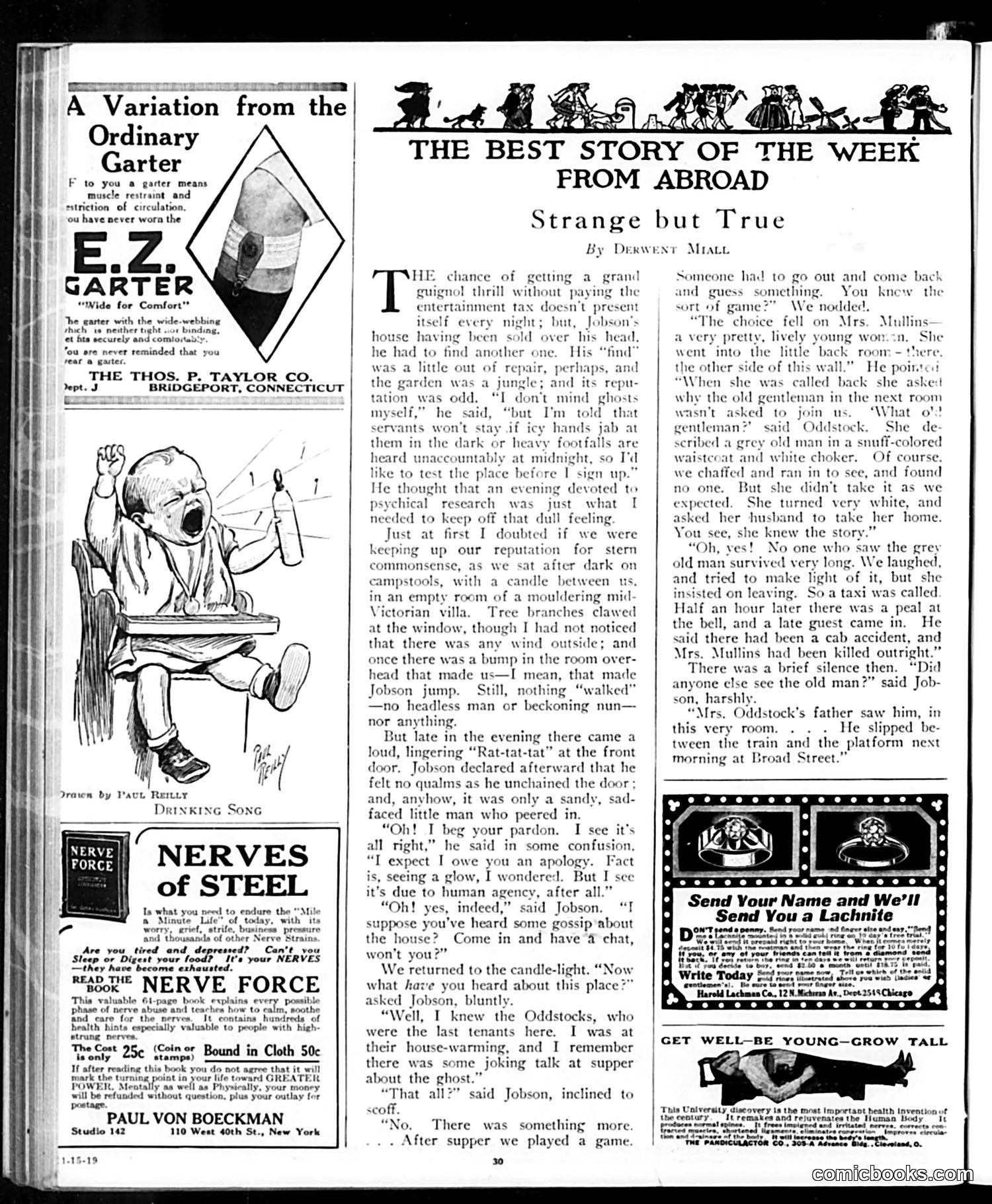
This page contains three distinct elements: **Left side:** Advertisements for practical goods (E.Z. garters for comfort, a "Nerves of Steel" self-help book addressing fatigue and poor digestion). These reflect early 20th-century consumer culture and period anxieties about modern life's strain on health. **Main story:** "Strange but True," a ghost story by Derwent Miall about a man (Jobson) renting a supposedly haunted house. It's a narrative curiosity piece—the "best story from abroad"—designed for entertainment. The tension builds as a visitor reveals an unsettling anecdote: at the previous tenants' party, a young woman entered an adjacent room to play a game, then returned asking about "an old gentleman" no one else had seen there. The satire is subtle: the story plays on period fascination with spiritualism and the supernatural while maintaining skeptical ambiguity—is it genuinely haunted or coincidence? **Bottom:** An advertisement for a "Get Well—Be Young—Grow Tall" health product, typical of the era's patent-medicine marketing.
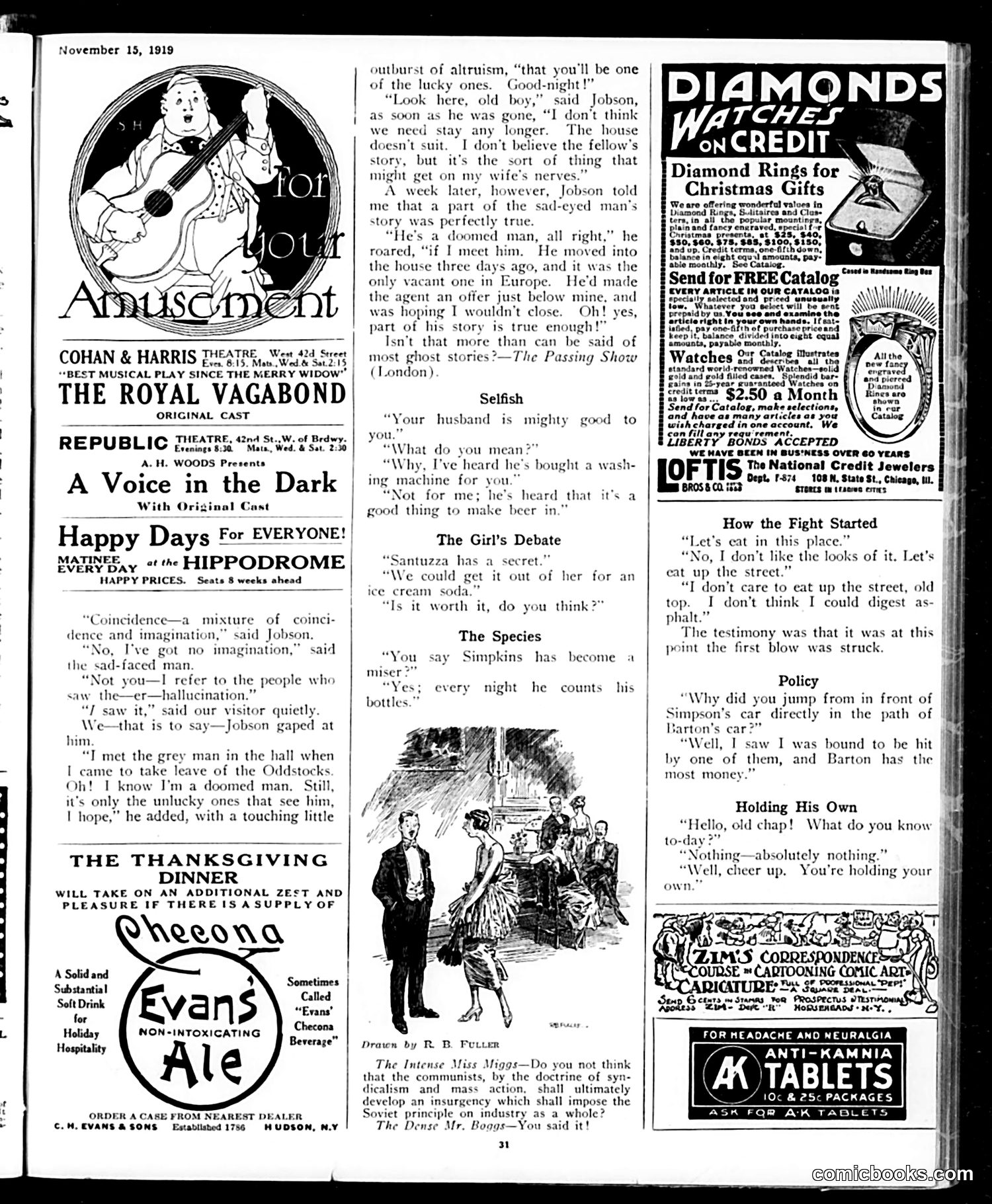
This page is primarily **theatrical advertisements and humorous short jokes**, not political satire. The main cartoon (by R.B. Fuller, center) depicts a domestic scene illustrating various comedic anecdotes. The jokes themselves reflect 1919 social concerns: - **Prohibition-era humor**: Multiple jokes reference beer-making and alcohol ("good thing to make beer in"), reflecting the imminent enforcement of the 18th Amendment (January 1920). - **Class/wealth satire**: "Policy" joke mocks working-class accident victims choosing wealthier targets for insurance claims. - **Gender dynamics**: "Selfish" joke portrays wives as manipulative; "The Girl's Debate" trivializes women's intellectual engagement. - **Communist anxiety**: The "Intense Miss Miggs" dialogue satirizes earnest discussion of Bolshevism and syndicalism—topical fears post-Russian Revolution (1917). The page is dominated by **product advertisements** (diamonds, watches, Evans Ale, Cheona soft drink, tablets) typical of Judge's commercial content. The theatrical listings indicate active Broadway entertainment during this period.
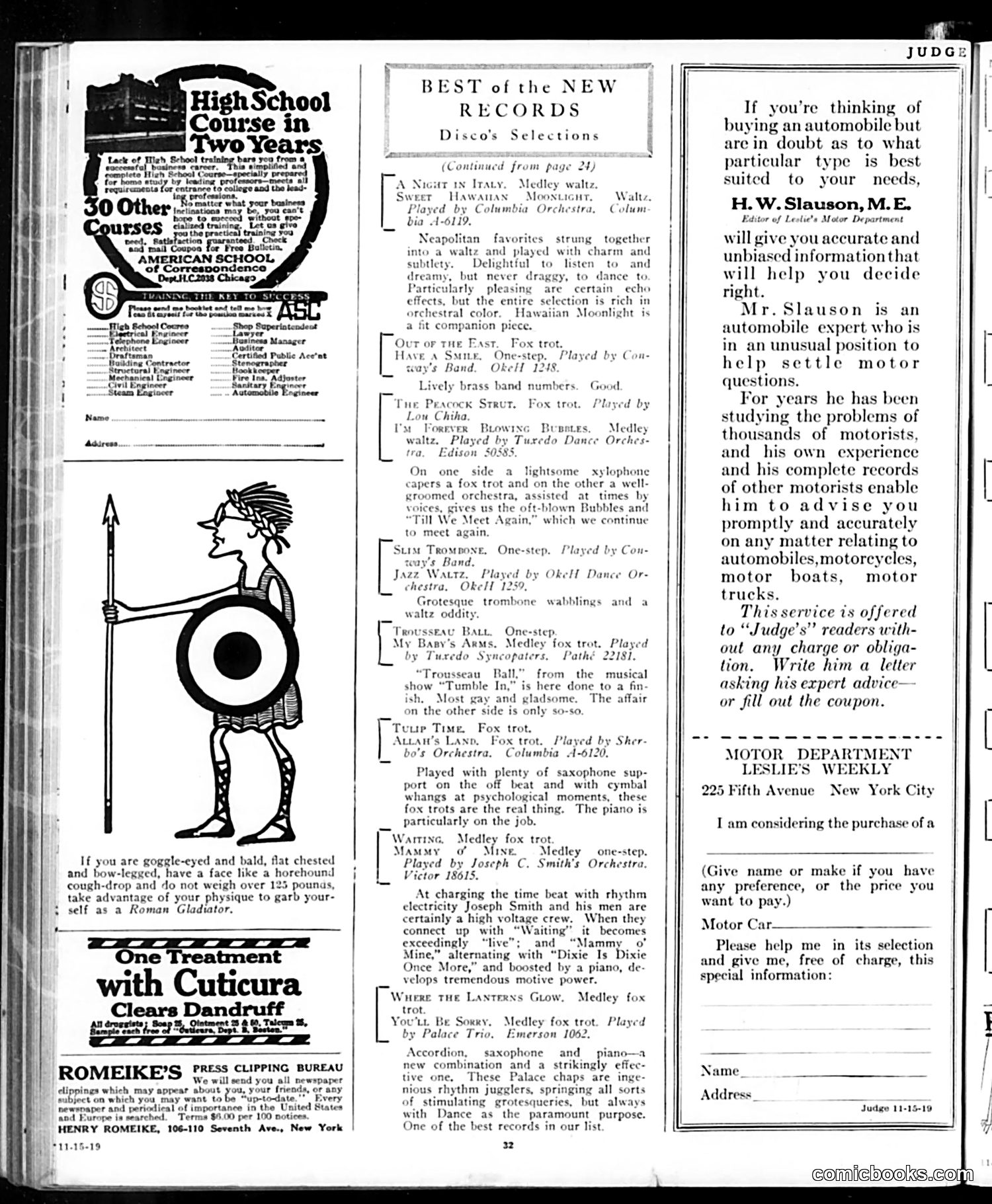
This page is primarily **advertising and editorial content** rather than political satire. The main cartoon shows a scrawny man dressed as a Roman Gladiator—a humorous advertisement for the American School of Correspondence's high school courses. The joke is visual irony: the text suggests that if you're physically unimpressive ("goggle-eyed and bald, flat chested and bow-legged"), you should compensate by dressing as a Roman Gladiator, implying education makes you impressive. It's a tongue-in-cheek pitch for self-improvement through correspondence courses. The page also features: - Record reviews of popular dance music (fox trots, waltzes, one-steps) - A Cuticura dandruff remedy advertisement - A press clipping bureau service notice - An automotive advice column by H.W. Slauson No significant political satire appears here. The content reflects 1919 consumer culture: mail-order education, popular music formats, personal grooming products, and emerging automobile ownership advice.
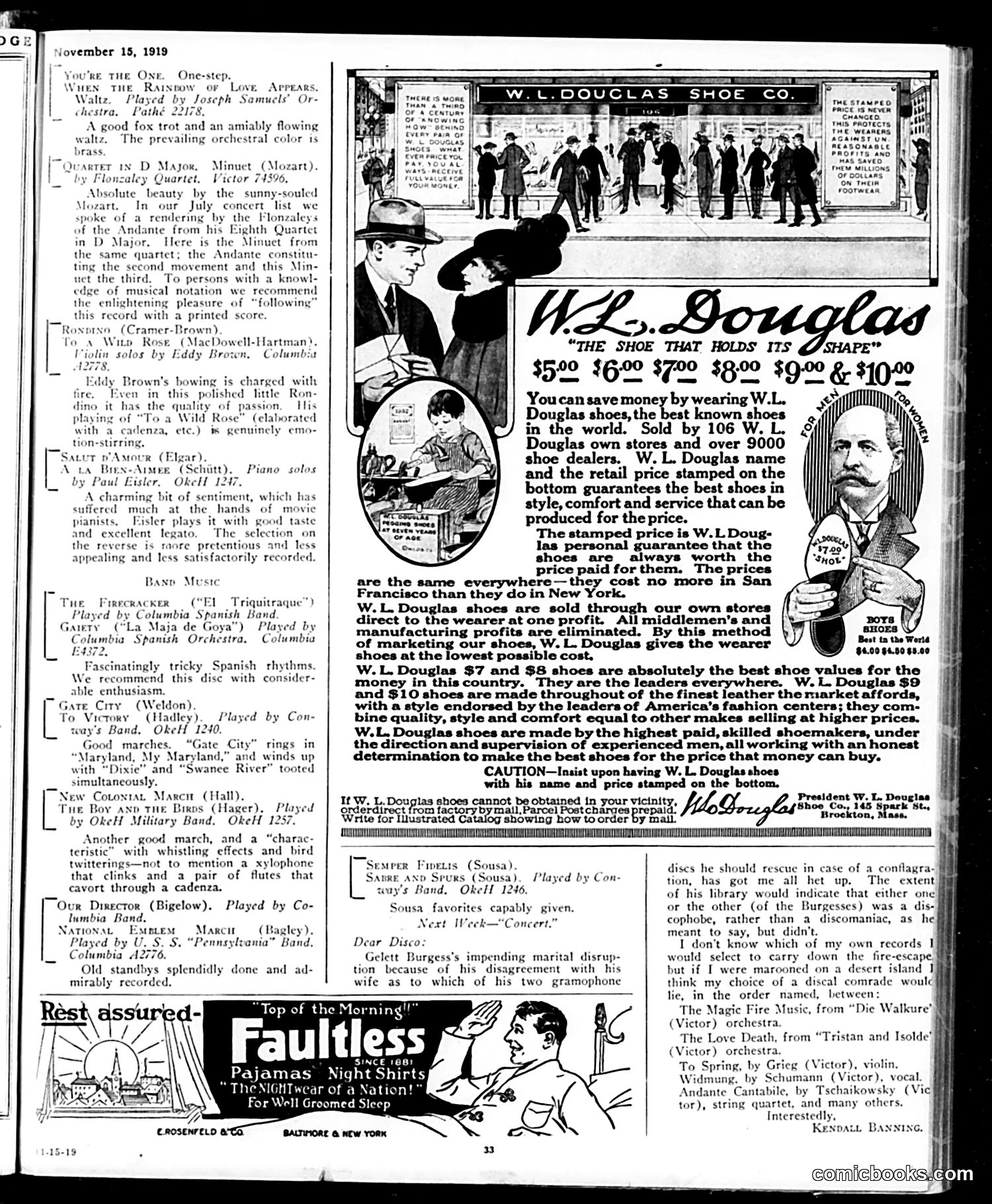
This page is primarily **advertising with music reviews**, not political satire. The dominant feature is a large W.L. Douglas Shoe Company advertisement occupying roughly half the page, featuring a storefront scene and portrait of what appears to be company founder W.L. Douglas. The advertisement emphasizes direct-to-consumer sales eliminating "middlemen's and manufacturing profits," positioning Douglas shoes as affordable quality footwear ($5-$10 price range). This reflects 1919 consumer marketing strategy emphasizing value and manufacturer transparency. The remaining content consists of record reviews for orchestral, band, and piano recordings—typical Judge magazine cultural coverage from this period. Notable composers reviewed include Mozart and Sousa. A smaller advertisement for "Faultless Pajamas Night Shirts" appears at bottom. **No political cartoons or satire are present on this page.** It represents standard magazine format: editorial content (music reviews) interspersed with commercial advertising.
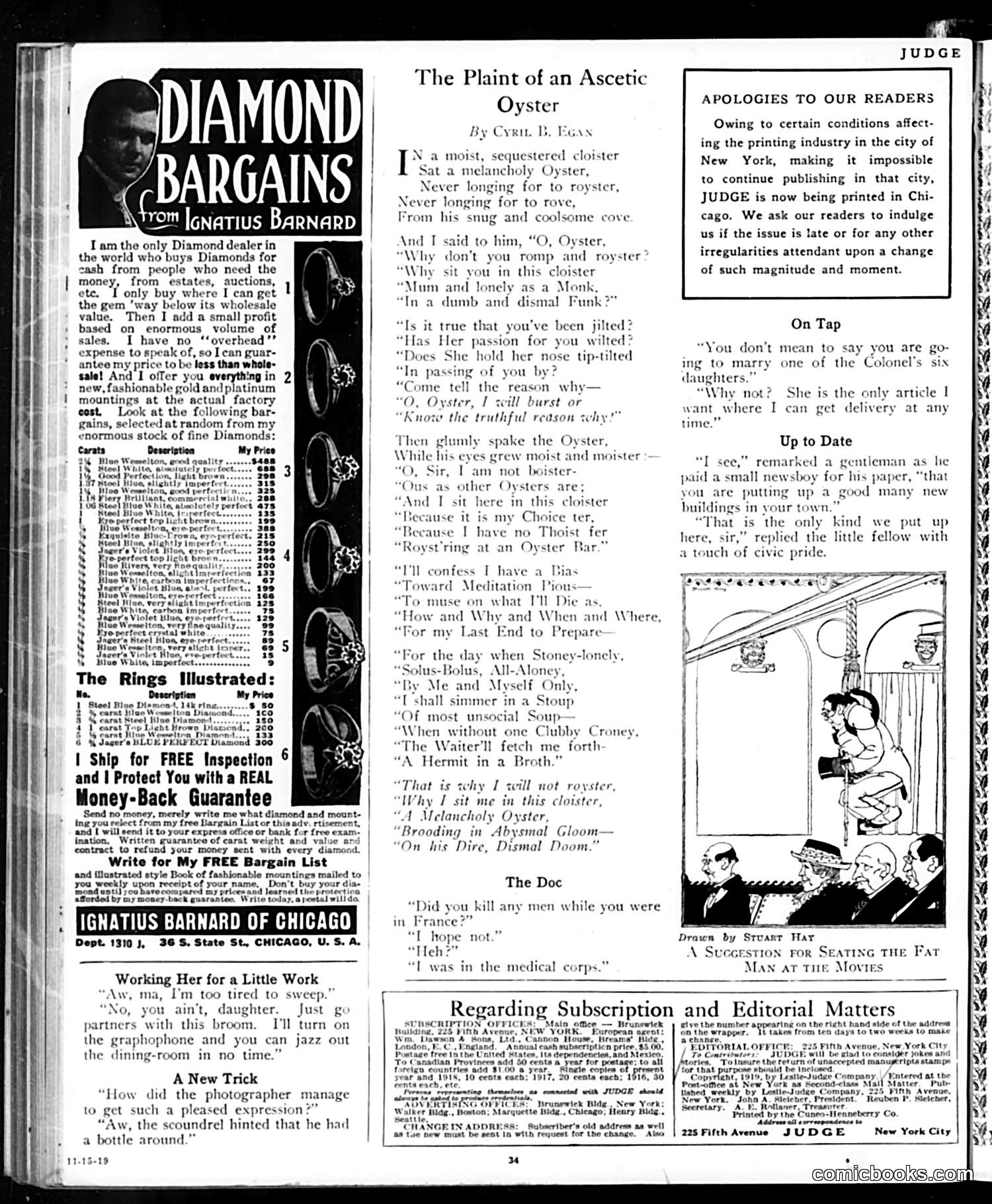
This page is primarily **advertising and editorial matter** rather than political satire. The dominant content is a diamond sales advertisement by "Ignatius Barnard of Chicago," claiming to be the only dealer who buys diamonds directly from consumers at below-wholesale prices. This is a mail-order pitch promising free inspection and money-back guarantees. The page also includes three brief humorous sketches unrelated to politics: - A mother motivating her tired daughter to sweep by playing a graphophone (early record player) - A photographer's trick for getting pleasant expressions (offering alcohol) - A lengthy poem about a melancholy, ascetic oyster who rejects oyster-bar hedonism for monastic contemplation An **editorial apology** explains Judge's move from New York to Chicago due to printing industry conditions—likely labor disruptions or material shortages following World War I. The content reflects 1919 consumer culture and light domestic humor, not political commentary.
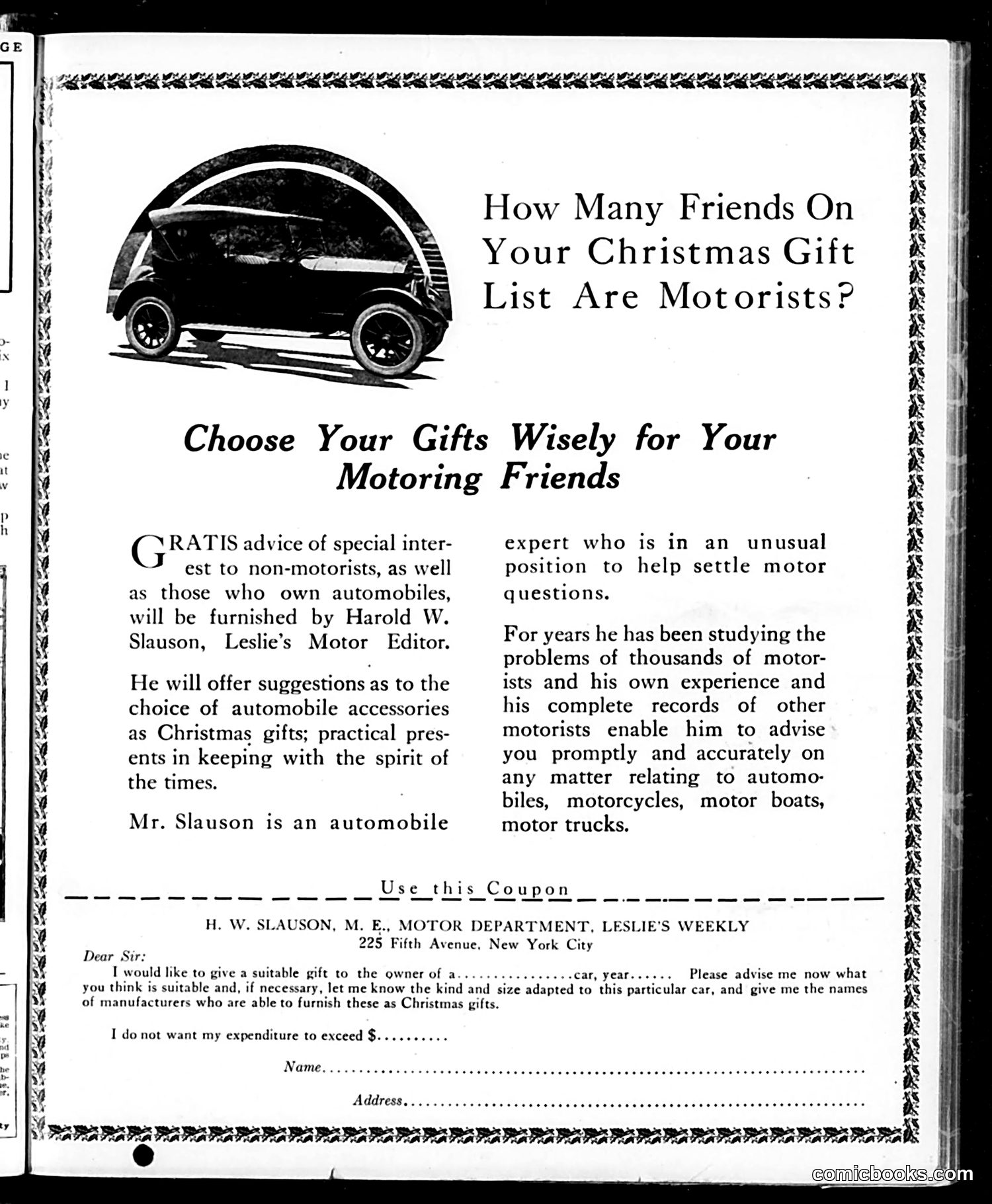
This is primarily **advertising content**, not satire. It's a service feature from *Leslie's Weekly* offering free gift advice for motorists during the Christmas season. The page addresses a genuinely new social problem of the early 20th century: automobiles were becoming common enough that many people needed to buy gifts for car owners, but didn't know what to choose. Harold W. Slauson, the magazine's motor editor, positioned himself as an expert who could help readers navigate this unfamiliar terrain. The humor is gentle and practical rather than satirical—the implicit joke is simply that automobiles were so novel and specialized that gift-giving required expert consultation. The coupon allows readers to submit questions about specific car models and budgets. This reflects the era's fascination with automobiles as status symbols and the rapid motorization of American society in the 1910s-1920s.
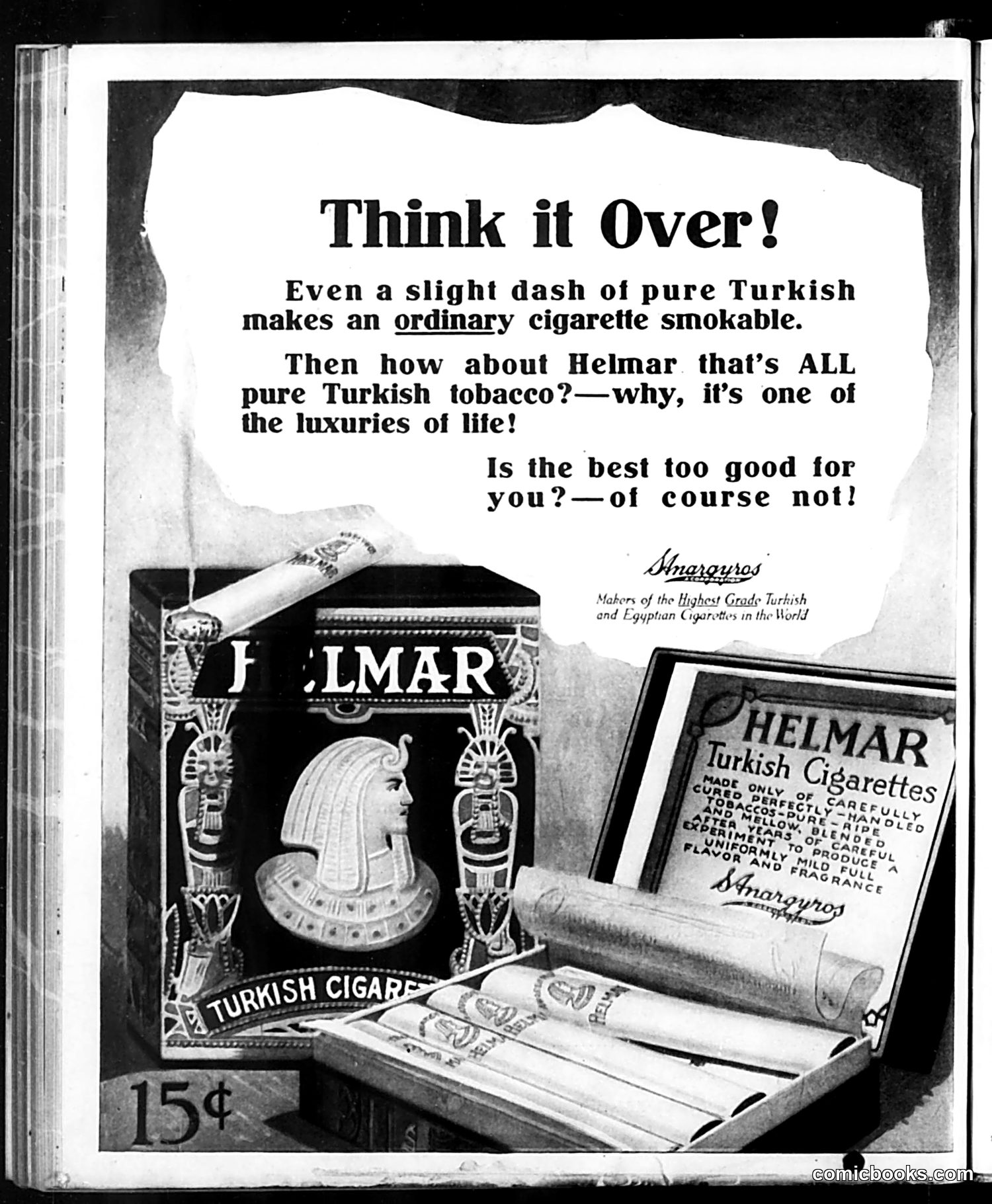
This is a **cigarette advertisement**, not political satire. It promotes Helmar brand cigarettes, priced at 15 cents, emphasizing their "pure Turkish tobacco" as a luxury product. The ad features Egyptian imagery (a pharaoh's profile, ornate columns) to evoke exoticism and quality. The rhetorical strategy appeals to aspiration: if a *dash* of Turkish tobacco improves ordinary cigarettes, imagine cigarettes made *entirely* of it—positioned as an affordable luxury for the consumer. The tagline "Is the best too good for you?" uses reverse psychology to encourage purchase. This reflects early 20th-century advertising when Turkish cigarettes were marketed as premium, and before tobacco's health dangers were widely acknowledged or regulated.