
Judge, 1919-11-15 · page 7 of 36
Judge — November 15, 1919 — page 7: what you’re looking at
What you’re looking at
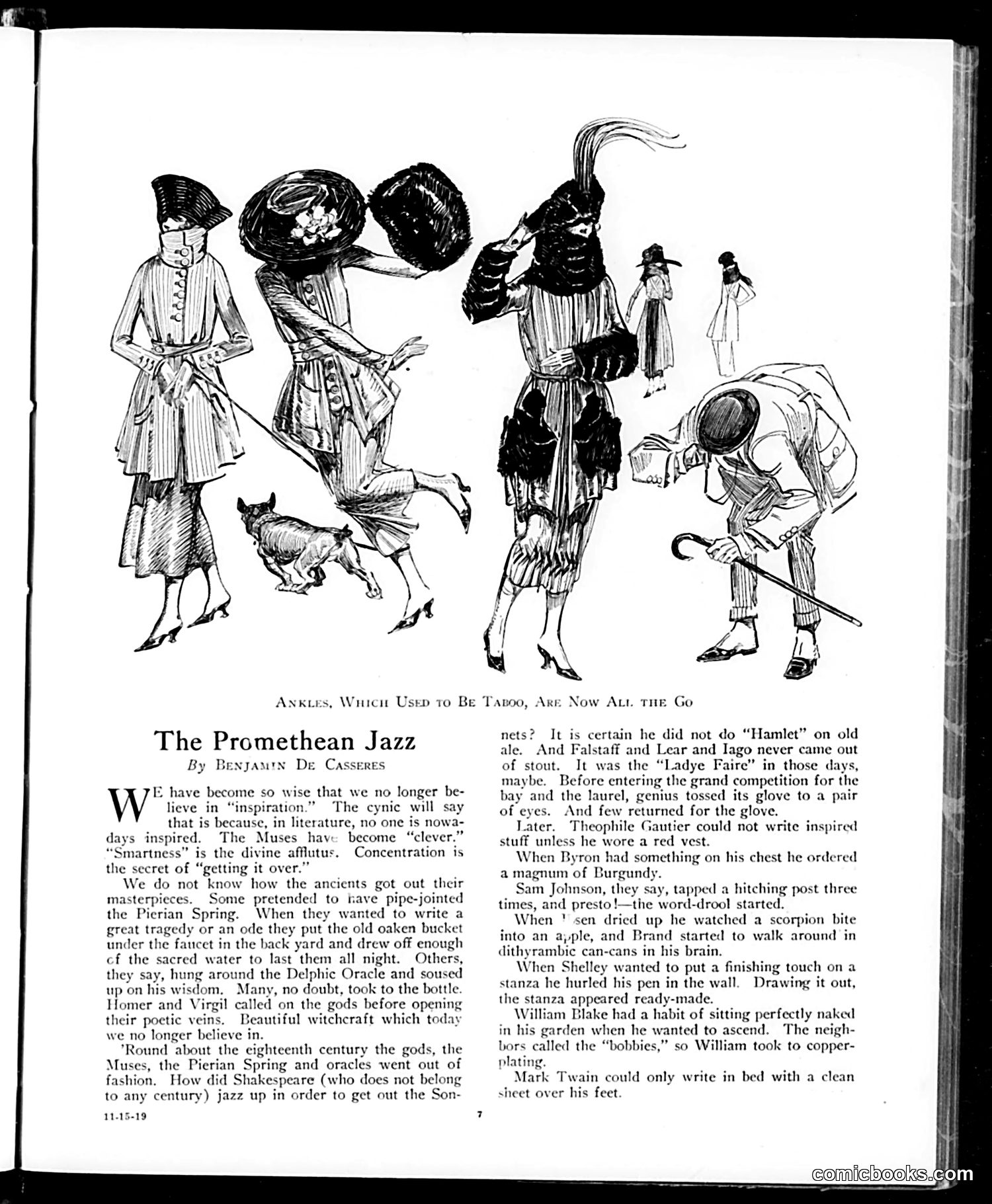
This is a satirical essay by Benjamin De Casseres mocking modern literary pretension and the decline of artistic inspiration. **The central argument:** Classical and Romantic-era writers attributed their genius to divine inspiration—the Muses, oracles, or eccentric rituals (Homer consulting gods, Byron drinking Burgundy, Blake sitting naked in his garden). Modern writers, by contrast, have abandoned belief in "inspiration" and replaced it with "cleverness" and "smartness"—mere technique. **The satire targets:** Contemporary literary culture's self-conscious artificiality. Writers now fake profundity through affected methods and concentration rather than genuine creative spirit. The essay catalogs famous authors' quirky habits to highlight how even great writers relied on ritual or altered states, not just raw skill. **The illustration** shows fashionable women displaying exaggerated ankles—referenced in the caption as formerly taboo but now "all the go"—suggesting how modern society has abandoned old conventions wholesale, paralleling literature's rejection of inspirational traditions. The piece laments the loss of authentic creative mystery in favor of manufactured "smartness."
📄 Transcribed text from this page (OCR, searchable)
Machine-transcribed from the original scan — historical spelling and the odd misread are preserved.
Ankces, Wnricit Usep to Be Tanoo, Are Now Att. tHe Go The Promethean Jazz By Benyamtn De Casseres E have become so wise that we no longer be- W lieve in “inspiration.” The cynic will say that is because, in literature, no one is nowa- days inspired. The Muses have become “clever.” “Smartness” is the divine afflutus. Concentration is the secret of “getting it over.” We do not know how the ancients got out their masterpieces. Some pretended to have pipe-jointed the Pierian Spring. When they wanted to write a great tragedy or an ode they put the old oaken bucket under the faucet in the back yard and drew off enough cf the sacred water to last them all night. Others, they say, hung around the Delphic Oracle and soused up on his wisdom. Many, no doubt, took to the bottle Homer and Virgil called on the gods before opening their poetic veins. Beautiful witcheraft which today we no longer believe in. *Round about the eighteenth century the gods, the Muses, the Pierian Spring and oracles went out of fashion. How did Shakespeare (who does not belong to any century) jazz up in order to get out the Son- 11-15-19 nets? It is certain he did not do “Hamlet” on old ale. And Falstaff and Lear and Iago never came out of stout. It was the “Ladye Faire” in those days, maybe. Before entering the grand competition for the bay and the laurel, genius tossed its glove to a pair of eyes. And few returned for the glove. Later. Theophile Gautier could not write inspired stuff unless he wore a red vest. When Byron had something on his chest he ordered a magnum of Burgundy. Sam Johnson, they say, tapped a hitching post three times, and presto!—the word-drool started. When ' sen dried up he watched a scorpion bite into an a)ple, and Brand started to walk around in dithyrambic can-cans in his brain. When Shelley wanted to put a finishing touch on a stanza he hurled his pen in the wall. Drawing it out, the stanza appeared ready-made. William Blake had a habit of sitting perfectly naked in his garden when he wanted to ascend. The neigh- bors called the “bobbies,” so William took to copper- plating. Mark Twain could only write in bed with a clean sheet over his feet.