
Judge, 1919-11-15 · page 5 of 36
Judge — November 15, 1919 — page 5: what you’re looking at
What you’re looking at
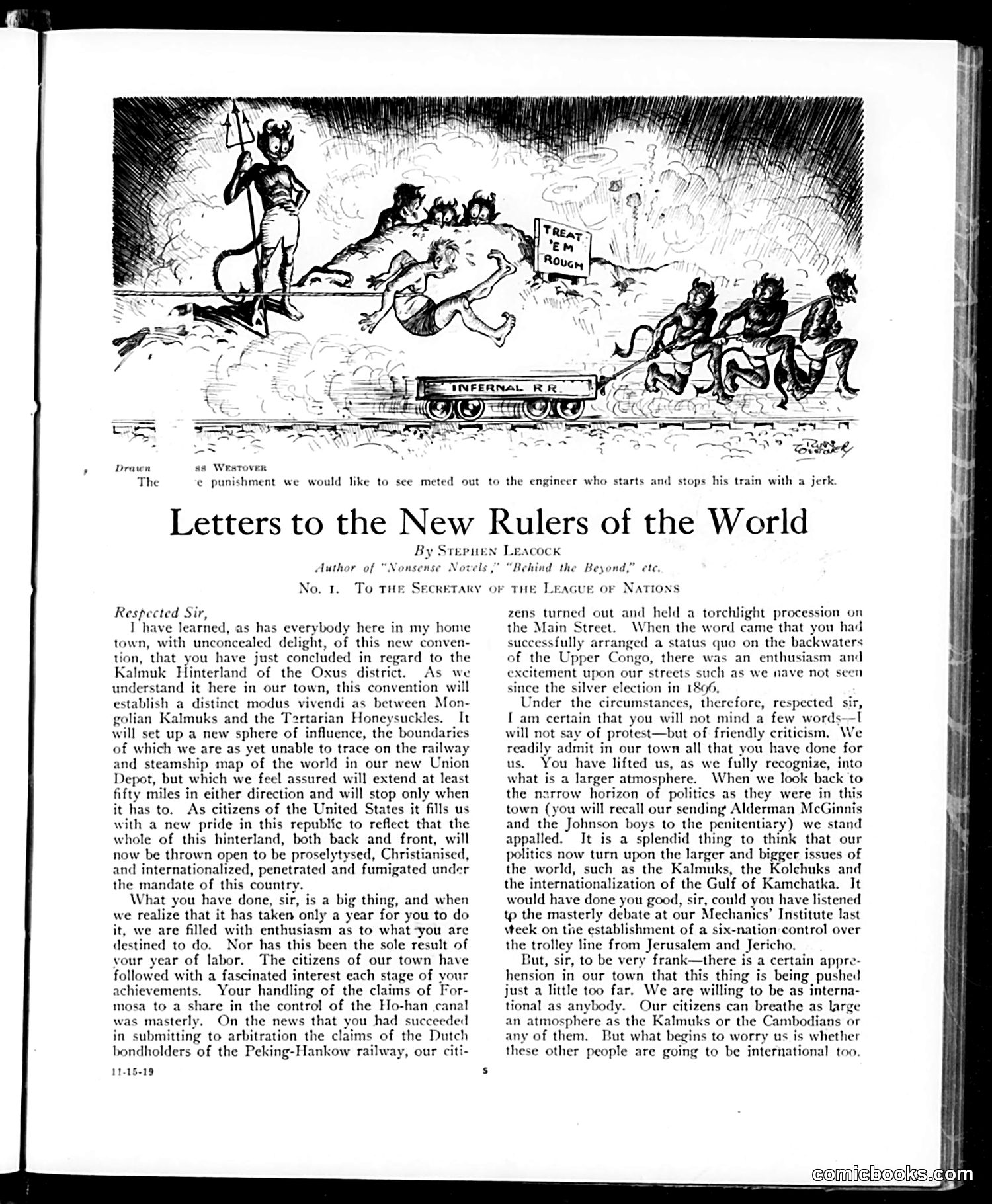
This page features a satirical letter to the League of Nations Secretary by Stephen Leacock. The accompanying cartoon depicts devils operating an "Infernal R.R." (railroad) train, with a sign reading "TREAT 'EM ROUGH." One devil conducts with a trident while others ride behind. The satire mocks the League's early failures in maintaining international order. Leacock references specific disputes—the Kalmuk Hinterland, Upper Congo, Formosa claims, and the Peking-Hankow railway—presenting them as examples of the League's inability to control global conflicts. The "Infernal Railroad" cartoon suggests international governance is chaotic and devil-driven, while the letter sarcastically congratulates the League while actually criticizing its ineffectiveness at preventing nations from pursuing self-interest over international cooperation.
📄 Transcribed text from this page (OCR, searchable)
Machine-transcribed from the original scan — historical spelling and the odd misread are preserved.
hment we would like to see meted out to the engineer who starts and stops his train with a jerk. Letters to the New Rulers of the World Author of “N. No. 1. Respected Sir, I have learned, as has everybody here in my home town, with unconcealed delight, of this new conven- tion, that you have just concluded in regard to the Kalmuk Hinterland of the Oxus district. As we understand it here in our town, this convention will establish a distinct modus vivendi as between Mon- golian Kalmuks and the Tertarian Honeysuckles. It will set up a new sphere of influence, the boundaries of which we are as yet unable to trace on the railway and steamship map of the world in our new Union Depot, but which we feel assured will extend at least fifty miles in either direction and will stop only when it has to. As citizens of the United States it fills us with a new pride in this republic to reflect that the whole of this hinterland, both back and front, will now be thrown open to be proselytysed, Christianised, and internationalized, penetrated and fumigated under the mandate of this country. What you have done, sir, is a big thing, and when we realize that it has taken only a year for you to do it, we are filled with enthusiasm as to what -you are destined to do. Nor has this been the sole result of your year of labor. The citizens of our town have followed with a fascinated interest each stage of your achievements. Your handling of the claims of For- mosa to a share in the control of the Ho-han canal was masterly. On the news that you had succeeded in submitting to arbitration the claims of the Dutch bondholders of the Peking-Hankow railway, our citi- 11-15-19 To THE SECRETARY OF Leacock Bchind the Beyond,” ete. THE Leacue or NATIONS held a torchlight procession on When the word came that you had successfully arranged a status quo on the backwaters of the Upper Congo, there was an enthusiasm and excitement upon our streets such as we nave not seen since the silver election in 1896, zens turned out a the Main Street. Under the circumstances, therefore, respected sir, [ am certain that you will not mind a few words--I will not say of protest—but of friendly criticism. We readily admit in our town all that you have done for us. You have lifted us, as we fully recognize, into what is a larger atmosphere. When we look back to the nzrrow horizon of politics as they were in this town (you will recall our sending Alderman McGinnis and the Johnson boys to the penitentiary) we stand appalled. It is a splendid thing to think that our politics now turn upon the larger and bigger issues of the world, such as the Kalmuks, the Kolchuks and the internationalization of the Gulf of Kamchatka. It would have done you good, sir, could you have listened tp the masterly debate at our Mechanics’ Institute last \teck on the establishment of a six-nation control over the trolley line from Jerusalem and Jericho. But, sir, to be very frank—there is a certain appre- hension in our town that this thing is being pushed just a little too far. We are willing to be as interna- tional as anybody. Our citizens can breathe as large an atmosphere as the Kalmuks or the Cambodians or any of them. But what begins to worry us is whether these other people are going to be international too.