
Judge, 1919-11-15 · page 20 of 36
Judge — November 15, 1919 — page 20: what you’re looking at
What you’re looking at
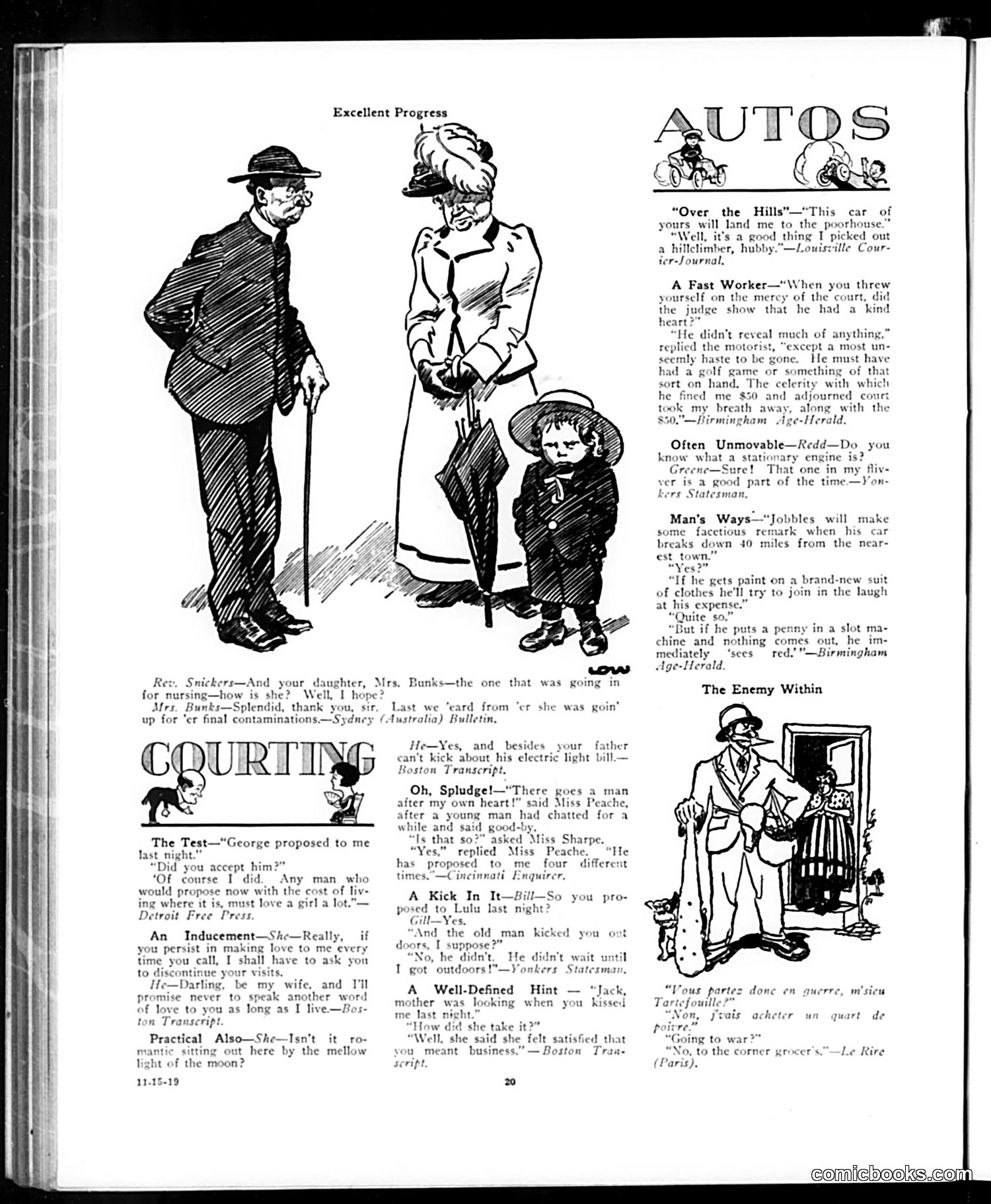
This page contains humorous anecdotes and jokes organized around two main sections: "COURTING" and "AUTOS," reflecting early 20th-century American social concerns. The **courting jokes** satirize romantic conventions: men's desperation (proposing despite high cost-of-living), women's manipulation of suitors, and courtship as a transactional arrangement. References to judges and fines suggest motorists facing consequences for traffic violations. The **automobile section** mocks early car ownership troubles: breakdowns, accidents leading to court appearances with hefty fines ($50), and the social embarrassment of automotive mishaps. The joke about paint on new clothes and slot machines reflects anxieties about cars as both status symbols and sources of humiliation. The illustration shows a well-dressed couple with a child, likely representing the aspirational automobile owner. The cartoons assume readers understand cars as novel, unreliable contraptions causing legal and financial trouble—positioning automobiles as agents of chaos in modern life rather than symbols of progress, despite the header "Excellent Progress."
📄 Transcribed text from this page (OCR, searchable)
Machine-transcribed from the original scan — historical spelling and the odd misread are preserved.
Excellent Progress ‘kers—And_ your daughter, Mrs. Bunks—the one that was going in I hope The Test—"George proposed to me last night.” “Did you accept him?" ‘Of course I did. Any man_who would propose now with the cost of liv- ing where it is, must love a girl a k Detroit Fr An Inducement—She—Really, if you persist in making love to me every I shall have to ask you r visits, be my wife, and mise never to speak another w ve to you as long as I live —B pr of I ton Transcript Practical Also—She—Isn't it 7 i here by the mellow ro- “Over the Hills"—"This car of yours will land me to the poorhouse.” “Well, it's a good thing I picked out a hillclimber, hubby."—Louisville Cour- ier-Journal, A Fast Worker—“When you threw yourself on the mercy of the court, did the judge show that he had a kind heart?” “He didn’t reveal much of anything,” replied the motorist, “except a most un- ne. He must have r something of sort on hand. The celerity with whi he fined me $50 and adjourned cov took my bri along with the birmi ‘Age-Herald. Often Unmovable—Redd know what a stat en you obbles will make rk when his car from the near- some facetious rer breaks down 40 mi est_town.” “Yes? “If he gets paint on a brand-new suit of clothes he'll try to join in the laugh at his expense.’ “Quite so.” “But if he puts a p chine and nothing mediately _ ‘sees Age-Herald. y in a slot ma- pmes out, he im- red,’ "—Birmingham The Enemy Within Last we ‘eard from ‘er she was goin’ (Australia) Bulletin, and besides your father about his electric light bill— Boston Transcript, Oh, Spludge!— after my own heart!” s after a young man ha while and said good. “Is that so?” asked Miss Sharpe. “Yes,” replied Miss "| sed to) me ati Enquirer. here goes a man id Miss Peache, chatted for a imes."—Cincin A Kick In It—Bil posed to Lulu last nigh: Gill—Yes, “And the old man kicked doors, I suppose?” “No, he didn't. T got outdoors!" A Well-Defined Hint — “Jack, mother was looking when you kissed last nigh! “How did she take it? “Well, she said she felt sa meant business.” — Boston T you pro- you o He didn’t wait v ers Statesman, c, m'siew de ing to war to the corner grocers,” sfied Le Rire 20