
A complete issue · 36 pages · 1919
Judge — November 8, 1919
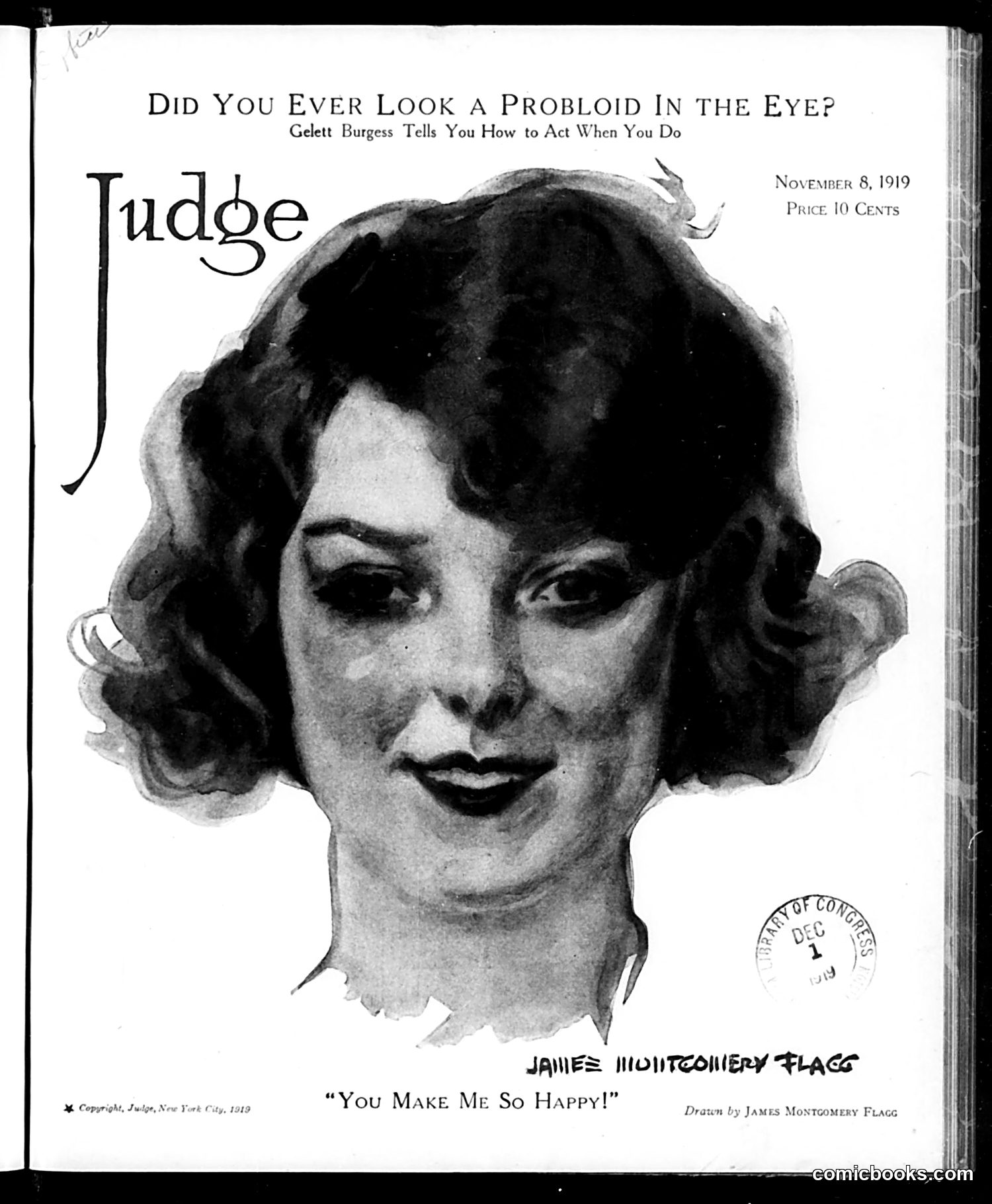
This is a Judge magazine cover from November 8, 1919 featuring an article by Gelett Burgess about acting technique, illustrated with a portrait drawing by James Montgomery Flagg. The cover's title, "Did You Ever Look a Probloid In the Eye?" appears to be a humorous phrase (likely nonsensical wordplay typical of Judge's satirical style). The subtitle indicates Burgess is offering advice on "how to act when you do." The portrait shows a woman with 1920s-style bobbed hair and makeup, looking downward with a somewhat coy or demure expression—likely demonstrating one of the acting techniques Burgess discusses. The phrase "You Make Me So Happy!" beneath the illustration suggests this may illustrate a specific emotional performance or theatrical moment. Without access to Burgess's full article, the exact satirical point remains unclear, though it appears to mock contemporary acting conventions or theatrical affectations of the era.
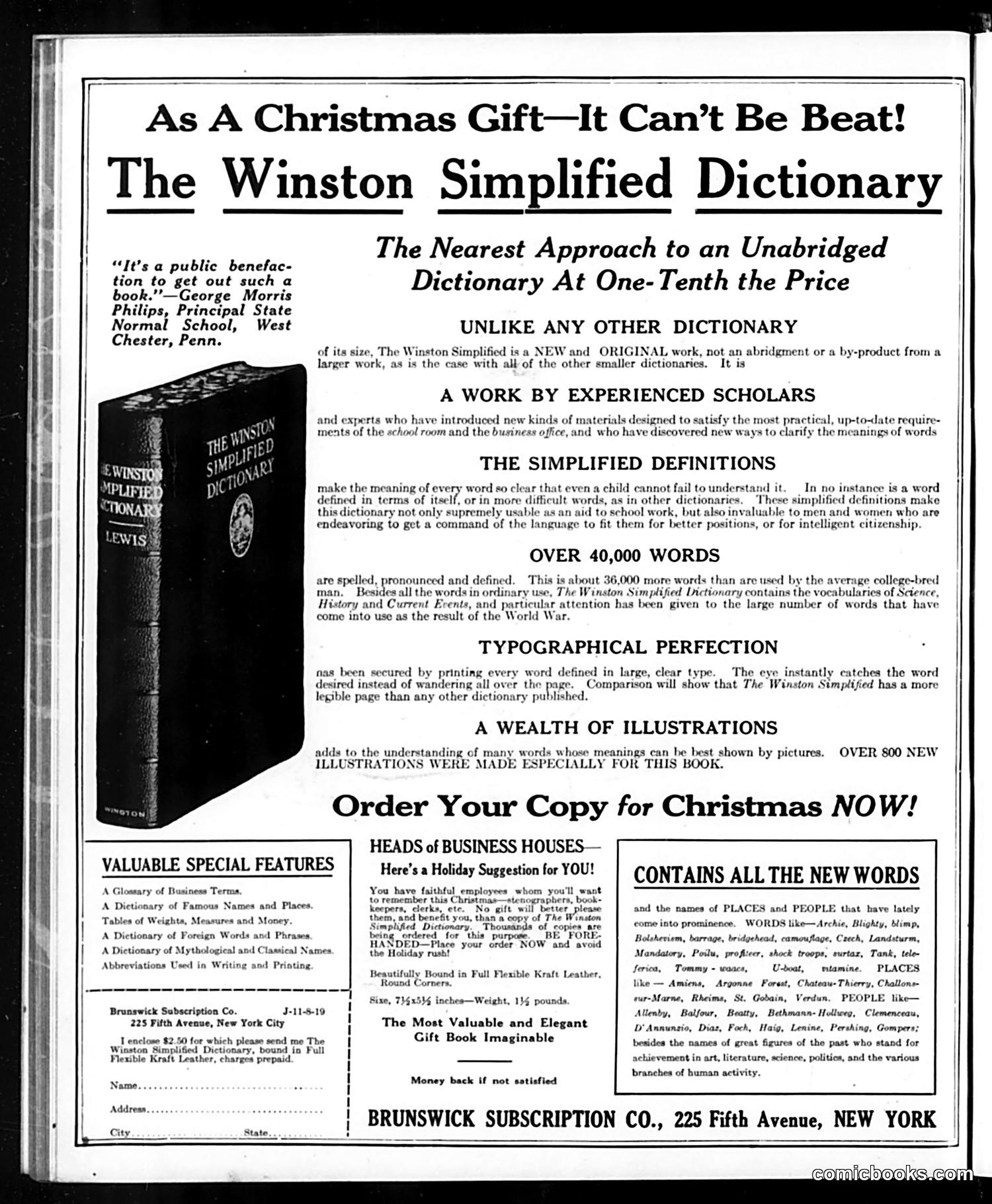
This page is **primarily an advertisement**, not satirical content. It promotes *The Winston Simplified Dictionary* as a Christmas gift, published by Brunswick Subscription Co. of New York. The ad emphasizes the dictionary's practical value: over 40,000 words, simplified definitions accessible to children and non-specialists, and over 800 new illustrations. It claims to offer "an Unabridged Dictionary at One-Tenth the Price" and includes a testimonial from a Pennsylvania school principal. The subscription form at bottom allows readers to order copies. This represents early 20th-century direct-mail advertising in a magazine format—a common monetization strategy for *Judge* and similar publications of the era. There is **no political satire or cartoon evident** on this page.
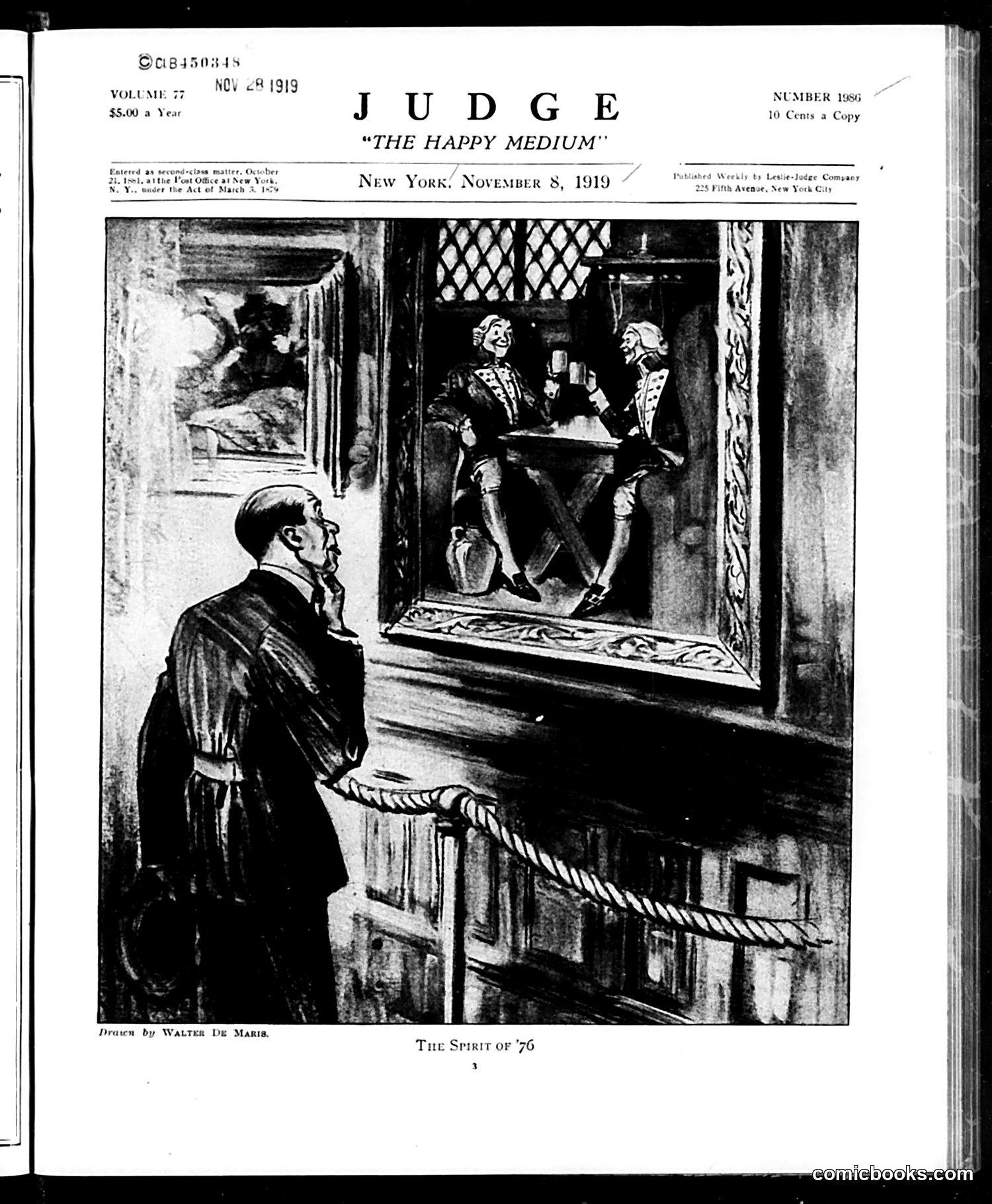
This illustration depicts a man in modern dress gazing through a window at two figures in Revolutionary War-era clothing, seated and conversing. The title "The Spirit of '76" references the American Revolution and patriotic ideals. The satire appears to contrast the revolutionary generation's ideals with the present moment (1919). The man viewing the historical figures seems separated from them—literally behind glass—suggesting that the spirit of '76 has become distant or inaccessible to modern Americans. Given the 1919 date (immediately after World War I and during social unrest), this likely comments on how contemporary Americans have lost touch with founding principles, or how the Revolutionary spirit feels distant amid current conflicts or political turmoil. The artist is credited as Walter De Maris.
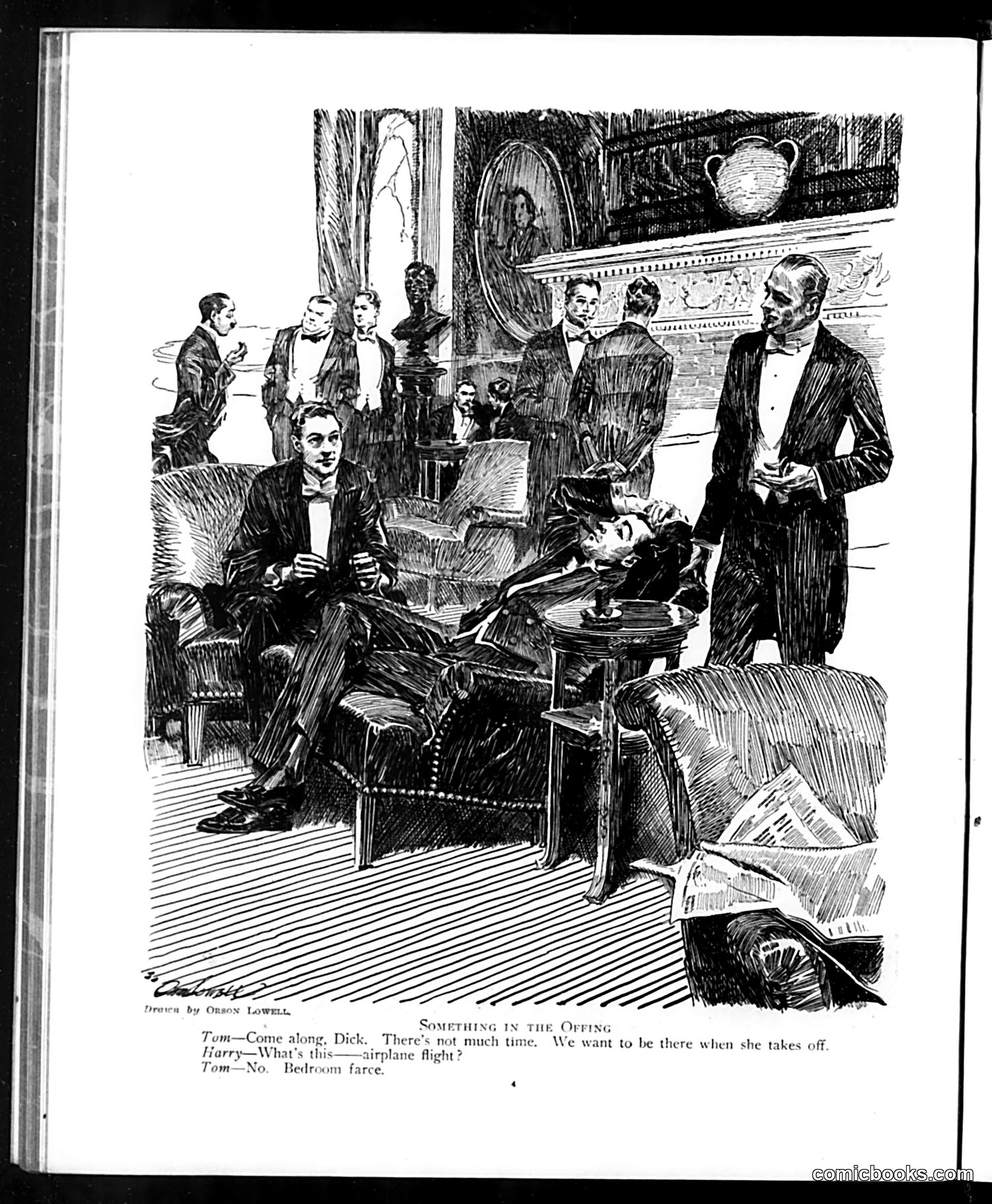
This illustration by Orson Lowell depicts a social scene where two men discuss an impending airplane flight. Tom urges Dick to hurry ("There's not much time. We want to be there when she takes off"), while Harry questions whether this is an "airplane flight." Tom dismisses the concern as a "bedroom farce." The humor relies on double meaning: "takes off" and "flight" suggest both aviation and romantic/marital escape. The bedroom farce reference implies infidelity or scandalous behavior disguised as innocent travel plans. The cartoon satirizes early aviation's novelty and respectability, contrasting it with the era's risqué theatrical comedies about marital impropriety. The joke depends on readers recognizing "airplane flight" as a euphemism for illicit romantic adventure.
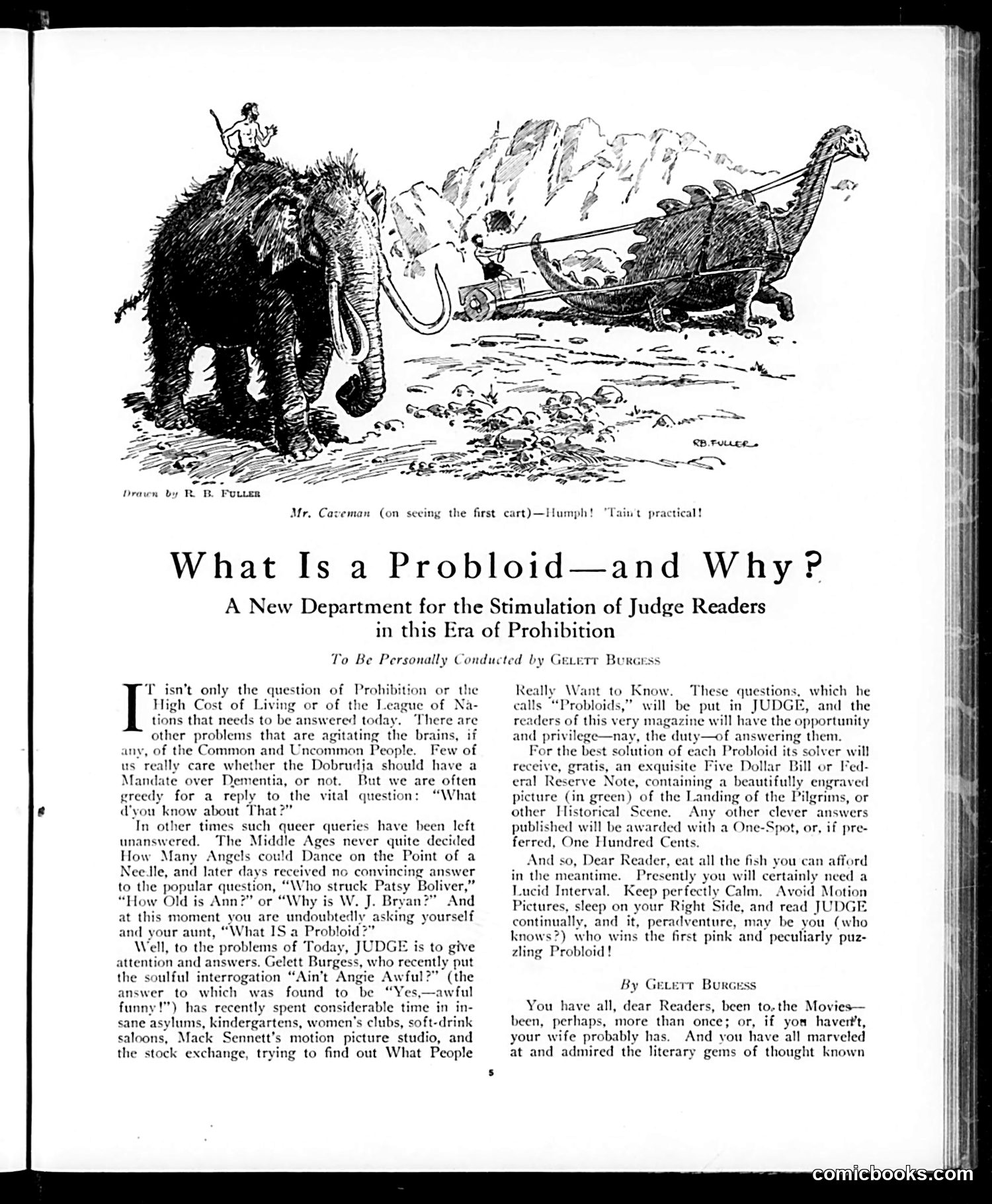
The cartoon depicts an elephant and dinosaur harnessed to pull a cart, with a man (labeled "Mr. Caveman") dismissing it as impractical. This is satirical commentary on technological progress during Prohibition (the 1920s-1930s ban on alcohol). The illustration mocks resistance to new ideas—the "caveman" character represents those opposing modern solutions. The dinosaur symbolizes obsolete thinking; the elephant likely represents the Republican Party (its standard symbol), suggesting GOP resistance to progressive policy. The page announces a new "Probioid" column in *Judge* magazine, where editor Gelett Burgess will tackle unanswered questions plaguing readers during Prohibition. The satire targets those clinging to old ways while society modernizes, making the Prohibition-era debate tangible through this absurdist visual metaphor.
This page contains three distinct items: 1. **"Post Card Prohibit" Contest**: A movie-subtitle writing competition featuring Lloyd George as a dance-hall keeper in Arizona, with Charlie Chaplin in disguise. Readers submit humorous subtitles; the winner receives five dollars. 2. **"Childe Helen" Story**: A short fiction piece by E.H. Potter about a society hostess and her young visitor Helen, who playfully spins a phonograph record on the hostess's head. The piece appears to satirize upper-class leisure and domestic absurdity. 3. **"Egg View News-Note"**: Brief humorous commentary by Leslie Van Evry on contemporary social observations, including references to loan-sharking among strangers and baseball rule innovations. The page is primarily literary/comedic content rather than visual cartooning.
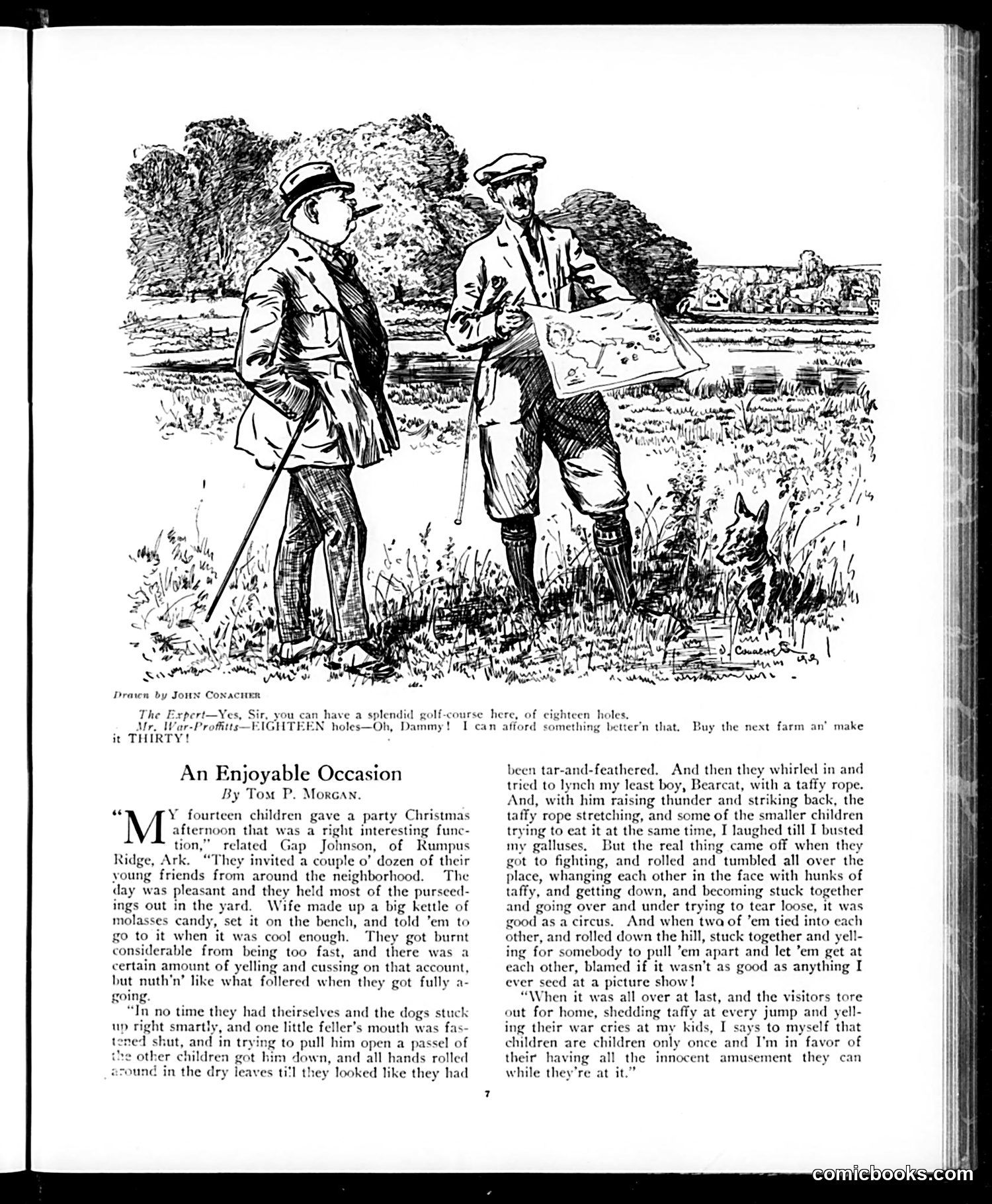
This page contains no political cartoon—instead, it features a humorous illustration accompanying a comedic short story titled "An Enjoyable Occasion" by Tom P. Morgan. The cartoon depicts two men in a rural setting: one appears to be a real-estate expert or land agent showing property to a potential buyer. The expert boasts of an "eighteen-hole golf course," but the buyer responds dismissively that he can "afford something better'n that" and would "buy the next farm an' make it THIRTY!" The joke satirizes rural Americans' attitudes toward golf—a sport associated with wealthy urbanites. The rustic character's response mocks the supposed superiority of golf by casually proposing to build a *larger* course, deflating the expert's sales pitch through rural pride and indifference to fashionable leisure activities. The accompanying story describes a chaotic but innocent children's Christmas party where taffy-candy chaos ensues—celebrating unsophisticated rural amusement.
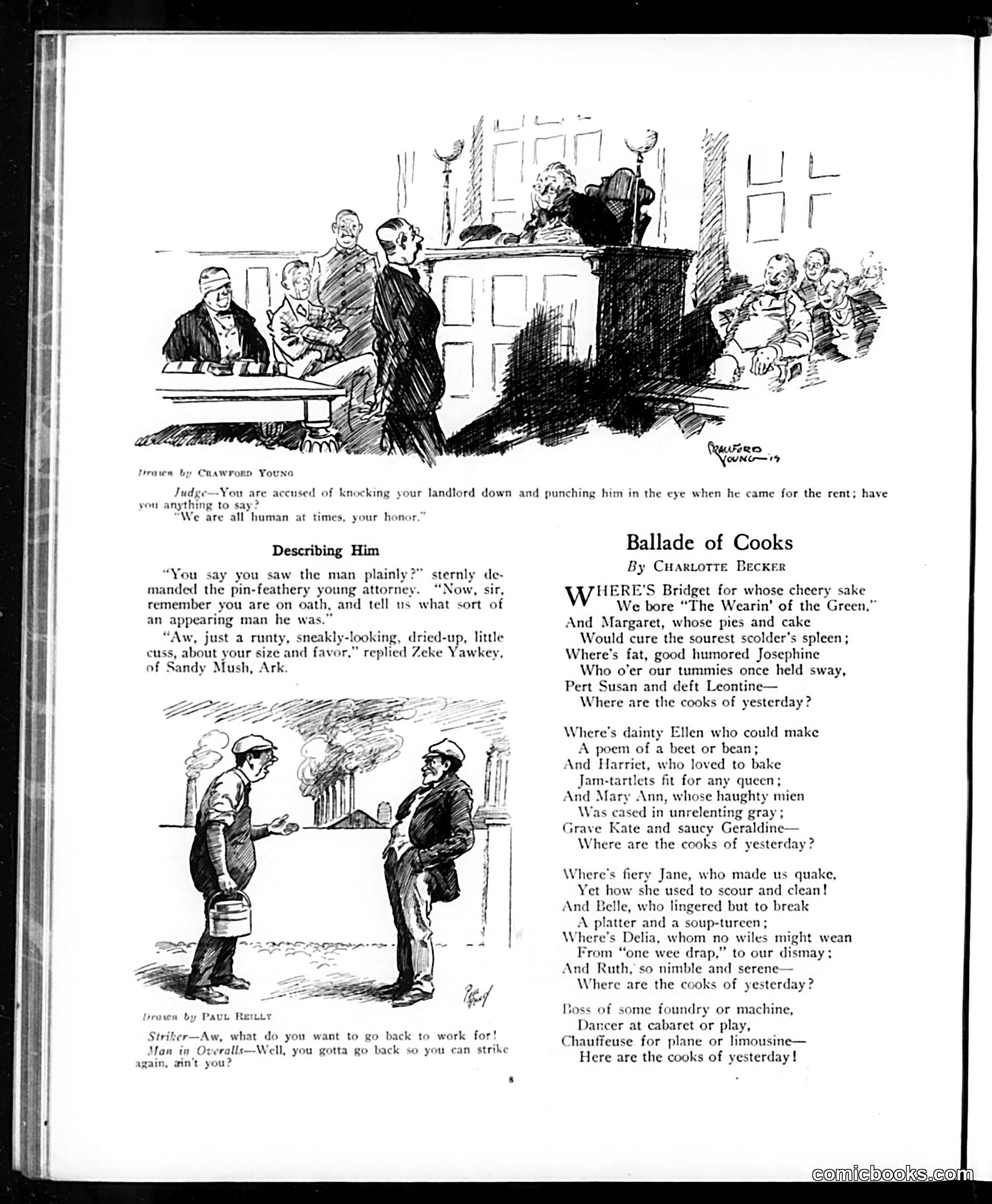
The top cartoon depicts a courtroom scene satirizing working-class desperation during labor unrest. A defendant accused of assaulting his landlord for rent money offers the defense "We are all human at times, your honor"—a sympathetic comment on poverty-driven violence. The judge's skeptical expression suggests the comic's commentary on class conflict: the poor man's violent act is presented as understandable, if not excusable. The bottom section features "Ballad of Cooks" by Charlotte Becker, a nostalgic poem lamenting disappeared domestic servants. Named cooks (Bridget, Margaret, Josephine, etc.) have vanished into factory work, cabaret dancing, and modern occupations—as a machine boss, chauffeur, plane worker. The refrain "Where are the cooks of yesterday?" expresses middle-class anxiety about the domestic labor shortage as women entered industrial employment. This reflects early 20th-century social disruption from urbanization and changing women's work.
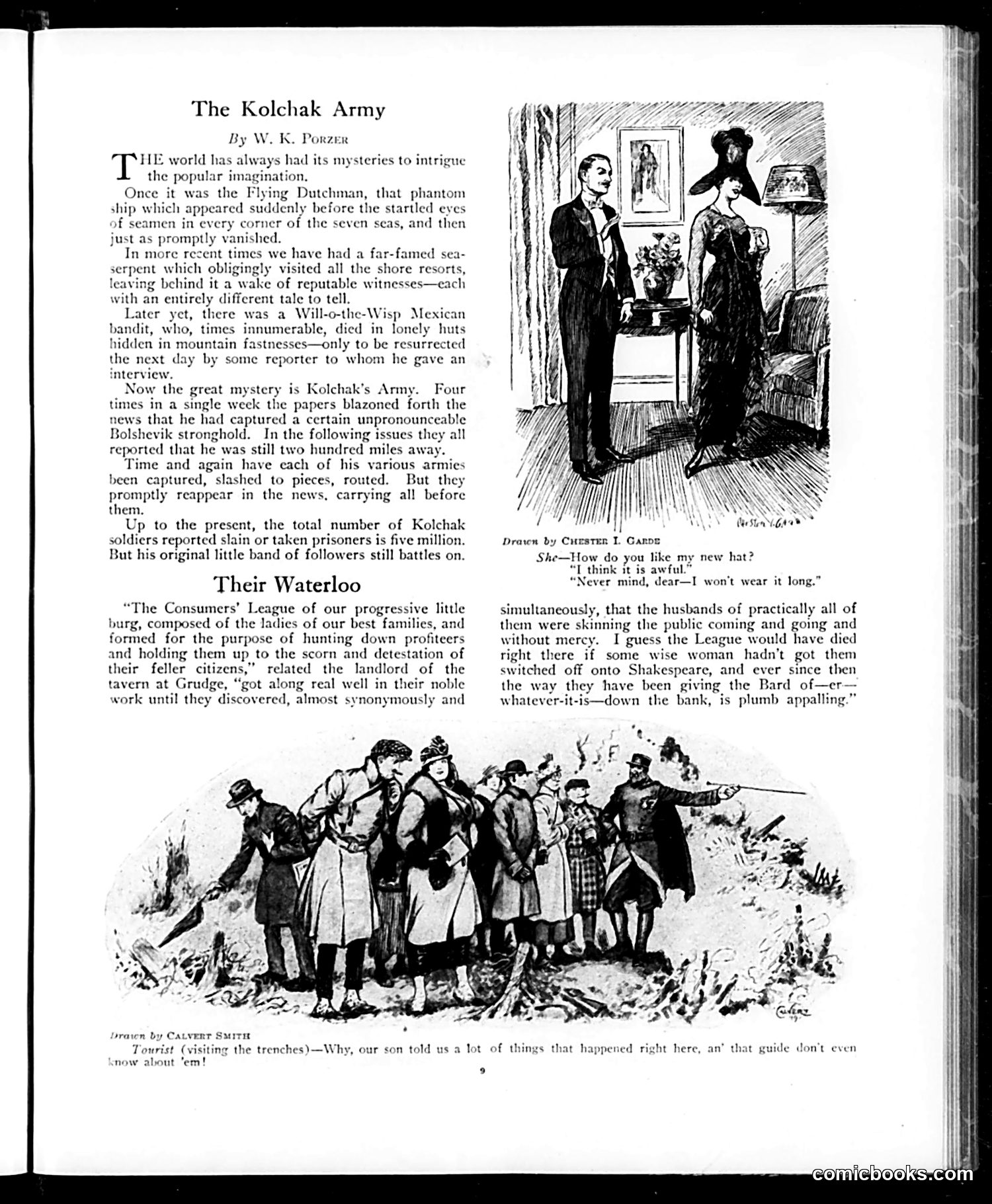
**"The Kolchak Army"** satirizes the contradictory war reports from the Russian Civil War. Admiral Kolchak led White Army forces against the Bolsheviks (1918-1920). The article mocks newspapers that repeatedly claimed he'd captured strategic positions, then reported him still miles away—with casualty figures reaching five million while his original force supposedly remained intact. It's a jab at sensationalist journalism creating a phantom "mystery" through contradictory reporting about a real military campaign. **"Their Waterloo"** (bottom cartoon) depicts tourists in WWI trenches. A guide apparently omits embarrassing local details about war profiteering that soldiers' letters home revealed. The satire suggests official narratives sanitize uncomfortable truths about home-front exploitation during the war. **Top cartoon** shows a woman modeling a hat to her husband. His dismissive comment—"I won't wear it long"—plays on the period's fashion-conscious women; she'll abandon it when styles change.
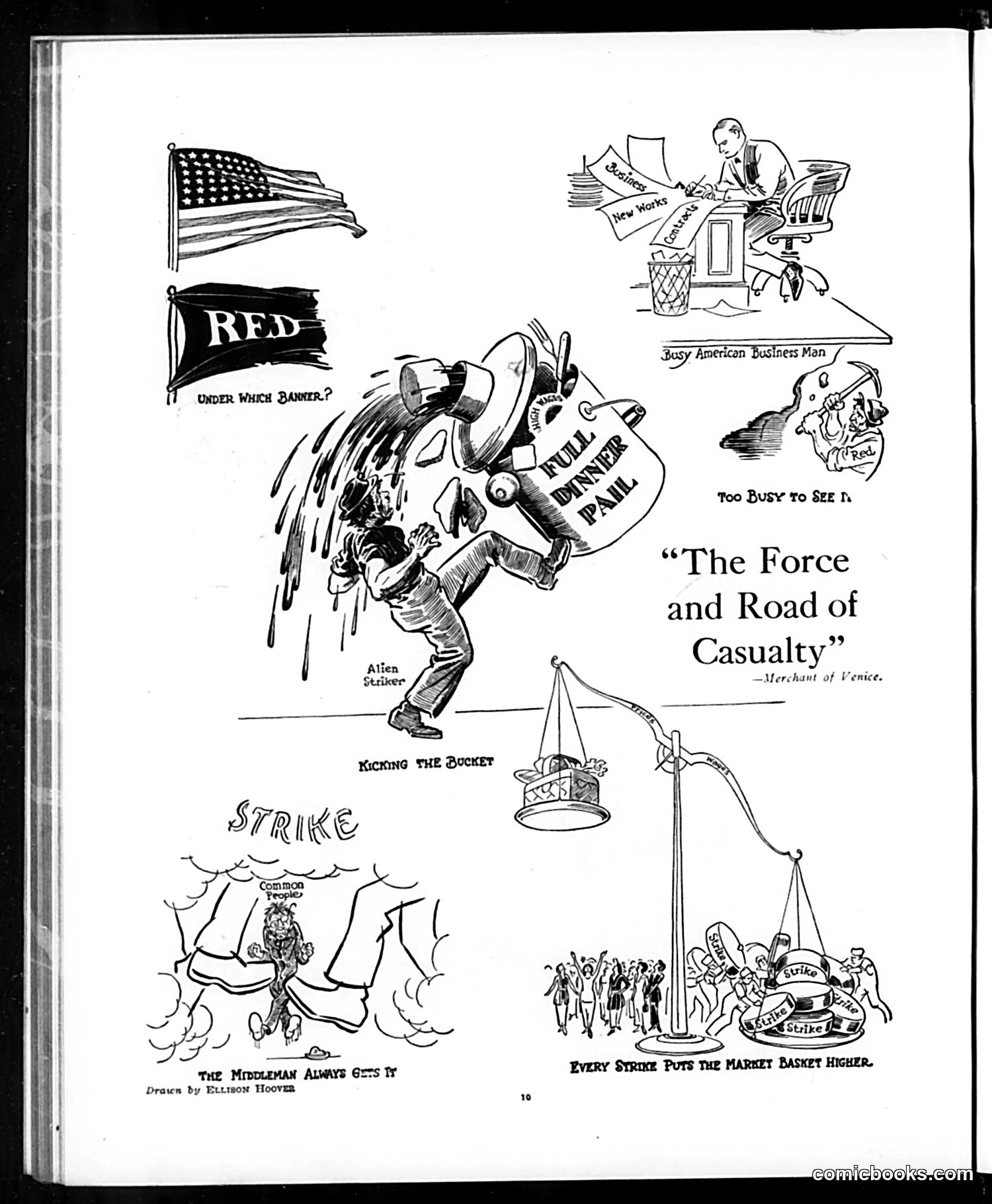
This page presents several cartoons criticizing labor strikes and their economic consequences. The central image shows an "Alien Striker" kicking a bucket labeled "Tariff Distinctive Panacea," suggesting strikes undermine protective tariff policies. The surrounding vignettes critique strikers as obstacles to business: a "Busy American Business Man" overwhelmed by paperwork; a figure "Too Busy to See" labor concerns; and scales showing "Every Strike Puts the Market Basket Higher"—meaning strikes increase consumer prices. The bottom panel, "The Middleman Always Gets It," depicts a common man caught between labor and capital forces during strikes. The cartoons argue strikes harm ordinary citizens more than they help workers, making inflation and economic disruption the "casualties" of labor action. This reflects anti-labor sentiment common in early 20th-century Judge magazine.
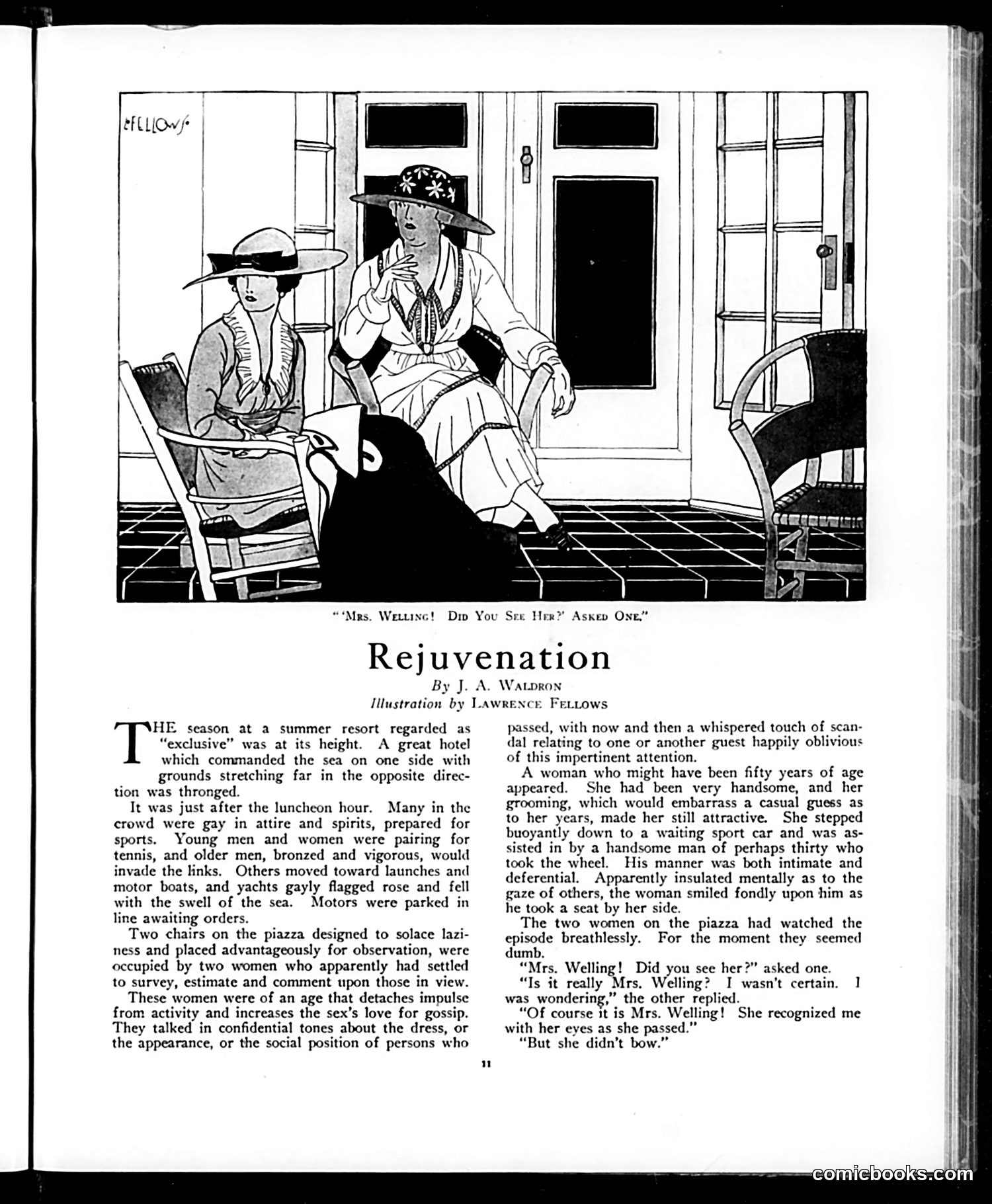
This story satirizes upper-class gossip culture at an exclusive summer resort. Two middle-aged women sit observing other guests, their primary occupation being commentary on others' appearance and social standing. The joke centers on a woman appearing to be approximately fifty years old who presents herself with such attractive grooming and youthful bearing that she successfully passes for younger—particularly when accompanied by a handsome thirty-year-old man. The two gossiping women recognize her as "Mrs. Welling" but are astonished by her apparent rejuvenation. The satire targets several things: the vanity of aging society women attempting to maintain youth through careful presentation, the cattiness of female gossips, and social hierarchies at resorts where status-conscious women obsessively monitor each other. The final detail—that Mrs. Welling didn't acknowledge them with a bow—adds a sting, suggesting the gossipers are beneath her notice, or that her apparent confidence transcends their social judgments entirely.
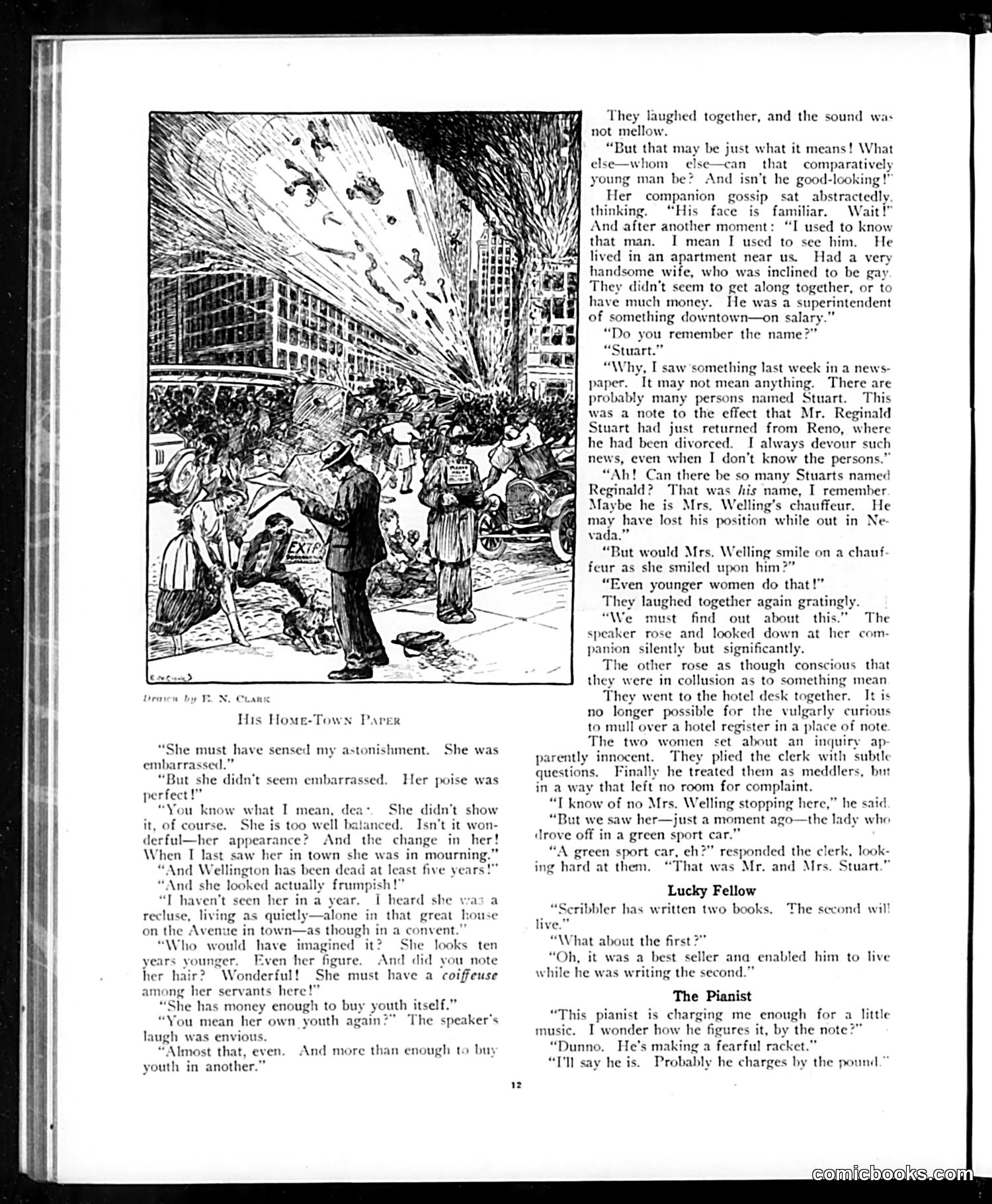
This cartoon satirizes wealthy society women's malicious gossip and snobbery. Two women at a resort notice a wealthy widow (Mrs. Welling) appearing rejuvenated, accompanied by a handsome younger man. Through idle chitchat, one recalls seeing the man years ago as a poorly paid apartment superintendent with an unhappy marriage. Learning from a newspaper that a "Reginald Stuart" was recently divorced in Reno, they speculate he's Mrs. Welling's chauffeur—a social inferior. Their "mean" collusion leads them to interrogate the hotel clerk, who reveals the man is actually "Mr. and Mrs. Stuart," indicating the couple married after his divorce. The satire mocks upper-class women who: assume working-class status based on appearance, conspire to uncover scandalous details, and judge relationships by social hierarchy. The widow's genuine happiness and the man's improved circumstances expose their petty malice as groundless.
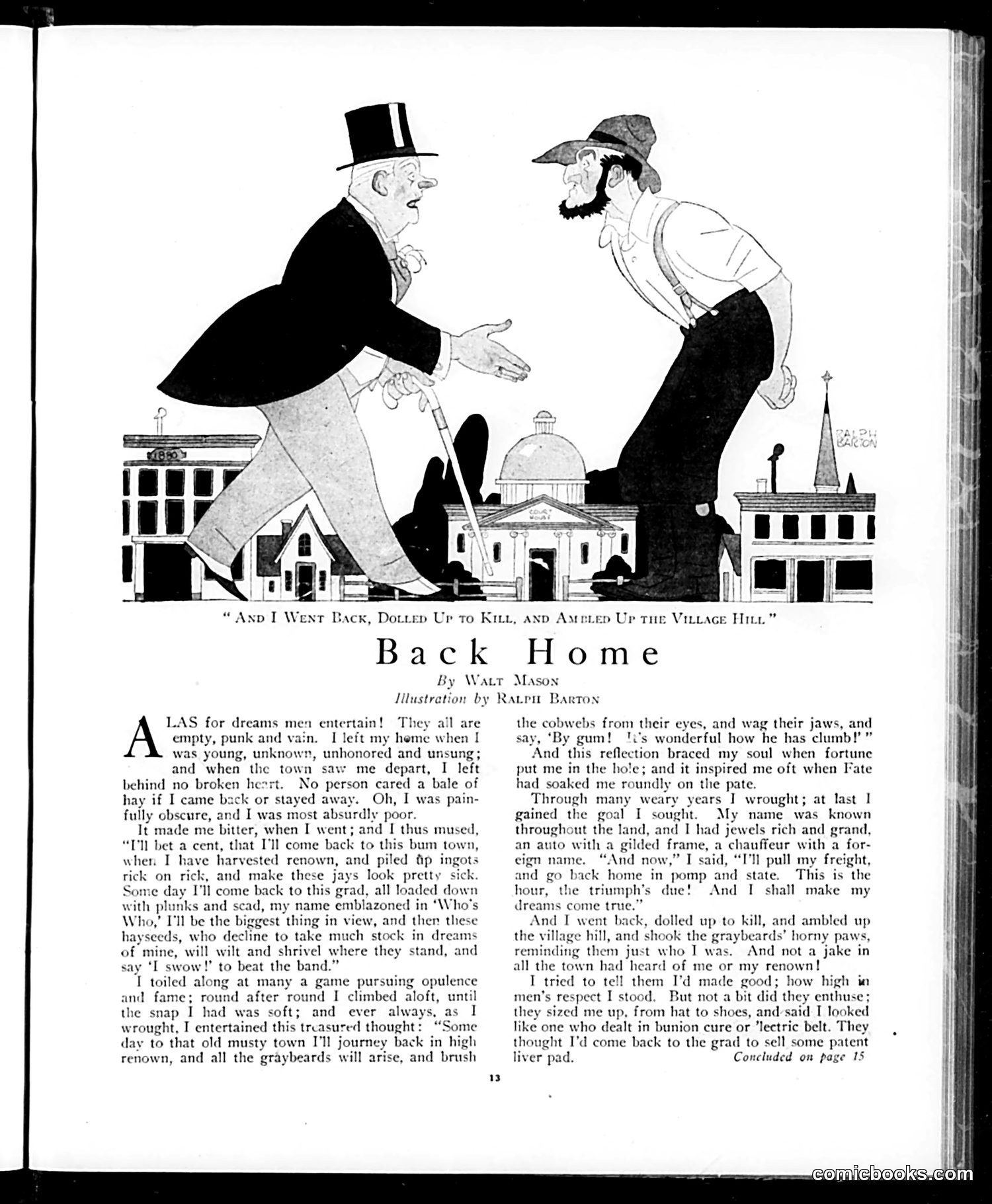
This is a humorous narrative poem by Walt Mason, illustrated by Ralph Barton, satirizing the "self-made man" fantasy and small-town attitudes. The story depicts a poor, unknown young man who leaves his hometown vowing to return rich and famous, imagining the townspeople's admiration. The cartoon shows him—now wealthy and well-dressed (top hat, fine clothes)—confronting a rural townsperson, representing his imagined triumphant homecoming. The satire's point: despite achieving success and returning in "pomp and state," the hometown folks neither recognize nor respect him. Instead of awe, they assume he's a traveling salesman hawking dubious patent remedies (bunion cure, electric belt). The joke mocks both the protagonist's naive fantasy of vindication and the provincial indifference of small-town America. It satirizes the American dream's hollow promise—that leaving and returning wealthy guarantees respect—and the gap between ambition and reality.
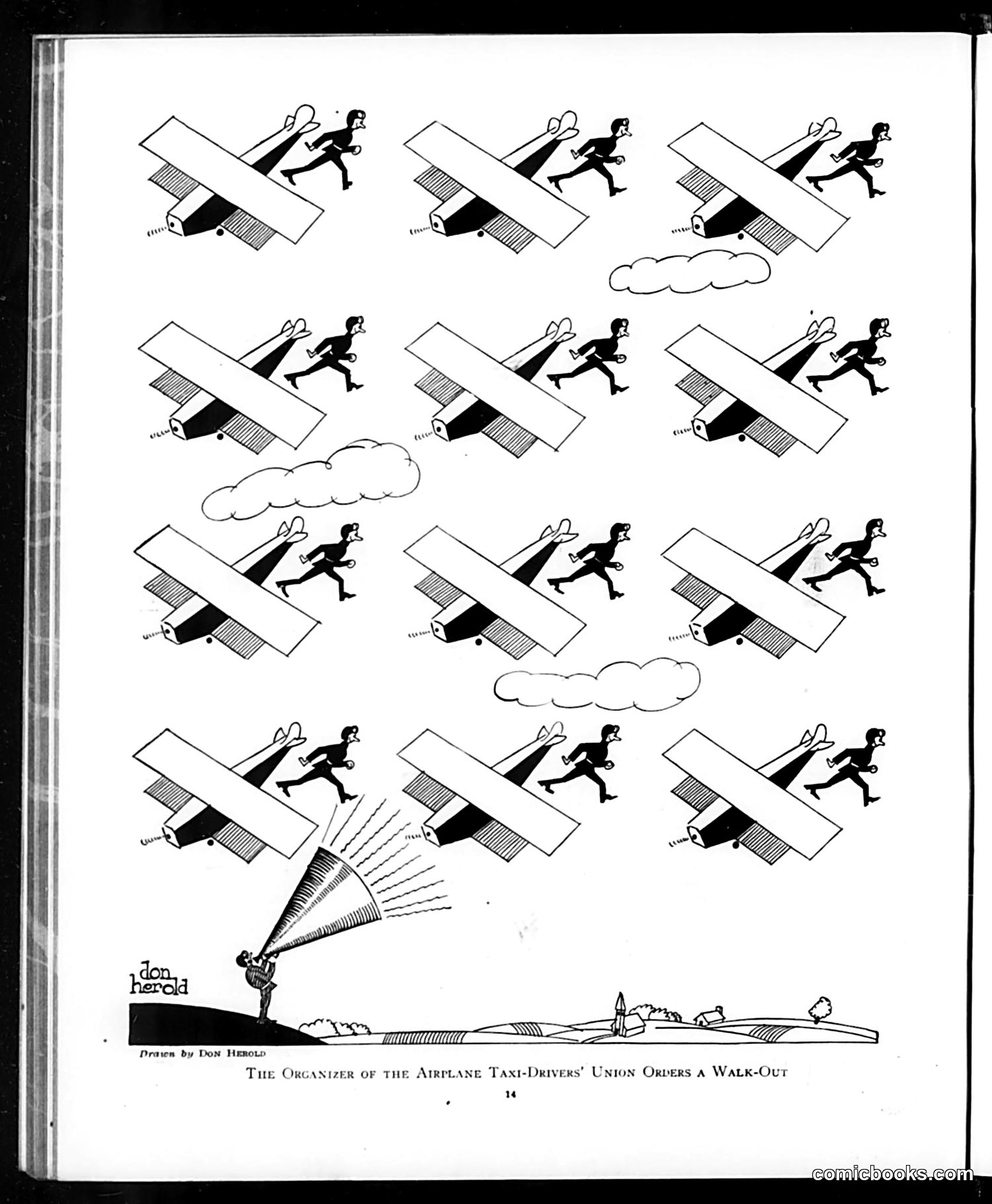
This Don Herold cartoon satirizes a labor strike by the Airplane Taxi-Drivers' Union. The repeated visual sequence shows identical airplanes with pilots walking away in protest—a "walk-out." The humor derives from the absurdity: traditional labor strikes involve workers literally walking away from jobs, but airplane taxi drivers *are already airborne*, making a conventional "walk-out" nonsensical. The massive megaphone at the bottom represents the union organizer directing the strike action. The cartoon mocks either the impracticality of unionizing aviation workers or the blind application of standard labor tactics to aviation—a then-novel industry where traditional strike methods don't logically apply. The publication date and specific historical context remain unclear without additional information.
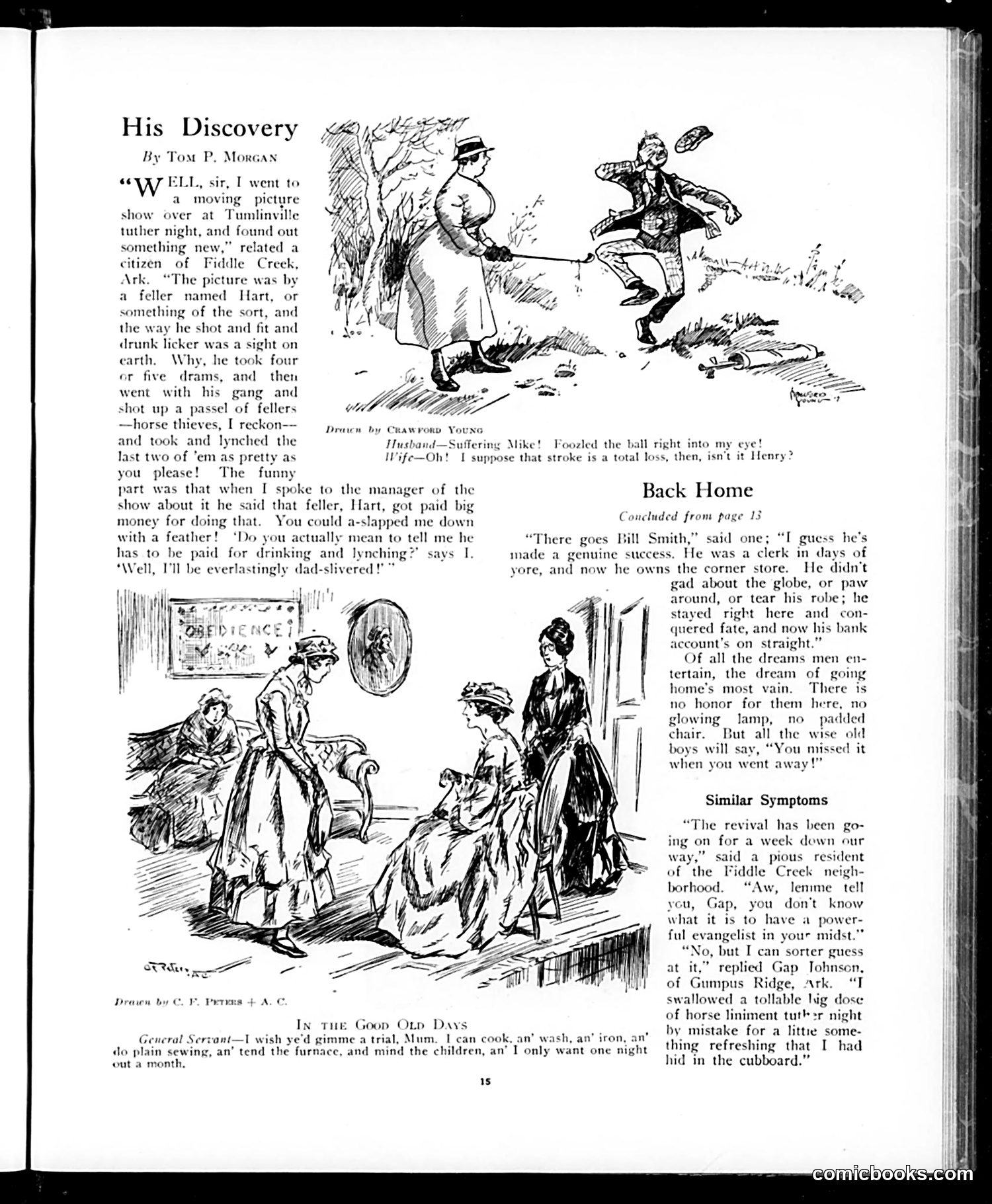
This page contains three humorous rural dialect stories satirizing early 1900s American small-town life. **"His Discovery"** mocks a backwoods Arkansas citizen amazed that actor Hart (likely William S. Hart, famous Western film star) gets paid handsomely for on-screen drinking and violence—activities the narrator views as criminal misconduct, not entertainment. The satire targets rural audiences' naïveté about cinema and actors' compensation. **"Back Home"** contrasts worldly ambition with provincial values: Bill Smith succeeds by staying put and building the corner store rather than adventuring elsewhere. The moral—that leaving home dishonors you—reflects conservative small-town ideology mocking those seeking broader opportunities. **"Similar Symptoms"** draws a crude analogy between religious revivals and accidental poisoning (horse liniment mistaken for medicine), suggesting both produce similar feverish, disorienting effects. It satirizes evangelical enthusiasm as mentally disruptive. All three stories use exaggerated dialect and folksy narrators to portray rural America as comically backward and suspicious of modernity—a common Judge magazine trope targeting working-class readers as objects of ridicule.
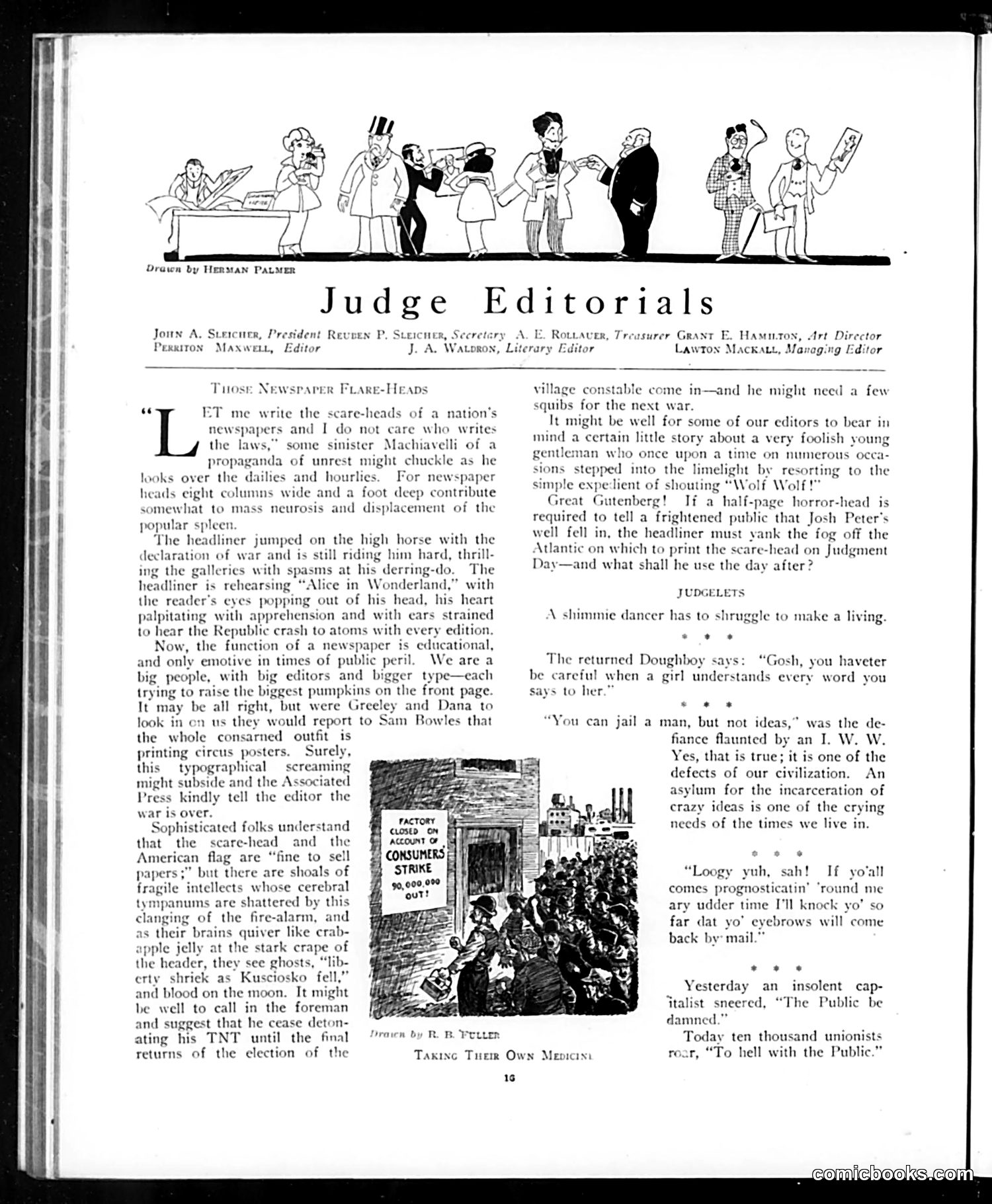
This page critiques sensationalist newspaper headlines in the post-WWI era. The main editorial argues that newspapers' massive, alarming headlines ("scare-heads") manipulate public emotion rather than inform, causing "mass neurosis" among readers. The satire references the "Wolf Wolf" fable—editors crying disaster to sell papers when none exists. It invokes historical editors Horace Greeley and Charles Dana, suggesting modern papers have devolved into "circus posters." The accompanying cartoon by H.B. Yeller depicts a factory strike, illustrating how inflammatory headlines distort labor disputes into sensational stories. The "Judgelets" (short jokes) mock various social targets: an I.W.W. (Industrial Workers of the World) sympathizer, a returned soldier, and capitalist arrogance. The final quip shows symmetrical hypocrisy—both capitalist and union worker dismiss "the Public." The page advocates editorial restraint and factual reporting over attention-grabbing typography designed to frighten readers.
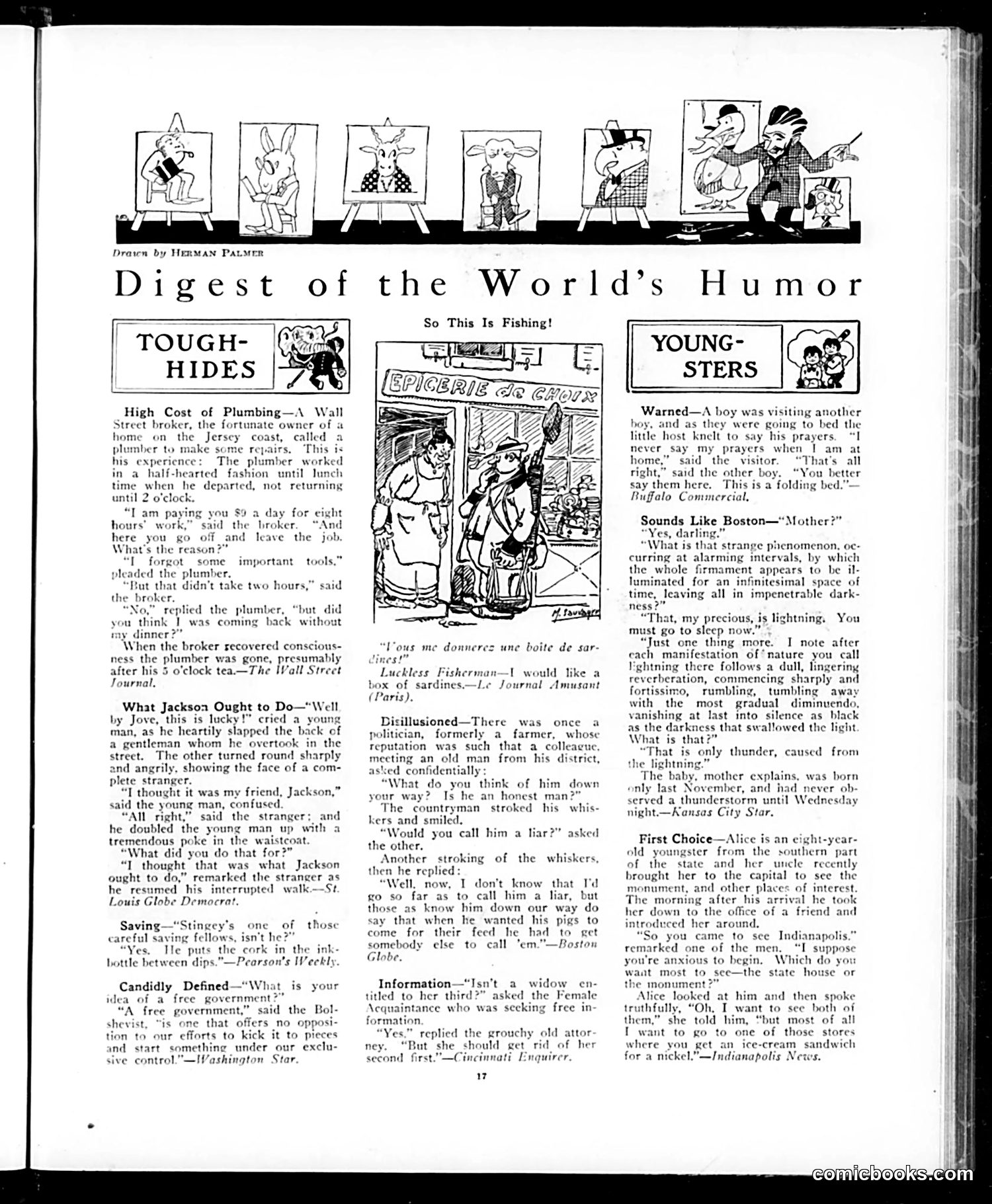
This page collects brief humorous anecdotes from various newspapers, presented without overt political content. The cartoons at top (drawn by Herman Palmer) illustrate artists at easels, setting up the "humor digest" theme. The jokes satirize everyday frustrations and social types: - **"High Cost of Plumbing"**: Mocks wartime/postwar labor costs—a plumber demands full pay despite disappearing for lunch, then demands money for dinner before returning. The broker literally faints at the audacity. - **"What Jackson Ought to Do"**: A mistaken-identity joke where a young man punches a stranger he thought was his friend Jackson. - **"Disillusioned"**: Lampoons a politician's dishonesty through rural folk wisdom—when asked if he's honest, a countryman avoids calling him a liar but notes he had to hire someone else to call his pigs to dinner (implying the man's word is worthless). - **"Sounds Like Boston"**: Gently mocks Boston Brahmin pretension through an infant speaking in overwrought vocabulary about lightning and thunder. The humor targets labor disputes, class anxiety, political corruption, and regional stereotypes typical of early-20th-century American satire.
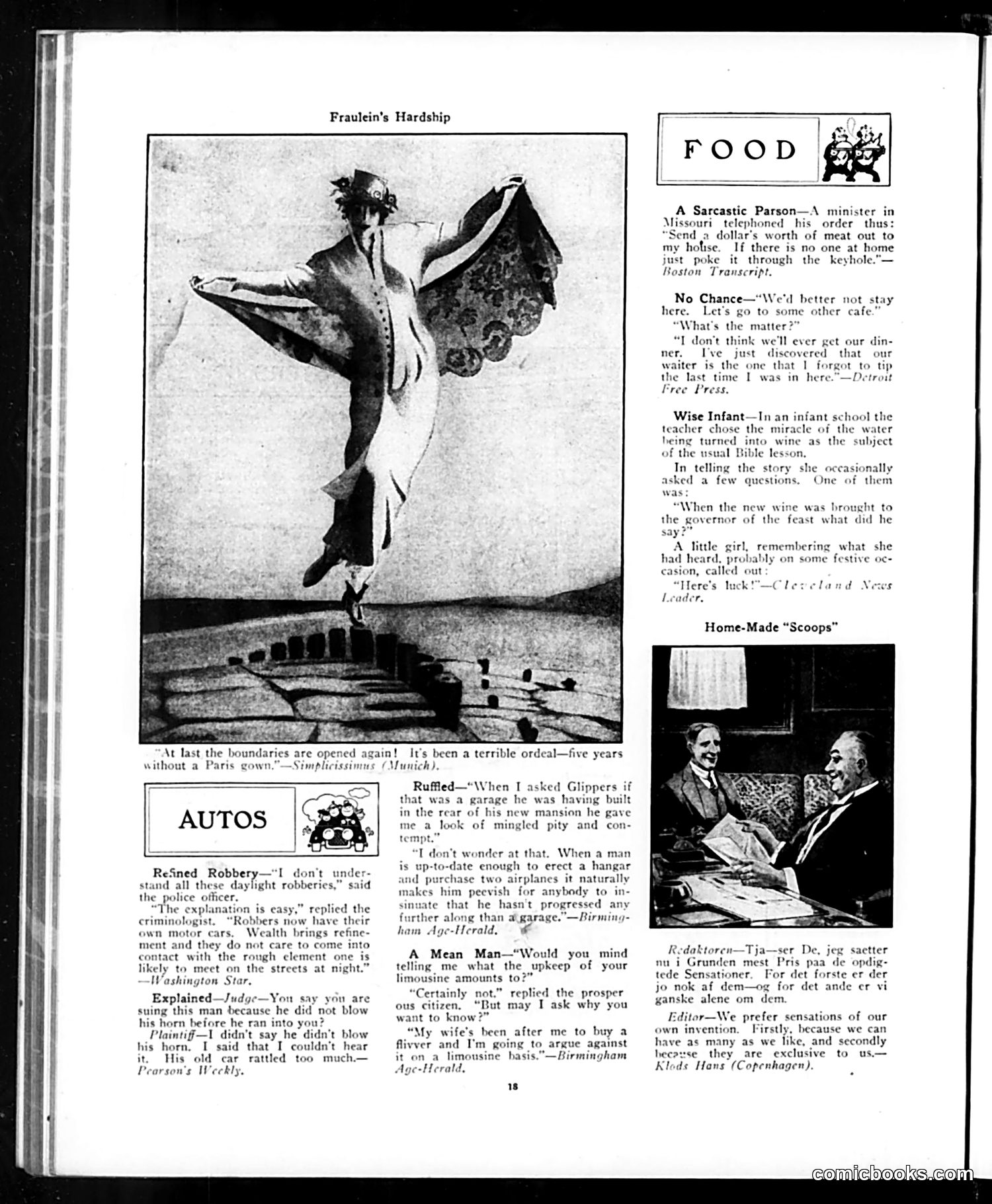
This page collects brief satirical anecdotes organized by topic (Food, Autos), typical of Judge's format. The main cartoon, "Fraulein's Hardship," depicts a young woman in distress, referencing German hardship post-WWI—likely the economic devastation and social upheaval following Germany's defeat. The caption's reference to "five years without a Paris gown" satirizes how even during wartime deprivation, fashion concerns persist among the privileged. The miscellaneous jokes mock emerging automotive culture: wealthy car owners displaying pretension ("garages" vs. airplanes), the cacophony of poorly-maintained vehicles, and automobiles enabling "refined" daylight crime. The "Home-Made Scoops" cartoon at bottom features two editors—one appears Scandinavian (given the Copenhagen credit)—joking that newspapers prefer *invented* sensations over real news because they can control the supply and claim exclusivity. This satirizes journalistic integrity and the temptation toward fabrication. Overall, the page reflects 1920s anxieties about modernity, wealth, and media reliability.
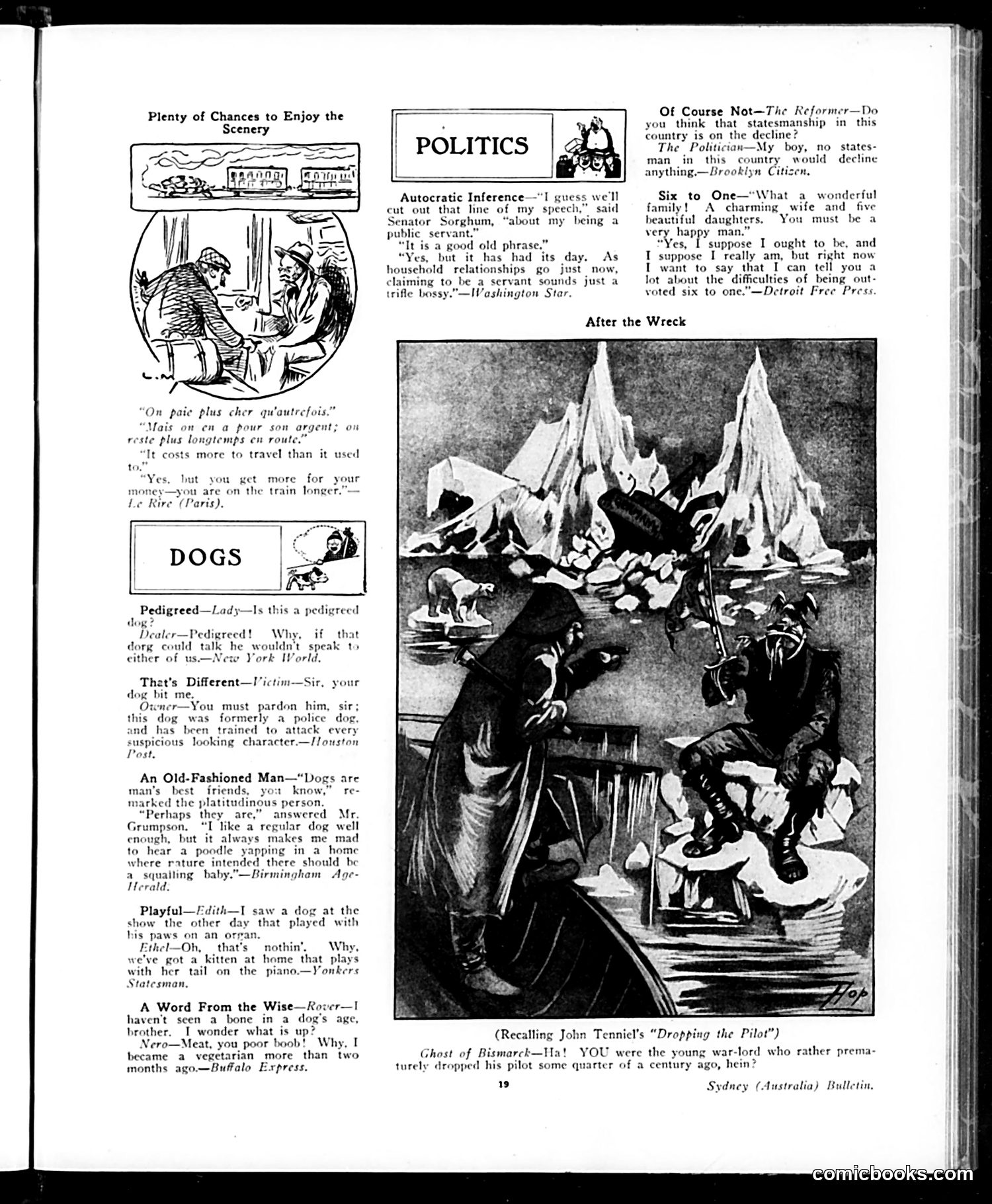
This page contains several short comic dialogues and illustrations satirizing American politics and social life, plus one political cartoon. The **political cartoon** (right) references John Tenniel's famous 1890 Punch cartoon "Dropping the Pilot," which depicted Kaiser Wilhelm II dismissing Chancellor Bismarck. Here, the ghost of Bismarck confronts a young wartime leader who "prematurely dropped his pilot"—likely critiquing an American political figure's removal of an experienced advisor during wartime. The **upper dialogues** mock politicians' self-serving language: one politician claims statesmen never "decline anything" (refuse positions), satirizing their opportunism. Another jokes about being "voted six to one" by his wife and daughters, suggesting male authority is diminished in households. The **dog jokes** below employ wordplay and social commentary—pedigree dogs speaking condescendingly, a former police dog attacking suspects, and a complaint about poodles replacing babies in homes. These reflect period anxieties about class, propriety, and changing domestic life.
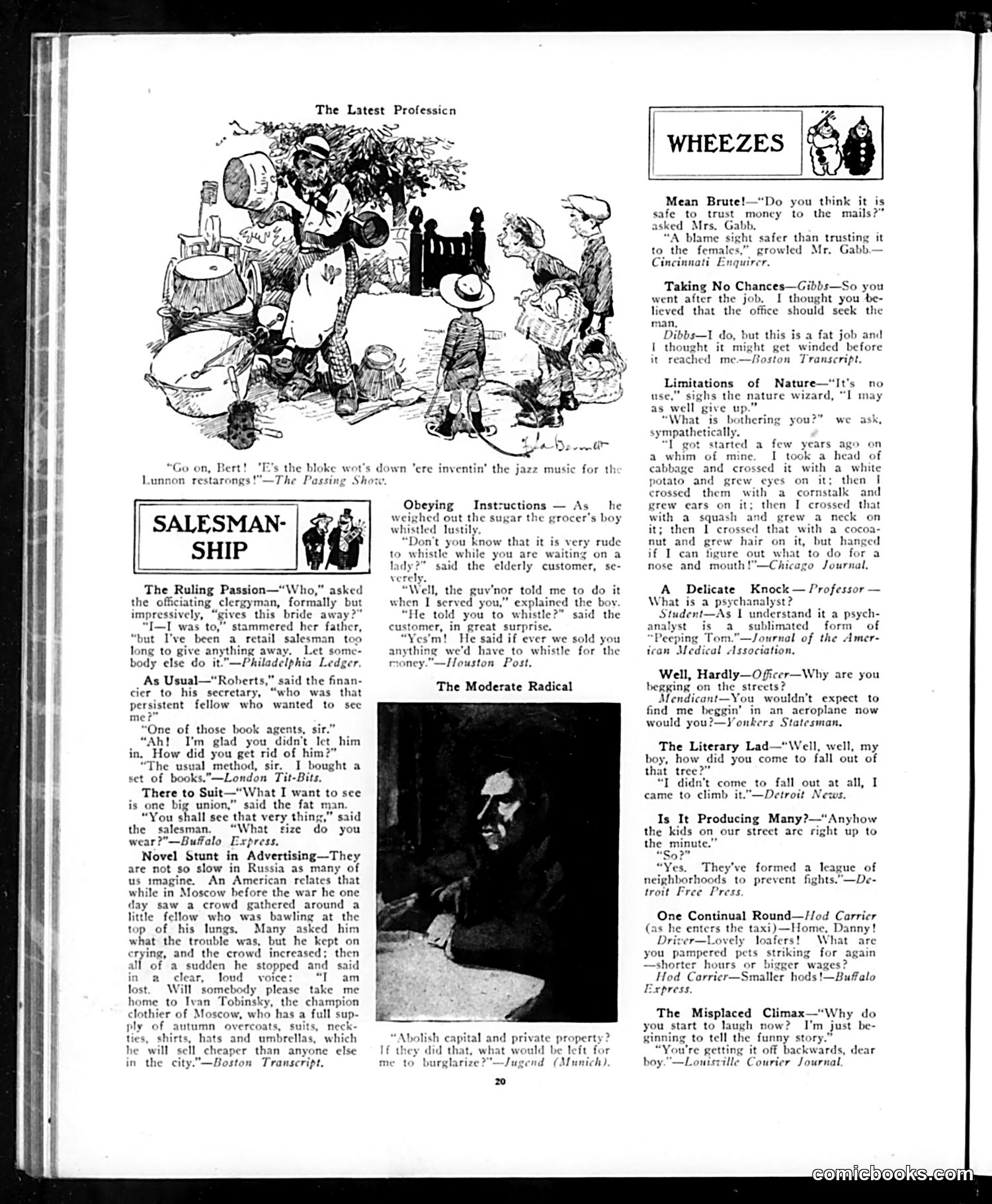
This page from the satirical magazine *Judge* collects brief humorous anecdotes mocking various social types and modern trends circa the early 20th century. **"The Latest Profession"** cartoon depicts a chaotic inventor creating "jazz music" for London restaurants—satirizing both the novelty of jazz and commercial exploitation of trendy cultural fads. **"Salesman-Ship"** section ridicules aggressive salesmanship through multiple jokes: a father-turned-salesman who can't give away his daughter; a financier who buys unwanted books to escape pushy agents; and a Russian clothier's child actor creating a fake lost-child scene to advertise overcoats. **Other anecdotes** mock: women's untrustworthiness with money ("Mean Brute"), overly cautious job-seekers, nature scientists attempting absurd cross-breeding experiments, and psychoanalysis as voyeurism. **"The Moderate Radical"** (center image) criticizes socialist rhetoric—someone advocating abolishing private property while depending on laws against burglary. The humor targets emerging modern anxieties: commercialism, women's changing roles, pseudo-scientific fads, and radical politics.
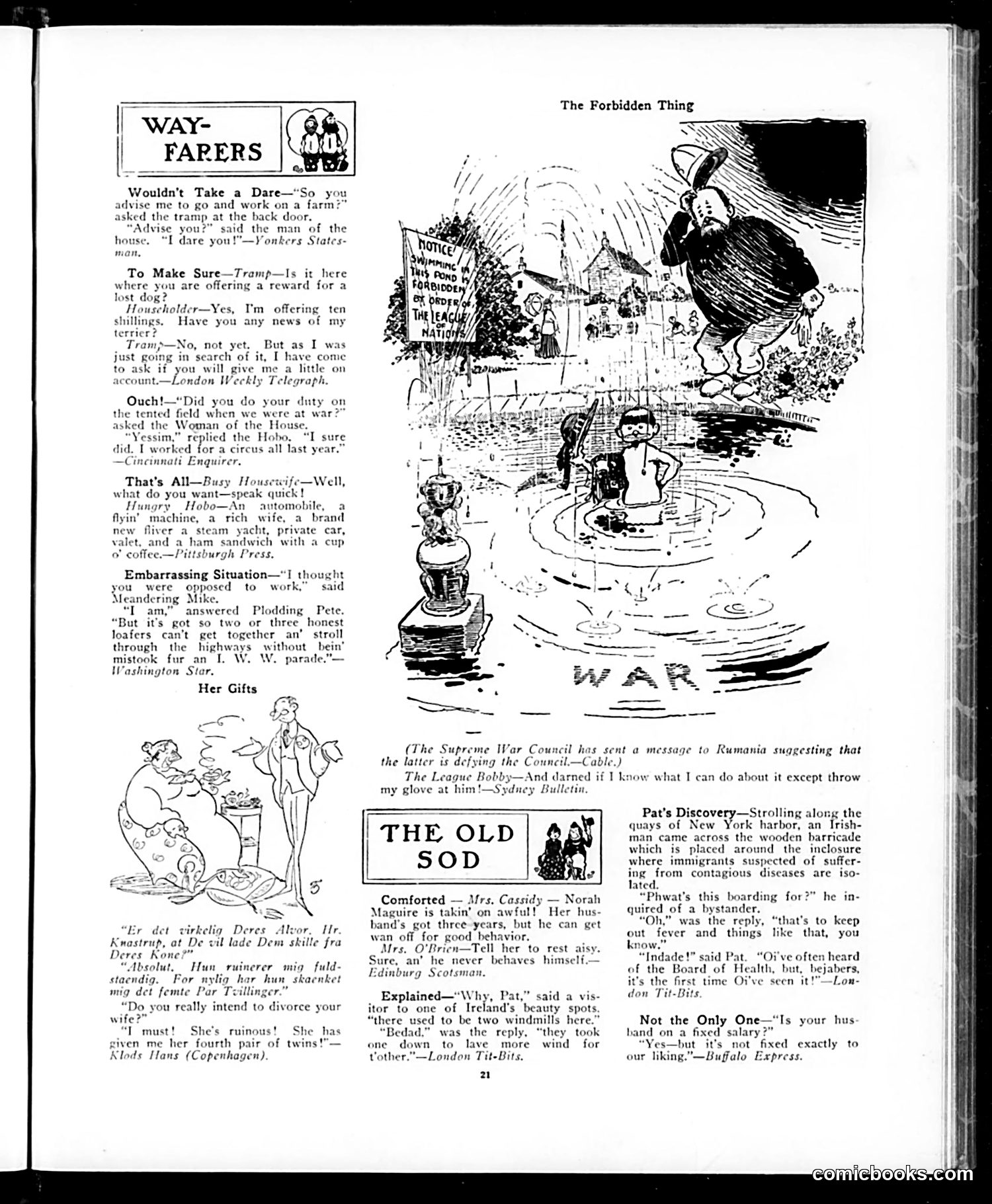
This page contains multiple short humor pieces typical of early 20th-century satirical magazines, centered on the figure of the vagrant or "tramp"—a common subject during economically unstable periods. **Main Cartoons:** The "Wayfarers" section presents brief joke exchanges mocking hobos and transients. One piece jokes about a tramp claiming circus work as military service; another has a vagrant making absurdly extravagant demands (automobiles, yachts) from a harried householder. **Social Context:** These pieces reflect anxiety about vagrancy and labor unrest. One reference to the "I.W.W." (Industrial Workers of the World—a radical labor union) suggests contemporary fear of radical agitation. **"The Forbidden Thing"** cartoon (upper right) appears to reference wartime restrictions, possibly WWI-era regulations around immigrant quarantine. **Other Content:** Irish immigrant jokes and domestic humor fill the remaining space—typical filler content for the era. The overall tone is condescending toward the poor and working classes, presenting them as comedic figures rather than sympathetically.
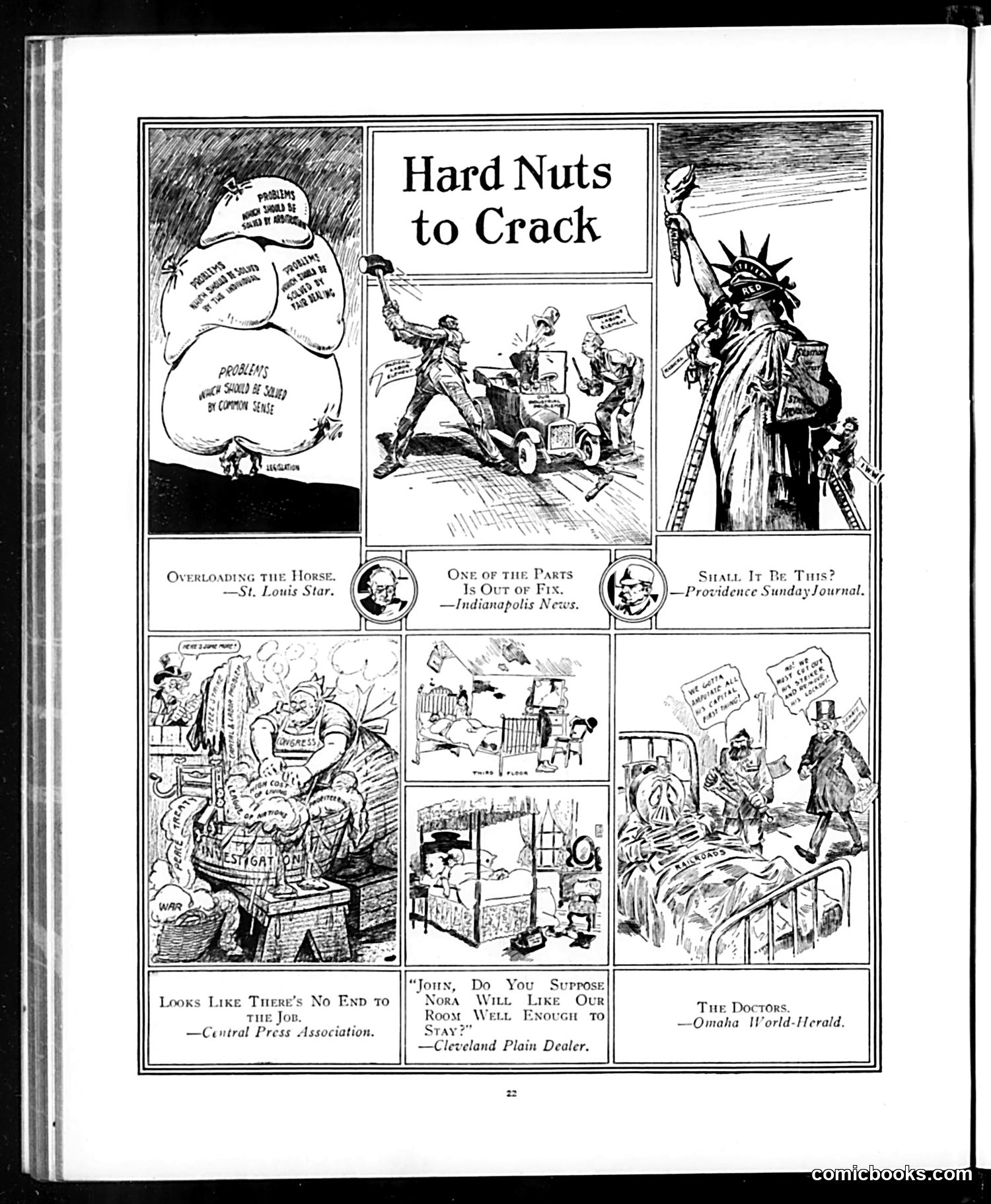
This Judge magazine page presents six editorial cartoons satirizing unresolved problems of the era (appears to be early 20th century). The title references difficult national issues depicted as stubborn obstacles. The cartoons criticize: 1. **"Overloading the Horse"** - Government overextending resources or citizens bearing excessive burdens 2. **"One of the Parts Is Out of Fix"** - Broken governmental or industrial systems (possibly labor/manufacturing issues) 3. **"Shall It Be This?"** - Liberty/Democracy figure uncertain about the nation's direction 4. **"Looks Like There's No End to the Job"** - Endless governmental or social problems 5. **Hospital/Medical scene** - Appears to mock healthcare or institutional care issues 6. **"The Doctors"** - Likely satirizes political leaders ("doctors") unable to cure national ailments The cartoons use visual metaphors—overloaded equipment, broken machinery, diseased patients—to suggest that political solutions are inadequate or ineffective. The sourcing from multiple newspapers indicates these were widely syndicated critiques of contemporary governance.
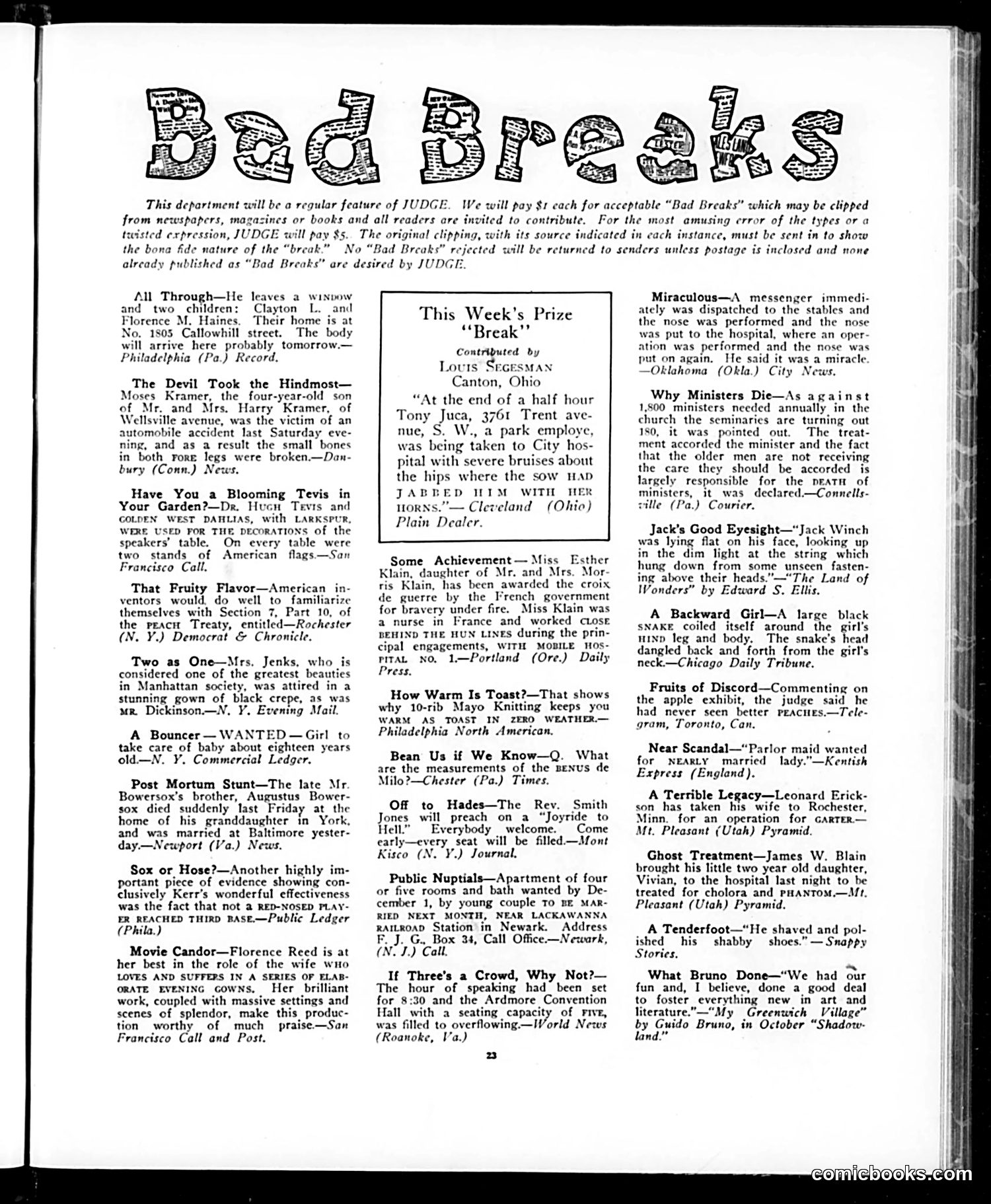
This page features Judge magazine's "Bad Breaks" humor column—a recurring section paying readers $1 for newspaper printing errors and unintentional double meanings clipped from publications. The humor derives from absurd or embarrassing mishaps in published text. Examples include: a obituary stating a deceased man "was married at Baltimore yesterday" (implying posthumous marriage); a classified ad seeking a girl "eighteen years old" to care for a baby; and a sports report noting a "RED-NOSED PLAYER REACHED THIRD BASE" (unclear what body part was intended). These weren't intentional jokes but real typographical errors, awkward phrasings, or careless editing that created unintended comedy. The column's appeal lay in mocking newspapers' sloppiness while entertaining readers with the resulting absurdities. This reflects early 20th-century humor—finding humor in literal misreadings and the gap between intended and actual meaning.
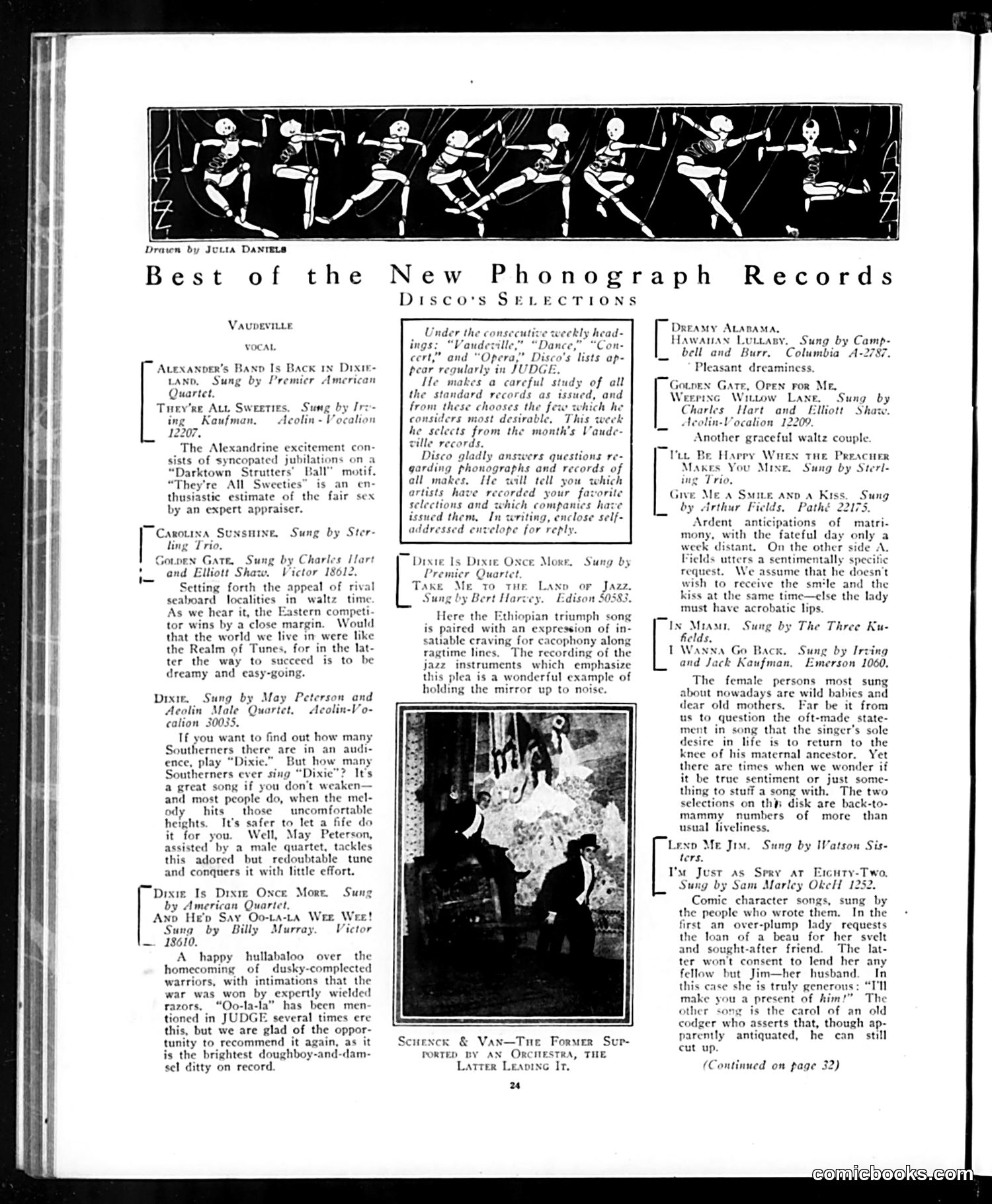
This page is a **record review column**, not a political cartoon. Judge magazine's "Disco" (the reviewer) evaluates newly released phonograph records across various genres—sentimental ballads, comic songs, and novelty numbers popular in the early 1920s. The reviews reflect post-WWI American culture: songs like "And He'd Say Oo-ta-La Wee Wee!" celebrate "doughboys" returning from war; "Dixie" appeals to Southern nostalgia; sentimental favorites include "I Wanna Go Back" (homesick soldier songs) and "Lend Me Jim" (maternal devotion). The tone is light and gossipy—Disco pokes fun at singers tackling difficult ranges and notes the era's obsession with "mammy numbers." The illustrated header showing dancing skeletons appears decorative rather than satirical. This reflects Judge's role as **entertainment and consumer guide** for middle-class readers, not primarily a political organ on this particular page.
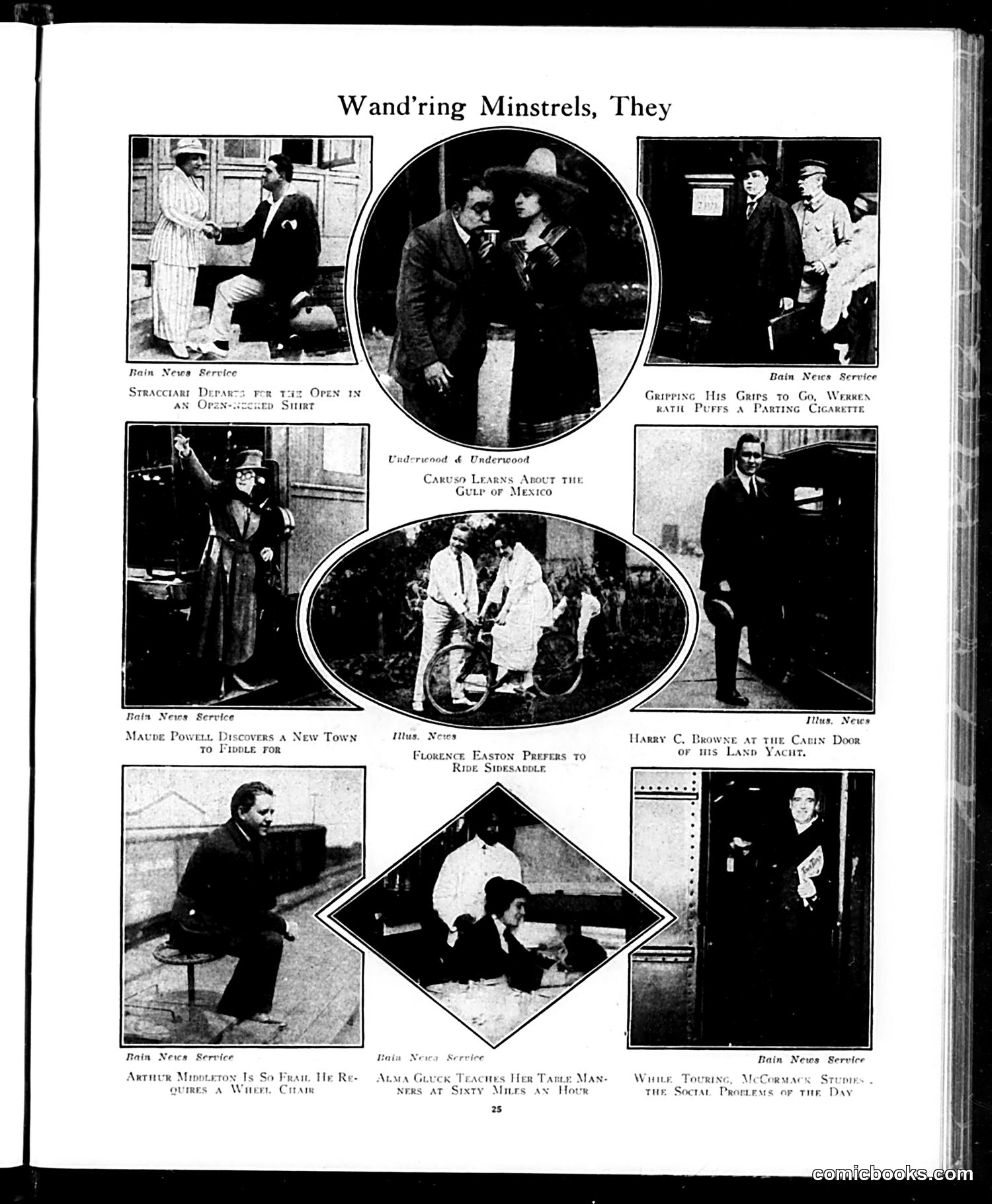
This page from *Judge* satirizes celebrities and public figures of the era—likely early 1920s—by depicting them in mundane or absurd situations. The title suggests these are touring performers or personalities constantly in the public eye. Notable captions include Enrico Caruso (the famous opera singer) learning about the Gulf of Mexico, Florence Easton preparing to ride a sidecar, and Maude Powell discovering a new town. Arthur Middleton appears so frail he needs a wheel chair, while Alma Gluck teaches table manners at high speed. The satire targets celebrity culture itself: these "wandering minstrels" are perpetually newsworthy despite doing trivial things. The joke mocks both the celebrities' minor activities being deemed headline-worthy and the public's appetite for such coverage. The varying photograph sources (Bain News Service, Underwood & Underwood) emphasize how news syndicates commodified celebrity gossip.
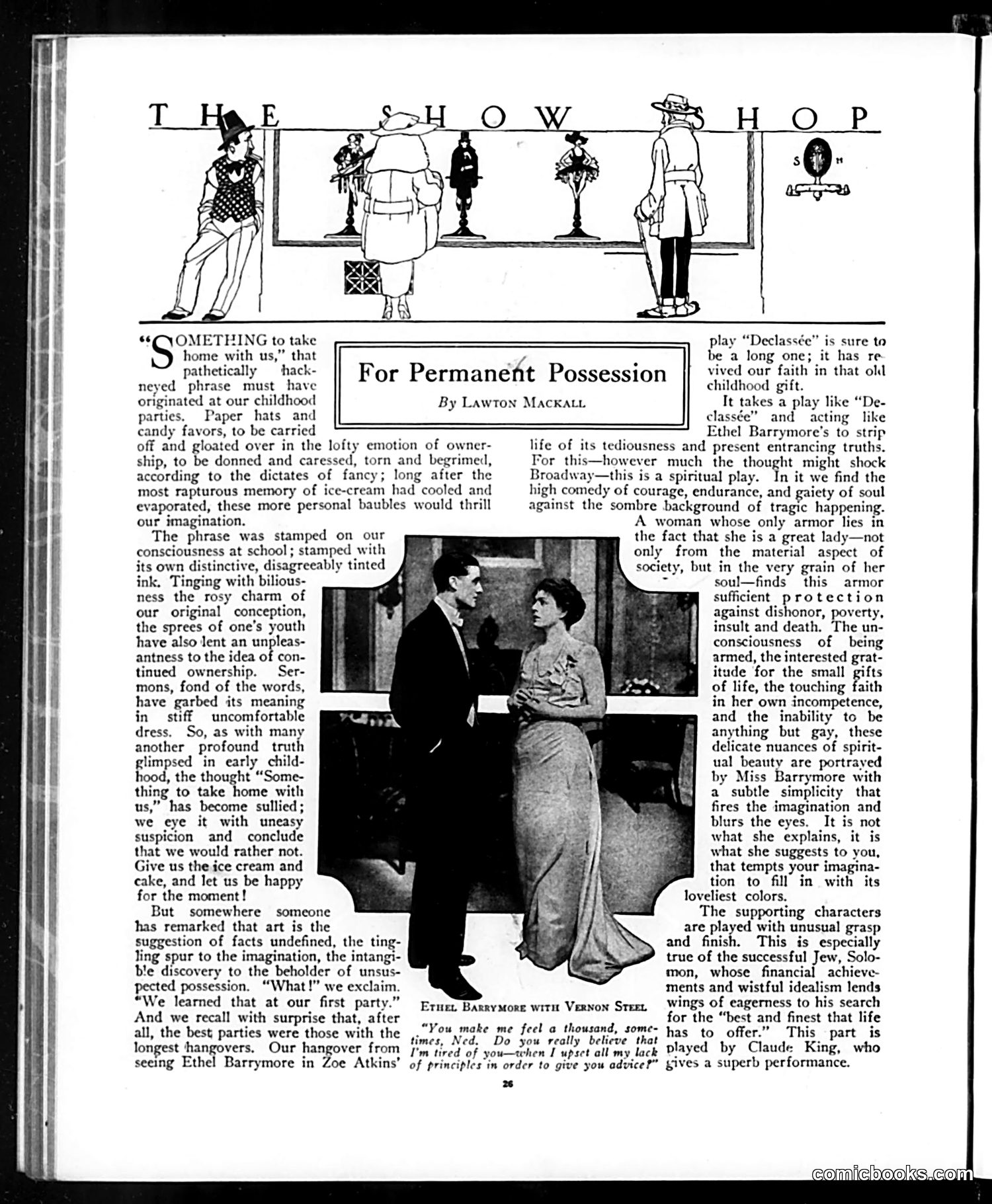
This page contains two distinct pieces: a theatrical review and an illustration. **"The Show Shop" Header:** A decorative cartoon showing a storefront window display with fashionable figures and hats—likely advertising or illustrating theater-related content. **Main Review:** Lawton Mackall's essay reviews Ethel Barrymore in the play "Declassée" by Zoë Atkins. The review praises Barrymore's performance as spiritually elevating, depicting a woman of inherent dignity who maintains her "armor" of grace against poverty and dishonor. Barrymore is portrayed as embodying refined values—kindness, faith, and courage—rather than material wealth or social status. **Supporting Cast:** The review notes Claude King's performance as Solomon, a Jewish character whose financial success is tempered by idealistic yearnings for "the best and finest that life has to offer." **Context:** This represents 1920s theater criticism celebrating Barrymore's dramatic range and the play's moral sophistication, contrasting inner character with external circumstances—popular themes in postwar American drama.
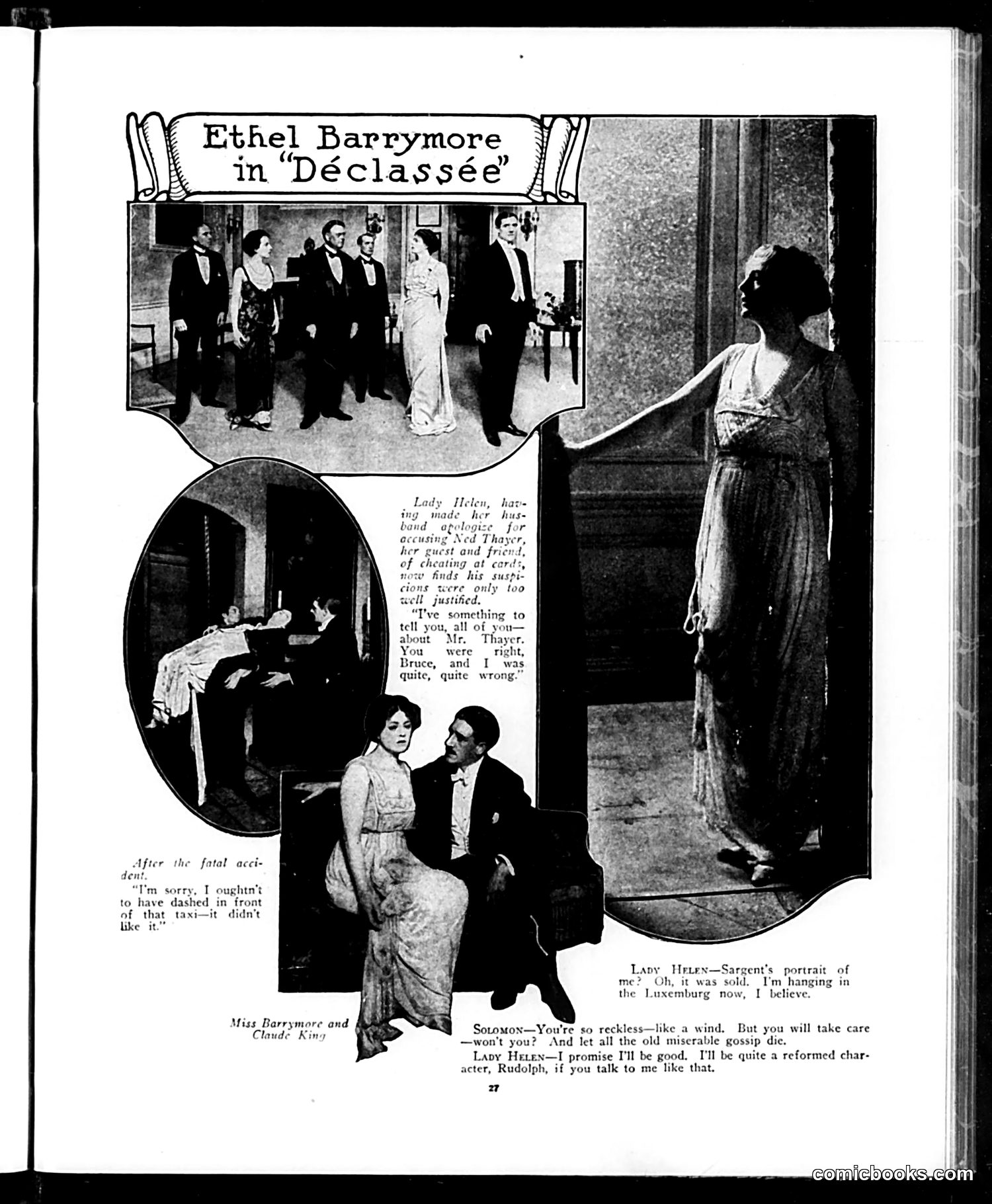
This page showcases scenes from Ethel Barrymore's theatrical production "Déclassée," a play about social scandal and redemption. The multiple scenes depict dramatic moments: a formal social gathering, a confrontation involving accusations of infidelity (the "Ned Thayer" card-cheating scandal), and reconciliation dialogue. The narrative arc shows a character named Solomon warning Lady Helen about recklessness and gossip, while she promises reform. Another scene features Miss Barrymore with Claude King, while a separate moment captures her alone, apparently distressed. The satire reflects early 20th-century theatrical melodrama—specifically the "fallen woman" trope common in period plays, where characters face social ruin through moral missteps but seek redemption. Judge's coverage treats this theatrical morality tale with gentle mockery typical of the magazine's entertainment commentary.
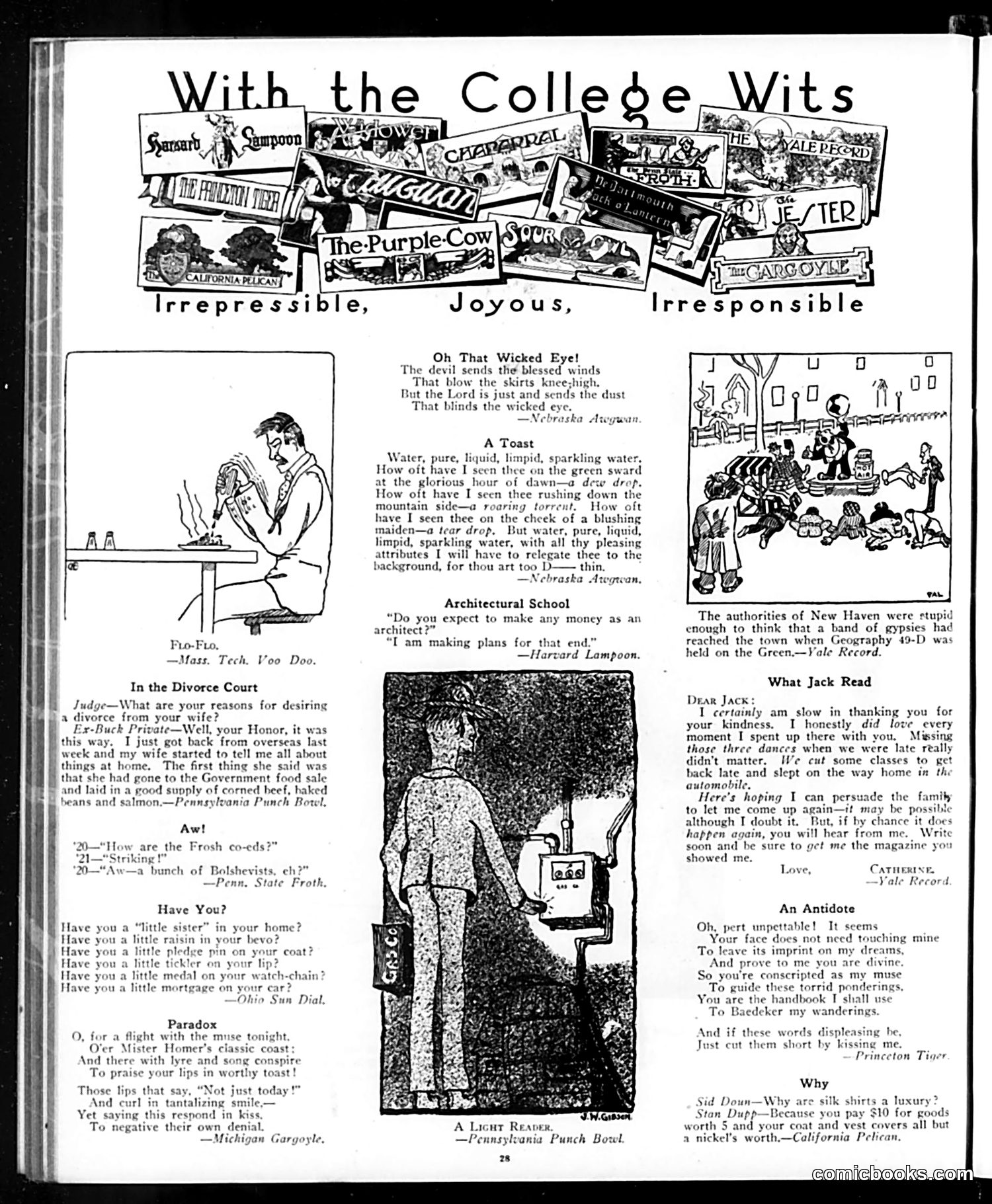
This page collects humorous submissions from college humor magazines (MIT's *Voo Doo*, Harvard *Lampoon*, Yale *Record*, etc.), typical of Judge's format. **Key content:** - **"In the Divorce Court"**: A post-WWI joke where an ex-soldier divorces his wife because she bought wartime rationed foods (corned beef, beans, salmon)—satirizing both soldiers' readjustment and women's domestic management. - **"Oh That Wicked Eye!"**: A morality-joke about wind lifting women's skirts, playing on religious irony (God sends dust to blind "sinful" lookers). - **"A Toast"**: Romantic poetry undermined by the punchline that water is "too D—thin"—likely referencing Prohibition-era frustration (the dash obscures a profanity). - **"What Jack Read"**: A letter from a woman thanking a male friend for time together, hinting at romance and suggesting he cut classes—typical college courtship humor. The page satirizes college life: post-war adjustment, Prohibition, gender dynamics, and romantic entanglements. The humor is genteel but occasionally risqué.

This is a **straight advertisement**, not political satire. It's a full-page ad for Genco Razors from November 8, 1919, appearing in Judge magazine. The ad features an illustration of a barber stropping (sharpening) a razor on a customer in a barbershop. The marketing appeal targets both professional barbers and home shavers, emphasizing that Genco razors are "built to strop" and designed with a scientifically correct angle for stropping. The ad's main claims: Genco razors save time and money, produce a superior shaving edge, and come with a guarantee ("must make good or we will"). It includes a diagram showing the razor and strop, and directs readers to ask their dealer or contact Geneva Cutlery Corporation in Geneva, New York. There is no political commentary or satirical intent—Judge's pages mixed advertising with editorial content.
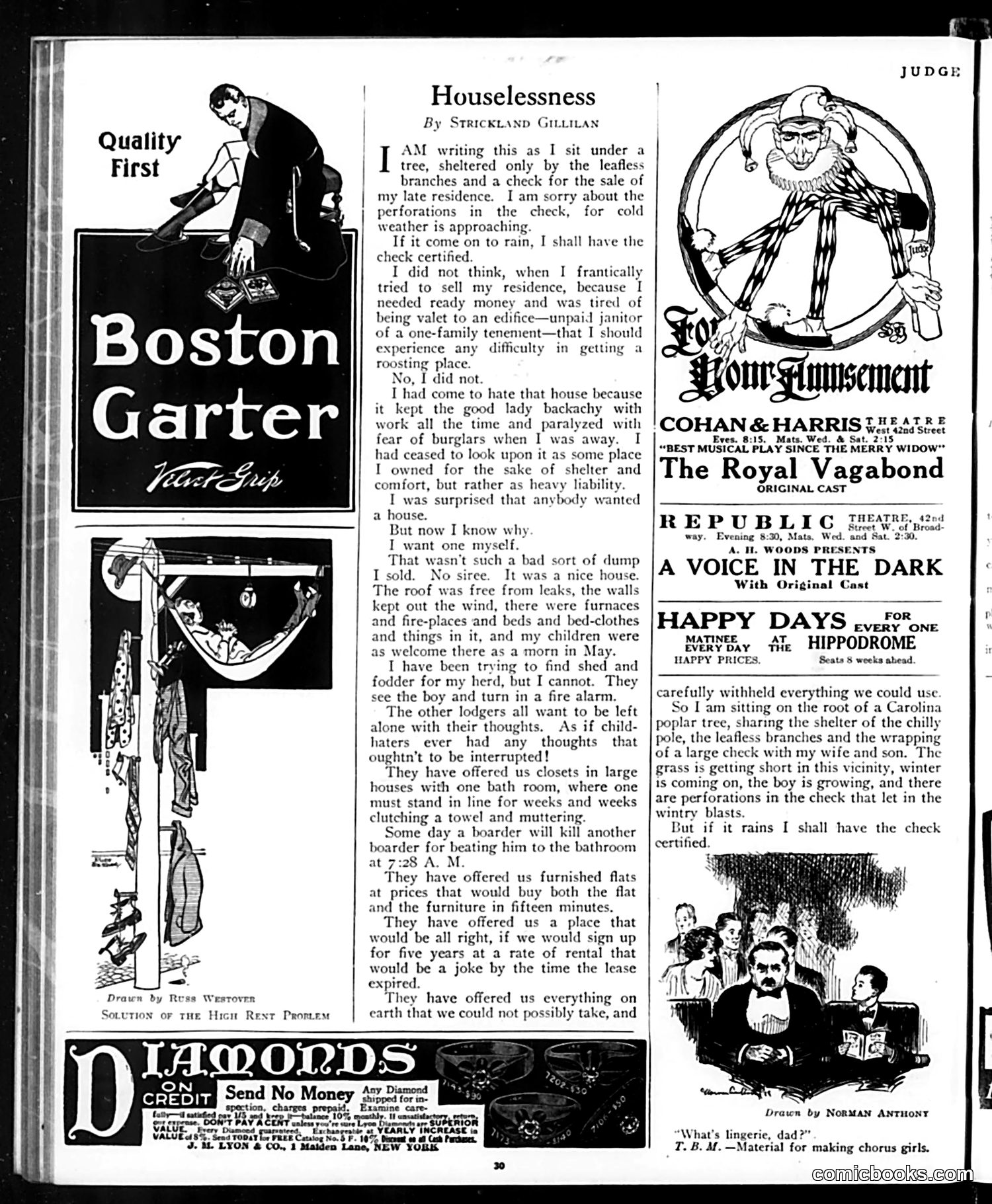
This satirical article addresses the housing crisis of the early 20th century. The author ironically describes selling his house to escape its burden—viewing homeownership as financial liability and endless maintenance work—only to discover he cannot find affordable shelter afterward. The piece critiques the housing market's failures: landlords offer cramped shared bathrooms, overpriced furnished flats, and exploitative long-term leases with inflated rates. The joke builds through the author's predicament: he now sits homeless under a tree, clutching only a check for his house sale (with "perforations" suggesting it's damaged or questionable), while his family lacks basic shelter as winter approaches. The satire attacks both the housing shortage and the disconnect between housing supply and actual human needs—landlords offer everything *except* what people actually require. The recurring joke about getting the check "certified" if it rains suggests desperation masquerading as optimism, mocking those displaced by economic conditions they cannot control.
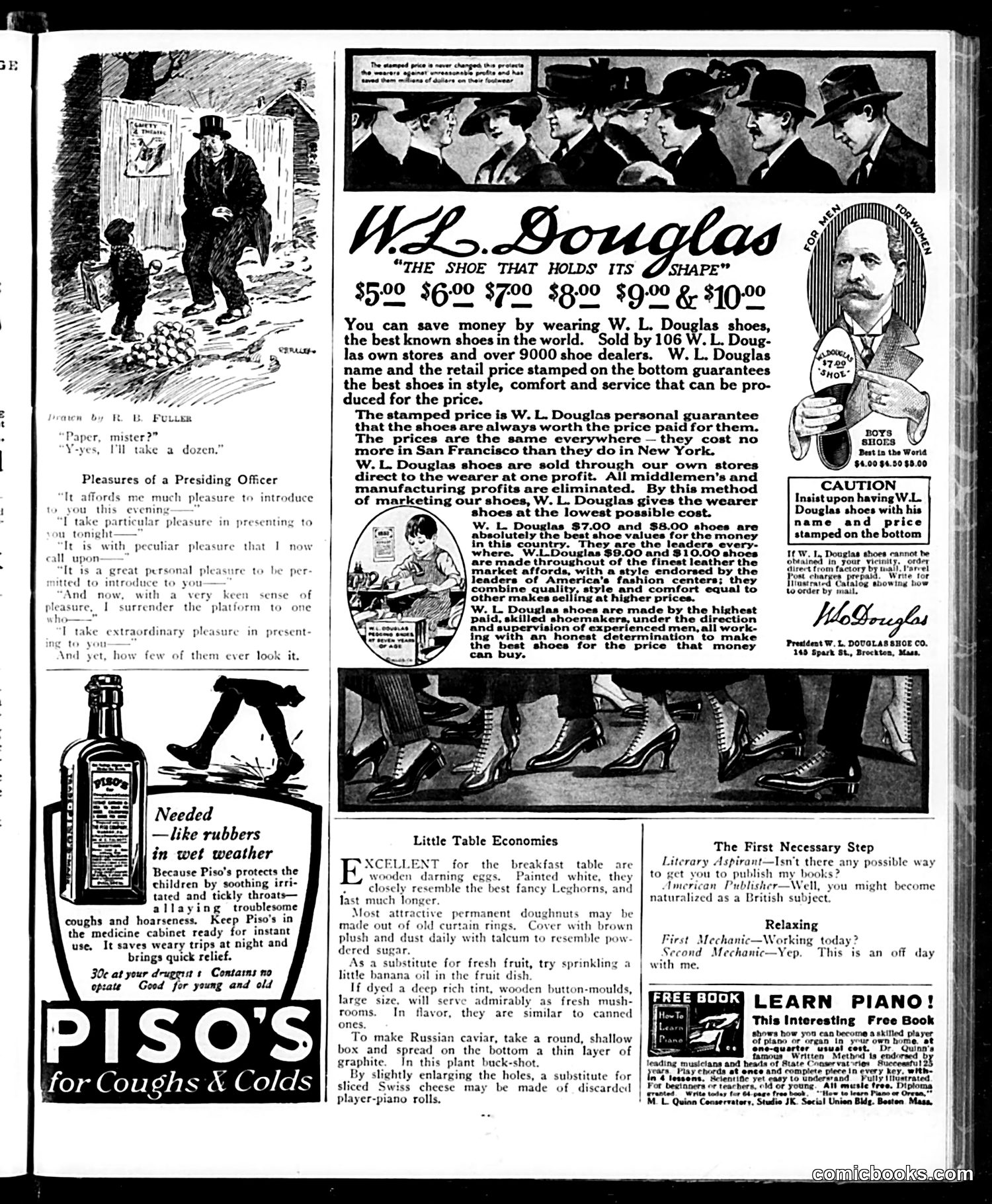
This page is primarily **advertising**, not political satire. The dominant content is a W.L. Douglas shoe advertisement featuring the company's founder/namesake and testimonials about shoe quality and value. The small cartoon at top-left, titled "Pleasures of a Presiding Officer" by R.B. Fuller, shows a formal speaker introducing someone to an audience—likely satirizing the self-congratulatory speeches common at civic events. The joke appears to be that the speaker takes "extraordinary pleasure" in introducing things, mocking the overwrought formality of such occasions. The page also contains minor humor pieces ("The First Necessary Step," "Relaxing") and household tips in "Little Table Economies." The remaining advertisements—for Piso's cough medicine and a piano instruction book—are typical period marketing, not satire.
This page is primarily **advertising and record reviews**, not political satire. The visible content consists of: **Advertisements** for commercial products: Dean's Mentholated Cough Drops, Remoh Gems, Cuticura products for soldiers' skin problems, Cortez Cigars, Brooks' Truss appliance, and Homeike's Press Clipping Bureau. **Editorial notice**: Judge announces it's relocating printing operations from New York to Chicago due to printing industry disruptions, apologizing for potential publication delays. **Main content**: "Best of the New Records—Disco's Selections," reviewing recently released phonograph records, including songs from musical comedies like "Listen Lester" and "Someboy's Sweetheart," performed by artists like Van and Schenck and John Steel. There is **no visible political cartoon or satire** on this page. It represents a typical early 20th-century magazine layout mixing editorial content with revenue-generating advertisements.
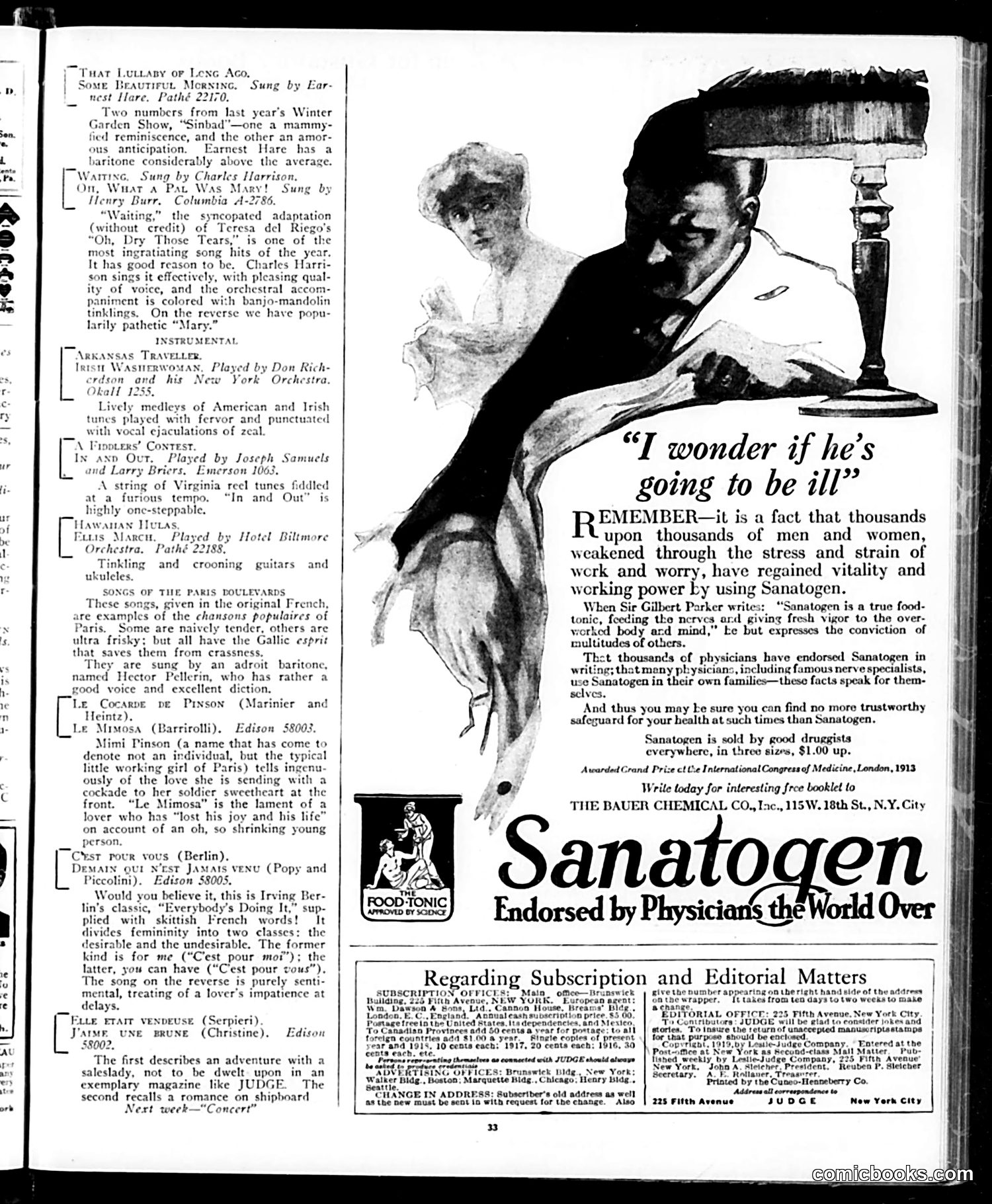
This page is primarily a **patent medicine advertisement** disguised as editorial content. The main image shows a concerned man looking at an ill woman in bed, with the caption "I wonder if he's going to be ill?" **The Advertisement's Claim:** Sanatogen is marketed as a "food-tonic" that restores vitality to people weakened by "stress and strain of work and worry." It claims thousands have regained working power through its use. **The Satire/Historical Context:** This represents the common early-20th-century medical fraud era. The ad cites testimonials from "Sir Gilbert Parker" and claims "thousands of physicians" endorse it—typical marketing tactics of patent medicines that were largely unregulated and often ineffective. The product promised to cure exhaustion and restore vigor, exploiting widespread anxiety about modern life's pace. **For Modern Readers:** This exemplifies pre-FDA regulation when magazines freely promoted unproven remedies. The emotional manipulation (sick woman, worried man) and vague scientific-sounding language ("food-tonic," "nerve feeding") were standard deceptive practices of the era. The surrounding content—song reviews—appears designed to make the advertisement seem like regular magazine material.
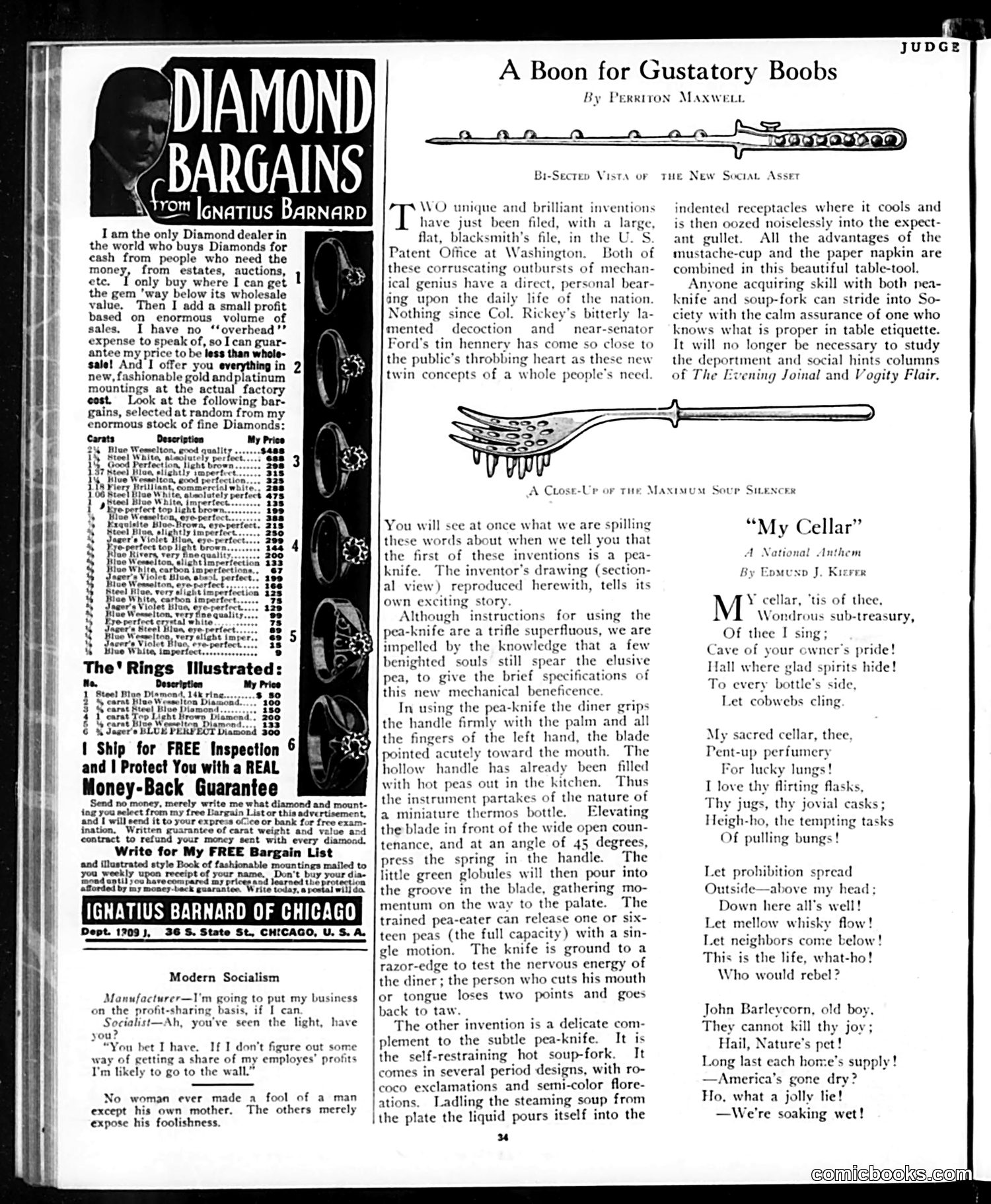
This page from *Judge* magazine contains two satirical pieces: **"Modern Socialism"** (bottom left): A brief joke mocking the socialist movement. A manufacturer claims he's adopting profit-sharing on "socialist principles," but his true motive is selfish—he wants to prevent workers from keeping profits he believes should be his. The satire targets both naive socialism and capitalist hypocrisy, suggesting businessmen would cynically exploit any ideology for personal gain. **"A Boon for Gustatory Boobs"** (right): A humorous mock-serious article about absurd new inventions: a "pea-knife" (for eating peas without spearing them) and a "soup silencer" (appears to be a utensil addressing table manners). The satire gently mocks Americans obsessed with etiquette and "proper" dining, suggesting these ridiculous gadgets would solve social embarrassment. The flowery language parodies patent descriptions and advice columns popular in the era. The left page is primarily a diamond dealer advertisement, unrelated to satire.
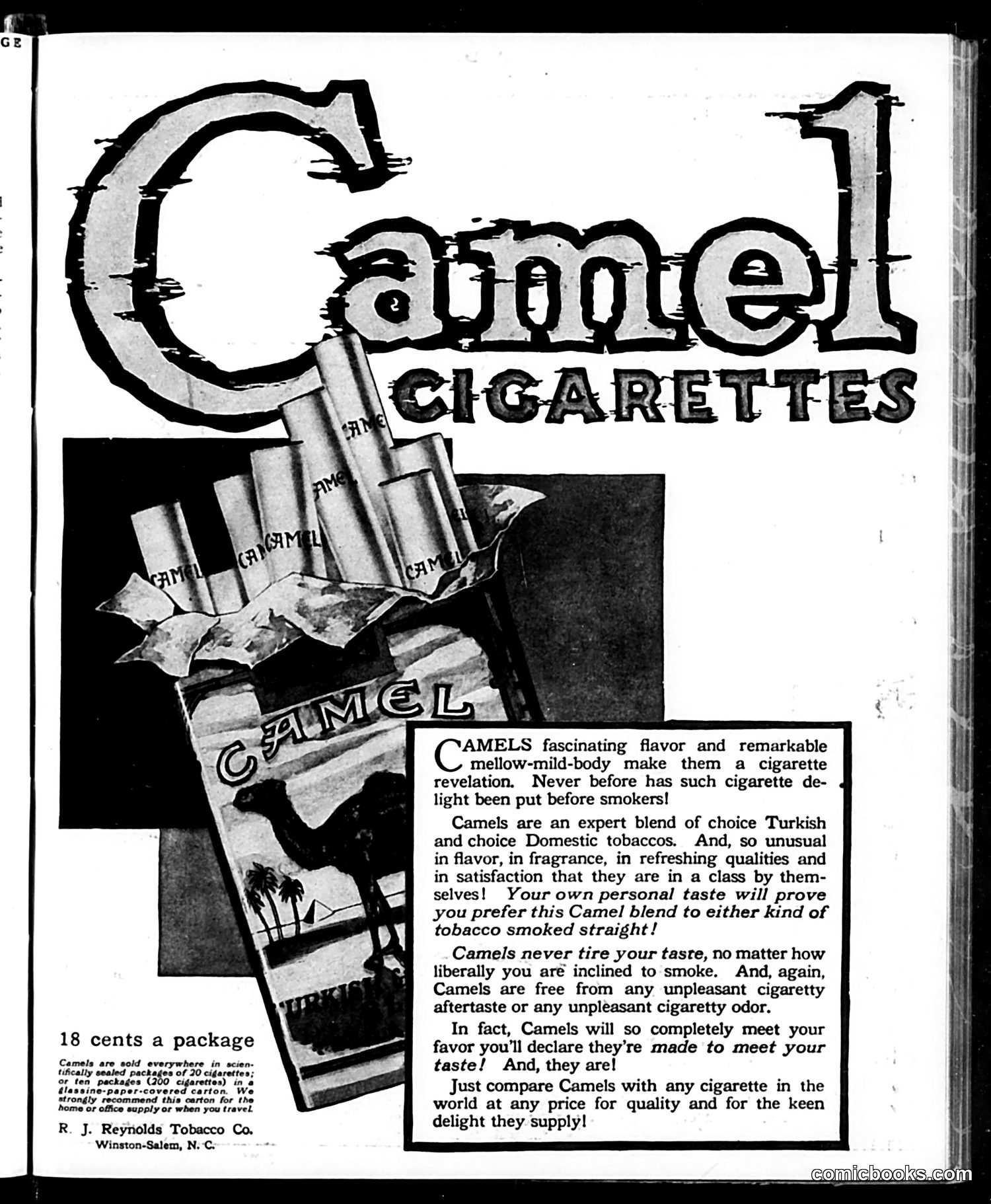
This is a **cigarette advertisement**, not political satire. It occupies the full page of *Judge* magazine as a paid advertisement for Camel cigarettes by R.J. Reynolds Tobacco Company (Winston-Salem, N.C.). The ad features the Camel brand logo prominently and displays a package of cigarettes. The accompanying text makes marketing claims typical of early 20th-century tobacco advertising: Camels offer "fascinating flavor," a "mellow-mild-body," and are made from Turkish and domestic tobacco blends. Notably, the ad promises health-adjacent benefits—claiming Camels "never tire your taste" and are "free from any unpleasant cigarette aftertaste or odor." These claims, which would be prohibited in modern advertising, reflect the era before cigarette health dangers were widely acknowledged. The price of 18 cents per package dates this to approximately the 1920s-1930s.
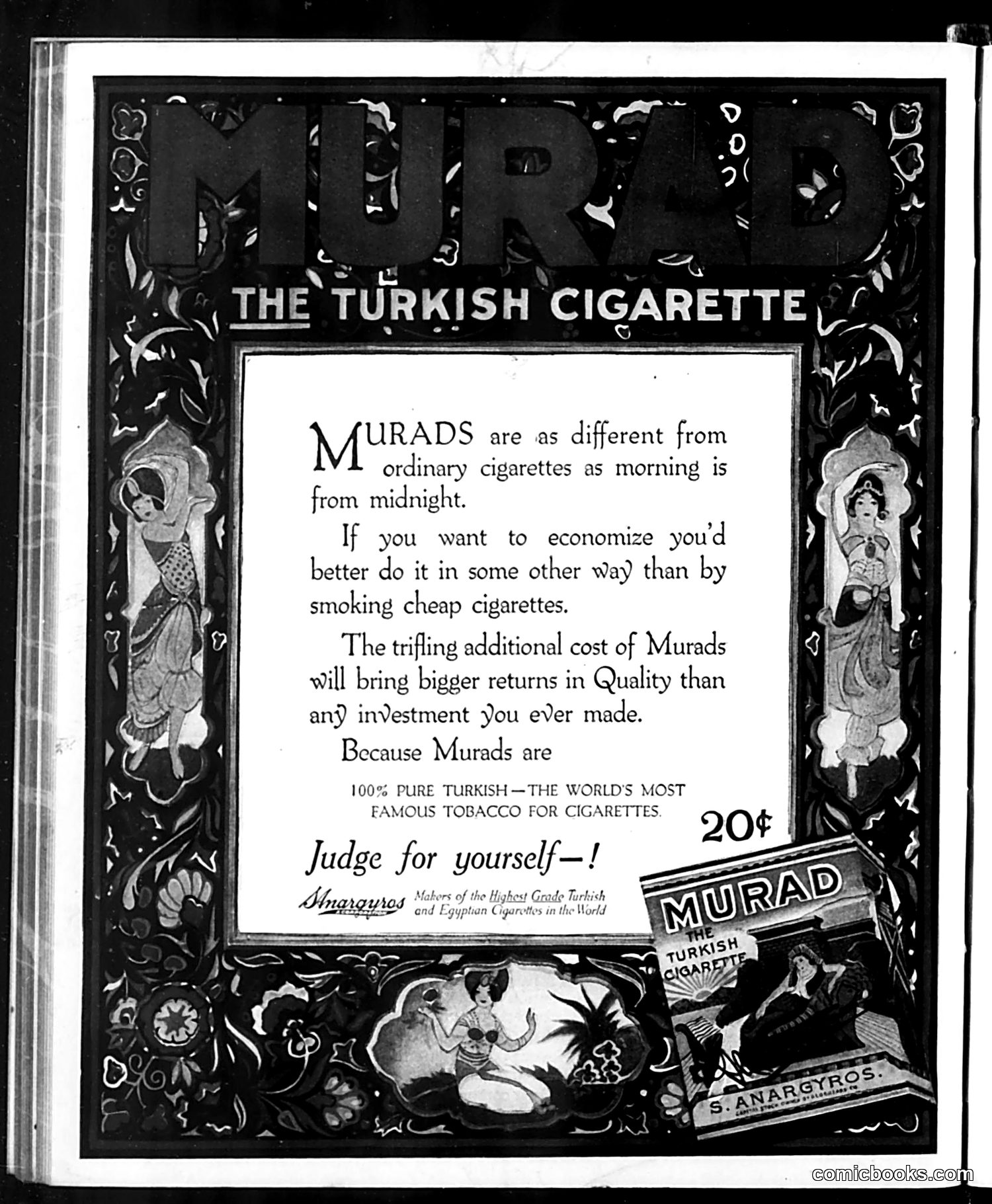
This page is primarily a **cigarette advertisement** for Murads, not political satire. The ornate border and Oriental imagery reflect early 20th-century marketing aesthetics. The ad's humor relies on claiming superiority through exclusivity: Murads are "as different from ordinary cigarettes as morning is from midnight." It discourages budget-conscious smokers from buying cheaper brands, arguing the "trifling additional cost" represents a better investment than economizing. The decorative border features Turkish/Oriental figures and motifs, emphasizing the product's "100% PURE TURKISH" origin—a major selling point when Turkish tobacco was considered premium. The manufacturer name appears to be "S. Anargyros." The "Judge for yourself—!" tagline invites consumer decision-making, standard advertising rhetoric of the era. There is no political cartoon or social satire visible on this page—it's straightforward brand promotion capitalizing on Turkish tobacco's prestige and exotic associations.