
Judge, 1919-11-08 · page 15 of 36
Judge — November 8, 1919 — page 15: what you’re looking at
What you’re looking at
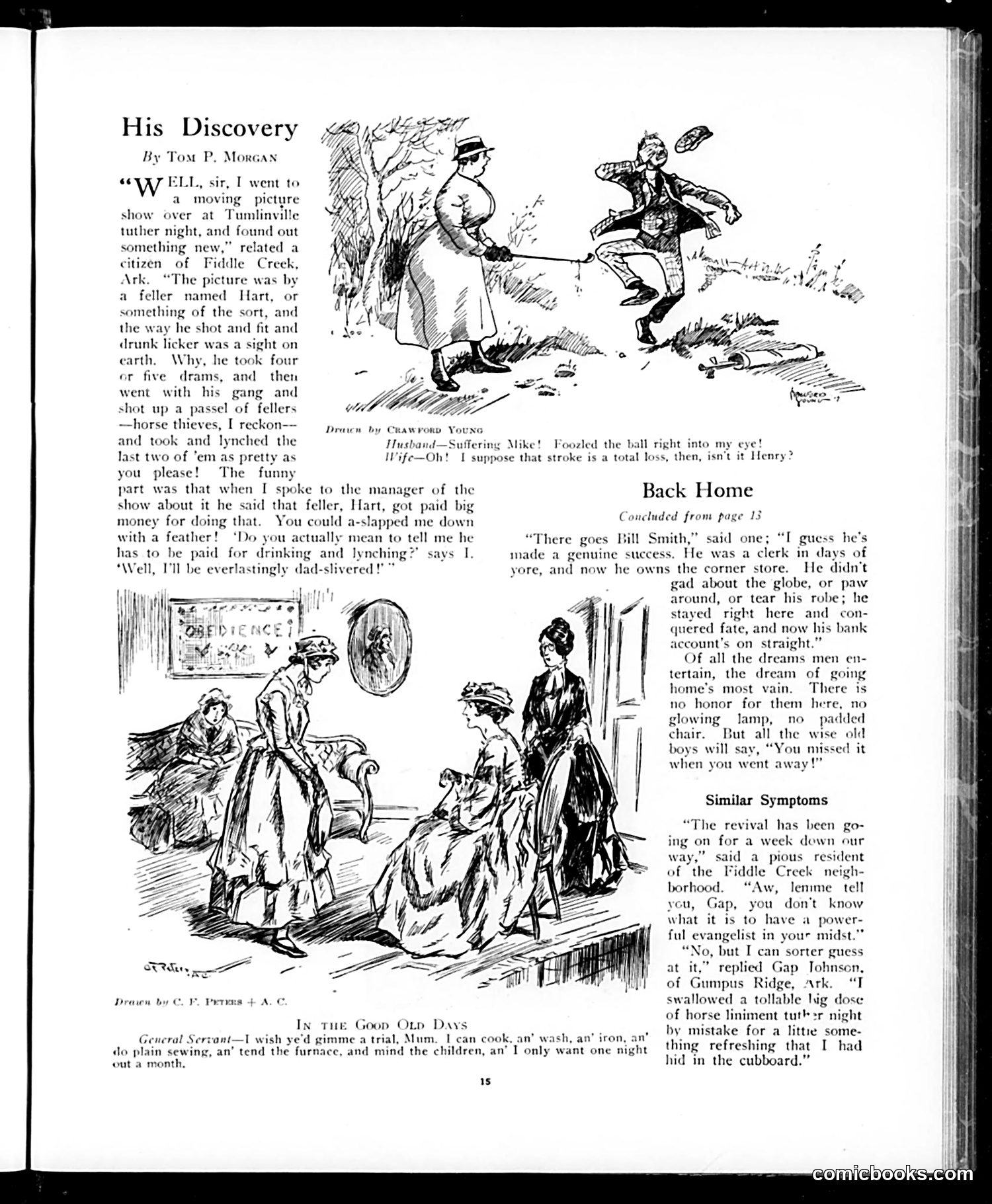
This page contains three humorous rural dialect stories satirizing early 1900s American small-town life. **"His Discovery"** mocks a backwoods Arkansas citizen amazed that actor Hart (likely William S. Hart, famous Western film star) gets paid handsomely for on-screen drinking and violence—activities the narrator views as criminal misconduct, not entertainment. The satire targets rural audiences' naïveté about cinema and actors' compensation. **"Back Home"** contrasts worldly ambition with provincial values: Bill Smith succeeds by staying put and building the corner store rather than adventuring elsewhere. The moral—that leaving home dishonors you—reflects conservative small-town ideology mocking those seeking broader opportunities. **"Similar Symptoms"** draws a crude analogy between religious revivals and accidental poisoning (horse liniment mistaken for medicine), suggesting both produce similar feverish, disorienting effects. It satirizes evangelical enthusiasm as mentally disruptive. All three stories use exaggerated dialect and folksy narrators to portray rural America as comically backward and suspicious of modernity—a common Judge magazine trope targeting working-class readers as objects of ridicule.
📄 Transcribed text from this page (OCR, searchable)
Machine-transcribed from the original scan — historical spelling and the odd misread are preserved.
His Discovery <& By Tom P. Moran “W =LL, sir, I went to a moving picture show over at Tumlinville tuther night, and found out something new,” related a citizen of Fiddle Creek, Ark. “The picture was by a feller named Hart, or something of the sort, and the way he shot and fit and drunk licker was a sight on earth. Why, he took four or five drams, and then went with his gang and shot up a passel of fellers —horse thieves, I reckon-—-——pruien by Crawrono Youno and took and lynched the Husband—Suffering Mike! Foozled the ball right into my eye! last two of ‘em as pretty as Wife—Oh! 1 suppose that stroke is a total loss, then, isn’t it Henry? you please! The funny part was that when I spoke to the manager of the Back Home show about it he said that feller, Hart, got paid big 7 money for doing that. You could a-slapped me down Concluded from page 13 with a feather! ‘Do you actually mean to tell me he “There goes Bill Smith,” said one; “I guess he’s has to be paid for drinking and lynching?” I. made a genuine success. He was a clerk in days of ‘Well, I'l be everlastingly dad-sliverec yore, and now he owns the corner store. He didn't , gad about the globe, or paw around, or tear his robe; he stayed right here and con- quered fate, and now his bank account’s on straight.” Of all the dreams men en- tertain, the dream of going home's most vain. There is no honor for them here, no glowing lamp, no padded chair. But all the wise old boys will say, “You missed it when you went away!” Similar Symptoms “The revival has been go- ing on for a week down our way,” said a pious resident of the Fiddle Creek neigh- borhood. “Aw, lenime tell you, Gap, you don't know what it is to have a power- ful evangelist in your midst.” “No, but I can sorter guess at it,” replied Gap Johnson, of Gumpus Ridge, Ark. “T swallowed a tollable hig dose salltre: Goats Orn Bays of horse liniment turk or night ral Servont—t wish ye'd gimme a trial, Mum, Lcan cook, an’ wash, an’ iron, ant bY, mistake for a litte some. 1 sewing, an’ tend the furnace, and mind the children, an’ I only want one night thing refreshing that I had out a month, hid in the cubboard.” Drawn by C.F. Perens + J 1s