
Judge, 1919-11-08 · page 26 of 36
Judge — November 8, 1919 — page 26: what you’re looking at
What you’re looking at
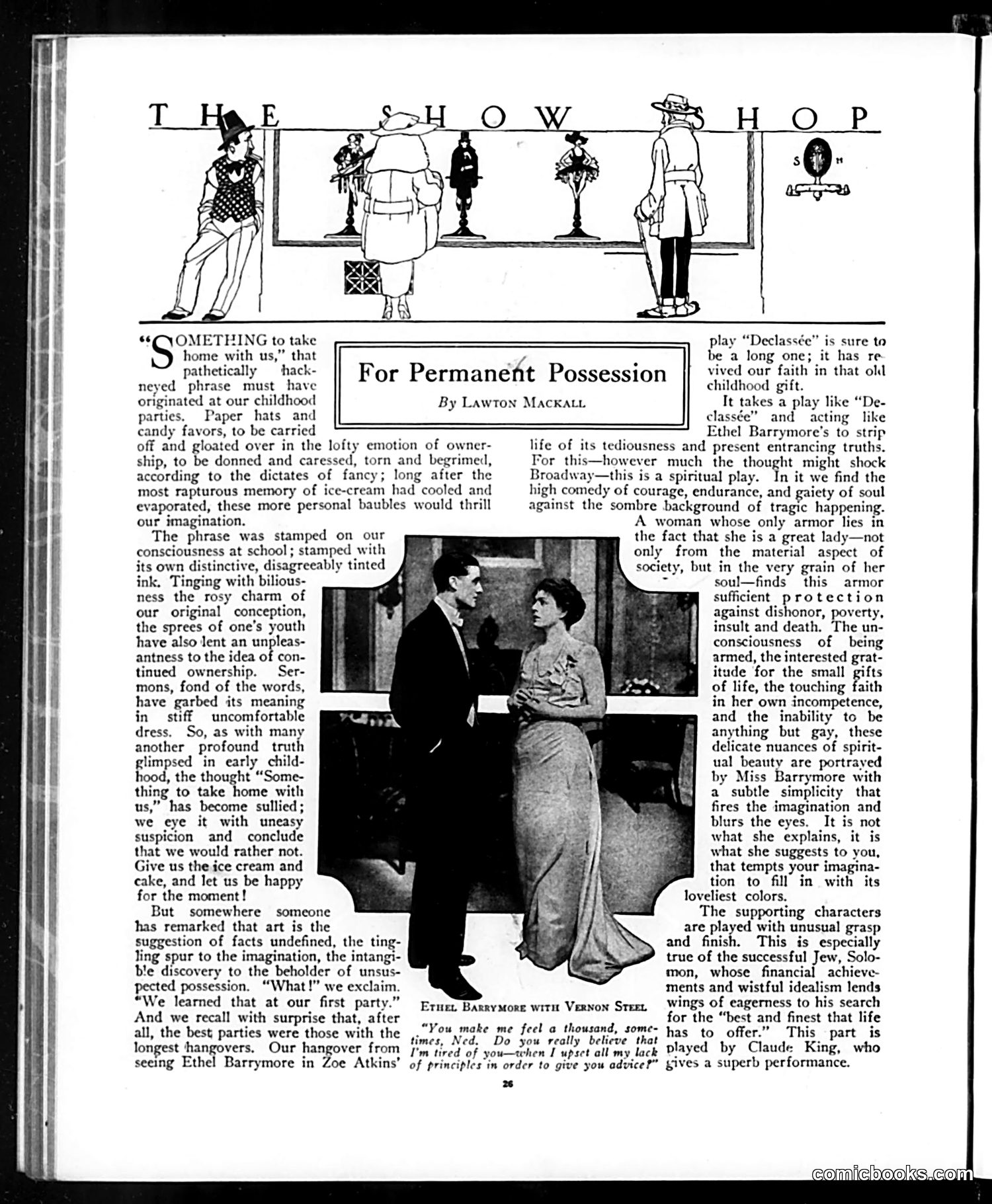
This page contains two distinct pieces: a theatrical review and an illustration. **"The Show Shop" Header:** A decorative cartoon showing a storefront window display with fashionable figures and hats—likely advertising or illustrating theater-related content. **Main Review:** Lawton Mackall's essay reviews Ethel Barrymore in the play "Declassée" by Zoë Atkins. The review praises Barrymore's performance as spiritually elevating, depicting a woman of inherent dignity who maintains her "armor" of grace against poverty and dishonor. Barrymore is portrayed as embodying refined values—kindness, faith, and courage—rather than material wealth or social status. **Supporting Cast:** The review notes Claude King's performance as Solomon, a Jewish character whose financial success is tempered by idealistic yearnings for "the best and finest that life has to offer." **Context:** This represents 1920s theater criticism celebrating Barrymore's dramatic range and the play's moral sophistication, contrasting inner character with external circumstances—popular themes in postwar American drama.
📄 Transcribed text from this page (OCR, searchable)
Machine-transcribed from the original scan — historical spelling and the odd misread are preserved.
“CVOMETHING to take home with us,” that pathetically —‘hack- neyed phrase must have originated at our childhood parties. Paper hats and candy favors, to be carried For Permanent Possession By Lawton Mackati off and gloated over in the lofty emotion of owner- ship, to be donned and caressed, torn and begrimed, according to the dictates of fancy; long after the most rapturous memory of ice-cream had cooled and evaporated, these more personal baubles would thrill our imagination. The phrase was stamped on our consciousness at school; stamped with its own distinctive, disagreeably tinted ink. Tinging with bilious- ness the rosy charm of our original conception, the sprees of one’s youth have also Jent an unpleas- antness to the idea of con- tinued ownership. Ser- mons, fond of the words, have garbed its meaning in stiff uncomfortable dress. So, as with many another profound truth glimpsed in early child- hood, the thought “Some- thing to take home with us,” has become sullied; we eye it with uneasy suspicion and conclude that we would rather not. Give us the ice cream and cake, and let us be happy for the moment! But somewhere someone has remarked that art is the suggestion of facts undefined, the ting- ling spur to the imagination, the intangi- ble discovery to the beholder of unsus- pected possession. “What!” we exclaim. “We learned that at our first party.” And we recall with surprise that, after all, the best parties were those with the Our hangover from seeing Ethel Barrymore in Zoe Atkins’ longest ‘hangovers. Ernet Barrymore wit Vernon Steet “You make me feel a thousand, some- times, Ned. Do you really believe that I'm tired of you—then I upset all my lack Pl of principles in order to give you advice?” gives a superb performance. ’ is sure ta be a long one; it has re vived our faith in that oll childhood gift. It takes a play like “De- é and acting like Ethel Barrymore's to strip life of its tediousness and present entrancing truths. For this—however much the thought might shock Broadway—this is a spiritual play. In it we find the high comedy of courage, endurance, and gaiety of soul against the sombre background of tragic happening. A woman whose only armor lies in the fact that she is a great lady—not only from the material aspect of society, but in the very grain of her iy soul—finds this armor sufficient protection against dishonor, poverty, insult and death. The un- consciousness of being armed, the interested grat- itude for the small gifts of life, the touching faith in her own incompetence, and the inability to be anything but gay, these delicate nuances of spirit- ual beauty are portrayed by Miss Barrymore with a subtle simplicity that fires the imagination and blurs the eyes. It is not what she explains, it is what she suggests to you, that tempts your imagina- tion to fill in with its loveliest colors. The supporting characters are played with unusual grasp and finish. This is especially true of the successful Jew, Solo- mon, whose financial achieve- ments and wistful idealism lends wings of eagerness to his search for the “best and finest that life has to offer.” This part is played by Claude King, who