
Judge, 1919-11-08 · page 12 of 36
Judge — November 8, 1919 — page 12: what you’re looking at
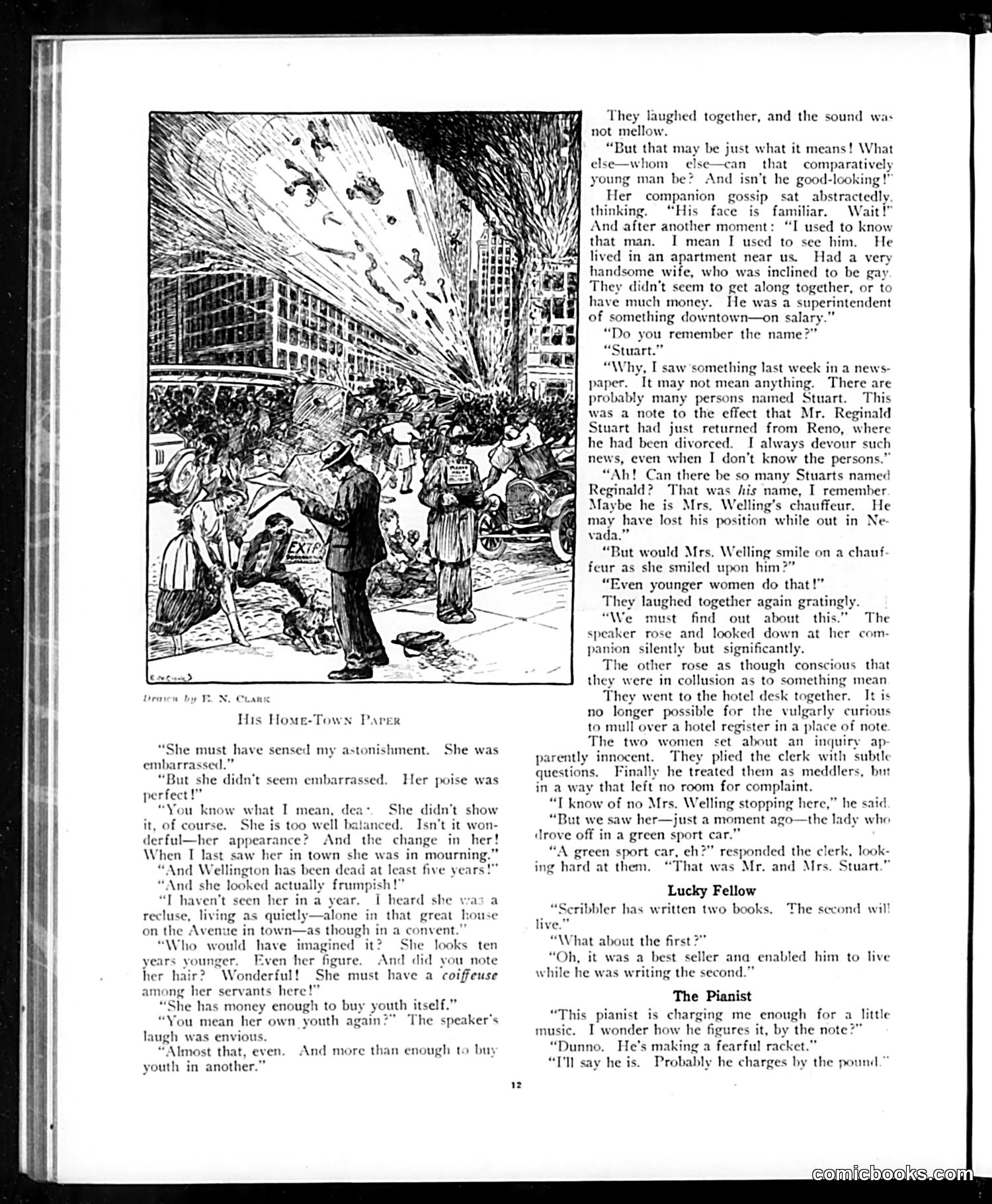
What you’re looking at
This cartoon satirizes wealthy society women's malicious gossip and snobbery. Two women at a resort notice a wealthy widow (Mrs. Welling) appearing rejuvenated, accompanied by a handsome younger man. Through idle chitchat, one recalls seeing the man years ago as a poorly paid apartment superintendent with an unhappy marriage. Learning from a newspaper that a "Reginald Stuart" was recently divorced in Reno, they speculate he's Mrs. Welling's chauffeur—a social inferior. Their "mean" collusion leads them to interrogate the hotel clerk, who reveals the man is actually "Mr. and Mrs. Stuart," indicating the couple married after his divorce. The satire mocks upper-class women who: assume working-class status based on appearance, conspire to uncover scandalous details, and judge relationships by social hierarchy. The widow's genuine happiness and the man's improved circumstances expose their petty malice as groundless.
📄 Transcribed text from this page (OCR, searchable)
Machine-transcribed from the original scan — historical spelling and the odd misread are preserved.
His Home-Town Parer “She must have sensed my astonishment. She was embarrassed.” “But she didn’t seem embarrassed perfect!” “You know what I mean, dea* She didn’t show it, of course. She is too well balanced. Isn't it won- derful—her appearance? And the change in her! When I last saw her in town she was in mourning.” “And Wellington has been dead at least five years!” “And she looked actually frumpish!” “T haven't seen her ina year. I heard she was a recluse, living as quictly—alone in that great house on the Ave in town—as though in a convent.” “Who would have imagined it? She looks ten years younger. Even her figure. And did you note her hair? Wonderful! She must have a coiffeuse among her servants here!” “She has money enough to buy You mean her own youth again?” h was envious. “Almost that, even. And more than enough to buy youth in another.” Her poise was outh itself.” The speaker's They laughed together, and the sound was not mellow. “But that may be just what it means! What else—whom else—can_ that comparatively young man be? And isn’t he good-looking!" Her companion gossip sat abstractedly thinking. “His face is familiar. Wait!” And after another moment: “I used to know that man. I mean I used to see him. He lived in an apartment near us. Had a very handsome wife, who was inclined to be gay. They didn’t seem to get along together, or to have much money. He was a superintendent of something downtown—on salary.” “Do you remember the name?” “Stuart.” “Why, I saw something last week in a news- paper. It may not mean anything. There are probably many persons named Stuart. This was a note to the effect that Mr. Reginald Stuart had just returned from Reno, where he had been divorced. I always devour such news, even when I don’t know the persons.” “Ah! Can there be so many Stuarts named Reginald? That was his name, I remember Maybe he is Mrs, Welling’s chauffeur. He may have lost his position while out in Ne- vada.” “But would Mrs. Welling smile on a chauf- feur as she smiled upon him?” “Even younger women do that!” They laughed together again gratingly. “We must find out about this.” The speaker rose and looked down at her com- panion silently but. significantly. The other rose as though conscious that they were in collusion as to something mean They went to the hotel desk together. It is no longer possible for the vulgarly curious to mull over a hotel register in a place of note The two women set about an inquiry ap parently innocent. They plied the clerk with subtle questions. Finally he treated them as meddlers, but in a way that left no room for complaint. “IT know of no Mrs. Welling stopping here,” he said “But we saw her—just a moment ago—the lady who drove off in a green sport car.” “A green sport car, eh?” responded the clerk, look- ing hard at them. “That was Mr. and Mrs. Stuart.” Lucky Fellow ribbler has written two books. The second will Vhat about the first ?” “Oh, it was a best seller ana enabled him to live while he was writing the second.” The Pianist “This pianist is charging me enough for a little music. I wonder how he figures it, by the note?” “Dunno. He's making a fearful racket.” “I'll say he is. Probably he charges by the pound.”