
A complete issue · 38 pages · 1919
Judge — November 1, 1919
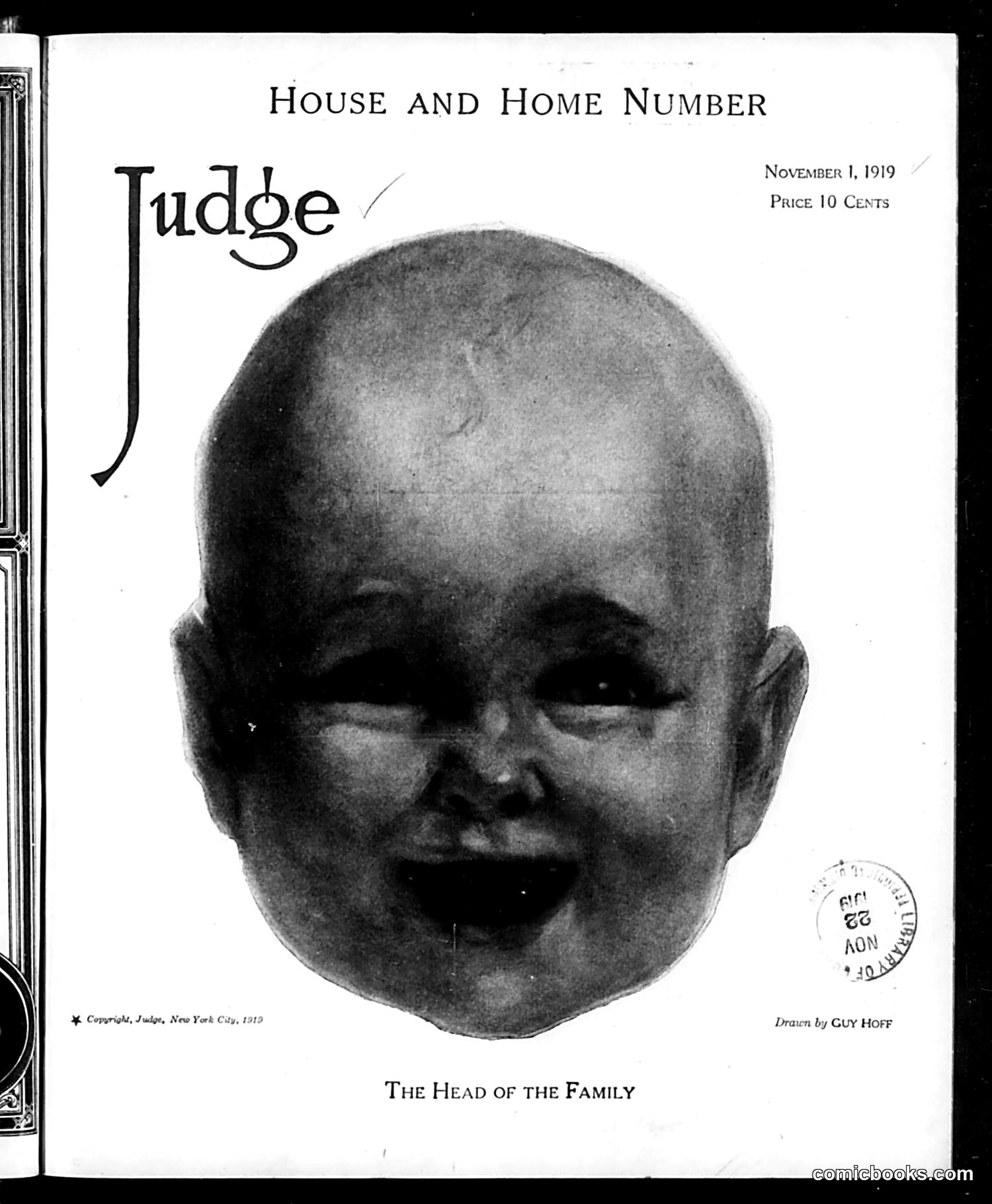
This is the cover of Judge magazine's satirical issue from November 1919, featuring a drawing by Guy Hoff titled "The Head of the Family." The image shows a bald man's head rendered in caricature style. Without additional context on the page, the specific identity of this figure is unclear. However, the title "The Head of the Family" suggests social commentary about domestic authority or family structure—likely a topical reference relevant to 1919 America. The drawing's emphasis on the head and its formal presentation as a cover suggests this was a prominent public figure of the era, but I cannot definitively identify who without more contextual information from the magazine's contents.

This page is primarily **advertising, not satire or political cartoon**. It promotes WDC Triangle pipes made with Bakelite, a synthetic material popular in early-to-mid 20th century manufacturing. The advertisement includes decorative illustrations of men smoking pipes in various social settings (what appears to be a ship, office, and leisure scenes), meant to suggest sophistication and status. The text emphasizes that Triangle Bakelite pipes possess beauty comparable to natural amber while offering superior durability and won't burn or stain. The WDC (Wm. Demuth & Co.) mark indicates this is a product advertisement from a major pipe manufacturer. This represents typical consumer advertising of the era, targeting affluent male smokers who valued quality tobacco equipment.
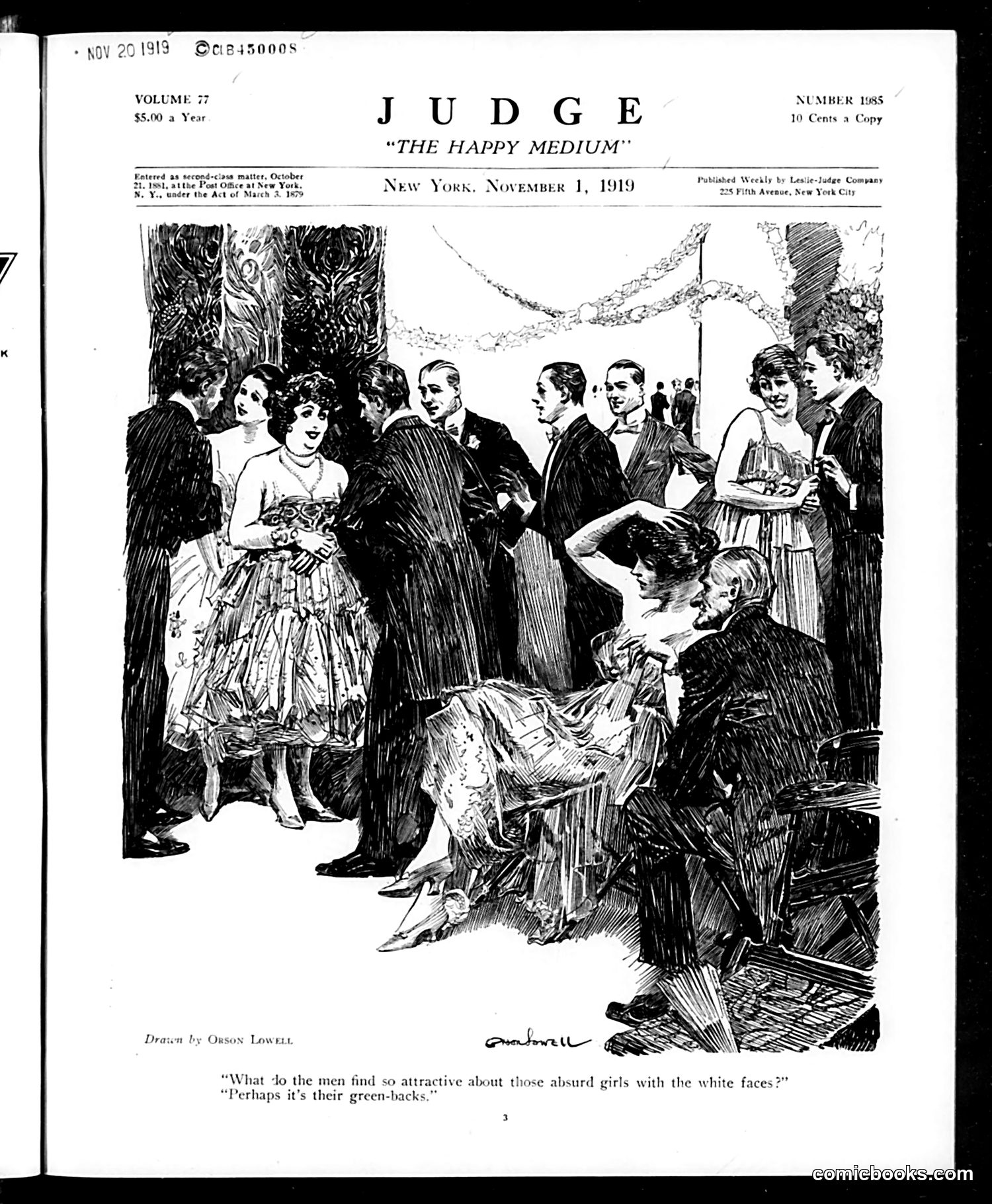
This satirical cartoon depicts a social gathering where well-dressed men surround women with heavily powdered faces. The caption records a conversation: one man asks what men find attractive about "those absurd girls with the white faces," to which another replies "Perhaps it's their green-backs" (slang for money/dollar bills). The satire targets the fashion trend of heavily powdered makeup popular among women in the 1910s-1920s, which gave faces an artificial white appearance. The joke cynically suggests men pursue these women not for their beauty or personality, but for their wealth. This reflects period anxieties about changing gender roles, consumerism, and the "flapper" era emerging post-World War I.
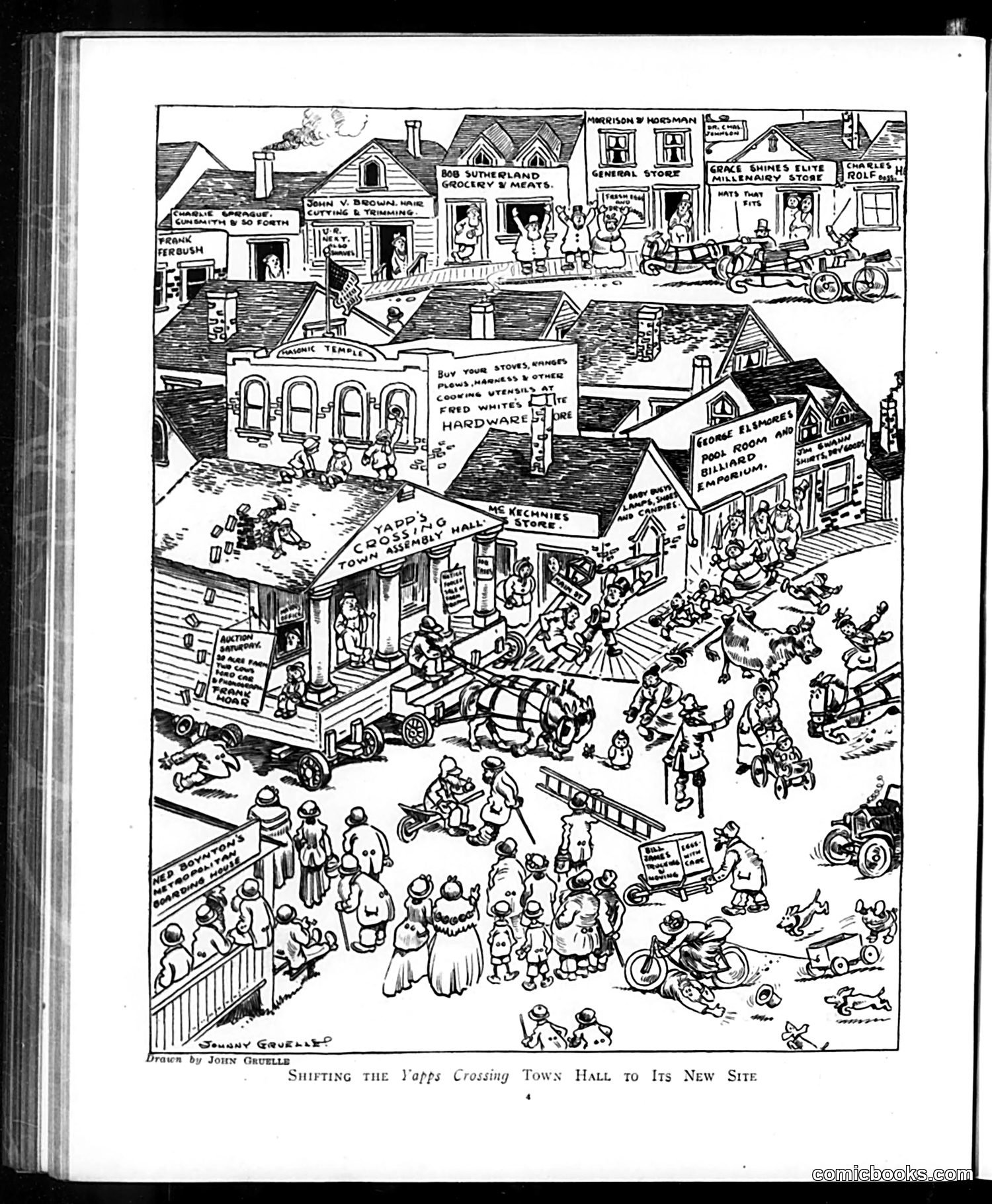
This is a detailed satirical illustration depicting a small town community effort to relocate their town hall building. The cartoon shows numerous townspeople engaged in the physical labor of moving the structure, using various makeshift methods and vehicles—horses, carts, and simple mechanical devices. The satire appears to target small-town civic pride and the ambitious (perhaps overreaching) efforts of rural communities to modernize and improve their infrastructure. Various labeled businesses and establishments surround the scene, suggesting this depicts a specific real town undergoing development. The humor lies in the chaotic, labor-intensive nature of the undertaking and the broad cross-section of townspeople mobilized for this collective civic project—a gentle mockery of rural American community cooperation and earnest determination.
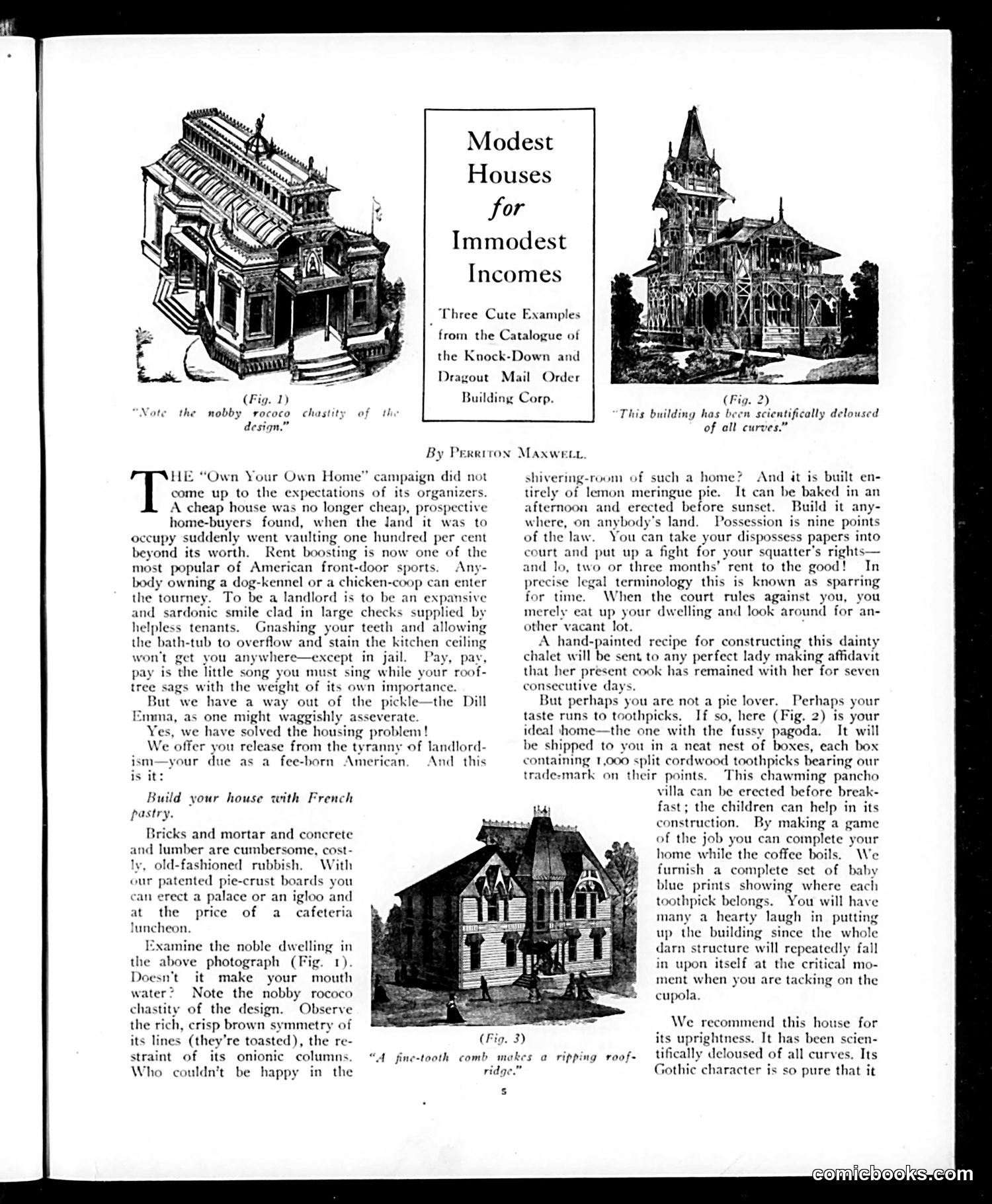
This satirical article by Perriton Maxwell mocks the "Own Your Own Home" campaign—likely referring to 1920s real-estate promotion. The humor targets the gap between marketing promises and reality. The three illustrated house designs are intentionally absurd: Fig. 1 shows an ornate, elaborate mansion labeled "rococo" despite claims of modesty; Fig. 2 depicts an impractical Victorian tower; Fig. 3 presents a structure so geometrically awkward that "a fine-tooth comb makes a ripping roof-ridge." Maxwell's text sarcastically proposes building homes from edible materials (French pastry) and toothpicks—absurdist solutions highlighting the impossibility of affordable homeownership for working-class Americans. The satire exposes how real-estate marketing promises modest homes while delivering expensive, impractical designs unsuitable for average budgets.
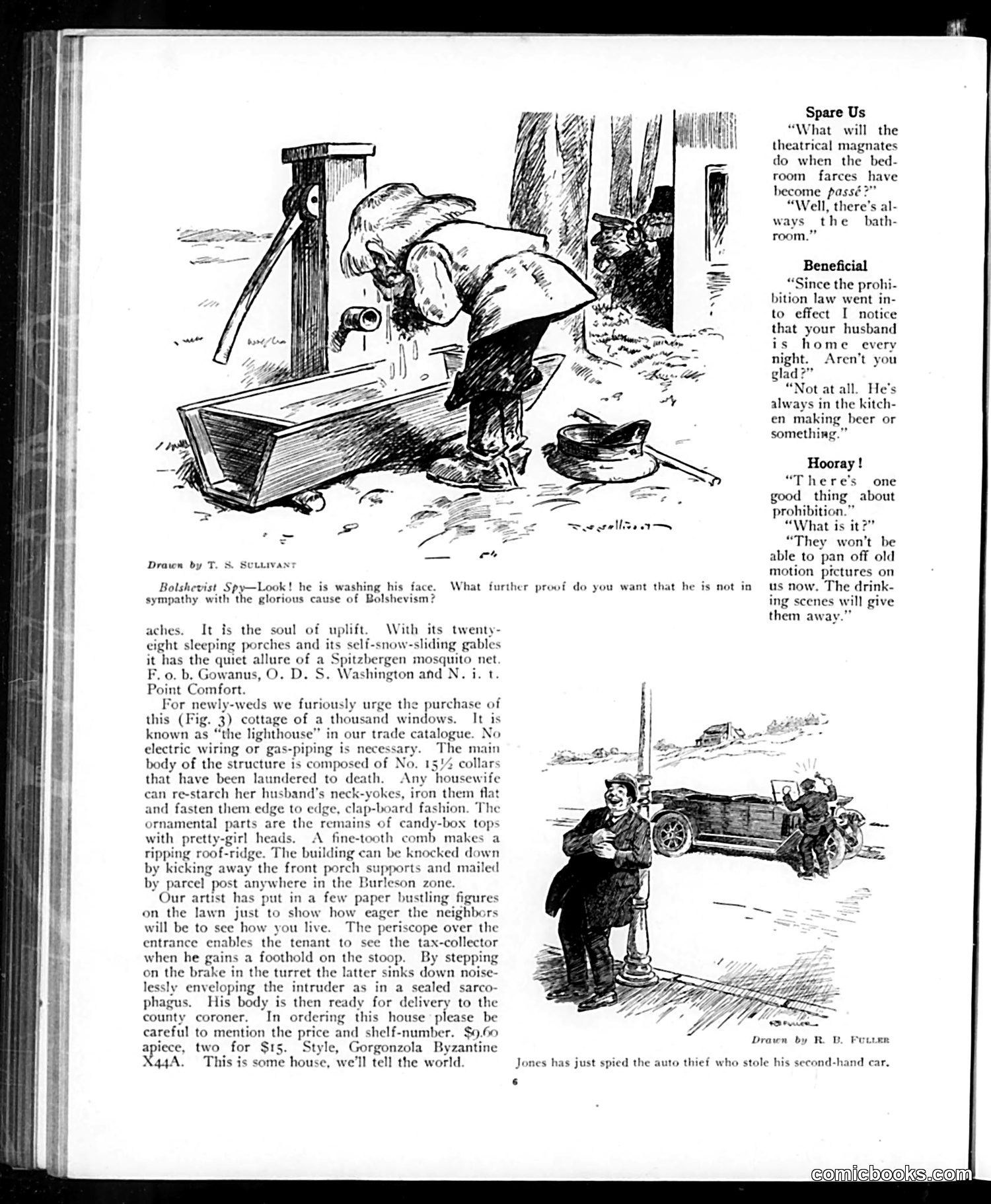
This page contains satirical commentary on Prohibition (the alcohol ban referenced in the OCR text). The three comic vignettes in the "Spare Us," "Beneficial," and "Hooray!" sections mock the law's effects: - **"Spare Us"** jokes that theatrical magnates will relocate to bathrooms since bedroom farces are now "passé" - **"Beneficial"** suggests husbands stay home nightly now—not from virtue but because they're "in the kitchen making beer" - **"Hooray!"** celebrates one benefit: movies won't show drinking scenes anymore, as "the drinking scenes will give them away" The top illustration shows a man apparently engaged in illicit alcohol production or washing up from such work—visual proof of Prohibition's ironic result: widespread home brewing replacing legal taverns. The satire targets how the law drove alcohol consumption underground rather than eliminating it.
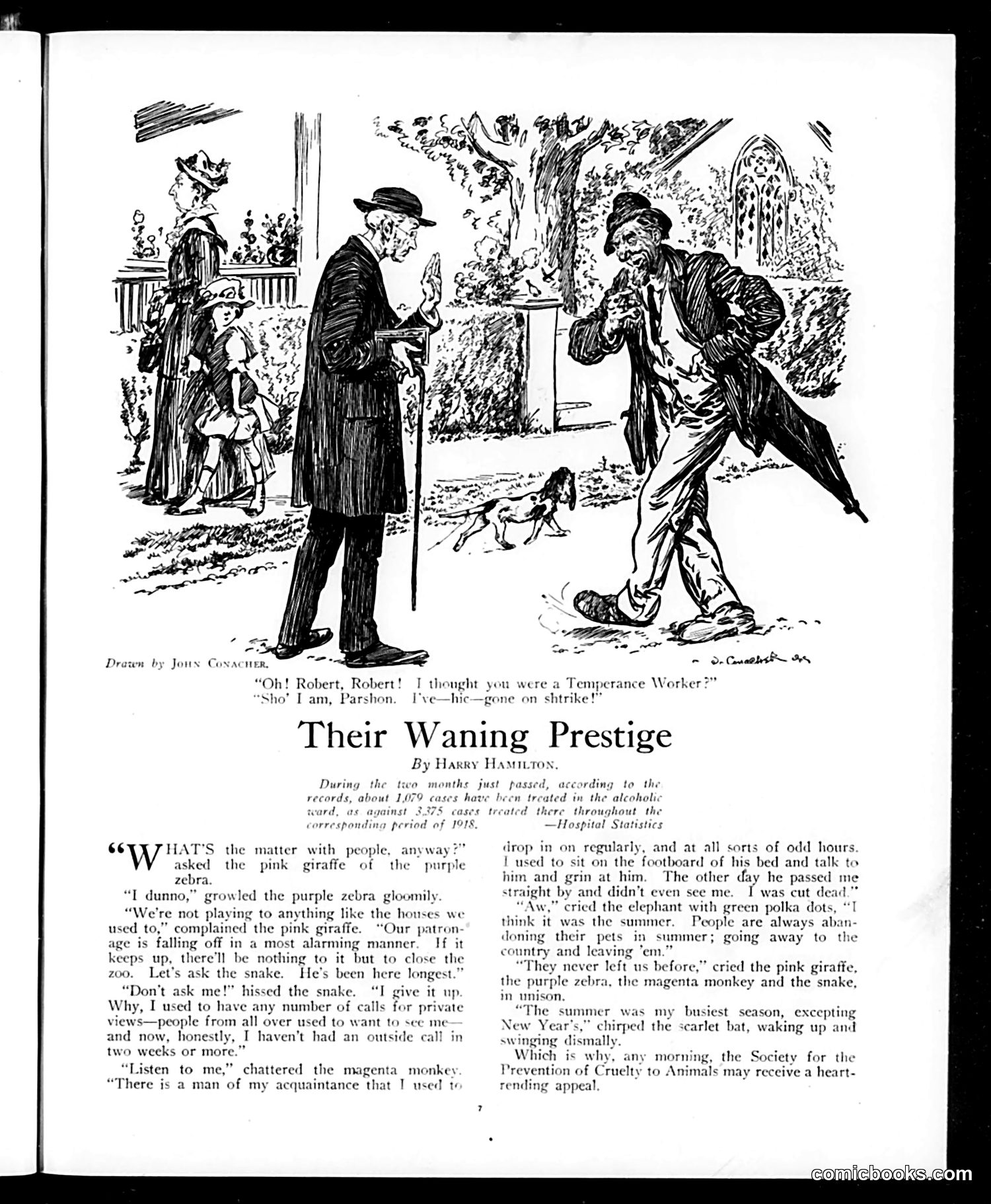
This is a satirical fable using zoo animals as stand-ins for what appears to be **entertainment venues or performers experiencing declining attendance** during Prohibition era (context: "Temperance Worker" reference in the cartoon). The cartoon shows a well-dressed man confronted by a drunk acquaintance claiming to be on "strike"—mocking temperance activists' credibility. The story below uses anthropomorphic animals (giraffe, zebra, snake, monkey, elephant, bat) lamenting lost business. They blame summer vacations and people abandoning their "pets"—likely satirizing how **Prohibition reduced social gathering spaces and entertainment venues**. The piece concludes with an appeal to the Society for the Prevention of Cruelty to Animals, sarcastically suggesting these establishments deserve sympathy like neglected animals. The satire targets both the temperance movement's impact on leisure industries and the hypocrisy of reform advocates.
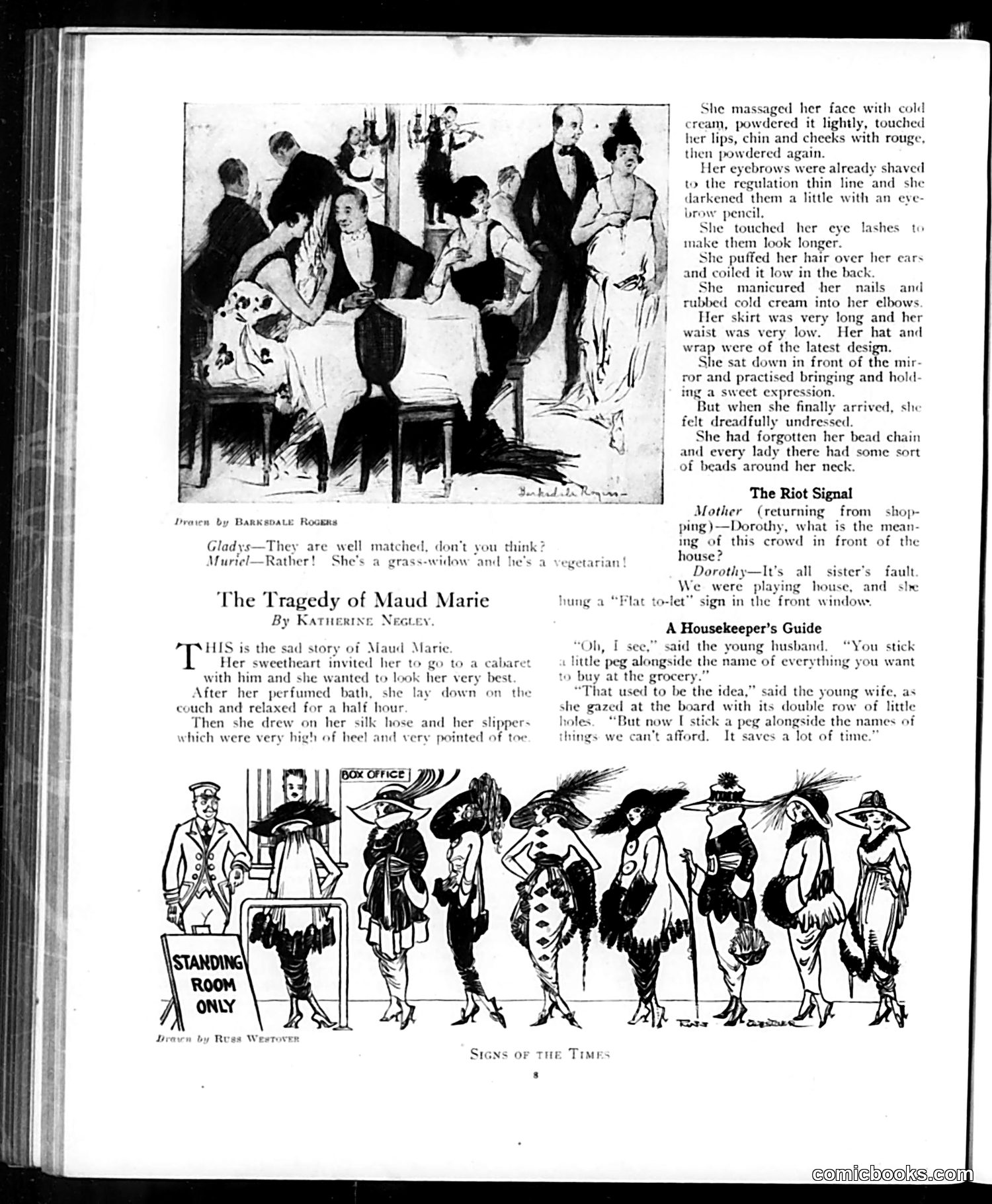
This page contains three satirical pieces mocking 1920s social anxieties: **"The Tragedy of Maud Marie"** (top): A story ridiculing the elaborate beauty rituals upper-class women performed before going out. The "tragedy" is that despite hours of cosmetics, styling, and preparation—massaging with cold cream, powdering, darkening eyebrows, curling hair, manicuring—Maud arrives at the cabaret feeling "dreadfully undressed" because she forgot a beaded necklace. It satirizes both women's exhausting beauty standards and the superficiality of fashionable society. **Bottom cartoons** mock domestic life: "The Riot Signal" jokes that a "Flat to-let" (apartment for rent) sign causes neighborhood commotion; "A Housekeeper's Guide" depicts a budget-conscious wife marking grocery items she *cannot* afford rather than those she can—suggesting Depression-era economic anxiety inverted as housewifely thrift. The page reflects Judge's satirical approach to modern consumer culture and gender roles of the era.
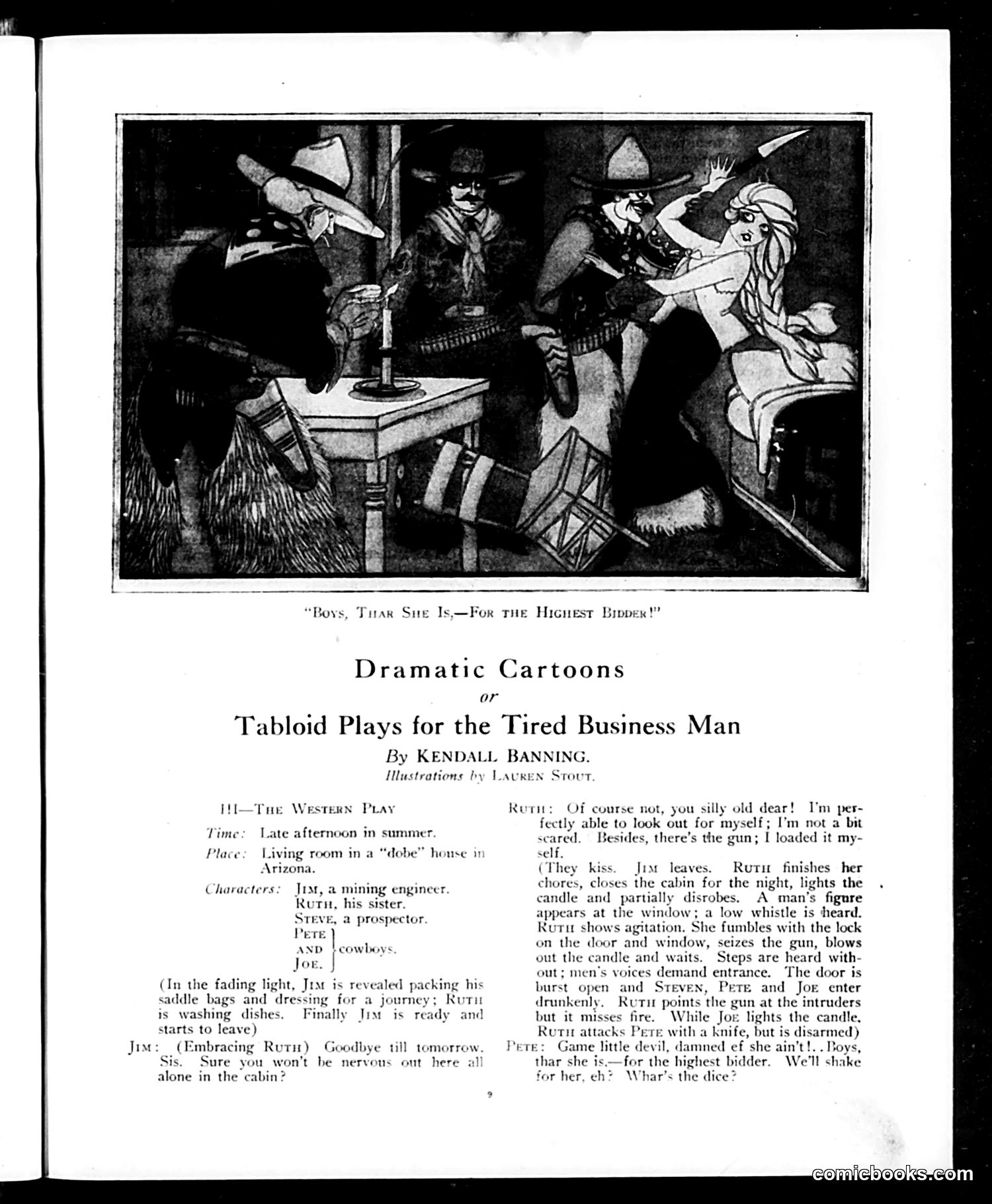
This is a serialized melodramatic sketch presented as entertainment for busy readers. The scenario depicts a classic Western scenario: a mining engineer (Jim) leaves his sister (Ruth) alone in an Arizona cabin. Drunk cowboys led by Pete break in, revealing their intention to sell Ruth "for the highest bidder"—implying sexual exploitation or trafficking. Ruth attempts self-defense with a gun and knife but is overpowered. The sketch's title promises "tabloid plays for the tired business man," suggesting these brief, sensational dramatic narratives provided escapist entertainment in the style of tabloid journalism. The cartoon illustration above shows the scene's action and danger. The humor/appeal lies in the melodramatic Western tropes: isolation, violence, villainous cowboys, and a woman in peril—pulp fiction fare presented as sophisticated satire for Judge's audience.
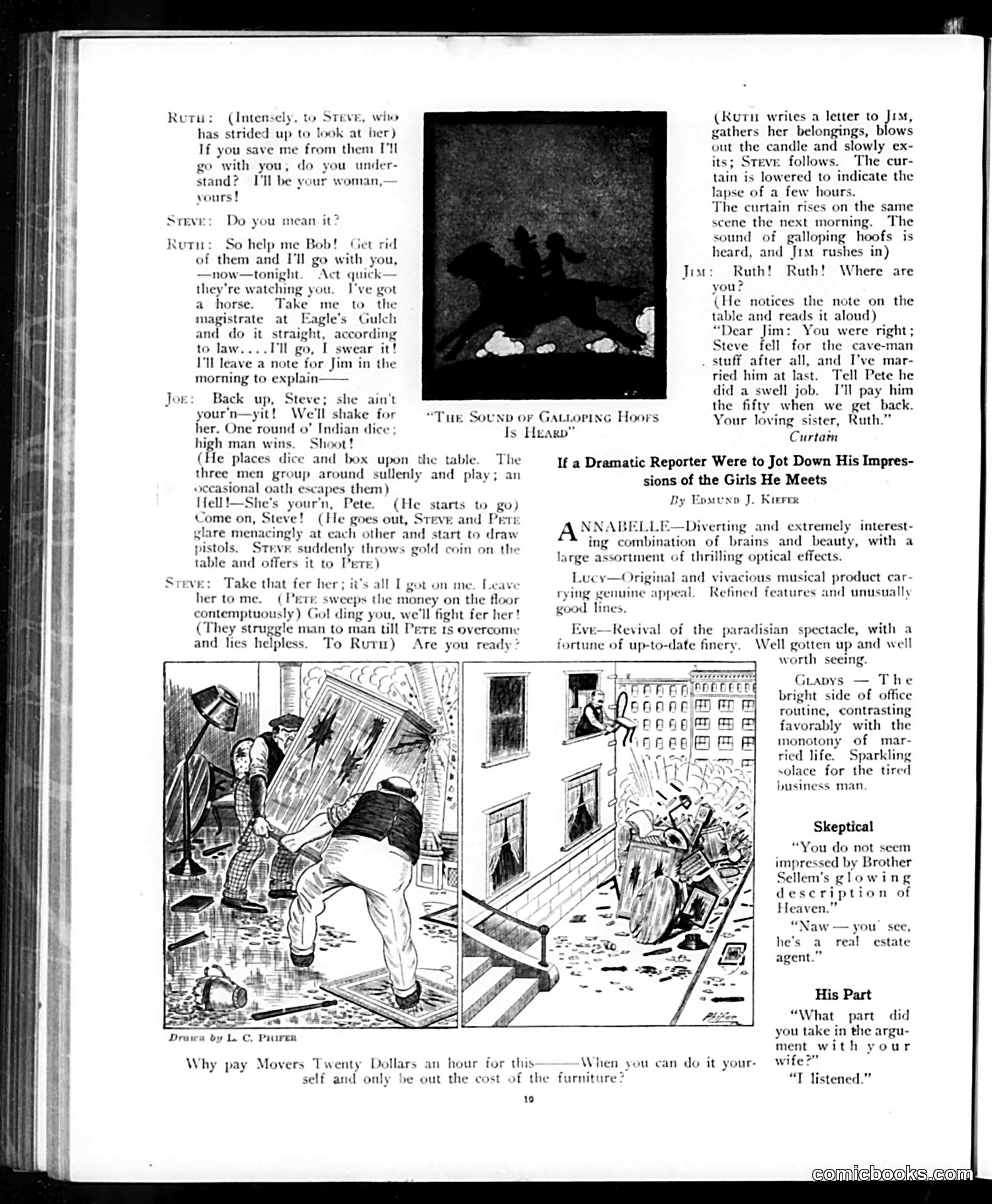
This page contains two distinct satirical pieces from an early 20th-century Judge magazine: **The Drama Sketch** (top): A melodramatic Western scene spoofing popular frontier fiction. It mocks the "caveman" trope—where men compete violently for women's affection—by having the female character (Ruth) cynically manipulate the situation. Her letter reveal shows she's played them all: she married Steve for escape but plans to pay Pete for his role. The satire targets both overwrought romantic drama and naive masculine assumptions about female agency. **"Impressions of the Girls He Meets"** (bottom): A gossip column parodying society pages. It characterizes women primarily through physical appearance and entertainment value—Annabelle's "optical effects," Lucy's "musical product," Eve as decorative spectacle, Gladys as office escapism for businessmen. The final exchange about a wife who merely "listened" to her husband's real estate pitch mocks both marital dynamics and women's supposed intellectual passivity. The satire critiques how men reduce women to ornamental or functional roles.
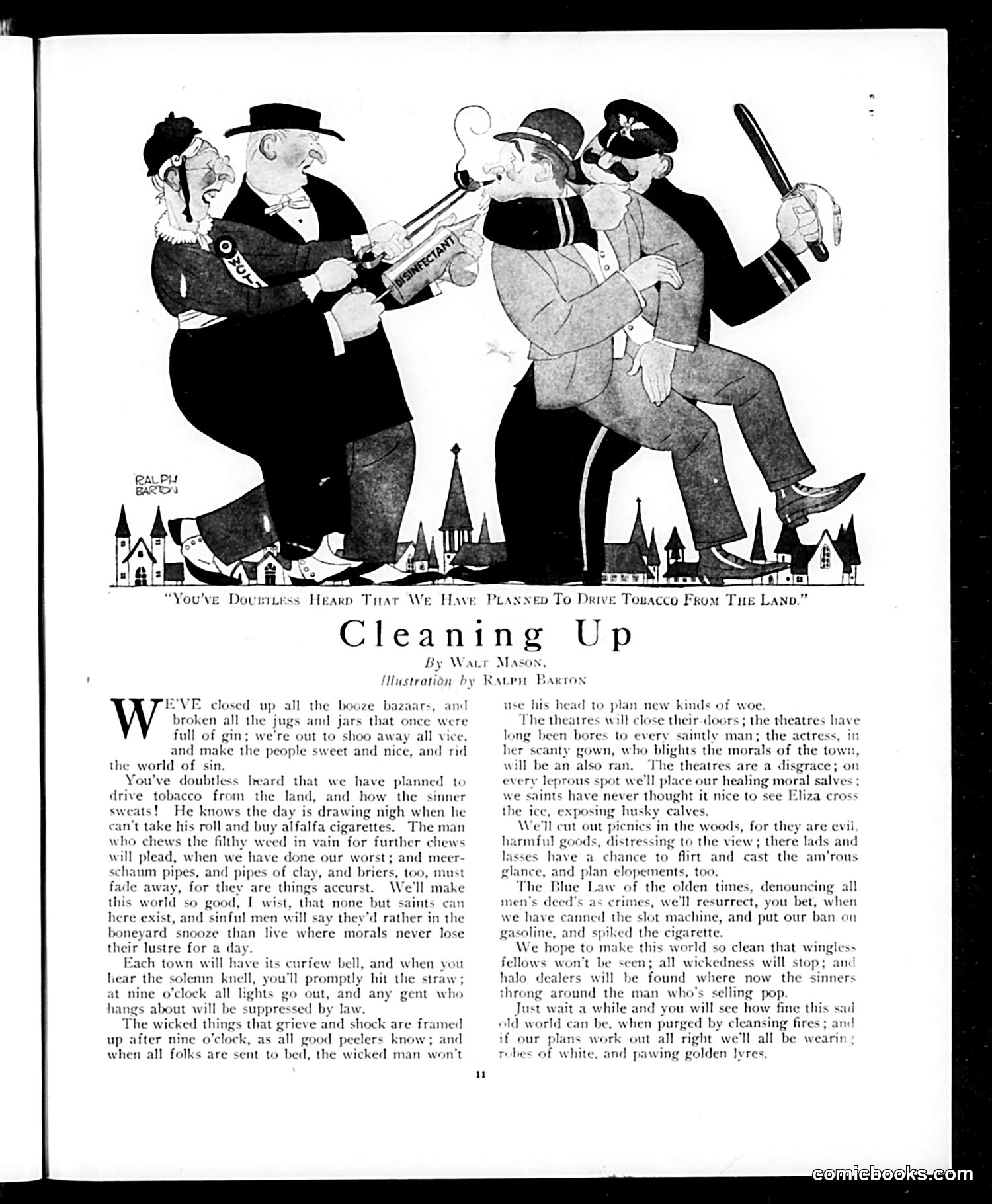
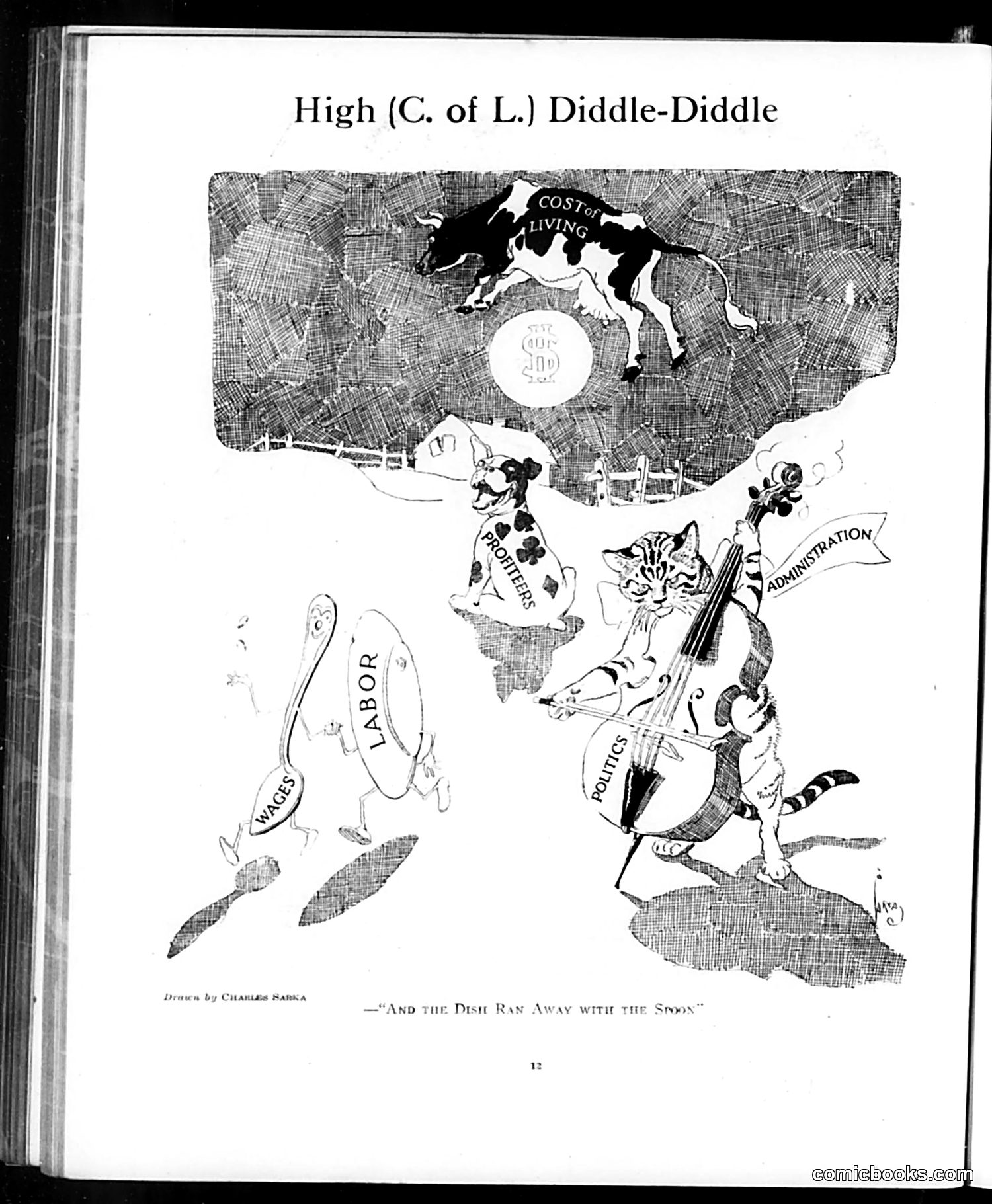
This satirical cartoon references the nursery rhyme "Hey Diddle Diddle," reimagined as political commentary. The title "High (C. of L.) Diddle-Diddle" appears to reference "C. of L." (likely "Cost of Living"), a major political concern of the era. The illustration shows anthropomorphic animals—a dog and cat playing musical instruments—with labeled elements including "Wages," "Labor," "Politics," and "Administration." The subtitle states "And the Dish Ran Away with the Spoon," adapting the nursery rhyme's conclusion. The cartoon satirizes how ordinary people (represented by the humble dish and spoon) are being cheated or displaced by various political and economic forces, while established institutions play on regardless. The high cost of living and political administration are portrayed as separate from—or indifferent to—workers' actual welfare.
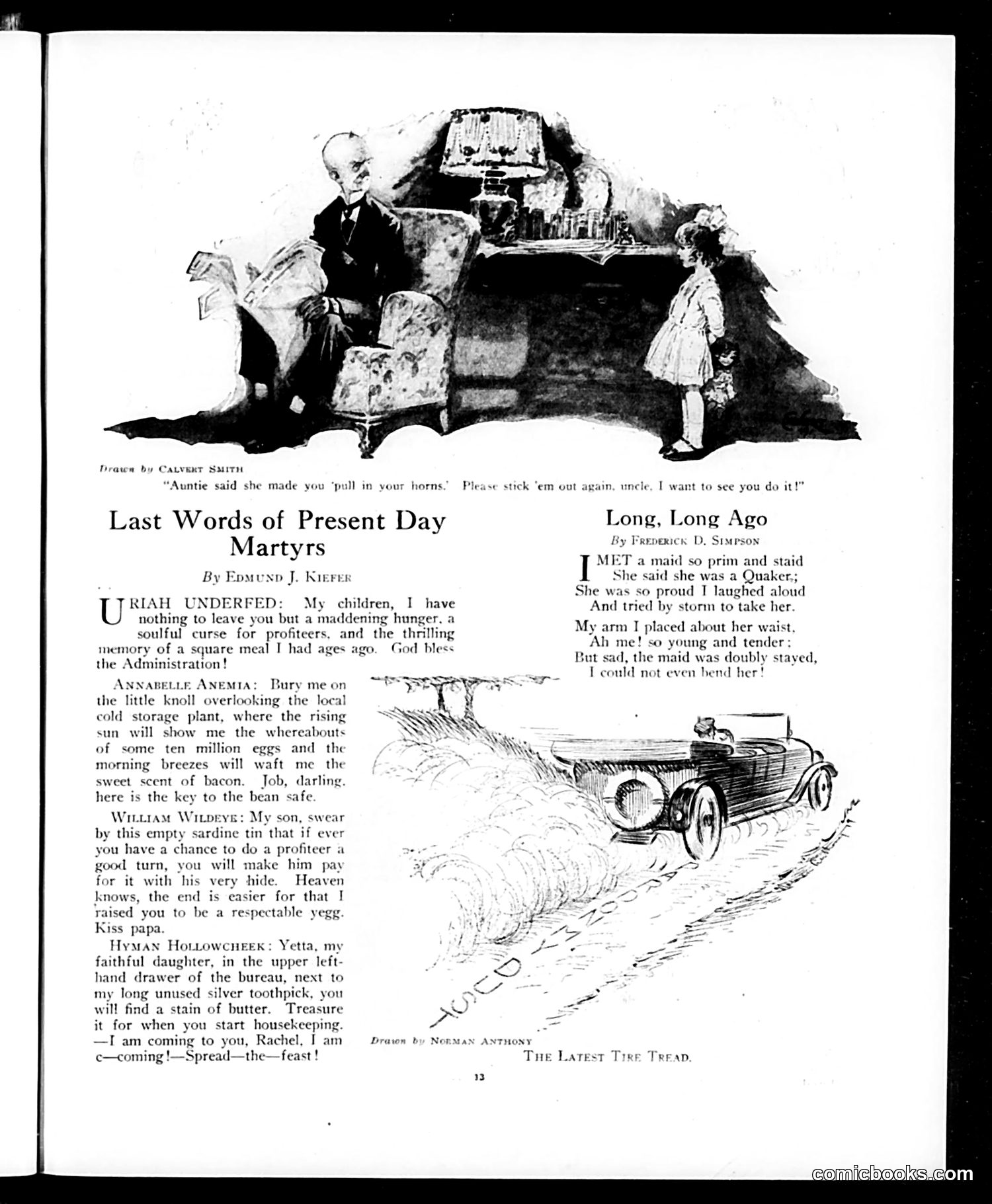
This page satirizes **post-WWI economic hardship and class resentment** through mock "last words" of dying martyrs to poverty and food scarcity. The left column presents deathbed monologues from starving characters—Uriah Underfed, Annabelle Anemia, William Wildeye—whose names literalize their deprivation. They leave their children curses against "profiteers" (wealthy industrialists blamed for inflation and scarcity) rather than material wealth. The satire targets both the actual suffering of working-class Americans and the radical rhetoric blaming capitalists. The top cartoon shows an uncle performing for a child—likely satirizing adults performing artificial displays of prosperity or restraint ("pull in your horns") for appearance's sake during economic crisis. The right poem "Long, Long Ago" offers sentimental contrast: a romanticized past where courtship occurred without modern complications. The automobile illustration ("Latest Tire Tread") advertises consumer goods—ironic juxtaposition with the starvation narratives, suggesting magazine readers lived in a different economic reality than those depicted.
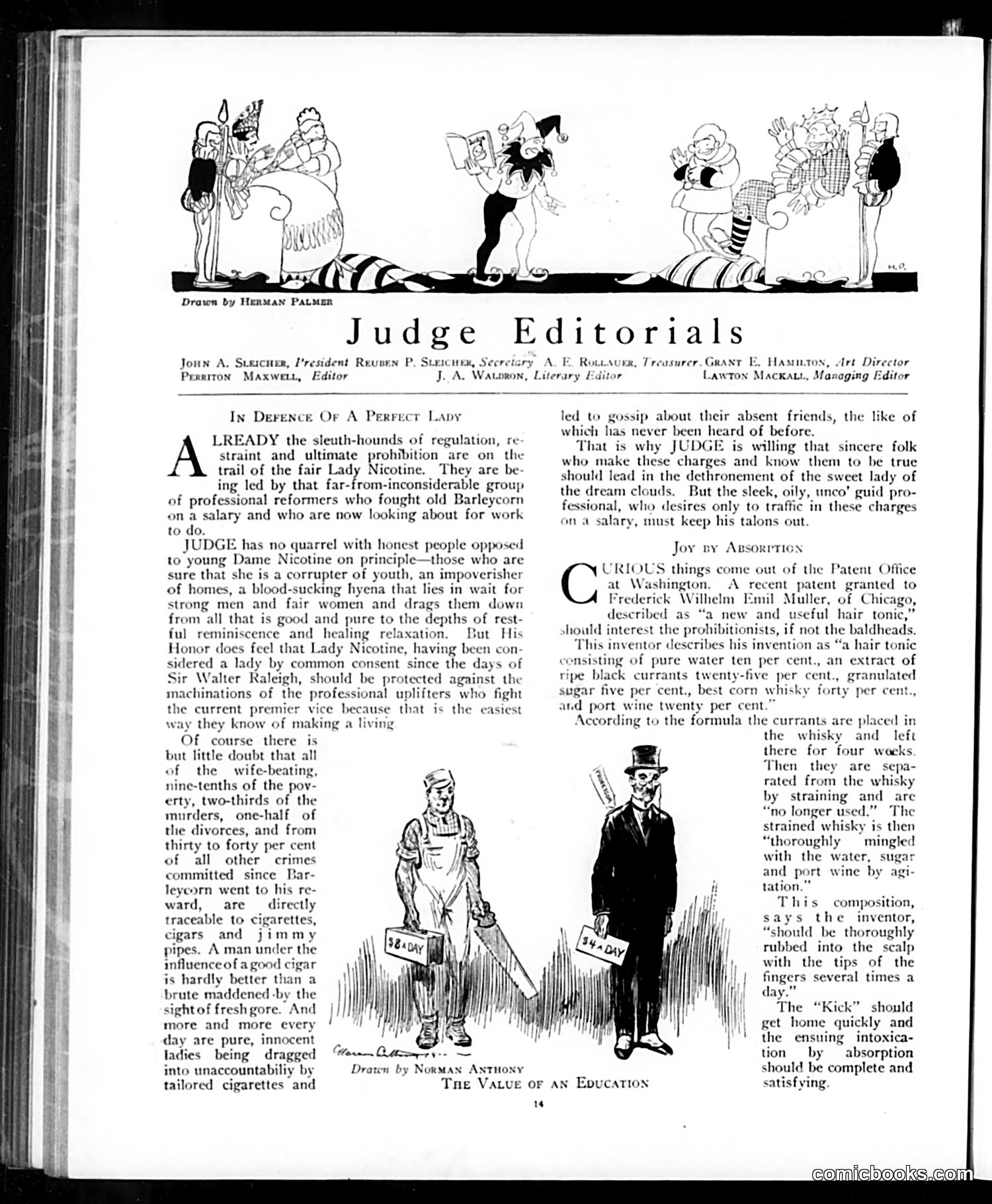
This page contains two editorials satirizing reform movements of the era (likely early 1900s). **"In Defence of a Perfect Lady"** defends cigarette smoking against prohibition campaigners. The editorial mockingly acknowledges reformers' claims that cigarettes cause crime and corruption, but attacks the "professional uplifters"—paid anti-vice activists—as opportunists. The satire suggests these reformers simply seek employment and salaries by manufacturing moral panics, having previously fought alcohol prohibition ("Barleycorn"). **"Joy by Absorption"** ridicules prohibition activists more directly through a patent description for a "hair tonic" by Friedrich Wilhelm Emil Muller. The formula is transparently a disguised alcoholic drink (40% whisky, plus port wine), designed for scalp absorption to evade anti-alcohol laws. The joke exposes how prohibition-era reformers were so focused on banning alcohol that they missed obvious loopholes—people would invent fake "medicines" to consume spirits legally. Both pieces attack prohibition-era moral reformers as both hypocritical and ineffectual.
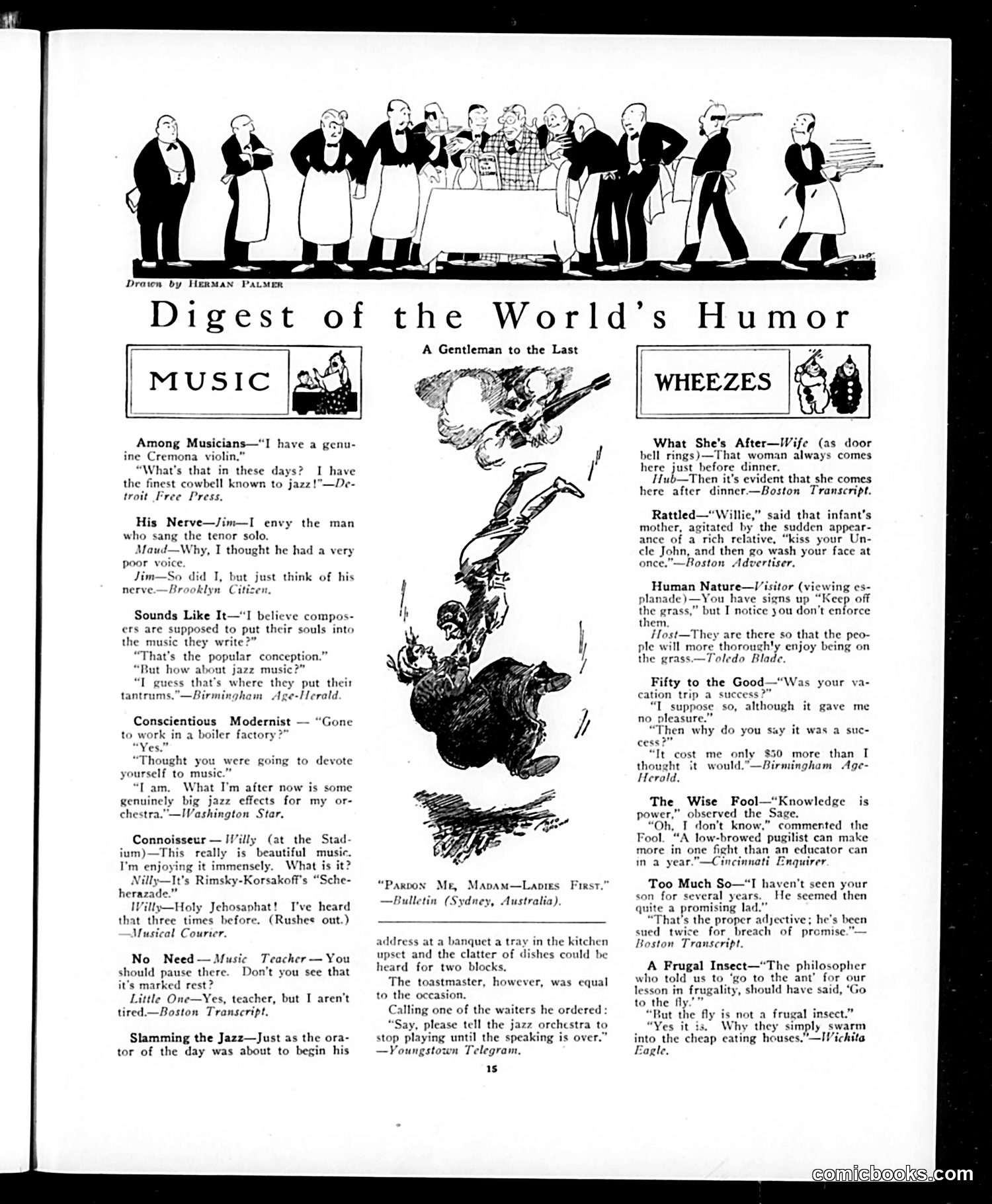
This is a humor column collecting brief jokes from various newspapers, not a political cartoon. The header illustration by Herman Palmer shows formally-dressed figures around a dining table—establishing the "sophisticated humor" framing. The jokes target early 1920s social anxieties: **jazz music** appears repeatedly as a symbol of cultural decline (displacing "serious" music like Rimsky-Korsakoff), **modernism** in arts is mocked, and there are domestic comedy bits about wives and servants. One piece jokes that a toastmaster asks a jazz orchestra to stop playing so an orator can be heard—reflecting the period's view of jazz as loud, intrusive noise. Other humor reflects class attitudes (wealthy relatives, servants, breach-of-promise suits) and social absurdities. The "Frugal Insect" joke about flies in cheap restaurants relies on Depression-era economic awareness. The central cartoon, "Pardon Me, Madam—Ladies First," depicts a gentleman helping a woman, illustrating period expectations about courtesy despite social chaos—the "gentleman to the last" theme.
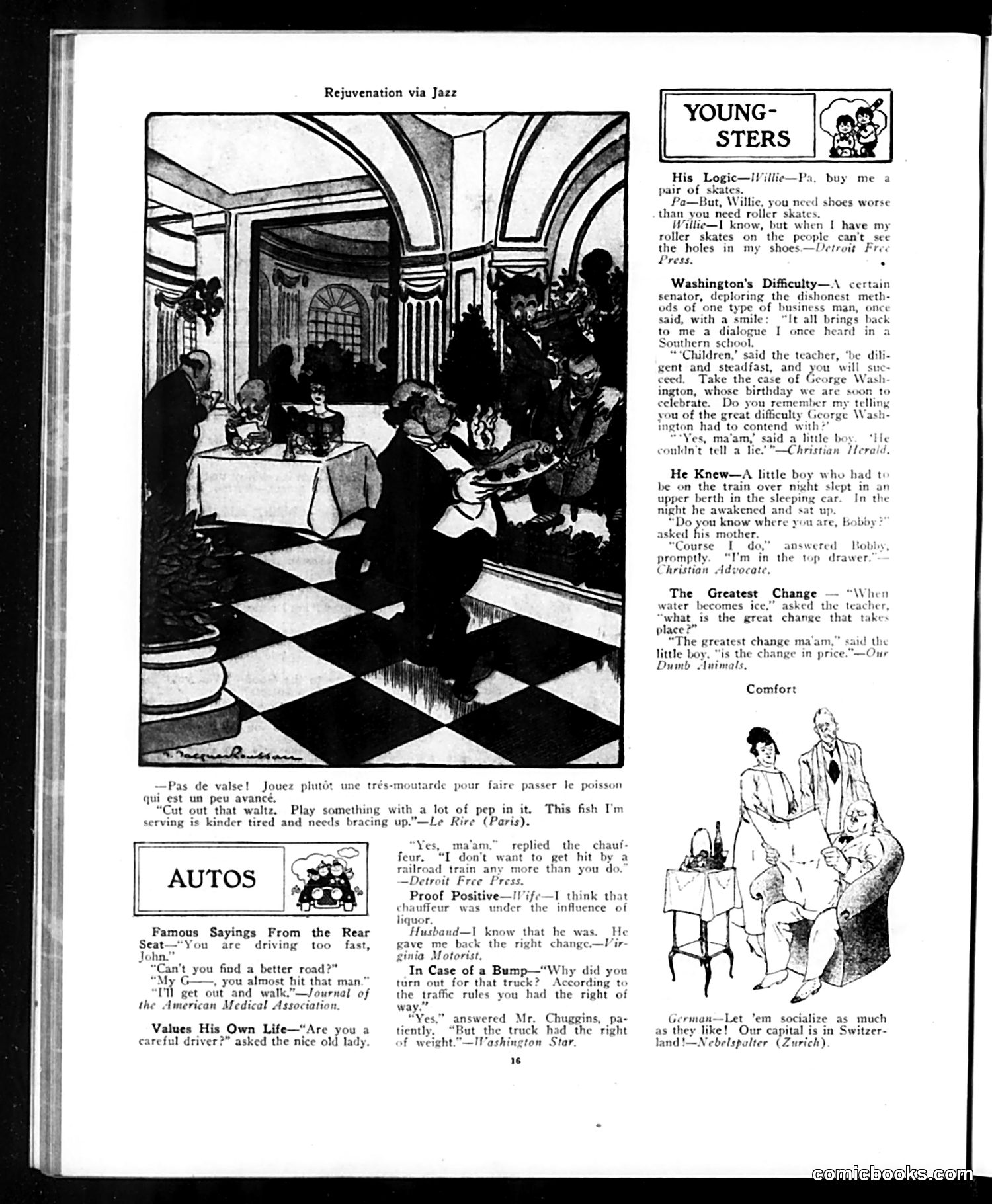
This page from *Judge* magazine (early 20th century) collects short humorous anecdotes and a large illustration about Jazz-era social life. The main cartoon depicts a formal dinner scene with lively dancing and music—"Jazz" serving as metaphorical rejuvenation for staid social conventions. A caption references a French joke about enlivening tired fish with peppy music instead of a waltz. The surrounding "Young-Sters" and "Autos" sections offer brief jokes mocking automobiles (new technology), backseat drivers, and children's logic. The "Washington's Difficulty" piece humorously invokes George Washington while criticizing dishonest business practices—implying even the founding fathers faced moral challenges. The overall theme reflects *Judge*'s satirical stance: poking fun at modern anxieties (cars, jazz's "impropriety"), family dynamics, and social pretension. The magazine assumes readers appreciate witty wordplay and gentle mockery of contemporary American life and morality.
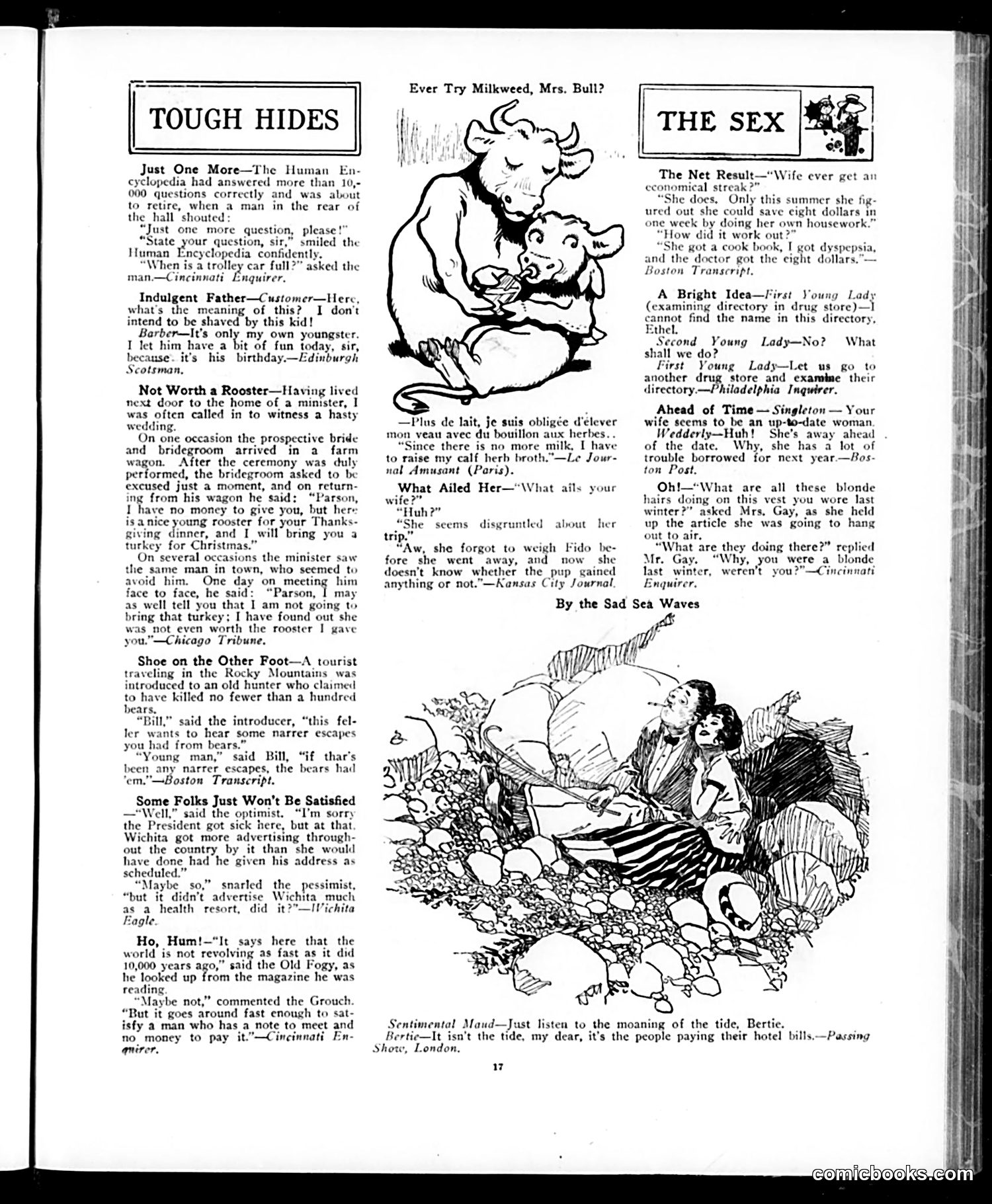
This page from *Judge* magazine contains several short humorous anecdotes typical of early-20th-century American humor. The cartoons and jokes satirize everyday social situations: **"Tough Hides"** section includes various brief jokes mocking human nature—a know-it-all encyclopedia expert stumped by a simple question, an indulgent barber father, a minister tricked by a deceptive parishioner, and a hunter's exaggerated bear stories. **"The Sex"** section (right column) features domestic humor about married life, particularly wives' economic schemes backfiring or creating unexpected costs, and humorous misunderstandings between couples. **"By the Sad Sea Waves"** (center illustration) depicts a romantic beach scene with accompanying witty dialogue about tourists and seaside expenses. The overall tone reflects period attitudes: condescension toward working-class characters, gentle mockery of marriage dynamics, and humor centered on deception and miscommunication. The French anecdote about raising a calf on herb broth (appearing mid-page) suggests *Judge* reprinted international humor content.
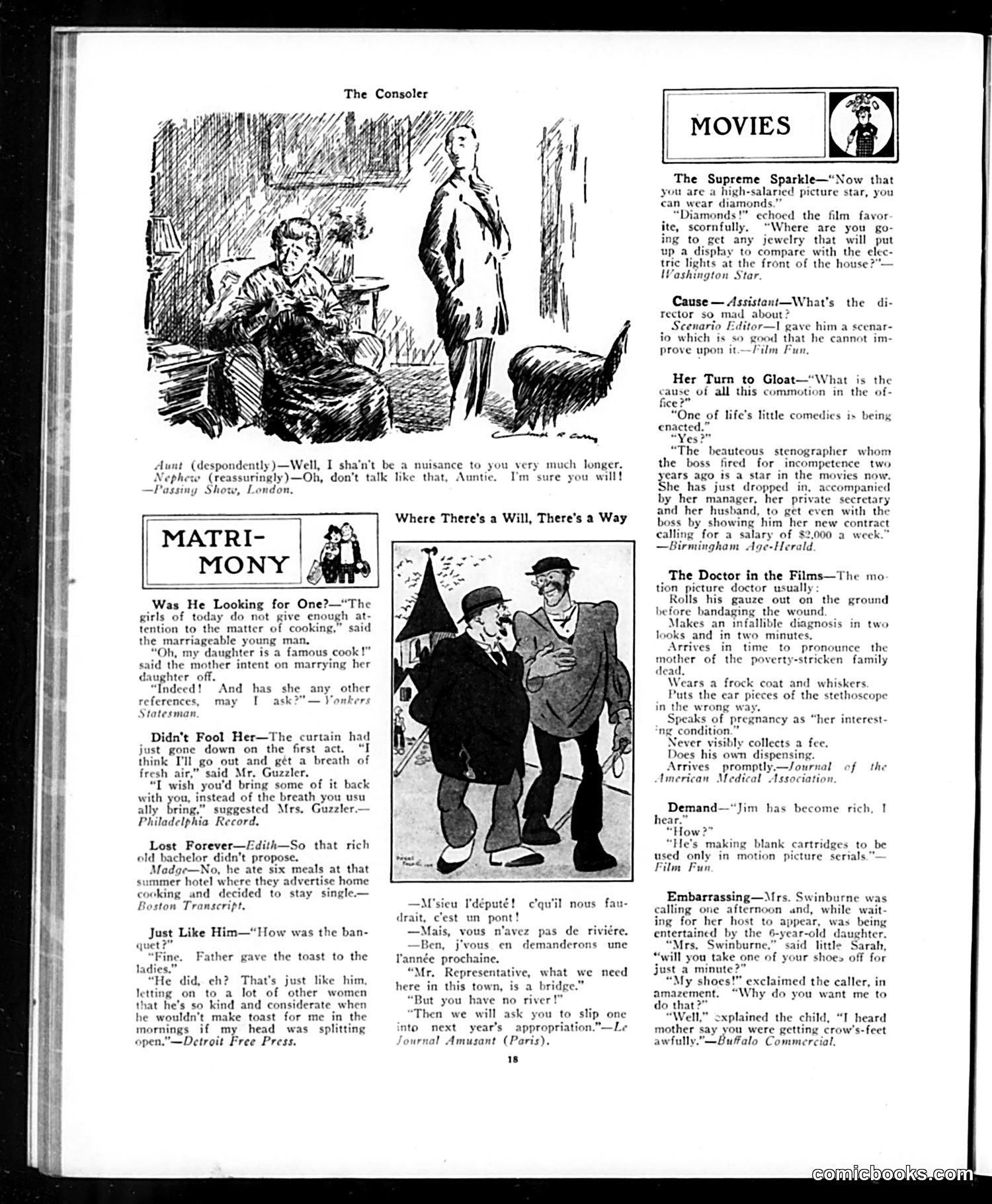
This page from Judge presents early 20th-century American satirical humor through short jokes and cartoons. The main cartoon shows an aunt telling her nephew she won't be a burden much longer—he reassures her, but the implication is darkly comic: he's relieved she's dying. The surrounding jokes mock social conventions of the era: a mother tries marrying off her daughter by claiming she's a "famous cook" (implying women's value lay in domestic skills); a film actress's salary ($2,000/week) exceeds the electric lighting on her house; and a stenographer gains revenge on a former boss by becoming a movie star—reflecting Hollywood's emerging cultural power around the 1920s. The page also includes a French joke about politicians requesting a bridge for a town with no river, satirizing bureaucratic absurdity across nations. Throughout, the humor targets changing social roles, particularly women in cinema and employment, class pretensions, and marital dynamics—common Judge magazine preoccupations.
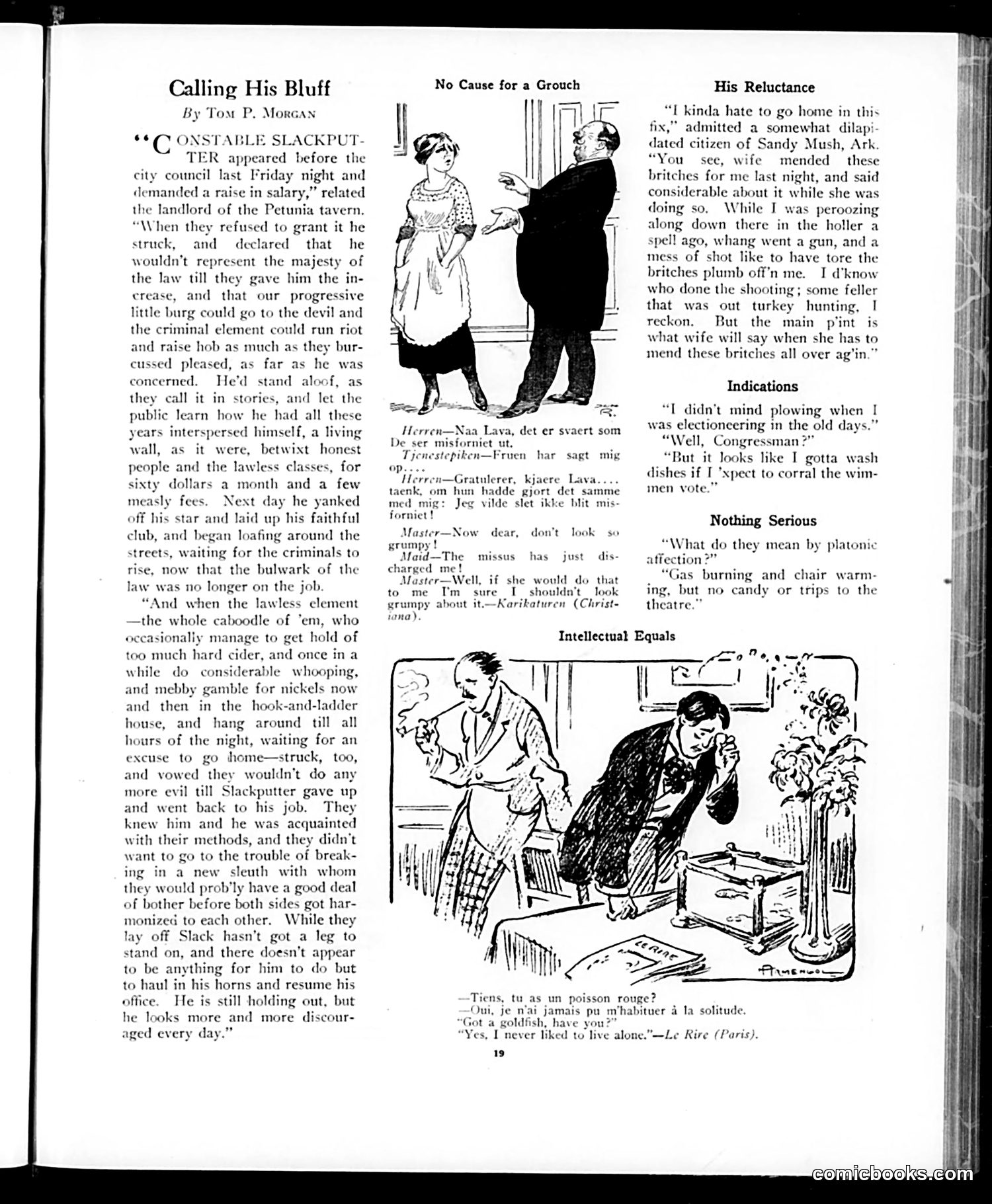
This page contains four separate humorous sketches satirizing early 20th-century American life and social customs. **"Calling His Bluff"** depicts a constable demanding a salary raise, then striking when refused. The joke: he threatens that crime will run rampant without him, but the local criminals simultaneously strike in solidarity—they prefer dealing with him rather than training a new officer. The irony is that both sides need each other, undercutting his bluff about his indispensability. **The remaining three sketches** are brief comedic vignettes: a maid complaining about her mistress's criticism; a rural man dreading his wife's reaction to shotgun damage to freshly-mended britches; and a politician's wife expecting material rewards (candy, theater trips) for "platonic affection." The **foreign-language caption** (Scandinavian and French) suggests *Judge's* cosmopolitan audience. The overall theme: small domestic and civic conflicts resolved through ironic reversals and working-class humor typical of early 1900s American satire.
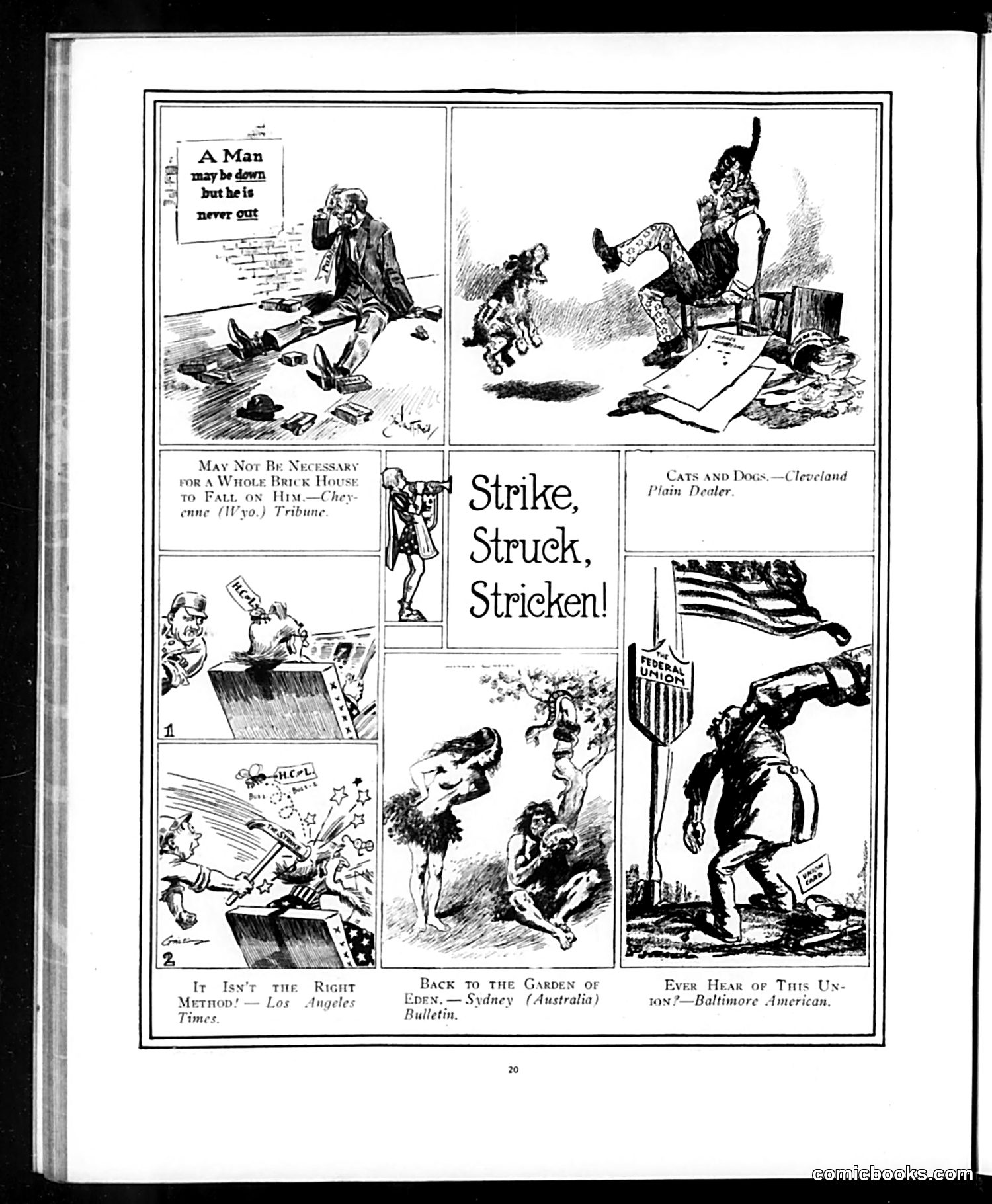
This Judge magazine page collects editorial cartoons addressing **labor strikes and social unrest**, likely from the early 20th century. The central panel's title—"Strike, Struck, Stricken!"—signals the theme. The cartoons depict strikes as destructive chaos: one shows a brick house collapsing on a man (suggesting strikes cause collapse); another portrays strikers as violent chaos agents destroying property and order. The sourced captions from regional papers (Cheyenne, Cleveland, Los Angeles, Sydney, Baltimore) indicate widespread American concern about labor activism. The imagery consistently portrays strikes as irrational violence rather than legitimate labor action, with implicit warnings about social breakdown. The "Union" reference in the Baltimore cartoon suggests anxiety about organized labor's growing power. These cartoons reflect the anti-strike, pro-business editorial stance typical of Judge magazine during periods of significant labor organizing and conflict.
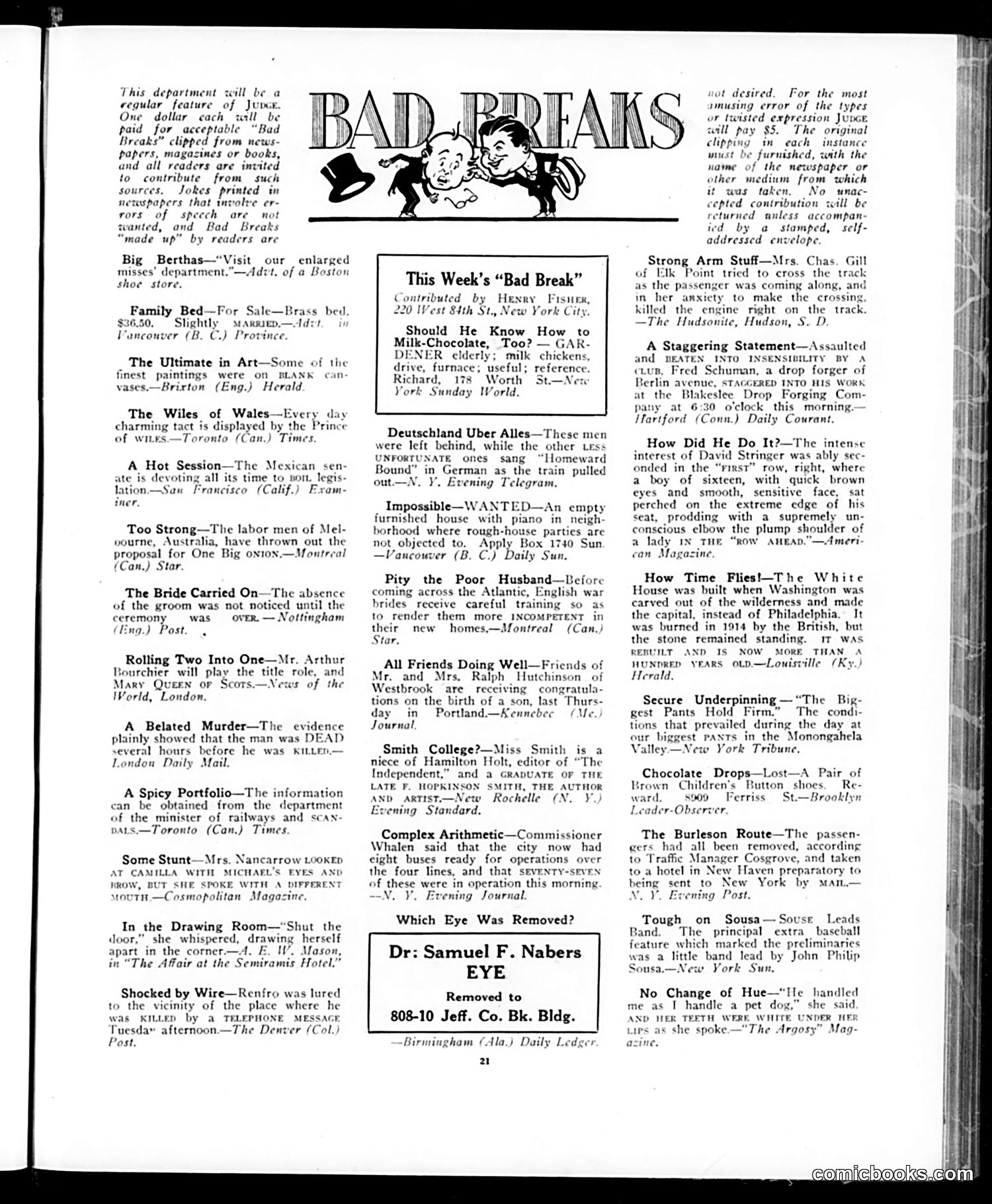
This page features Judge magazine's "Bad Breaks" column—a humor section paying readers one dollar for unintentional errors ("typos" and malapropisms) clipped from newspapers and magazines. The cartoon header shows two figures laughing at these mistakes. The examples showcase absurd unintended meanings created by printing errors or word placement. For instance: a shoe store ad reading "misses' department" as "Big Berthas"; a Mexican senate "devoting all its time to nom. legislation" (incomplete word); a murder victim being "DEAD several hours before he was KILLED" (temporal contradiction); and a job listing for someone to milk "chocolate" chickens. A featured "Bad Break" describes a job applicant who can apparently milk chocolate. The final advertisement for an ophthalmologist humorously asks "Which Eye Was Removed?"—itself a potential bad break. The humor relies on readers recognizing how editorial errors create unintentionally funny or nonsensical statements, reflecting early-20th-century newspaper production's imperfect editing.
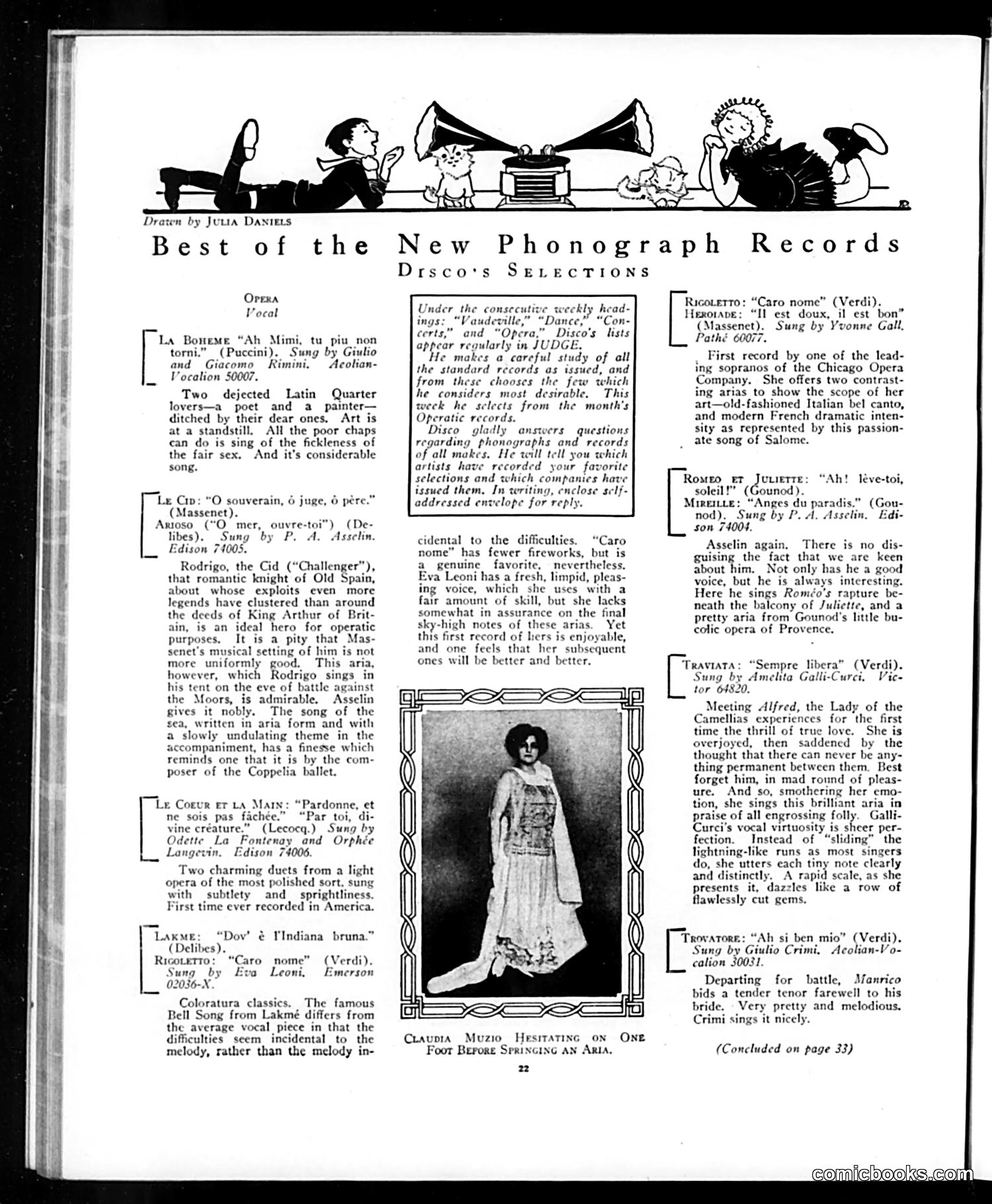
This page is not primarily satirical—it's a **record review column** titled "Best of the New Phonograph Records" by a critic called "Disco." The decorative header by Julia Daniels shows figures with a gramophone, establishing the musical theme. The content reviews newly released opera recordings on various labels (Acolian-Vocation, Edison, Emerson, Pathé, Victor). Disco evaluates performances by singers like Eva Leoni, Yvonne Gall, and P. A. Asselin, discussing both the compositions (from operas by Puccini, Verdi, Massenet, Delibes) and the artists' vocal abilities. The photograph shows **Claudia Muzio**, a soprano, about to perform an aria. This reflects early 1920s culture when phonograph records were novel entertainment, and Judge—primarily a humor magazine—included lifestyle and cultural commentary for its educated readership. The detailed, enthusiastic reviews suggest records and opera held significant status among the magazine's audience.
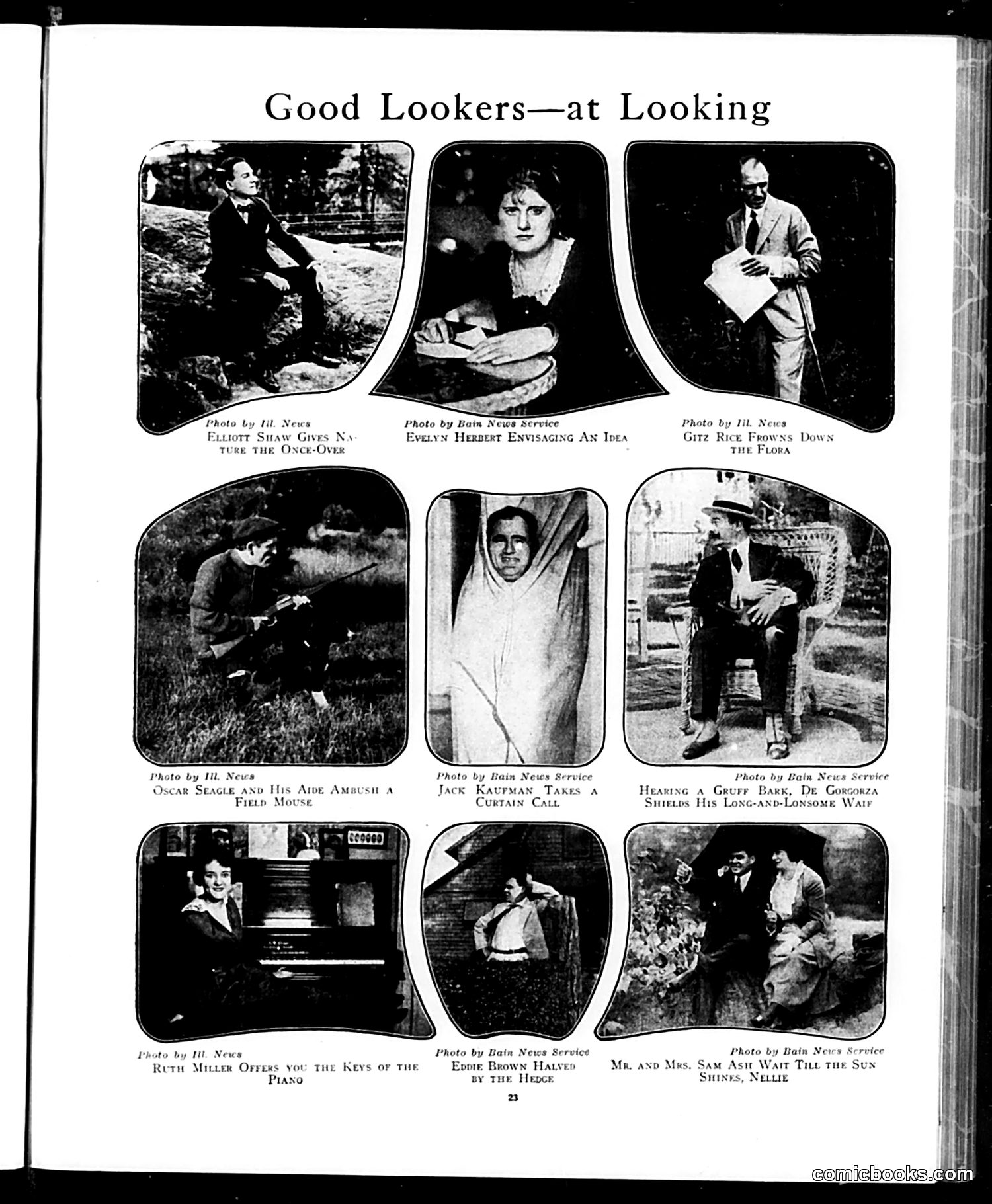
This page from *Judge* is a humorous photo essay featuring nine black-and-white photographs of early 20th-century entertainers and public figures caught in candid or awkward moments. The title's pun—"good lookers" (attractive people) "at looking" (appearing foolish)—sets up the joke: the page mocks these celebrities by capturing unflattering expressions or undignified poses. The captions identify performers like Elliott Shaw, Evelyn Herbert, Gitz Rice, Oscar Seagle, Jack Kaufman, Ruth Miller, and others in situations designed for comedic effect—a woman wrapped in fabric looking startled, a man crouched ambushing a field mouse, someone halted by a dog. The satire relies on the mid-1920s audience's familiarity with these stage and vaudeville stars, making humor from their dignified public personas contrasted with these silly, unguarded moments. It's essentially celebrity mockery through candid photography.
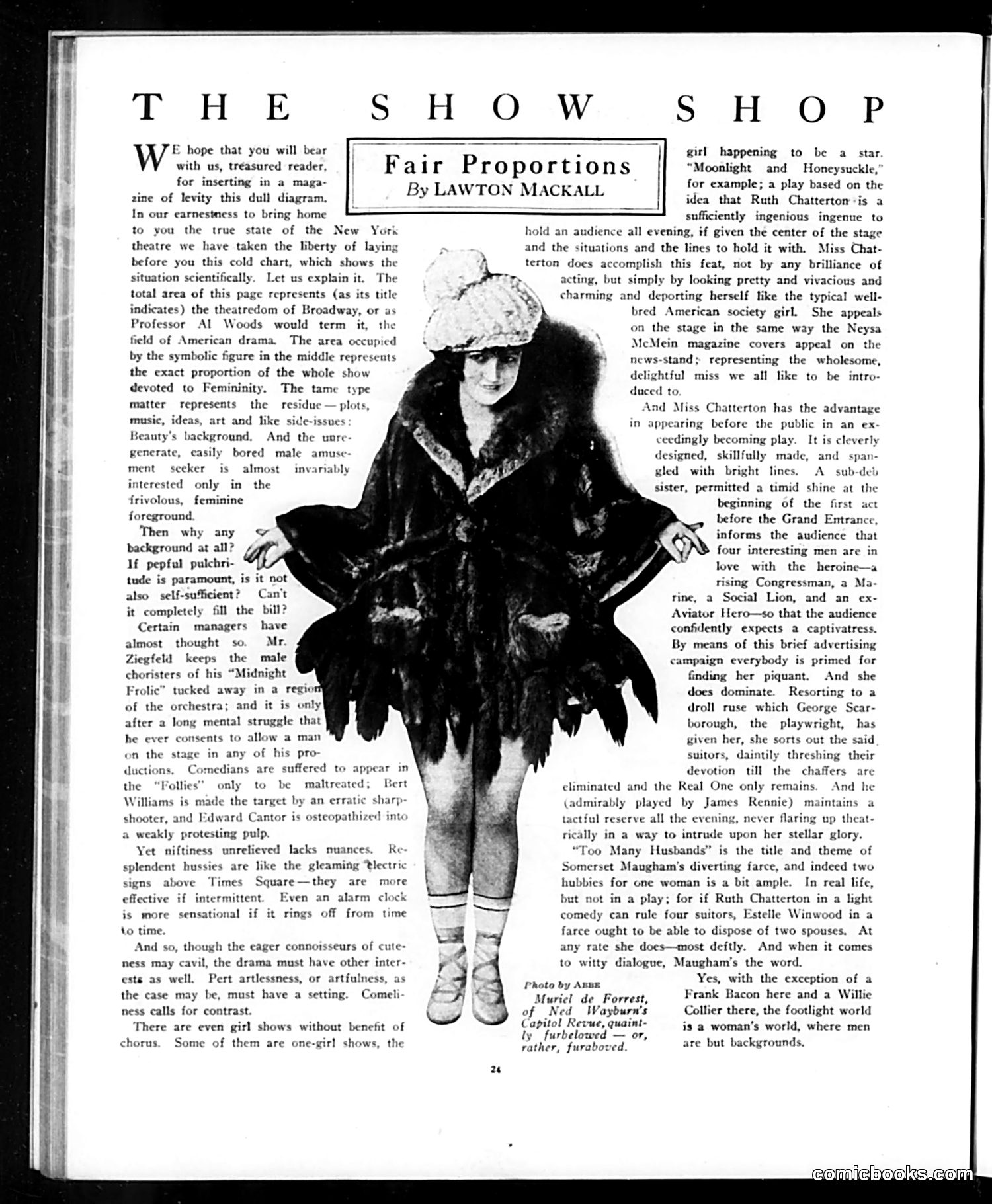
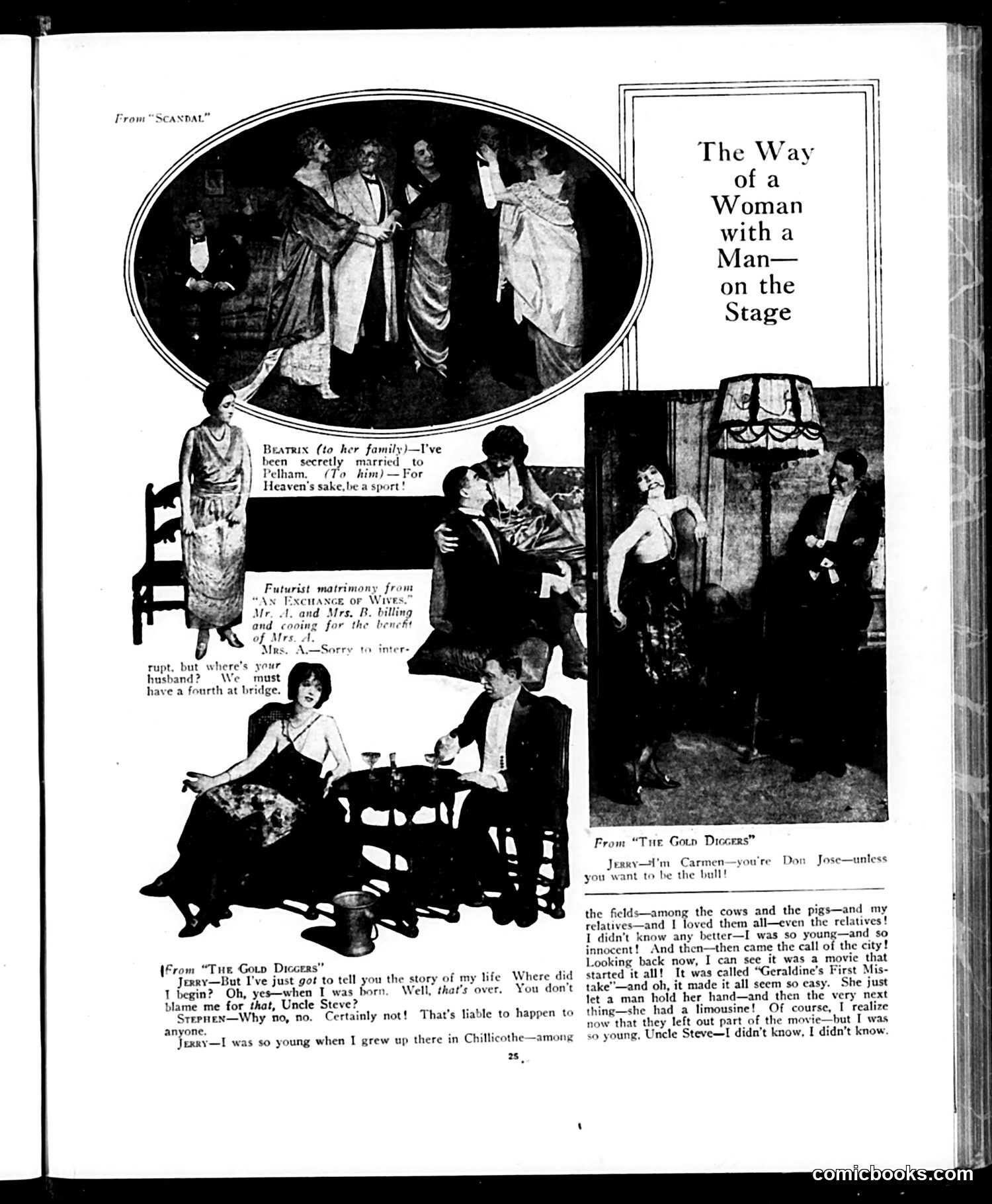
This Judge magazine page satirizes theatrical depictions of romance and morality, circa 1910s-1920s. The three theatrical scenes mock how stage plays (referenced as "Scandal," "An Exchange of Wives," and "The Gold Diggers") portray women's relationships with men in increasingly scandalous ways: 1. **"Scandal"**: A woman secretly marries one man while flirting with another—treated as dramatic intrigue. 2. **"Exchange of Wives"**: Implies adultery disguised as sophisticated comedy. 3. **"The Gold Diggers"**: A rural woman seduced by city life and cinema. Jerry's monologue reveals the mechanism of moral corruption: a movie showing a woman gaining luxury through romantic manipulation inspires real imitation. The satire's point: theater and film present unethical behavior as glamorous and consequence-free, misleading naive audiences (especially women and youth) into adopting these values. The joke targets both theatrical excess and cinema's corruptive influence on public morality—a common Progressive-era concern about mass media.
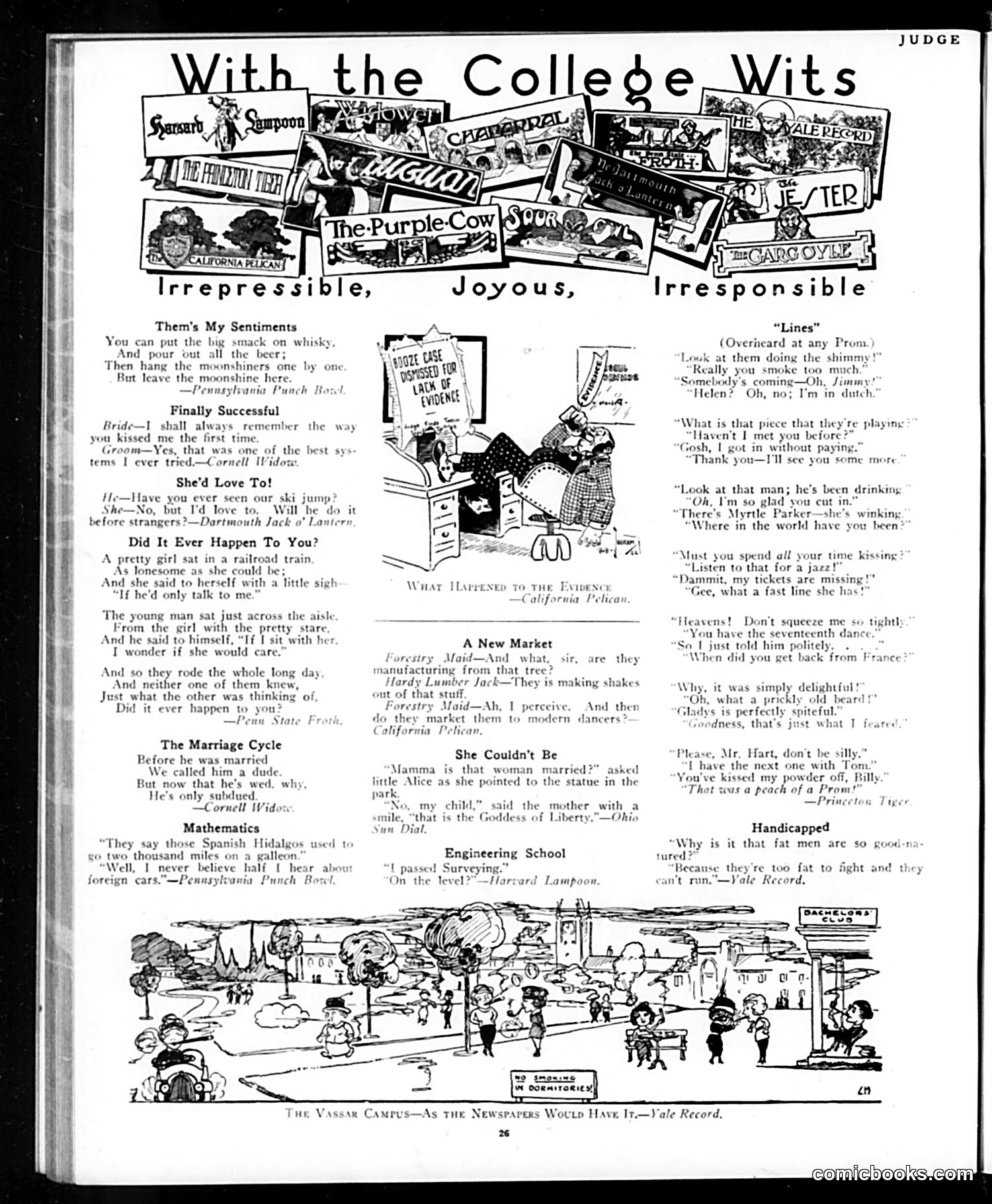
This page from *Judge* magazine compiles humorous quips and observations from college humor publications (Cornell Widow, Dartmouth Jack o' Lantern, Harvard Lampoon, Yale Record, etc.). The satire targets college social life circa the 1920s. **Key themes:** - **Prohibition-era drinking**: "Them's My Sentiments" mocks alcohol bans by defending illicit moonshine - **Dating/romance awkwardness**: Multiple jokes depict young men and women's shyness and miscommunication ("Did It Ever Happen To You?") - **Prom culture**: "Lines" satirizes smooth-talking male students using rehearsed flirtation tactics at formal dances - **Gender dynamics**: Jokes about women's appearance, kissing, and courtship reflect period attitudes - **Marriage**: "The Marriage Cycle" jokes that marriage transforms men from fashionable "dudes" to subdued husbands The bottom illustration shows Vassar campus life, humorously depicting student activities. The overall tone is lighthearted mockery of college social conventions, dating rituals, and student behavior during the Jazz Age.
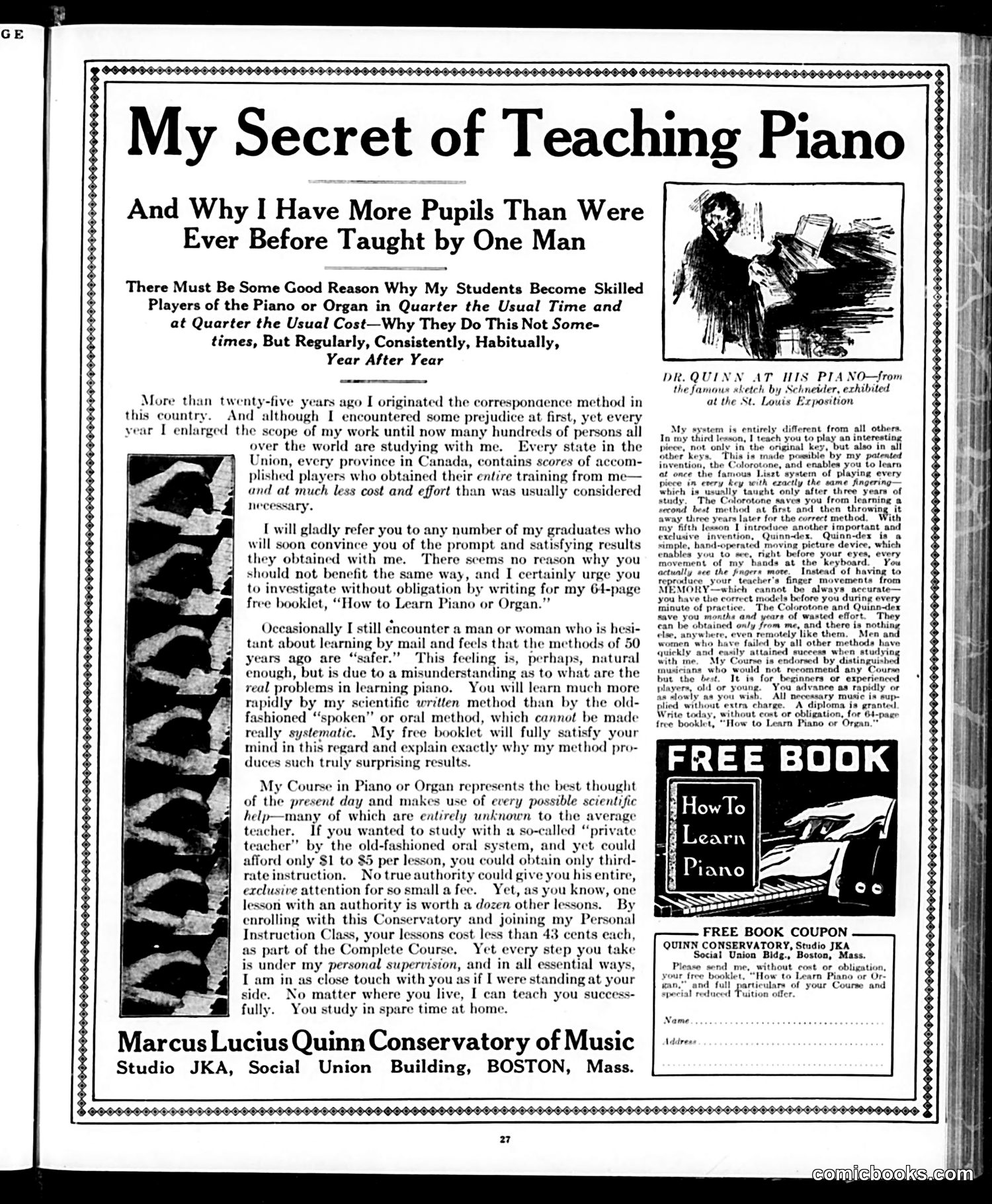
This page is **not satirical content** from Judge magazine—it's a full-page **advertisement** for the Marcus Lucius Quinn Conservatory of Music in Boston, masquerading as editorial content (a common early 20th-century advertising practice). The "cartoon" is actually a portrait of Dr. Quinn at his piano, presented as credible testimony. The text makes exaggerated claims typical of mail-order music instruction: learning piano in "quarter the usual time," lessons for 43 cents each, his "patented" teaching method (Quinnodex, Colorotone), and references to satisfied students nationwide. The pitch targets people who couldn't afford traditional $1-5 per-lesson instruction from prestigious teachers, offering a "scientific written method" superior to old-fashioned oral teaching. The free booklet offer was a standard lead-generation tactic. **For modern readers:** This represents early correspondence-school marketing—promising revolutionary results through mail-based instruction, with pseudo-scientific language and testimonial rhetoric we'd now recognize as dubious advertising.
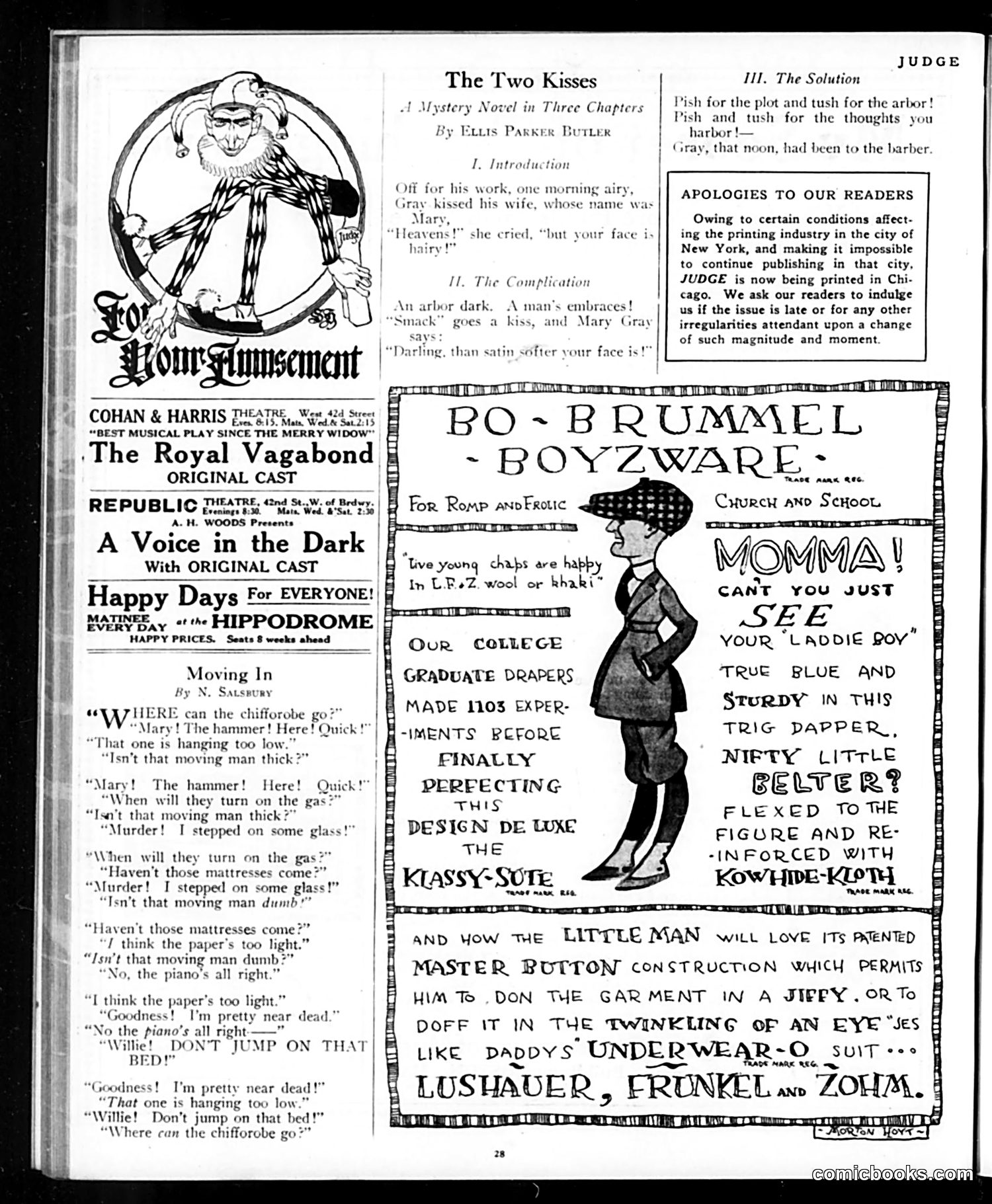
This page contains satirical content typical of Judge's early-20th-century humor: **"The Two Kisses"** is a three-part comedic mystery by Ellis Parker Butler. The joke plays on marital domesticity: a husband (Gray) kisses his wife goodbye in the morning before work, then later kisses a woman in an arbor—but the "mystery" is resolved when we learn the second woman is also his wife, Mary Gray. The humor lies in the innocent misunderstanding and the mild suggestion of infidelity immediately defused. The page also includes theater advertisements and a children's clothing advertisement for "Bo-Brummel Boyzware," marketing boys' clothing with humorous copy about durable, flexible construction. **The moving sketch** ("Moving In") is a dialogue-heavy comedy about movers repeatedly fumbling with furniture, with exasperated homeowners shouting directions—slapstick humor about domestic chaos. Overall, this represents Judge's mix of light domestic satire, theatrical promotion, and advertising disguised as humor—typical of American satirical magazines of this era.
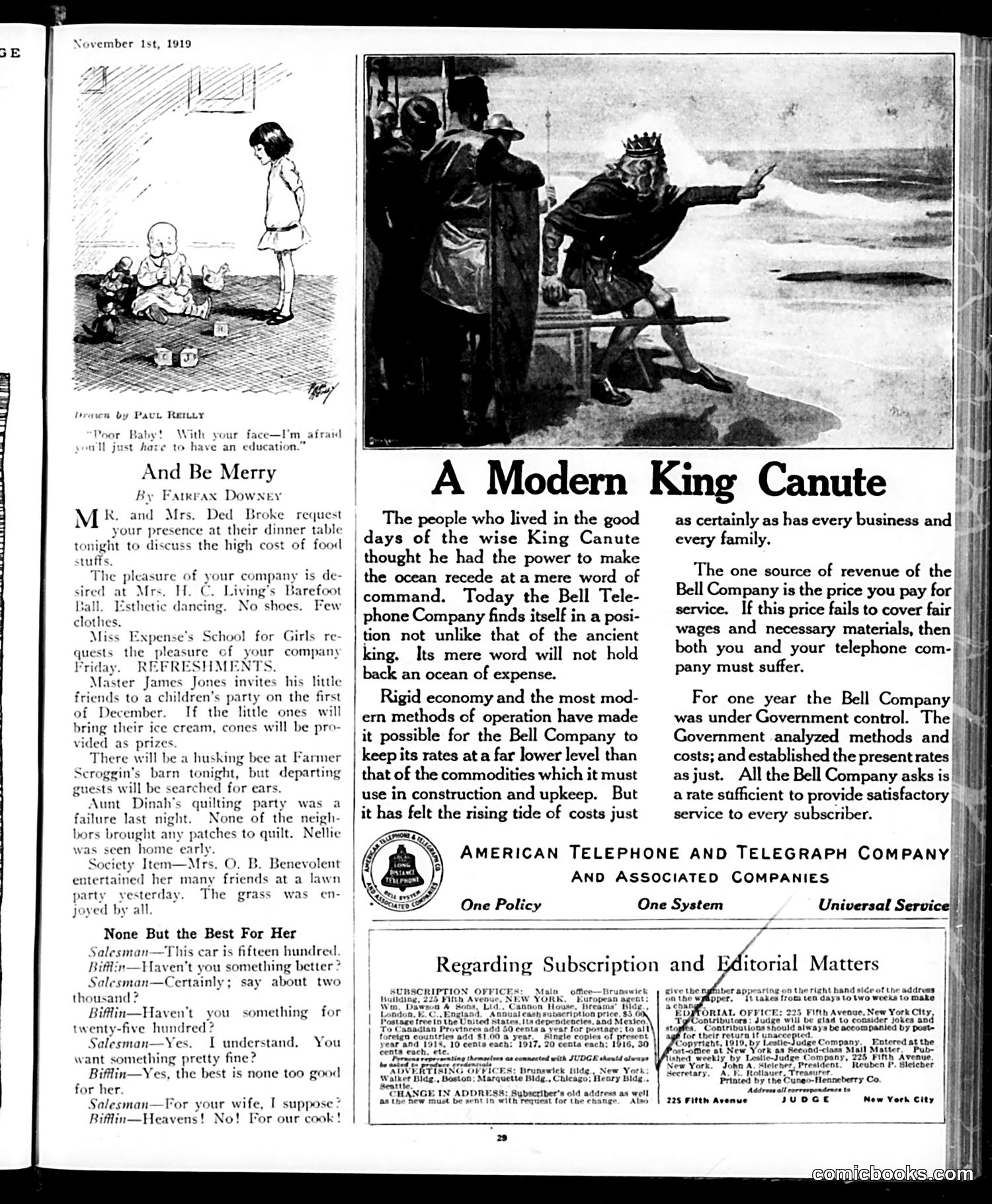
**"A Modern King Canute"** (right panel): This is a Bell Telephone Company advertisement using the King Canute legend as analogy. Canute supposedly commanded the ocean to recede; the ad compares this to Bell's inability to hold back rising operational costs through willpower alone. The company argues it cannot keep rates low indefinitely—wages, materials, and other expenses (the "ocean") inevitably rise. The ad defends Bell's rate increases as justified after one year of Government control (during WWI), suggesting rates are now fair and necessary. **Left side humor sketches**: These mock high living costs and social pretension post-WWI (dated November 1, 1919). Examples include dinner discussions about food costs, parties where guests supply their own refreshments, and a punchline about a salesman selling a car—the wealthy buyer specifies the car is "none too good" not for his wife, but for his cook, satirizing misplaced priorities during inflation.
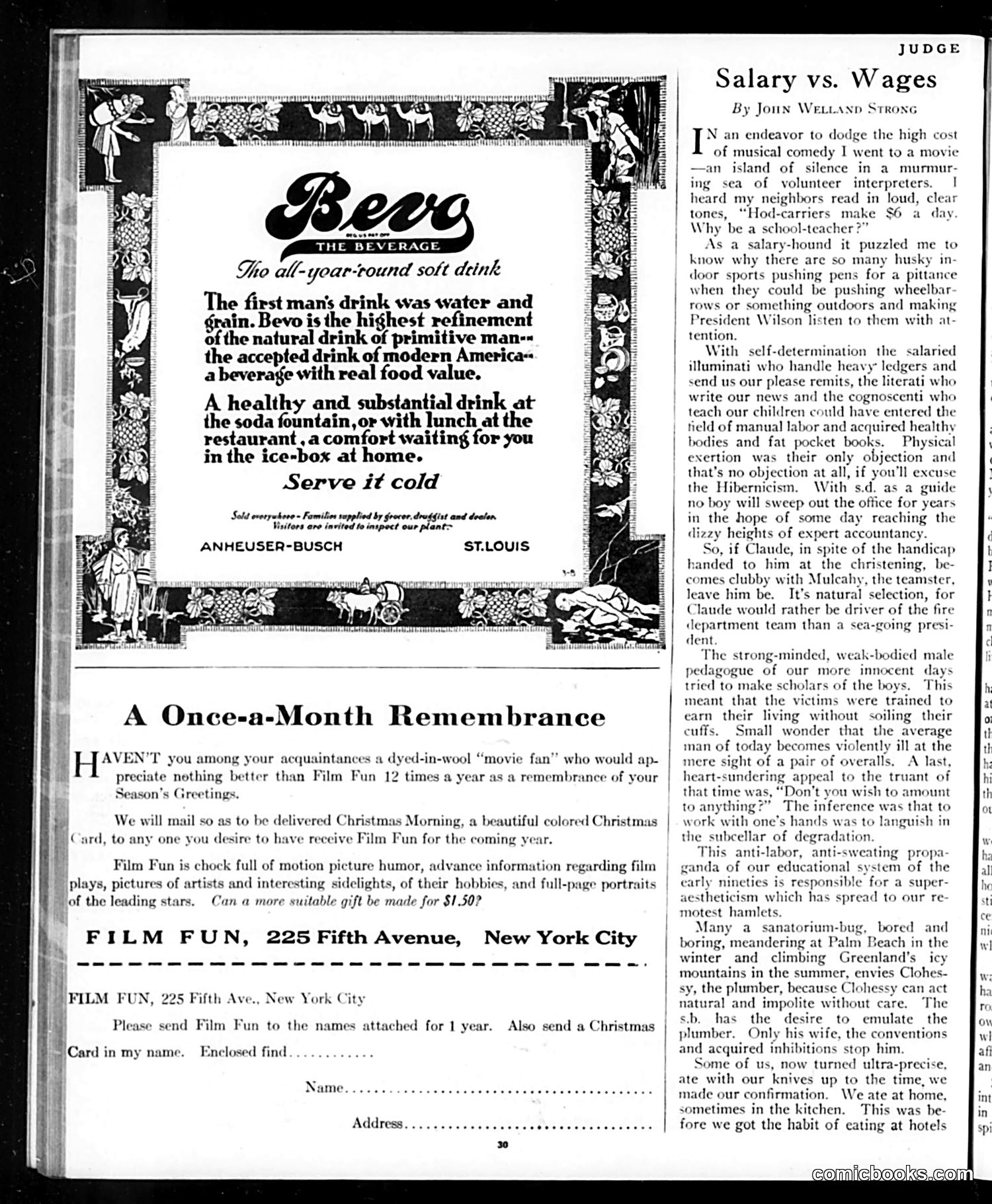
This page contains **two separate pieces**: a Bevo beverage advertisement and a Judge magazine article titled "Salary vs. Wages" by John Welland Strong. The **article critiques American class attitudes** toward manual labor. Strong observes that working-class laborers (hod-carriers earning $6/day) are better compensated than white-collar professionals like teachers, yet society stigmatizes manual work. He argues this stems from late-19th-century educational messaging that portrayed physical labor as degrading—training boys to avoid "soiling their cuffs." Strong ridicules the consequence: modern wealthy idlers ("sanatorium-bugs") at fashionable retreats like Palm Beach actually *envy* working tradesmen like "Clohessy the plumber" for their freedom and authenticity, yet social conventions prevent them from abandoning pretense. The **satire targets snobbish attitudes** that devalue honest labor while creating miserable, constrained elites. The Bevo ad above, emphasizing the drink's "real food value," appears coincidentally ironic—offering substance alongside an article about substance versus social performance.
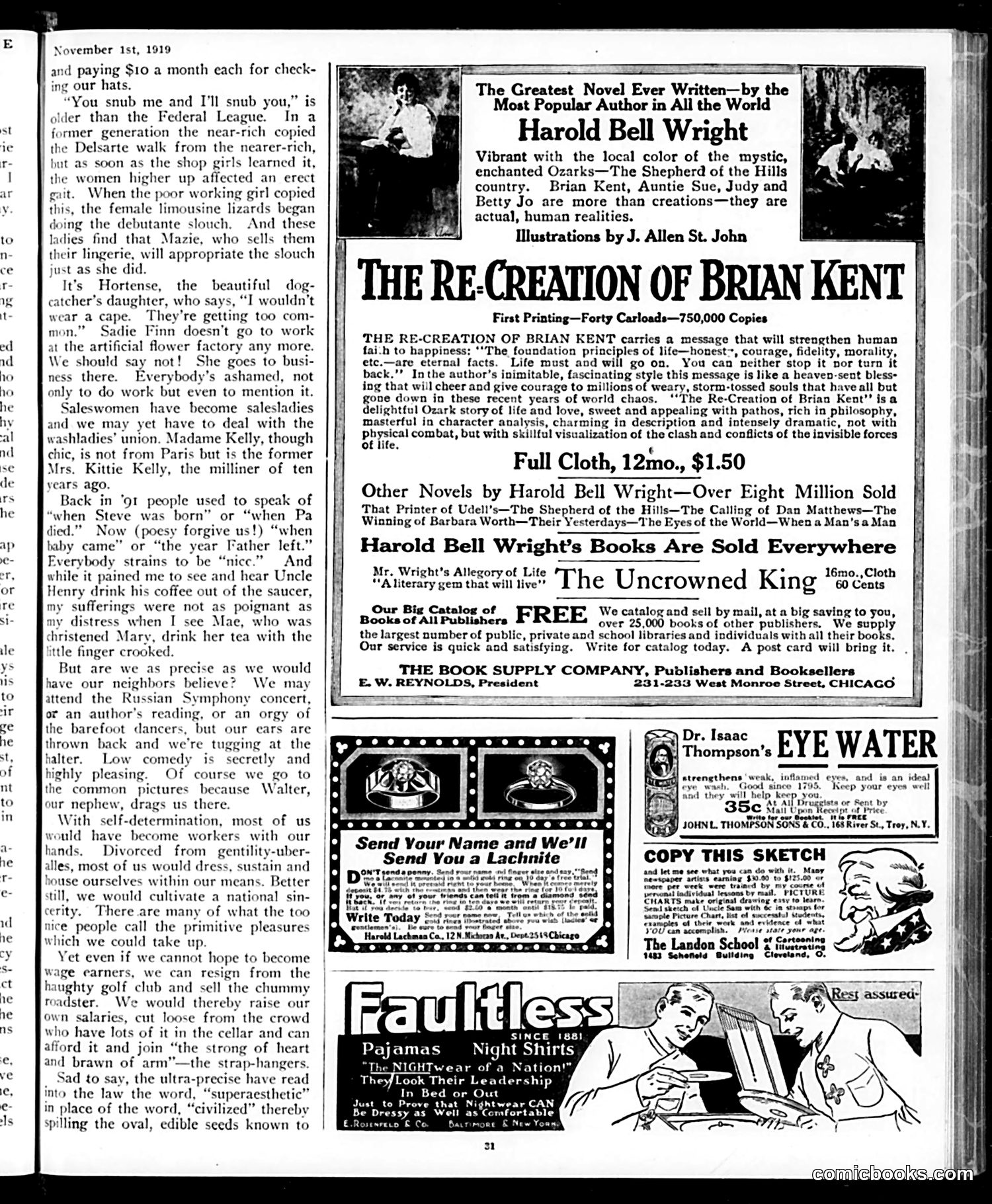
This page is primarily **advertising and editorial content**, not political satire. The main feature is a lengthy essay critiquing American social pretension and class-climbing behavior in the post-WWI era. **The Editorial Content:** The unsigned essay satirizes how Americans obsessively copy the mannerisms and affectations of those they perceive as "higher" in social status—a cycle of mimicry descending from the wealthy to working classes. It references specific examples: women adopting the "Delsarte walk," then switching to the "debutante slouch" once shop girls copied them. The author mocks euphemistic language (calling saleswomen "salesladies," avoiding mention of actual work) and people straining to appear "nice" and cultured while secretly enjoying "low comedy." **The Point:** The satire attacks American hypocrisy and status anxiety, arguing that authentic sincerity and self-respect—even manual labor—would be preferable to constant social posturing. **Advertising:** The page features prominent ads for Harold Bell Wright's novel *The Re-Creation of Brian Kent* and smaller ads for eye water, sketch lessons, and Faultless pajamas—typical 1919 magazine fare.
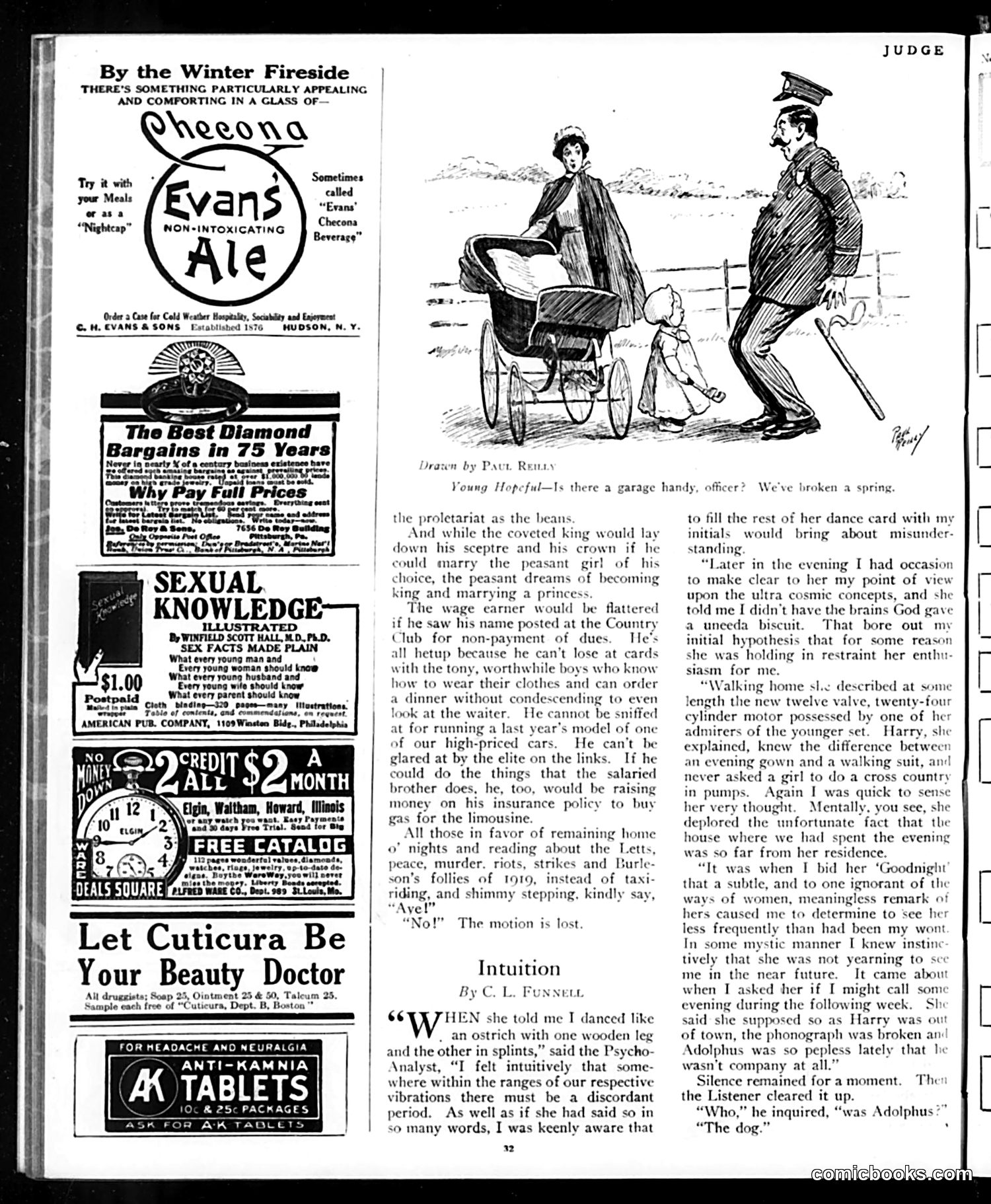
This page contains advertisements and two satirical pieces typical of Judge magazine's social commentary. **Main Cartoon**: "Young Hopeful" depicts a working-class family with a broken car asking a policeman for help. The satire critiques class aspiration—the accompanying text explains how the working poor imitate the wealthy, desperate to join their social circles (Country Clubs, golf links, expensive cars). The irony: they can't afford these luxuries but strain themselves financially trying. **"Intuition" Story**: A psychoanalyst describes a woman who insults him repeatedly but shows interest in wealthier suitors. The joke is his mock-serious psychoanalytic interpretation of her obvious message: she's not interested in him. It satirizes both pseudo-intellectual psychology and oblivious male vanity. **Advertisements** include Cheona Evans Ale, a sexual education book, Cuticura beauty products, and Anti-Kamnia tablets—typical early-20th-century patent medicines and beauty products. The overall theme: class consciousness and misread social signals in 1920s America.
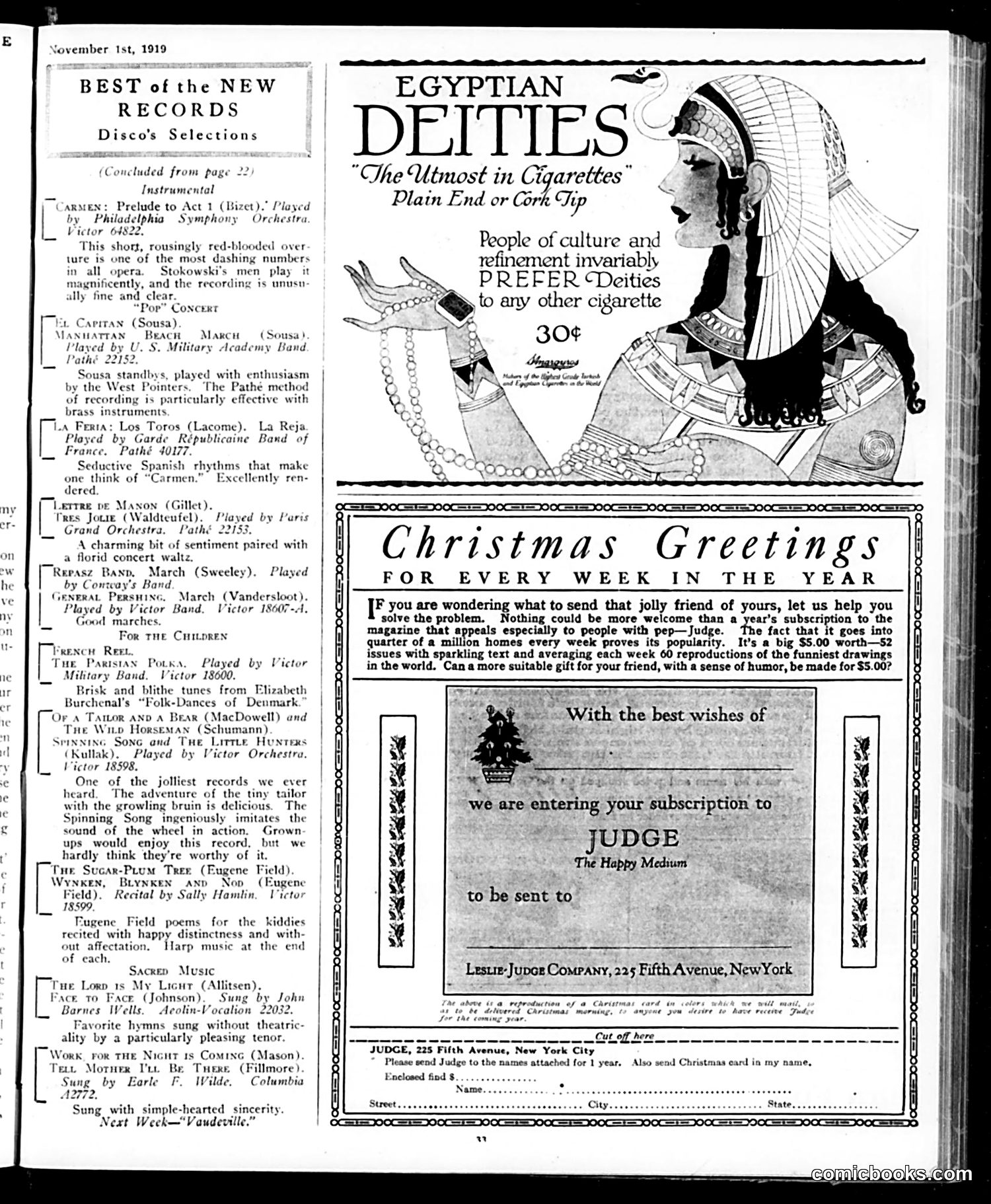
This page contains two distinct sections: **music reviews** and **advertising**. The **left column** reviews new phonograph records—a common feature for Judge in this era, as recorded music was still novelty entertainment. The selections span opera, military marches, Spanish music, and children's songs on various labels (Victor, Pathé), reflecting 1919's emerging recording industry. The **top right** advertises Egyptian Deities cigarettes with an Art Deco illustration of an Egyptian woman in profile—typical orientalist imagery used in early 20th-century advertising. The "30¢" price and appeal to "people of culture and refinement" reflects how luxury cigarettes marketed to educated consumers. The **bottom half** is a Judge magazine subscription advertisement framed as "Christmas Greetings for Every Week in the Year." It promotes a year's subscription ($5.00) as an ideal gift, emphasizing the magazine's humor and reach ("quarter of a million homes"). This was standard practice: magazines solicited gift subscriptions during the holiday season by positioning themselves as thoughtful presents for people with "a sense of humor." The page is primarily **commercial content**, not satirical commentary.
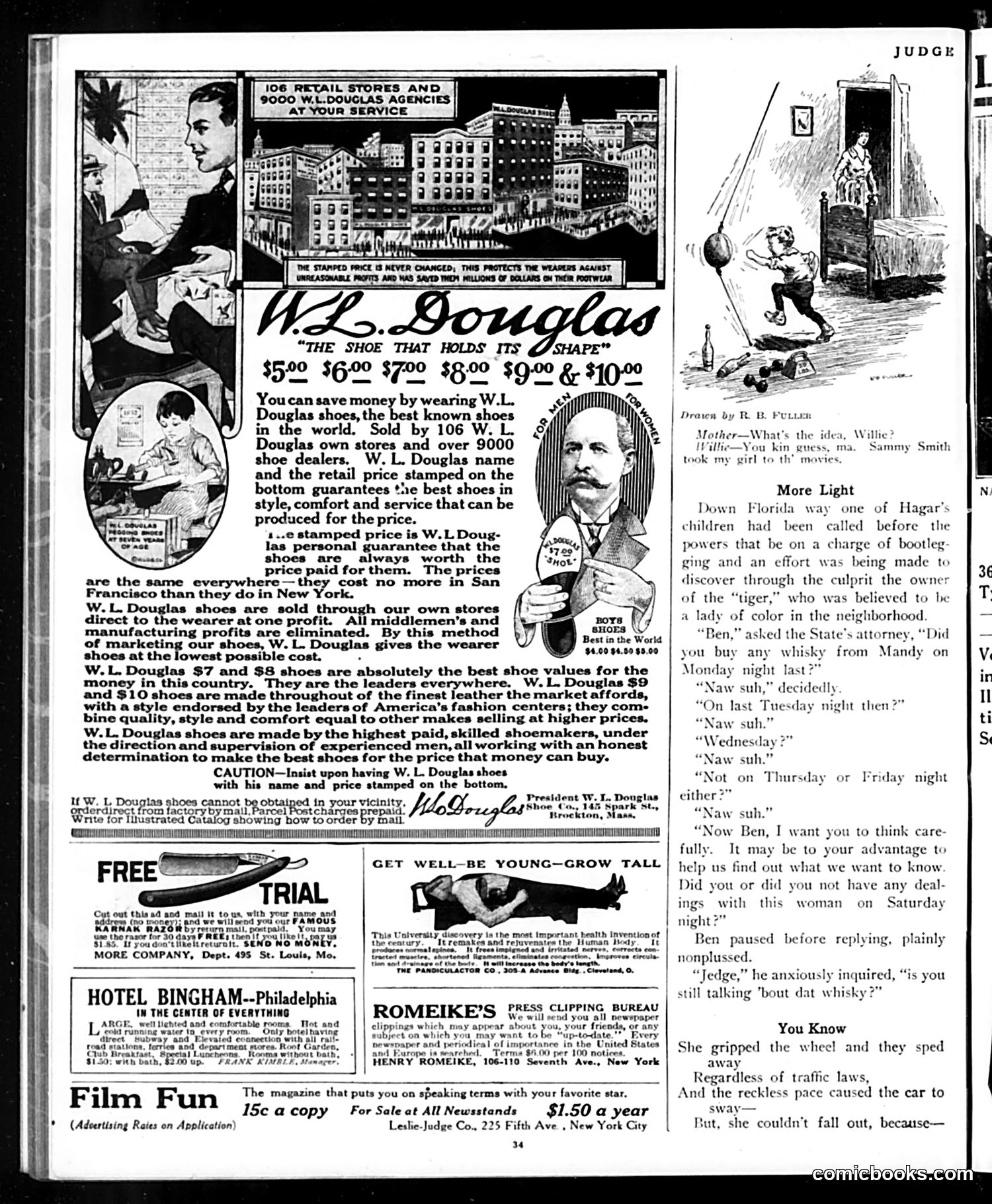
This page is primarily **advertising**, not satirical content. The dominant feature is a W.L. Douglas shoe advertisement promoting shoes at various price points ($5-$10), emphasizing their direct-to-consumer sales model that eliminated middlemen profits. The actual comic content appears minimal: **Right side cartoon**: A brief comedic dialogue drawn by R.B. Fuller showing a mother ("What's the idea, Willie?") confronting a child who has taken his friend to the movies. The humor is domestic and light—a parent discovering unauthorized activities. **"More Light" story**: A satirical piece about Prohibition-era enforcement. A judge interrogates a Black woman named "Mandy" about whisky sales, repeatedly asking about different nights of the week. The humor derives from her consistent denial ("Naw suh") and the judge's exasperation—it's social satire about the difficulty of enforcing Prohibition laws. The page reflects 1920s concerns: Prohibition, domestic propriety, and consumer capitalism. The racial dialect in the Prohibition story reflects period conventions that modern readers would find offensive.
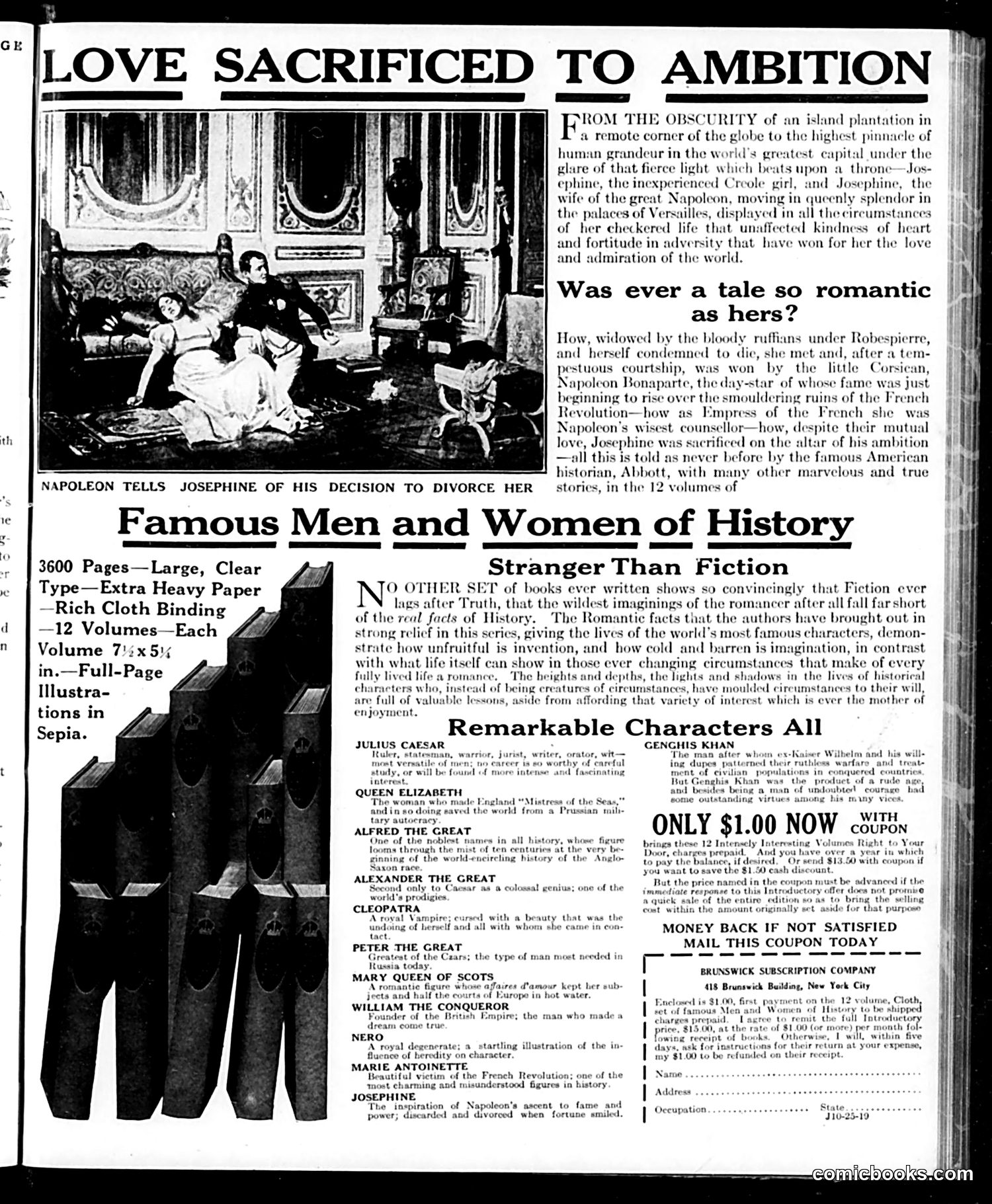
This page is primarily an **advertisement for a 12-volume historical book series**, not a political cartoon. The image shows Napoleon informing Josephine of his decision to divorce her—a historically significant moment presented as romantic tragedy. The text frames their relationship as a dramatic narrative: Josephine rose from obscurity on a Caribbean plantation to become Empress of France alongside Napoleon, only to be divorced by him for political/dynastic reasons (he needed an heir). The advertisement emphasizes this as "romantic" and "remarkable," presenting historical facts as more compelling than fiction. The marketing pitch claims these books show "real facts of History" more dramatic than invented stories. It's selling the appeal of authentic historical narratives about famous figures like Julius Caesar, Alexander the Great, and Cleopatra—positioning history itself as entertainment. The coupon offers the complete set for $1.00, promoting it as an accessible educational product for early 20th-century readers.
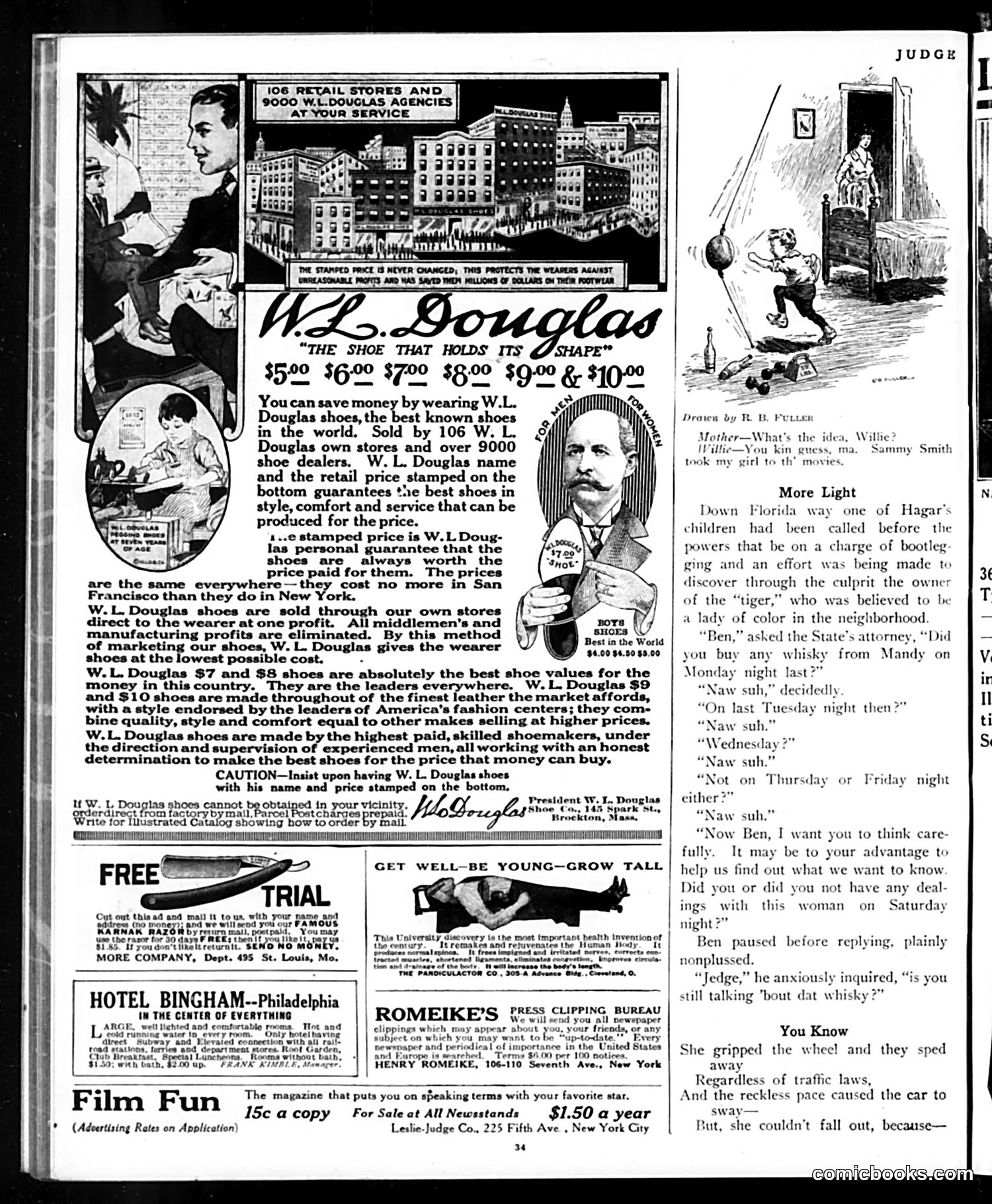
This page is primarily **advertising**, featuring a major W.L. Douglas shoe company advertisement with the company founder's portrait. The ad emphasizes price-stamping guarantees and direct-to-consumer sales eliminating middlemen profits—a sales pitch targeting Depression-era consumers concerned about value. The page includes a small cartoon by R.B. Fuller titled "More Light," depicting a humorous domestic scene where a boy explains to his mother that he took his girlfriend to the movies. The joke relies on innocent wordplay—the mother's question "What's the idea, Willie?" suggests she suspects romantic intentions, while the boy's straightforward answer treats it as merely recreational. Below is a **dialect humor piece** set in rural Florida involving Prohibition-era bootlegging. A State's attorney questions a man named Ben about purchasing whisky from a woman named Mandy, using leading questions about different days of the week. Ben's exasperated response—"is you still talking 'bout dat whisky?"—constitutes the joke's punchline. The remainder consists of hotel advertisements, a "Get Well—Be Young" health product ad, and trade publication notices.
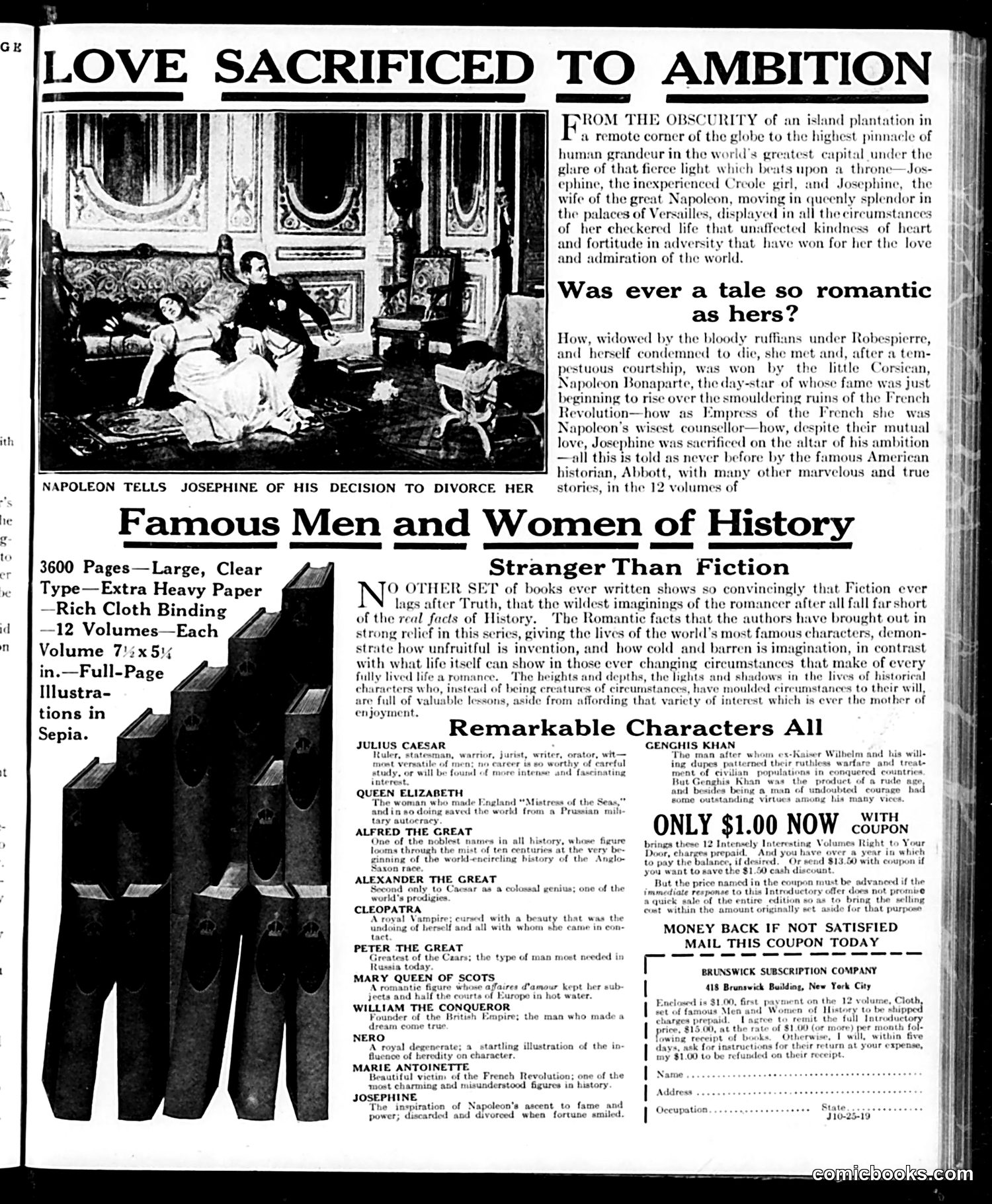
This page advertises a 12-volume encyclopedia-style book series titled "Famous Men and Women of History" by American historian Abbott. The main illustration depicts **Napoleon informing Josephine of his decision to divorce her**—a historically accurate event. The accompanying text romanticizes their relationship, describing Josephine's rise from obscurity on a Caribbean plantation to Empress of France, then her sacrifice when Napoleon divorced her for political/dynastic reasons (to secure an heir with another wife). The satire is subtle: the advertisement markets this as "Stranger Than Fiction," claiming real history surpasses invented romance. The irony is that this "true" story—Josephine's dramatic arc and Napoleon's calculation—reads as pure melodrama. The series promised to cover famous historical figures (Julius Caesar, Cleopatra, Alexander the Great, etc.) in richly illustrated volumes. The "$1.00 NOW" offer with coupon is a classic mail-order sales pitch targeting early-20th-century readers seeking accessible, entertaining history.
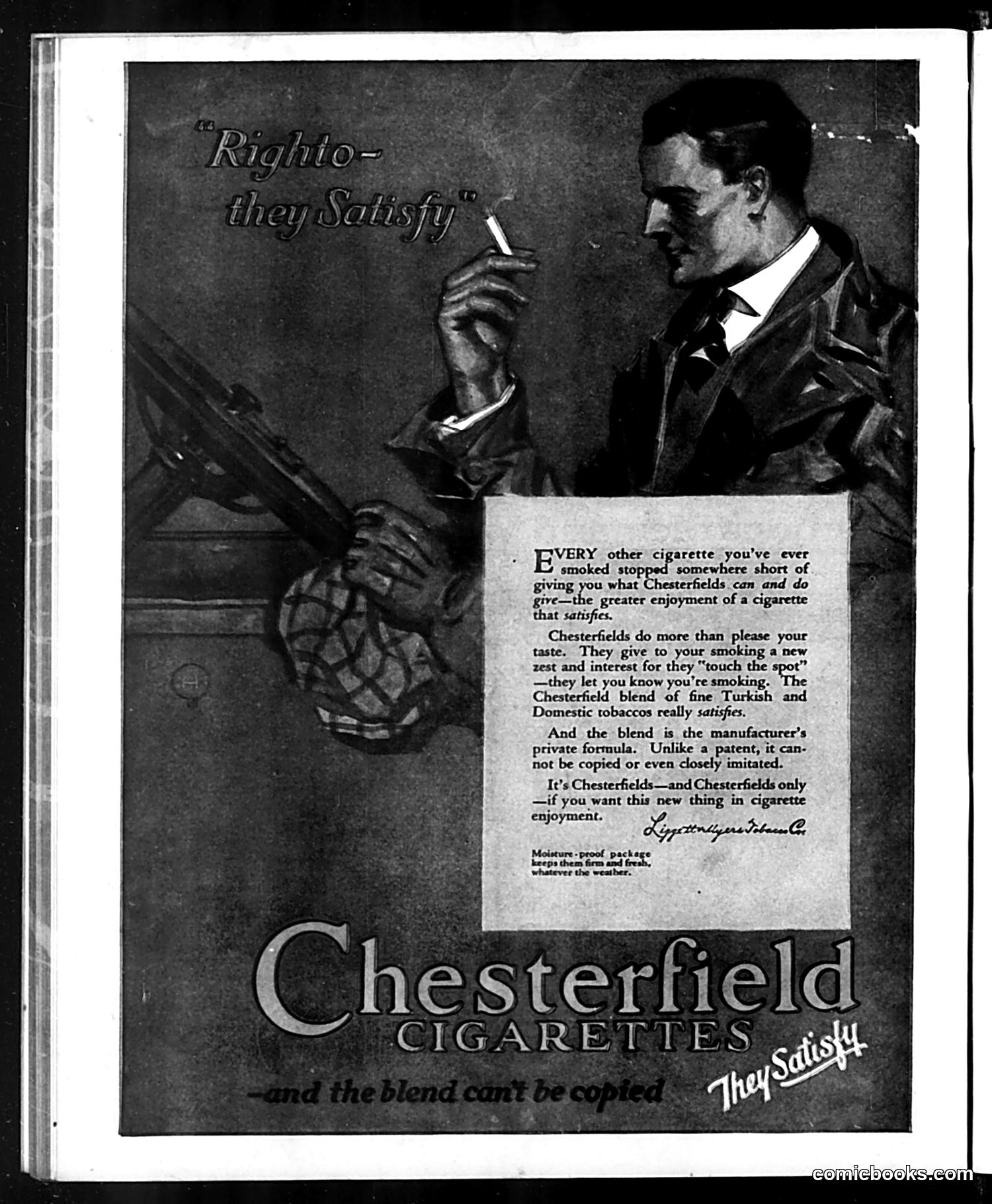
This is a **cigarette advertisement**, not political satire. It's a Chesterfield Cigarettes ad featuring a well-dressed man in profile, smoking contemplatively. The ad's pitch emphasizes that Chesterfield's blend is a proprietary formula that "can-not be copied or even closely imitated"—a marketing claim about competitive advantage. The headline "Right to—they Satisfy" plays on the word "right" (suggesting superiority or legitimacy). The imagery and refined styling appeal to aspirational masculinity and sophistication typical of 1920s-30s tobacco advertising. There is no political commentary or satire present—this is straightforward commercial promotion using period conventions of elegance and exclusivity to sell cigarettes. The irony for modern readers is that this full-page ad presents cigarettes as a desirable luxury product, with no health warnings whatsoever, in an era before such warnings were legally required.