
Judge, 1919-11-01 · page 22 of 38
Judge — November 1, 1919 — page 22: what you’re looking at
What you’re looking at
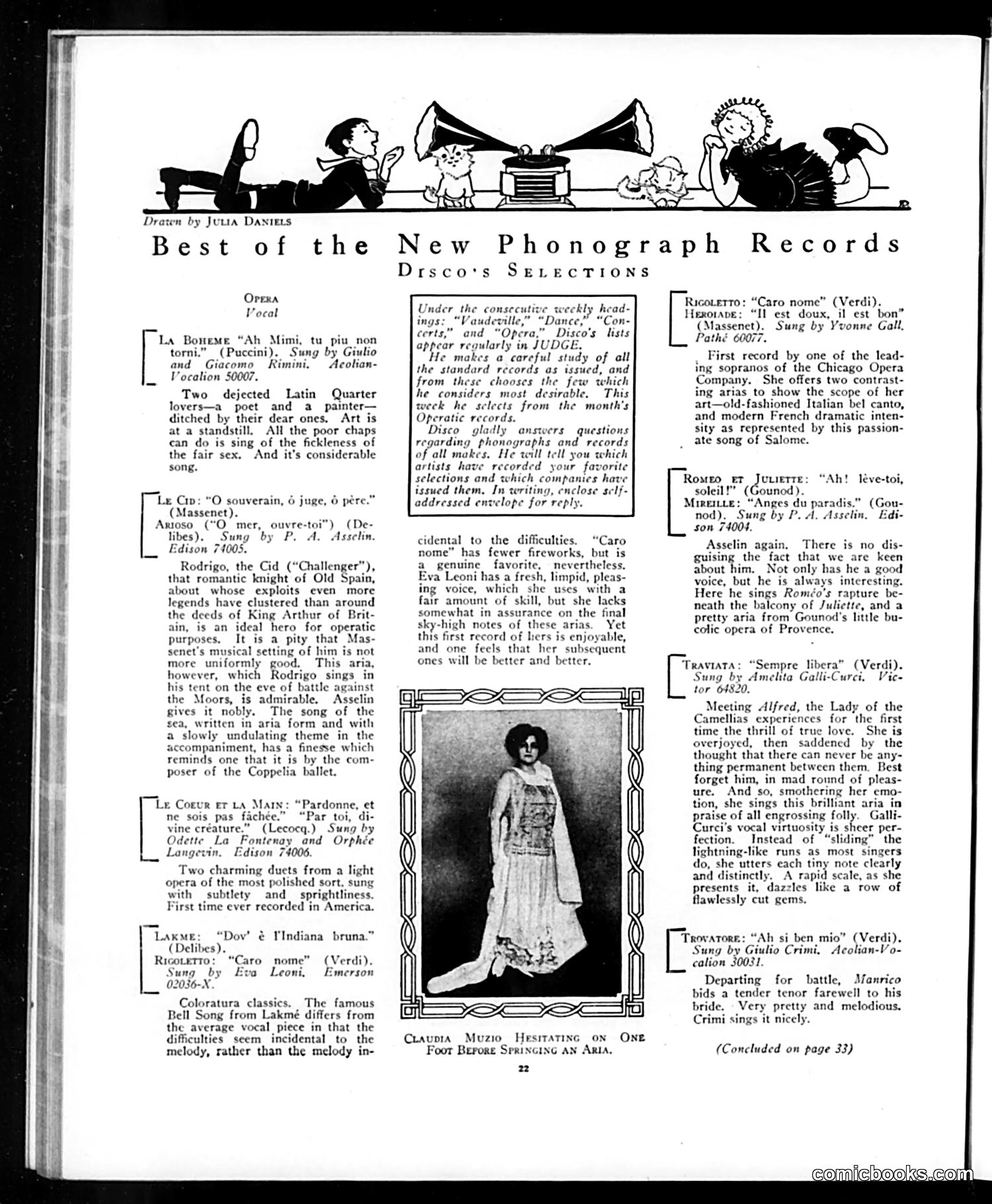
This page is not primarily satirical—it's a **record review column** titled "Best of the New Phonograph Records" by a critic called "Disco." The decorative header by Julia Daniels shows figures with a gramophone, establishing the musical theme. The content reviews newly released opera recordings on various labels (Acolian-Vocation, Edison, Emerson, Pathé, Victor). Disco evaluates performances by singers like Eva Leoni, Yvonne Gall, and P. A. Asselin, discussing both the compositions (from operas by Puccini, Verdi, Massenet, Delibes) and the artists' vocal abilities. The photograph shows **Claudia Muzio**, a soprano, about to perform an aria. This reflects early 1920s culture when phonograph records were novel entertainment, and Judge—primarily a humor magazine—included lifestyle and cultural commentary for its educated readership. The detailed, enthusiastic reviews suggest records and opera held significant status among the magazine's audience.
📄 Transcribed text from this page (OCR, searchable)
Machine-transcribed from the original scan — historical spelling and the odd misread are preserved.
Drawn by Juuia Danters Best of the New Phonograph Records Drsco's SELECTIONS Orexa Vocal La Boneme “Ah Mimi, tu piu_non torni.” (Puccini). Sung by Giulio and Giacomo Rimini, Acolian- Vocation $0007. Two dejected Latin Quarter lovers—a poet and a painter— ditched by their dear ones. Art is at a standstill. All the poor chaps can do is sing of the fickleness of the fair sex. And it's considerable song. Le Crp: “O souverain, 6 juge, 6 pére.” (Massenet). Aroso (“O mer, ouvre-toi”) (De- libes). Sung ‘by P. A. Asselin Edison 74008. Rodrigo, the Cid (“Challenger”), that romantic knight of Old Spain, about whose exploits even more legends have clustered than around the deeds of King Arthur of Brit- ain, is an ideal hero for operatic purposes, It is a pity that Mas- senet’s musical setting of him is not more uniformly good. This aria, however, which Rodrigo sings in his tent on the eve of battle against the Moors, is admirable. Asselin gives it nobly, The song of the written in aria form and with a slowly undulating theme in the accompaniment, has a finesse which reminds one that it is by the com- poser of the Coppelia ballet. z Coeur eT LA Main: “Pardonne, et ne sois pas fachée.” “Par toi, di: vine créature.” (Lecocq.) Sung b: Odette La Fontenay and Orphée Langevin. Edison 74006. Two charming duets from a light opera of the most polished sort, sung with subtlety and_ sprightliness. First time ever recorded in America. Lakme: “Dov’ @ I'Indiana bruna (Delibes). Ricotetto: “Caro nome” (Verdi). Sung by Eva Leoni, Emerson 02036-X Coloratura classics. The famous Bell Song from Lakmé differs from the average vocal piece in that the difficulties seem incidental to the melody, rather than the melody in- kly head- 1M Dance,” “Con- and pera,” Disco's lists oppe ar regularly in JUDGE, He makes a careful study of all the standard records as issued, and from these chooses the few which he considers most desirable. This week he cts from the month's Operatic records. Disco gladly answers questions regarding phonographs and records of all makes, He will tell you which artists have recorded your favorite selections and which companies have iipied them, In writing, addressed envelope for reply. cidental to the difficulties. “Caro nome” has fewer fireworks, but is a genuine favorite, nevertheless. ‘a Leoni has a fresh, limpid, pleas- ing voice, which she uses with a fair amount of skill, but she lacks somewhat in assurance on the final sky-high notes of these arias. Yet this first record of hers is enjoyable, and one feels that her subsequent ones will be better and better. Ctaupia Muzio S Rucotetto: “Caro nome” (Verdi). Herotape: “Il est doux, il est bon” (Massenet). Sung by Yvonne Gall. Pathé 60077. st record by one of the lead- ing sopranos of the Chicago Opera Company. She offers two contrast- ing arias to show the scope of her art—old-fashioned Italian bel canto, and modern French dramatic inten- sity as represented by this passion- ate song of Salome. uuierte: “Ah! léve-toi, punod). nges du paradis.” (Gor nod). Sung by P. A. Asselin, E son 74004. Asselin again, There is no dis- guising the fact that we are keen about him. Not only has he a good voice, but he is alw interesting. Here he sings Roméo’s rapture be- neath the balcony of Juliette, and a pretty aria from Gounod’s little bu- colic opera of Provence. Traviata: “Sempre libera” (Verdi). Sung by Amelta Galli-Curci. V tor 64820, Meeting Alfred, the Lady of the mellias experiences for the first time the thrill of true love. She is overjoyed, then saddened by the thought that there can never be any- thing permanent between them. Best forget him, in mad round of pleas- ure. And so, smothering her emo- tion, she sings this brilliant aria in praise of all engrossing folly. Galli- Curci’s vocal virtuosity is sheer per- fection. Instead of “sliding” the lightning-like runs as most singers do, she utters each tiny note clearly and distinctly. A rapid scale, as she presents it, dazzles like a row of flawlessly cut gems. Trovatorr: “Ah si ben mio” (Verdi). Sung by Giulio Crimi, Acolian-Vo- calion 30031. Departing for battle, Manrico bids a tender tenor farewell to his bride. Very pretty and melodious. Crimi sings it nicely. (Concluded on page 33)