
Judge, 1919-11-01 · page 24 of 38
Judge — November 1, 1919 — page 24: what you’re looking at
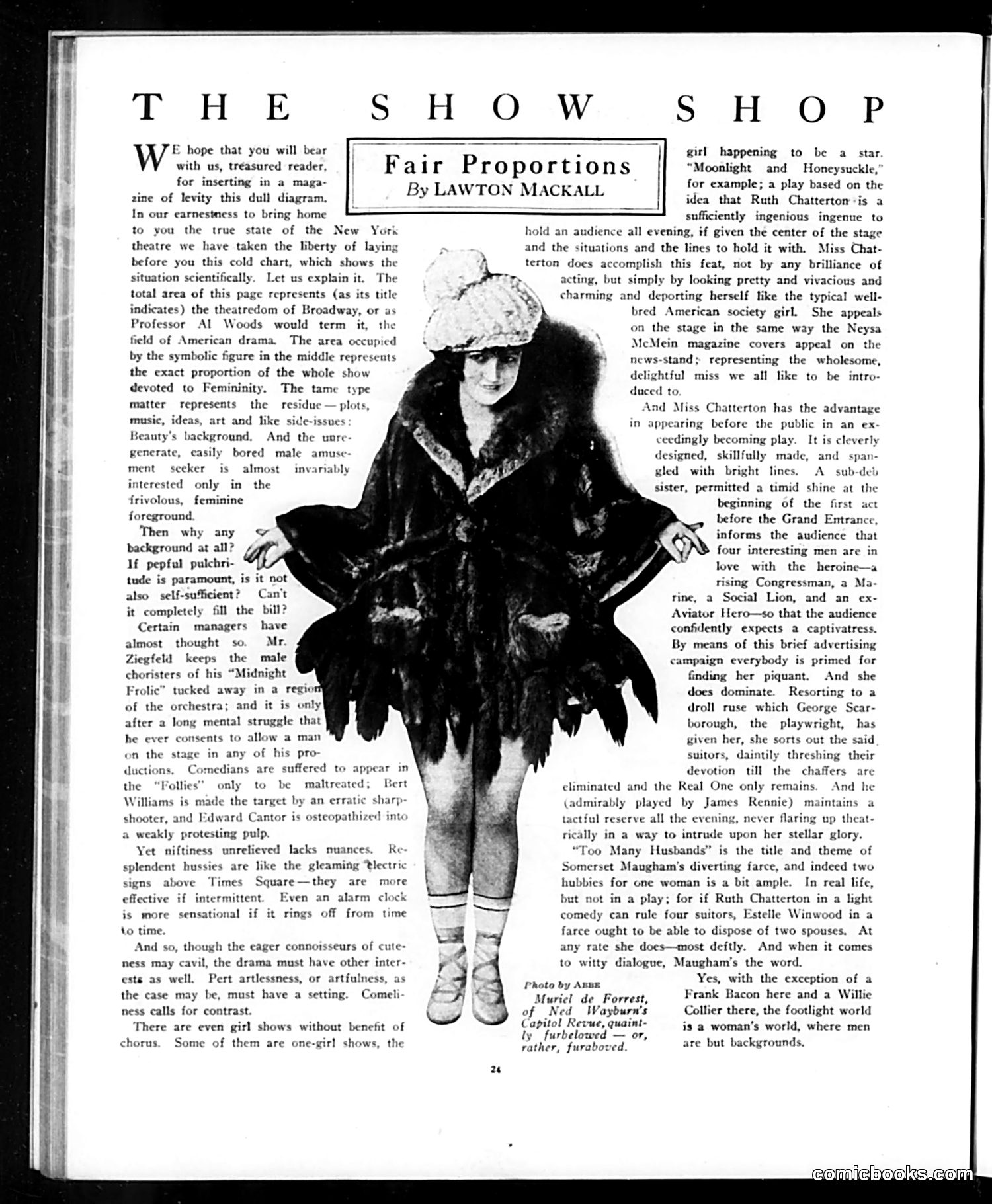
A restored page from Judge, 1919-11-01. Page through the whole issue in the reader above.
📄 Transcribed text from this page (OCR, searchable)
Machine-transcribed from the original scan — historical spelling and the odd misread are preserved.
T H E S E hope that you will bear with us, treasured reader, for inserting in a maga- zine of levity this dull diagram. In our earnestmess to bring home to you the true state of the theatre we have taken the liberty of laying before you this cold chart, which shows the situation scientifically. Let us explain it. The total area of this page represents (as its title indicates) the theatredom of Broadway, or as Professor Al Woods would term it, the field of American drama. The area occupied by the symbolic figure in the middle represents the exact proportion of the whole show devoted to Femininity, The tame type matter represents the residue — plots, music, ideas, art and like side-issues Beauty’s background. And the unre- generate, casily bored male almost the New York amuse- ment seeker is invariably interested only in frivolous, feminine foreground. Then why any background at all? If pepful pulchri- tude is paramount, is it not self-sufficient? Can't fill the bill? have also it completely Certain managers almost thought so. Mr. Ziegfeld keeps the male choristers of his “Midnight Frolic” tucked away in a regiot of the orchestra; and it is only after a long mental struggle that sents to allow a man stage in any his pro- Comedians are suffered to be maltreated; he ever on the of ductions, appear the “Follies” only to Williams is made the target by an erratic shary shooter, and Edward Cantor is osteopathized i a weakly protesting pulp. Yet unrelieved lacks nuances. niftiness splendent hussies are like the gleaming Tlectric mc Square—they are Even signs above ‘Times effective if intermittent is more sensational if it rings off from time to time. And so, though the eager connoisseurs of cute- ness may cavil, the drama must have other inter- ests as well. Pert artlessness, or artfulness, the case may be, must have a setting. ness calls for contrast. There are even girl shows without benefit of chorus. | Fair Proportions By LAWTON MACKALL Bert Re- ore an alarm clock - P Photo by Aube Comeli. Some of them are one-girl shows, the S H O P girl happening be a. star. “Moonlight and Honeysuckle,” for example; a play based on the idea that Ruth Chattertoris a sufficiently ingenious ingenue to hold an audience all evening, if given the center of the stage and the situations and the lines to hold it with. Miss Chat- terton does accomplish this feat, not by any brilliance of acting, but simply by looking pretty and vivacious and charming and deporting herself like the typical well- bred American society girl She appeals on the stage in the same way the Neysa McMein magazine covers appeal on the news-stand; representing the wholesome, delightful miss we all like to be intro- duced to. And Miss Chatterton has the advantag i before the public in an ex- It is cleverly H O W to in appea ceedingly becoming play. designed, skillfully made, and span- gled with bright lines. A sub-deb sister, permitted a timid shine the beginning of the first act before the Grand Entrance, informs the audience that four interesting men are in love with the heroine—a rising Congressman, a Ma- rine, a Social Lion, and an ex- Aviator Hero—so that the audience confidently expects a captivatress. By means of this brief advertising campaign everybody is primed for finding her piquant. And she does dominate. Resorting to a droll ruse which George Scar- borough, the playwright, has given her, she sorts out the said suitors, daintily threshing their in devotion till the chaffers are eliminated and the Real One only remains. And he (admirably played by James Rennie) maintains tactful reserve all the evening, never flaring up thes rically in a way to intrude upon her stellar glory. ‘co Many Husbands” is the title and theme of Somerset Maugham's diverting farce, and indeed two hubbies for one woman is a bit ample. In real life, but not in a play; for if Ruth Chatterton in a light comedy can rule four suitors, Estelle Winwood in a farce ought to be able to dispose of two spouses. At any rate she does—most deftly. And when it comes to witty dialogue, Maugham’s the word. Yes, with the exception of a Frank Bacon here and a Willie Collier there, the footlight world is a woman's world, where men are but backgrounds. Muriel de Forrest, ed Wayburn’s Capitol Revue, quaint- ly furbelowed — or, rather, furaboved