
A complete issue · 36 pages · 1919
Judge — July 19, 1919
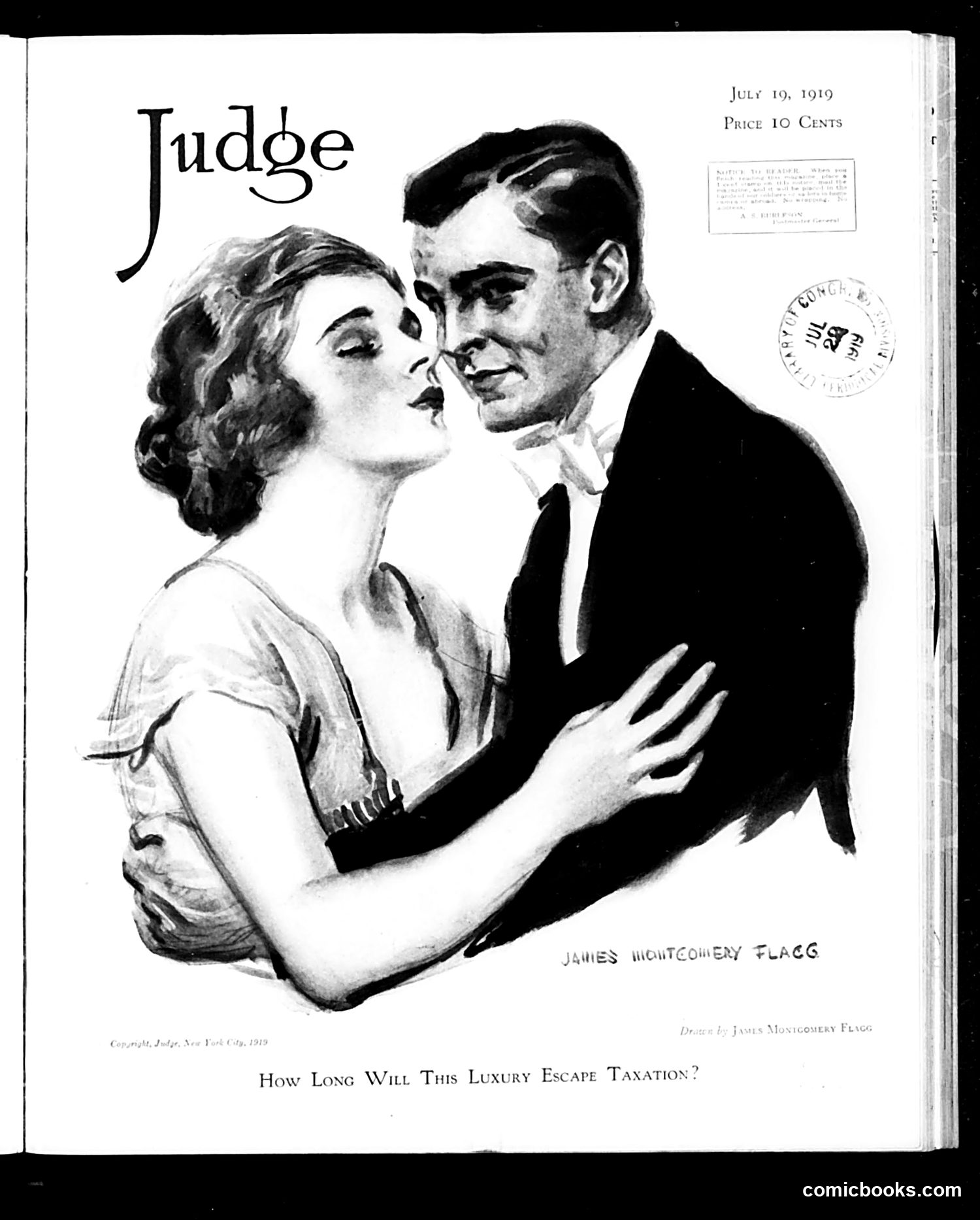
This satirical cartoon by James Montgomery Flagg addresses luxury taxation during the post-World War I period. The illustration shows an elegant couple in an intimate embrace, with the caption asking "How Long Will This Luxury Escape Taxation?" The satire targets wealthy Americans' indulgences during a time when the U.S. government was seeking new revenue sources, particularly through taxation of luxury goods. The cartoon suggests that even personal pleasures and romantic encounters—represented by the couple's embrace—might eventually face taxation as the government expanded its fiscal reach. Published at 10 cents, this reflects 1919's anxieties about government expansion and the reach of taxation into previously untaxed aspects of American life.
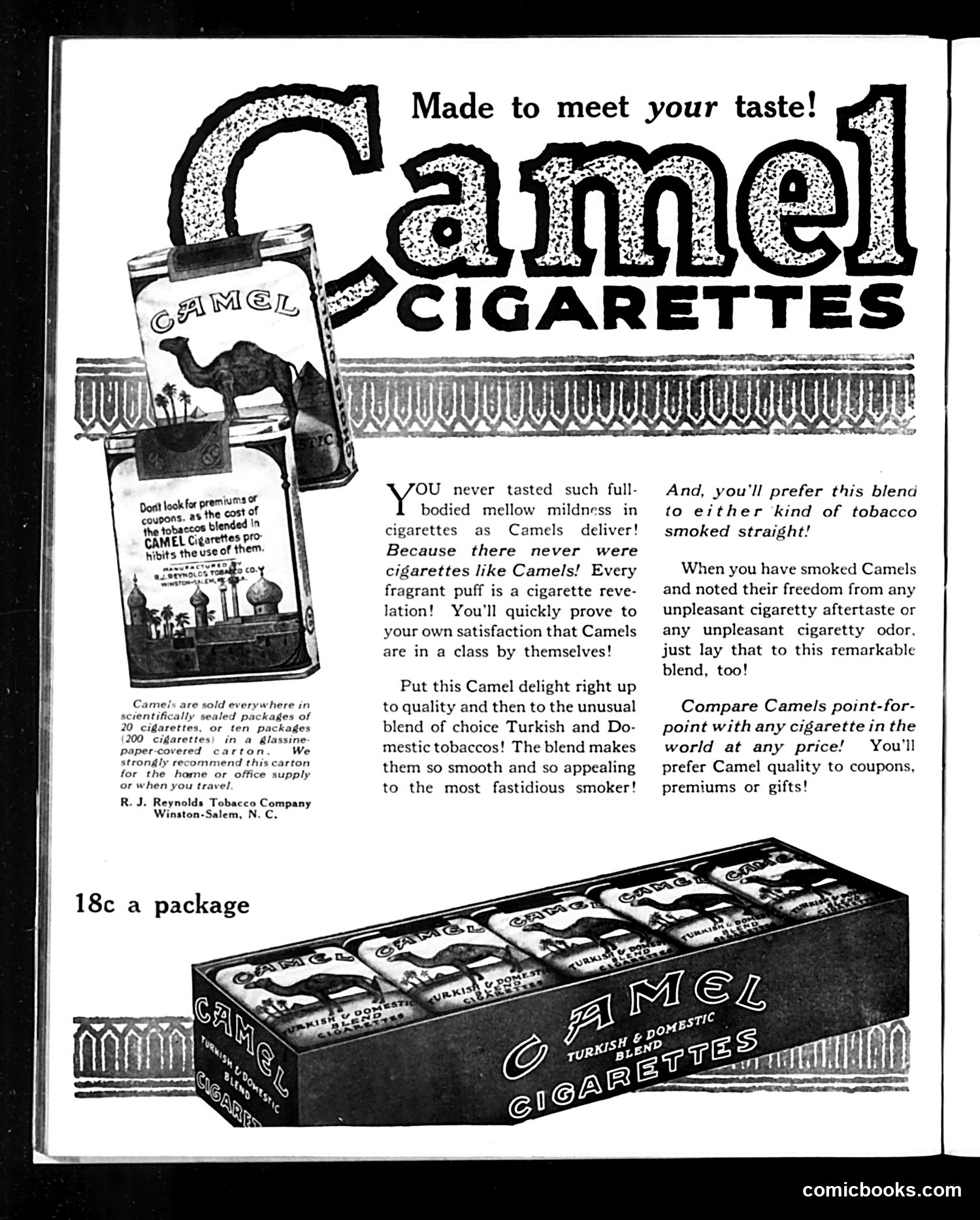
This is not a political cartoon or satire—it's a **straightforward cigarette advertisement** for Camel brand cigarettes, published in Judge magazine. The ad uses the brand's iconic camel mascot and emphasizes the product's appeal through claims about its "full-bodied mellow mildness" and blend of "Turkish and Domestic tobaccos." It highlights the low price (18 cents per package) and encourages consumers to compare Camels favorably against competitors. The advertisement reflects early 20th-century marketing practices, when cigarettes were openly promoted without health warnings. The exotic imagery (camels, Middle Eastern aesthetics) was typical branding of the era, designed to convey sophistication and quality to consumers.
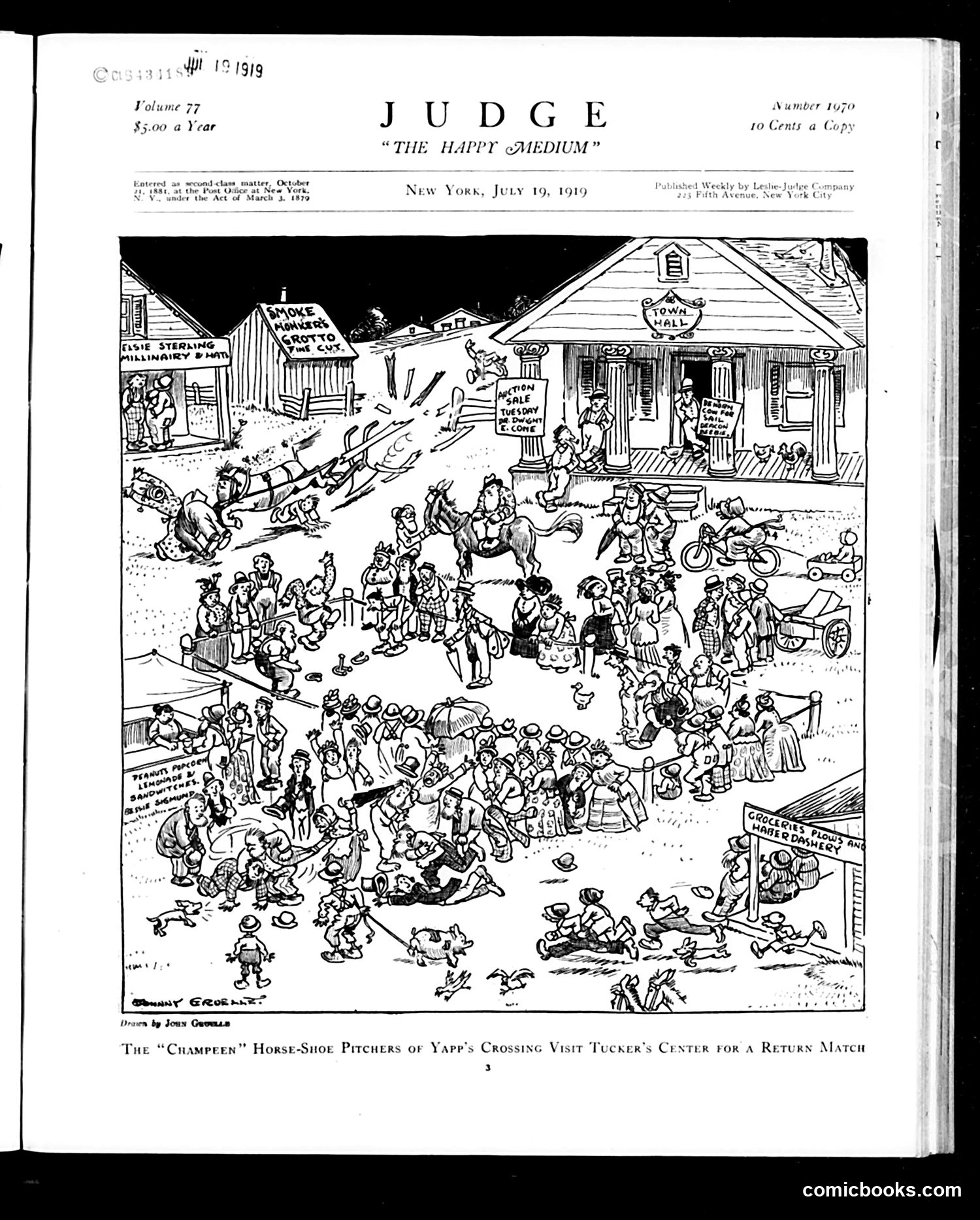
This satirical cartoon depicts a chaotic rural town scene titled "The 'Champion' Horse-Shoe Pitchers of Yapp's Crossing Visit Tucker's Center for a Return Match." The image shows a competitive horseshoe-pitching event—a popular working-class American pastime—that has apparently devolved into pandemonium. Crowds of townspeople, children, dogs, and various characters fill the town square near a "Town Hall," with visible storefronts including "Esme Sterling Millinery." The satire appears to mock small-town competitive spirit and the chaos that ensues when neighboring communities clash over sporting events. The exaggerated disorder—with people scattered everywhere, animals roaming freely—parodies how such local rivalries could spiral into mayhem, transforming a simple athletic contest into a town-wide commotion. This reflects early 20th-century American rural life and community tensions.
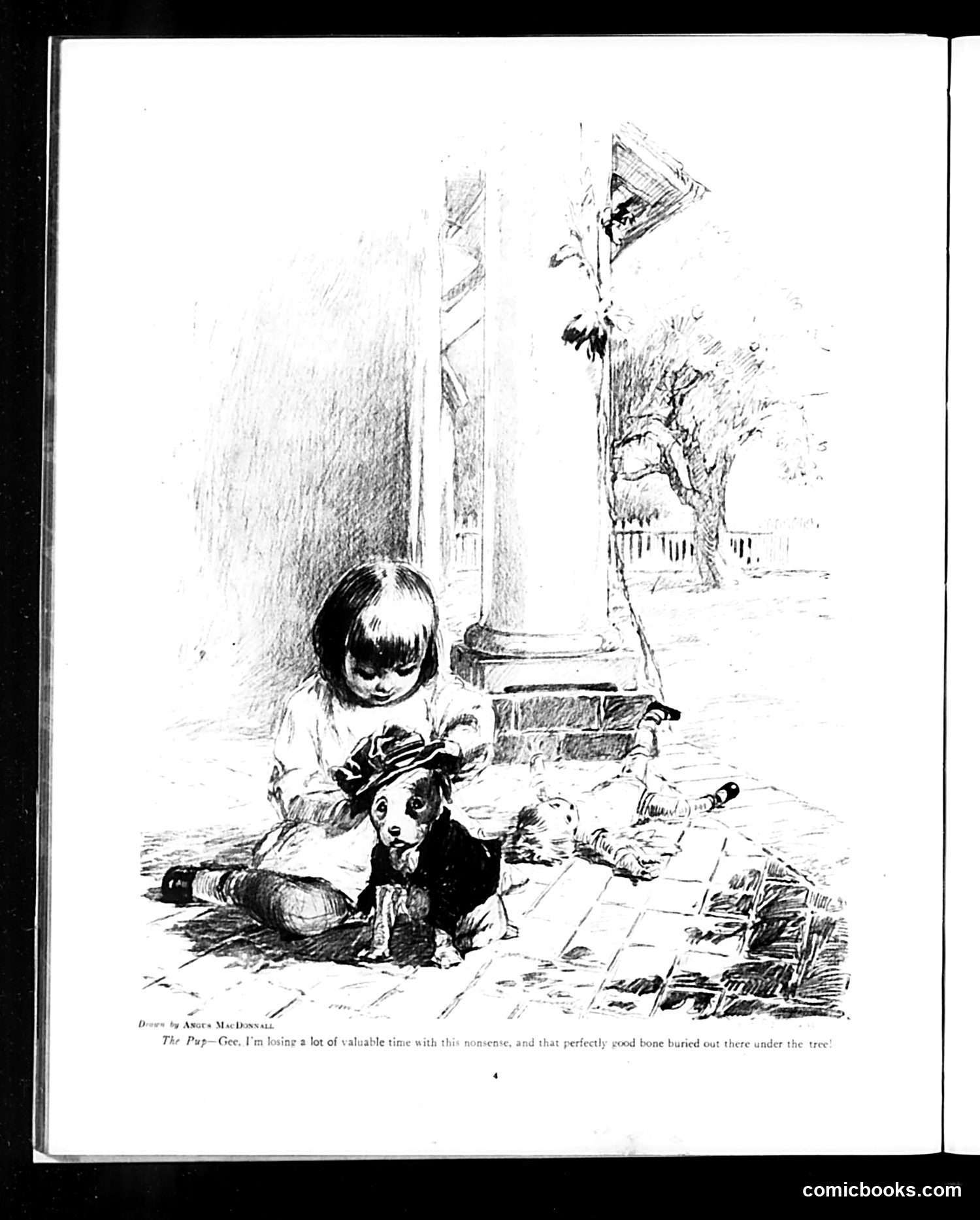
This is a single illustration by Alice Macdonnell titled "The Pup," depicting a child playing with a small dog outdoors. The child sits on the ground near a tree, appearing to scold or converse with the dog about burying a bone. The caption reads: "Gee, I'm losing a lot of valuable time with this nonsense, and that perfectly good bone buried out there under the tree." This is straightforward children's humor rather than political satire—the joke is the dog's imagined complaint about wasted time and the buried bone. The illustration captures a relatable scene of childhood play and pet ownership, with gentle anthropomorphization of the dog's perspective. There are no apparent political figures or social commentary evident in this particular page.
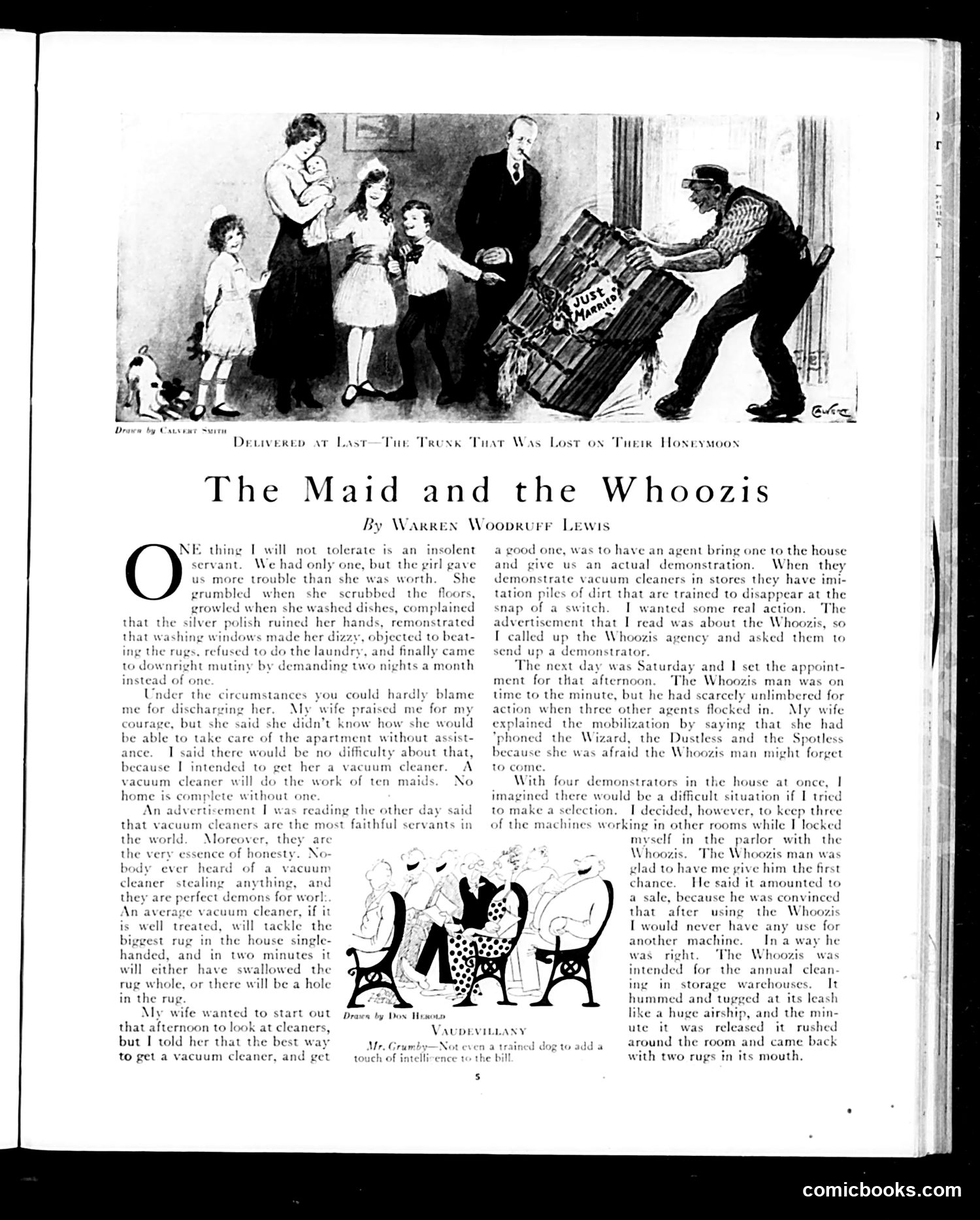
This is a humorous short story about a domestic servant problem, not political satire. The narrative describes hiring a vacuum cleaner demonstrator after the author's maid proves unsatisfactory at household tasks. The top illustration shows a delivery scene where a large vacuum cleaner ("the trunk that was lost on their honeymoon") arrives at a family home. The lower cartoon, captioned "Vaudvillany," depicts the vacuum cleaner in action—humorously personified as performing like a stage act, suggesting the machine's chaotic, unpredictable behavior in the household. The satire targets early vacuum cleaner technology and advertising claims of the era, presenting the device as both miracle solution and comedic menace to domestic life.
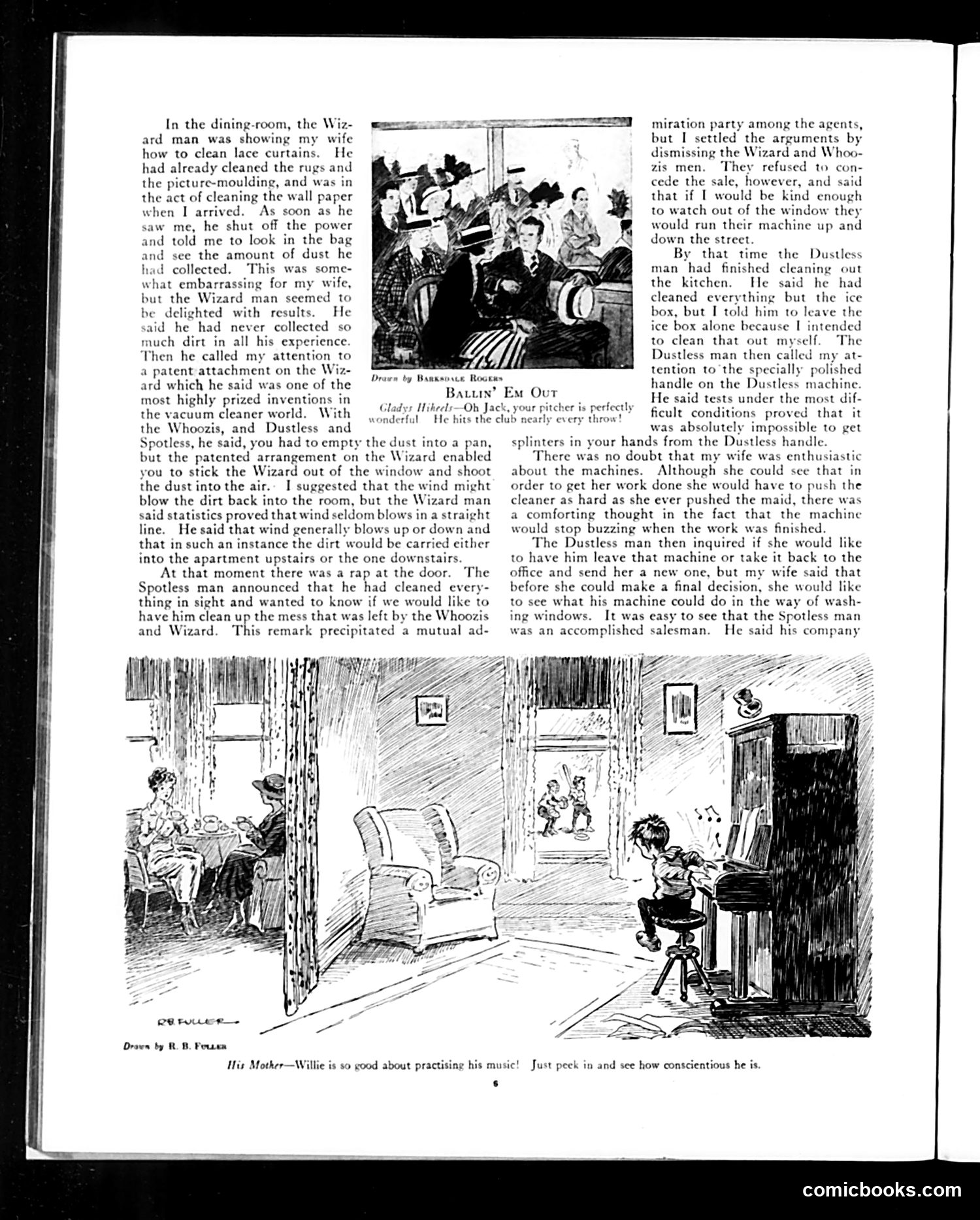
**Upper Cartoon - "Balls' Em Out":** This depicts a baseball scene where a pitcher (labeled "Jack") is throwing to a batter. The joke appears to be a pun on "balls" (baseballs) and criticizes the pitcher's control, with text mentioning splinters and wind affecting the game. It's sports satire mocking poor pitching performance. **Lower Cartoon - "His Mother":** Shows a domestic scene where a boy practices music (visible at piano) while his mother peers in, proud of his diligence. The caption's humor lies in suggesting the boy is "conscientious" about practicing—likely satirizing parental pride in children's musical training, a common middle-class aspiration of the era. Both cartoons employ simple visual humor typical of early 20th-century Judge magazine.
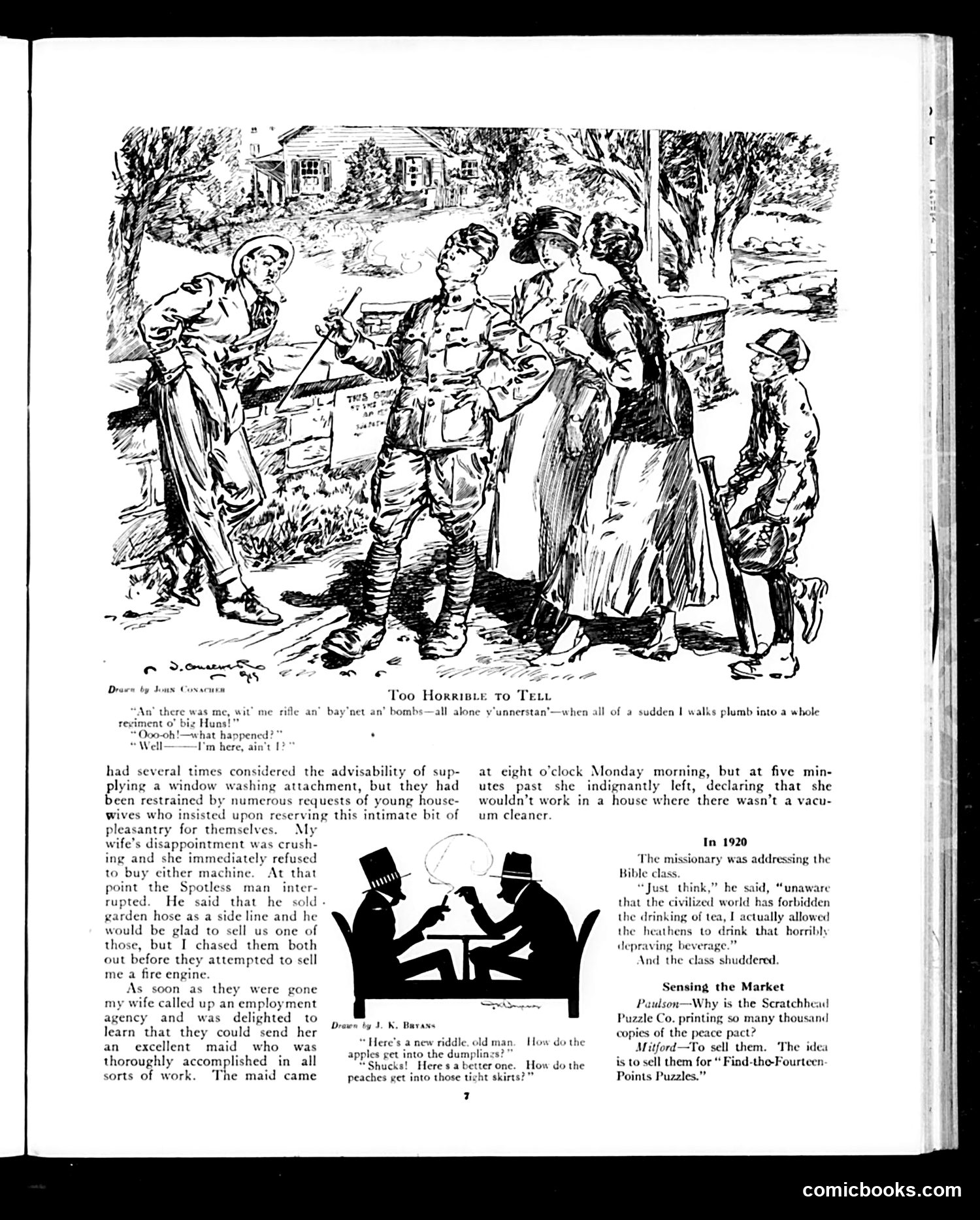
**Main Cartoon ("Too Horriste to Tete"):** This satirizes the absurd marketing tactics of appliance salesmen in the early 1920s. A soldier or serviceman is surrounded by housewives and salesmen hawking labor-saving devices (vacuum cleaners, window-washing attachments, garden hose). The joke: a maid refuses to work in a home *without* a vacuum cleaner—the very machines meant to replace domestic help have created impossible consumer expectations. The satire targets both aggressive sales culture and the new consumer mentality where modern appliances became status symbols rather than genuine conveniences. **Secondary Content:** - A 1920 anecdote mocking a missionary's self-righteousness about "civilizing" heathens by forbidding tea - A small joke about puzzle companies opportunistically packaging the Wilson peace plan as a puzzle game to capitalize on current events The overall theme: American consumer culture and advertising's manipulative reach into everyday life.
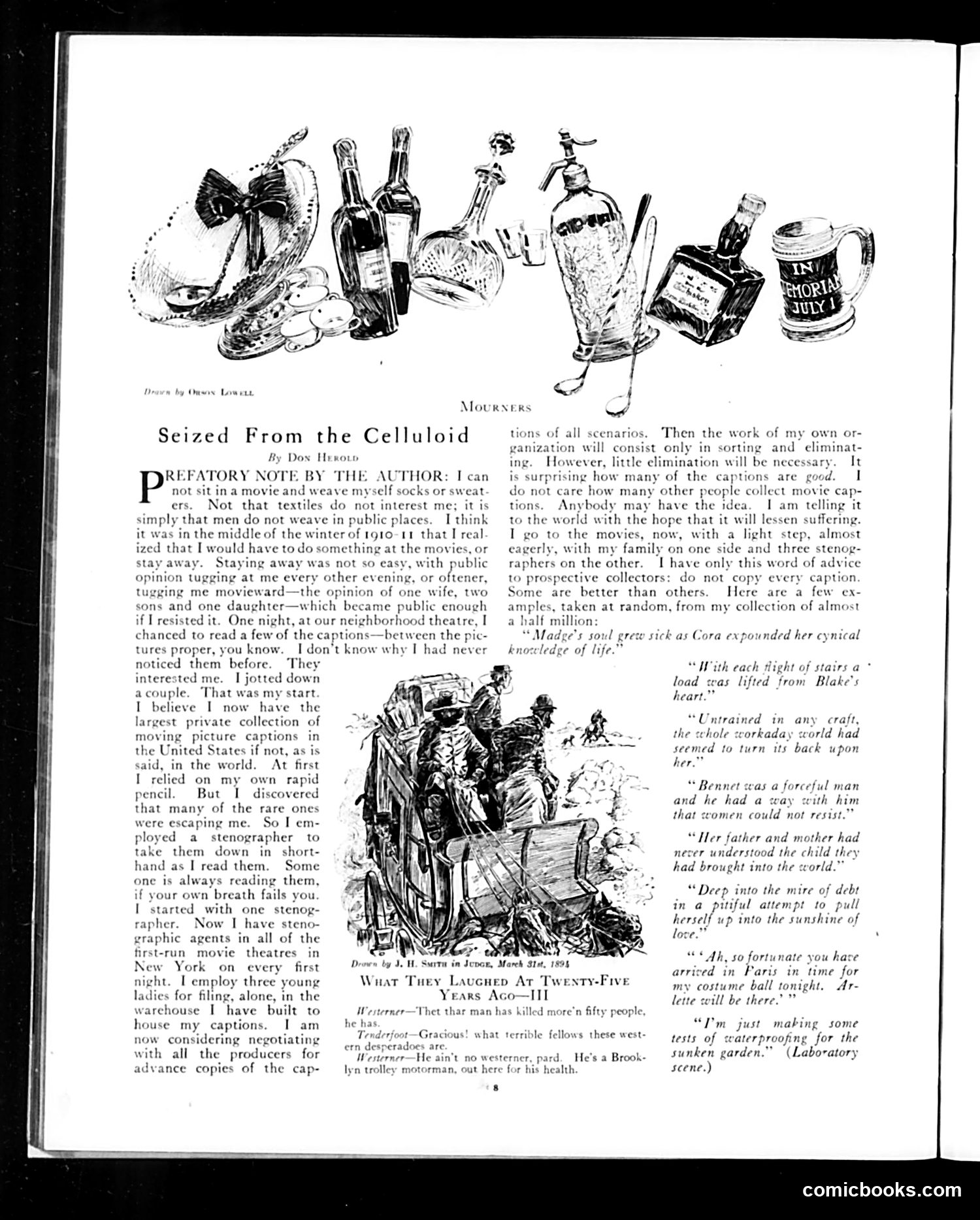
This page satirizes **silent film intertitles**—the text cards inserted between scenes in early cinema that advanced the plot or provided dialogue. The top illustration shows objects labeled "Mourners," a visual joke about melodramatic film captions (quotes visible include references to tragedy and forced emotion). **The main satire:** Author Dos Herrold collected actual movie captions and discovered them hilariously overwrought. He now employs stenographers in movie theaters to record them, having built a house to store nearly half a million examples. The humor lies in how absurdly *earnest* these captions were—overwrought, clichéd, and unintentionally comical. Examples shown include purple prose about moral downfall, family misunderstanding, and waterproofing tests presented with equal melodramatic weight. **For modern readers:** This mocks how early cinema substituted clumsy written exposition for visual storytelling, creating unintentionally funny overwrought moralizing. It's pre-sound film's equivalent of mocking bad movie dialogue today.
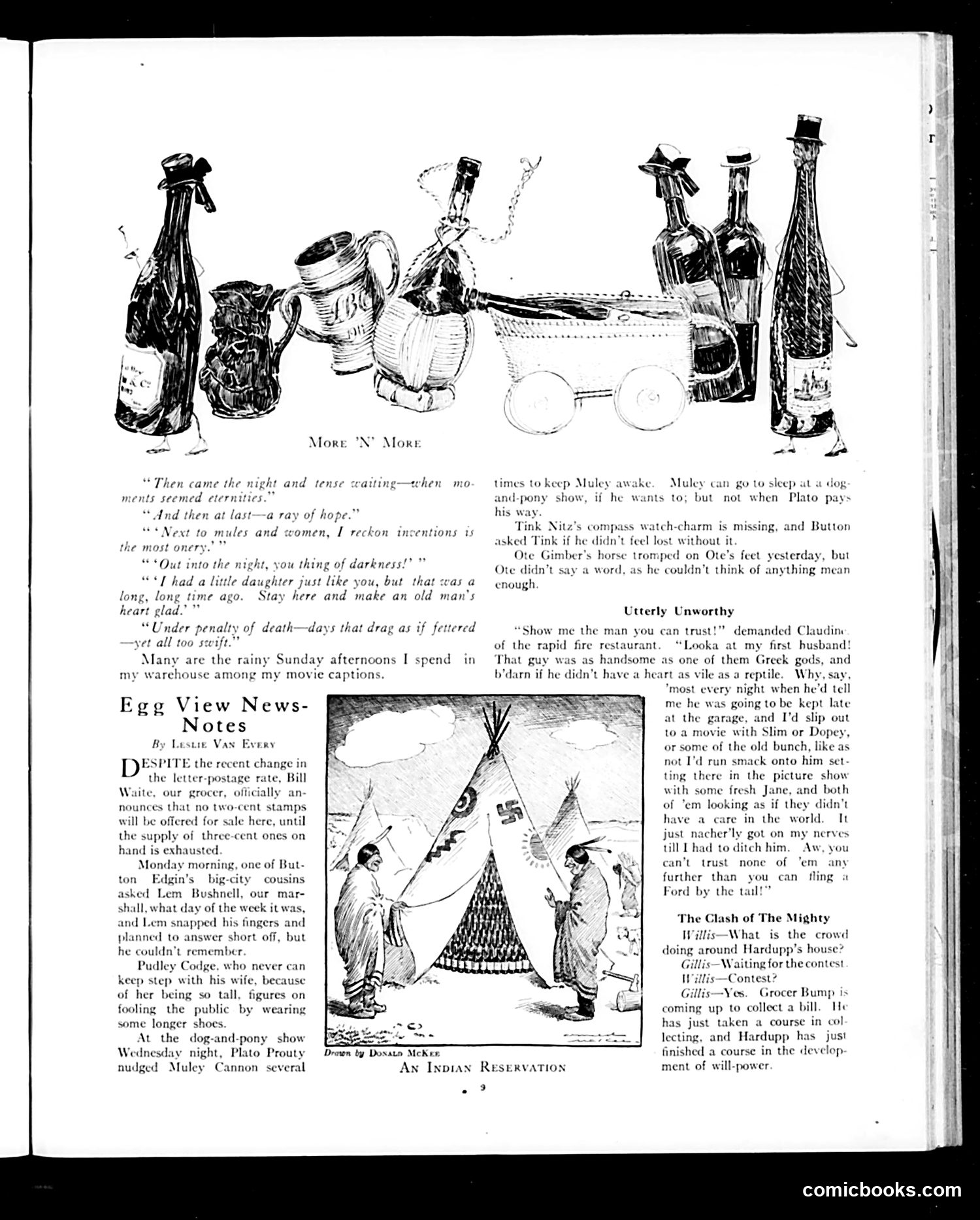
This page from Judge magazine contains light humor pieces typical of early 20th-century American satirical magazines. **"More 'N' More"** (top): A cartoon showing anthropomorphized bottles of alcohol with hats and a baby carriage. The accompanying text offers philosophical musings seemingly inspired by drinking, presenting drunken rambling as profound wisdom—satirizing how alcohol loosens tongues and creates false profundity. **"Egg View News-Notes"**: A small-town gossip column mocking rural American life. The items ridicule local characters' peculiarities: men who can't remember days of the week, those trying to appear taller, and petty jealousies. It's gentle satire of small-town life and human vanity. **"An Indian Reservation"** (McKee illustration): Shows Native Americans in a teepee, likely satirizing stereotypical depictions or contemporary attitudes toward Native peoples, though the specific context is unclear. **"Utterly Unworthy" and "The Clash of The Mighty"**: Brief humorous dialogues about infidelity and debt collection, representing domestic comedy typical of the era. Overall, this represents Judge's blend of visual cartoons and comedic prose targeting middle-class American audiences.
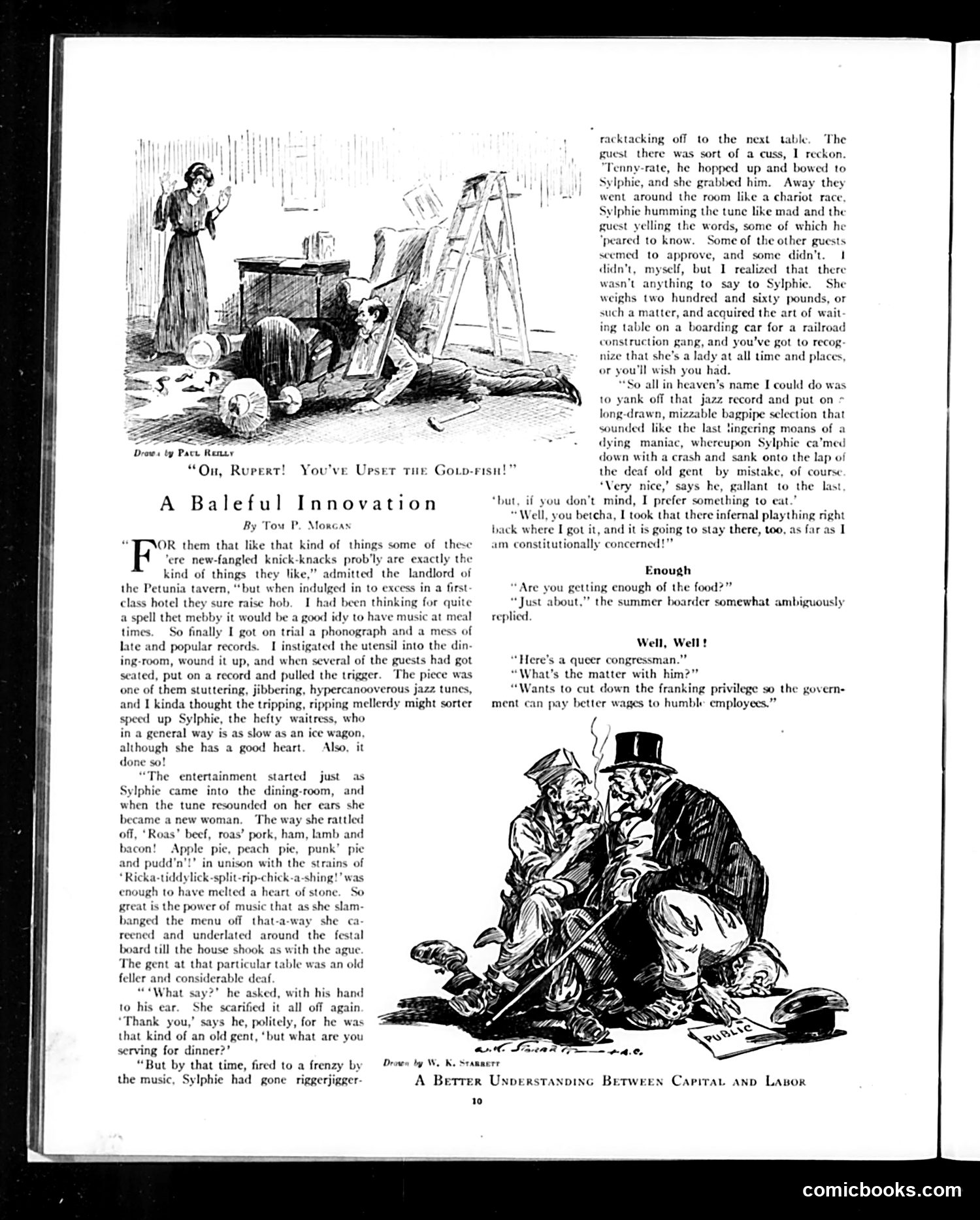
This page contains two satirical pieces from an early 20th-century American humor magazine. **"A Baleful Innovation"** mocks the new technology of phonographs in restaurants. A tavern owner installs one to speed up service from his slow waitress Sylphie. When jazz music plays, she becomes hyperactive, dancing wildly around the dining room—disrupting guests and nearly injuring a deaf elderly man. The satire targets both the indiscriminate adoption of new technology and the chaotic effects of modern jazz music on working-class women, presented as comedic chaos. **"A Better Understanding Between Capital and Labor"** (bottom cartoon by W.K. Starrett) depicts two working-class figures discussing a congressman who wants to cut "franking privileges" (free congressional mailing rights) to fund better wages for humble employees. The joke satirizes the contradiction: even reformers protecting worker interests face skepticism from the workers themselves, suggesting mutual distrust between labor and government. Both pieces reflect early 1900s anxieties about modernization, class relations, and technological disruption.
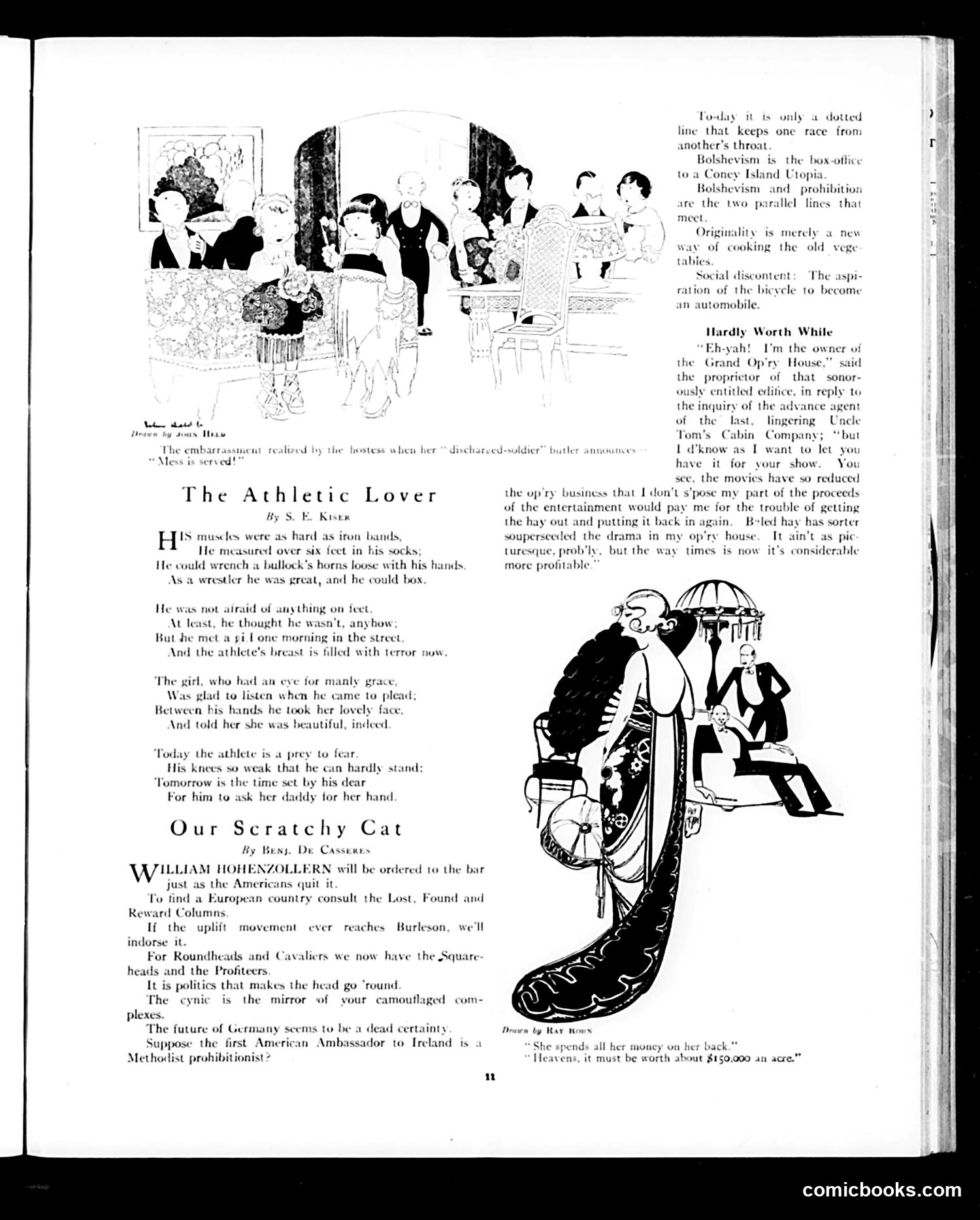
This page contains three distinct pieces of 1920s American satire: **"The Athletic Lover"** is a humorous poem about masculine contradiction—a powerful athlete fearless in physical contests becomes terrified when romantically involved and must ask his girlfriend's father for her hand. **"Our Scratchy Cat"** comprises brief political quips mocking post-WWI America. References include: Kaiser Wilhelm II (German ruler) facing legal consequences as Americans end Prohibition; the "Lost and Reward Columns" (unclear reference); "Roundheads and Cavaliers" replaced by "Square-heads and Profiteers" (war profiteers); and speculation about appointing a Methodist prohibitionist as Ambassador to Ireland—satirizing both American moral rigidity and Irish-American relations. **"Hardly Worth While"** depicts an opera house owner refusing to rent to a traveling "Uncle Tom's Cabin" theatrical company, claiming movies have destroyed live entertainment's profitability. It satirizes entertainment industry decline during the cinema boom. The cartoons mock contemporary anxieties: gender relations, post-war politics, Prohibition, and technological disruption of traditional entertainment.
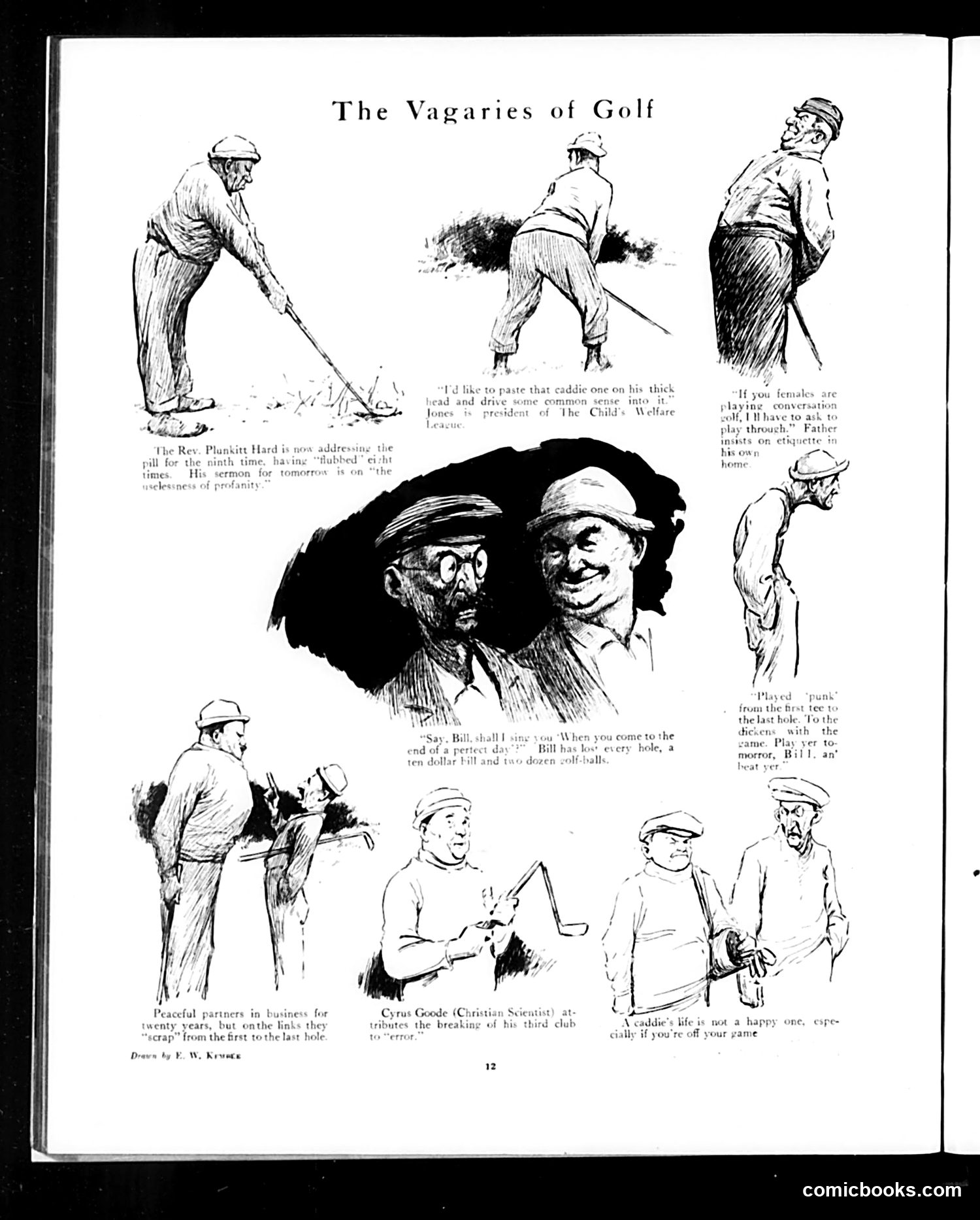
This satirical page mocks various golf stereotypes and player types through character sketches. The illustrations show: - A clergyman (Rev. Plansitt Hard) addressing the ball for the ninth time, satirizing verbose, ineffective players - "Bill" and another character in conversation about perfect days and golf balls—likely poking fun at boastful golfers - Cyrus Goode (identified as a Christian Scientist) breaking his club in frustration, mocking religious hypocrisy when faced with golf's challenges - Various other character types: overbearing fathers, domestic nags, and business partners who "scrap" over golf outings The satire targets how golf reveals people's true nature—clergy lose patience, scientists abandon faith, and respectable people become irritable. It's social commentary through sporting mishap, exposing the vanity and frustration lurking beneath genteel facades.
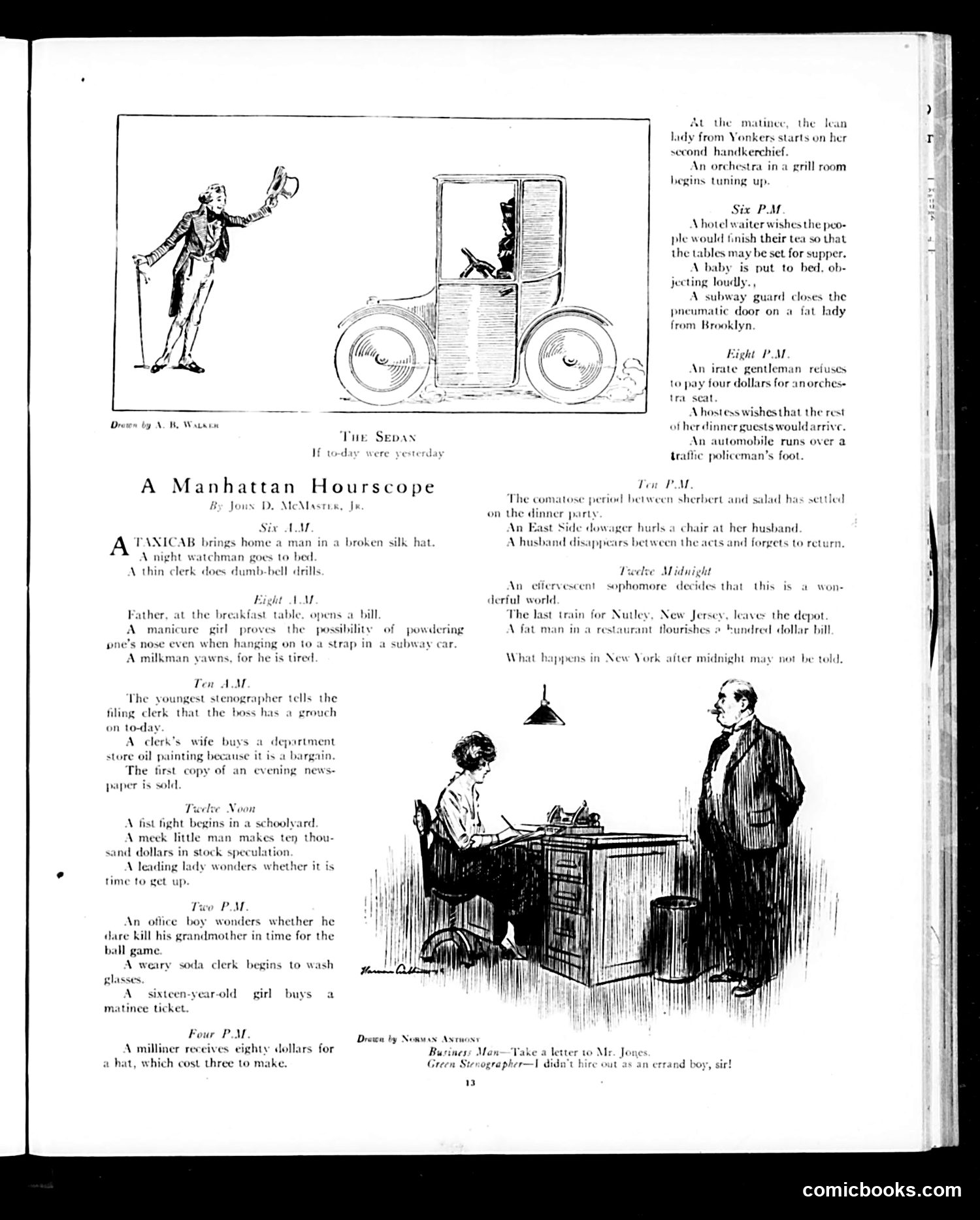
This satirical piece tracks absurd events across a single New York day, from 6 A.M. to midnight, mocking urban life's contradictions and chaos. The humor relies on juxtaposing mundane complaints with genuine emergencies: a hotel waiter annoyed guests linger over tea, while a subway guard traps a woman in a pneumatic door. A manicure girl gossips while a man makes thousands in stock speculation. The title parodies astrological horoscopes—instead of zodiac predictions, we get a cynical "hourly forecast" of New York's petty grievances and dramatic incidents. References to specific locations (Yonkers, Brooklyn, East Side) and transportation (taxicabs, subways, the Nutley train) ground the satire in recognizable urban experience. The cartoon's final panel caption jokes that "what happens in New York after midnight may not be told"—implying scandalous or immoral nightlife the magazine couldn't openly depict. The satire targets both New Yorkers' self-importance and the city's frenetic, morally dubious character.
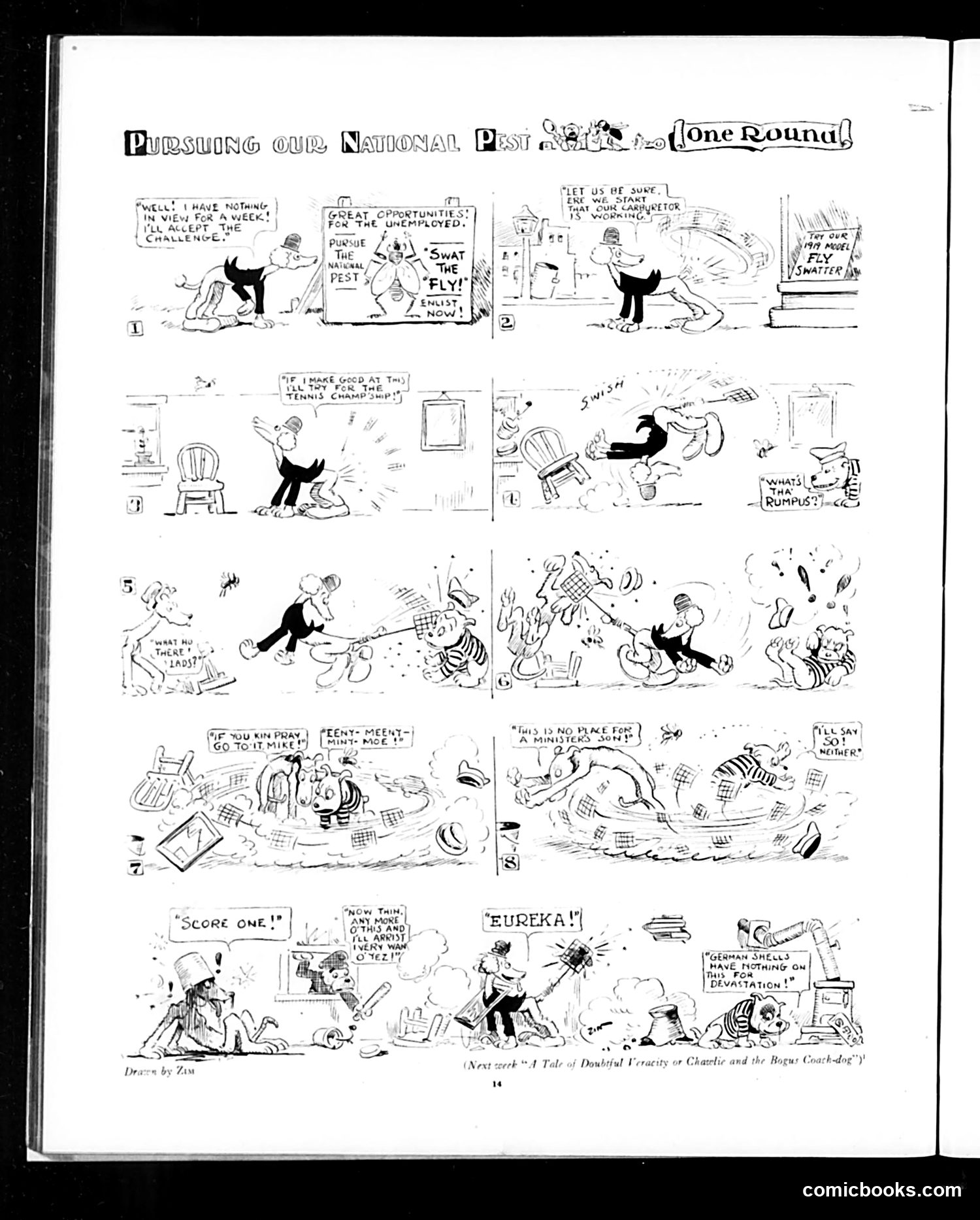
This Judge magazine cartoon satirizes pest control efforts, likely during World War I (suggested by references to "German shells"). The narrative follows characters attempting to eliminate a fly—depicted as a persistent nuisance requiring escalating, comedic methods. The "pest" serves as metaphor: the fly represents either an actual public health concern (flies spread disease) or a wartime enemy. Early panels show confident attempts ("swat the fly!"); later panels depict increasingly chaotic, destructive responses involving explosions and chaos. The final panels reference German military capability ("German shells have nothing on this devastation"), suggesting the cartoon compares civilian pest-control efforts to wartime destruction—likely mocking either overblown responses to minor problems or the actual devastation of war itself. The black cat functions as comic observer throughout, highlighting the absurdity of the escalating battle against one small insect.
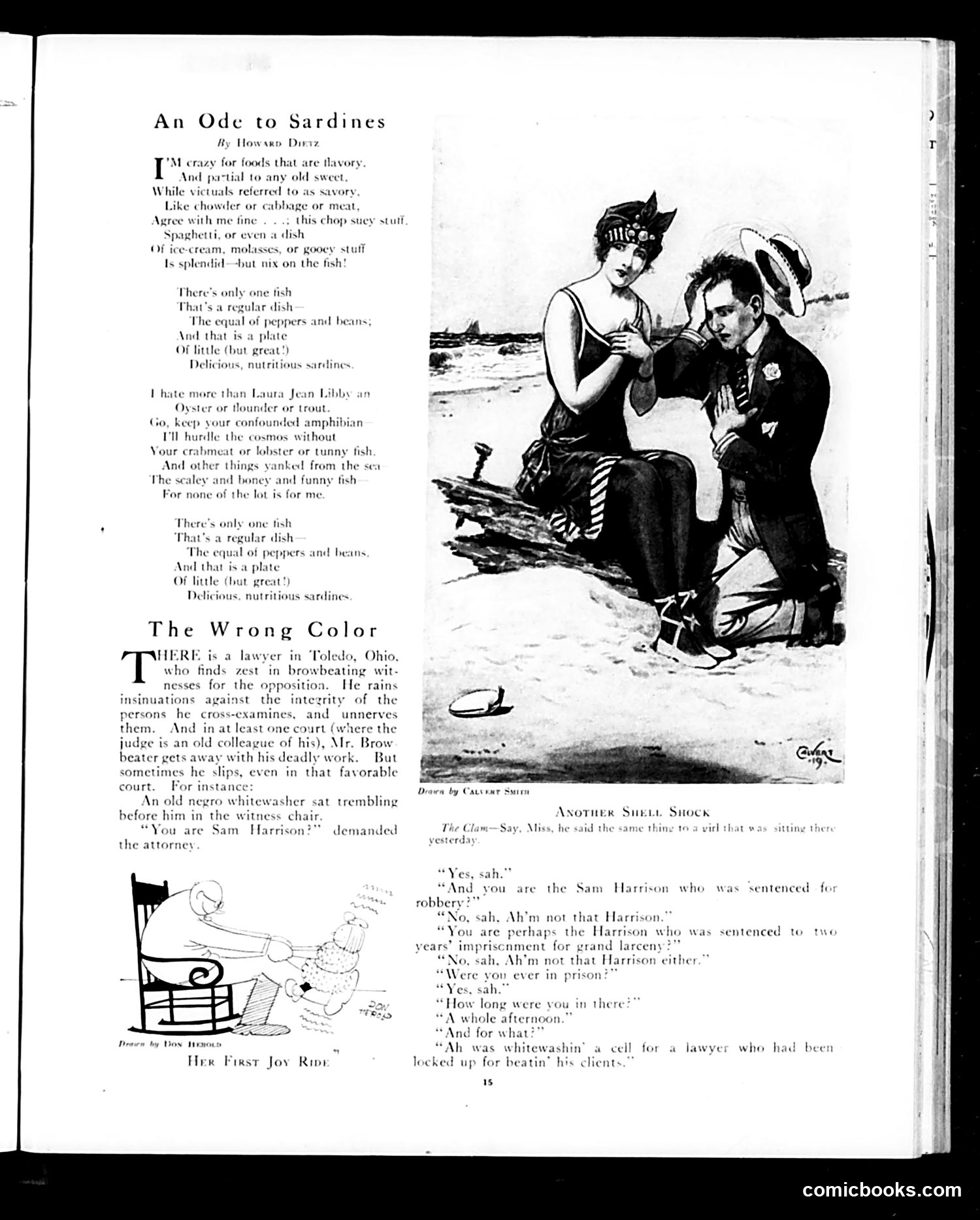
This page contains three pieces of satirical content: **"An Ode to Sardines"** is a humorous poem by Howard Dietz celebrating sardines as the only acceptable fish, while mocking various other seafood and foods. It's light comic verse with no apparent political meaning. **"The Wrong Color"** is a courtroom satire mocking a lawyer in Toledo, Ohio who bullies witnesses through aggressive cross-examination. The joke centers on a Black whitewasher (janitor) who, when repeatedly asked if he's a "Sam Harrison" convicted of various crimes, finally reveals he was locked up briefly for whitewashing a cell—because that lawyer had himself been imprisoned for beating his own clients. The satire targets the lawyer's hypocrisy and intimidation tactics. **"Her First Joy Ride"** (illustrated below) appears to be a brief comic piece, though its full text is unclear from this OCR. The racial dialect and terminology reflect the magazine's early-20th-century context and editorial perspective.
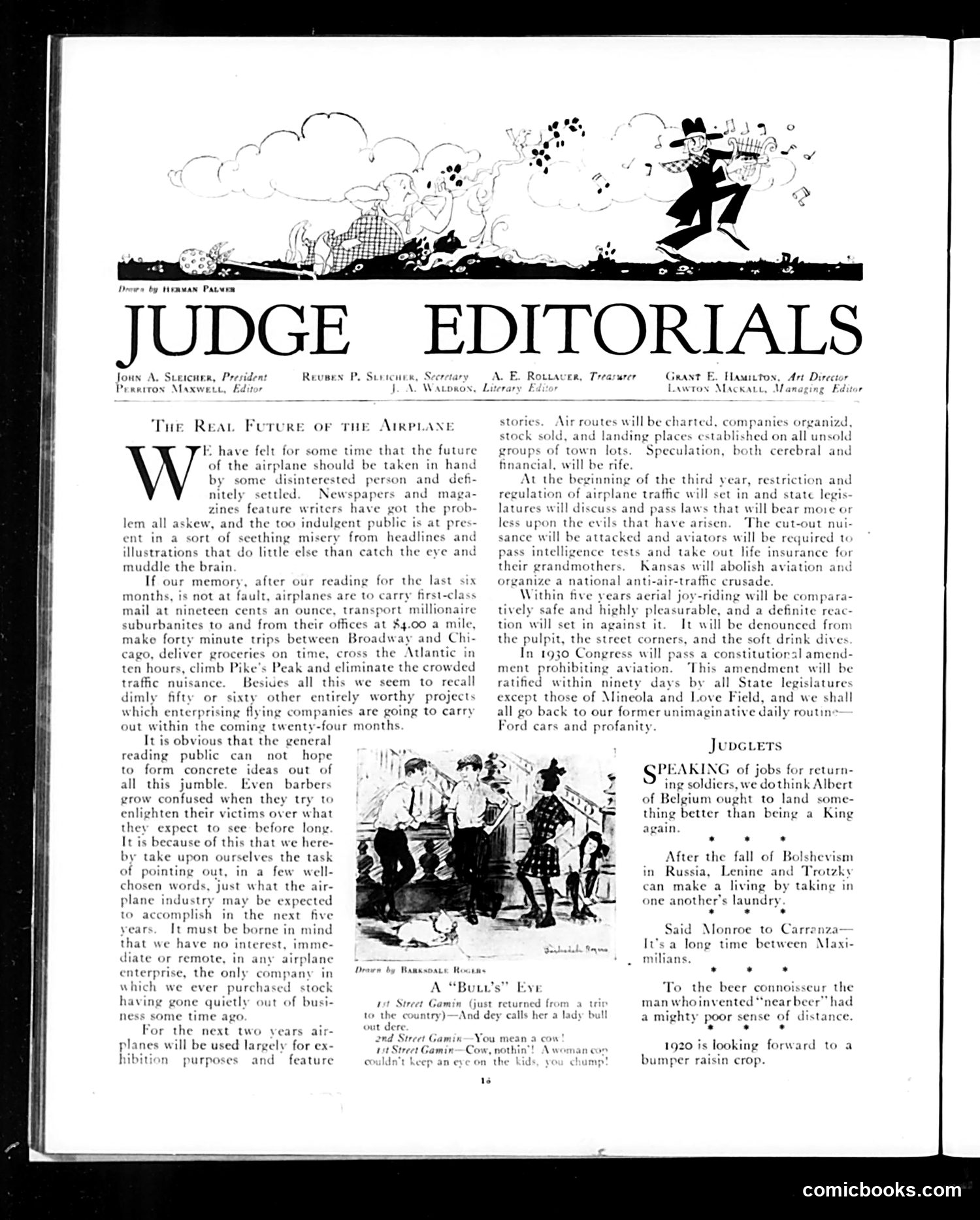
This page from Judge (an American satirical magazine) contains two main pieces: **"The Real Future of the Airplane"** is a tongue-in-cheek editorial mocking the public's gullible enthusiasm for aviation's promised future. The editorialists satirize exaggerated newspaper claims about what planes will soon accomplish—mail delivery, luxury transport, grocery delivery, transatlantic flights—predicting instead that within five years, public backlash will lead to a constitutional amendment *prohibiting* aviation entirely. The satire targets both the hype-driven aviation industry and the credulous media and public that uncritically accept fantastical promises. **"Judgets"** is a section of short, mordant jokes. References include: Albert of Belgium (King Albert I) deserving better employment than kingship; Lenin and Trotsky taking in laundry after Bolshevism's fall; Monroe and Carranza (Mexican president); and a joke about "near beer" (alcohol substitute during Prohibition). The cartoon by Barrymore Hogarth (credited) illustrates street-scene humor, though details are unclear from the image quality.
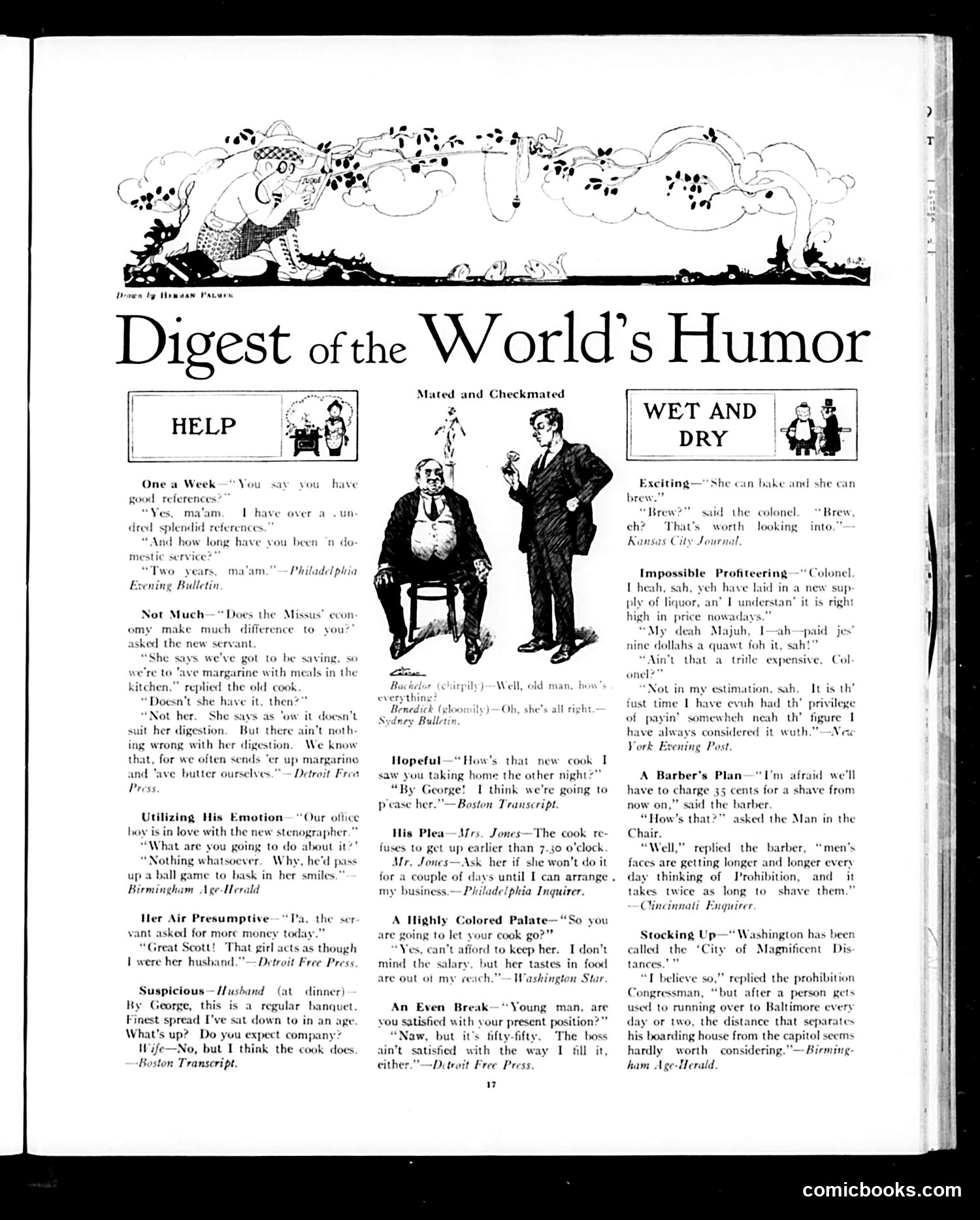
This page collects brief humorous anecdotes from newspapers, typical of Judge's format. The humor reflects early 20th-century domestic concerns: **Key themes:** - **Servant/employer relations**: Multiple jokes about cooks and servants demanding higher wages or better conditions, reflecting labor tensions of the era - **Prohibition era references**: A barber charges more because customers' faces are longer from "thinking of Prohibition"; a congressman discusses trips to Baltimore (then outside dry zones) to escape restrictions - **Gender dynamics**: Wives manipulating husbands through cooking; servants outsmarting employers - **Class anxiety**: Middle-class anxiety about rising servant costs and maintaining household economy **The central cartoon** (center-left) shows two men discussing a cook—representing the common contemporary problem of domestic service shortages and wage demands. The "Wet and Dry" section explicitly addresses Prohibition's social impact, treating it as absurd rather than morally serious—typical of Judge's satirical stance during that period.
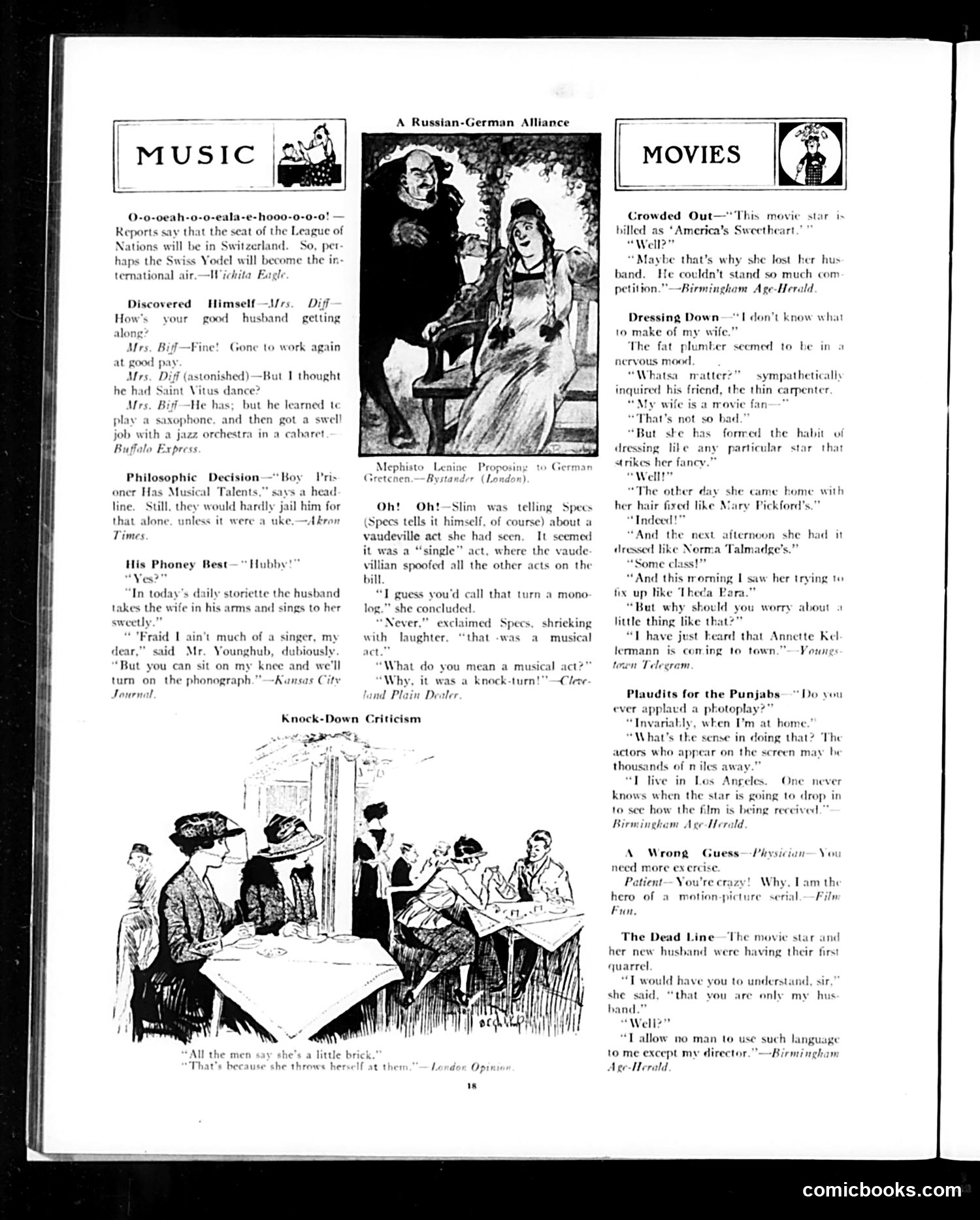
This page contains music and movie humor from the early 20th century. The "Knock-Down Criticism" cartoon depicts women at what appears to be a social gathering, with the caption suggesting a woman is "a little brick" because "she throws herself at them"—satirizing aggressive female socializing as unfeminine behavior. The movie section mocks film culture obsessions: one joke features a wife constantly imitating movie stars' hairstyles (Mary Pickford, Norma Talmadge, Theda Bara), exasperating her husband. Another satirizes the absurdity of applauding movies when actors are miles away. A third jokes about a newlywed actress who tells her husband she only tolerates profanity "from my director"—satirizing Hollywood's power dynamics and actresses' submission to authority figures. The music section contains light wordplay about saxophones and vaudeville. These pieces mock emerging popular culture's influence on daily life and gender behavior during this period.
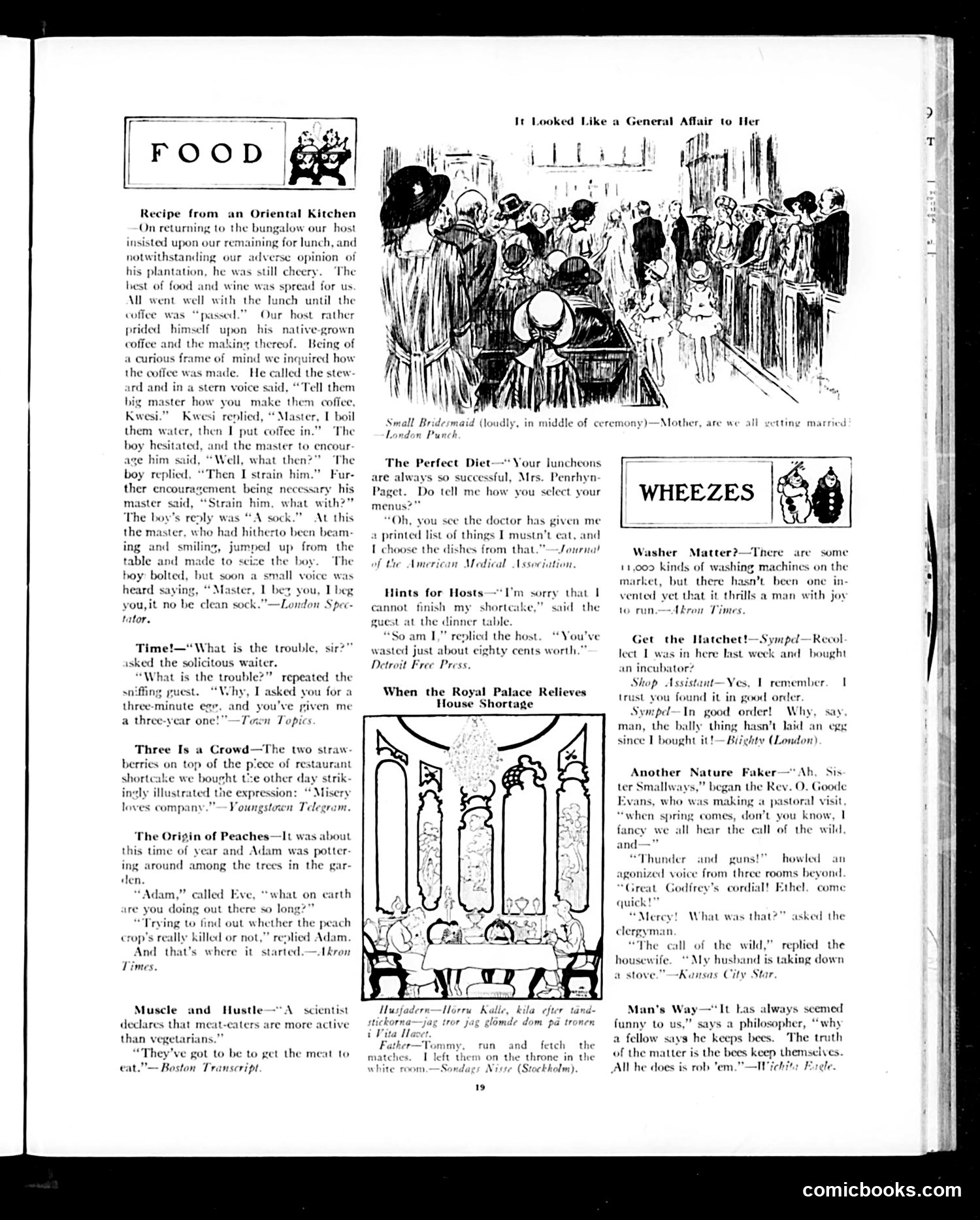
This page from Judge contains multiple short humorous anecdotes typical of early 20th-century American satirical humor. The main cartoon "It Looked Like a General Affair to Her" depicts a wedding ceremony where a bridesmaid (noted as "loudly, in middle of ceremony") asks the mother if everyone is "getting married"—a naive joke about the formality and pageantry of the event. The surrounding text consists of brief comedic vignettes poking fun at everyday situations: a colonial servant's confusion about making coffee with a "sock" (strainer), complaints about undercooked eggs, the absurdity of selecting meals based on forbidden foods, a waiter's sarcasm about wasted dinner, and various puns about nature, washing machines, and beekeeping. The humor is gentle, domestic, and relies on wordplay and simple misunderstandings rather than political commentary. These appear designed as light entertainment for Judge's readers.
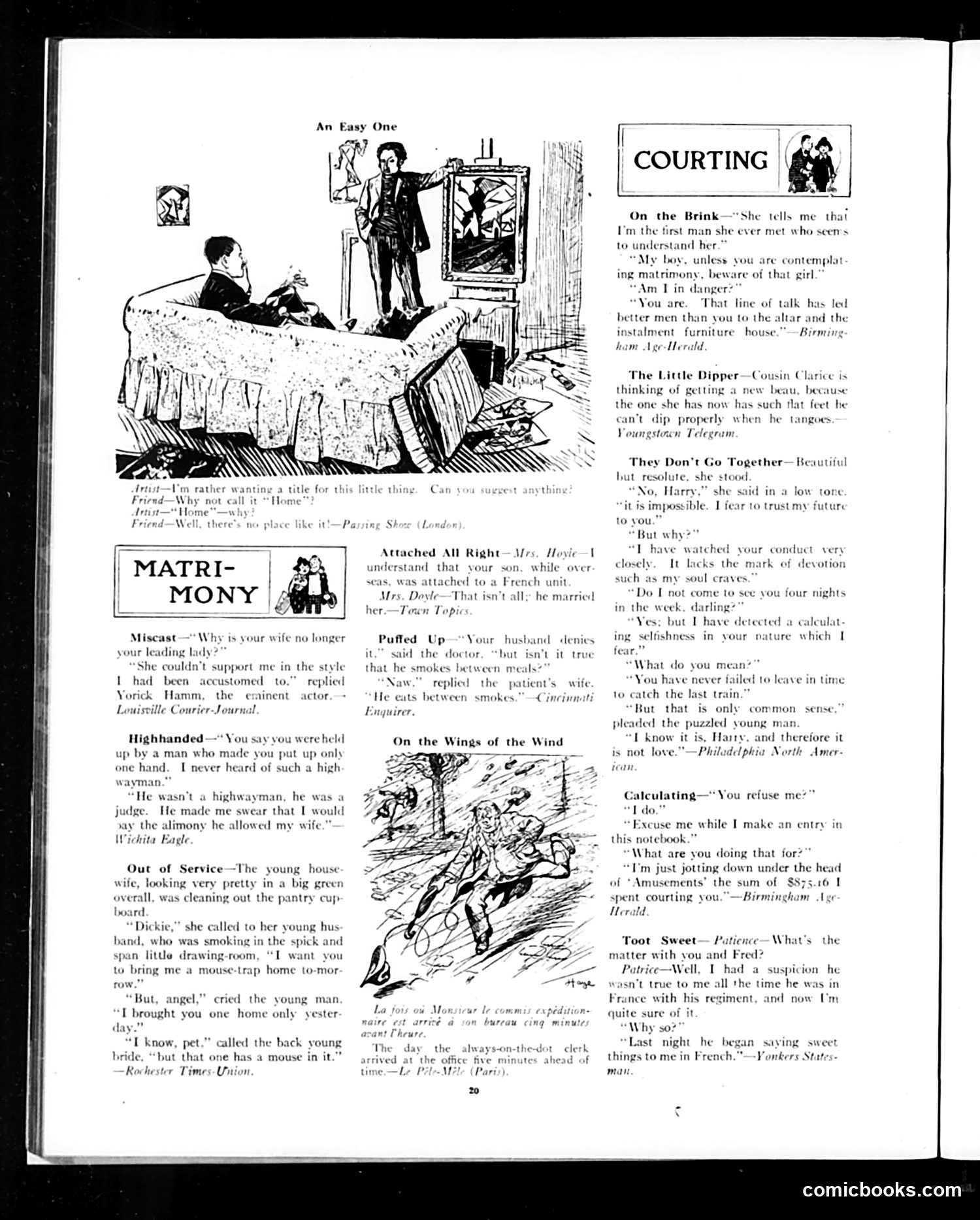
This page collects brief humorous anecdotes organized by topic—marital disputes under "Matrimony" and romantic troubles under "Courting." The jokes reflect early 20th-century anxieties about gender roles and marriage. "Highhanded" mocks alimony payments (courts forcing husbands to support ex-wives). "Out of Service" plays on a wife's incompetence (the mousetrap joke suggests she's silly). "Attached All Right" jokes about a son's hasty marriage to a French woman during military service—likely WWI, when American soldiers were stationed abroad. Under "Courting," the humor targets calculating women. "They Don't Go Together" depicts a woman rejecting a suitor for his *reliability*—she distrusts his faithfulness because he's *too* dependable catching trains, implying devotion lacks passion. "Calculating" shows a man literally accounting romance as an "amusement" expense. "Toot Sweet" suggests a soldier's infidelity in France, now exposed by his suddenly romantic French phrases—implying he learned them from a French mistress. Overall, the satire expresses male anxiety: wives are gold-diggers, women are illogical, and wartime separation breeds female suspicion of male infidelity.
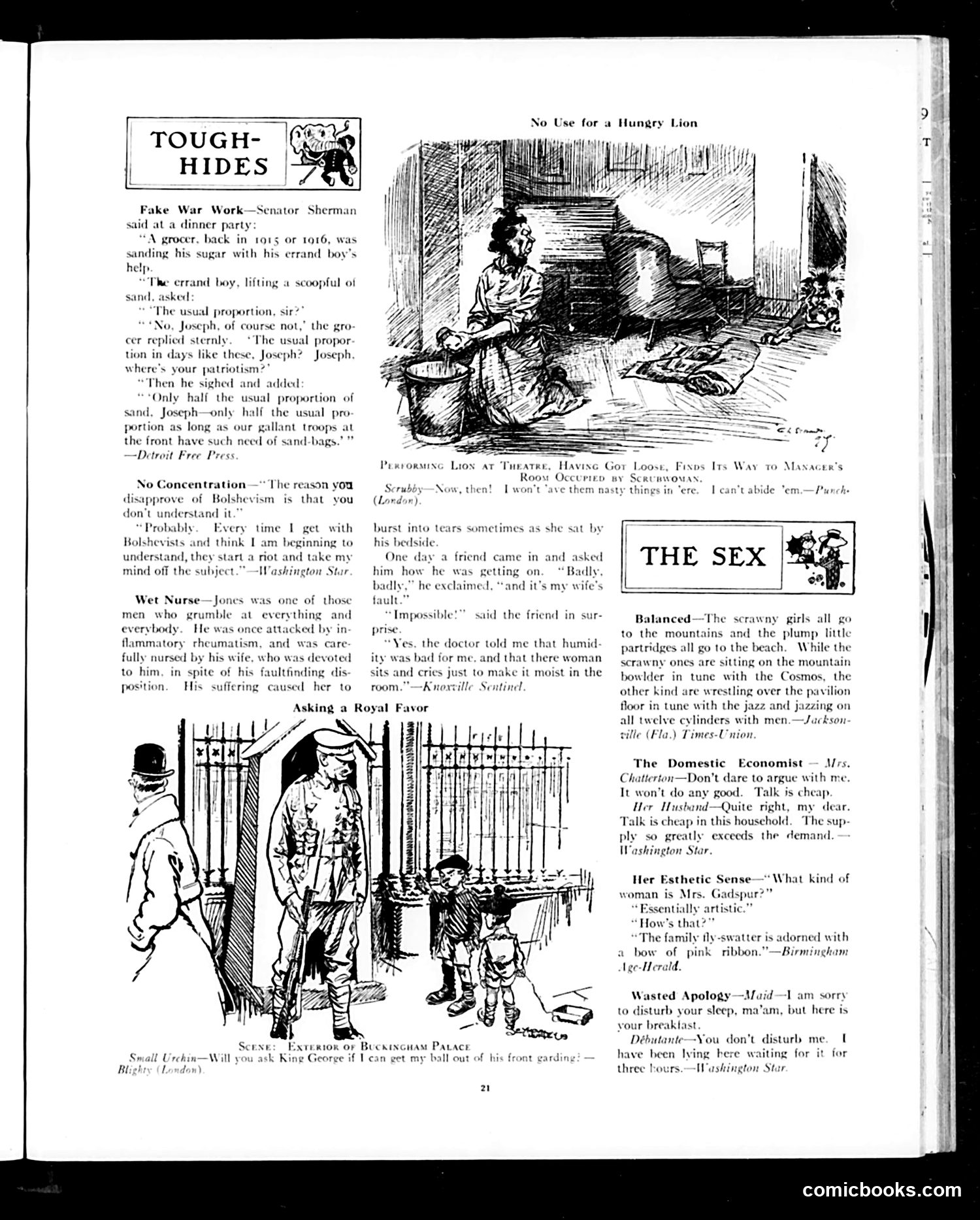
This page from *Judge* magazine contains several brief satirical pieces typical of WWI-era American humor: **"Fake War Work"** mocks wartime profiteering and false patriotism. A grocer during 1915-1916 reduces sand in his sugar (adulteration) by half, claiming it's a patriotic sacrifice for troops needing sandbags—absurd logic that masks greed as patriotism. **"No Concentration"** jokes about Bolshevism (Soviet communism), which Americans found confusing and threatening post-1917. The joke: understanding it requires focus, but Bolsheviks' violent riots prevent sustained attention. **"Wet Nurse"** presents a domestic complaint: a chronically ill, perpetually complaining husband blames his wife's tears (from caring for him) for worsening his humidity-sensitive condition—dark humor about ingratitude. **"Asking a Royal Favor"** shows a street urchin requesting King George retrieve his ball from Buckingham Palace grounds—gentle humor about class barriers and British formality. The remaining items are brief, miscellaneous quips about relationships and social behavior.
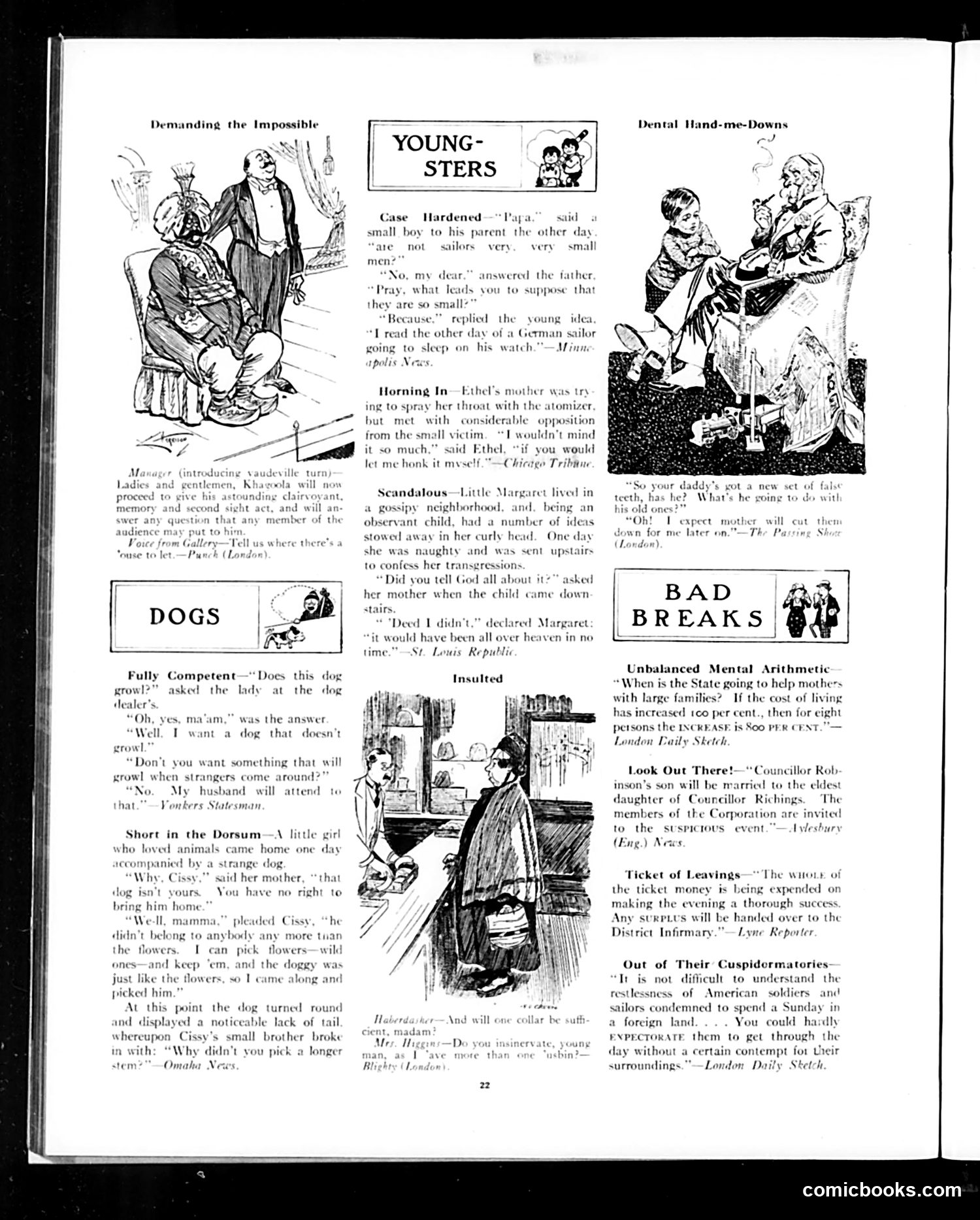
This page collects humorous anecdotes about children ("Youngsters"), dogs, and social commentary ("Bad Breaks"). **"Youngsters" section**: Brief joke stories about children's literal-minded logic—a boy reasoning that German sailors must be tiny because one fell asleep on watch; a girl who can't understand why her mother won't let her use the throat atomizer herself; Margaret's incomplete confession to God about misbehavior. The humor derives from children's innocent misinterpretations of adult statements. **"Dogs" section**: Similar anecdotes about pet ownership—a woman wanting a dog that won't grow or growl; a girl adopting a stray dog, unaware it's missing its tail. **"Bad Breaks"**: Brief satirical notes on contemporary issues—mothers with large families needing state support; a councilman's son's wedding described as "suspicious" (implying scandal); American soldiers' restlessness abroad. The page exemplifies Judge's early 20th-century style: genteel domestic humor, children's naïveté, and light social criticism presented without explicit dating or attribution.
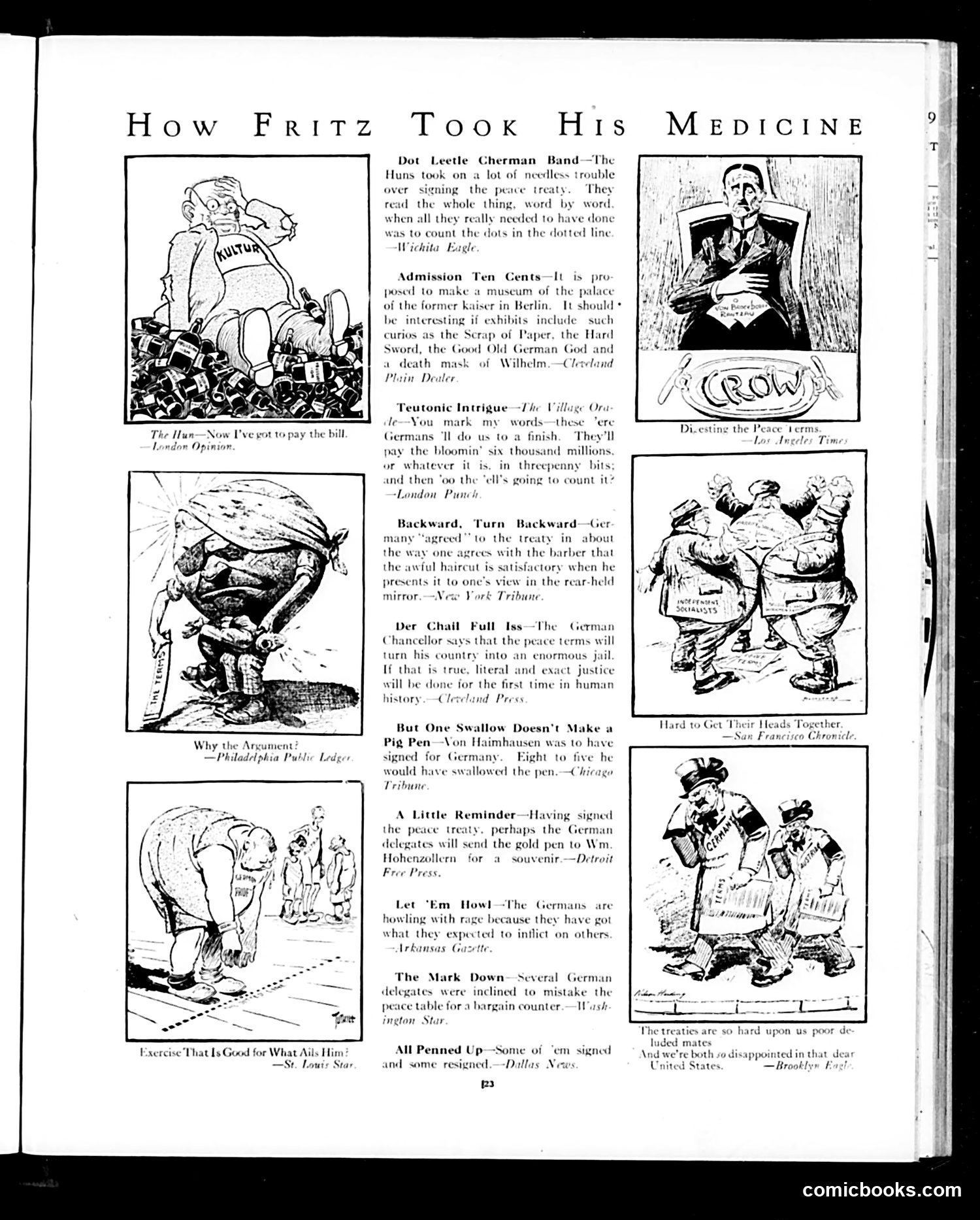
This page satirizes Germany's signing of the Treaty of Versailles (likely 1919), depicting it as bitter medicine Germany must swallow. "Fritz" was a common American caricature name for Germans. The cartoons mock German complaints about harsh treaty terms: - **Top left**: Germans reading the entire treaty when they could simply "count the dots in the dotted line"—suggesting the outcome was inevitable - **Center**: The German Chancellor claims peace terms will turn Germany into a "jail"—satirizing his complaints as hypocritical, since Germany expected to impose similar harsh terms on others - **Various quips**: References to German delegates' reluctance ("some signed, some resigned"), comparisons to a bad haircut or bargain-basement deal, and jokes about the gold signing pen The underlying message: Germany deserves these punitive terms and should stop complaining. The satire reflects American post-war sentiment that Germany bore responsibility for the war and must face consequences.
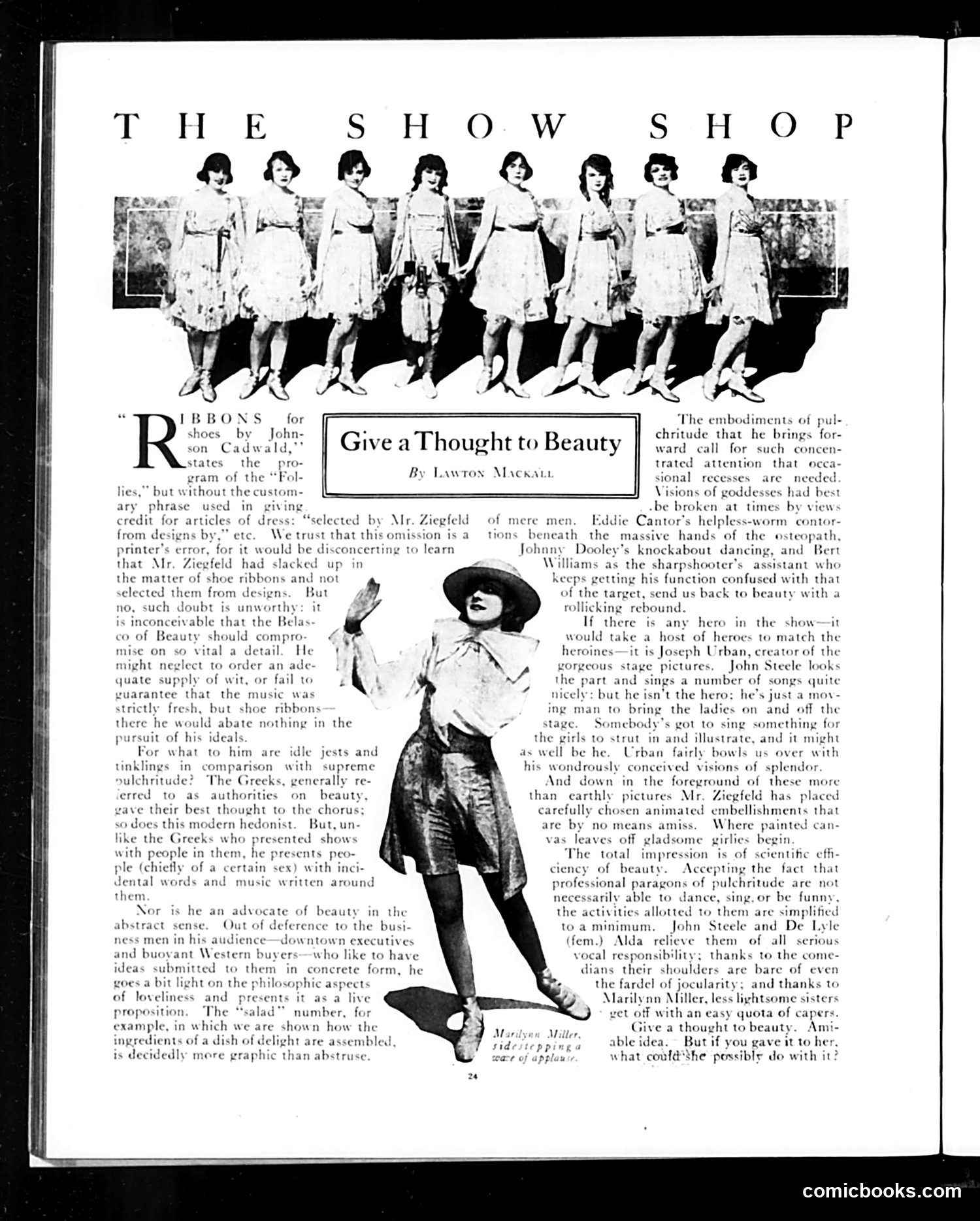
This page reviews what appears to be a Florenz Ziegfeld theatrical production, likely the *Follies*. The article praises Ziegfeld's meticulous attention to visual detail—specifically criticizing the omission of designer credits for shoe ribbons—while satirizing his approach to beauty as purely aesthetic spectacle. The satire targets Ziegfeld's treatment of chorus girls as interchangeable visual elements rather than performers. The review notes that actual entertainers like Eddie Cantor, Johnny Dooley, and Bert Williams provide comic relief from the "goddesses," suggesting the production subordinates talent to scenery. Joseph Urban, the set designer, receives higher praise than the female performers, underscoring how Ziegfeld prioritizes stagecraft over substance. The final caption—"Give a thought to beauty. Amiable idea. But if you gave it to her, what could she possibly do with it?"—is the key joke: mocking the absurdity of expecting beauty alone (in women) to function as meaningful entertainment without actual skill or agency.
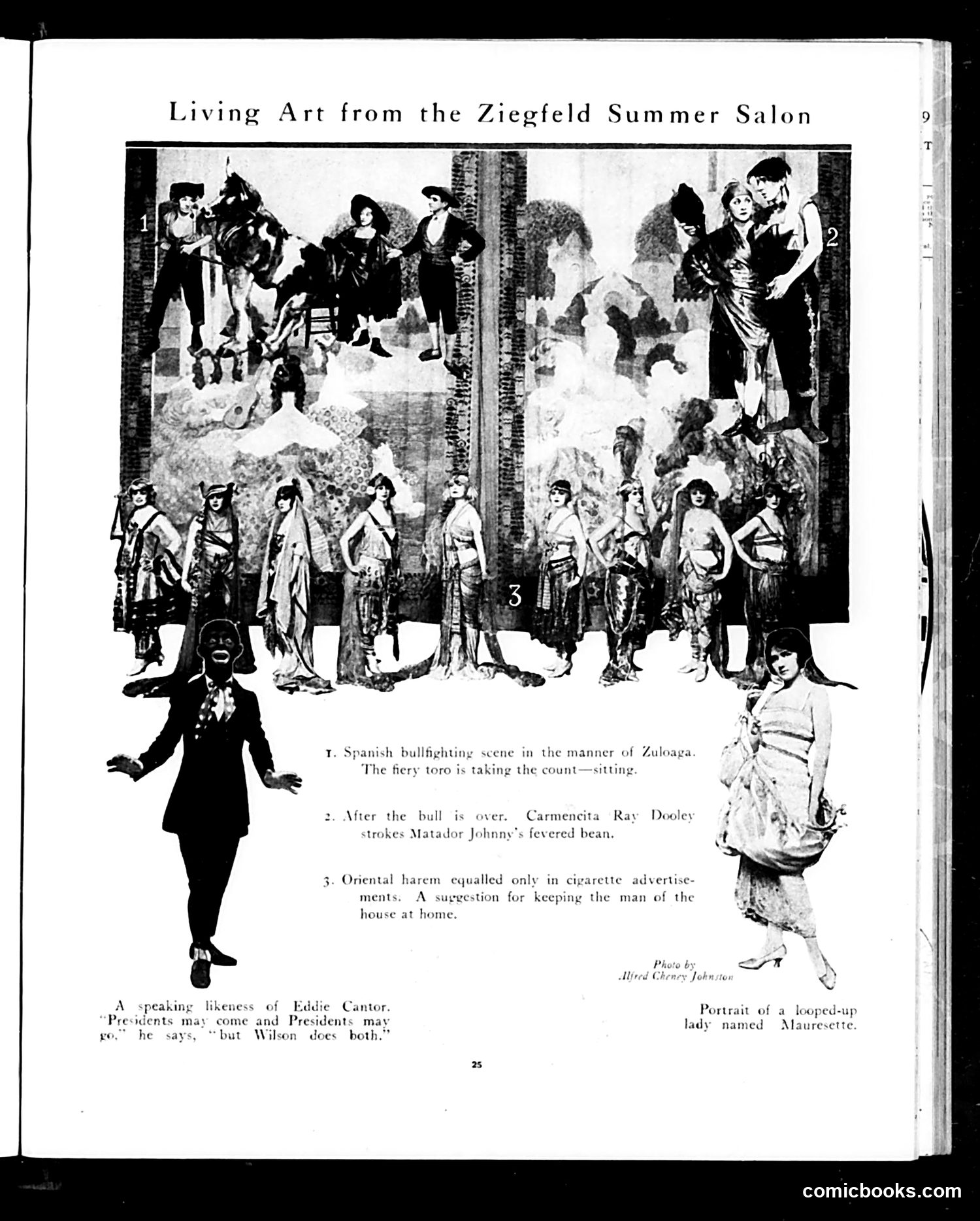
This page satirizes the Ziegfeld Follies theatrical revues through three numbered scenes depicting elaborate stage tableaux. The captions mock the pretentious artistic staging: 1. A bullfighting scene "in the manner of Zuloaga" (referencing Spanish painter Ignacio Zuloaga) where the bull is comically "taking the count—sitting," deflating the drama. 2. References "Carmencita Ray Dooley" striking "Matador Johnny's fevered bean" (head), suggesting domestic comedy within the exotic setup. 3. Depicts an "Oriental harem" stage set, sarcastically comparing it to cigarette advertisements while suggesting such displays are designed to keep husbands entertained at home. The bottom includes a caricature identified as resembling "Eddie Cantor" with a quip about Presidents (likely Wilson, who was serving at publication) coming and going, but "Wilson does both"—likely a political jab at President Wilson's policies or personality. The satire targets Ziegfeld's productions as shallow spectacle masquerading as high art.
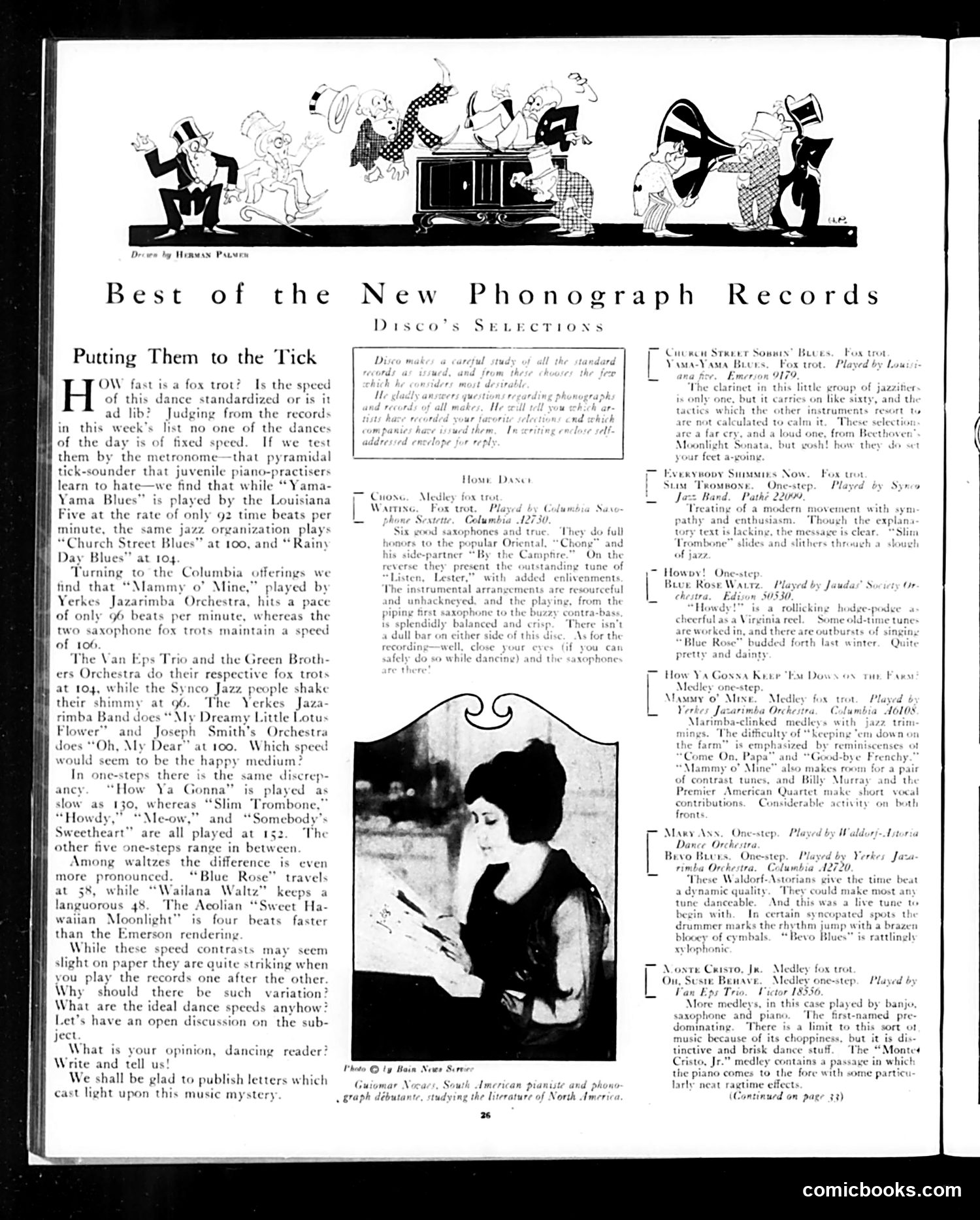
This page is **not primarily satirical**—it's a music column reviewing phonograph records, specifically jazz and dance music releases. The decorative header by Heyward Sommers shows stylized figures dancing and enjoying phonograph entertainment, reflecting the page's focus. The main article, "Putting Them to the Tick," addresses a genuine question about jazz: **why do different orchestras play the same dances at wildly different tempos?** The author uses a metronome (the "pyramidal tick-sounder") to measure actual speeds of fox trots, one-steps, and waltzes from various bands. This reveals the **early standardization problems of 1920s jazz**—there were no fixed speeds for dances yet. The piece invites reader debate about ideal dance tempos, showing how this popular music form was still establishing conventions. The photograph shows **Guiomar Novaes**, a South American pianist, likely featured because her recordings are reviewed below. This is straightforward music journalism, not satire—documenting jazz's experimental, unregulated character during this period.
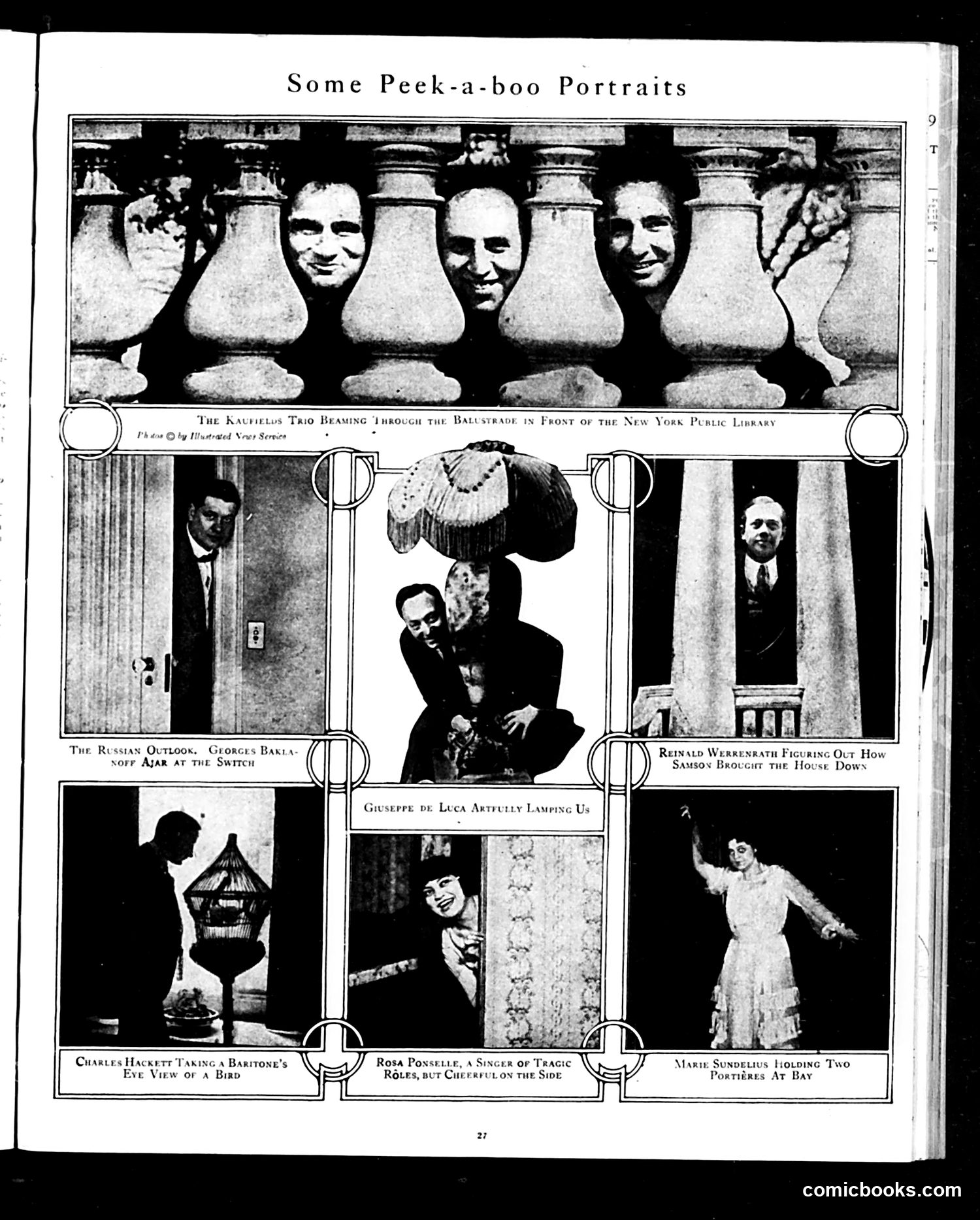
This page presents a novelty photo feature titled "Peek-a-boo Portraits," a visual gag format popular in early 20th-century magazines. The layout shows theatrical and entertainment figures posed behind architectural elements—columns, doorways, and bird cages—so their heads appear to emerge from or peek around these objects, creating humorous compositional effects. The subjects appear to be theatrical performers of the era: The Kauffelt Trio, George Baklanoff (identified as "Russian Outlook"), Reinaldo Werrenrath, Charles Hackett, Rosa Ponselle, and Marie Sundelius. The captions reference their professions (singers, performers) and create mild puns ("Taking a Baritone's Eye View of a Bird"). The satire is genteel and visual rather than political—the humor derives simply from the incongruous juxtaposition of refined performers with awkward staging and wordplay. This represents typical light entertainment coverage in Judge magazine.
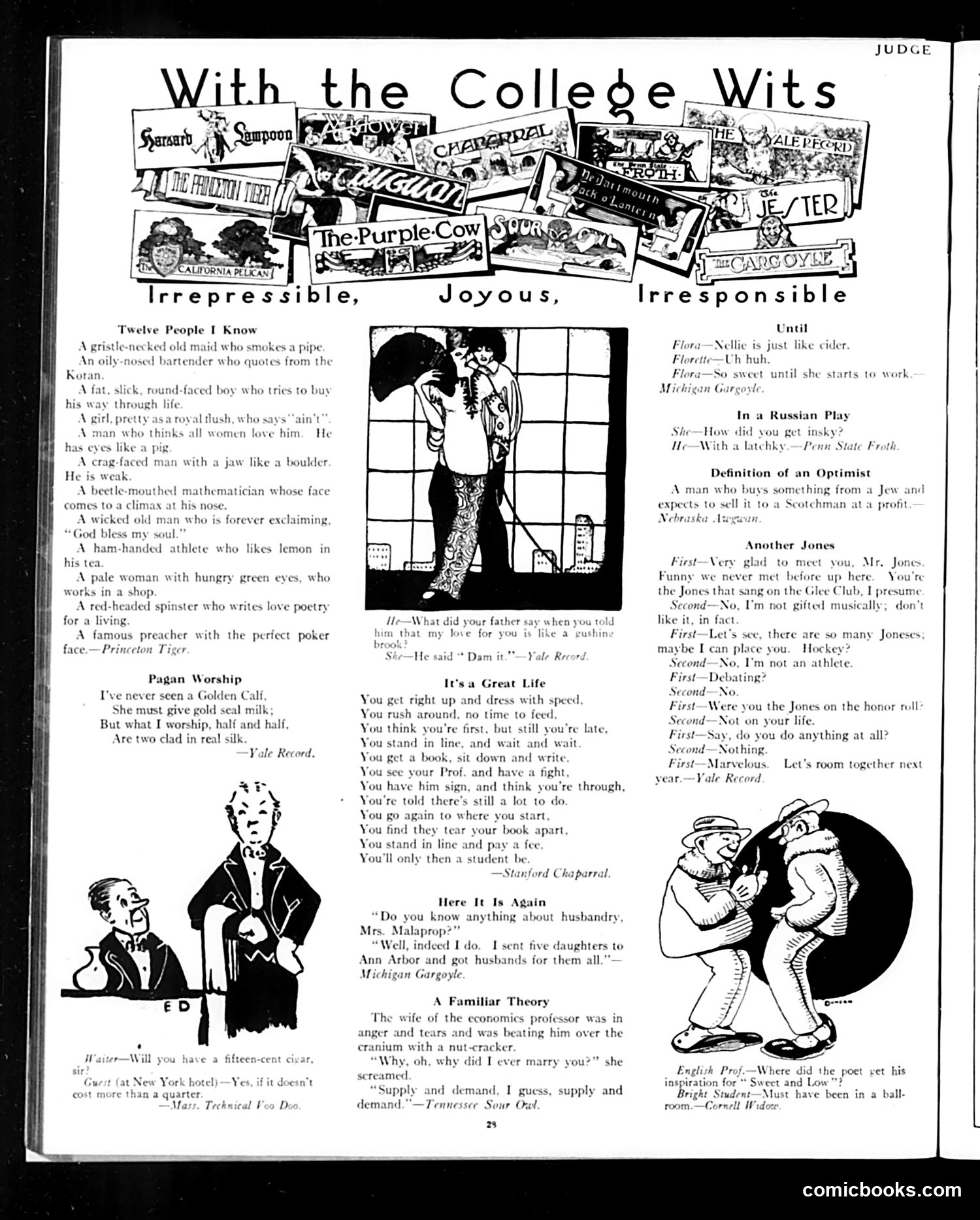
This page collects humorous sketches and jokes from college humor magazines (Yale Record, Michigan Gargoyle, Penn State Froth, etc.). The content satirizes college life and contemporary social stereotypes. **Key satire targets:** - **"Twelve People I Know"**: Mocks stock character types—the pipe-smoking spinster, the social climber, the athlete—representing recognizable campus archetypes. - **"It's a Great Life"**: Parodies the actual student experience as chaotic drudgery masked by institutional busywork (rushing, paying fees, exhausted professors). - **Ethnic/national jokes**: References to "a Jew," "Scotchman," and Russian characters reflect period casual stereotyping common in 1920s humor. - **"A Familiar Theory"**: Economics professor joke plays on supply-and-demand theory applied to marriage—cynically suggesting matrimony follows market logic rather than love. The cartoons use exaggerated caricature to mock both the pretensions of college life and broader social absurdities. The humor assumes educated readers familiar with university culture.
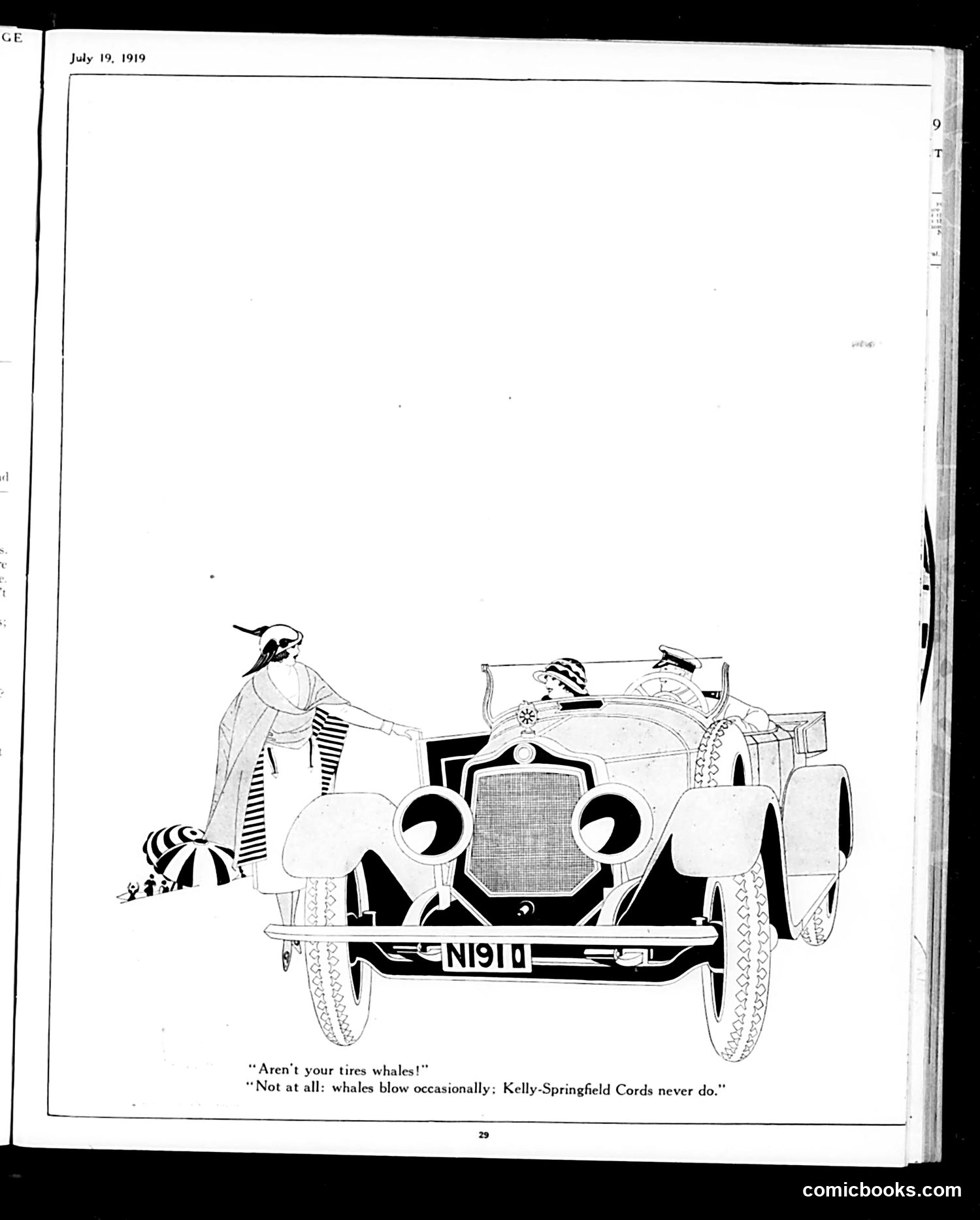
This is an advertisement masquerading as a comic, published July 19, 1919. It depicts a fashionable woman and man in a luxury automobile (license plate EN1910) having a conversation about tires. The "joke" plays on a double meaning: "whales blow" refers both to whales surfacing to breathe and to tire blowouts (a common problem with early automobile tires). The woman asks if the tires are "whales," implying they blow out frequently. The man reassures her that Kelly-Springfield Cord tires are superior—they never blow out like whales blow occasionally. This is essentially a product endorsement using wordplay and the aspirational imagery of well-dressed motorists to sell tire reliability to early automobile owners, for whom tire failure was a genuine frustration.
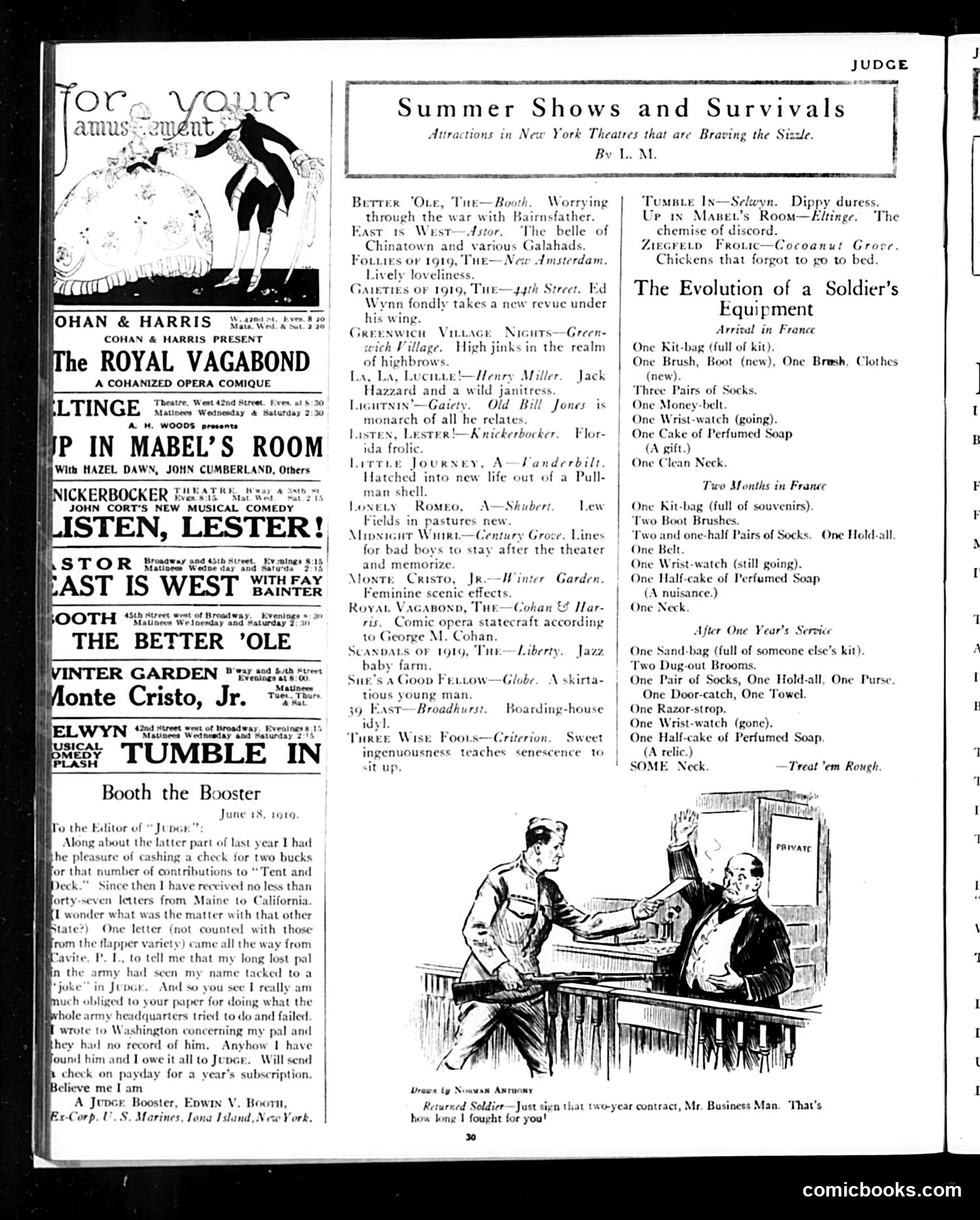
This page is primarily **theatrical advertising** for Broadway shows from 1919, with a humorous sidebar about military life. The main satirical content is "The Evolution of a Soldier's Equipment," which contrasts what American soldiers arrived in France with at the start of WWI versus what they accumulated after two months and a year of service. The joke is that soldiers progressively lost or wore out their official gear (socks, watches, soap) while gaining **souvenirs and military detritus** (sand-bags full of "someone else's kit," dug-out brooms). It mocks the reality of trench warfare—soldiers' belongings degraded while they scavenged and collected battlefield debris. The cartoon below shows a **returned soldier** negotiating a "two-year contract" with a businessman, suggesting soldiers were being exploited post-war for labor after their service. "Booth the Booster" is a heartwarming letter crediting Judge magazine for reuniting the writer with a lost Army friend by publishing his name—a genuine human-interest story celebrating the magazine's social utility during WWI.
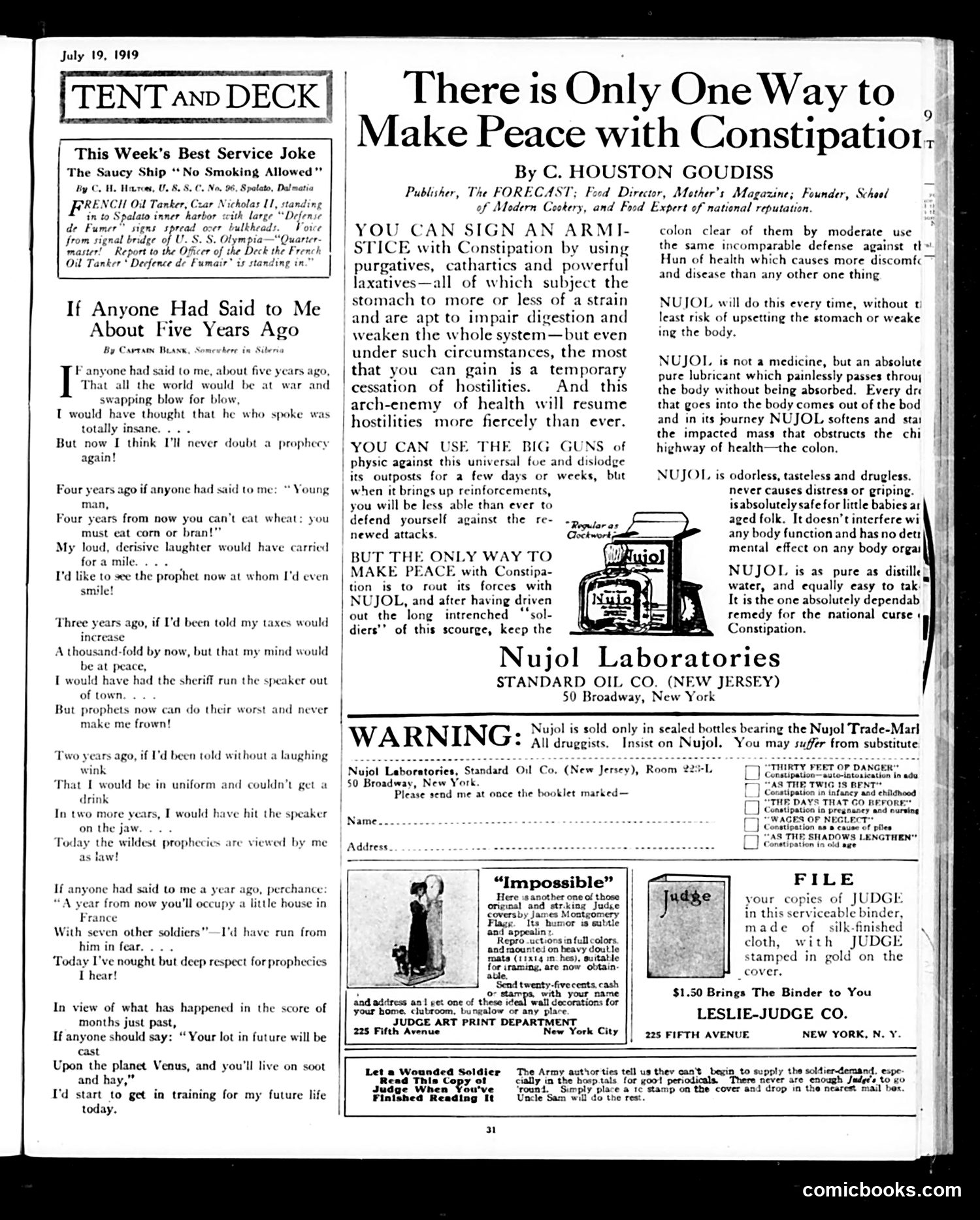
This page mixes humor about WWI with product advertising. The left side contains a humorous column by Carlton Hiam reflecting on how improbable predictions from five years prior—about war, food rationing, increased taxes, military service, and living in France—have all come true. The satire targets readers' disbelief in prophecy: what seemed impossible in 1914 now feels inevitable to a soldier in 1919. The main article advertises Nujol, a mineral oil laxative, using military metaphor: constipation is an enemy requiring an "armistice" and "peace." The ad equates digestive health with winning against "the Hun"—a dehumanizing WWI reference to Germans. This wartime rhetoric applied to bodily functions reflects how thoroughly martial language saturated American culture during and immediately after the war.
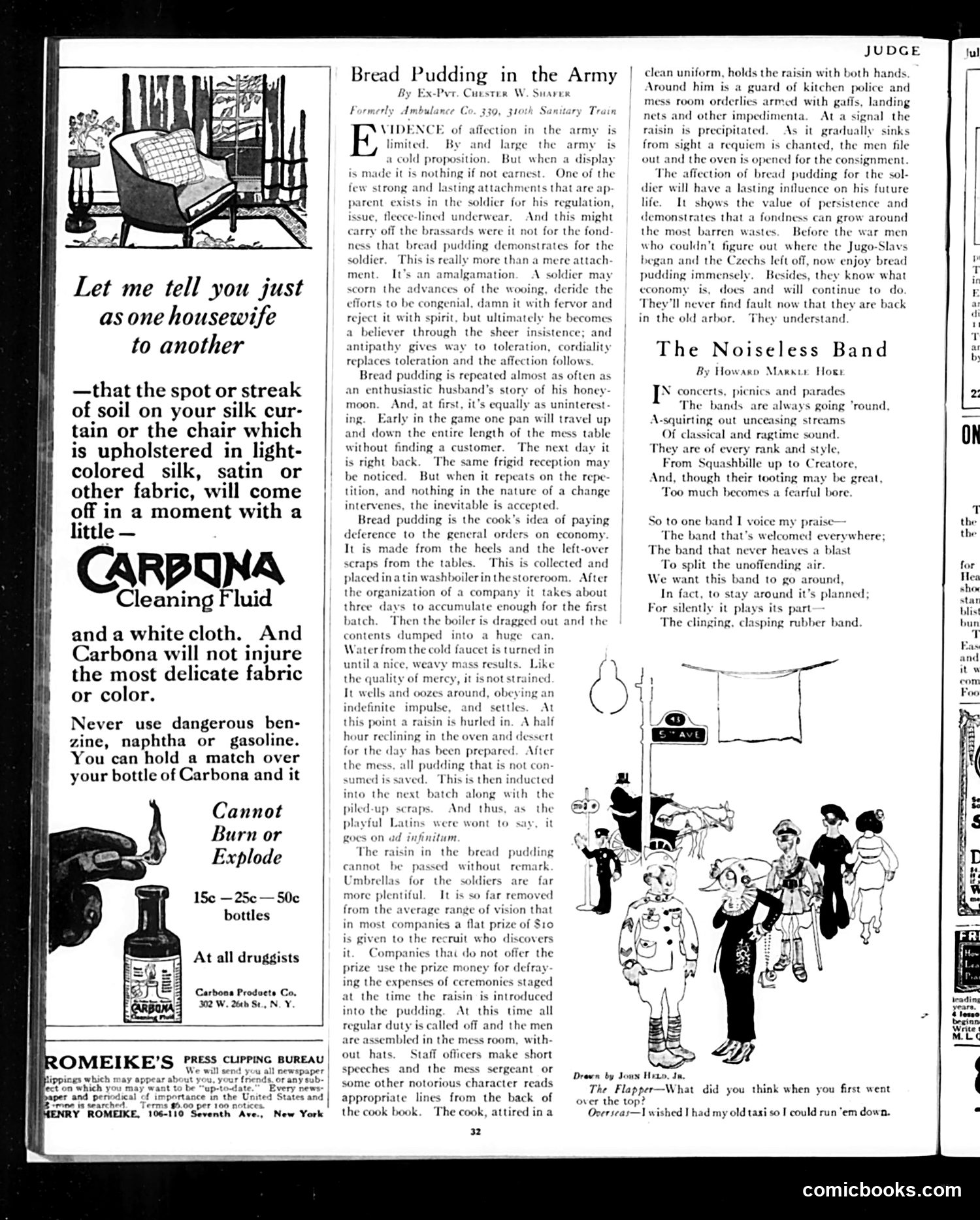
This page contains two pieces satirizing American military life during what appears to be World War I. The main article mocks soldiers' inexplicable attachment to army bread pudding—a notoriously unappetizing dish made from leftover table scraps, heels of bread, and a single raisin. The satire's humor lies in portraying how soldiers gradually accept and even develop fondness for this terrible food through sheer repetition and army economics. The elaborate ceremony described—kitchen police with "landing nets," ritualistic raisin precipitation, and requiem chanting—exaggerates the pudding's importance in barren military life. The piece suggests that enduring bread pudding builds character and teaches soldiers about persistence and making do with nothing, skills that will serve them after the war (referencing recent Austro-Hungarian geography, a topical wartime reference). The adjacent "Noiseless Band" poem appears separate social commentary on military bands. The page also contains a Carbona cleaning fluid advertisement—standard magazine filler of the era.
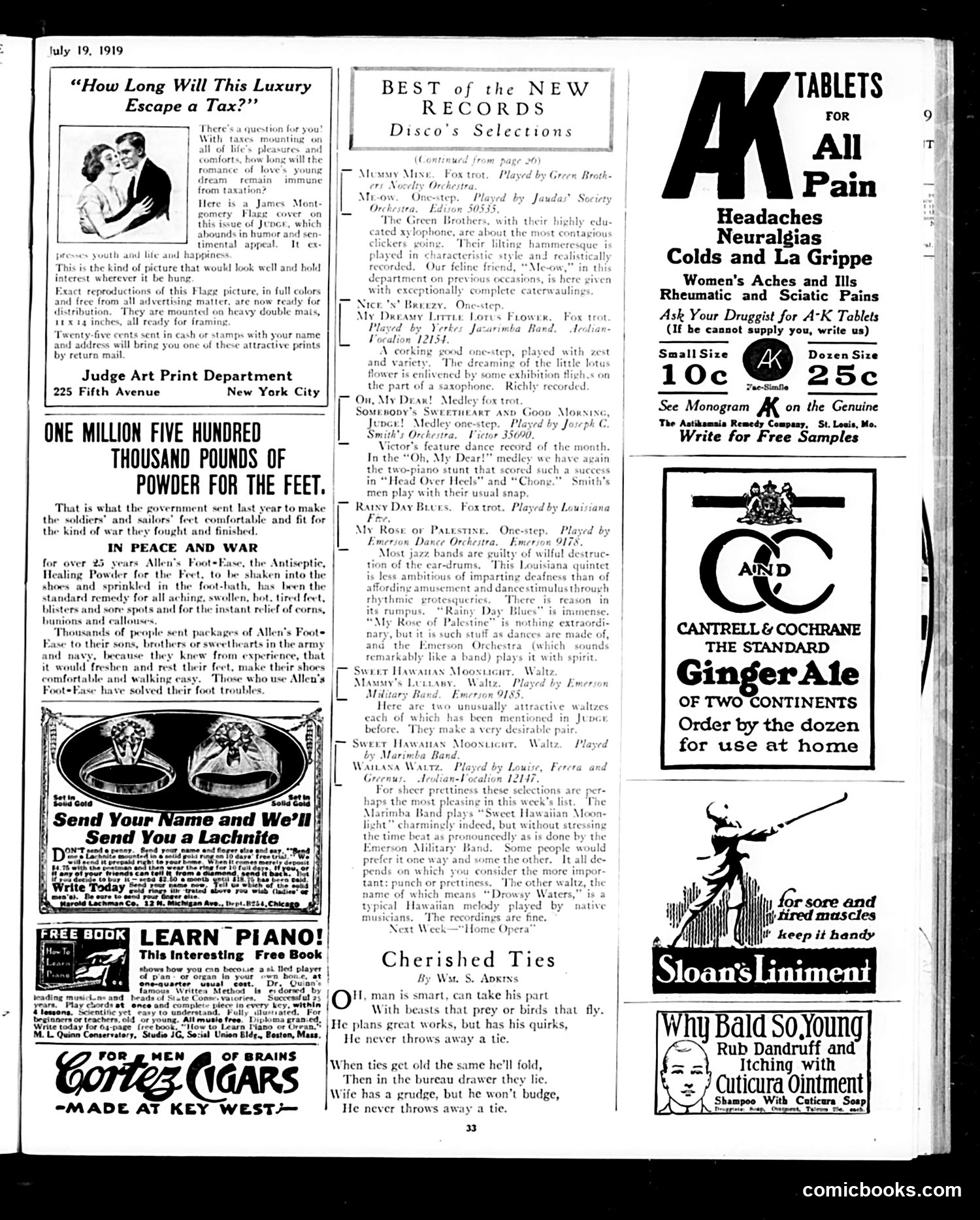
This page is primarily **advertising with minimal editorial content**. The notable cartoon element is the opening illustration titled "How Long Will This Luxury Escape a Tax?" showing a couple in an intimate embrace. The caption poses a rhetorical question about taxation, likely referencing post-WWI economic concerns and debates over luxury taxes on consumer goods and leisure activities. The dominant content consists of product advertisements typical of 1919: foot powder (Allen's Foot-Ease), piano instruction, cigars, and various patent medicines (AK Tablets for pain, Sloan's Liniment, Cuticura treatments). The page also includes a brief poem titled "Cherished Ties" by W.S. Axtens about a man's reluctance to discard old neckties—a gentle domestic humor piece with no apparent political significance. The magazine content reflects post-WWI America's consumer culture and early advertising strategies targeting middle-class readers.
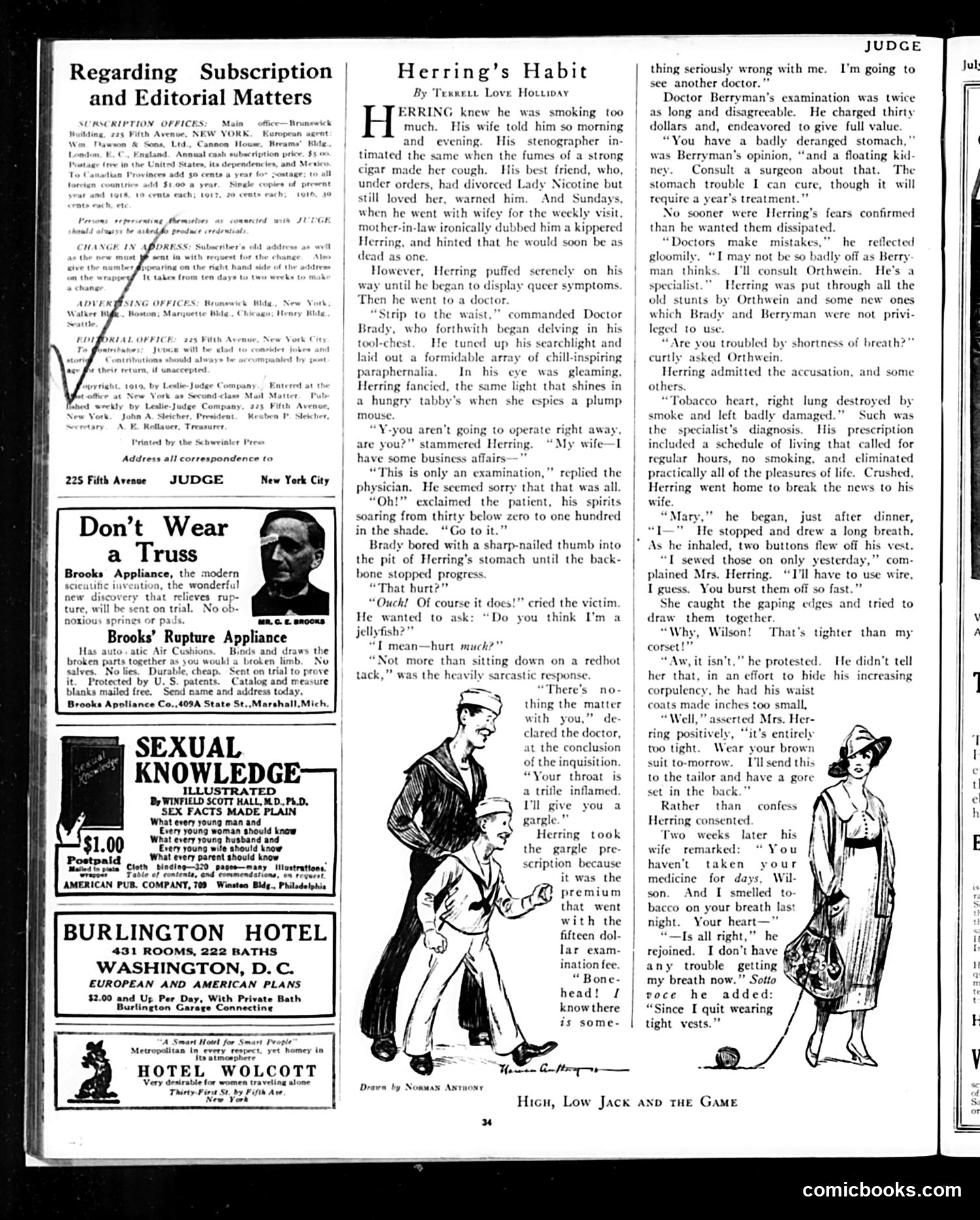
This page features a humorous short story about a man named Herring who smokes excessively despite warnings from his wife, stenographer, friend, and mother-in-law (who sarcastically calls him a "kippered Herring"). When Herring finally visits Doctor Brady complaining of symptoms, the doctor performs an elaborate, intimidating examination with "chill-inspiring paraphernalia," delighting in the patient's discomfort. Brady diagnoses only a mildly inflamed throat and prescribes a gargle—a trivial treatment for Herring's anxiety. The satire targets both excessive smoking (a contemporary health concern) and medical theater: doctors' theatrical bedside manner, their apparent pleasure in patient suffering, and the gap between patients' fears and actual diagnoses. The humor lies in Herring's catastrophic expectations being deflated by an anticlimactic result, and his subsequent decision to consult *another* doctor rather than accept the diagnosis.
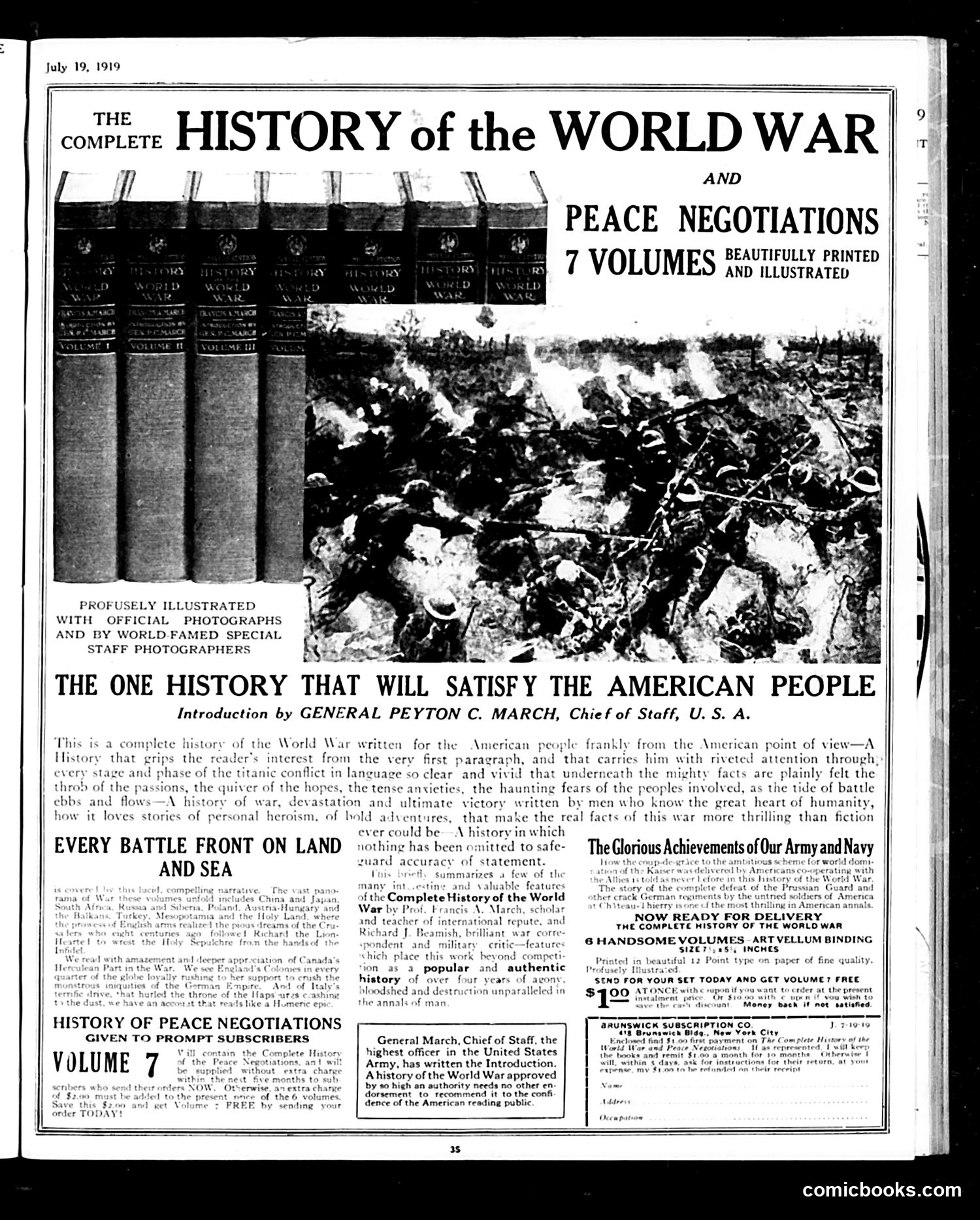
This page is primarily a **book advertisement**, not a political cartoon or satirical content. It promotes "The Complete History of the World War," a 7-volume set published in 1919, shortly after WWI's armistice. **Key elements:** - The text emphasizes the history is written "from the American point of view" and will "satisfy the American people" - It includes an introduction by **General Peyton C. March**, the U.S. Army Chief of Staff, lending military authority - The advertisement stresses official photographs and eyewitness accounts to establish credibility - The dramatic battle photograph illustrates the war's brutality **Historical context:** In 1919, such comprehensive war histories were commercially valuable as Americans sought to understand the conflict they'd recently fought. The emphasis on official endorsement and American perspective reflects post-war nationalism and public appetite for authoritative accounts of their military participation. This is essentially a straightforward commercial advertisement with no discernible satire or political messaging.
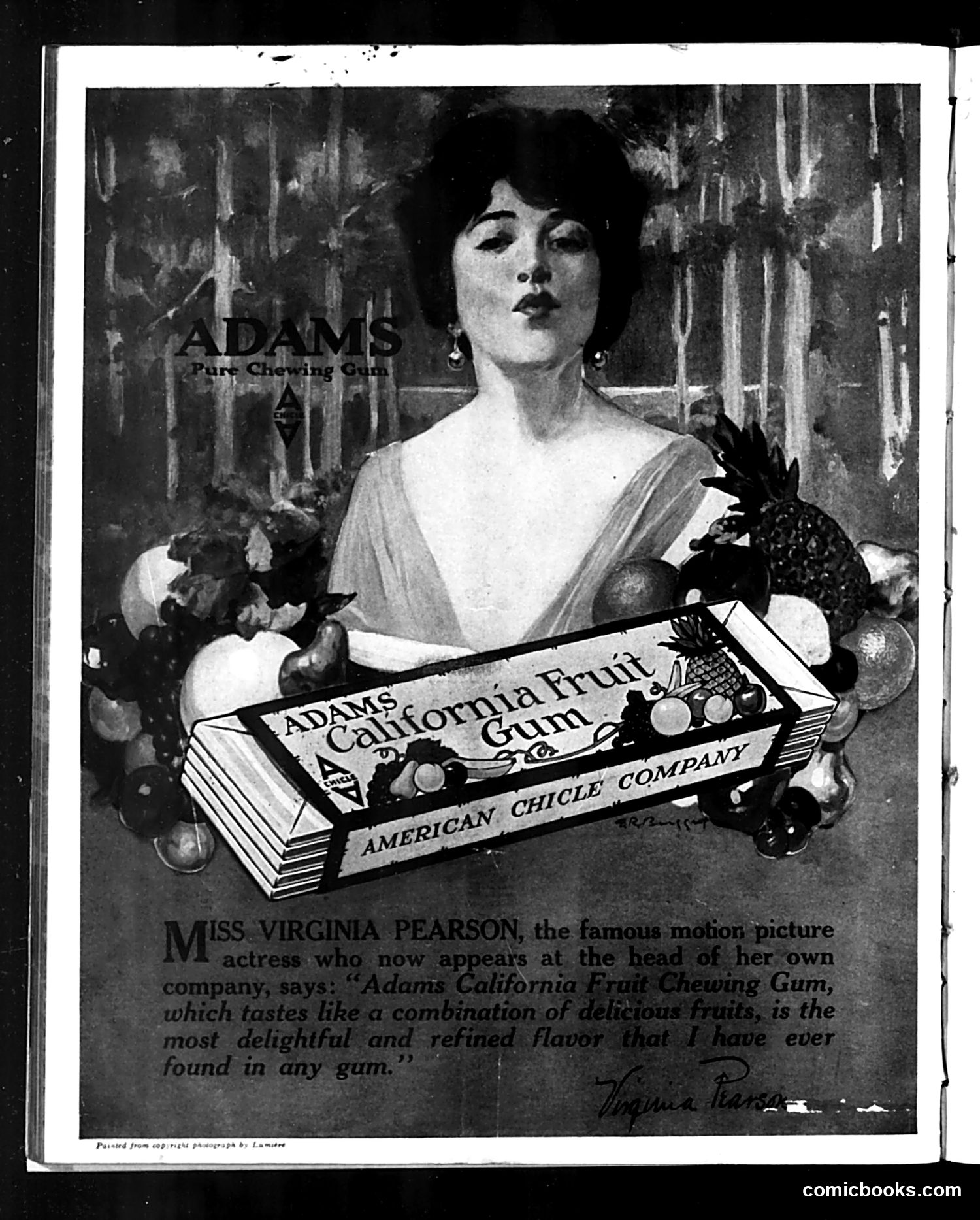
This is an advertisement rather than editorial content. It features actress Virginia Pearson, identified as "the famous motion picture actress who now appears at the head of her own company," endorsing Adams California Fruit Chewing Gum. The ad presents a celebrity testimonial—a common early 20th-century marketing technique where famous performers lent credibility to consumer products. Pearson holds the gum box while surrounded by fruit imagery, and provides a quoted endorsement praising the product's "delicious fruits" flavor. This represents the intersection of Hollywood celebrity culture and commercial advertising during the silent film era, when movie stars had significant cultural influence and were frequently recruited to promote consumer goods to the public.