
Judge, 1919-07-19 · page 26 of 36
Judge — July 19, 1919 — page 26: what you’re looking at
What you’re looking at
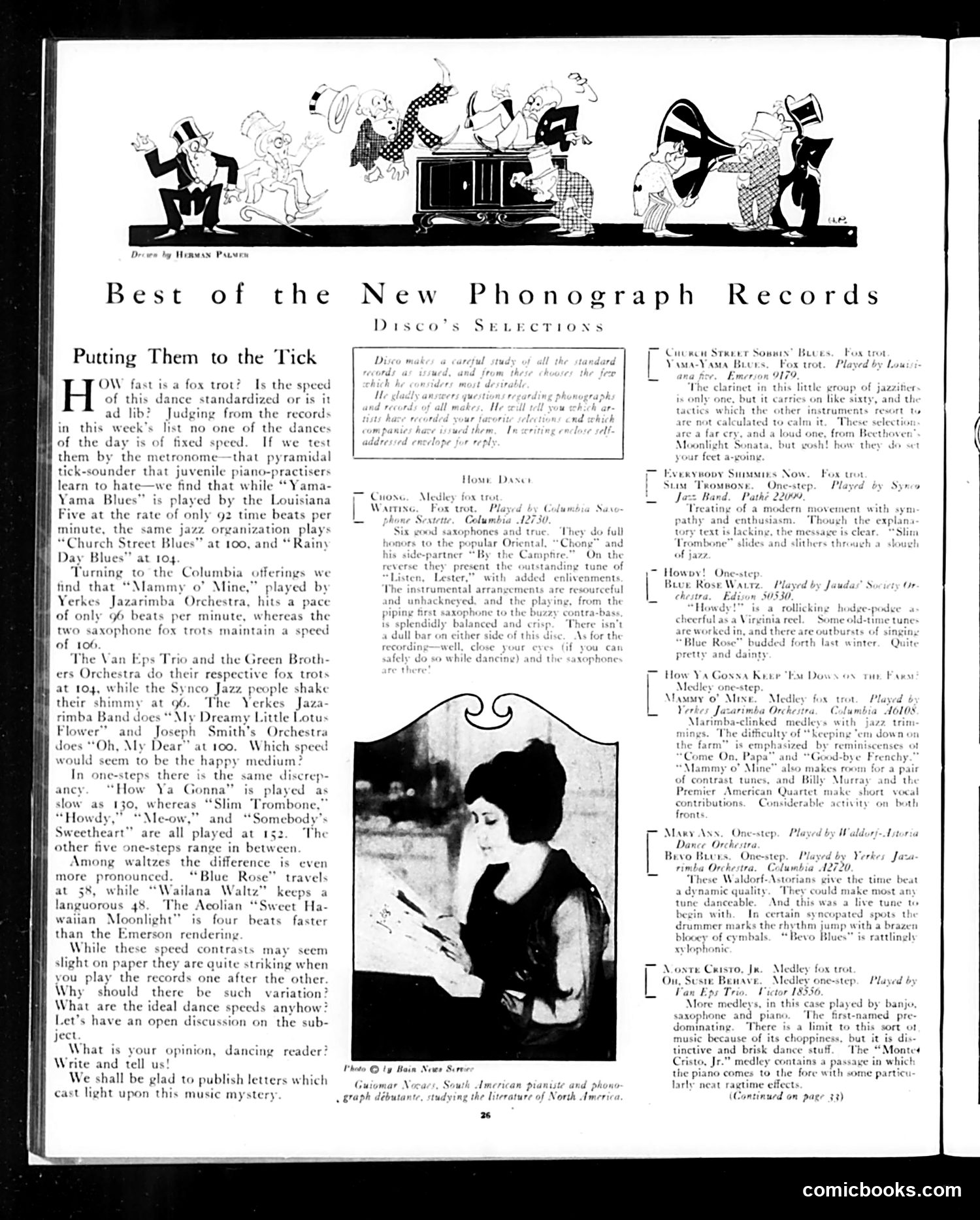
This page is **not primarily satirical**—it's a music column reviewing phonograph records, specifically jazz and dance music releases. The decorative header by Heyward Sommers shows stylized figures dancing and enjoying phonograph entertainment, reflecting the page's focus. The main article, "Putting Them to the Tick," addresses a genuine question about jazz: **why do different orchestras play the same dances at wildly different tempos?** The author uses a metronome (the "pyramidal tick-sounder") to measure actual speeds of fox trots, one-steps, and waltzes from various bands. This reveals the **early standardization problems of 1920s jazz**—there were no fixed speeds for dances yet. The piece invites reader debate about ideal dance tempos, showing how this popular music form was still establishing conventions. The photograph shows **Guiomar Novaes**, a South American pianist, likely featured because her recordings are reviewed below. This is straightforward music journalism, not satire—documenting jazz's experimental, unregulated character during this period.
📄 Transcribed text from this page (OCR, searchable)
Machine-transcribed from the original scan — historical spelling and the odd misread are preserved.
fy Henwas Po Best of the New Phonograph Records Disco’s SreLectTions Putting Them to the Tick OW fast is a fox trot? Is the speed H of this dance standardized or is it ad lib?) Judging from the record in this week’s list no one of the dances of the day is of fixed speed. If we test them by the tronome—that pyramidal tick-sounder t juvenile piano-practisers learn to hate—we find that while “ Yama- Yama Blues” is played by the Louisiana Five at the rate of only 92 time beats per minute, the same jazz organization plays “Church Street Blues” at 100, and “ Rainy Day Blues” at 104 Turning to the Columbia offerings we tind that “Mammy o” Mine,” played by Yerkes Jazarimba Orchestra, hits a pace of only beats per minute, whereas the two saxophone fox trots maintain a speed of 106. The Van Eps Trio and the Green Broth- ers Orchestra do their respective fox trots at 104, while the Synco Jazz people shake their sh y at 96. The Yerkes Jaza rimba Band does “My Dr y Little Lotus Flower” and Joseph Smith’s Orchestra My Dear” at 100. Which speec m to be the happy medium? steps there is the same discrep- ancy. “How Ya Gonna” is played slow as 130, whereas “Slim Trombone “Howdy,” “Me-ow,” and ‘Someboc Sweethe are all played at other five one-steps range in between Among waltzes the difference is even more pronounced. “Blue Rose’ travels at 58, while “Wailana Waltz” keeps a languorous 48. The Acolian “Sweet Ha- waiian Moonlight” is four beats faster than the Emerson rendering While these speed contrasts may seem slight on paper they are quite striking when you play the records one after the other Why should there be such variation? What are the ideal dance speeds anyhow? Let’s have an open discussion on the sub- ject What is your opinion, dancing reader? Write and tell us! We shall be glad to publish letters which cast light upon this music mystery Howe Daser 77 Cone } Warrixe Mhoto © ty Bain News Sere Guiomar Nocaes, Sow rican pian North Imerica Crencn Steeer Som Vaara-Yasta Bue win’ Buves. Fox trot 3179. this little and enthu One-step ur Rose Wanrz ee cerf are we 7 How Ya Gossa Kee M one-step with sy explana 530. eB Do: Masry o' Mine. Medle rimba C ~ ked Mine st tunes, American Dance Orchestra Bevo Burs. One~ Orchestra [Nore Cristo. Je Orch 1 medicys with jazz Ity of “Keeping ‘em down asized by reminiscense “Good nd Billy M Q § with a brazen is rattlingly Medley fox trot Medley one-step. Played ¢ amed p this ic because of its ch but it is di and brisk r.” medley the piano comes to larly neat contains a passage in whict e fore comicbooks.com