
A complete issue · 36 pages · 1919
Judge — May 31, 1919
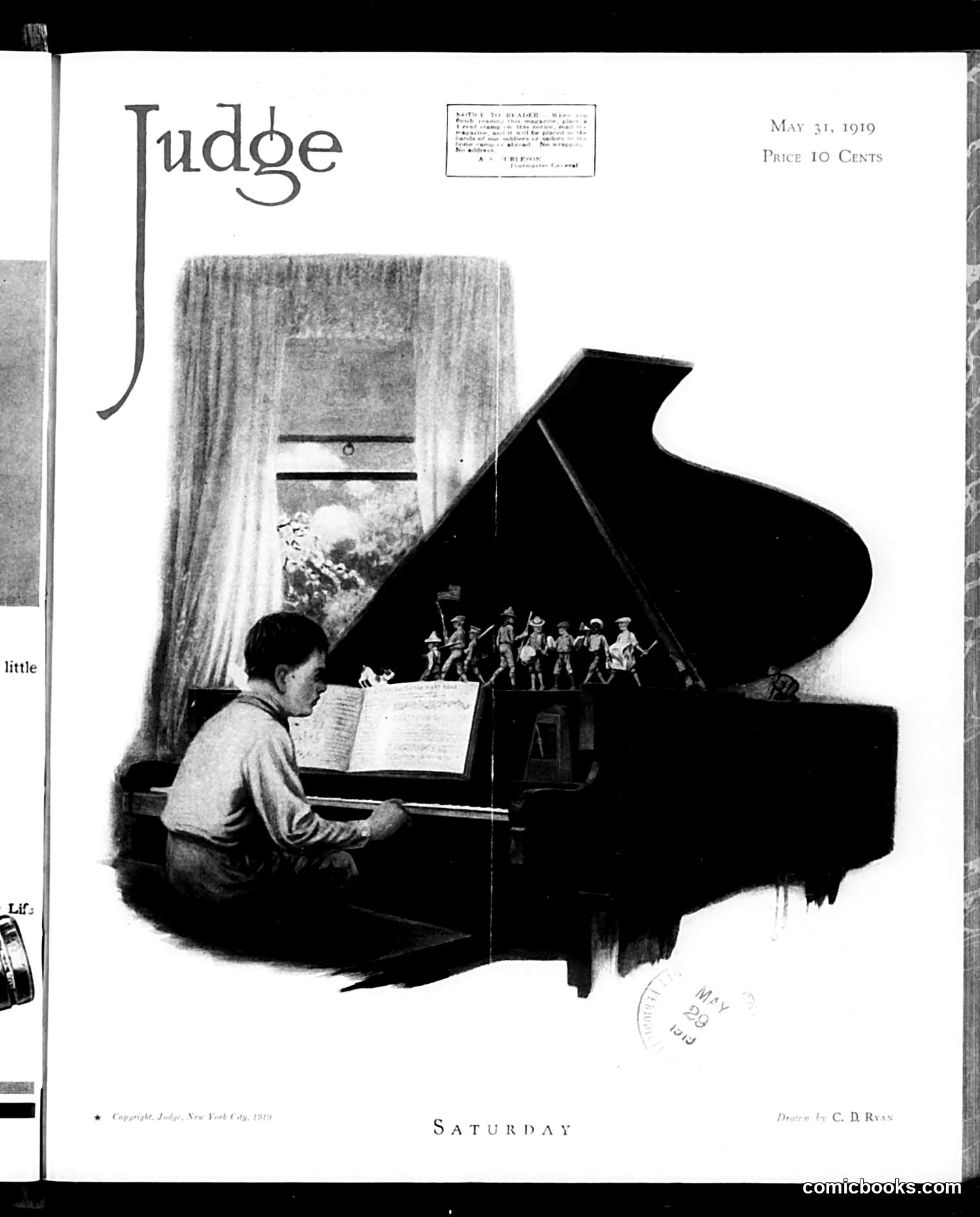
This cover illustration by C.D. Ryan depicts a young boy at a grand piano, with tiny figures performing on top of the instrument like a stage. The image appears to be titled "Saturday" and plays on the common experience of children practicing piano lessons—a staple of middle-class American life in the early 20th century. The satire likely mocks the tedium and formality of mandatory piano practice, where the child dutifully performs scales and exercises while fantasizing about more exciting entertainment. The juxtaposition of serious musical training against the miniature theatrical performance suggests the contrast between what children are forced to do versus what they'd prefer to watch or do for amusement. This reflects period anxieties about proper child development and cultural refinement.
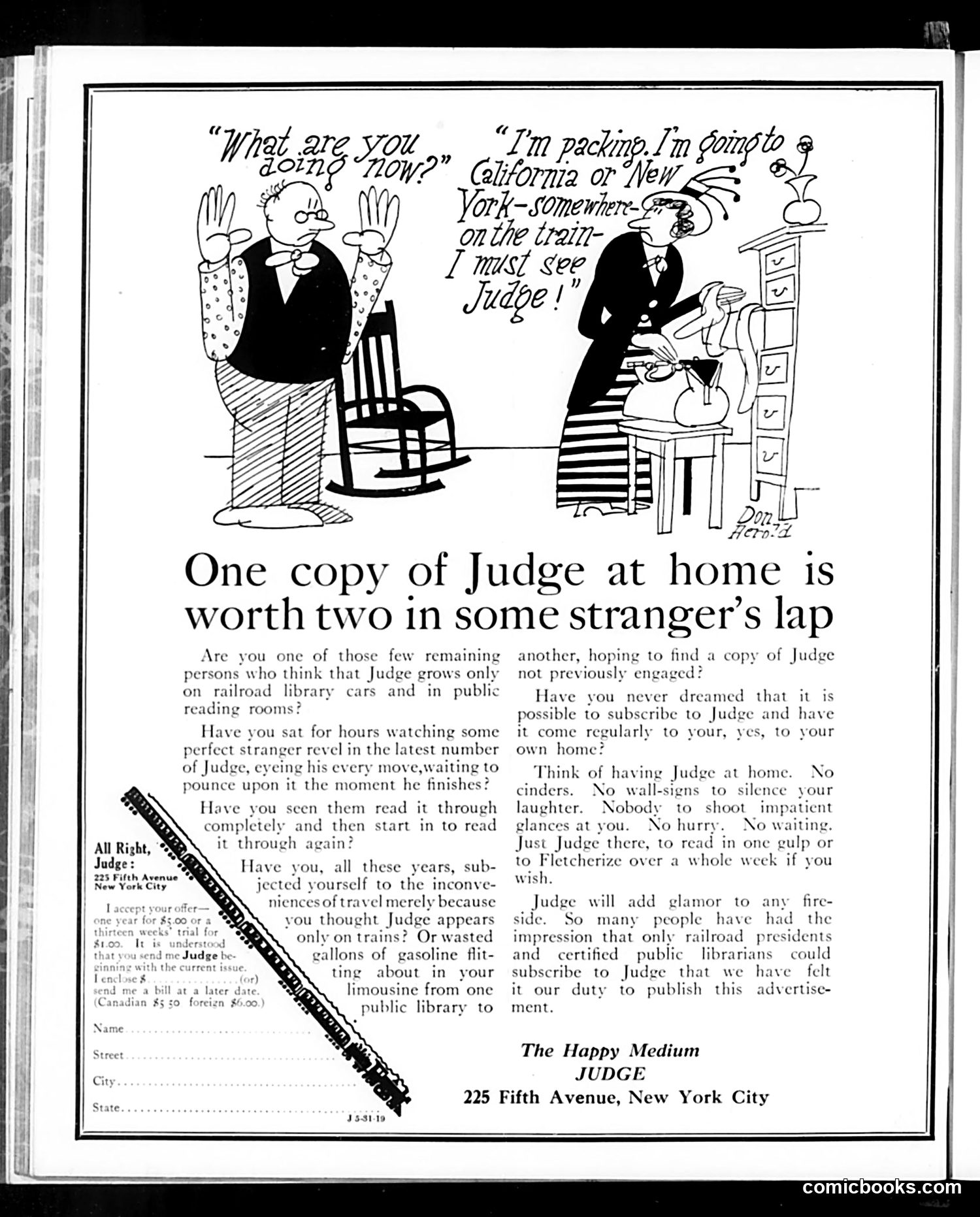
This is primarily a **magazine advertisement** for *Judge* magazine itself, disguised as editorial content. The cartoon shows two figures—one packing a suitcase, the other at a desk—in a domestic scene. The advertisement's headline and body copy make a sales pitch: subscribing to *Judge* at home is superior to reading it casually in public spaces (trains, libraries). The copywriter argues that owning the magazine privately eliminates social inconveniences—you won't miss issues, endure strangers' stares, or face interruptions while reading. The cartoon illustrates this pitch humorously: the departing figure wants to take *Judge* on their travels, suggesting the magazine's portable entertainment value. The advertisement appeals to readers' desire for convenience and uninterrupted enjoyment of the magazine's satirical content.
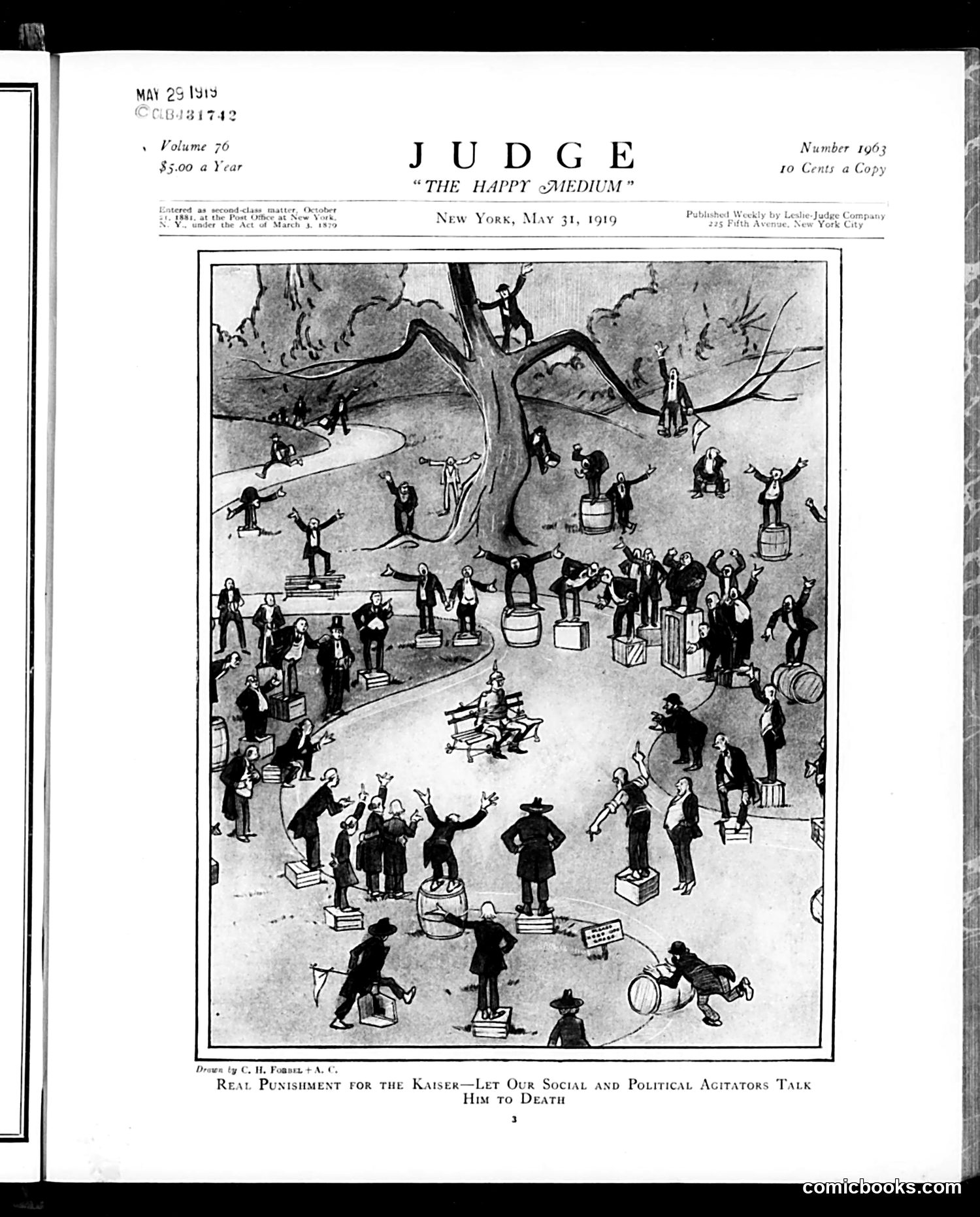
This political cartoon depicts a chaotic scene beneath a gnarled tree, with dozens of figures in formal dress engaged in various activities—some climbing the tree, others standing on pedestals or boxes, many gesturing wildly. The caption reads: "Real Punishment for the Kaiser—Let Our Social and Political Agitators Talk Him to Death." The satire targets American social and political activists of the post-WWI era (likely socialists, labor organizers, and radicals). Rather than execute Kaiser Wilhelm II through traditional means, the cartoon sarcastically suggests subjecting him to endless talk from America's vocal agitators would be worse punishment. It mocks these activists as chaotic, self-aggrandizing noise-makers while simultaneously expressing anti-German sentiment following World War I's conclusion.
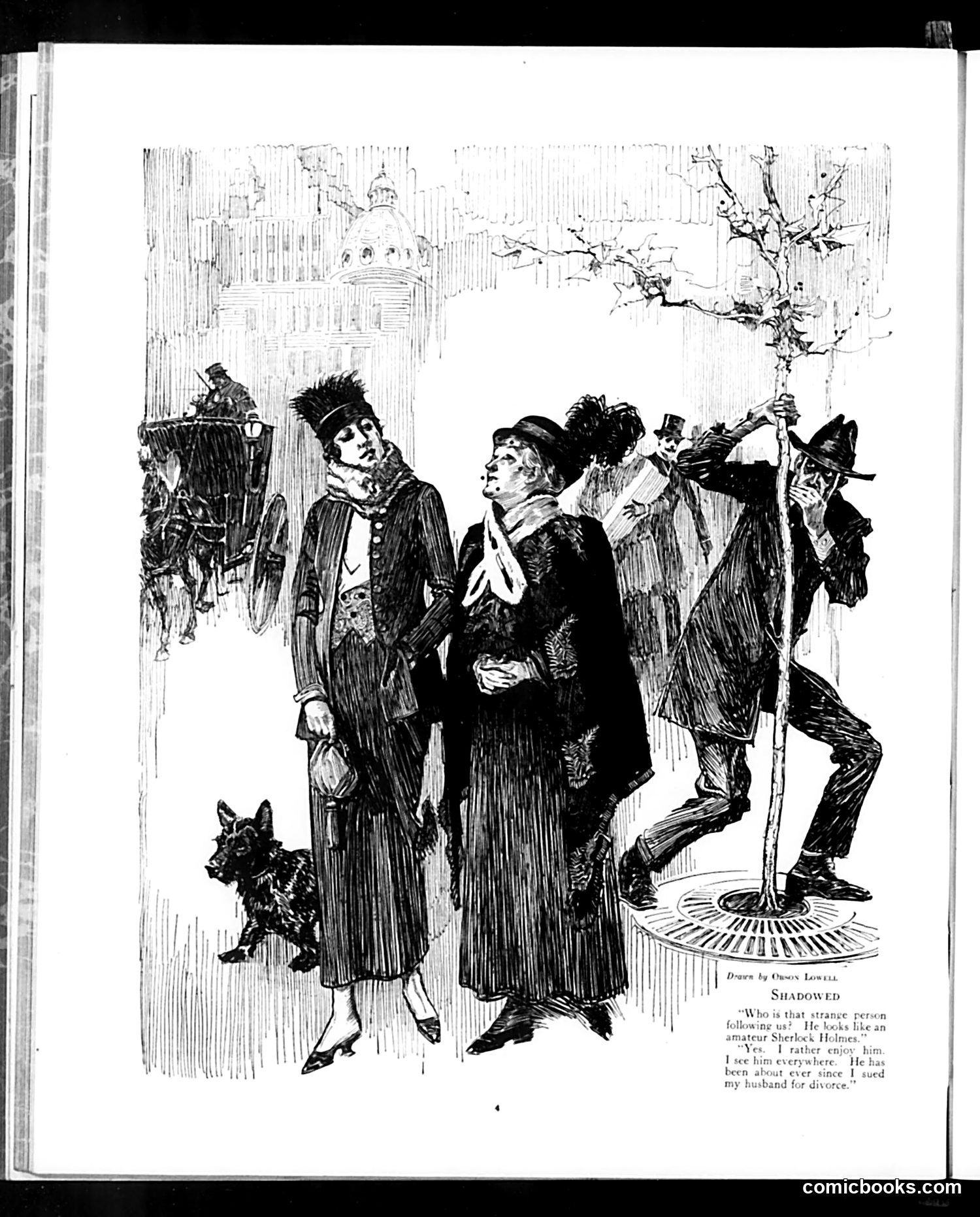
This illustration depicts a woman being followed by a suspicious figure, referencing the caption's dialogue about Sherlock Holmes. The woman asks "Who is that strange person following us?" A man responds he appears to be "an amateur Sherlock Holmes," suggesting the follower is an amateur detective attempting deduction. The woman's comment about enjoying "the peace which has not been about ever since I sued my husband for divorce" indicates this is satirizing post-divorce surveillance—likely a commentary on how divorce proceedings or marital disputes attracted unwanted public attention and amateur sleuthing in this era. The cartoon mocks the contemporary fascination with detective work and invasion of privacy during contentious divorces, which were scandalous public events in the period.
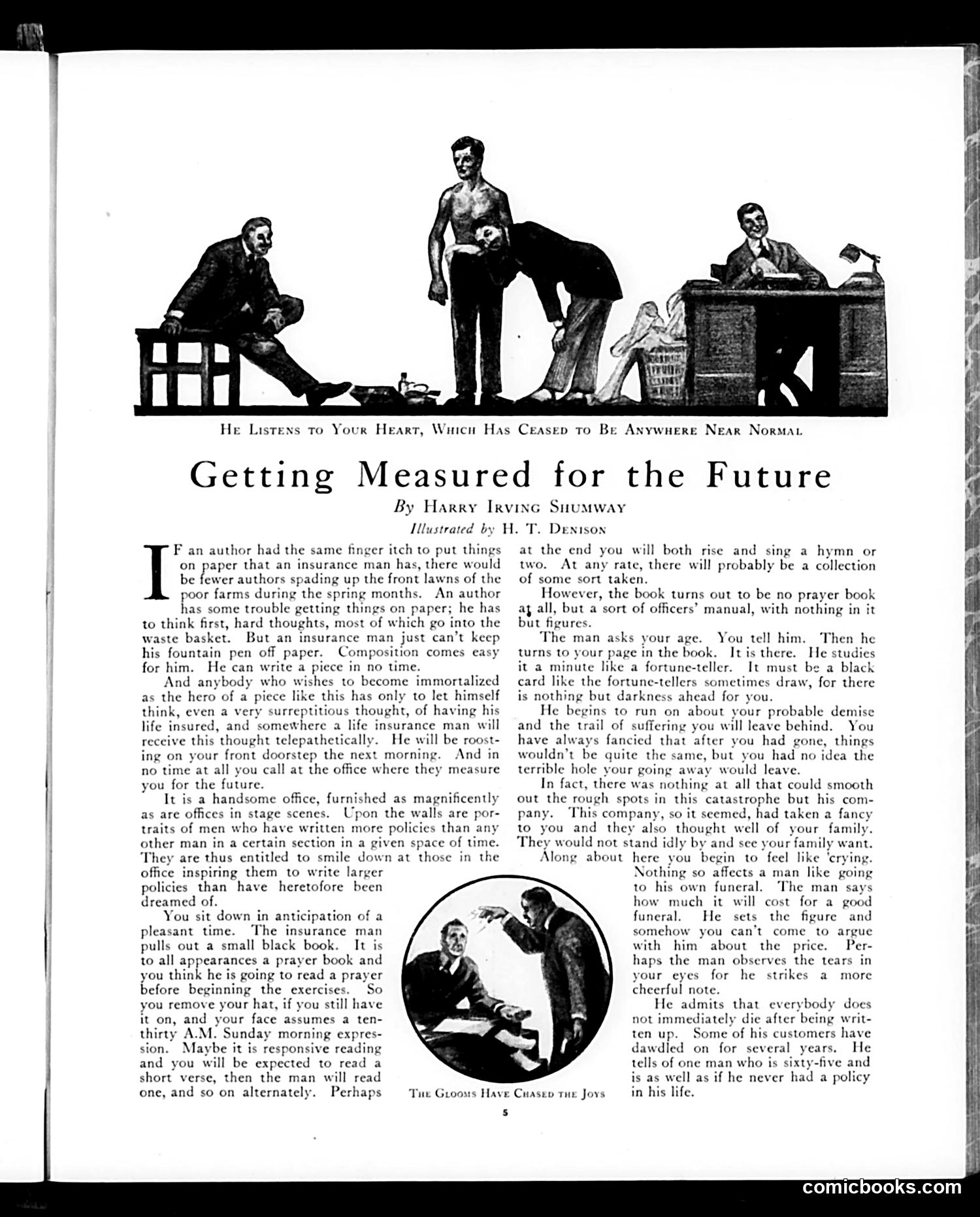
This satirical story by Harry Irving Shumway mocks life insurance salesmen and their sales tactics. The illustration at top shows a man undergoing various medical measurements and examinations—the "measuring" for an insurance policy. The satire targets how insurance companies use actuarial data and medical examinations to predict customers' lifespans and profitability. The story describes the absurd, invasive nature of the process: the salesman extracts personal details, calculates probable death, discusses funeral costs—presenting it all with cheerful indifference to the customer's existential dread. The joke centers on the insurance industry's cold, mechanical approach to human mortality, treating death as mere spreadsheet calculation rather than acknowledging its emotional reality.
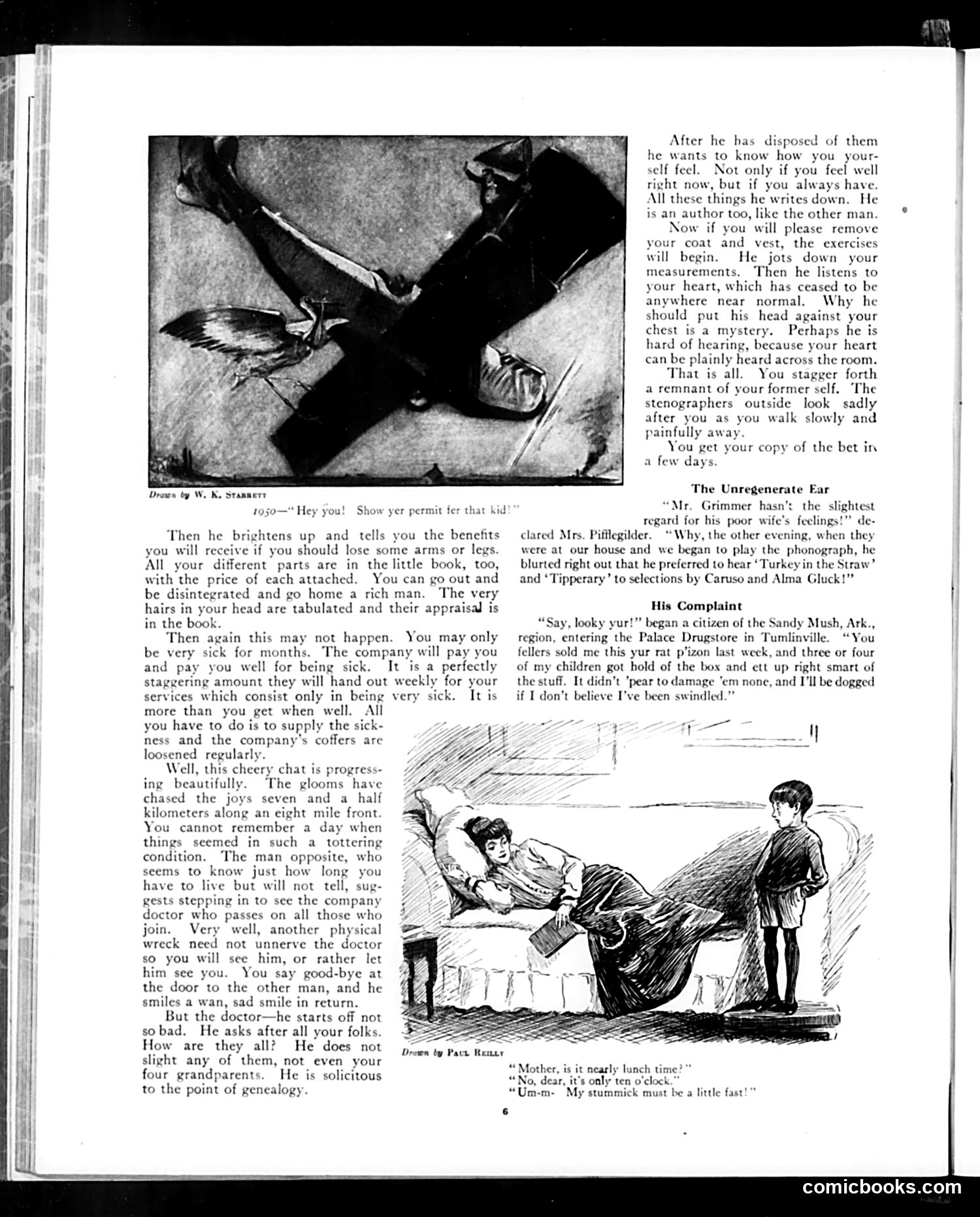
This page contains two distinct pieces: **Top section**: A narrative story about a medical examination by a company doctor. The text describes a humiliating process where a worker undergoes physical inspection to qualify for disability benefits—the doctor measures him, listens to his heart, and assesses whether he'll receive compensation. The satire mocks both the invasive nature of corporate medical screenings and the meager payments offered to injured workers. **Bottom cartoon** (drawn by Paul Henley): Shows a domestic scene where a mother and child discuss lunch timing. The child says it's "only ten o'clock" but his stomach demands food anyway. This is straightforward domestic humor about childhood hunger and impatience, unrelated to the top story's labor critique. The page juxtaposes workplace exploitation with family comedy.
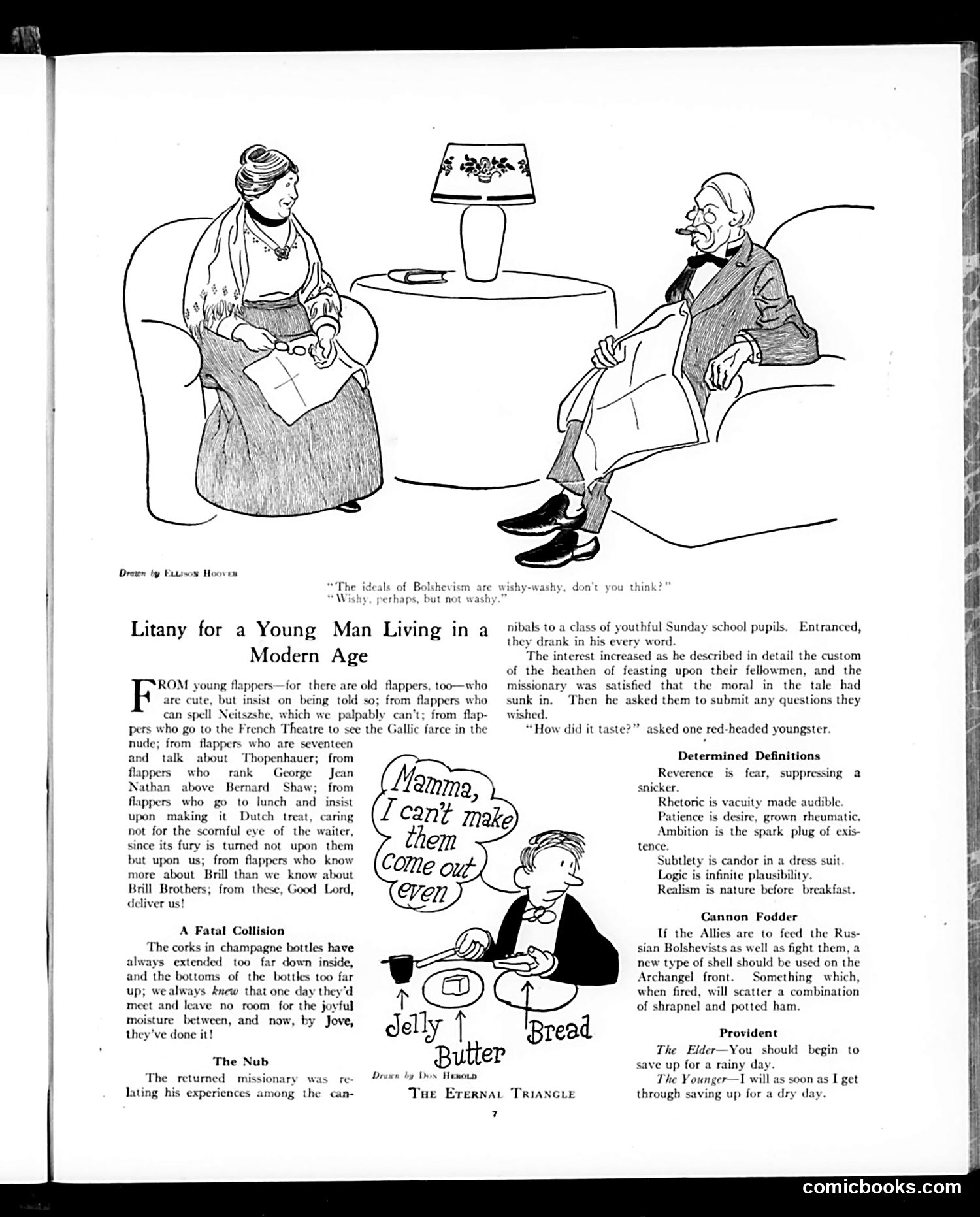
This page from Judge satirizes 1920s American youth culture and social trends. The top cartoon mocks the pretentiousness of young "flappers"—modern women who adopt intellectual affectations, referencing philosophers like Schopenhauer and critic George Jean Nathan, while frequenting French theaters and insisting on "Dutch treat" dating (splitting bills). The satirist suggests their sophistication is shallow. The "Litany" section parodies this flapper culture through mock-serious definitions and jokes. References to "Nietzsche" and philosophical posturing highlight the gap between their claimed intellectualism and actual understanding. Other items mock contemporary issues: a joke about WWI weapons ("potted ham" ammunition for fighting Bolsheviks in Russia), a missionary story with dark humor, and economic jokes about saving money during Prohibition ("dry day"). The overall tone is characteristically Judge: irreverent, cynical commentary on modern manners, youth rebellion, and 1920s social upheaval.
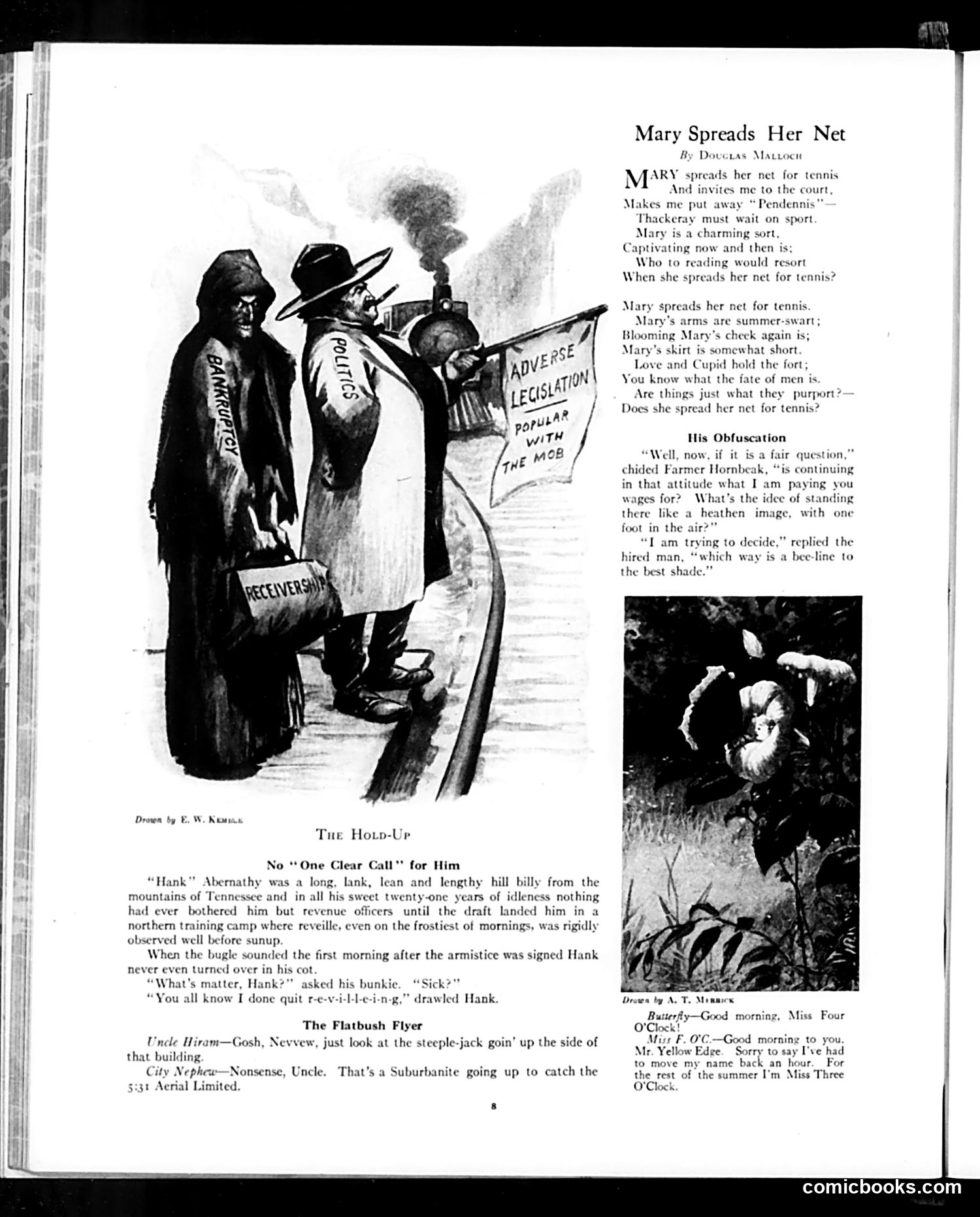
This page contains three distinct humor pieces from the post-WWI era: **"The Hold-Up"** satirizes a Tennessee hill-billy drafted into the military. "Hank" had evaded revenue officers (Prohibition enforcers) for years but cannot escape military discipline. The joke: when the armistice ends the war, he refuses to wake for reveille, claiming he's "quit" it—misunderstanding that the war's end doesn't exempt him from camp duties. **"The Flatbush Flyer"** is a brief joke about mistaken identity: an uncle sees someone climbing a building's exterior and assumes it's a "steeple-jack" (professional climber), but it's actually a suburbanite chasing a train. **"Mary Spreads Her Net"** is a romantic poem about a woman using tennis as a social stratagem to attract men, playing on period anxieties about women's changing roles and shorter skirts. The smaller "His Obfuscation" depicts a hired man's absurd excuse-making to his employer about standing idle.
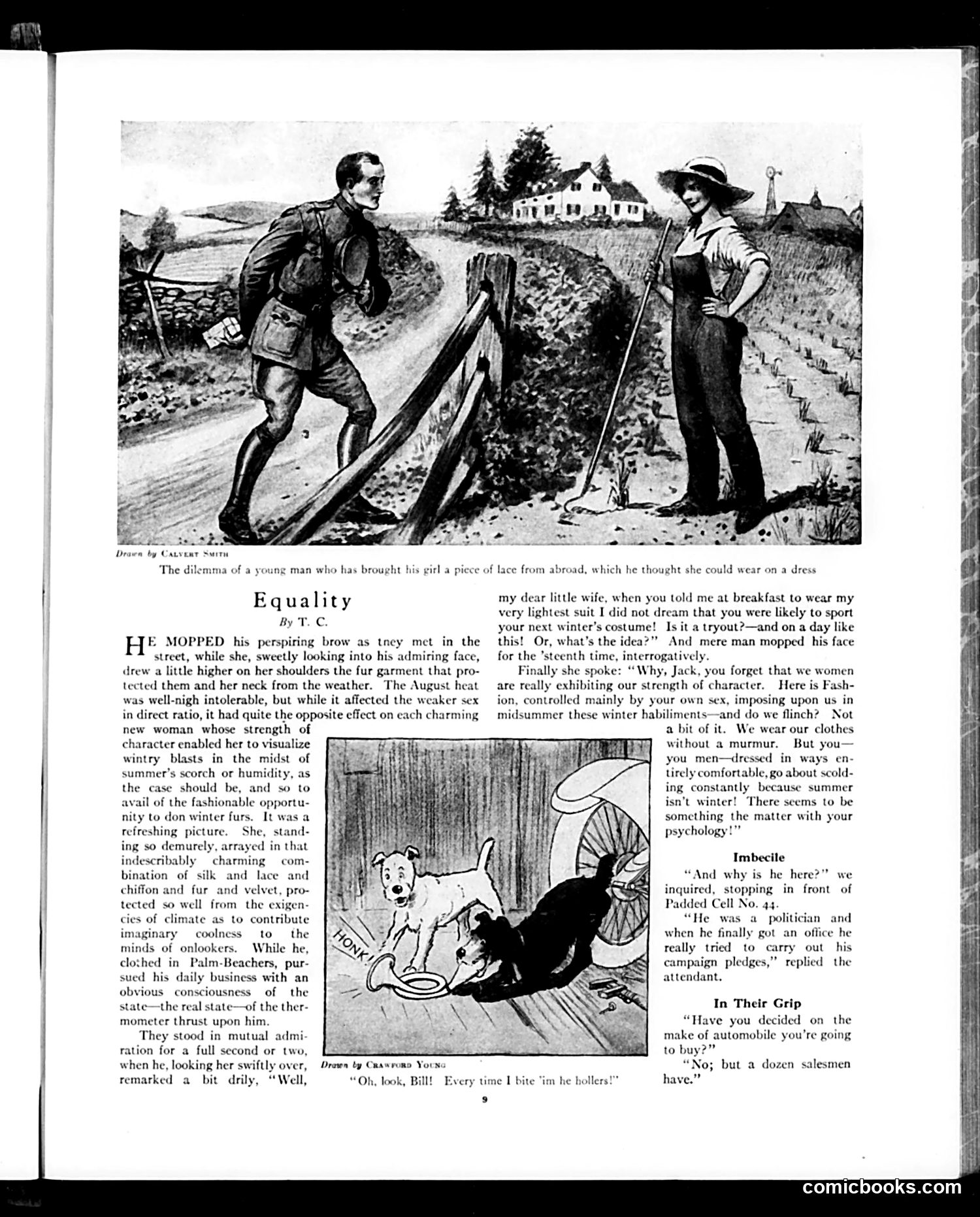
The main cartoon depicts a young couple on a sweltering August day. The woman wears heavy winter furs and multiple layers, while the man sweats in lightweight summer clothing. When he questions her outfit, she explains that women are demonstrating "strength of character" by enduring winter fashion imposed by male-dominated fashion industry, without complaint—contrasting this with men's constant griping about summer heat despite wearing comfortable clothes. The satire mocks early 20th-century gender ideology: it suggests men control fashion standards that torment women, yet men lack the "character" to accept minor discomfort themselves. The joke is that women's supposed strength is really submission to impractical fashion dictates, while men demand comfort without recognizing their hypocrisy. The smaller cartoon about the politician (captioned "Imbecile") jokes that he went insane trying to actually fulfill campaign promises—a separate jab at political dishonesty.
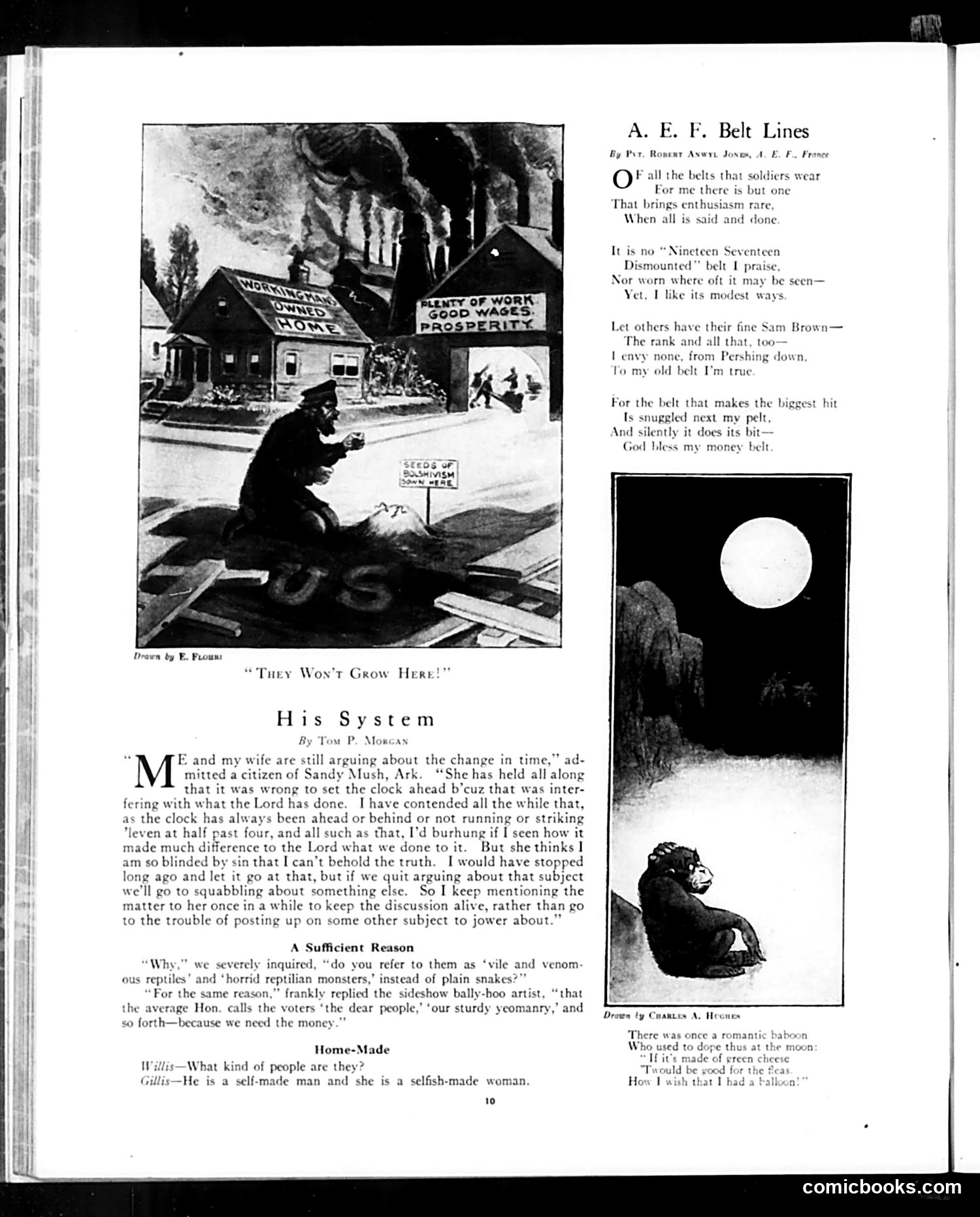
This page contains three separate pieces of WWI-era satire: **"A.E.F. Belt Lines"** is a patriotic poem by a soldier praising his practical money belt over fancy military belts like the "Sam Brown" (officers' parade belt). It's sentimental wartime verse celebrating humble functionality. **"His System"** mocks a rural Arkansas couple endlessly arguing about daylight saving time—he claims it interferes with God's work; she calls him spiritually blind. The joke is that their pointless argument keeps them occupied, preventing worse quarrels. It satirizes rural superstition and marital discord. **"A Sufficient Reason"** is a short joke: when asked why a carnival barker uses flowery language ("vile reptiles") instead of plain speech ("snakes"), he admits it's purely for money—paralleling how politicians flatter voters as "dear people" and "sturdy yeomanry" for the same mercenary reason. Political hypocrisy is the target. The cartoon above shows prosperity propaganda signs amid wartime conditions—likely satirizing government rhetoric about abundance during rationing.
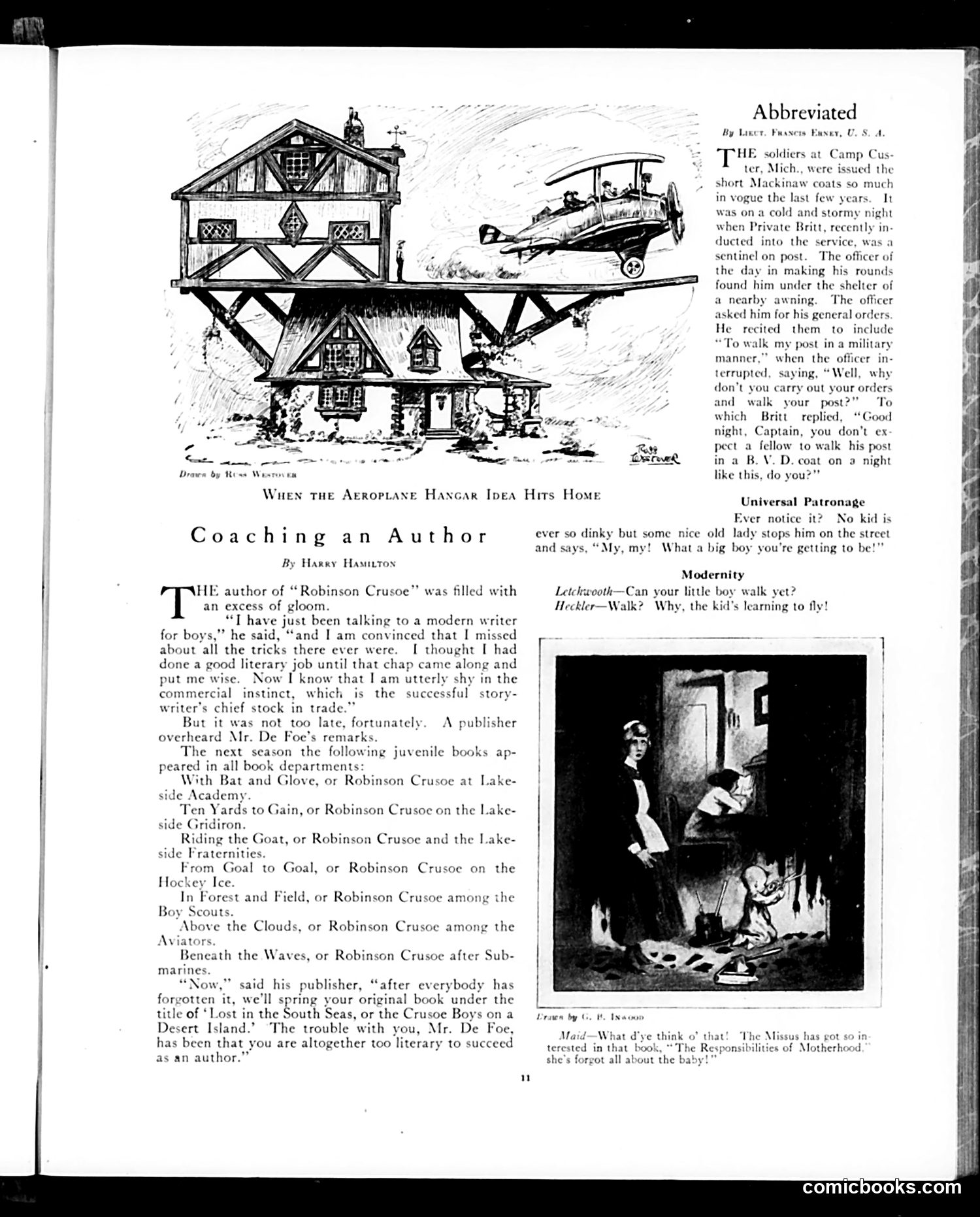
**"Coaching an Author"** satirizes early 20th-century commercial publishing. Daniel Defoe (author of *Robinson Crusoe*) complains to a publisher that he lacks modern marketing savvy. The publisher responds by showing how successful books exploit a single concept across multiple genres—rebranding *Robinson Crusoe* as sports stories ("With Bat and Glove"), college tales ("Riding the Goat"), Boy Scout adventures, aviation stories, and submarine tales. The joke: literary merit is irrelevant; publishers cynically milk profitable formulas by slapping familiar titles onto trendy subjects. The final threat to eventually republish the original under a new gimmicky title mocks both publisher opportunism and audience gullibility. **"Abbreviated"** jokes about military life. A newly drafted soldier stands under an awning during a cold night rather than patrol his post properly, claiming he won't walk outside in just his underwear (B.V.D. = a brand of men's undergarments/undershirts). The humor relies on the recruit's cheeky disregard for orders and the absurdity of army-issued thin coats. **"Modernity"** is a brief joke about children learning to fly (airplanes) before walking—reflecting aviation's newness as a cultural phenomenon.
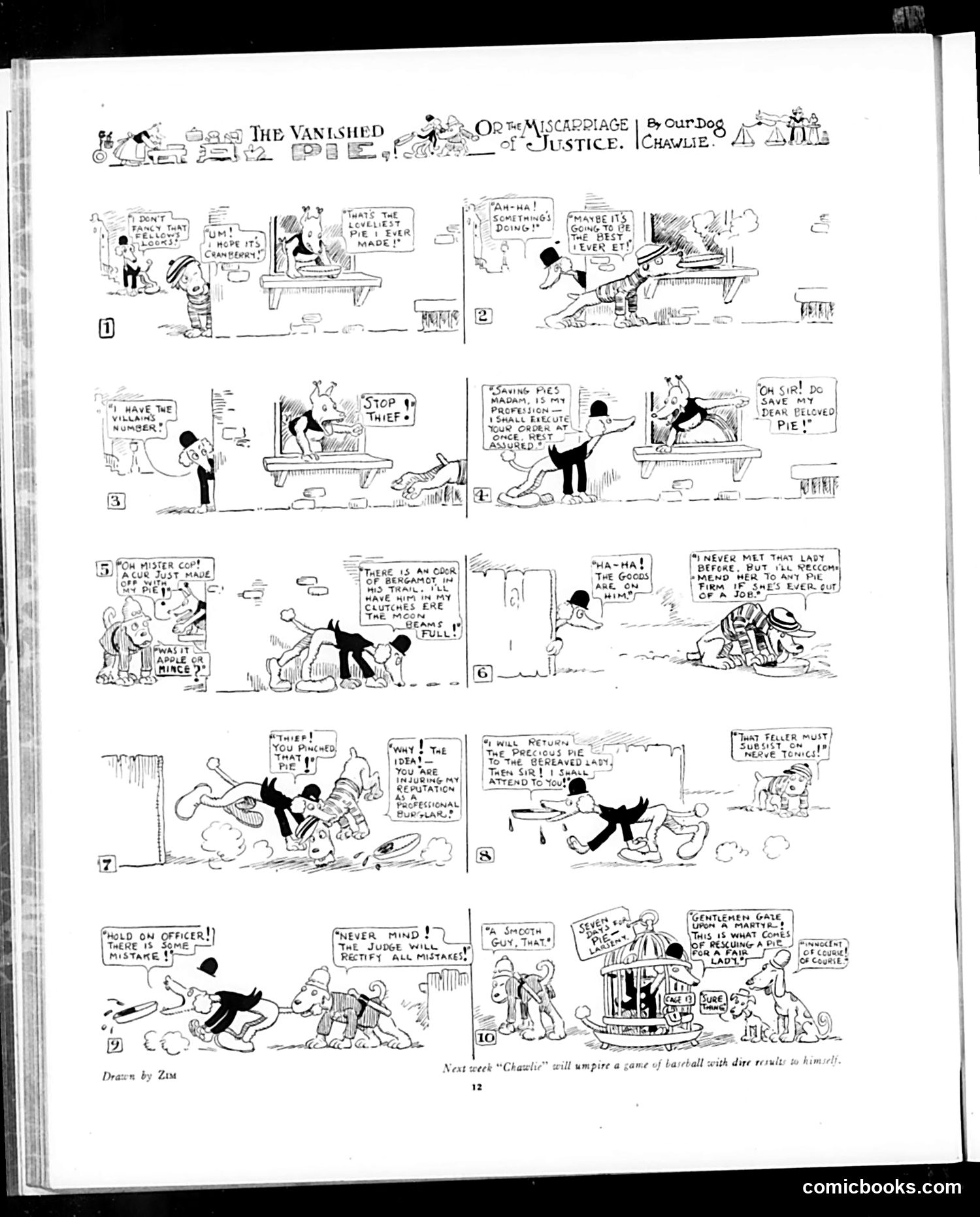
This multi-panel comic satirizes a pie-theft case. A domestic servant appears accused of stealing a pie. The narrative follows a bumbling "Officer" and what seems to be a magistrate or judge figure attempting to investigate and prosecute. The satire targets institutional incompetence: the officer repeatedly bundles the case, losing evidence (the pie itself), arresting the wrong person, and creating chaos. The accused maintains innocence while the officer's reputation suffers from his incompetence. A judge eventually appears to oversee the farce. The title "Miscalriage of Justice" signals the comic's point—the legal system fails through sheer bureaucratic ineptitude rather than corruption. The humor derives from slapstick mismanagement of a trivial matter (a pie) being treated with mock-serious judicial formality. The final caption promises "Charlie" will umpire baseball next week, suggesting this is part of a recurring satirical series about everyday institutional failure.
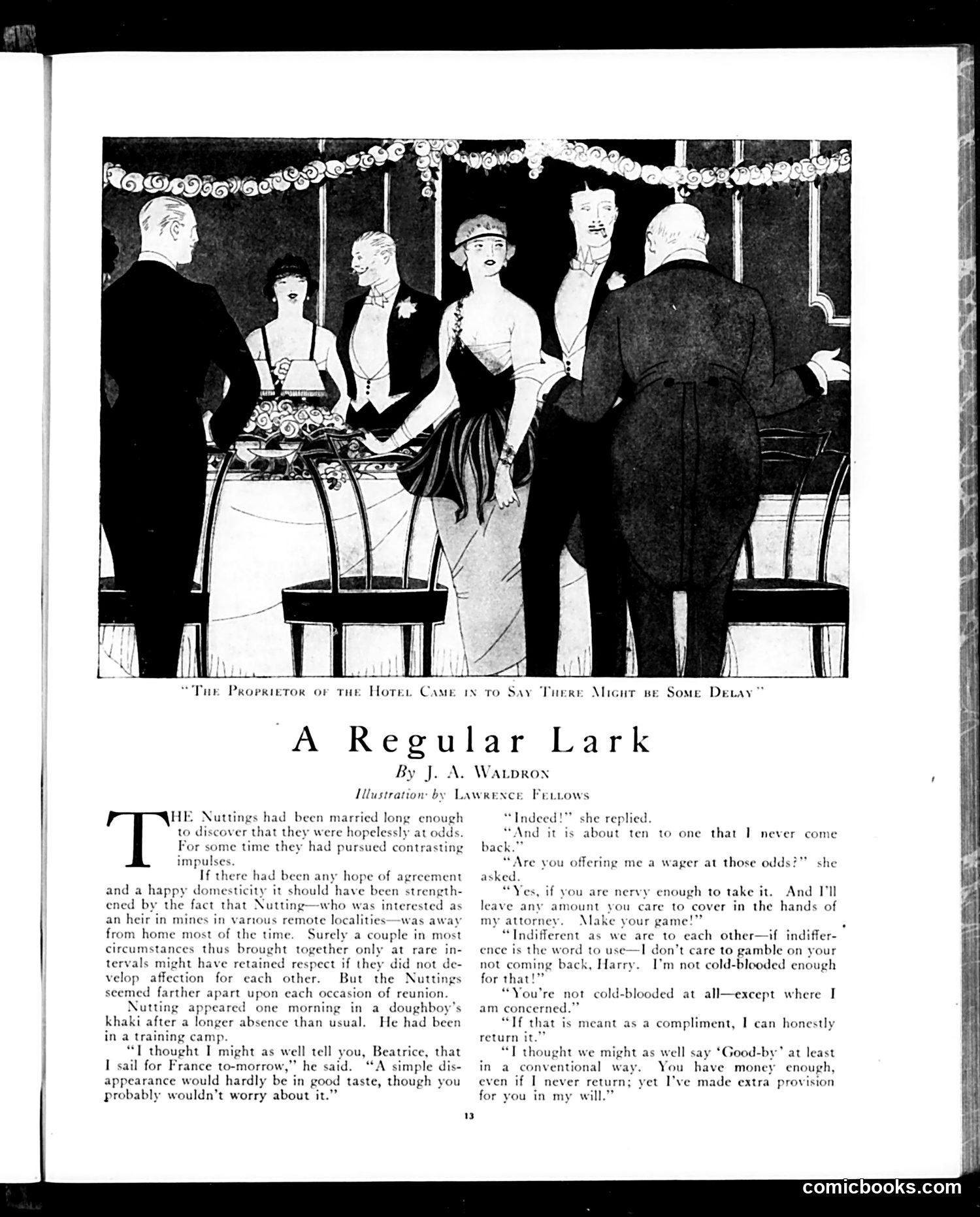
This is a short story illustration, not a political cartoon. It depicts an unhappy marriage between the Nuttings during World War I. The husband, a soldier in khaki who's been away in training camp, announces he's sailing to France. Rather than expressing concern, his wife Beatrice remains emotionally detached. The satire targets the deteriorating marriage through their cold conversation: he offers her a wager ("ten to one") that he won't return, and she responds with indifference rather than affection. The title "A Regular Lark" suggests their separation is treated as a casual joke rather than a serious wartime goodbye. The illustration shows them at what appears to be a formal dinner party, emphasizing the social facade masking their emotional distance. The story critiques how some marriages of the era had become purely transactional arrangements, devoid of genuine feeling.
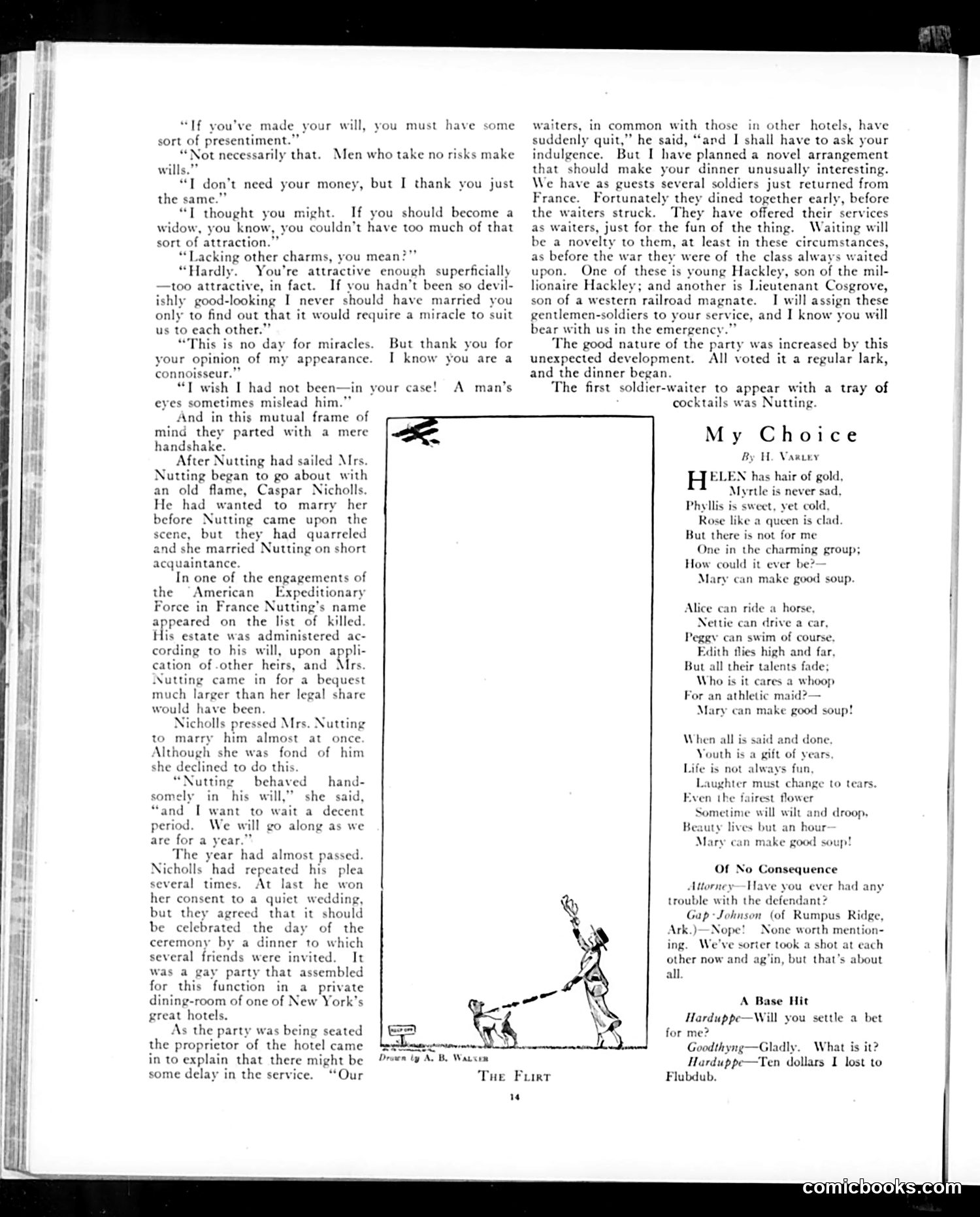
This page contains a serialized story with embedded cartoon rather than pure political satire. The narrative concerns Mrs. Nutting, whose husband dies in WWI, inherits his estate, and plans to remarry her former flame, Caspar Nicholls. The twist: during their wedding dinner at a New York hotel, the waiters have struck (labor action). The hotel manager solves this by recruiting returned soldier-officers as temporary waiters—including the supposedly-dead Nutting himself, now appearing with cocktails. **The satire targets:** Post-WWI social disruption (waiter strikes), the absurdity of class reversal (wealthy officers serving dinner), and marital infidelity enabled by wartime confusion. The "miracle" mentioned early becomes literal—Nutting's unexpected return. The adjacent poem "My Choice" and other brief items are unrelated filler content typical of Judge's miscellaneous format.
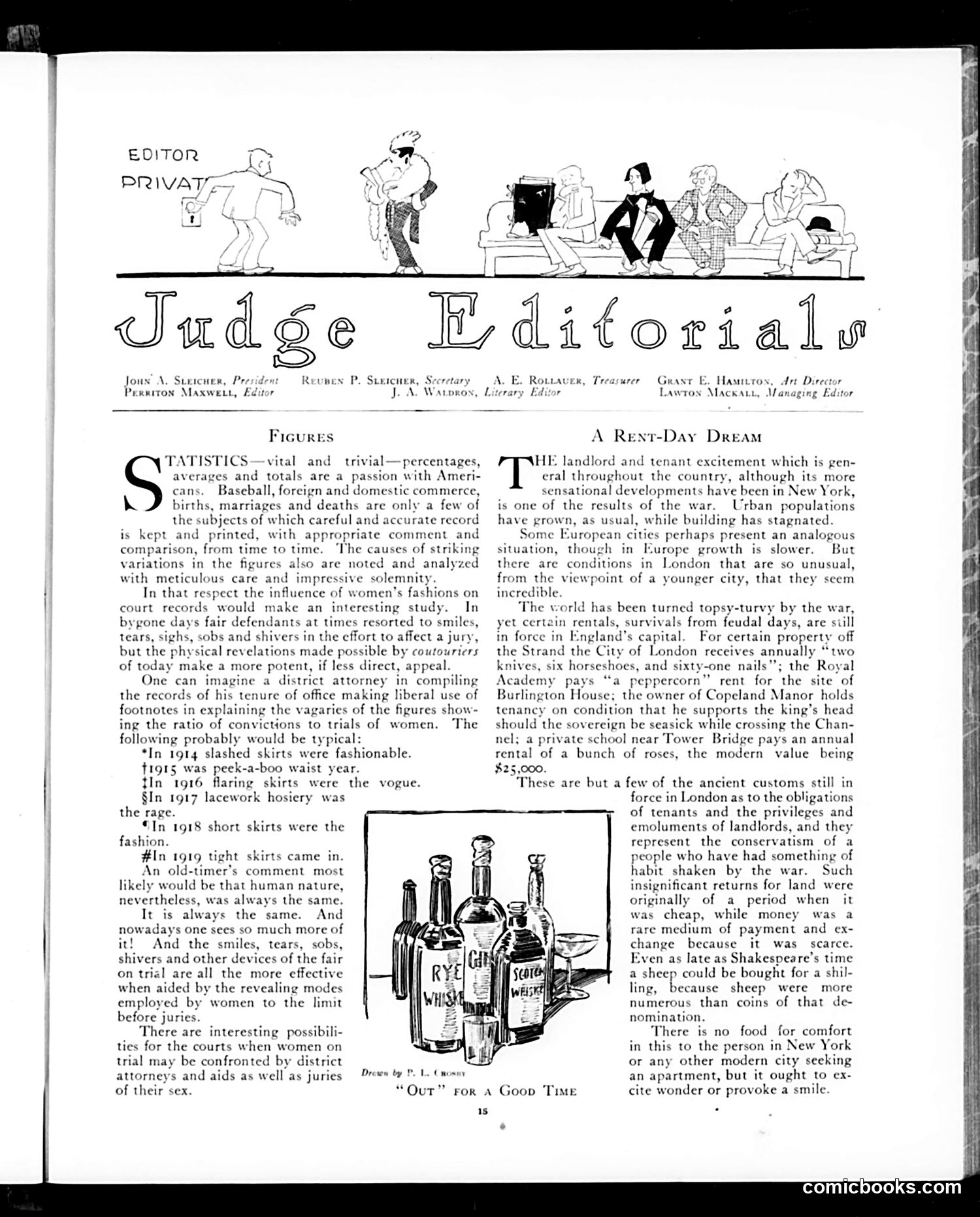
This is the masthead and editorial section of *Judge* magazine, featuring two distinct pieces: ## "Figures" Column A satirical commentary on how women's courtroom appearances influence trial outcomes. The author notes that lawyers could compile statistics showing conviction rates correlate with women's fashion trends (slashed skirts in 1914, peek-a-boo waists in 1915, etc.). The joke: modern revealing fashions make women defendants more "effective" before juries than traditional tactics like tears or smiles. It's a post-WWI critique of how women's increasingly visible clothing choices—a real social shift of that era—unexpectedly benefit them in legal proceedings. ## "A Rent-Day Dream" Discusses the postwar housing crisis and unusual feudal rental arrangements still existing in London. Examples include properties whose annual rent consists of "two knives, six horseshoes," or a rose bunch (valued at $25,000). The piece treats these archaic customs as charming historical curiosities while implicitly critiquing how tradition persists even when economically nonsensical—a commentary on British conservatism amid postwar modernization. Both pieces employ gentle satire about social change following World War I.
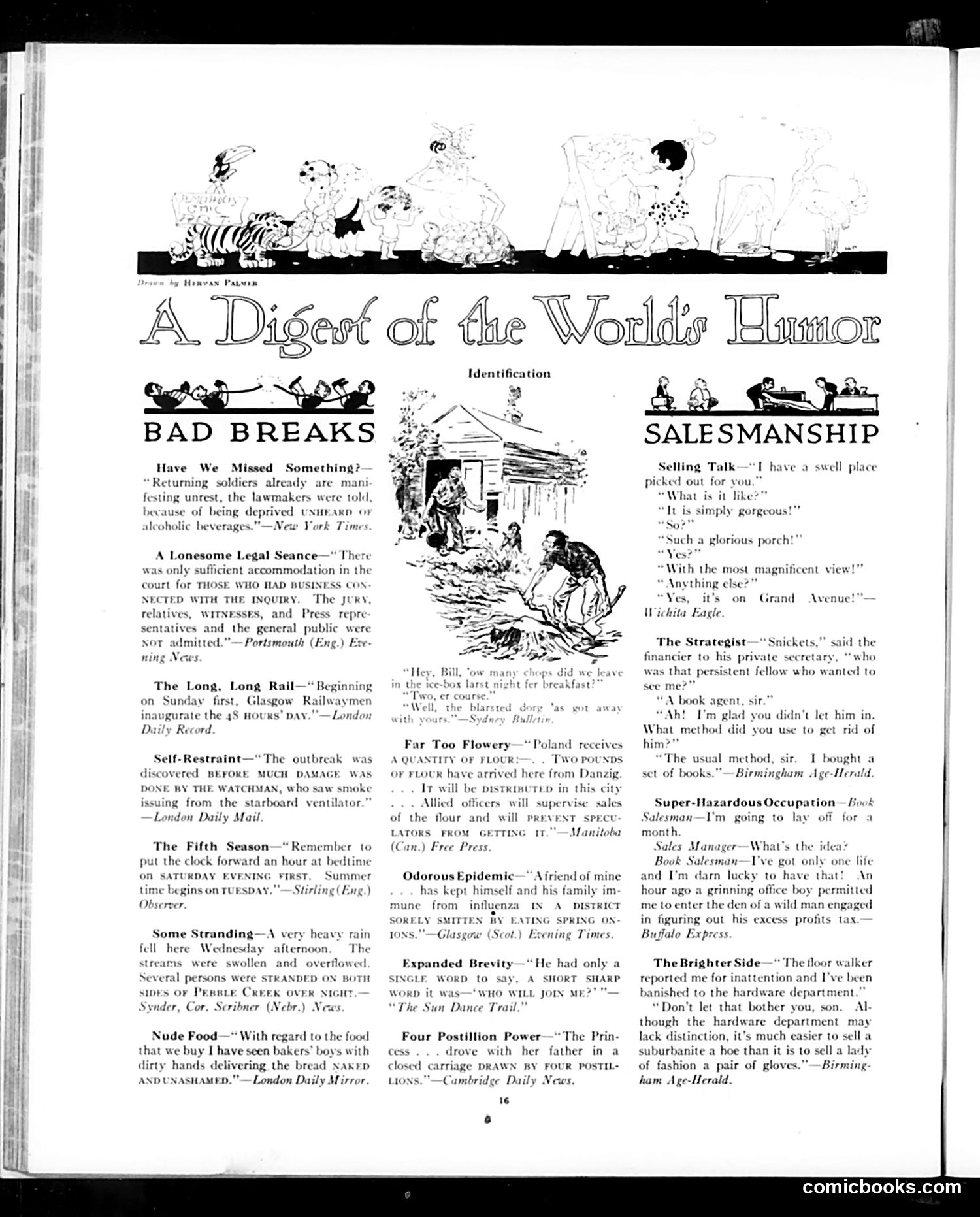
This is a humor compilation page from Judge magazine, organized into two sections: "Bad Breaks" (humorous newspaper clippings) and "Salesmanship" (jokes about selling). **Bad Breaks** reprints amusing excerpts from newspapers worldwide—soldiers complaining about prohibition, courtroom overcrowding, railway labor disputes, and absurd situations like "naked" (unwrapped) bread delivery. The satire targets bureaucratic incompetence and social upheaval during post-WWI reconstruction. **Salesmanship** section mocks aggressive sales tactics through brief anecdotes: a real-estate agent's flowery pitch, a financier avoiding book salesmen, and a discouraged book salesman citing workplace hazards. These jokes target the era's high-pressure commercial culture and the desperation of traveling salesmen. The cartoons at the page top (credited to Hervas Patton) visually reinforce the humor theme with exaggerated characters. The overall effect satirizes contemporary social friction—labor unrest, commercial greed, and bureaucratic absurdity—through collected "found humor."
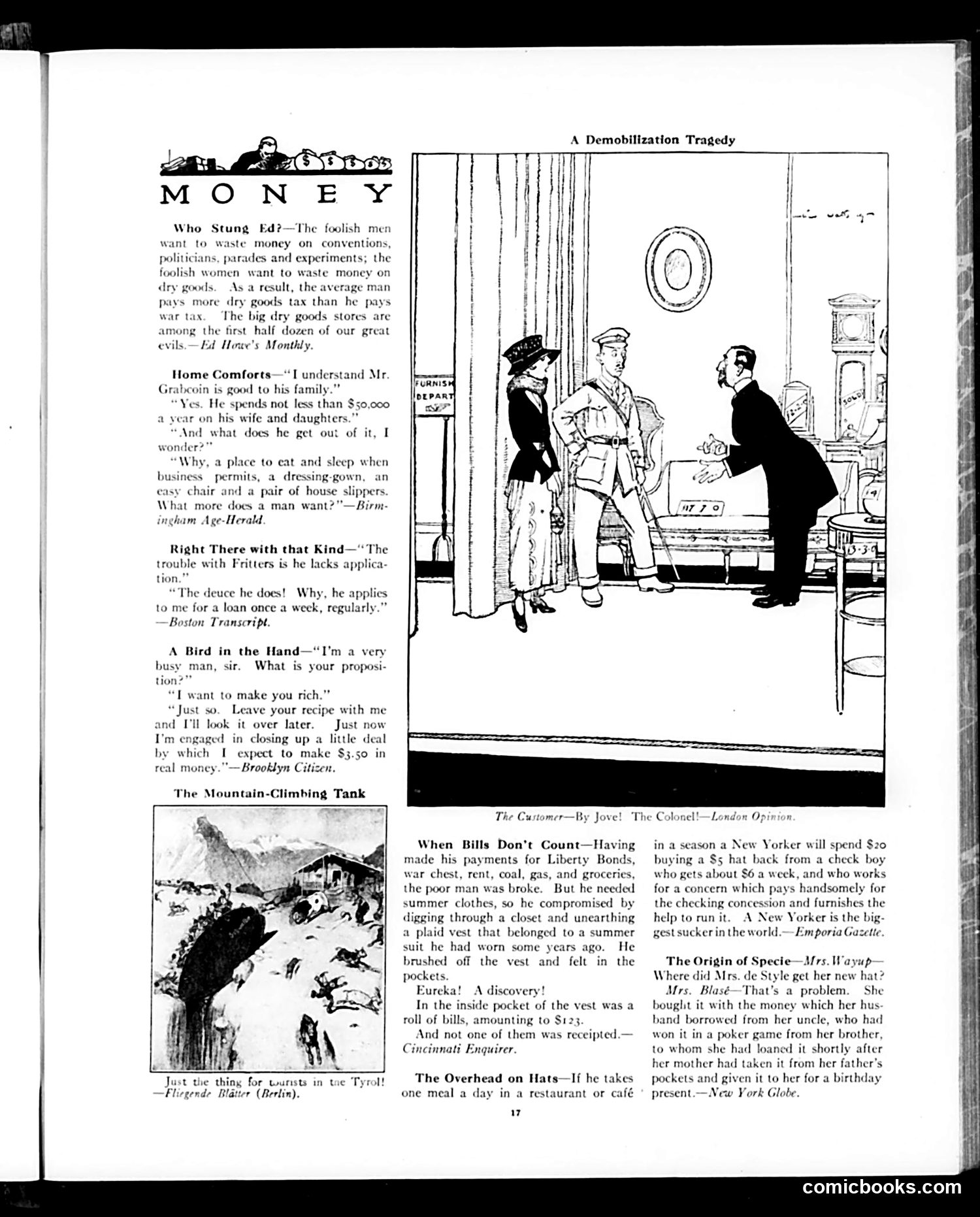
This page satirizes post-World War I economic hardship through the cartoon "The Customer—By Jove! The Colonel!" (top right). The scene depicts a military officer in a furniture showroom confronting a civilian salesman, likely representing the disconnect between returning soldiers and the civilian economy. The title suggests the "tragedy" of demobilization—soldiers returning home to find civilian life economically challenging. The accompanying anecdotes mock widespread financial struggles: men cannot afford basic needs despite wartime sacrifice; dry goods stores exploit consumers; working men barely survive after paying taxes and bills. The Mountain-Climbing Tank illustration references German military technology, placing this content in the immediate post-WWI period when American audiences remained fixated on recent conflict. Overall, the page critiques how ordinary Americans—especially veterans—faced economic squeeze from inflation, luxury consumption, and institutional exploitation following the war.
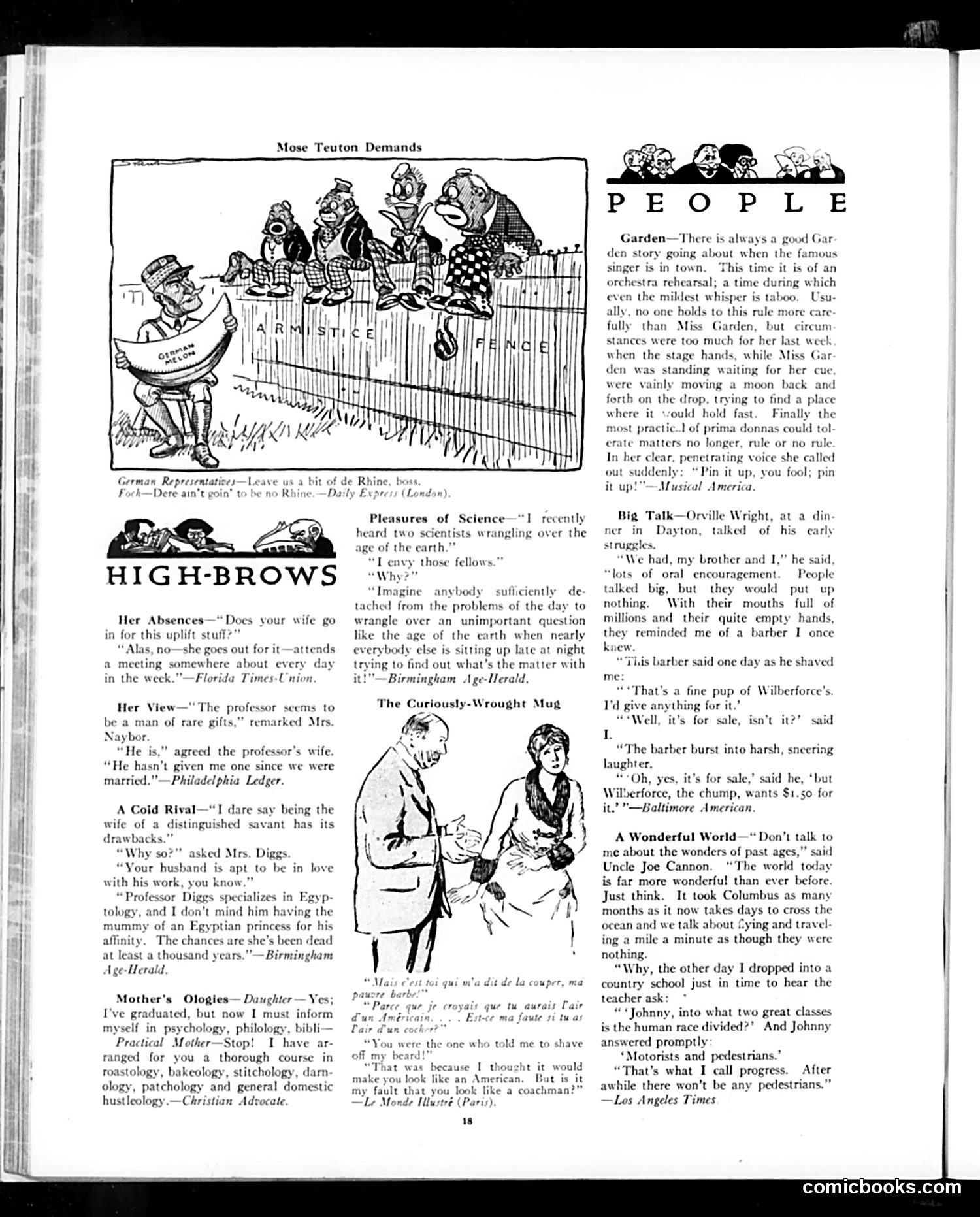
This page collects brief humorous anecdotes mocking early 20th-century American society. The top cartoon shows "Mose Teuton" (a German stereotype character) demanding something from behind a fence labeled "ARMISTICE FENCE"—likely satirizing post-WWI German reparations demands. The "High-Brows" section ridicules educated elites through domestic humor: professors neglecting wives for academic pursuits, scholars debating obscure questions while ignoring current problems, and mothers rejecting higher education for practical domestic skills. The cartoons and jokes target: - Gender roles and marriage dynamics - Academic pretension - The disconnect between intellectuals and everyday concerns - Class attitudes A notable reference: Orville Wright (aviation pioneer) appears in "Big Talk," discussing early struggles with financial backers who talked big but delivered nothing—satirizing wealthy patrons' empty promises. The French cartoon caption mocks someone's appearance, suggesting failed attempts at looking American. Overall, the page uses gentle satire to critique American social pretensions and the gap between words and actions.
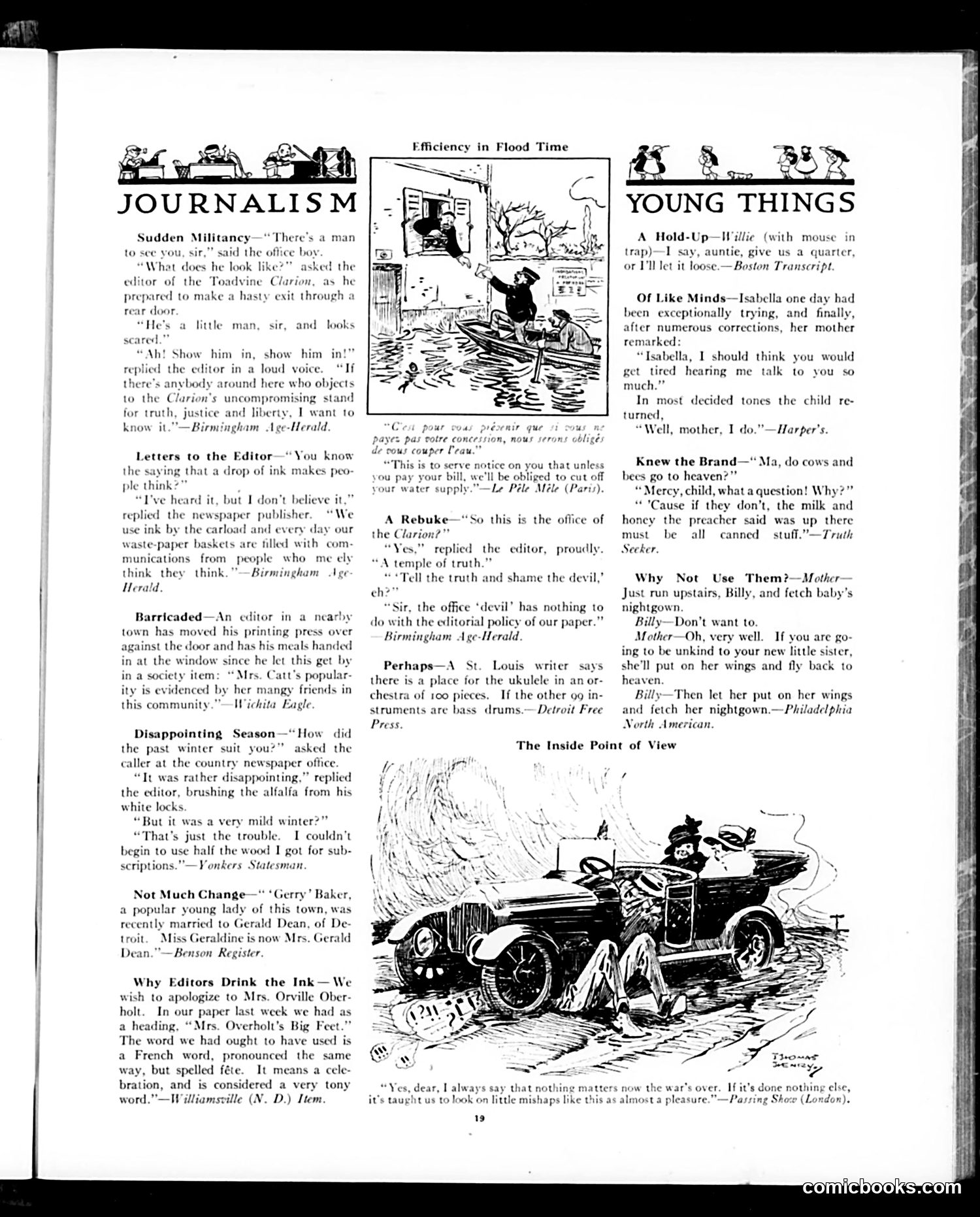
This page collects **journalism-related humor** (left column), **children's witticisms** (right column), and **editorial cartoons** (center). The **"Journalism" section** satirizes newspaper editors and the publishing industry through anecdotes. Key jokes include: editors' contradictory bravado about truth-seeking while avoiding confrontation; the irrelevance of published letters ("waste-paper baskets"); editors' financial struggles (trading subscriptions for firewood); and a humorous typo mishap involving a French word mistaken for an English one. The **central cartoon** titled "Efficiency in Flood Time" shows a flooded scene with a man in a boat, appearing to satirize newspaper management during crisis—likely mocking how editors prioritize business (water bills) over practical disaster response. The **"Young Things" section** presents children's supposedly clever or cheeky remarks, reflecting period humor about precocious youth challenging adults through logical literalism and irreverence. Overall, the page demonstrates Judge's satirical focus on institutional incompetence and social absurdity through brief, punchy anecdotes typical of early 20th-century American humor magazines.
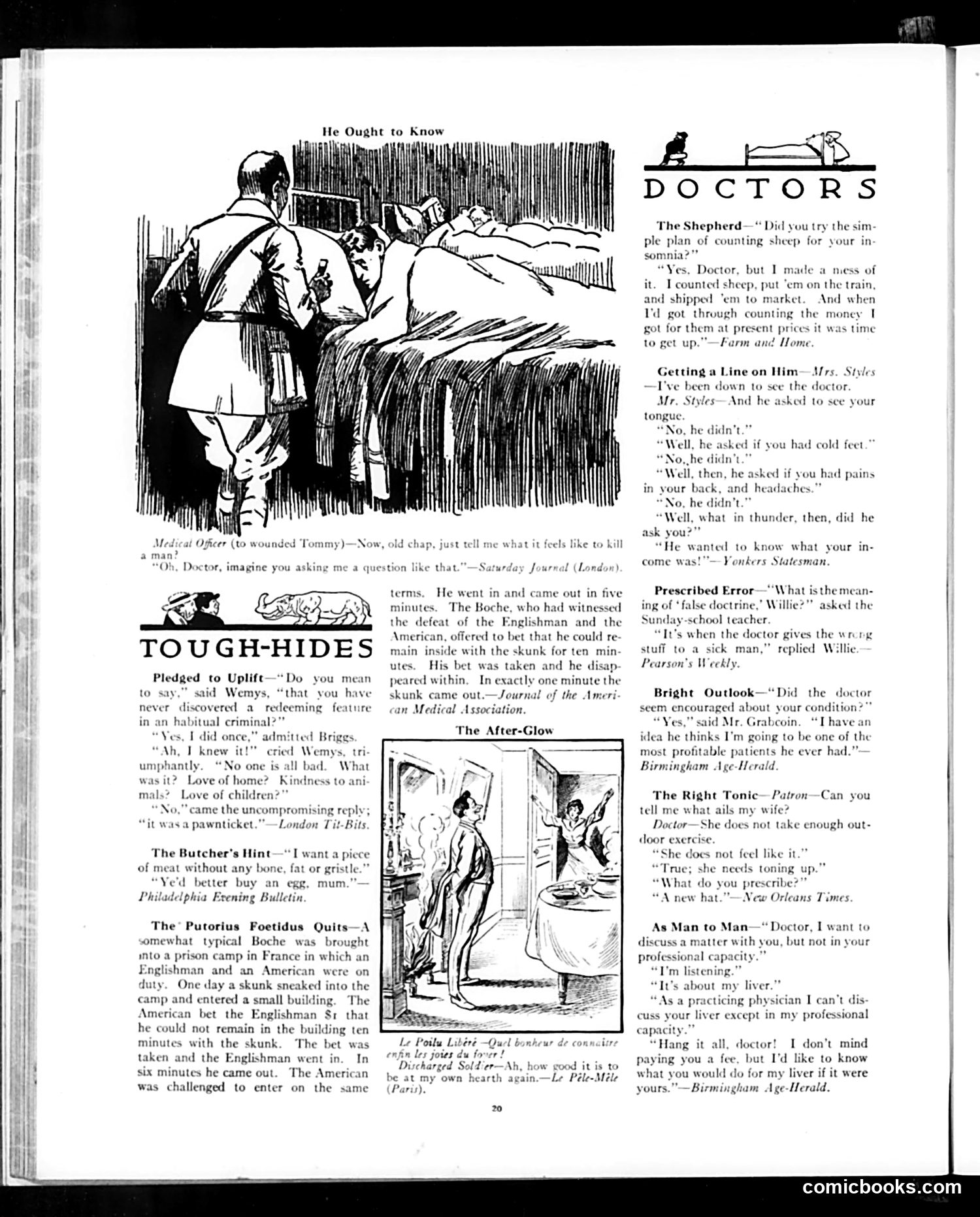
This page from *Judge* magazine contains several doctor-themed jokes and one WWI anecdote, typical of early 20th-century American humor. **The main cartoon** ("He Ought to Know") depicts a medical officer examining a wounded soldier, with a quote about doctors asking uncomfortable questions. **The jokes** satirize doctors and patients through scenarios like: - A shepherd who counts sheep to sell them, then counts the money instead of sleeping - A wife visiting a doctor who only asks about her income - A patient trying to discuss his liver as a personal matter rather than medical concern **The "Putorius Foetidus" anecdote** references WWI, contrasting a German ("Boche") prisoner negatively with British and American soldiers—a common wartime propaganda trope. The "skunk" metaphor suggests Germans were unpleasant or cowardly. The humor relies on wordplay, irony about doctor-patient dynamics, and era-specific attitudes toward medicine and national stereotypes. Most jokes turn on economic anxiety or the awkwardness of medical consultations—concerns recognizable today, though the execution feels dated.
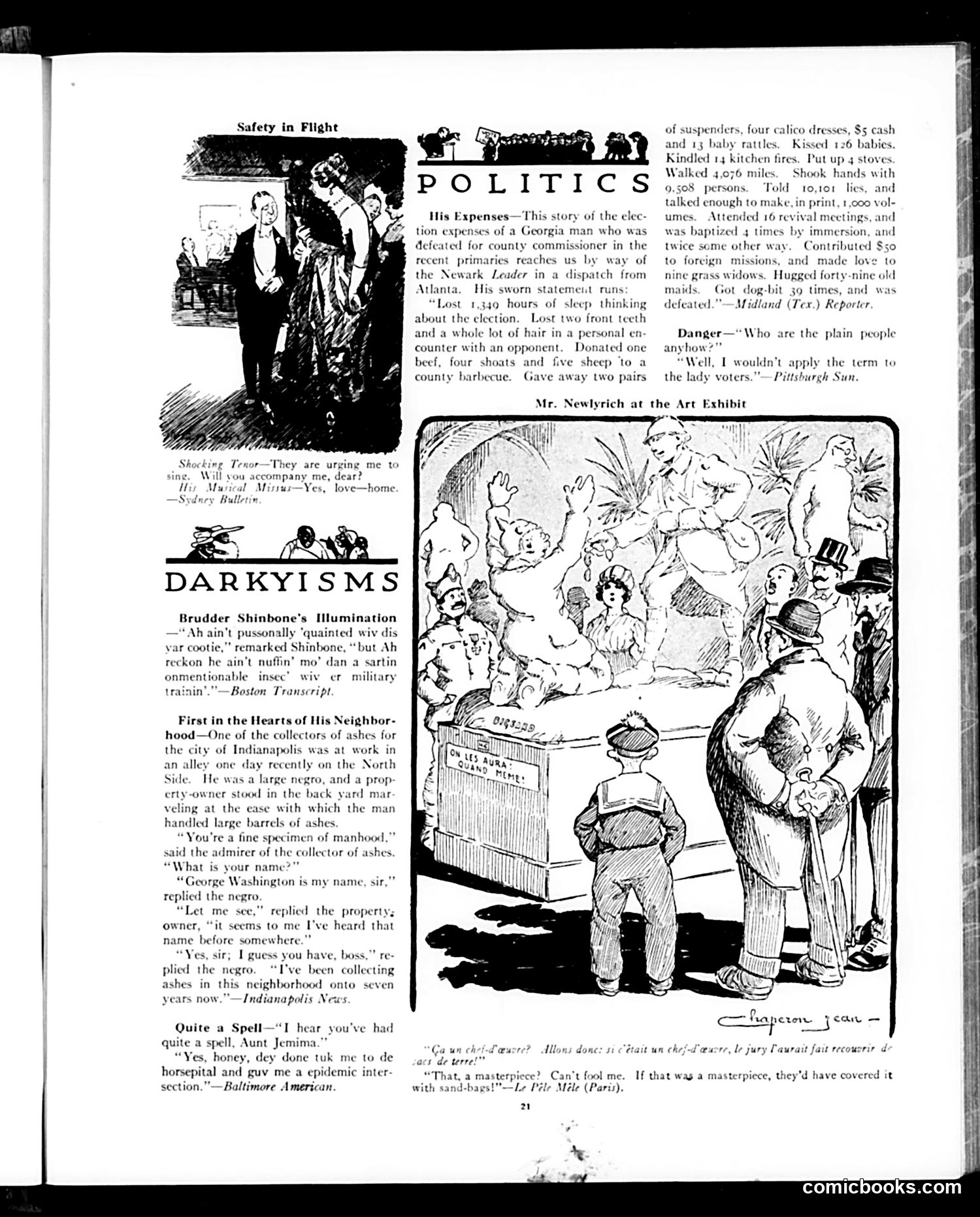
This page contains several distinct satirical pieces: **"His Expenses"** mocks a defeated Georgia county commissioner candidate by listing absurd election costs—lost sleep, teeth knocked out in a fight with an opponent, donated livestock. The satire ridicules wasteful campaign spending and political violence. **"Darkyisms"** section uses racist dialect humor (common in early 20th-century American publications) featuring African American characters. One sketch plays on the name "George Washington" given to a Black ash collector, creating humor through the incongruity of a common figure's name applied to a humble laborer. **"Mr. Newlyrich at the Art Exhibit"** (right panel) appears to satirize wealthy nouveaux riches attending art galleries, likely mocking their pretension or lack of genuine aesthetic appreciation. The overall tone reflects Judge's satirical approach to American politics, class, and social pretension, though the racial content reflects deeply problematic historical attitudes.
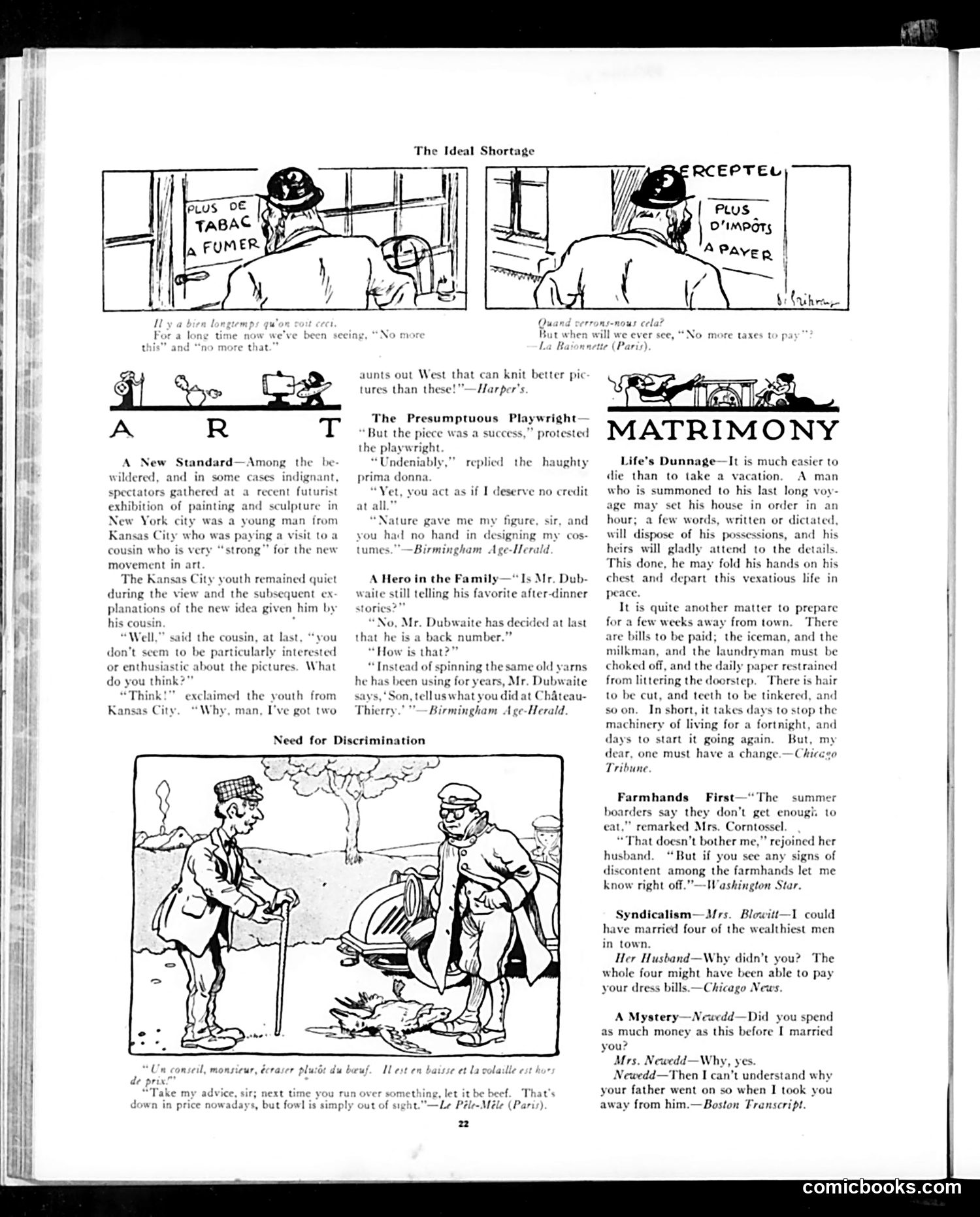
This Judge page collects brief humorous sketches mocking early 20th-century social attitudes. The title cartoon jokes that a Kansas City visitor finds Futurist art so incomprehensible that his aunts' knitting looks superior—satirizing both avant-garde pretension and provincial skepticism toward modernism. Other sketches target: a prima donna's vanity (crediting her success to nature, not the playwright); an elderly man reduced to recycling WWI anecdotes; and conjugal complaints about household management and marriage expenses. The "Need for Discrimination" cartoon (French caption unclear in OCR) appears to contrast city and rural perspectives, though its specific point is difficult to extract. The humor throughout reflects period anxieties: generational conflict over "new" art movements, class consciousness, and domestic/marital tensions. These are topical satires accessible primarily to Judge's educated, urban readership of the 1920s.
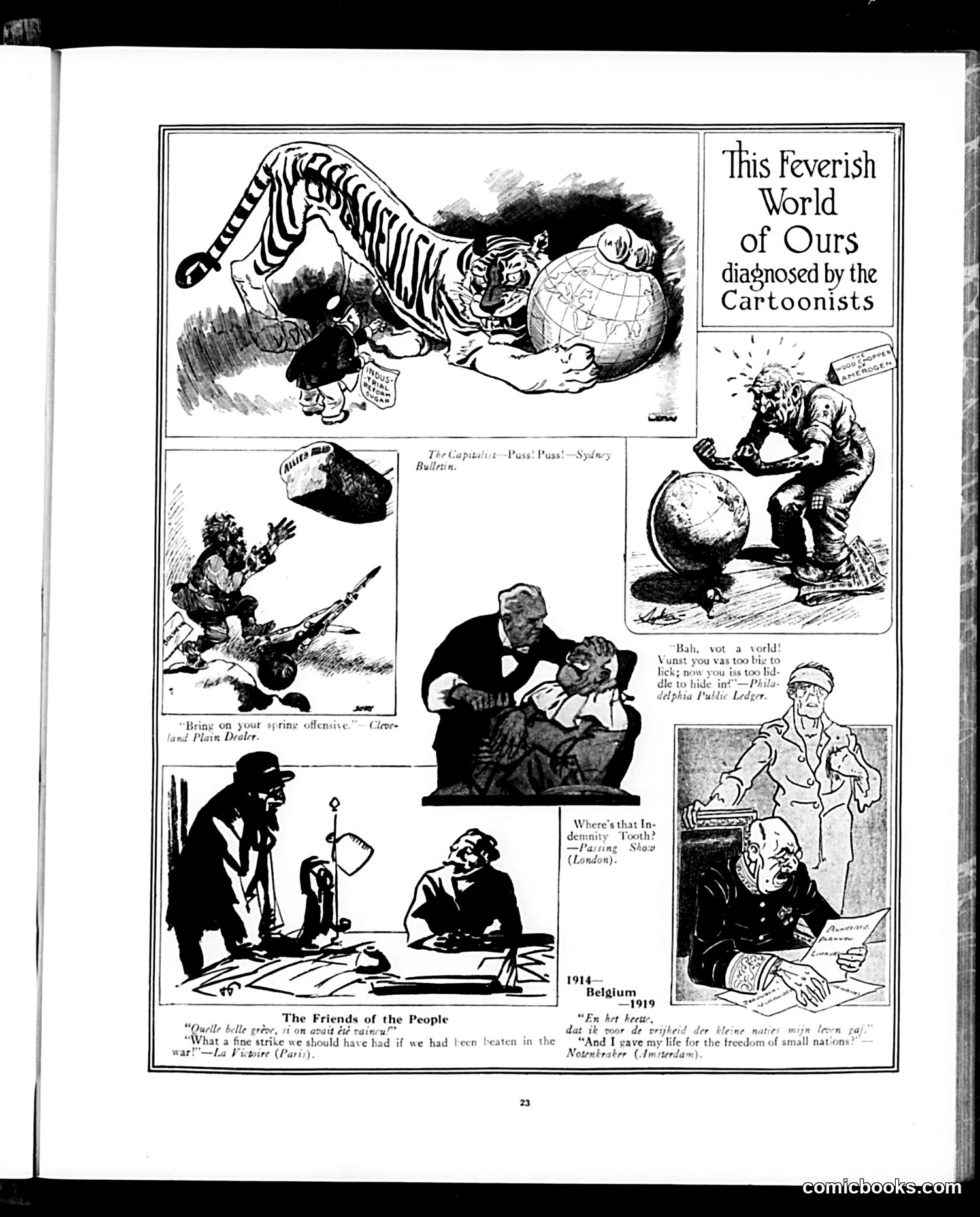
This Judge magazine page uses multiple cartoons to diagnose contemporary global problems through satirical diagnosis. The top panel depicts a tiger (likely representing militarism or an aggressor nation) menacing a globe and small figure, suggesting imperial threat. Other panels lampoon "The Friends of the People" and reference Belgium (1918-1919), likely addressing post-WWI politics and broken promises to smaller nations. One cartoon shows a doctor figure, emphasizing the "diagnosis" metaphor—the world is portrayed as sick and needing treatment. The quotes critiquing missed military opportunities and sacrifices made for "freedom of small nations" suggest frustration with war's outcome and postwar settlements. The cartoons collectively mock how political leaders and ideologies have destabilized the world, presenting complex geopolitical chaos through accessible visual satire.
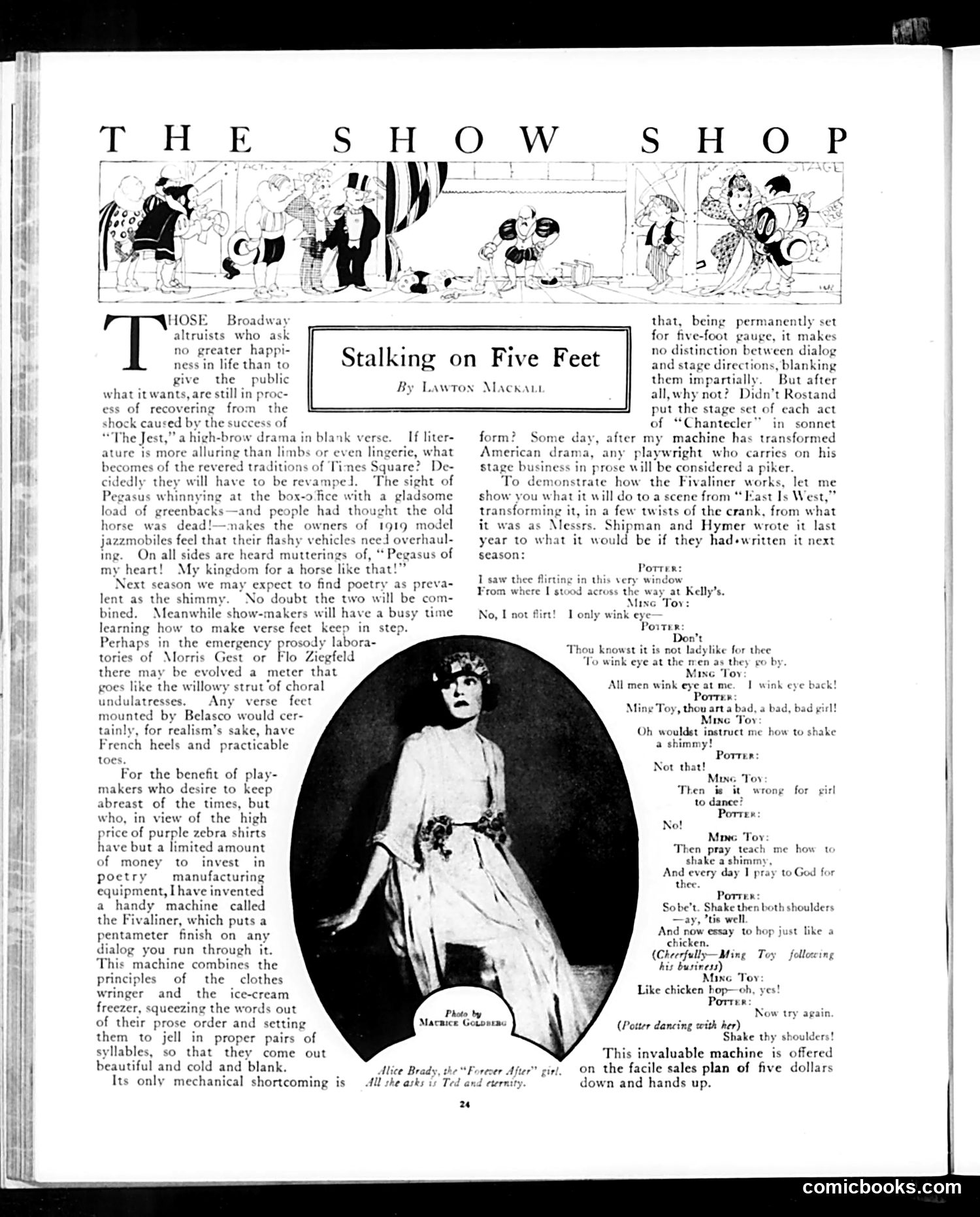
This page satirizes Broadway's commercial theater and the absurdity of forcing dramatic dialogue into rigid poetic forms. The main article mocks the success of highbrow plays like "The Jest," while the centerpiece is a humorous invention: the "Fivaliner," a fictional machine that converts prose drama into pentameter verse. The satire targets theater producers who chase trends while lacking resources to invest properly in productions. The author invents this ridiculous machine that mechanically "squeezes" dialogue into iambic pentameter—joking that it treats stage directions and dialog identically, creating nonsensical results. The sample scene from "East Is West" demonstrates the absurdity: pedestrian dialogue about winking and dancing becomes forced, awkward blank verse. The joke suggests that some Broadway producers are so desperate to appear sophisticated and literary that they'd embrace such mechanical artificiality over genuine artistry. This reflects 1920s theater debates between commercial entertainment and artistic pretension.
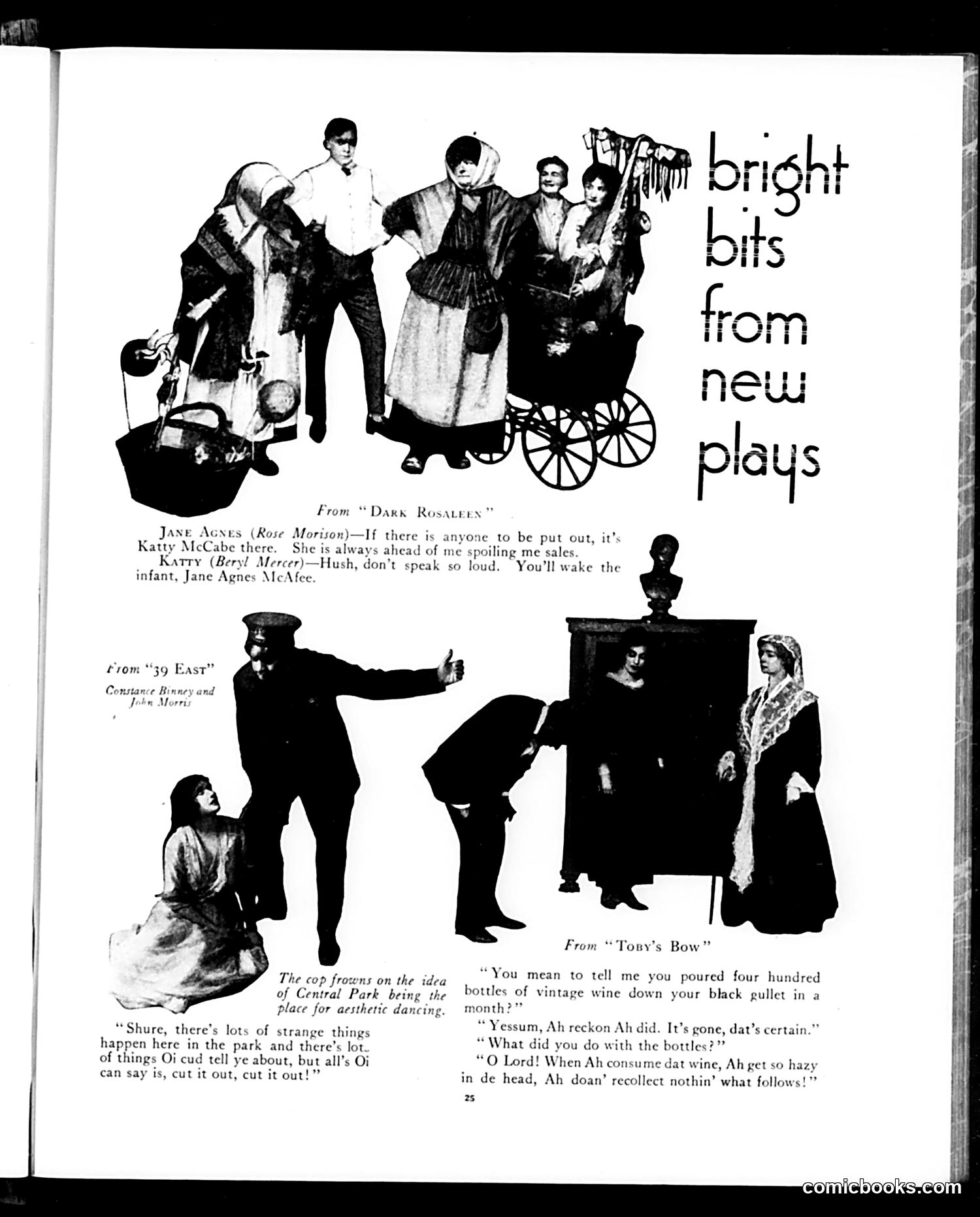
This page presents humorous dialogue excerpts from three theatrical productions, structured as comedy highlights rather than political satire. **"Dark Rosaleen"** features working-class Irish characters (Jane Agnes and Katty) in a domestic dispute about sales and a sleeping infant—humor derived from Irish brogue and petty rivalries. **"39 East"** shows a cop objecting to aesthetic dancing in Central Park, reflecting early 20th-century tensions between artistic expression and public morality enforcement. **"Toby's Bow"** satirizes an African American character's drinking habits through dialect humor—he admits consuming 400 bottles of wine monthly but claims drunken amnesia about the empty bottles. This reflects the deeply problematic racial caricature standards of the era, using exaggerated dialect and stereotypes for comedic effect. The page essentially showcases theatrical jokes meant to amuse readers familiar with these plays.
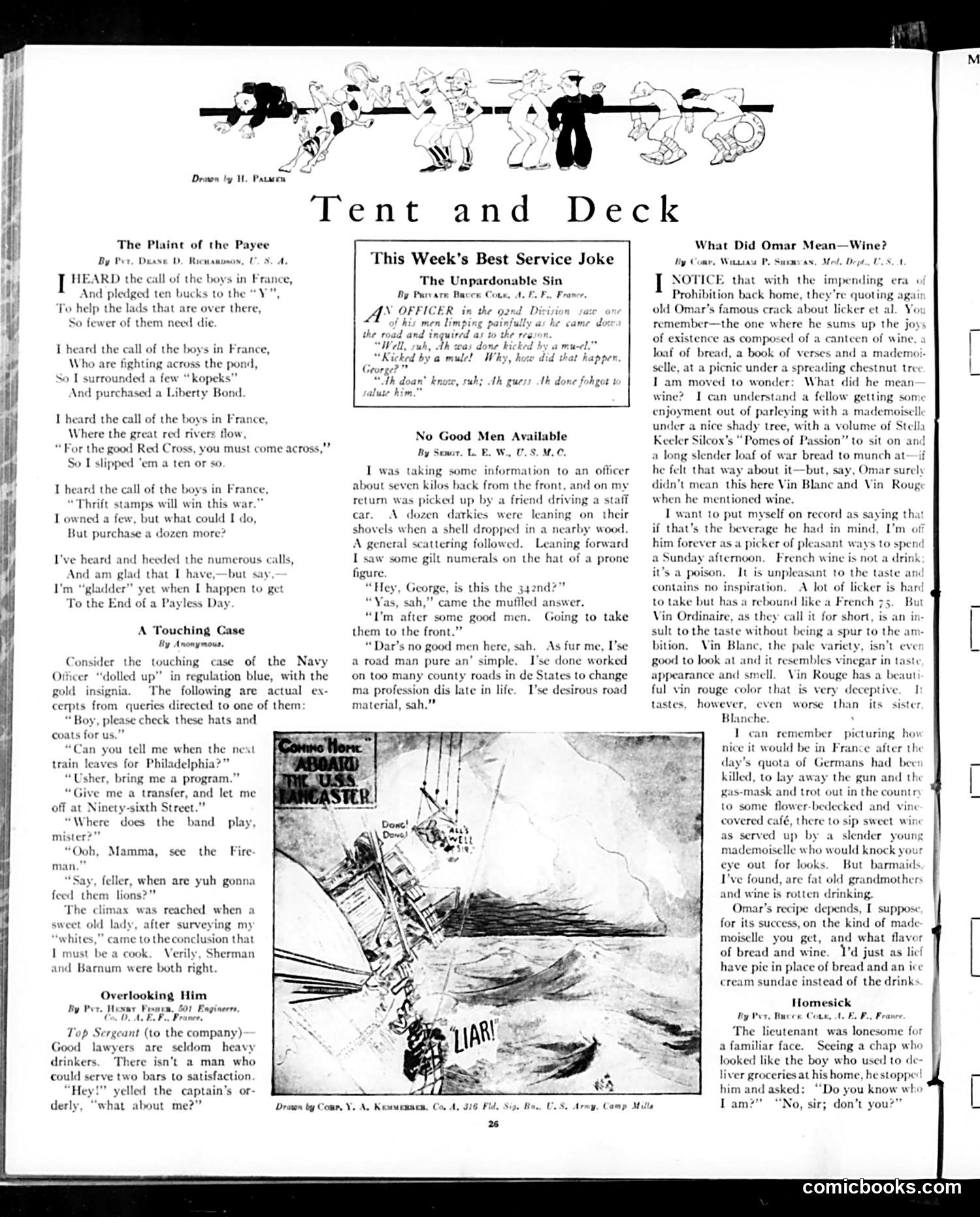
This is a WWI-era humor page from *Judge* magazine, featuring soldiers' complaints and observations from the front lines in France. **Main content:** Several short pieces mock military life and wartime sacrifice. "The Plaint of the Payee" satirizes Americans who donated repeatedly to war efforts (YMCA, Liberty Bonds, thrift stamps) only to find themselves broke. "A Touching Case" jokes about a Navy officer in dress uniform being mistaken for a porter or cook by civilians. "No Good Men Available" presents a racial stereotype—a Black soldier claiming he won't volunteer because manual labor is beneath him. **The Omar piece** references the famous Persian poet's lines about wine, bread, and companionship, joking that American soldiers can't actually enjoy "real" wine due to Prohibition taking effect, only inferior military rations. These pieces reflect soldiers' dark humor about deprivation, public sacrifice, and the gap between civilian expectations and military reality. The racial humor reflects the deeply segregated era's casual bigotry.
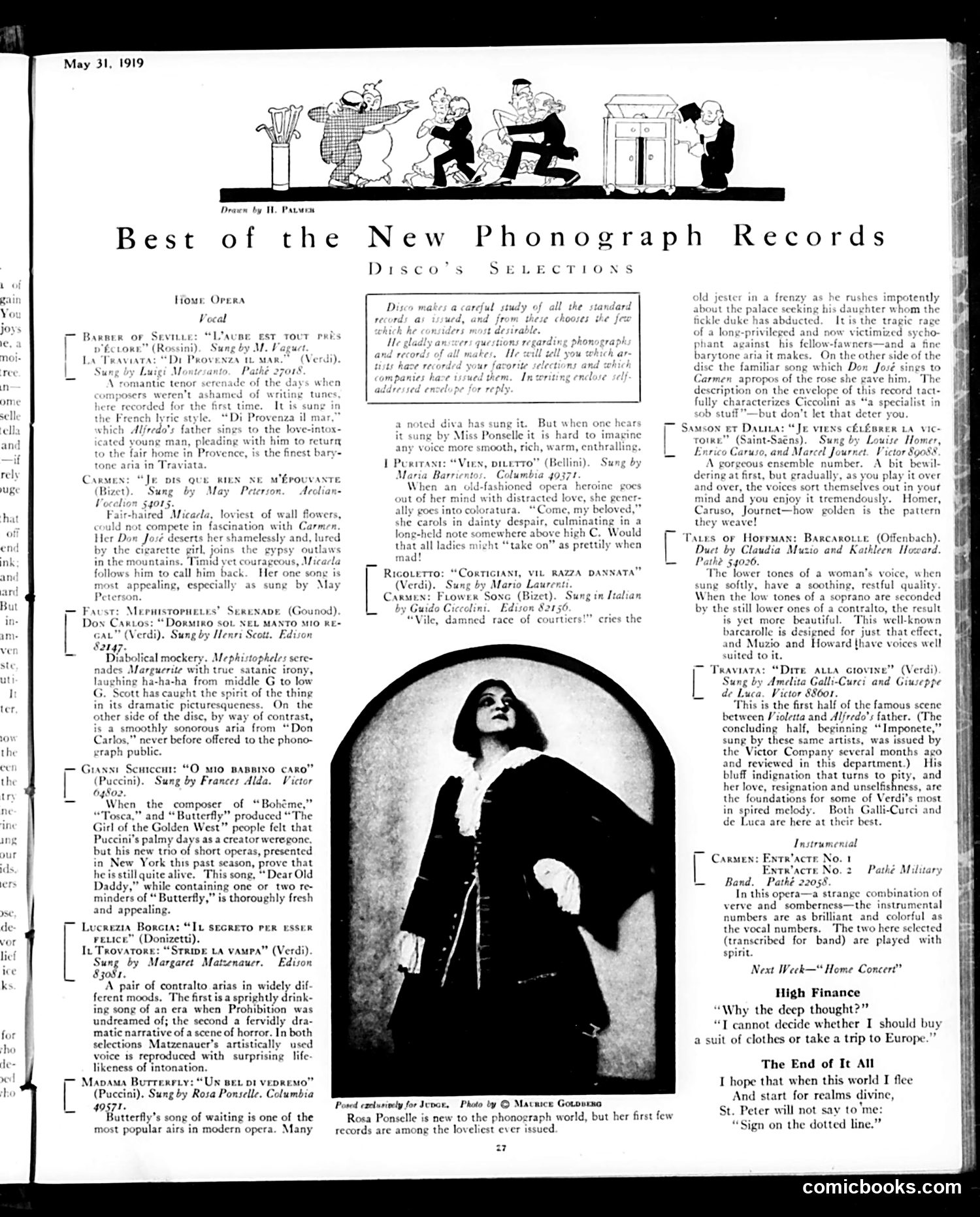
The header cartoon by H. Palmer depicts a humorous domestic scene in silhouette: a man appears to be fleeing from his wife (who waves a rolling pin or similar weapon), past children and furniture, toward what looks like a cabinet or safe. The joke plays on marital discord—the "new phonograph" (a recent luxury technology) appears to be either the cause of domestic strife or the man's attempted escape route. The remainder of the page is not a cartoon but rather **Disco Records' music review column** evaluating newly released phonograph recordings. It reviews operatic arias and scenes from famous operas (Carmen, Faust, Don Carlos, etc.), praising particular singers like Enrico Caruso and Rosa Ponselle. The column has no political content; it's straightforward entertainment criticism for wealthy readers who could afford phonographs and opera records—a marker of refined taste in 1919.
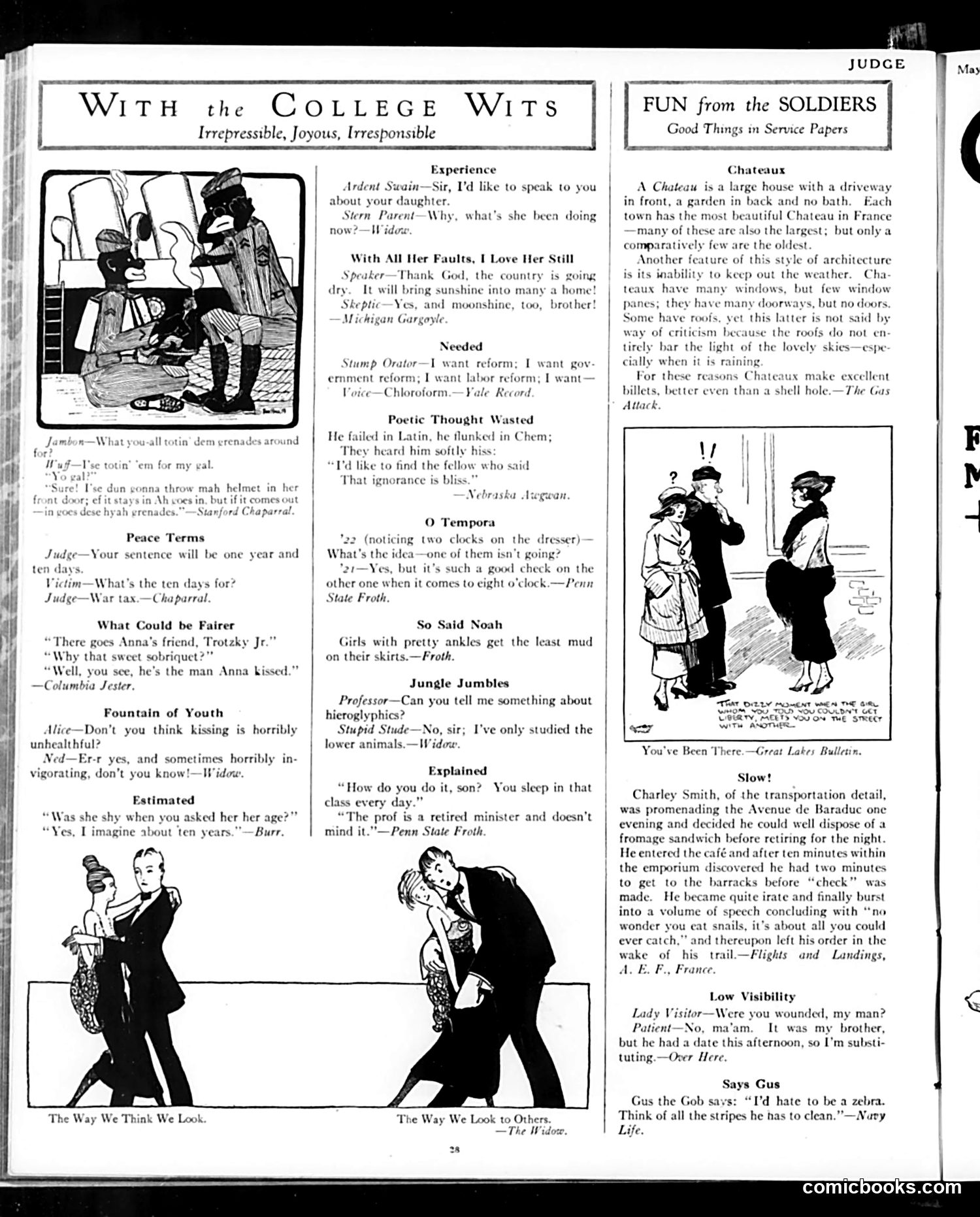
This page from Judge combines college humor and WWI soldier anecdotes. The left side features "College Wits"—jokes from university publications about courtship, prohibition, and Latin classes. The right side presents "Fun from the Soldiers"—military humor from service papers. Key content includes: **College jokes** mock romantic awkwardness, Prohibition's arrival ("moonshine, too, brother"), and academic failure. A reference to "Trotzky Jr." appears to allude to Leon Trotsky, though the specific context is unclear. **Soldier anecdotes** humorously depict life in France: a soldier's frustration at a slow French café, a substituting soldier claiming his wounded brother's furlough, and complaints about eating snails. **"Chateaux" educational section** explains French country houses—their beauty, poor weather-proofing, and suitability as military billets—reflecting soldiers' actual quartering experiences. The humor assumes readers familiar with both college life and current WWI realities, blending civilian and military perspectives for a American audience.
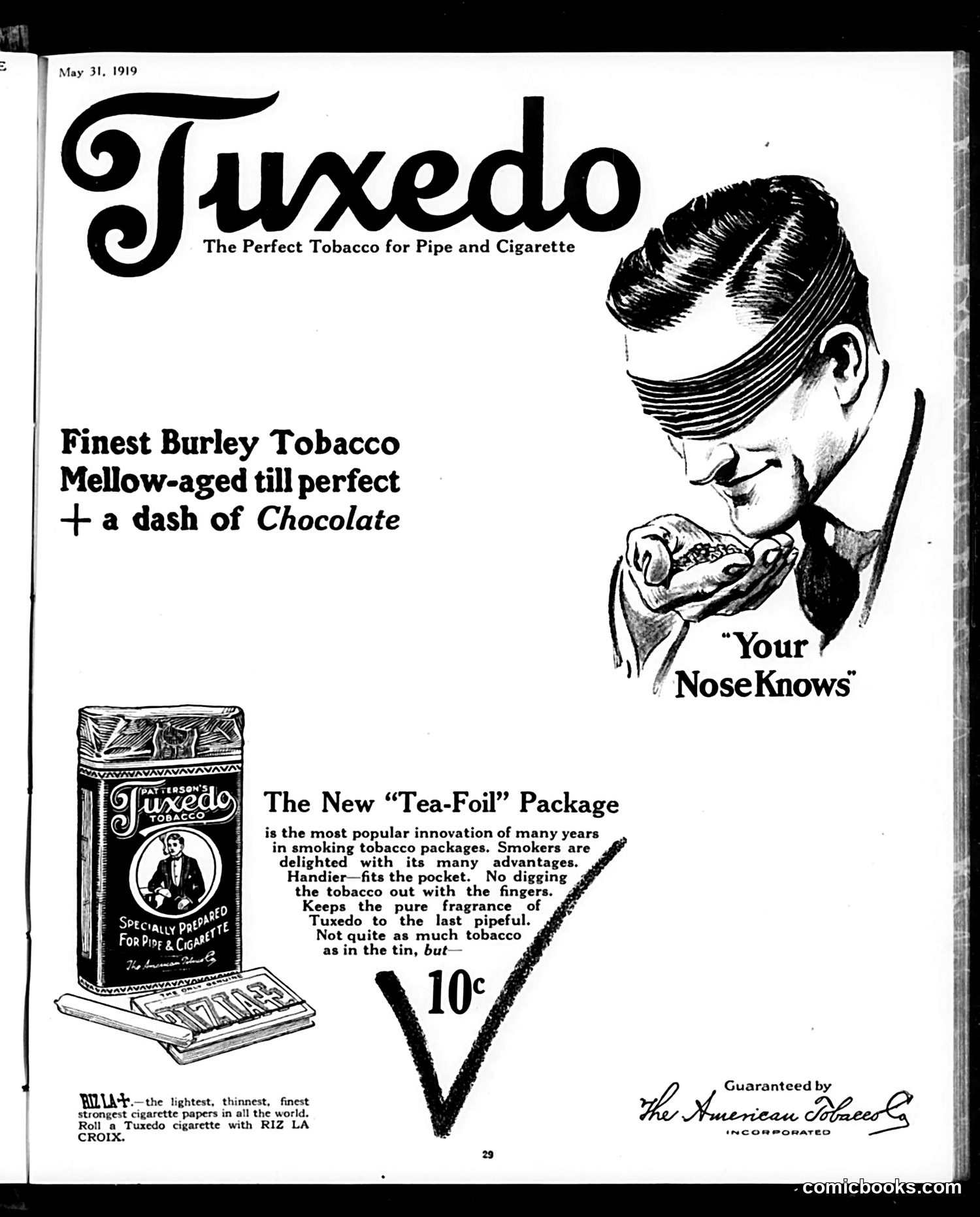
This is primarily a **tobacco advertisement**, not political satire or editorial cartoon. It dates to May 31, 1919. The page advertises "Tuxedo" brand tobacco, marketed as suitable for both pipes and cigarettes. The main visual shows a man with blindfold and "Your Nose Knows" tagline—a humorous appeal to sensory marketing, suggesting the product's quality is self-evident through smell alone. The advertisement highlights a new "Tea-Foil" package innovation (a foil wrapper for portability), priced at 10 cents. It emphasizes convenience and aroma preservation, though acknowledging slightly less tobacco than tin containers. There is **no political content or satire** on this page. The humor is purely commercial—a lighthearted sales pitch using the blindfold gimmick to suggest superior quality. The "Riz La Croix" cigarette paper mention indicates a premium positioning. This reflects early 20th-century tobacco marketing before health warnings, when such advertisements appeared regularly in mainstream publications like *Judge*.
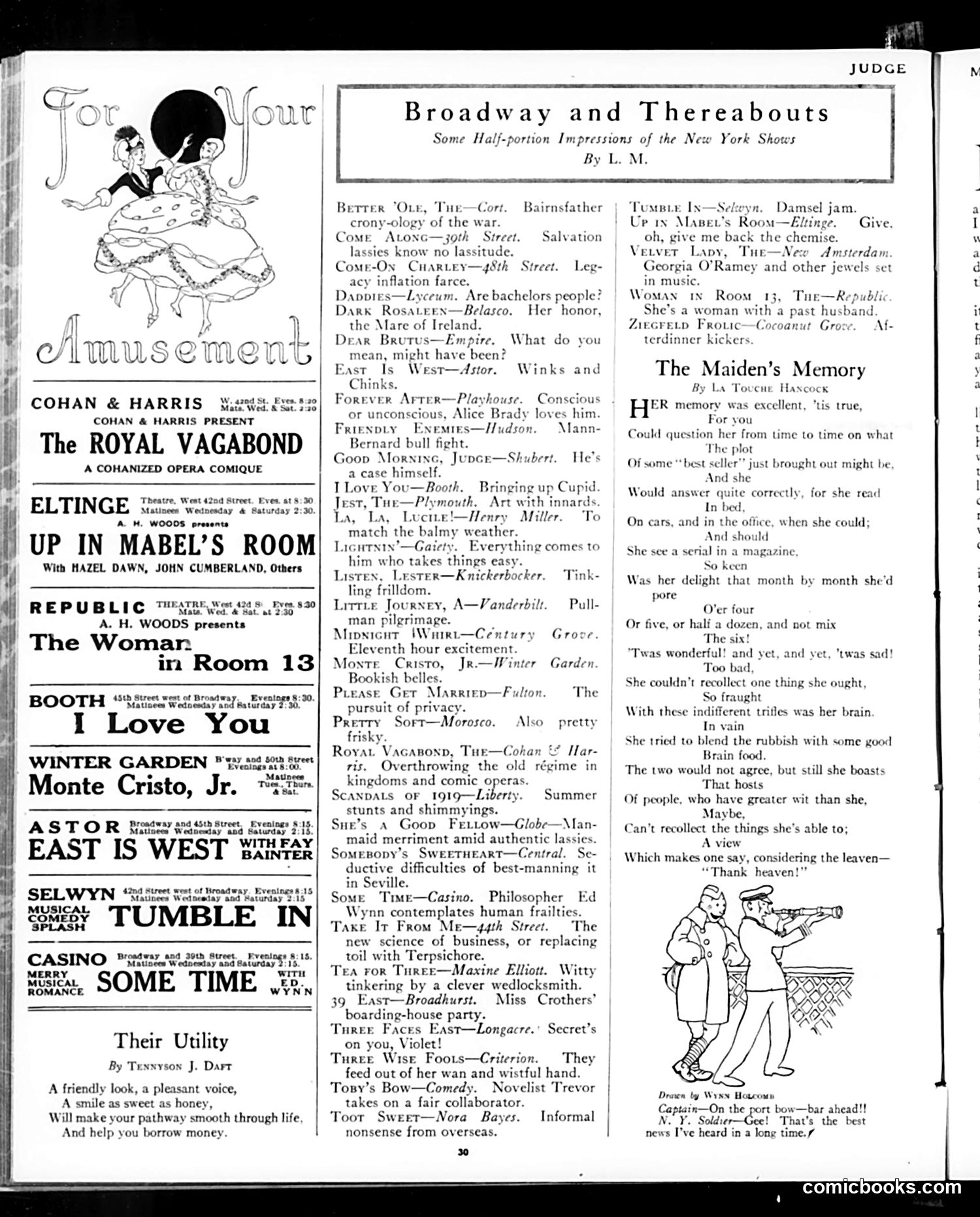
This page is primarily **Broadway theater advertising** with brief satirical show reviews by "L.M." The reviews use punny, dismissive one-liners about current New York productions—mocking plots, acting, and themes rather than targeting specific political figures. The small cartoon at bottom right (drawn by Winn Holcomb) shows two men with a telescope, captioned about "the best news I've heard in a long time"—likely satirizing wartime anxiety or gossip-mongering, though context is unclear. The poem "The Maiden's Memory" humorously portrays a woman obsessively reading serialized fiction across multiple venues (bed, streetcars, offices), celebrating her compulsive consumption of popular entertainment while ironically praising her "excellent" memory for frivolous plots. The page reflects 1910s-20s concerns: wartime references (Bairnsfather's "crony-ology of the war"), women's changing social roles, and mass culture's grip on leisure time.
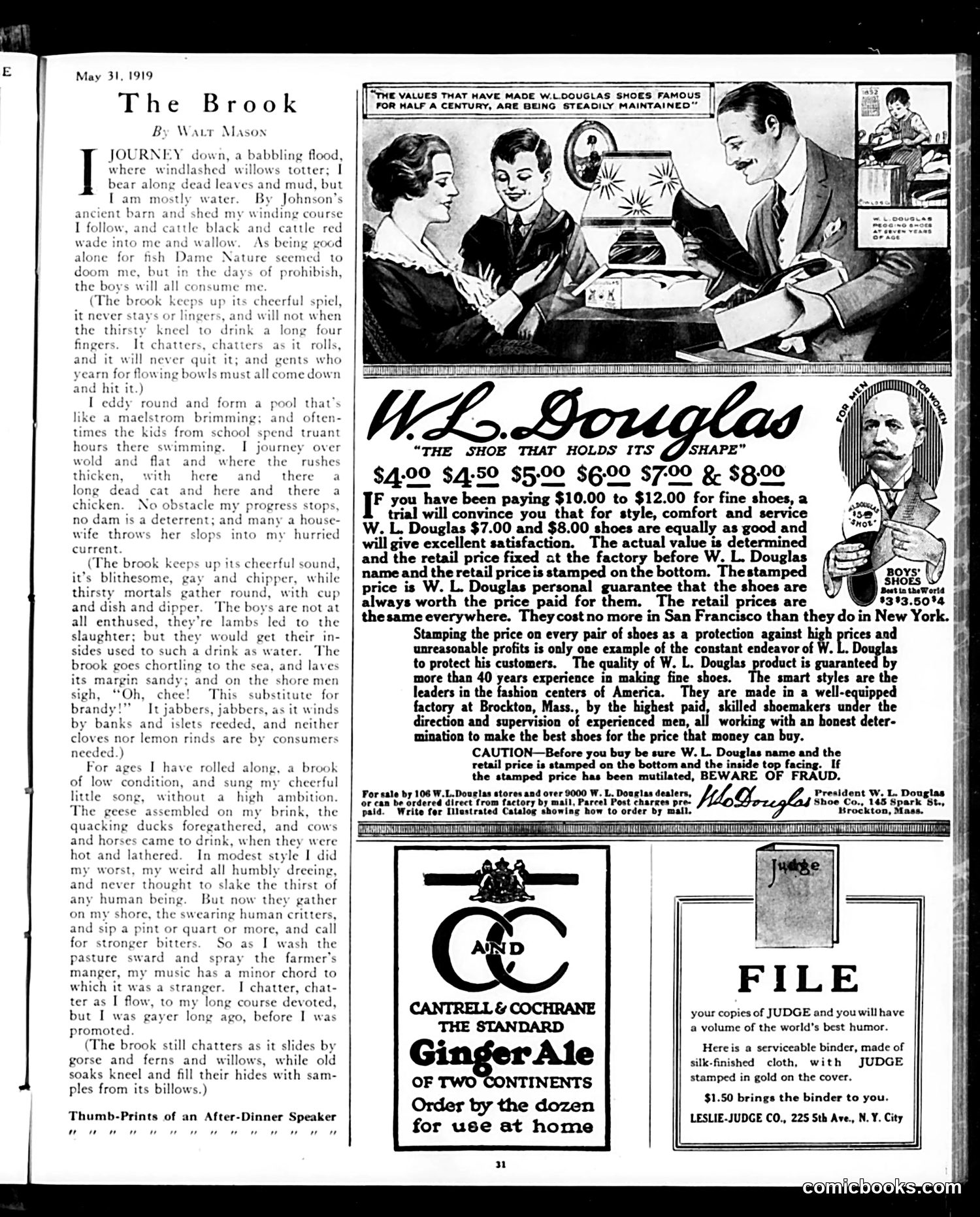
This poem uses an extended metaphor of a babbling brook to satirize **Prohibition**, which had just been enacted (the 18th Amendment passed in 1919). The brook personifies itself as lamenting its new fate: once it served animals and practical purposes, but now humans gather on its banks to drink from it as a substitute for alcohol, which is now illegal. The satire's point: Prohibition won't eliminate drinking—desperate people will resort to drinking literal brook water. The poem's melancholy ending ("I was gayer long ago, before I was promoted") suggests the brook misses its simpler pre-Prohibition existence, mocking the law's futility and the absurdity it creates. The page is primarily **advertising** (W.L. Douglas shoes dominate), typical of Judge's revenue model. The poem is the substantive editorial content.
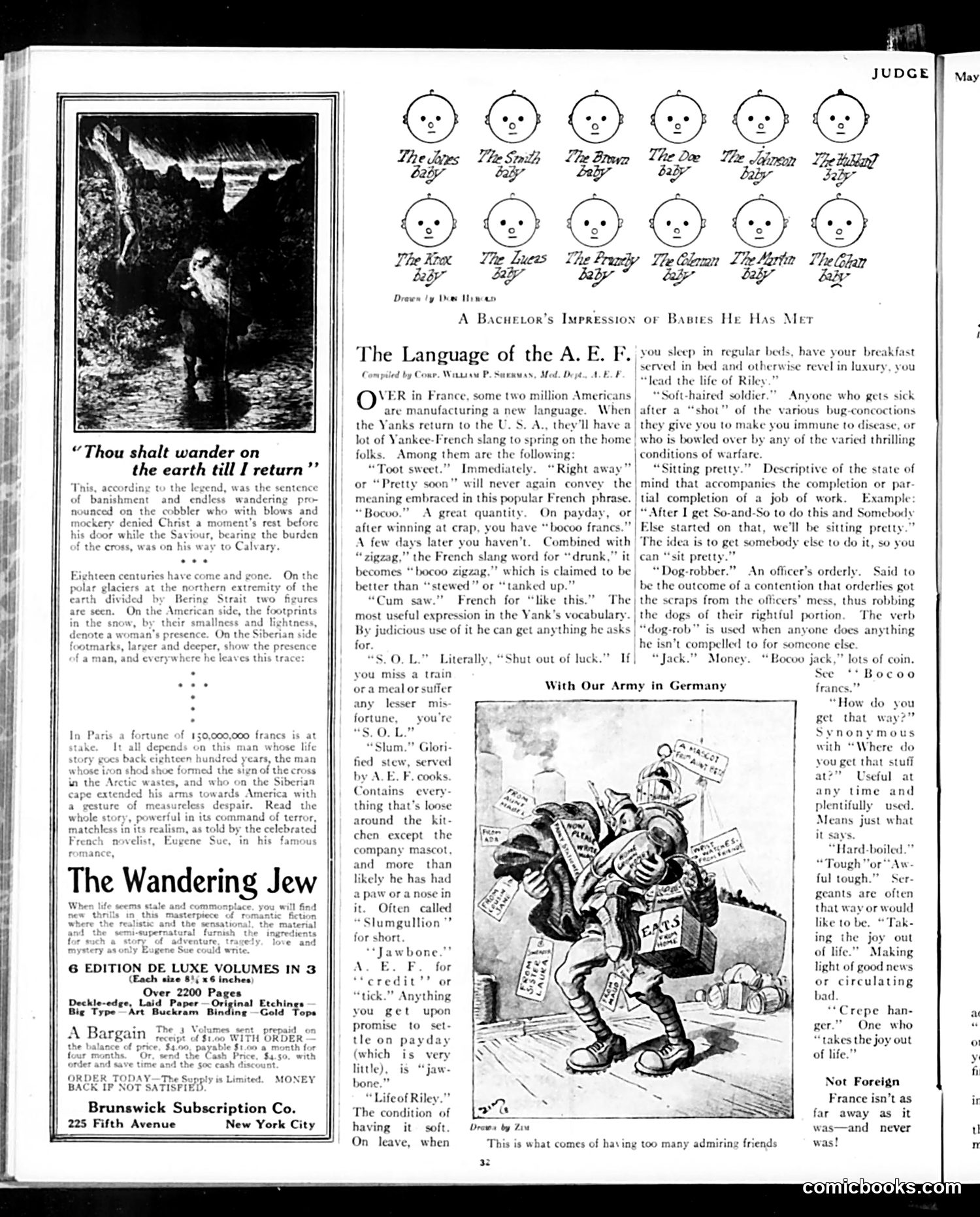
This page satirizes American soldiers returning from World War I France, who have adopted French military slang. The main article, "The Language of the A.E.F." (American Expeditionary Forces), compiles colorful soldier terms like "Bocoo" (lots), "S.O.L." (shut out of luck), and "Jawbone" (credit). The cartoon "With Our Army in Germany" depicts a soldier surrounded by admirers, illustrated as a caricatured figure labeled with various slang terms. The satire targets how American servicemen adopt and overuse French phrases upon returning home, creating an affected, pretentious manner. The broader joke: soldiers who spent time abroad adopt foreign mannerisms and vocabulary to appear worldly or sophisticated, becoming objects of both admiration and gentle ridicule among civilians. This reflects post-WWI culture shock and the gap between soldiers' wartime experiences and American domestic life.
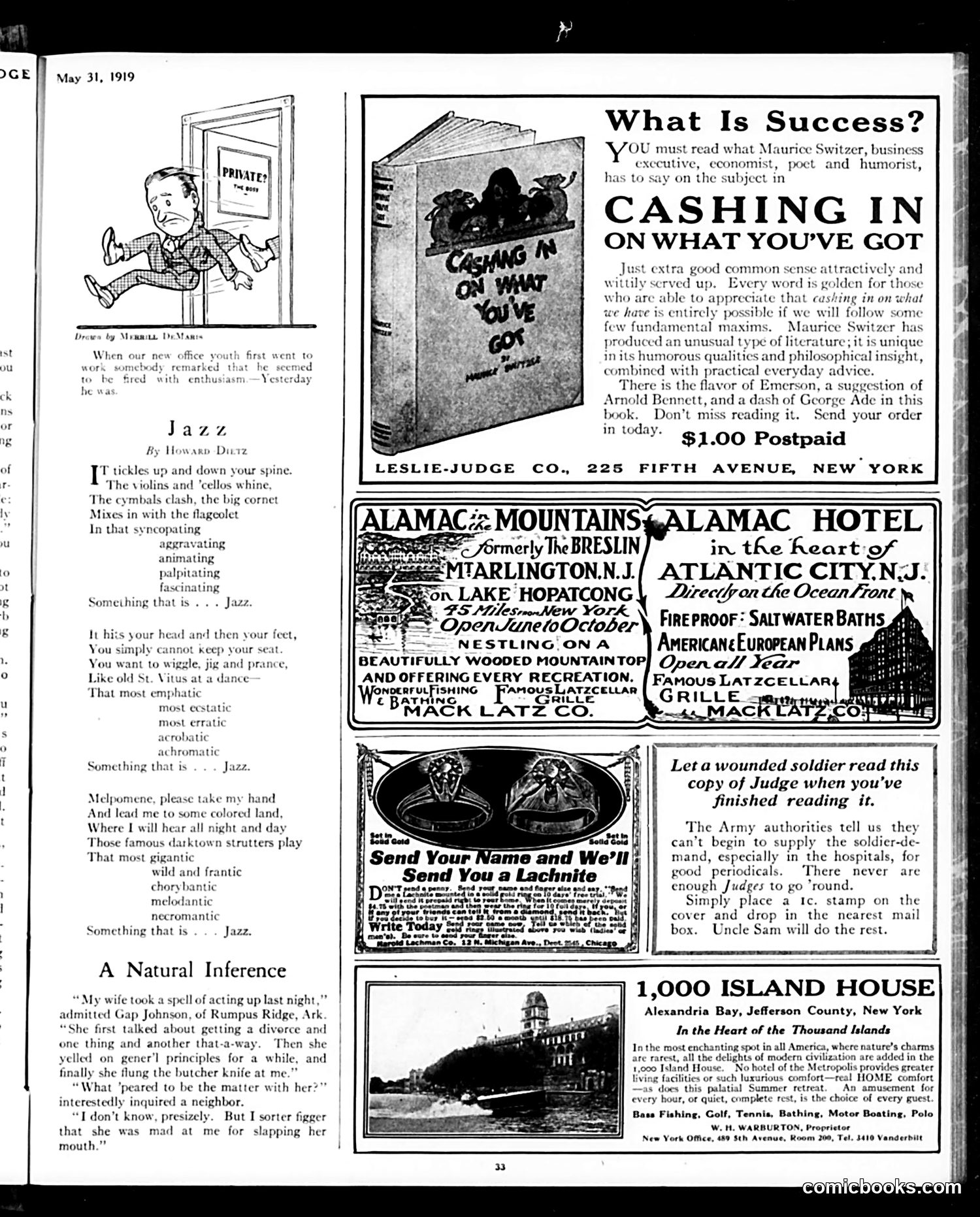
**The Cartoons and Content:** The page features minimal political satire. The small cartoon by Munne DeManes shows an office boy at a "Private" door—a mild joke about workplace hierarchy, not political commentary. **"Jazz" Poem:** Howard Dietz's poem celebrates Jazz music through rhythmic, onomatopoetic language ("tickles," "whine," "syncopating"). Notably, the final stanza references "colored land" and "darktown strutters play"—reflecting 1919's casual racial stereotyping. Jazz was still new and exotic to mainstream white audiences; the poem treats it as fashionable entertainment while simultaneously perpetuating the association of jazz with African American culture in mildly othering terms typical of the era. **"A Natural Inference":** A rural humor piece where Gap Johnson's wife throws a butcher knife at him after he slapped her mouth. The "joke" relies on domestic violence as comedic fodder—reflecting attitudes toward spousal punishment considered acceptable in 1919. **Remainder:** Mostly advertisements for books, hotels, and a public service announcement encouraging readers to donate Judge magazines to hospitalized soldiers.
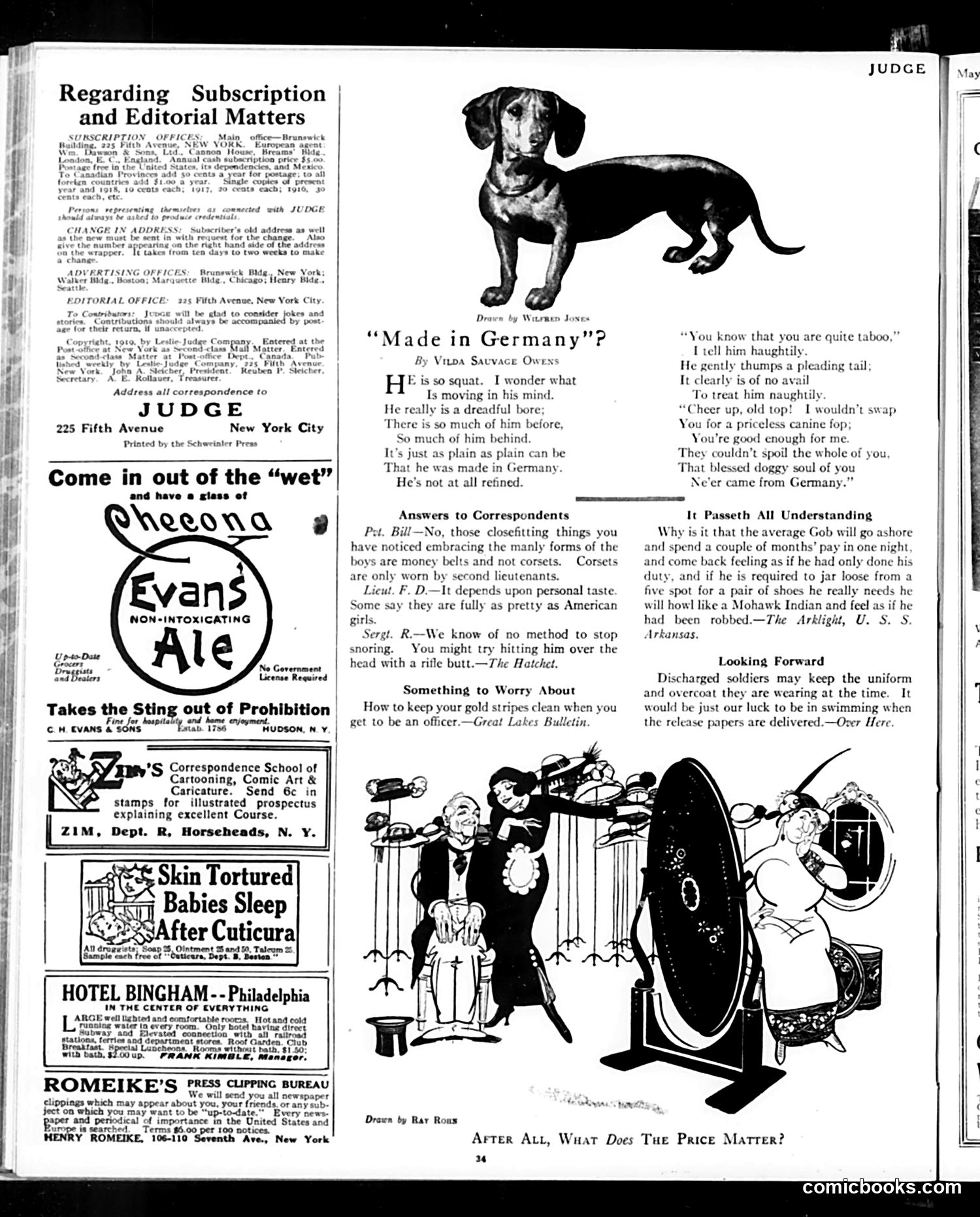
This page mixes editorial/advertising content with satirical humor targeting military life during WWI era (indicated by references to officers, enlisted men, and discharge procedures). **Main cartoon** ("Made in Germany"): A poem accompanying a dachshund illustration. The joke plays on anti-German sentiment of the period—the speaker insults the dog as "squat," "dreadful," and "made in Germany" / "not refined," yet ultimately accepts it anyway. This reflects contemporary prejudice against German-origin breeds, which faced suspicion during wartime. **Reader responses** parody military life: money belts mistaken for corsets, snoring remedies, maintaining dress uniforms. The humor targets the absurdities of military regulation and enlisted men's financial irresponsibility—a soldier splurges months' pay on shore leave but complains about spending on necessities. **"Looking Forward" cartoon** (Ray Haus): Shows discharged soldiers keeping uniforms, with the joke being the military's bad luck if soldiers are swimming when discharge papers arrive—a comment on post-war demobilization procedures. Overall, patriotic wartime satire mixed with practical complaints about military life.
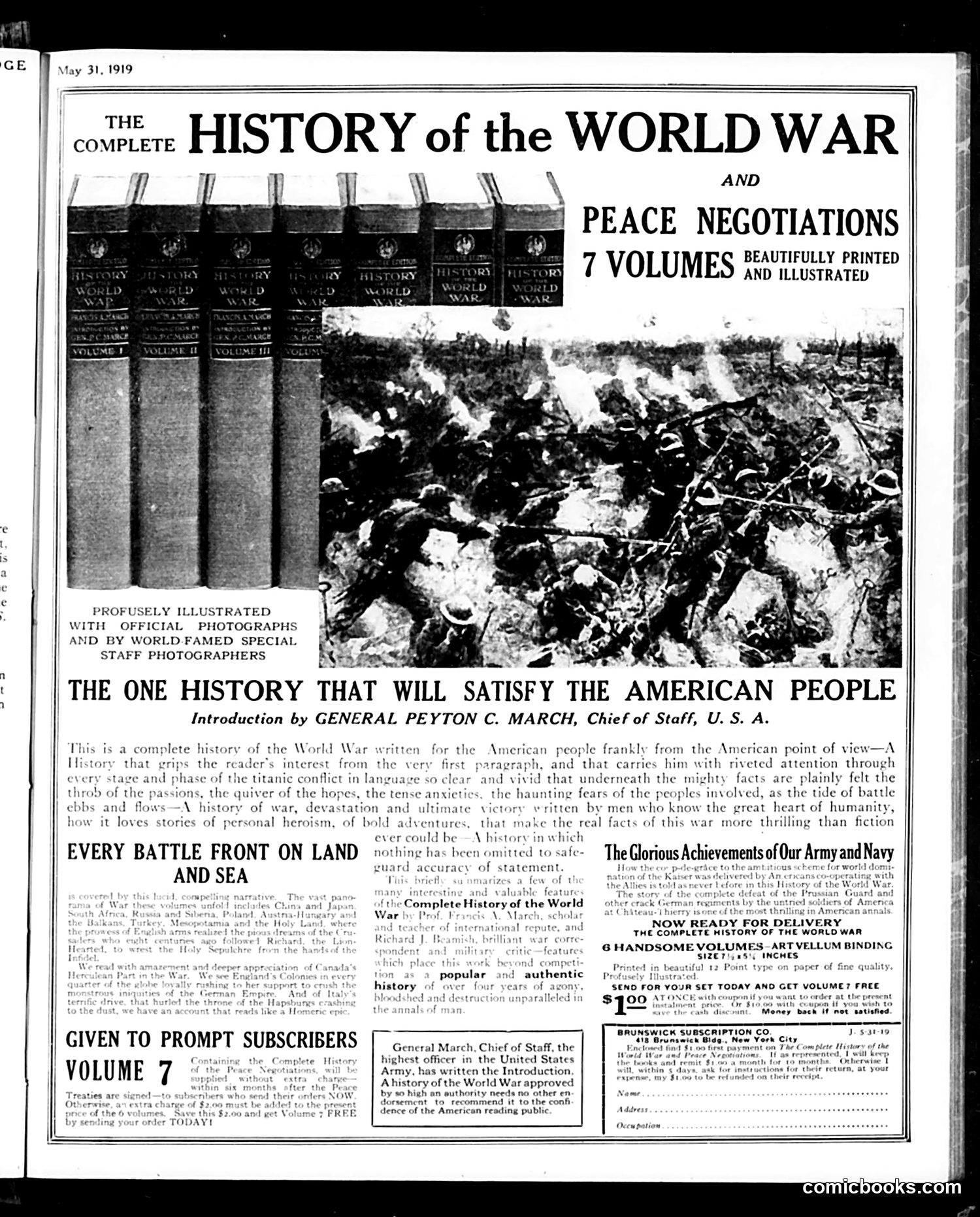
This is primarily a **magazine advertisement**, not a cartoon or satirical commentary. It's a full-page ad for a 7-volume subscription encyclopedia titled "The Complete History of the World War and Peace Negotiations," dated May 31, 1919—shortly after WWI's armistice. The ad markets the set as authoritative history "written for the American people frankly from the American point of view," emphasizing it covers "every battle front on land and sea" with official photographs. It features an endorsement from **General Peyton C. March**, Chief of Staff of the U.S. Army, lending military credibility. The dramatic battlefield photograph shows trench warfare devastation. The ad targets "prompt subscribers," offering Volume 7 free and promising delivery within days. There is **no satire here**—this is a straightforward commercial pitch capitalizing on post-war American interest in understanding the conflict they'd just participated in.

This is a **full-page advertisement**, not satire or political commentary. It promotes WDC Triangle Pipes manufactured by Wm. Demuth & Co. of New York. The ad emphasizes that Triangle Bakelite—a synthetic material—matches natural amber's appearance while surpassing it in durability, taste-neutrality, and fire-resistance. The copy stresses this as a scientific innovation: bakelite offers amber's "brilliant, rich and translucent" coloring without its drawbacks. The decorative left margin shows figures in period dress (likely early 20th century), appearing to represent craftsmen or laborers, suggesting manufacturing heritage and quality. Prices ranged from $1.00 for pipes upward, with cigar and cigarette holders at 35-50 cents—marketed as luxury items for "men who want something distinctive." This reflects the era when pipe smoking was common among middle and upper-class men, and bakelite represented cutting-edge consumer materials.