
Judge, 1919-05-31 · page 5 of 36
Judge — May 31, 1919 — page 5: what you’re looking at
What you’re looking at
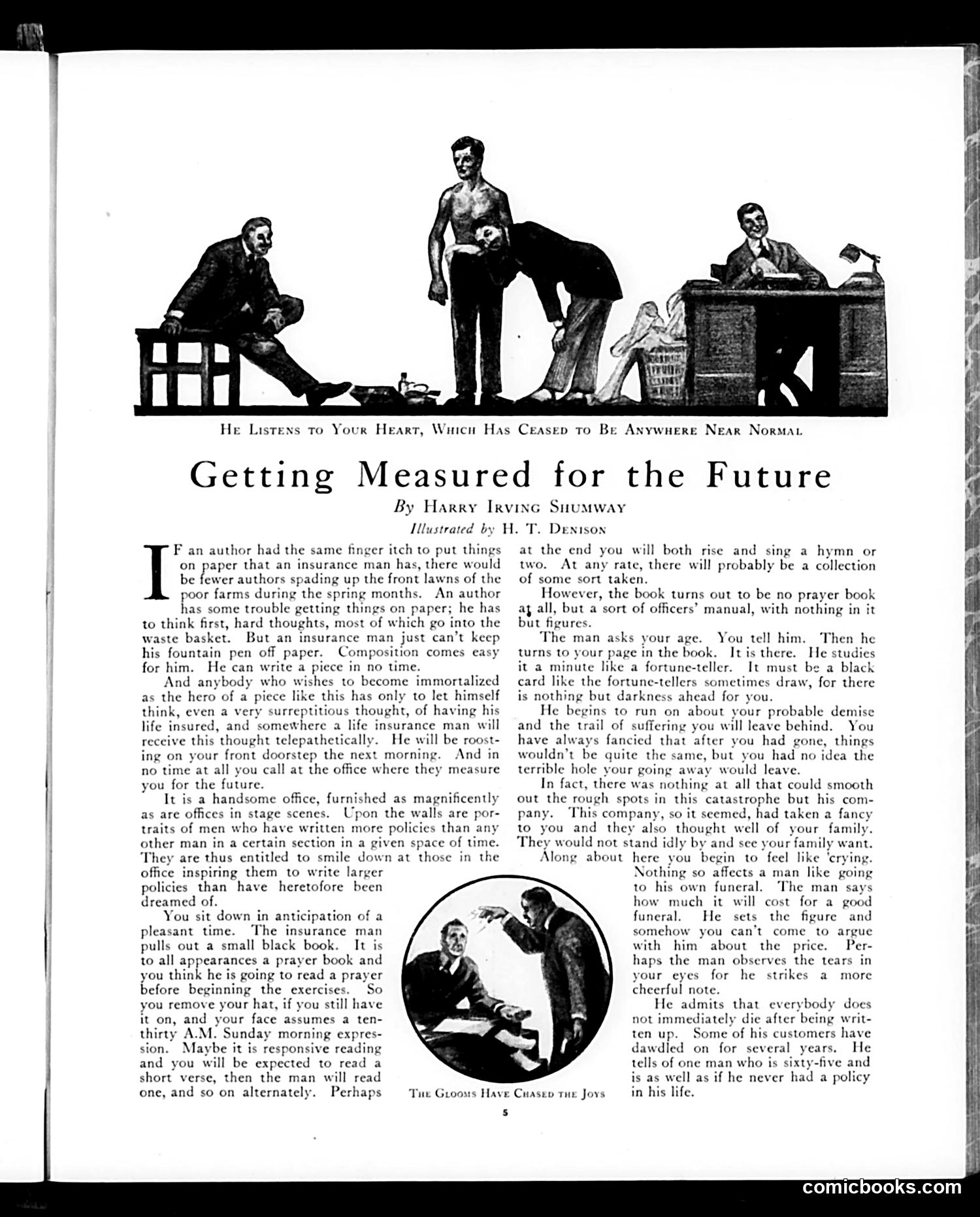
This satirical story by Harry Irving Shumway mocks life insurance salesmen and their sales tactics. The illustration at top shows a man undergoing various medical measurements and examinations—the "measuring" for an insurance policy. The satire targets how insurance companies use actuarial data and medical examinations to predict customers' lifespans and profitability. The story describes the absurd, invasive nature of the process: the salesman extracts personal details, calculates probable death, discusses funeral costs—presenting it all with cheerful indifference to the customer's existential dread. The joke centers on the insurance industry's cold, mechanical approach to human mortality, treating death as mere spreadsheet calculation rather than acknowledging its emotional reality.
📄 Transcribed text from this page (OCR, searchable)
Machine-transcribed from the original scan — historical spelling and the odd misread are preserved.
He Listens to Your Heart, Wuicn Has Ceaseo to Be Anywuere Near Normar Getting Measured for the Future By Harry Irvine Suumway Illustrated by F an author had the same finger itch to put things on paper that an insurance man has, there would be Eogce authors spading up the front lawns of the poor farms during the spring months. An author has some trouble getting things on paper; he has to think first, hard thoughts, most of which go into the waste basket. But an insurance man just can’t keep his fountain pen off paper. Composition comes easy for him. He can write a piece in no time. And anybody who wishes to become immortalized as the hero of a piece like this has only to let himself think, even a very surreptitious thought, of having his life insured, and somewhere a life insurance man will receive this thought telepathetically. He will be roost- ing on your front doorstep the next morning. And in no time at all you call at the office where they measure you for the future. It is a handsome office, furnished as magnificently as are offices in stage scenes. Upon the walls are por- traits of men who have written more policies than any other man in a certain section in a given space of time. They are thus entitled to smile down at those in the office inspiring them to write larger policies than have heretofore been dreamed of. You sit down in anticipation of a pleasant time. The insurance man pulls out a small black book. It is to all appearances a prayer book and you think he is going to read a prayer before beginning the exercises. So you remove your hat, if you still have it on, and your face assumes a ten- thirty A.M. Sunday morning expres- sion. Maybe it is responsive reading and you will be expected to read a short verse, then the man will read one, and so on alternately. Perhaps H. Tue Grooms Have Cuasen tHe Joys s T. Denison at the end you will both rise and sing a hymn or two. At any rate, there will probably be a collection of some sort taken. However, the book turns out to be no prayer book ag all, but a sort of officers’ manual, with nothing in it but figures. The man asks your age. You tell him. turns to your page in the book. It is there. He studies it a minute like a fortune-teller. It must be a black card like the fortune-tellers sometimes draw, for there is nothing but darkness ahead for you. He begins to run on about your probable demise and the trail of suffering you will leave behind. You have always fancied that after you had gone, things wouldn't be quite the same, but you had no idea the terrible hole your going away would leave. In , there was nothing at all that could smooth out the rough spots in this catastrophe but his com- pany. This company, so it seemed, had taken a fancy to you and they also thought well of your family. They would not stand idly by and see your family want. Along about here you begin to feel like ‘crying. Nothing so affects a man like going to his own funeral. The man says Then he how much it will cost for a good funeral. He sets the figure and somehow you can’t come to argue with him about the price. Per- haps the man observes the tears in your eyes for he strikes a more cheerful note. He admits that everybody does not immediately die after being writ- ten up. Some of his customers have dawdled on for several years. He tells of one man who is sixty-five and is as well as if he never had a policy in his life. comicbooks.com