
Judge, 1919-05-31 · page 22 of 36
Judge — May 31, 1919 — page 22: what you’re looking at
What you’re looking at
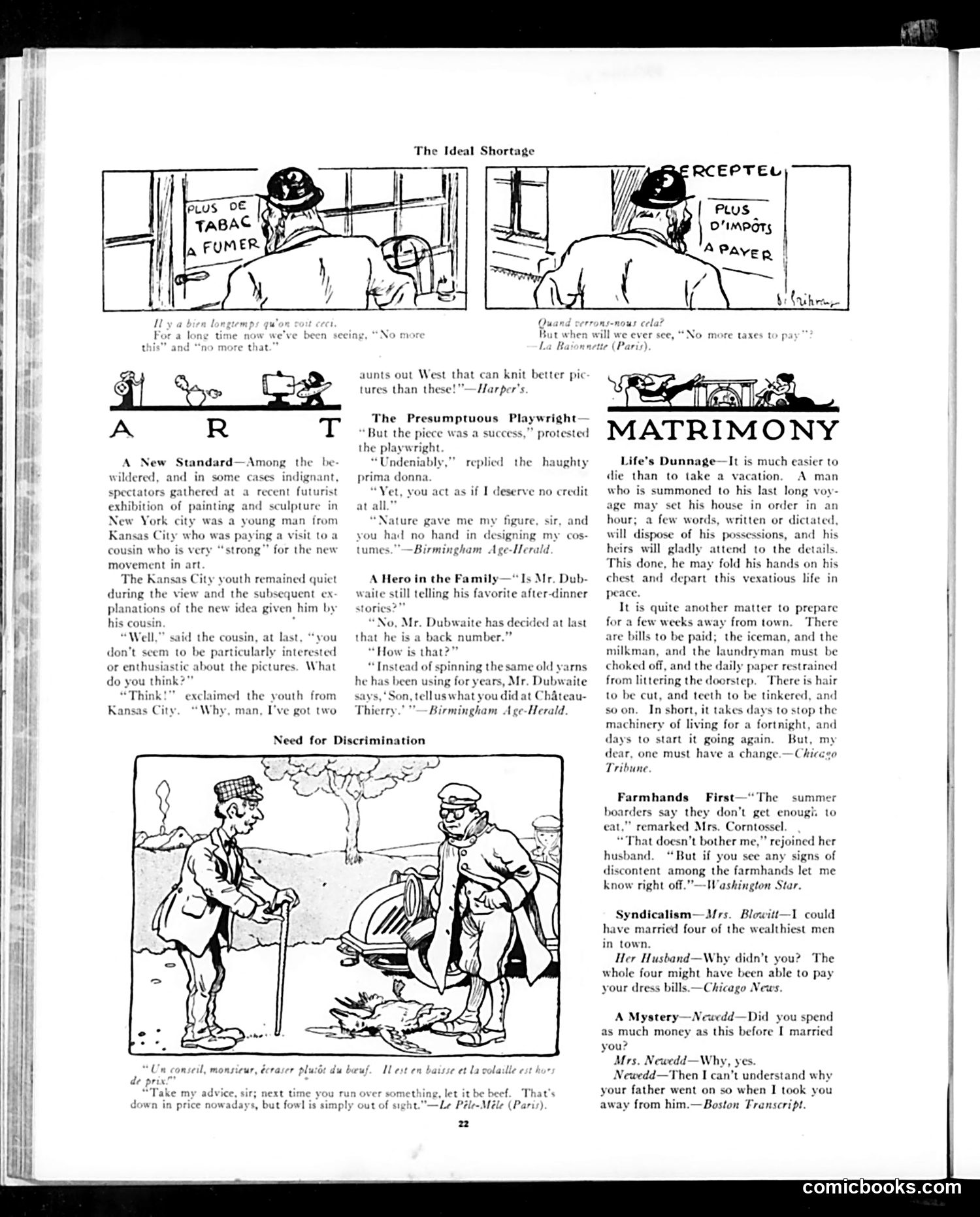
This Judge page collects brief humorous sketches mocking early 20th-century social attitudes. The title cartoon jokes that a Kansas City visitor finds Futurist art so incomprehensible that his aunts' knitting looks superior—satirizing both avant-garde pretension and provincial skepticism toward modernism. Other sketches target: a prima donna's vanity (crediting her success to nature, not the playwright); an elderly man reduced to recycling WWI anecdotes; and conjugal complaints about household management and marriage expenses. The "Need for Discrimination" cartoon (French caption unclear in OCR) appears to contrast city and rural perspectives, though its specific point is difficult to extract. The humor throughout reflects period anxieties: generational conflict over "new" art movements, class consciousness, and domestic/marital tensions. These are topical satires accessible primarily to Judge's educated, urban readership of the 1920s.
📄 Transcribed text from this page (OCR, searchable)
Machine-transcribed from the original scan — historical spelling and the odd misread are preserved.
A New Standard—Among the be wildered, and in some cases indignant, spectators gathered at a recent futurist exhibition of painting and sculpture in New York city was a young man from Kansas City who was paying a visit to a cousin who is very “strong” for the new movement in art The Kansas City youth remained quiet during the view and the subsequent ex planations of the new idea given him by his cousin “Well,” said the cousin, at last, n't seem to be particularly interested or enthusiastic about the pictures. What do you think?” “Think!” exclaimed the youth from Kansas City. “Why, man, I've got two ‘you The Ideal Shortage aunts out West that can knit better pic "—Harper's tures than these! The Presumptuous Playwright “But the piece was a success,” protested the playwright “Undeniably,”” prima donna “Yet, you act as if I deserve no credit at all.” “Nature gave me my figure, sir, and you had no hand in designing my cos- Birmingham Age-Herald. replied the haughty tumes.”” A Hero in the Family—" Is Mr. Dub- waite still telling his favorite after-dinner ies “No, Mr. Dubwaite has decided at last that he is a back number.” “How is that?” “Instead of spinning the same old yarns years, Mr. Dubwaite he has been using says, ‘Son, tellus what you did at Chateau- Thierry.’ "—Birmingham Age-Herald. Need for Discrimination cil, monsieur, écra. 1° plucot du beus, MATRIMONY Life's Dunnage—It is much easier to die than to take a vacation. A man who is summoned to his last long voy- age may set his house in order in an hour; a few words, written or dictated, will dispose of his possessions, and his heirs will gladly attend to the details. This done, he may fold his hands on his chest and depart this vexatious life in peace. It is qui nother matter to prepare for a few weeks away from town. There are bills to be paid; the iceman, and the milkman, and the laundryman must be choked off, and the daily paper restrained from littering the doorstep. There is hair to be cut, and teeth to be tinkered, and soon. In short, it takes days to stop the machinery of living for a fortnight, and ays to start it going again. But, my dear, one must have a change.—Chicczo Tribune Farmhands — First—“ The boarders say they don’t get enough to remarked Mrs. Corntossel. That doesn’t bother me,” rejoined her husband. “But if you see any signs of discontent among the farmhands let me know right off." —Washington Star. summer Syndicalism—Mrs. Blowitt—1 could have married four of the wealthiest men in town. Her Husband—Why didn’t you? The whole four might have been able to pay your dress bills. —Chicago News. A Mystery—Newedd—Did you spend as much money as this before I married you? Mrs. Newedd—Why, yes. Newedd—Then I can’t understand why your father went on so when I took you away from him.—Boston Transcript. comicbooks.com