
Judge, 1919-05-31 · page 27 of 36
Judge — May 31, 1919 — page 27: what you’re looking at
What you’re looking at
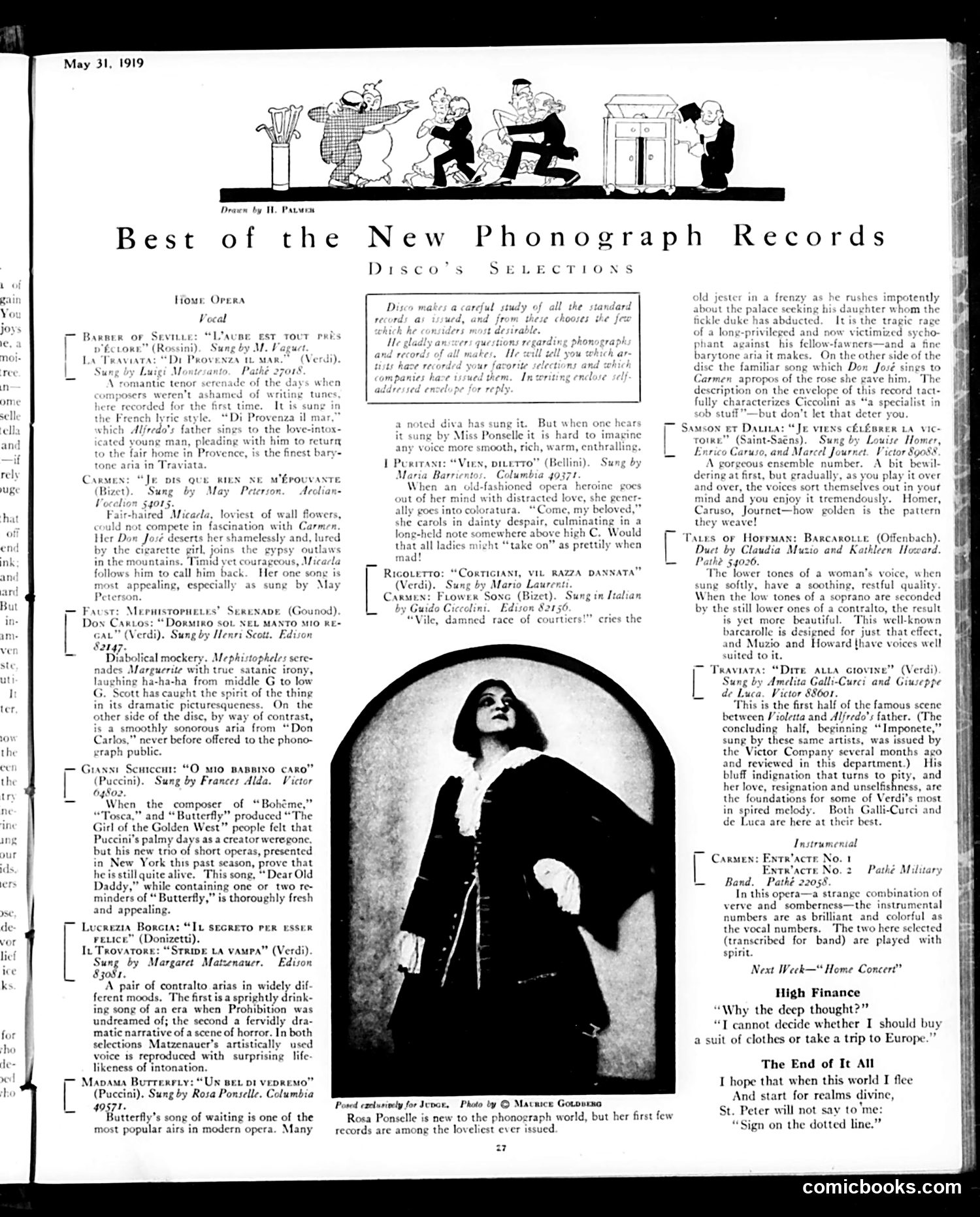
The header cartoon by H. Palmer depicts a humorous domestic scene in silhouette: a man appears to be fleeing from his wife (who waves a rolling pin or similar weapon), past children and furniture, toward what looks like a cabinet or safe. The joke plays on marital discord—the "new phonograph" (a recent luxury technology) appears to be either the cause of domestic strife or the man's attempted escape route. The remainder of the page is not a cartoon but rather **Disco Records' music review column** evaluating newly released phonograph recordings. It reviews operatic arias and scenes from famous operas (Carmen, Faust, Don Carlos, etc.), praising particular singers like Enrico Caruso and Rosa Ponselle. The column has no political content; it's straightforward entertainment criticism for wealthy readers who could afford phonographs and opera records—a marker of refined taste in 1919.
📄 Transcribed text from this page (OCR, searchable)
Machine-transcribed from the original scan — historical spelling and the odd misread are preserved.
Drawn by WH. Pauses Best of the New Phonograph Records Hiowe Orera Vo Barner or Sevitwe f xe’ (Rossini) ata: “Di Pr Luigi M antic U ne love him to e fir RIEN NE M'EPOUVANTE. 54015 aired Mica amelessly an the gyp: us, Micaela slows him to call him back. Her one song is t appealing, especially a g by May — Faust: Merntstorneces’ Serenave ( d) Dow Caktos: Dorstino SOL NEL MANTO MIO KE- cab” (V Sung by Henri Scots. Edi 47. Diabolical moc! opheles sere nades Marguerite with true satanic irony, ing ha. a fr middle ‘0 low rit of the thing in its dra ueness. On the ther side of the disc, by of contrast, a smoothly sonorous aria from “Don >s,"" never before offered to the phono- public. danni Scutcemt: “O ato BABBINO CARO” (Puccini). Sung by Frances Alda. Victor h the composer of “Bc d ‘osca,” and “Butterfly” produ The irl of the Golden West” people felt that Puccini's palmy days as a creator weregone. but his new tno of short operas, presented in New York this past season, prove that heis still quite alive. This song, “Dear Old Daddy,” while containing one or two re- minders of “Butterfly,” is thoroughly fresh and appealing. — Lucrezta Borcta: “IL secreto Per Esser reuice” (Donizetti). It Trovatore: “Stripe La vasa” (Verdi) Sung Margaret Matzenauer. Edison 83081. A pair of contralto arias in widely dif ferent moods. The first isa sprightly drink- ing song of an era when Prohibition was undreamed of; the second a fervidly dra- matic narrative of a scene of horror. In both selections Matzenauer’s artistically used voice is reproduced with surprising life likeness of intonation. [7 Mapasta Butrerriy: “Us pet pt vepremo” (Puccini). Sung by Rosa Ponselle. Columbia 49571. Butterfly’s song of waiting is one of the most popular airs in modern opera. Many Disco’s SELECTIONS Posed exclusively for Seve Rosa Ponselle is new to the phonograph world, but her first few records are among the loveliest ever issued. C. Would tily when te somewhere t all ladies might “take mad! RicoLetto: “COoRTIGIANI, VIL RAZZA DANNATA™ (Verdi). Sung by Mario Laurenti ng in It Frowek Sone (Bizet) n 82156. Photo by © Macuice Gotpurna 27 Id j ' s impotently abou pala gh Hi whom the of a long Carmen apropos of th e she The descripti s record tact fully chara “a specialist in Samson et Datina: “Je viens CELEBRER LA vic- rorwe” (Saint-Saéns). Sung by Louise Homer, Enrico Caruso, and Marcel Journet. Victor 89088 A gorgeous en A bit bev dering i over, t ind and you enjoy it tre ‘aruso, Journet—how they weave! vices sort the ¢ pattern Tates or Horraa Duct by Claudia } 6. The lower tones of a wor ¢ softly, have a soothing, restful quality en the low tones of a soprano are seconded by the still lower ones of a contralto, the result is yet more beautiful. This well-known barcarolle is designed for just that effect, and Muzio and Howard {have voices well suited to it. Barcanottt (Offenbach). s voice, when Traviata: “Dire Auta ctovixe” (Verdi) Sung by Amelita Galli-Curci and Giuseppe Victor 88601. ‘This is the first half of the famous scene between Vi Alfredo’s father. (The concluding half, beginning “Imponete,” sung by these same artists, was issued by the Victor Company several months ago and reviewed in this department.) His uff indignation that turns to pity, and her love, resignation and unselfishnows, are the foundations for some of Verdi's most in spired melody. Be Curci and de Luca are her Instrum Canaten: Extr’actr: No. 1 Entx’actr: No. 2 Band. Pathé 22058 In this opera—a strange combination of verve and somberness—the instrumental numbers are as brilliant and colorful as the vocal numbers. he two here selected (transcribed for band) are played with spirit. Next Week—“ Home Concert” Pathé Milit High Finance “Why the deep thought?” “T cannot decide whether I should buy a suit of clothes or take a trip to Europe.”” The End of It All I hope that when this world I flee And start for realms divine, St. Peter will not say to'me: “Sign on the dotted line.” comicbooks.com