
A complete issue · 36 pages · 1919
Judge — April 12, 1919
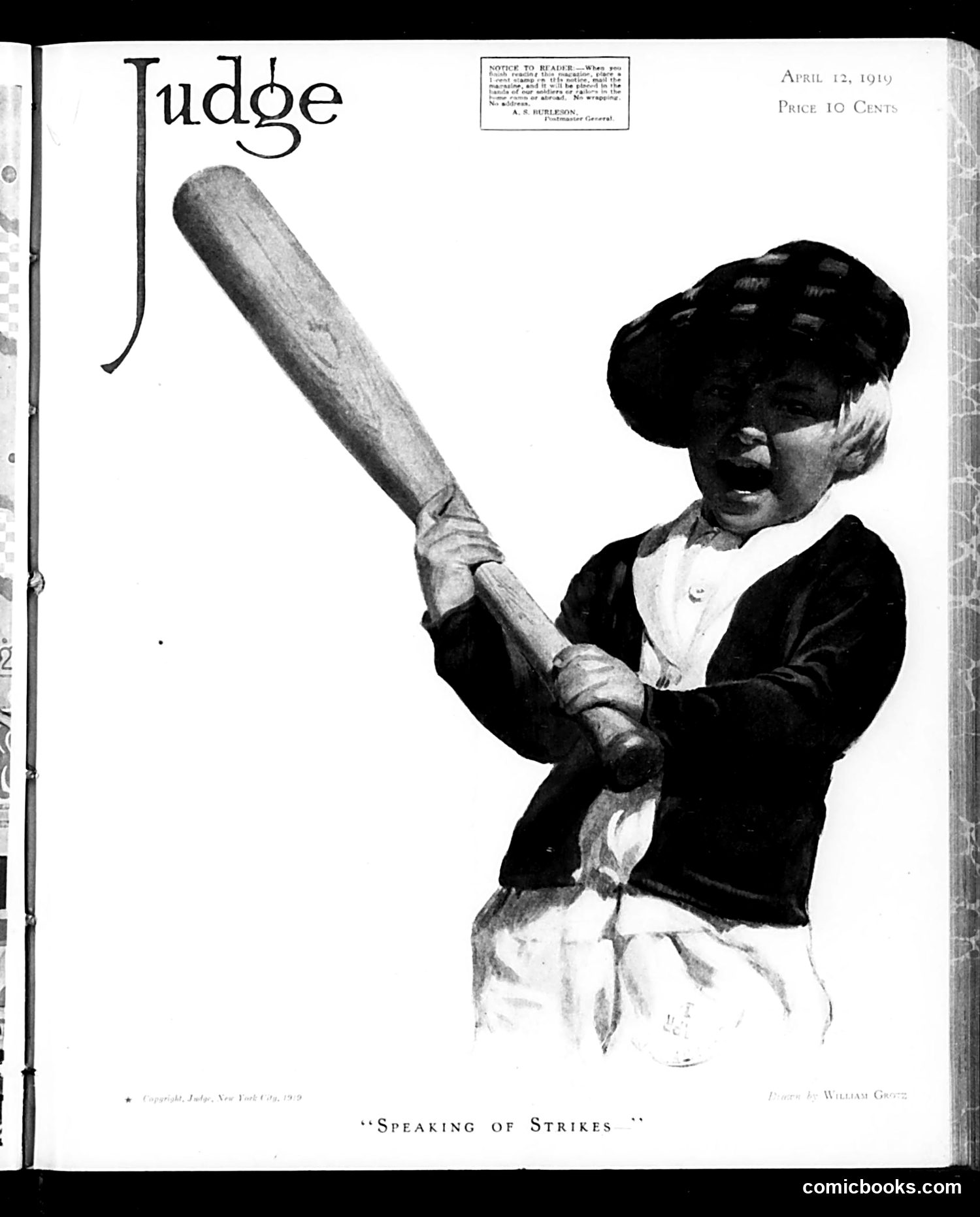
This cartoon satirizes labor strikes through a figure wielding a baseball bat labeled "Judge." The title "Speaking of Strikes" creates a visual pun—conflating baseball strikes with labor strikes, which were a major social issue in 1919. The figure, dressed in formal attire with a cap, appears to represent either a strikebreaker, authority figure, or judge (playing on the magazine's name) responding to labor unrest. The aggressive bat-wielding pose suggests either defending against strikes or using force to suppress them. The 1919 date is significant: this was the year of major American labor upheaval, including the Seattle General Strike and steel strikes. The cartoon likely critiques either labor activism or the violent suppression of workers' demands, depending on Judge magazine's editorial stance.
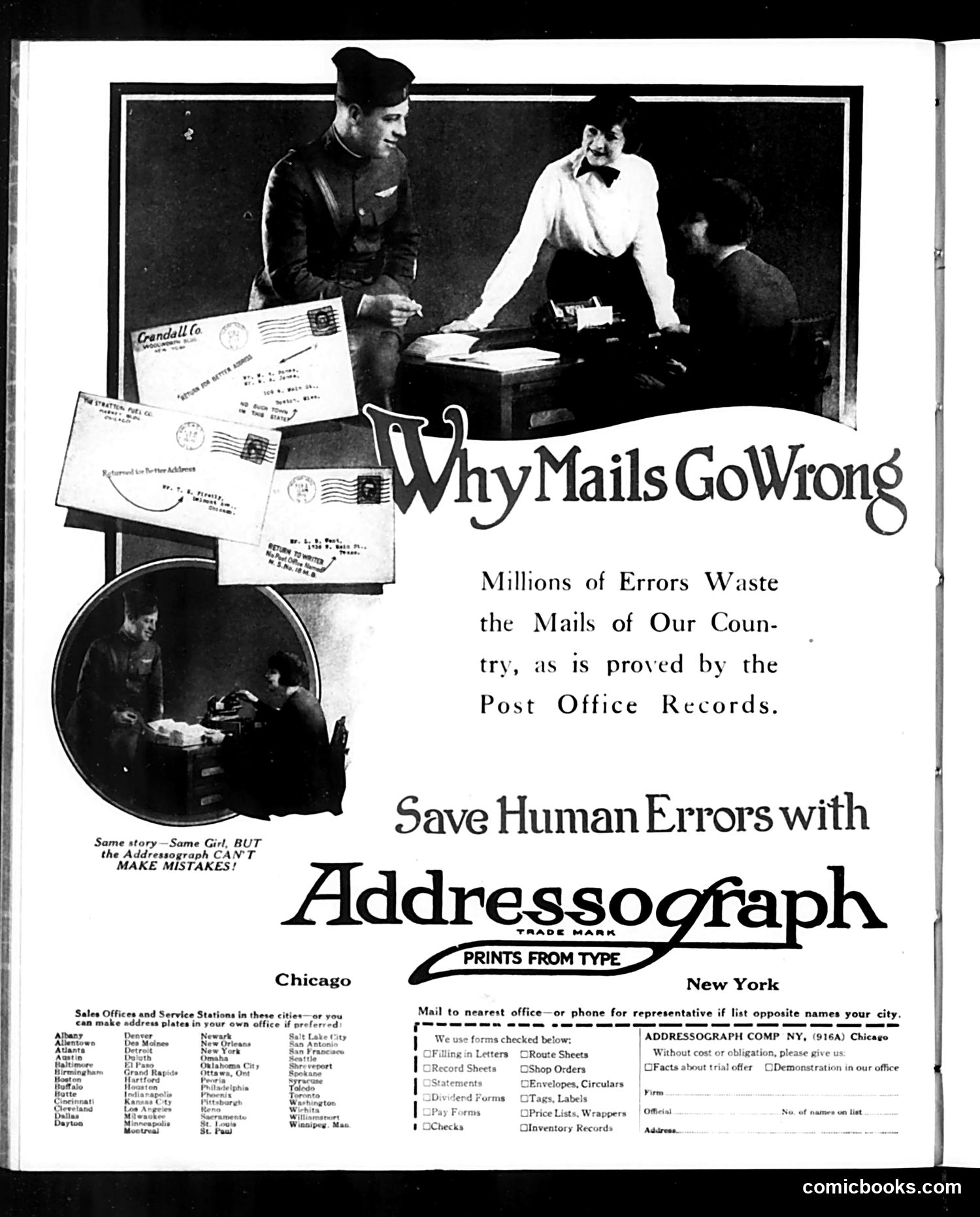
This is primarily a **commercial advertisement**, not political satire. The "Addressograph" company is marketing an addressing machine that automatically prints addresses on envelopes. The advertisement's premise is that human mail sorters make millions of errors, wasting postal resources. The images show postal workers processing mail and a woman at a desk—illustrating the problem of manual address-writing mistakes. The satirical angle is subtle: the headline "Why Mails Go Wrong" and caption "Some story—Some Girl, BUT the Addressograph CAN'T MAKE MISTAKES" humorously blame human error (particularly suggesting women workers are unreliable) while promoting the machine as infallible. This reflects early 20th-century attitudes toward automation and gender in the workplace, positioning machines as more dependable than human employees.
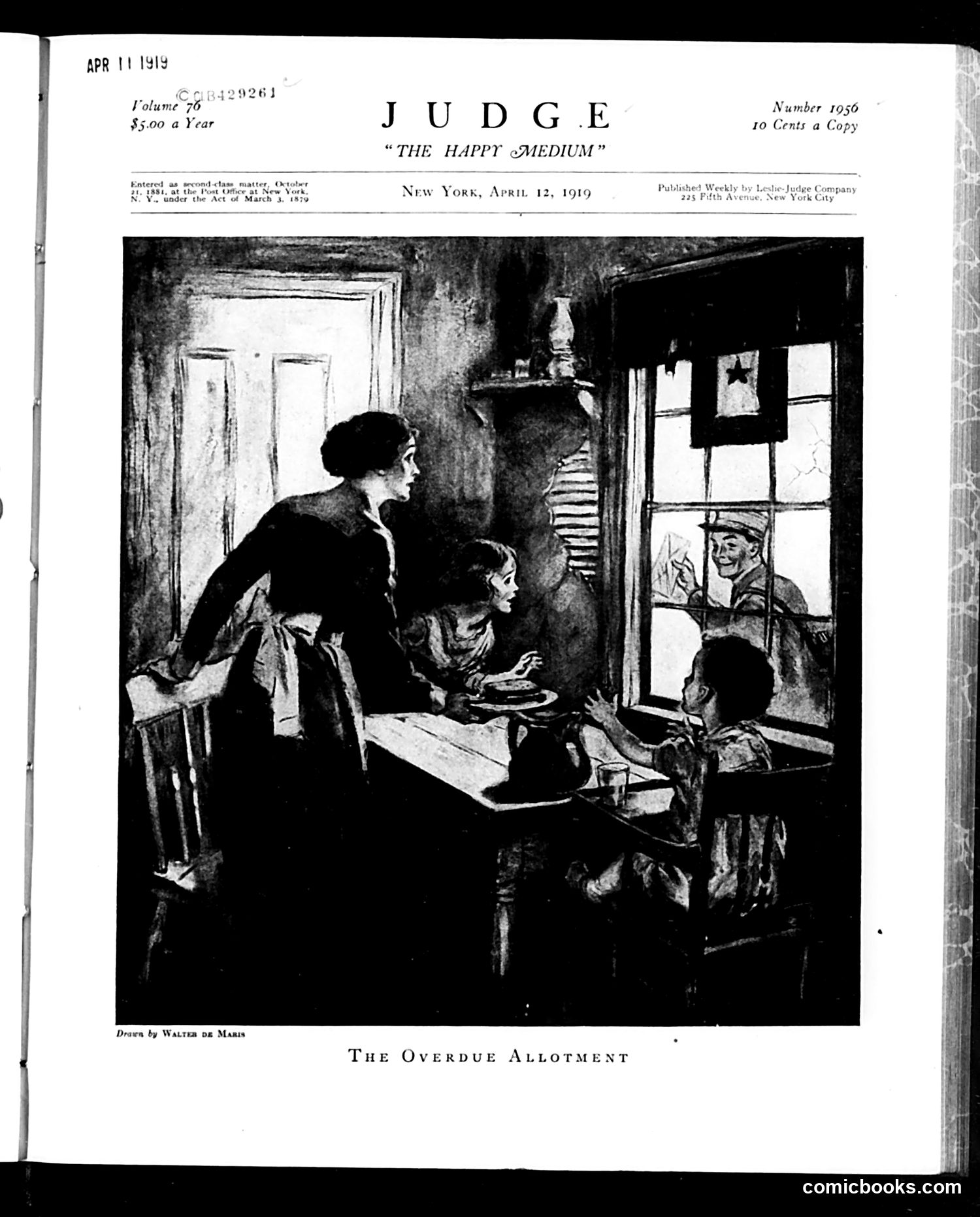
This cartoon satirizes the financial struggles of working-class families during World War I. A mother and children await food or money at their window, while a man outside appears to be a delivery person or official—likely representing delayed government allotment payments to military families. The "allotment" refers to mandatory portions of soldiers' wages sent home to dependents. The satire critiques the government's failure to deliver these payments promptly, leaving families in poverty. The woman's anxious posture and the children's evident need underscore the real hardship caused by bureaucratic delays. Published April 12, 1919 (just after WWI ended), this reflects public frustration with inadequate support systems for servicemen's families—a significant social issue of the postwar period.
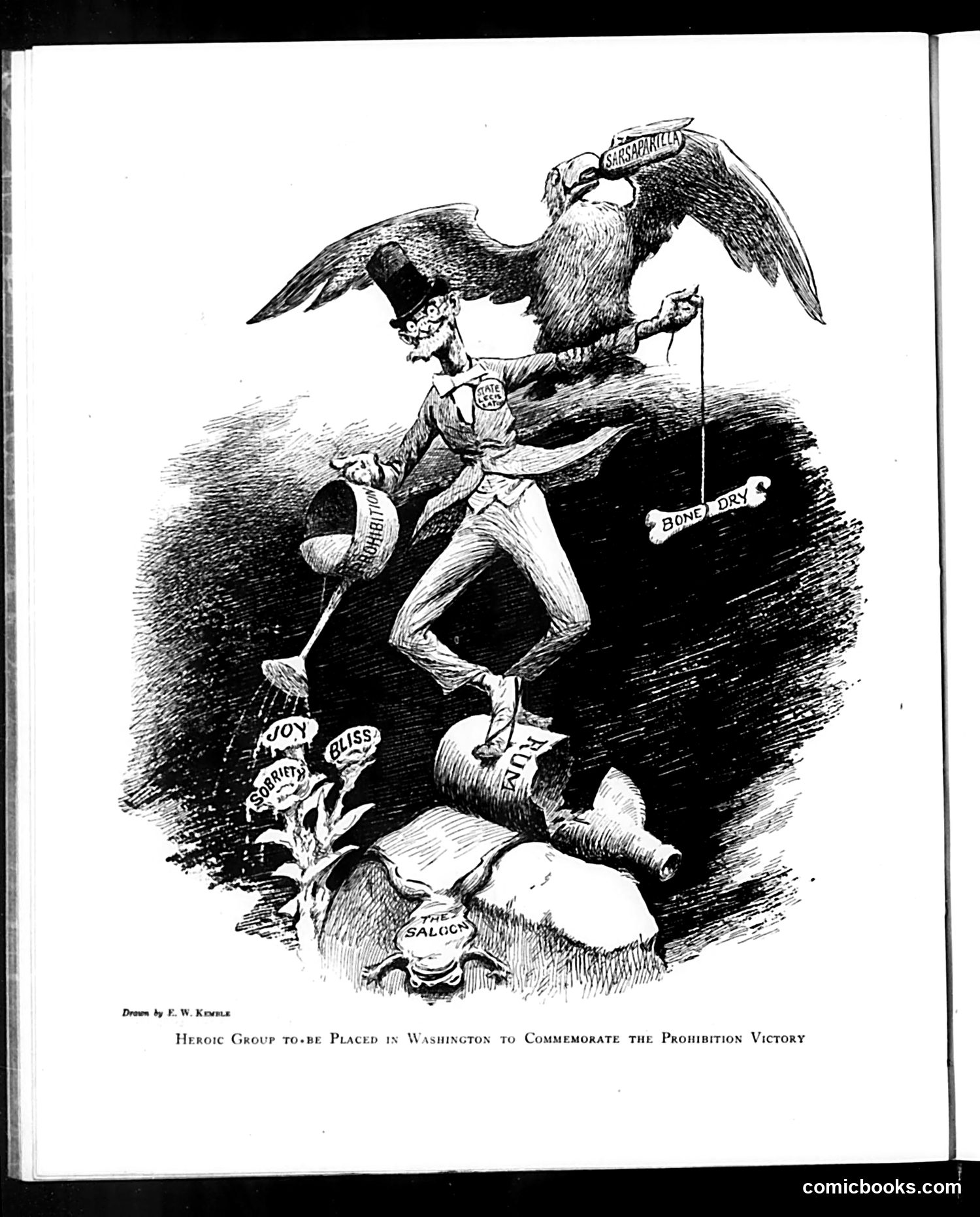
This 1920s satirical cartoon by F.W. Kemble depicts a skeletal Uncle Sam figure standing triumphantly over fallen bottles and barrels labeled "Saloon," "Bliss," "Joy," and "Sarsaparilla." The eagle above him holds a banner reading "Sarsaparilla" while Uncle Sam brandishes a sword labeled "Bone Dry." The cartoon celebrates Prohibition's passage, satirizing the temperance movement's victory. The skeleton imagery mocks what the artist appears to view as Prohibition's death-dealing effect—killing the spirits industry and the pleasures associated with drinking. The bones underfoot represent businesses destroyed by alcohol's prohibition. The title references a "Heroic Group" planned for Washington, sardonically equating Prohibition advocates' perceived righteousness with heroism, while the artwork itself ridicules their achievement as skeletal and death-bringing rather than victorious.
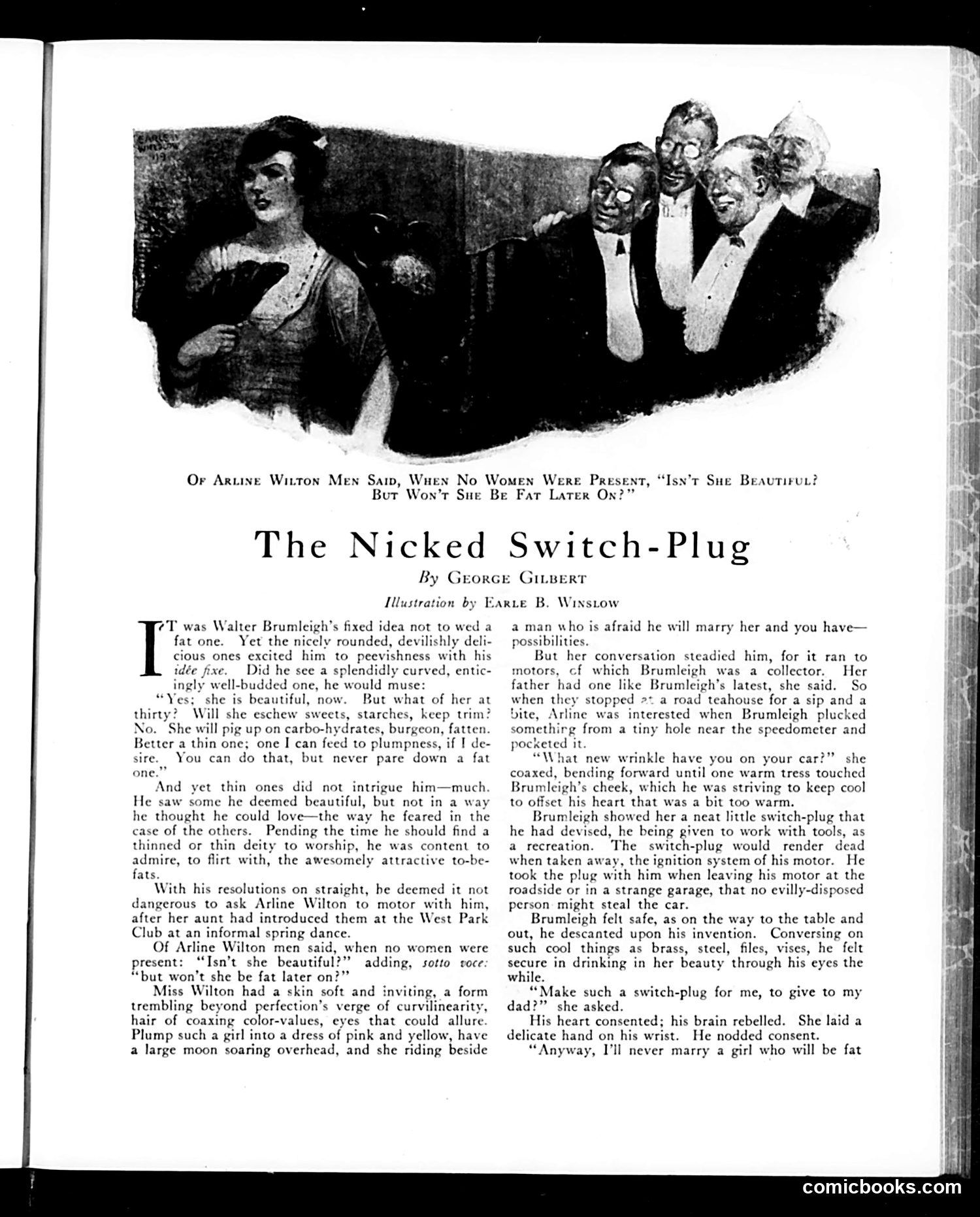
This story satirizes early 20th-century attitudes about women's appearance and marriage. The illustration shows men (including one identified as "Arline Wilton Men") admiring a woman, with the caption asking if she won't "be fat later on?" The narrative mocks Walter Brumleigh's fixation on marrying only thin women, while paradoxically fearing weight gain in his future wife. The "switch-plug" invention—a device to disable a car's motor—represents a humorous "solution" to control and monitor women's behavior. The story satirizes masculine anxieties about female autonomy and appearance, presenting marriage as a system of control. The satire targets both male insecurity and the era's shallow standards for women's worth, though it reflects rather than critiques these prejudices.
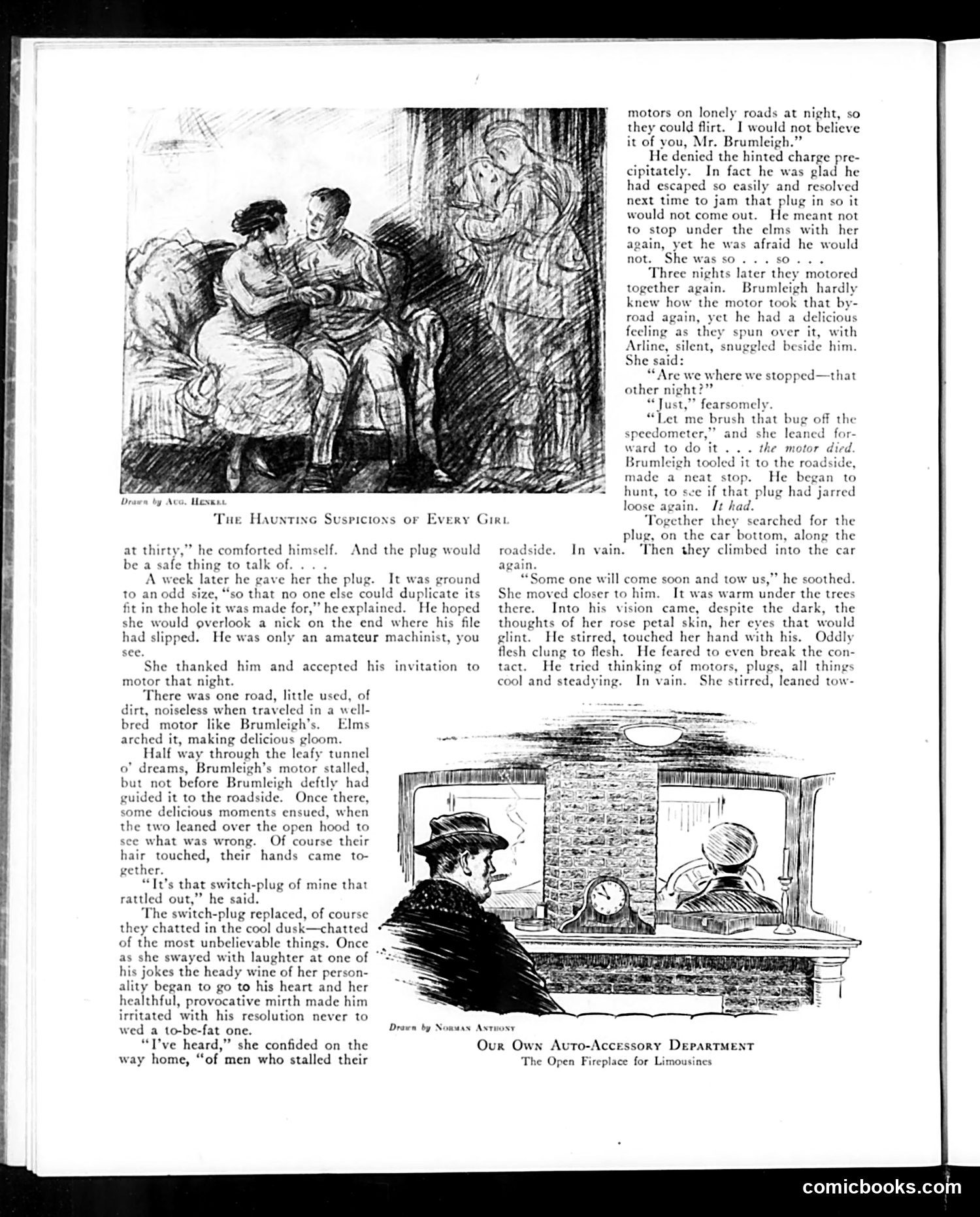
This page contains two distinct elements: **Top illustration** ("The Haunting Suspicions of Every Girl"): A sketch showing a couple in a motor car. The accompanying story depicts a romantic scenario where a man named Brumleigh takes a woman named Arline motoring. The humor hinges on her suspicions about the car's mechanical reliability—she worries the vehicle will break down, forcing them to stop together. The satire mocks both automotive unreliability in the early auto era and the social anxieties surrounding unmarried couples' privacy in cars. **Bottom illustration** ("Our Own Auto-Accessory Department"): A cartoon captioned "The Open Fireplace for Limousines," showing what appears to be a fireplace installed in an automobile. This is likely satirizing either unnecessary luxury auto accessories or humorous solutions to keeping vehicles warm—typical of Judge's consumer-culture satire from the early 20th century. Both reflect contemporary fascination with automobiles and social etiquette.
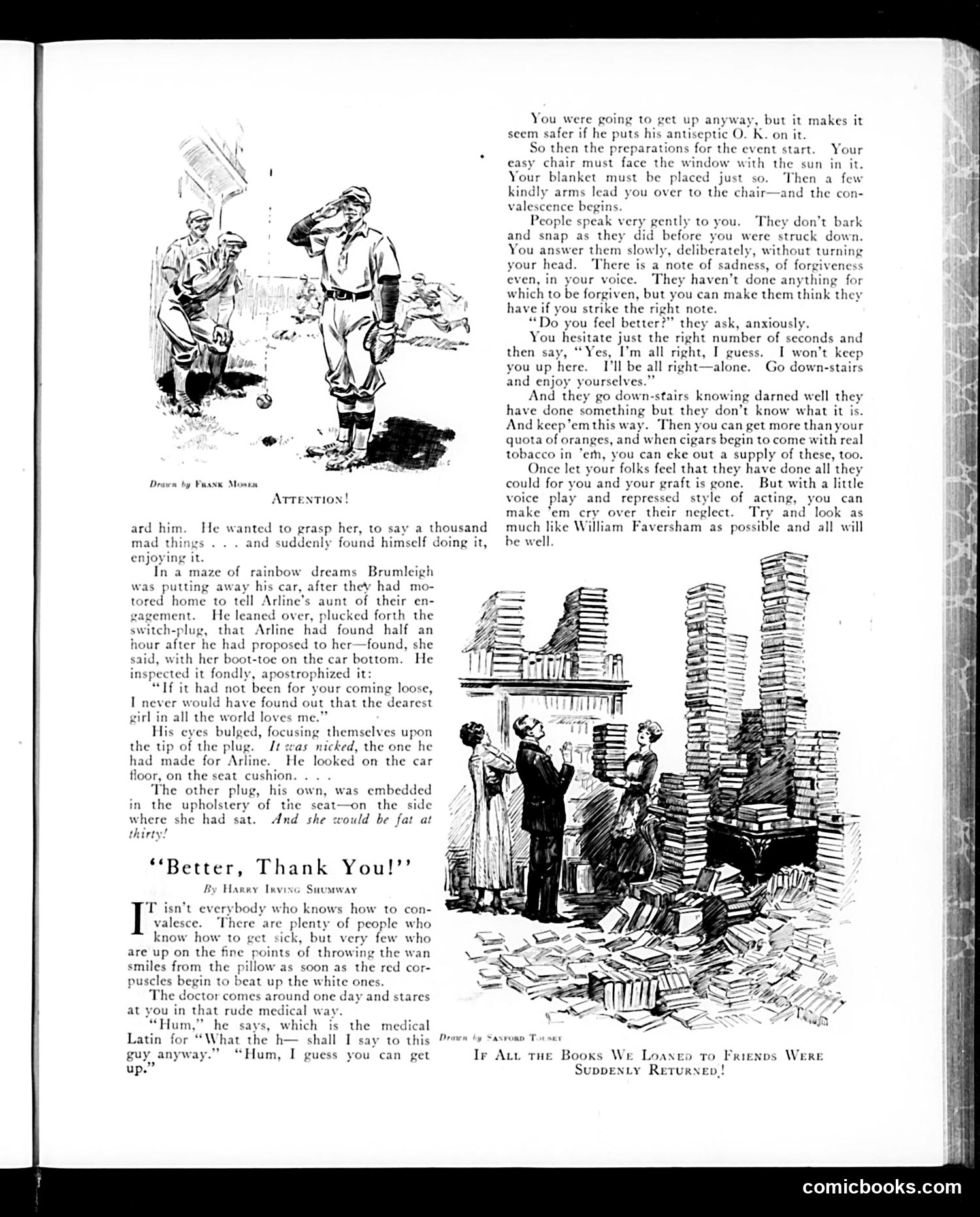
This page contains two distinct pieces: **"Attention!"** (top): A romantic vignette where a man discovers a switch-plug he'd made for his fiancée Arline wedged in her car's upholstery—evidence she loves him. The joke's punchline, "And she would be fat at thirty," reflects early 20th-century anxieties about women's appearance after marriage, treating this as comedic inevitability. **"Better, Thank You!"** (bottom): Satirizes malingering—the art of milking sympathy during convalescence. The text humorously details how invalids manipulate family members through performative suffering: speaking slowly, refusing help, and guilt-tripping visitors into bringing oranges and cigars. It's social satire mocking both the faker's cynicism and families' gullible enabling. William Faversham (referenced) was a famous stage actor, suggesting theatrical exaggeration of illness for effect. Both pieces target human nature's less admirable impulses with period-appropriate humor.
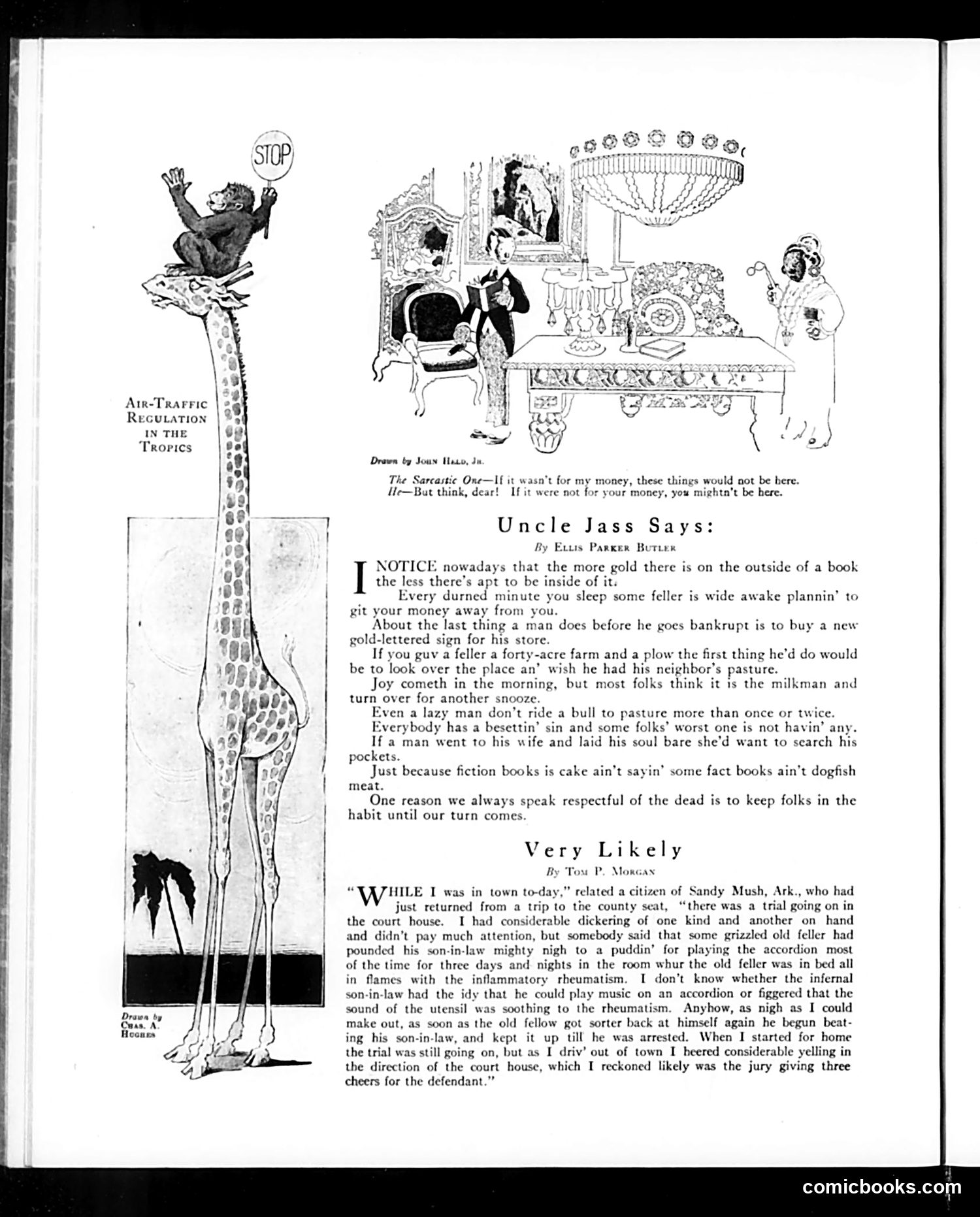
This page contains three separate humorous pieces typical of early 20th-century satirical magazines: **"Air-Traffic Regulation in the Tropics"** (left cartoon): A giraffe holds a "STOP" sign while a mosquito flies nearby. The joke plays on the absurdity of traffic control in an exotic setting where insects pose greater hazards than vehicles. **Sarcastic Dialogue** (center): A couple at an elegant dinner party exchanges barbs about wealth and existence—she credits her money for their luxuries; he sardonically suggests her money is also responsible for her being alive. This mocks nouveau riche materialism and marital tension. **"Uncle Jass Says"** and **"Very Likely"** (text pieces): Folksy, homespun wisdom columns delivering cynical observations about human nature—money-seeking, hypocrisy, laziness, and marital discord. The final anecdote humorously describes an old man beating his accordion-playing son-in-law during an illness, with apparent community approval ("cheers for the defendant"). Together, these pieces reflect Judge's satirical approach to American social behavior and class pretensions.
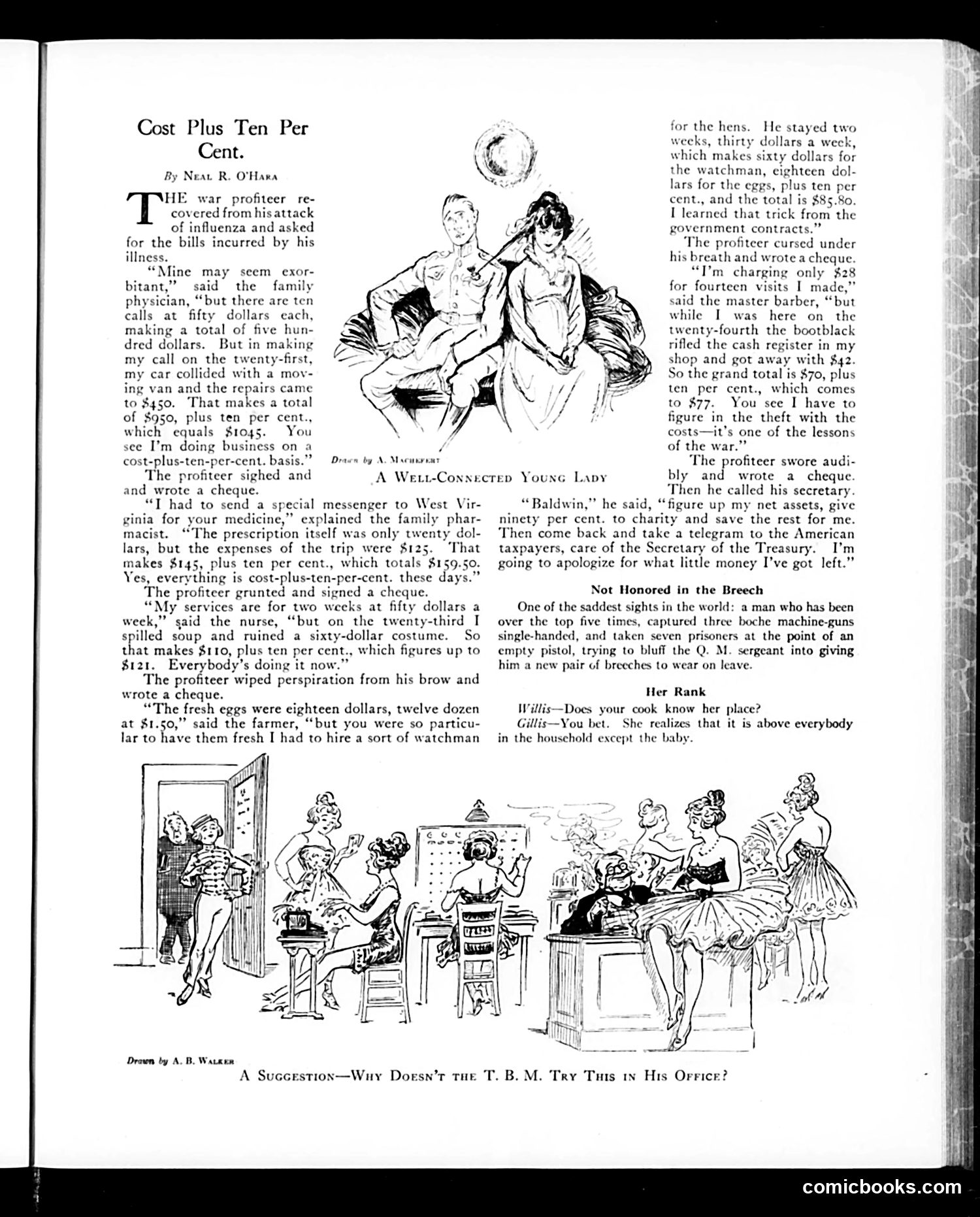
This story mocks wartime "cost-plus" contracting, where suppliers charged the government their expenses plus a percentage markup. A war profiteer recovers from influenza and receives bills from his doctor, pharmacist, nurse, farmer, and barber. Each provider adds inflated costs to their base charges, then tacks on ten percent. The doctor charges $450 for car repairs; the nurse adds $60 for a ruined dress; the farmer includes watchman fees for egg freshness; the barber incorporates a theft from his register—all justified as "lessons of the war." The satire targets how war contracts encouraged dishonest accounting: service providers bundle unrelated expenses into their bills, then profit further through the percentage markup. The profiteer, previously accustomed to such practices, is now on the receiving end, ultimately vowing to surrender his remaining assets to charity. The humor stems from cosmic justice—the war profiteer experiencing the system he exploited.
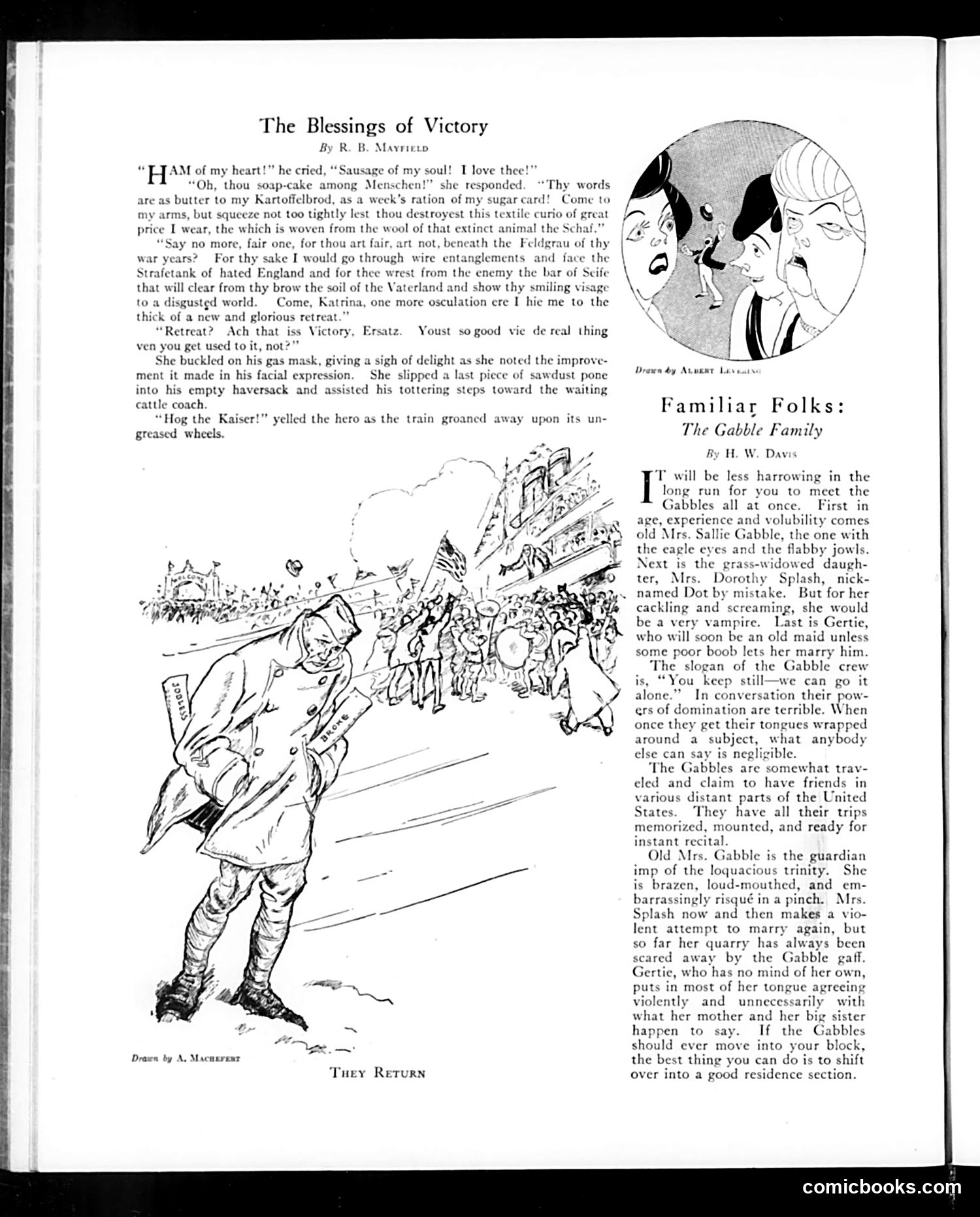
This WWI-era satire mocks German soldiers and the home front. The main cartoon depicts a German soldier and his girlfriend speaking in exaggerated German-accented English, using food rationing references (sugar cards, sawdust bread) and worn-out textiles. She praises his "retreat" as "Victory"—dark humor about German military defeats. The satire targets German propaganda and the harsh realities of war: the soldier wears a gas mask, carries meager rations, and boards a "cattle coach" for transport. His sweetheart's comment that the gas mask improves his appearance is particularly cruel. The final line "Hog the Kaiser!" mocks German patriotism. The cartoon works by contrasting romantic German language ("Sausage of my soul") with the grim, impoverished circumstances—highlighting the disconnect between official war messaging and battlefield reality for ordinary Germans. The "Familiar Folks" feature on the facing page is unrelated satirical content about American family archetypes.
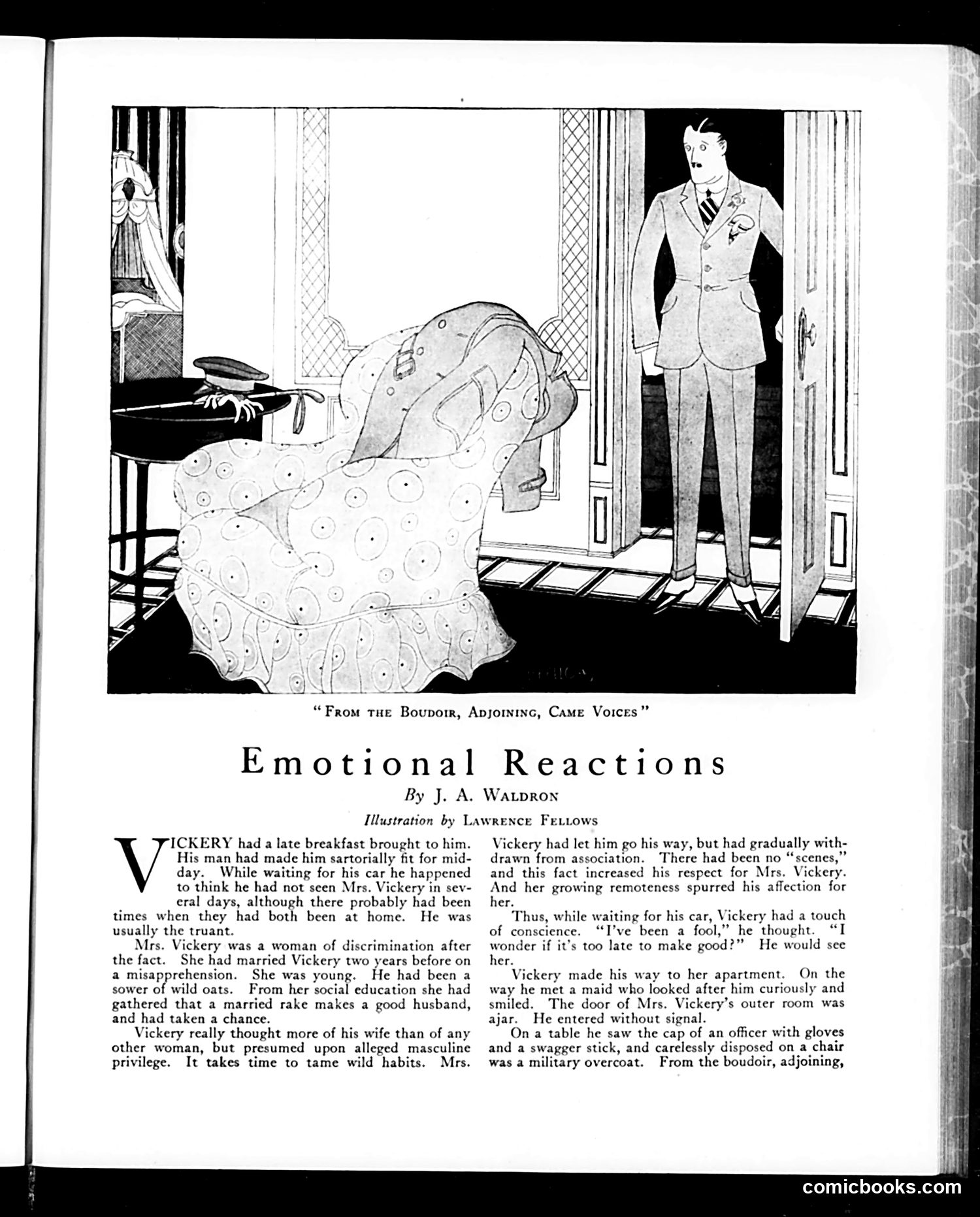
This story illustration depicts a husband's moment of marital conscience. Vickery, a philandering man who has neglected his wife, suddenly feels remorseful while waiting for his car. He resolves to visit her apartment to reconcile. However, the punchline arrives through visual irony: he discovers a military officer's cap, gloves, swagger stick, and overcoat in her room—suggesting his wife is entertaining a soldier in her boudoir. The illustration captures the moment he realizes this, standing shocked in the doorway. The satire targets the era's sexual double standards: Vickery's affairs were presumed acceptable "masculine privilege," yet his wife's implied infidelity is presented as a comeuppance. The story uses his belated guilt and discovery as ironic justice, suggesting that "wild habits" eventually catch up with neglectful husbands.
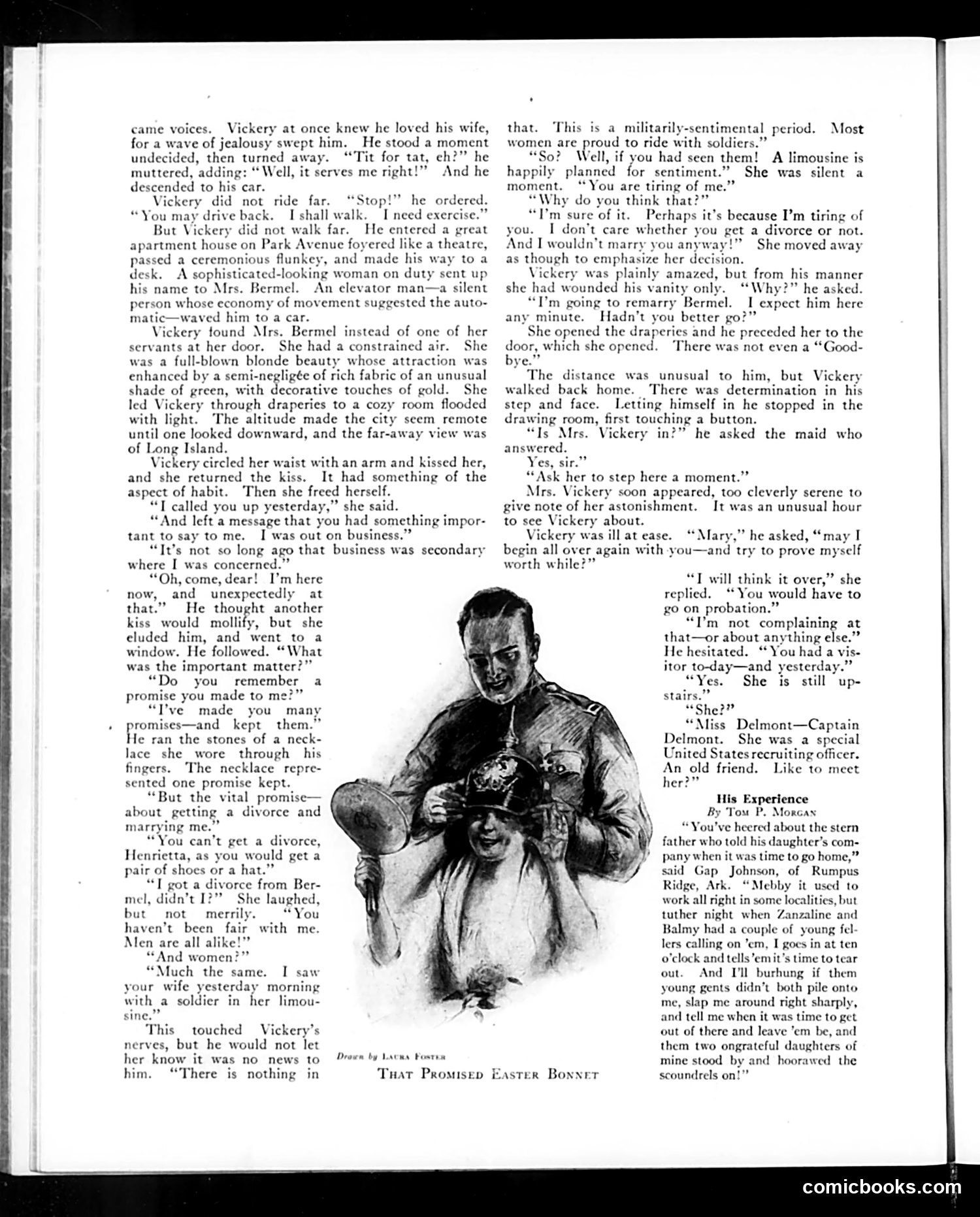
This page shows a serialized fiction story—not political satire—depicting a domestic drama. The narrative involves a man named Vickery discovering his wife's infidelity with a soldier during what the text calls "a militarily-sentimental period" (likely WWI era, when women were "proud to ride with soldiers"). Vickery confronts his mistress, Mrs. Bermel, seeking to resume their affair, but she dismisses him—she's reuniting with her ex-husband instead. The illustration shows an elegant woman in a negligée. Humbled, Vickery returns home to confront his own wife. The "Easter Bonnet" reference in the title appears ironic: rather than sentimental springtime romance, the story explores betrayal and vanity among the wealthy. Judge magazine mixed satirical cartoons with such serialized fiction for middle-class readers.
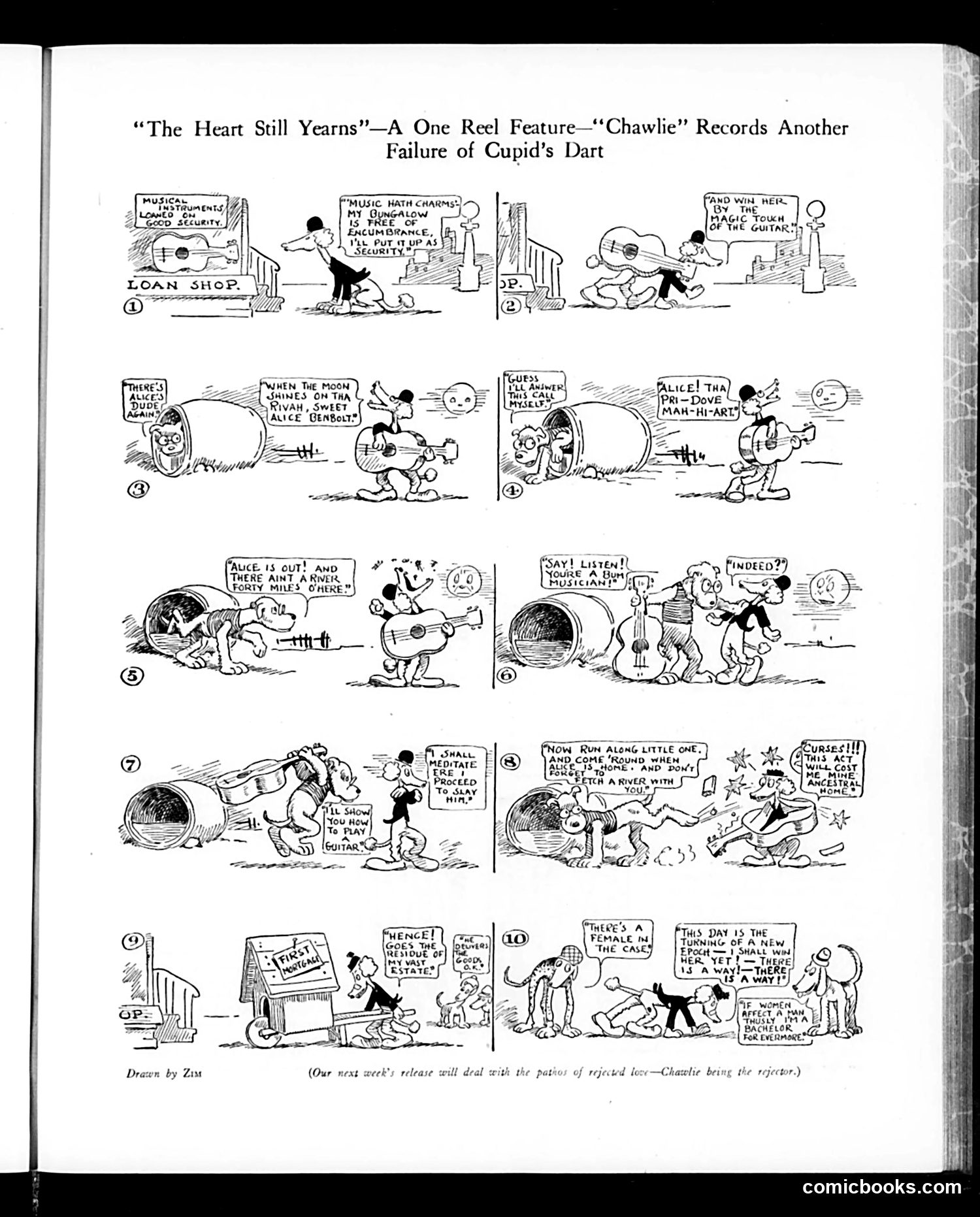
This is a silent-comedy one-reel film synopsis satirizing romantic failure. "Chawlie" (likely Charlie Chaplin, given the era and the character name) attempts to win "Alice" through musical serenading with a guitar, using a borrowed instrument as collateral at a loan shop. The joke develops across ten panels: despite his earnest efforts to charm her with music and poetry, Alice repeatedly rejects him—most pointedly telling him to return when he can "sketch a river" (a reference to romantic gestures). His schemes escalate absurdly, culminating in frustrated declarations that he'll win her "yet." The satire mocks romantic melodrama in early cinema: the overwrought declarations, musical accompaniment, and the protagonist's delusional persistence despite obvious rejection. The title's irony—"Failure of Cupid's Dart"—emphasizes how thoroughly love eludes him. This appears designed as humorous plot synopsis for Judge magazine's readers familiar with Chaplin-style silent comedy.
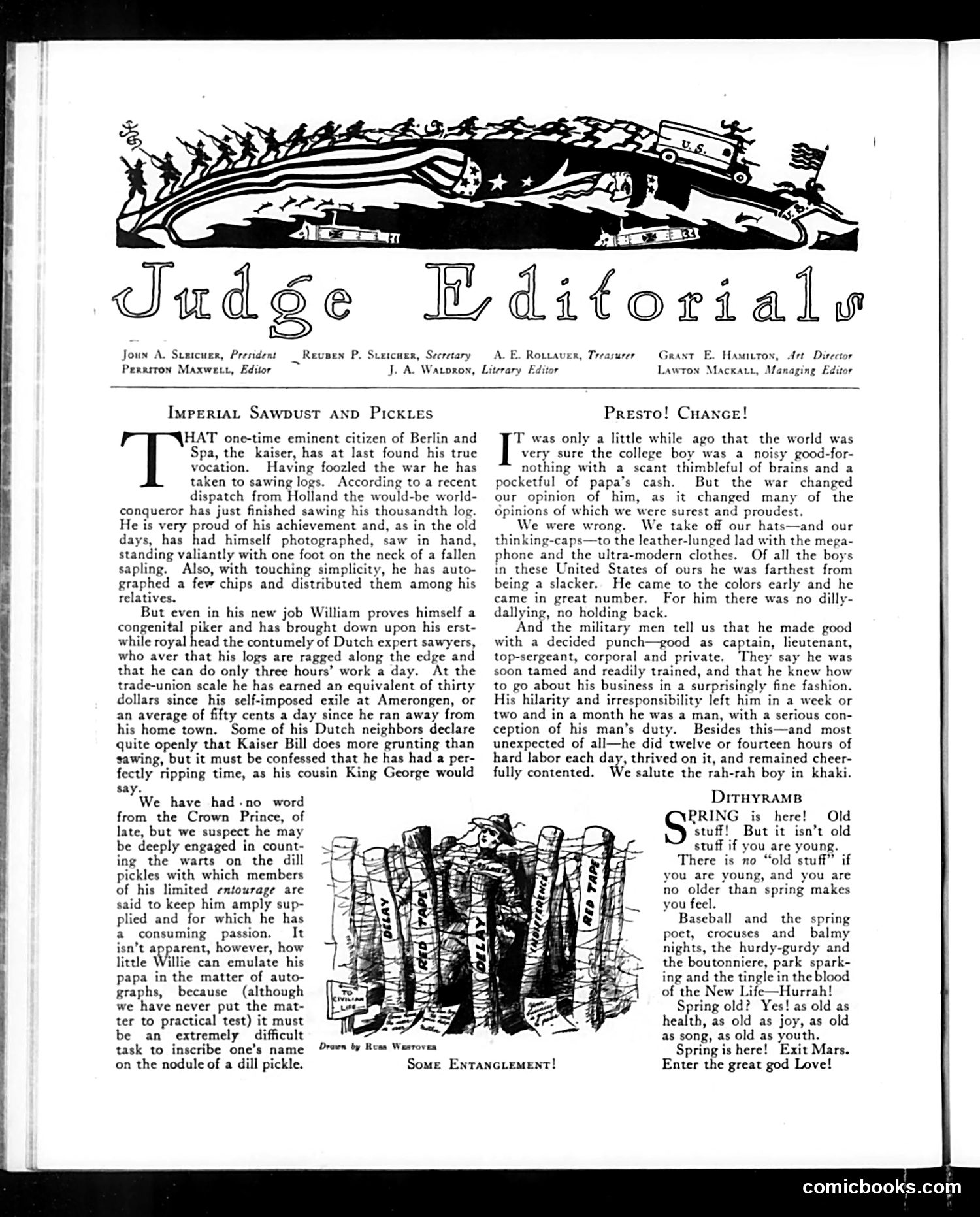
This is primarily an **editorial/opinion page** rather than a single cartoon. It contains two satirical pieces mocking post-WWI figures: **"Imperial Sawdust and Pickles"** targets **Kaiser Wilhelm II**, exiled in Holland after Germany's defeat. The satire ridicules him for taking up log-sawing as his new occupation—a comedown from his imperial pretensions. The piece mocks his pride in photographing himself doing manual labor and autographing wood chips for relatives, while Dutch sawyers criticize his poor work. It also references the **Crown Prince** (his son) in exile, joking he's obsessed with counting warts on dill pickles. **"Presto! Change!"** reverses prior negative opinions about college boys, praising their military service in WWI. The editorial credits them with proving themselves serious, disciplined soldiers who abandoned their frivolous reputations for genuine patriotism and hard work. The small illustration labeled "Some Entanglement!" (artist Russ Westover credited) appears to depict tangled boots or military gear, reinforcing the military theme.
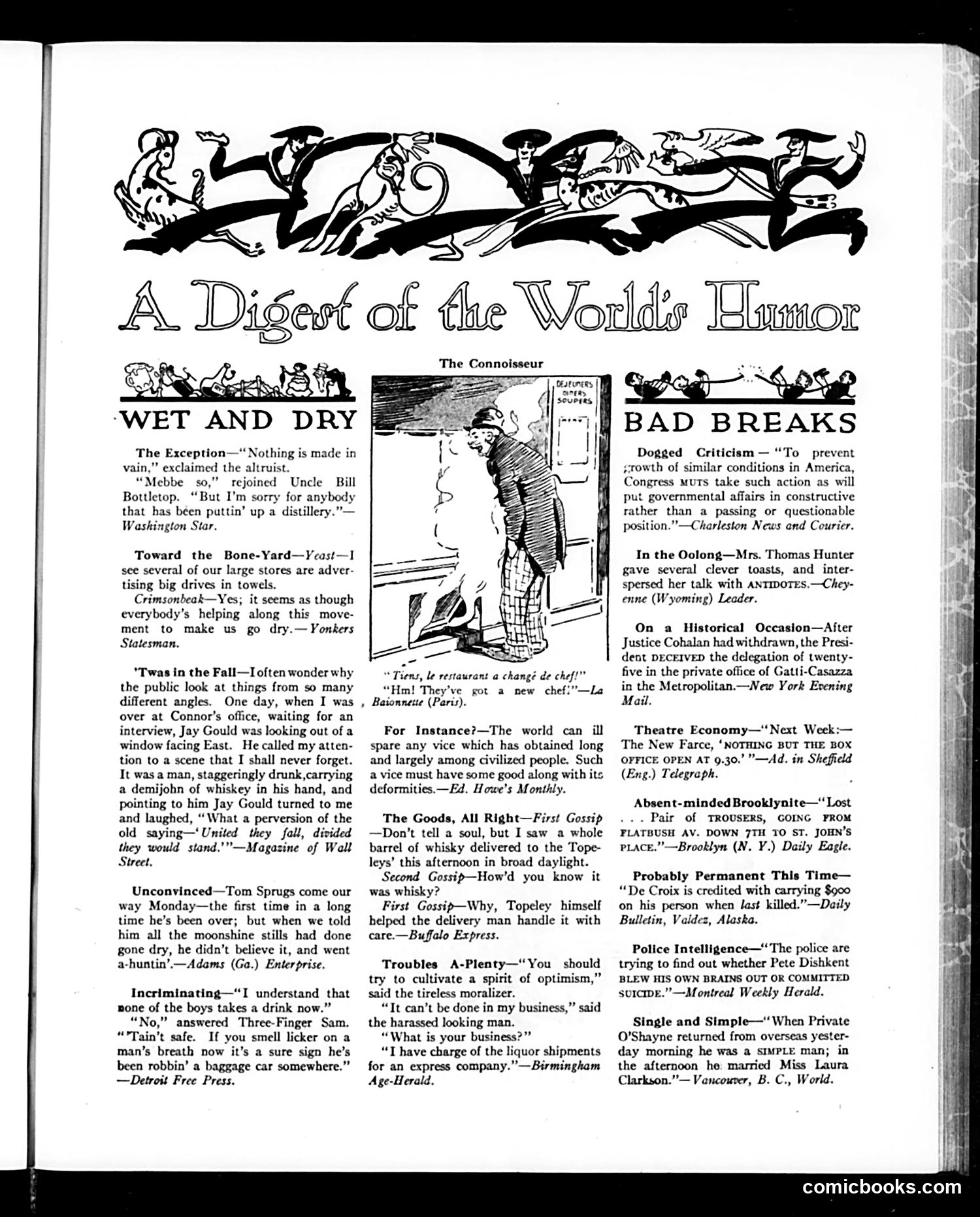
This page from *Judge* magazine collects humorous anecdotes mocking Prohibition (the ban on alcohol). The jokes fall into two sections: "Wet and Dry" (pro-alcohol commentary) and "Bad Breaks" (newspaper typos and misquotations). The "Wet and Dry" section ridicules Prohibition's effects through exaggerated scenarios: a man carrying whiskey while preaching unity; skepticism that moonshine stills have actually closed; and a man smuggling liquor in his job transporting "express company" shipments. The cartoon depicts "The Connoisseur"—a restaurant patron bewailing a "new chef," a French reference to changing standards. The "Bad Breaks" section highlights unintentional newspaper humor from across America, mostly typos creating absurd meanings: "antidotes" instead of anecdotes, officials "deceived" instead of "received," and dark jokes about death. Overall, the page ridicules Prohibition enforcement while celebrating Americans' continued drinking and the law's perceived failure.
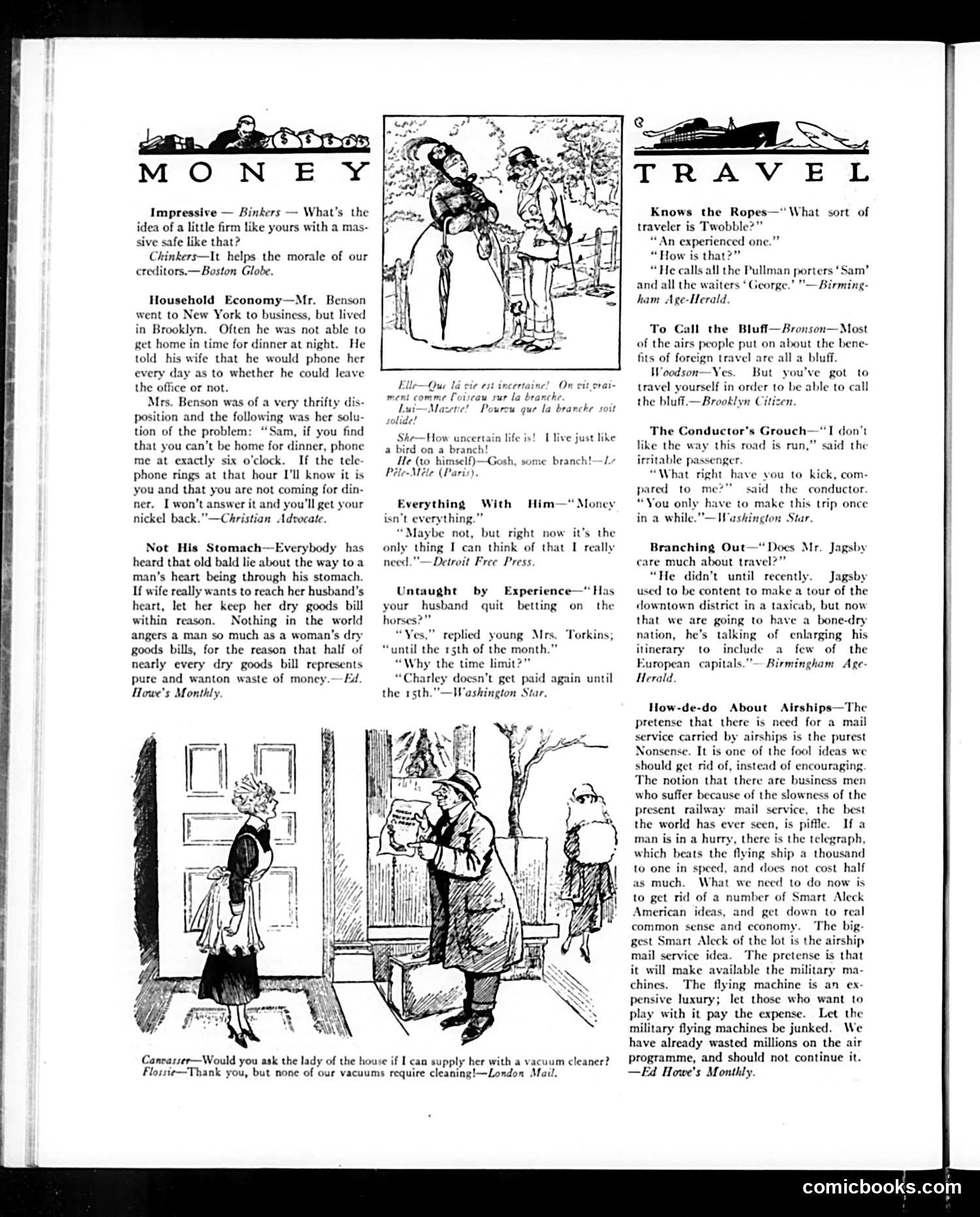
This page collects brief satirical jokes about early 20th-century American life, organized thematically around "Money" and "Travel." The **Money** section mocks domestic finances: a small business uses an oversized safe to reassure creditors; a wife avoids phone charges by instructing her husband not to call; and consumer spending—particularly women's dry goods purchases—is portrayed as wasteful and emraging to husbands. The **Travel** section ridicules both leisure travel and emerging technology. "Knows the Ropes" jokes that experienced travelers merely memorize porter and waiter names. "Branching Out" notes a man only became interested in European travel after learning Prohibition would eliminate domestic bars. Most notably, "How-de-do About Airships" dismisses airmail as an unnecessary "Smart Aleck" idea, arguing the telegraph and railways suffice—reflecting contemporary skepticism about aviation's practical value before its widespread adoption. The cartoons and jokes reflect period anxieties about spending, gender roles in marriage, and technological progress.
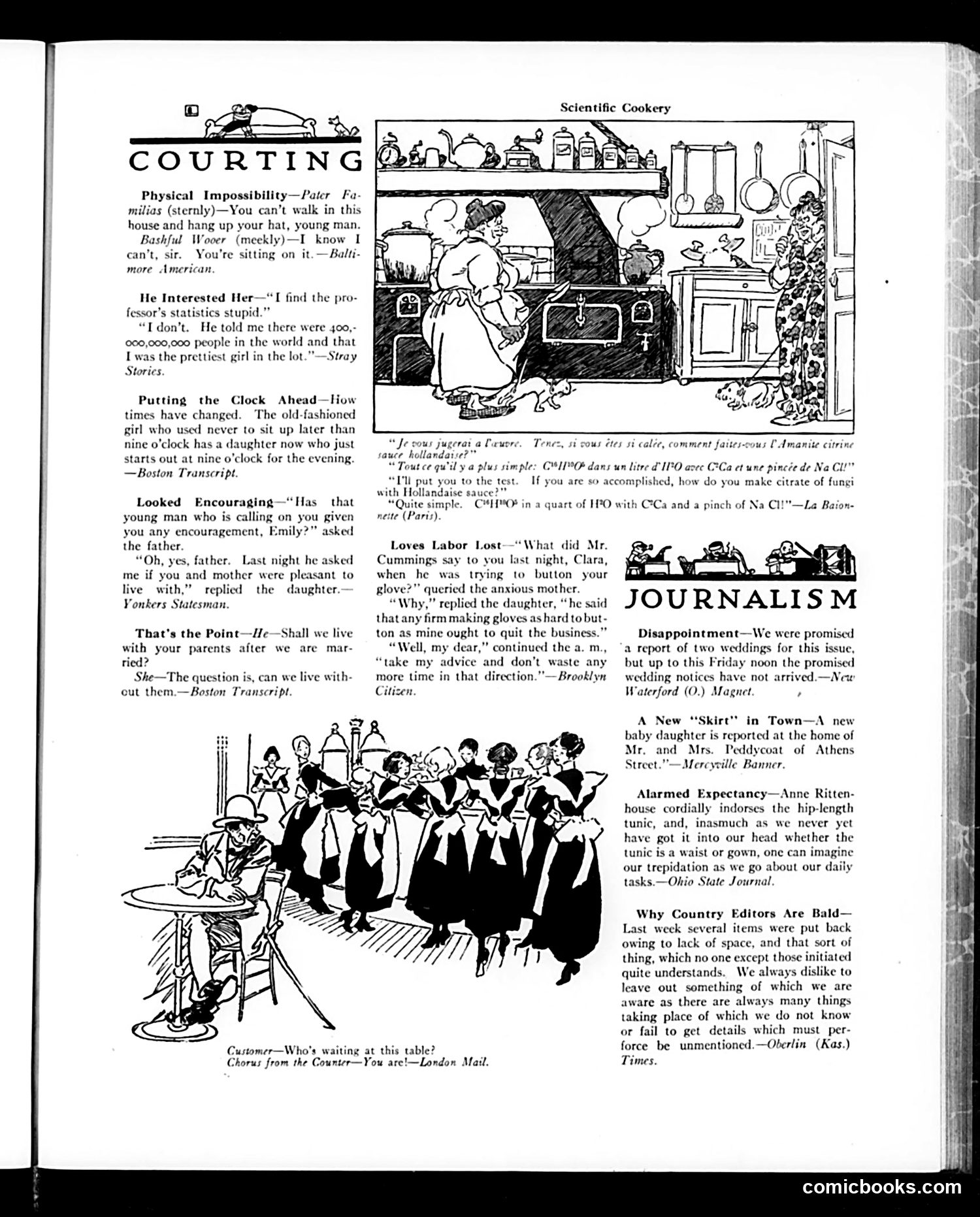
This page collects brief humorous anecdotes about courtship and journalism, typical of early 20th-century American humor magazines. The **courting section** features comedic dialogues satirizing dating customs: a young man literally sitting on his hat (physical comedy), a girl flattered by dubious statistics, and changing social expectations—the "old-fashioned girl" staying up until 9 PM versus modern daughters *leaving* at 9 PM. These jokes mock evolving gender roles and relaxing social restrictions on unmarried women. The **"Scientific Cookery" illustration** depicts a kitchen scene with a humorous French dialogue about making hollandaise sauce using chemical formulas (C₆H₁₀O₅, etc.) instead of traditional methods—satirizing pretentious "scientific" cooking fads popular among educated classes. The **journalism section** includes light notes about missed wedding announcements and new births, plus a meta-joke about country editors omitting stories due to space constraints—gently mocking small-town newspaper limitations. Overall, the page reflects genteel American humor of its era: domestic life, courtship customs, and gentle mockery of modern pretensions.
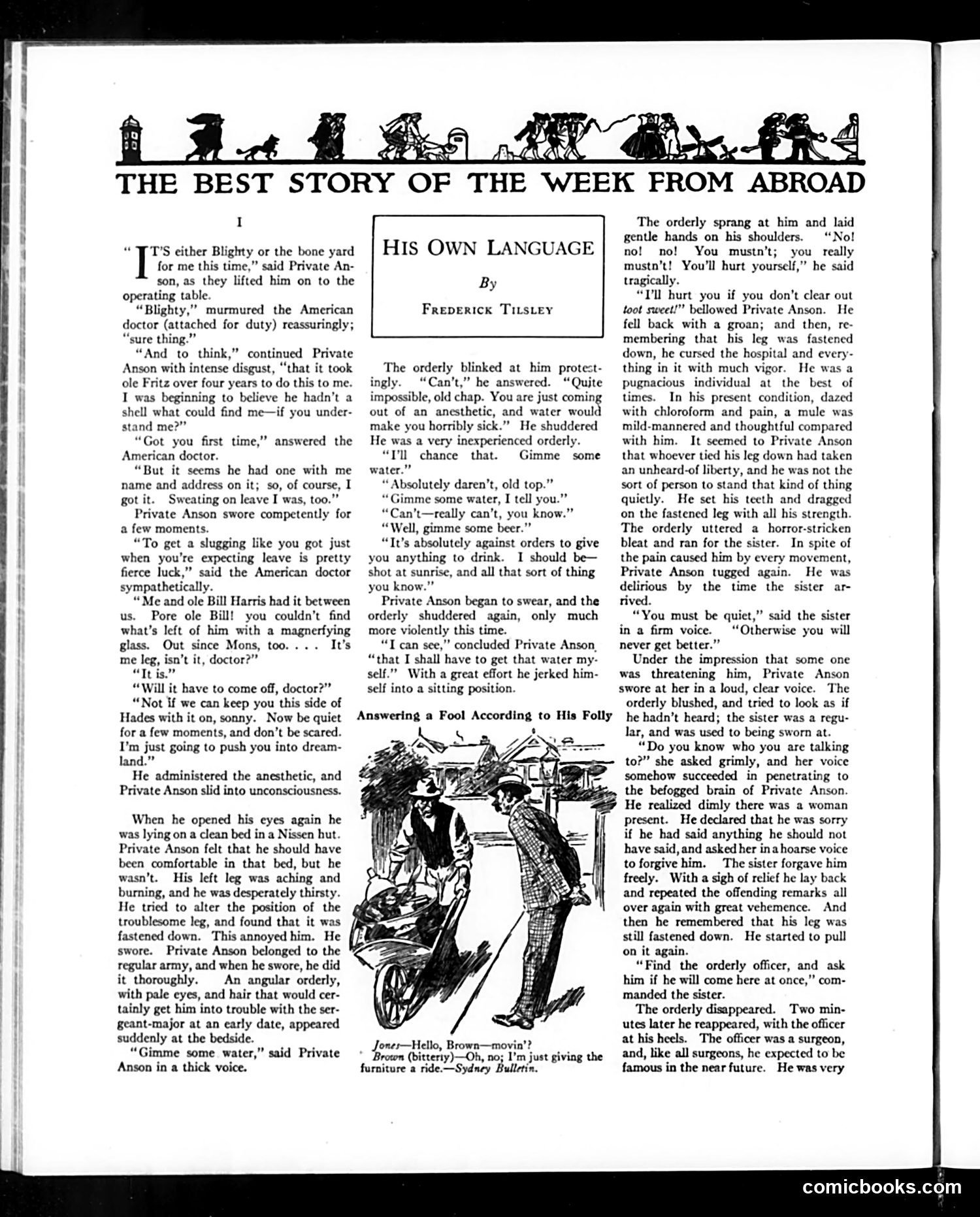
This story satirizes the stereotype of the uncouth British soldier—specifically "Private Anson," a working-class regular army man wounded in World War I. The humor relies on class contrast: Anson's vulgar, profane manner (he "swore competently") clashes with the polite, educated orderly trying to follow medical protocol. The title "His Own Language" suggests Anson speaks only in crude imperatives and oaths. When denied water post-surgery, he responds with characteristic military profanity rather than reasoned argument, reducing the orderly to nervous shudders. The joke portrays the enlisted man as inarticulate, aggressive, and unable to communicate except through swearing—a common early-20th-century British class stereotype. The separate cartoon caption about furniture-moving appears unrelated.
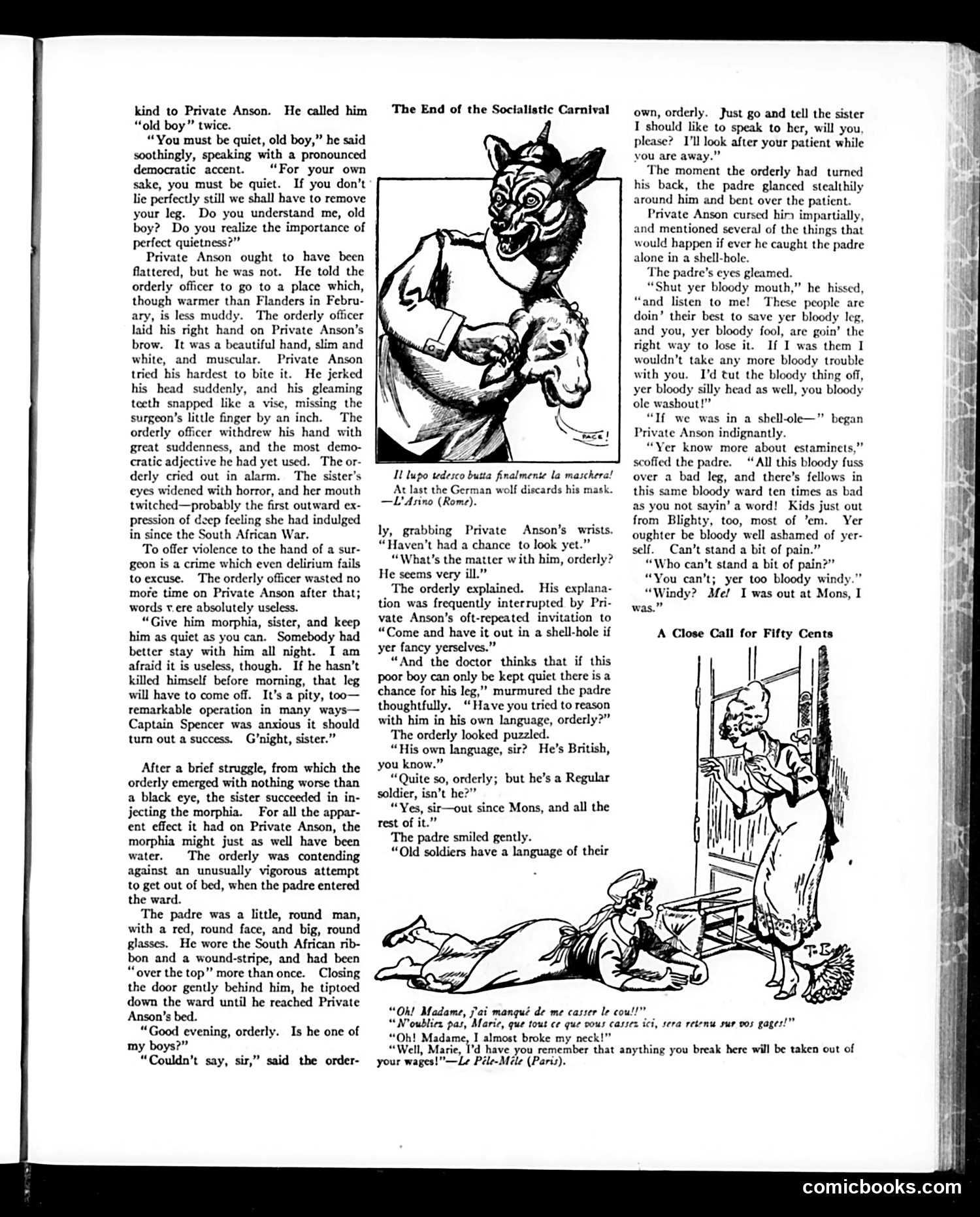
This page satirizes WWI medical care and class attitudes. The main narrative mocks an "orderly officer" who condescends to Private Anson (a wounded soldier) with affected "democratic" speech while maintaining class superiority—calling him "old boy" repeatedly while threatening amputation. The cartoon's humor derives from Anson's defiant working-class resistance: he attempts to bite the officer's hand and tells him to go to hell, rejecting false sympathy. The story critiques how officers patronize enlisted men while maintaining real power over their bodies and fates. The italicized German caption about "the wolf discarding his mask" references wartime propaganda about German deception—unrelated to the main story but typical of Judge's anti-German content during WWI. The padre (chaplain) represents religious institution attempting to further manipulate the soldier. The satire suggests institutional hypocrisy across military, medical, and religious hierarchies.
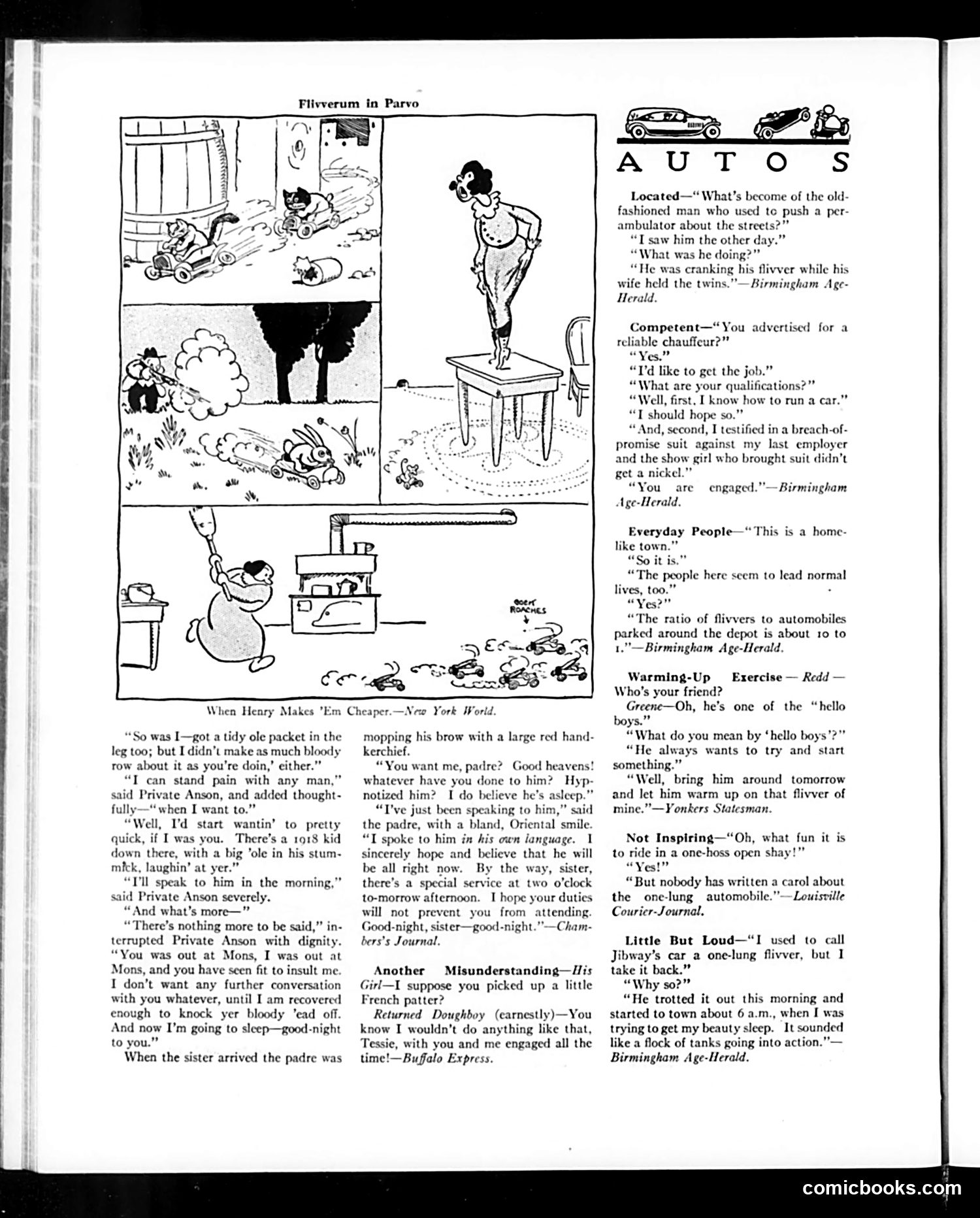
This page satirizes the rapid proliferation of cheap automobiles ("flivvers"—likely referring to Ford Model Ts) in early 20th-century America. The title cartoon depicts men operating a makeshift vehicle factory, suggesting mass production has made cars absurdly commonplace. The accompanying jokes mock how the cheap "flivver" has displaced traditional life: fathers crank cars while wives hold babies; the ratio of flivvers to "real" automobiles near train depots is 10-to-1. One joke compares a car's early-morning noise to "tanks going into action"—a reference suggesting post-WWI publication, when returning soldiers would understand military comparisons. The humor targets both the vehicles themselves (unreliable, loud, one-cylinder engines) and their social impact: automobiles have become so ubiquitous and affordable that they've fundamentally altered domestic life and social hierarchy, replacing horse-drawn carriages and prams. The satire captures anxiety about rapid modernization and changing social norms.
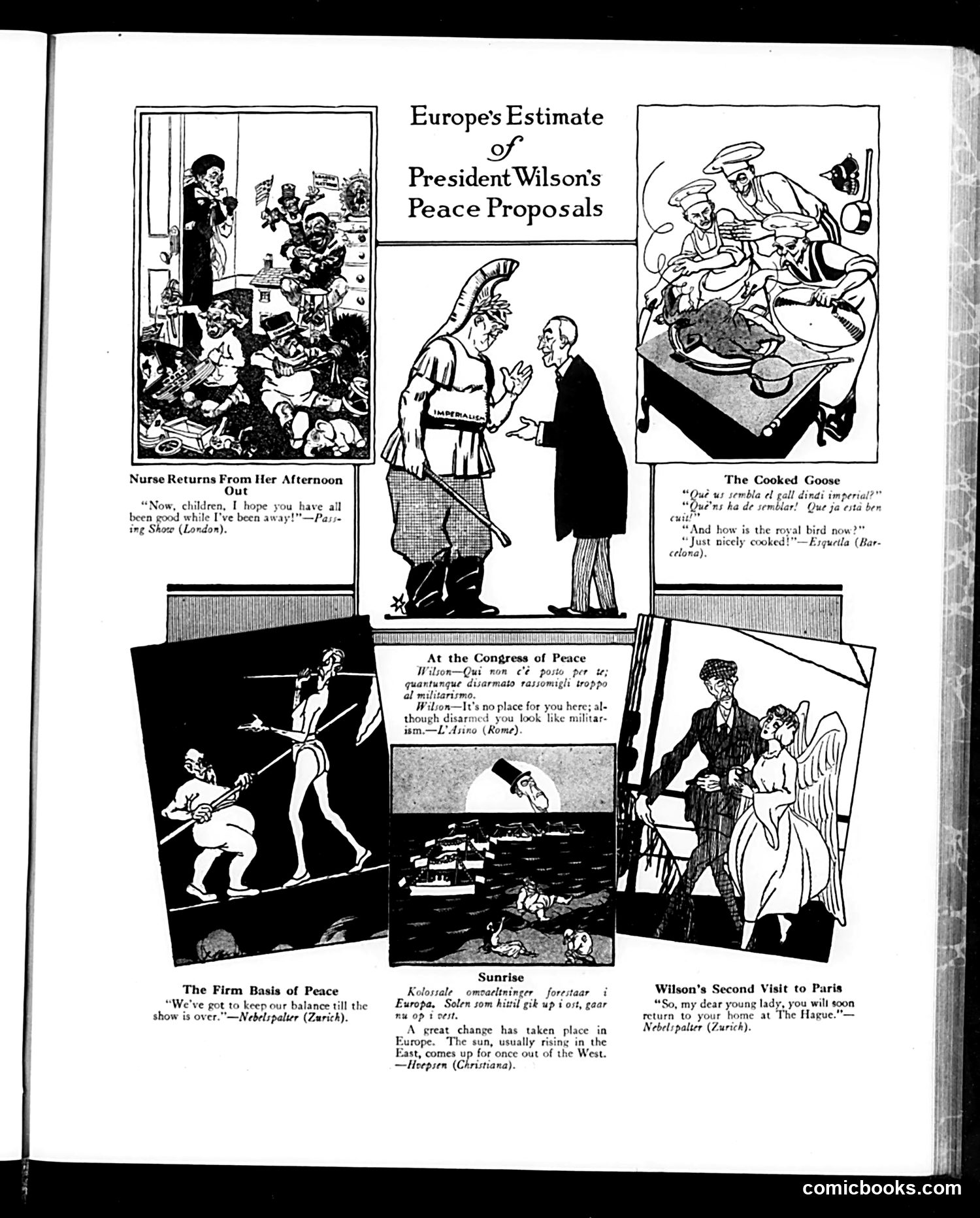
This 1919 Judge page satirizes European reactions to President Wilson's post-WWI peace plan through cartoons attributed to European publications. The central figure is Wilson (identifiable from context), depicted negotiating with various allegorical representations. The satire suggests Europeans viewed Wilson's proposals skeptically or ironically. "The Cooked Goose" implies the peace plan is already finished/dead. "The Firm Basis of Peace" shows precarious balance—suggesting the proposals lack solid foundation. "At the Congress of Peace" appears to depict Wilson as disarmed militarism, implying his idealism conflicts with European power politics. The "Nurse Returns" and "Wilson's Second Visit to Paris" panels suggest ongoing disappointment with negotiations. The recurring joke seems to be that Wilson's idealistic proposals clash with European cynicism about actually achieving lasting peace.
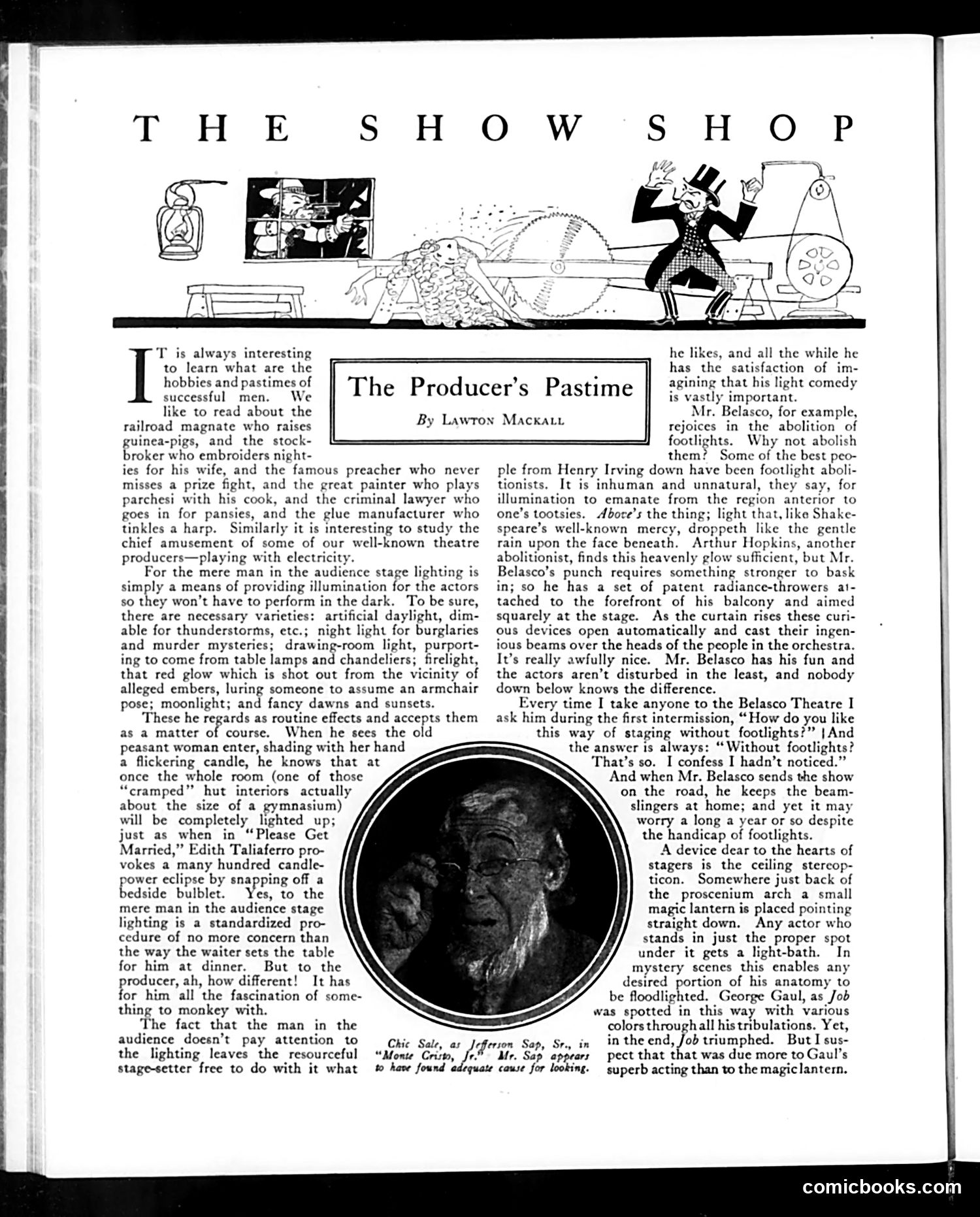
This article satirizes theatre producer **David Belasco**, a famous early-20th-century Broadway impresario known for his elaborate staging innovations. The satire mocks producers' obsession with technical experimentation, particularly **stage lighting**, which audiences largely ignore. The piece targets Belasco's specific crusade: abolishing **footlights** (lights at stage front) in favor of overhead lighting rigs that illuminate actors from above. The author presents this as vanity—producers tinker endlessly with effects while audiences remain oblivious. The joke culminates when Belasco removes the expensive lighting equipment for touring productions, revealing the innovation was merely ego-driven spectacle. The accompanying illustration shows a theatre producer (likely Belasco caricatured) gleefully manipulating theatrical elements, emphasizing how producers treat stagecraft as a personal hobby rather than practical necessity. The satire targets the gap between theatrical pretension and audience indifference—a classic Judge theme.
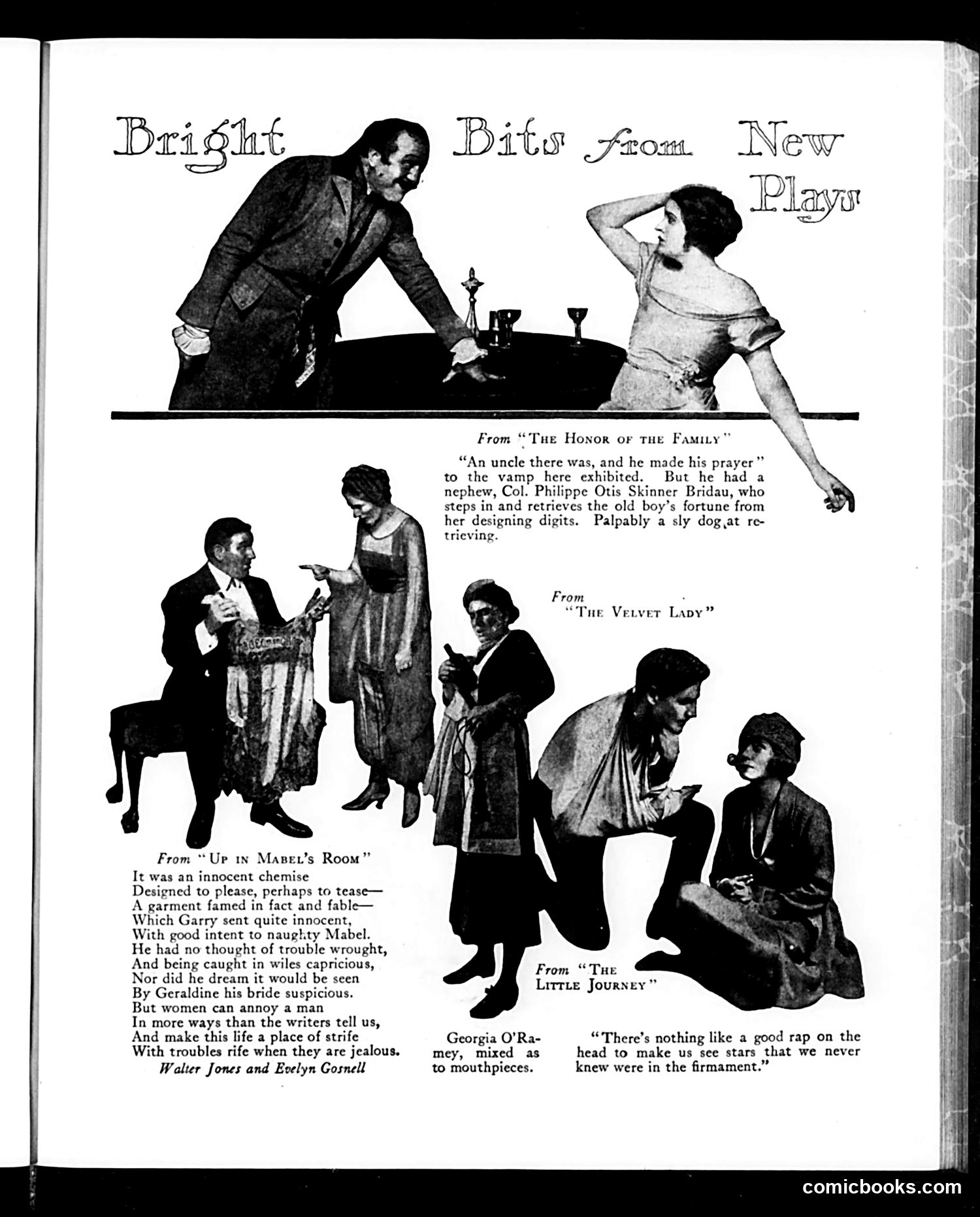
This page features theatrical humor drawn from contemporary stage productions. The top scene depicts a romantic entanglement—a man sending an innocent negligée ("chemise") to a woman named Mabel as a gift, but his suspicious wife Geraldine discovers it, creating marital conflict. The joke plays on the comedy of misunderstanding and female jealousy. The lower scenes excerpt other plays: "The Honor of the Family" involves a nephew retrieving an elderly uncle's fortune from a scheming woman; "The Velvet Lady" and "The Little Journey" appear to involve similar romantic or social complications, with one caption suggesting physical violence ("a good rap on the head") as humor. The satire targets theatrical plots of the era—predictable domestic comedies centered on infidelity anxieties, scheming women ("vamps"), and physical slapstick. This reflects early 20th-century theater's stock situations and attitudes toward gender and marriage.
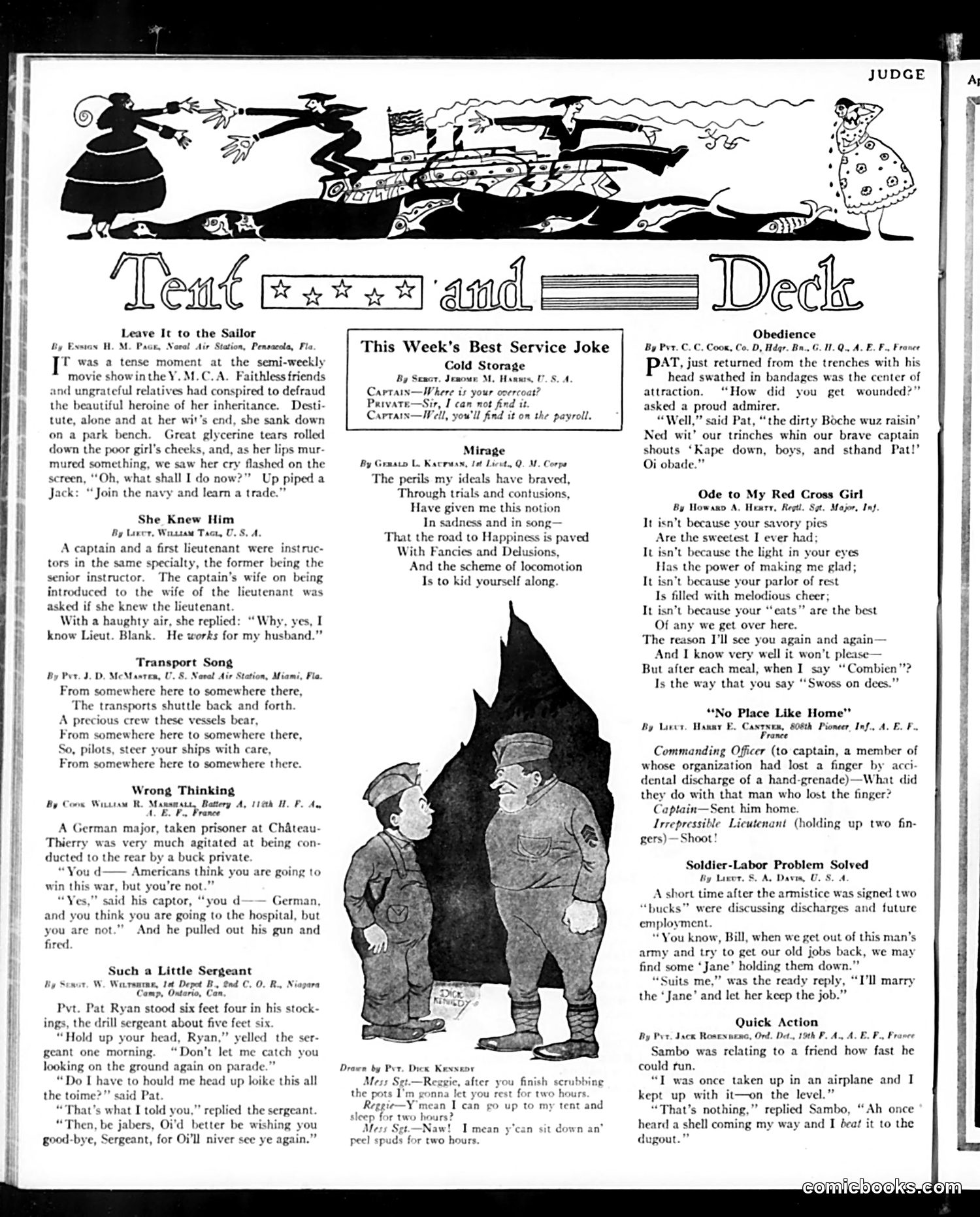
This WWI-era page from *Judge* contains humorous military anecdotes and verse contributed by servicemen. The central cartoon depicts two soldiers discussing scrubbing pots and peeling potatoes—menial camp duties presented as absurd equivalencies ("two hours" either way). The "service jokes" satirize military life's frustrations: a soldier's overcoat mysteriously "on the payroll" (implying it's lost to theft or bureaucracy); a German prisoner's miscalculation that Americans will lose the war; and an Irish private so tall he can't maintain proper parade posture. "Wrong Thinking" mocks German confidence despite capture. "Such a Little Sergeant" plays on the humiliation of a towering private taking orders from a diminutive drill sergeant—physical comedy highlighting military absurdity. The page overall captures soldier humor—self-deprecating, cynical about military organization, and reflective of trench-war weariness—while maintaining patriotic framing. It's essentially crowdsourced entertainment for and about servicemen, validating their experiences through comedy.
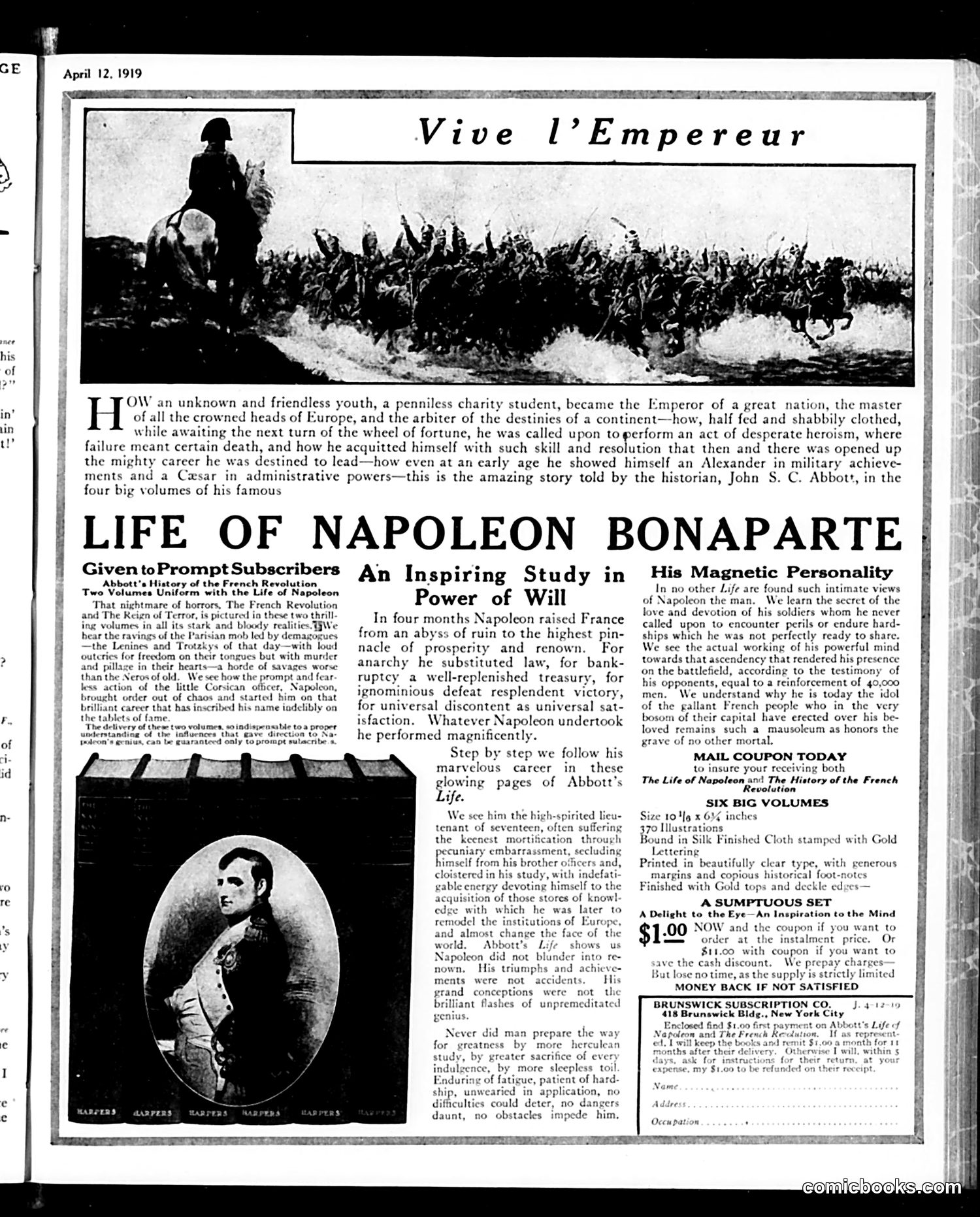
This is primarily **advertising, not political satire**. It's a mail-order subscription pitch for a six-volume biography set: *Life of Napoleon Bonaparte* and *Abbott's History of the French Revolution*, published by Brunswick Subscription Co. The page capitalizes on post-WWI American interest in Napoleon as a "great man" leader who brought order from chaos. The text emphasizes his will-power, rise from obscurity, and ability to transform France from ruin to prosperity—appealing messaging in 1919, just after World War I's devastation. The small illustration shows a silhouetted figure (likely Napoleon) on horseback addressing troops, reinforcing the "magnetic personality" theme described in the adjacent text. This is essentially a historical self-help book marketed through inspirational biography—Napoleon presented as a model of determination and leadership. No satire is evident; the tone is earnest promotional material.
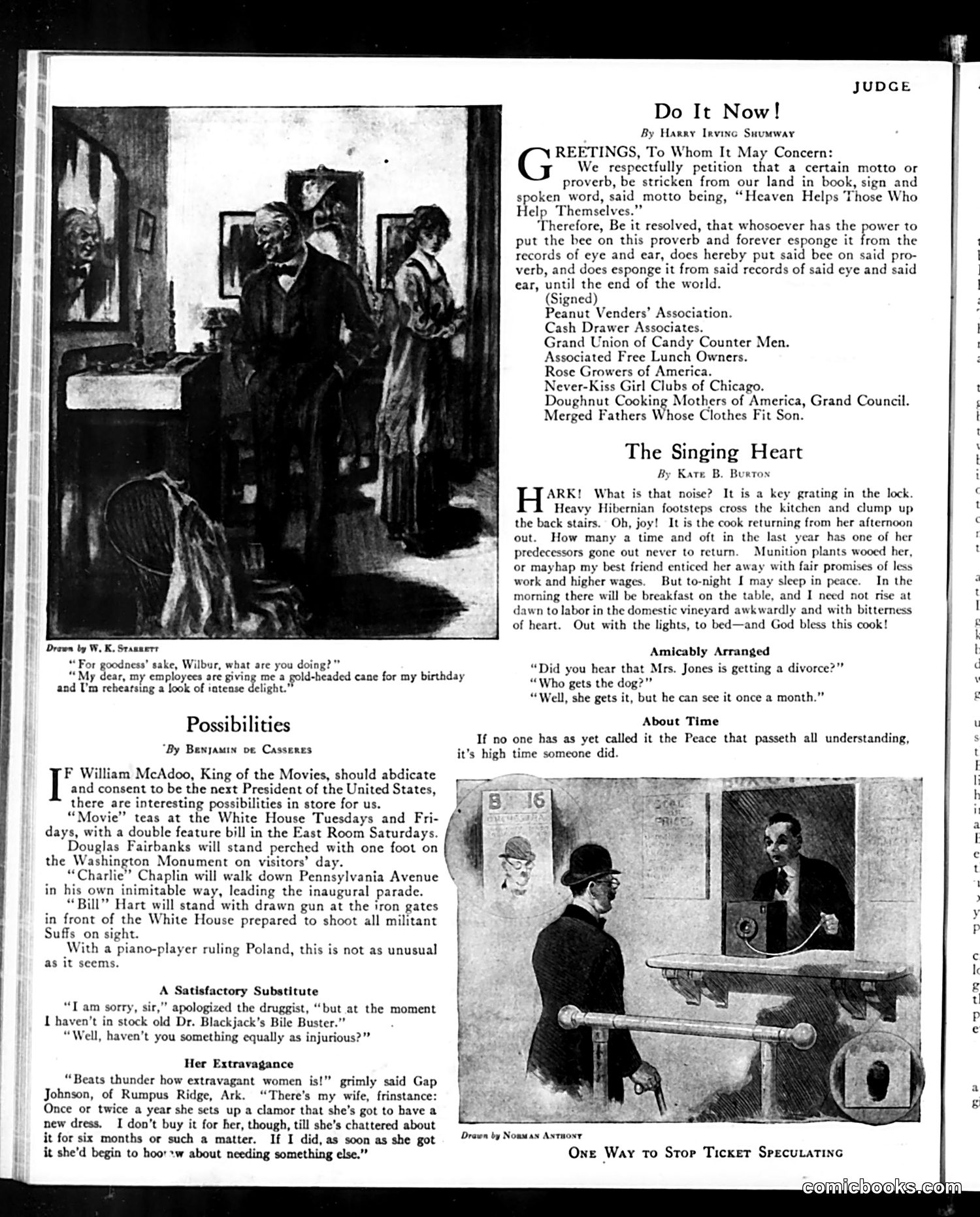
This page from the satirical magazine *Judge* contains multiple short humor pieces satirizing American society circa early 20th century. The top cartoon by W.K. Stasaert depicts a man rehearsing a fake expression of delight before receiving a gold-headed cane from employees—mocking insincere workplace gratitude rituals. "Possibilities" by Benjamin de Casseres satirizes William McAdoo (Treasury Secretary, likely a potential presidential candidate) by imagining Hollywood figures governing America: Douglas Fairbanks at monuments, Charlie Chaplin leading parades, and "Bill" Hart shooting "militant Suffs" (suffragettes)—absurdist humor attacking both movie star celebrity culture and anti-suffrage sentiment. Other pieces mock working-class life: a druggist joke about poisonous patent medicines; a farmer's complaint about wives wanting new dresses; and a petition from various worker groups demanding the proverb "Heaven Helps Those Who Help Themselves" be banned—satirizing laziness. The remaining content includes sentimental domestic fiction and a cartoon about ticket scalping (unclear specifics). The overall tone targets both upper-class pretension and working-class complaints while opposing women's suffrage.
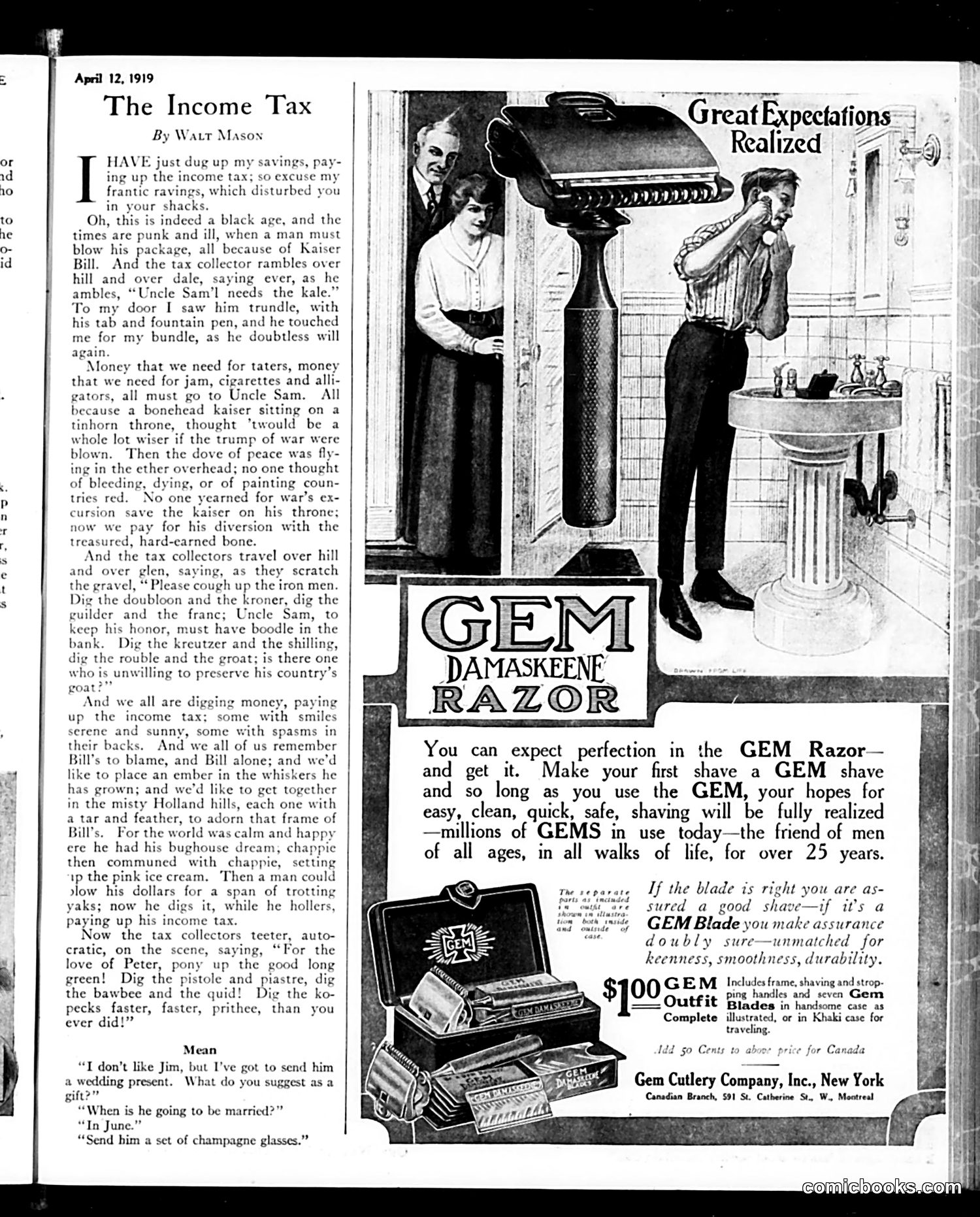
This page satirizes American resentment over income taxes imposed to fund World War I. The poem by Walt Mason complains that citizens must surrender their savings to "Uncle Sam" because of Kaiser Bill's war ambitions. The satire blames Germany's emperor for the conflict, arguing Americans now pay the price through taxation while tax collectors hound them relentlessly for "boodle" (money). The poem's repeated refrain—that people must "dig" money in various currencies to support the war effort—reflects post-WWI frustration. The final joke about champagne glasses as a wedding gift is unrelated humor filler. The GEM Razor advertisement occupies the right side, a typical magazine feature. Together, the content shows how income tax (newly permanent after 1913) generated public grumbling, particularly after America's costly 1917-1918 war involvement.
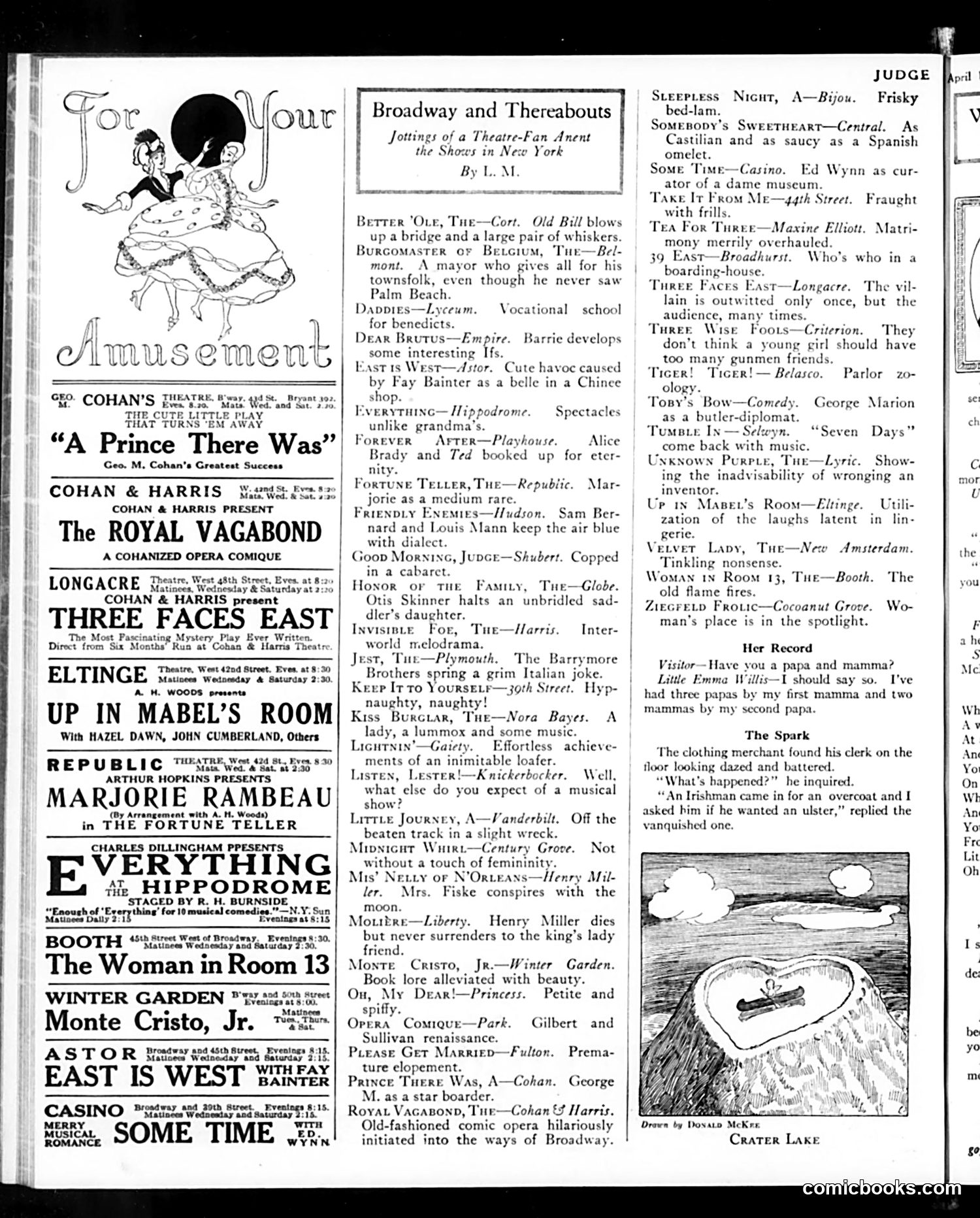
This page is primarily **theater advertising and reviews**, not political satire. The left side lists Broadway shows playing in New York, including titles like "A Prince There Was" (starring George M. Cohan) and "The Royal Vagabond." The right column contains brief, witty capsule reviews of current theatrical productions. The humor is theatrical—punny, observational commentary on plots and performances rather than political satire. For example, reviewing "Butter 'Ole, The": "Old Bill blows up a bridge and a large pair of whiskers." The small illustration (credited to Donald McKee) shows "Crater Lake"—a scenic landscape drawing, likely accompanying a separate article not visible here. **This is an entertainment/lifestyle page**, typical of Judge's format mixing humor with Broadway coverage, not a political cartoon page. The satire targets theatrical conventions and performers, not politics or current events.
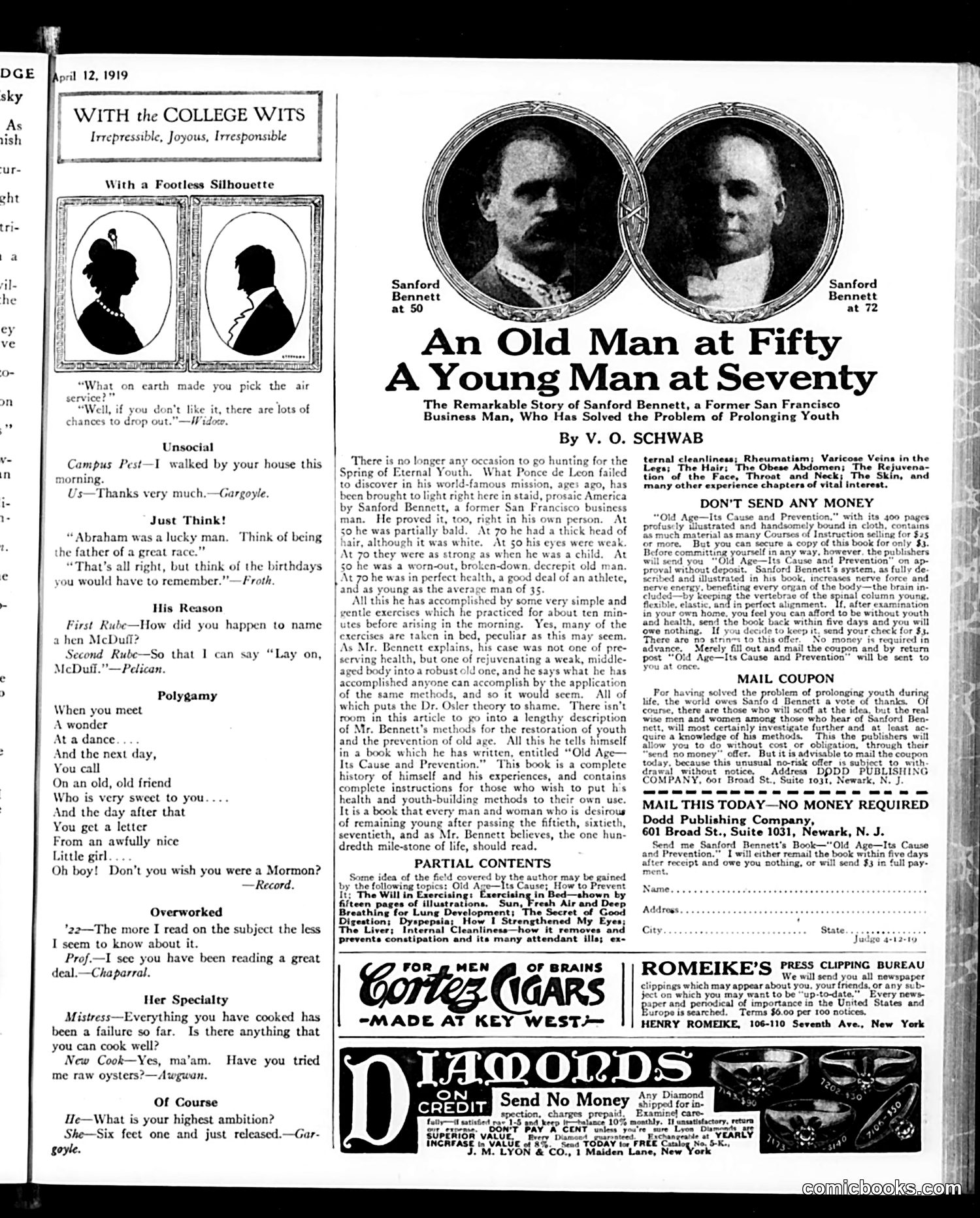
This page mixes college humor with an extended advertisement for a health book. **"With the College Wits"** presents short jokes about campus life—typical collegiate humor about romance, social awkwardness, and academic pretension. The "Footless Silhouette" section shows two profile portraits but the jokes aren't about identifying specific figures; they're generic college comedy. **The main feature**, "An Old Man at Fifty, A Young Man at Seventy," advertises Sanford Bennett's book "*Age—Its Cause and Prevention*." The accompanying portraits allegedly show Bennett at 50 (bald, weak-eyed, decrepit) versus 72 (full head of white hair, strong eyes, athletic). The pitch: Bennett "solved" aging through simple daily exercises and claims readers can reverse aging without sending money upfront. **The satire/appeal** targets anxieties about aging and vitality common in 1919. The "no money required" mail coupon represents classic mail-order promotional tactics of the era—offering free examination copies to generate interest. This reflects early-20th-century wellness marketing that mixed legitimate interest in fitness with exaggerated anti-aging claims.
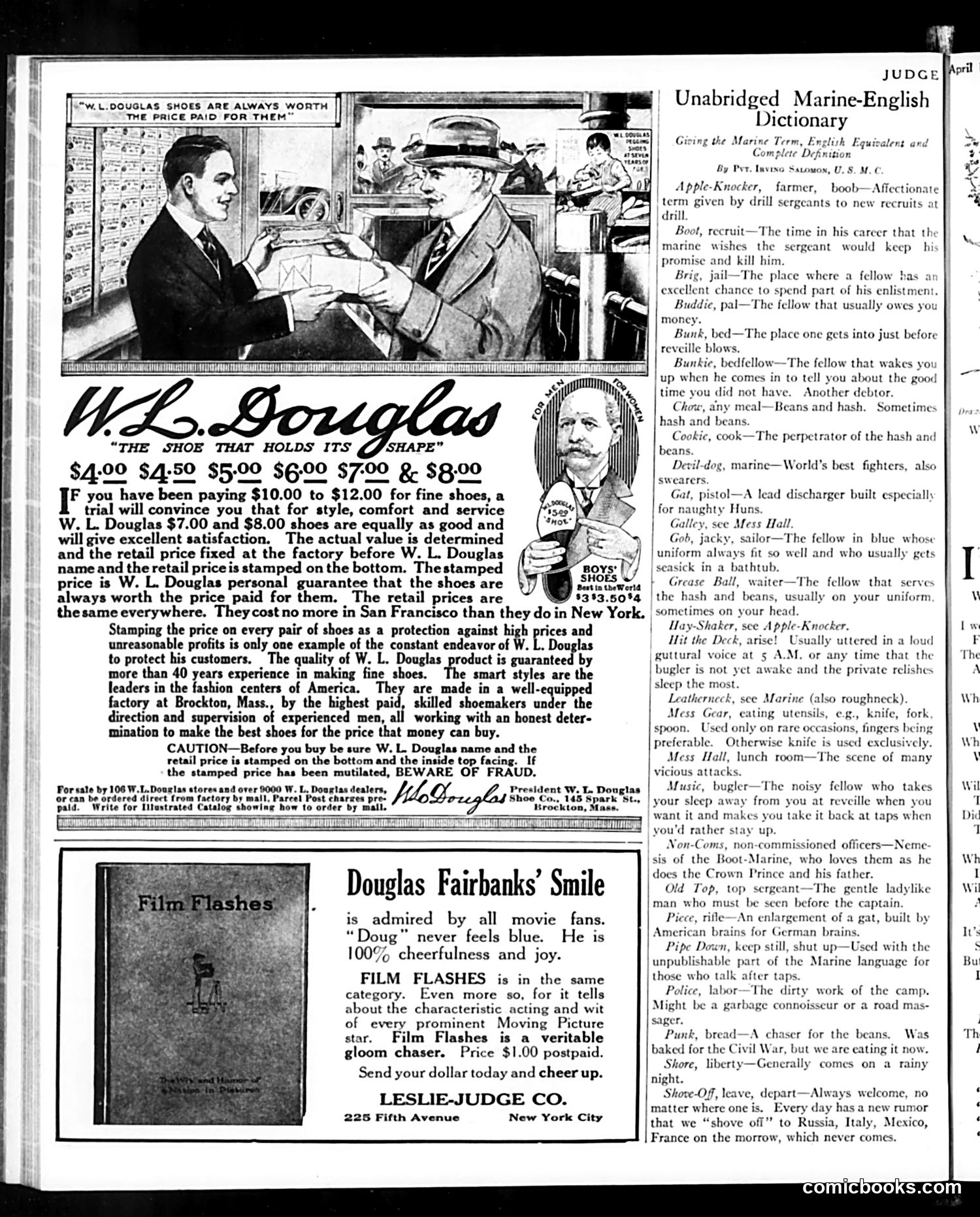
This page is primarily **advertising**, not political satire. The main content promotes W.L. Douglas shoes, emphasizing their affordability and quality ($4-8 price range) with a factory-direct pricing guarantee. The accompanying illustration shows a shoe salesman convincing a customer of the shoe's value. A secondary advertisement features actor Douglas Fairbanks promoting *Film Flashes*, a movie fan magazine published by Leslie-Judge Company. The page's only satirical content is the "Unabridged Marine-English Dictionary"—a humorous glossary defining military slang from WWI era. Terms like "Boot" (recruit), "Devil-dog" (Marine), and "Gob" (sailor) mock military life with tongue-in-cheek definitions. For instance, "Boot" jokes that recruits wish their sergeant would "keep his promise and kill him," satirizing harsh drill sergeant training. The dictionary reflects *Judge* magazine's characteristic irreverent humor about military culture, likely resonating with post-WWI American readers familiar with service life.
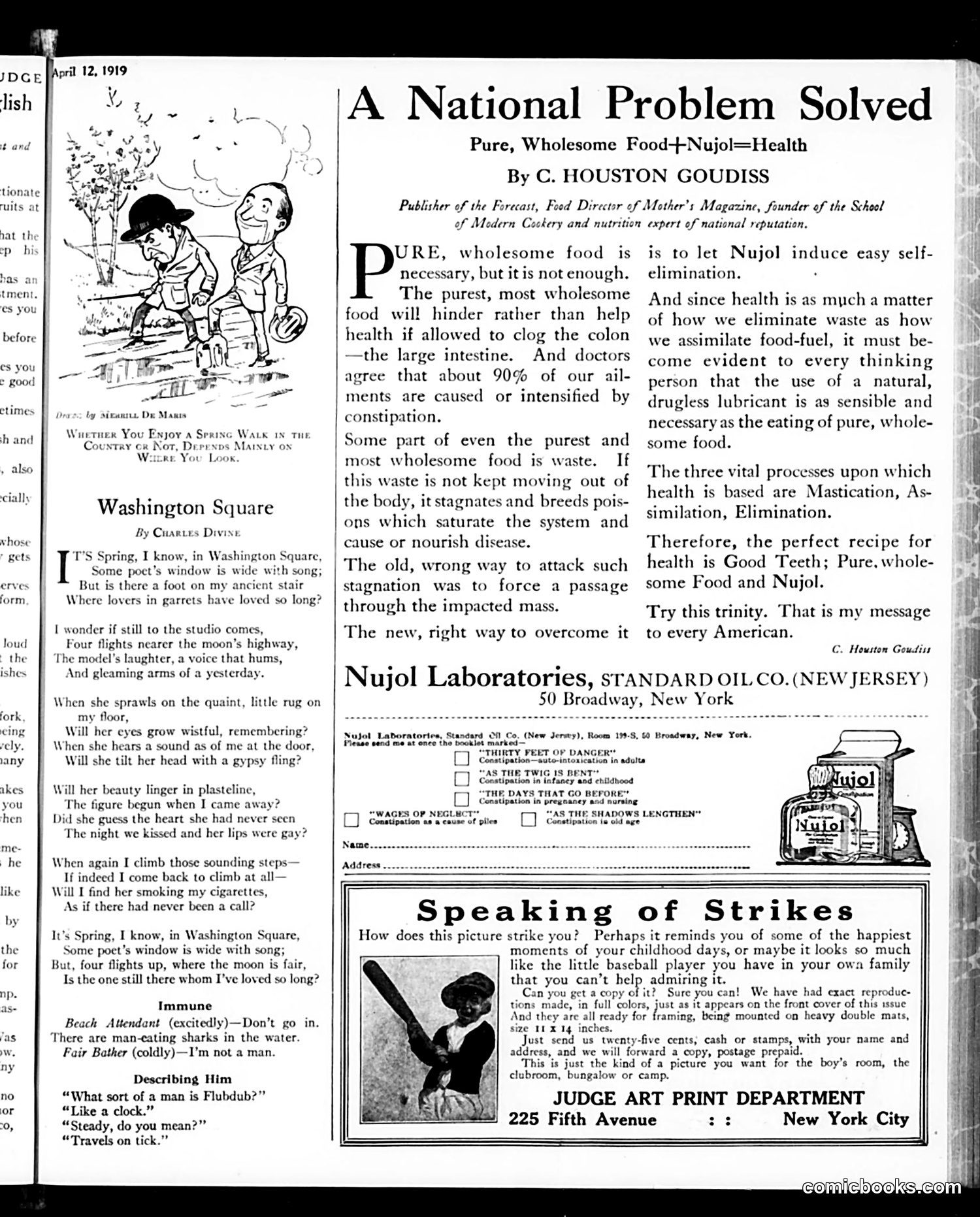
This page mixes poetry, humor, and advertising rather than political satire. **The main content** includes: - "Washington Square" by Charles Divine—nostalgic verse about a poet remembering a former lover in a Greenwich Village garret, reflecting post-WWI melancholy about lost romance - Brief joke items ("Immune," "Describing Him") with mild social humor - A large advertisement for **Nujol**, a mineral-oil laxative by Standard Oil, presented as solving America's "national problem" of constipation **The Nujol ad** is notable for its pseudo-scientific health claims (90% of ailments caused by constipation) and celebrity endorsement by "nutrition expert" C. Houston Goudiss—typical of 1919 patent-medicine marketing before FDA regulation. The ad promises health through three processes: "Mastication, Assimilation, Elimination." **The cartoon** at top-left appears to show two men discussing spring activities—likely related to the romantic themes in the poetry. This represents Judge's shift toward consumer advertising revenue rather than purely satirical content.
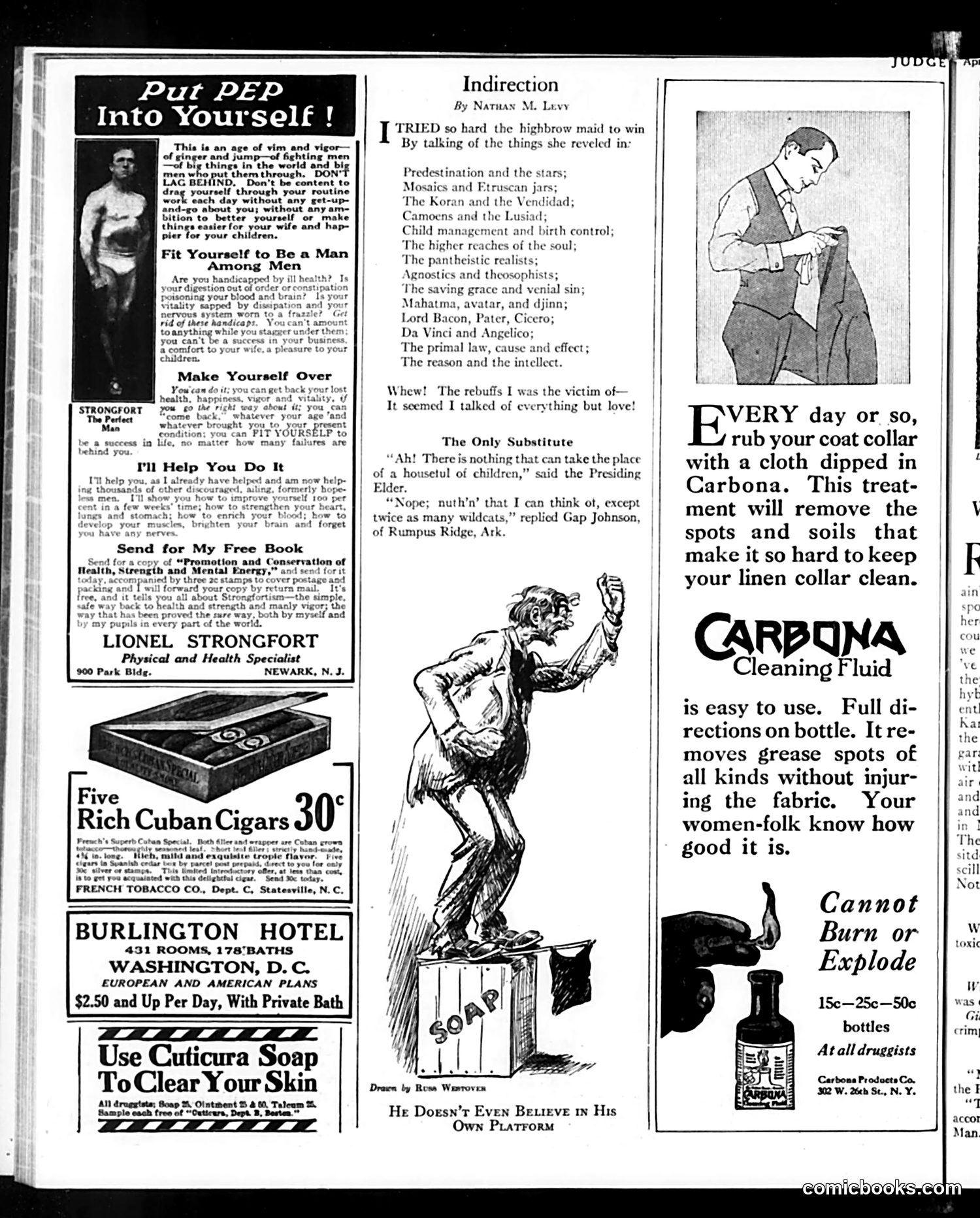
This page contains primarily **advertisements and satirical content** from Judge magazine (a humor/satire publication). The main cartoon, titled "He Doesn't Even Believe in His Own Platform," depicts a figure standing on a soapbox labeled "SOAP"—a visual pun suggesting the character is literally standing on soap while preaching. The cartoonist implies the speaker is hypocritically promoting ideas he doesn't actually believe in himself, or that his platform is insubstantial ("soap"). The accompanying poem "Indirection" by Nathan M. Levy satirizes a failed courtship attempt: a man tries impressing an intellectual woman by discussing lofty philosophical topics (predestination, Eastern philosophy, classical figures), but she rejects him because he never addresses love or romance—he talks of everything *except* what matters. The remainder consists of period advertisements (cigars, hotels, physical fitness courses, cleaning products) typical of early 20th-century magazine pages. No specific political figures or dated events are identifiable.
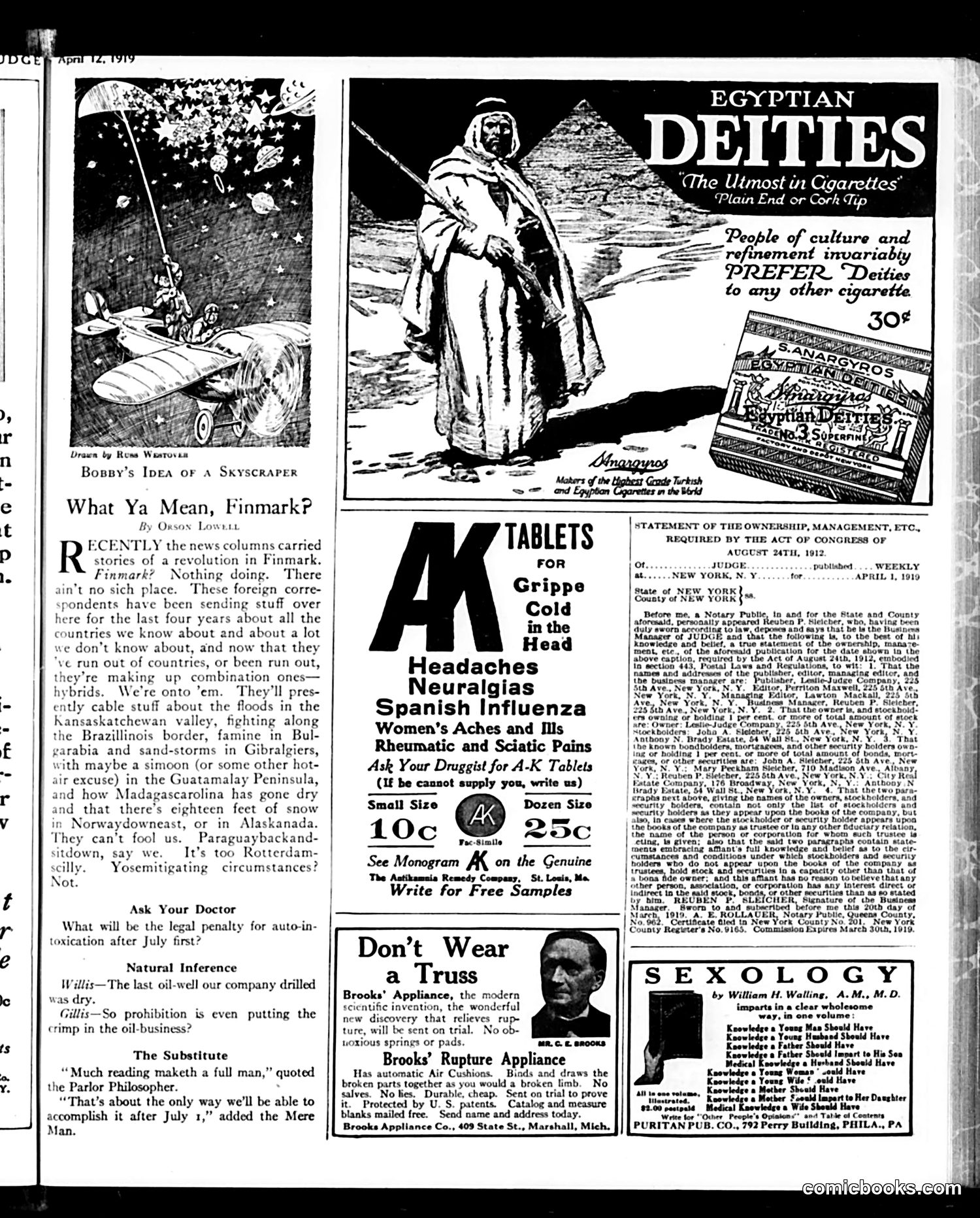
This page is primarily **advertising with minimal political content**. The main cartoon, "Bobby's Idea of a Skyscraper," depicts a child's imaginative drawing—likely satirizing naive or unrealistic visions of modern progress. The accompanying article "What Ya Mean, Finmark?" mocks newspaper foreign correspondents for fabricating or combining place names (Finmark, Kansaskatchewan-Brazillinois, etc.) when actual news runs dry. This satirizes post-WWI journalism's credibility problem—reporters inventing stories rather than admitting lack of genuine news from distant regions. The remaining page consists of period advertisements: AK Tablets (headache remedy), Egyptian Deities cigarettes, a rupture truss, and a medical textbook on sexology. **Context for modern readers:** This reflects 1919 concerns about journalistic reliability and the prevalence of quack medical remedies marketed without modern FDA regulation.
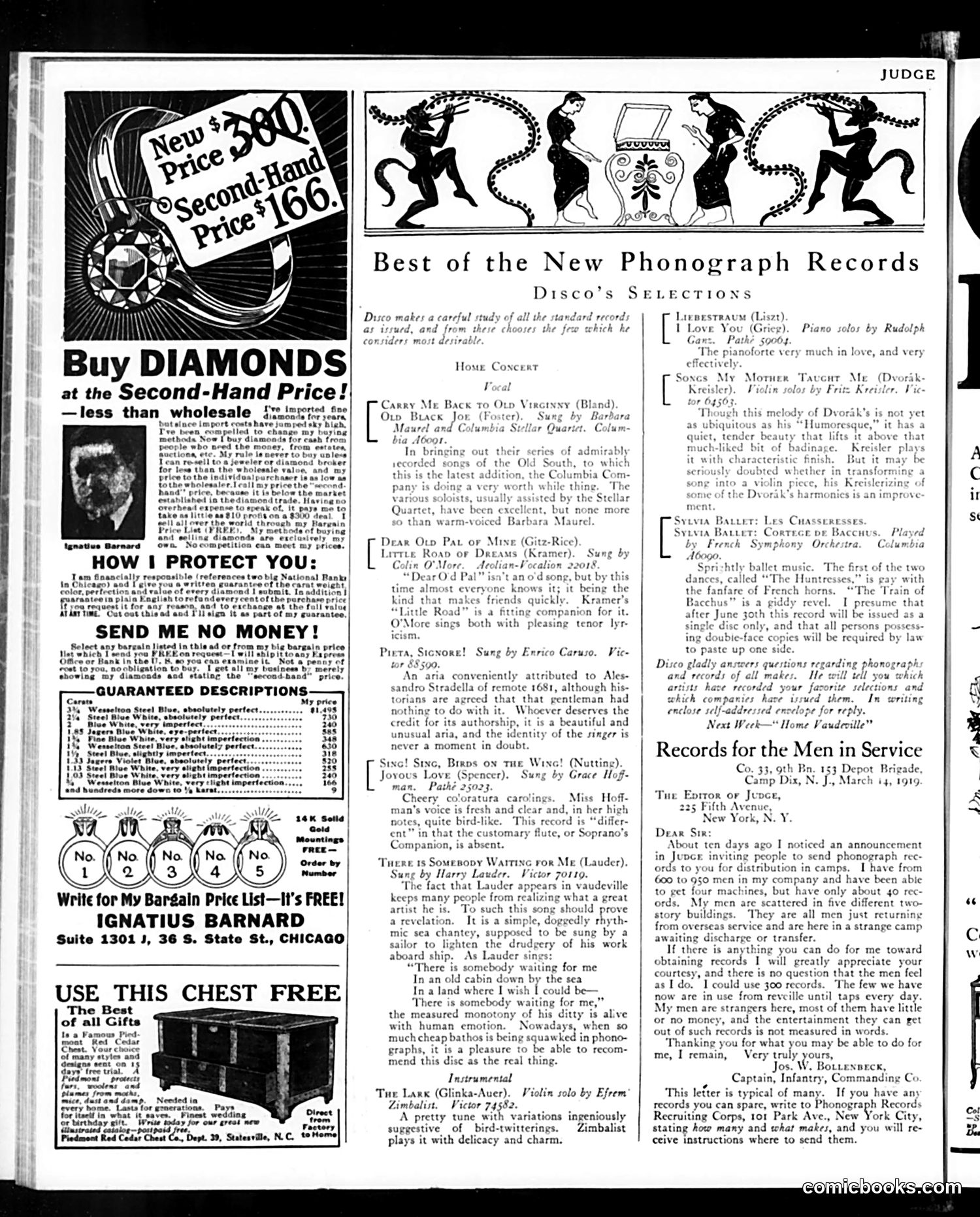
This page is primarily **advertising and reader correspondence**, not political satire. The main content features: 1. **Diamond sales ads** (Ignatius Barnard) - exploiting post-WWI economic uncertainty by selling "second-hand" diamonds at steep discounts, claiming wholesale prices. The pitch targets consumers seeking bargains. 2. **Phonograph record reviews** ("Disco's Selections") - contemporary classical and popular music recommendations, reflecting the early phonograph era's cultural cachet. 3. **"Records for Men in Service"** - a touching letter from Captain Bollenbeck requesting phonograph records for soldiers in camps post-WWI (dated March 1919). This shows how the magazine engaged readers in charitable support for returning troops. The page reflects **1919 America**: post-war economic transitions, emerging consumer culture, and patriotic appeals to support soldiers. The satirical magazine format includes earnest reader correspondence alongside commercial exploitation—a characteristic Judge blend of humor, advertisement, and social commentary.
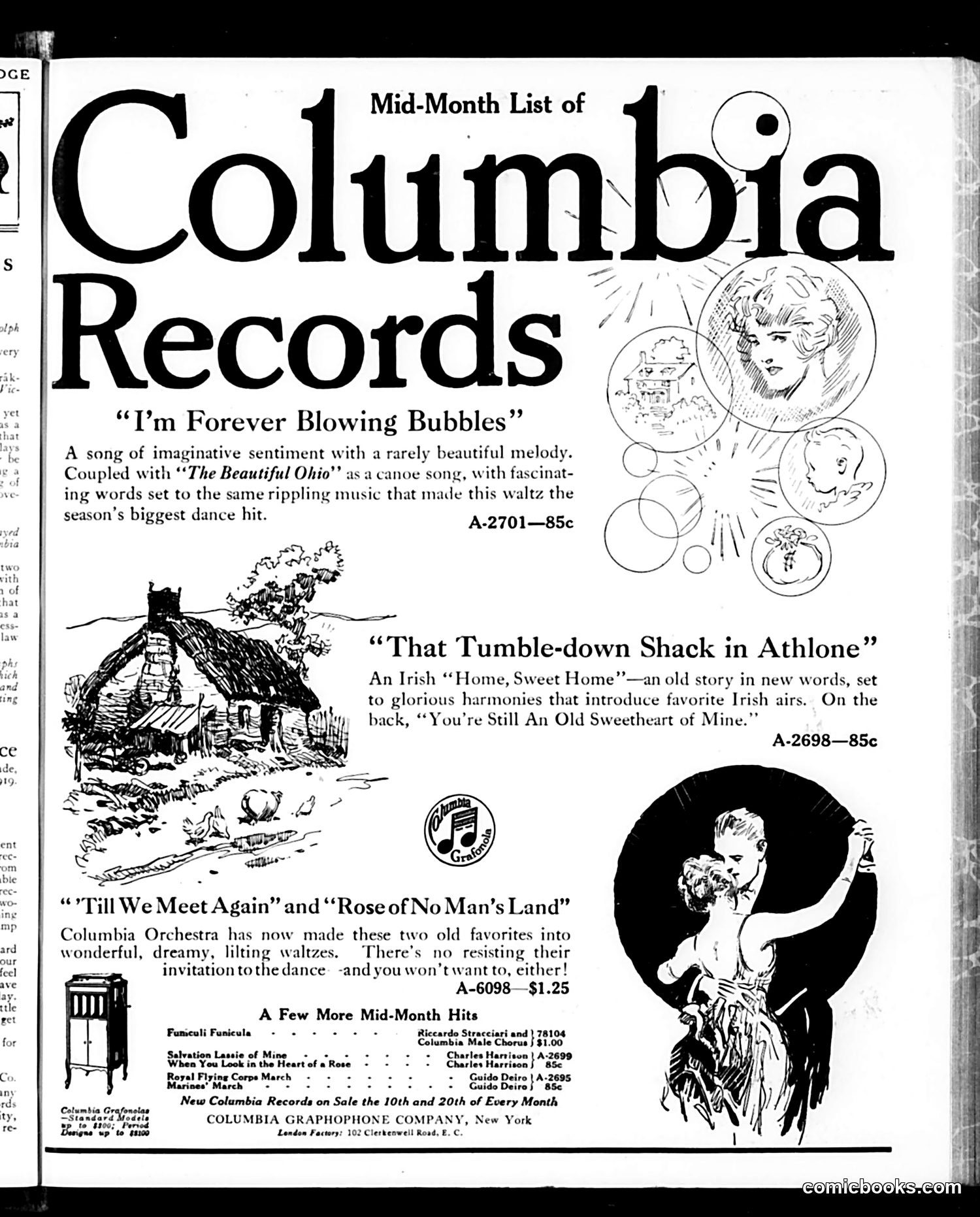
This is a Columbia Records advertisement from Judge magazine, promoting phonograph recordings—not a political cartoon. The page showcases popular songs of the era, likely from around WWI based on song titles like "Till We Meet Again," "Rose of No Man's Land," and "Royal Flying Corps March." The featured recordings include sentimental waltzes and Irish-themed songs ("That Tumble-down Shack in Athlone"), reflecting popular taste of the period. The imagery—couples dancing, romantic scenes—illustrates the escapist entertainment these records offered. The price points (85¢ to $1.25) and mentions of "the season's biggest dance hit" indicate this was commercial promotion targeting middle-class consumers who owned gramophones. There is no satire or political commentary here; this is straightforward period advertising for entertainment products.
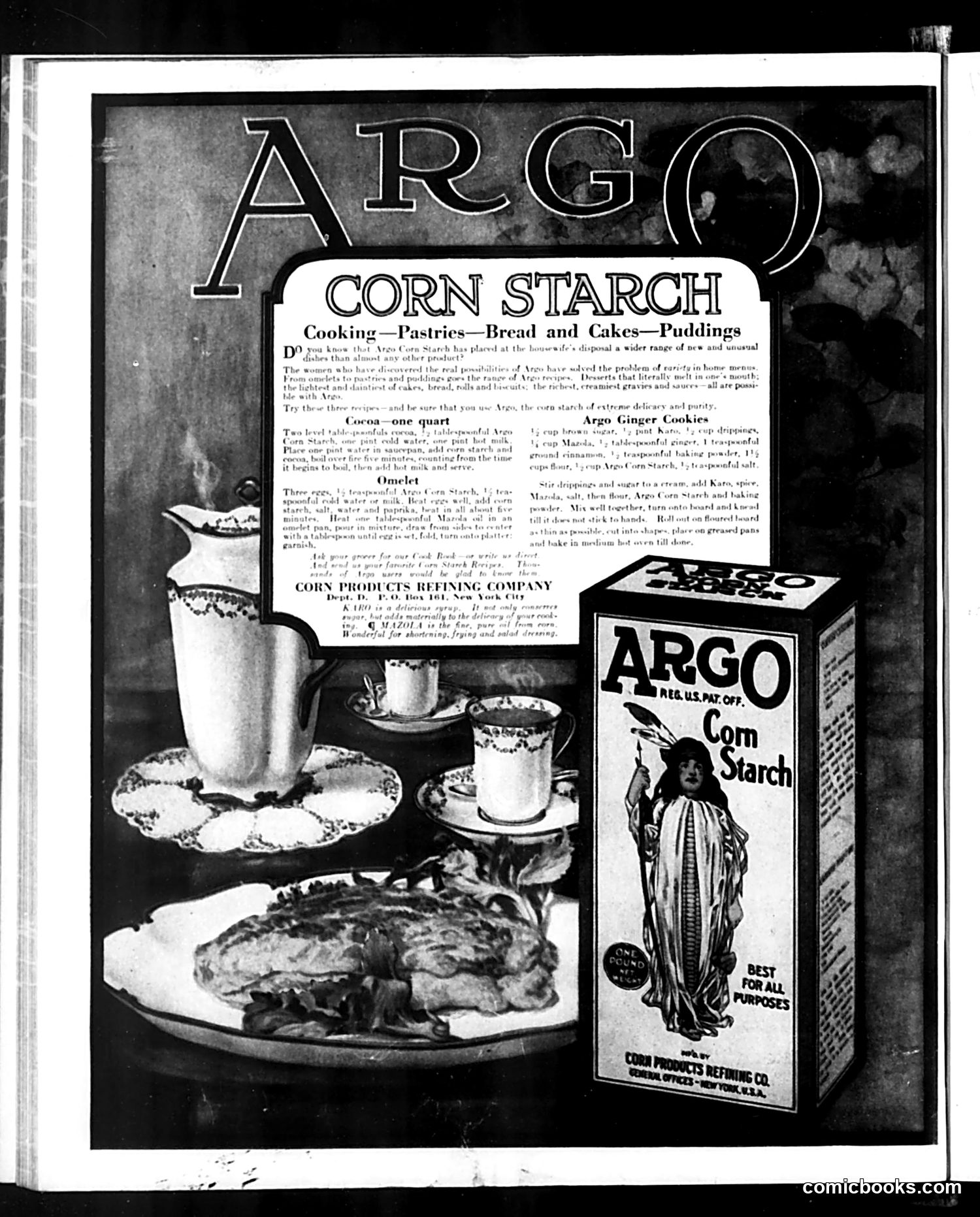
This page is **primarily an advertisement**, not political satire. It promotes Argo Corn Starch, a product by the Corn Products Refining Company (New York City). The ad features recipes for cooking applications—ginger cookies, cocoa, and omelet—emphasizing the product's versatility for "Cooking—Pastries—Bread and Cakes—Puddings." The visual elements include the product box (decorated with a Native American figure, a common branding choice of the era) alongside finished dishes and beverages meant to demonstrate culinary uses. The Native American imagery was typical early-20th-century marketing, though problematic by modern standards. No satirical commentary or political figures are present. This is straightforward commercial advertising from Judge magazine's pages.