
Judge, 1919-04-12 · page 12 of 36
Judge — April 12, 1919 — page 12: what you’re looking at
What you’re looking at
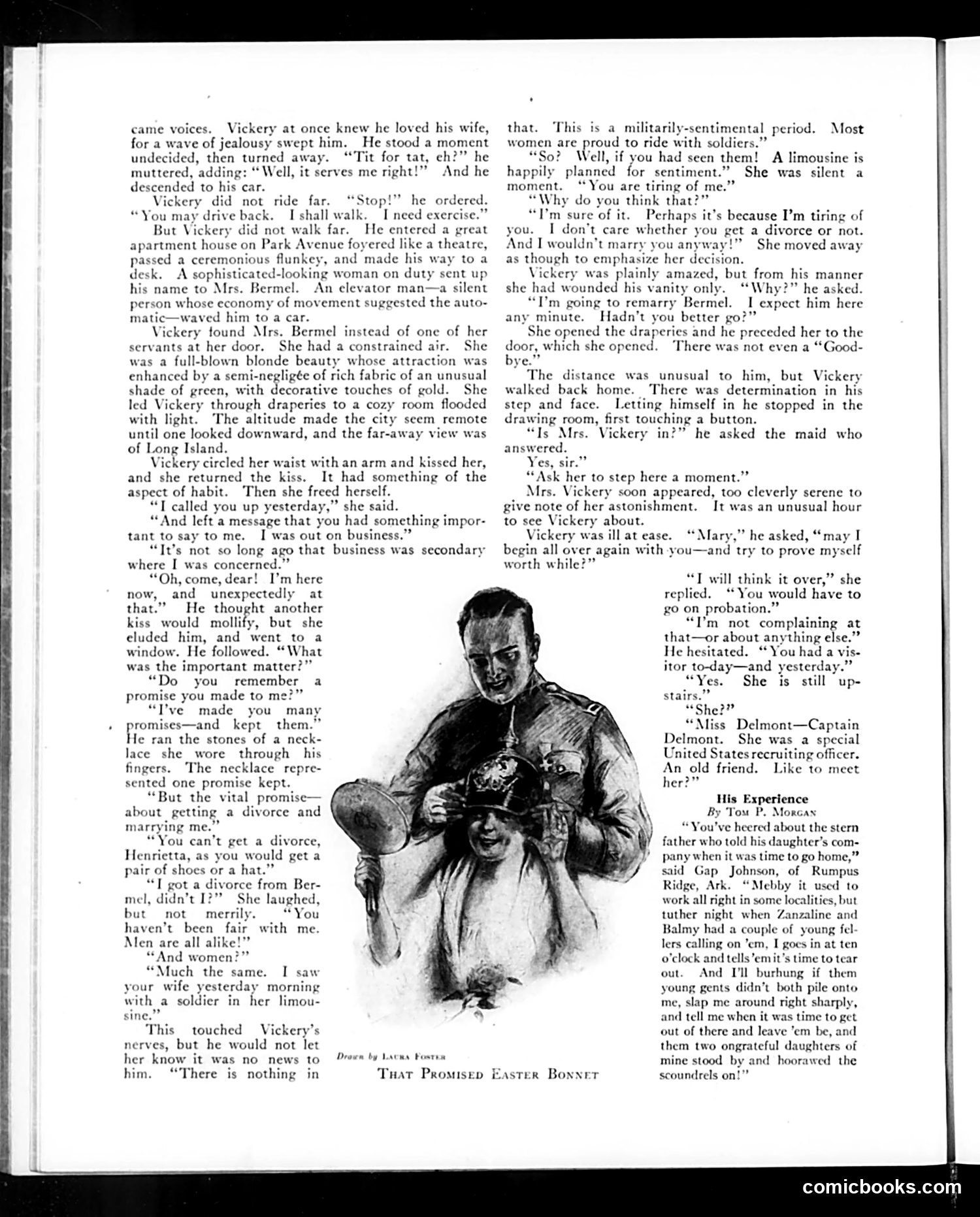
This page shows a serialized fiction story—not political satire—depicting a domestic drama. The narrative involves a man named Vickery discovering his wife's infidelity with a soldier during what the text calls "a militarily-sentimental period" (likely WWI era, when women were "proud to ride with soldiers"). Vickery confronts his mistress, Mrs. Bermel, seeking to resume their affair, but she dismisses him—she's reuniting with her ex-husband instead. The illustration shows an elegant woman in a negligée. Humbled, Vickery returns home to confront his own wife. The "Easter Bonnet" reference in the title appears ironic: rather than sentimental springtime romance, the story explores betrayal and vanity among the wealthy. Judge magazine mixed satirical cartoons with such serialized fiction for middle-class readers.
📄 Transcribed text from this page (OCR, searchable)
Machine-transcribed from the original scan — historical spelling and the odd misread are preserved.
came voices. Vickery at once knew he loved his wife, for a wave of jealousy swept him. He stood a moment undecided, then turned away. “Tit for tat, ch?” he muttered, adding: “Well, it serves me right!” And he descended to his car. Vickery did not ride far. “Stop!”’ he ordered. “You may drive back. I shall walk. I need exercise.” But Vickery did not walk far. He entered a great apartment house on Park Avenue foyered like a theatre, passed a ceremonious flunkey, and made his way to a desk. A sophisticated-looking woman on duty sent up his name to Mrs. Bermel. An elevator man—a silent person whose economy of movement suggested the auto- waved him to a car. Vickery tound Mrs. Bermel instead of one of her servants at her door. She had a constrained air. She was a full-blown blonde beauty whose attraction was enhanced by a semi-negligée of rich fabric of an unusual shade of green, with decorative touches of gold. She led Vickery through draperies to a cozy room flooded with light. The altitude made the city seem remote until one looked downward, and the far-away view was of Long Island. Vickery circled her waist with an arm and kissed he: and she returned the kiss. It had something of the aspect of habit. Then she freed herself. “I called you up yesterday,” she said. “And left’a message that you had something impor- tant to say to me. I was out on business.” “Tt’s not so long ago that business was secondary where I was concerned.” “Oh, come, dear! I’m here now, and unexpectedly at that.” He thought another kiss would mollify, but she eluded him, and went to a window. He followed. “What was the important matter?” “Do you remember a promise you made to me?” “T’'ve made you many promises—and kept them.” He ran the stones of a neck- lace she wore through his fingers. The necklace repre- sented one promise kept. “But the vital promise— about getting a divorce and marrying me.” “You can’t get a divorce, Henrietta, as you would get a pair of shoes or a hat.” “T got a divorce from Ber- mel, didn’t She laughed, but not merrily. “You haven’t been fair with me. Men are all alike!” “And women “Much the same. I saw your wife yesterday morning with a soldier in her limou- his touched Vickery’s nerves, but he would not let her know it was no news to him. “There is nothing in Drown by Lacns Posten Tuat Promisep Easter Bonnet that. This is a militarily-sentimental period. Most women are proud to ride with soldiers.” “S Well, if you had seen them! A limousine is happily planned for sentiment.” She was silent a moment. ‘You are tiring of me.” “Why do you think that?” “I'm sure of it. Perhaps it’s because I’m tiring of you. I don’t care whether you get a divorce or not. And I wouldn’t marry you anywa She moved away as though to emphasize her decision. Vickery was plainly amazed, but from his manner she had wounded his vanity only. “Why?” he asked. “I’m going to remarry Bermel. I expect him here minute. Hadn't you better go? She opened the draperies and he preceded her to the door, which she opened. ‘There was not even a “Good- bye.” The distance was unusual to him, but Vickery walked back home. There was determination in his step and face. Letting himself in he stopped in the drawing room, first touching a button. “Is Mrs. Vickery in?” he asked the maid who answered Yes, sir.” “Ask her to step here a moment.” Mrs. Vickery soon appeared, too cleverly serene to give note of her astonishment. It was an unusual hour to see Vickery about. Vickery was ill at ease. “Mary,” he asked, “may I begin all over again with -you—and try to prove myself worth while?” any “T will think it over,” she replied. ‘You would have to go on probation.” “I’m not complaining at that—or about anything else.” He hesitated. “ You had a vis- itor to-day—and yesterday.” “Yes. She is still up- stairs.” “She?” “Miss Delmont—Captain Delmont. She was a special United States recruiting officer. An old friend. Like to meet her?” His Experience Tou P. Morcax “You've heered about the stern father who told his daughter's com- pany when it was time to go home,” said Gap Johnson, of Rumpus Ridge, Ark. “Mebby it used to work all right in some localities, but tuther night when Zanzaline and Balmy had a couple of young fel- lers calling on ’em, I goes in at ten o'clock and tells’em it’s time to tear out. And I'll burhung if them young gents didn’t both pile onto me, slap me around right sharply, and tell me when it was time to get out of there and leave ‘em be, and them two ongrateful daughters of mine stood by and hoorawed the scoundrels on!’ comicbooks.com