
Judge, 1919-04-12 · page 8 of 36
Judge — April 12, 1919 — page 8: what you’re looking at
What you’re looking at
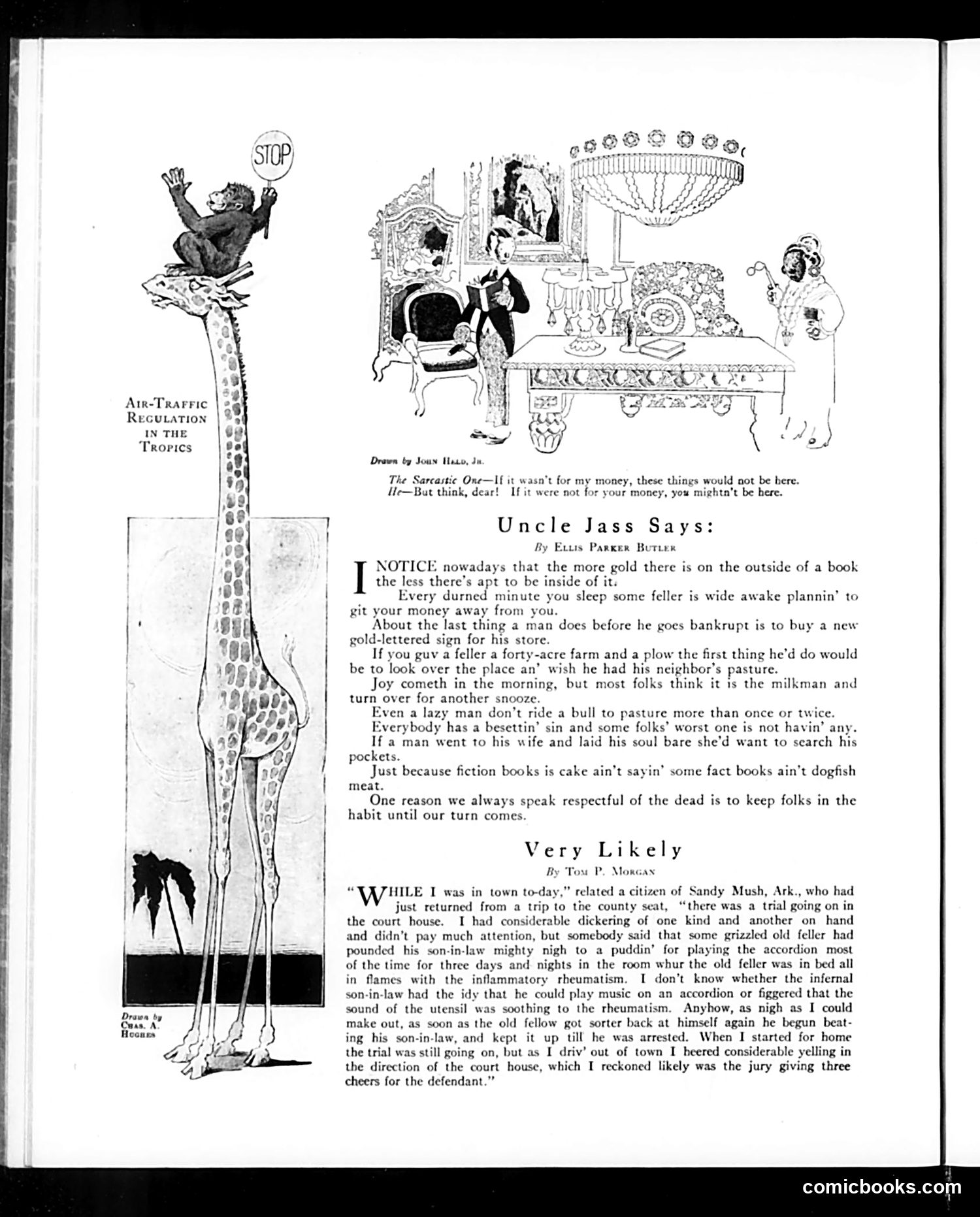
This page contains three separate humorous pieces typical of early 20th-century satirical magazines: **"Air-Traffic Regulation in the Tropics"** (left cartoon): A giraffe holds a "STOP" sign while a mosquito flies nearby. The joke plays on the absurdity of traffic control in an exotic setting where insects pose greater hazards than vehicles. **Sarcastic Dialogue** (center): A couple at an elegant dinner party exchanges barbs about wealth and existence—she credits her money for their luxuries; he sardonically suggests her money is also responsible for her being alive. This mocks nouveau riche materialism and marital tension. **"Uncle Jass Says"** and **"Very Likely"** (text pieces): Folksy, homespun wisdom columns delivering cynical observations about human nature—money-seeking, hypocrisy, laziness, and marital discord. The final anecdote humorously describes an old man beating his accordion-playing son-in-law during an illness, with apparent community approval ("cheers for the defendant"). Together, these pieces reflect Judge's satirical approach to American social behavior and class pretensions.
📄 Transcribed text from this page (OCR, searchable)
Machine-transcribed from the original scan — historical spelling and the odd misread are preserved.
Air-Trarric RecuLation IN THE Tropics Fr Lk msec Ptr yu Drawn by Joux taro, Ju The Sarcastic One—If it wasn't for my money, these things would not be here. He—But think, dear! If it were not for your money, you mightn’t be here. =2ee Uncle Jass Says: By Extis Parwer Butiex I NOTICE nowadays that the more gold there is on the outside of a book the less there’s apt to be inside of it. Every durned minute you sleep some feller is wide awake plannin’ to your money away from you. About the last thing a man does before he goes bankrupt is to buy a new gold-lettered sign for his store. If you guv a feller a forty-acre farm and a plow the first thing he'd do would be to look over the place an’ wish he had his neighbor’s pasture. Joy cometh in the morning, but most folks think it 1s the milkman and turn over for another snooze. Even a lazy man don’t ride a bull to pasture more than once or twice. I ybody has a besettin’ sin and some folks’ worst one is not havin’ any. If a man went to his wife and laid his soul bare she’d want to search his pockets. Just because fiction books is cake ain’t sayin’ some fact books ain't dogfish meat. One reason we always speak respectful of the dead is to keep folks in the habit until our turn comes. Very Likely By Tou P. Moxcax HILE I was in town to-day,” related a citizen of Sandy Mush, Ark., who had just returned from a trip to the county seat, “there was a trial going on in the court house. I had considerable dickering of one kind and another on hand and didn’t pay much attention, but somebody said that some grizzled old feller had pounded his son-in-law mighty nigh to a puddin’ for playing the accordion most of the time for three days and nights in the room whur the old feller was in bed all in flames with the inflammatory rheumatism. I don’t know whether the infernal son-in-law had the idy that he could play music on an accordion or figgered that the sound of the utensil was soothing to the rheumatism. Anyhow, as nigh as I could Cwas. A. make out, as soon as the old fellow got sorter back at himself again he begun beat- Hocus fi) C ing his son-in-law, and kept it up till he was arrested. When I started for home gy the trial was still going on, but as I driv’ out of town I heered considerable yelling in aA the direction of the court house, which I reckoned likely was the jury giving three . cheers for the defendant.” comicbooks.com