
Judge, 1919-04-12 · page 22 of 36
Judge — April 12, 1919 — page 22: what you’re looking at
What you’re looking at
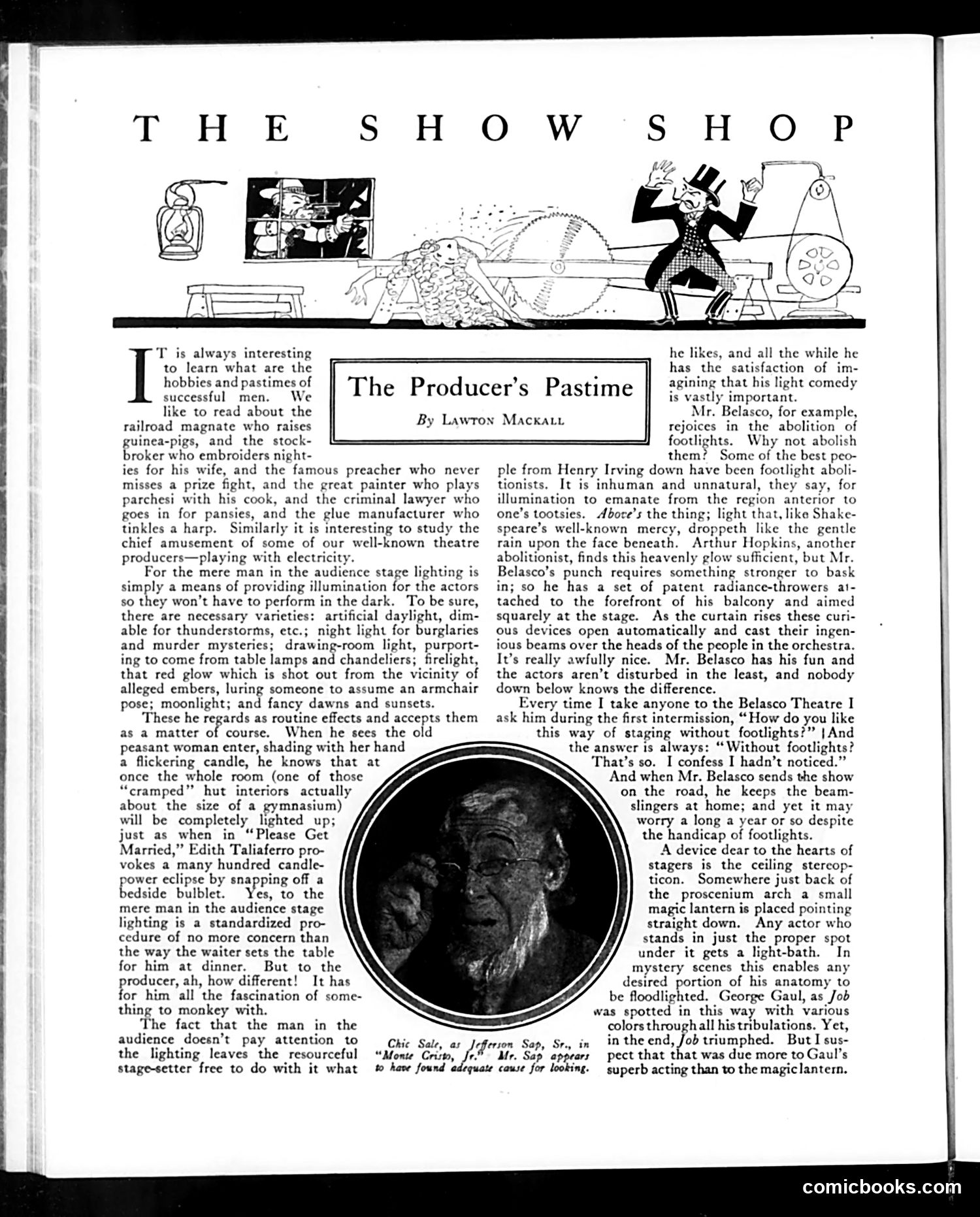
This article satirizes theatre producer **David Belasco**, a famous early-20th-century Broadway impresario known for his elaborate staging innovations. The satire mocks producers' obsession with technical experimentation, particularly **stage lighting**, which audiences largely ignore. The piece targets Belasco's specific crusade: abolishing **footlights** (lights at stage front) in favor of overhead lighting rigs that illuminate actors from above. The author presents this as vanity—producers tinker endlessly with effects while audiences remain oblivious. The joke culminates when Belasco removes the expensive lighting equipment for touring productions, revealing the innovation was merely ego-driven spectacle. The accompanying illustration shows a theatre producer (likely Belasco caricatured) gleefully manipulating theatrical elements, emphasizing how producers treat stagecraft as a personal hobby rather than practical necessity. The satire targets the gap between theatrical pretension and audience indifference—a classic Judge theme.
📄 Transcribed text from this page (OCR, searchable)
Machine-transcribed from the original scan — historical spelling and the odd misread are preserved.
T is always interesting to learn what are the hobbies and pastimes of successful men. We like to read about the railroad magnate who raises guinea-pigs, and the stock- broker who embroiders night- ies for his wife, and the famous preacher who never misses a prize fight, and the great painter who plays parchesi with his cook, and the criminal lawyer who goes in for pansies, and the glue manufacturer who tinkles a harp. Similarly it is interesting to study the chief amusement of some of our well-known theatre producers—playing with electricity. For the mere man in the audience stage lighting is simply a means of providing illumination for the actors so they won’t have to perform in the dark. To be sure, there are necessary varieties: artificial daylight, dim able for thunderstorms, etc.; night light for burglaries and murder mysteries; drawing-room light, purport- ing to come from table lamps and chandeliers; firelight, that red glow which is shot out from the vicinity of alleged embers, luring someone to assume an armchair pose; moonlight; and fancy dawns and sunsets. These he regards as routine effects and accepts them as a matter of course. When he sees the old peasant woman enter, shading with her hand a flickering candle, he knows that at once the whole room (one of those “cramped” hut interiors actually about the size of a gymnasium) will be completely lighted up; just as when in “Please Get Married,” Edith Taliaferro pro- vokes a many hundred candle- power eclipse by snapping off a bedside bulblet. Yes, to the mere man in the audience stage lighting is a standardized pro- cedure of no more concern than the way the waiter sets the table for him at dinner. But to the producer, ah, how different! It has for him all the fascination of some- thing to monkey with. The fact that the man in the audience doesn’t pay attention to the lighting leaves the resourceful stage-setter free to do with it what eee ee ae e. “Monte Cristo, Jr.’ The Producer’s Pastime By Lawron Mackati Chic Sale, as Jefferson Sap, Sra in to have found adequate cause for looking. he likes, and all the while he has the satisfaction of im- agining that his light comedy is vastly important. Mr. Belasco, for example, rejoices in the abolition of footlights. Why not abolish them? Some of the best peo- ple from Henry Irving down have been footlight aboli- tionists. It is inhuman and unnatural, they say, for illumination to emanate from the region anterior to one’s tootsies. Abore’s the thing; light that, like Shake- speare’s well-known mercy, droppeth like the gentle rain upon the face beneath. Arthur Hopkins, another abolitionist, finds this heavenly glow sufficient, but Mr. Belasco’s punch requires something stronger to bask in; so he has a set of patent radiance-throwers ai- tached to the forefront of his balcony and aimed squarely at the stage. As the curtain rises these curi- ous devices open automatically and cast their ingen- ious beams over the heads of the people in the orchestra. It’s really awfully nice. Mr. Belasco has his fun and the actors aren’t disturbed in the least, and nobody down below knows the difference. Every time I take anyone to the Belasco Theatre I ask him during the first intermission, “How do you like this way of staging without footlights?” |And the answer is always: “Without footlights? That’s so. I confess I hadn’t noticed.” And when Mr. Belasco sends the show on the road, he keeps the beam- slingers at home; and yet it may worry a long a year or so despite the handicap of footlights. A device dear to the hearts of stagers is the ceiling stereop- ticon. Somewhere just back of the proscenium arch a small magic lantern is placed pointing straight down. Any actor who stands in just the proper spot under it gets a light-bath. In mystery scenes this enables any desired portion of his anatomy to be floodlighted. George Gaul, as Job was spotted in this way with various colors throughall histribulations. Yet, in the end, Job triumphed. But] sus- pect that that was due more to Gaul’s superb acting than to the magiclantern. Mr. Sap appears comicbooks.com