
A complete issue · 32 pages · 1918
Judge — August 3, 1918
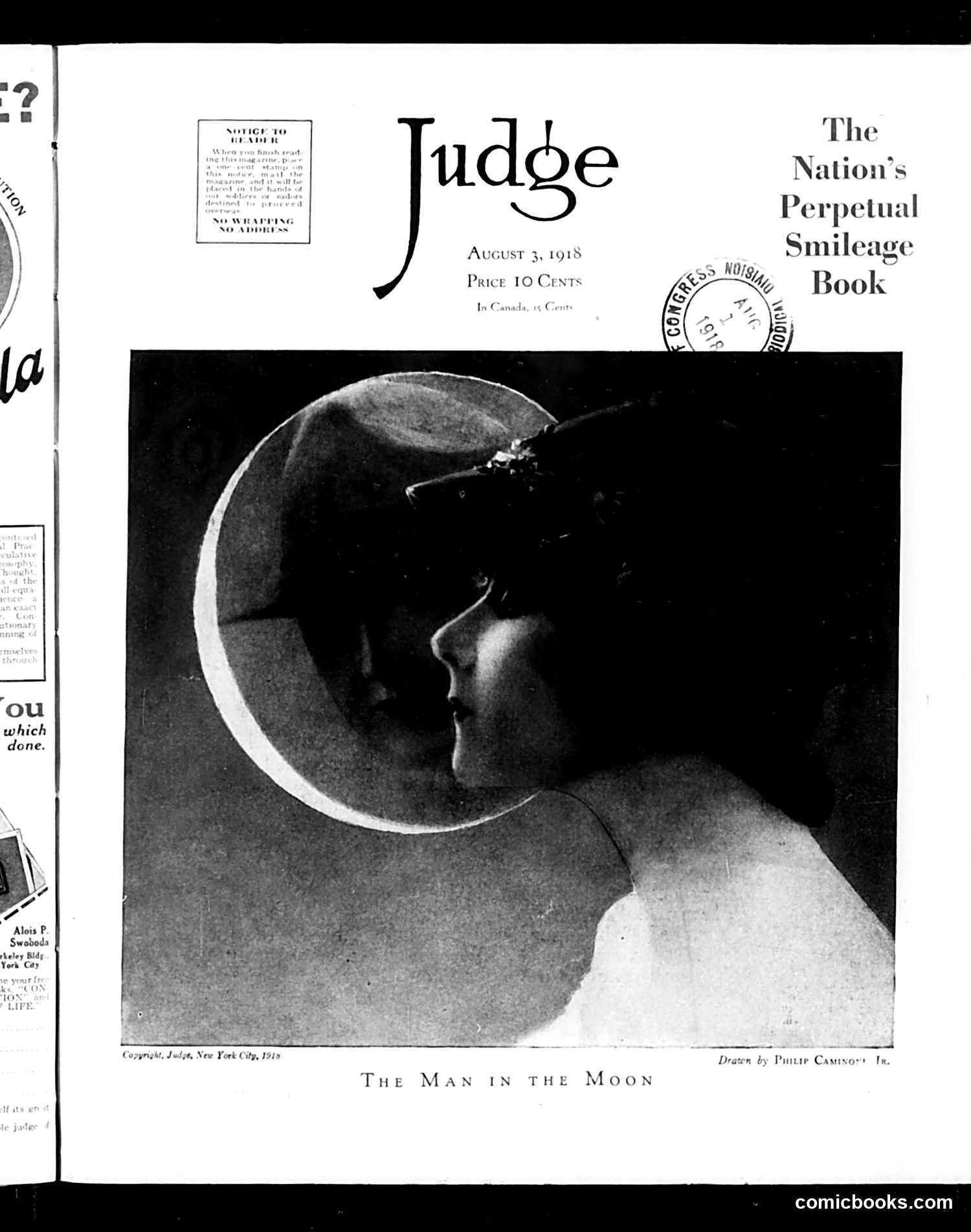
This illustration depicts a woman's profile gazing at a crescent moon, where a face appears within the lunar curve. The caption reads "The Man in the Moon." The image likely plays on the folkloric "man in the moon" — a figure traditionally seen in the moon's shadows. However, the specific satirical meaning is unclear without additional context. Given the August 1918 date (late WWI), this could reference wartime concerns, though the connection isn't explicit from the image alone. The subtitle identifies this as part of "The Nation's Perpetual Smileage Book," suggesting this was meant as humorous content. The artist is credited as Philip Cammeron Jr.
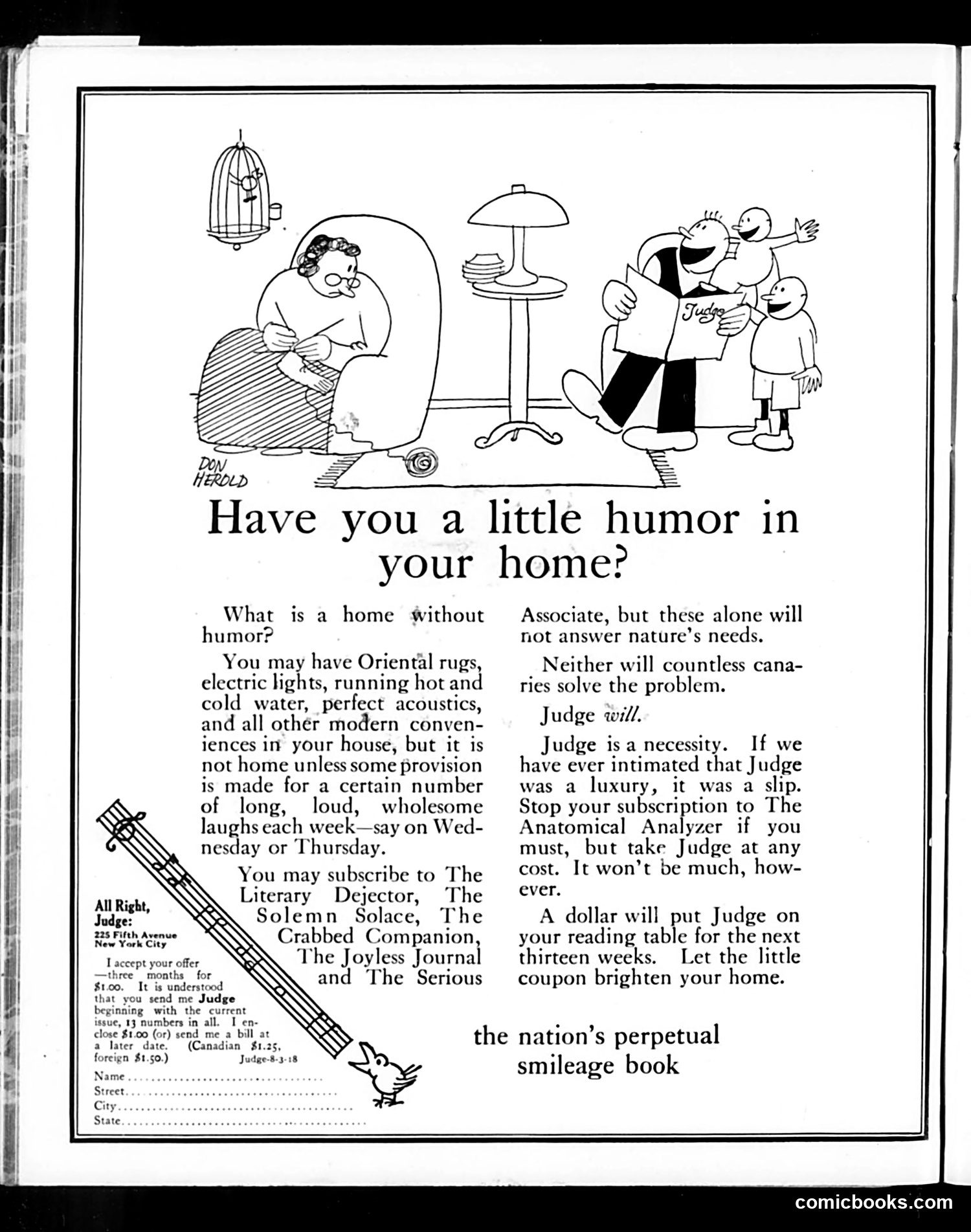
This page is primarily **advertising for Judge magazine itself**, not political commentary. The cartoon by Don Herold illustrates the magazine's appeal as home entertainment. The illustration shows a domestic scene: a woman reads alone looking bored, while a man entertains children nearby with apparent joy. The accompanying text argues that a home needs "humor" beyond material comforts—Oriental rugs and electric lights cannot substitute for laughter. The ad promotes Judge as "the nation's perpetual smileage book," claiming it provides essential weekly humor (Wednesday or Thursday delivery). Additional subscription options for other humor publications (The Literary Dejector, The Crabbed Companion, etc.) are satirically listed, with prices and ordering details provided below. This is essentially a self-promotional advertisement disguised as social commentary.
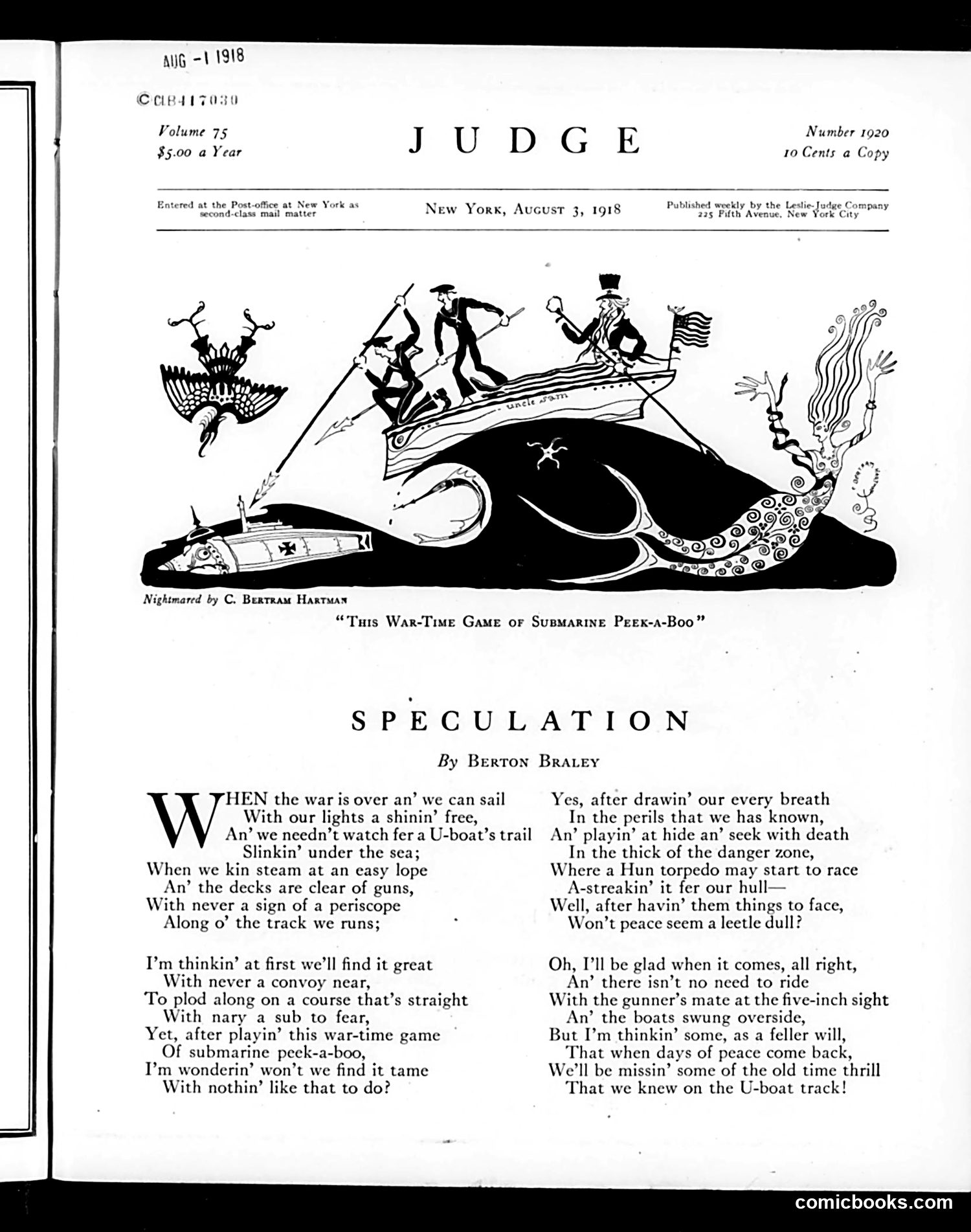
This August 1918 cartoon satirizes the dangers of submarine warfare during World War I. The illustration shows American naval officers in a small boat atop a massive, menacing German U-boat (submarine), depicted as a sea creature with tentacles. The officers appear engaged in a precarious, almost playful "game" of avoiding detection. The accompanying poem by Berton Braley expresses sailors' perspective: anticipating war's end while acknowledging the genuine terror of submarine attacks. The satire critiques the grim reality—that maintaining vigilance against U-boats remains deadly serious despite calling it a "game." The cartoon captures American anxiety about German submarines, which posed a genuine threat to Allied shipping throughout WWI.
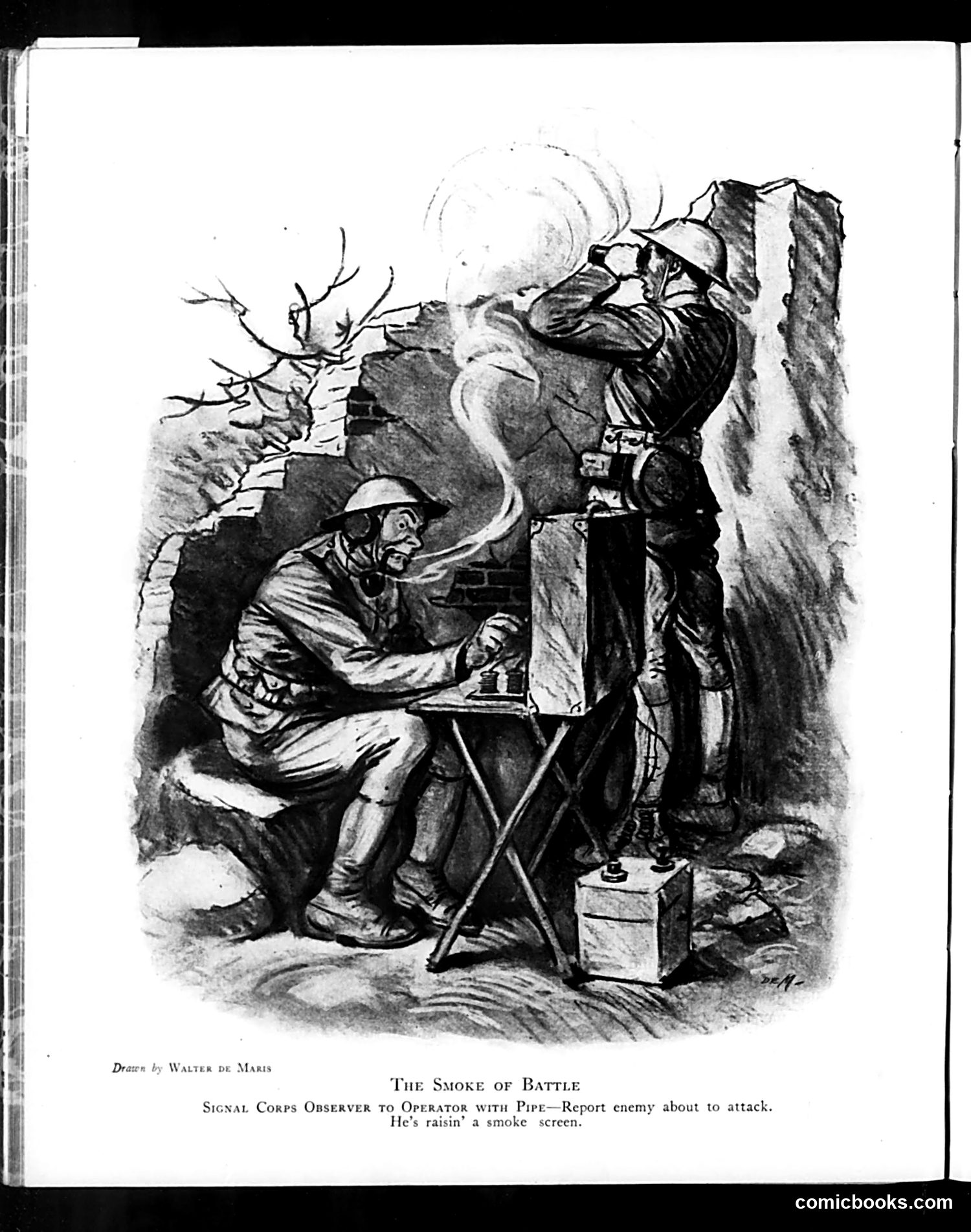
This WWI-era military illustration depicts a Signal Corps observer reporting enemy movements to an operator via telephone pipe. The caption explains the scene: the observer is "raisin' a smoke screen" while reporting that "enemy about to attack." The humor appears to play on the dual meaning of "smoke"—both the literal battlefield smoke screen (a military tactic to obscure troop movements) and the colloquial phrase "raising smoke" (creating commotion or disturbance). The cartoon illustrates practical wartime communications and equipment while making a light joke about the chaotic conditions soldiers faced. Drawn by Walter de Maris for *Judge* magazine, this reflects American public interest in WWI military operations and soldier life during the conflict.
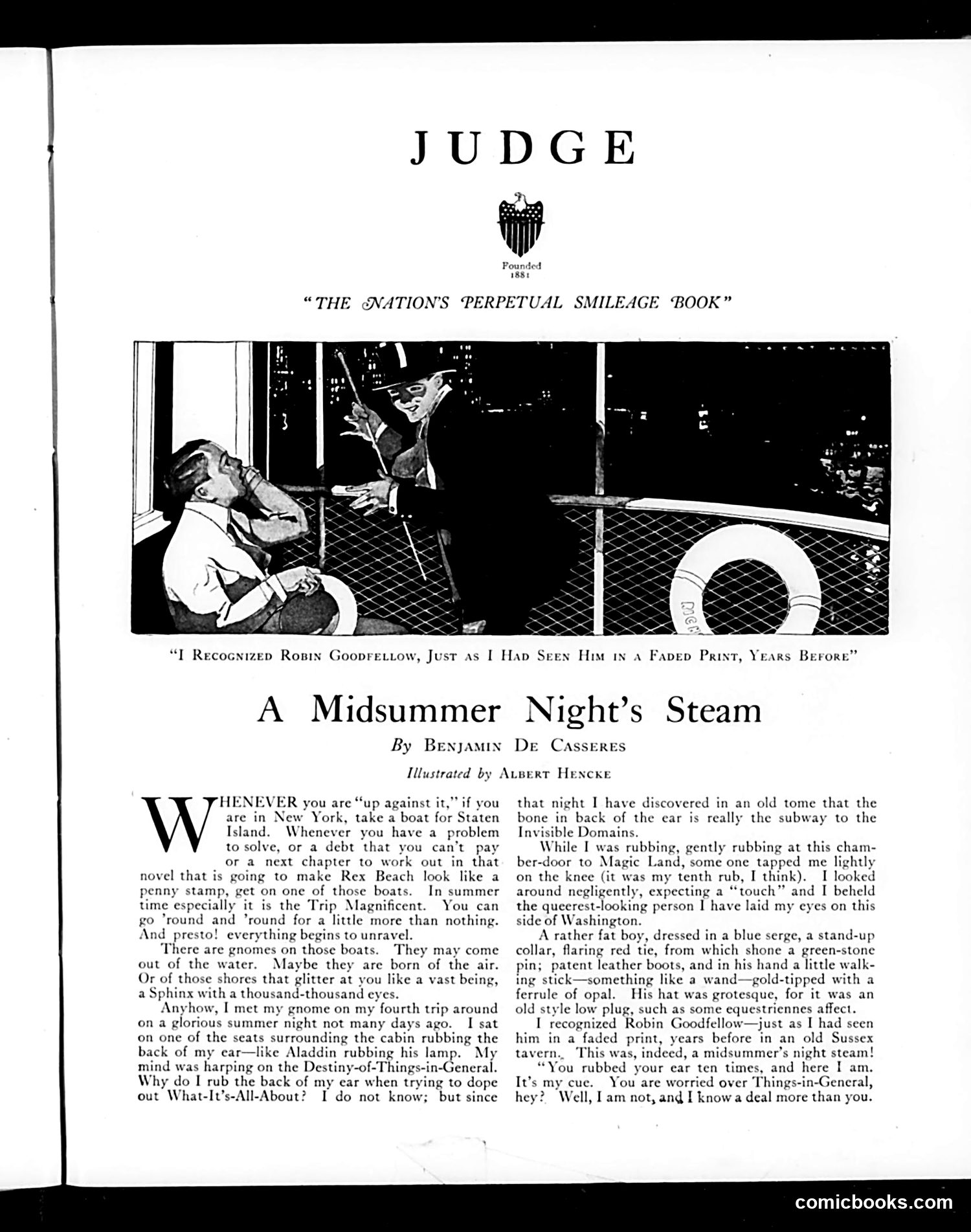
This page features "A Midsummer Night's Steam," a short story by Benjamin De Casseres illustrated by Albert Hencke. The comic strip at top shows a man on what appears to be a Staten Island ferry recognizing someone from a faded print he'd seen years before in a Sussex tavern. The satire targets New York's transit problems and urban mysteries. The narrator humorously describes solving urban riddles—like why ferries exist and what "What-It's-All-About" means—suggesting the absurdity of city life. The reference to "Magic Land," "Invisible Domains," and the subway suggests commentary on New York's confusing, maze-like transportation system and the strange encounters one has there. The overall tone mocks both urban pretension and the inexplicable nature of modern city living.
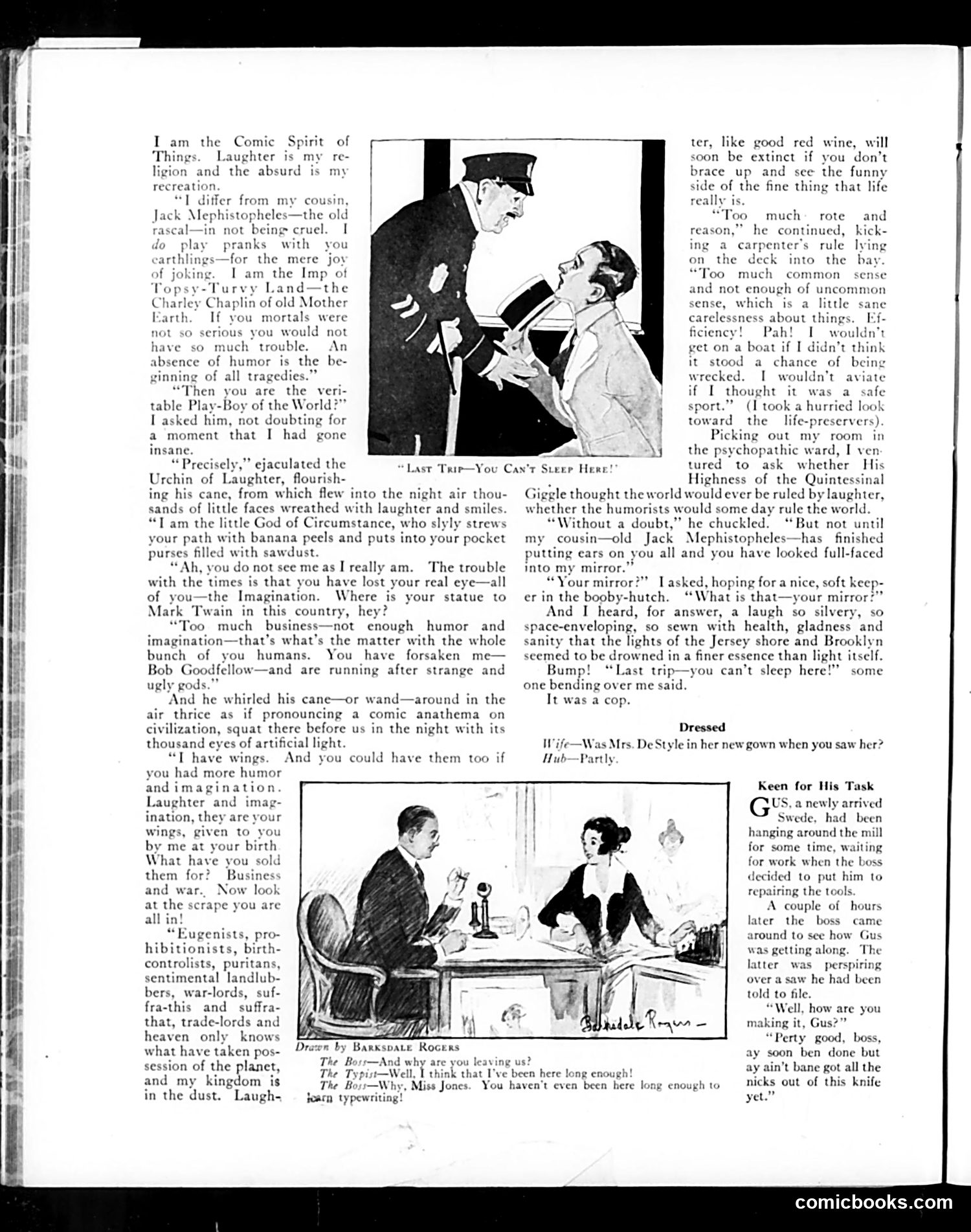
This page contains two distinct illustrated stories with satirical commentary on humor and imagination. The top cartoon ("Last Trip—You Can't Sleep Here") depicts a uniformed official (appears to be a ship's captain or authority figure) ejecting an intoxicated man, satirizing the collision between authority and comic relief. The lower illustration ("Dressed" and "Keen for His Task") shows domestic and workplace scenes drawn by Barksdale Rogers, focusing on social interactions and gender dynamics. The dialogue suggests satire about women's fashion choices and workplace competence. The left column's philosophical discussion personifies "the Comic Spirit," arguing that humor and imagination are essential human qualities—contrasting them against excessive "business" and rationality. The text advocates for laughter as civilization's counterbalance, targeting attitudes of late-19th/early-20th-century utilitarianism and progressivism.
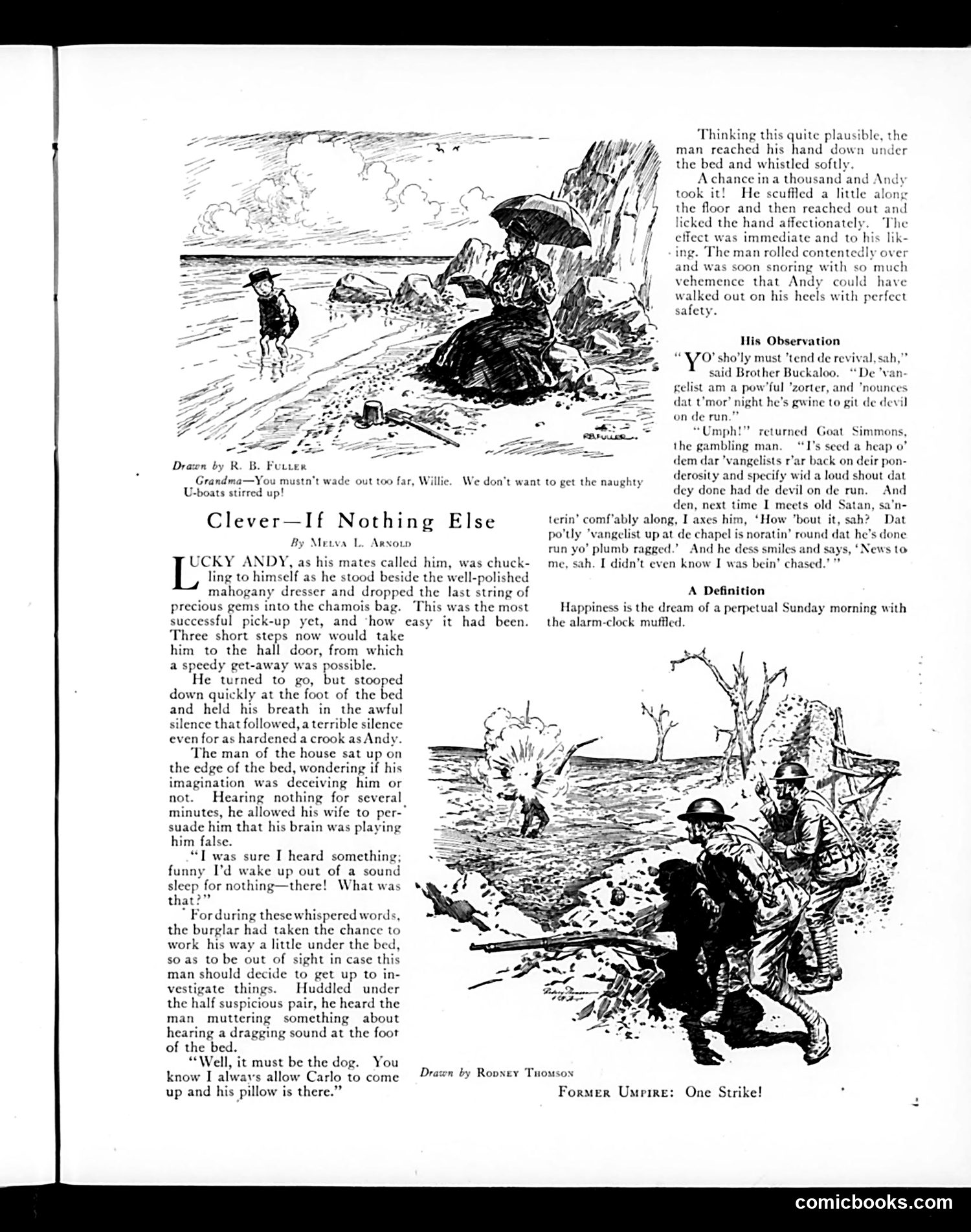
**Top Cartoon (R.B. Fuller):** "Grandma—You mustn't wade out too far, Willie" references WWI-era anxieties about German U-boats (submarines). The joke warns a child about wading into the ocean as one might warn about provoking enemy submarines—satirizing the public's fear of German naval warfare during America's involvement in the conflict. **Main Story ("Clever—If Nothing Else"):** A crime fiction narrative about a burglar named Andy who nearly gets caught stealing jewels. The twist: when the homeowner hears noise, he reaches under the bed, and Andy licks his hand. The man assumes it's the family dog "Carlo," allowing the burglar to escape. It's a suspenseful short story rather than political satire. **"His Observation":** A dialect-heavy piece featuring Black characters discussing religious revivals and the devil. The gambling man humorously suggests Satan remains unimpressed by revival meetings, claiming the devil continues living comfortably despite preachers' claims to defeat him. This reflects period stereotypes and attitudes toward both Black vernacular and religious hypocrisy.
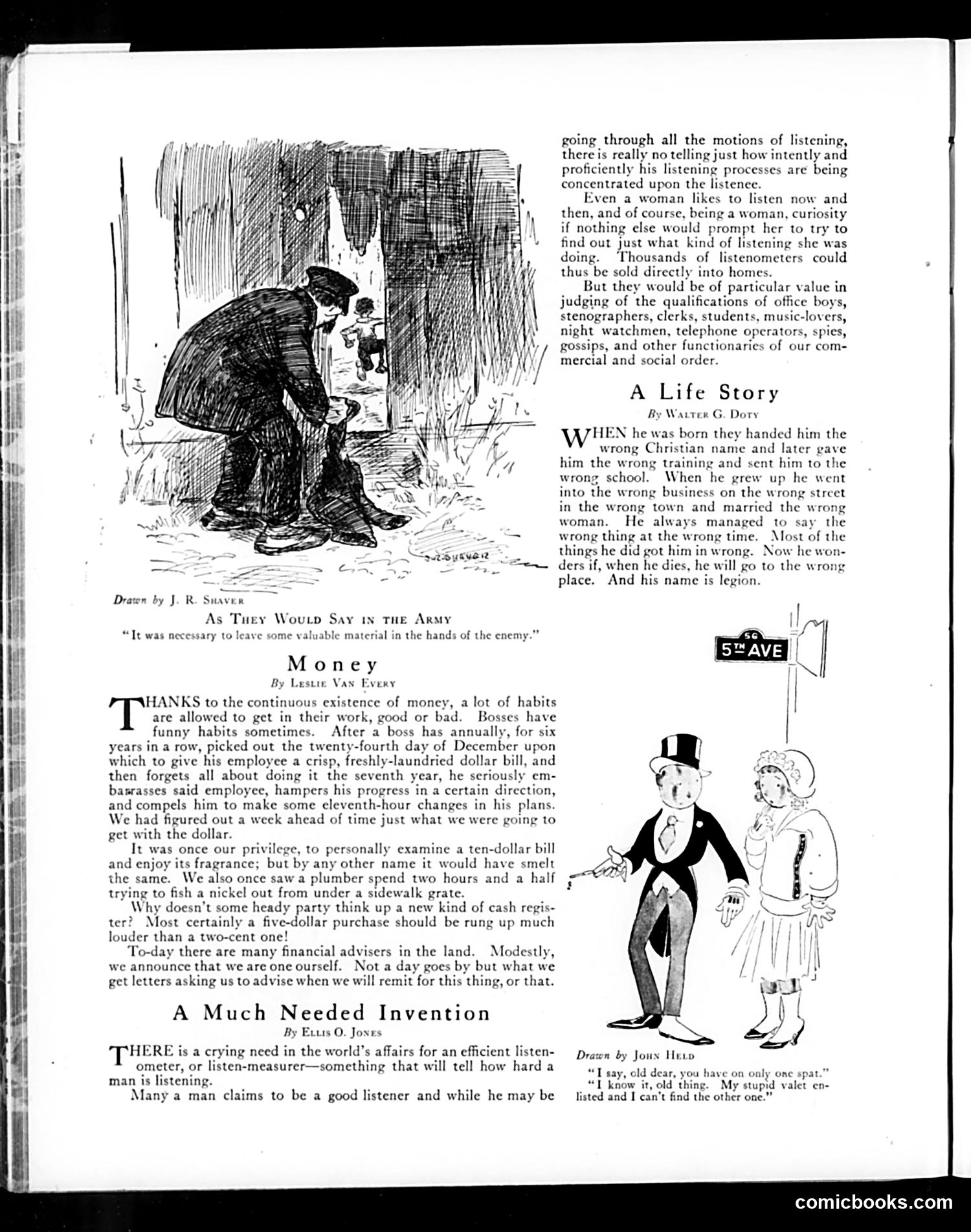
This page contains three satirical pieces. The main feature, "A Much Needed Invention," proposes a "listenometer"—a humorous device to measure how intently people actually listen. The author suggests it would be valuable for evaluating office boys, stenographers, telephone operators, and gossips, implying these groups often pretend to listen without genuine attention. "A Life Story" is a brief, dark comedy about a hapless man who consistently makes wrong choices throughout life—wrong name, wrong school, wrong career, wrong wife—suggesting some people are destined for failure regardless of circumstances. The cartoon captioned "As They Would Say in the Army" appears to be wartime commentary (likely WWI era, given Judge's publication period), with text explaining "It was necessary to leave some valuable material in the hands of the enemy"—military doublespeak for losing material to enemy forces. The remaining content addresses money and financial habits in dry, observational humor typical of Judge magazine's satirical style.
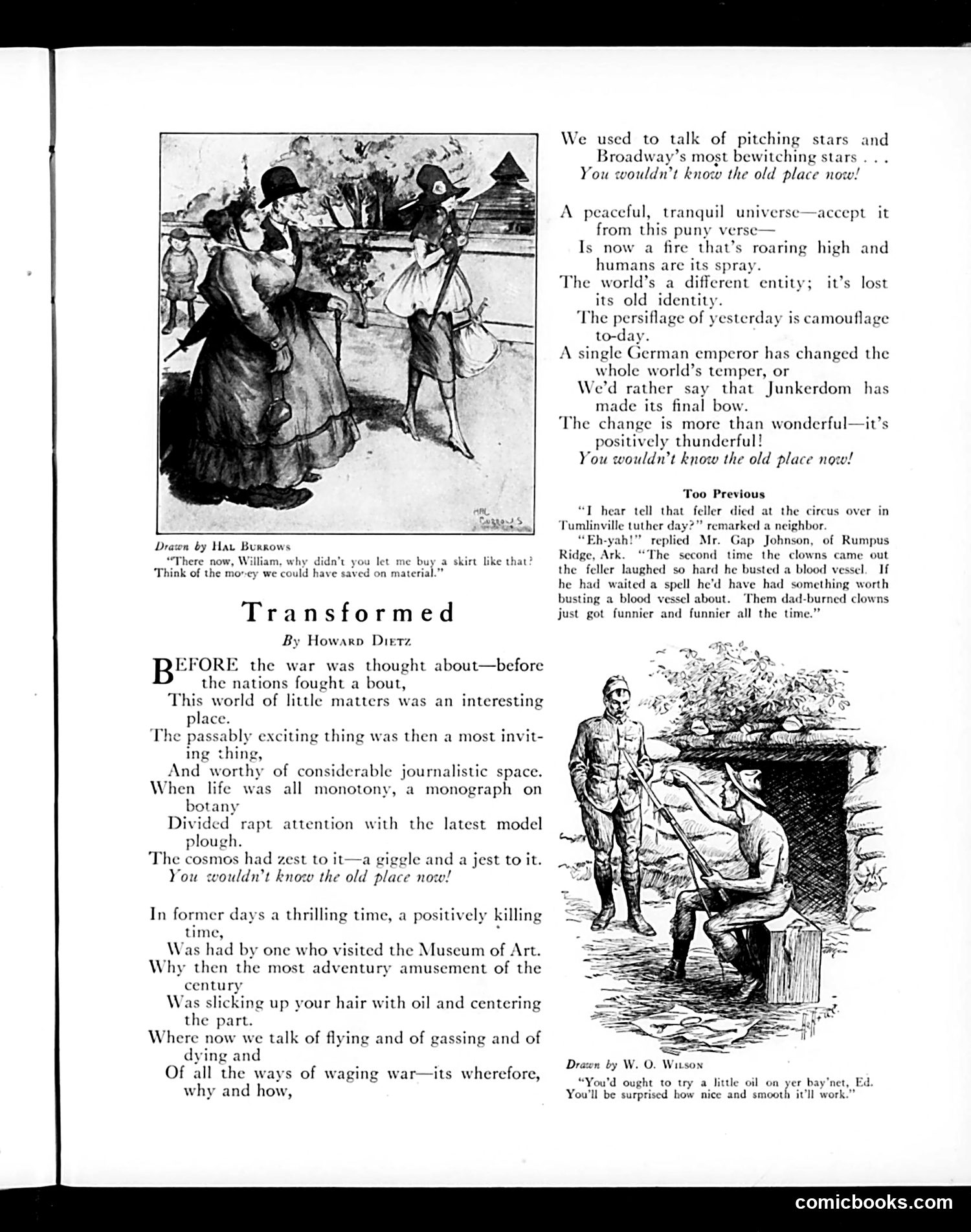
This page contrasts pre-war and wartime life. The poem "Transformed" by Howard Dietz nostalgically describes a peaceful pre-war world obsessed with trivial matters—fashion, Broadway stars, hairstyles, museum visits—where life had "zest" and "giggle." The refrain "You wouldn't know the old place now!" marks the shift: World War I has transformed society completely. The poet blames "a single German emperor" (Kaiser Wilhelm II) and "Junkerdom" (Prussian militarism) for changing the world's character. Now people discuss "flying and gassing and dying"—modern warfare technologies—replacing idle gossip. The cartoon at top (by Hal Burrows) shows a woman in a wartime economical skirt, with her husband sardonically noting the material savings—implying women's fashion itself has been transformed by wartime rationing and practicality. The page satirizes how completely World War I disrupted ordinary civilian life and concerns.
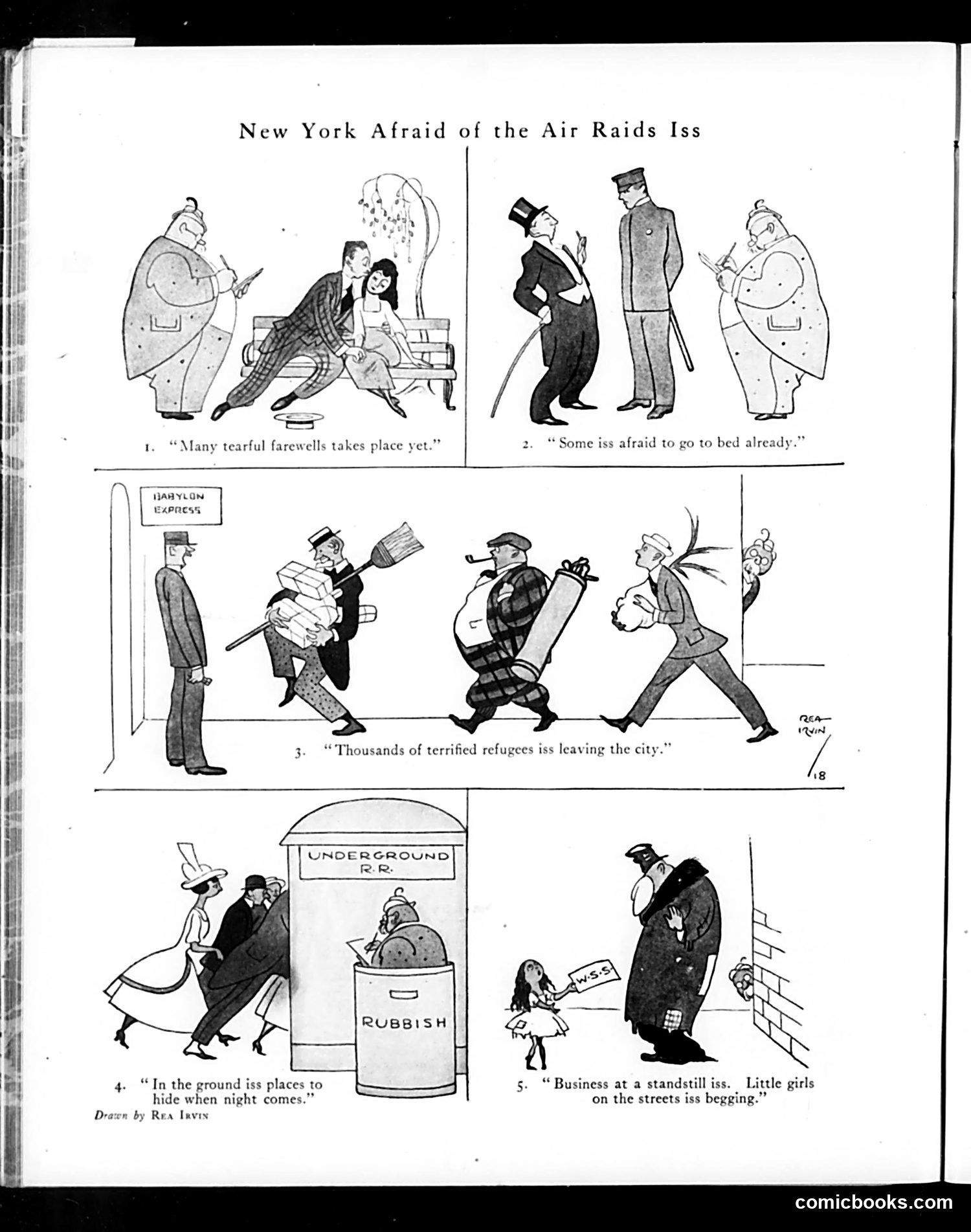
This satirical cartoon depicts New York City's panic during air raid threats (likely WWI or WWII era). The six panels mock various fearful responses: emotional goodbyes, people rushing to bed early, masses fleeing the city with belongings, crowds sheltering in underground railways, and economic disruption including child begging at streetcalls. The exaggerated dialect ("iss" instead of "is") appears to mock immigrant speech patterns. The cartoonist satirizes both the hysteria gripping the city and society's collapse into chaos—people abandoning work, homes, and civic order. The humor targets New Yorkers' perceived overreaction to air raid fears, portraying dignified citizens reduced to panicked refugees. Artist Rex Irwin draws these scenarios to ridicule the city's collective anxiety during wartime.
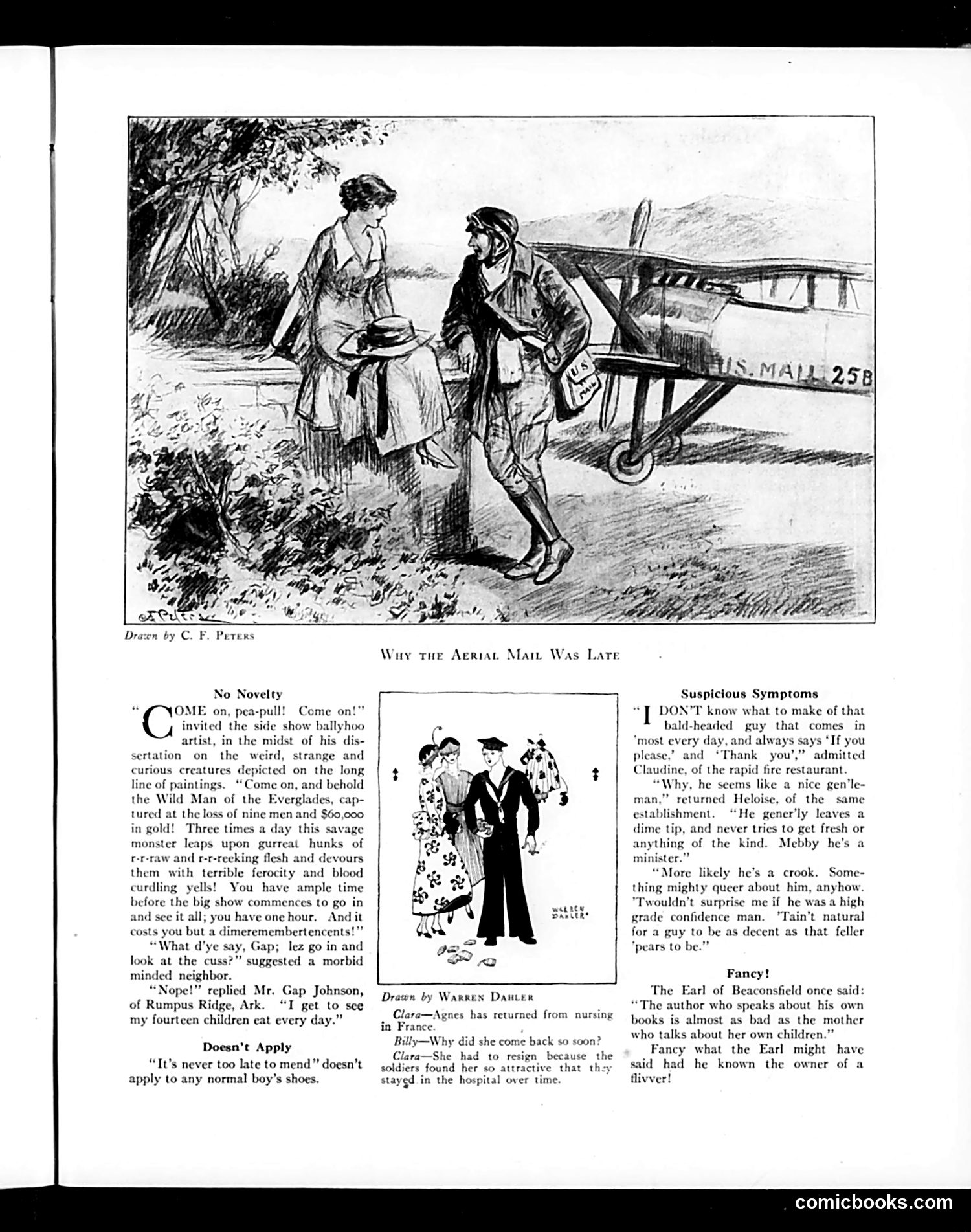
This page contains three separate humorous pieces satirizing American social types and attitudes circa WWI era. **"Why the Aerial Mail Was Late"** (top): A woman offers food to an aviator beside a mail plane. The joke plays on the contrast between civilization and frontier roughness—a man refuses to see a sideshow "Wild Man" exhibit because he watches his fourteen children eat daily, finding that spectacle sufficient. **Middle anecdote** (by Warren Dahler): A woman nursing soldiers in France resigned because she was "so attractive" the soldiers deliberately prolonged their hospital stays—satirizing both romantic distraction and malingering. **"Suspicious Symptoms"** and **"Fancy!"** (right): Restaurant workers suspect a polite, tipping customer of being a criminal because his decency seems unnatural. The final piece mocks automobile owners, comparing them to authors who boast about their own accomplishments—suggesting "flivver" (cheap car) owners are similarly insufferable about their vehicles. The humor targets working-class observation, wartime romance, and emerging automobile culture.
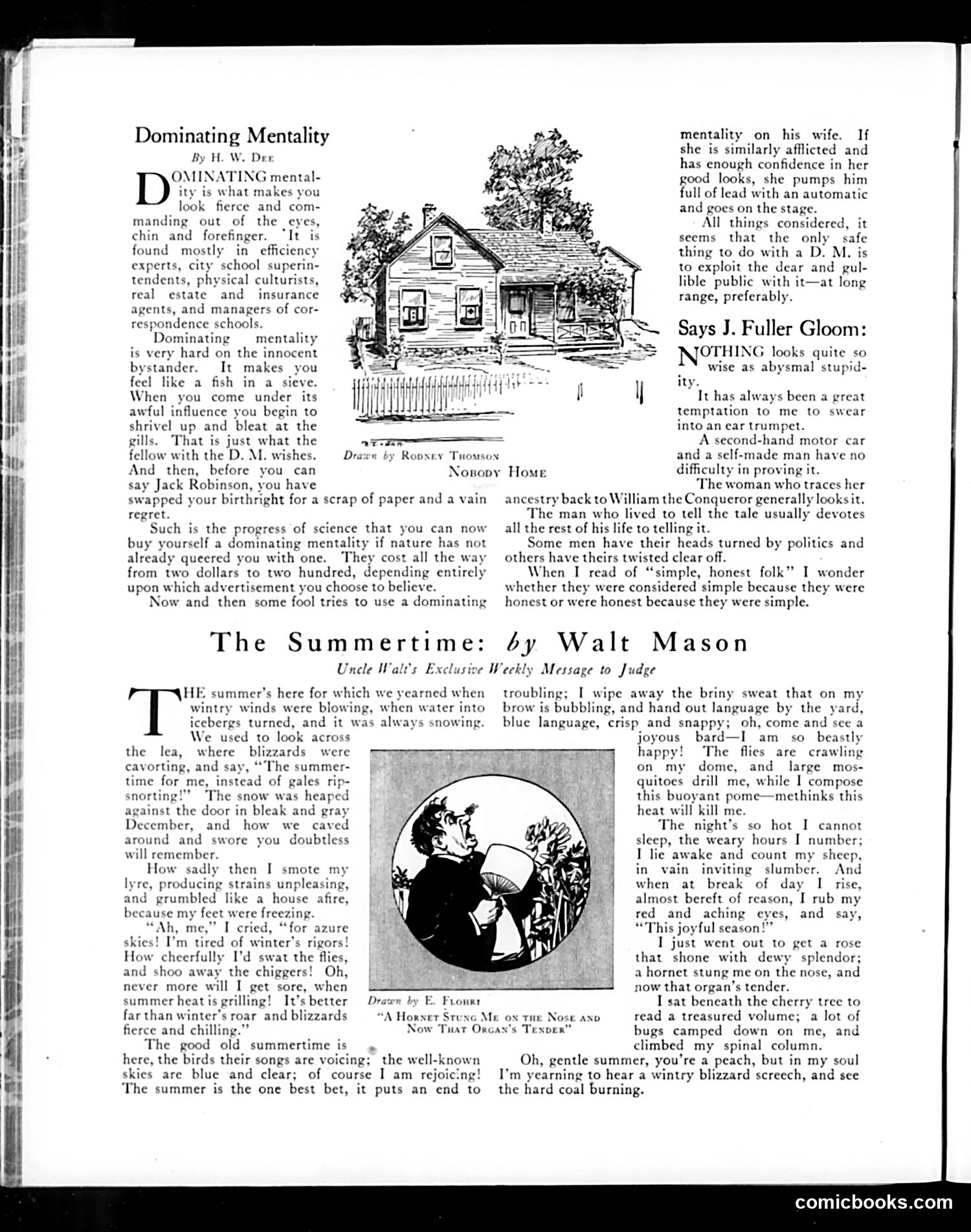
This page contains two satirical pieces and poetry mocking contemporary American types and sentiments. **"Dominating Mentality"** ridicules the "D.M."—a personality type found in efficiency experts, school administrators, and insurance agents who intimidate others through commanding presence and forceful manner. The satire notes these traits can be purchased through advertisements and warns of consequences: using dominating mentality on one's wife may result in her shooting him and becoming a stage performer instead. **"The Summertime"** is Walt Mason's humorous poem contrasting winter complaints with summer's actual miseries—oppressive heat, insects, and sleeplessness. The irony: people romanticize summer during winter, only to discover it's equally unbearable. **"Says J. Fuller Gloom"** offers cynical observations about human nature—questioning whether people labeled "simple and honest" are actually virtuous or merely unsophisticated. The magazine uses these pieces to deflate American self-improvement culture and expose the gap between expectation and reality in everyday life.
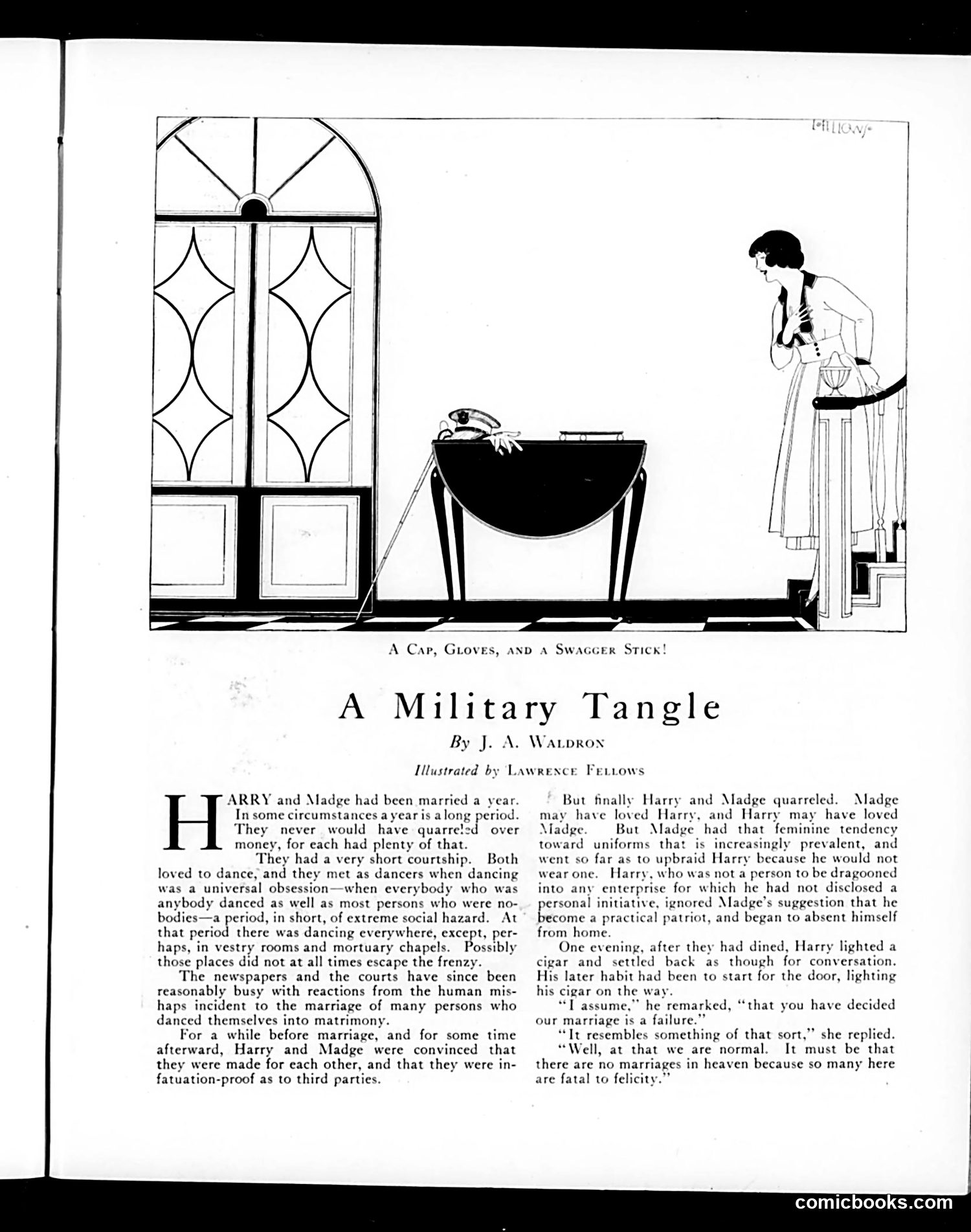
This is a short story (not a political cartoon) satirizing the strain on 1920s marriages caused by the era's dance craze and, more pointedly, pressure on men to enlist in the military. **The Setup:** Harry and Madge married after meeting during the widespread dancing obsession of the WWI era. The story notes this "extreme social hazard" led many couples into hasty marriages. **The Conflict:** Madge increasingly pressures Harry to wear a military uniform and become "a practical patriot"—he refuses. Harry begins avoiding home, eventually leaving immediately after dinner without conversing. **The Satire:** The story mocks both marital incompatibility and the social pressure on men to enlist. Harry's refusal to be "dragooned into any enterprise" without personal initiative represents resistance to nationalist pressure. The ending implies their marriage is failing specifically because of this conflict over military service. The illustration shows an elegant domestic interior with the couple—suggesting the gap between their refined lifestyle and wartime expectations placed upon them.
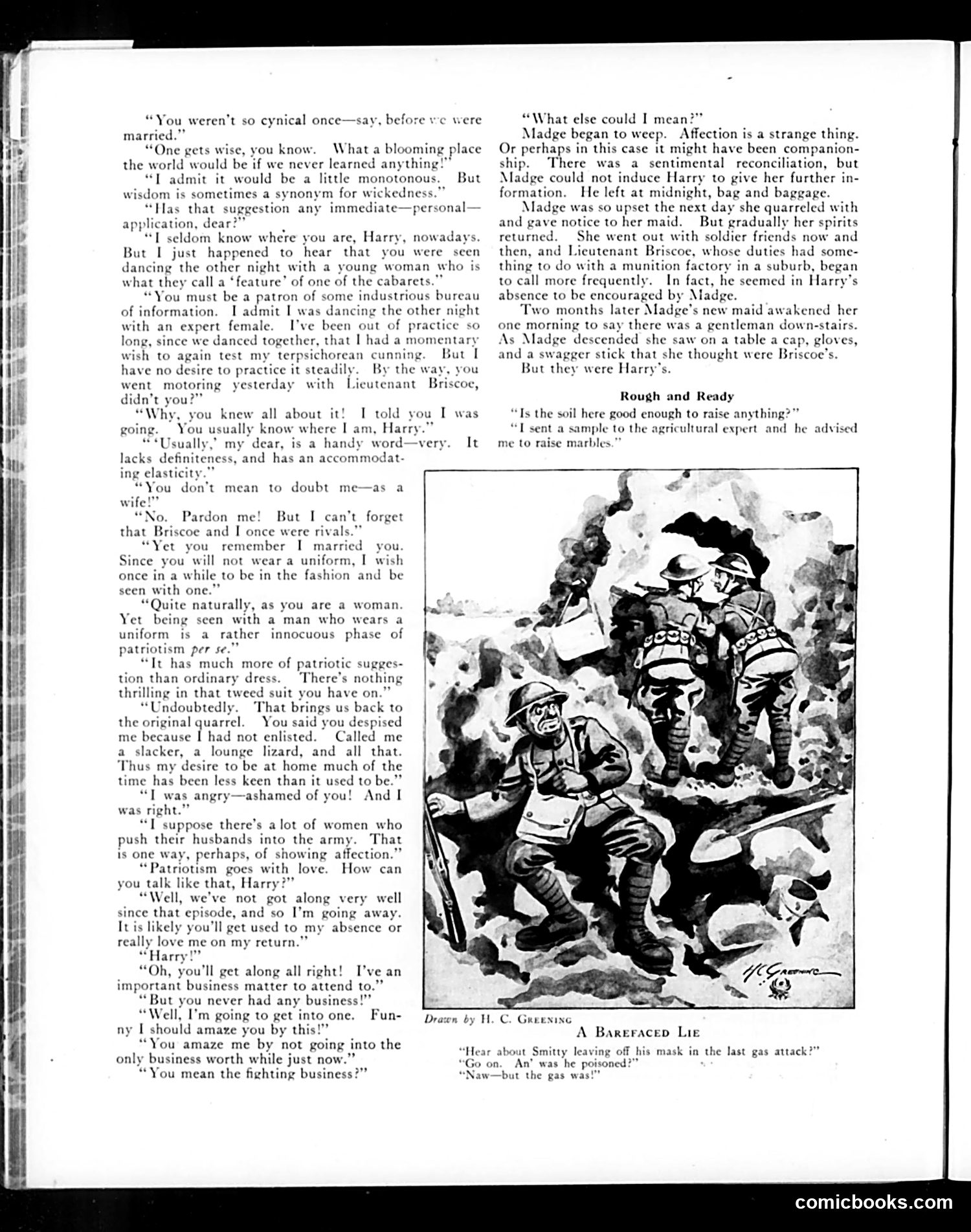
This page presents a domestic drama satirizing WWI-era attitudes about patriotism and marriage. The main narrative depicts a marital conflict: Harry, a civilian, has been dancing with cabaret performers while his wife Madge entertained Lieutenant Briscoe. When Madge pressures Harry to enlist, calling him a "slacker" and "lounge lizard," he refuses and leaves with his luggage—claiming he has "important business." The implication is clear: he's lying to avoid admitting he won't enlist. The cartoon titled "A Barefaced Lie" (bottom) shows soldiers in combat, illustrating the stakes of Harry's refusal to serve. **The satire targets**: wives who publicly shame non-enlisting husbands into military service through social pressure and infidelity; husbands who prioritize comfort over patriotic duty; and the absurdity of using romance and honor to manipulate men into war. The page mocks both gender dynamics and civilian reluctance during wartime, presenting enlistment as a patriotic obligation that respectable men shouldn't resist.
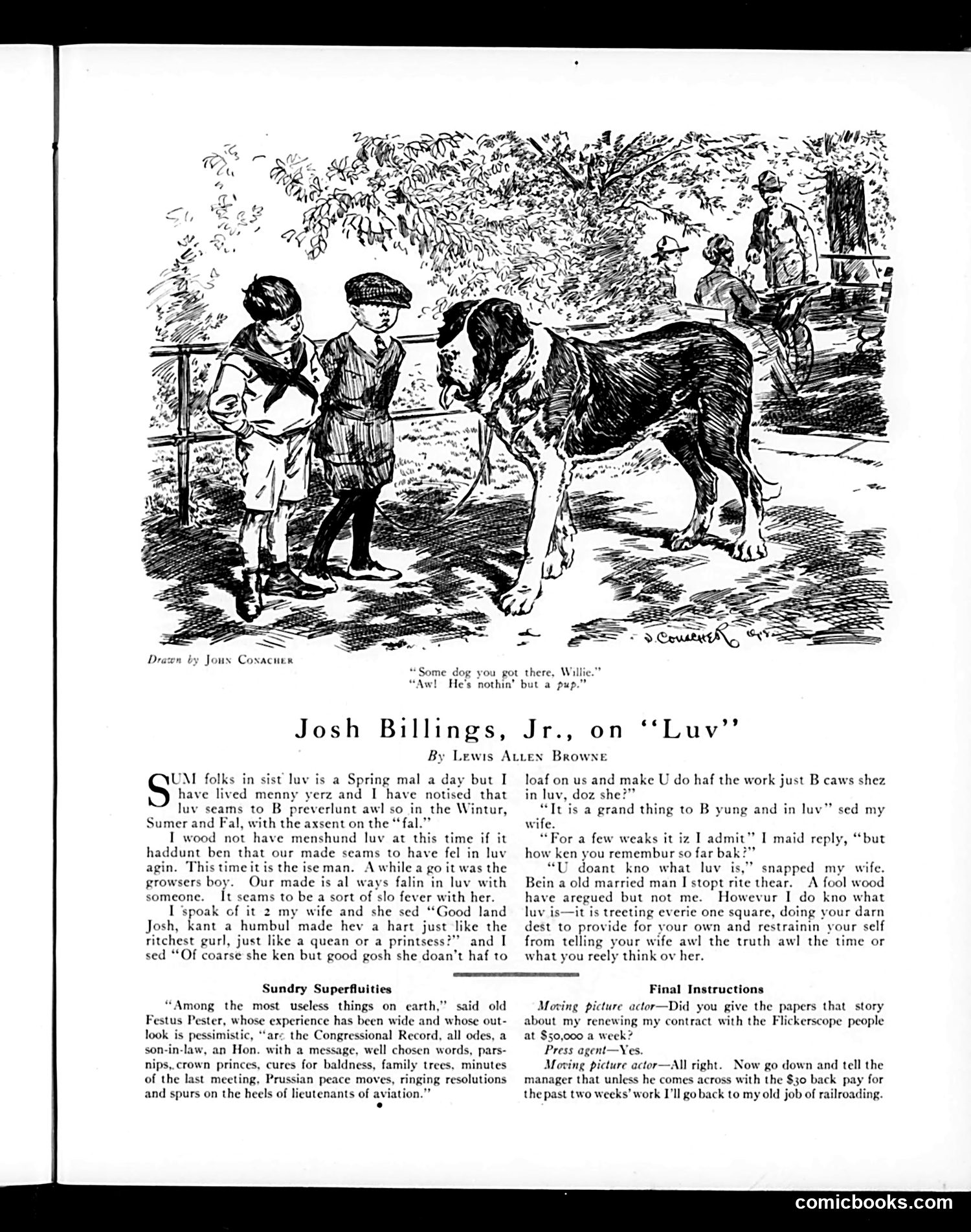
**The Cartoon:** A sketch shows two children and a large dog, with one child dismissing it as "nothin' but a pup." This illustrates the accompanying story's theme about youthful romance. **"Josh Billings, Jr., on 'Luv'":** This is a humorous dialect piece (written in intentionally misspelled phonetic English, mimicking rural speech) by Lewis Allen Browne. The narrator complains that his maid repeatedly falls in love—first with the grocer's boy, now with someone new—causing her to slack off on household work. His wife defends young love's nobility; he cynically defines love as treating everyone fairly and refraining from telling one's spouse the complete truth. The humor derives from the clash between romantic idealism and domestic practicality, and the exaggerated rustic dialect style popular in early 20th-century humor writing. **Other Content:** "Sundry Superfluities" offers sardonic observations on useless things (Congressional Record, sons-in-law, etc.). "Final Instructions" satirizes Hollywood actors' contract disputes and inflated salaries—a moving picture actor threatens to return to railroading unless paid overdue wages.
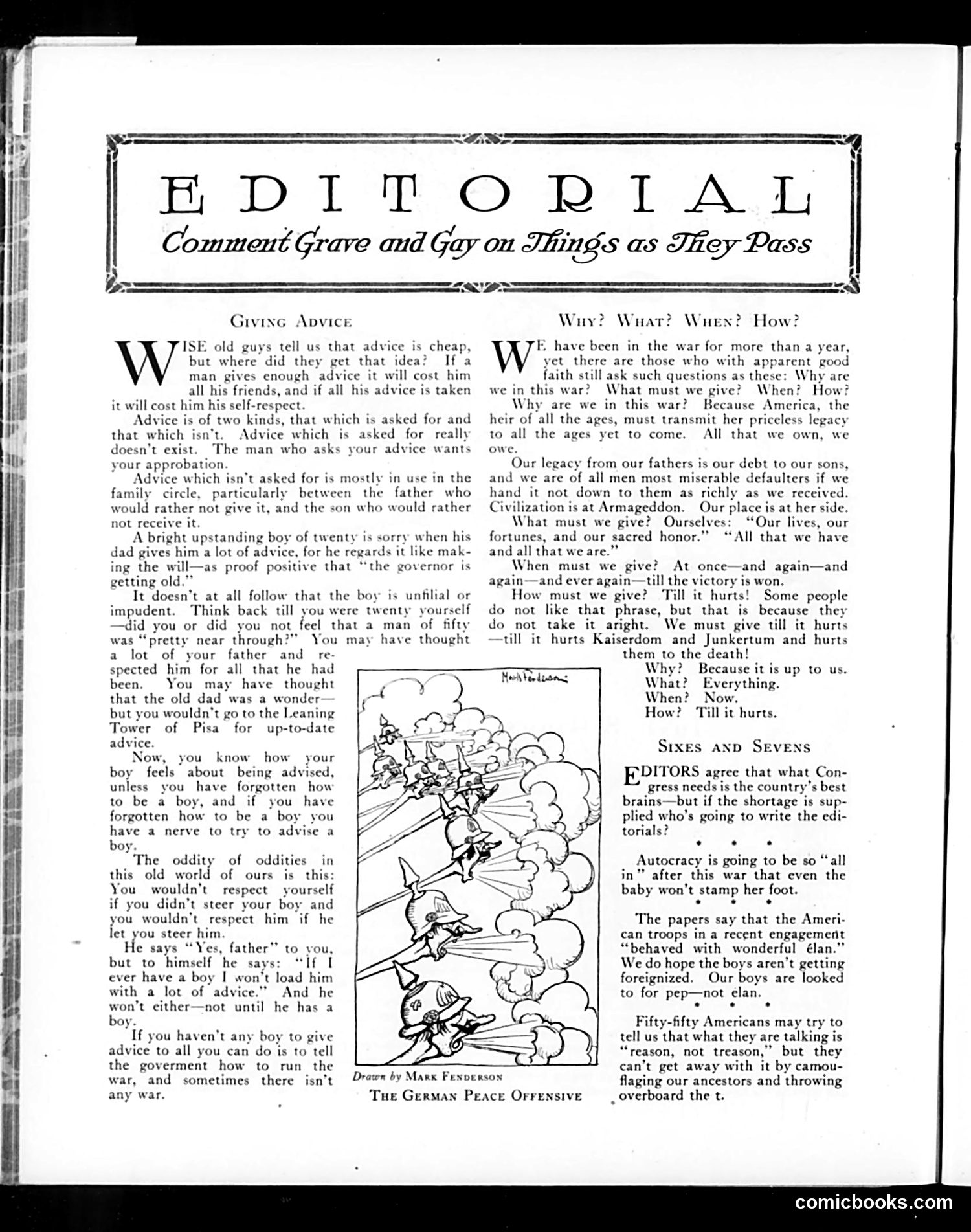
This editorial page addresses American home-front anxieties during World War I. The left column satirizes unsolicited advice-giving, using the father-son relationship as metaphor—a father can't respect his son if he controls him, yet won't respect himself if he doesn't try. The humor reflects tension between traditional authority and emerging independence. The right column directly addresses war questions: "Why are we fighting?" The editor argues America inherits a civilizational debt to transmit to future generations, positioning the conflict as civilizational obligation. "Give till it hurts" means financial/material sacrifice should damage Germany ("Kaiserdom and Junkertum"—references to German aristocratic militarism). The cartoon by Mark Fenderson (labeled "The German Peace Offensive") depicts German soldiers being blown back by explosions—satirizing German peace proposals as hollow propaganda. The "Sixes and Sevens" section mocks domestic concerns as trivial compared to war sacrifice, warning against "foreignization" of American troops and autocracy's post-war consequences. The page advocates total war commitment while mocking civilian hesitation.
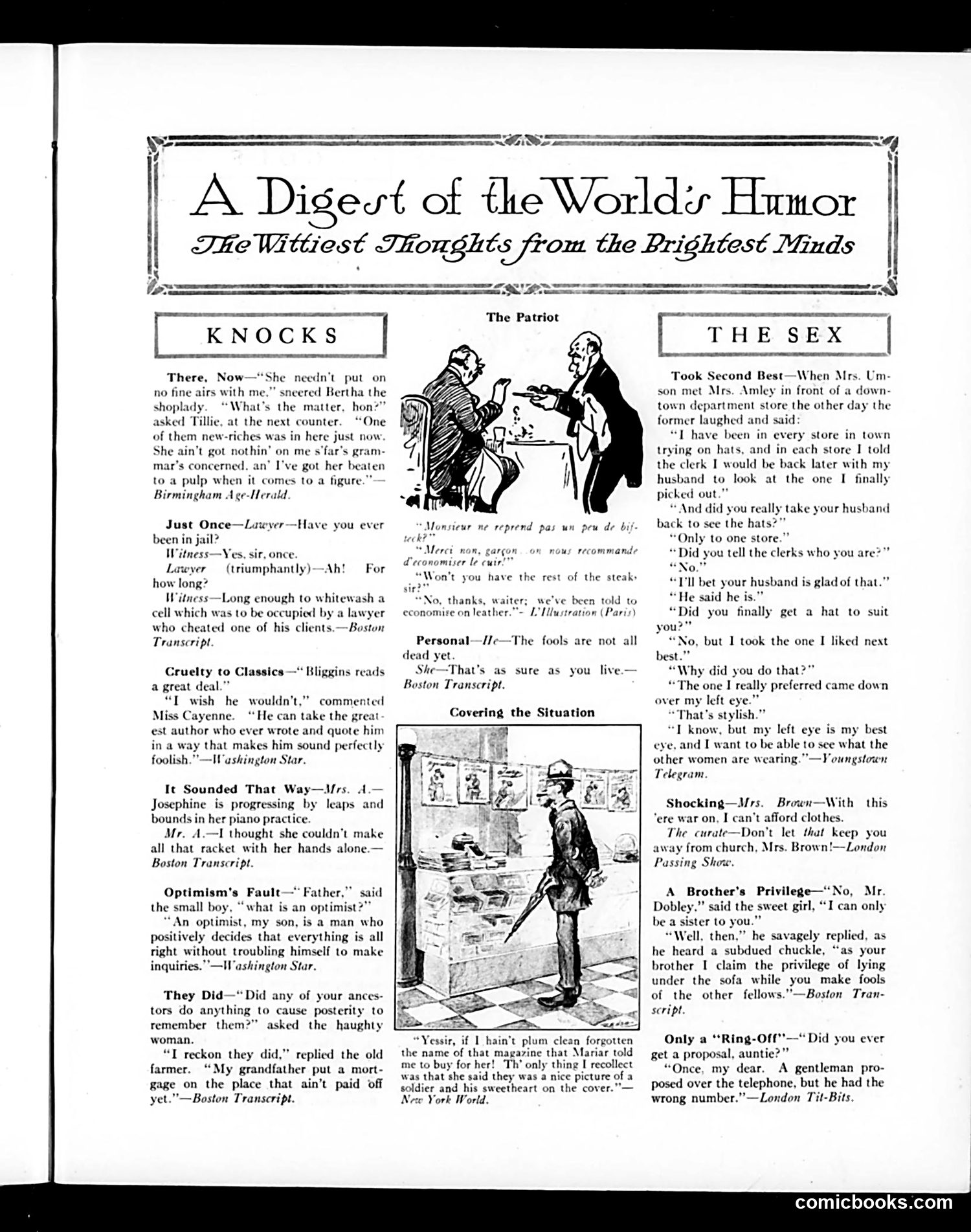
This page collects brief satirical anecdotes rather than political cartoons. The humor targets social pretensions and gender dynamics typical of early 20th-century American life. **"The Patriot"** (center) depicts a WWI-era joke: a Frenchman refuses meat to economize for the war effort, contrasting with American abundance. **"Knocks"** section mocks class anxiety: a shopgirl boasts she's grammatically superior to wealthy newcomers ("new-riches"), reflecting period anxiety about social mobility and education. **"The Sex"** section presents domestic comedy around women's shopping and hat-buying indecision, with the punchline that a woman chose an unflattering hat simply because it covered her "best" eye—satirizing female vanity and illogical consumer behavior. **"Covering the Situation"** uses wartime context; a soldier's sweetheart graces a magazine cover, highlighting how commercial media capitalized on romantic war imagery. The overall tone mocks class pretension, female consumer behavior, and wartime sentimentality—typical Judge satire from the WWI period.
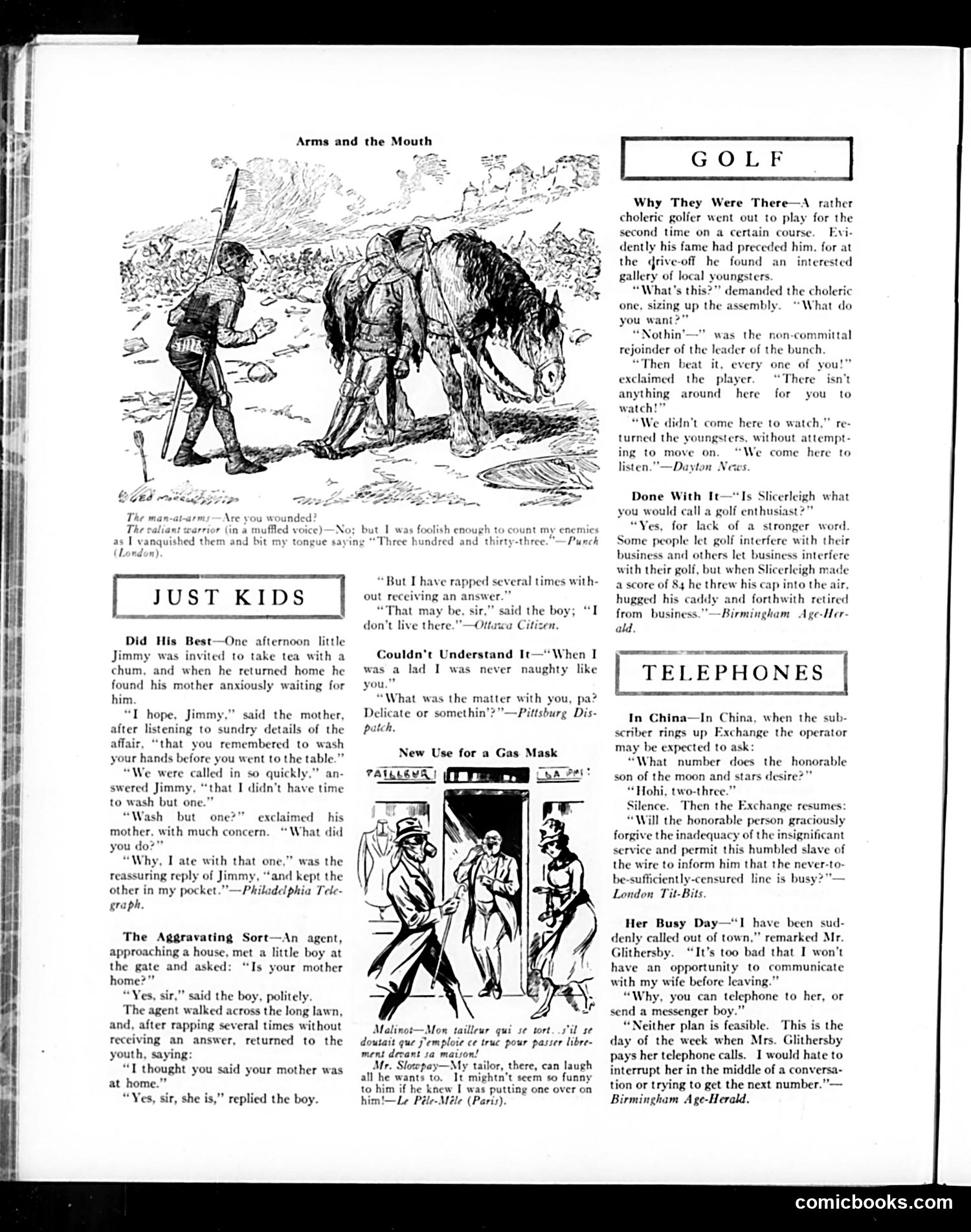
This page contains three unrelated humor sections typical of early 20th-century American comic magazines: **"Just Kids"** features three brief anecdotes about children's literal-minded logic—a boy who washes only one hand at tea, a boy deceiving a door-to-door agent about his mother's presence, and a child unable to explain parental hypocrisy. **"Golf"** includes three golf-themed jokes: youngsters gathering to *hear* (not watch) an angry golfer play, and a businessman named Slicerleigh who abandons business after one good round. **"Telephones"** satirizes telephone culture through three sketches: Chinese operators using exaggerated honorifics, and Mrs. Glithersby being so constantly on telephone calls that her husband cannot reach her to say goodbye before traveling. The humor relies on wordplay, absurdist logic, and gentle mockery of social conventions and modern technology (telephones were still relatively novel). The page appears to be circa 1910s-1920s based on style and subject matter.
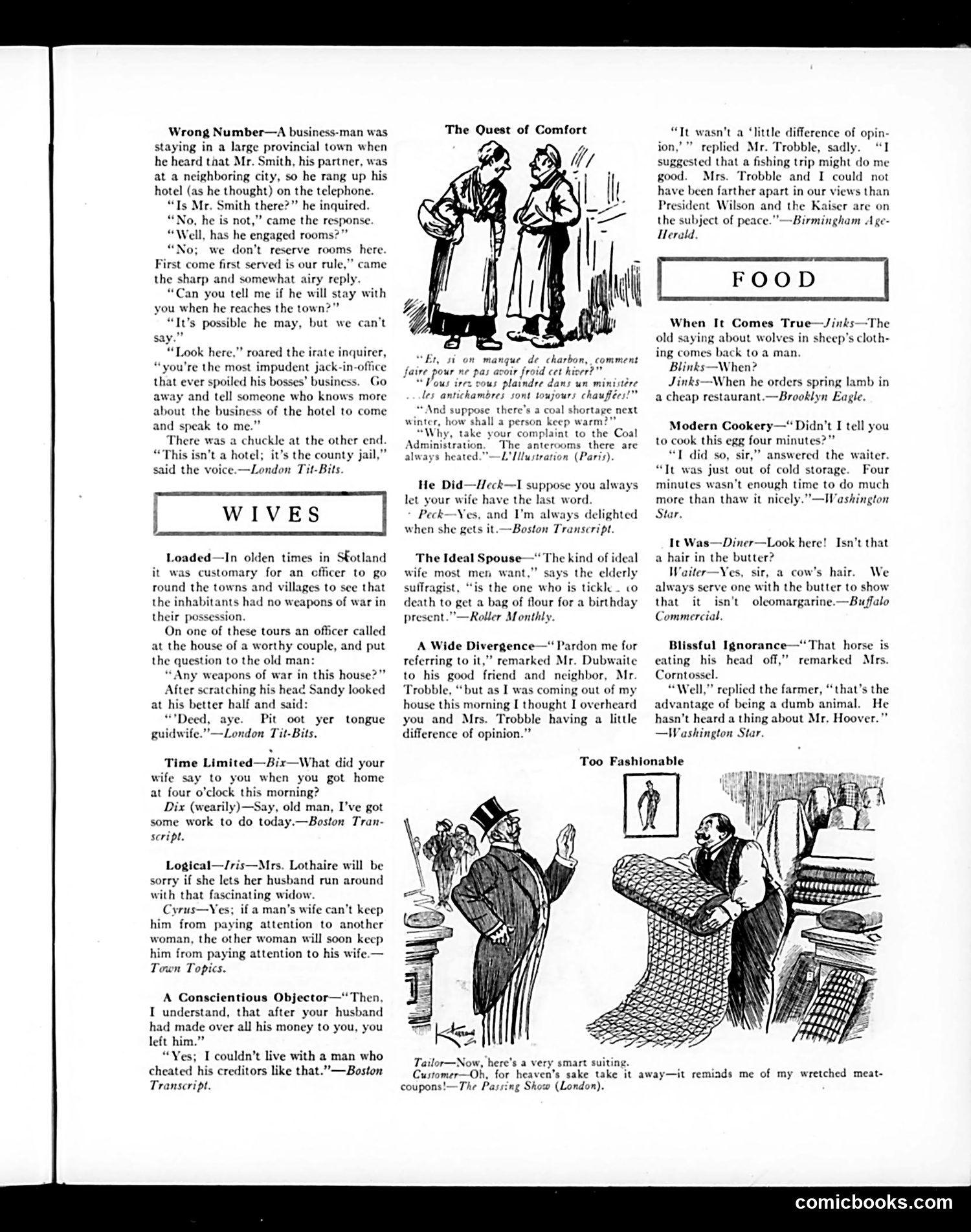
This page from the satirical magazine **Judge** contains multiple short humorous anecdotes and two cartoons, typical of early 20th-century American humor magazines. **Key content:** The "Wrong Number" joke satirizes bureaucratic rigidity: a businessman accidentally calls a county jail instead of a hotel, but the jail clerk's unhelpful responses mirror typical hotel staff indifference—the humor lies in both institutions being equally unhelpful. The "Quest of Comfort" cartoon references **World War I-era coal shortages** in France. It satirizes government inefficiency: when asked how people will stay warm during a coal shortage, the response is to complain at government ministries—which are always heated. The joke mocks bureaucratic absurdity and privileged officials. The "Too Fashionable" cartoon depicts a woman surrounded by stacked clothing and fashionable garments, likely critiquing excessive materialism or fashion obsession. Other brief jokes poke fun at **marriage dynamics**, **spousal relationships**, and gender roles typical of the era—showing husbands as henpecked and wives as domineering or demanding.
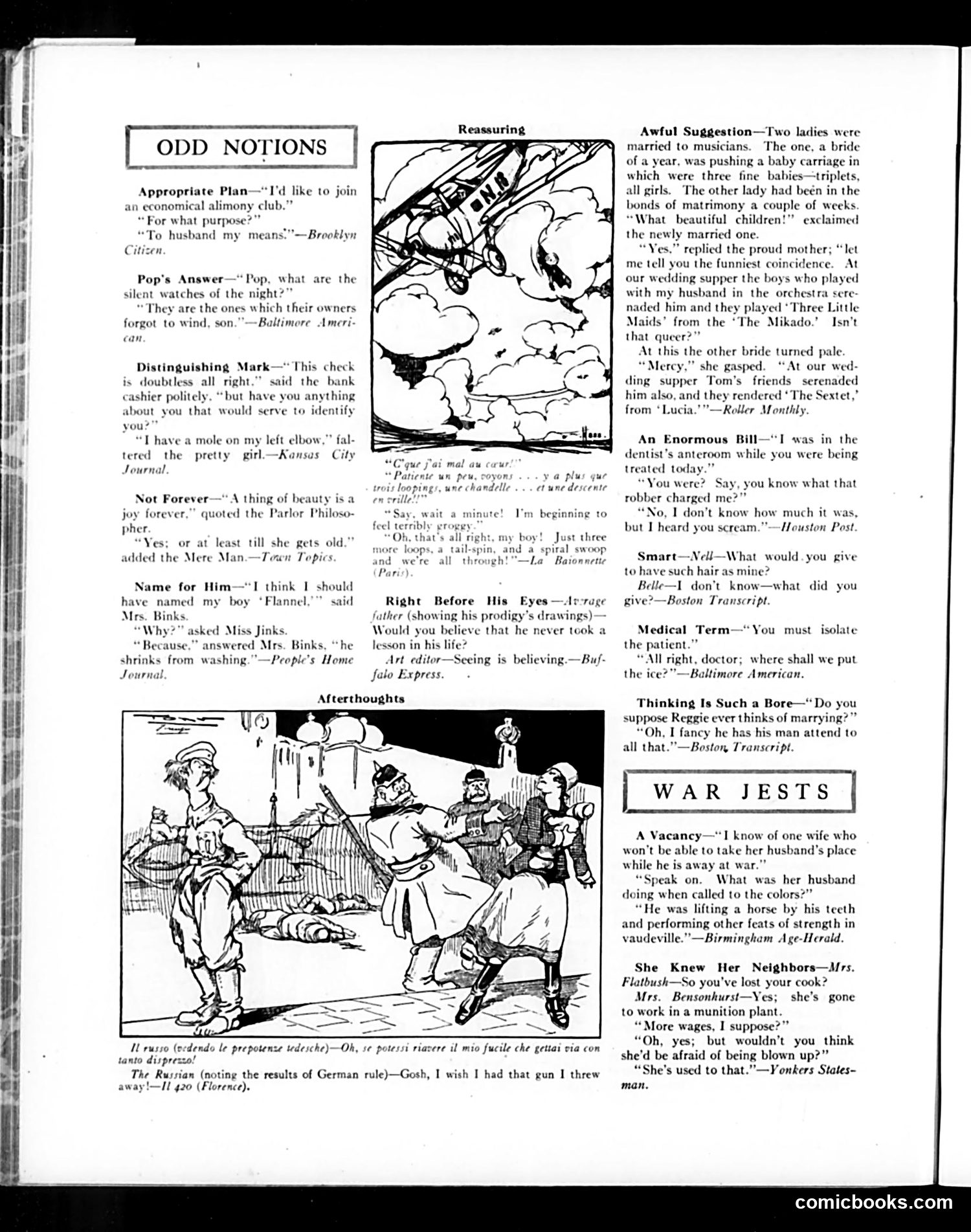
This page contains **short humor pieces and one political cartoon**, typical of Judge's satirical format. ## The Main Cartoon ("Afterthoughts") Depicts soldiers or military figures in conversation, with a caption referencing "German rule" and a Russian character regretting throwing away a gun. This is **World War I-era satire** criticizing German occupation or military aggression. ## The Humor Sections The "Odd Notions" and "War Jests" sections are brief jokes touching on: - **Marital/financial satire**: An "economical alimony club" joke mocks divorce culture - **Women in wartime**: Jokes about wives replacing husbands' jobs (munitions factory work, vaudeville acts) - **Class commentary**: Bank clerks, musicians, dentists appear as targets ## Historical Context This appears to be from **WWI era** (references to "colors"/military service, German rule, munitions plants). The humor reflects contemporary anxieties: marriage instability, women entering the workforce due to war, and military sacrifice. The satire is gentle, domestic, and aimed at middle-class readers familiar with these social disruptions.
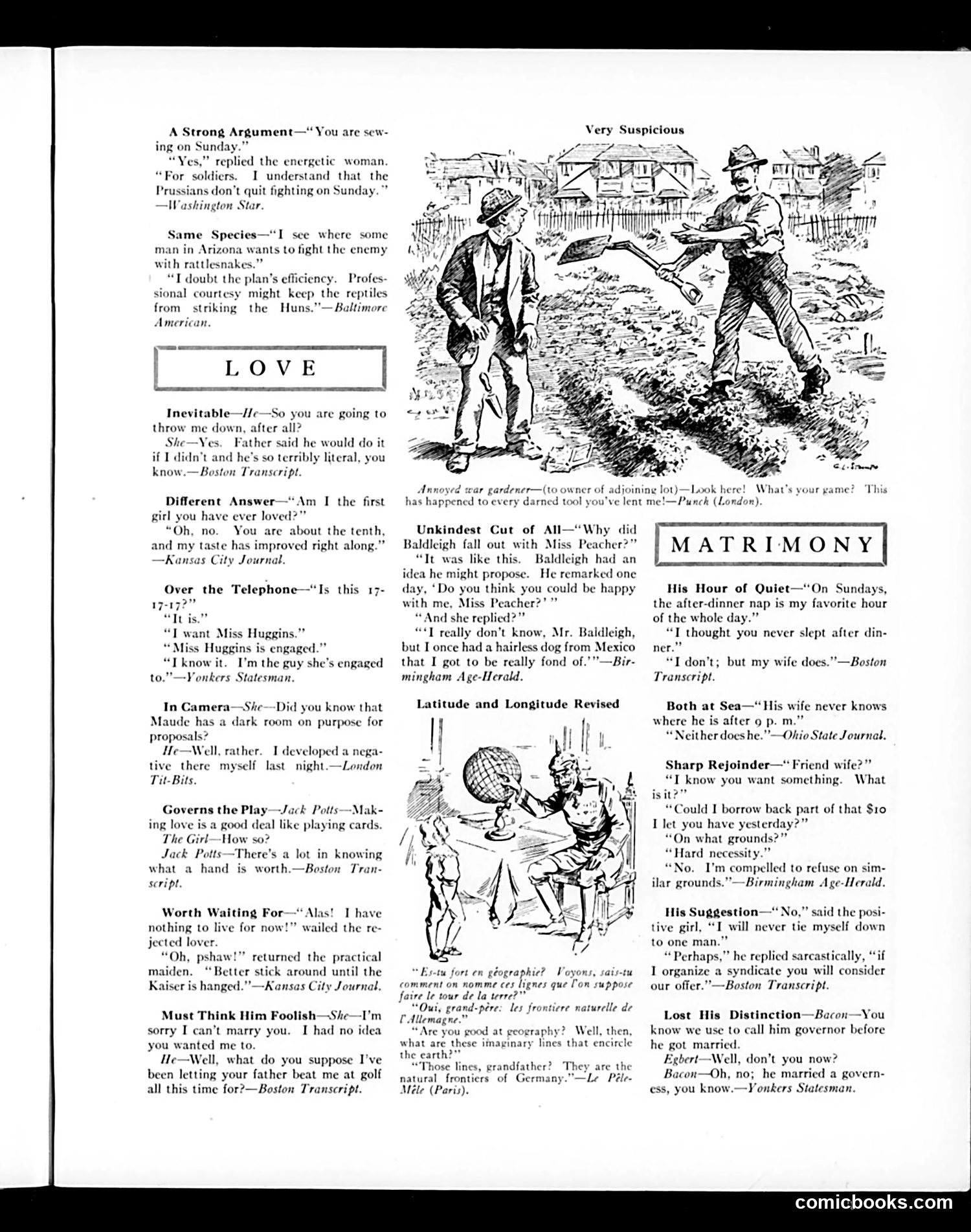
This page from *Judge* magazine collects humorous one-liner jokes about love and marriage, likely from World War I era (references to "the Kaiser" and soldiers fighting Prussia appear in the opening section). The content consists entirely of **brief comic exchanges**, not political cartoons. Two illustrations appear: one showing two men in a rural setting (labeled "Very Suspicious"), and another depicting a geography lesson with a grandfather and child. The jokes target: - **Gender dynamics**: Women rejecting suitors, wives controlling husbands' leisure time, haggling over borrowed money - **Social pretense**: A woman with a "dark room" for proposals; men using transparent excuses to court - **Class/status**: A man losing his title "governor" upon marrying a governess The humor relies on **unexpected punchlines and role reversals**—rejections, practical women outwitting romantic men, wives dominating domestic life. These reflect early-20th-century anxieties about changing gender roles and courtship conventions. The page is primarily **humorous content**, not satirical commentary on specific political figures or events.
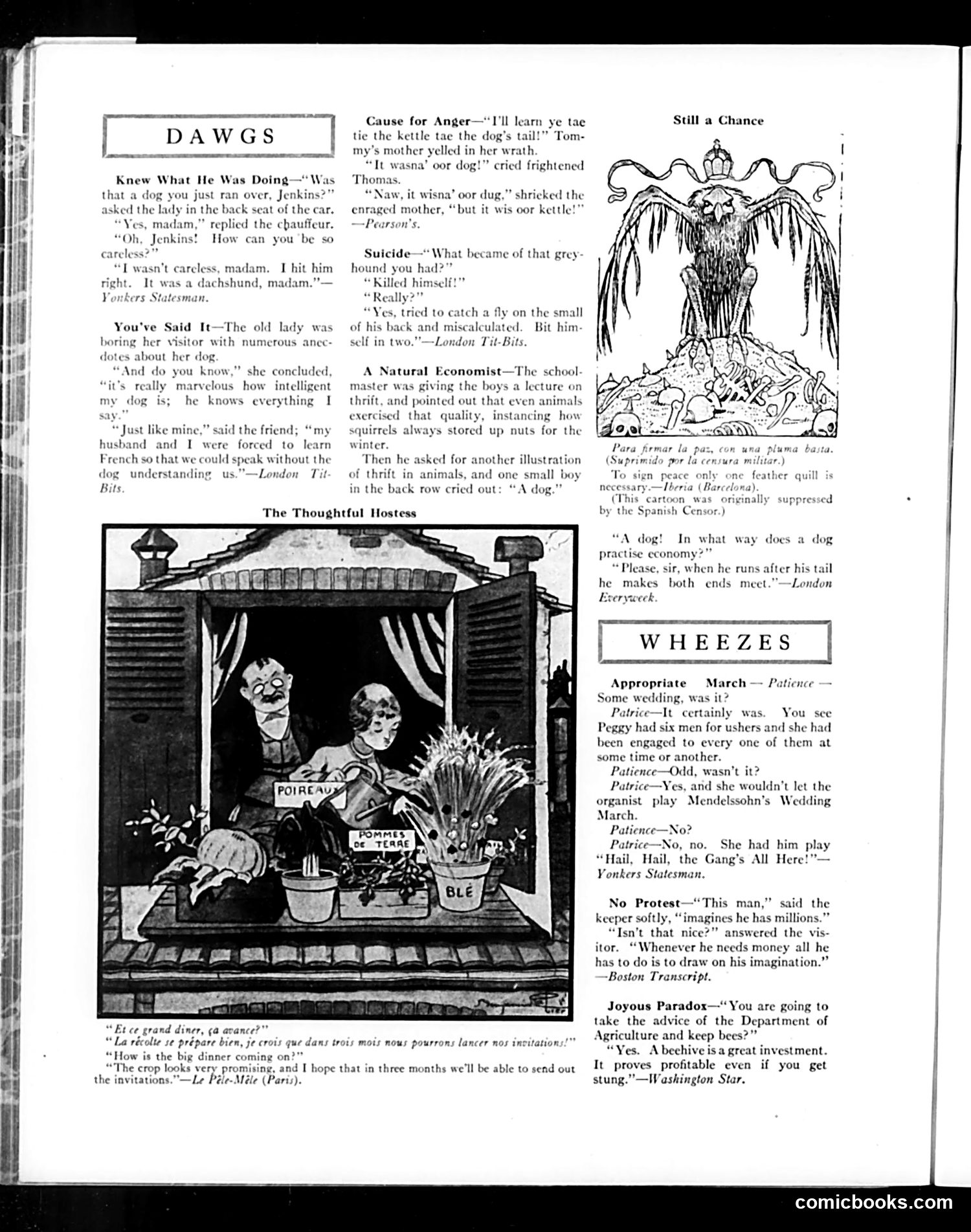
This page contains brief humorous anecdotes and a cartoon, typical of Judge's satirical humor from the early 20th century. **"The Thoughtful Hostess" cartoon** depicts a French woman at a window display of vegetables, planning an elaborate dinner. The French captions and dialogue mock upper-class pretension—she's so concerned with impressing guests that she's planning the menu months in advance, obsessing over produce quality. The satire targets both French dining culture and wealthy hosts' social anxiety. **The anecdotes** use dogs as vehicles for gentle humor: a chauffeur intentionally hits a dachshund (playing on their elongated shape), a woman's dog is so intelligent it requires French conversation, and a schoolboy suggests dogs practice "economy" by chasing their tails (both ends meet). The "Wheezes" section offers light romantic and social comedy: a bride who'd been engaged to all her ushers, wordplay about bees and investment returns. Overall, this represents Judge's trademark blend of class satire, animal humor, and puns targeting educated readers familiar with European culture and upper-class social conventions.
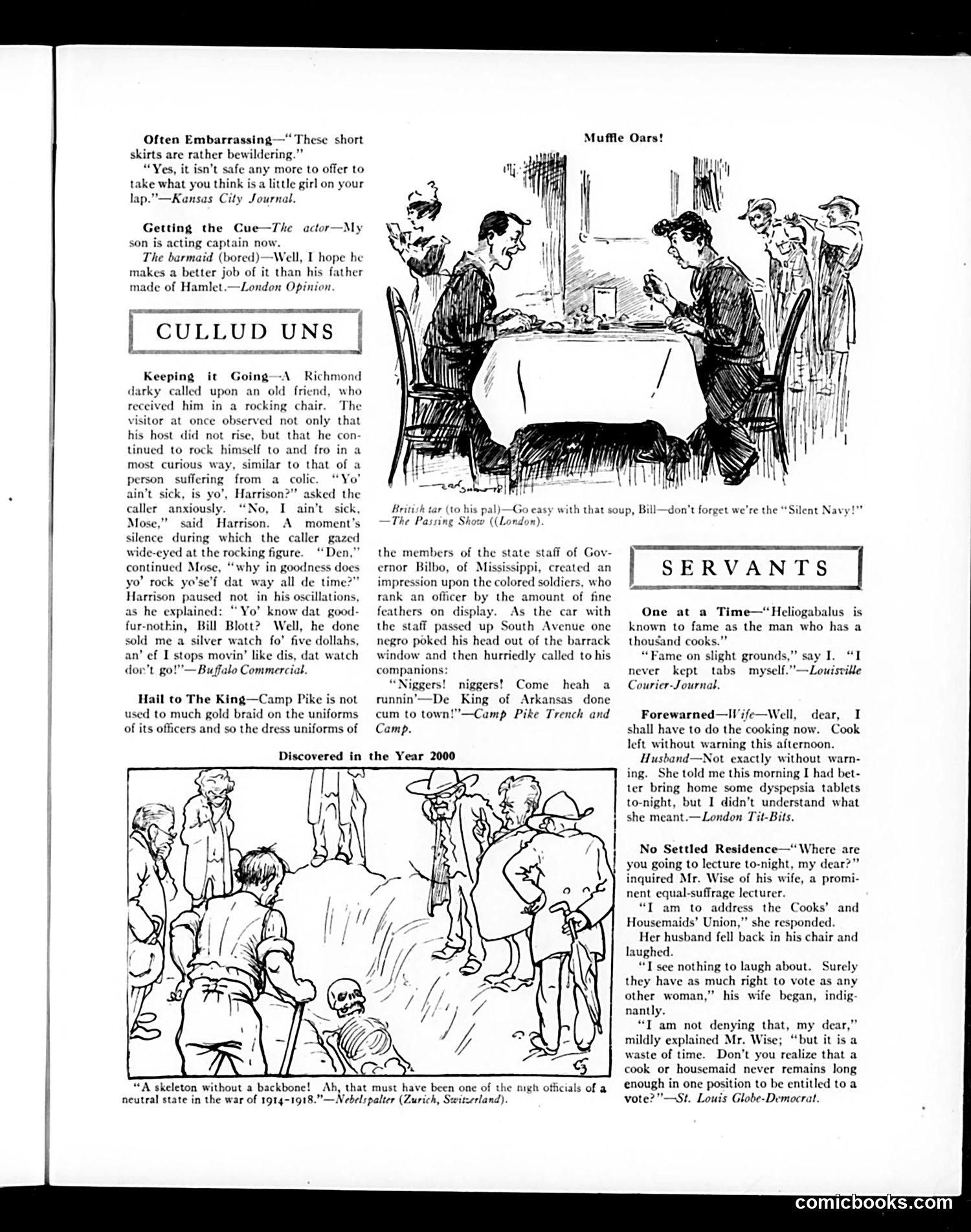
This satirical page from Judge magazine contains several humor pieces targeting early 20th-century social issues: **"Muffle Oars"** (top cartoon): A naval joke about maintaining silence during wartime operations—a British sailor warns companions not to make noise while rowing, as they're part of the "Silent Navy." **"Cullud Uns"** section: Contains racist dialect humor typical of the era. The "Keeping it Going" joke uses offensive racial stereotypes and minstrel-show language about African Americans. **"Discovered in the Year 2000"**: A political cartoon depicting a skeleton labeled as representing neutral nations during WWI (1914-1918)—satirizing countries that avoided the conflict. **"Servants" section**: Multiple brief jokes about domestic workers, including commentary on women's suffrage. The final piece mocks suffragist women and suggests domestic servants lack voting eligibility due to job instability. The page reflects early 20th-century attitudes: casual racism, gender politics debates, and WWI commentary. Modern readers should recognize these pieces as period artifacts reflecting outdated, offensive social perspectives rather than contemporary humor standards.
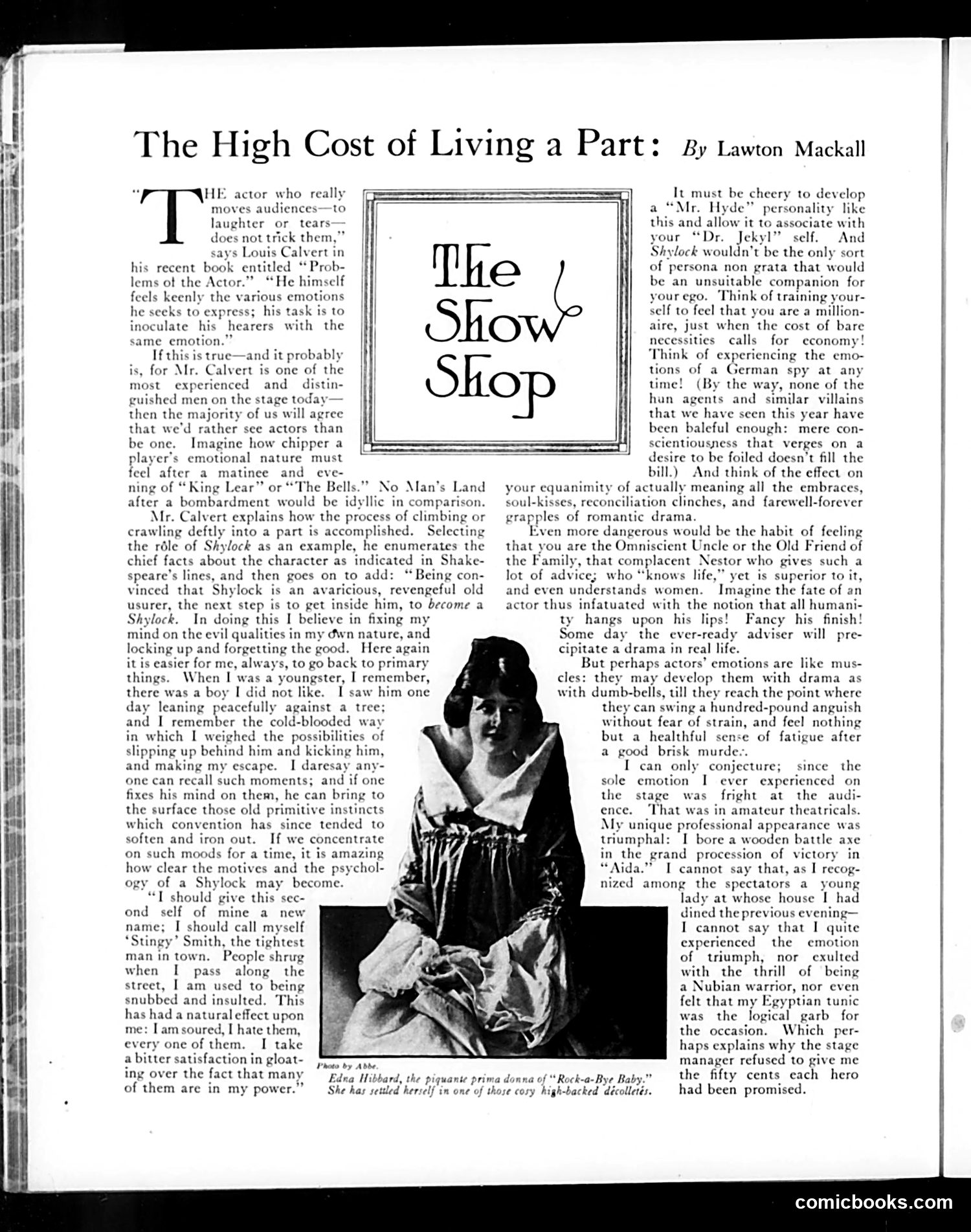
This article by Lawton Mackall discusses the emotional demands of acting, using actor Louis Calvert's theories as a framework. The central point is that serious actors must genuinely feel the emotions of their characters to move audiences authentically. The satire criticizes the practical consequences of this method. Mackall argues that constantly inhabiting dark characters—Shylock's avarice, a German spy's malice, a meddling family friend's condescension—could dangerously warp an actor's personality off-stage. He jokes that an actor might become "Stingy Smith," genuinely misanthropic and bitter, or develop a messiah complex from playing authority figures. The photograph shows an actress (identified as Edna Hibbard in the caption) in theatrical costume, embodying the transformative power Mackall discusses. The satire's point: the "high cost" of great acting may be psychological damage to the performer's actual self.
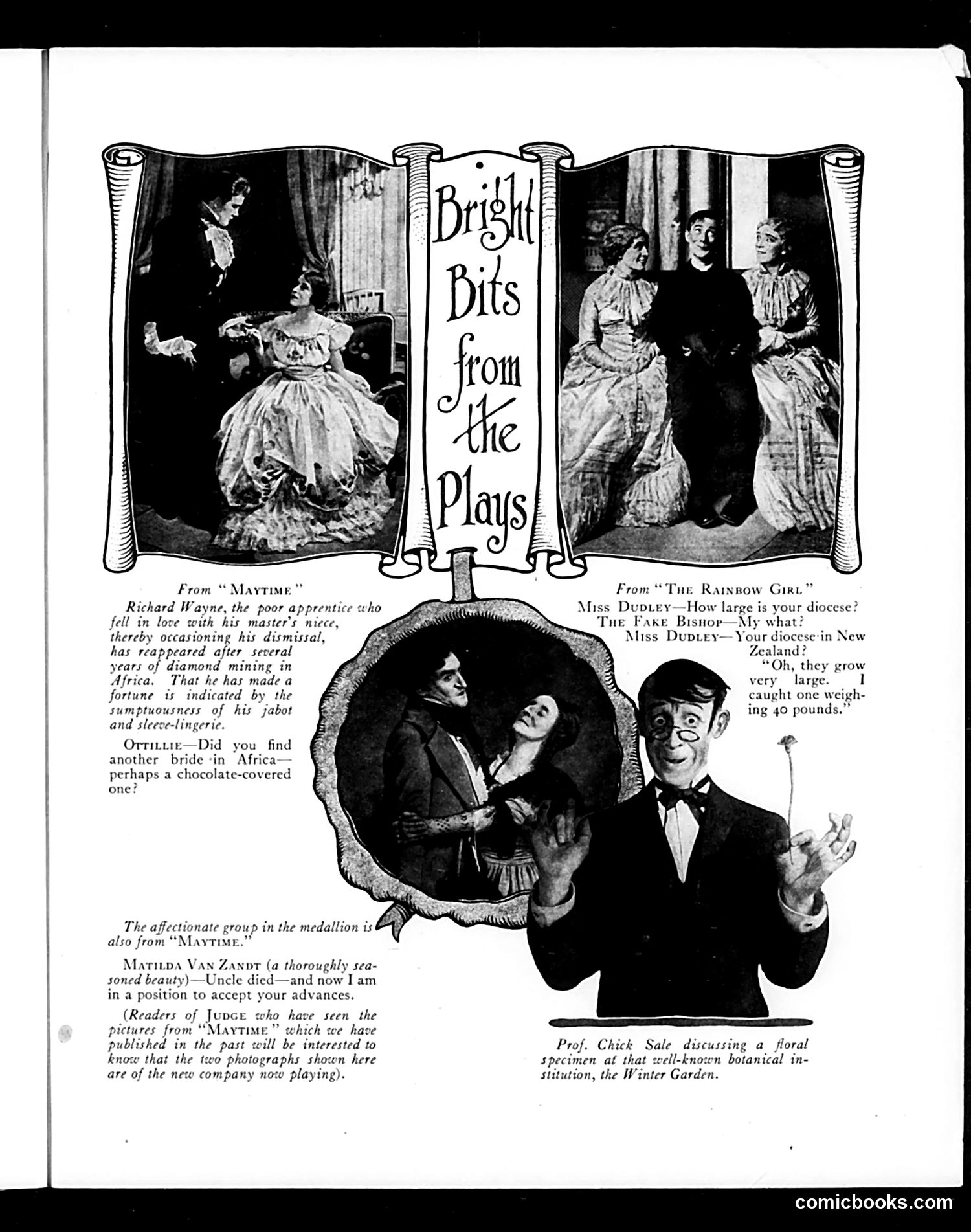
This page showcases humorous dialogue snippets from contemporary theatrical productions ("Maytime" and "The Rainbow Girl"), a common Judge magazine feature. The jokes rely on verbal misunderstandings and social satire: 1. **"Maytime" references**: A man returning wealthy from African diamond mining is mocked for his ostentatious dress (elaborate jabot and sleeves), and a woman humorously pursues him now that her uncle's death has left her financially independent. 2. **"The Rainbow Girl" joke**: A fake bishop confuses "diocese" (religious territory) with "dioecious" (a botanical term), revealing his fraudulence. The humor lies in exposing religious charlatans—a common satirical target. 3. **Bottom caption**: References "Prof. Chick Sale," likely a vaudeville performer known for humorous monologues, discussing flowers at the Winter Garden theater. The satire targets wealth-obsession, matrimonial scheming, religious fraud, and theatrical pretension—standard Judge fare mocking contemporary urban society and popular entertainment.
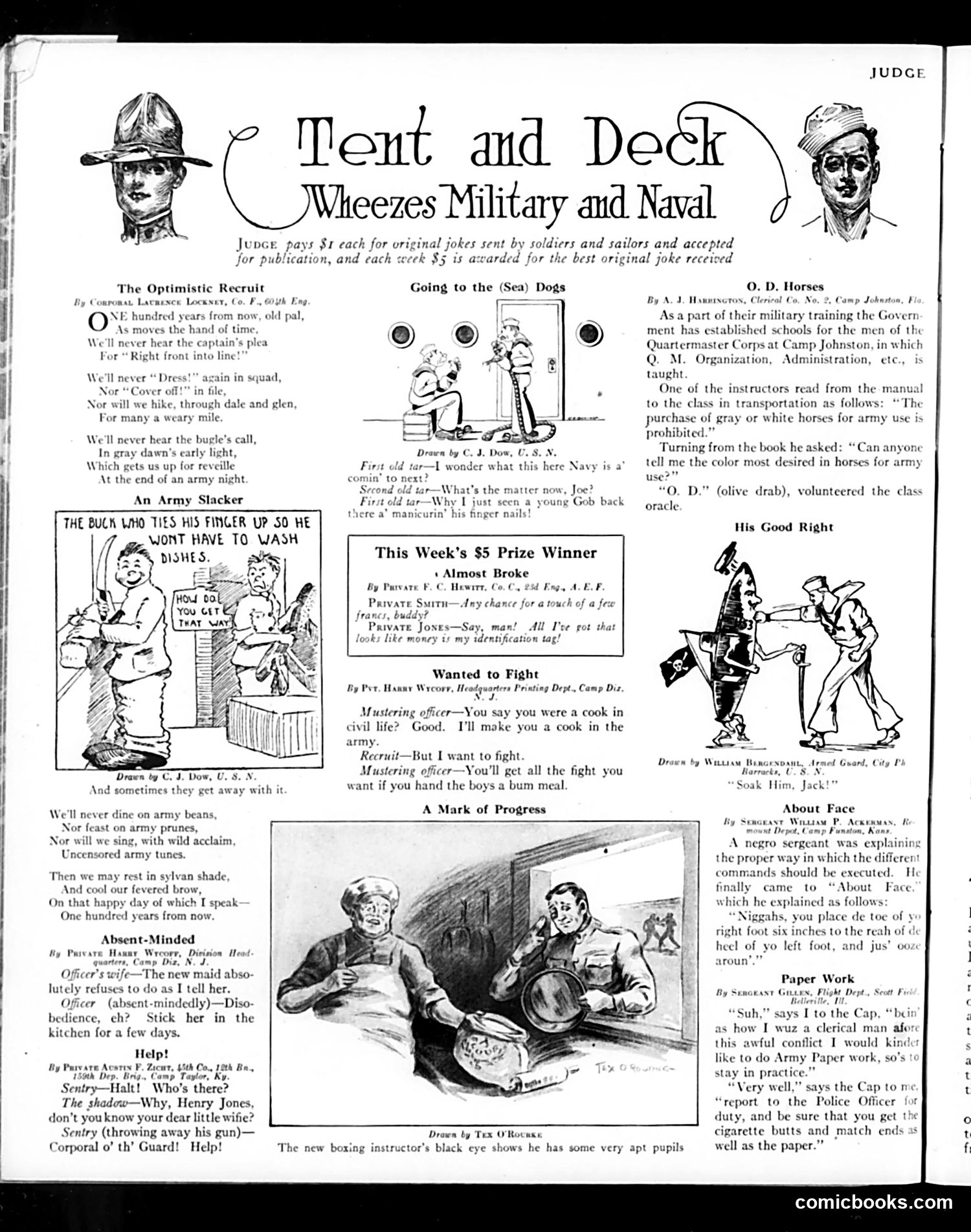
This page collects satirical jokes about World War I soldiers and sailors, submitted by military personnel themselves for Judge's "Tent and Deck" column. The humor targets common military frustrations and absurdities. **Key satirical targets:** - **"The Optimistic Recruit"**: Mock-serious poem about a soldier dreaming that army hardships (marching, bugle calls, bad food, censored songs) will end in 100 years—grim commentary on endless military routine. - **"Army Slacker"**: Cartoon mocking soldiers who shirk duties (tying up a finger to avoid washing dishes). - **"Wanted to Fight"**: Recruits claiming martial enthusiasm get assigned kitchen duty instead—ironic deflation of war fever. - **"About Face"**: A Black sergeant's malapropism about executing commands, presented for ethnic humor (period standard, now offensive). - **"Paper Work"**: A clerk assigned to collect cigarette butts instead of doing administrative work—bureaucratic absurdity. The page reflects soldiers' own cynicism about military life: boredom, bad food, pointless orders, and the gap between idealism and reality.
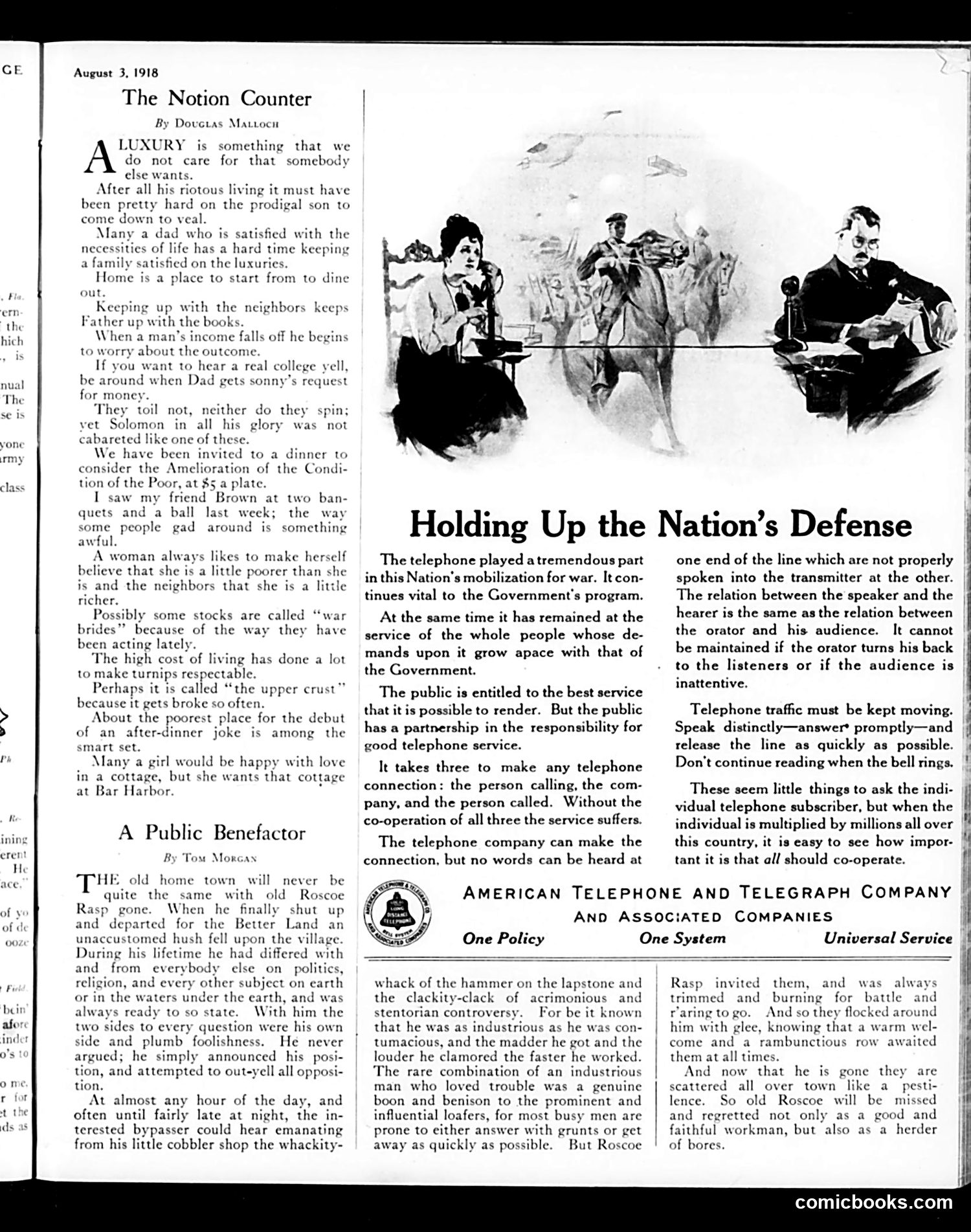
This page contains three distinct pieces: **"The Notion Counter"** (left column): A satirical humor column about wealth and social pretense during WWI-era America. It mocks the upper classes for their contradictions—maintaining luxuries while claiming poverty, spending lavishly at charity dinners "for the poor," and obsessing over status symbols like Bar Harbor cottages. **"A Public Benefactor"** (bottom left): An obituary-style tribute to "old Roscoe Rasp," a contentious small-town cobbler who argued loudly about everything. The piece gently mocks provincial argumentativeness while ultimately praising his character. **"Holding Up the Nation's Defense"** (right): A telephone company advertisement framed as patriotic service advice (1918 was WWI). It urges citizens to use telephones efficiently—speak clearly, answer promptly, hang up quickly—to support government communications. The illustration shows proper telephone etiquette. This reflects how corporations marketed themselves as patriotic contributors during wartime. The page reflects 1918 American concerns: class anxiety, wartime sacrifice, and corporate patriotism.
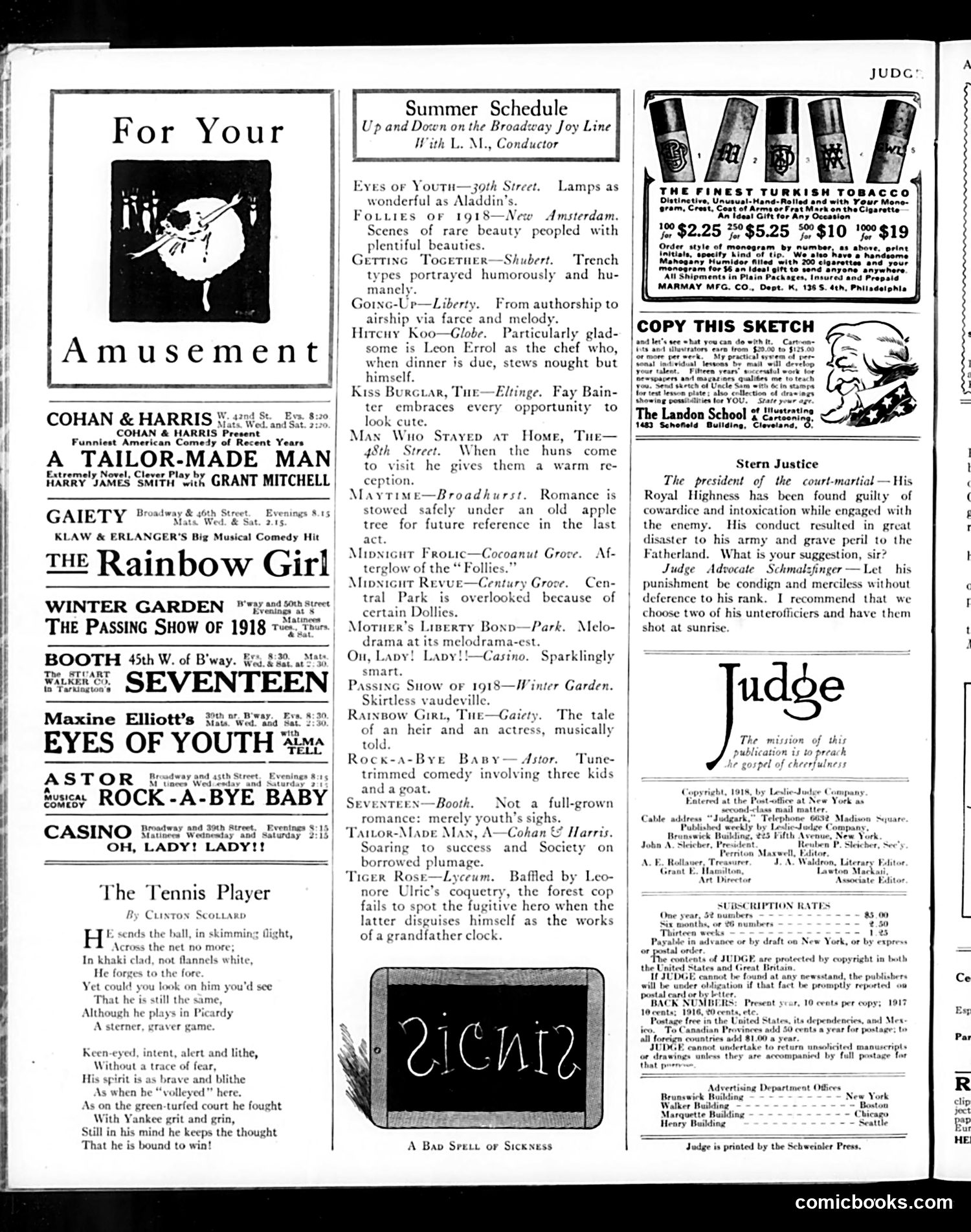
This page is primarily **theatrical advertising and entertainment content** from 1918, not political satire. The main editorial content is "The Tennis Player," a patriotic poem by Clinton Scollard celebrating an athlete who has left sports ("green-turfed court") to fight in World War I in France ("Picardy"). The poem uses tennis metaphors ("volley," "grit and grin") to suggest the soldier maintains his competitive spirit in actual combat—a romantic glorification of military service common during WWI. The brief "Stern Justice" cartoon depicts a court-martial scene, likely reflecting anxieties about military discipline and morale during the war, though the specific case referenced is unclear from the visible text. The bulk of the page lists Broadway shows and advertisements for Judge magazine and various products. This reflects Judge's dual role as satirical publication and entertainment-focused magazine in the early 20th century.
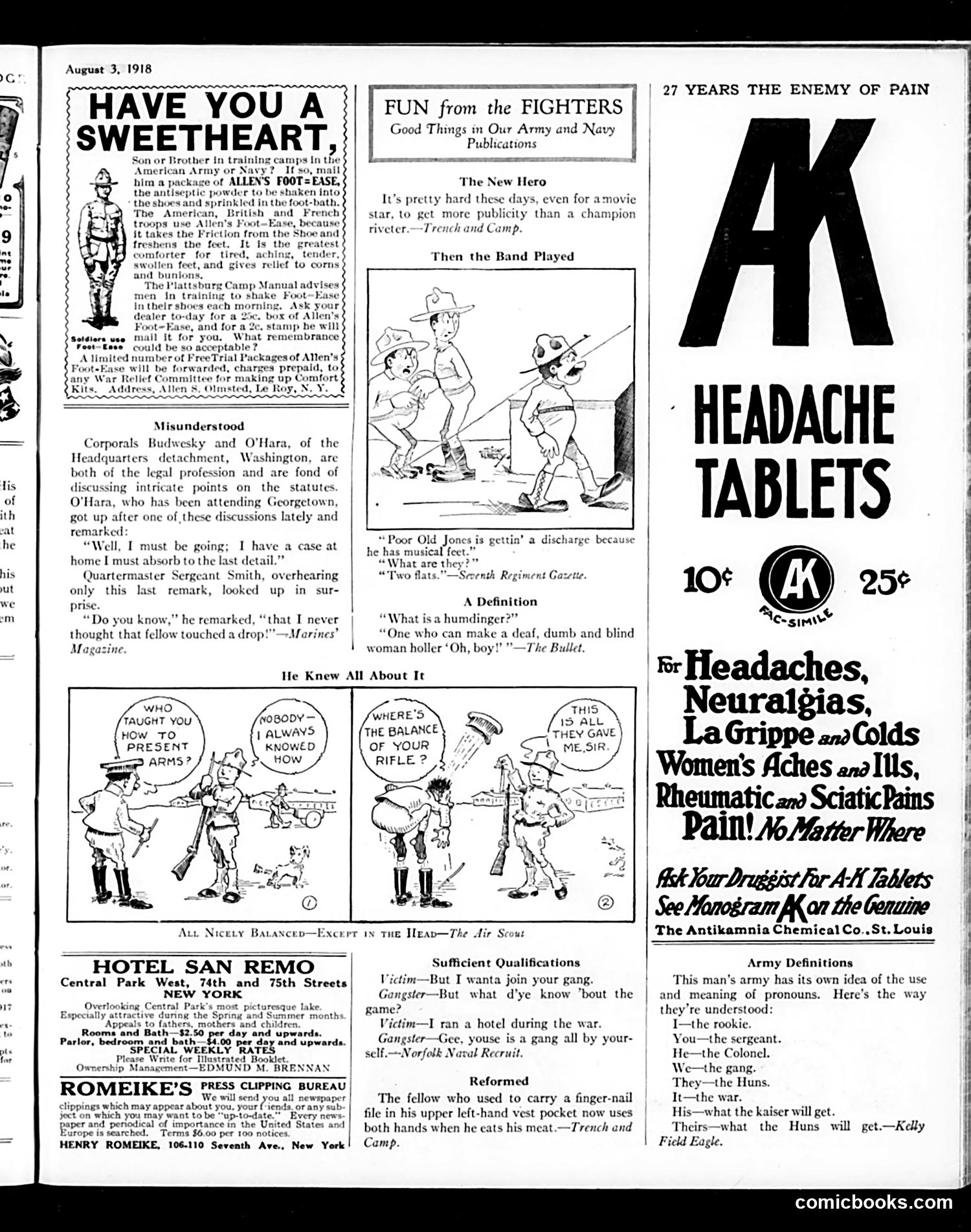
This page is primarily **advertisements and filler content** from a WWI-era satirical magazine, with several brief military humor pieces. **Main content:** The page features short jokes and anecdotes from Army/Navy publications, all playing on WWI military life: - "Then the Band Played": A joke about a soldier named "Jones" getting discharged because he has "musical feet" (two flats—a pun on both music and flat feet, a condition used to avoid service) - "He Knew All About It": A comic strip showing soldiers discussing military training, illustrating how soldiers absorbed knowledge - "Misunderstood": A brief anecdote about a sergeant misinterpreting a lawyer's comment about "absorbing a case" as alcoholism The **"Army Definitions"** section offers soldier slang where "the kaiser will get" what's theirs—a reference to German Emperor Wilhelm II, reflecting anti-German sentiment of 1918. The page is otherwise dominated by period **product advertisements**, including Allen's Foot-Ease powder for soldiers and A-K Headache Tablets—reflecting the commercial nature of popular magazines.
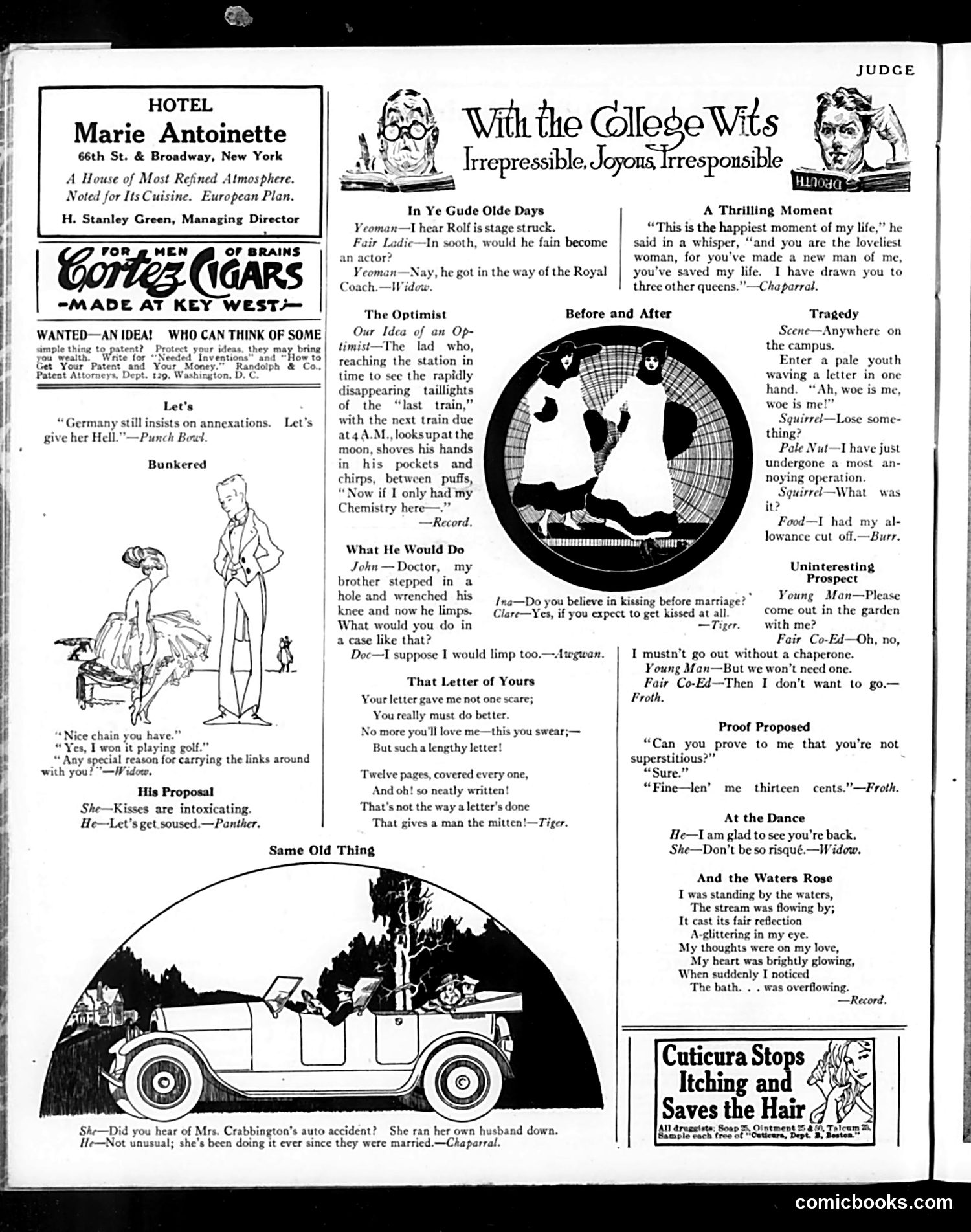
This page from *Judge* magazine contains mostly **humorous short jokes and comic sketches** rather than political commentary. The content reflects early 20th-century collegiate and domestic humor aimed at middle-class readers. Key elements include: **"With the College Wits"** section: A series of one-liner jokes about college life, courtship, and romance—typical of the era's comedic tone mocking young people's behavior, particularly around kissing, chaperones, and allowances. **Illustrated sketches**: "Bunkered" depicts a golf-related joke; "Same Old Thing" shows a wife who's been "running down" her husband since marriage—satirizing marital discord as mundane. **Hotel and product advertisements** fill the margins (Marie Antoinette Hotel, Cortes cigars, Cuticura). **Overall tone**: Lighthearted social satire focused on romance, marriage, and college culture rather than politics. The humor relies on puns, double meanings, and observations about gender relations that modern readers might find dated or mildly offensive.
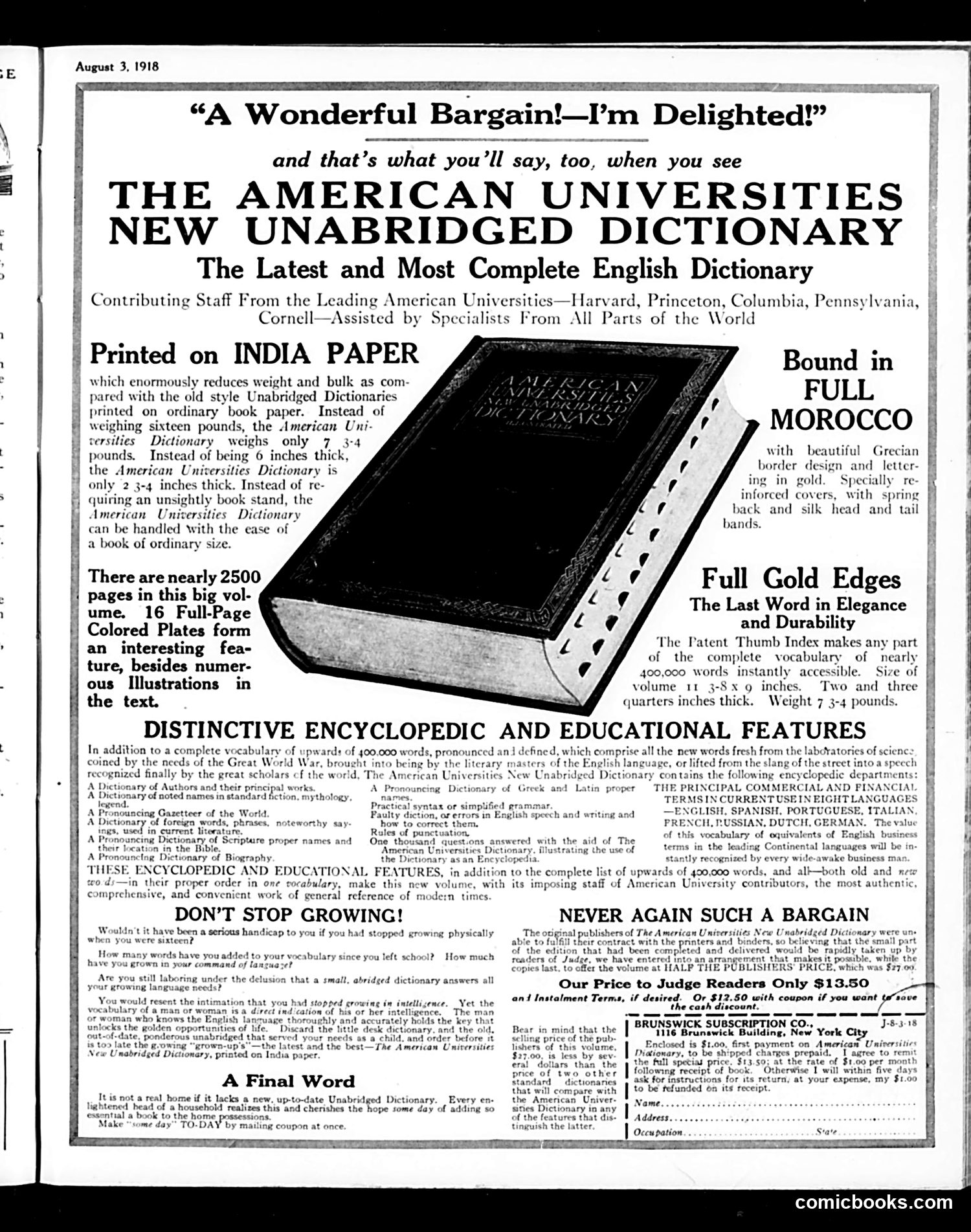
This page is primarily a **dictionary advertisement**, not a political cartoon. It promotes "The American Universities New Unabridged Dictionary" published by Brunswick Subscription Co. The ad uses a sales pitch framing ("A Wonderful Bargain!—I'm Delighted!") common to 1918 advertising. The central appeal emphasizes practical improvements: the dictionary weighs only 7¾ pounds instead of sixteen, measures 2¾ inches thick instead of 6 inches, and includes 2,500 pages with colored plates and illustrations. The copy includes motivational language ("Don't Stop Growing!") arguing that an updated dictionary is essential—not just for children but for adults seeking to expand vocabulary in response to "the needs of the Great World War." The dictionary itself appears designed for broad, educated American audiences: it includes contributions from leading universities (Harvard, Princeton, Columbia, Pennsylvania, Cornell) and promises comprehensive coverage of new war-related terminology, foreign words, and encyclopedic features. The special offer price to Judge readers: **$13.50** (normally $27.00). This represents standard early-20th-century magazine advertising strategy—using reputable institutional backing and patriotic context to market educational products.
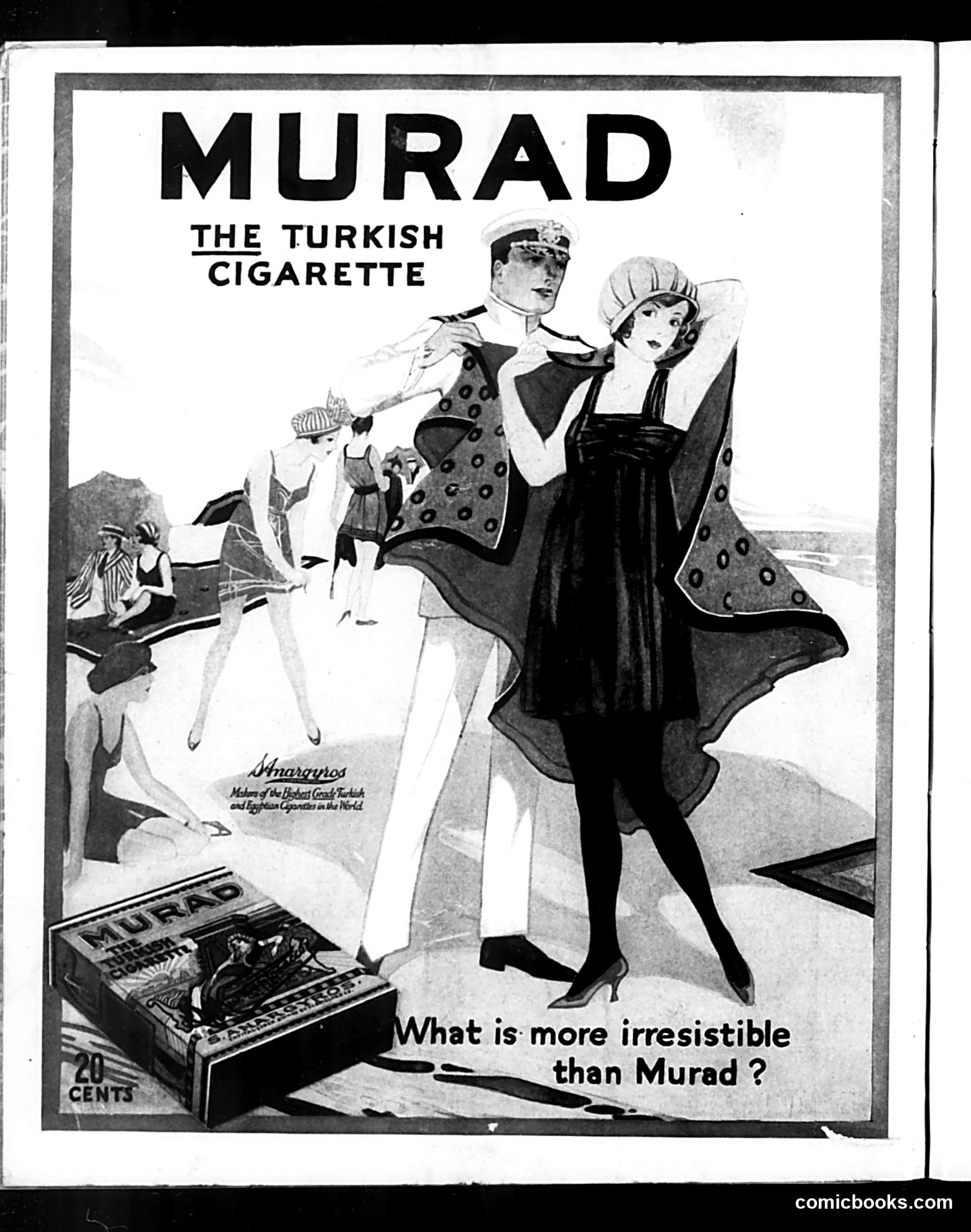
This is a cigarette advertisement, not political satire. It promotes Murad brand Turkish cigarettes, priced at 20 cents. The ad uses a rhetorical question—"What is more irresistible than Murad?"—paired with an illustration of fashionably dressed women in 1920s attire, suggesting the cigarettes appeal to sophisticated, glamorous consumers. The imagery associates the product with elegance and modernity. A small box of Murad cigarettes appears in the lower left. The ad's tagline claims these are "the finest of the highest grade Turkish and Virginia Cigarettes in the World." This represents typical early-20th-century tobacco marketing that openly targeted consumers, including women, without health warnings—a practice now heavily regulated.