
Judge, 1918-08-03 · page 16 of 32
Judge — August 3, 1918 — page 16: what you’re looking at
What you’re looking at
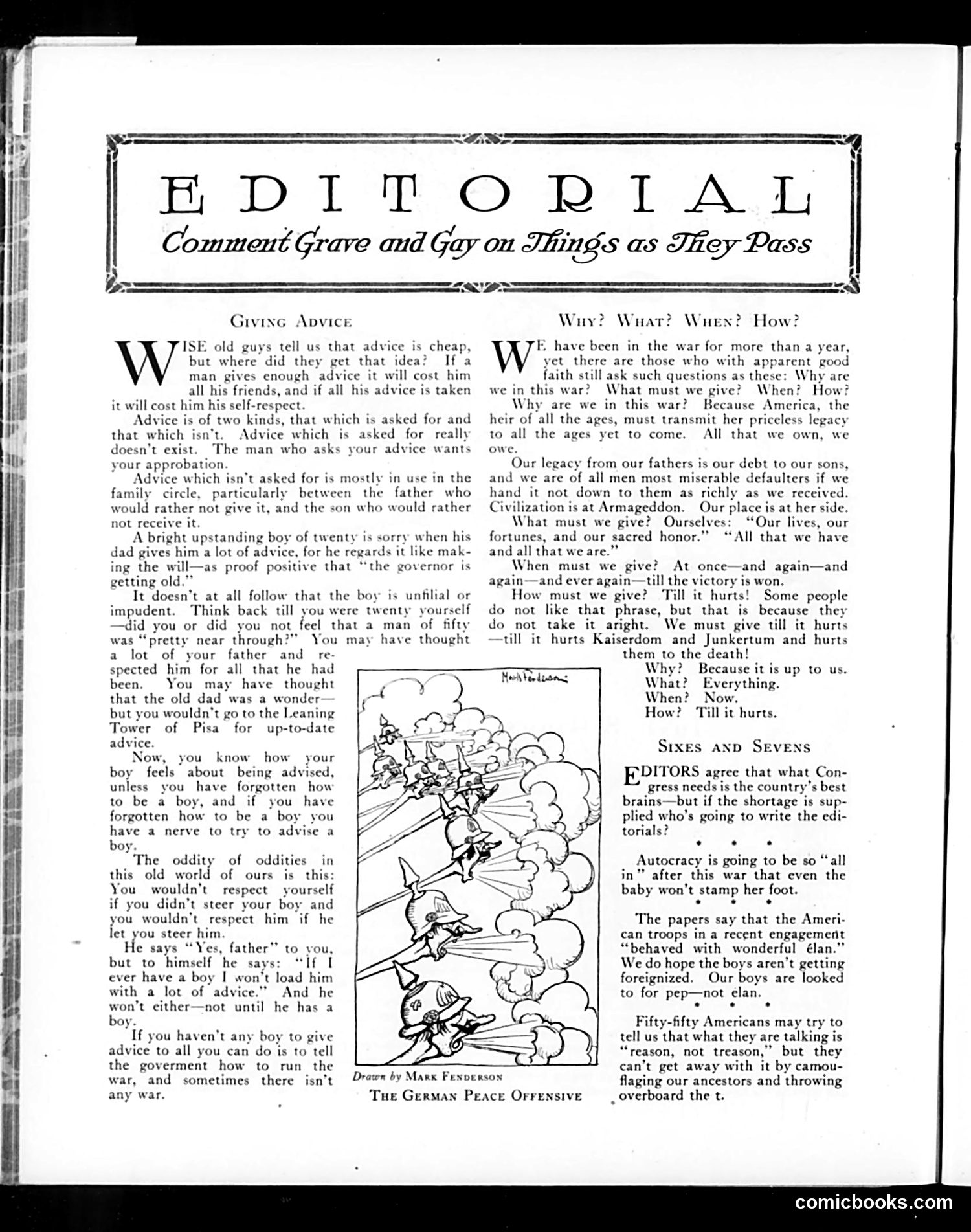
This editorial page addresses American home-front anxieties during World War I. The left column satirizes unsolicited advice-giving, using the father-son relationship as metaphor—a father can't respect his son if he controls him, yet won't respect himself if he doesn't try. The humor reflects tension between traditional authority and emerging independence. The right column directly addresses war questions: "Why are we fighting?" The editor argues America inherits a civilizational debt to transmit to future generations, positioning the conflict as civilizational obligation. "Give till it hurts" means financial/material sacrifice should damage Germany ("Kaiserdom and Junkertum"—references to German aristocratic militarism). The cartoon by Mark Fenderson (labeled "The German Peace Offensive") depicts German soldiers being blown back by explosions—satirizing German peace proposals as hollow propaganda. The "Sixes and Sevens" section mocks domestic concerns as trivial compared to war sacrifice, warning against "foreignization" of American troops and autocracy's post-war consequences. The page advocates total war commitment while mocking civilian hesitation.
📄 Transcribed text from this page (OCR, searchable)
Machine-transcribed from the original scan — historical spelling and the odd misread are preserved.
a ae a a 2 = Ss. aoe inane Ss Se a i SS eee oo RFDITORIAL Comment Grave and Gay ou Things as They Pass Givixc Apvice ISE old guys tell us that advice is cheap, but where did they get that idea? If a man gives enough advice it will cost him all his friends, and if all his advice is taken it will cost him his self-respect. Advice is of two kinds, that which is asked for and that which isn’t. Advice which is asked for really doesn’t exist. The man who asks your advice wants your approbation. Advice which isn’t asked for is mostly in use in the family circle, particularly between the father who would rather not give it, and the son who would rather not receive it. A bright upstanding boy of twenty is sorry when his dad gives him a lot of advice, for he regards it like mak- ing the will—as proof positive that “the governor is getting old.” It doesn’t at all follow that the boy is unfilial or impudent. Think back till you were twenty yourself -did you or did you not feel that a man of fifty was “pretty near through?” You may have thought a lot of your father and re- oN Pe Wuenx? How Wuy? Wuat » have been in the war for more than a year, W et there are those who with apparent good faith still ask such questions as these: Why are we in this war? What must we give? When? How? Why are we in this war? Because America, the heir of all the ages, must transmit her priceless legacy to all the ages yet to come. All that we own, we owe. Our legacy from our fathers is our debt to our sons, and we are of all men most miserable defaulters if we hand it not down to them as richly as we received. Civilization is at Armageddon. Our place is at her side. What must we give? Ourselves: “Our lives, our fortunes, and our sacred honor.” ‘All that we have and all that we are.” When must we give? At once—and again—and again—and ever again—till the victory is won. How must we give? Till it hurts! Some people do not like that phrase, but that is because they do not take it aright. We must give till it hurts —till it hurts Kaiserdom and Junkertum and hurts them to the death! Why? Because it is up to us. spected him for all that he had - been. You may have thought ™7y that the old dad was a wonder— but you wouldn't go to the Leaning Tower of Pisa for up-to-date advice. Now, you know how your boy feels about being advised, unless you have forgotten how to be a boy, and if you have forgotten how to be a boy you have a nerve to try to advise a boy. The oddity of oddities in this old world of ours is this: You wouldn't respect yourself if you didn’t steer your boy and you wouldn't respect him if he let you steer him. He says “Yes, father” to you, but to himself he says: “If I ever have a boy I won't load him with a lot of advice.” And he won't cither—not until he has a boy. If you haven't any boy to give advice to all you can do is to tell the goverment how to run the war, and sometimes there isn’t any war. Drawn by Marx Fexverson Tue German Peace Orre Hobterdeses What? Everything. When? Now. How? Till it hurts. Sixes anp SEVENS DITORS agree that what Con- gress needs is the count best brains—but if the shortage is sup- plied who’s going to write the edi- torials? Autocracy is going to be so “all in” after this war that even the baby won’t stamp her foot. * see The papers say that the Ameri- can troops in a recent engagement “behaved with wonderful élan.” We do hope the boys aren’t getting foreignized. Our boys are looked to for pep—not elan. . . . Fifty-fifty Americans may try to tell us that what they are talking is “reason, not treason,” but they can’t get away with it by camou- flaging our ancestors and throwing sive overboard the t. comicbooks.com