
Judge, 1918-08-03 · page 9 of 32
Judge — August 3, 1918 — page 9: what you’re looking at
What you’re looking at
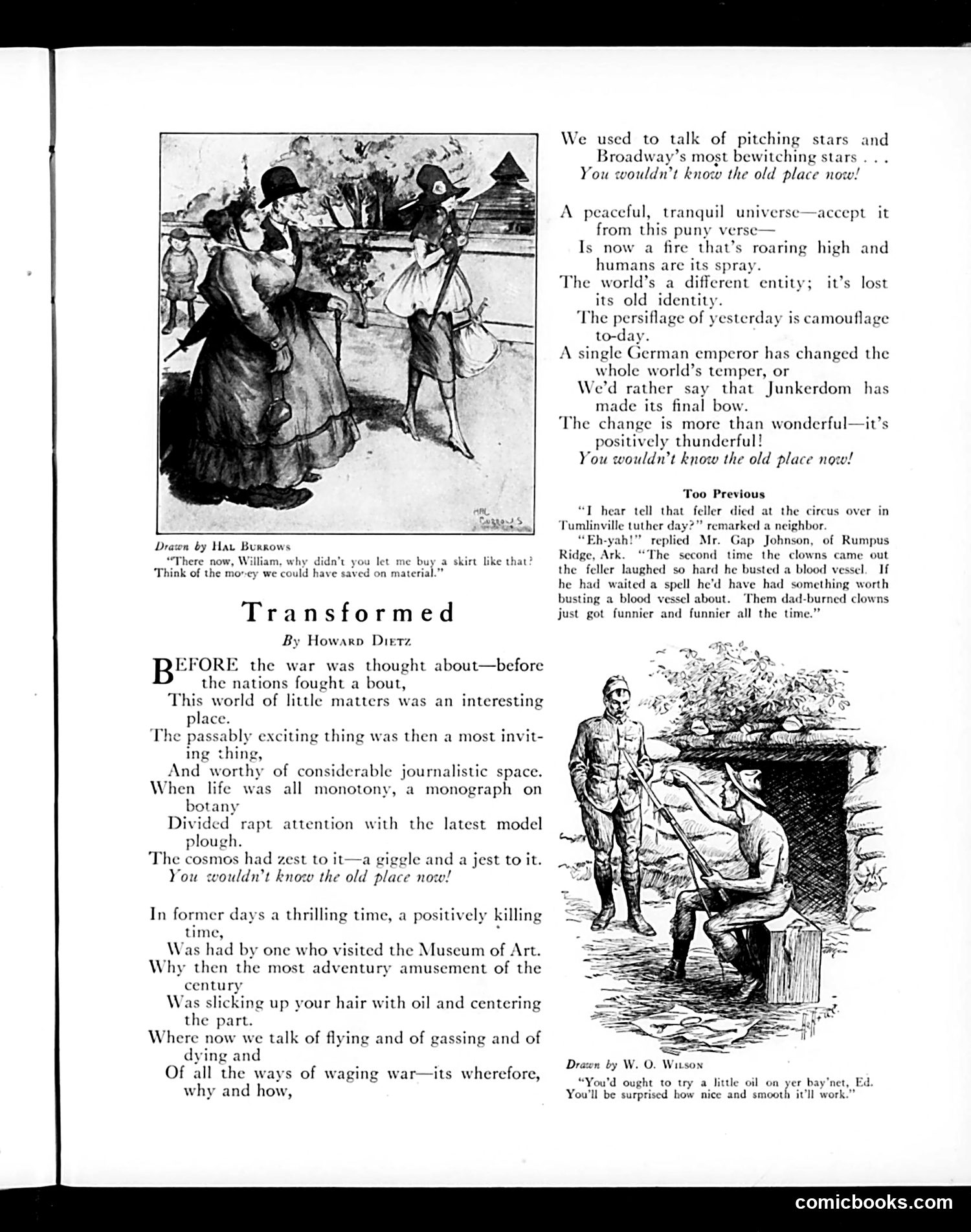
This page contrasts pre-war and wartime life. The poem "Transformed" by Howard Dietz nostalgically describes a peaceful pre-war world obsessed with trivial matters—fashion, Broadway stars, hairstyles, museum visits—where life had "zest" and "giggle." The refrain "You wouldn't know the old place now!" marks the shift: World War I has transformed society completely. The poet blames "a single German emperor" (Kaiser Wilhelm II) and "Junkerdom" (Prussian militarism) for changing the world's character. Now people discuss "flying and gassing and dying"—modern warfare technologies—replacing idle gossip. The cartoon at top (by Hal Burrows) shows a woman in a wartime economical skirt, with her husband sardonically noting the material savings—implying women's fashion itself has been transformed by wartime rationing and practicality. The page satirizes how completely World War I disrupted ordinary civilian life and concerns.
📄 Transcribed text from this page (OCR, searchable)
Machine-transcribed from the original scan — historical spelling and the odd misread are preserved.
nt wanes S Drawn by Hat Burrows “There now, William, why didn’t you let buy a skirt like that? Think of the mor-cy we could have saved on material.” Transformed By Howarp Dietz EFORE the war was thought about—before the nations fought a bout, This world of little matters was an interesting place. sably exciting thing was then a most invit- ing thing, And worthy of considerable journalistic s When life was all monotony, a monograph on botany Divided rapt attention with the plough. The cosmos had zest to it—a giggle and a jest to it. You cwouldn’t know the old place now! latest model In former da time, Was had by one who visited the Museum of Art. Why then the most adventury amusement of the century Was slicking up your hair with oil and centering the part. Where now we talk of flying and of gassing and of dying and Of all the ways why and how, a thrilling time, a positively killing of waging war—its wherefore, We used to talk of pitching stars and Broadway’s most bewitching stars . . . You wouldn’t know the old place now! A peaceful, tranquil universe—accept it from this puny verse— Is now a fire that’s r humans are its spray. The world’s a different entity; its old identity. The persiflage of yesterday is camouflage to-day. A single German emperor has changed the whole world’s temper, or We'd rather say that Junkerdom has made its final bow. The change is more than wonderful—it’s positively thunderful! You wouldn't know the old place now! ing high and it’s lost Too Previous “T hear tell that feller died at the circus over in Tumlinville tuther day?” remarked a neighbor. “ 1 replied Mr. Gap Johnson, of Rumpus Ridge, Ark. “The second time the clowns came out the feller laughed so hard he busted a blood vessel. If he had waited a spell he'd had something worth busting a blood vessel about. ‘Them dad-burned clowns just got funnier and funnier all the time.” Drawn by W. O. Wirsonx “You'd ought to try a little oil on yer bay’net, Ed. You'll be surprised how nice and smooth it'll work: comicbooks.com