
Judge, 1918-08-03 · page 24 of 32
Judge — August 3, 1918 — page 24: what you’re looking at
What you’re looking at
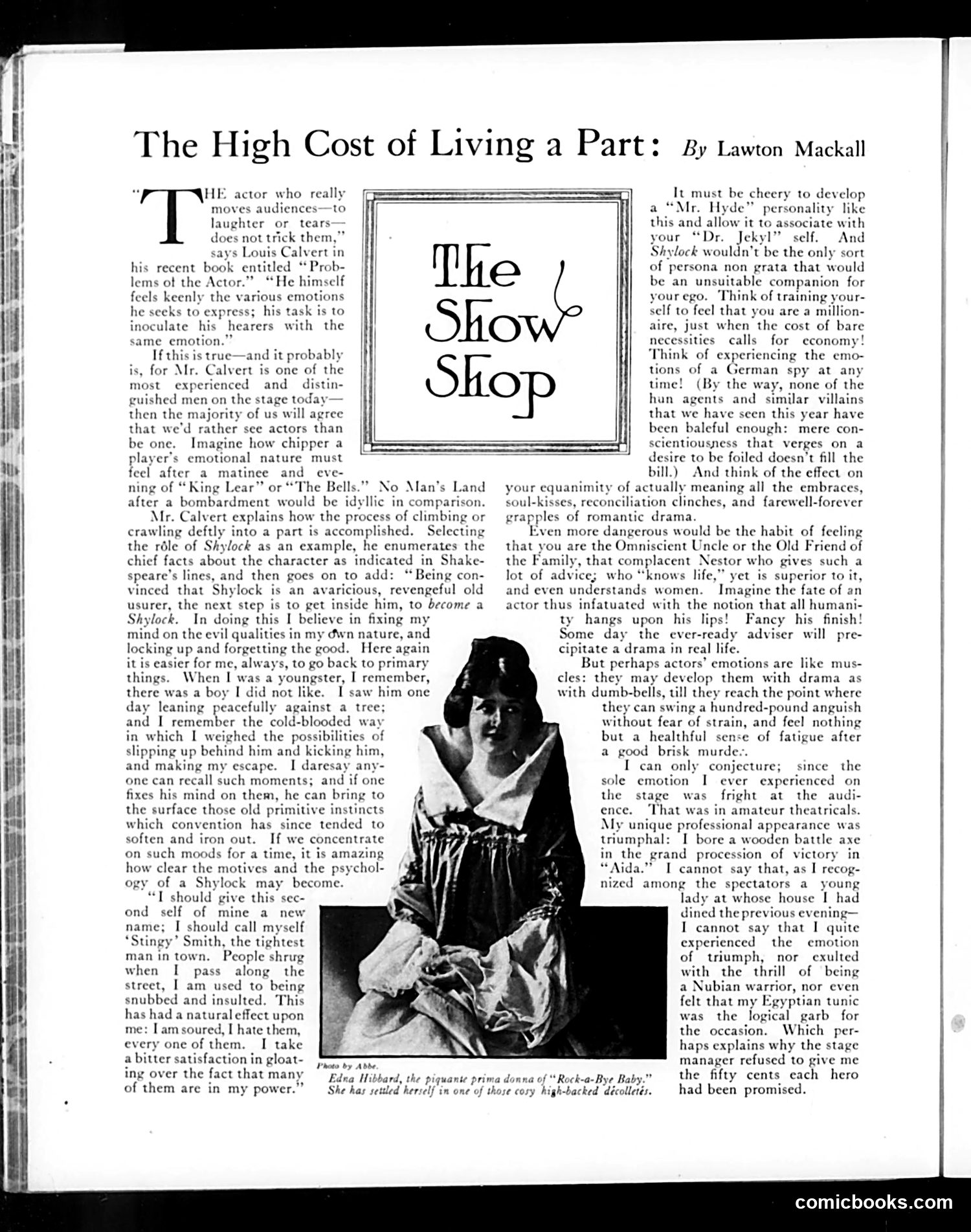
This article by Lawton Mackall discusses the emotional demands of acting, using actor Louis Calvert's theories as a framework. The central point is that serious actors must genuinely feel the emotions of their characters to move audiences authentically. The satire criticizes the practical consequences of this method. Mackall argues that constantly inhabiting dark characters—Shylock's avarice, a German spy's malice, a meddling family friend's condescension—could dangerously warp an actor's personality off-stage. He jokes that an actor might become "Stingy Smith," genuinely misanthropic and bitter, or develop a messiah complex from playing authority figures. The photograph shows an actress (identified as Edna Hibbard in the caption) in theatrical costume, embodying the transformative power Mackall discusses. The satire's point: the "high cost" of great acting may be psychological damage to the performer's actual self.
📄 Transcribed text from this page (OCR, searchable)
Machine-transcribed from the original scan — historical spelling and the odd misread are preserved.
The High Cost of Living a Part: HE actor who really By Lawton Mackall It must be cheery to develop moves audiences—to laughter or tears does not trick them,” says Louis Calvert in his recent book entitled ‘ Prob- lems ot the Actor.” “He himself feels keenly the various emotions he seeks to express; his task is to inoculate his hearers with the same emotion. If this is true—and it probably , for Mr. Calvert is one of the most experienced and distin- guished men on the stage today— then the majority of us will agree that we'd rather see actors than “Mr. Hyde” personality like this and allow it to associate with your “Dr. Jekyl” self. And hylock wouldn't be the only sort of persona non grata that would be an unsuitable companion for yourego. Think of training your- self to feel that you are a million- aire, just when the cost of bare necessities calls for economy! Think of experiencing the emo- tions of a German spy at any time! (By the way, none of the han agents and similar villains that we have seen this year have been baleful enough: mere con- be one. Imagine how chipper a scientiousness that verges on a player’s emotional nature must feel after a matinee and eve- ning of “King Lear” or “The Bells.” No Man’s Land after a bombardment would be idyllic in comparison. Mr. Calvert explains how the process of climbing or crawling deftly into a part is accomplished. Selecting the réle of Shylock as an example, he enumerates the chief facts about the character as indicated in Shake- speare’s lines, and then goes on to add: “Being con- vinced that Shylock is an avaricious, revengeful old usurer, the next step is to get inside him, to become a Shylock. In doing this I believe in fixing my mind on the evil qualities in my dwn nature, and locking up and forgetting the good. Here again it is easier for me, always, to go back to primary things. When I was a youngster, I remember, there was a boy I did not like. I saw him one day leaning peacefully against a tree; and I remember the cold-blooded way in which I weighed the possibilities of slipping up behind him and kicking him, and making my escape. I daresay any- one can recall such moments; and if one fixes his mind on them, he can bring to the surface those old primitive instincts which convention has since tended to soften and iron out. If we concentrate on such moods for a time, it is amazing how clear the motives and the psychol- of a Shylock may become. “TI should give this sec- ond self of mine a new name; I should call myself ‘Stingy’ Smith, the tightest man in town. People shrug when I pass along the street, I am used to being snubbed and insulted. This has had a naturaleffect upon me: Lam soured, I hate them, every one of them. I take a bitter satisfaction in gloat- ing over the fact that many of them are in my power.” desire to be foiled doesn’t fill the bill.) And think of the effect on your equanimity of actually meaning all the embraces, soul-kisses, reconciliation clinches, and farewell-forever grapples of romantic drama. Even more dangerous would be the habit of feeling that you are the Omniscient Uncle or the Old Friend of the Family, that complacent Nestor who gives such a lot of advice; who “knows life,” ." yet is superior to it, and even understands women. Imagine the fate of an actor thus infatuated with the notion that all humani- ty hangs upon his lips! Fancy his finish! Some day the ever-ready adviser will pre- cipitate a drama in real life. But perhaps actors’ emotions are like mus- cles: they may develop them with drama as with dumb-bells, till they reach the point where they can swing a hundred-pound anguish without fear of strain, and feel nothing but a healthful sense of fatigue after a good brisk murde-. I can only conjectur since the sole emotion I ever experienced on the stage was fright at the audi- ence. ‘That was in amateur theatricals. My unique professional appearance was triumphal: I bore a wooden battle axe in the grand procession of victory in “Aida.” I cannot say that, as I recog- nized among the spectators a young lady at whose house I had dined the previous evening— I cannot say that I quite experienced the emotion of triumph, nor cxulted with the thrill of being a Nubian warrior, nor even felt that my Egyptian tunic was the logical garb for the occasion. Which per- haps explains why the stage manager refused to give me the fifty cents each hero had been promised. “Rock-a-Bye Bab -backed décolleté comicbooks.com