
A complete issue · 36 pages · 1918
Judge — April 6, 1918
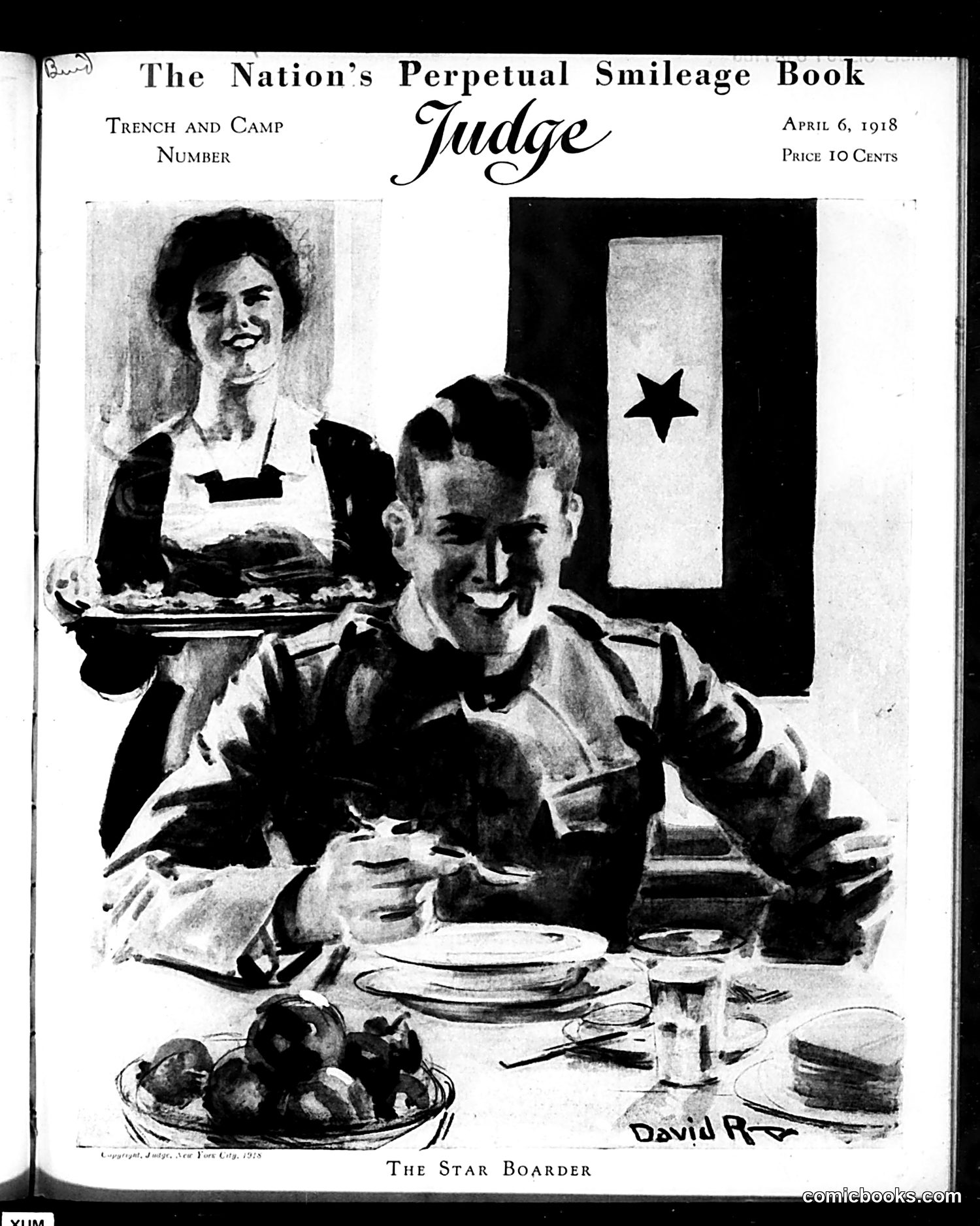
This illustration depicts a soldier in military uniform enjoying a hearty meal served by a smiling woman in an apron. The title "The Star Boarder" is a pun referencing both the soldier's uniform star insignia and the old expression for a favored lodger receiving special treatment. The cartoon celebrates American soldiers as honored guests in civilian homes during World War I. The woman's genuine smile and the abundant food (fruit bowl visible) suggest patriotic civilians warmly welcoming servicemen. This reflects 1918 propaganda promoting civilian support for troops—boarding soldiers in homes was common practice. The Star (visible on the wall behind) emphasizes American patriotism. The satire gently mocks civilian enthusiasm for treating military personnel as celebrities deserving exceptional hospitality.
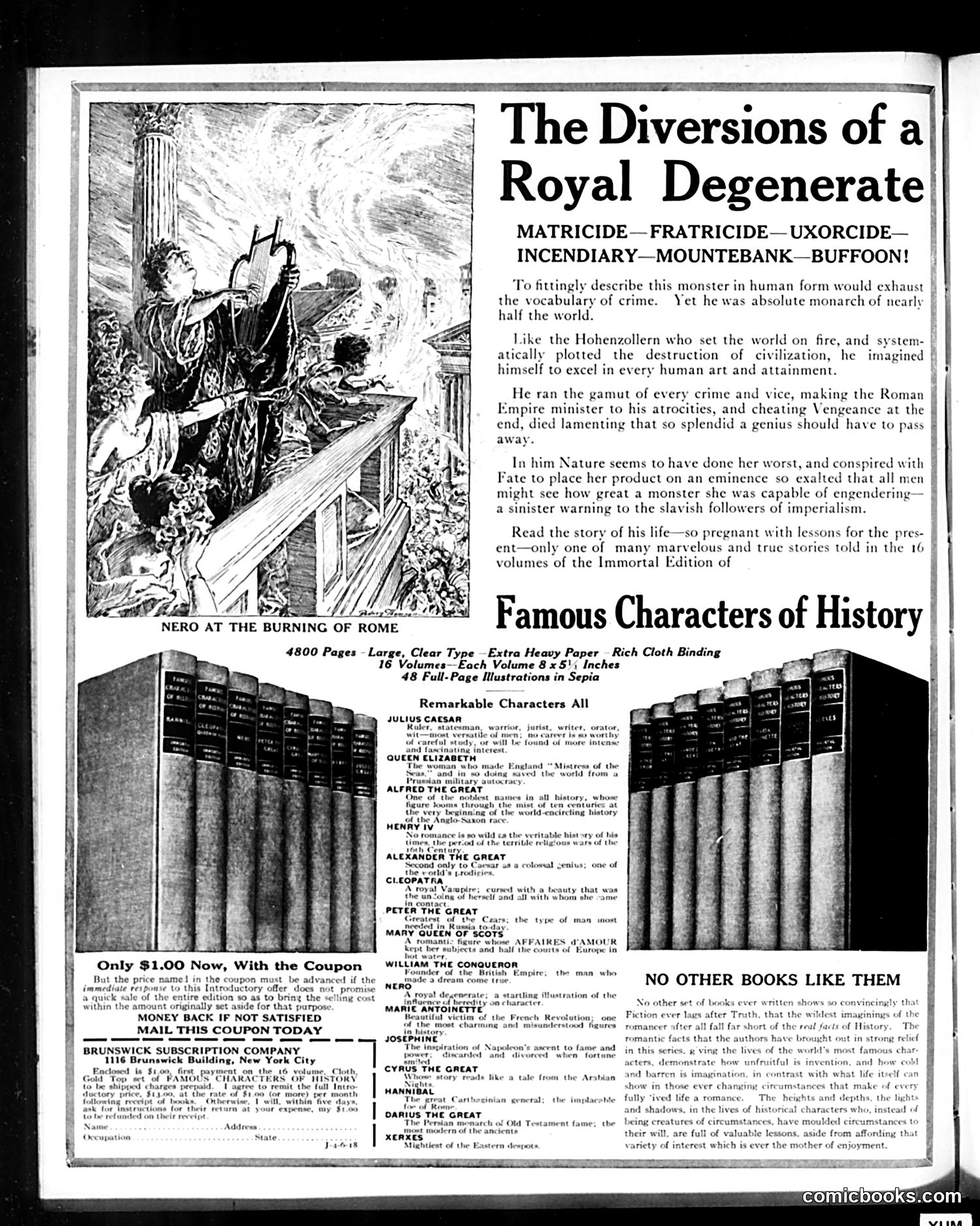
This page is primarily a **book advertisement** for "Famous Characters of History," a 16-volume encyclopedia set, rather than political satire. The left side features an engraving labeled "NERO AT THE BURNING OF ROME," depicting the infamous Roman emperor amid destruction and chaos. The accompanying text uses Nero as a cautionary example—comparing his crimes (matricide, fratricide, incendiarism) to warn against "imperialism" and its "slavish followers." This appears to be the ad's moral hook: purchasing this historical encyclopedia provides "lessons for the present" about how great civilizations fall when ruled by monstrous despots. The satirical angle, if present, seems to equate contemporary imperialism with Nero's tyranny, though the primary purpose is selling books.
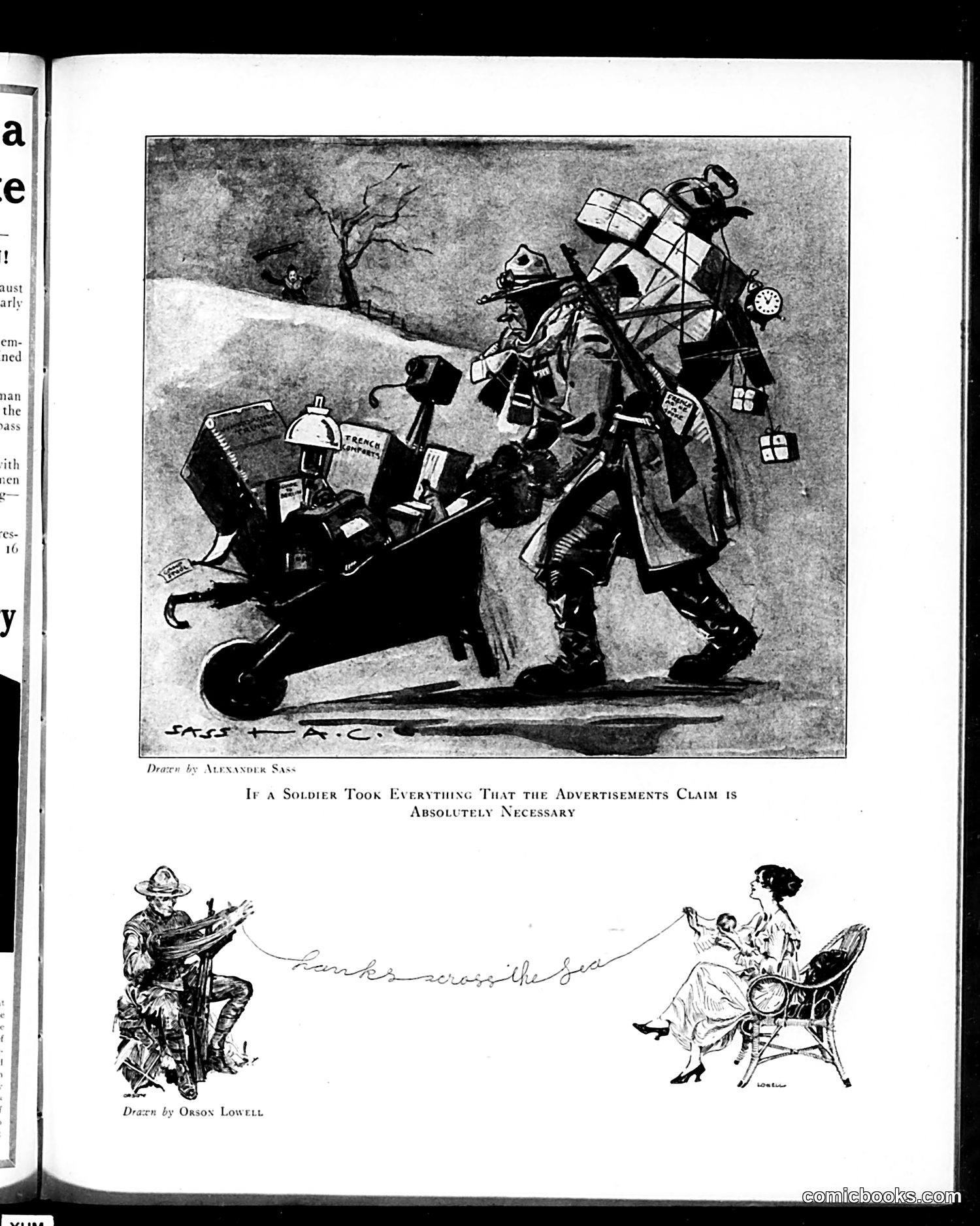
The top cartoon by Alexander Sass depicts a soldier overwhelmed by a towering pile of consumer goods and advertisements, with the caption: "If a Soldier Took Everything That the Advertisements Claim is Absolutely Necessary." The satire targets aggressive wartime advertising directed at soldiers. The cartoon suggests that commercial advertisers were making exaggerated claims about products being "absolutely necessary," creating an impossible burden if a soldier actually believed and purchased everything promoted to him. The two smaller drawings by Orson Lowell below appear to be supplementary illustrations, though their specific content is unclear from this reproduction. The page satirizes how American businesses exploited soldiers' needs through hyperbolic advertising during what appears to be WWI-era, when military service created captive consumer audiences.
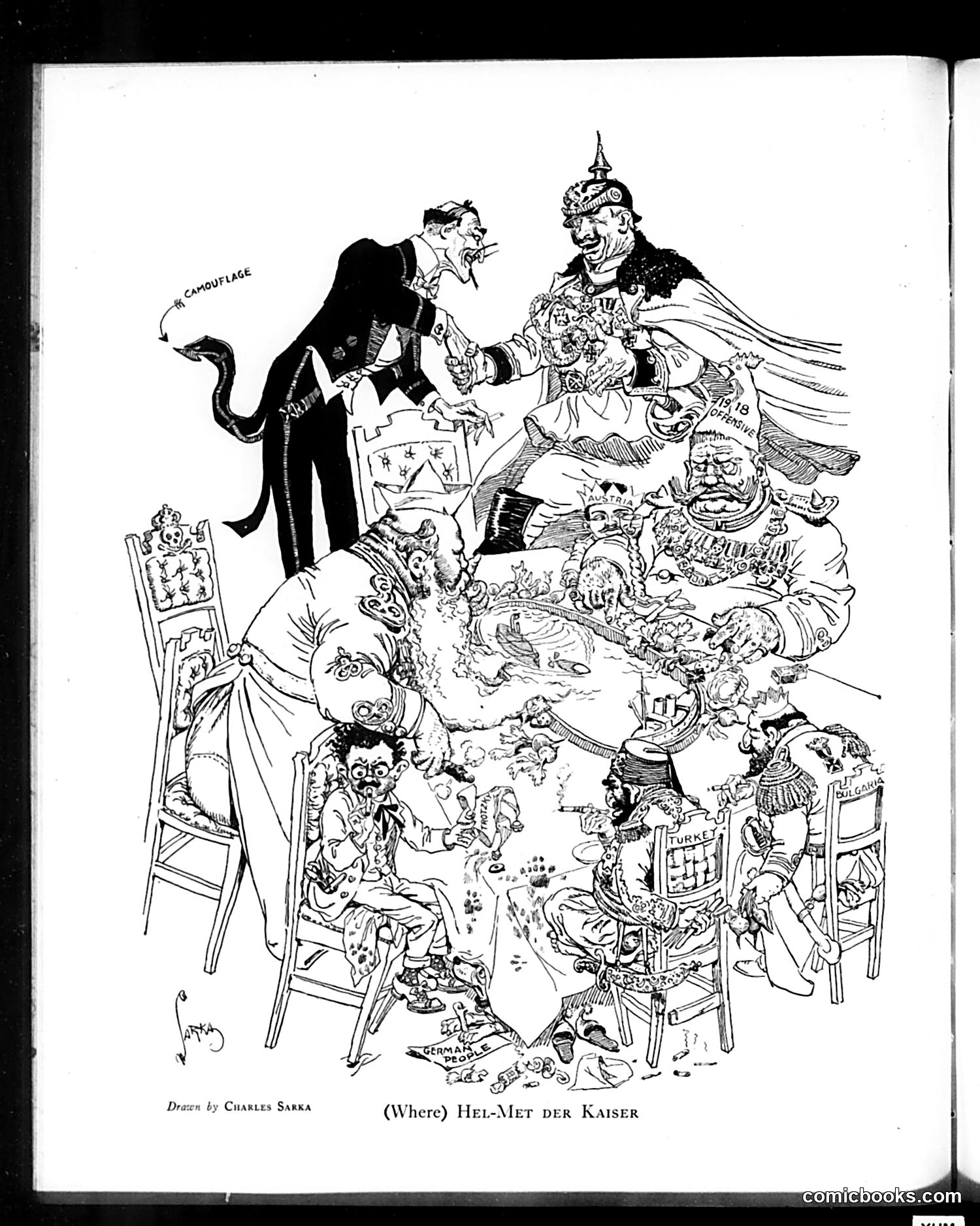
This 1910s-era Judge cartoon by Charles Sarka satirizes German military ambitions and imperialism. The title "(Where) Hel-Met der Kaiser" is a pun on "Helmet of the Kaiser" and German word-play. The central figure appears to be the German Kaiser (emperor), depicted in military regalia with an elaborate spiked helmet—a recognizable symbol of German militarism. The smaller caricatured figures gathered below likely represent various European nations or military powers, positioned subordinately. The "Camouflage" label on the left suggests the cartoon critiques Germany's military concealment or deceptive practices. The overall composition—with the Kaiser towering over other nations at what appears to be a negotiation or military gathering—mocks German imperial pretensions and satirizes pre-WWI European power dynamics and German militaristic aggression.
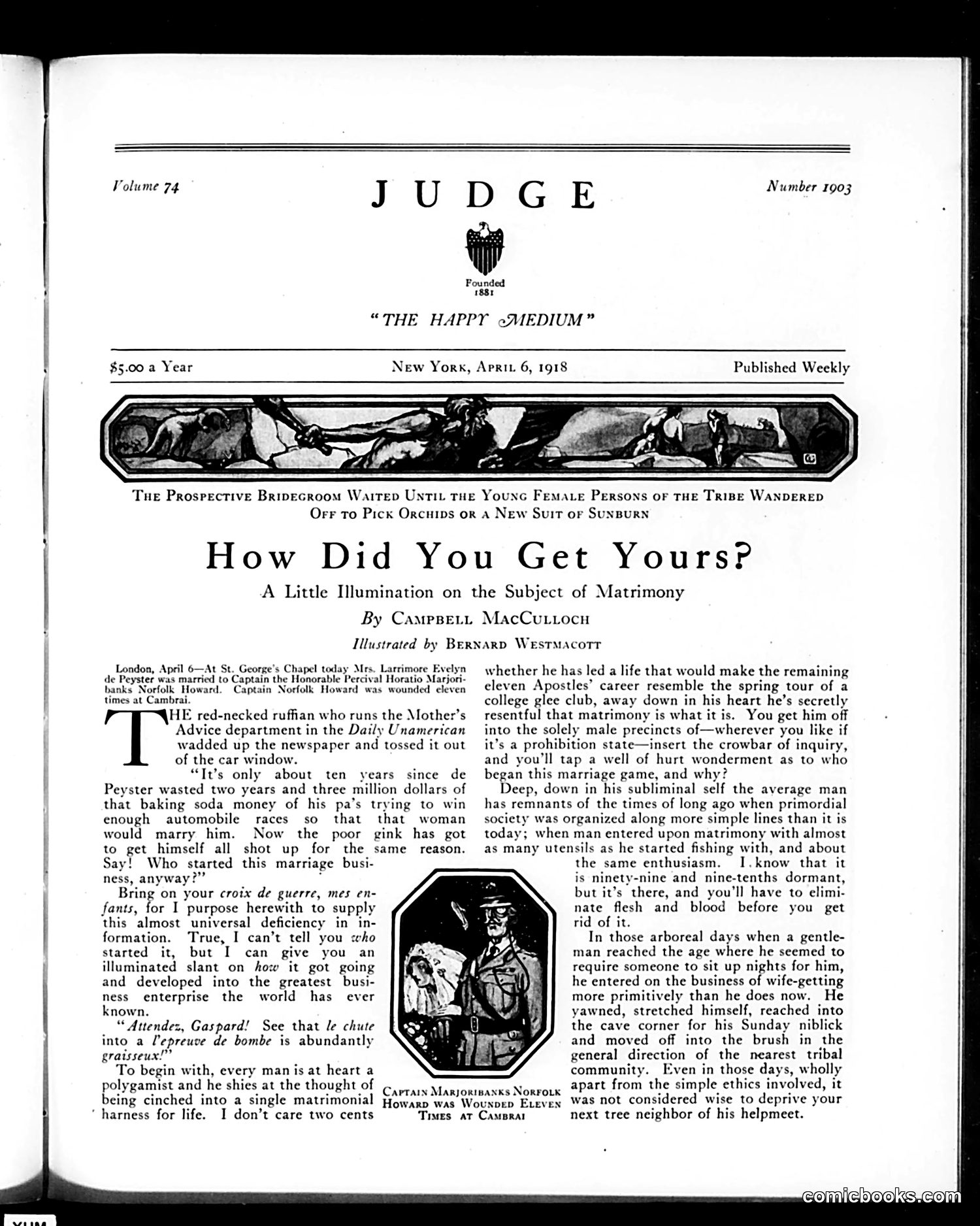
This page contains a satirical article titled "How Did You Get Yours?" about marriage, written by Campbell MacCulloch with illustrations by Bernard Westmacott. The main cartoon depicts a man in military uniform (likely a soldier or officer from World War I era, given the 1918 date). The article opens with a story about a "red-necked ruffian" who worked in the "Mother's Advice" department of the *Daily Unamerican* and wasted years trying to win enough automobile races to marry a wealthy woman. The satire mocks male attitudes toward marriage as a financial transaction. It critiques the notion that men view matrimony as something to be "won" through achievement or wealth, while also suggesting marriage itself is an unappealing obligation men reluctantly accept. The cartoon and text together satirize period attitudes about gender relations and courtship.
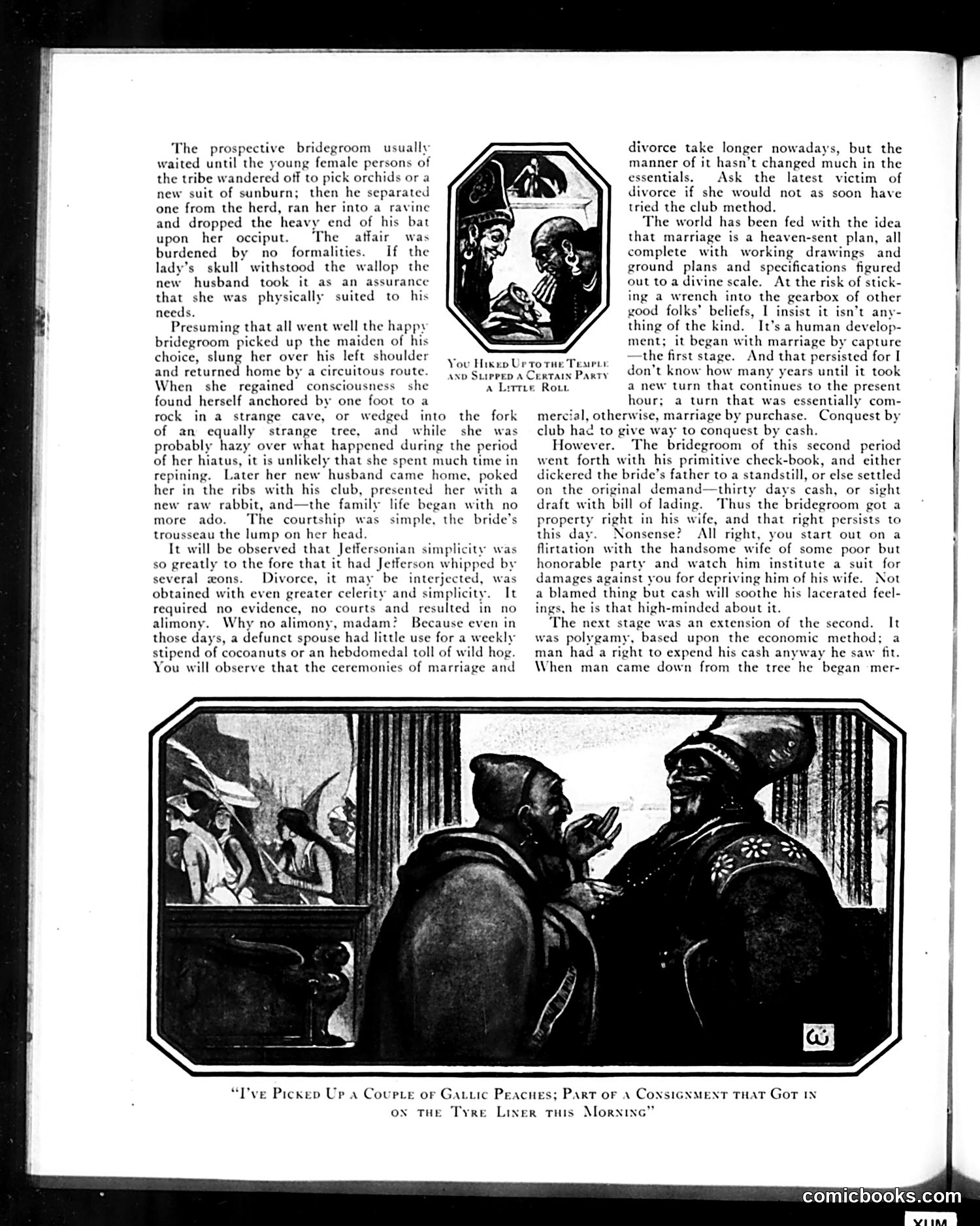
This page satirizes marriage customs and divorce practices. The text discusses how bridegrooms in various historical periods obtained wives through different methods—from tribal customs to purchase—arguing that marriage has always been fundamentally transactional, merely evolving in form. The upper illustration depicts a domestic scene where a woman finds herself "anchored by one foot to a strange cave, or wedged into an equally strange tree," suggesting women's entrapment in marriage. The lower cartoon shows two men discussing "a couple of Gallic peaches" received via the Tyre Liner, using commercial language ("consignment") to describe women—reinforcing the text's point that marriage fundamentally treats women as purchasable commodities, however refined the modern ceremony appears. The satire critiques the hypocrisy of treating marriage as romantic while its economic structure persists unchanged.
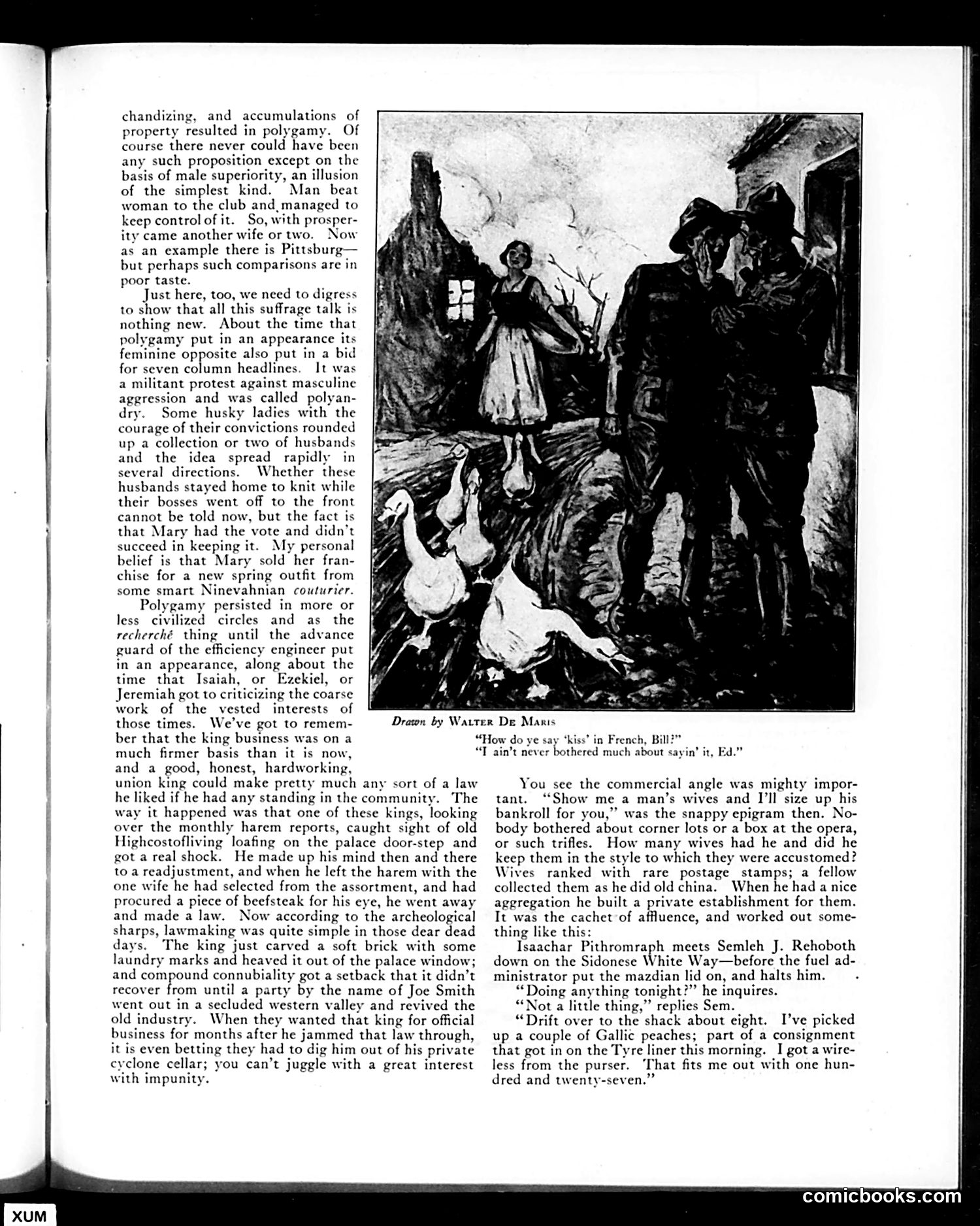
This Judge magazine page satirizes the economic basis of polygamy in ancient times. The accompanying Walter De Maris illustration depicts a Biblical-era domestic scene—a woman managing a household with multiple wives, visualizing the article's central argument. The text argues polygamy arose not from male lust but from **male economic control and property accumulation**. The satire draws historical parallels: just as polygamy emerged when prosperity allowed men to support multiple wives, a countermovement called "polyandry" (women taking multiple husbands) briefly appeared as suffrage protest—though the author dismissively suggests women abandoned voting rights for fashionable clothing. The humor targets both historical male superiority and contemporary feminism. The biblical references (Isaiah, Ezekiel, Jeremiah) frame this as ancient social engineering. The anecdote about a king eliminating his harem through law-carving ridicules how casually powerful men treated domestic arrangements. The dialogue snippet below suggests the feature continues with modern social commentary using biblical parallels as framework.
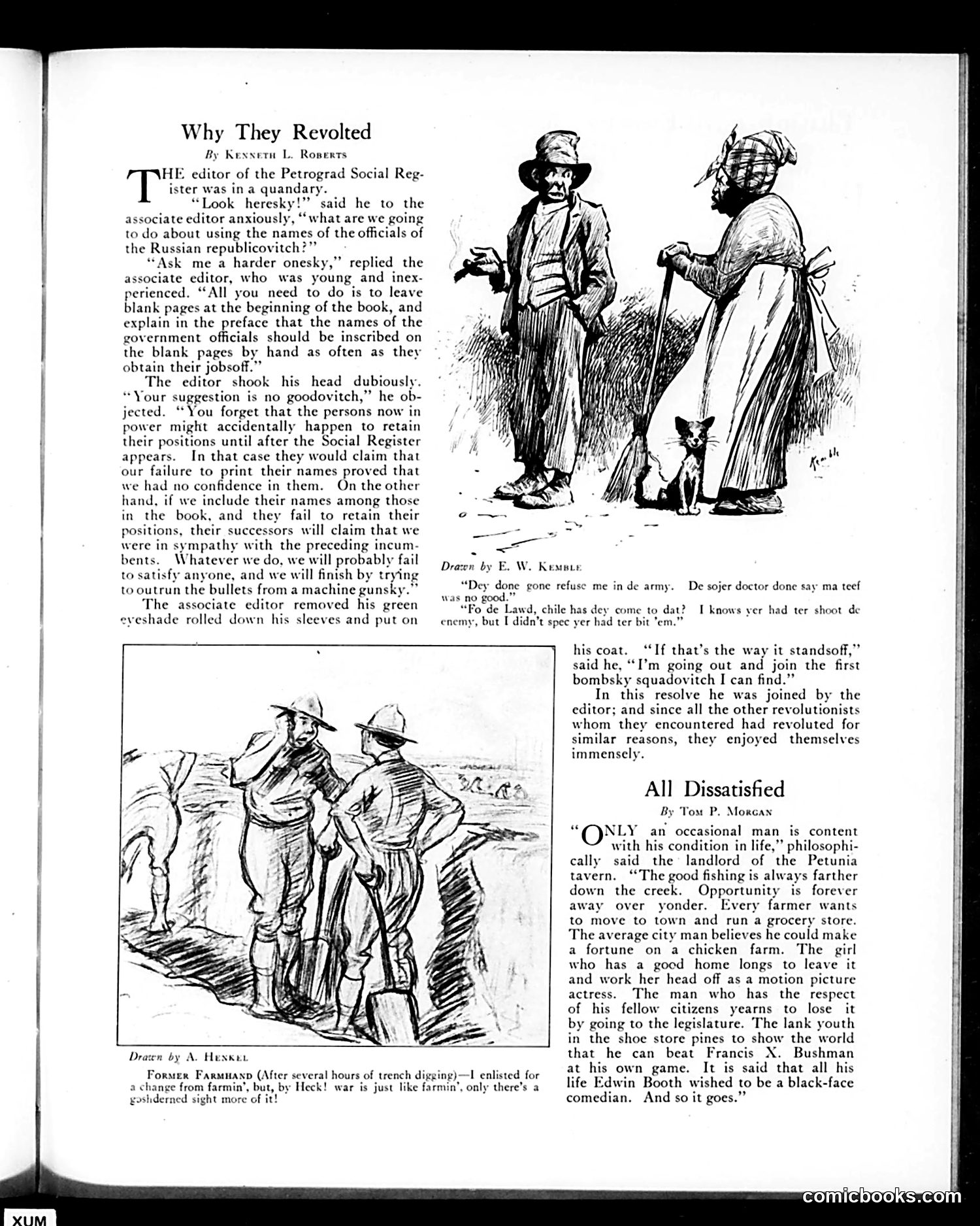
This page satirizes the Russian Revolution through three separate pieces: **"Why They Revolted"** mocks Russian bureaucratic instability through a deliberately absurdist joke. Two editors of a Russian social register debate whether to include government officials' names, knowing officials will constantly be replaced or executed during the revolutionary chaos. The punchline—that they'll join the revolution themselves to escape the impossible situation—satirizes how the revolution consumed everyone indiscriminately. The fake Russian suffixes ("sky," "ovitch," "off") parody Russian language while emphasizing the foreign, chaotic nature of events to American readers. **The lower cartoon** depicts a former farmhand claiming he enlisted for a change from farming, only to discover war involves even more labor—a dark joke about WWI's brutal conditions. **"All Dissatisfied"** presents an unrelated philosophical piece about human restlessness and ambition. The page's central point: Judge uses Russian Revolution absurdities to illustrate how revolution inevitably devours its own participants, while simultaneously critiquing universal human discontent.
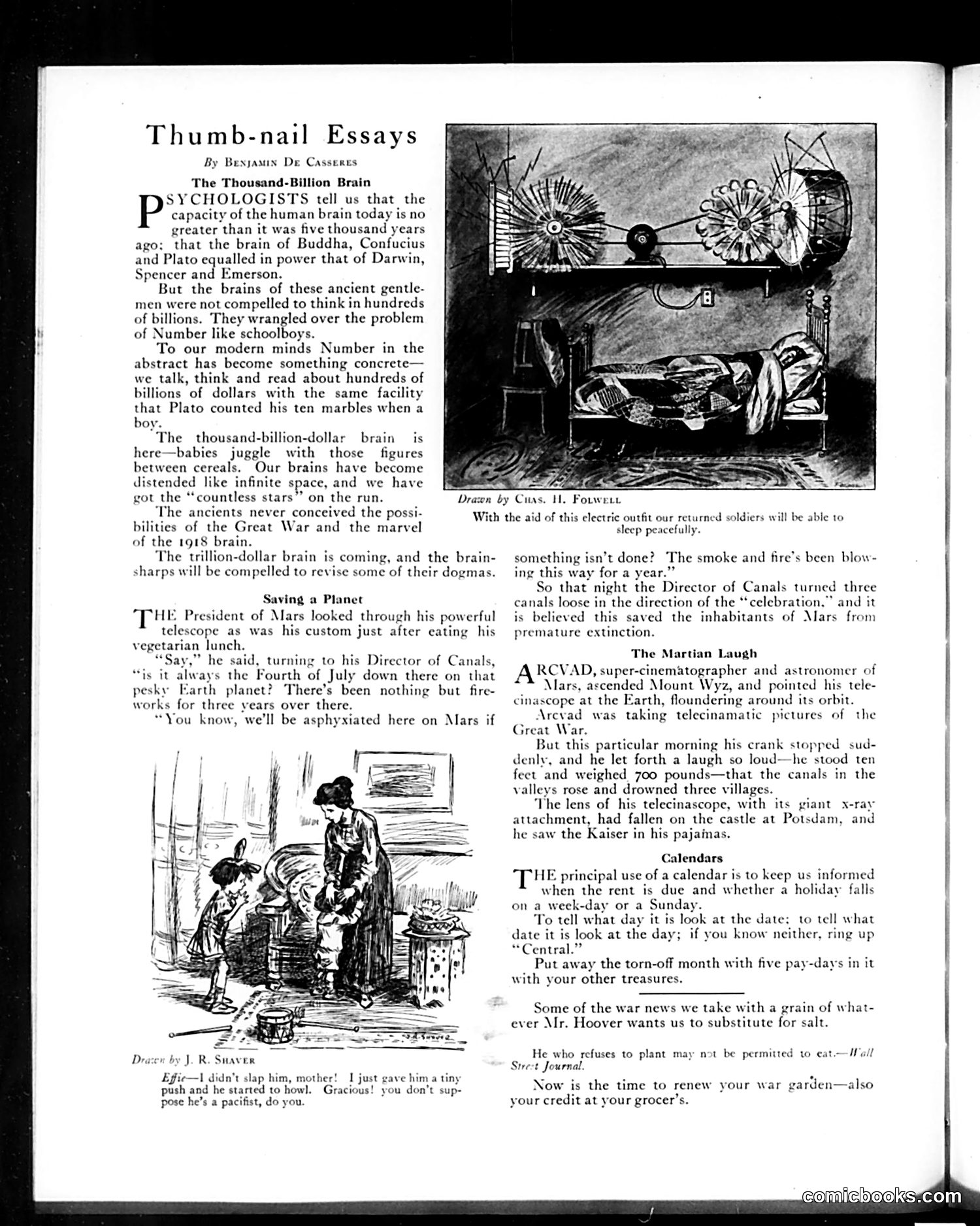
This page collects brief satirical essays by Benjamin De Casseres, likely from 1918. The content mocks modern wartime anxieties: **"The Thousand-Billion Brain"** jokes that modern minds have expanded to handle abstract figures (billions in war spending) that ancient philosophers couldn't conceive—a critique of industrial-scale warfare's economic complexity. **"Saving a Planet"** imagines Mars's President observing Earth's three-year bombardment (WWI's western front), nearly asphyxiating Mars with smoke. The satire attacks the war's relentless destruction. **"The Martian Laugh"** depicts a Martian astronomer laughing so hard at seeing the Kaiser in pajamas that canals flood—mocking German leadership's perceived foolishness. **"Calendars"** sarcastically advises readers to ignore war news ("take with a grain...salt") and renews emphasis on planting "war gardens" (food rationing propaganda). The cartoons complement these themes with domestic wartime scenes. The overall tone criticizes both the war's futility and American homefront compliance with government messaging.
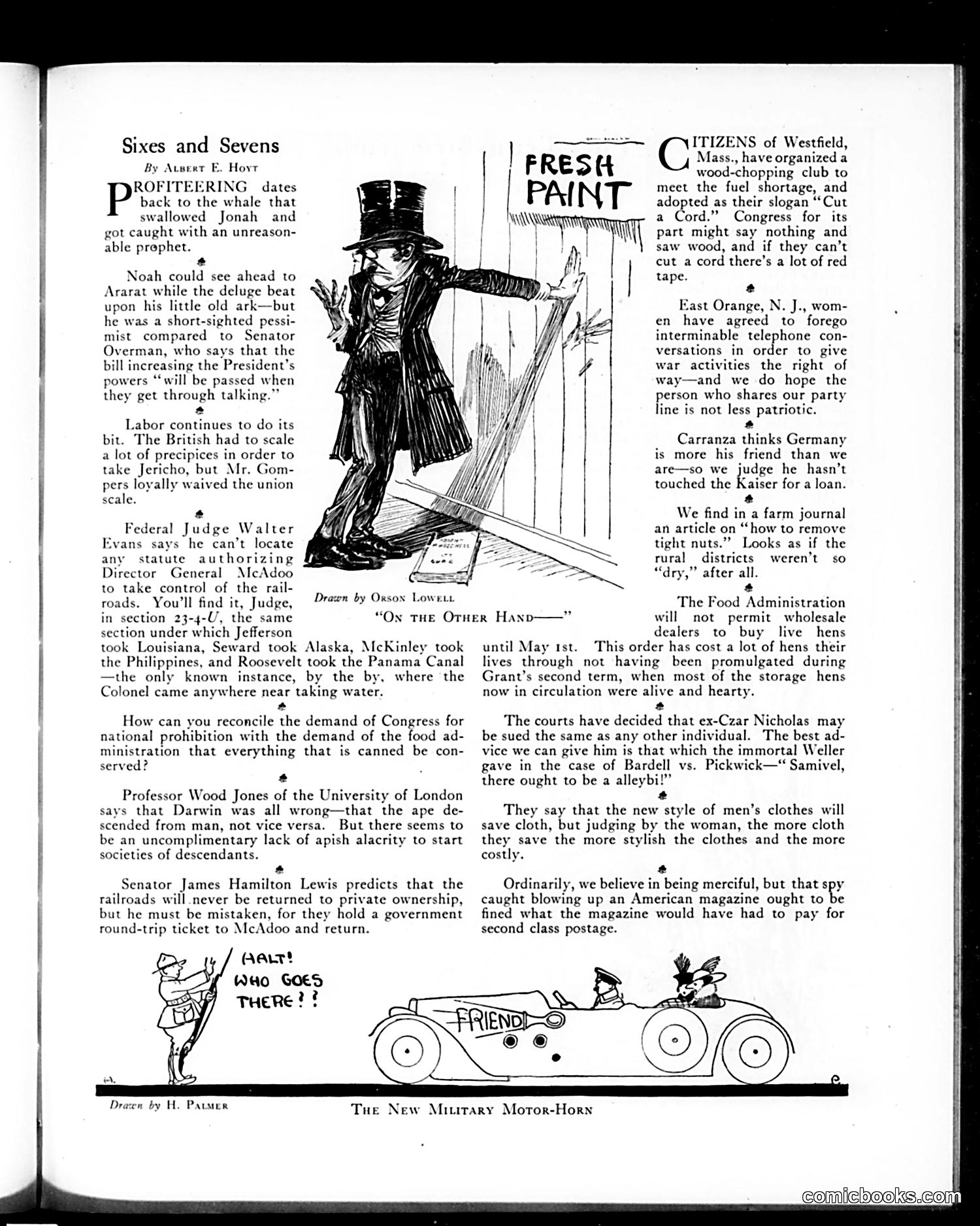
This page collects brief satirical observations on WWI-era American politics and society. The main cartoon "On the Other Hand" (by Osson Lowell) depicts a figure painting over something, likely referencing wartime censorship or propaganda. The written commentary targets government overreach: Director General McAdoo's railroad control lacks legal authority; Congress contradicts itself demanding both prohibition AND food conservation (canned goods require alcohol); Senator Overman's confidence in executive power expansion is mocked. Other items mock: rural areas claiming to be "dry" (Prohibition) while secretly drinking; the Food Administration's delayed hen-purchase ban; courts allowing suits against the deposed Russian Czar Nicholas; wartime spy sabotage; and new men's fashion claiming to save cloth while women's styles grow more expensive. The cartoons emphasize government inefficiency, hypocrisy, and wartime absurdities during America's WWI involvement.
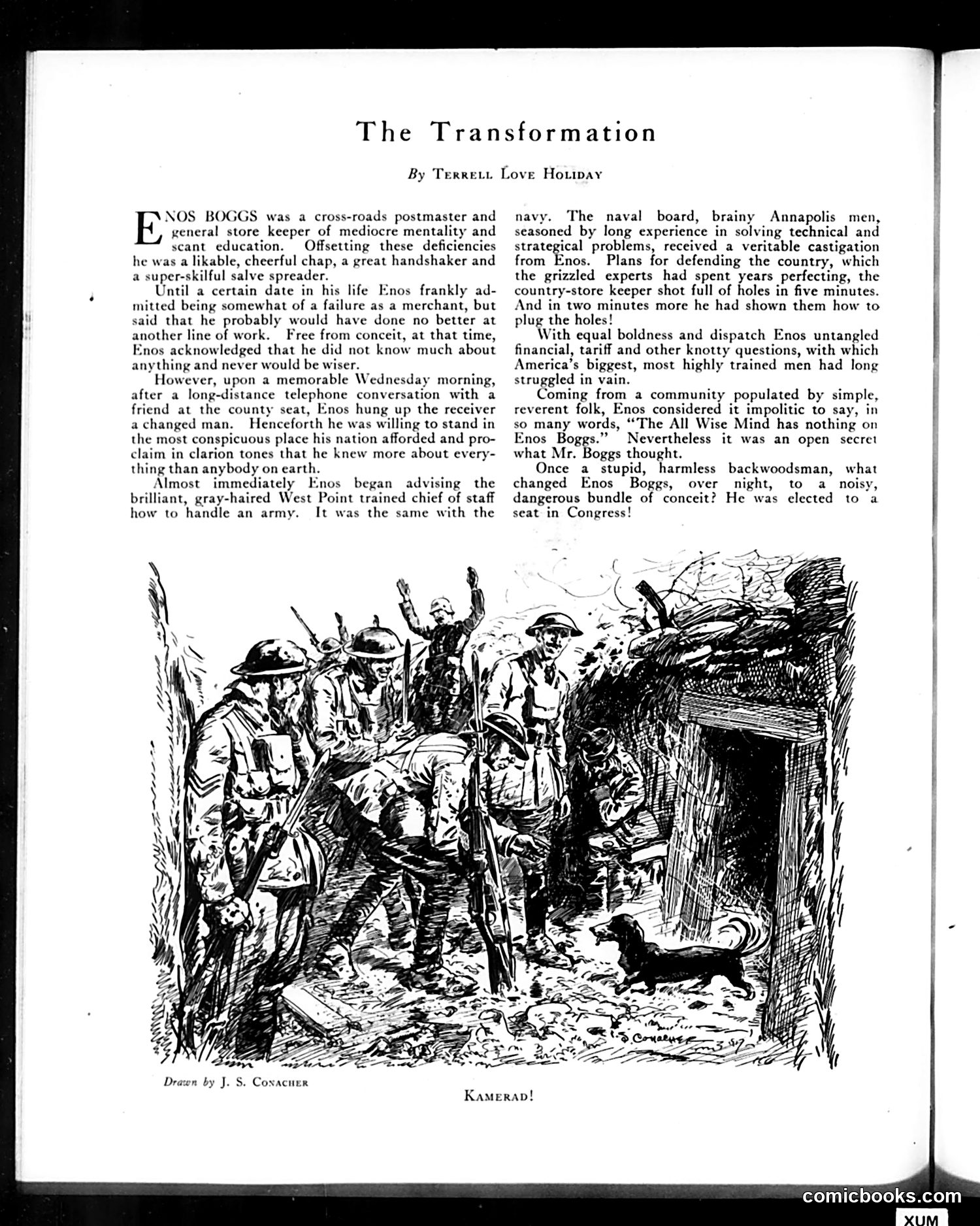
This story satirizes the corrupting effect of political office on an ordinary person. Enos Boggs, a humble small-town postmaster and store clerk, is honest about his ignorance and limitations. After a mysterious phone call, he transforms overnight into an insufferable know-it-all who presumes to advise trained West Point military officers and naval experts on strategy, defense, and national policy—despite having no expertise whatsoever. The punchline reveals the source of his sudden arrogance: **election to Congress**. The satire's point is clear—becoming a congressman inflates mediocre men with unwarranted confidence in their ability to govern complex matters. The accompanying military illustration (labeled "Kamerad!") appears to show soldiers, likely depicting the military context Boggs now presumes to advise on. This is a biting critique of congressional incompetence and the Dunning-Kruger effect of political power.
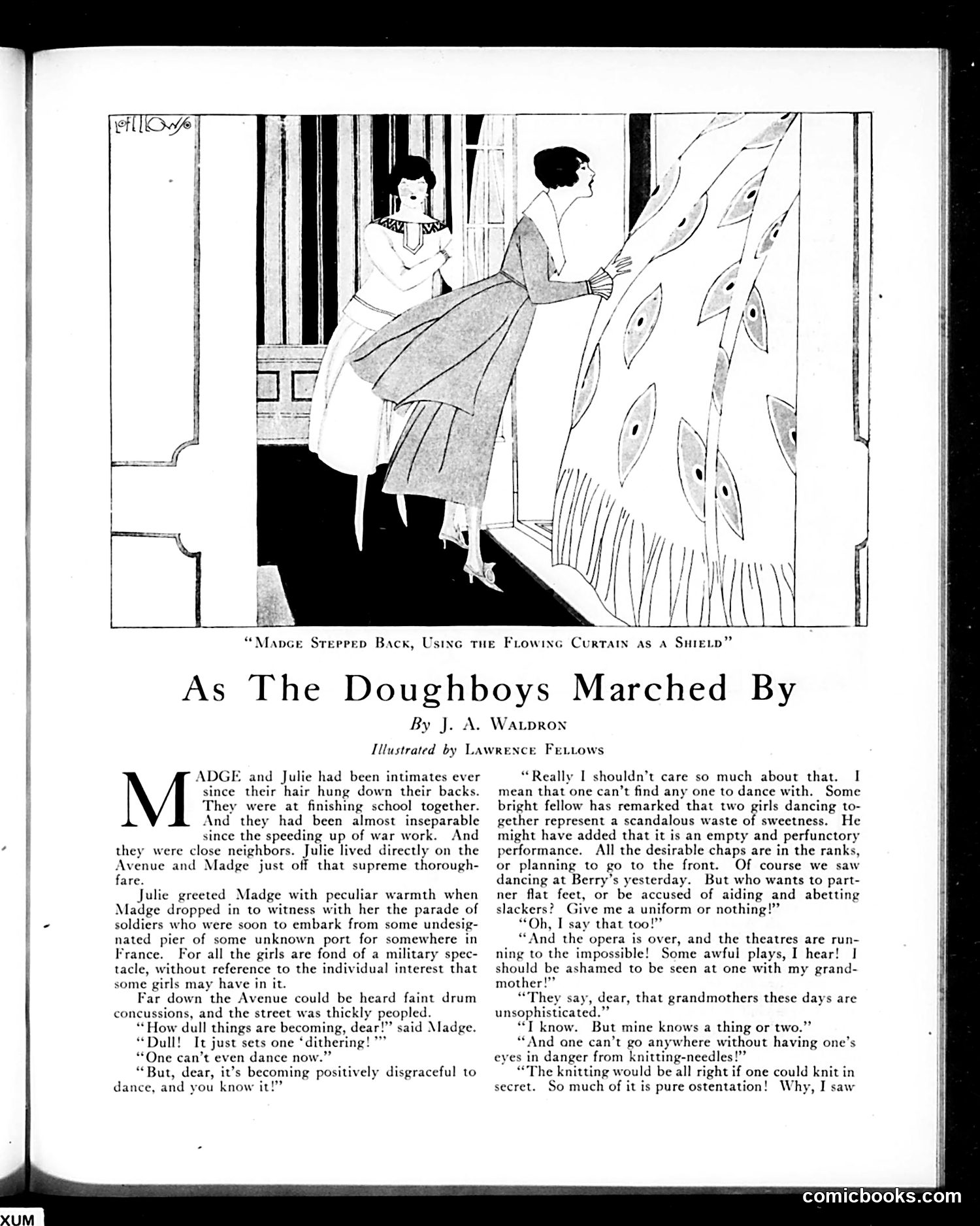
This is a humorous short story (not a political cartoon) satirizing upper-class women's complaints during World War I. Two wealthy female friends, Madge and Julie, complain about wartime restrictions: they can't dance because eligible men are deployed as soldiers ("doughboys"), attending social events has become unfashionable, and theaters offer only poor entertainment. The satire targets female vanity and frivolity during serious times. Their grievances—lacking dance partners, avoiding the appearance of supporting "slackers" (draft-dodgers), worrying about being seen with grandmothers—reveal shallow priorities. The illustration shows Madge using a decorative curtain as a shield, suggesting theatrical exaggeration of their concerns. The reference to "knitting-needles" mocks women's visible war-effort participation (knitting for soldiers), criticized as ostentatious performance rather than genuine patriotism. The story ridicules privileged women for treating wartime as primarily an inconvenience to their social calendar.
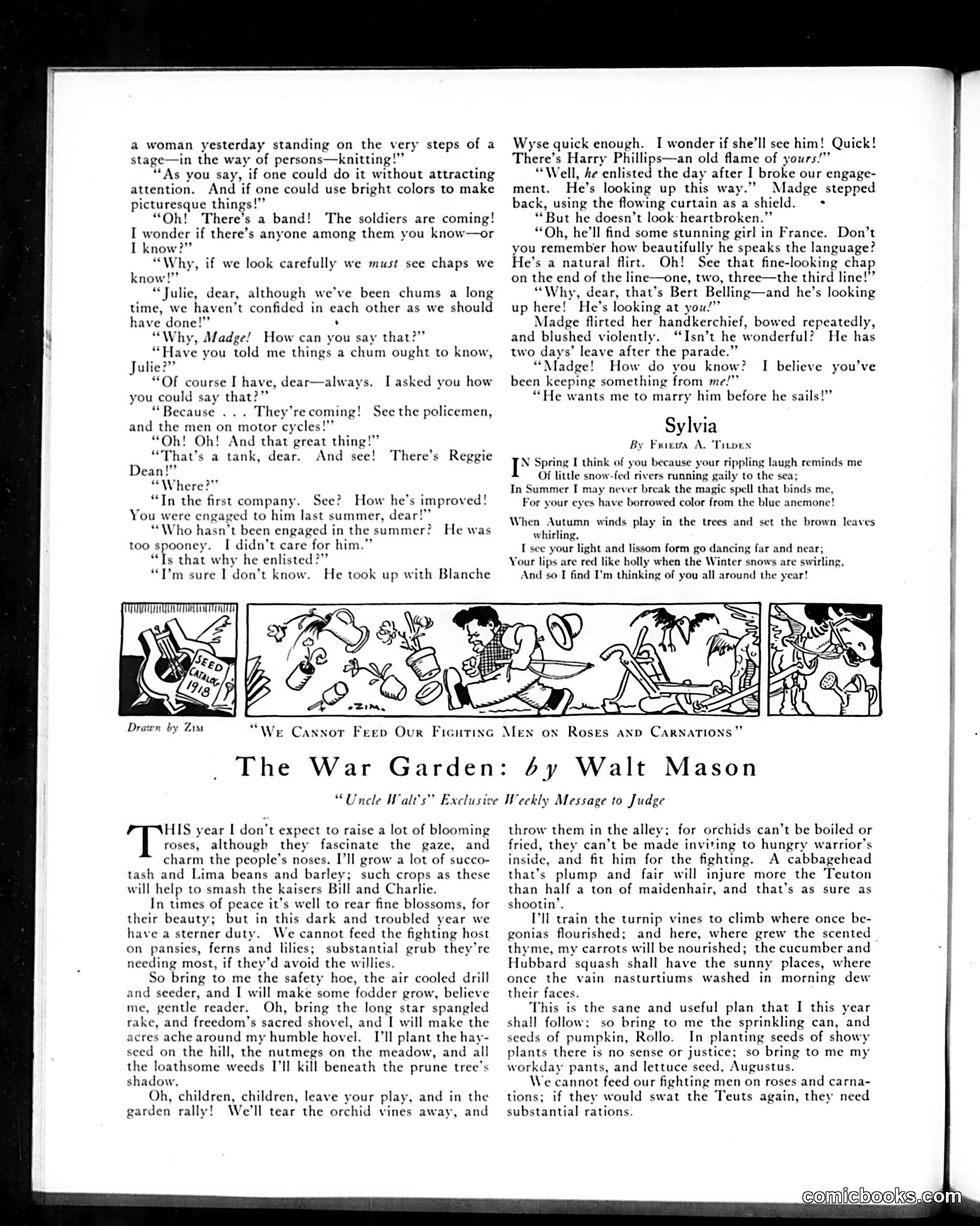
This page from Judge combines romantic wartime comedy with patriotic messaging. The main narrative follows two women, Madge and Julie, watching a military parade from a window. They spot former romantic interests—soldiers departing for World War I—including Harry Phillips (an ex-fiancé), Reggie Dean, and notably Bert Belling, who apparently has proposed marriage to Madge before shipping out. The dialogue satirizes women's romantic entanglements during wartime mobilization. The accompanying poem "Sylvia" romantically idealizes a woman through seasonal imagery. Walt Mason's "War Garden" essay urges Americans to prioritize vegetable cultivation over ornamental flowers to support the war effort—replacing roses and orchids with practical crops like succotash and lima beans. Mason uses humorous language ("Kaiser Bill") while emphasizing home-front sacrifice, a common WWI-era message encouraging civilian agricultural contribution to feed troops.
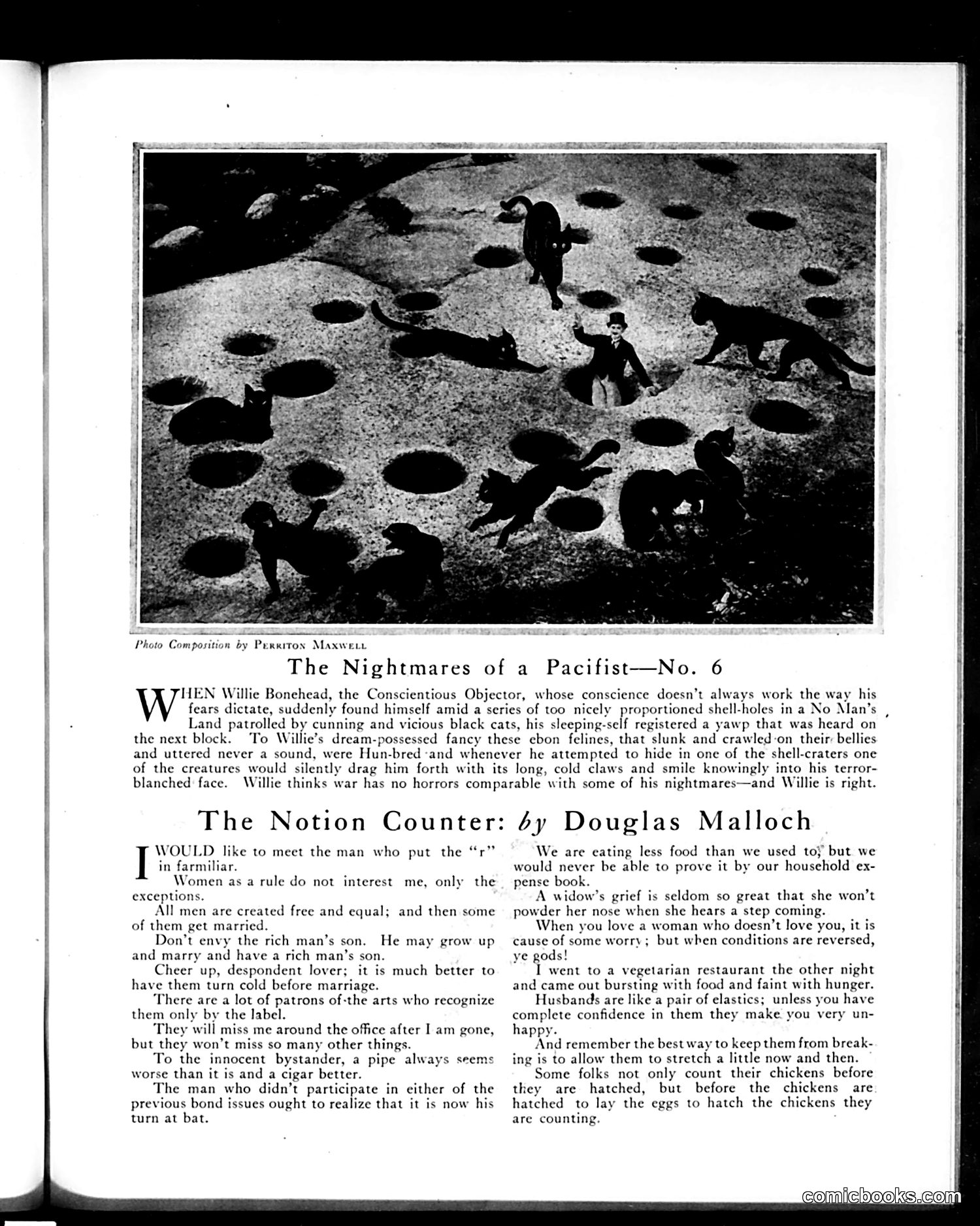
**"The Nightmares of a Pacifist—No. 6"** is a wartime satirical cartoon mocking conscientious objectors—men who refused military service on moral grounds. The cartoon depicts "Willie Bonehead," a caricatured pacifist, having nightmares about WWI combat: he's trapped in a shell-cratered battlefield where phantom black cats (representing "Hun-bred" German enemies) drag him from hiding spots. The satire's point: pacifists deserve ridicule because their squeamishness about war makes them imagine absurd horrors. The implication is that their moral objections are cowardly and unpatriotic. **"The Notion Counter"** is an unrelated humor column by Douglas Malloch offering cynical observations about marriage, wealth, food rationing, and social hypocrisy—typical light satirical commentary for the era. The pacifist cartoon reflects WWI-era American hostility toward draft resisters, portraying them as ridiculous rather than principled.
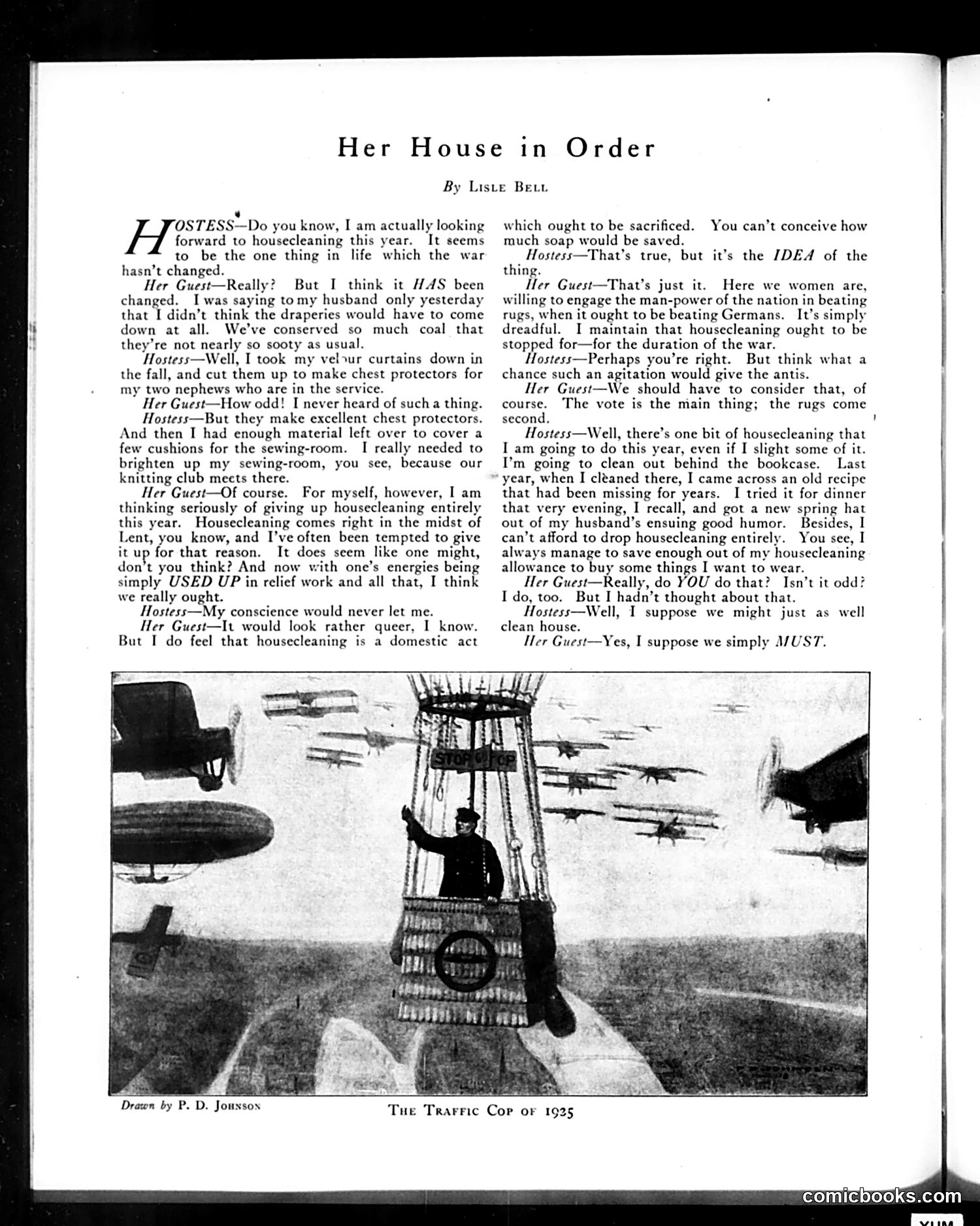
This satirical dialogue mocks upper-class women's selective patriotism during World War I. Two society women debate whether to do spring housecleaning, initially framing it as a wartime sacrifice—claiming it wastes soap and diverts "man-power" needed to "beat Germans." The satire exposes their hypocrisy: they're willing to *discuss* patriotic sacrifice, but their real concerns are superficial (appearance, the suffrage movement—"the antis"). Most tellingly, when the hostess reveals she secretly diverts housekeeping allowance money to buy clothes, the guest admits doing the same, and they abandon their principled stance entirely. The cartoon caption, "The Traffic Cop of 1925," reinforces the joke: by 1925 (the article's present), wartime rationales have become laughable pretexts for women's actual priorities: personal spending and social status.
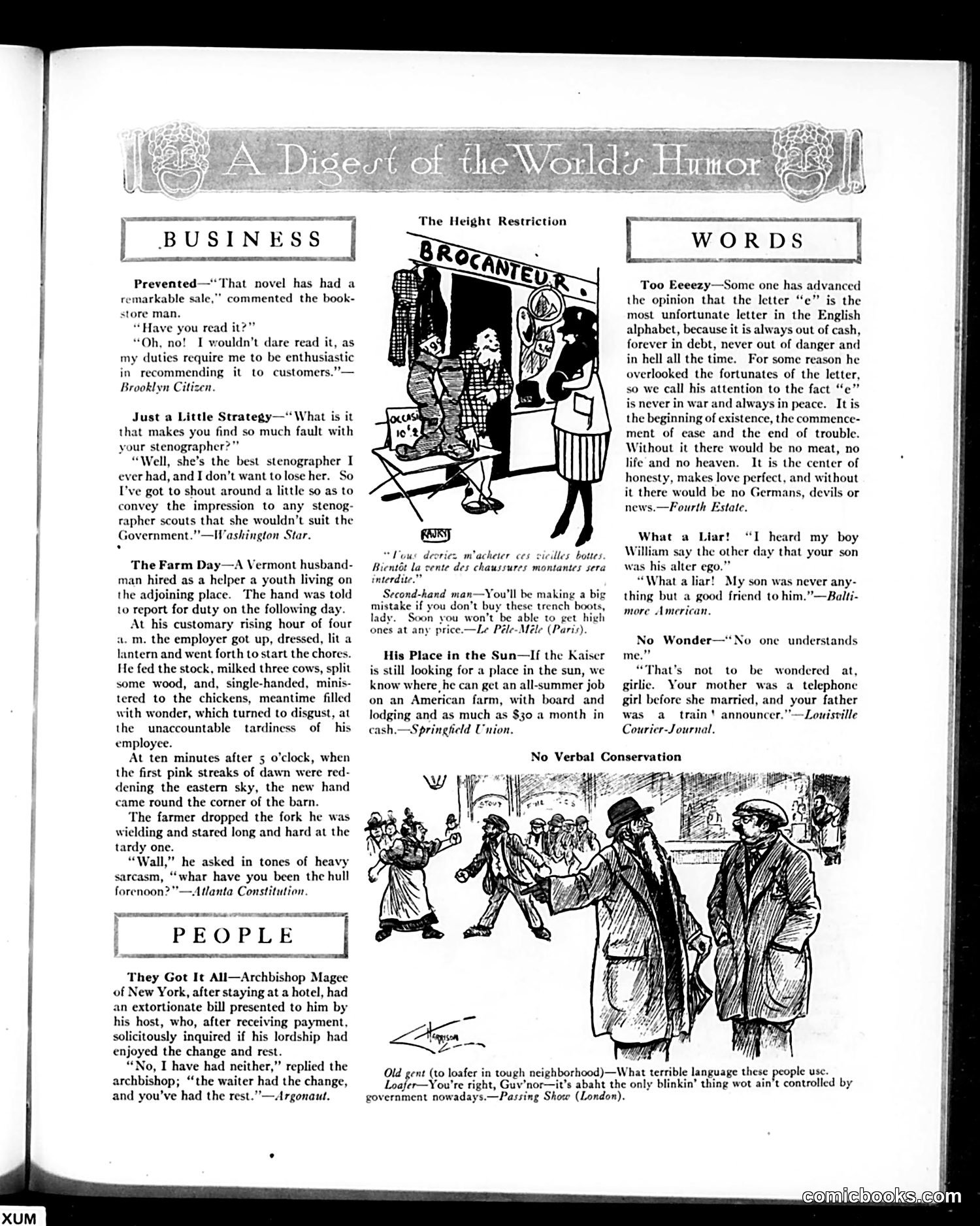
This page from Judge presents satirical humor across three sections: **BUSINESS** jokes mock workplace absurdities: a bookseller who won't read the novels she sells, an employer deliberately criticizing his best stenographer to discourage government recruitment, and a farmer's sarcasm toward his tardy hired hand. **PEOPLE** contains anecdotes about clergy and the wealthy. Archbishop Magee's quip about the waiter keeping "the change" and the host keeping "the rest" is wordplay on hospitality. The "Kaiser" reference likely alludes to WWI-era Germany seeking global dominance ("a place in the sun"). **WORDS** section plays with letter "e" having contrary qualities—perpetually broke yet representing peace, ease, and virtue. The cartoon "No Verbal Conservation" (bottom) shows tough street characters, with the loafer's joke suggesting that crude language is the *only* thing not yet controlled by government regulation—dark humor about expanding state authority, likely post-WWI concerns about government overreach. The overall tone is cynical about institutions, bureaucracy, and social pretension typical of Judge's satirical mission.
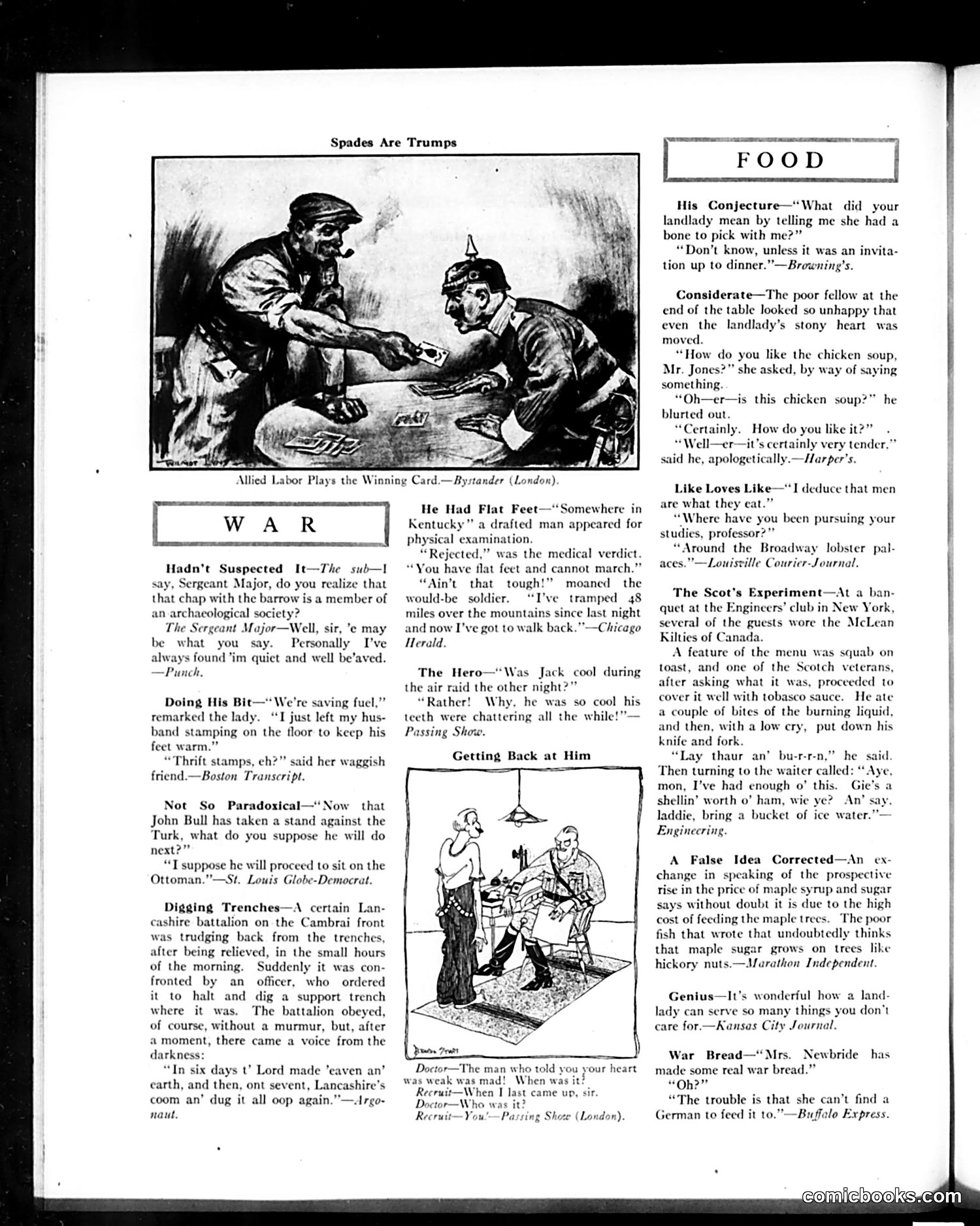
This Judge magazine page contains WWI-era humor organized under "WAR" and "FOOD" sections, reflecting American concerns during the conflict. The main cartoon shows two soldiers—one appears to be an officer or superior examining a subordinate's hands or feet, likely illustrating the "He Had Flat Feet" anecdote about a Kentucky draftee rejected from service despite having walked 48 miles. The "Getting Back at Him" cartoon depicts a doctor and recruit in conversation, playing on wordplay about who made whom "mad." The jokes throughout satirize wartime realities: fuel rationing ("stamping on the floor to keep his feet warm"), military absurdities (exhausted soldiers ordered to dig trenches after already working), rationing/"war bread" difficulties, and the contrast between military recruitment standards and rural practicality. The Lancashire soldier's complaint that God rested on the seventh day but Lancashire soldiers must dig reflects working-class resentment of endless labor demands. The food section jokes about landlady cooking, chicken soup quality, and maple syrup prices—everyday civilian concerns amid wartime scarcity.
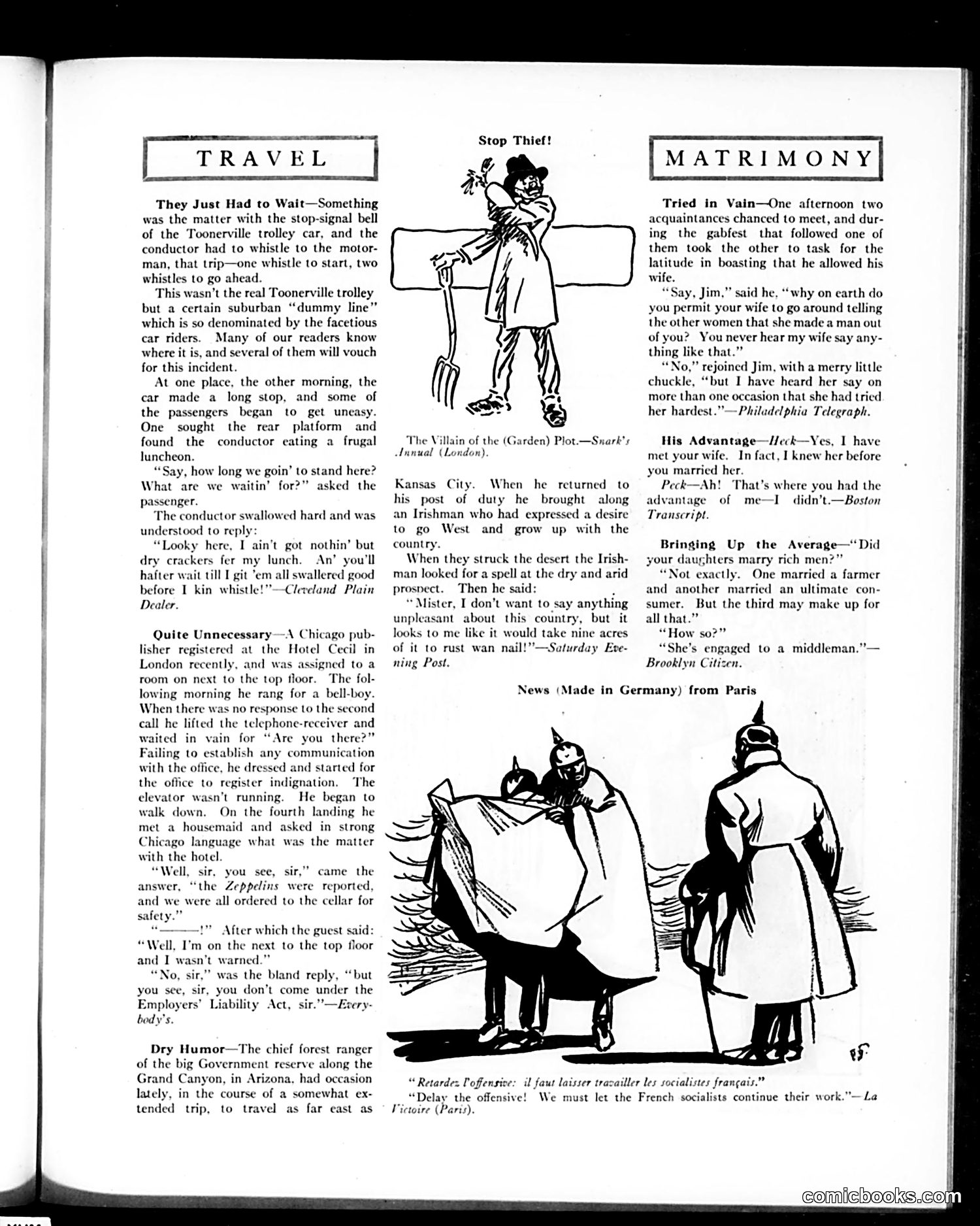
This page contains multiple short humorous pieces typical of early 20th-century American satirical magazines. The **"Stop Thief!" cartoon** depicts a woman in a dress catching a man, likely illustrating a common melodramatic scenario from stage plays—referenced as "The Villain of the (Garden) Plot." The **travel anecdotes** mock minor inconveniences: a trolley conductor prioritizing his lunch break, and a Chicago hotel guest assigned high floors during a Zeppelin air-raid scare (referencing WWI German airship threats to London). The **"News from Paris"** cartoon mocks French socialist politics, with German military figures dismissing French socialists as unworthy obstacles—reflecting wartime European tensions. The **matrimony jokes** rely on conventional domestic humor: wives exaggerating husbands' transformations, and marriage-market speculation about daughters. These pieces reflect Judge's target audience: educated, middle-class Americans amused by class distinctions, bureaucratic absurdity, and traditional gender dynamics. The wartime references date this to approximately 1915-1918.
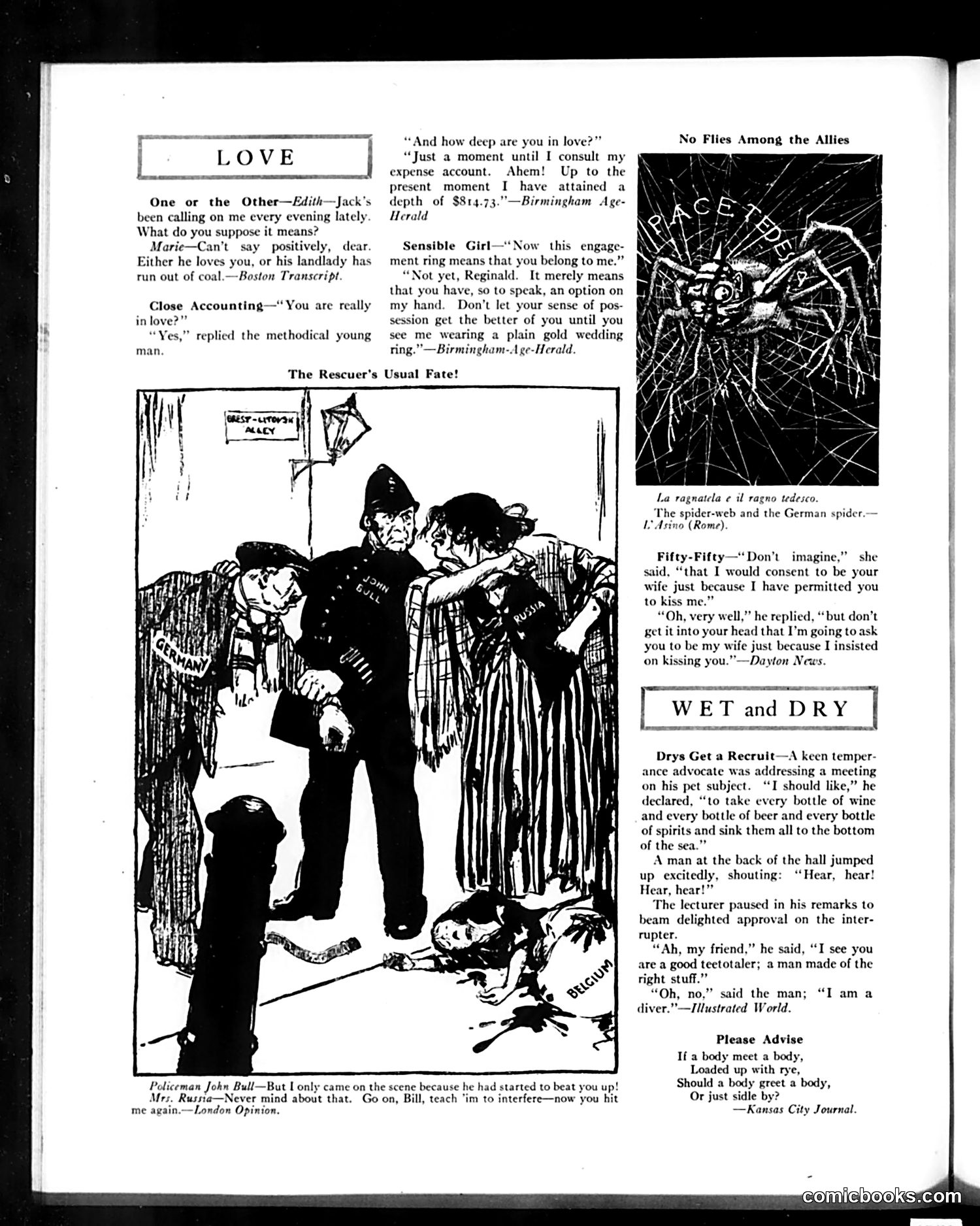
This page contains several short satirical pieces typical of early 20th-century humor: **"The Rescuer's Usual Fate"** depicts Policeman John Bull intervening in a domestic dispute between a man and Mrs. Russia. The joke's political meaning: Britain (John Bull) attempts to police Russian affairs, but Russia resists interference and wants to continue her own way—a commentary on Western intervention in Russian affairs, likely during the Russian Revolution period. **"No Flies Among the Allies"** shows a spider and web, captioned in Italian as "the spider-web and the German spider"—suggesting Germany is trapped or entangled, positioning the Allies as having Germany contained. The remaining items are brief romantic/social humor pieces about engagement rings, accounting in relationships, and a temperance advocate's ironic recruit (a diver, not a teetotaler). The page overall reflects wartime Allied solidarity and domestic social commentary typical of Judge's satirical approach.
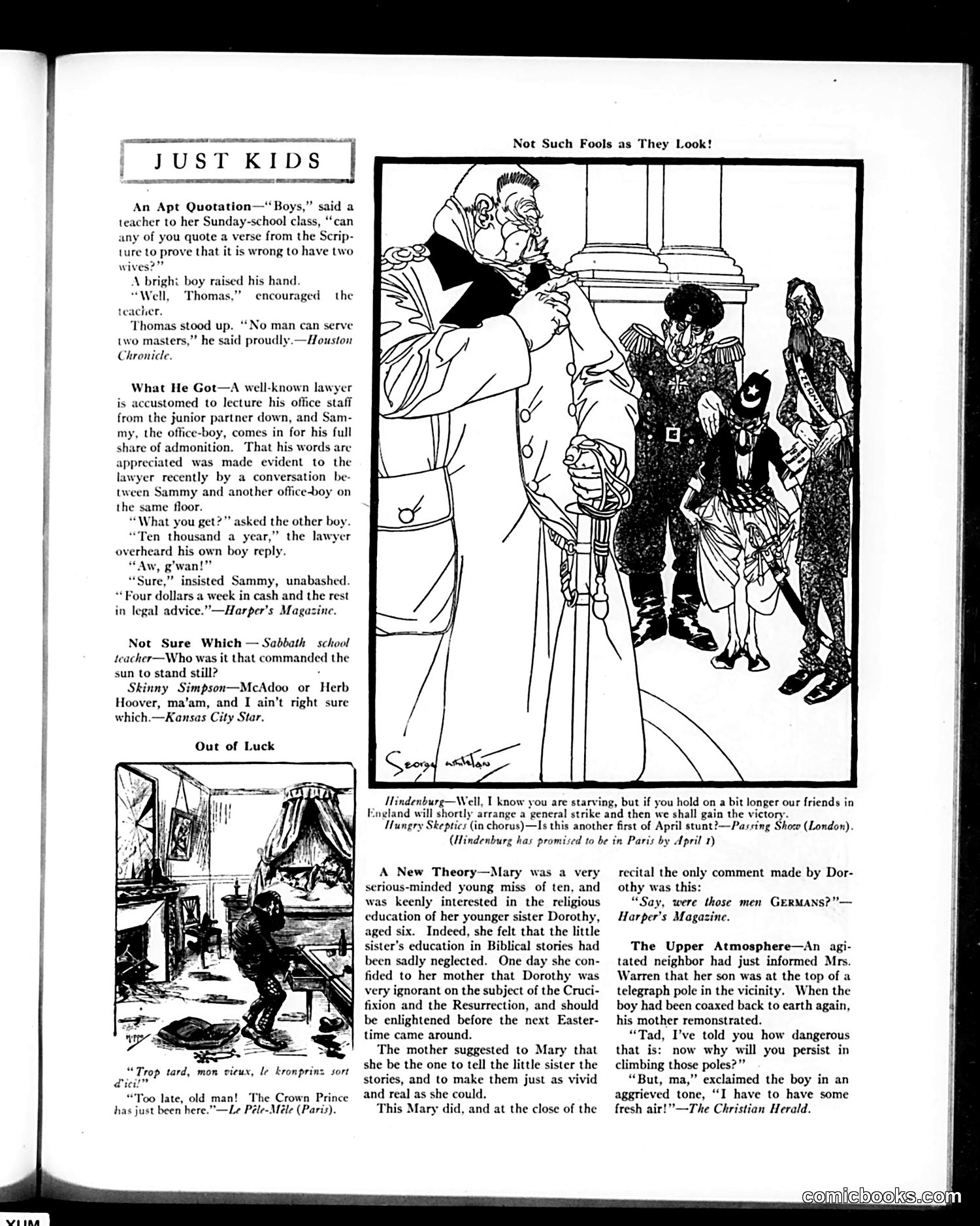
This page contains several brief humorous anecdotes ("Just Kids" section) typical of early 20th-century American humor magazines. The most historically significant cartoon is the top one titled "Not Such Fools as They Look!" It depicts **Hindenburg** (German military leader Paul von Hindenburg, shown as a large figure) addressing starving soldiers. He promises them victory if they wait for "a general strike" in England—implying German hopes that British labor unrest would weaken the enemy war effort. The soldiers' response—"Is this another first of April stunt?"—is satirical. They're skeptical of Hindenburg's optimism, especially given his famous boast to be "in Paris by April 1" (a failed WWI prediction). The cartoon mocks German military delusions and starving troops' loss of faith in leadership. The other anecdotes are light domestic humor with no political significance—jokes about children's misunderstandings and lawyers' wages.
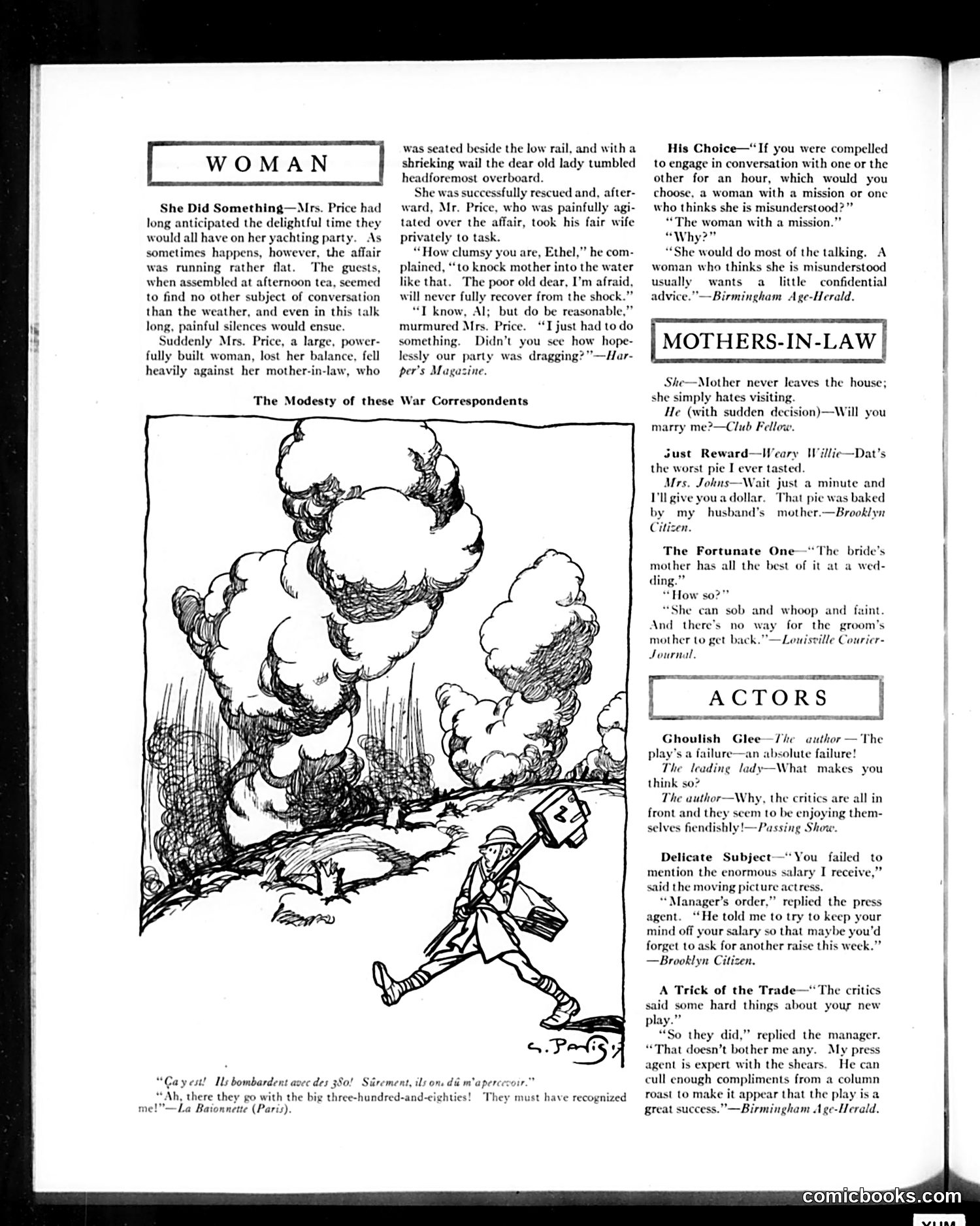
This page collects brief humorous anecdotes and a war-themed cartoon, all mocking social conventions and relationships: **"She Did Something"** satirizes the desperate measures taken to enliven dull social gatherings—a woman deliberately knocks her mother-in-law overboard just to create excitement at a yacht party. **"The Modesty of these War Correspondents"** (illustration): A soldier amid explosions represents war correspondents who, despite claiming modesty about their dangerous work, apparently sought recognition for covering WWI combat. The right column's jokes target **mothers-in-law** (portrayed as meddling), **actors and playwrights** (vain and insecure), and **press agents** (dishonest, manipulating reviews by extracting compliments from negative criticism to create false impressions of success). All share themes of social pretense, marital discord, and people prioritizing appearance over substance—typical Judge magazine satire of early 20th-century American life.
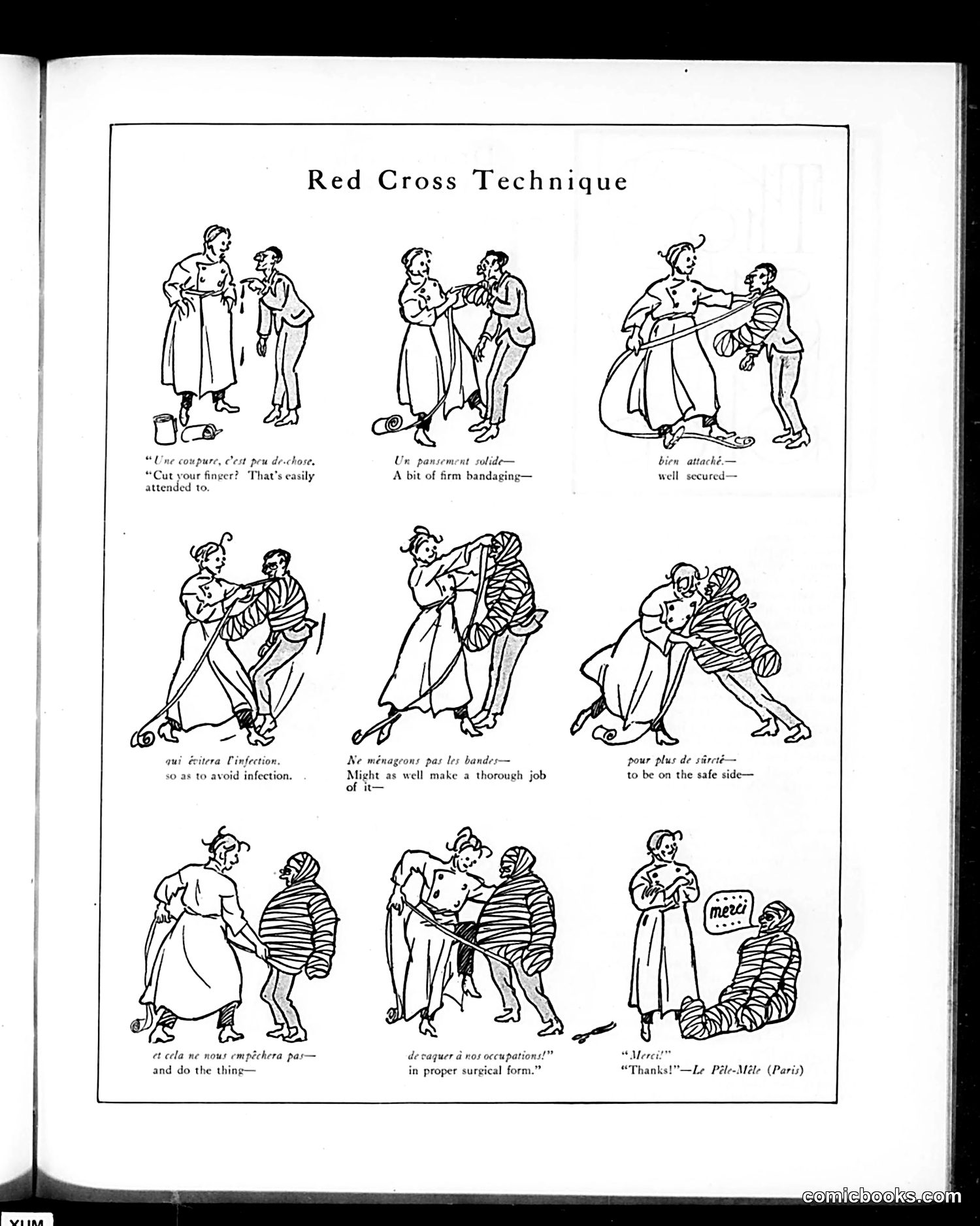
This instructional comic strip illustrates proper first aid and bandaging techniques, presented humorously through a nurse or Red Cross worker treating a patient. The page demonstrates sequential steps: assessing injuries ("Cut your finger!"), applying firm bandages, wrapping wounds properly to avoid infection, and ensuring bandages are secure enough for normal activities. The satire lies in the exaggerated casualness—the captions suggest applying medical care while maintaining everyday life ("do the thing," "resume our occupations"). The French text and attribution to *Le Péle-Méle* (a Paris satirical magazine) suggests this may be reprinted or inspired by European wartime medical humor, likely from WWI era when Red Cross work was prominent. The joke mocks both the simplicity of proper technique and perhaps the somewhat absurd situations requiring such care during wartime.
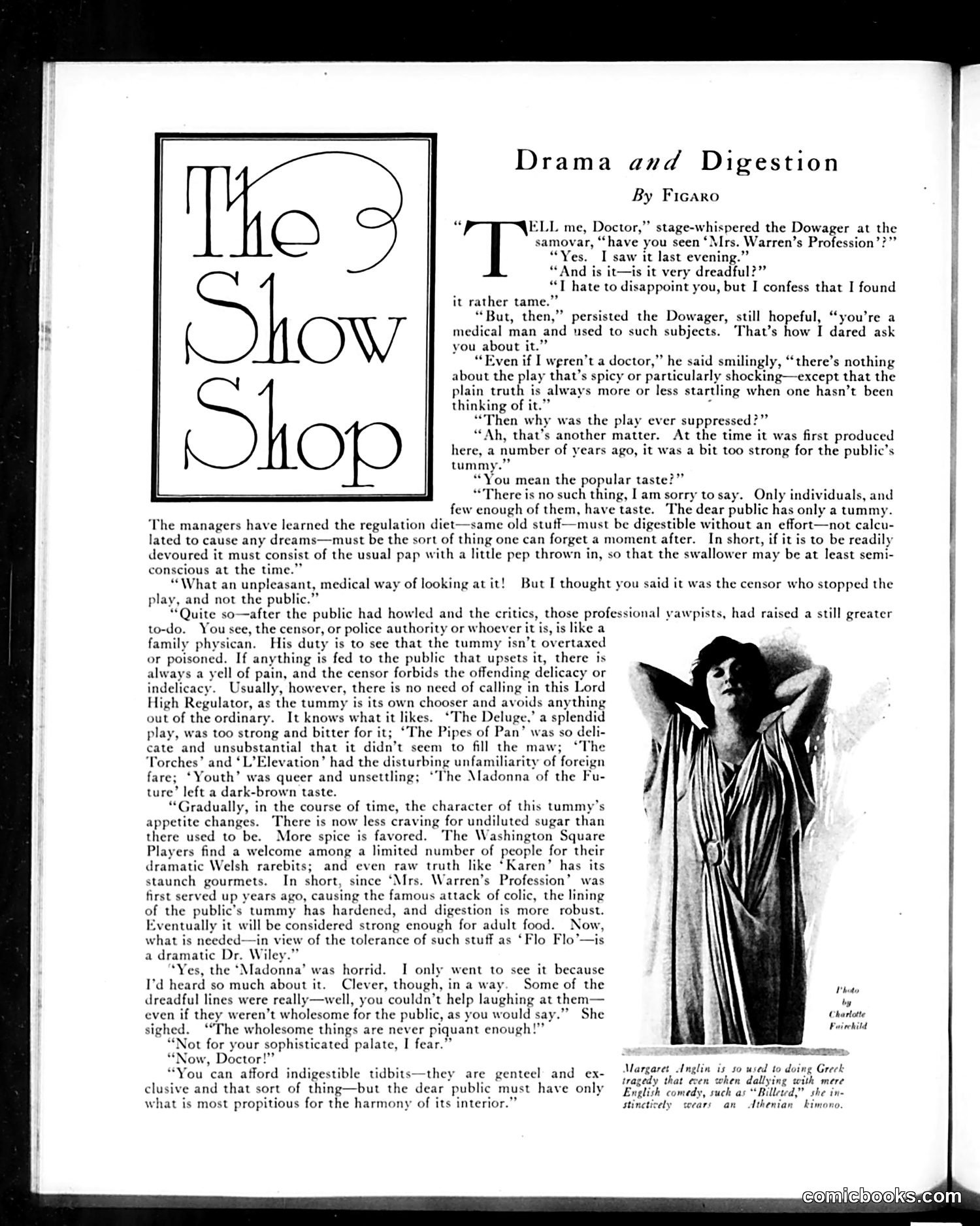
This article satirizes theatrical censorship and the public's intellectual capacity through a doctor-dowager conversation. The piece uses digestive metaphors to argue that censors treat audiences like infants requiring bland "pap"—carefully regulated mental food to prevent upset. The satire targets Shaw's *Mrs. Warren's Profession* (suppressed for addressing prostitution), which the doctor claims was deemed "too strong" for the public's "tummy," not because of objective harm but because the public has no real taste—only a stomach. The piece mocks both the censor's paternalism and the "dear public" for demanding only easily-digestible entertainment. The author argues public tolerance gradually increases (citing plays like *Karen*), and audiences eventually become sophisticated enough for adult material. The final photograph shows Margaret Anglin in a Greek theatrical costume, establishing theatrical context for this drama criticism.
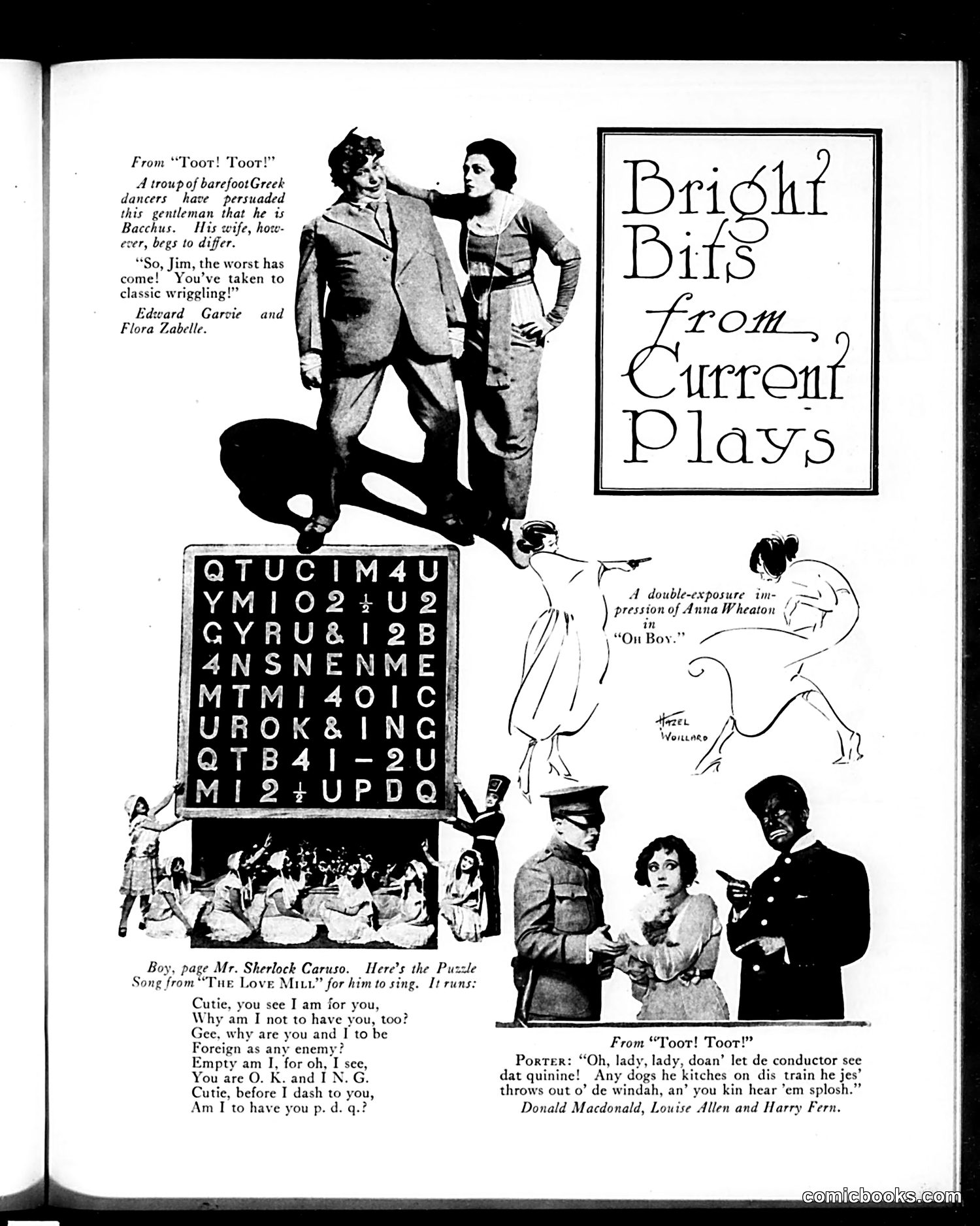
This page showcases comedic moments from contemporary Broadway productions (circa 1910s-1920s). The top scene shows Edward Garcie and Flora Zabelle in "Toot! Toot!"—a man persuaded by Greek dancers that he's Bacchus (the god of wine) while his skeptical wife objects to his "classic wriggling." The humor derives from ordinary domesticity clashing with theatrical pretension. Below are additional vaudeville/stage snippets: a sketch featuring "Sherlock Caruso" with a puzzle song about romantic pursuit; and a porter character from "Toot! Toot!" making dialect humor about disposing of dogs from a train. The comic illustrations and musical fragments represent typical early-20th-century popular theater—light, music-hall style entertainment emphasizing physical comedy and sentimental songs rather than sophisticated satire.
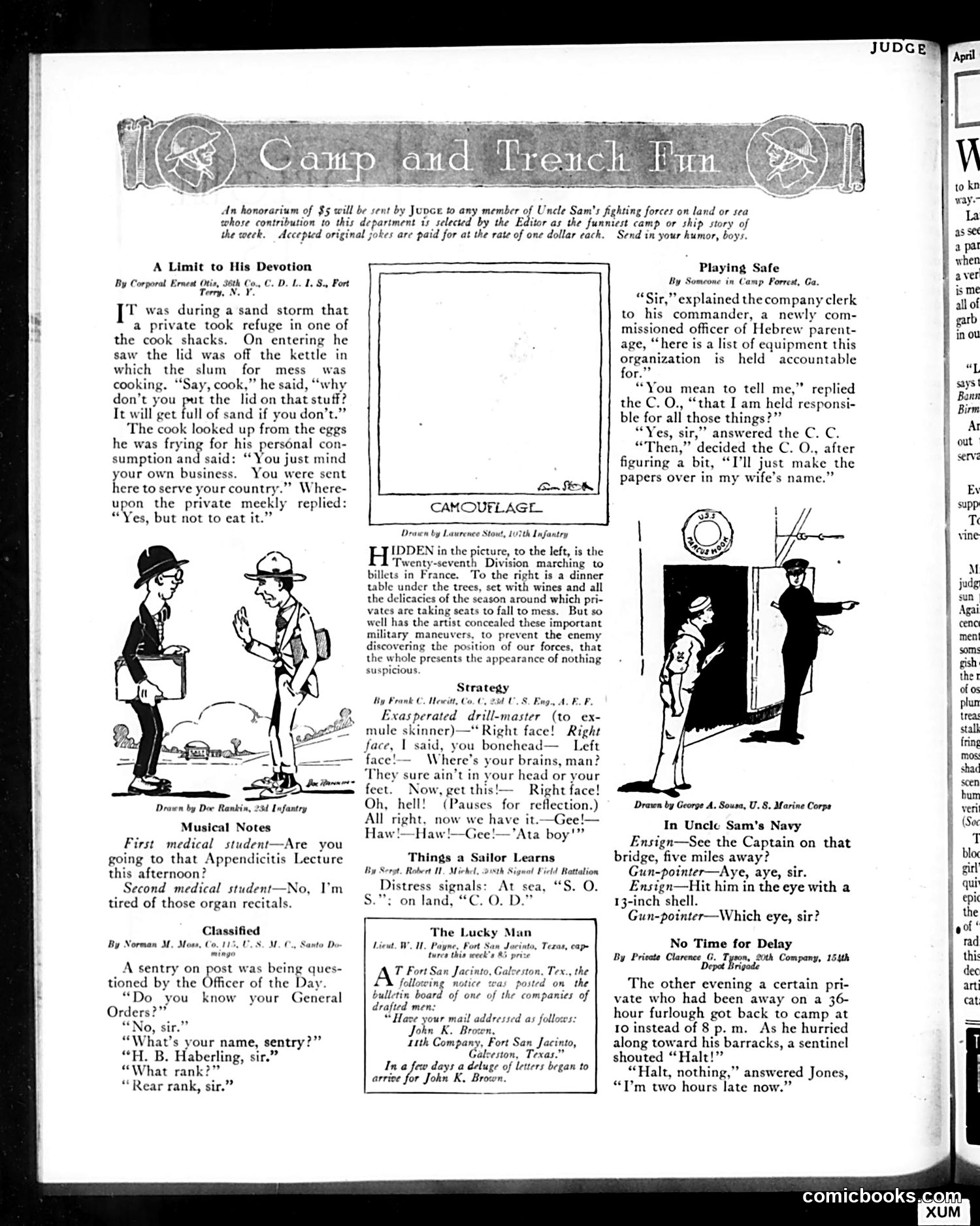
This is a humor page from *Judge* magazine during World War I, featuring jokes submitted by soldiers. The content reflects military life's absurdities: **Key pieces:** - "A Limit to His Devotion": A private complains about sand in the cook's slum (stew), but the cook refuses to cover it—satirizing selective patriotism. - "Camouflage": A drawing obscures a military dinner scene as camouflage against enemy detection—mocking military secrecy theater. - "Strategy": A drill sergeant confuses drill commands with mule-skinner calls ("Right face!" vs. "Gee!" and "Haw!")—poking fun at soldier training absurdities. - "Playing Safe": A newly commissioned Jewish officer avoids responsibility by putting equipment on his wife's name—suggesting anti-Semitic stereotypes about Jewish officers. The page emphasizes the gap between military expectations and soldier reality, with humor arising from incompetent officers, poor food, and bureaucratic confusion typical of wartime.
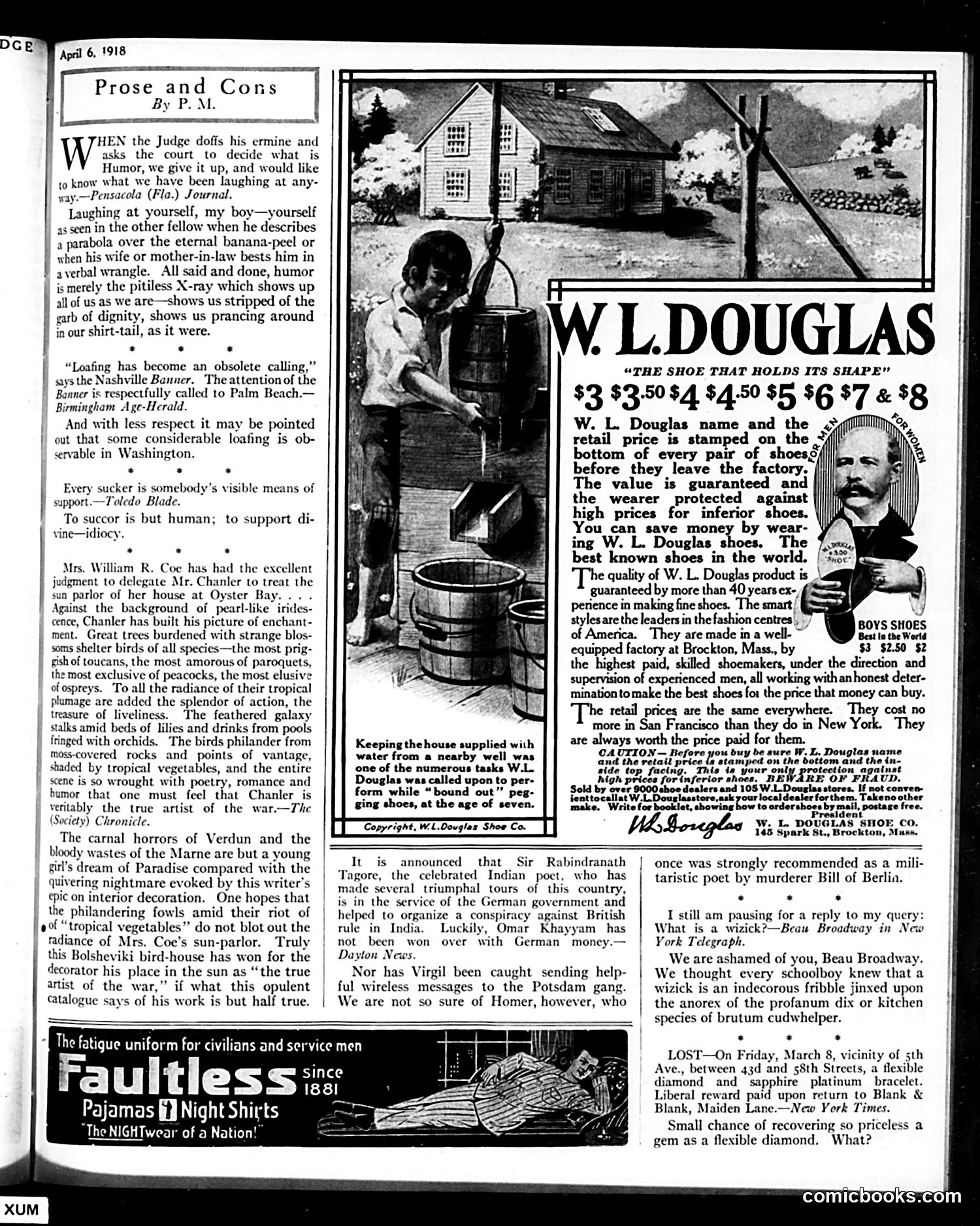
This page is primarily **advertising and humor columns**, not political satire. The "Prose and Cons" column by P.M. contains brief satirical jabs at contemporary targets: loafing in Washington, D.C.; and a lengthy mock-serious critique of an interior decoration project by "Mr. Chanler" at Mrs. William R. Coe's Oyster Bay home. The satire compares the ornate, tropical bird-filled sun parlor to the horrors of World War I battlefields (Verdun, the Marne), suggesting that obsessing over decorative excess while soldiers die is absurdly disconnected from reality. The reference to "Bolsheviki bird-house" suggests post-revolutionary Russian associations with radical aestheticism. The dominant content is a **W.L. Douglas shoe advertisement** featuring the company founder's portrait and price points ($3–$8), emphasizing quality and guaranteed retail prices. A **Faultless Pajamas advertisement** appears at bottom. The page reflects 1918 wartime America: consumer advertising coexisting with commentary on domestic frivolity amid global conflict.
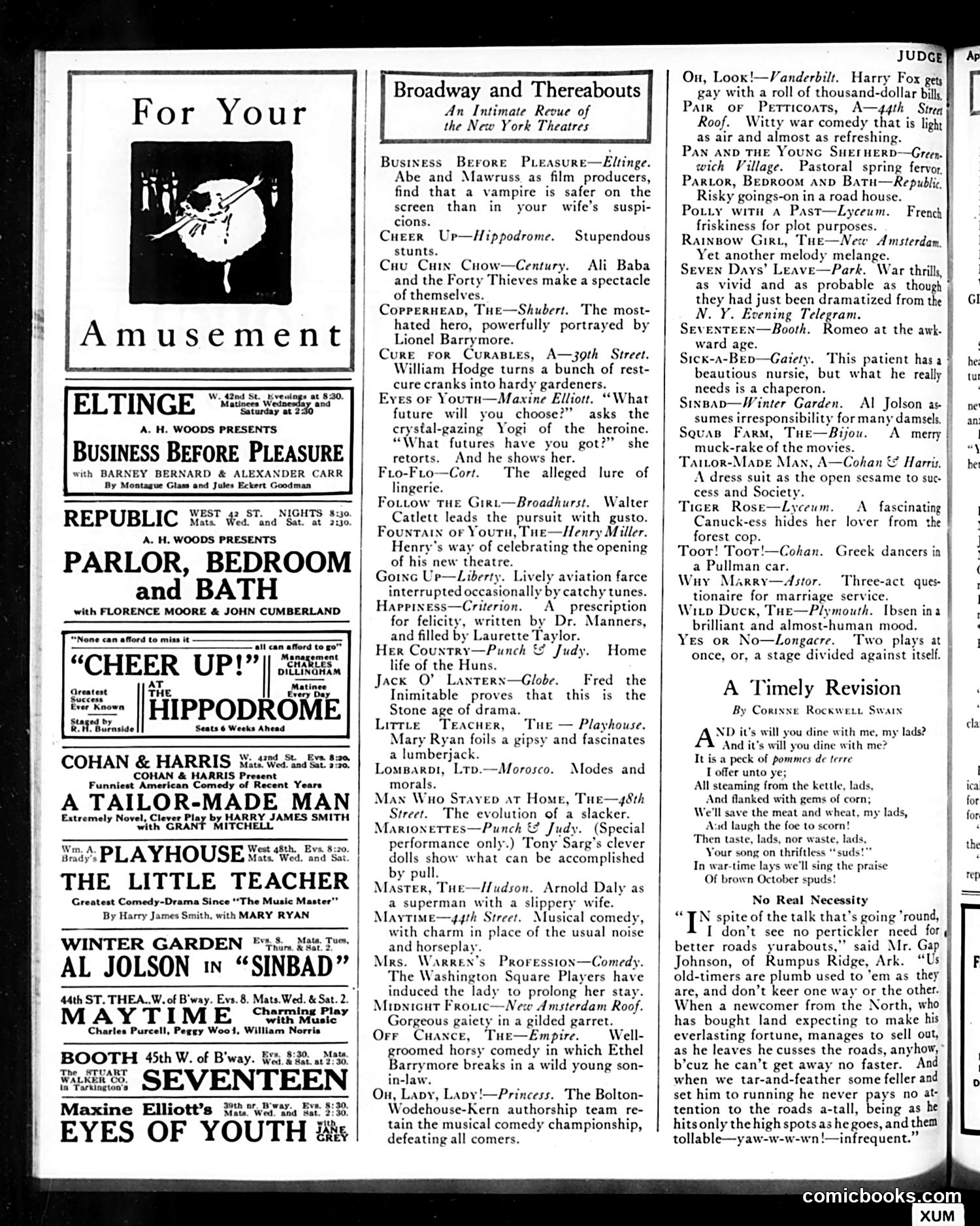
This is primarily a **theater advertisements and reviews page** from Judge magazine, not a political cartoon. The left side features Broadway theater advertisements; the right contains brief reviews of current New York theatrical productions. The content reflects **World War I-era entertainment**. References include a "slacker" character (*The Man Who Stayed at Home*), a "war comedy" (*A Pair of Petticoats*), and mentions of Greenwich Village bohemianism. Notable are reviews of popular productions: Al Jolson in *Sinbad*, Ethel Barrymore in *Off Chance*, and the Bolton-Wodehouse-Kern musical *Oh, Lady, Lady!* The reviews use light, witty commentary typical of Judge's satirical tone—mocking plot absurdities (e.g., vampires safer "on screen than in your wife's suspicions"). This page documents **early 20th-century American theater tastes**: musicals, comedies, and dramas dominated Broadway during the WWI period. No significant political satire appears here—it's entertainment coverage aimed at Judge's urbane readership.
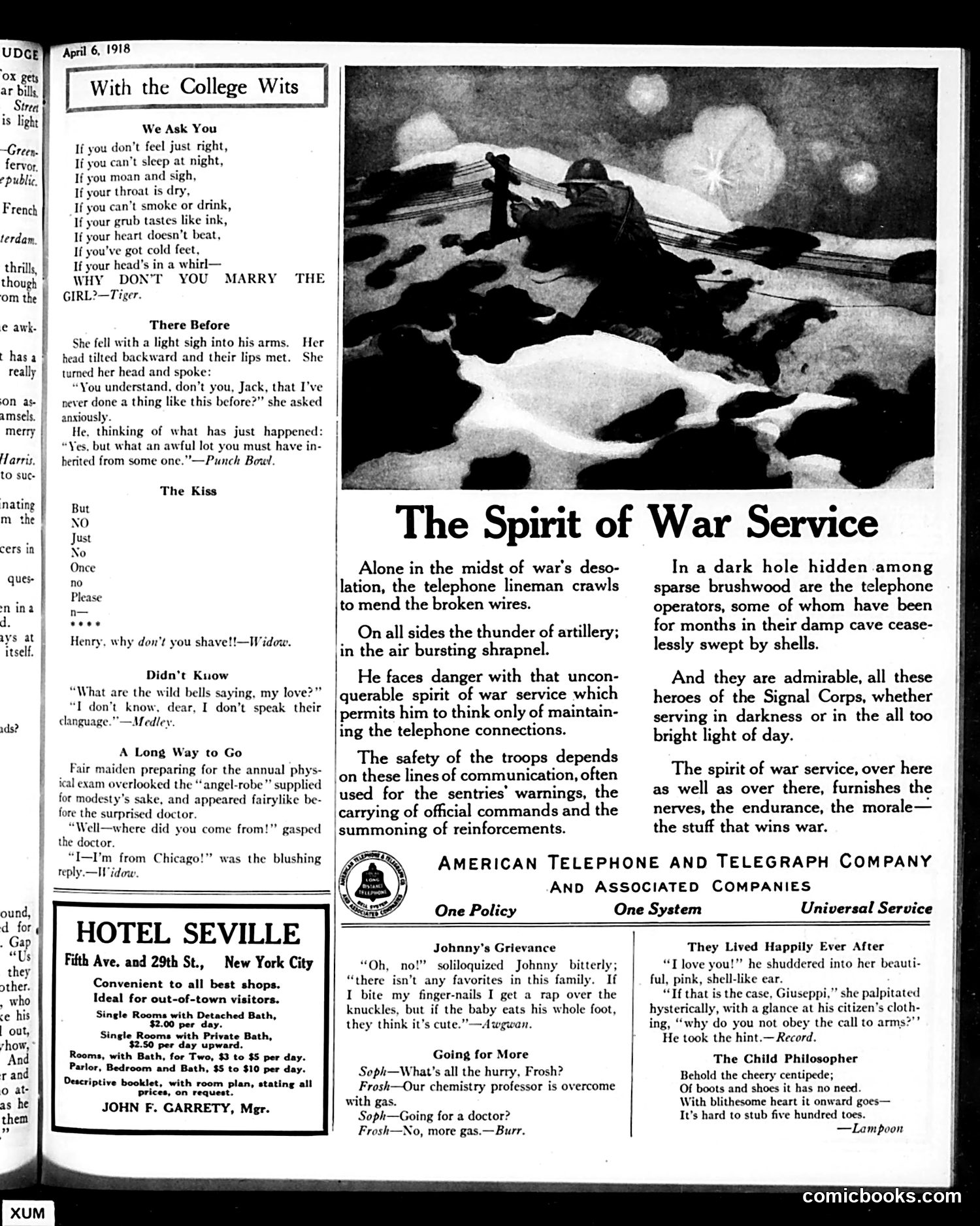
This page mixes light humor with wartime propaganda. The left side contains college-themed jokes and a hotel advertisement—typical Judge content. The dominant feature is a full-page advertisement by American Telephone and Telegraph Company celebrating telephone linemen and operators as war heroes. The ad's image shows soldiers in trenches; the accompanying text romanticizes Signal Corps workers maintaining communications under artillery fire. It frames telephone infrastructure as essential to troop safety and military victory, positioning AT&T as patriotically supporting the war effort (America had entered WWI in April 1917). This is corporate propaganda disguised as tribute to servicemen—AT&T was likely seeking government contracts or favorable wartime treatment. The framing transforms routine utility work into battlefield heroism, reflecting how American businesses mobilized patriotic messaging during the war. The college humor on the left provides contrast, showing domestic American life during wartime.
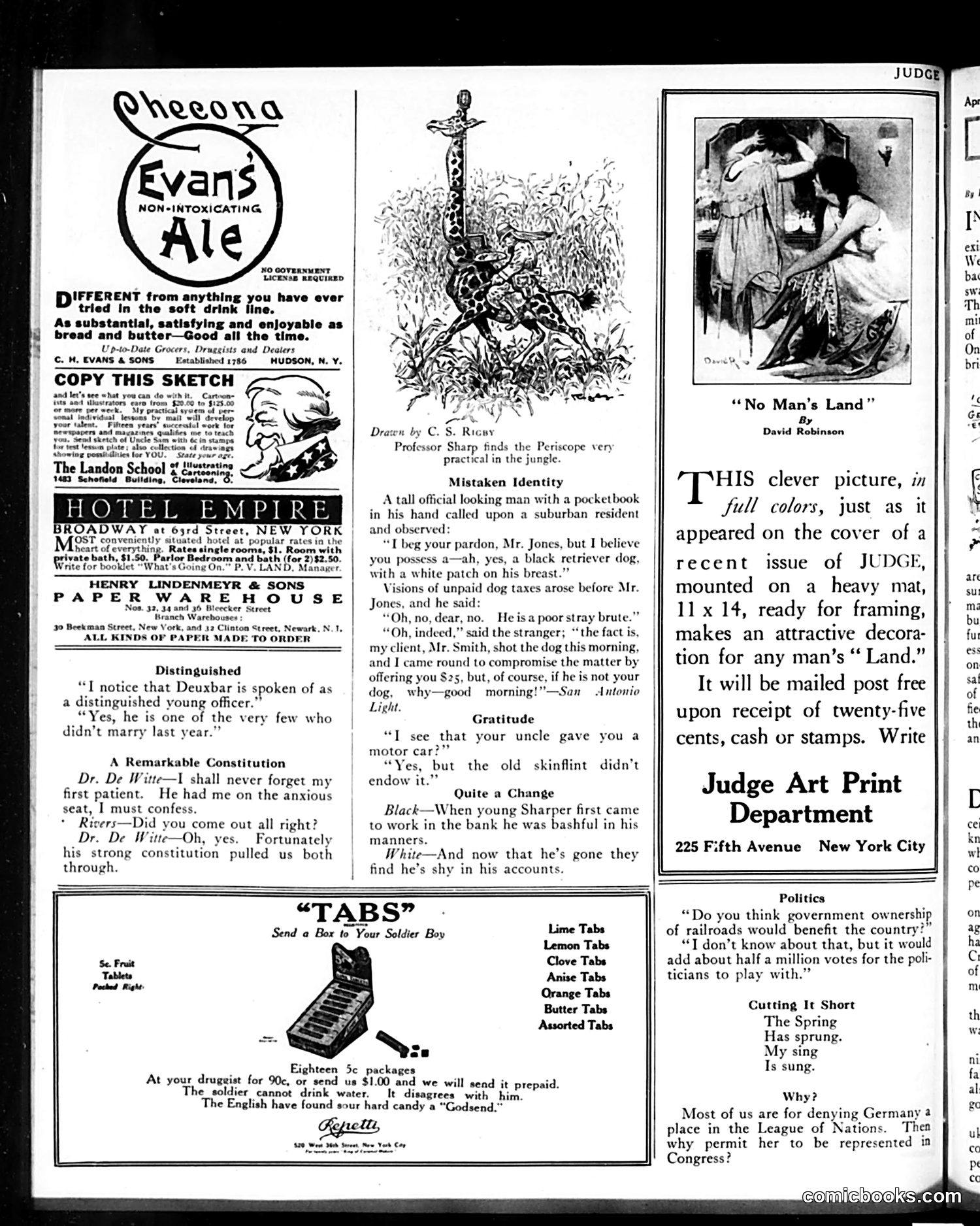
This page is primarily **advertising and humor content** rather than political cartoons. The main elements: **"No Man's Land" artwork**: A David Robinson illustration advertised as a colorful print available from Judge's Art Print Department for 25 cents. The image depicts a woman in classical dress, likely allegorical. **Humor pieces**: Brief jokes on various topics—a doctor whose patient's "strong constitution" saved them both, a tax collector mistaking a dog owner, wordplay about a banker's embezzlement ("shy in his accounts"). **Advertisements**: Cheona Evans non-intoxicating ale, Hotel Empire, paper warehouse, and notably **"TABS" candy** marketed directly to soldiers, capitalizing on WWI ("Send a Box to Your Soldier Boy"). The text notes soldiers cannot drink water, so hard candy is a "Godsend." **Political humor**: A brief joke about government railroad ownership adding "half a million votes for politicians to play with," and cynicism about Germany's League of Nations participation versus Congressional representation. The page reflects **early WWI-era American commercialism and light satire**, mixing product promotion with gentle social commentary.
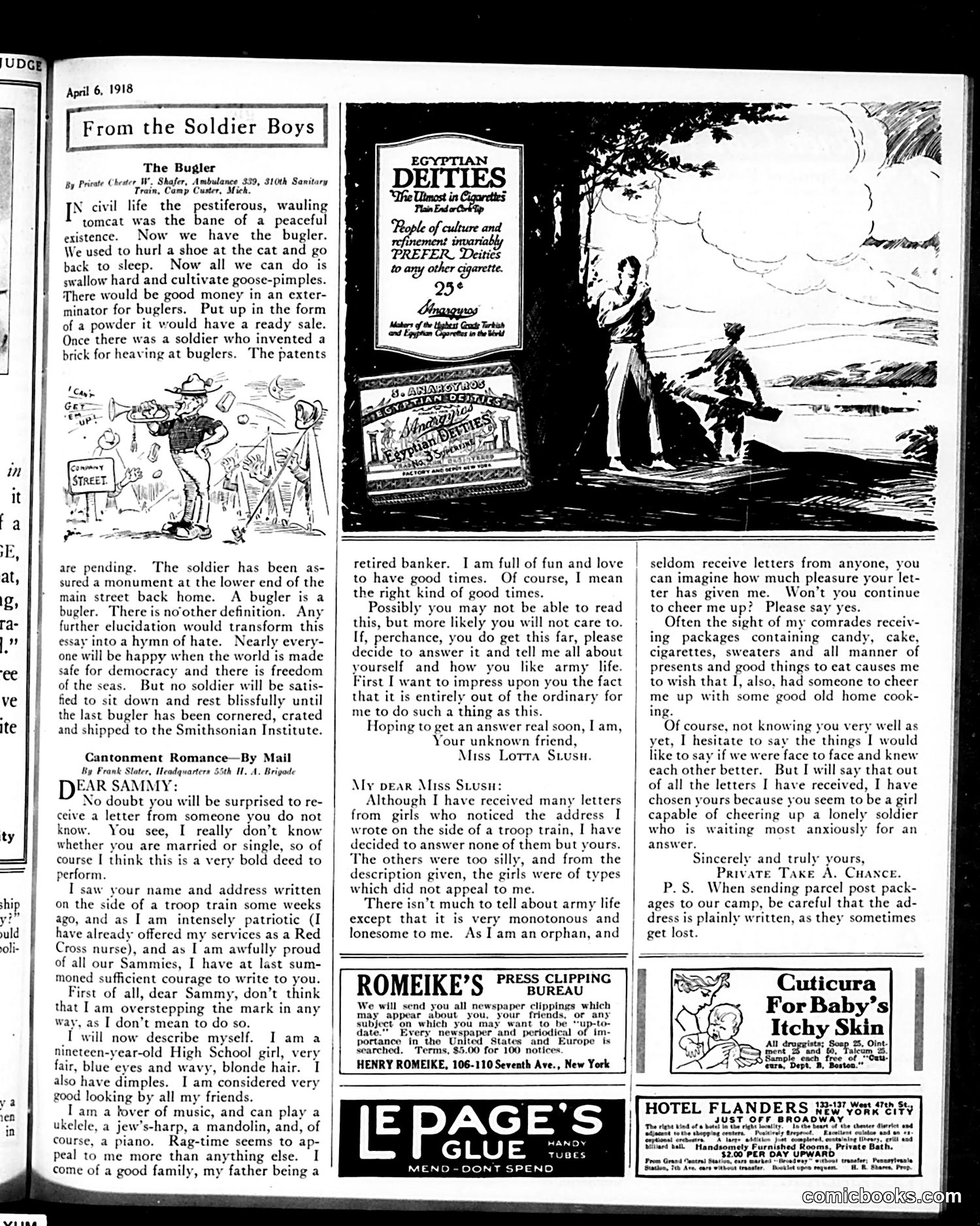
This page from *Judge* (April 6, 1918) contains soldier-written contributions during World War I: **"The Bugler"** is a humorous complaint from a soldier (Private Chester Shafer) comparing the annoying sound of military bugles to peacetime nuisances like tomcats. The joke is that soldiers can't escape the bugler's wake-up calls—unlike civilians who could throw shoes at cats. It's light griping about army life's unavoidable irritations. **"Cantonment Romance—By Mail"** depicts the era's common practice of soldiers receiving letters from patriotic civilian women. A 19-year-old girl writes to an unknown soldier, describing herself (blue eyes, blonde hair, musical talents) and inviting correspondence. His reply reveals loneliness—as an orphan with no family support, he's touched by her attention. The piece gently satirizes how wartime prompted civilians (especially women) to boost soldiers' morale through personal correspondence, while showing soldiers' genuine homesickness and isolation. Both pieces reflect authentic WWI soldier experiences published for popular amusement.
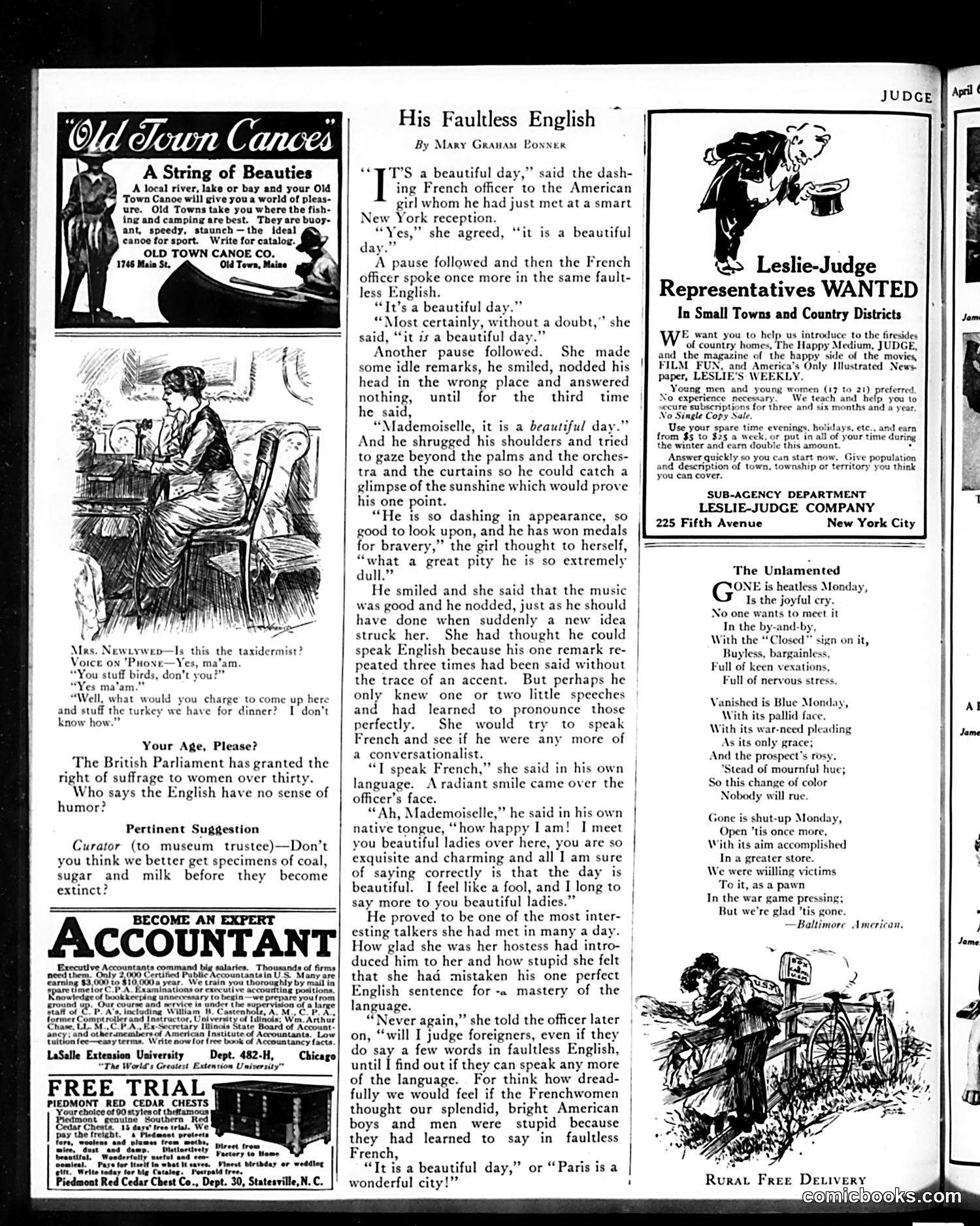
This story mocks both French military vanity and transatlantic romantic stereotypes. An American woman meets a dashing French officer at a New York reception. He repeatedly says only "It's a beautiful day" in perfect English, which she initially admires as sophisticated. She assumes his limited English reflects Continental coolness—until she realizes he likely knows *only* that one memorized phrase, pronouncing it flawlessly because he's rehearsed it endlessly. When she switches to French, his face lights up; he confesses he can barely speak English and feels foolish repeating his single prepared compliment. The satire targets the French officer's shallow charm masking linguistic incompetence, and mocks the American woman's gullibility in finding his repetitive remark appealing. It's a period comedy about international courtship and the gap between polished appearance and actual substance.
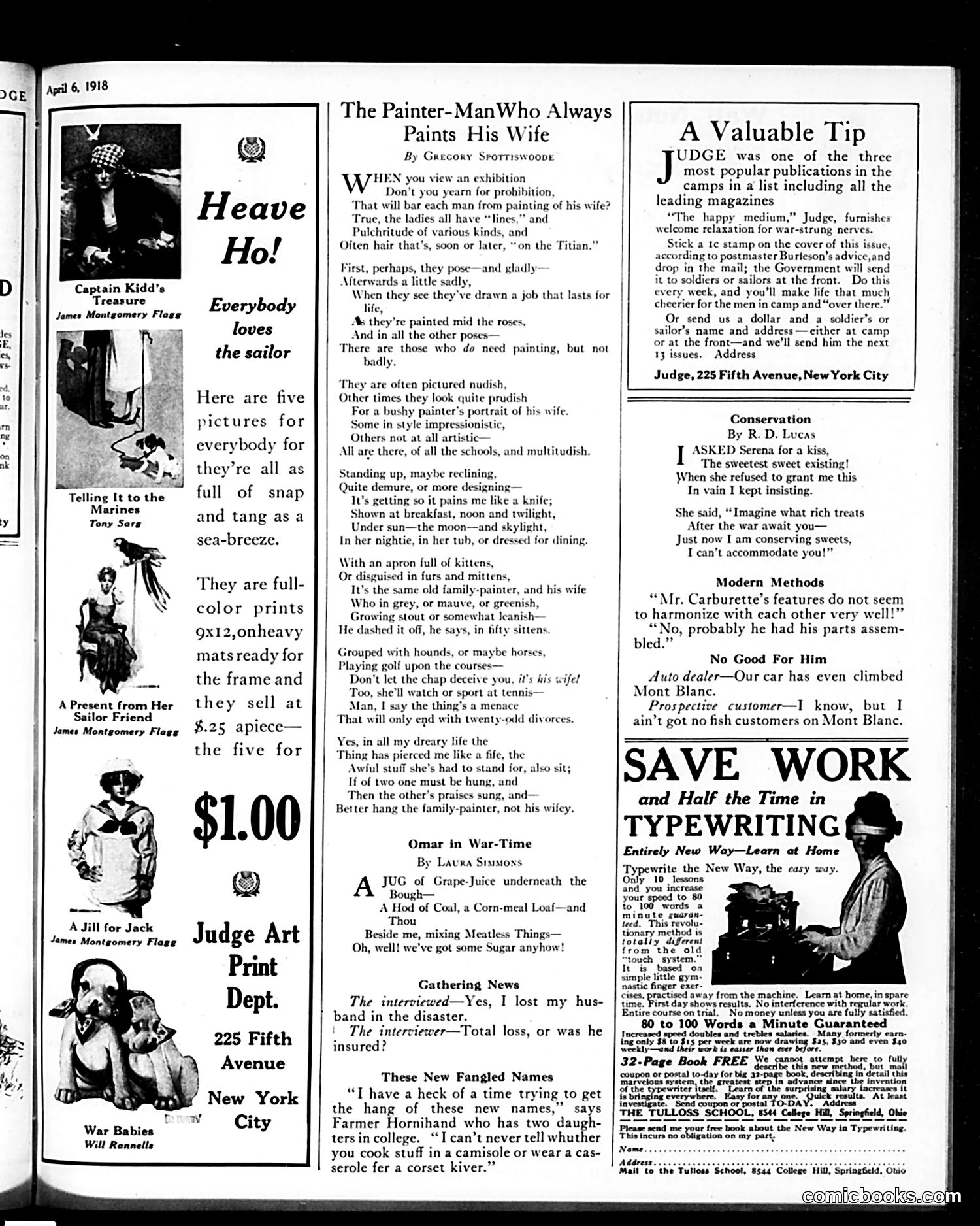
This page is primarily **advertising for Judge art prints and wartime services**, with satirical poems addressing WWI-era concerns. **Main content:** The featured poem "The Painter-Man Who Always Paints His Wife" mocks a widespread artistic cliché—male painters endlessly depicting their wives in every conceivable pose and setting (breakfast, bathing, with animals, etc.). The satire suggests this obsession is tedious, creatively bankrupt, and leads to marital discord ("twenty-odd divorces"). **Wartime context:** Multiple references reflect 1918 anxieties: - "Omar in War-Time" parodies Omar Khayyam using rationing items (grape-juice instead of wine, meatless dishes) - A "Valuable Tip" section urges readers to mail Judge to soldiers at the front - "These New Fangled Names" jokes about confusing new food rationing terms with women's clothing **Art prints** by James Montgomery Flagg featuring sailors ("Everybody loves the sailor") were sold patriotically—relevant given Flagg's famous WWI recruitment posters. The page reflects how even humor magazines pivoted content toward war support and domestic wartime adjustments.
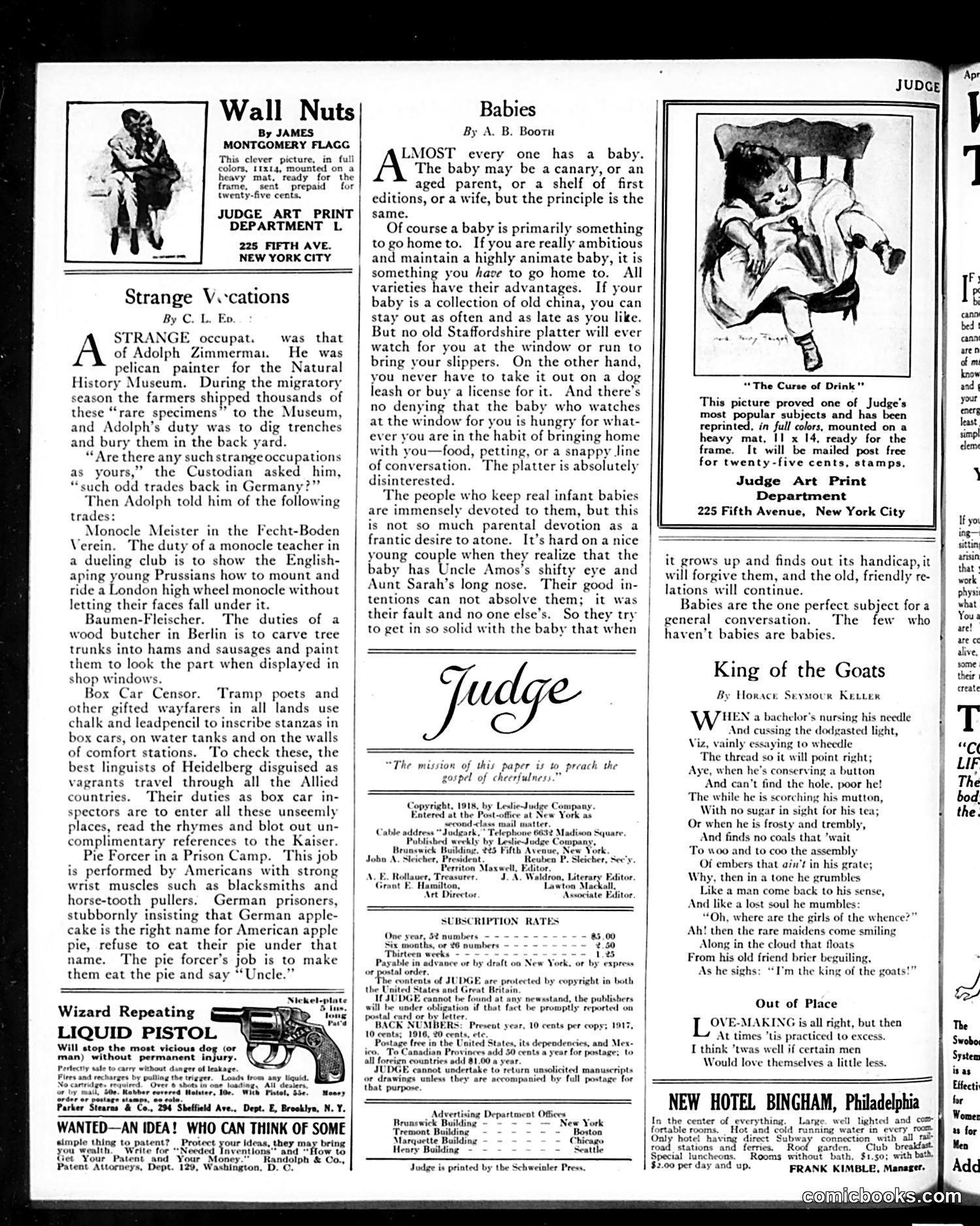
This page contains three satirical pieces typical of Judge's humor: **"Wall Nuts"** by Montgomery Flagg advertises an art print—a commercial offering, not editorial content. **"Strange Vocations"** satirizes German occupations during World War I. The humor mocks Germanic culture through absurdist "jobs": a "Monocle Meister" teaching Prussian officers to wear monocles while riding unicycles, a "Baumen-Fleischer" carving tree trunks into fake hams, and a "Box Car Censor" inspecting hobo poetry for anti-Kaiser sentiment. The piece culminates in mocking German prisoners refusing to call American apple pie by its American name—reflecting WWI-era anti-German sentiment and stereotypes about German stubbornness. **"Babies"** by A.B. Booth is a humorous essay using extended metaphor, comparing literal infants to other "babies" (canaries, old china collections, wives). It jokes about parental devotion as "atonement" for children inheriting undesirable family traits. The page reflects 1918 American attitudes: anti-German mockery during active wartime, consumerism, and domestic humor.
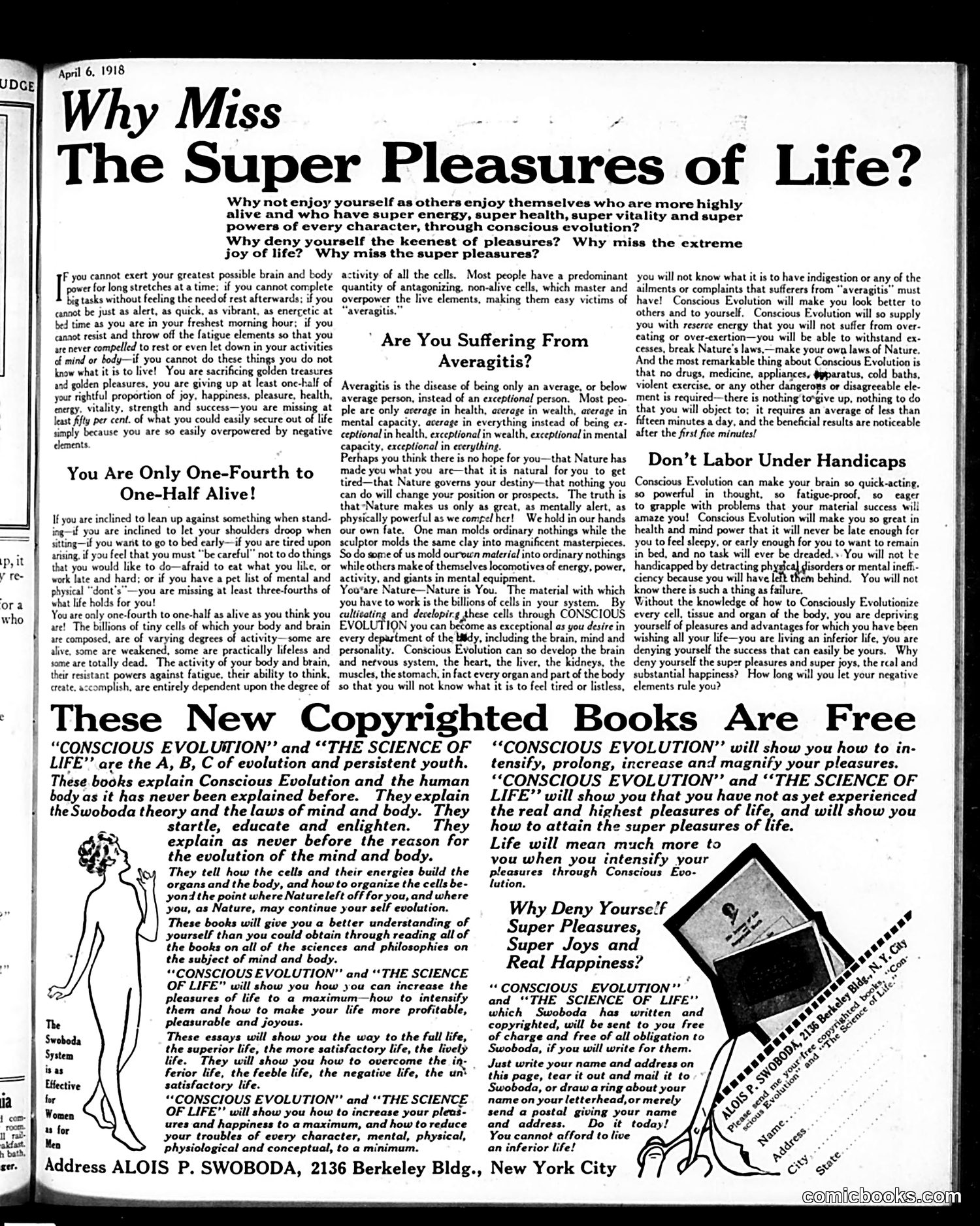
This is primarily **advertising copy**, not satire. The page promotes self-help books titled "Conscious Evolution" and "The Science of Life" by Alois P. Swoboda (address given at bottom). The text uses pseudo-scientific health rhetoric common to early 20th-century wellness movements. It invents a disease called "averagitis"—being an average person—and promises that reading these books will unlock superhuman vitality, energy, and life satisfaction through "conscious evolution" of one's cells and mind. The small illustration shows a nude male figure, emphasizing bodily vitality. **The appeal**: targeting readers feeling tired, weak, or dissatisfied by suggesting their problems are solvable through purchased knowledge rather than medical intervention. This represents a pre-FDA era when such health claims faced minimal regulation—typical of magazines like *Judge* which accepted dubious advertisements alongside satirical content.
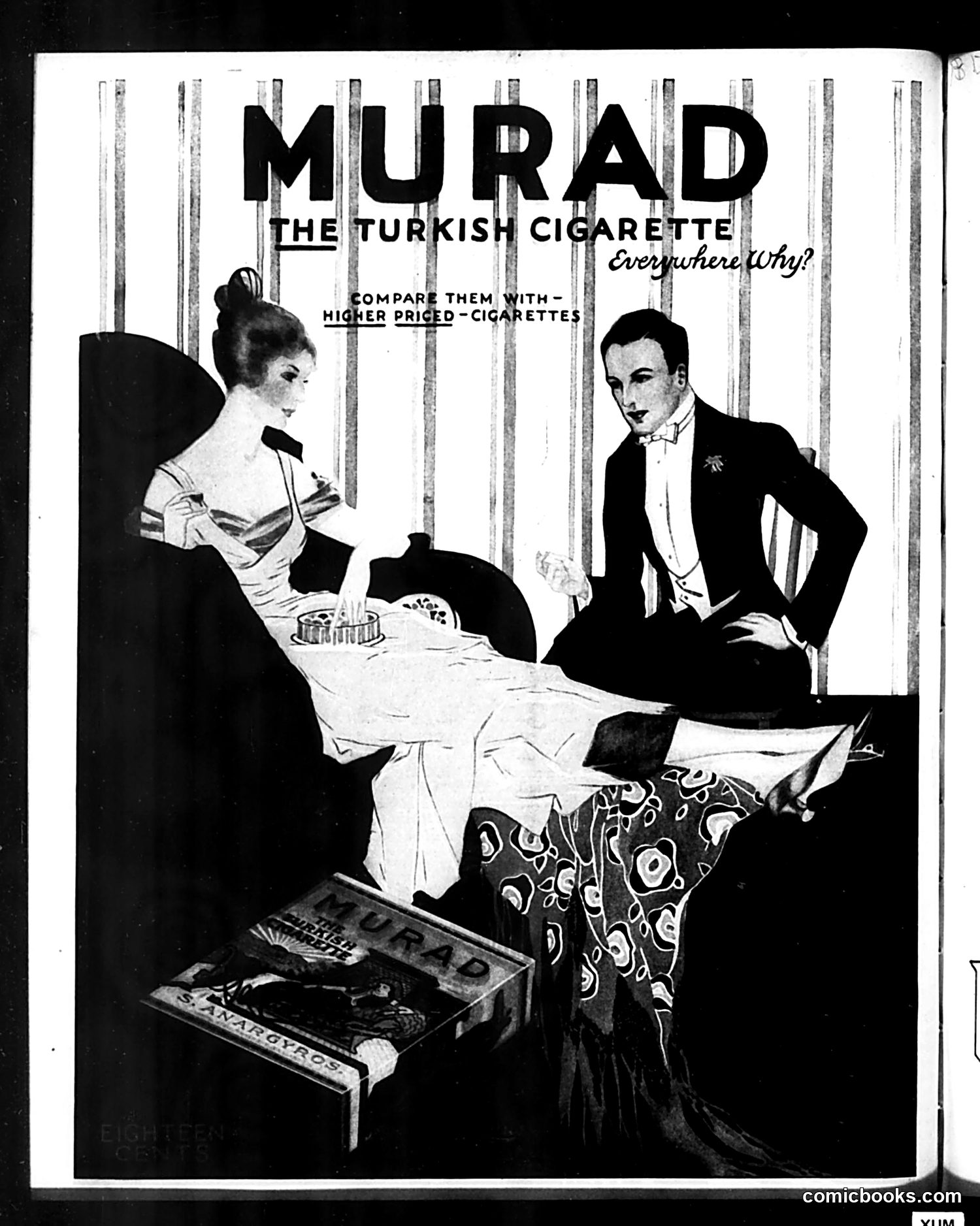
This is a **cigarette advertisement** for Murad Turkish cigarettes, not political satire. The ad features an elegantly dressed couple in what appears to be a theater or upscale venue. The headline asks "everywhere Why?" and instructs readers to "Compare them with Higher Priced Cigarettes." The advertisement uses **aspirational imagery**—fashionable people in formal wear—to market Murad as a sophisticated, affordable alternative to premium cigarette brands. This was a standard advertising approach of the early 20th century, before tobacco health warnings existed. The "Turkish cigarette" designation references a specific product category popular in that era. The page demonstrates how luxury goods were marketed through appeals to style and social status rather than actual product qualities.