
Judge, 1918-04-06 · page 17 of 36
Judge — April 6, 1918 — page 17: what you’re looking at
What you’re looking at
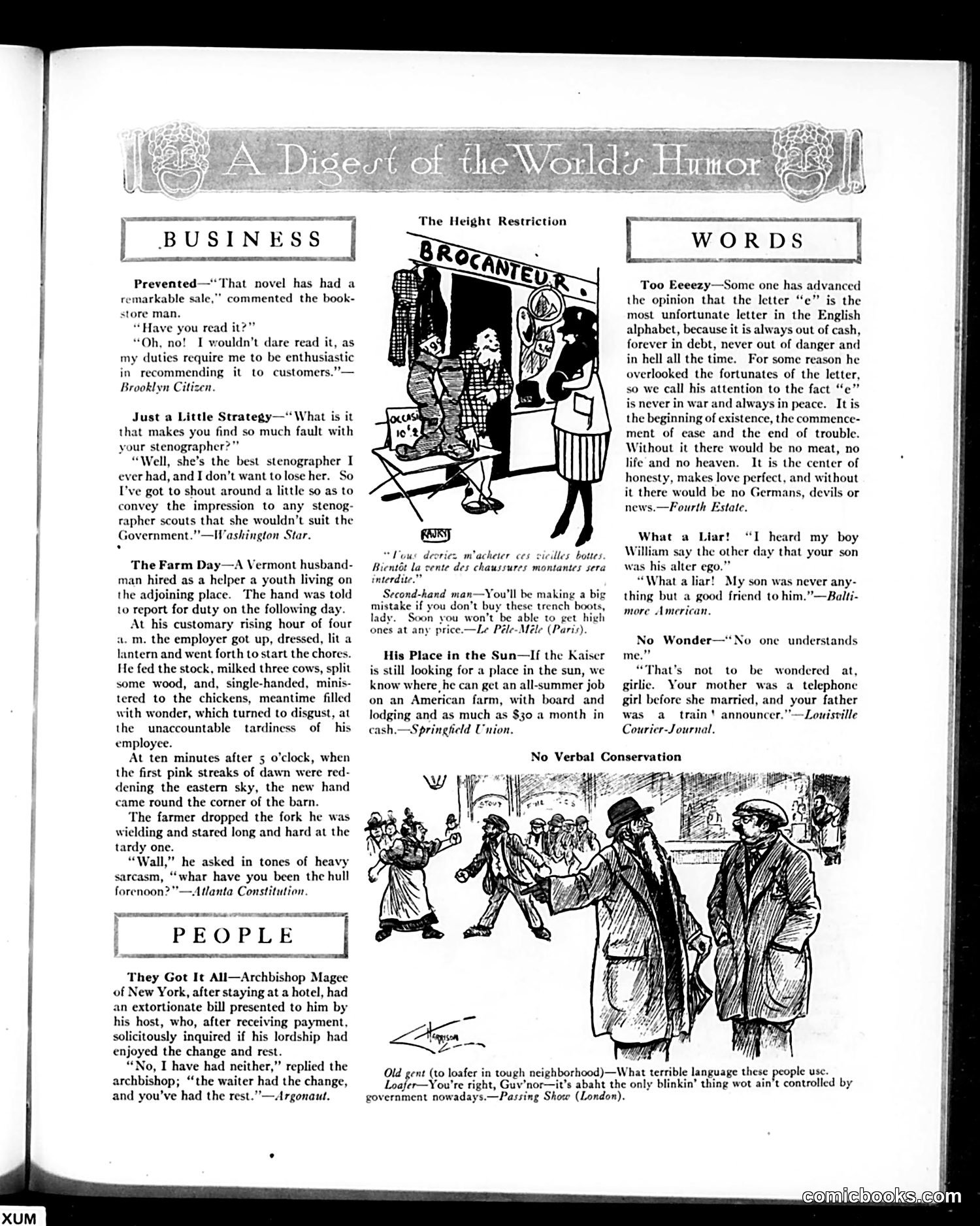
This page from Judge presents satirical humor across three sections: **BUSINESS** jokes mock workplace absurdities: a bookseller who won't read the novels she sells, an employer deliberately criticizing his best stenographer to discourage government recruitment, and a farmer's sarcasm toward his tardy hired hand. **PEOPLE** contains anecdotes about clergy and the wealthy. Archbishop Magee's quip about the waiter keeping "the change" and the host keeping "the rest" is wordplay on hospitality. The "Kaiser" reference likely alludes to WWI-era Germany seeking global dominance ("a place in the sun"). **WORDS** section plays with letter "e" having contrary qualities—perpetually broke yet representing peace, ease, and virtue. The cartoon "No Verbal Conservation" (bottom) shows tough street characters, with the loafer's joke suggesting that crude language is the *only* thing not yet controlled by government regulation—dark humor about expanding state authority, likely post-WWI concerns about government overreach. The overall tone is cynical about institutions, bureaucracy, and social pretension typical of Judge's satirical mission.
📄 Transcribed text from this page (OCR, searchable)
Machine-transcribed from the original scan — historical spelling and the odd misread are preserved.
BUSINESS eer ae ARNE Prevented—‘That novel has had a remarkable sale,’ commented the book- store man. “Have you read it?” “Oh, no! I wouldn't dare read it, as my duties require me to be enthusiastic in recommending it to customers.”— Brooklyn Citizen. Just a Little Strategy—*“ What is it that makes you find so much fault with your stenographer?” Well, she’s the best stenographer I ever had, and I don’t want to lose her. So I've got to shout around a little so as to convey the impression to any stenog- rapher scouts that she wouldn’t suit the Government.”—Washington Star. The Farm Day—A Vermont husband- man hired as a helper a youth living on the adjoining place. The hand was told to report for duty on the following day. At his customary rising hour of four a.m. the employer got up, dressed, lit a lantern and went forth to start the chores. He fed the stock, milked three cows, split some wood, and, single-handed, minis- tered to the chickens, meantime filled with wonder, which turned to disgust, at the unaccountable tardiness of _ his employee. At ten minutes after 5 o’clock, when the first pink streaks of dawn were red- dening the eastern sky, the new hand came round the corner of the barn. The farmer dropped the fork he was wielding and stared long and hard at the tardy one. “Wall,” he asked in tones of heavy sarcasm, “whar have you been the hull forenoon?" —Allanta Constitution. ne naa, | PEOPLE | They Got It All—Archbishop Magec of New York, after staying at a hotel, had an extortionate bill presented to him by his host, who, after receiving payment, solicitously inquired if his lordship had enjoyed the change and rest. “No, I have had neither,” replied the archbishop; “the waiter had the change, and you’ve had the rest.”-—Argonaut. “Vous decries m'acheter ces vicilles bottes. Bientét la vente des chaussures montantes sera interdite.” Second-hand man—You'll be making a big mistake if you don’t buy these trench boots, lady. Soon you won't be able to get high ones at any price.—Le Péle-Méle (Paris). His Place in the Sun—If the Kaiser is still looking for a place in the sun, we know where he can get an all-summer job on an American farm, with board and lodging and as much as $30 a month in cash.—Springfield Union. Too Eeeezy—Some one has advanced the opinion that the letter “e” is the most unfortunate letter in the English alphabet, because it is always out of cash, forever in debt, never out of danger and in hell all the time. For some reason he overlooked the fortunates of the letter, so we call his attention to the fact “e” is never in war and always in peace. It is the beginning of existence, the commence- ment of ease and the end of trouble. Without it there would be no meat, no life and no heaven. It is the center of honesty, makes love perfect, and without it there would be no Germans, devils or news.—Fourth Estate. What a Liar! “I heard my boy William say the other day that your son was his alter ego.”” “What a liar! My son was never any- thing but a good friend to him.”—Balti- more American. No Wonder—“No one understands me.” “That's not to be wondered at, girlic. Your mother was a telephone girl before she married, and your father was a train! announcer.” —Louistille Courier-Journal. No Verbal Conservation Old gent (to loafer in tough neighborhood)—What terrible language these people usc. Loajer—You're right, Guv'nor—it’s abaht the only blinkin’ thing wot ain't controlled by government nowadays.—Passing Show (London).