
Judge, 1918-04-06 · page 7 of 36
Judge — April 6, 1918 — page 7: what you’re looking at
What you’re looking at
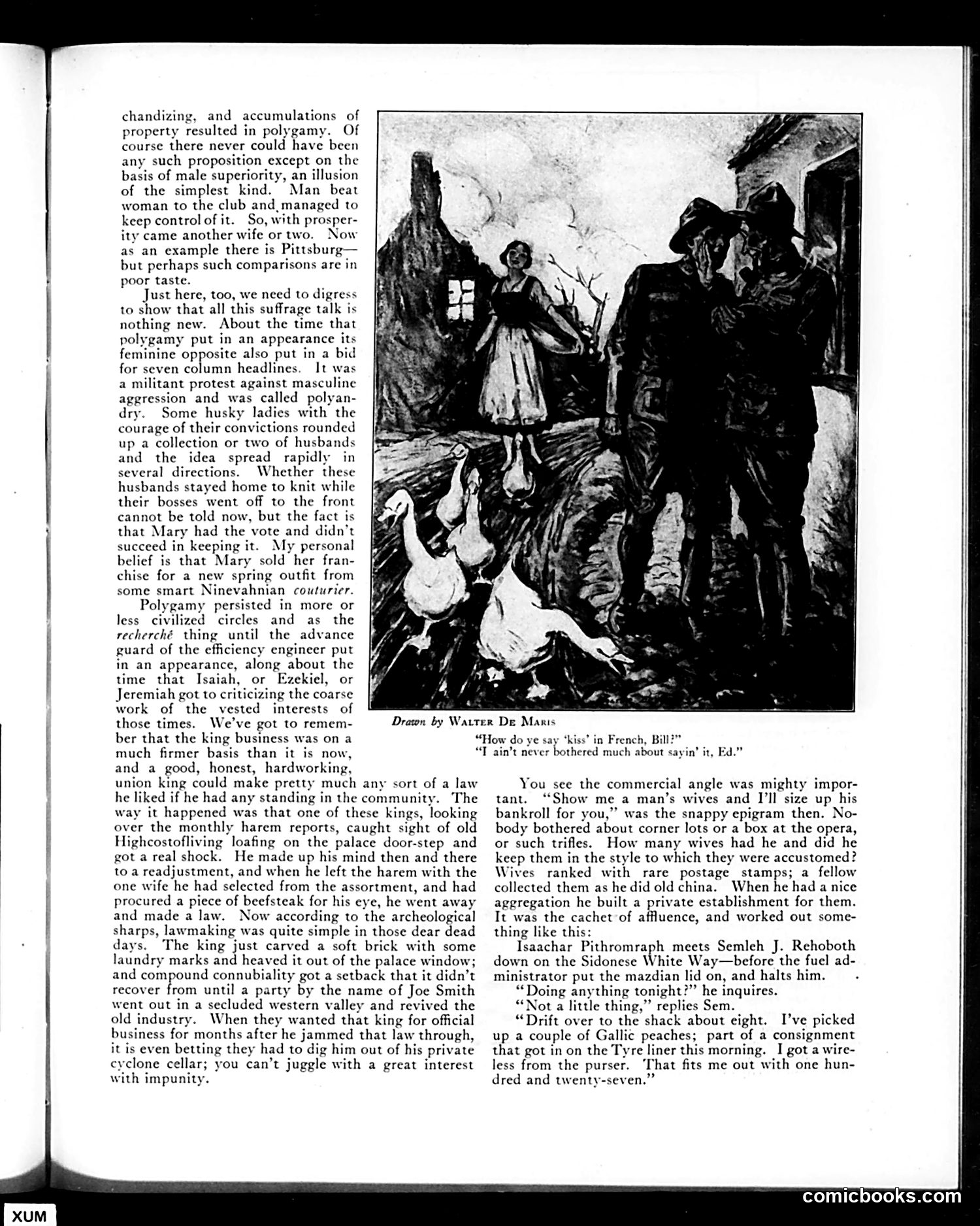
This Judge magazine page satirizes the economic basis of polygamy in ancient times. The accompanying Walter De Maris illustration depicts a Biblical-era domestic scene—a woman managing a household with multiple wives, visualizing the article's central argument. The text argues polygamy arose not from male lust but from **male economic control and property accumulation**. The satire draws historical parallels: just as polygamy emerged when prosperity allowed men to support multiple wives, a countermovement called "polyandry" (women taking multiple husbands) briefly appeared as suffrage protest—though the author dismissively suggests women abandoned voting rights for fashionable clothing. The humor targets both historical male superiority and contemporary feminism. The biblical references (Isaiah, Ezekiel, Jeremiah) frame this as ancient social engineering. The anecdote about a king eliminating his harem through law-carving ridicules how casually powerful men treated domestic arrangements. The dialogue snippet below suggests the feature continues with modern social commentary using biblical parallels as framework.
📄 Transcribed text from this page (OCR, searchable)
Machine-transcribed from the original scan — historical spelling and the odd misread are preserved.
; ; } f chandizing, and accumulations of property resulted in polygamy. Of course there never could have been y such proposition except on the of male superiority, an illusion of the simplest kind. Man beat woman to the club and, managed to keep control of it. So, with prosper- ity came another wife or two. Now as an example there is Pittsburg— but perhaps such comparisons are in poor taste. Just here, too, we need to digress to show that all this suffrage talk is nothing new. About the time that amy put in an appearance its feminine opposite also put in a bid for seven column headlines. It was a militant protest against masculine aggression and was called polyan- dry. Some husky ladies with the courage of their convictions rounded up a collection or two of husbands and the idea spread rapidly in several directions. Whether these husbands stayed home to knit while their bosses went off to the front cannot be told now, but the fact is that Mary had the vote and didn’t succeed in keeping it. My personal belief is that Mary sold her fran- chise for a new spring outfit from some smart Ninevahnian couturier. Polygamy persisted in more or less civilized circles and as the recherché thing until the advance guard of the efficiency engineer put in an appearance, along about the time that Isaiah, or Ezekiel, or Jeremiah got to criticizing the coarse work of the vested interests of those times. We've got to remem- ber that the king business was on a much firmer basis than it is now, and a good, honest, hardworking, union king could make pretty much any sort of a law he liked if he had any standing in the community. The way it happened was that one of these kings, looking over the monthly harem reports, caught sight of old Highcostofliving loafing on the palace door-step and got a real shock. He made up his mind then and there to a readjustment, and when he left the harem with the one wife he had selected from the assortment, and had procured a piece of beefsteak for his eye, he went away and made a law. Now according to the archeological sharps, lawmaking was quite simple in those dear dead days. The king just carved a soft brick with some laundry marks and heaved it out of the palace window; and compound connubiality got a setback that it didn’t recover from until a party by the name of Joe Smith went out in a secluded western valley and revived the old industry. When they wanted that king for official business for months after he jammed that law through, it is even betting they had to dig him out of his private cyclone cellar; you can’t juggle with a great interest with impunity. Drawn by Warter De Maris “How do ye say “T ain’t never bothered much about sayin’ it, Ed.” in French, Bill?” You see the commercial angle was mighty impor- tant. “Show me a man’s wives and I’ll size up his bankroll for you,” was the snappy epigram then. No- body bothered about corner lots or a box at the opera, or such trifles. How many wives had he and did he keep them in the style to which they were accustomed? Wives ranked with rare postage stamps; a fellow collected them as he did old china. When he had a nice aggregation he built a private establishment for them. It was the cachet of affluence, and worked out some- thing like this: Isaachar Pithromraph meets Semleh J. Rehoboth down on the Sidonese White Way—before the fuel ad- ministrator put the mazdian lid on, and halts him. * “Doing anything tonight?” he inquires. “Not a little thing,” replies Sem. “Drift over to the shack about eight. I’ve picked up a couple of Gallic peaches; part of a consignment that got in on the Tyre liner this morning. I got a wire- less from the purser. That fits me out with one hun- dred and twenty-seven.” comicbooks.com