
Judge, 1918-04-06 · page 13 of 36
Judge — April 6, 1918 — page 13: what you’re looking at
What you’re looking at
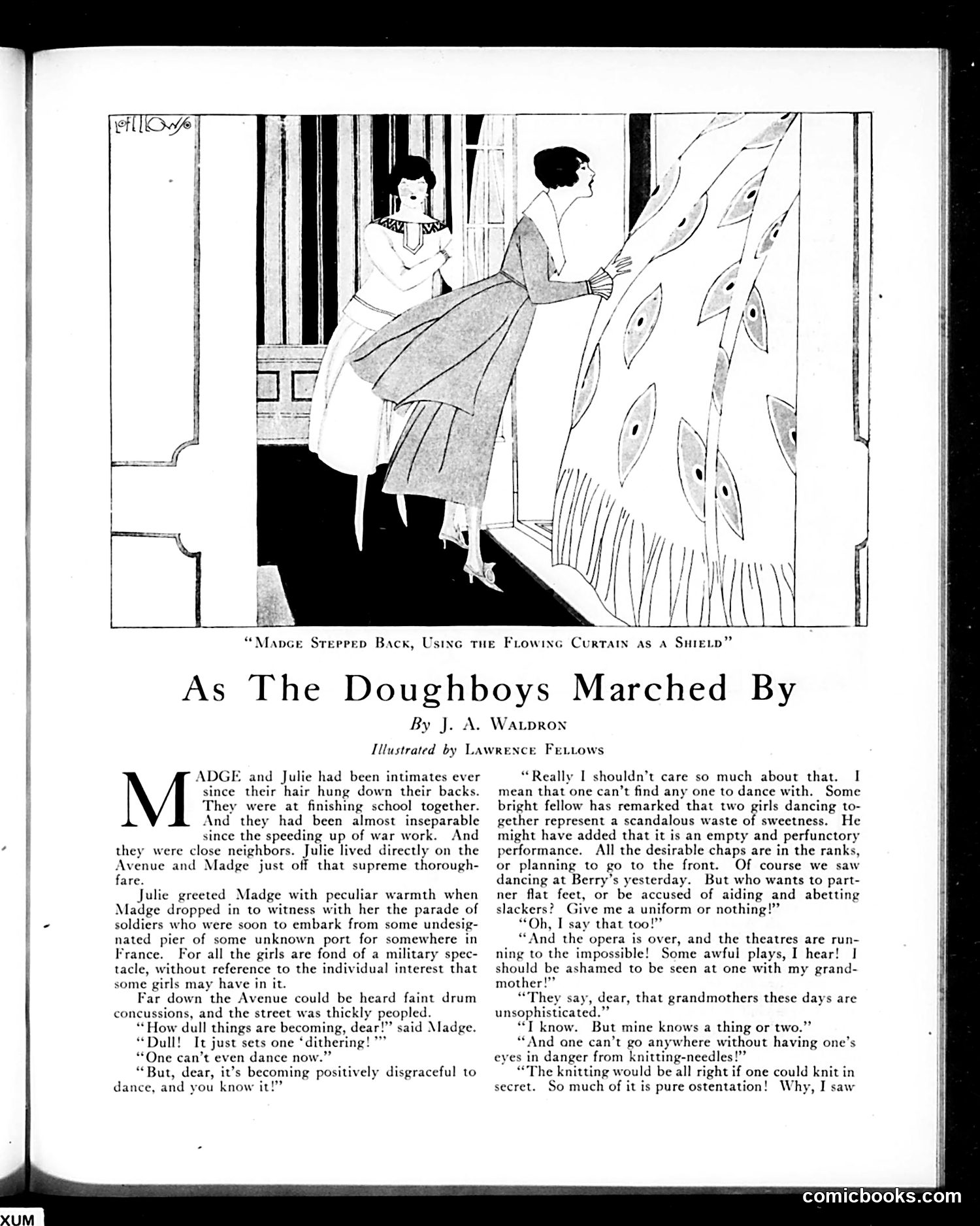
This is a humorous short story (not a political cartoon) satirizing upper-class women's complaints during World War I. Two wealthy female friends, Madge and Julie, complain about wartime restrictions: they can't dance because eligible men are deployed as soldiers ("doughboys"), attending social events has become unfashionable, and theaters offer only poor entertainment. The satire targets female vanity and frivolity during serious times. Their grievances—lacking dance partners, avoiding the appearance of supporting "slackers" (draft-dodgers), worrying about being seen with grandmothers—reveal shallow priorities. The illustration shows Madge using a decorative curtain as a shield, suggesting theatrical exaggeration of their concerns. The reference to "knitting-needles" mocks women's visible war-effort participation (knitting for soldiers), criticized as ostentatious performance rather than genuine patriotism. The story ridicules privileged women for treating wartime as primarily an inconvenience to their social calendar.
📄 Transcribed text from this page (OCR, searchable)
Machine-transcribed from the original scan — historical spelling and the odd misread are preserved.
“Mapce Sreprep Back, Usinc tue Frowinc Curtatn as a Suie.p” s The Doughboys Marched By By J. A. Watpron Illustrated by Lawrence Fettows ADGE and Julie had been intimates ever since their hair hung down their backs. They were at finishing school together. And they had been almost inseparable since the speeding up of war work. And they were close neighbors. Julie lived directly on the Avenue and Madge just off that supreme thorough- fare. Julie greeted Madge with peculiar Madge dropped in to witness with her soldiers who were soon to embark from nated pier of some unknown port for somewhere in France. For all the girls are fond of a military spec- tacle, without reference to the individual interest that some girls may have in it. Far down the Avenue could be heard faint drum concussions, and the street was thickly peopled. “How dull things are becoming, dear!”’ said Madge. “Dull! It just sets one ‘dithering! ’” “One can’t even dance now.” “But, dear, it’s becoming positively disgraceful to dance, and you know it!” warmth when the parade of some undesig- “Really I shouldn’t care so much about that. I mean that one can’t find any one to dance with. Some bright fellow has remarked that two girls dancing to- gether represent a scandalous waste of sweetness. He might have added that it is an empty and perfunctory performance. All the desirable chaps are in the ranks, or planning to go to the front. Of course we saw dancing at Berry’s yesterday. But who wants to part- ner flat feet, or be accused of aiding and abetting slackers? Give me a uniform or nothing!” “Oh, I say that too!” “And the opera is over, and the theatres are run- ning to the impossible! Some awful plays, I hear! | should be ashamed to be seen at one with my grand- mother! “They say, dear, that grandmothers these days are unsophisticated.” “T know. But mine knows a thing or two.” “And ane can’t go anywhere without having one’s in danger from knitting-needles!” “The knitting would be all right if one could knit in secret. So much of it is pure ostentation! Why, I saw ey comicbooks.com