
A complete issue · 32 pages · 1917
Judge — May 19, 1917
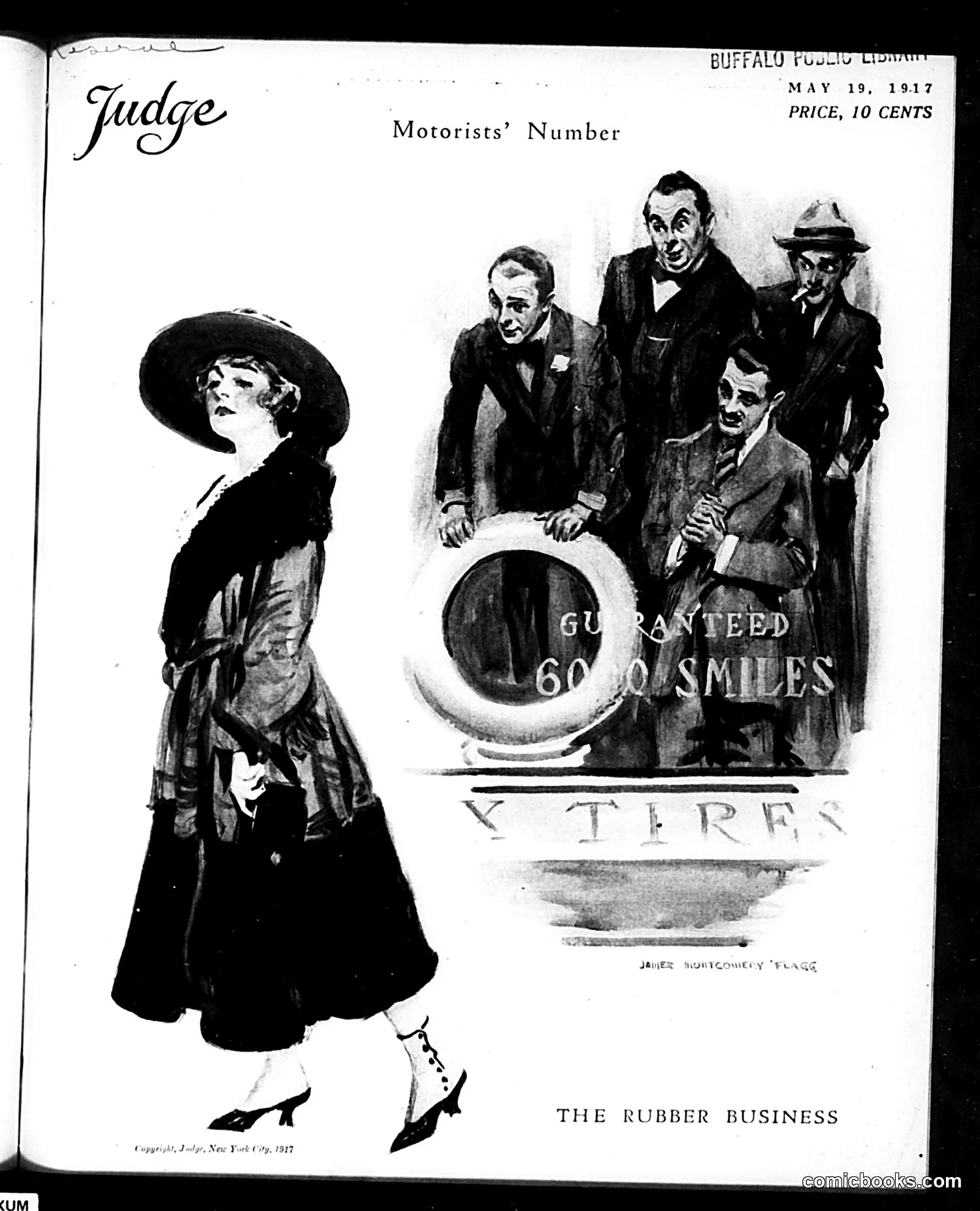
This satirical cartoon critiques tire/rubber company sales practices during World War I. On the left, a well-dressed woman appears uncertain or skeptical. On the right, five male salesmen surround a large tire marked "GUARANTEED 60,000 SMILES," employing aggressive sales tactics—their exaggerated expressions suggest deceitful manipulation. The cartoon mocks the disconnect between manufacturers' inflated promises and actual product quality. The "60,000 smiles" slogan is presented ironically, implying such guarantees are absurd. The woman's hesitant posture contrasts with the salesmen's aggressive pitch, suggesting consumers were vulnerable to high-pressure tactics and false advertising during this period. This reflects broader wartime concerns about price-gouging and profiteering in essential industries like rubber manufacturing.
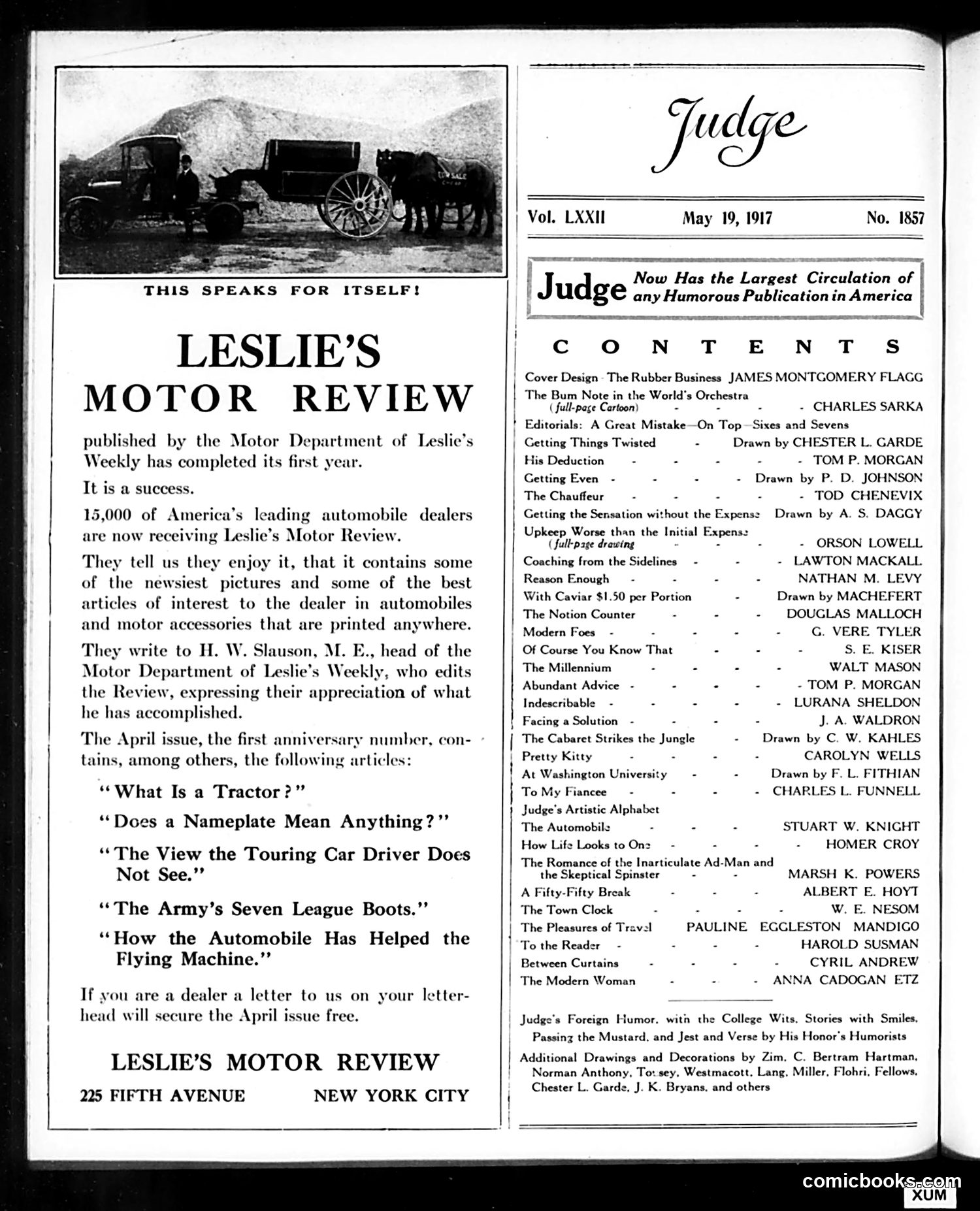
This page is primarily a **paid advertisement** for Leslie's Motor Review, a trade publication launched by Leslie's Weekly magazine one year prior (around 1916). The left side features a photograph of early automobiles and horses with the tagline "THIS SPEAKS FOR ITSELF!" promoting the review's success: 15,000 automobile dealers now receive it. The ad emphasizes the publication contains valuable industry articles and technical content. The right side lists the magazine's **table of contents** for the May 19, 1917 issue—humorous pieces like "What Is a Tractor?" and "Does a Nameplate Mean Anything?"—establishing Judge's identity as a satirical publication. This is **commercial content rather than political satire**, documenting the early automotive industry's growth in America during World War I.
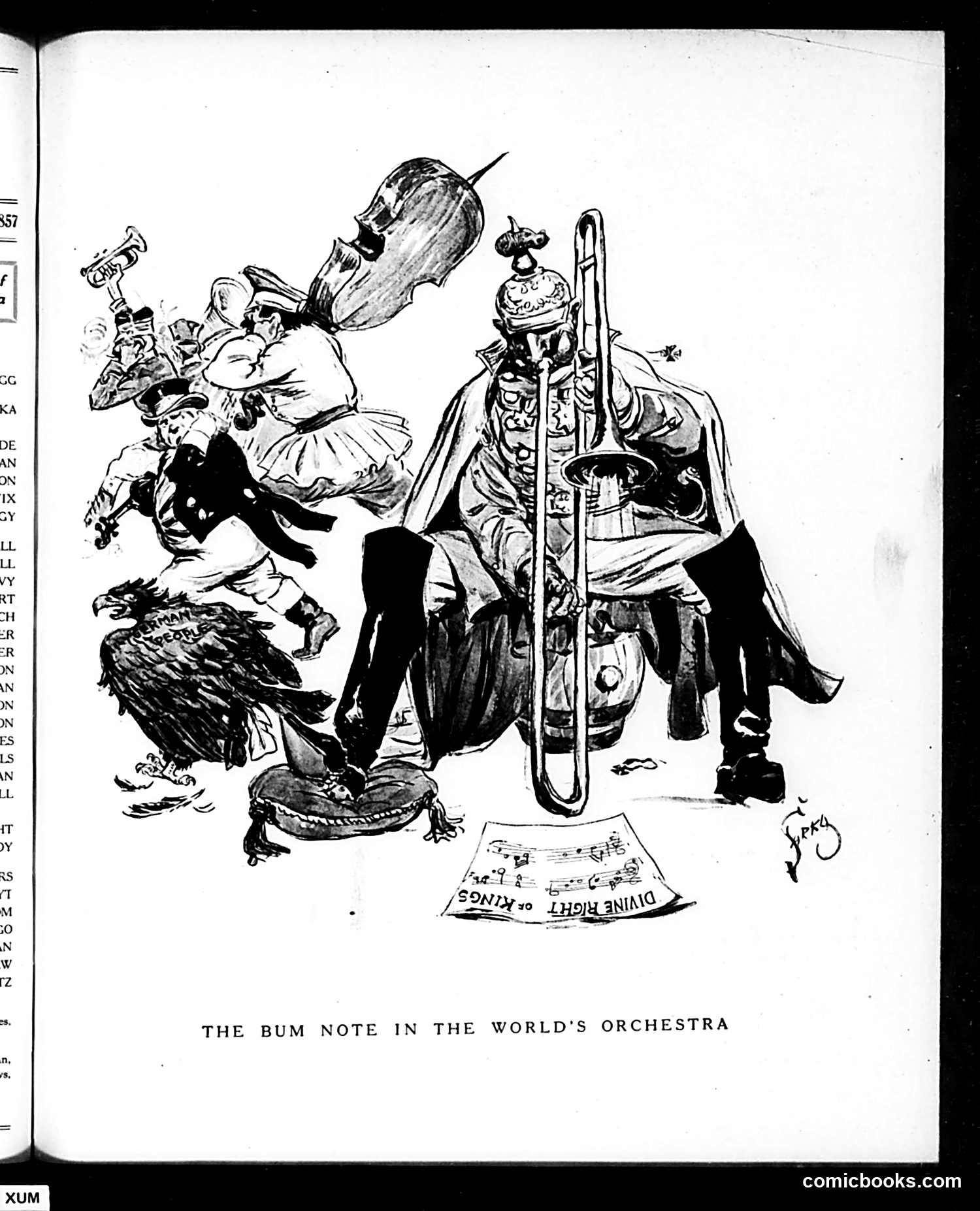
This satirical cartoon depicts a military conductor (likely a German or Central Powers general, given the ornate uniform and spiked helmet) attempting to lead an orchestra. However, a disheveled vagrant or "bum" character disrupts the performance by playing a discordant trombone, creating chaos among the musicians. The satire appears to criticize military leadership during wartime—suggesting that despite attempts at organized, coordinated warfare ("the world's orchestra"), disruptive forces (represented by the vagrant/bum) undermine the effort. The sheet music reads "Danube [?] Sonata," possibly referencing Eastern European conflicts. Published in *Judge*, a pro-Allied satirical magazine, this likely mocks Central Powers military incompetence or the destabilizing effects of war itself on international order.
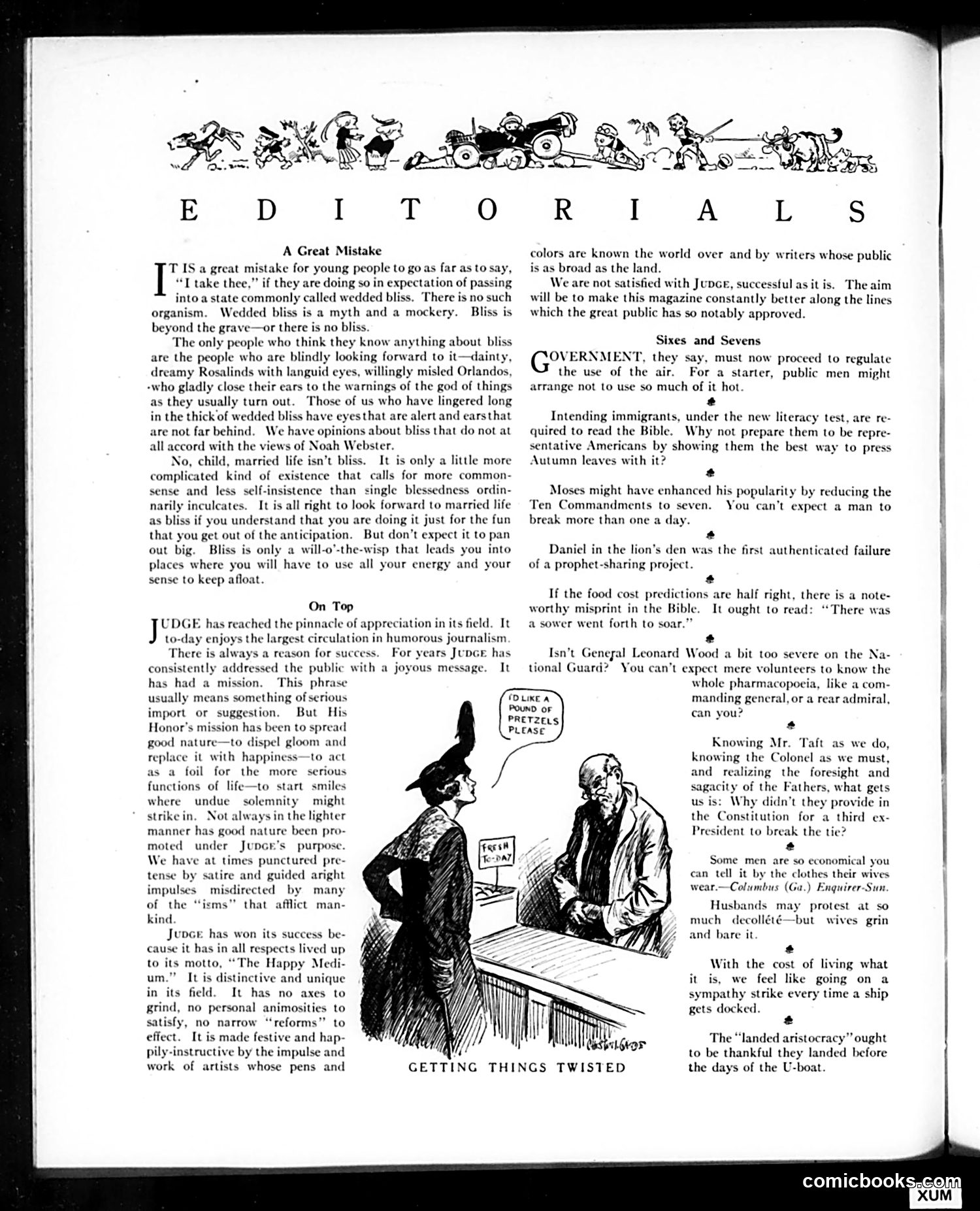
This cartoon satirizes bureaucratic confusion and miscommunication. The sketch shows two figures at a desk: one appears to be an official or authority figure reading a document labeled "POUND OF PRETZELS PLEASE," while the other figure (possibly a vendor or citizen) holds a sign reading "TWIST & DAY." The humor derives from things being "twisted"—both literally (pretzels are twisted food) and figuratively (messages getting garbled in government dealings). The cartoon critiques how simple requests become complicated when filtered through bureaucratic processes, with officials misinterpreting or confusing straightforward citizen requests. This reflects early 20th-century American frustration with growing government red tape and administrative inefficiency.
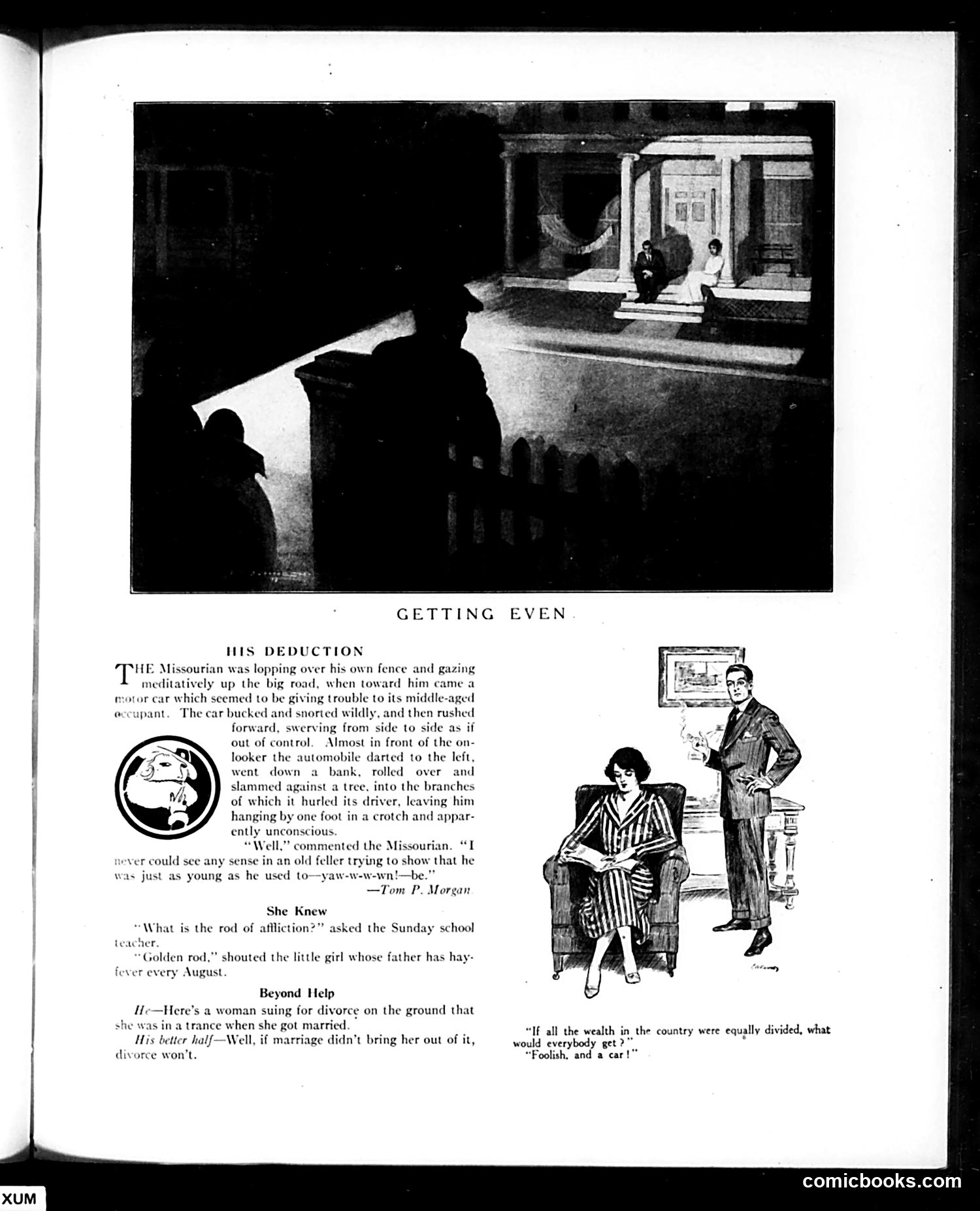
This page contains three separate humor pieces satirizing social issues of the era: 1. **"Getting Even"** (top photo-story): Shows a man injured after a car accident, mocking the "middle-aged occupant" who lost control. The joke attributes the accident to the driver's attempts to appear young—the Missourian's comment suggests vanity caused the crash. 2. **"She Knew"** (middle): A Sunday school joke where a child answers "golden rod" to the teacher's question about "the rod of affliction," likely referencing a wealthy father's annual August fever/absence—satirizing wealthy fathers' escape behaviors. 3. **"Beyond Help"** (bottom): A divorce joke mocking a woman who married hoping to improve her situation; the punchline suggests marriage couldn't help, so divorce won't either. These reflect early 20th-century social commentary on wealth, vanity, and marriage dissolution.
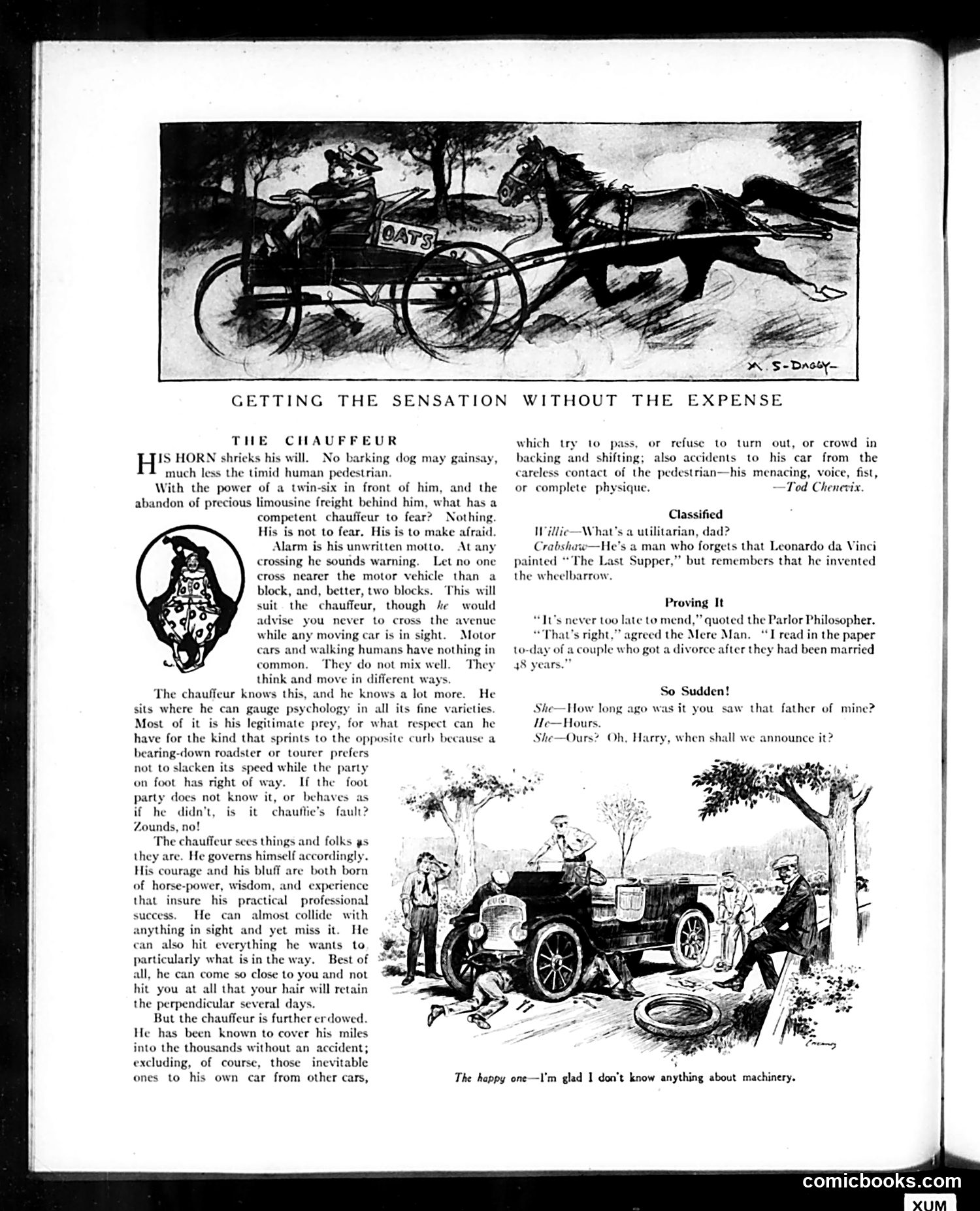
This Judge magazine page satirizes early-1900s automobile culture through contrasting scenarios. **Top cartoon**: A horse-drawn cart labeled "OATS" outruns a speeding automobile. The satire suggests that despite cars' expense and complexity, they don't necessarily outperform traditional horse transport—you get the "sensation" (excitement/speed) of modern motoring without the practical advantage. **"The Chauffeur" article**: Mocks professional automobile drivers, describing their arrogance and psychology. The text suggests chauffeurs are pretentious—they claim expertise while actually being reckless with pedestrians and other vehicles. **Bottom cartoon**: Shows a broken-down car surrounded by mechanics struggling with repairs, captioned "I'm glad I don't know anything about machinery." This mocks the unreliability and complexity of early automobiles, suggesting ignorance is preferable to owning such troublesome machines.
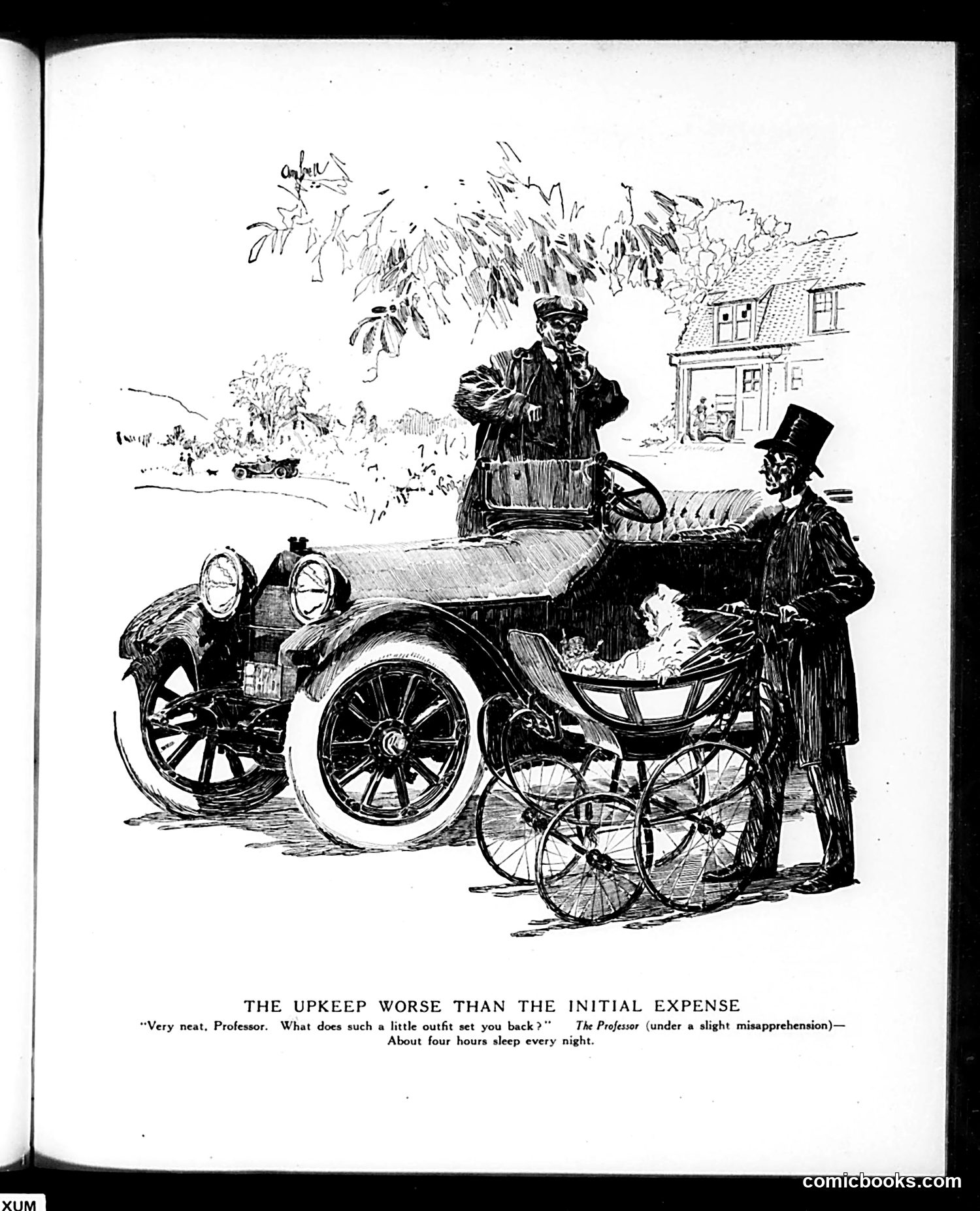
This satirical cartoon mocks the hidden costs of early automobile ownership. A well-dressed man (labeled "The Professor") admires another gentleman's car and baby carriage, asking what the "outfit" costs. The Professor misunderstands, thinking he's being asked about purchase price. The joke's punchline—"About four hours sleep every night"—reveals the real point: owning an automobile requires constant maintenance and worry, causing the owner chronic sleep loss. The juxtaposition of a fancy motorcar with a baby carriage suggests both represent significant ongoing expenses and responsibilities. This reflects early 1900s attitudes toward automobiles as luxury items with substantial upkeep demands, before cars became commonplace. The humor targets the gap between purchase enthusiasm and ownership reality.
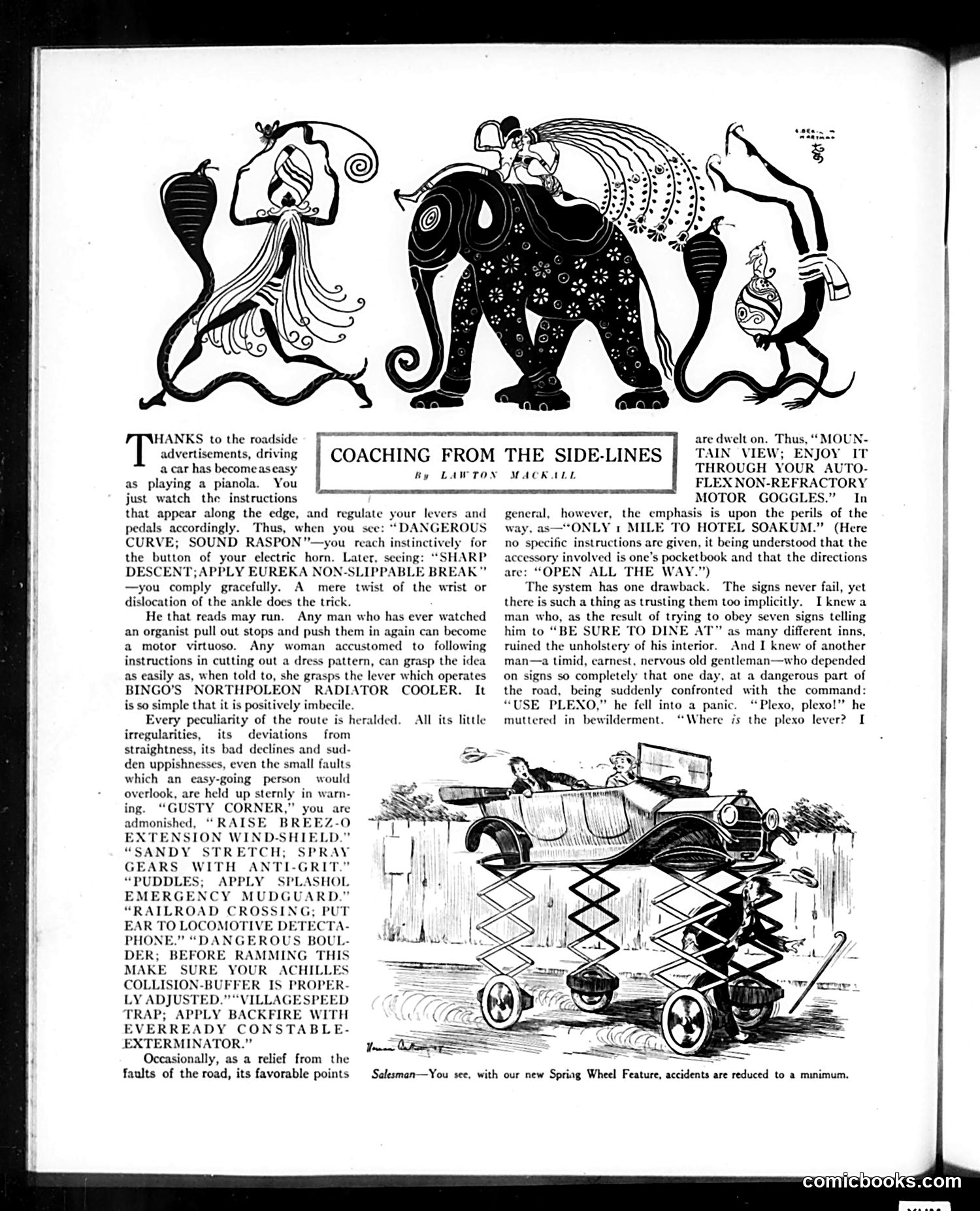
This article satirizes the proliferation of roadside advertising signs that instruct drivers on how to operate their automobiles. The author, Lawton Mackall, compares learning to drive via these signs to playing a player piano—both require passive compliance with external instructions rather than skill. The satire targets how exhaustively signs dictate even trivial actions (twist wrist, push button), treating drivers as incapable of independent judgment. Mackall illustrates the absurdity through invented command signs like "DANGEROUS CURVE," "SOUND RASPON," and "USE PLEXO" (a made-up product). The humor peaks in anecdotes about drivers who over-trusted signs: one man followed contradictory hotel directions and ruined his car's interior; another panicked searching for a non-existent "plexo lever." The accompanying illustration shows a car accident resulting from this over-reliance on roadside instructions—the cartoon's punchline supporting the text's critique of automotive advertising culture in the early 20th century.
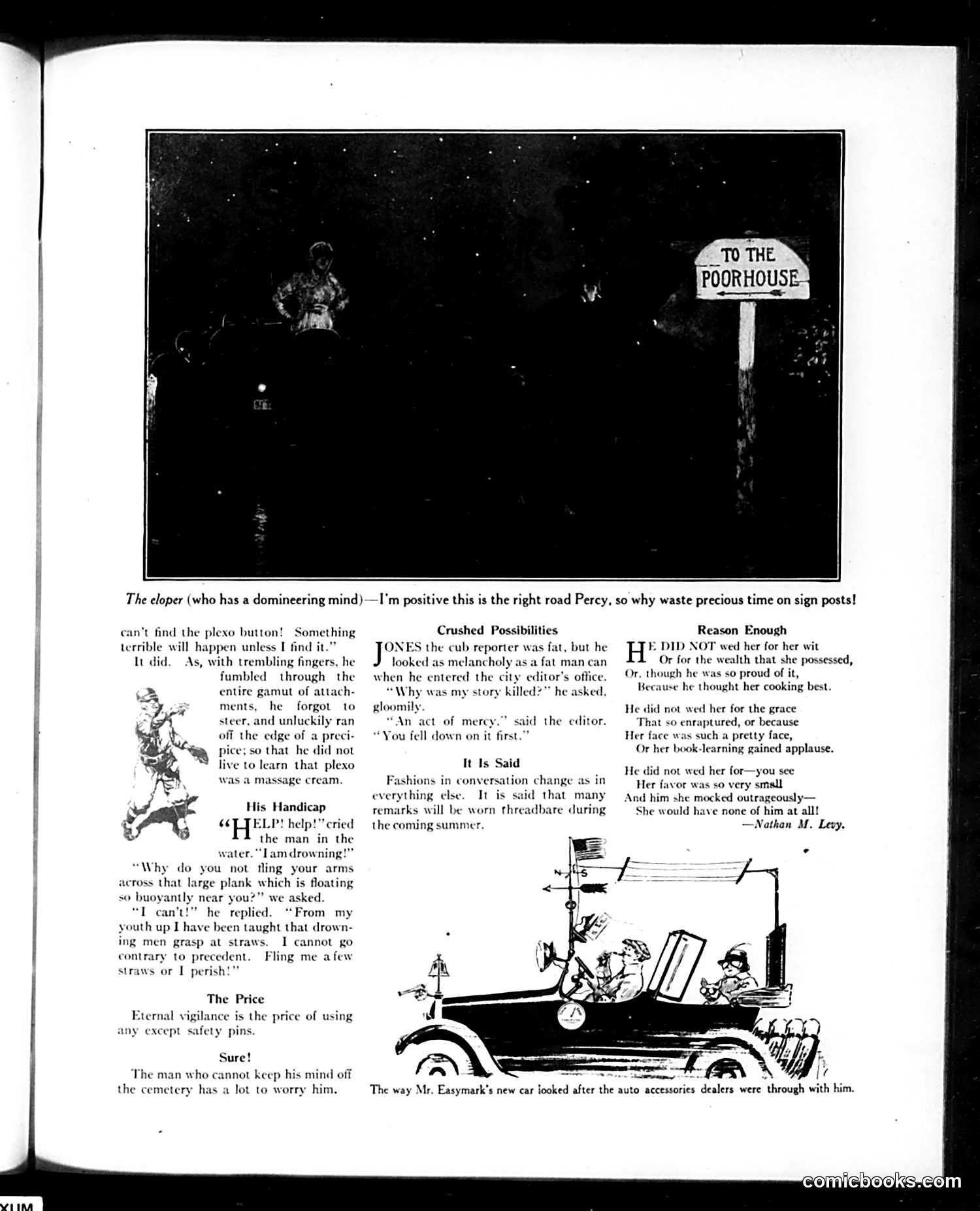
This page contains multiple short humorous pieces typical of Judge's satirical style: **Top cartoon:** Shows a couple in a car near a "To the Poorhouse" sign. The joke satirizes stubborn overconfidence—the man ignores directional signs, insisting he knows the way, leading them toward financial ruin (the poorhouse). **Short comedic pieces below** include: - "His Handicap": A drowning man won't grab a plank because tradition teaches drowning men "grasp at straws"—he's paralyzed by precedent - "Crushed Possibilities": A fat cub reporter's story was killed because he "fell down on it first"—wordplay on his weight - "It Is Said": Brief observation that conversation fashions change seasonally - "Reason Enough": A poem explaining why a man married—she rejected him so thoroughly he had no choice The page satirizes human foolishness: stubbornness, rigid adherence to tradition, incompetence, and absurd logic. The humor relies on wordplay, irony, and exaggerated scenarios typical of early 20th-century American comic magazines.
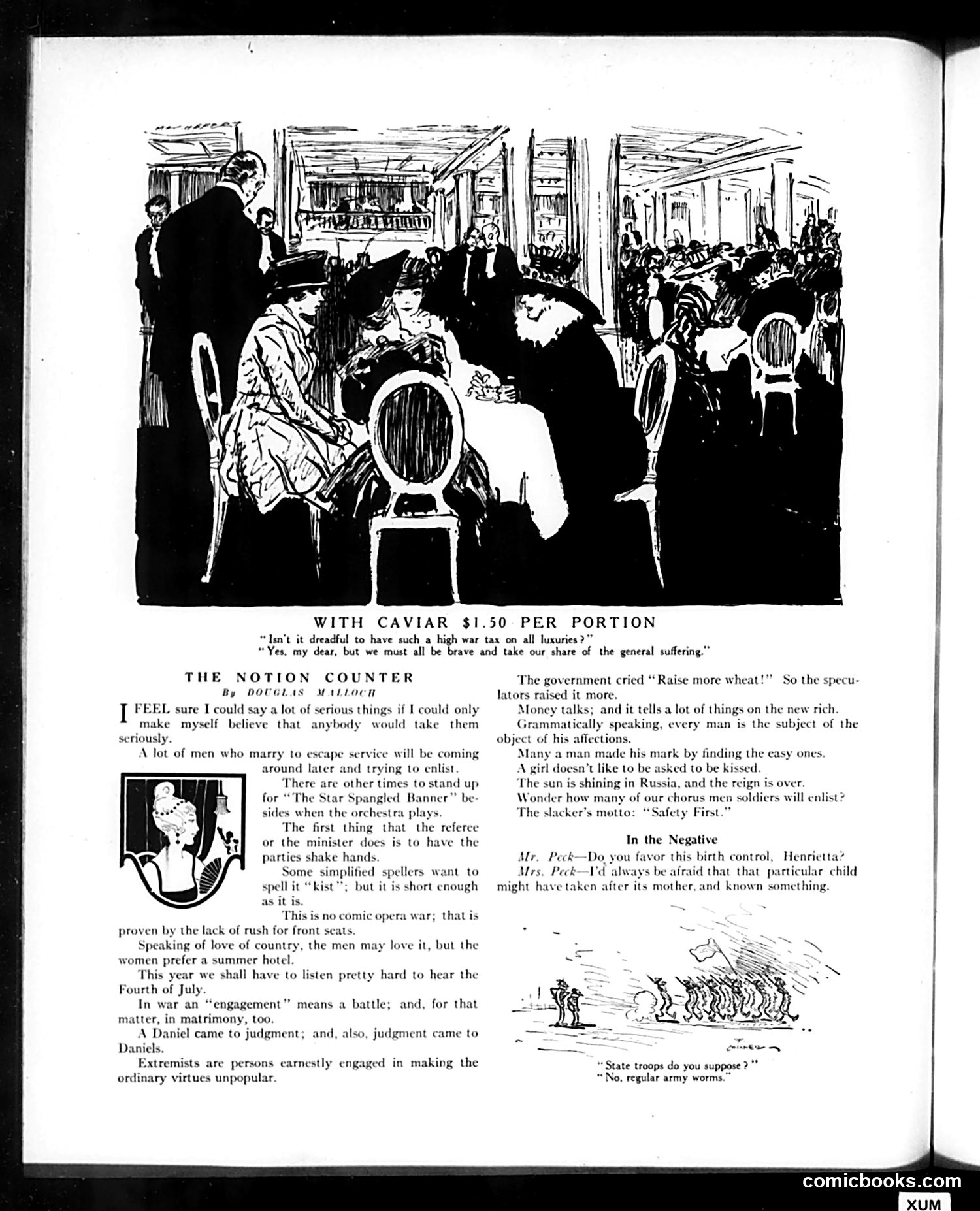
This Judge magazine page satirizes American home-front attitudes during World War I. **Top cartoon**: The main illustration mocks wealthy society women dining at an upscale restaurant, complaining about war taxes on luxuries like caviar ($1.50 per portion) while claiming to "share the general suffering"—obvious hypocrisy, as ordinary citizens faced genuine hardship. **"The Notion Counter" column** by Douglas Milloch contains brief social commentary exploiting wartime themes: draft-dodgers pretending patriotism, food speculation (the government demanding increased wheat production while speculators profit), and questions about military enlistment of chorus performers. **"In the Negative" dialogue** jokes about birth control fears—a contemporary social controversy. The **bottom cartoon** appears to reference military recruitment or troop matters, though the text is unclear. The overall point: American elites ignore genuine wartime sacrifice while pursuing self-interest, embodying the gap between patriotic rhetoric and actual conduct.
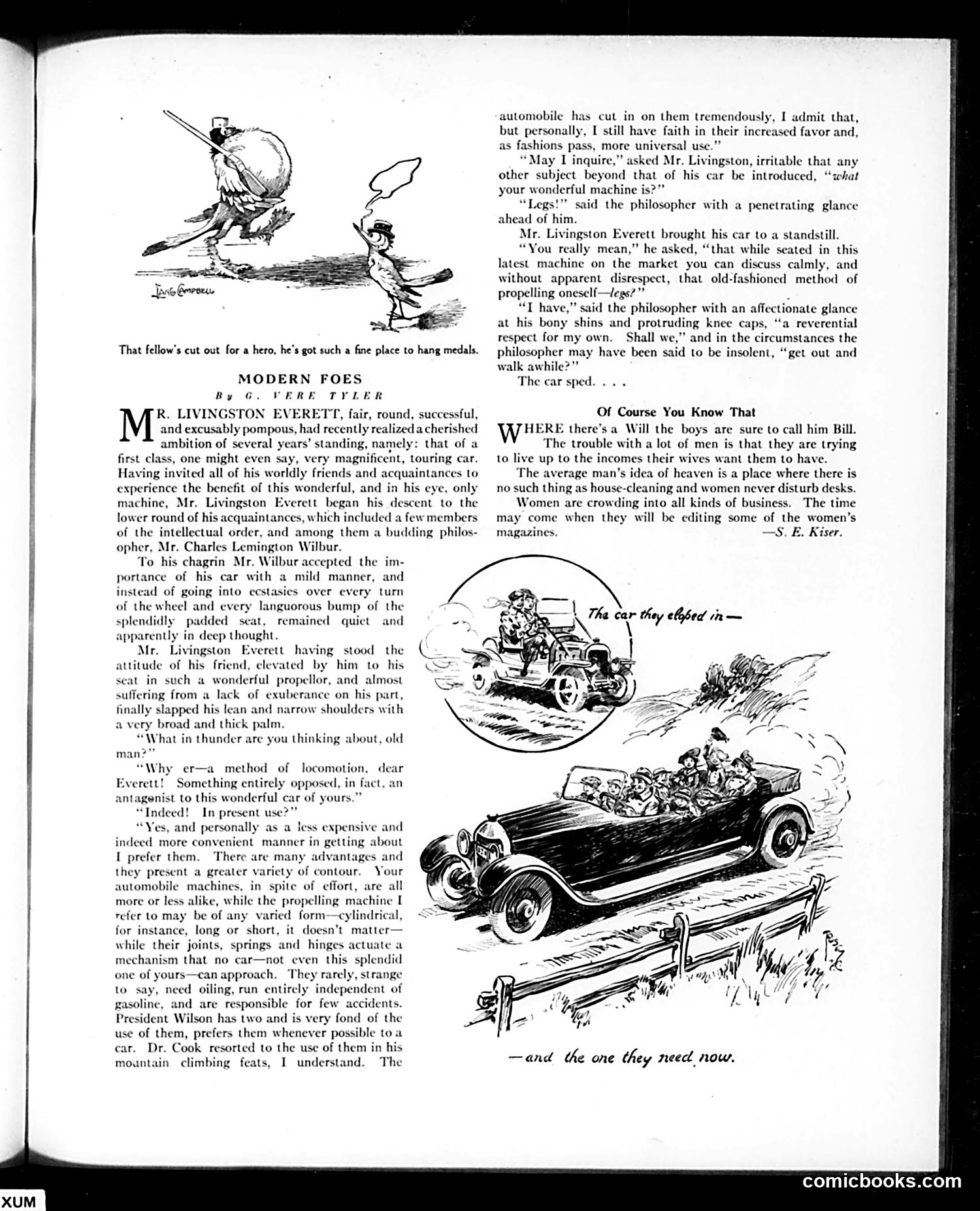
This satirical story mocks the pretentious new automobile culture of the early 20th century. Mr. Livingston Everett, a successful but pompous man, proudly shows off his expensive touring car to his acquaintances—including a philosopher, Charles Lemington Wilbur. The joke: When Wilbur remains unimpressed and instead praises his preferred method of locomotion, Everett demands to know what it is. Wilbur's answer—"Legs!"—delivers the satire's point. The philosopher argues that walking offers advantages cars cannot match: variety, durability, independence from gasoline, and fewer accidents. He even notes President Wilson and Dr. Cook prefer them. The cartoon attacks automobile snobbery and consumerism, suggesting that wealthy people's obsession with machines blinds them to simpler, superior alternatives. The philosopher's calm insistence on walking's dignity—even invoking famous figures—mocks those who mistake expensive possessions for superiority.
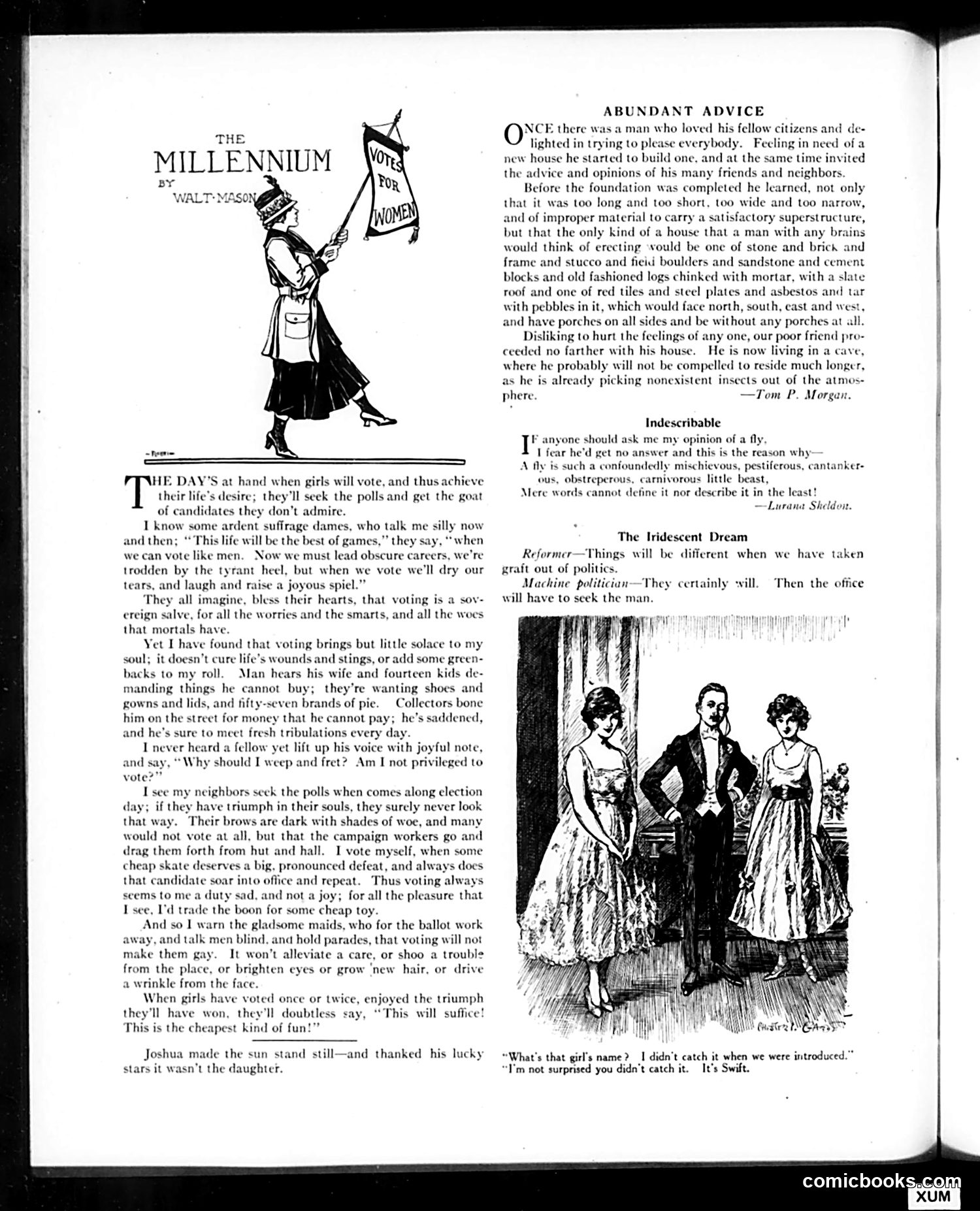
This page from the satirical magazine *Judge* satirizes women's suffrage through multiple pieces: **"The Millennium"** (main left column): A cynical essay mocking women's voting rights advocates. The unnamed author argues voting won't solve real problems—wives still demand shoes and pie, debt collectors still hound people, and voting brings no actual joy. He warns "gladsome maids" working for the ballot that voting won't improve their lives or appearance. The bitter conclusion: women will find voting "the cheapest kind of fun" and abandon it. **Illustration (top left)**: Shows a woman triumphantly holding a "Votes for Women" banner—a direct visual reference to the suffrage movement. **"Abundant Advice"** and other shorter pieces appear to be unrelated satirical content about unsolicited opinions and indescribable subjects. The page's core message: women's suffrage is overrated and won't materially improve women's circumstances. This reflects anti-suffrage sentiment common in early 20th-century satirical publications.
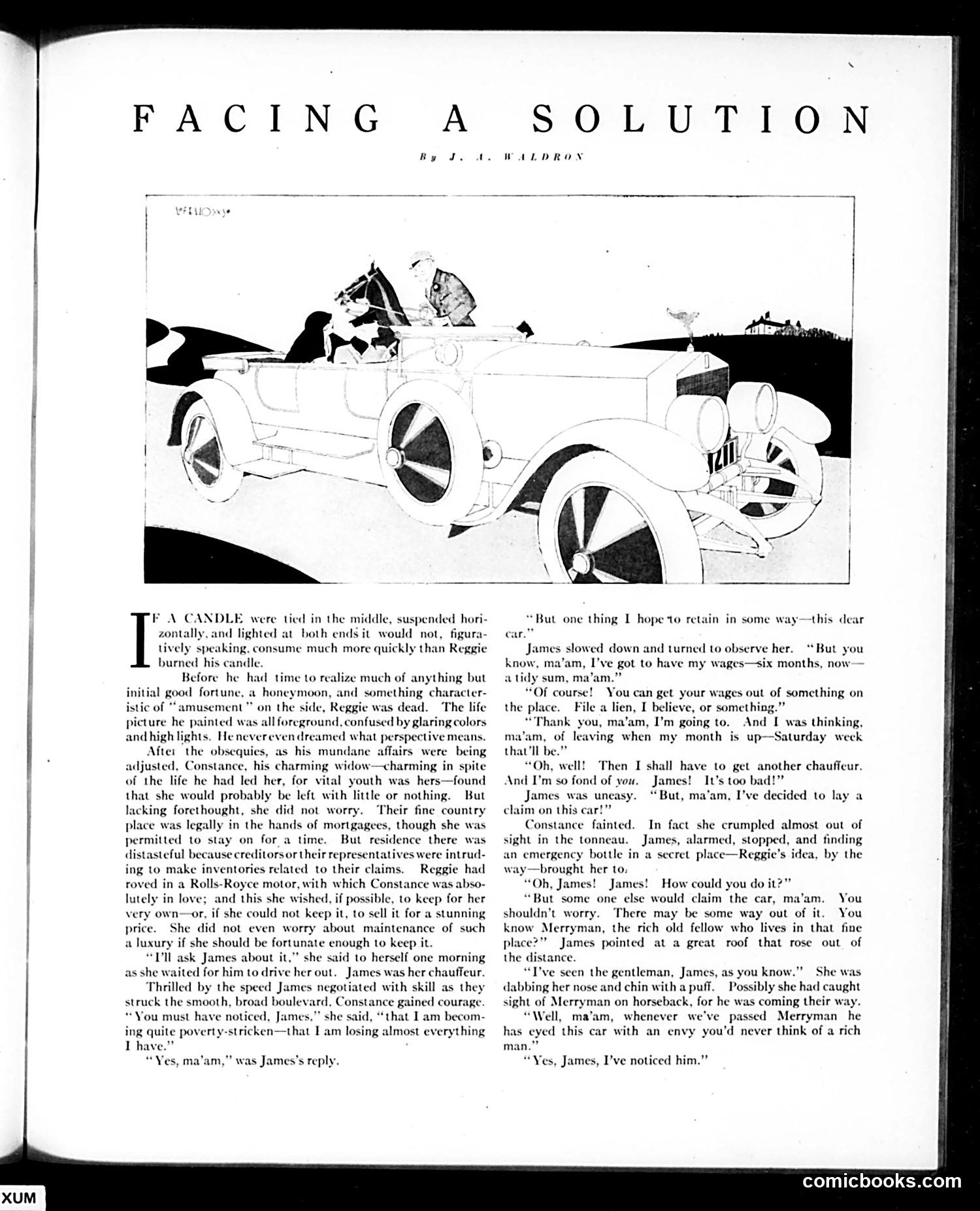
This story-cartoon satirizes post-WWI wealth anxieties and class dynamics. Reggie, a wealthy but reckless man, dies young, leaving his widow Constance nearly destitute despite their formerly luxurious lifestyle—mortgaged estate, no liquid assets. Her sole attachment is a Rolls-Royce motorcar. When her loyal chauffeur James announces he must leave to recover unpaid wages and plans to file a legal claim against the car, Constance faces losing her last symbol of status. James, however, suggests a solution: wealthy neighbor Merryman has shown obvious envy of the vehicle. The implication is that Constance should seduce or manipulate Merryman into purchasing (or providing for) the car—trading on her charm and femininity to solve her financial crisis. The satire targets both the frivolous wealthy and the desperation of those fallen from privilege, while the "solution" reflects period attitudes about women's limited economic options.
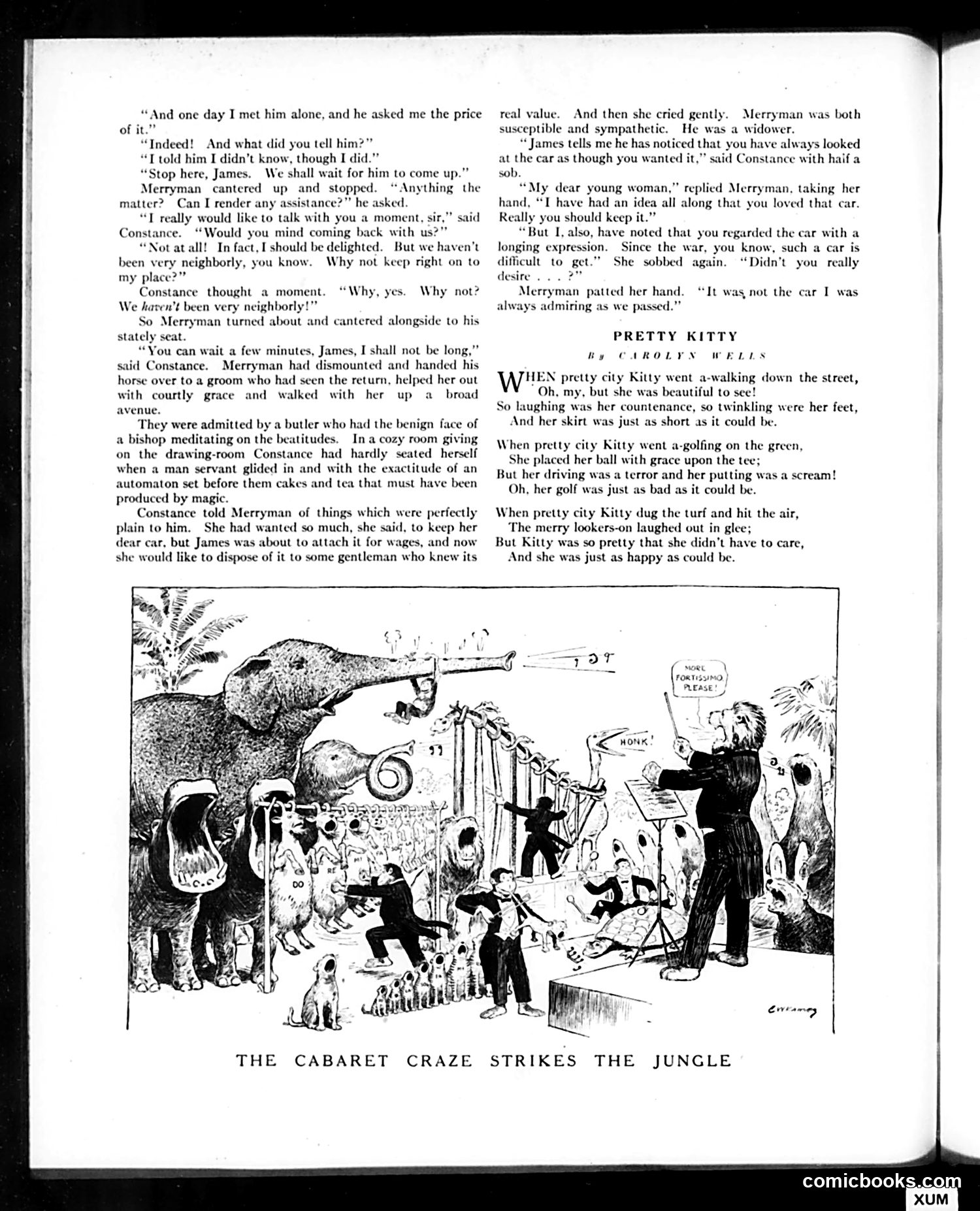
This page contains two unrelated pieces from *Judge* magazine: **Upper section:** A prose story about a woman (Constance) negotiating to sell her automobile to a man (Merryman) during what appears to be post-WWI economic hardship. She manipulates his sympathies by crying and claiming financial desperation, implying she's actually attracted to *him* rather than concerned about the car's sale. It's a romantic comedy playing on social conventions and emotional manipulation. **"Pretty Kitty" poem:** Light satirical verse mocking a fashionable young woman who is physically attractive but athletically incompetent at golf—yet doesn't care because her beauty excuses poor performance. The satire targets both 1920s flapper culture and the idea that attractive women face no social consequences for incompetence. **Bottom cartoon:** "The Cabaret Craze Strikes the Jungle" depicts jungle animals performing in a cabaret setting—likely satirizing the Jazz Age's "primitivism" fad, where Western entertainment exoticized African and non-Western cultures as entertainment.
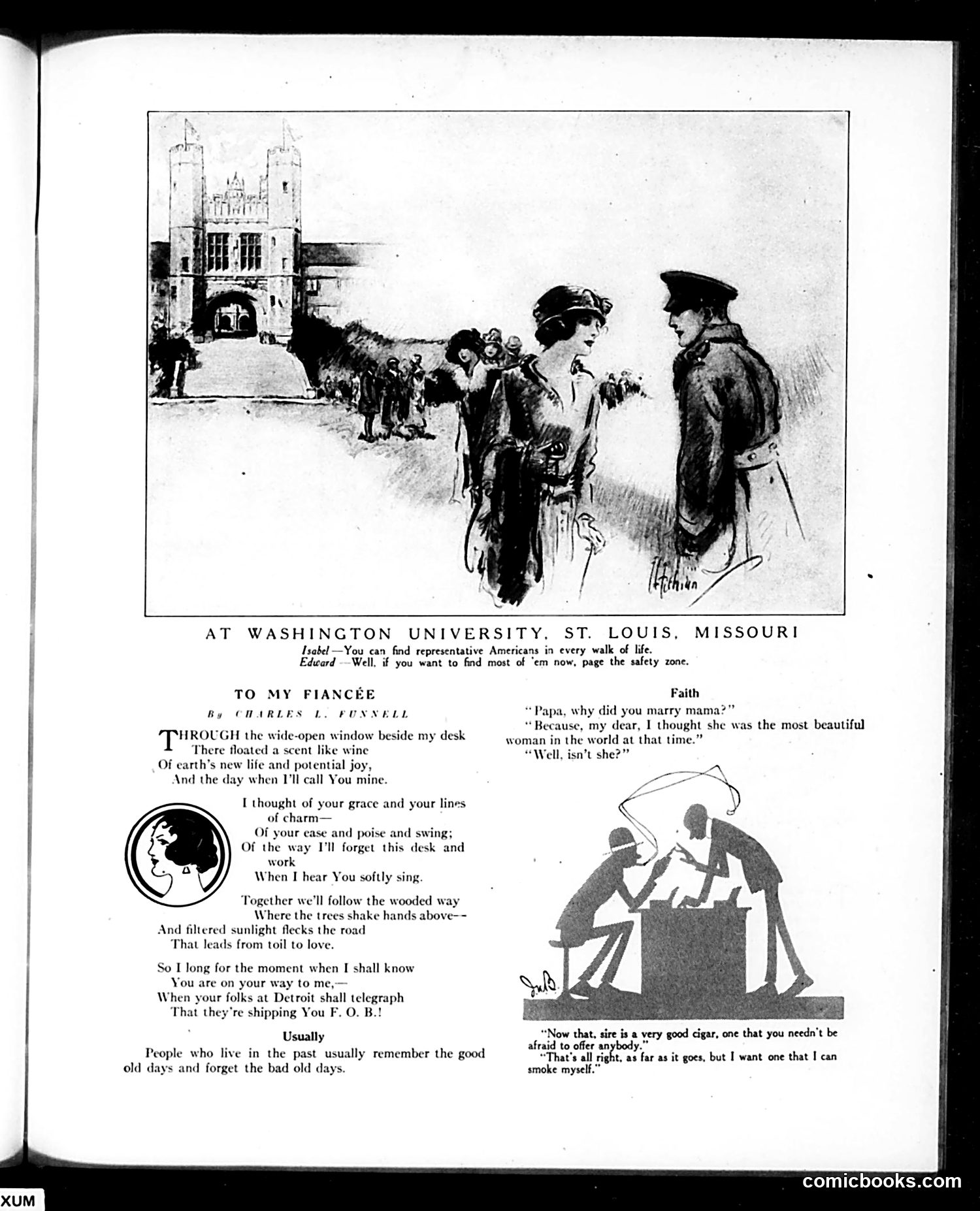
This page contains three distinct pieces of early 20th-century American humor: **Top cartoon:** A "safety zone" joke. Isabel and Edward discuss finding representative Americans at Washington University. Edward's quip suggests most Americans are currently in "safety zones"—likely referring to pedestrian safety zones marked on city streets, implying Americans are preoccupied with traffic dangers or urban life's hazards. **Poem "To My Fiancée":** Charles L. Funnell's sentimental verse about longing for his beloved, with a humorous final stanza: he'll know she's coming when "your folks at Detroit shall telegraph / That they're shipping You F.O.B."—a joking reference to shipping her like freight (F.O.B. = "Free On Board," a commercial shipping term). **Bottom cartoons:** Two brief jokes about cigars and marriage, playing on conventional domestic humor and gender dynamics typical of the era. The page reflects Judge's blend of satirical social commentary, romantic sentiment, and light domestic comedy aimed at middle-class readers.
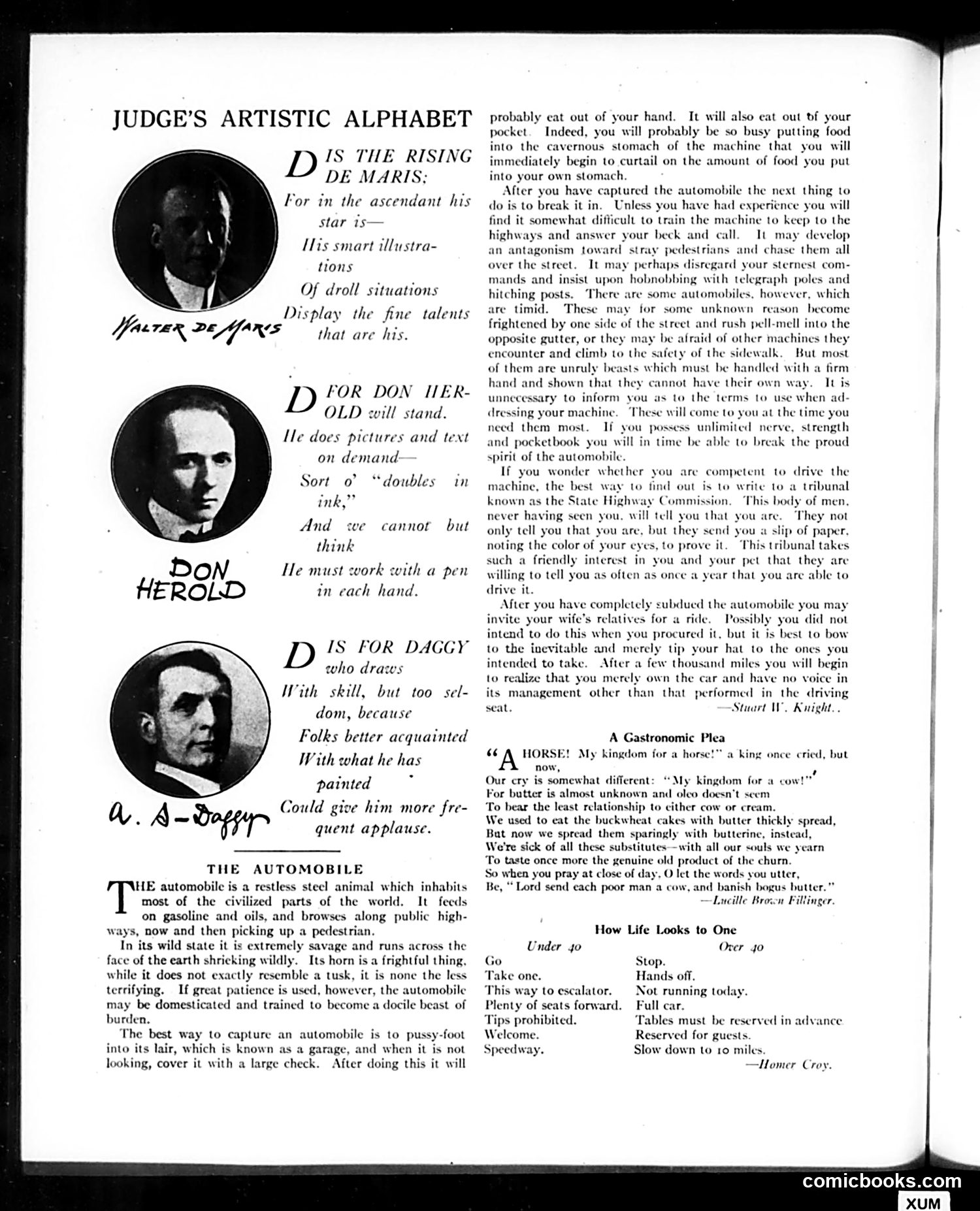
This page from *Judge* magazine features two main sections: **"Judge's Artistic Alphabet"** celebrates three illustrators: Walter de Maris, Don Herold, and A.B. Frost ("Daggy"), praising their work in the magazine—their comic illustrations and text pieces. **"The Automobile"** is satirical commentary on the then-novel automobile as a wild, dangerous animal requiring "training" and "domestication." The humor lies in treating cars like untamed beasts: they're savage, unpredictable, eat money ("your pocket"), ignore commands, chase pedestrians, and crash into telegraph poles. The piece mocks early drivers' poor control and the chaos automobiles caused in cities. The author suggests obtaining a driver's license involves a bureaucratic joke—authorities judge you competent without meeting you, merely noting eye color. Finally, he warns that once you own a car, you lose agency over it (and your wife's relatives invite themselves for rides). The satire reflects early-20th-century anxieties about automobiles as dangerous, expensive nuisances disrupting urban life.
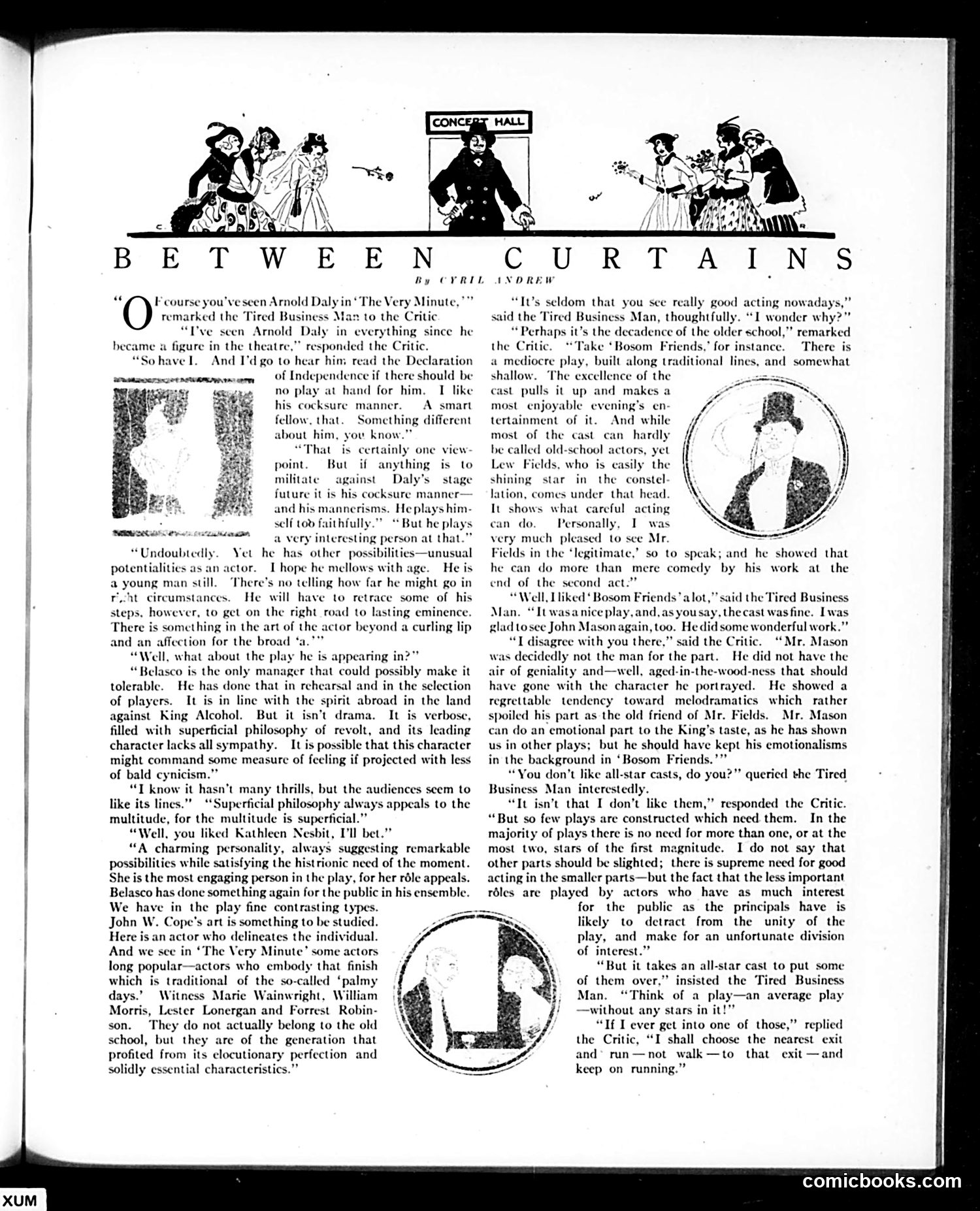
This is a theatrical criticism column by Cyril Andrews featuring a dialogue between a "Tired Business Man" and a "Critic" discussing contemporary Broadway productions. **Key figures discussed:** - **Arnold Daly**: An actor praised for his "cocksure manner" but criticized for self-indulgent mannerisms that may harm his career - **Lew Fields**: Commended for skillful acting in "Bosom Friends," demonstrating that serious performance exceeds comedy work - **John Mason**: Referenced as a returning performer - **David Belasco**: The producer/manager credited with making mediocre plays tolerable through direction and casting **The satire's point:** The dialogue contrasts two theatrical philosophies—the Critic's sophisticated aesthetic standards versus the Businessman's simpler entertainment tastes. The Critic argues modern acting lacks depth, attributing this to the "decadence of the older school." The piece mocks both pretentious criticism and unsophisticated audiences while examining whether contemporary theater (around 1910) maintains artistic standards of earlier generations.
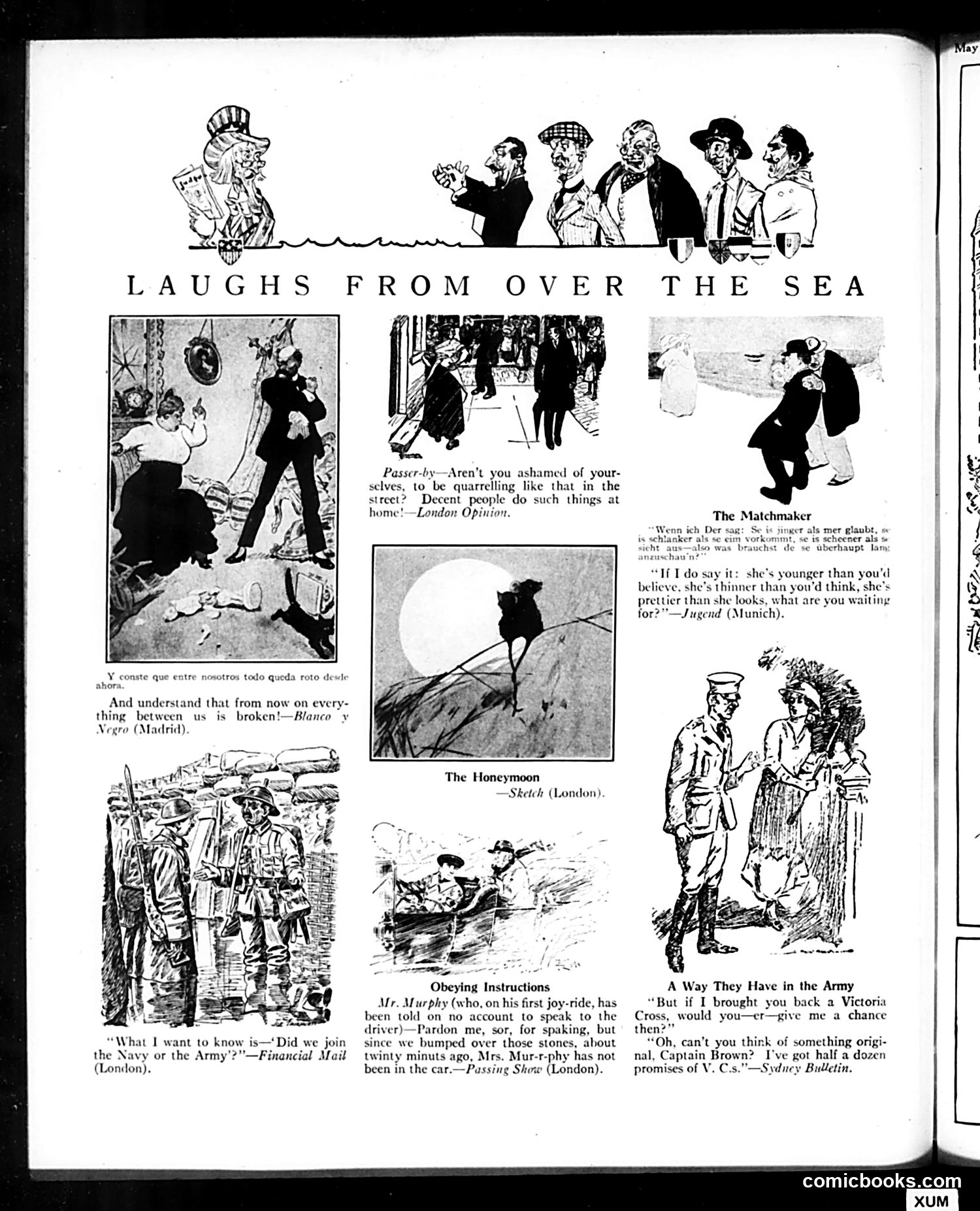
This page collects humorous cartoons and jokes sourced from international publications (London Opinion, Madrid's Blanco y Negro, Sketch, Jugend, etc.), a common Judge feature. The cartoons satirize domestic and social behavior: - **Quarreling couple**: A passer-by ironically suggests marital disputes belong at home, not public streets—inverting decorum expectations. - **"The Honeymoon"**: Silhouette of a couple in a romantic pose, captioned from a London source, likely mocking newlyweds' affected behavior. - **Mr. Murphy**: An Irishman (stereotyped dialect) reports his wife disappeared during a car ride, playing on early automobile mishaps and the comedy of miscommunication. - **Navy/Army recruitment**: Soldiers questioning enlistment standards—likely post-WWI commentary on military bureaucracy. - **Matchmaker/Army romance**: Women rejecting suitors' marriage proposals using Victoria Cross (military decoration) promises, suggesting wartime romance clichés have become tiresome. The page reflects early 20th-century transatlantic humor about courtship, marriage, and military culture.
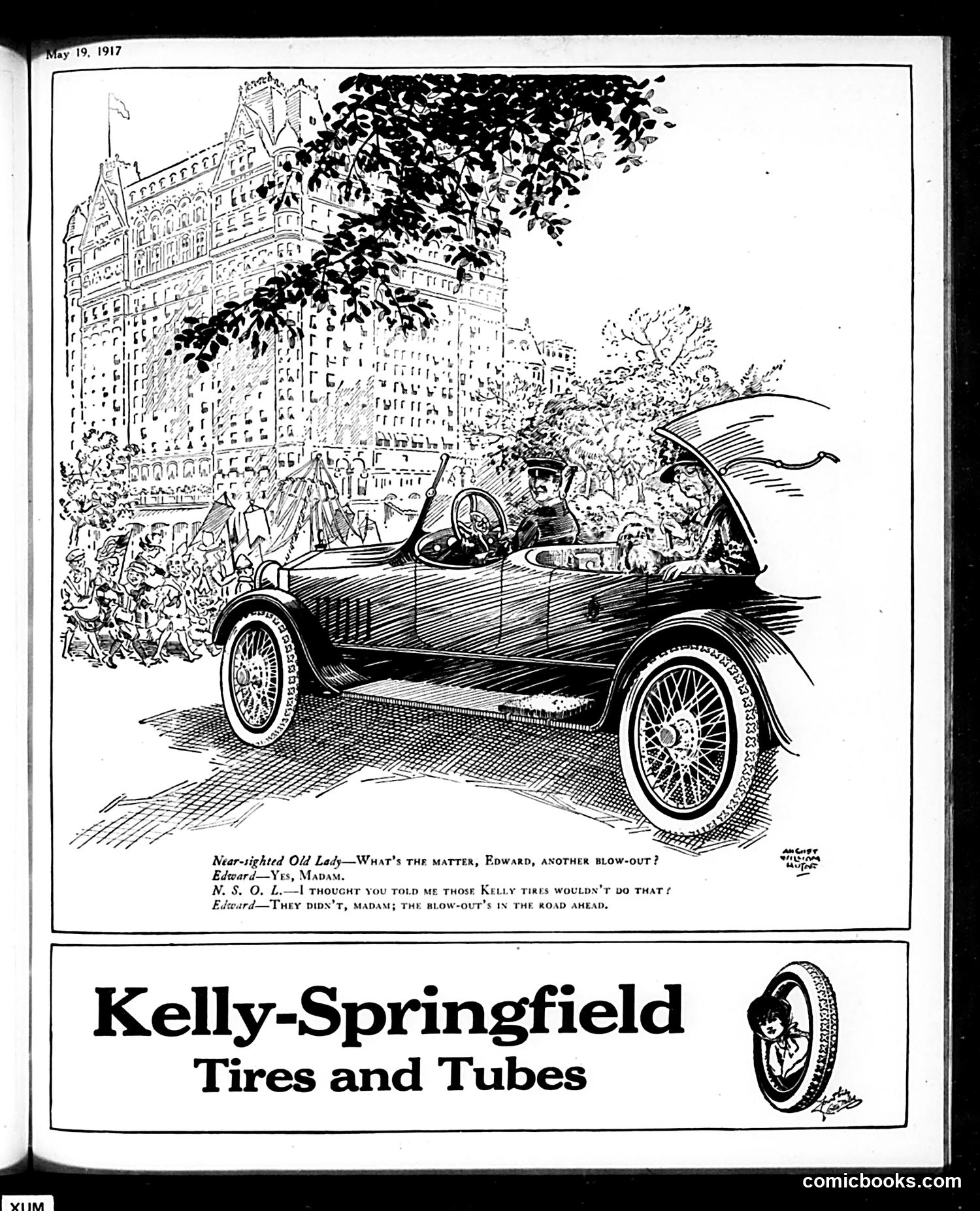
This is a **Kelly-Springfield Tires advertisement** disguised as humor, dated May 19, 1917. The cartoon depicts an elegant older woman ("Old Lady") in a car driven by her chauffeur Edward, who encounters a blown-out tire. She complains that Edward assured her Kelly tires "wouldn't do that." Edward's response reveals the ad's pitch: the blowout wasn't caused by Kelly tires—it's a tire already in the road that caused the problem. The joke is a sales pitch: Kelly-Springfield tires are so reliable they won't blow out themselves; any blowouts you experience must be someone *else's* failed tires on the road. It's clever misdirection advertising—the scenario seems to undermine the product, but actually reinforces its reliability claim. The comic illustrates typical 1917 motoring anxieties (tire failures were common) while positioning Kelly-Springfield as the trustworthy solution.
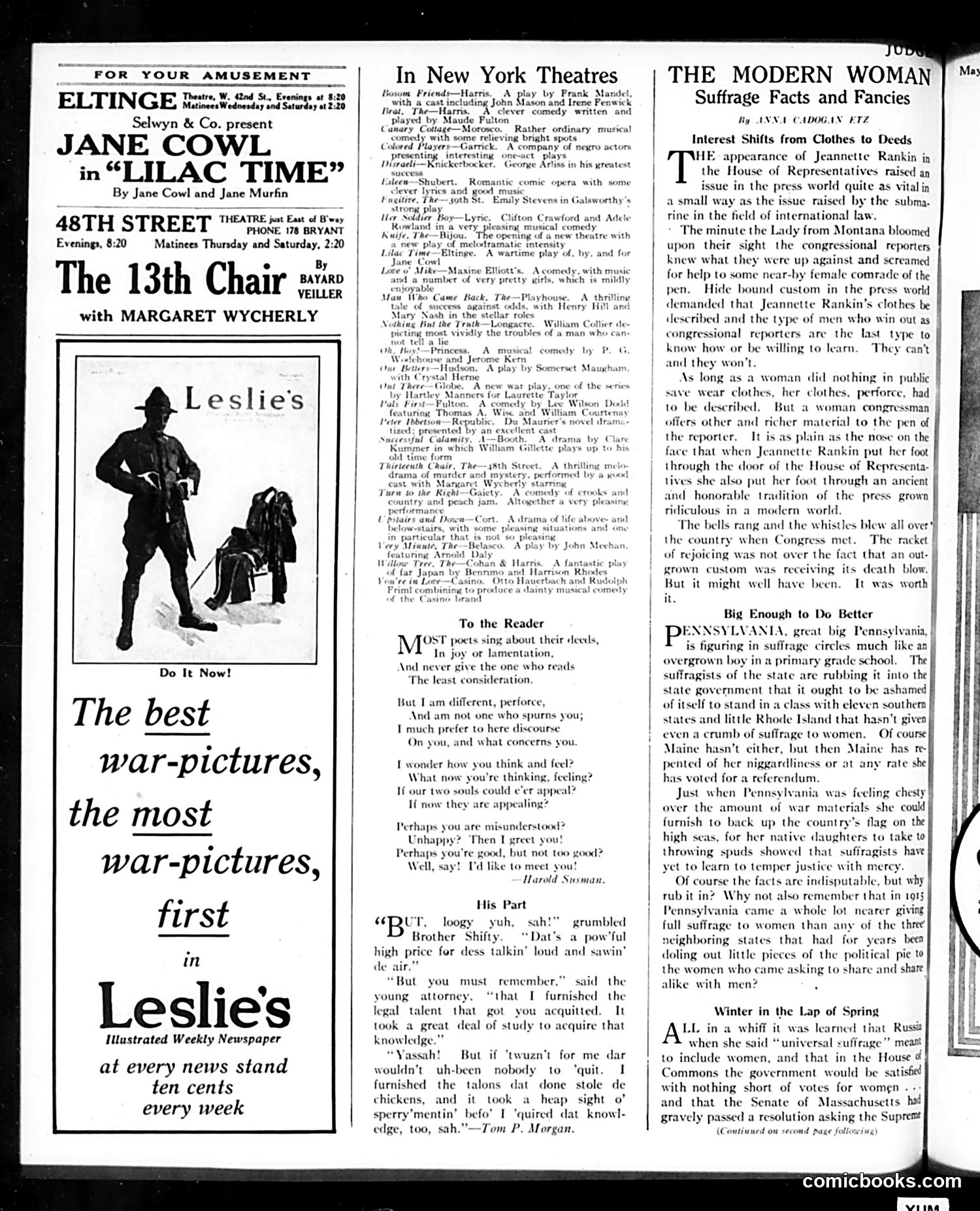
This page from *Judge* (a satirical weekly) is primarily **theatrical advertising and light humor**, not political satire. The bulk consists of **Broadway theater listings** for plays like *Lilac Time*, *The 13th Chair*, and *Disraeli*—standard entertainment coverage. The substantive content is **"The Modern Woman: Suffrage Facts and Fancies"** by Anna Cadogan Etz, discussing how congresswoman **Jeannette Rankin's** arrival forced male reporters to confront a problem: their tradition of describing women's clothing became absurd when covering a female legislator's actual *work*. The piece satirizes press convention—reporters "can't and they won't" learn to cover women seriously, defaulting to fashion commentary. The accompanying humor piece **"His Part"** features dialect comedy about a Black defendant's attorney claiming credit for legal victory, when the defendant insists *his* criminal skills (stealing chickens) required more "sperry'mentin'" than law school. The page reflects 1920 America: women's suffrage gaining traction, one woman in Congress causing institutional friction, and casual racial stereotyping in "humor."
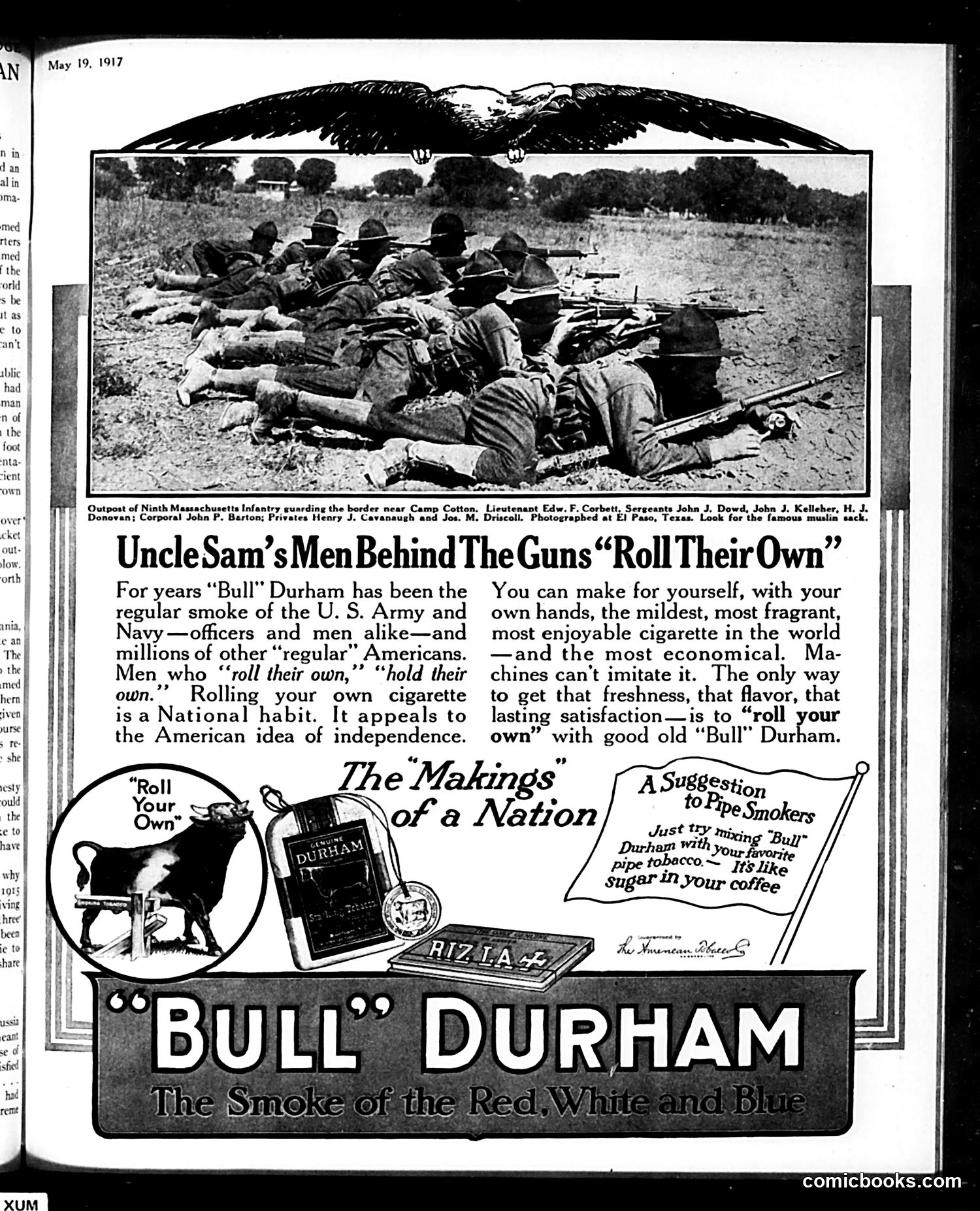
This is a cigarette advertisement, not political satire. It appeared in *Judge* magazine on May 19, 1917, during America's early involvement in World War I. The ad features a photograph of soldiers from the Ninth Massachusetts Infantry at Camp Cotton, Texas, positioned as endorsement. The tagline "Uncle Sam's Men Behind the Guns 'Roll Their Own'" connects military service to rolling custom cigarettes using Bull Durham tobacco and rolling papers. The advertisement appeals to American ideals of self-reliance and independence—"rolling your own" cigarette represents masculine autonomy. It claims hand-rolled cigarettes are fresher and cheaper than factory-made alternatives, which machines supposedly cannot replicate. The patriotic framing (red, white, and blue; soldiers; "Uncle Sam") associates the product with national duty and the masculine American ideal during wartime. This marketing strategy was common: companies prominently featured military use to boost civilian sales.
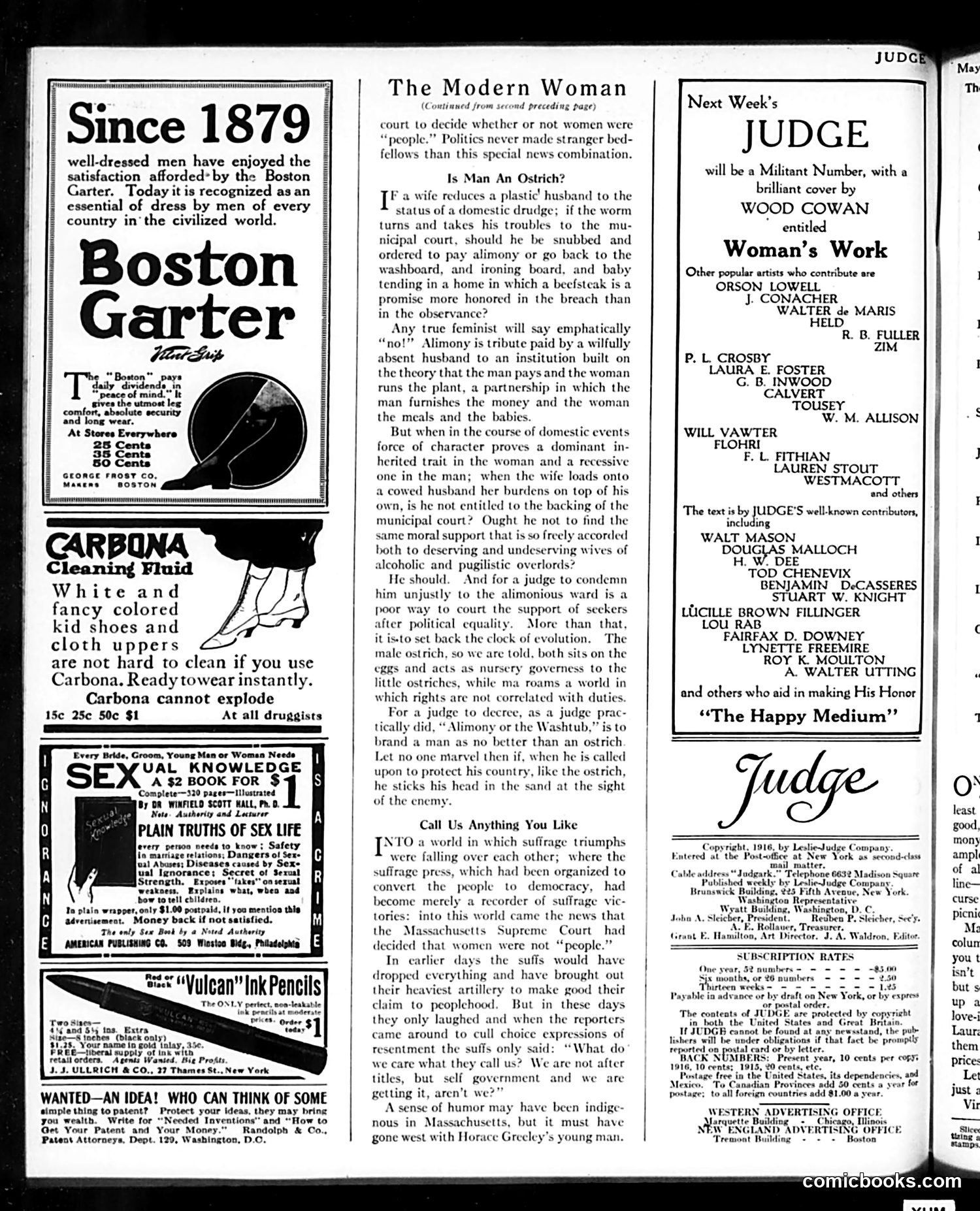
This page is primarily **advertising** with a substantial article titled "The Modern Woman" discussing gender relations and alimony law. The main article's satire argues against judicial bias in alimony cases. It critiques judges who, facing newly empowered women (the suffrage movement context), punish men who challenge unfair domestic arrangements. The piece uses an ostrich metaphor: just as male ostriches share childcare while females roam free, some men bear household burdens while wives dominate—yet courts still penalize them for seeking relief. The article's point: judges hostile to women's equality paradoxically undermine it by treating economically dependent men unjustly, potentially discouraging men from supporting women's political participation or national defense. The advertisements reflect 1918 concerns: garters for "well-dressed men," a sex education book ("Plain Truths of Sex Life"), and ink pencils—typical period commerce. **Context for modern readers:** This reflects pre-Nineteenth Amendment suffrage debates and anxieties about marriage law reform during early feminism.
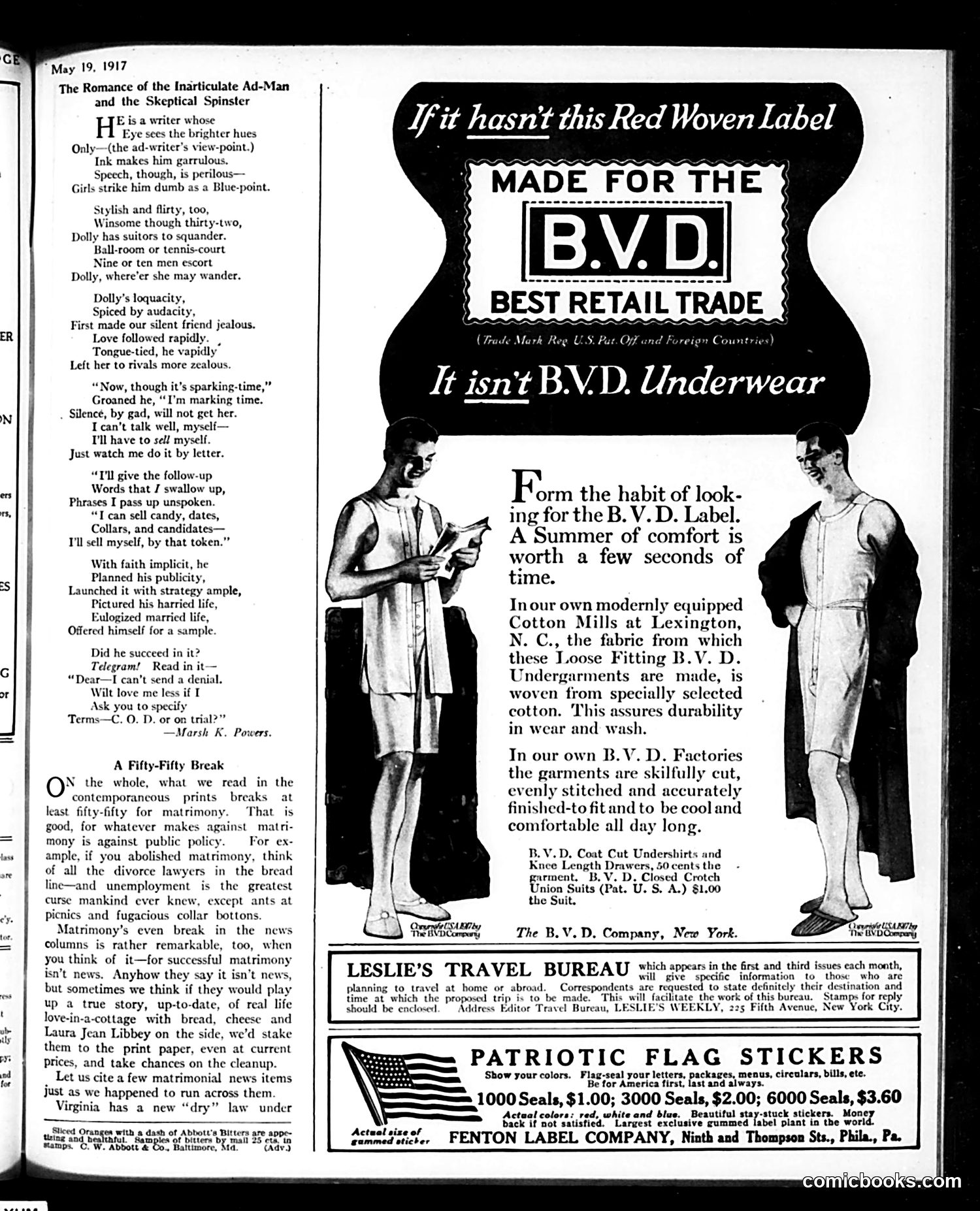
This page contains two distinct elements: a satirical poem and period advertisements. **The Main Cartoon/Poem:** "The Romance of the Inarticulate Ad-Man and the Skeptical Spinster" mocks an advertising copywriter who is articulate in print but tongue-tied around women. He pursues "Dolly," a desirable, talkative woman, by launching a publicity campaign via letter—selling himself as he would a product. The satire targets advertising industry conventions (the "follow-up," emotional appeals, strategic language) applied awkwardly to courtship, and pokes fun at masculine insecurity. The ending punchline—her response asking for "terms" like a C.O.D. delivery—inverts his commercial pitch back on him. **The Secondary Essay:** "A Fifty-Fifty Break" humorously argues that matrimonial news coverage is balanced, and suggests real love stories should be publicized more (with tongue-in-cheek reasoning about unemployed divorce lawyers). **The Advertisements** promoting B.V.D. underwear and Leslie's Travel Bureau are unrelated to the satire and reflect typical 1917 magazine content. The patriotic flag stickers advertisement references WWI context (U.S. entered April 1917).
This page is primarily **advertising and editorial content**, not political satire. The left side promotes "Love Maggy," a novel by Countess Barcynska, available in *Ainslee's* magazine—standard fiction advertising from the era. The right side contains a humorous column titled "Judge" (the magazine's name) offering satirical commentary on contemporary marriage and divorce cases. The humor targets **gender dynamics and marital discord**: a wife drinking her husband's hair restorer to spite him, a husband choosing jail over living with his wife, and a woman seeking court-ordered potatoes as alimony. The writer (Albert E. Host) uses these real divorce cases to joke about the absurdities of marriage and the fundamental incompatibility of spouses. The final item is a human-interest request: an interned Belgian soldier asking readers to send postage stamps to pass time during captivity—likely WWI-era correspondence. The satire reflects early-20th-century attitudes about marriage as inherently contentious and somewhat ridiculous.
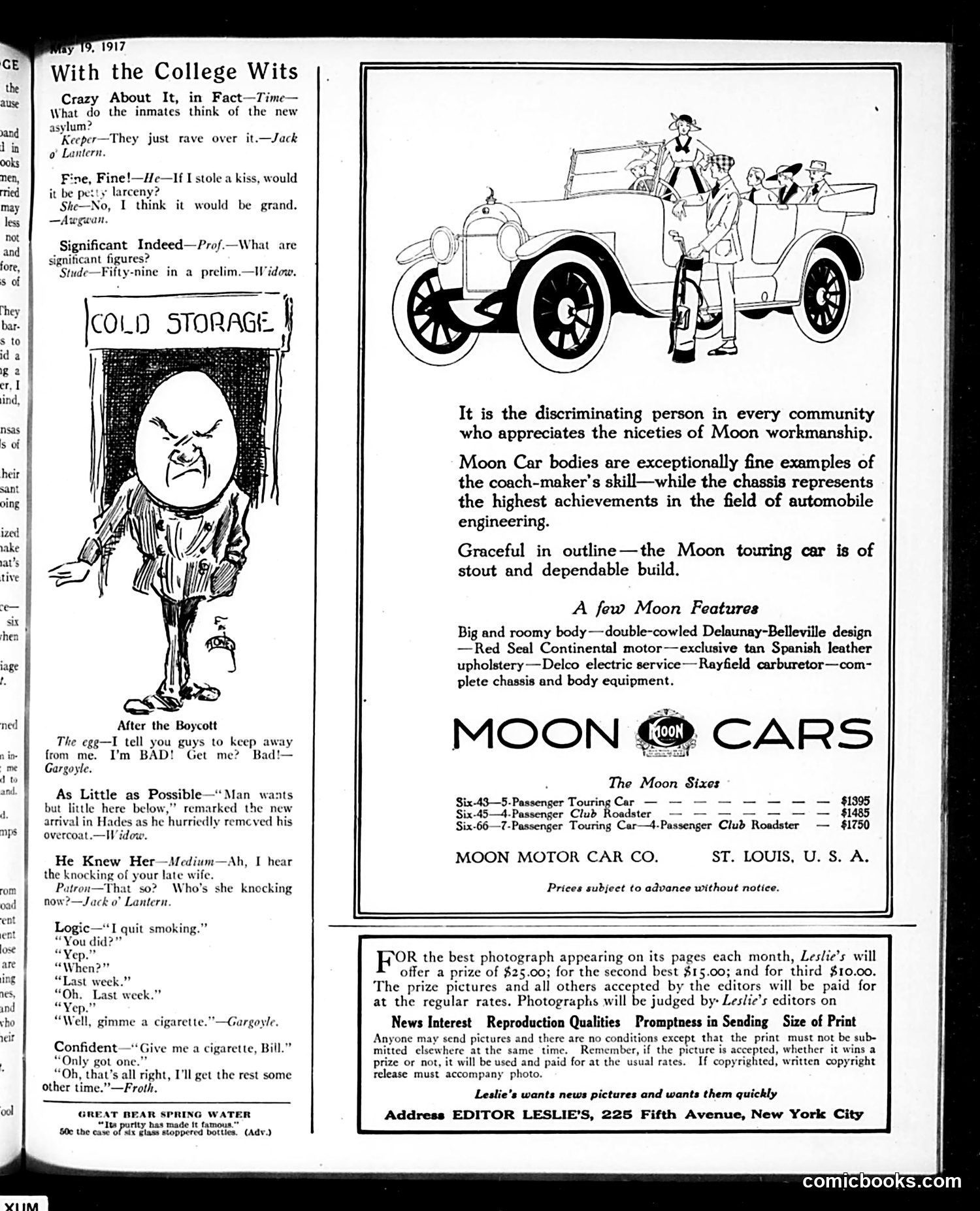
This page is primarily **advertising and humor fillers**, not political satire. The content includes: **"With the College Wits"** section: A series of brief, pun-based college humor jokes typical of the era—wordplay about kissing ("larceny" vs. "grand"), asylum inmates, and significant figures in math. **"Cold Storage" cartoon**: A single illustration of an angry egg labeled "After the Boycott," referencing a contemporary consumer boycott (likely against eggs or dairy). The egg complains about being avoided, suggesting public pressure against certain products. **Moon Cars advertisement**: The majority of the page promotes Moon automobiles with detailed specifications and pricing. **Photo contest notice**: Leslie's magazine solicits reader photographs for publication. The egg cartoon is the only clear social reference—it reflects 1917-era consumer activism and boycotts, though the specific cause remains unclear from context alone. Otherwise, this is entertainment and advertising rather than political commentary.
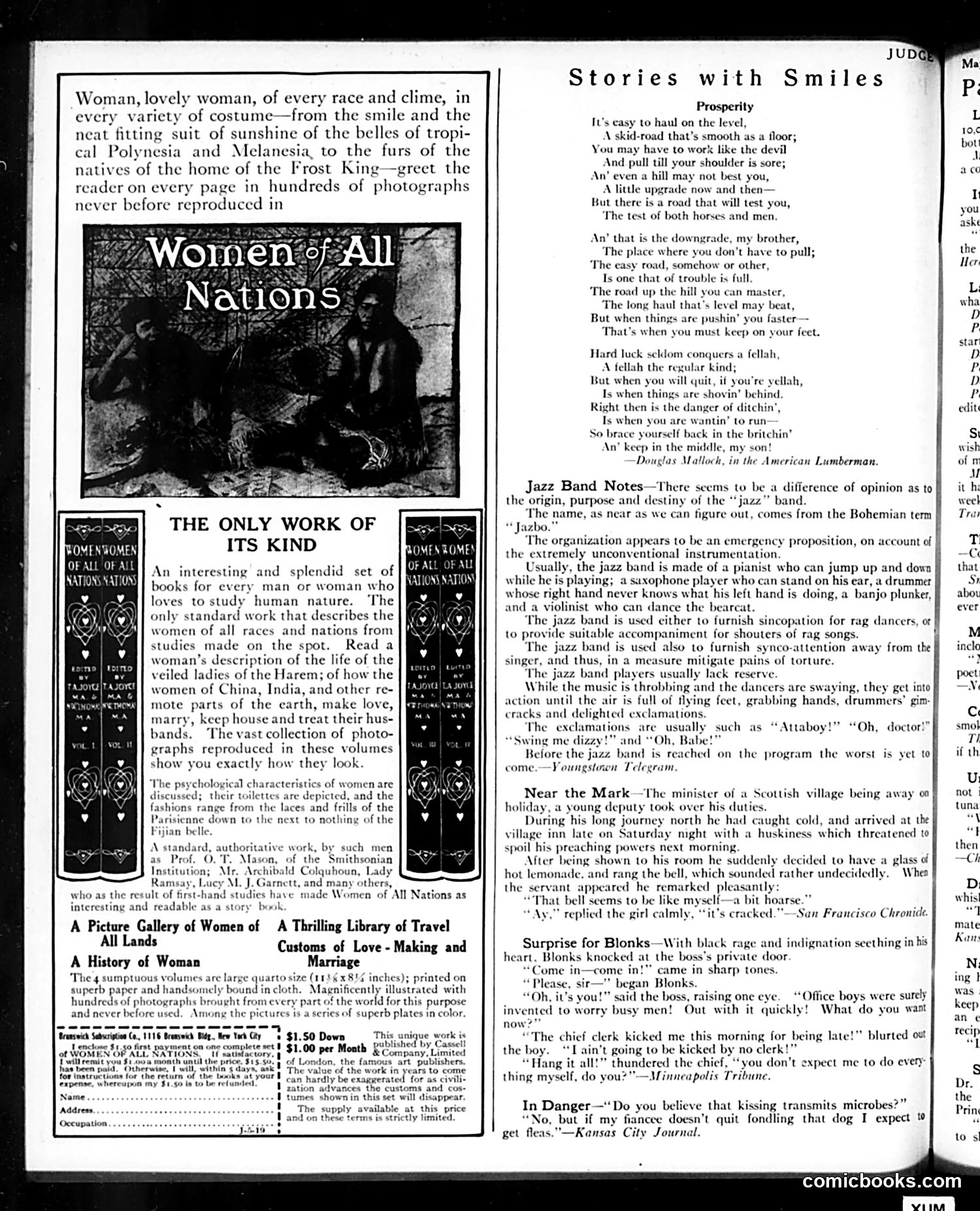
This page is primarily **advertising and content promotion** rather than political satire. The main focus is a multi-volume book set called *"Women of All Nations,"* marketed as an encyclopedic study of women across different cultures and races, featuring photographs and descriptions of women's customs, dress, and social practices from around the world. The advertisement emphasizes the work's scholarly authority (citing contributors from the Smithsonian Institution) and appeals to readers' interest in studying "human nature" and comparative cultures—reflecting early 20th-century attitudes toward ethnographic documentation. The page also includes lighter content: humor pieces about work ethics ("Prosperity"), jazz bands (an emerging cultural phenomenon), and anecdotal stories. These sections show Judge's mix of serious advertising with entertaining filler content typical of the era's magazines. **No clear political satire or caricature is evident on this specific page.**
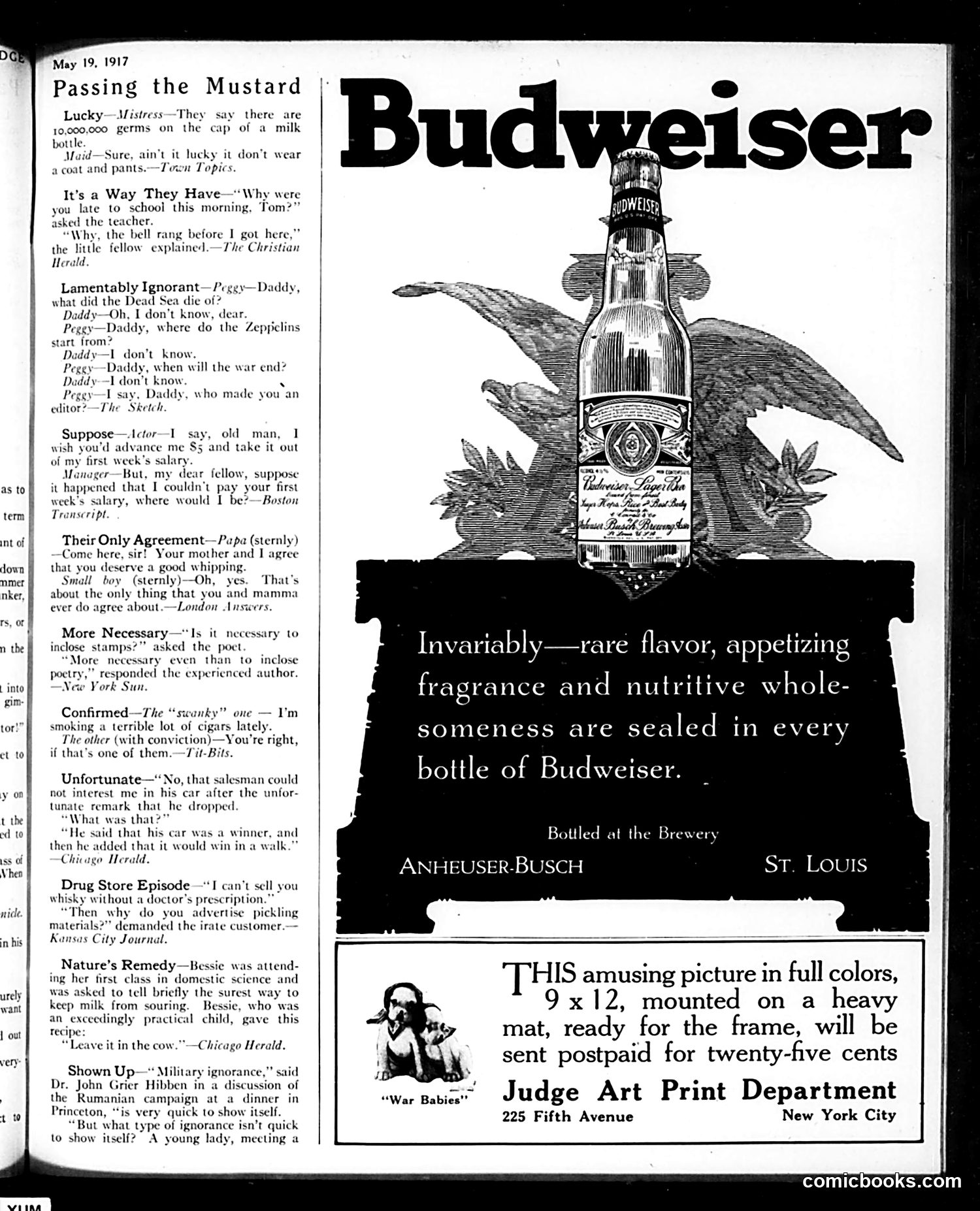
This page is primarily **advertising** (a large Budweiser beer ad dominates the right side) with accompanying **short humor columns** on the left—typical Judge magazine filler content. The humor pieces are brief, punny jokes on everyday situations: a child's practical logic about keeping milk fresh ("leave it in the cow"), questions about WWI (reflecting 1917 wartime context), workplace mishaps, and wordplay. None reference specific political figures or satirize particular events. The Budweiser ad, featuring an eagle-crowned bottle, uses patriotic imagery common during WWI. Notably, this advertisement appears in an American magazine just months after the U.S. entered the war—the beer industry would face Prohibition within a few years (ratified 1919), making this a document of pre-Prohibition advertising. The ad's "War Babies" art print offer at bottom represents typical magazine merchandising of the era. Overall: a snapshot of American commercial culture and light humor during wartime, rather than political satire.
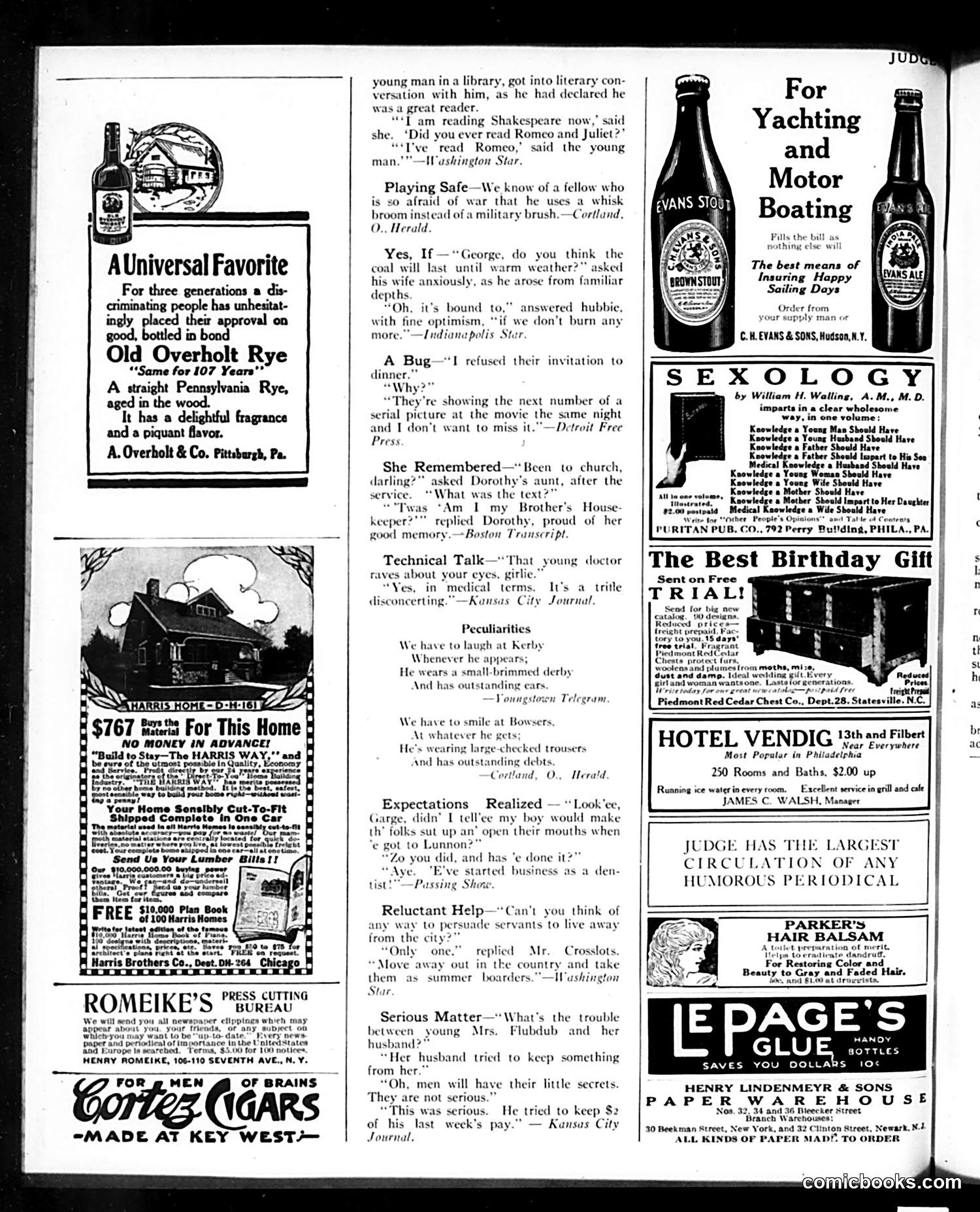
This page is primarily **advertising and humorous fillers**, not political satire. The content consists of: **Humorous anecdotes** (center column): Brief jokes about everyday life—a young man who's only read "Romeo" (not the full play), a husband hoarding coal, servants avoiding city life, and marital disputes over hidden money. These are gentle domestic humor typical of Judge magazine's "wit and wisdom" sections. **Advertisements** dominate: Old Overholt Rye whiskey, Harris home construction, Romeike's press-cutting bureau, Cortez cigars, Evans boat supplies, a "Sexology" instructional book, hotels, hair products, and paper warehouses. The only visual element is a house illustration for Harris Homes. There are **no political cartoons or caricatures** on this page—it's a standard mix of light social humor and commercial notices, reflecting early-20th-century American magazine conventions where advertising and editorial content blended seamlessly.
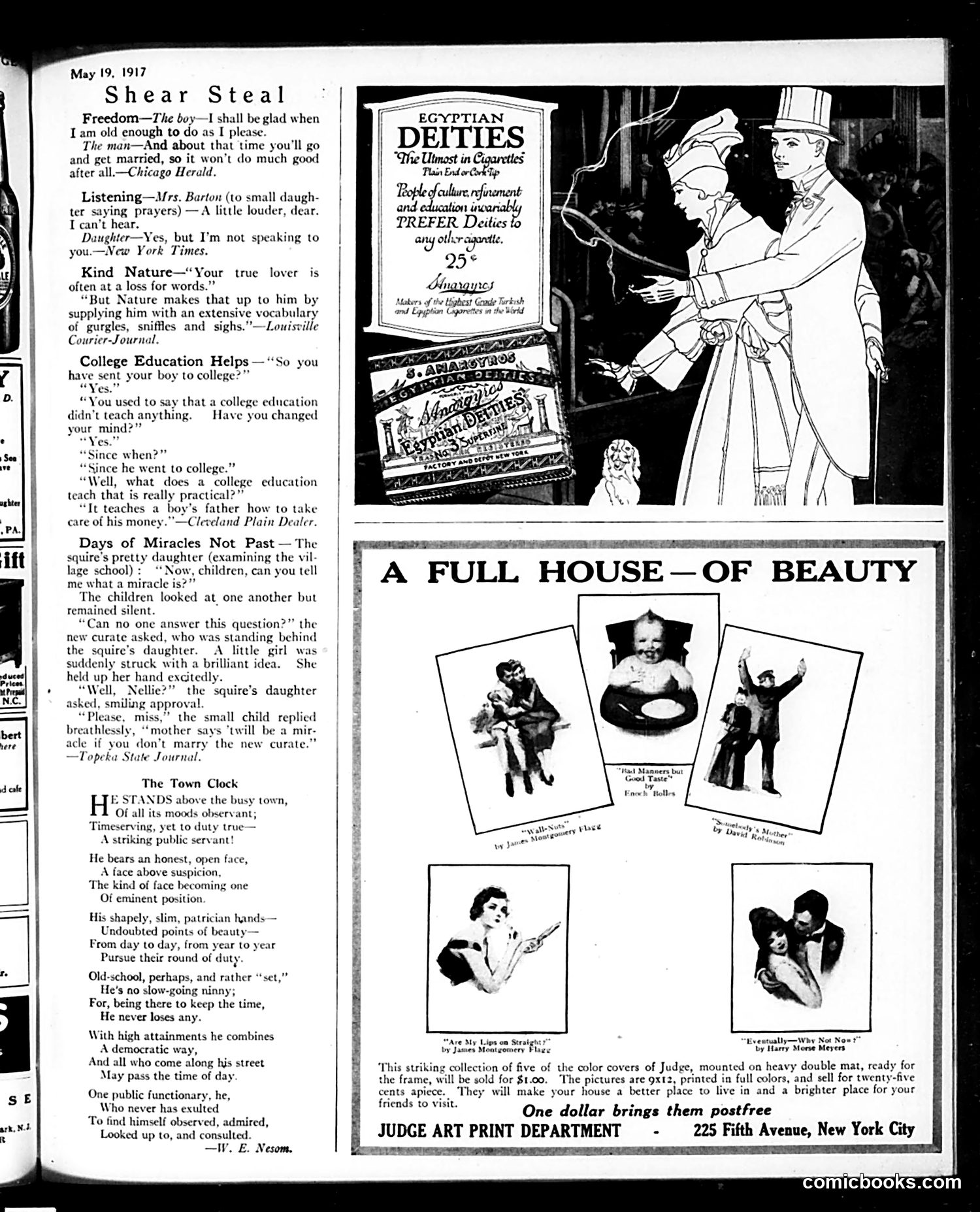
This page contains **short humorous anecdotes and poems** rather than political cartoons. The satire targets social conventions and human nature: **"Shear Steal"** presents brief comedic observations: a boy wants freedom until adulthood when marriage constrains him; a daughter prays only to God, not her listening mother; lovers struggle with vocabulary but nature compensates with physical expressions. **"College Education Helps"** mocks higher education's impracticality—a father's only benefit is learning financial management from his son's expensive tuition. **"Days of Miracles Not Past"** is a risqué joke: a village girl suggests a "miracle" would be the squire's daughter *not* marrying the new curate, implying inevitable seduction. **"The Town Clock"** is a straightforward celebratory poem praising civic duty and democratic values—no satire apparent. The **Egyptian Deities cigarette ad** and **Judge Art Print Department** advertisement occupy the right side, promoting luxury goods typical of 1917 Judge advertising.
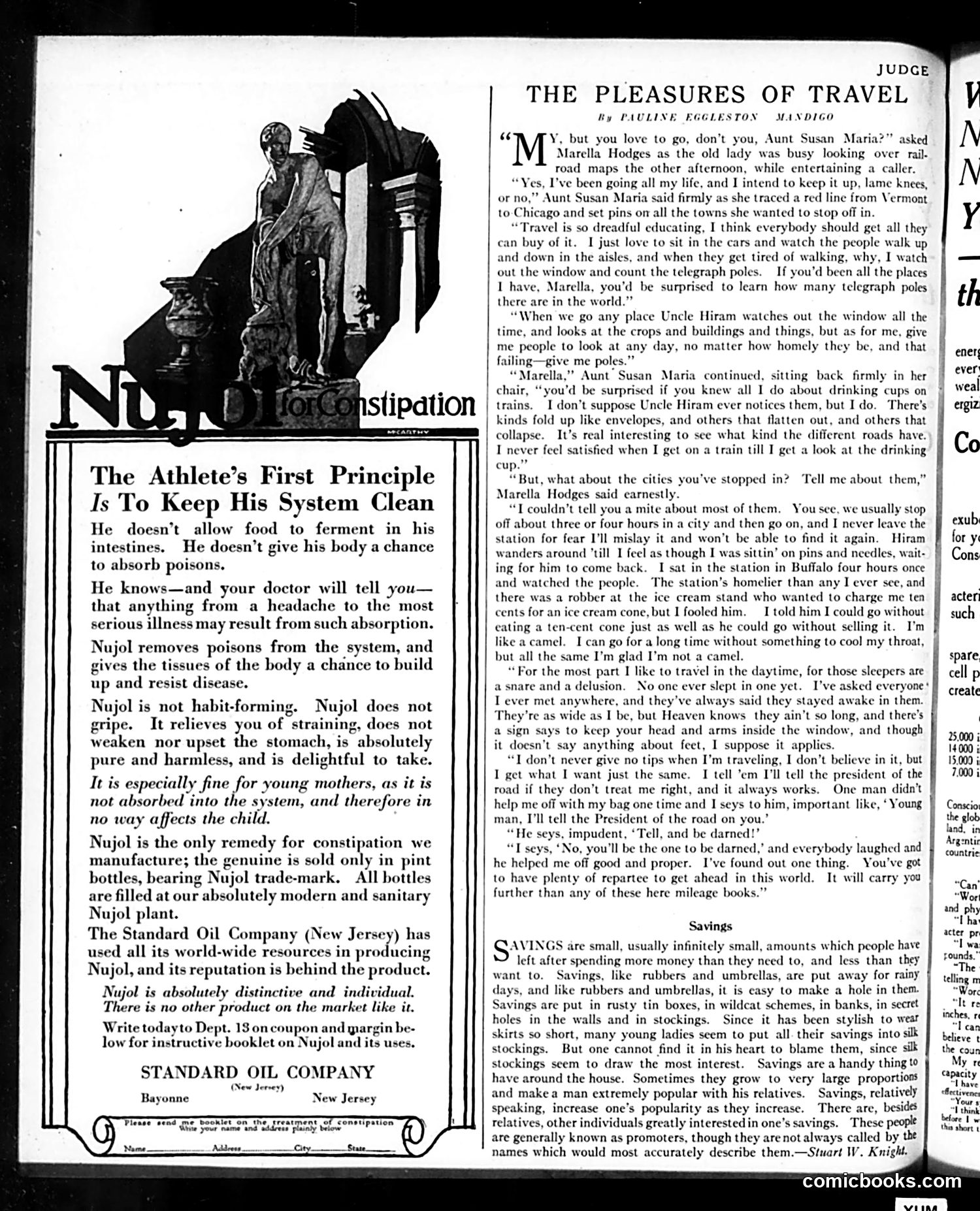
This page contains **two distinct advertisements/content pieces**, not political satire: 1. **Nujol Advertisement** (left/bottom): A Standard Oil Company pitch for Nujol, a laxative marketed to athletes and mothers. The ad emphasizes "keeping the system clean" and claims the product prevents constipation without being habit-forming. The imagery shows a classical athlete figure, invoking health and vigor. 2. **"The Pleasures of Travel" essay** (right): A humorous short story by Pauline Eggleston Mandigo featuring Aunt Susan Maria discussing her travel experiences with her niece Marella. The humor derives from the aunt's trivial observations—counting telegraph poles, watching people walk aisles, collecting different drinking cup designs—rather than appreciating actual destinations. She famously refuses to leave train stations, fearing she'll get lost. **For modern readers**: This reflects early 20th-century attitudes: the Nujol ad exploits health anxieties through pseudoscience, while the travel piece gently mocks elderly women's supposed lack of sophistication and adventurous spirit.
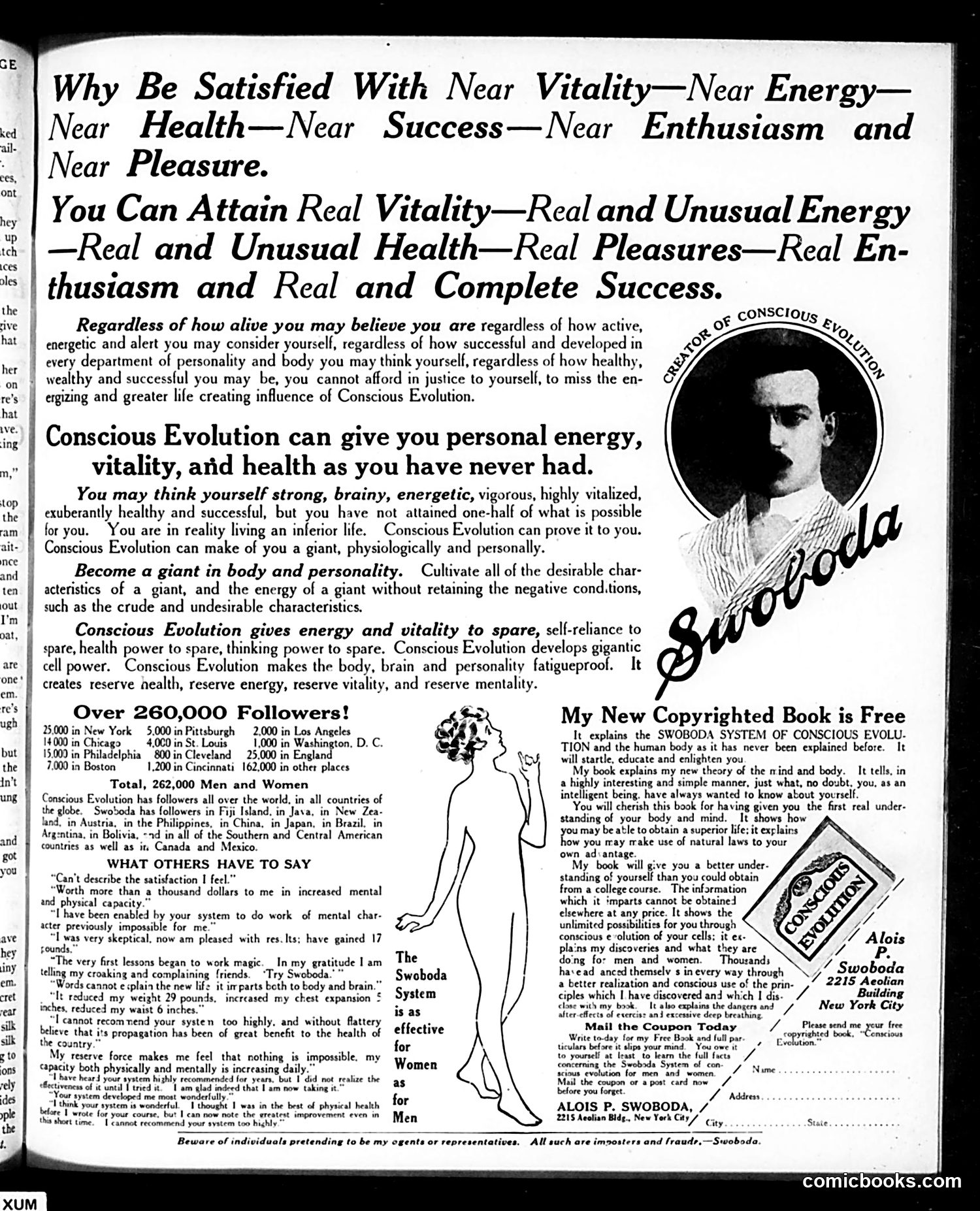
This page is primarily **advertising disguised as editorial content** — a common practice in early 20th-century magazines like Judge. It promotes "Conscious Evolution," a pseudo-scientific self-improvement system marketed by Alois P. Swoboda. The satire (if any exists) is subtle and likely **unintentional from the advertiser's perspective**. The hyperbolic language — promises of becoming a "giant in body and personality," gaining "reserve health" and "reserve mentality" — reads as absurdly overblown self-help rhetoric to modern eyes. The portrait shows Swoboda himself, positioned as the system's "Creator." The testimonials claiming miraculous results (weight loss, expanded chest, increased "mental capacity") reflect early 1900s wellness culture's credulous embrace of dubious methods. **The joke for Judge readers**: This likely mocked the proliferation of mail-order self-improvement schemes targeting anxious Americans. The earnest, grandiose promises contrast sharply with the vague, unfalsifiable benefits claimed — classic snake-oil marketing that satirical magazines regularly ridiculed.
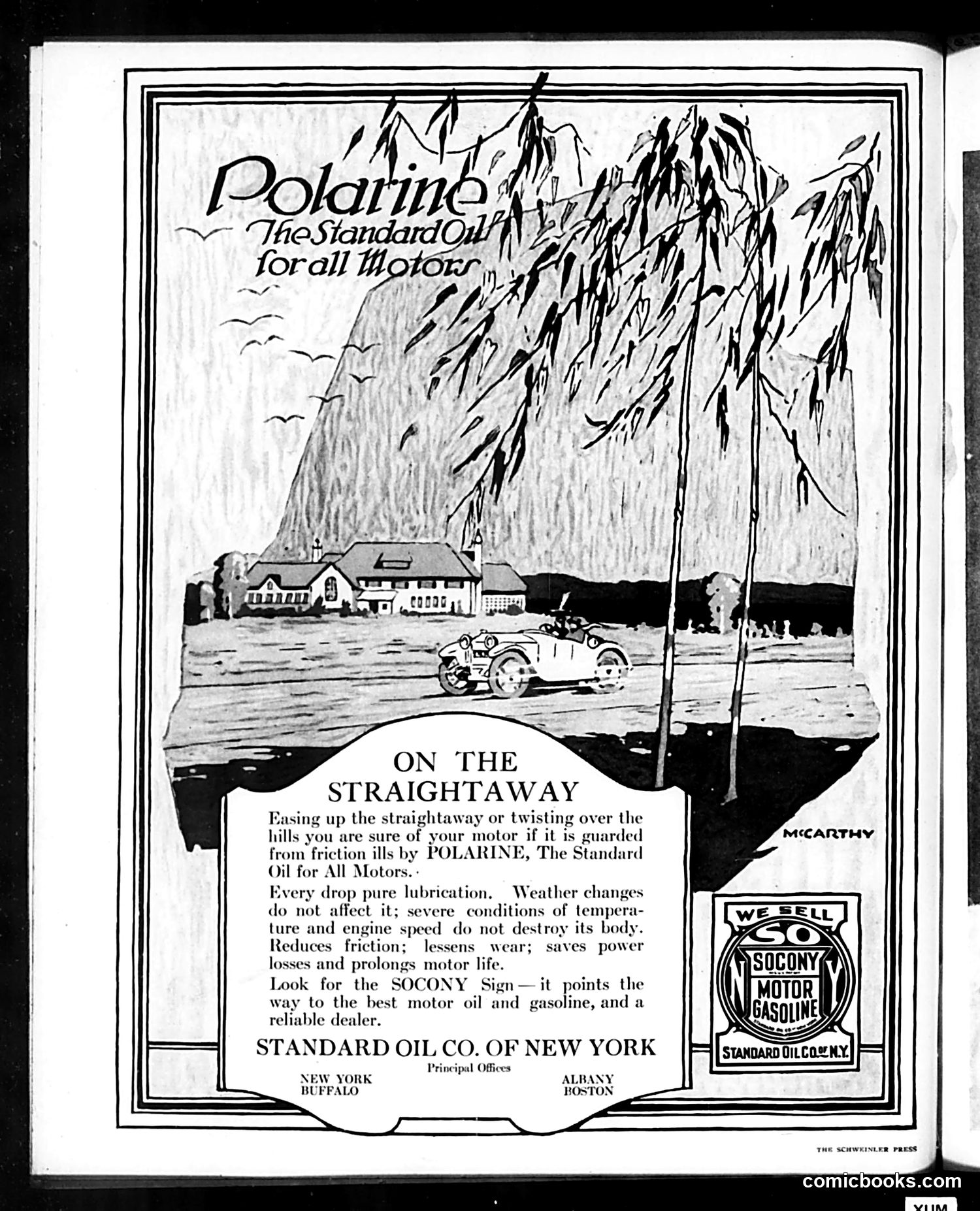
This is a **full-page advertisement**, not a cartoon or satire. It promotes Polarine motor oil by the Standard Oil Company of New York (SOCONY). The ad uses an illustration of an early automobile on a country road beneath a weeping willow tree, with a house in the background, to evoke leisure and reliability. The text's key selling point is that Polarine lubricates engines effectively under all conditions—heat, cold, and speed—reducing friction and extending engine life. The phrase "On the Straightaway" is a motoring metaphor suggesting confidence and smooth performance. The SOCONY sign logo reinforces brand recognition for dealers. This reflects early-20th-century automotive culture when motor oil quality directly affected engine longevity, making lubrication a genuine consumer concern rather than today's standardized products.