
Judge, 1917-05-19 · page 11 of 32
Judge — May 19, 1917 — page 11: what you’re looking at
What you’re looking at
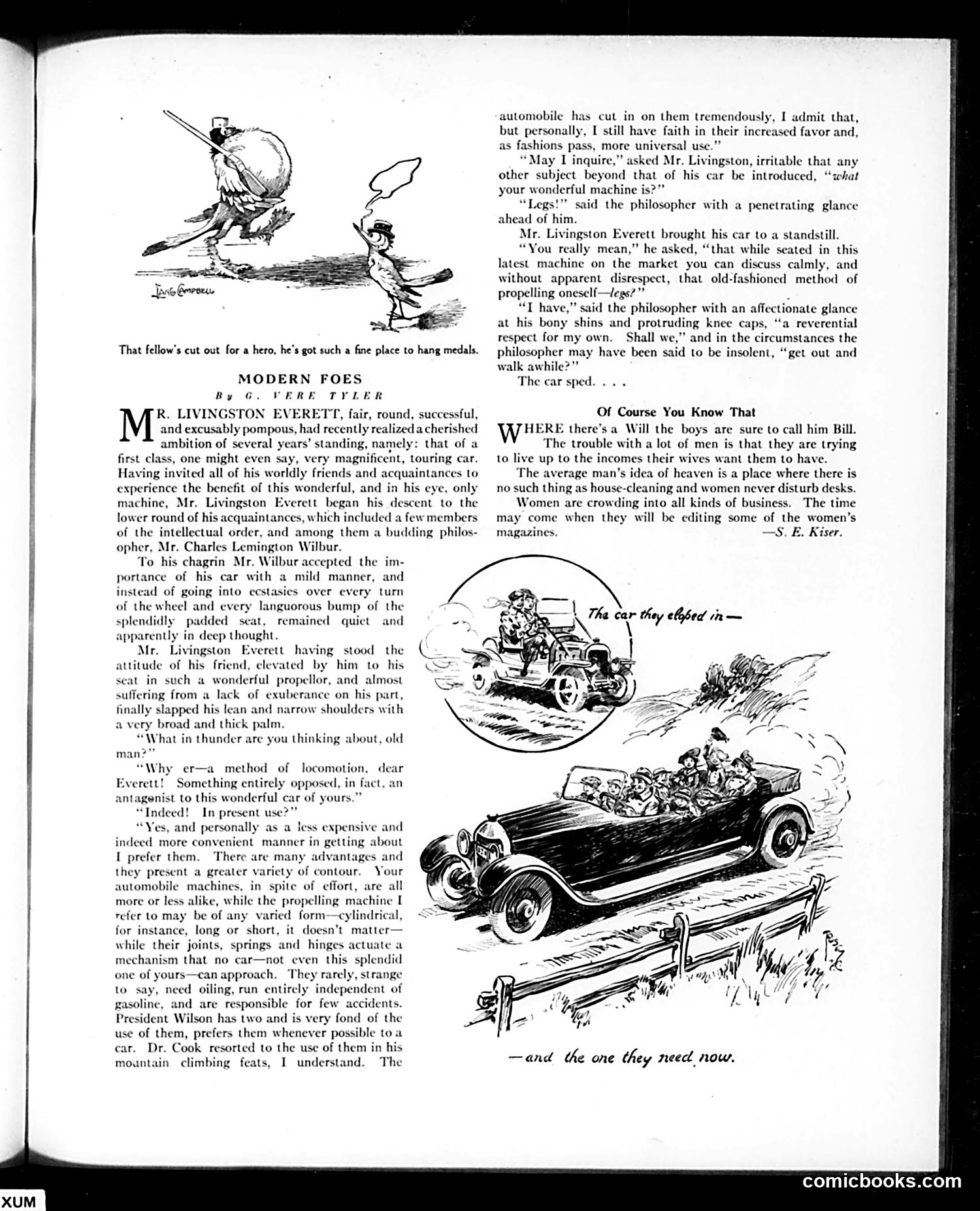
This satirical story mocks the pretentious new automobile culture of the early 20th century. Mr. Livingston Everett, a successful but pompous man, proudly shows off his expensive touring car to his acquaintances—including a philosopher, Charles Lemington Wilbur. The joke: When Wilbur remains unimpressed and instead praises his preferred method of locomotion, Everett demands to know what it is. Wilbur's answer—"Legs!"—delivers the satire's point. The philosopher argues that walking offers advantages cars cannot match: variety, durability, independence from gasoline, and fewer accidents. He even notes President Wilson and Dr. Cook prefer them. The cartoon attacks automobile snobbery and consumerism, suggesting that wealthy people's obsession with machines blinds them to simpler, superior alternatives. The philosopher's calm insistence on walking's dignity—even invoking famous figures—mocks those who mistake expensive possessions for superiority.
📄 Transcribed text from this page (OCR, searchable)
Machine-transcribed from the original scan — historical spelling and the odd misread are preserved.
os XUM That fellow’s cut out for a hero, he's got such a fine place to hang medals. MODERN FOES By G. VERE TYLER R. LIVINGSTON EVERETT, fair, round, successful, and excusably pompous, had recently realized a cherished ambition of several years’ standing, namely: that of a first class, one might even say, very magnificent, touring car. Having invited all of his worldly friends and acquaintances to experience the benefit of this wonderful, and in his eye, only machine, Mr. Livingston Everett began his descent to the lower round of his acquaintances, which included a few membe: of the intellectual order, and among them a budding philos- opher, Mr. Charles Lemington Wilbur. To his chagrin Mr. Wilbur accepted the im- portance of his car with a mild manner, and instead of going into ecstasies over every turn of the wheel and every languorous bump of the splendidly padded seat, remained quiet and apparently in deep thought, Mr. Livingston Everett having stood the attitude of his friend, clevated by him to his in such a wonderful propellor, and almost suffering from a lack of exuberance on his part, finally slapped his lean and narrow shoulders with a very broad and thick palm. What in thunder are you thinking about, old man?” “Why er—a method of locomotion, Everett! Something entirely opposed fi antagenist to this wonderful car of yours.” Indeed! In present use?” Yes, and personally as a less expensive and indeed more convenient manner in getting about I prefer them. There are many advantages and they present a greater variety of contour. Your automobile mac! . in spite of effort, are all more or less alike, while the propelling machine I refer to may be of any varied form—cylindri for instance, long or short, it doesn’t: matter— while their joints, springs and hinges actuate a mechanism that no car—not even this splendi one of yours—can approach. They rarely, strange to say, need oiling, run entirely independent of gasoline, and are responsible for few accidents. President Wilson has two and is very fond of the use of them, prefers them whenever possible to a car. Dr. Cook resorted to the use of them in his mountain climbing feats, I understand. The automobile has cut in on them tremendously, I admit that, but personally, I still have faith in their increased favor and, as fashions pass, more universal use.”” “May I inquire,” asked Mr. Livingston, irritable that any other subject beyond that of his car be introduced, “what your wonderful machine is?” “Legs!” said the philosopher with a penetrating glance ahead of him. Mr. Livingston Everett brought his car to a standstill. “You really mean,” he asked, “that while seated in this latest machine on the market you can discuss calmly, and without apparent disrespect, that old-fashioned method of propelling onescli—legs? “T have,” said the philosopher with an affectionate glance at his bony shins and protruding knee caps, ‘‘a reverential respect for my own. Shall we,” and in the circumstances the philosopher may have been said to be insolent, “get out and walk awhile?” The car sped. . . . Of Course You Know That HERE there’s a Will the boys are sure to call him Bill. The trouble with a lot of men is that they are trying to live up to the incomes their wives want them to have. The average man’s idea of heaven is a place where there is no such thing as house-cleaning and women never disturb desks. Women are crowding into all kinds of business. The time may come when they will be editing some of the women’s —S. E. Kiser. —and the one they neect now, comicbooks.com