
Judge, 1917-05-19 · page 13 of 32
Judge — May 19, 1917 — page 13: what you’re looking at
What you’re looking at
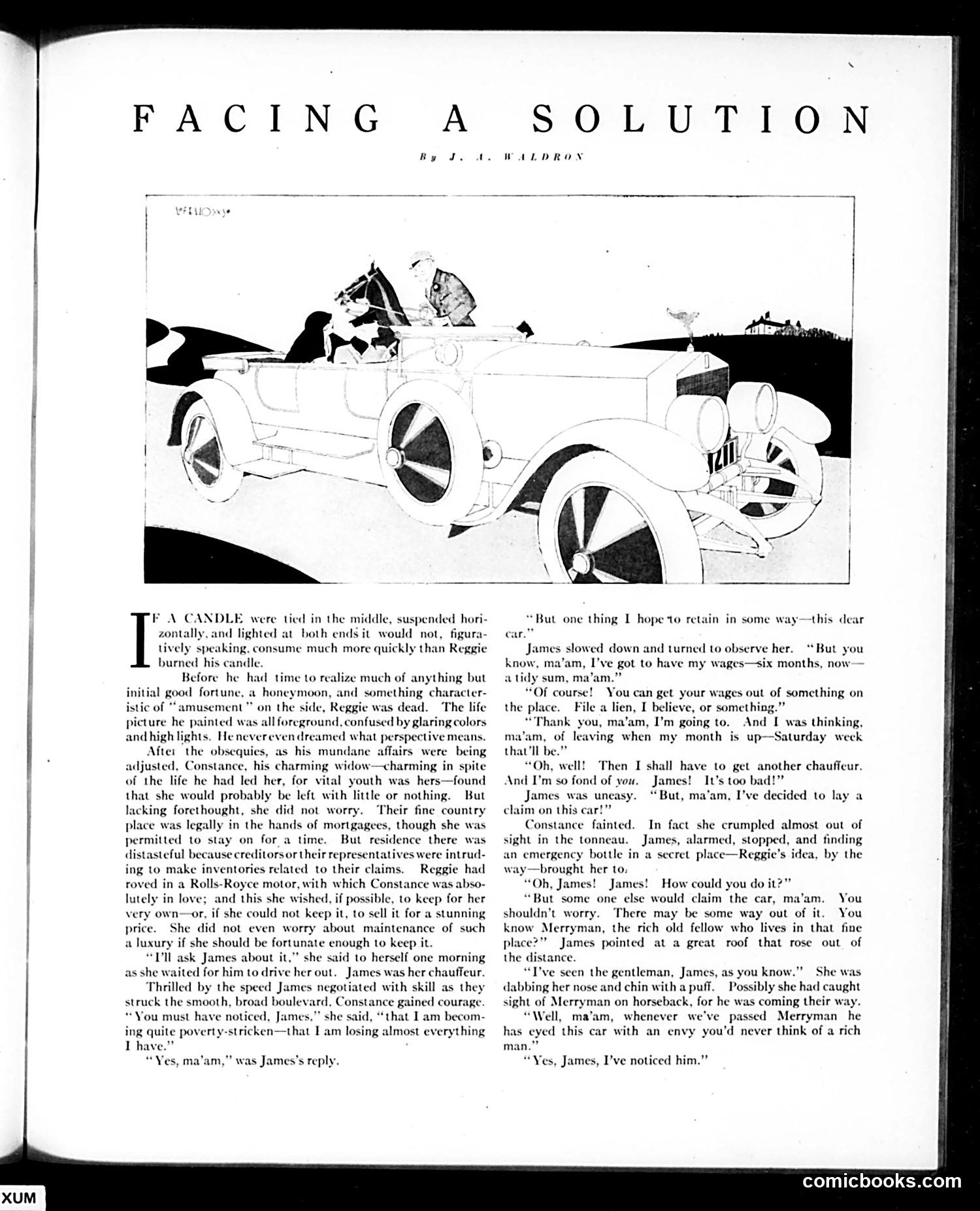
This story-cartoon satirizes post-WWI wealth anxieties and class dynamics. Reggie, a wealthy but reckless man, dies young, leaving his widow Constance nearly destitute despite their formerly luxurious lifestyle—mortgaged estate, no liquid assets. Her sole attachment is a Rolls-Royce motorcar. When her loyal chauffeur James announces he must leave to recover unpaid wages and plans to file a legal claim against the car, Constance faces losing her last symbol of status. James, however, suggests a solution: wealthy neighbor Merryman has shown obvious envy of the vehicle. The implication is that Constance should seduce or manipulate Merryman into purchasing (or providing for) the car—trading on her charm and femininity to solve her financial crisis. The satire targets both the frivolous wealthy and the desperation of those fallen from privilege, while the "solution" reflects period attitudes about women's limited economic options.
📄 Transcribed text from this page (OCR, searchable)
Machine-transcribed from the original scan — historical spelling and the odd misread are preserved.
XUM SOLUTION WALDRON F A CANDLE were tied in the middle, suspended hori- zontally, and lighted at both ends it would not, figura- tively speaking, consume much more quickly than Reggie burned his candl Before he 1 time to realize much of anything but initial good fortune, a honeymoon, and something character- istic of “amusement” on the side, Reggie was dead. The life picture he painted was all foreground, confused by glaring colors and high lights. Henevereven dreamed what perspective mean After the obsequ s his mundane affairs were being adjusted, Constance, his charming widow—charming in spite of the life he had led her, for vital youth was hers—found that she would probably be left with little or nothing. But lacking forethought, she did not worry. Their fine country place was legally in the hands of mortgagees, though she was permitted to stay on for a time. But residence there distasteful because creditors or their representatives were intrud- ing to make inventories related to their claims. Reggie had roved in a Rolls-Royce motor, with which Constance was abso- lutely in love; and this she wished, if possible, to keep for her very own—or, if she could not keep it, to sell it for a stunning pric She did not even worry about maintenance of such a luxury if she should be fortunate enough to keep it. “T'll ask James about it,” she said to herself one morning as she waited for him to drive her out. James was her chauffeur. hrilled by the speed James negotiated with skill as the struck the smooth, broad boulevard, Constance gained courag “You must have noticed, James,” she said, “that 1am becom- ing quite poverty-stricken—that I am losing almost everything I have. s, ma’am,” was James’s reply. “But one thing 1 hope to retain in some way—this dear car.” James slowed down and turned to observe her. “But you know, ma’am, I've got to have my wages—six months, now atidy sum, ma’am. Of course! You can get your wages out of something on the place. File a lien, I believe, or something.” Thank you, ma’am, I’m going to. And I was thinking, ma'am, of leaving when my month is up—Saturday weck thau'll be. “Oh, well! Then I shall have to get another chauffcur. And I’m so fond of you. James! It’s too bad!” James was uneasy. “But, ma‘am, I’ve decided to lay a claim on this car!” Constance fainted. In fact she crumpled almost out of sight in the tonnea James, alarmed, stopped, and finding an emergency bottle ecret_ place—Reggie’s idea, by the way—brought her to. Oh, James! James! How could you do it?” “But some one else would claim the car, ma'am. You shouldn’t wor here may be some way out of it. You know Merryman, the rich old fellow who lives in that fine pla James pointed at a great roof that rose out of the distance. “T've seen the gentleman, James, as you know.” She dabbing her nose and chin with a puff. Possibly she had caught sight of Merryman on horseback, for he was coming their way. “Well, ma'am, whenever we've passed Merryman he d this car with an envy you'd never think of a rich nas has man. wy 's, James, I’ve noticed him.” comicbooks.com