
Judge, 1917-05-19 · page 24 of 32
Judge — May 19, 1917 — page 24: what you’re looking at
What you’re looking at
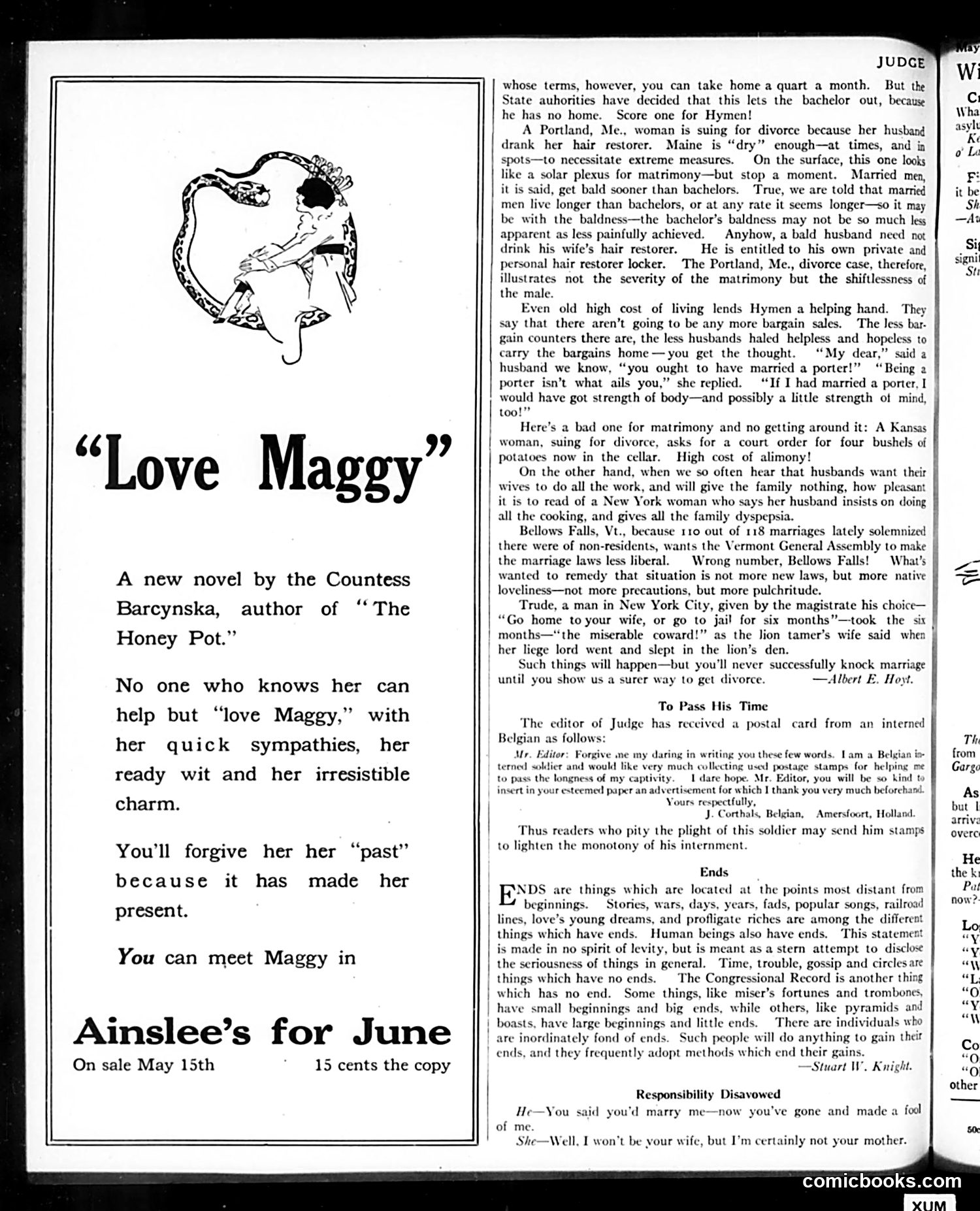
This page is primarily **advertising and editorial content**, not political satire. The left side promotes "Love Maggy," a novel by Countess Barcynska, available in *Ainslee's* magazine—standard fiction advertising from the era. The right side contains a humorous column titled "Judge" (the magazine's name) offering satirical commentary on contemporary marriage and divorce cases. The humor targets **gender dynamics and marital discord**: a wife drinking her husband's hair restorer to spite him, a husband choosing jail over living with his wife, and a woman seeking court-ordered potatoes as alimony. The writer (Albert E. Host) uses these real divorce cases to joke about the absurdities of marriage and the fundamental incompatibility of spouses. The final item is a human-interest request: an interned Belgian soldier asking readers to send postage stamps to pass time during captivity—likely WWI-era correspondence. The satire reflects early-20th-century attitudes about marriage as inherently contentious and somewhat ridiculous.
📄 Transcribed text from this page (OCR, searchable)
Machine-transcribed from the original scan — historical spelling and the odd misread are preserved.
‘Love Maggy” | A new novel by the Countess Barcynska, author of ‘‘ The Honey Pot.” | No one who knows her can help but “love Maggy,” with her quick sympathies, her ready wit and her irresistible charm. You'll forgive her her because present. “past” it has made her You can meet Maggy in Ainslee’s for June On sale May 15th 15 cents the copy JUDGE But the because whose terms, however, you can take home a quart a month. State auhorities have decided that this lets the bachelor out, he has no home. Score one for Hymen! A Portland, Me., woman is suing for divorce because her husband drank her hair restorer. Maine is “dry” enough—at times, and in spots—to necessitate extreme measures. On the surface, this one looks like a solar plexus for matrimony—but stop a moment. Married men, it is said, get bald sooner than bachelors. True, we are told that married men live longer than bachelors, or at any rat ems _longer—so it may be with the baldness—the bachelor’s baldness may not be so much less apparent as less painfully achieved. Anyhow, a bald husband need not drink his wife’s hair restorer. He is entitled to his own private and personal hair restorer locker. The Portland, Me., divorce case, therefore, illustrates not the severity of the matrimony but the shiftlessness of the male. Even old high cost of living lends Hymen a helping hand. They say that there aren’t going to be any more bargain sales. The Jess bar- | gain counters there are, the less husbands haled helpless and hopeless to carry the bargains home — you get the thought. ‘My dear,” said a husband we know, “you ought to have married a porter!” “Being a porter isn’t what ails you,” she replied. “If I had married a porter, I would have got strength of body—and possibly a little strength of mind, too!" Here a bad one for matrimony and no getting around it: A Kansas woman, suing for divorce, s for a court order for four bushels of potatoes now in the cellar. High cost of alimony! On the other hand, when we so often hear that husbands want their wives to do all the work, and will give the family nothing, how pleasant it is to read of a New York woman who says her husband insists on doing all the cooking, and gives all the family dyspepsia. | Bellows Falls, Vt., because 110 out of 118 marriages lately solemnized there were of non-residents, wants the Vermont General Assembly to m: the marriage laws less liberal. | Wrong number, Bellows Falls! What's wanted to remedy that situation is not more new laws, but more native loveliness—not more precautions, but more pulchritude. Trude, a man in New York City, given by the magistrate his choice— “Go home to your wife, or go to jail for six months”—took the six months—“the miserable coward!” as the lion tamer’s wife said when her liege lord went and slept in the lion’s den. Such things will happen—but you'll never successfully knock marriage until you show us a surer way to get divorce. —Albert E. Host. To Pass His Time The editor of Judge has re Belgian as follows: Mr. Editor: Forgive ed a postal card from an interned ne my daring in writing you these few words. Lam a Belgian iar te * and would like very much collecting used postage stamps for helping me to pass the longness of my captivity. I dare hope. Mr. Editor, you will be so kind to insert in your esteemed paper an advertisement for which I thank you very much beforchand. Yours respectfully, J. Corthals, Belgian, ‘Thus readers who pity the plight of this soldier may to lighten the monotony of his internment. od soldi Amersfoort, Holland. nd him stamps Ends NDS are things which are located at the points most distant from beginnings. Stories, wars, days, years, fads, popular songs, railroad lines, lo’ young dreams, and profligate riches are among the different Human beings also have ends. This statement is made in no spirit of levity, but is meant as a stern attempt to disclose the seriousness of things in general. Time, trouble, gossip and circles are things which have no ends. | The Congressional Record is another t which has no end. Some things, like miser’s fortunes and trombones, have small beginnings and big ends, while others, like pyramids and boasts, have large beginnings and little ends. There are individuals who are inordinately fond of ends. Such people will do anything to gain their ends, and they frequently adopt methods which end their gains. —Stuart W. things which have ends. Knight. Responsibility Disavowed He ~You said you'd marry me—now you've gone and made a fod of m ‘She—Wel, I won't be your wife, but I’m certainly not your mother. comicbooks.com