
Judge, 1917-05-19 · page 8 of 32
Judge — May 19, 1917 — page 8: what you’re looking at
What you’re looking at
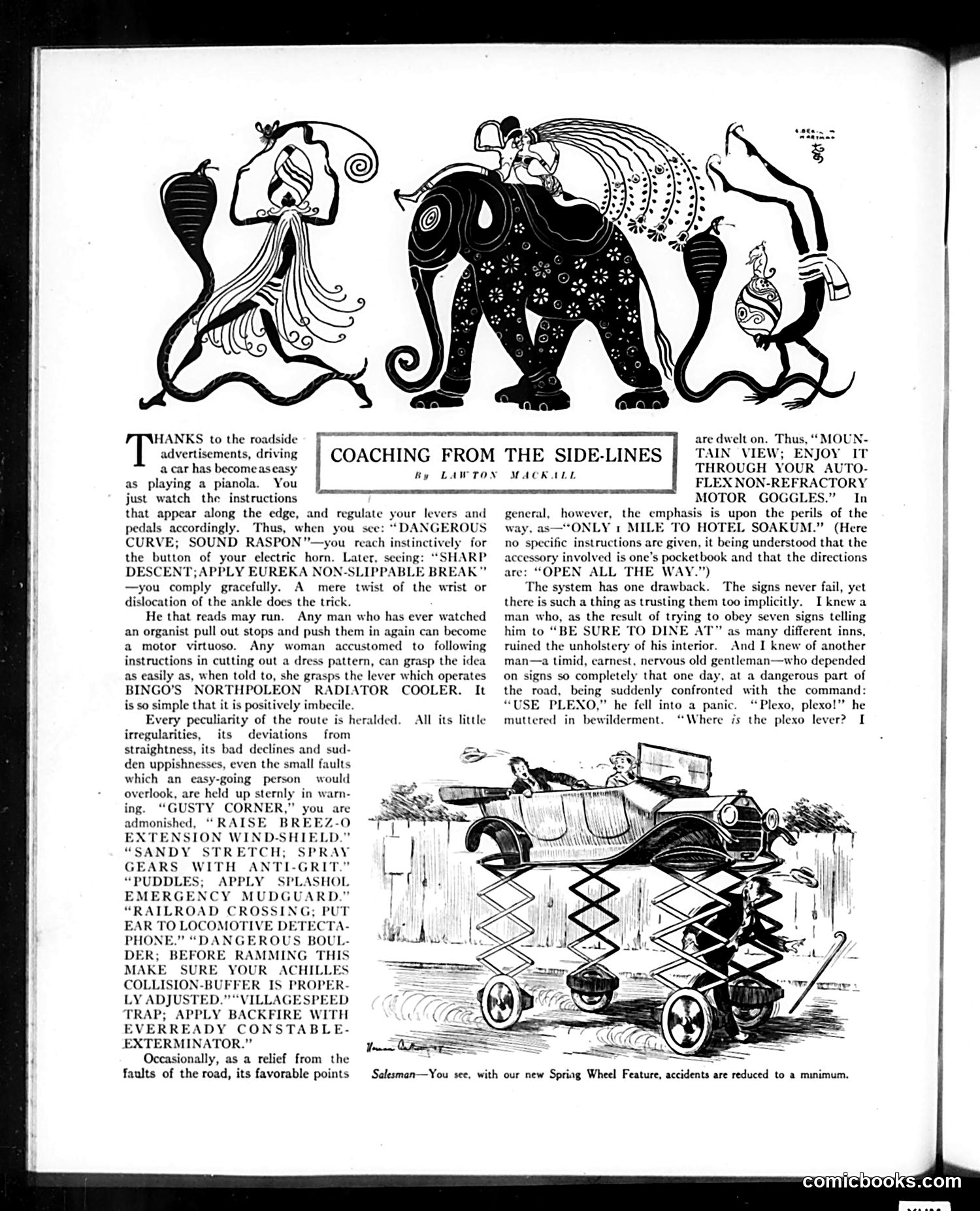
This article satirizes the proliferation of roadside advertising signs that instruct drivers on how to operate their automobiles. The author, Lawton Mackall, compares learning to drive via these signs to playing a player piano—both require passive compliance with external instructions rather than skill. The satire targets how exhaustively signs dictate even trivial actions (twist wrist, push button), treating drivers as incapable of independent judgment. Mackall illustrates the absurdity through invented command signs like "DANGEROUS CURVE," "SOUND RASPON," and "USE PLEXO" (a made-up product). The humor peaks in anecdotes about drivers who over-trusted signs: one man followed contradictory hotel directions and ruined his car's interior; another panicked searching for a non-existent "plexo lever." The accompanying illustration shows a car accident resulting from this over-reliance on roadside instructions—the cartoon's punchline supporting the text's critique of automotive advertising culture in the early 20th century.
📄 Transcribed text from this page (OCR, searchable)
Machine-transcribed from the original scan — historical spelling and the odd misread are preserved.
HANKS to the roadside T advertisements, dri a car has become. p as playing a pianola. just watch the instructions that appear along the edge, pedals accordingly. Thus, se CURVE; SOUND RASPON”—you reac the button of your electric horn. DESCENT; APPLY EUREKA NC —you comply gracefully. A mere twist of the wrist or dislocation of the ankle does the trick. He that reads may run. Any man who has ever watched an organist pull out stops and push them in again can become a motor virtuoso. Any woman accustomed to following instructions in cutting out a dress pattern, can grasp the idea as easily as, when told to, s asps the lever which operates BINGO’S NORTHPOL RADIATOR COOLER. It is so simple that it is positively imbecile. Every peculiarity of the route is heralded. All its little irregulari its deviations from straightness, sand sud- den uppishnesses, even the small faults which an easy-going person would overlook, are held up sternly in warn- EMERGENCY MUDGUARD.” “RAILROAD CROSSING; PUT URE YOUR ACHIL COLLIS -BUFFER IS PROPE LY “VILLAGESP TRAP; APPLY BACKFIRE WI EVERREADY CONSTABLE- EXTERMINATOR.” Occasionally, as a relief from the faults of the road, its favorable points COACHING FROM THE SIDE-LINES By LAWTON are dwelt on. Thu: TAIN V. ’; ENJOY IT THROUGH YOUR AUTO- MACK ALY FLEX NON-REFRACTORY MOTOR GOGGLES.” In of the general, however, the emphasis is upon the pe wa ONL E ‘0 HOTEL SOAKUM.” (Here ¢ given, it being understood that the pocketbook and that the directions N ALL THE WAY.”) The system has one drawback. The signs never fail, yet there is such a thing as trusting them too implicitly. Iknewa man who, as the result of trying to obey seven signs telling him to “BE SUR ‘oO DID T” as many different inns, ruined the unholstery of his interior. And I knew of another man—a timid, carnest, nervous old gentleman—who depended on signs so completely that one day, at a dangerous part of the road, being suddenly confronted with the command: “USE PLEXO,” he fell into a panic. “Plexo, plexo!"”” he muttered in bewilderment. “Where is the plexo lever? I oe |