
Judge, 1917-05-19 · page 17 of 32
Judge — May 19, 1917 — page 17: what you’re looking at
What you’re looking at
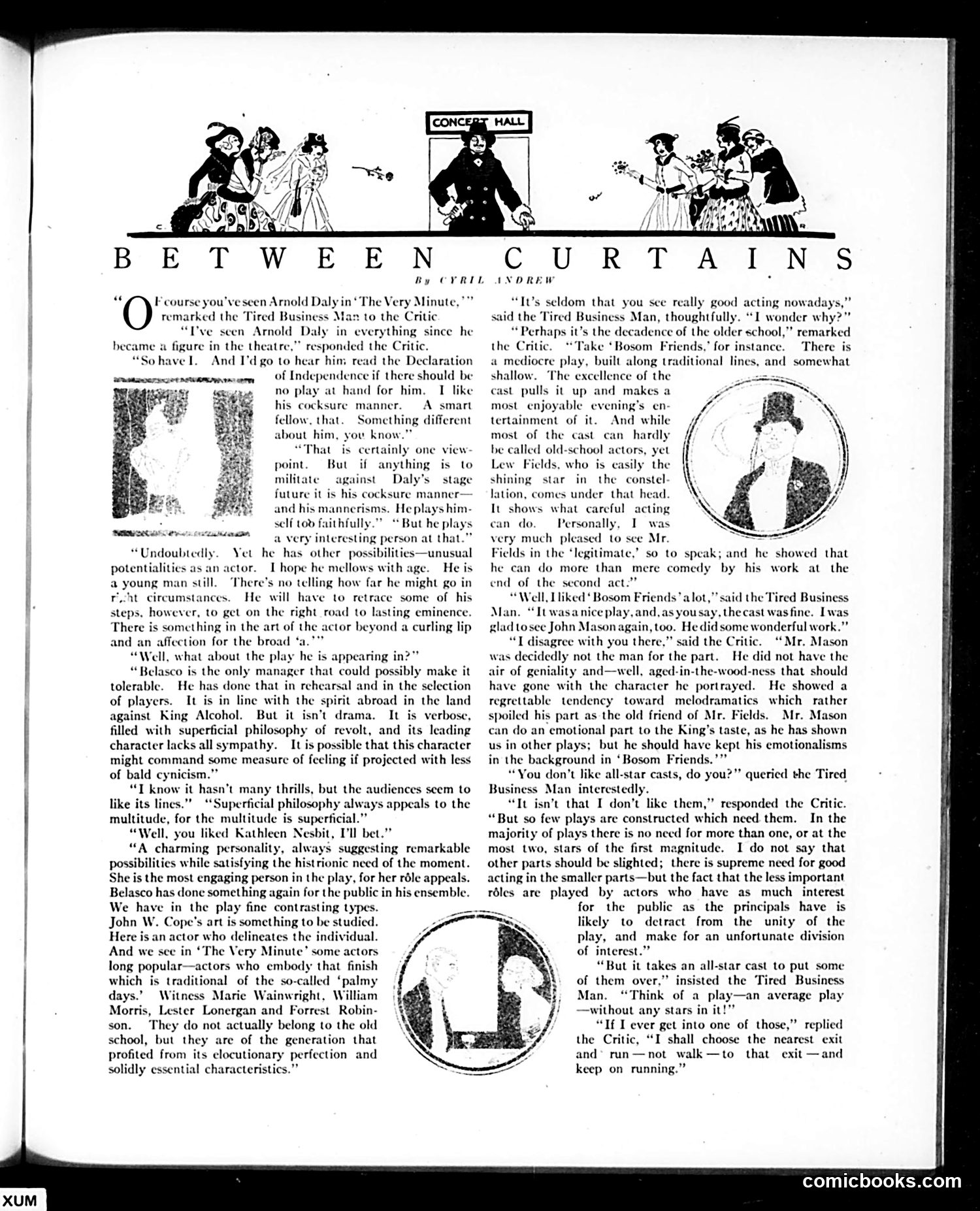
This is a theatrical criticism column by Cyril Andrews featuring a dialogue between a "Tired Business Man" and a "Critic" discussing contemporary Broadway productions. **Key figures discussed:** - **Arnold Daly**: An actor praised for his "cocksure manner" but criticized for self-indulgent mannerisms that may harm his career - **Lew Fields**: Commended for skillful acting in "Bosom Friends," demonstrating that serious performance exceeds comedy work - **John Mason**: Referenced as a returning performer - **David Belasco**: The producer/manager credited with making mediocre plays tolerable through direction and casting **The satire's point:** The dialogue contrasts two theatrical philosophies—the Critic's sophisticated aesthetic standards versus the Businessman's simpler entertainment tastes. The Critic argues modern acting lacks depth, attributing this to the "decadence of the older school." The piece mocks both pretentious criticism and unsophisticated audiences while examining whether contemporary theater (around 1910) maintains artistic standards of earlier generations.
📄 Transcribed text from this page (OCR, searchable)
Machine-transcribed from the original scan — historical spelling and the odd misread are preserved.
BE T WE EN as F course you've seen Arnold Daly in* The Very Minute,’” O remarked the ed Business to the Critic “Pve seen Arnold Daly ything since he became a figure in the theatre,” responded the Critic. “Sohavel. And I'd go to hear him read the Declaration of Independence if there should be no play at hand for him. I like his cocksure manner. A smart fellow, that. Something different about him, you know.” “That is certainly one view point. But if anything is to militate against Daly’s stage future it is his cocksure manner- and his mannerisms. He plays him- ARETE SORIA Ce : self tod faithfully.” * But he plays Rema erwcncaneewee 4 Very interesting person at that.” “Undoubtedly. Yet he has other possibilities—unusual potentialities as an actor. I hope he mellows with age. He is a young man still. There's no telling how far he might go in rat circumstances. He will have to retrace some of his steps, however, to get on the right road to lasting eminence. There is something in the art of the actor beyond a curling lip and an affection for the broad ‘a.” “Well, what about the play he is appearing in?” “Belasco is the only manager that could possibly make it tolerable. He has done that in rehearsal and in the selection of players in line with the spirit abroad in the land against King Alcohol. But it isn’t drama. It is verbose, filled with superficial philosophy of revolt, and its leading character lacks all sympathy. It is possible that this character might command some measure of feeling if projected with less of bald cynicism. “T know i s, but the audiences seem to sophy always appeals to the multitude, for the multitude is superficial.” “Well, you liked Kathleen bit, I'll bet.” “A charming personality, always suggesting remarkable possibilities while satisfying the histrionic need of the moment. She is the most engaging person in the play, for her réle appeals. Belasco has done something again for the public in his ensemble. We have in the play fine contrasting typ John W. Cope's art is something to be studied. Here is an actor who delineates the individual. And we sce in ‘The Very Minute’ some actors long popular—actors who embody that finish which is traditional of the so-called ‘palmy days.’ Witness Marie Wainwright, William Morris, Lester Lonergan and Forrest: Robin- son. They do not actually belong to the old school, but they are of the generation that profited from its clocutionary perfection and solidly essential characteristics.” Ps. By CYRIL CURTAINS INDREW “Is seldom that you see really good acting nowaday said the Tired Business Man, thoughtfully. “I wonder why? “Perhaps it’s the decadence of the older school,”? remarked the Crit Take ‘Bosom ends,’ for instance. There a mediocre pl. built along traditional lines, and somewhat shallow. The excellence of the a cast pulls it. up and makes a gr IE most enjoyable evening's en b tertainment of it. And while most of the cast can hardly be called old-school actors, yet Lew Fields, who is casily the shining star in’ the constel lation, comes under that head. It shows what careful acting can do. — Personally, 1 was very much pleased to sce Mr. Fields in the ‘legitimate,’ so to speak; and he showed that he can do more than mere come by his work at the end of the second act.” “Well, Lliked ‘ Bosom Friends’ alot,” said the Tired Business. Man. “Itwasaniceplay,and,as yousay, thecast was fine. Iwas glad tosee John Mason again, too. He did some wonderful work.” “IT disagree with you there,” said the Critic. “Mr, Mason was decidedly not the man for the part. He did not have the air of geniality and—well, aged-in-the-wood-ness that should have gone with the character he portrayed. He showed a regrettable tendency toward melodramatics which rather spoiled his part as the old friend of Mr. Fields. Mr. Mason can do an emotional part to the King’s taste, as he has shown us in other plays; but he should have kept his emotionalisms in the background in ‘Bosom Friends.’” You don’t like all-star casts, do you?” queried the Tired Business Man interestedly. “It isn’t that I don’t like them,” responded the Critic. “But so few plays are constructed which need them. In the majority of plays there is no need for more than one, or at the most two, stars of the first magnitude. I do not say that other Parts should be slighted; there is supreme need for good acting in the smaller parts—but the fact that the less important réles are played by actors who have as much interest for the public as the principals have is likely to detract from the unity of the play, and make for an unfortunate division of interest.” “But it takes an all-star cast to put some of them over,” insisted the Tired Business Man. “Think of a play—an average play hout any stars in ii If I ever get into one of those,” replied the Critic, “I shall choose the nearest exit and’ run—not walk—to that exit —and keep on running.” comicbooks.com