
Judge, 1917-05-19 · page 6 of 32
Judge — May 19, 1917 — page 6: what you’re looking at
What you’re looking at
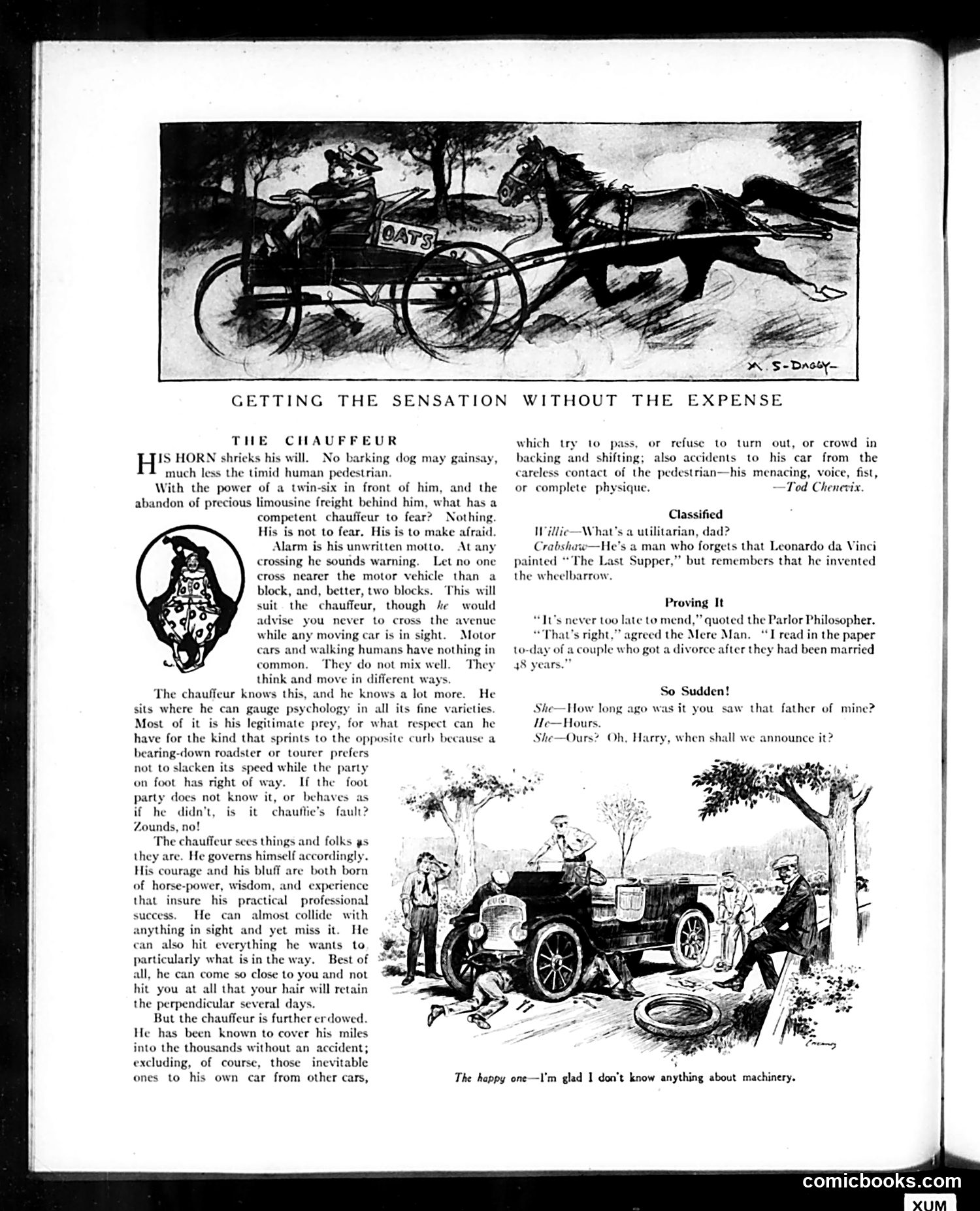
This Judge magazine page satirizes early-1900s automobile culture through contrasting scenarios. **Top cartoon**: A horse-drawn cart labeled "OATS" outruns a speeding automobile. The satire suggests that despite cars' expense and complexity, they don't necessarily outperform traditional horse transport—you get the "sensation" (excitement/speed) of modern motoring without the practical advantage. **"The Chauffeur" article**: Mocks professional automobile drivers, describing their arrogance and psychology. The text suggests chauffeurs are pretentious—they claim expertise while actually being reckless with pedestrians and other vehicles. **Bottom cartoon**: Shows a broken-down car surrounded by mechanics struggling with repairs, captioned "I'm glad I don't know anything about machinery." This mocks the unreliability and complexity of early automobiles, suggesting ignorance is preferable to owning such troublesome machines.
📄 Transcribed text from this page (OCR, searchable)
Machine-transcribed from the original scan — historical spelling and the odd misread are preserved.
THE CHAUFFEUR IS HORN shrieks his will. No barking dog may gainsay, much less the timid human pedestrian With the power of a twin-six in front of him, and the abandon of precious limousine freight behind him, what has a competent chauffeur to fear? Nothing. His is not to fear. His is to make afraid. Alarm is his unwritten motto. At any crossing he sounds warning. Let no one cross nearer the motor vehicle than a block, and, better, two blocks. This will suit the chauffeur, though /e would ady you never to cross the avenue while any moving car is in sight. Motor cars and walking humans have nothing in common. They do not mix well. They think and move in different ways. The chauffeur knows this, and he knows a lot more. He sits where he can gauge psychology in all its fine varieties. Most of it is his legitimate prey, for what respect can he have for the kind that sprints to the opposite curb because a bearing-down roadster or tourer prefers not to slacken its speed while the party on foot has right of way. If the foot party does not know it, or behaves as if he didn’t, is it chauftie’s fault? Zounds, no! The chauffeur sees things and folks gs they are. He governs himself accordingly. His courage and his bluff are both born of horse-power, wisdom, and experience that insure his practical professional success. He can almost collide with anything in sight and yet miss it. He can also hit everything he wants to particularly what is in the wa: Best of all, he can come so close to you and not hit you at all that your hair will retain the perpendicular several days. But the chauffeur is further erdowed. He has been known to cover his miles into the thousands without an accident; excluding, of course, those inevitable ones to his own car from other cars, GETTING THE SENSATION The happy one—I'm glad | don’t know anything about machinery. WITHOUT THE EXPENSE which try to pass, or refuse to turn out, or crowd in backing and shifting; also accidents to his car from the careless contact of the pedestrian—his menacing, voice, fist, or complete physique. Tod Chenevix. Classified Willie—What's a utilitarian, dad? Crabshaw—He’s a man who forgets that Leonardo da Vinci painted “The Last Supper,” but remembers that he invented the wheelbarrow. Proving It I's never too late to mend,” quoted the Parlor Philosopher. That's right,” agreed the Mere Man. “I read in the paper day of a couple who got a divorce after they had been married So Sudden! She—How long ago was it you saw that father of mine? He—Hours. She—Ours? Oh, Harry, when shall we announce it? comicbooks.com Sean at | | |