
A complete issue · 28 pages · 1917
Judge — May 12, 1917
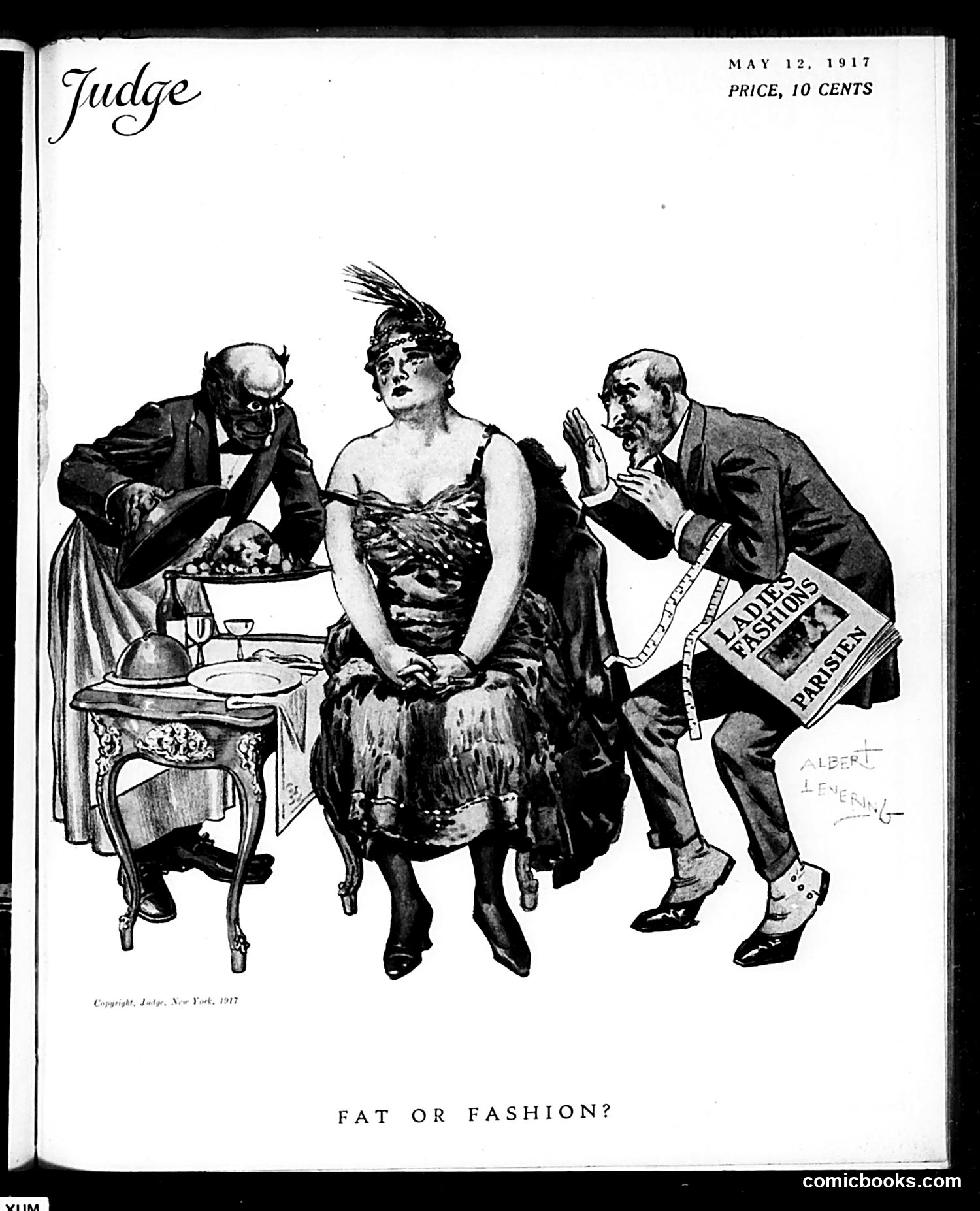
This satirical cartoon mocks the fashion industry's influence on women's bodies during the 1910s. A heavyset woman sits centrally, uncomfortably corseted in a fashionable dress, while two male figures—appearing to be fashion designers or tailor—flank her with exaggerated gestures. One holds what appears to be a fashion magazine or pattern labeled "LADY FASHIONS" and "PARIS SET." The satire critiques how fashion dictates that women conform their natural bodies to impractical, often uncomfortable standards set by (implicitly male-dominated) fashion industries. The woman's expression suggests her discomfort with this impossible standard. The title poses a rhetorical question: should women prioritize their natural body or slavish adherence to fashion trends? The cartoon suggests fashion demands women sacrifice comfort and authenticity for arbitrary aesthetic ideals.
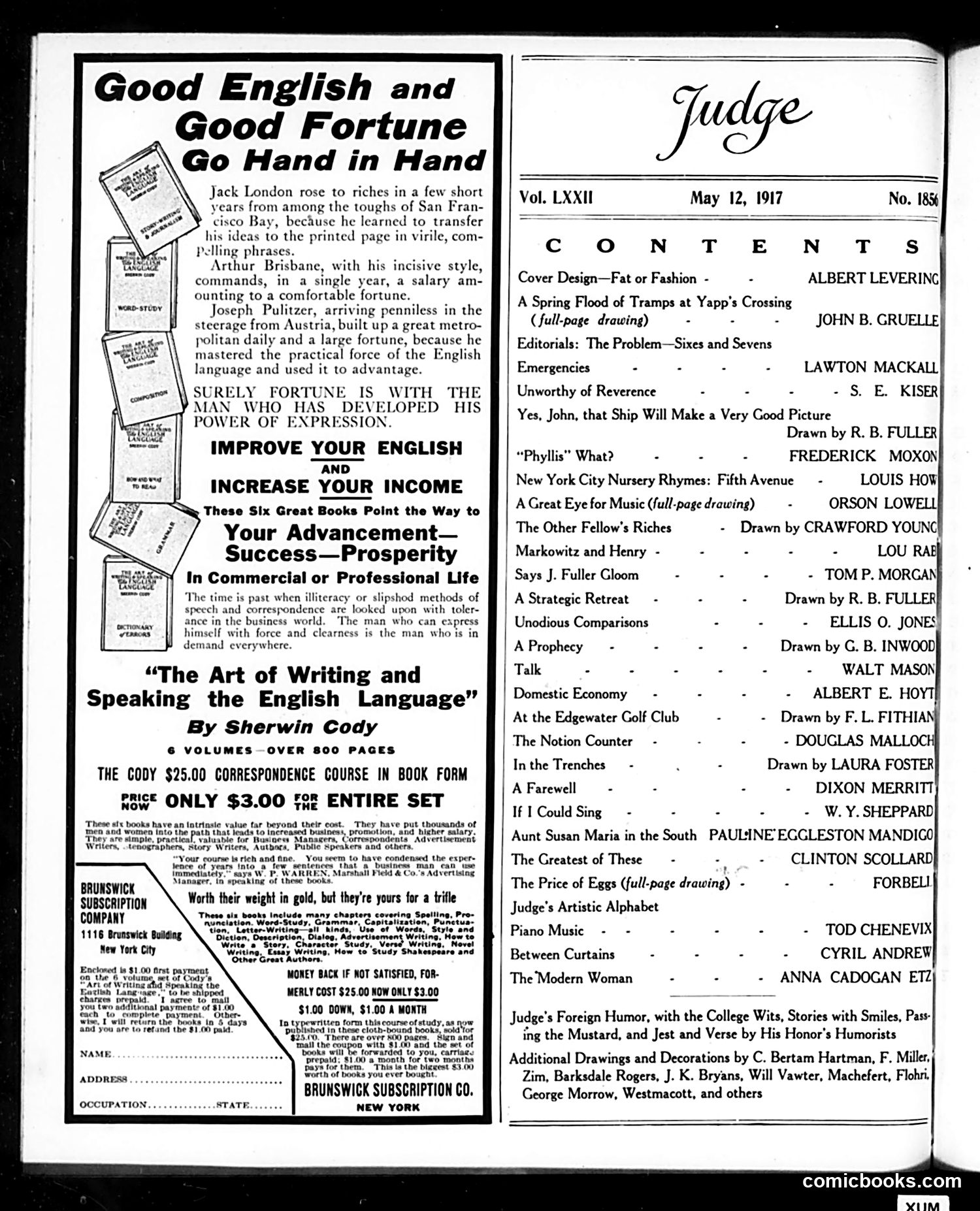
This is primarily a contents/index page for Judge magazine's May 1917 issue, listing articles and illustrations rather than displaying cartoons themselves. The left side contains a **advertisement for English language instruction books** by Sherwin Cody, emphasizing that "Good English and Good Fortune Go Hand in Hand." It promises success through improved communication skills—a common self-improvement pitch of the era. The right side lists the issue's contents, including pieces like "A Spring Flood of Tramps at Yap's Crossing," "Phyllis" What?", and "New York City Nursery Rhymes," suggesting Judge's typical blend of social humor and commentary. The **May 1917 date is significant**: America had just entered World War I (April 1917), though no war-related content is visible on this particular page.
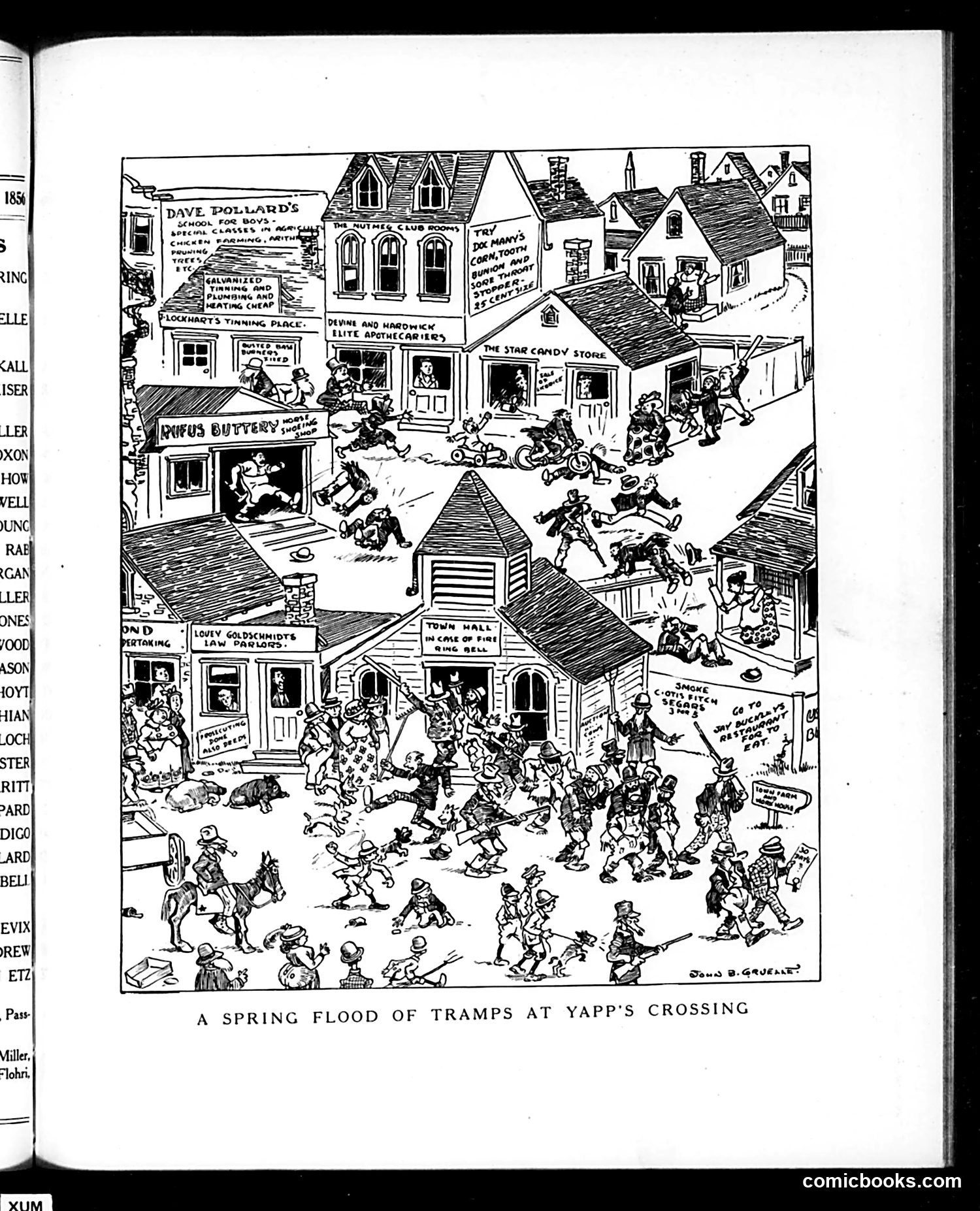
This satirical illustration depicts a chaotic scene of vagrants and hobos overrunning a small town. The cartoon presents various buildings and businesses—Dave Pollard's barber shop, the Star Candy Store, Town Hall, and others—all besieged by transients. The satire likely addresses late 19th/early 20th-century anxieties about homelessness and vagrancy, portraying "tramps" as an invasive force overwhelming respectable communities. The "spring flood" metaphor suggests these wanderers arrive seasonally in large numbers, threatening civic order and commerce. The cartoon reflects period prejudices against traveling poor and unemployed workers, presenting them as comic nuisances rather than sympathetically. This was a common satirical subject in American publications of this era.
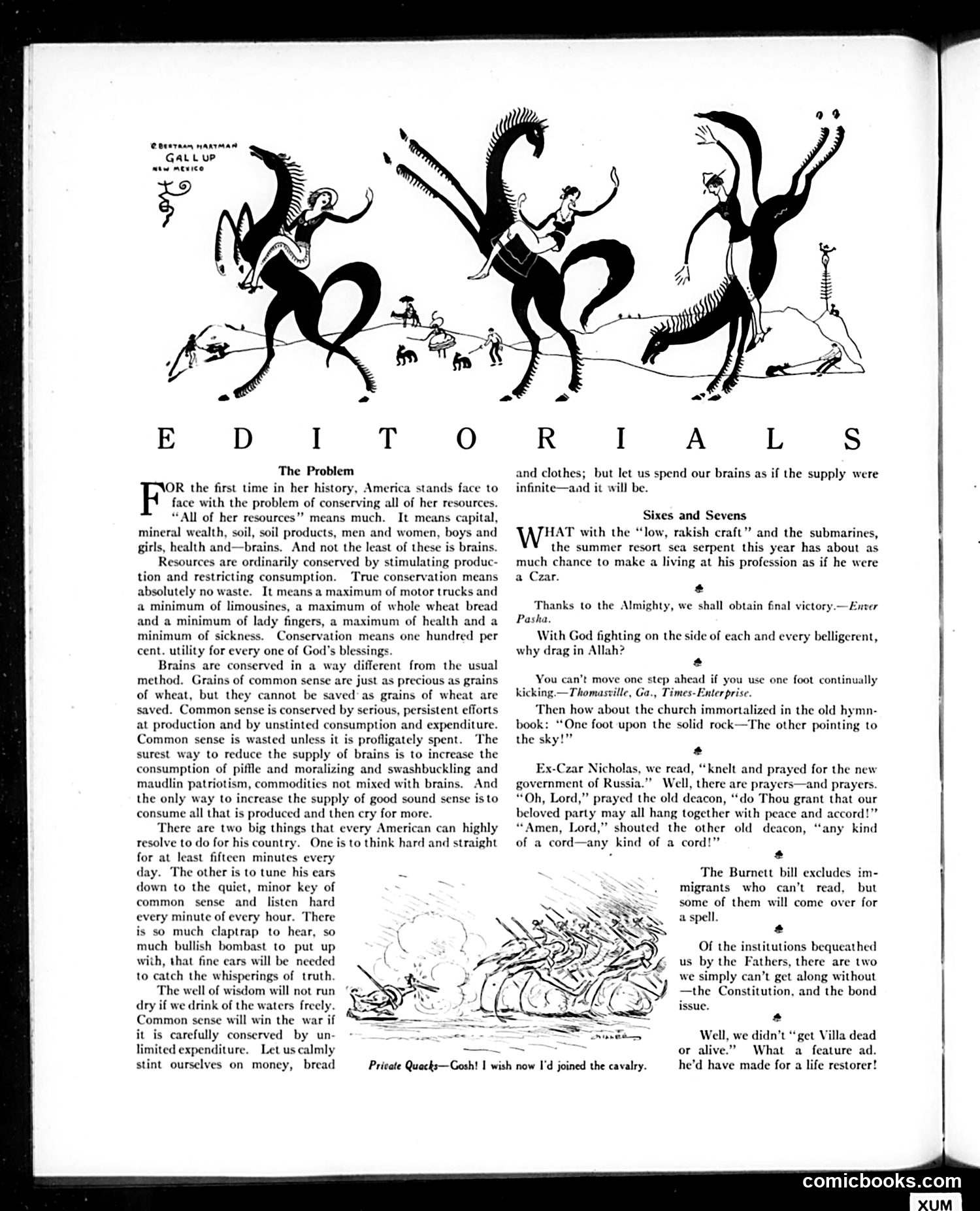
This page from *Judge* magazine presents wartime editorial content about conserving American resources. The title "Editorials" appears beneath stylized illustrations of demons or devils riding curved serpentine creatures—likely representing wasteful practices or profiteering. The main article, "The Problem," argues for strict conservation of capital, minerals, food, and manpower, advocating "maximum motor trucks and minimum limousines." It criticizes wasteful consumption while praising "common sense" as essential to winning the war. The subsequent brief sections reference contemporary debates: naval warfare ("Sixes and Sevens"), Russian politics ("Ex-Czar Nicholas"), and the Burnett immigration bill. A sketch at page bottom depicts what appears to be a cavalry soldier, accompanying a quote about joining the cavalry. The overall message promotes patriotic sacrifice and practical wartime economics.
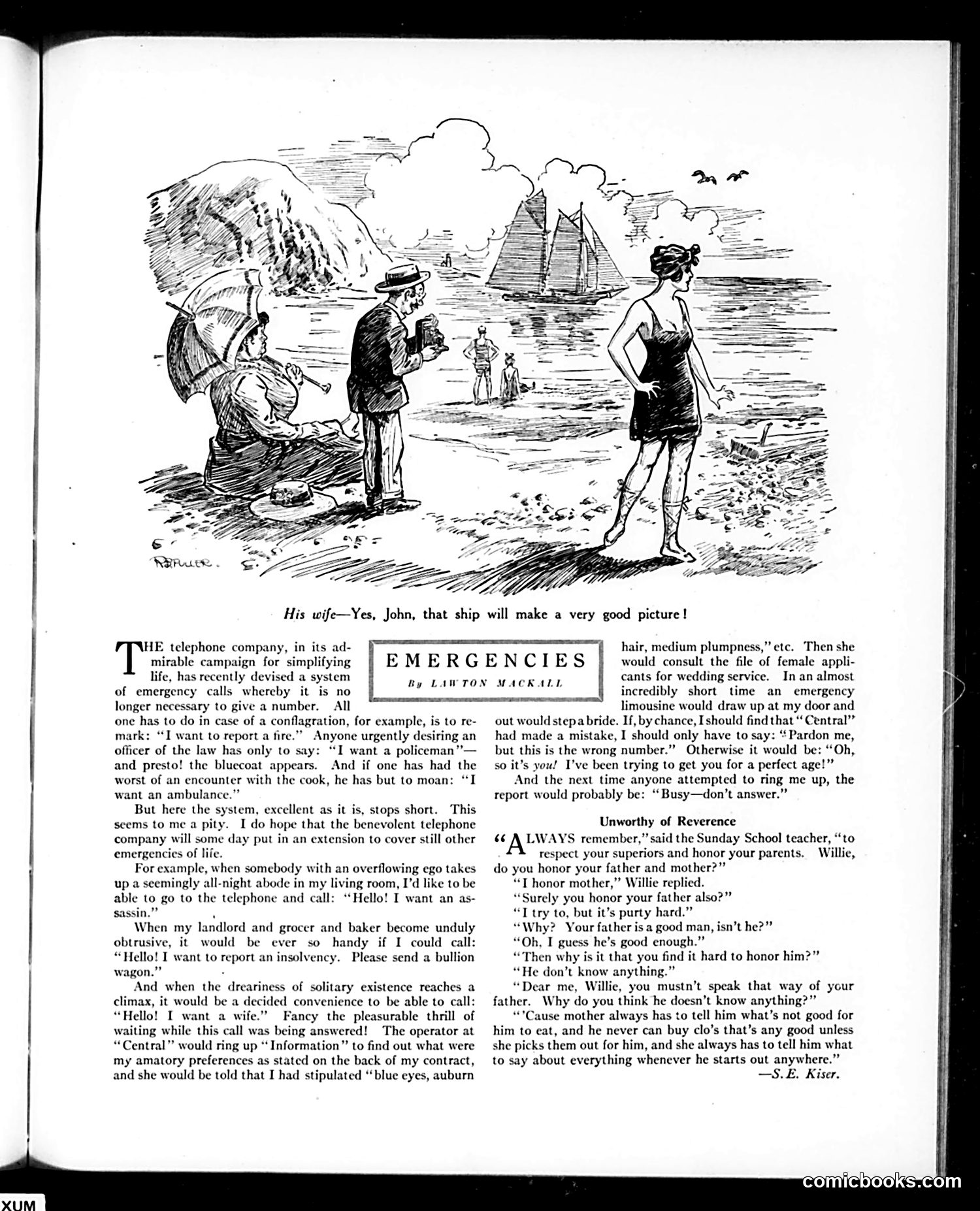
The main cartoon depicts a beach scene where a man in formal attire remarks to his wife about a sailing ship: "Yes, John, that ship will make a very good picture!" This appears to be gentle social satire about early 20th-century leisure and photography—possibly mocking the affectations of wealthy beachgoers or the casual way vacation moments were documented. Below this is an article titled "EMERGENCIES" by Linton Mackall about telephone company communication systems and their limitations. The piece humorously describes scenarios where emergency calls would be useful (reporting fires, needing ambulances, etc.). The final section, "Unworthy of Reverence," presents a dialogue between a Sunday School teacher and a boy named Willie about respecting parents—standard moral instruction humor typical of Judge's era.
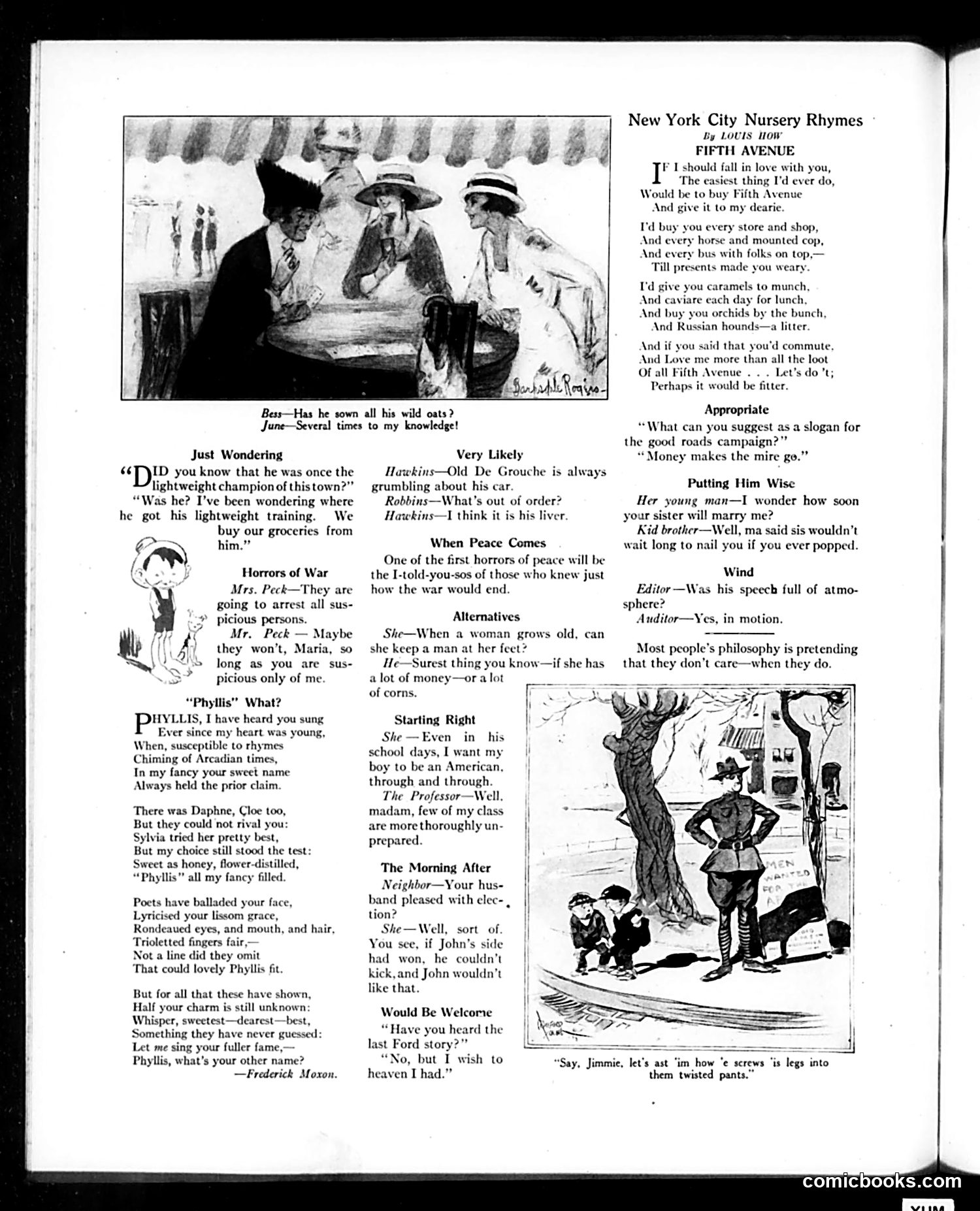
This page from Judge magazine contains humorous short pieces and sketches rather than political cartoons. The content includes: **"Fifth Avenue"** - A romantic poem about buying expensive gifts on New York's famous shopping street, satirizing consumer materialism and urban courtship. **"Just Wondering"** - Brief comedic dialogues mocking pretension, such as wondering about a "lightweight champion" and grocery shopping habits. **"Phyllis What?"** - A longer poem by Frederick Meson playfully teasing a woman named Phyllis, comparing her to historical figures like Daphne and Sylvia. The sketches show everyday domestic scenes—people conversing, children playing outdoors. The overall tone is light, social satire targeting middle-class American life, shopping culture, and romantic conventions rather than partisan politics. This appears to be entertainment-focused content typical of Judge's humor magazine format.
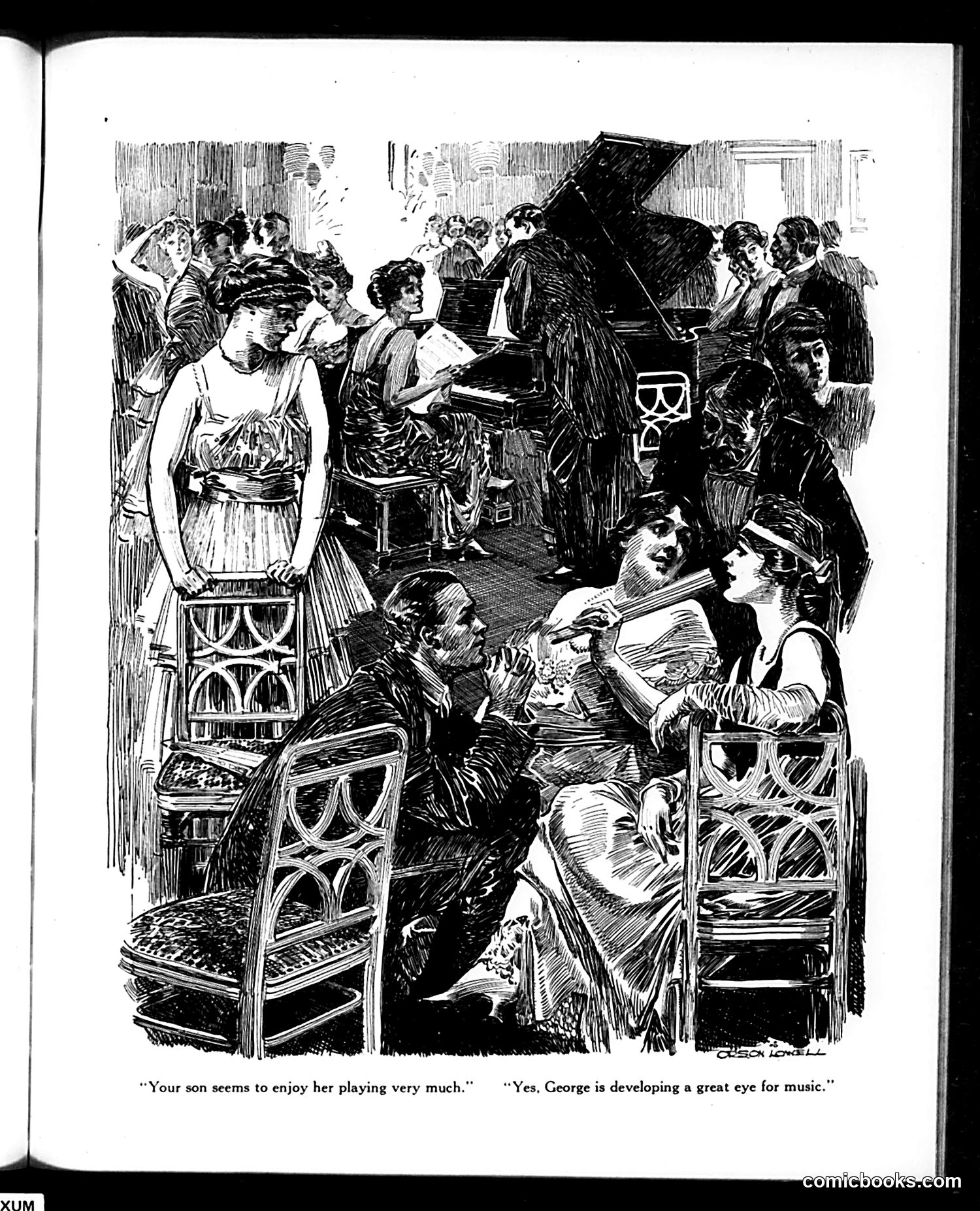
This is a humorous domestic scene from Judge magazine depicting a social gathering with musical performance. Two adults comment on a young man named George who is watching a female musician play piano. The joke relies on a double entendre: while one observer notes George "enjoys her playing," the response quips he's "developing a great eye for music"—implying George is more interested in *looking at* the attractive female pianist than actually listening to the music. The phrase "eye for music" is a pun, since having a good "eye" normally means visual appreciation, not auditory appreciation. This reflects period attitudes about young men, courtship, and social gatherings, satirizing the pretense that musical salons were purely cultural events when romantic attraction was clearly at play.
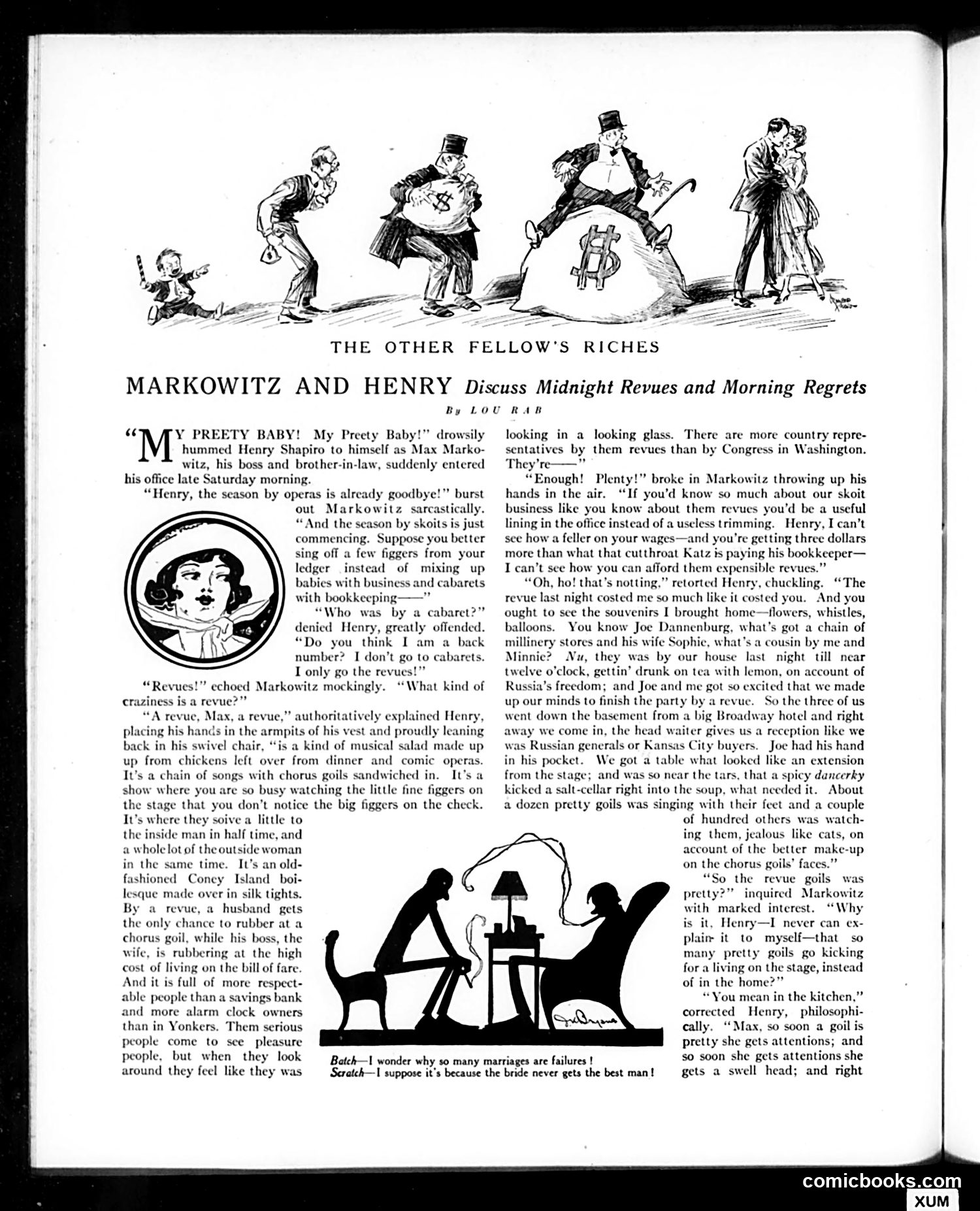
This is a satirical dialogue between Max Markowitz (a boss) and Henry Shapiro (an employee) about Broadway revues—a popular early 20th-century theatrical form mixing music, dancing, and comedy sketches. **The satire's targets:** 1. **Class hypocrisy**: Henry defends revues as morally respectable while admitting they're basically updated burlesque designed to let married men ogle chorus girls while their wives watch, distracted by expensive tickets. 2. **Immigrant/Yiddish-inflected English**: The phonetic dialect ("by a cabaret," "figgers," "goils") marks both men as working-class Jewish immigrants, common satirical subjects in Judge magazine. 3. **Marital tension**: The joke centers on the cost and moral compromise—Henry spends money he can't afford on entertainment his boss considers wasteful and improper, yet the boss also attends revues. The bottom cartoon offers a related joke about marriage: the bride never gets to keep the groom's best man (implying infidelity or that husbands stray after marriage). **The broader point**: Mocking both immigrant culture and the gap between respectable pretense and actual behavior in American leisure.
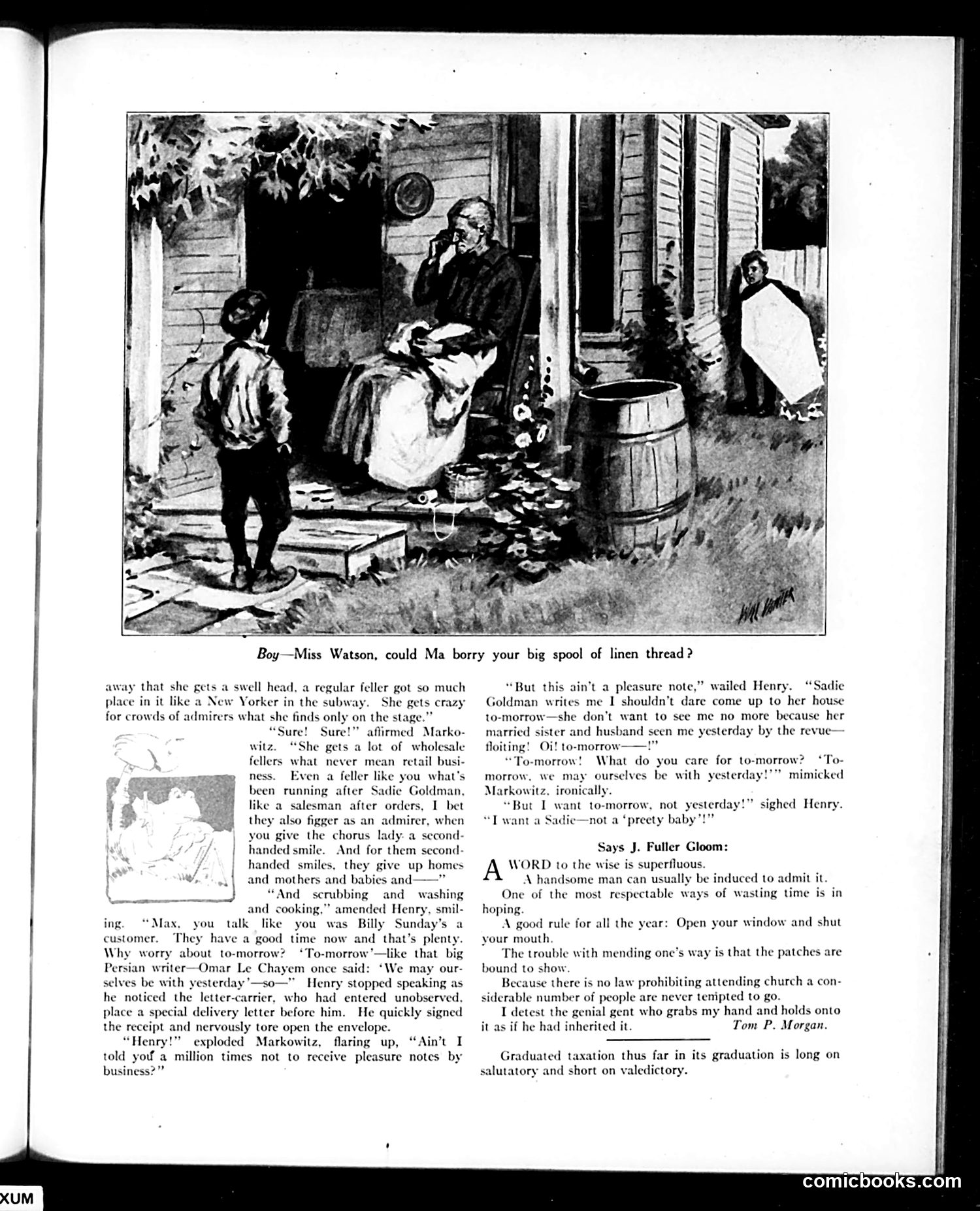
This page contains a comic story about Henry and his boss Markowitz, a clothing manufacturer. The satire centers on **working-class immigrant life** in early 20th-century America. The plot: Henry receives a special delivery letter from Sadie Goldman (a chorus girl) rejecting him because her married sister spotted him at a revue. Markowitz mocks Henry's romantic troubles, then cynically quotes the Persian poet Omar Khayyam about living for today, not worrying about tomorrow. **The satire's point**: Markowitz ironically lectures Henry about not fretting over the future—yet Henry actually *does* care about consequences (losing Sadie), exposing Markowitz's hollow philosophy. The humor comes from their contrasting attitudes toward responsibility and pleasure. The cartoon above shows tenement life, illustrating the working-class immigrant setting. The "Says J. Fuller Gloom" section offers unrelated satirical aphorisms mocking human nature.
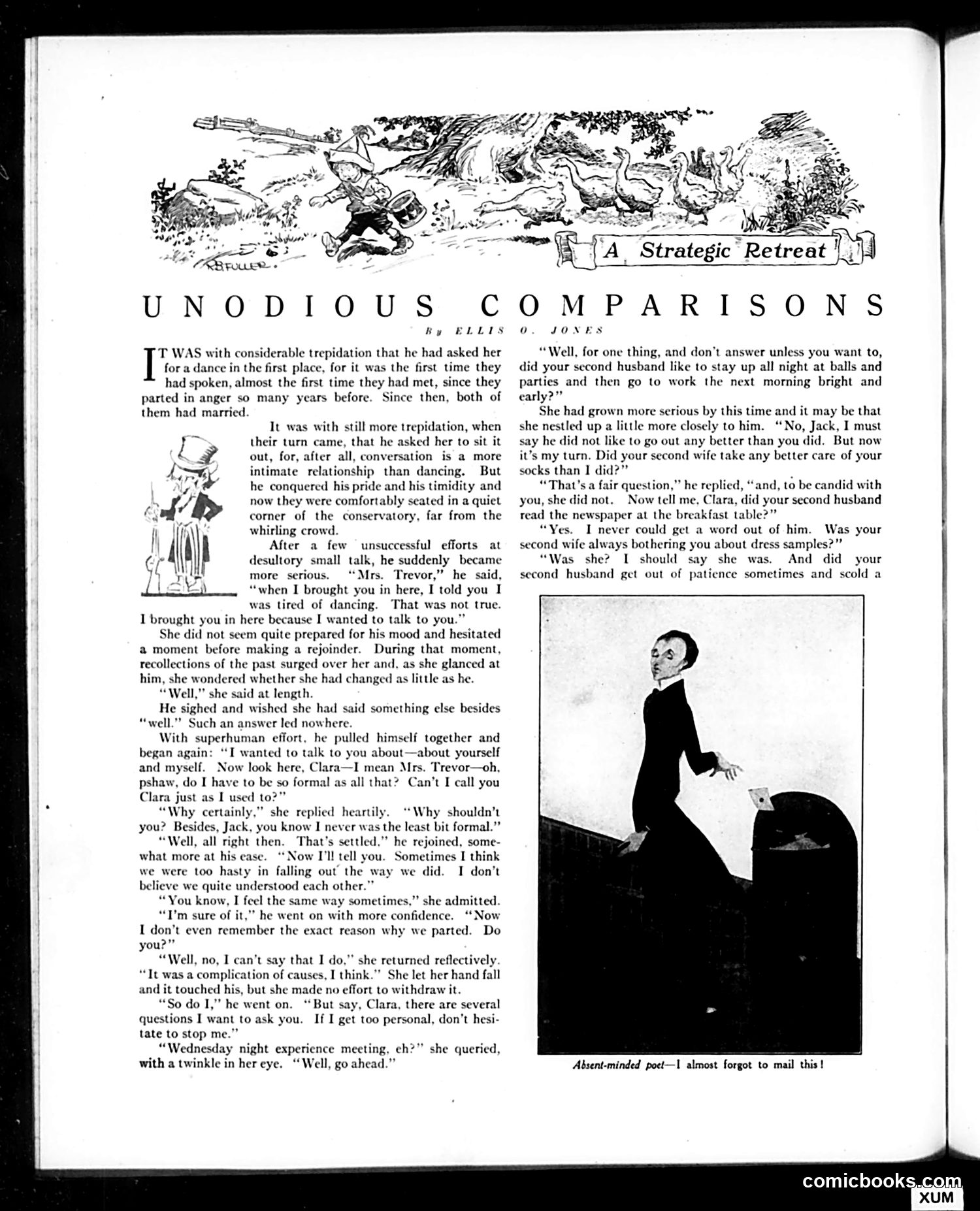
This story-based page depicts a sentimental reunion between two former lovers, Jack and Clara, now each married to other people. They reunite at a social event and discuss their past relationship and current marriages. The satire targets **romantic nostalgia and marital dissatisfaction**. The couple realizes they may have ended their relationship prematurely, then systematically catalog their spouses' faults—late-night partying habits, poor sock care, newspaper-reading at breakfast, nagging about dress samples, impatience. The humor lies in their **discovery that their current marriages replicate the same annoying patterns** they apparently complained about before. The cartoon's title "A Strategic Retreat" (top) and the illustration of an absent-minded poet reinforce the theme: both characters are retreating into nostalgic comparison rather than appreciating what they have. The piece satirizes how people romanticize past relationships while overlooking that their problems may be universal rather than partner-specific—or, darkly, that they themselves are the common problem.
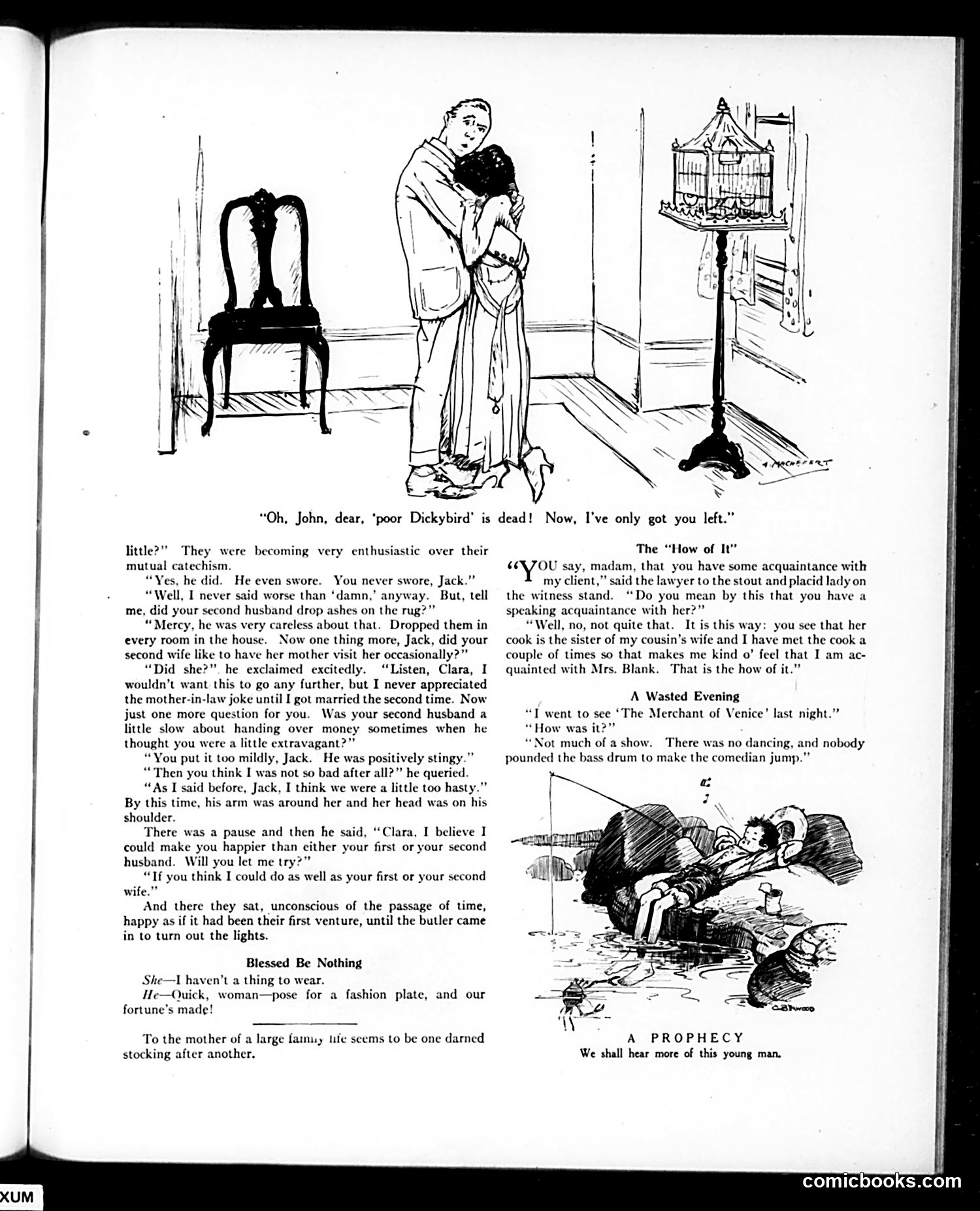
This page from *Judge* magazine contains several satirical pieces poking fun at early 20th-century social conventions: **Main cartoon (top):** A widow and widower reminisce about their respective previous spouses, comparing notes on domestic annoyances (ashes on rugs, intrusive mothers-in-law, financial stinginess). The satire mocks how people rationalize remarriage by convincing themselves their new partner is superior to past ones—while apparently oblivious to their own flaws. **"Blessed Be Nothing":** A joke about gender and vanity—a woman claims to have nothing to wear while a husband suggests she pose for a fashion magazine, implying women's constant complaints about clothing are performative rather than genuine. **"The How of It":** Courtroom satire satirizing how people claim acquaintance through absurdly tenuous social connections (knowing someone's cook's sister). **"A Wasted Evening":** Mocks audiences expecting lowbrow entertainment (dancing, loud comedy) at serious theatrical productions like Shakespeare's *Merchant of Venice*. The humor relies on exaggerated character types and social observation typical of early 20th-century American satire.
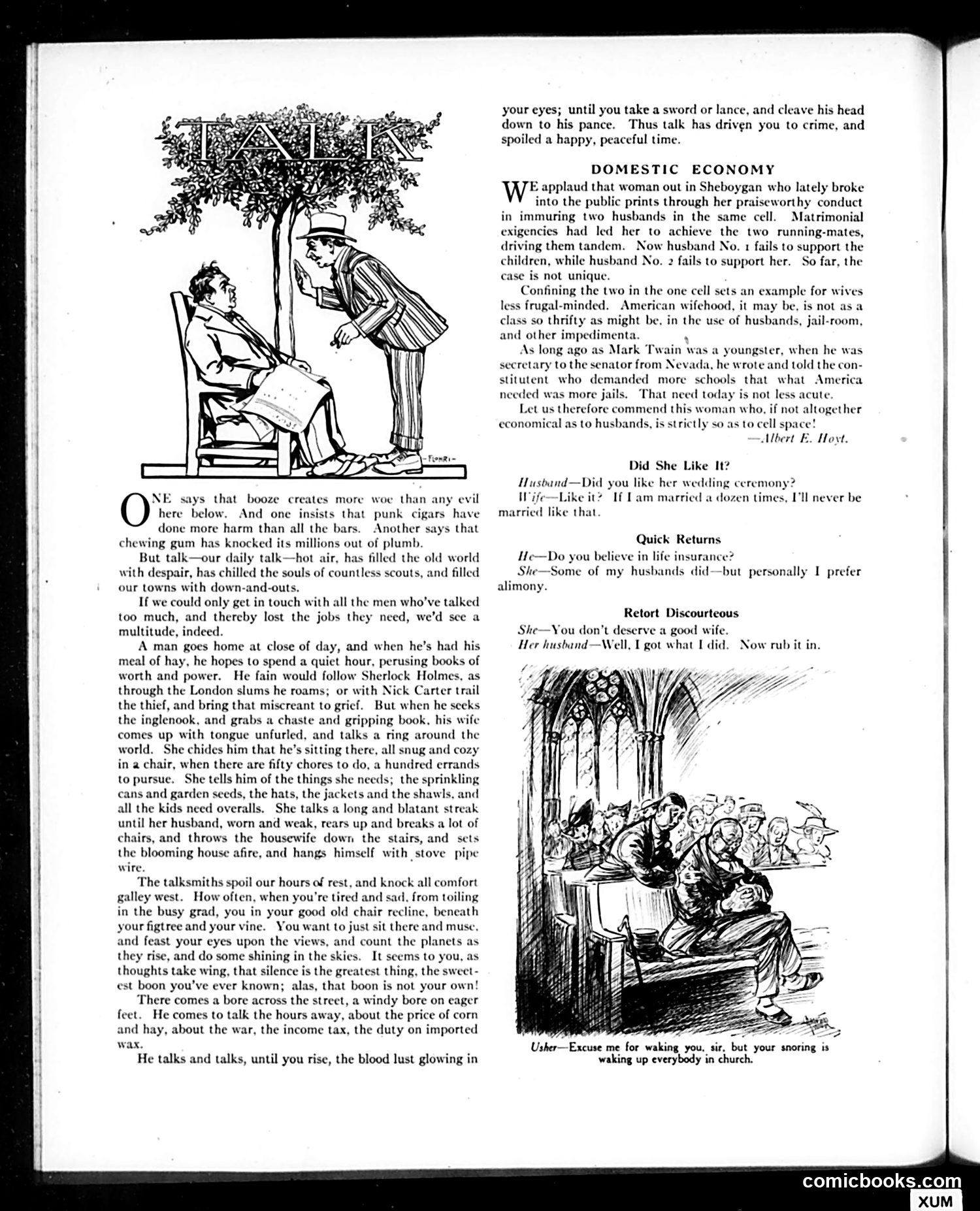
This page contains two distinct satirical pieces typical of early 20th-century American humor. **"Domestic Economy"** mocks a Sheboygan woman who imprisoned two non-supporting husbands in the same jail cell. The piece uses this real case to satirize wives' supposed wastefulness with husbands as a resource. It invokes Mark Twain's (then-recent) quip that America needed more jails than schools, suggesting society's real problem is criminal excess rather than education. The satire targets both marital dysfunction and social disorder through exaggerated praise of this woman's "economy." **The opening section** attacks excessive talking as society's greatest evil—surpassing booze, cigars, and chewing gum. It depicts a tired husband's domestic peace destroyed by his wife's incessant chatter about household tasks, escalating to violence and suicide. The accompanying cartoon illustrates this domestic conflict. Both pieces employ Judge's characteristic absurdist humor to critique American domestic life, gender relations, and social problems, using hyperbole and dark comedy to make their points about contemporary anxieties.
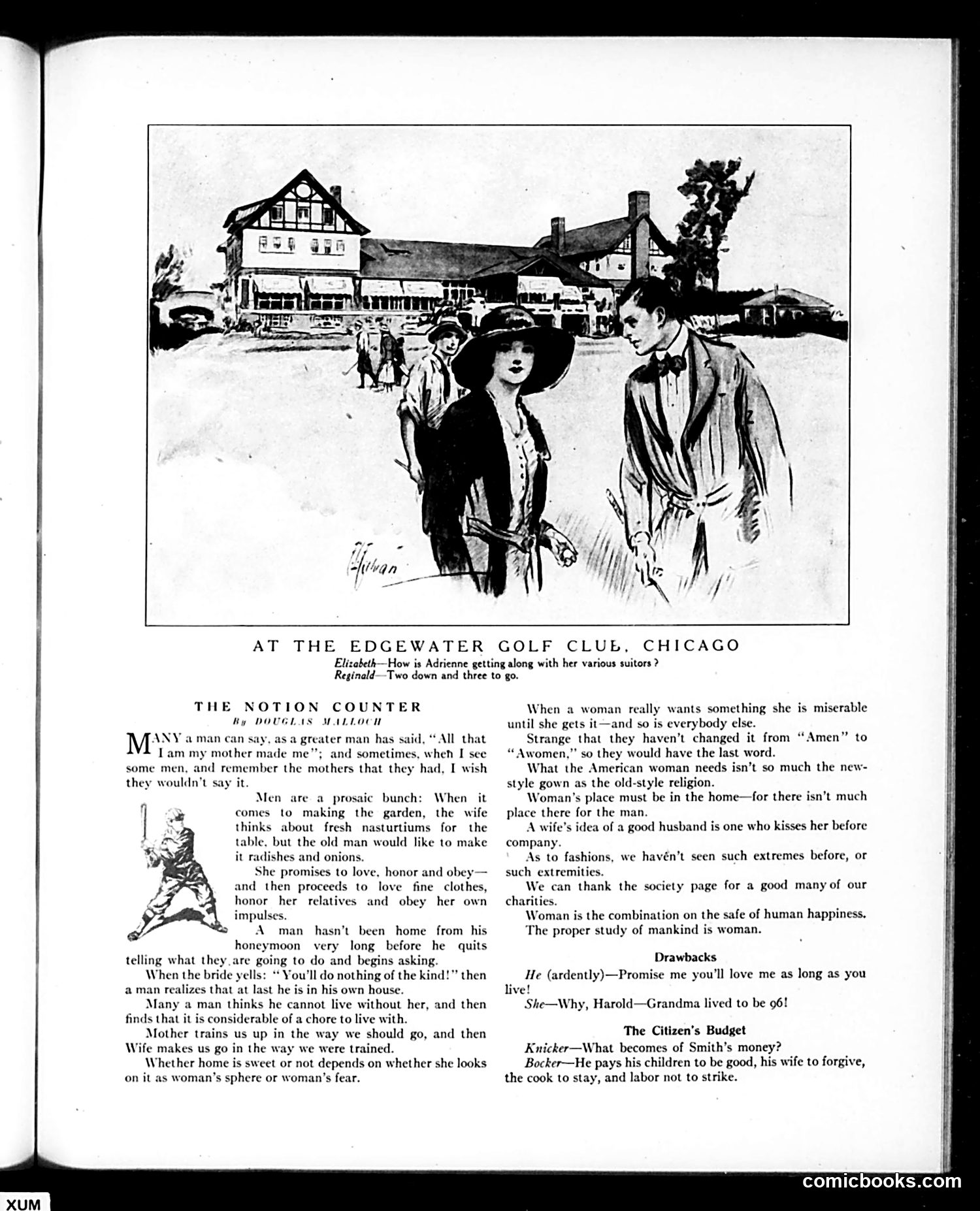
The page contains satirical commentary on gender relations and marriage, typical of early 20th-century American humor. **The Cartoon:** Shows a woman and man at Chicago's Edgewater Golf Club. The caption jokes that a woman named Adrienne is juggling suitors—"two down and three to go"—mocking both women's romantic pursuits and the era's courtship conventions. **"The Notion Counter":** A prose essay by Douglas Malloch offering sardonic observations about wives versus husbands. It attacks women's contradictions: they promise obedience but follow their own impulses; they claim to want a "woman's sphere" (the home) yet resent its confines. The piece mocks women's materialism, their desire for fashionable clothes, and their supposed need to "have the last word" in arguments. **Underlying Satire:** Rather than defending women, this satirizes *both* genders—depicting marriage as mutual frustration where wives manipulate and husbands are powerless. The humor reflects anxieties about changing gender roles and women's growing independence in the 1910s-1920s. The tone is misogynistic by modern standards, treating women's agency as inherently problematic.
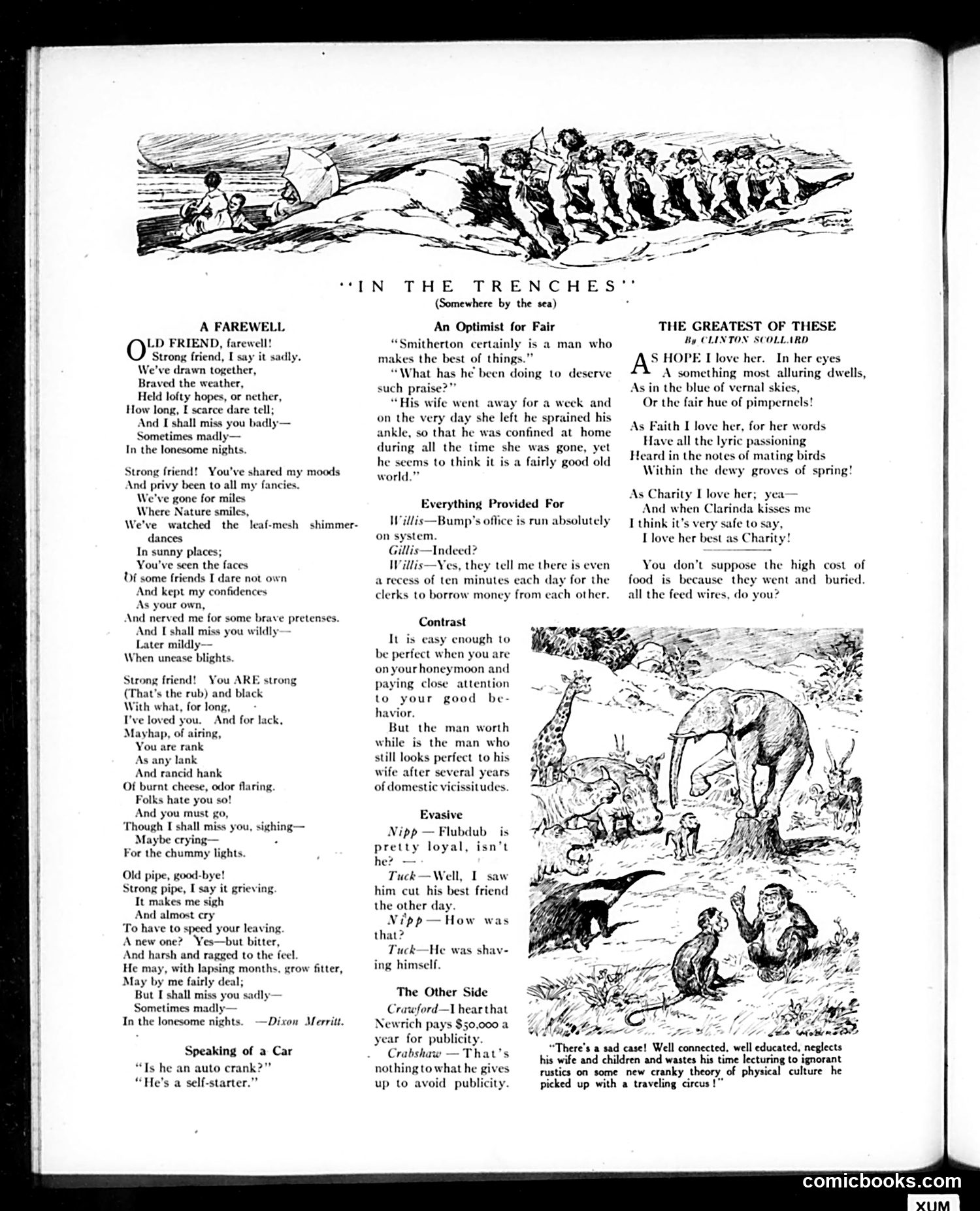
This page contains several satirical pieces typical of Judge's humor: **"A Farewell"** (left column): A sentimental poem by Dixon Merritt bidding goodbye to an old pipe. The joke is the mock-dramatic tone applied to a worn-out smoking pipe—treating it like a departing friend while acknowledging it's now rank-smelling and socially embarrassing ("Folks hate you so!"). It's gentle nostalgia-based humor. **"The Greatest of These"** (right column): A poem celebrating love in its three forms (Hope, Faith, Charity), playing on the biblical passage. The humor appears mild—romantic verse of the era. **Various short jokes** scattered throughout mock domestic life, office systems, and social pretension—typical Judge fare mocking middle-class American behavior. **The cartoons** show outdoor/nature scenes, possibly related to wartime ("In the Trenches" header), though details are unclear from this reproduction. The overall tone is light social satire and wordplay rather than hard political commentary.
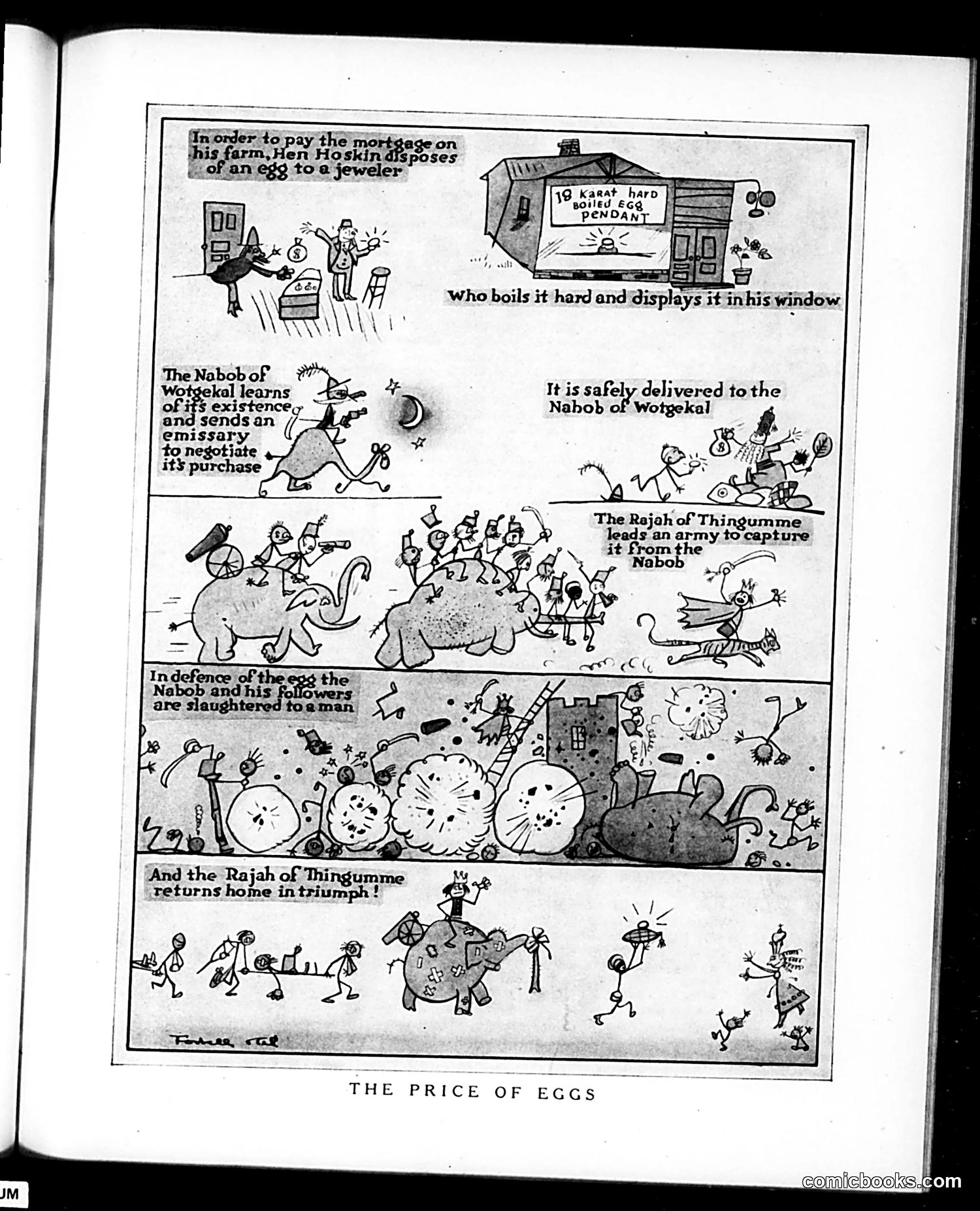
This is a satirical comic strip about economic absurdity. A farmer (Hen Hoskin) must sell a single egg to a jeweler to pay his farm mortgage. The jeweler boils and displays it as an "18 karat egg pendant." The "Nabob of Wotgekal" (a fictional exotic ruler) learns of this egg's existence and sends an emissary to purchase it. Simultaneously, the "Rajah of Thingumme" (another invented potentate) leads an army to capture it from the Nabob. The armies clash over the egg, causing destruction. **The satire:** The joke mocks the absurd consequences of inflating value through luxury marketing and the ridiculous international conflicts that ensue over worthless status symbols. What began as a practical necessity (paying a debt) becomes an object of warfare between fictional monarchs—a comment on how manufactured prestige and competitive consumption can escalate into chaos over essentially nothing.
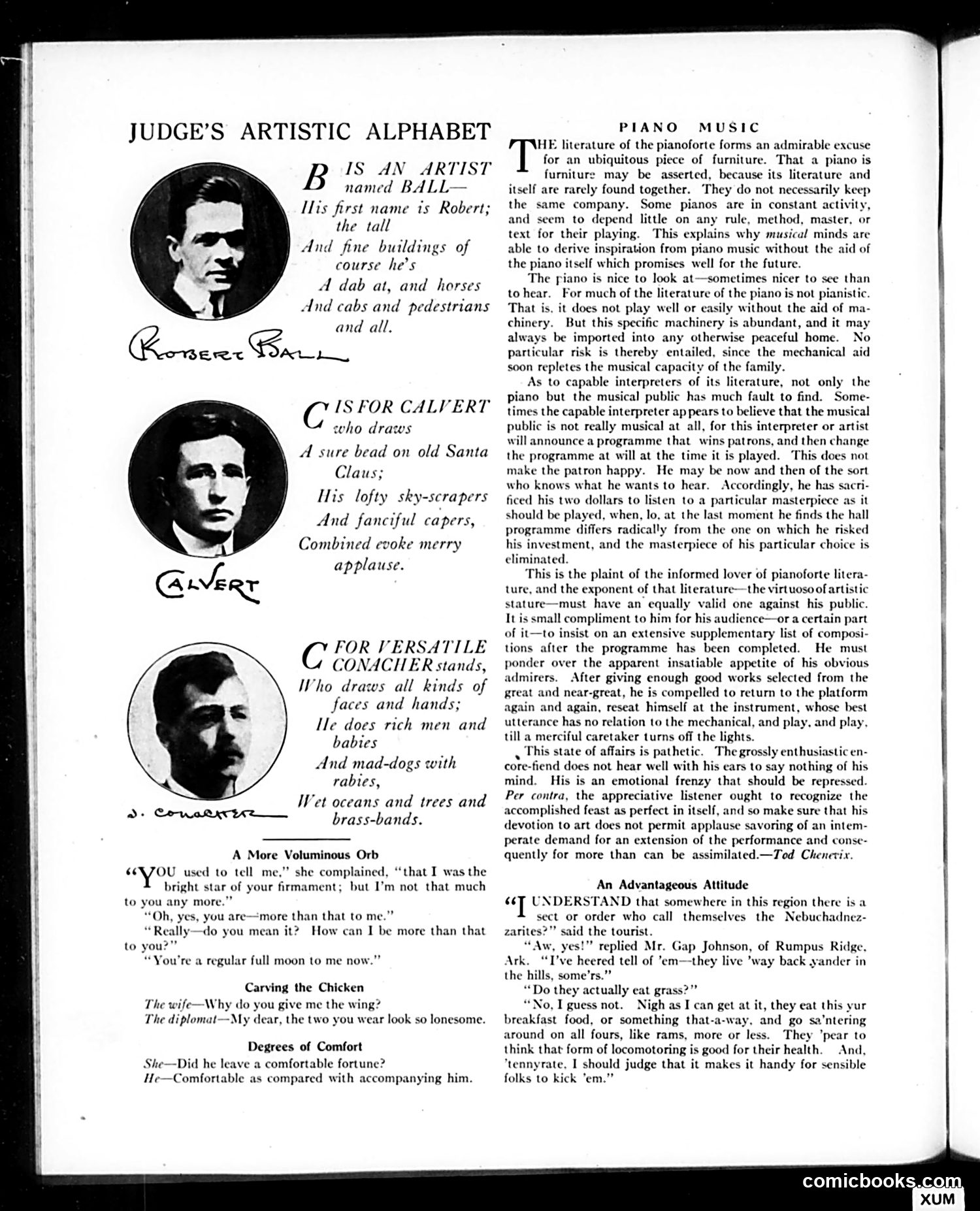
This page presents **satirical character sketches of cartoonists** working for Judge magazine, written as humorous alphabet entries. The text identifies three artists by their last names and caricatures: **Robert Ball** (who draws buildings, horses, and street scenes), **Calvert** (known for Santa Claus and architectural drawings), and **S. Conacher** (versatile figure artist). The accompanying jokes mock domestic life and social pretense—a husband comparing his wife's diminished importance to a "full moon," a diplomat's double meaning about carving chicken, and a wife questioning whether a departed husband's fortune was comfortable to *leave behind*. The "Piano Music" essay satirizes both piano culture and virtuoso performers—criticizing concert pianists who change programs arbitrarily, audiences who demand endless encores, and the gap between piano literature and actual playability.
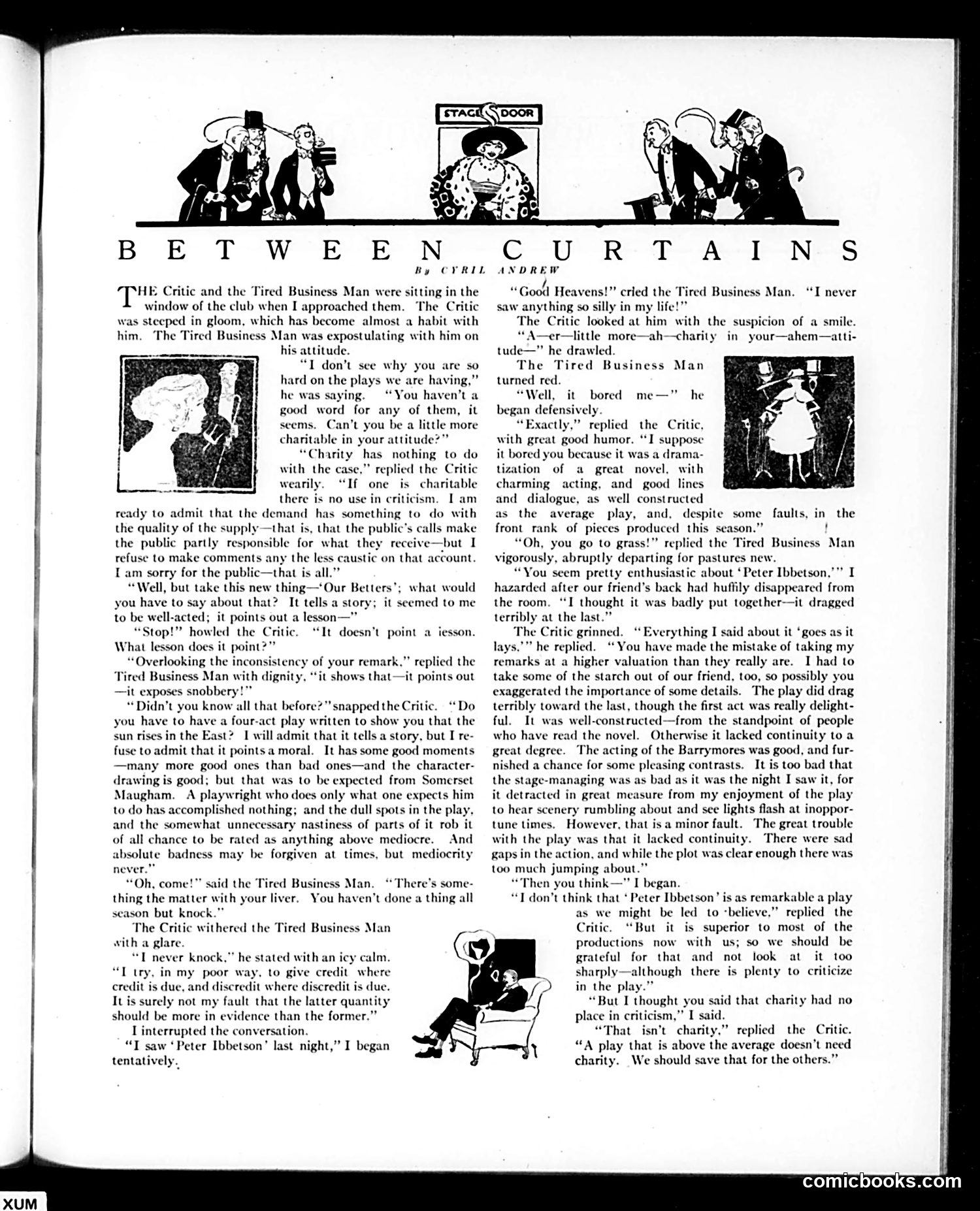
This satirical dialogue by Cyril Andrew appears in *Judge* magazine and depicts a conversation between a professional theater **Critic** and a **Tired Business Man** (a recurring character type representing the average, weary commuter). The satire targets **theatrical criticism versus popular taste**. The Critic is portrayed as harshly dismissive—refusing to praise any play, dismissing Somerset Maugham's "Our Betters" as mediocre despite its story and acting, and arguing criticism requires cruelty, not charity. When the Business Man praises "Peter Ibbetson," the Critic mockingly echoes his own standards back at him, revealing his hypocrisy: he praised the play only to needle his opponent, not from genuine conviction. The joke is that the pompous Critic claims to judge objectively but actually judges arbitrarily—judging "Our Betters" harshly for being predictable while praising "Peter Ibbetson" insincerely. The cartoon mocks how theater critics use intellectual superiority as cover for capricious, contradiction-filled opinions.
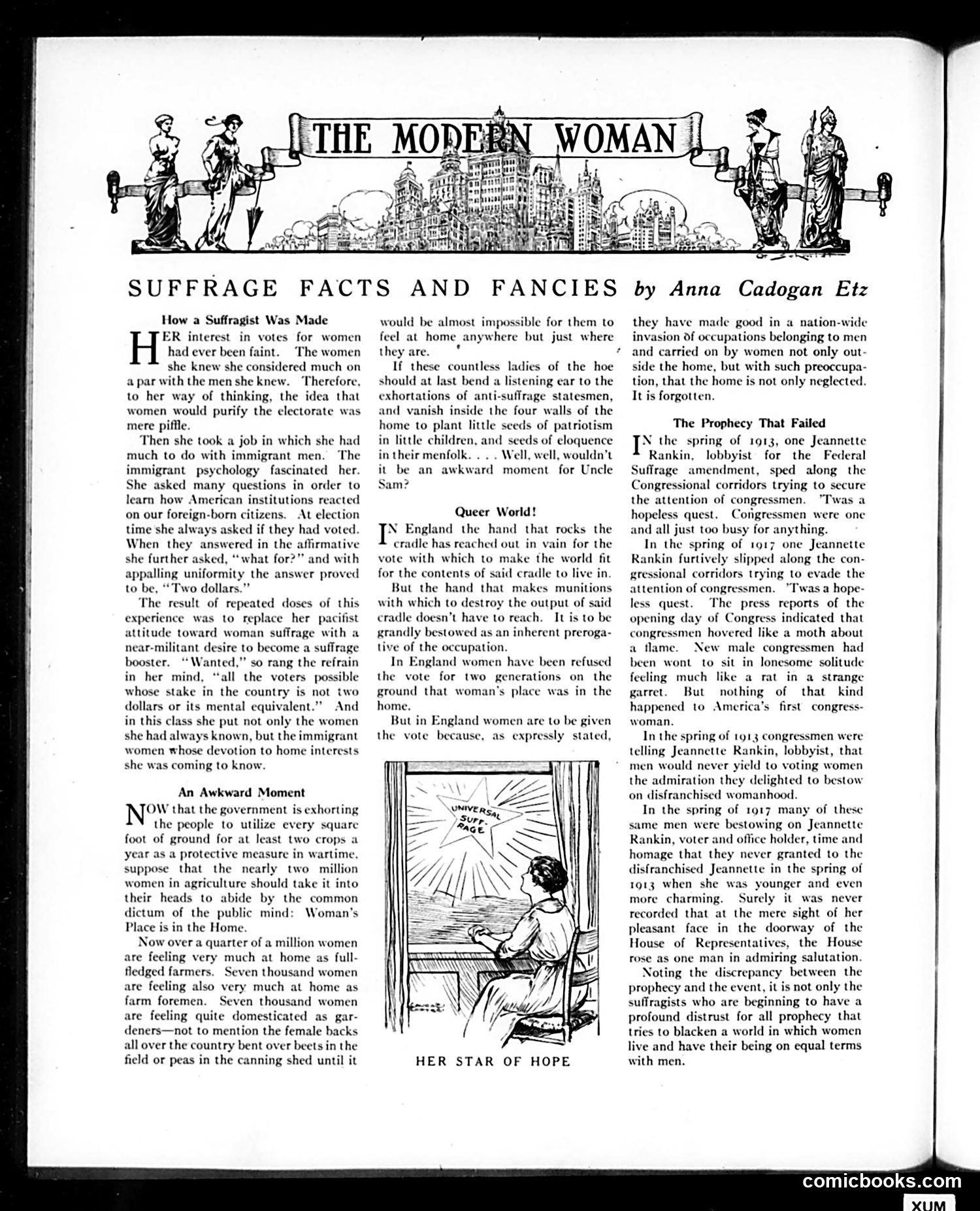
This article by Anna Cadogan Etz presents pro-suffrage arguments in *Judge*, a satirical magazine. The content includes three sections: **"How a Suffragist Was Made"** describes a woman who, after witnessing immigrant men vote corruptly for money ("Two dollars"), becomes a militant suffragist—arguing women deserve votes more than men who sell theirs. **"An Awkward Moment"** points out the hypocrisy of wartime: the government demands women work farms for national production, yet society insists "woman's place is in the home." **"Queer World!"** and **"The Prophecy That Failed"** reference Jeannette Rankin (the first woman elected to Congress, 1916), noting that male congressmen previously ignored suffragists in 1913 but by 1917 were suddenly deferential to her. The accompanying illustration, "Her Star of Hope," depicts a woman gazing toward suffrage symbolically. This pro-woman's-suffrage content satirizes anti-suffragists' contradictions: they deny women votes while exploiting their labor and accepting immigrant men's corrupted votes.
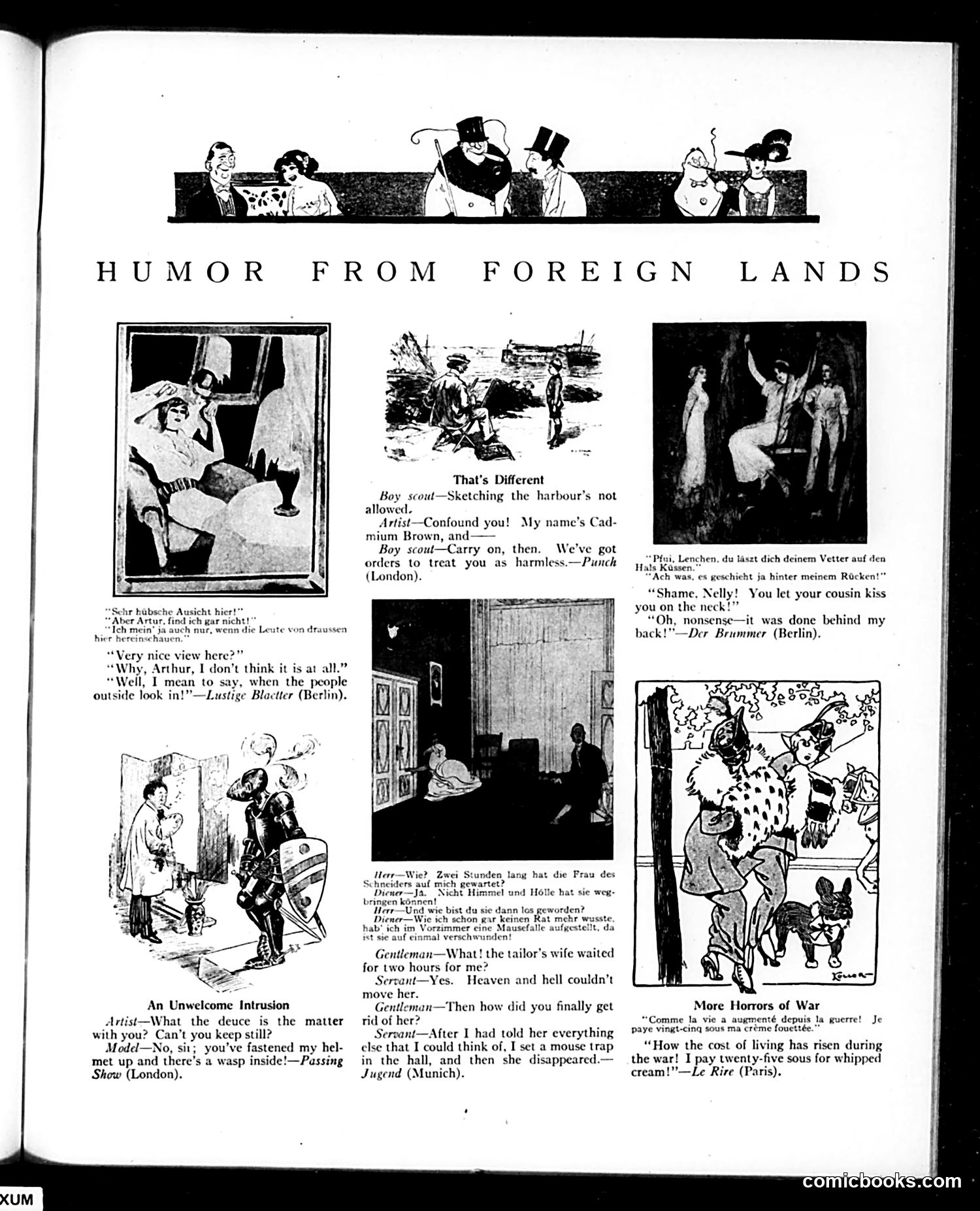
This page collects short comic anecdotes translated from European satirical magazines (Punch, Jugend, Der Brummer, Le Rire, Passing Show). The humor is genteel and domestic rather than overtly political. The jokes include: an artist's model trapped with a wasp in her helmet; a boy scout mistakenly stopping an artist from sketching a harbor; a gentleman whose tailor's persistently waiting wife is finally deterred by a mousetrap in the hall; a girl defending a cousin's kiss as acceptable because it happened behind her back; and a Parisian complaint about wartime inflation affecting even whipped cream prices. These reflect early 20th-century concerns: minor social embarrassments, class interactions, gender propriety, and—in the final joke—the economic hardships of World War I. The page demonstrates *Judge* magazine's international perspective, presenting Continental humor as sophisticated entertainment for American readers.
This is primarily a **theater advertising page** from Judge magazine, listing current Broadway shows (circa 1918, based on war references in play titles). The main illustrated element—a decorative oval vignette on the left—is ornamental rather than satirical; it frames the "For Your Amusement" section advertising theatrical productions. The page includes advertisements for books, particularly Maurice Switzer's *"The Letters of a Self-Made Failure,"* marketed as humorous and philosophical reading. The text-based content includes brief theatrical synopses and three short humor items ("Who Am I?", "How It Happened," "Also, They Do It")—generic anecdotal jokes typical of Judge's filler humor, involving workplace and marital situations. These contain **no political satire or caricature**. This appears to be a **commercial/entertainment page** rather than satirical commentary—Judge's core function sometimes involved promoting theater and entertainment rather than purely political cartooning.
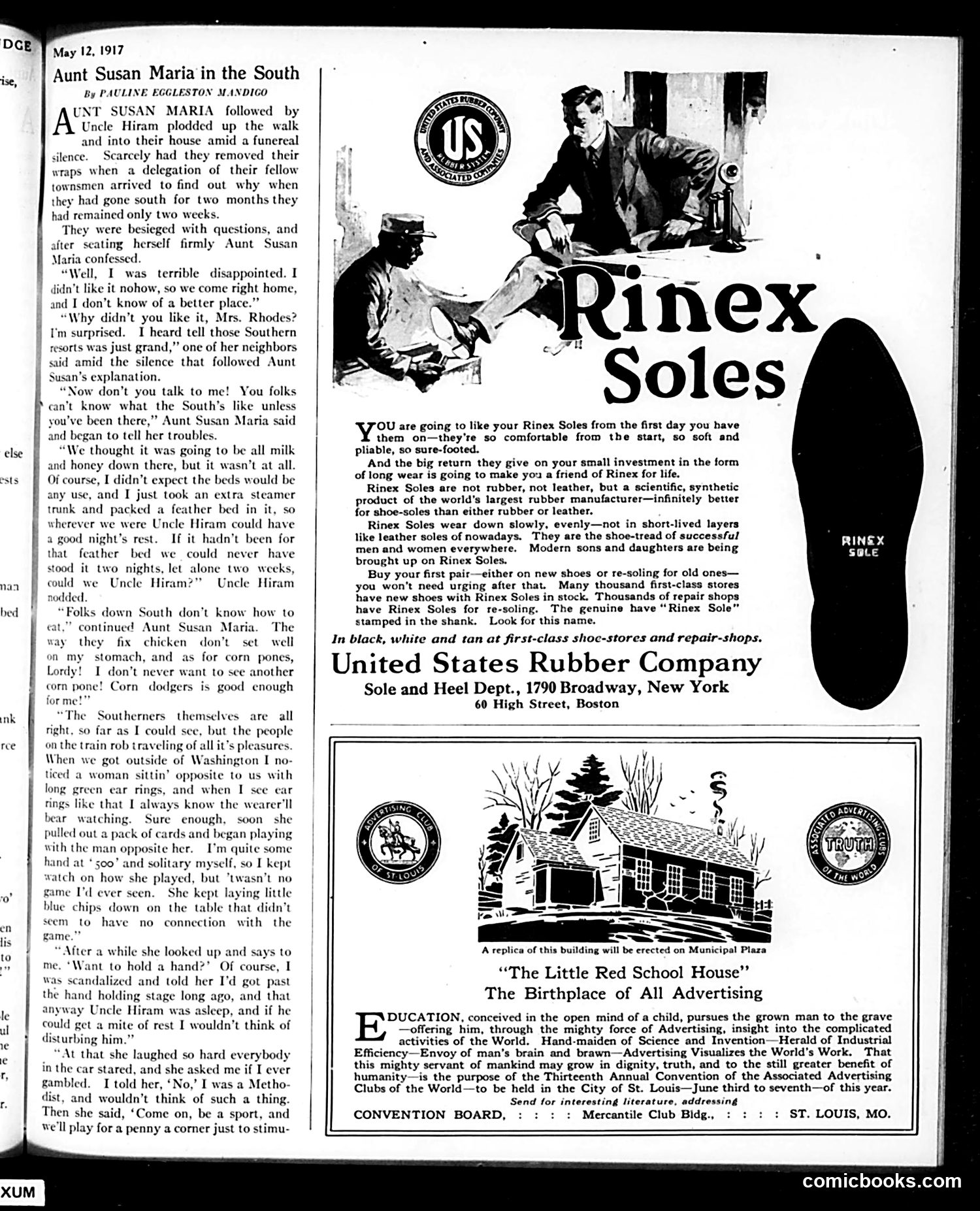
This is a humorous short story (not a political cartoon) about a Northern woman's disappointment with a Southern vacation. Aunt Susan Maria traveled south for two months but returned after just two weeks, to her neighbors' surprise. Her complaints reveal period stereotypes and class anxieties: Southern accommodations were poor (she brought her own feather bed), Southern food was unappetizing (particularly corn pones), and train travel exposed her to disreputable characters—specifically a woman she perceived as a card sharp or con artist who propositioned her to gamble. The humor derives from Aunt Susan's provincial prudishness and her assumption that a woman's invitation to "hold a hand" was gambling rather than literal hand-holding. The piece satirizes Northern assumptions about Southern hospitality while also mocking the narrator's naive moralism and social anxiety about unfamiliar behavior.
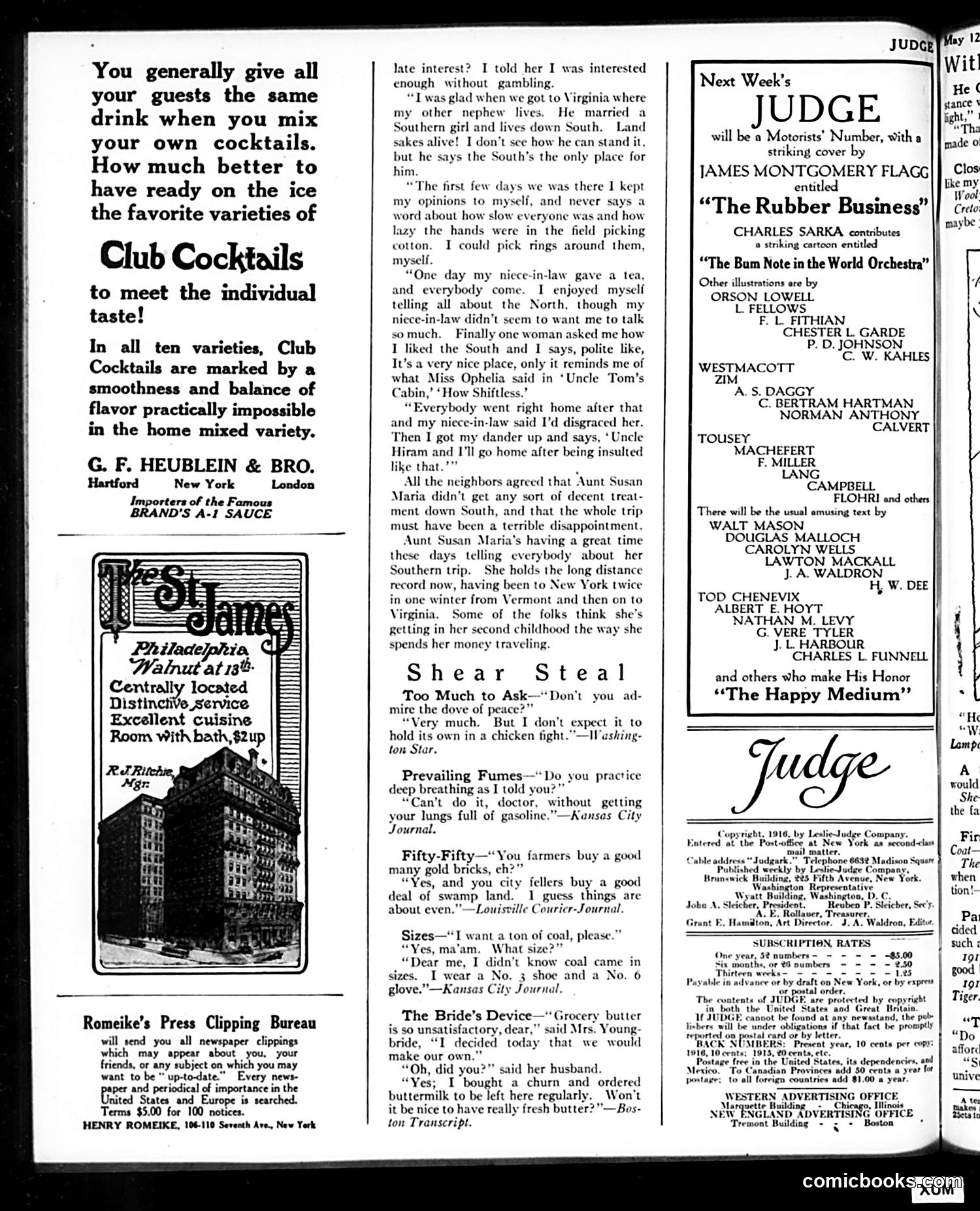
This page is primarily **advertisements and filler content** rather than satirical cartoons or political commentary. The main featured text is a humorous anecdote about "Aunt Susan Maria," a Northern woman visiting relatives in the South who offends her Southern niece by comparing the region unfavorably to the North and praising Northern industriousness over Southern "laziness." The joke relies on period stereotypes about North-South cultural differences and the clash between a Yankee visitor's blunt opinions and Southern hospitality norms. The page also contains several brief joke items ("Shear Steal," "Prevailing Fumes," etc.)—typical light humor fillers for the era. An advertisement for Club Cocktails occupies significant space, along with notices for hotel accommodations, a press clipping service, and a preview of next week's Judge issue featuring a motorist-themed cover by artist James Montgomery Flagg. This appears to be a largely non-satirical, advertising-heavy issue page from Judge magazine.
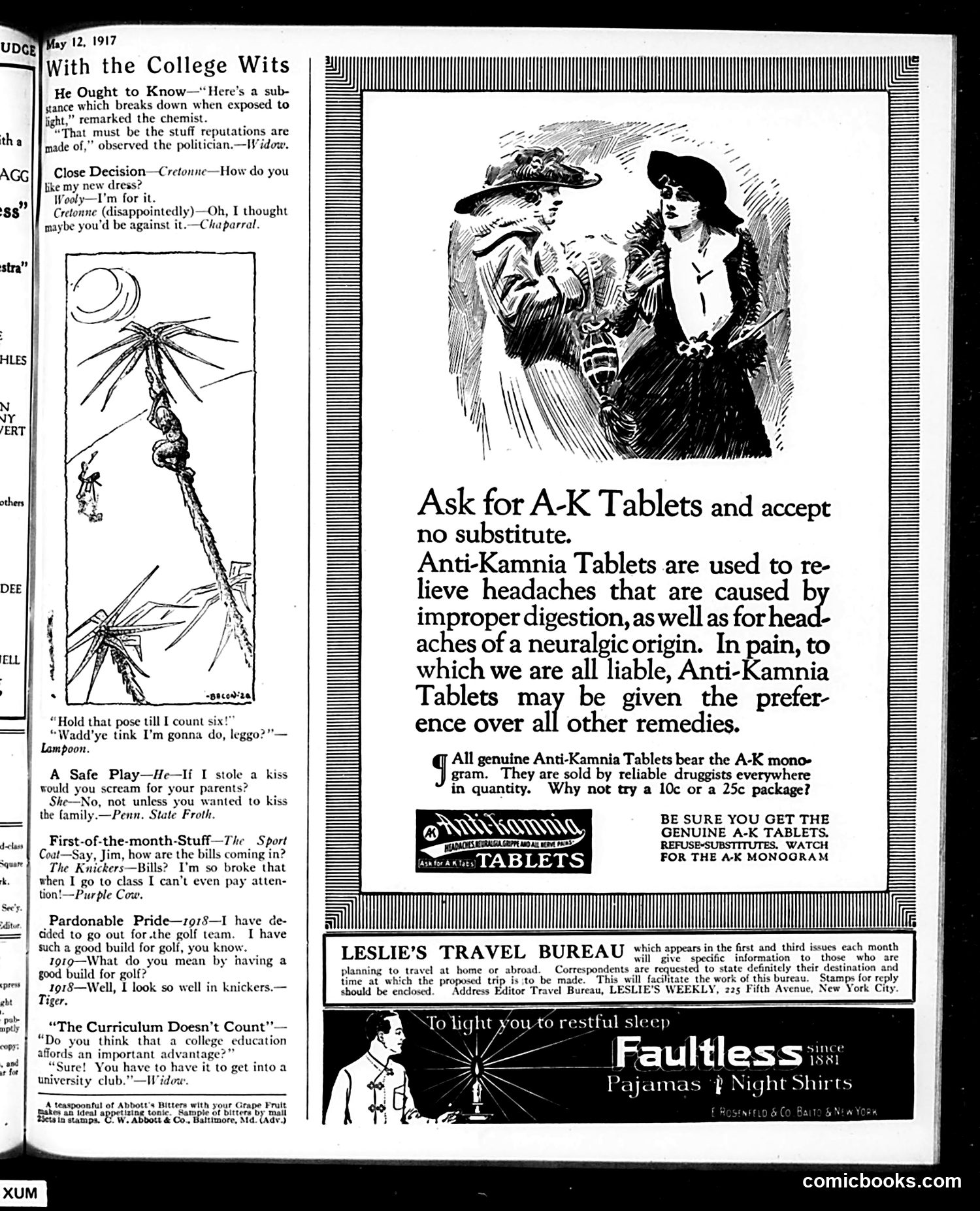
This page consists primarily of **short humorous quips** labeled "With the College Wits" — brief joke exchanges between characters with attributions to various college humor publications (Widow, Chaparral, Penn State Froth, etc.). The jokes mock college life and social pretension: a chemist and politician joke about reputations being "made of" the same breakdown substance; a woman's date approves of her dress only because he mistakenly thinks she wants his approval; another character claims to have a "good build for golf" despite being unable to afford college expenses. **The page is otherwise dominated by advertisements** — notably for Anti-Kamnia Tablets (a headache remedy), Leslie's Travel Bureau, and Faultless Pajamas. There are no significant political cartoons or identifiable caricatures of public figures. The content reflects typical 1917 collegiate humor and period advertising rather than political satire.
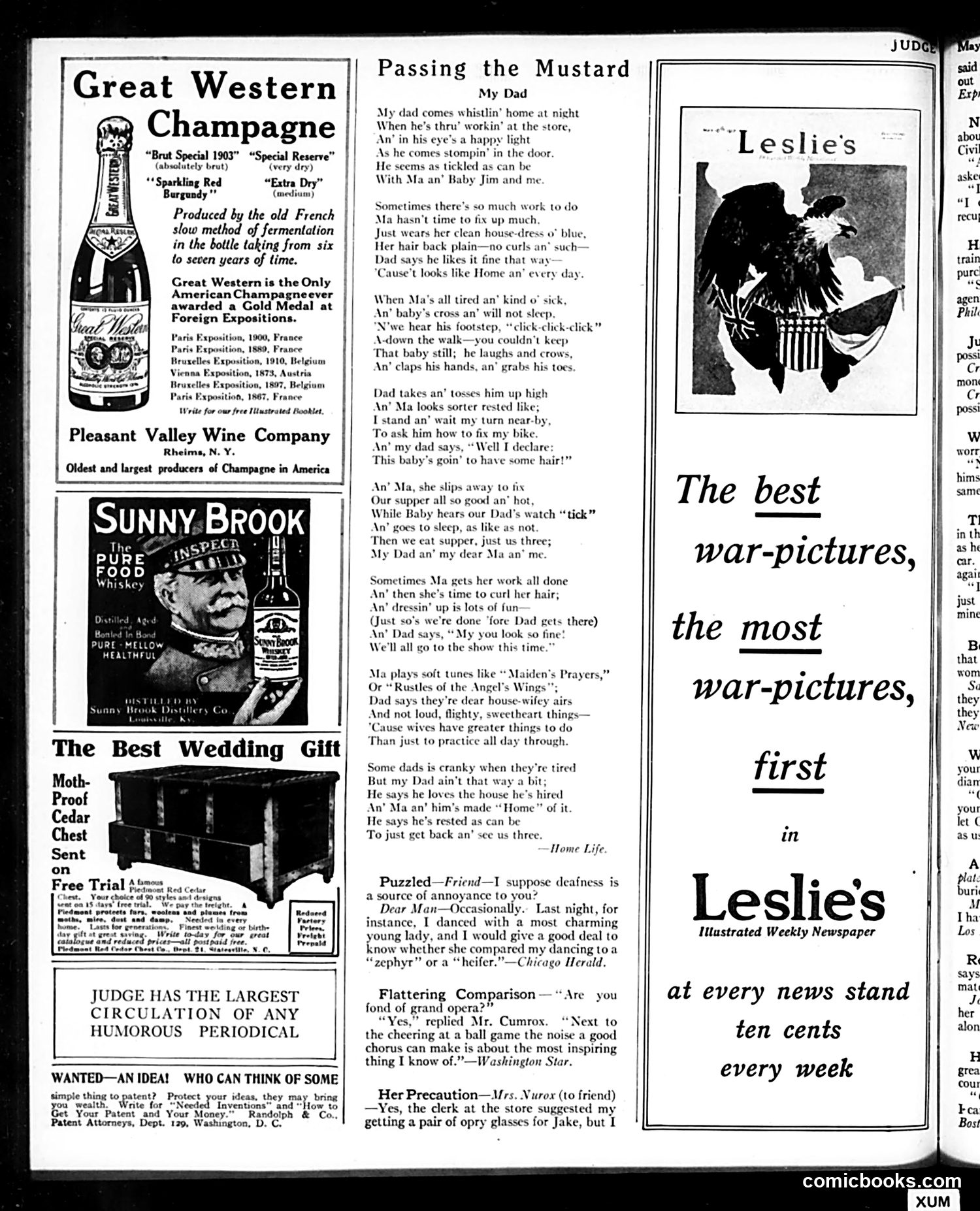
This page is primarily **advertising and light humor**, not political satire. The main content includes: **"Passing the Mustard"** — a sentimental poem celebrating working-class domestic life. A father returns home from his store job, delights in his wife and baby, and family contentment. The poem romanticizes modest living: the mother in a plain housedress, simple home pleasures (supper together, going to "the show"), and paternal pride. It reflects early 20th-century American idealization of the nuclear family and domestic duty. **Advertisements** dominate: Great Western Champagne, Sunny Brook Whiskey, and Cedar Chest furniture emphasize consumer goods and luxury. **Brief humor items** ("Puzzled," "Flattering Comparison") are mild wordplay with no political content. The page reflects *pre-WWI American values*: domesticity, modest prosperity, and consumer culture—not satire of those values. "Leslie's" advertisement at right promotes the magazine as patriotic war coverage.
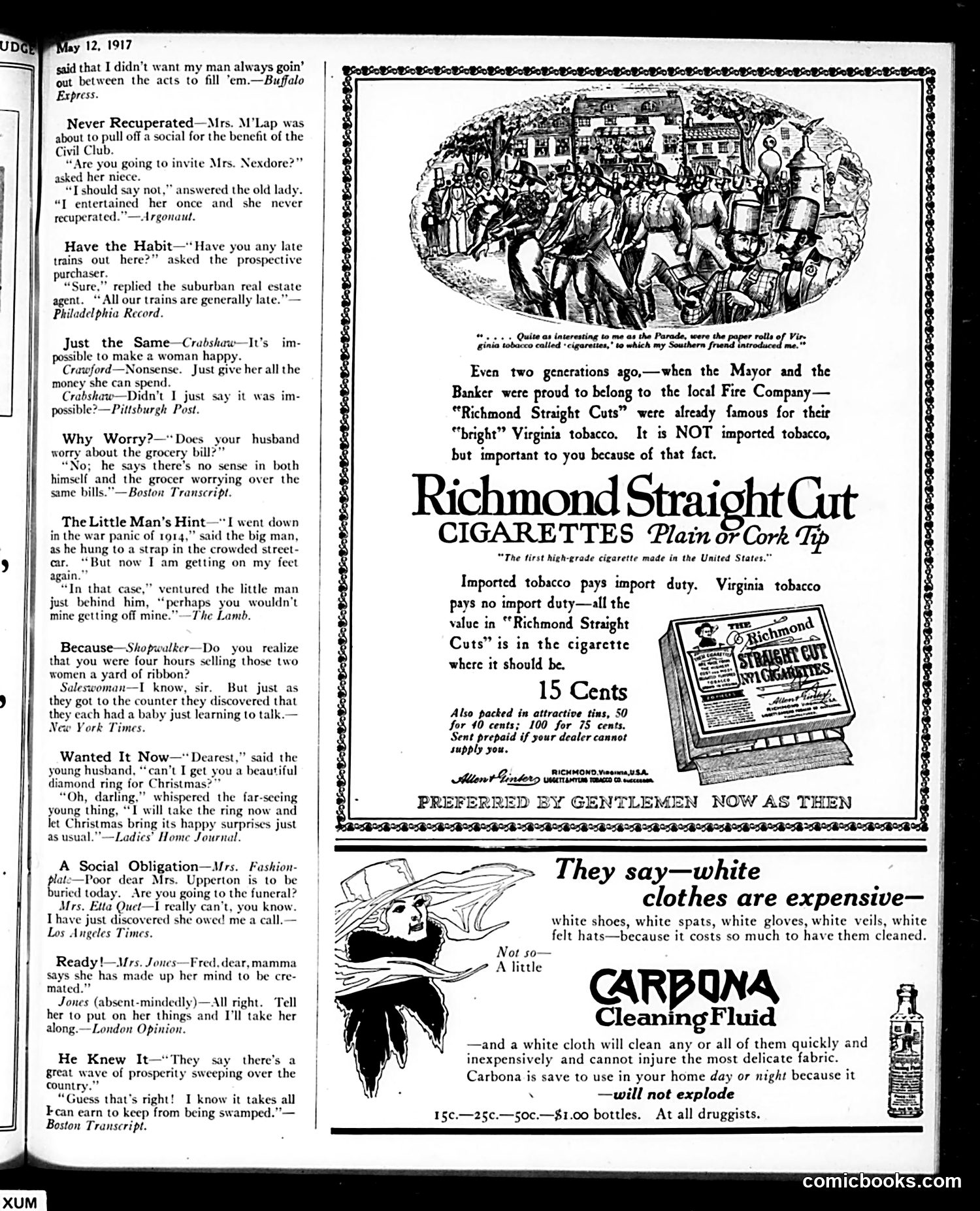
This page contains **primarily advertisements** interspersed with brief humor columns typical of Judge magazine's format. The main content is a **Richmond Straight Cut Cigarettes advertisement** featuring a large engraving of a historical parade or celebration. The ad emphasizes that Richmond cigarettes use Virginia tobacco and are made domestically, not imported—positioned as patriotic during WWI (the page's date of May 1917 is significant). The tagline "Preferred by Gentlemen Now as Then" suggests continuity and tradition. Below this is a **Carbona Cleaning Fluid advertisement** addressing a contemporary concern: white clothing's maintenance costs. It counters the objection that white garments are expensive by promoting Carbona as a safe, inexpensive cleaning solution. The left column contains **brief joke items** typical of Judge's humor format—short anecdotes about marriage, social obligations, and domestic life, drawn from various newspapers. **Historical context:** The advertisements reflect 1917 American consumer concerns (domestic manufacturing pride, household labor efficiency) and leisure habits (cigarette smoking among gentlemen).
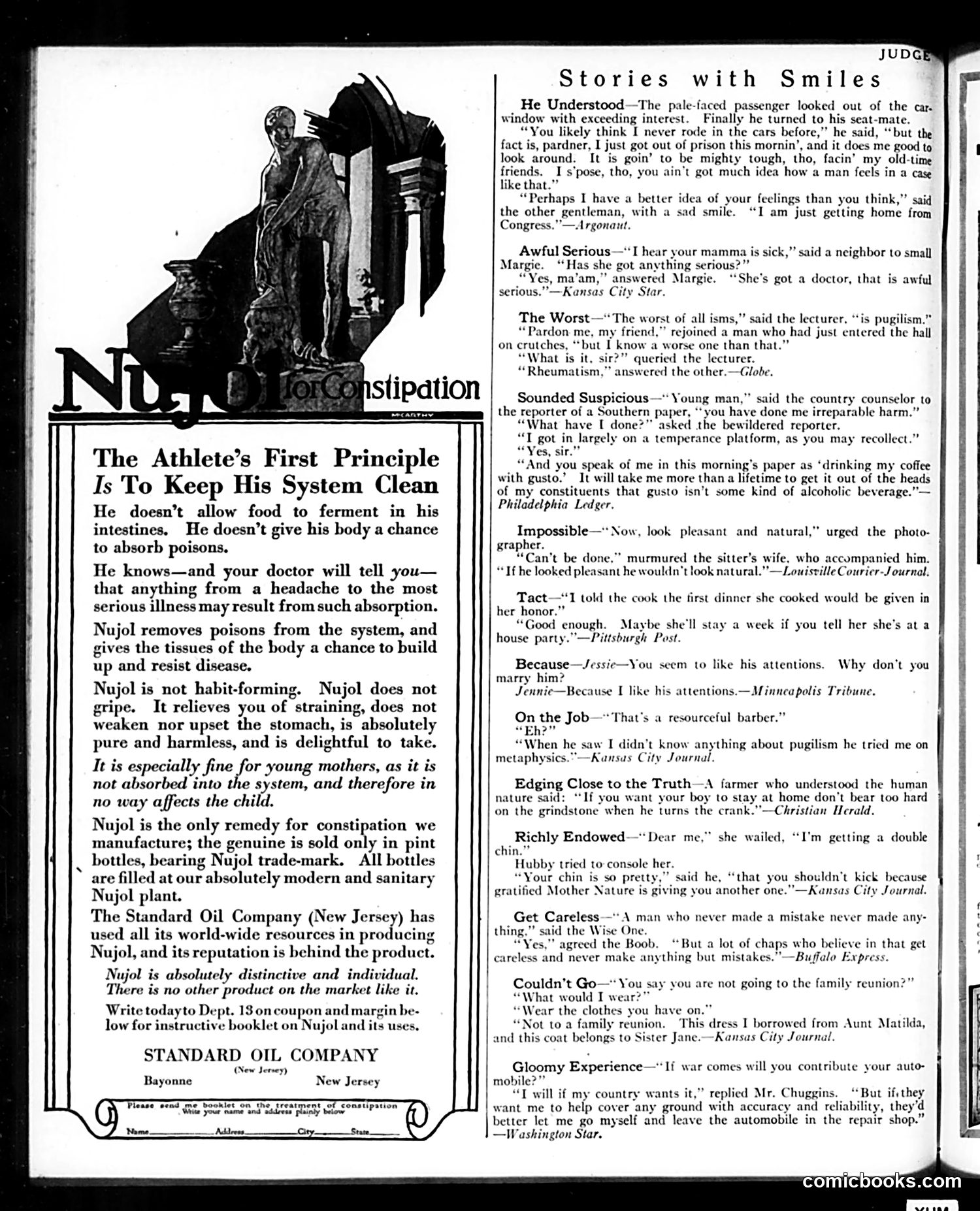
This Judge magazine page contains **one large advertisement** (left side) and **a collection of short humorous anecdotes** (right side). ## The Advertisement The Nujol ad uses an athlete as spokesperson to promote a laxative product. It claims Nujol removes "poisons" from the intestines—reflecting early-20th-century medical pseudoscience about "autointoxication" (the false belief that constipation causes systemic poisoning). Standard Oil Company manufactured it. ## The Jokes ("Stories with Smiles") These are brief satirical quips on contemporary topics: - **Prison vs. Congress**: A released convict compares his ordeal to a congressman's—implying Congress is as bad as prison - **Doctor as illness**: A child notes her mother's real problem is the doctor, not sickness - **Rheumatism vs. pugilism**: A heckler claims rheumatism is worse than boxing - **Political rhetoric**: A temperance politician fears "drinking coffee with gusto" sounds like alcoholism—mocking political hypocrisy - **Marriage mockery**: A woman likes a suitor's *attention*, not the suitor himself These reflect Judge's satirical style: quick political/social commentary with cynical humor about politics, medicine, and relationships.
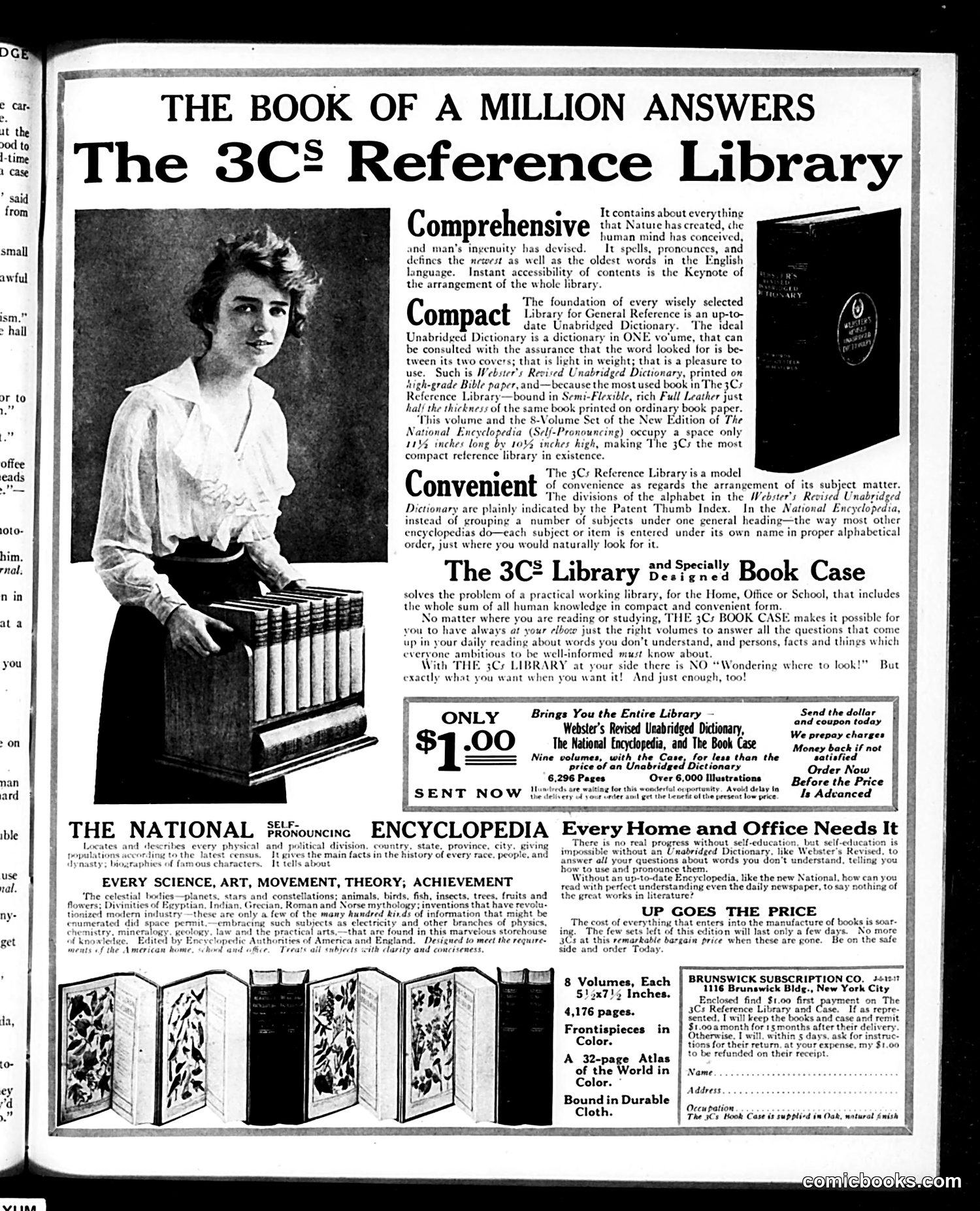
This page is primarily **a full-page advertisement**, not a political cartoon. It promotes "The 3C's Reference Library"—a comprehensive home reference set combining Webster's Revised Unabridged Dictionary, The National Encyclopedia, and a book case. The advertisement features a professional photograph of a woman posing with the elegant leather-bound volumes, positioned to suggest this is aspirational, quality merchandise for educated households. The marketing emphasizes the library's comprehensiveness ("contains about everything"), convenience (indexed with "Patent Thumb Index"), and affordability (only $1.00). The supporting text stresses that self-education and access to reliable information are essential for progress—a common early-20th-century American belief in the democratizing power of knowledge. The advertisement targets middle-class professionals (homes, offices, schools) seeking to appear cultured and well-informed. **No satire is evident here.** This is straightforward commercial messaging typical of Judge magazine's revenue model.
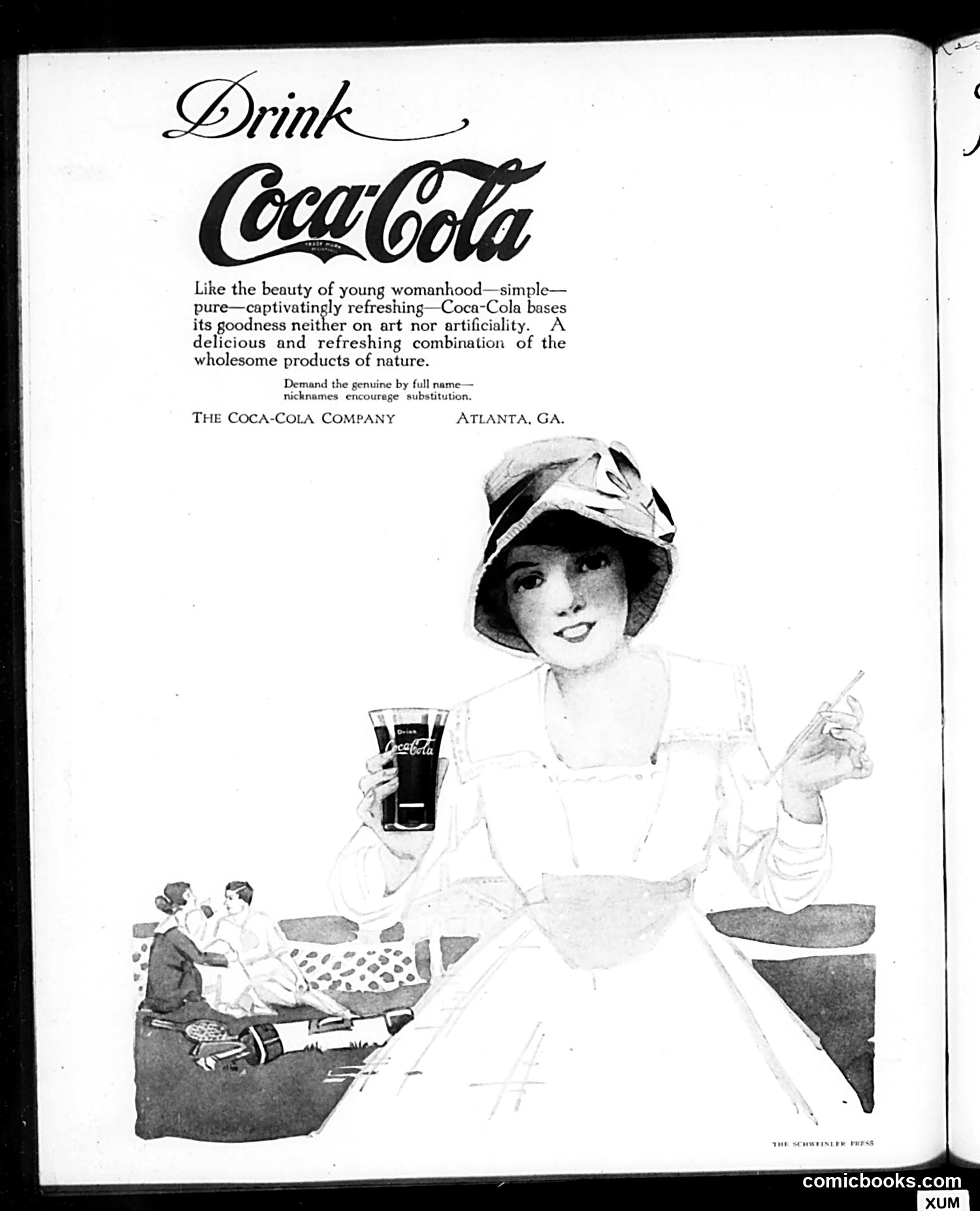
This is a **Coca-Cola advertisement, not satire**. The page shows a young woman in 1920s fashion (cloche hat, white dress) holding a Coca-Cola glass, with smaller figures picnicking in the background. The ad uses marketing rhetoric comparing Coca-Cola's appeal to "the beauty of young womanhood"—emphasizing naturalness and purity. The warning "Demand the genuine by full name—nicknames encourage substitution" reflects actual competition from imitation cola products in this era. This appears in *Judge* magazine because publications accepted paid advertisements. The content is straightforward product promotion rather than editorial satire or political commentary.