
Judge, 1917-05-12 · page 5 of 28
Judge — May 12, 1917 — page 5: what you’re looking at
What you’re looking at
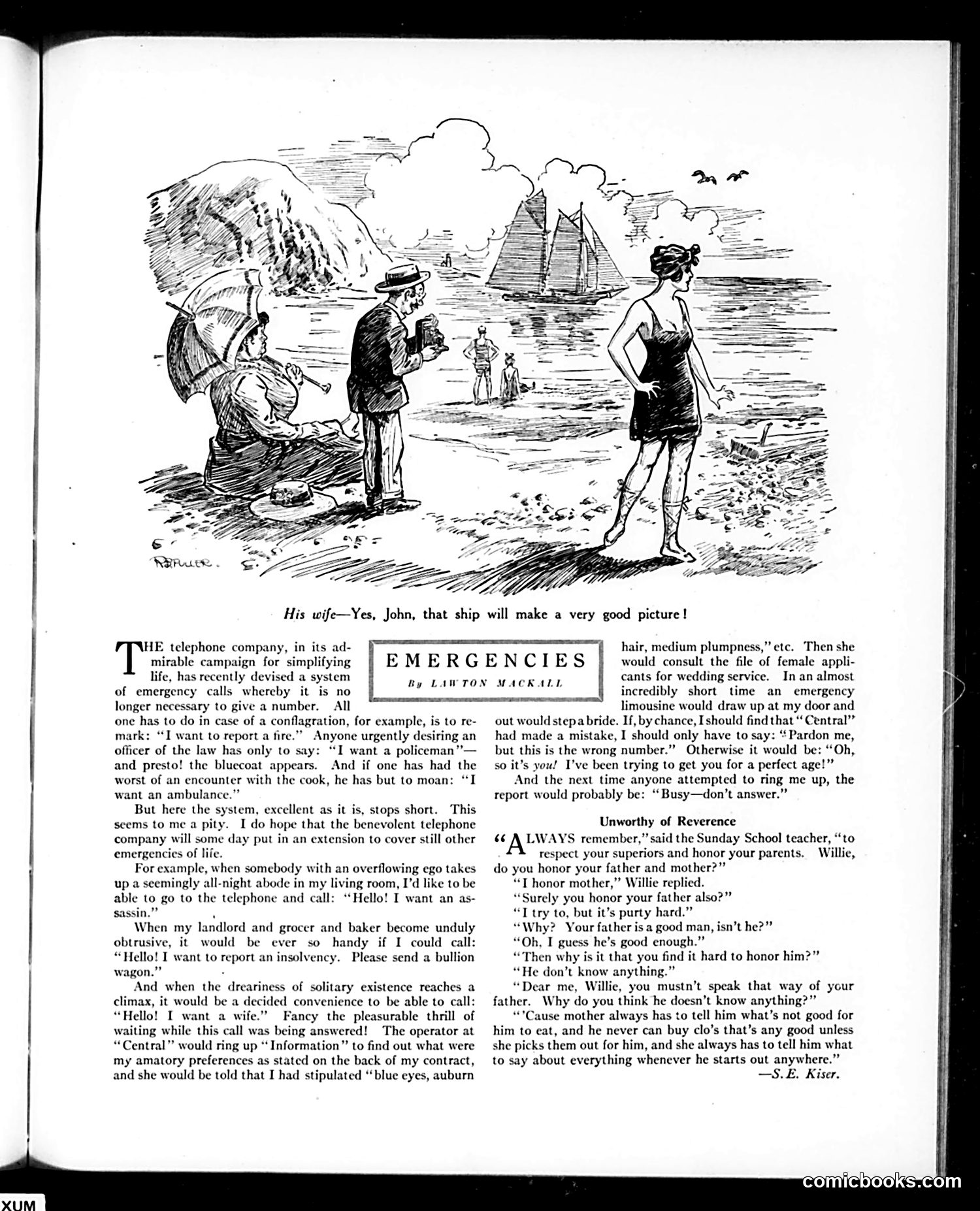
The main cartoon depicts a beach scene where a man in formal attire remarks to his wife about a sailing ship: "Yes, John, that ship will make a very good picture!" This appears to be gentle social satire about early 20th-century leisure and photography—possibly mocking the affectations of wealthy beachgoers or the casual way vacation moments were documented. Below this is an article titled "EMERGENCIES" by Linton Mackall about telephone company communication systems and their limitations. The piece humorously describes scenarios where emergency calls would be useful (reporting fires, needing ambulances, etc.). The final section, "Unworthy of Reverence," presents a dialogue between a Sunday School teacher and a boy named Willie about respecting parents—standard moral instruction humor typical of Judge's era.
📄 Transcribed text from this page (OCR, searchable)
Machine-transcribed from the original scan — historical spelling and the odd misread are preserved.
HE telephone company, in its ad- T mirable campaign for simplifying life, has recently devised a system of emergency calls whereby it is no longer necessary to give a number. All one has to do in case of a conflagration, for example, i: mark: “I want to report a fire.” Anyone urgently di officer of the law has only to say: “I want a policeman”— and presto! the bluecoat appears. And if one has had the worst of an encounter with the cook, he has but to moan: “I want an ambulance.” But here the system, excellent as it is, stops short. This seems to me a pity. I do hope that the benevolent telephone company will some day put in an extension to cover still other emergencies of lif For example, when somebody with an overflowing ego takes up a seemingly all-night abode in my living room, I'd like to be able to go to the telephone and call: ‘Hello! I want an as- sassin.”” ‘ When my landlord and grocer and baker become unduly obtrusive, it would be ever so handy if I could call: “Hello! I want to report an insolvency. Please send a bullion wagon.” : And when the dreariness of solitary existence reaches a climax, it would be a decided convenience to be able to call: “Hello! I want a wife.” Fancy the pleasurable thrill of waiting while this call was being answered! The operator at “Central” would ring up “Information” to find out what were my amatory preferences as stated on the back of my contract, and she would be told that I had stipulated “blue eyes, auburn By LAWTON His wife—Yes, John, that ship will make a very good picture! EMERGENCIES hair, medium plumpness,” etc. ‘Then she would consult the file of female appli- cants for wedding service. In an almost incredibly short time an emergency limousine would draw up at my door and out would stepa bride. If, by chance, Ishould find that “Central” had made a mistake, I should only have to say: “ Pardon me, but th the wrong number.” Otherwise it would be: “Oh, so it’s you! I’ve been trying to get you for a perfect age!” And the next time anyone attempted to ring me up, the report would probably be: ‘“ Busy—don’t answer.” MACKALL Unworthy of Reverence Se ALWAY remember,” said the Sunday School teacher, “to respect your superiors and honor your parents. Willie, do you honor your father and mother?” “T honor mother,” Willie replied. “Surely you honor your father also?” “T try to, but it’s purty hard.” “Why? Your father is a good man, isn’t he?” “Oh, I guess he’s good enough.” “Then why is it that you find it hard to honor him?” “He don’t know anything.” “Dear me, Willie, you mustn’t speak that way of your father. Why do you think he doesn’t know anything?” “’Cause mother always has to tell him what’s not good for him to eat, and he never can buy clo’s that’s any good unless she picks them out for him, and she always has to tell him what to say about everything whenever he starts out anywhere.” —S.E. Kiser.