
Judge, 1917-05-12 · page 11 of 28
Judge — May 12, 1917 — page 11: what you’re looking at
What you’re looking at
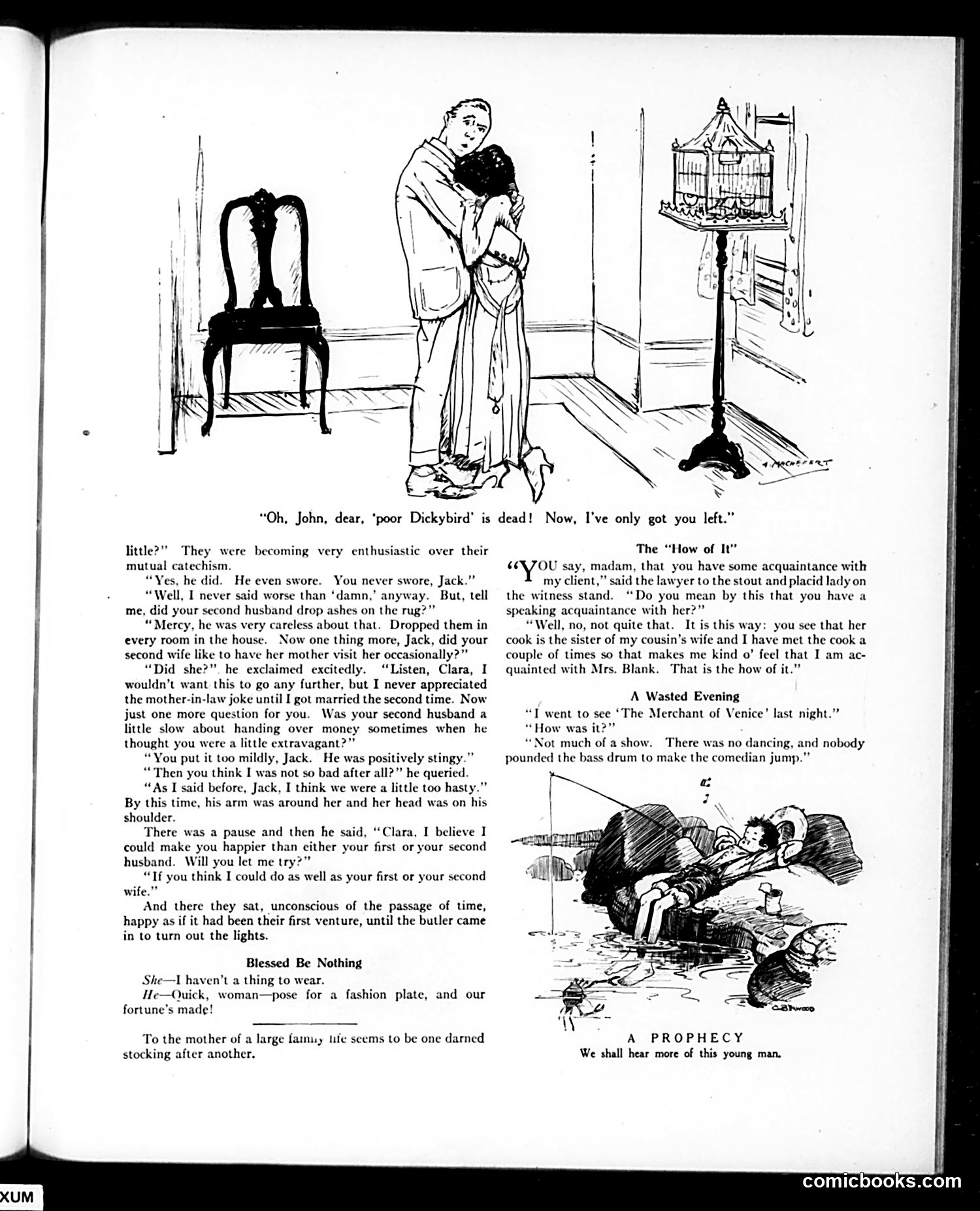
This page from *Judge* magazine contains several satirical pieces poking fun at early 20th-century social conventions: **Main cartoon (top):** A widow and widower reminisce about their respective previous spouses, comparing notes on domestic annoyances (ashes on rugs, intrusive mothers-in-law, financial stinginess). The satire mocks how people rationalize remarriage by convincing themselves their new partner is superior to past ones—while apparently oblivious to their own flaws. **"Blessed Be Nothing":** A joke about gender and vanity—a woman claims to have nothing to wear while a husband suggests she pose for a fashion magazine, implying women's constant complaints about clothing are performative rather than genuine. **"The How of It":** Courtroom satire satirizing how people claim acquaintance through absurdly tenuous social connections (knowing someone's cook's sister). **"A Wasted Evening":** Mocks audiences expecting lowbrow entertainment (dancing, loud comedy) at serious theatrical productions like Shakespeare's *Merchant of Venice*. The humor relies on exaggerated character types and social observation typical of early 20th-century American satire.
📄 Transcribed text from this page (OCR, searchable)
Machine-transcribed from the original scan — historical spelling and the odd misread are preserved.
little?” They were becoming very enthusiastic over their mutual catechism. “Yes, he did. He even swore. You never swore, Jack.” “Well, I never said worse than ‘damn,’ anyway. But, tell me, did your second husband drop ashes on the rug?” “Mercy, he was very less about that. Dropped them in every room in the house. Now one thing more, Jack, did your second wife like to have her mother visit her occasionally?” “Did she?” he exclaimed excitedly. “Listen, Clara, I wouldn’t want this to go any further, but I never appreciated the mother-in-law joke until I got married the second time. Now just one more question for you. Was your second husband a little slow about handing over money sometimes when he thought you were a little extravagant?” “You put it too mildly, Jack. He was positively stingy.” “Then you think I was not so bad after all?” he queried. “As I said before, Jack, I think we were a little too hasty.” By this time, his arm was around her and her head was on his shoulder. There was a pause and then he said, “Clara, I believe I could make you happier than either your first or your second husband. Will you let me try?” “If you think I could do as well as your first or your second wife.” And there they sat, unconscious of the passage of time, happy as if it had been their first venture, until the butler came in to turn out the lights. Blessed Be Nothing She—I haven't a thing to wear. He—Ouick, woman—pose for a fashion plate, and our fortune’s made! To the mother of a large fainuy life seems to be one darned stocking after another, “Oh, John, dear, ‘poor Dickybird’ is dead! Now, I've only got you left.” The “How of It” 66XYVOU say, madam, that you have some acquaintance with my client,” said the lawyer to the stout and placid lady on the witness stand. “Do you mean by this that you have a speaking acquaintance with her?” “Well, no, not quite that. It is this way: you sce that her cook is the sister of my co fe and I have met the cook a couple of times so that makes me kind o’ feel that I am ac- quainted with Mrs. Blank. That is the how of it.” A Wasted Evening “T went to see ‘The Merchant of Venice’ last night.” “ How was it?” “Not much of a show. There was no dancing, and nobody pounded the bass drum to make the comedian jump.” A PROPHECY We shall hear more of this young man, : i comicbooks.com