
Judge, 1917-05-12 · page 18 of 28
Judge — May 12, 1917 — page 18: what you’re looking at
What you’re looking at
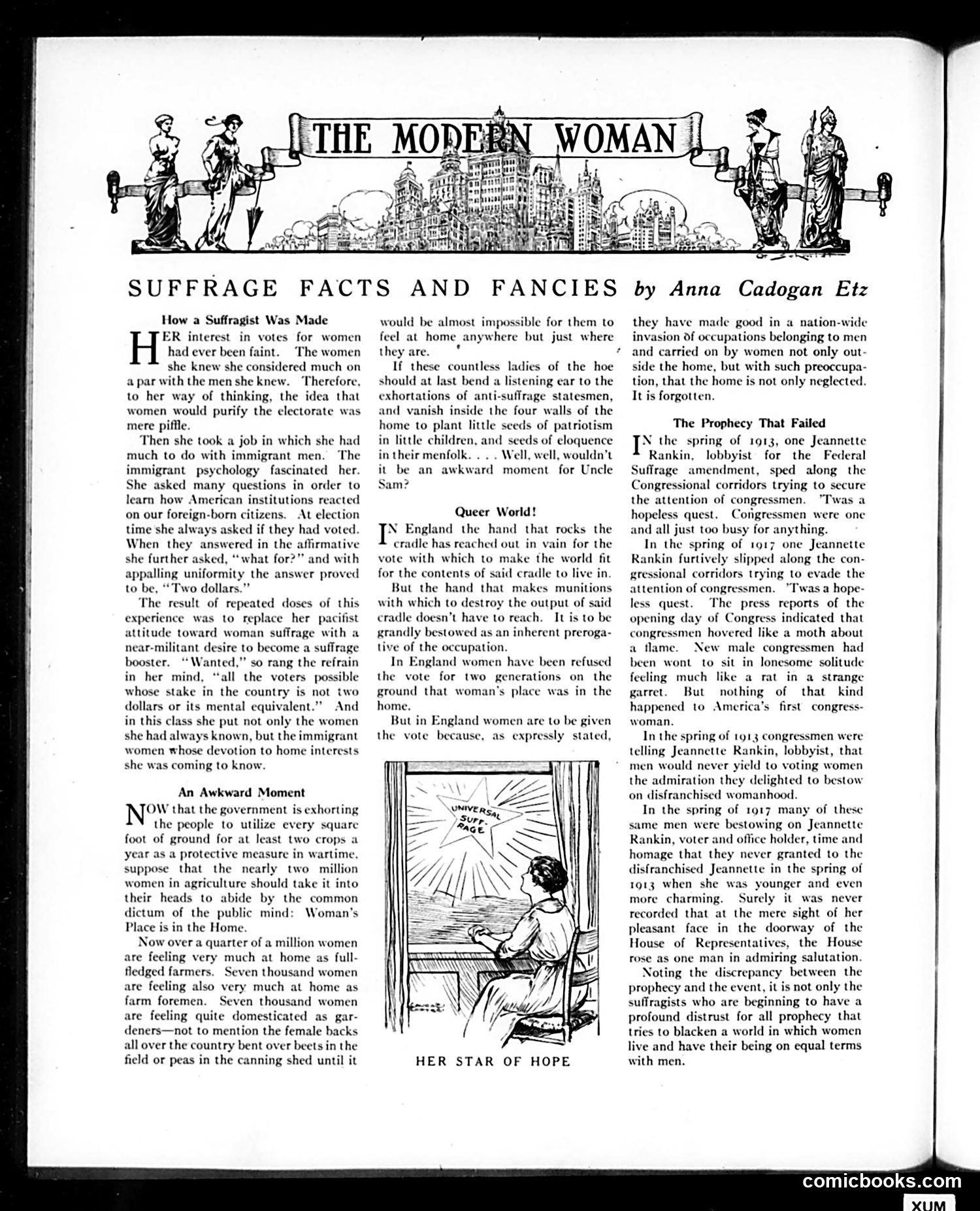
This article by Anna Cadogan Etz presents pro-suffrage arguments in *Judge*, a satirical magazine. The content includes three sections: **"How a Suffragist Was Made"** describes a woman who, after witnessing immigrant men vote corruptly for money ("Two dollars"), becomes a militant suffragist—arguing women deserve votes more than men who sell theirs. **"An Awkward Moment"** points out the hypocrisy of wartime: the government demands women work farms for national production, yet society insists "woman's place is in the home." **"Queer World!"** and **"The Prophecy That Failed"** reference Jeannette Rankin (the first woman elected to Congress, 1916), noting that male congressmen previously ignored suffragists in 1913 but by 1917 were suddenly deferential to her. The accompanying illustration, "Her Star of Hope," depicts a woman gazing toward suffrage symbolically. This pro-woman's-suffrage content satirizes anti-suffragists' contradictions: they deny women votes while exploiting their labor and accepting immigrant men's corrupted votes.
📄 Transcribed text from this page (OCR, searchable)
Machine-transcribed from the original scan — historical spelling and the odd misread are preserved.
SUFFRAGE FACTS AND FANCIES by Anna Cadogan Etz How a Suffragist Was Made ER interest in votes for women had ever been faint. ‘The women she knew she considered much on a par with the men she knew. Therefore, to her way of thinking, the idea that women would purify the electorate was mere piffle. Then she took a job in which she had much to do with immigrant men. The immigrant psychology fascinated her. She ed many questions in order to learn how American institutions reacted on our foreign-born citizens. At election time she alway ed if they had voted. When they answered in the affirmative she further asked, “what for?” and with appalling uniformity the answer proved to be, “Two dollars.”” Phe result of repeated doses of this experience was to replace her pacifist attitude toward woman suffrage with a near-militant desire to become a suffrage booster. “Wanted,” so rang the refrain in her mind, “all the voters possible whose stake in the country is not two dollars or its mental equivalent.” And in this class she put not only the women she had always known, but the immigrant women whose devotion to home interests she was coming to know. An Awkward Moment OW that the government is exhorting the people to utilize every square foot of ground for at least two crops a year as a protective measure in wartime, suppose that the nearly two million women in agriculture should take it into their heads to abide by the common dictum of the public mind: Woman's Place is in the Home. Now over a quarter of a million women are feeling very much at home as full- fledged farmers. Seven thousand women are feeling also very much at home as farm foremen. Seven thousand women are feeling quite domesticated as gar- deners—not to mention the female backs all over the country bent over beets in the field or peas in the canning shed until it would be almost impossible for them to feel they are. If these countless ladies of the hoe should at last bend a listening ear to the exhortations of anti-suffrage statesmen, and vanish inside the four walls of the home to plant little 1s of patriotism in little children, and seeds of eloquence in their menfolk. . . . Well, well, wouldn't it be an awkward moment for Uncle Sam? Queer World! N England the hand that rocks the cradle has reached out in vain for the vote with which to make the world fit for the contents of said cradle to live in But the hand that makes munitions with which to destroy the output of said rradle doesn’t have to reach. It is to be grandly bestowed as an inherent preroga- tive of the occupation. In England women have been refused the vote for two generations on the ground that woman’s plac s in the home. But in the vote be ingland women are to be given ause, as expressly stated, HER STAR OF HOPE at home anywhere but just where they have made good in a nation-wide invasion df occupations belonging to men and carried on by women not only out- side the home, but with such preoccupa- tion, that the home is not only neglected. It is forgotten. The Prophecy That Failed ‘ the spring of 1913, one Jeannette kin, lobbyist for the Federal amendment, spe quest. Congressmen were one all just too busy for anything. In the spring of 1017 one Jeannette Rankin furtively slipped along the con- ional corridors trying to evade the attention of congressmen. ’Twas a hope- The press reports of the opening day of Congress indicated that congressmen hovered a moth about a flame. New male congressmen had been wont to sit in lonesome solitude feeling much like a in a strange garret But nothing of that kind happened to America’s first congress- woman. In the spring of 1913 congressmen were telling Jeannette Rankin, lobbyist, that men would never yield to voting women the admiration they delighted to bestow on disfranchised womanhood. In the spring of 19017 many of the same men were bestowing on Jeannette Rankin, voter and office holder, time and homage that they never granted to the disfranchised Jeannette in the spring of 1913 when she was younger and even more charming. Surely it was never recorded that at the mere sight of her pleasant face in the doorway of the House of Representatives, the House rose as one man in admiring salutation. Noting the discrepancy between the prophecy and the event, it is not only the suffragists who are beginning to have a profound distrust for all prophecy that tries to blacken a world in which women live and have their being on equal terms with men, less quest. comicbooks.com